Question 13 Marks
How do you expect the metallic hydrides to be useful for hydrogen storage? Explain.
AnswerMetallic hydrides are hydrogen deficient, i.e., they do not hold the law of constant composition. It has been established that in the hydrides of Ni, Pd, Ce, and Ac, hydrogen occupies the interstitial position in lattices allowing further absorption of hydrogen on these metals. Metals like Pd, Pt, etc. have the capacity to accommodate a large volume of hydrogen. Therefore, they are used for the storage of hydrogen and serve as a source of energy.
View full question & answer→Question 23 Marks
What properties of water make it useful as a solvent? What types of compound can it:
- Dissolve, and
- Hydrolyse?
Answer
- A high value of dielectric constants $\left(78.39 \mathrm{C}^2 / \mathrm{Nm}^2\right)$ and dipole moment make water a universal solvent. Water is able to dissolve most ionic and covalent compounds. lonic compounds dissolve in water because of the ion dipole interaction, whereas covalent compounds form hydrogen bonding and dissolve in water.
- Water can hydrolyze metallic and non-metallic oxides, hydrides, carbides, phosphides, nitrides and various other salts. During hydrolysis, $\mathrm{H}^{+}$and $\mathrm{OH}^{-}$ions of water interact with the reacting molecule.
Some reactions are:
$\text{CaO}+\text{H}_2\text{O}\xrightarrow{ \ \ \ \ \ \ \ \ \ \ \ \ \ }\text{Ca}(\text{OH})_2$
$\text{NaH}+\text{H}_2\text{O}\xrightarrow{ \ \ \ \ \ \ \ \ \ \ \ \ \ }\text{NaOH}+\text{H}_2$
$\text{CaC}_2+\text{H}_2\text{O}\xrightarrow{ \ \ \ \ \ \ \ \ \ \ \ \ \ }\text{C}_2\text{H}_2+\text{Ca}(\text{OH})_2$ View full question & answer→Question 33 Marks
What do you understand by the terms:
‘Syngas’.
AnswerSyngas: Syngas is a mixture of carbon monoxide and dihydrogen. Since the mixture of the two gases is used for the synthesis of methanol, it is called syngas, synthesis gas, or water gas. Syngas is produced on the action of steam with hydrocarbons or coke at a high temperature in the presence of a catalyst. $\text{C}_\text{n}\text{H}_{2\text{n}+2}+\text{nH}_2\text{O}\xrightarrow[\text{Ni}]{\ \ \ \ \ \ \ \ \ {1270\text{K}} \ \ \ \ \ \ \ }\text{nCO}+(2\text{n}+1)\text{H}_2$ For example: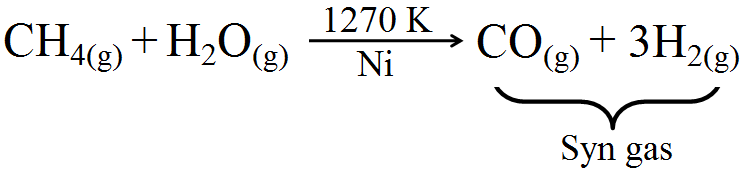
View full question & answer→Question 43 Marks
What do you understand by the term ’auto-protolysis’ of water? What is its significance?
AnswerAuto-protolysis (self-ionization) of water is a chemical reaction in which two water molecules react to produce a hydroxide ion $\left(\mathrm{OH}^{-}\right)$and a hydronium ion $\left(\mathrm{H}_3 \mathrm{O}^{+}\right)$.
The reaction involved can be represented as:
$\text{H}_2\text{O}_{(\text{l})}\ \ +\ \ \text{H}_2\text{O}_{\text{(l})}\ \ \ \leftrightarrow\ \ \ \text{H}_3\text{O}^+_{\text{(aq)}}\ \ \ \ \ \ \ \ \ +\ \ \ \ \ \ \ \ \text{OH}^-_{\text{(aq)}}\\\ \ \ \ \ \ \ \ \ \ \ \ \ \ \ \ \ \ \ \ \ \ \ \ \ \ \ \ \ \ \ \ \ \ \ \ \ \ \ \ \text{Hydronium ion}\ \ \ \ \ \ \ \text{Hydroxide ion}$
Auto-protolysis of water indicates its amphoteric nature i.e., its ability to act as an acid as well as a base.
The acid-base reaction can be written as:
$\text{H}_2\text{O}_{(\text{l})}\ \ +\ \ \ \text{H}_2\text{O}_{\text{l}}\ \ \ \leftrightarrow\ \ \ \ \text{H}_3\text{O}^+_{(\text{aq})}\ \ \ \ \ \ \ \ \ \ \ +\ \ \ \ \ \ \ \ \ \ \ \ \ \text{OH}^-_{(\text{aq})}\$\text{Acid})\ \ \ \ \ \ \ \ \ \text{(Base)}\ \ \ \ \ \ \ \ \text{(conjugate acid)}\ \ \ \ \ (\text{conjugate base})$
View full question & answer→Question 53 Marks
What do you understand by:
- Electron-deficient.
- Electron-precise, and
- Electron-rich compounds of hydrogen? Provide justification with suitable examples.
Answer
- Electron-deficient hydrides: The hydrides of group 13 elements have an incomplete octet and hence are electron deficient molecules. They act as Lewis acids e.g., $B_2H_6$
- Electron-precise hydrides: These compounds have the required number of electrons to write their conventional Lewis structures. All elements of group 14 form such compounds (e.g., $CH_4$) which have tetrahedral structure.
- Electron rich compounds of hydrogen: These compounds have excess electrons which are present as lone pairs, elements of group 15-17 form such compounds, e.g., $NH_3$ has one lone pair, $H_2O$ has two lone pairs and HF has three lone pairs.
View full question & answer→Question 63 Marks
What causes the temporary and permanent hardness of water?
AnswerTemporary hardness of water is due to the presence of bicarbonates of calcium and magnesium in water i.e., $\mathrm{Ca}\left(\mathrm{HCO}_3\right)_2$ and $\mathrm{Mg}\left(\mathrm{HCO}_3\right)$ in water. Permanent hardness of water is due to the presence of soluble chlorides and sulphates of calcium and magnesium i.e., $\mathrm{CaCl}_2, \mathrm{CaSO}_4, \mathrm{MgCl}_2$ and $\mathrm{MgSO}_4$.
View full question & answer→Question 73 Marks
How does the atomic hydrogen or oxy-hydrogen torch function for cutting and welding purposes? Explain.
AnswerAtomic hydrogen atoms are produced by the dissociation of dihydrogen with the help of an electric arc. This releases a huge amount of energy ( $435.88 \mathrm{~kJ} \mathrm{~mol}{ }^{-1}$ ). This energy can be used to generate a temperature of 4000 K , which is ideal for welding and cutting metals. Hence, atomic hydrogen or oxy-hydrogen torches are used for these purposes. For this reason, atomic hydrogen is allowed to recombine on the surface to be welded to generate the desired temperature.
View full question & answer→Question 83 Marks
Is demineralised or distilled water useful for drinking purposes? If not, how can it be made useful?
AnswerWater is essential for all forms of life. It constitutes around 65% of the human body and 95% of plants. Water plays an important role in the biosphere owing to its high specific heat, thermal conductivity, surface tension, dipole moment, and dielectric constant.
The high heat of vaporization and heat of capacity of water helps in moderating the climate and body temperature of all living beings. It acts as a carrier of various nutrients required by plants and animals for various metabolic reactions.
View full question & answer→Question 93 Marks
How can the production of dihydrogen, obtained from ‘coal gasification’, be increased?
AnswerDihydrogen is produced by coal gasification method as,
$\text{C}_{(\text{s})}+\text{H}_2\text{O}_{(\text{g})}\xrightarrow{\ \ \ \ {1270\text{k}}\ \ \ \ \ }\text{CO}_{\text{g}}+\text{H}_{2{\text{(g)}}}\\\text{(coal)}$
The yield of dihydrogen (obtained from coal gasification) can be increased by reacting carbon monoxide (formed during the reaction) with steam in the presence of iron chromate as a catalyst.
$\text{CO}_{(\text{g})}+\text{H}_2\text{O}_{(\text{g})}\xrightarrow[\text{Catalyst}]{\ \ \ \ \ \ {1270\text{k}}\ \ \ \ \ \ \ }\text{CO}_{2(\text{g})}+\text{H}_{2(\text{g})}$
This reaction is called the water-gas shift reaction. Carbon dioxide is removed by scrubbing it with a solution of sodium arsenite.
View full question & answer→Question 103 Marks
How does $\mathrm{H}_2 \mathrm{O}_2$ behave as a bleaching agent?
Answer$\mathrm{H}_2 \mathrm{O}_2$ acts as bleaching agent due to the release of nascent oxygen.
$\mathrm{H}_2 \mathrm{O}_2 \rightarrow \mathrm{H}_2 \mathrm{O}+[\mathrm{O}]$
Thus, the bleaching action of hydrogen peroxide is permanent and is due to oxidation. It oxidises the colouring matter to a colourless product.
$\text{Colouring matter}+[\text{O}]\xrightarrow{\ \ \ \ \ \ \ \ \ \ \ \ \ \ \ \ }\text{Colourless matter}\\ \ \ \ \ \ \ \ \ \ \ \ \ \ \ \ \ \ \ \ \ \ \ \ \ \ \ \ \ \ \ \ \ \ \ \ \ \ \ \ \ \ \ \ \ \ \ \ \ \ \ \ \ \ \ \ \ \ \ \ \ \ \text{(Bleached)}$
View full question & answer→Question 113 Marks
How can saline hydrides remove traces of water from organic compounds?
AnswerSaline hydrides are ionic in nature. They react with water to form a metal hydroxide along with the liberation of hydrogen gas. The reaction of saline hydrides with water can be represented as,
$\text{AH}_{\text{s}}+\text{H}_2\text{O}_{\text{l}}\xrightarrow{\ \ \ \ \ \ \ \ \ \ \ \ \ \ \ \ }\text{AOH}_{\text{aq}}+\text{H}_{2\text{g}}$
(where, A = Na, Ca, ……)
When added to an organic solvent, they react with water present in it. Hydrogen escapes into the atmosphere leaving behind the metallifc hydroxide. The dry organic solvent distills over.
View full question & answer→Question 123 Marks
What is the difference between the terms ‘hydrolysis’ and ‘hydration’?
AnswerHydrolysis is a chemical reaction in which a substance reacts with water under neutral, acidic or alkaline conditions.
$\text{Na}_2\text{CO}_3\ +\ 2\text{H}_2\text{O}\xrightarrow{\ \ \ \ \ \ \ \ \ \ \ \ \ }2\text{NaOH}\ +\ \text{H}_2\text{CO}_3\\ \text{ Salt 1} \ \ \ \ \ \ \ \ \ \ \ \ \ \ \ \ \ \ \ \ \ \ \ \ \ \ \ \ \ \ \ \ \ \ \ \text{Base 2}\ \ \ \ \ \ \ \ \text{ Acid 1}$
Hydration on the other hand is the property of a chemical compound to take up molecules of water of crystallisation and get, hydrated.
$\text{Cu}\text{SO}_4(\text{s})\ +\ 5\text{H}_2\text{O(l)}\xrightarrow{\ \ \ \ \ \ \ \ \ \ \ \ \ }\text{CuSO}_4\ 5\ \text{H}_2\text{O}(\text{s})\\ \text{colorless} \ \ \ \ \ \ \ \ \ \ \ \ \ \ \ \ \ \ \ \ \ \ \ \ \ \ \ \ \ \ \ \ \ \ \ \ \ \ \text{(Blue)}$
View full question & answer→Question 133 Marks
Write the names of isotopes of hydrogen. What is the mass ratio of these isotopes?
AnswerHydrogen has three isotopes. They are,
Protium, $^1_1\text{H}$
Deuterium, $^2_1\text{H}$ or D, and
Tritium, $^3_1\text{H}$ or T
The mass ratio of protium, deuterium and tritium is 1 : 2 : 3
View full question & answer→Question 143 Marks
Is demineralised or distilled water useful for drinking purposes? If not, how can it be made useful?
AnswerNo, demineralised water is not always useful for drinking purposes. It is usually tasteless. Moreover, some ions such as $\mathrm{Na}^{+}, \mathrm{K}^{+}$and $\mathrm{Mg}^{2+}$, etc. are essential to the body.
In order to make demineralised water more useful, proper amount of additional salts of sodium and potassium etc. must be dissolved in it.
View full question & answer→Question 153 Marks
Discuss the consequences of high enthalpy of H–H bond in terms of chemical reactivity of dihydrogen.
AnswerThe ionization enthalpy of $\mathrm{H}-\mathrm{H}$ bond is very high $\left(1312 \mathrm{~kJ} \mathrm{~mol}^{-1}\right)$. This indicates that hydrogen has a low tendency to form $\mathrm{H}^{+}$ions. Its ionization enthalpy value is comparable to that of halogens. Hence, it forms diatomic molecules $\left(\mathrm{H}_2\right)$, hydrides with elements, and a large number of covalent bonds. Since ionization enthalpy is very high, hydrogen does not possess metallic characteristics (lustre, ductility, etc.) like metals.
View full question & answer→Question 163 Marks
Give one method of preparation of $\mathrm{H}_2 \mathrm{O}_2$. Write chemical reactions to justify that $\mathrm{H}_2 \mathrm{O}_2$ can function as an oxidising as well as reducing agent. Write its two uses.
AnswerPreparation of $\mathrm{H}_2 \mathrm{O}_2$:
$\text{BaO}_2.8\text{H}_2\text{O}+\text{H}_2\text{SO}_4\xrightarrow{\ \ \ \ \ \ \ \ \ }\text{BaSO}_4+\text{H}_2\text{O}_2+8\text{H}_2\text{O}$
Reaction to justify $\mathrm{H}_2 \mathrm{O}_2$ as oxidising as well as reducing agent:
$\text{PbS}+4\text{H}_2\text{O}_2\xrightarrow{\ \ \ \ \ \ \ \ }\text{PbSO}_4+4\text{H}_2\text{O}(\text{Oxidising agent})$
$\text{Ag}_2\text{O}+\text{H}_2\text{O}_2\xrightarrow{\ \ \ \ \ \ \ \ }2\text{Ag}+\text{H}_2\text{O}+\text{O}_2(\text{Reducing agent})$
Uses of $\mathrm{H}_2 \mathrm{O}_2$:
- $\mathrm{H}_2 \mathrm{O}_2$ is used as oxidising agent and bleaching agent.
- Dilute solution of $\mathrm{H}_2 \mathrm{O}_2$ is used as mild antiseptic and its concentrated solution is used as rocket propellant.
View full question & answer→Question 173 Marks
- Why do lakes freeze from top towards bottom?
- Why is impure zinc preferred for preparation of $\mathrm{H}_2$ gas by reaction with dilute $\mathrm{H}_2 \mathrm{SO}_4$?
Answer
- It is because ice is lighter than water, it floats over water, that is why lakes freeze from top towards bottom.
- The presence of impurities in zinc increases the rate of reaction due to formation of electro chemical cells, i.e., zinc will lose electron whereas $\text{H}^+$ will gain electron to form hydrogen gas.
View full question & answer→Question 183 Marks
Explain why HCl is a gas and HF is a liquid.
AnswerIn HF, fluorine has highest electronegative character which has the capacity to establish Hydrogen bon with other HF molecule.
This property is not observed in HCl therefore HF exist in liquid state while HCl exist in gaseous state.
View full question & answer→Question 193 Marks
If a given sample of water has degree of hardness equal to $46$ ppm. If entire hardness is due to $MgSO_4,$ how much $MgSO_4,$ is present per kg of water?
AnswerGiven, degree of hardness $= 46$ ppm
which means that $10^6g$ of sample require 46g of $CaCO_3$
$\therefore$ $CaCO_3$ present in 1000g of water $=\frac{46\times1000}{10^6}$
$=46\times10^{-3}\text{g}$
1mol (or 100g) of $CaCO_3$ = 1mol (or 120g) of $MgSO_4$
$\therefore$ $46 \times 10^{-3}g of CaCO_3$ $=\frac{120\times46\times10^{-3}}{100}\text{g}$
$=0.055\text{g}$ or $55\text{mg}$.
View full question & answer→Question 203 Marks
i. Name the class of hydrides to which $\mathrm{H}_2 \mathrm{O}$ and NaH belong.
ii. What is understood by hydride gap?
iii. What do you mean by 15 volume $\mathrm{H}_2 \mathrm{O}_2$ solution?
Answeri. $\mathrm{H}_2 \mathrm{O}$ is covalent hydride whereas NaH is ionic or saline hydride.
ii. Group 7 to group 9 elements do not form hydrides. This region of periodic table from group 7 to 9 is called as hydride gap.
iii. 1 ml of $\mathrm{H}_2 \mathrm{O}_2$ gives 15 ml of $\mathrm{O}_2$ at STP.
View full question & answer→Question 213 Marks
What are the advantages in using hydrogen as a fuel?
AnswerHydrogen as a fuel has the following advantages.
- It has high calorific value.
During combustion, it does not produce smoke or any unpleasant fumes.
- It leaves no ash after burning. The only product of combustion is water.
- It does not pollute the air because no pollutant is produced during its combustion.
- It can be used in a fuel cell to generate electricity.
It can be used in the internal combustion engines with slight modifications.
View full question & answer→Question 223 Marks
- What happens when $H_2O_2$ is passed through alkaline solution of Chromium sulphate? Write the chemical reaction involved.
- Compare the structures of $H_2O$ and $H_2O_2$.
Answer
- The solution will become yellow in colour due to formation of $Na_2CrO_4$.
$\text{Cr}_2(\text{SO}_4)+3\text{H}_2\text{O}_2+10\text{NaOH}\\\xrightarrow{\ \ \ \ \ \ }2\text{Na}\text{}_2\text{CrO}_4+3\text{Na}_2\text{SO}_4+8\text{H}_2\text{O}$
Alternate Answer
$2\text{Cr}^3+3\text{H}_2\text{O}_2+10\text{OH}^-\xrightarrow{\ \ \ \ \ \ \ \ \ }2\text{Cr}\text{O}_4^{2-}+8\text{H}_2\text{O}$
- Structure of $H_2O$ and $H_2O_2$:
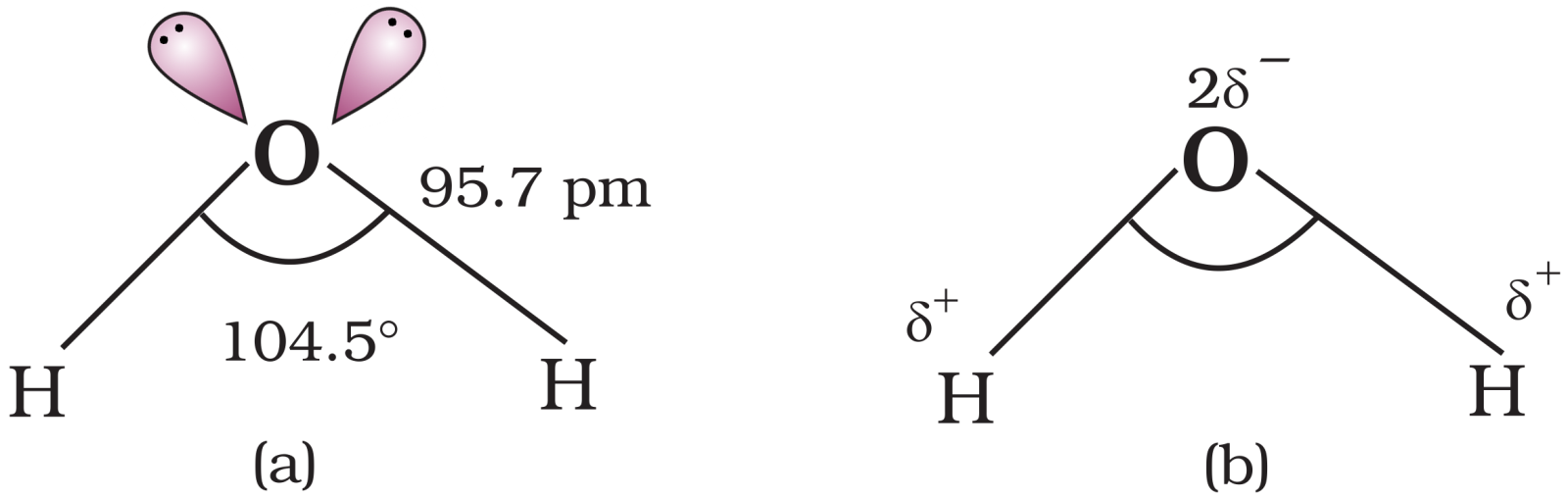
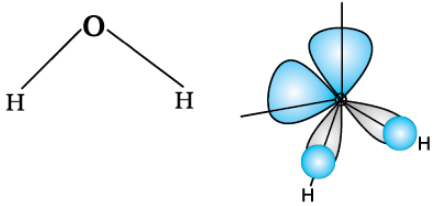
In $\mathrm{H}_2 \mathrm{O}$, O is $\mathrm{sp}^3$ hybridised but due to lone pair-lone pair repulsion, the HOH bond angle decreases to $104.5^{\circ}$. Hence, water is a bent molecule as shown above.
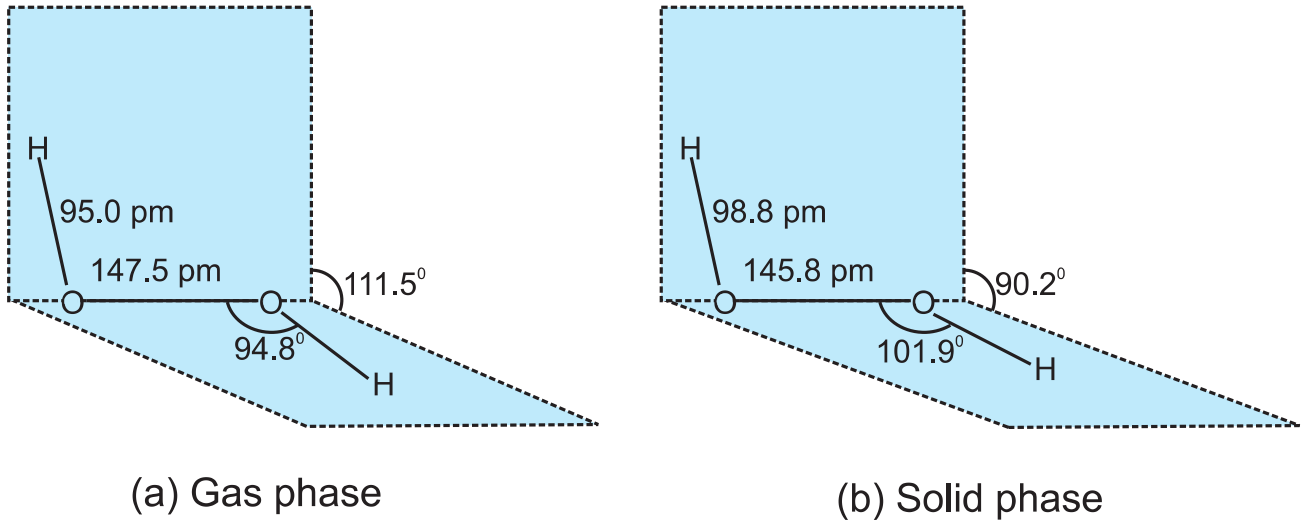
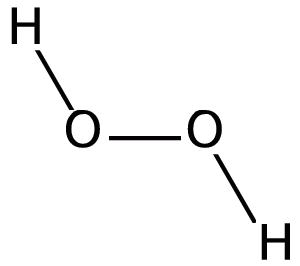
In $\mathrm{H}_2 \mathrm{O}_2$, the two oxygen atoms are linked to each other by single bond (peroxide) and each oxygen is further linked to H atom by single bond. The two $\mathrm{O}-\mathrm{H}$ bonds are in different plane, giving $\mathrm{H}_2 \mathrm{O}_2$ a non-planar structure as shown above. View full question & answer→Question 233 Marks
If 1 kg of a hard water sample contains 12 mg of $\mathrm{CaCl}_2$ and 12 mg of $\mathrm{MgCl}_2$, then what will be the total hardness in terms of $\mathrm{CaCO}_3$ per $10^6$ parts by mass of water sample.
AnswerGiven $\mathrm{CaCl}_2$ present in $10^3 \mathrm{~g}=12 \mathrm{mg}$
$\mathrm{CaCl}_2$ present in $10^6 \mathrm{~g}=12 \mathrm{~g}$
$\therefore \mathrm{MgCl}_2$ present in $10^6 \mathrm{~g}=12 \mathrm{~g}$
Now, $1 \mathrm{~mol}(111 \mathrm{~g}) \mathrm{CaCl}_2=1 \mathrm{~mol}(100 \mathrm{~g}) \mathrm{CaCO}_3$
$\therefore12\text{g}\text{CaCl}_2=\frac{100\times12}{111}=10.81\text{g}$
Similarly 1mol (95g) $\text{MgCl}_2=1\text{mol}(100\text{g})\text{CaCO}_3$
$\therefore12\text{g }\text{MgCl}_2=\frac{100\times12}{95}=12.63\text{g}$
Total hardness in terms of $CaCO_3 = (10.81 + 12.63)$
= 23.44 ppm.
View full question & answer→Question 243 Marks
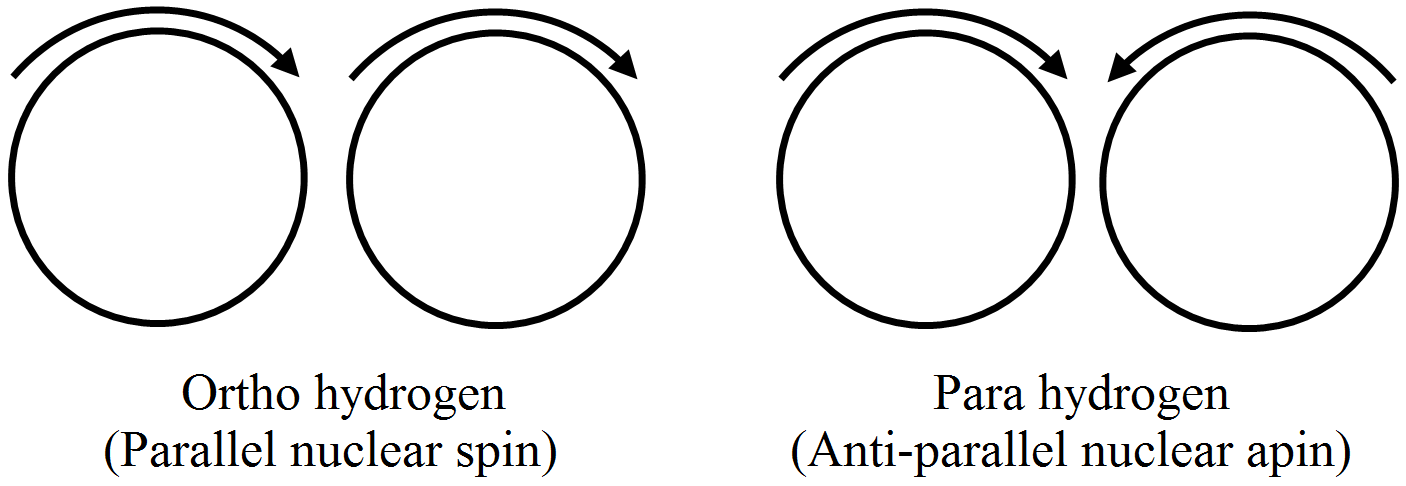
- Show the difference of ortho and para hydrogen by a diagram.
- Difference in chemical behaviour of compound of hydrogen with elements of atomic number 17 and 20
Answer
-
ii. $\mathrm{H}_2+\mathrm{Cl}_2 \rightarrow 2 \mathrm{HCl}$
$\mathrm{Cl}_2$ is oxidising agent. $\mathrm{H}_2$ is reducing agent.
$\mathrm{Ca}+\mathrm{H}_2 \rightarrow \mathrm{CaH}_2$
Ca is reducing agent, $\mathrm{H}_2$ is oxidising agent. View full question & answer→Question 253 Marks
Complete the following reactions:()
- $\text{HCHO} +\text{H}_2\text{O}_2\xrightarrow{\ \ \ \ \ \ \ }$
-
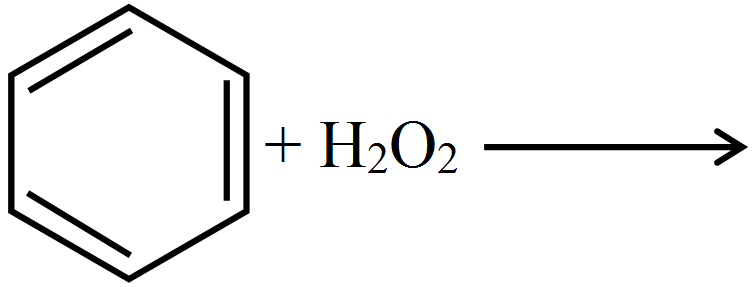
- $\text{KNO}_2+\text{H}_2\text{O}_2\xrightarrow{\ \ \ \ \ \ \ \ }$
Answer
- $\text{HCHO}+\text{H}_2\text{O}_2\xrightarrow{\ \ \ \ \ \ \ }\text{HCOOH}+\text{H}_2\text{O}\\\text{Methanal}\ \ \ \ \ \ \ \ \ \ \ \ \ \ \text{Potassium acid}$
-
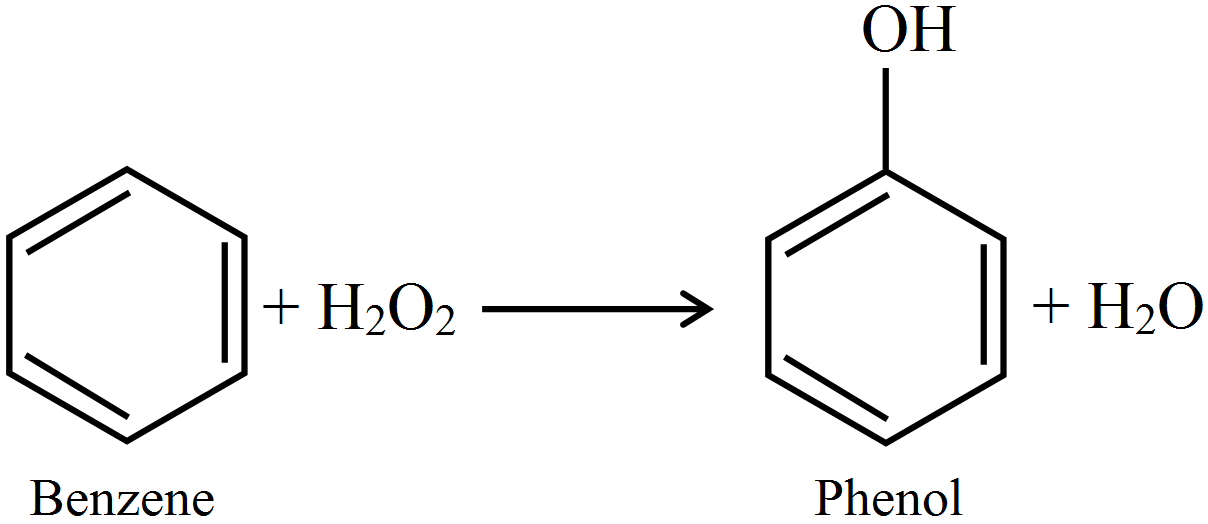
$\text{KNO}_2+\text{H}_2\text{O}_2\xrightarrow{\ \ \ \ \ \ \ \ \ \ \ }\text{KNO}_3+\text{H}_2\text{O}\\ \text{Potessium nitrite}\ \ \ \ \ \ \ \text{Potassium nitrate}$ View full question & answer→Question 263 Marks
i. Arrange $\mathrm{NH}_3, \mathrm{PH}_3, \mathrm{AsH}_3, \mathrm{SbH}_3$ in increasing order of boiling point.
ii. Identify complex, interstitial, covalent and polymeric hydrides from the following.
$\mathrm{BeH}_2, \mathrm{AsH}{ }_3, \mathrm{LaH}_3, \mathrm{LiAlH}_4$.
Answeri. $\mathrm{PH}_3<\mathrm{AsH}_3<\mathrm{NH}_3<\mathrm{SbH}_3$ is increasing order of boiling point.
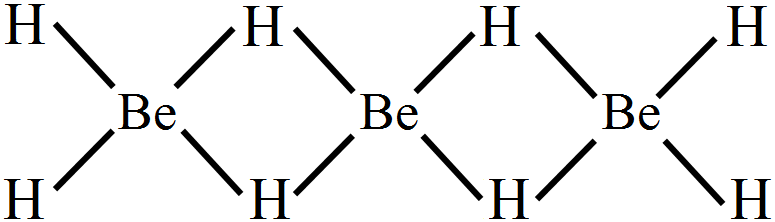
ii. BeH2 Polymeric.
$\because$ It is electron deficient.
$AsH_3$ Covalent
$LaH_3$ Interstitial
$LiAlH_4$ Complex View full question & answer→Question 273 Marks
Why hard water does not form lather with soap? What advantage has soap over detergents?
AnswerIt is because $\mathrm{Ca}^{2+}$ and $\mathrm{Mg}^{2+}$ ions present in hard water react with soap to form $\mathrm{Ca}^{2+}$ and $\mathrm{Mg}^{2+}$ salts of fatty acids which are insoluble in water.
$\text{Ca}^{2+}+\text{C}_{17}\text{H}_{35}\text{COONa}\xrightarrow{\ \ \ \ \ \ \ \ \ \ }(\text{C}_{17}\text{H}_{35}\text{COO)}_2\text{Ca}+0\text{Na}^+$
$\text{Mg}^{2+}+\text{C}_{17}\text{H}_{35}\text{COONa}\\\xrightarrow{\ \ \ \ \ \ \ \ \ }(\text{C}_{17}\text{H}_{35}\text{COO})_2\text{Mg}+2\text{Na}^+$
Advantage of soap over detergents: Soaps are biodegradable whereas detergents are non biodegradable.
View full question & answer→Question 283 Marks
i. Arrange $CO _2, H _2 O , H _2 O _2$ in increasing order of acidity.
ii. The correct order of bond length $O _2, H _2 O _2, O _3$.
iii. What is the use of EDTA?
Answeri. $H _2 O < H _2 O _2< CO _2$ is increasing order of acidity.
$H _2 O$ is neutral, $H _2 O _2$ is weakly acidic, $CO _2$ is more acidic than $H _2 O _2$.
' C ' is more electronegative than H .
ii. $H _2 O _2> O _3> O _2$
$H _2 O _2$ has single bond which is largest.
$O _3$ has bond order between 1 and 2 due to resonance.
$O _2$ has double bond which is shortest.
iii. EDTA (Ethylene diamine tetra acetate) is used from softening hard water.
View full question & answer→Question 293 Marks
What happens:
- When $\mathrm{F}_2$ reacts with hot water
- Barium peroxide reacts with phosphoric acid
- Hydrogen peroxide reacts with ozone.
Write the chemical reacts involved. Answer
- $\mathrm{O}_3$, is formed
$3\text{F}_3+3\text{H}_2\text{O}(\text{hot)}\xrightarrow{\ \ \ \ \ \ \ \ \ }6\text{HF}+\text{O}_3$
- Hydrogen peroxide and Barium phosphate are formed.
$3\text{BaO}_2+2\text{H}_3\text{PO}_4\xrightarrow{\ \ \ \ \ \ \ \ }\text{Ba}_3 (\text{PO}_4)_2+3\text{H}_2\text{O}_2$
- $\mathrm{H}_2 \mathrm{O}$ and $\mathrm{O}_2$ gas is formed.
$\text{H}_2\text{O}_2++\text{O}_3\xrightarrow{\ \ \ \ \ \ \ \ \ }\text{H}_2\text{O}+2\text{O}_2$ View full question & answer→Question 303 Marks
Complete the following reactions:
- $\text{K}_4[\text{Fe}(\text{CN)}_6]+\text{H}_2\text{O}_2+\text{H}_2\text{SO}_4\xrightarrow{\ \ \ \ \ \ \ }$
- $\text{HOCl}+\text{H}_2\text{O}_2\xrightarrow{\ \ \ \ \ \ \ \ }$
- $\text{K}_2\text{Cr}_2\text{O}_7+\text{H}_2\text{SO}_4+\text{H}_2\text{O}_2\xrightarrow{\ \ \ \ \ \ }$
Answer
- $2\text{K}_4[\text{Fe}(\text{CN})_6]+\text{H}_2\text{SO}_4+\text{H}_2\text{O}_2\\\xrightarrow{\\ \ \ \ \ \ \ \ \\ }2\text{K}_3[\text{Fe(CN)}_6]+\text{K}_2\text{SO}_4+2\text{H}_2\text{O}$
- $\text{HOCl}+\text{H}_2\text{O}_2\xrightarrow{\ \ \ \ \ \ \ }\text{HCl}+\text{H}_2\text{O}+\text{O}_2$
- $\text{K}_2\text{Cr}_2\text{O}_7+\text{H}_2\text{SO}_4+4\text{H}_2\text{O}_2\\\xrightarrow{\ \ \ \ \ \ \ \ \ }\text{K}_2\text{SO}_4+\text{CrO}_5+5\text{H}_5\text{O}$
View full question & answer→Question 313 Marks
An ionic hydride of groups has sufficiently covalent character. It is used to form hydrides of other elements of group 13 which are useful reducing agent. Write the formula this hydride and its reaction with $\mathrm{B}_2 \mathrm{H}_6$ and $\mathrm{AlCl}_3$.
AnswerLiH has sufficiently covalent character because lithium has smallest size.
$4\text{LiH}+\text{AlCl}_3\xrightarrow{\ \ \ \ \ \ \ \ \ \ }\text{LiAlH}_4+3\text{LiCl}\\\ \ \ \ \ \ \ \ \ \ \ \ \ \ \ \ \ \ \ \ \ ^\text{Lithium aluminium hydride}$
$2\text{LiH}+\text{B}_2\text{H}_6\xrightarrow{\ \ \ \ \ \ \ \ \ \ }\text{LiBH4}\\\ \ \ \ \ \ \ \ \ \ \ \ \ \ \ \ \ \ \ \ \ \ \ \ \ ^ \text{Lithium borohydride}$
$\text{LiAlH}_4$ and $\text{LiBH4}$ are used as reducing agents.
View full question & answer→Question 323 Marks
How will you concentrate $H _2 O _2$ ? Show differences between structures of $H _2 O _2$ and $H _2 O$ by drawing their spatial structures. Also mention three important uses of $H _2 O _2$.
AnswerMethods for concentrating hydrogen peroxide and obtaining this compound in anhydrous form, based on removal or binding of water from the surface of solution in an open vessel or in a closed volume and also on binding of water directly in a $H _2 O _2$ solution, are described.
Differences between structures of $H _2 O _2$ and $H _2 O ^{-}$
In gaseous phase, water molecule $\left( H _2 O \right)$ has a bent form with a bond angle of $104.5^{\circ}$. The $O - H$ bond length is 95.7 pm . The structure of $H _2 O$ can be shown as:
Hydrogen peroxide has a non-planar structure both in gas and solid phase. The dihedral angle in gas and solid phase is $111.5^\circ$ and $90.2^\circ$ respectively. The structure of $H_2O_2$ can be shown as:
Uses- Hydrogen peroxide is a mild antiseptic used on the skin to prevent infection of minor cuts, scrapes, and burns. It may also be used as a mouth rinse to help remove mucus or to relieve minor mouth irritation (e.g., due to canker/ cold sores, gingivitis). This product works by releasing oxygen when it is applied to the affected area. The release of oxygen causes foaming, which helps to remove dead skin and clean the area. View full question & answer→Question 333 Marks
Complete the following reactions:
- $\text{Zn}+\text{NaOH}\xrightarrow{\ \ \ \ \ \ \ }$
- $\text{MnO}_4^-+\text{H}_2\text{O}_2\xrightarrow{\ \ \ \ \ \ \ \ \ }$
- $\text{Ca(HCO}_3)_2+\text{Ca(OH)}_2\xrightarrow{\ \ \ \ \ \ \ \ \ \ }$
Answer
- $\text{Zn}+2\text{NaOH}\xrightarrow{\ \ \ \ \ \ \ \ }\text{Na}_2\text{ZnO}_2+\text{H}_2$
- $2\text{MnO}_4^-+6\text{H}^++5\text{H}_2\text{O}_2\xrightarrow{\ \ \ \ \ \ \ }2\text{Mn}^{2+}+5\text{O}_2+8\text{H}_2\text{O}$
- $\text{Ca(HCO}_3)_2+\text{Ca(OH})_2\xrightarrow{\ \ \ \ \ \ \ \ }2\text{CaCO}_3+2\text{H}_2\text{O}$
View full question & answer→Question 343 Marks
Complete the following reactions:
- $\text{SO}_3+\text{D}_2\text{O}\xrightarrow{\ \ \ \ \ \ \ \ \ }$
- $2\text{Na}+2\text{D}_2\text{O}\xrightarrow{\ \ \ \ \ \ \ \ }$
- $\text{P}_2\text{O}_5+\text{D}_2\text{O}\xrightarrow{\ \ \ \ \ \ \ \ \ }$
Answer
- $\text{SO}_3+\text{D}_2\text{O}\xrightarrow{\ \ \ \ \ \ \ \ }\text{D}_2\text{SO}_4\\\ \ \ \ \ \ \ \ \ \ \ \ \ \ \ \ \ \ \ \ \text{Deuterium sulphate}$
- $2\text{Na}+2\text{D}_2\text{O}\xrightarrow{\ \ \ \ \ \ \ \ \ \ }2\text{NaOD}+\text{D}_2\\\ \ \ \ \ \ \ \ \ \ \ \ \ \ \ \ \ \ \ \ \ \ \ \ \ \ \ \ \text{Sodium deuteroxide}$
- $\text{P}_2\text{O}_5+3\text{D}_2\text{O}\xrightarrow{\ \ \ \ \ \ \ \ }2\text{D}_3\text{PO}_4\\\ \ \ \ \ \ \ \ \ \ \ \ \ \ \ \ \ \ \ \ \ \text{Deuterium phosphate}$
View full question & answer→Question 353 Marks
Explain the correct context in which the following terms are used:
- diprotium.
- dihydrogen.
- proton.
- hydron.
Answer
- Diprotium: Diprotium is the term used to represent
- Dihydrogen: The diatomic molecule $\text{H}_2$ is called dihydrogen while referring to the isotopic mixture with natural abundance of H and D.
- Proton: The ionised form of protium i.e. $\text{H}^+$ is called a proton. This term is used in describing the self ionisation of water and ionisation of acids in water.
- Hydron: $\text{H}^+$ when used in relation to the isotopic mixture is called hydron.
View full question & answer→Question 363 Marks
When a substance 'A' reacts with water it produces a combustible gas 'B' and a solution of substance 'C' in water. When another substance 'D' reacts with this solution of 'C' it produces same gas 'B' on warming but 'D' can produce 'B' on reaction with dil. $\mathrm{H}_2 \mathrm{SO}_4$ at room temperature. A imparts deep golden yellow colour to the smokeless flame of bunsen burner. Identify A, B, C and D and write the reactions involved.
Answer$2\text{Na}(\text{s})+2\text{H}_2\text{O}(\text{l})\xrightarrow{\ \ \ \ \ \ \ \ \ \ \ }2\text{NaOH}(\text{aq})+\text{H}_2(\text{g})\\\ \ \ \ \text{'A'}\ \ \ \ \ \ \ \ \ \ \ \ \ \ \ \ \ \ \ \ \ \ \ \ \ \ \ \ \ \ \ \ \ \ \ \ \ \ \ \ \text{'C'}\ \ \ \ \ \ \ \ \ \ \ \ \ \ \ \ \text{'B'}$
$\text{Zn}(\text{s})+2\text{NaOH}(\text{aq})\xrightarrow{\ \ \ \ \ \ \ \ \ \ \ }\text{Na}_2\text{nO}_2(\text{aq})+\text{H}_2(\text{g})\\\ \ \ \text{'D'}\ \ \ \ \ \ \ \ \ \ \ \ \ \ \ \ \ \ \ \ \ \ \ \ \ \ \ \ \ \ \ \ \ \ \ \ \ \ \ \ \ \ \ \ \ \ \ \ \ \ \ \ \ \ \ \ \ \ \ \ \ \ \ \ \ \ \text{'B'}$
$\text{Zn}(\text{s})+\text{H}_2\text{SO}_4(\text{dil.})\xrightarrow{\ \ \ \ \ \ \ \ \ \ }\text{ZnSO}_4(\text{aq})+\text{H}_2(\text{g})\\\ \ \ \ \ \ \ \ \ \ \ \ \ \ \ \ \ \ \ \ \ \ \ \ \ \ \ \ \ \ \ \ \ \ \ \ \ \ \ \ \ \ \ \ \ \ \ \ \ \ \ \ \ \ \ \ \ \ \ \ \ \ \ \ \ \ \ \ \ \ \ \ \ \text{'B'}$
‘Na' imparts golden yellow colour to the flame.
View full question & answer→Question 373 Marks
What mass of hydrogen peroxide will be present in 2 litres of 5M solution?Calculate the mass of oxygen which will be liberated by 1ml this solution at STP?
AnswerMolar mass of $\mathrm{H}_2 \mathrm{O}_2=2+16 \times 2=34 \mathrm{~g} \mathrm{~mol}^{-1}$
1 L of 5 M solutio contains $34 \times 5=170 \mathrm{~g}$ of $\mathrm{H}_2 \mathrm{O}_2$
2 L of 5 M solution contains $170 \times 2=340 \mathrm{~g}$ of $\mathrm{H}_2 \mathrm{O}_2$
2000 ml of $5 \mathrm{M} \mathrm{H}_2 \mathrm{O}_2$ contains $=340 \mathrm{~g}$
1 ml of $5 \mathrm{M} \mathrm{H}_2 \mathrm{O}_2$ contains $\frac{340}{2000}=0.17 \mathrm{~g}$
$2 \mathrm{H}_2 \mathrm{O}_2 \longrightarrow 2 \mathrm{H}_2 \mathrm{O}+\mathrm{O}_2$
$2 \times 34=6822400 \mathrm{ml}$ of STP
68 g of $\mathrm{H}_2 \mathrm{O}_2$ liberate 22400 ml of $\mathrm{O}_2$ at STP
0.17 g of $\mathrm{H}_2 \mathrm{O}_2$ liberate $=\frac{22400}{68} \times \frac{17}{100}=\frac{224}{4}$
$=56 \mathrm{ml}$ at STP.
View full question & answer→Question 383 Marks
Name the products obtained when hydrogen reacts under suitable conditions with.
- nitrogen.
- Carbon monoxide.
- lead oxide.
Answer
-

- $\text{CO}(\text{g})+2\text{H}_2(\text{g)}\xrightarrow[\text{ZnO.CrO}_3]{700\text{K.200}\text{ atm}}\text{CH}_3\text{OH}(\text{l})\\\ \ \ \ \ \ \ \ \ \ \ \ \ \ \ \ \ \ \ \ \ \ \ \ \ \ \ \ \ \ \ \ \ \ \ \ \ \ \ \ \ \ \ \ \ \ \ \ \ \ ^\text{Methanol of menthyl alcohol}$
- $\text{PbO}(\text{s})+\text{H}_2(\text{g})\xrightarrow{\text{Heat}}\text{Pb}(\text{s})+\text{H}_2\text{O}(\text{l})\\ \ \ \ \ \ \ \ \ \ \ \ \ \ \ \ \ \ \ \ \ \ \ \ \ \ \ \ \ \ \ \ \ \ \ \ \ \ \ ^\text{Lead}$
View full question & answer→Question 393 Marks
How will you account for $104.5^{\circ}$ bond angle in water?
AnswerIn $\mathrm{H}_2 \mathrm{O}$ molecule the oxygen is $\mathrm{sp}^3$-hybridizedand thus, tetrahedral configuration comes into existence. Two positions are occupied by H atoms by forming sigma bonds with two hybrid orbitals and two positions are occupied by lone pairs. The expected bond angle should be109.5 ${ }^{\circ}$, but the actual angle is $104.5^{\circ}$. The lone pair-lone pair repulsions are greater than bond pair-bond pair repulsions. As a result, bond angle in water is reduced from $109.5^{\circ}$ to $104.5^{\circ}$.
View full question & answer→Question 403 Marks
Basic principle of hydrogen economy is transportation and storage of energy in the form of liquid or gaseous hydrogen. Which property of hydrogen may be useful for this purpose? Support your answer with the chemical equation if required.
AnswerHydrogen economy (Hydrogen as fuel):
- The electricity cannot be stored to mn automobiles. It is not possible to store and transport nuclear energy. Hydrogen is an alternative source of energy and heance called as "hydrogen enomy". Hydrogen has some advantages as fuel.
- Available in abundance in combined form as water.
- On combustion produces $\mathrm{H}_2 \mathrm{O}$. Heance pollution free.
- $\mathrm{H}_2{ }^{-} \mathrm{O}_2$ fuel cell give more power.
- Excellent reducing agent. Therefore, can be used as substitute of carbon in reduction for processes in industry.
View full question & answer→Question 413 Marks
- Calculate strength of 20 Vol. of $H_2O_{2.}$
- Give one example in which it act as oxidizing and reducing agent in basic median.
Answer
- $2\text{H}_2\text{O}_2\xrightarrow{\ \ \ \ \ \ \ \ \ \ }2\text{H}_2\text{O}+\text{O}_2\ \ \ \\\ \ 2\times34=68\text{g}\ \ \ \ \ 22.4\text{L}\text{ at}\text{ STP}$
20 volume of $H _2 O _2$ means IL of the $H _2 O _2$ gives
20 L of $O _2$ at STP. 22.4 L of $O _2$ at STP is produced
from 68 g of $H _2 O _2$. 20 L of $O _2$ will be produced
from
$\frac{68}{22.4} \times 20=\frac{360}{22.4}=60.71 gL^{-1}$
The strength of $20 vol . H _2 O _2$ is $60.71 g / L ^{-1}$ or 6.071\%.
6.071%.
-
- $\text{Mn}^{2+}+\text{H}_2\text{O}_2\xrightarrow{\ \ \\ \ \ \ \ \ }\text{Mn}^{4+}+20\text{H}^-$
$[H_2O_2$ is oxidising agent]
- $\text{Cl}_2+\text{H}_2\text{O}_2+20\text{H}^-\xrightarrow{\ \ \ \ \ \ \ \ }2\text{Cl}^-+2\text{H}_2\text{O}+\text{O}_2$
$[H_2O_2$ is redusing agent] View full question & answer→Question 423 Marks
Describe the industrial applications of hydrogen dependent on:
- the heat liberated when its atoms are made to combine on the surface of a metal.
- its effect on the unsaturated organic systems in the presence of a catalyst.
- its ability to combine with nitrogen under specific conditions.
Answer
- Due to this property hydrogen is used in atomic hydrogen welding/cutting torch.
- Due to this property hydrogen is used for the manufacture of vanaspati ghee from edible oils such as cotton-seed oil, soyabean oil, corn oil etc.
Unsaturated oil $+\text{H}_2(\text{g})\xrightarrow{\text{Ni catatyst}}$ Vanaspati ghee.
- Due to this property dihydrogen is used for the manufacture of ammonia (Haber's process).

View full question & answer→Question 433 Marks
Melting point, enthalpy of vapourisation and viscosity data of $H_2O$ and $D_2O$ are given below:
|
|
$H_2O$
|
$D_2O$
|
|
Melting point / K
|
373.0
|
374.4
|
|
Enthalpy of vapourisation at $(373 K)/ kJ mol^{-1}$
|
40.66
|
41.61
|
|
Viscosity/ centipoise
|
0.8903
|
1.107
|
On the basis of this data, explain in which of these liquids intermolecular forces are stronger? AnswerThe melting point, enthalpy of vapourisation and viscosity values of all these items depend upon the intermolecular forces of attraction.
Since their values are higher for $D_2O$ as compared to those of $H_2O$, therefore, intermolecular forces of attraction are stronger in $D_2O$ than in $H_2O$.
View full question & answer→Question 443 Marks
What is conjugate base of $\mathrm{H}_2$ ? What happens when $\mathrm{Cl}_2$ reacts with $\mathrm{H}_2 \mathrm{O}$ ? What type of reaction it is? Explain.
Answer$\mathrm{H}^{-}$is conjugate base of $\mathrm{H}_2$.
$\stackrel{.\ \ \ \ }{\hbox{C}\text{l}_2}+\stackrel{+1\ \ }{\hbox{H}_2}\stackrel{{ \ -2}}{\hbox{O}}\xrightarrow{\ \ \ \ \ \ \ \ \ \ \ }\stackrel{{+1}}{\hbox{H}}\stackrel{{\ \ \ -1}}{\hbox{Cl}}+\stackrel{{+1}}{\hbox{H}}\stackrel{{\ \ -2}}{\hbox{ O}}\stackrel{{\ \ +1}}{\hbox{Cl}}$
Hydrogen chloride and Hypo chlorine acid is formed. It is disproportionation reaction.
Reason: Because oxidation state of 'Cl' increasing from 0 to +1 (in HOCI) and decreasing from 0 to -1 (in HCI).
View full question & answer→Question 453 Marks
Write the Lewis structure of hydrogen peroxide.
Answer
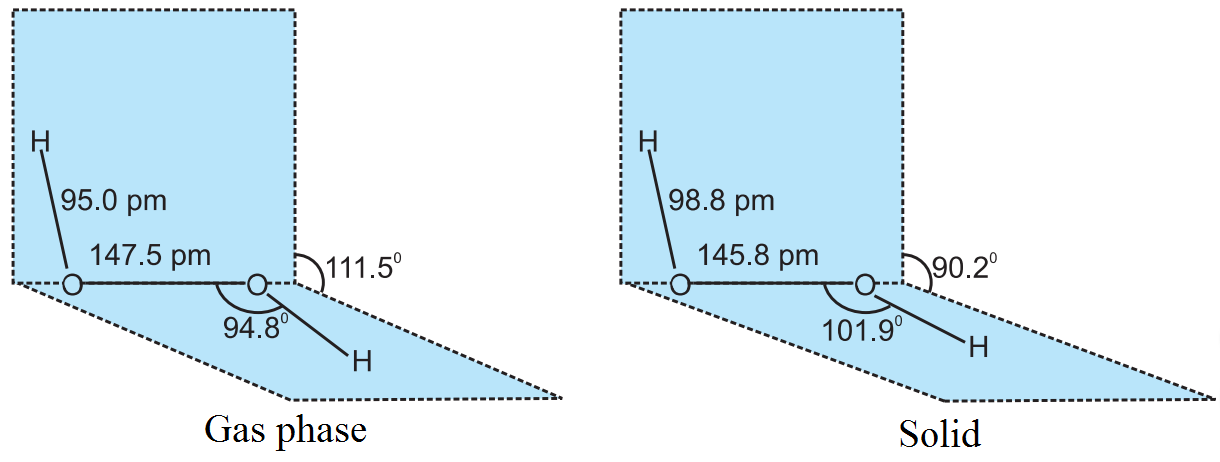
- $\mathrm{H}^2 \mathrm{O}^2$ structure in gas phase, dihedral angle is $111.5^{\circ}$
- $\mathrm{H}^2 \mathrm{O}^2$ structure in solid phase at 110 K , dihedral angle is $90.2^{\circ}$
View full question & answer→Question 463 Marks
What is the importance of heavy water?
AnswerHeavy water has been used in nuclear reactors. In nuclear reactors, chain reactions occur very fast. In order to slow down the rate of these reactions, heavy water is used as a moderator. Actually, the speed of neutrons is slowed down by passing through heavy water before bringing about fission of uranium.
View full question & answer→Question 473 Marks
Atomic hydrogen combines with almost all elements but molecular hydrogen does not. Explain.
AnswerAtomic hydrogen is very reactive whereas molecular hydrogen are quite stable. The chemical behaviour of dihydrogen (and for that matter any molecule) is determined, to a large extent, by bond dissociation enthalphy. The H - H bond dissociation enthalphy is the hoghest for a single bond between two atoms of any element. As a result, molecular hydrogen reacts only with a few elements.
View full question & answer→Question 483 Marks
$\text{H}_2\text{O}_2$ is a better oxidizing agent than water. Explain.
Answer$\text{H}_2\text{O}_2$ is a better oxidizing agent than water.
$\text{H}_2\text{O}_2$ acts as an oxidizing agent as well as in alkaline medium.
$\text{H}_2\text{O}_2+2\text{H}^++2\text{e}^-\xrightarrow{\ \ \text{Acid }\ }2\text{H}_2\text{O}\ \ \ \text{E}^\circ=1.77\text{V}$
$\text{H}_2\text{O}_2+\text{OH}^-+2\text{e}^-\xrightarrow{\ \ \text{Alkaline}\ \ }3\text{OH}^-\ \ \ \text{E}^\circ=0.88\text{V}$
Oxidation state of oxygen changes from -1 to -2.
Oxidising nature of $\text{H}_2\text{O}_2$ can be interpreted account of possession of labile oxygen.
$\text{H}_2\text{O}_2\xrightarrow{\ \ \ \ \ }\text{H}_2\text{O}\ \ +\ \ \text{H}_2\text{O}\ \ +\ \ \text{O}$
When water acts as an oxidizing ageng, it is reduced to $\text{H}_2$.
Water reacts with number of active metals whose electrode potential is less than -0.83V.
$2\text{Na}\ \ \ \ \ \ \ \ \ +\ \ \ \ \ \ \ 2\text{H}_2\text{O}\xrightarrow{\ \ \ \ \ \ \ \ }2\text{NaOH}\ \ \ \ \ \ \ +\ \ \ \ \ \ \ \ \ \text{H}_2\\\text{Reductant}\ \ \ \ \ \ \ \ \text{Oxidant}$
View full question & answer→Question 493 Marks
- Name the different salts that cause permanent hardness of water.
- How do we obtain demineralised water from hard water after passing it from synthetic ion exchange resins? Give reactions.
Answer
- $\text{CaCl}_2.\text{MgCl}_2.\text{CaSO}_4$ and $\text{MgSO}_4$ will cause permanent hardness of water.
- Synthetic ion exchange resins remove both cations and anions from hard water, therefore, we will get demineralised water.
Cation exchange resin:
$2\text{R}-\text{COO}^-\text{H}^+\text{CaCl}_2\xrightarrow{\ \ \ \ \ \ \ \ \ }(\text{RCOO})_2\text{Ca}+2\text{H}^++2\text{Cl}^-$
$2\text{R}-\text{COO}^-\text{H}^++\text{MgCl}_2\xrightarrow{\ \ \ \ \ \ \ \ }(\text{RCOO})_2\text{Mg}+2\text{H}^++2\text{Cl}^-$
Anion exchange resin:
$ \ \ + \ \ \ \ \ \ \ \ \ \ \ \ \ \ \ \ \ \ \ \ \ \ \ \ \ \ \ \ \ \ \ \ \ \ \ + \\\text{RNH}_3\text{OH}^-+\text{Cl}^-\xrightarrow{\ \ \ \ \ \ \ }\text{RNH}_3\text{Cl}^-+\text{OH}^-\\\ \ \ \ \ \ \ \ \ \ \ \ \ \ \ \ \ (\text{From hard} \\\ \ \ \ \ \ \ \ \ \ \ \ \ \ \ \ \ \ \text{water})$
$2\text{RNH}_3\text{OH}^-+\text{SO}_4^{2-}\xrightarrow{\ \ \ \ \ \ }(\text{RNH}_3)_2\text{SO}_4^{2-}+2\text{OH}^-\\\ \ \ \ \ \ \ \ \ \ \ \ \ \ \ \ \ \ \ \ \ \ \ \ \ \text{(From hard} \\\ \ \ \ \ \ \ \ \ \ \ \ \ \ \ \ \ \ \ \ \ \ \ \ \ \ \ \ \ \ \ \text{water})$ View full question & answer→Question 503 Marks
Describe the industrial use of hydrogen which depends on
- the heat liberated when it burns.
- its ability to react with vegetable oil in the presence of a catalyst.
- its ability to unite with $\mathrm{N}_2$.
Answer
- It is used in oxy-hydrogen flame for welding purposes.
- It is used to manufacture vanaspati ghee.
- It is used for manufacture of $\mathrm{NH}_3$.
View full question & answer→Question 513 Marks
Why is water molecule polar?
AnswerWater is a polar molecule and also acts as a polar solvent. When a chemical species is said to be "polar," this means that the positive and negative electrical charges are unevenly distributed. The positive charge comes from the atomic nucleus, while the electrons supply the negative charge. It's the movement of electrons that determines polarity. Here's how it works for water.
View full question & answer→Question 523 Marks
An aqueous solution of an inorganic compound 'X' shows the following reactions:
- It decolourises an acidified solution of $\text{KMnO}_4$
- It liberates $\text{I}_2$ from acidified KI solution.
- If removes black stains from red paintings.
Identify 'X' and write all the reactions involved in ionic form, Answer'X' is $\text{H}_2\text{O}_2$
- $2\text{MnO}_4^-+5\text{H}_2\text{O}_2+6\text{H}^+\xrightarrow{\ \ \ \ \ \ \ \ \ }2\text{Mn}^{2+}+8\text{H}_2\text{O}+5\text{O}_2$
- $2\text{I}^-+\text{H}_2\text{O}_2+2\text{H}^+\xrightarrow{\ \ \ \ \ \ \ \ \ }\text{I}_2+2\text{H}_2\text{O}$
- $\text{PbS}+4\text{H}_2\text{O}_2\xrightarrow{\ \ \ \ \ \ \ \ \ }\text{PbSO}_4+4\text{H}_2\text{O}$
View full question & answer→Question 533 Marks
i. Why is $\mathrm{H}_2 \mathrm{O}_2$ syrupy liquid?
ii. Is $\mathrm{H}_2 \mathrm{O}_2$ paramagnetic or diamagnetic, why?
iii. Which has higher dipole moment $\mathrm{H}_2 \mathrm{O}_2$ or $\mathrm{H}_2 \mathrm{O}$, why?
Answeri. $\mathrm{H}_2 \mathrm{O}_2$ is associated with intermolecular H -bonding.
ii. $\mathrm{H}_2 \mathrm{O}_2$ is diamagnetic because $\mathrm{O}^{2-}{ }_2$ does not have unpaired electrons.
iii. $\mathrm{H}_2 \mathrm{O}_2$ has higher dipole moment because it has open book structure and both $\mathrm{O}-\mathrm{H}$ group are.
not in same plane. It is more polar than water.
View full question & answer→Question 543 Marks
Phosphoric acid is preferred over sulphuric acid in preparing hydrogen peroxide from peroxides. Why?
AnswerIn the preparation of $\mathrm{H}_2 \mathrm{O}_2$ from barium peroxide and sulphuric acid, the use of sulphuric acid has a disadvantage as it catalyses the decomposition of $\mathrm{H}_2 \mathrm{O}_2$ formed. In place of $\mathrm{H}_2 \mathrm{O}_2$, weak acids like ortho phosphoric acid, carbonic acid are preferred. All heavy metal impurities present in $\mathrm{BaO}_2$ are removed as insoluble phosphates and decomposition of $\mathrm{H}_2 \mathrm{O}_2$ is prevented.
View full question & answer→Question 553 Marks
A metal ' $X$' for crystalline ionic solid with dihydrogen. The solid produces hydrogen with $\mathrm{H}_2 \mathrm{O}$ and produces $\mathrm{H}_2$ gas and compound ' $Y$ ' is formed. ' $Y$ ' reacts with Aluminium metal and liberates $\mathrm{H}_2$ gas. ' $Y$ ' is also manufactured by electrolysis of brine solution.
Identify ' $X$ ' and ' $Y$ ' and write reaction involved.
Answer$2\text{Na}+\text{H}_2\xrightarrow{\ \ \ \ \ \ \ \ \ \ \ \ }2\text{NaH}\\\ \ \ \text{'X'}\ \ \ \ \ \ \ \ \ \ \ \ \ \ \ ^\text{sodium hydride}\\^\text{sodium}$
$2\text{NaH}+2\text{H}_2\text{O}\xrightarrow{\ \ \ \ \ \ \ \ \ }2\text{NaOH}+3\text{H}_2\\\ \ \ \ \ \ \ \ \ \ \ \ \ \ \ \ \ \ \ \ \ \ \ \ \ \ \ \ \ \ \ \ \ \ \ \ \ \ \ \ \ \ \ \text{'Y'}$
$2\text{Al}+2\text{NaOH}+2\text{H}_2\text{O}\xrightarrow{\ \ \ \ \ \ \ \ \ \ }2\text{NaAlO}_2+3\text{H}_2\\\ \ \ \ \ \ \ \ \ \ \ \ \ \ \text{'Y'}\ \ \ \ \ \ \ \ \ \ \ \ \ \ \ \ \ \ \ \ \ \ \ \ \ \ \ \ \ ^\text{Sodium meta}\\\ \ \ \ \ \ \ \ \ \ \ \ \ \ \ \ \ \ \ \ \ \ \ \ \ \ \ \ \ \ \ \ \ \ \ \ \ \ \ \ \ \ \ \ \ \ \ \ \ \ ^\text{aluminate}$
$2\text{H}_2\text{O}+2\text{NaCl}(\text{aq)}\xrightarrow[]{\text{electrolysis}}2\text{NaOH}+\text{H}_2+\text{Cl}_2\\\ \ \ \ \ \ \ \ \ \ \ \ \ \ \ \ \ \ \ \ \ \ \ \ \ \ \ \ \ \ \ \ \ \ \ \ \ \ \ \ \ \ \ \ \ \ \ \ \ \ \ \ \text{'Y'}\\\ \ \ \ \ \ \ \ \ \ \ \ \ \ \ \ \ \ \ \ \ \ \ \ \ \ \ \ \ \ \ \ \ \ \ \ \ \ \ \ \ \ \ \ \ ^\text{Sodium hydroxide}$
View full question & answer→Question 563 Marks
- The hardness of water sample is 0.002 mole of magnesium sulphate dissolved in a litre of water. Express in ppm.
- Which of these is peroxide?
$KO_2, BaO_2, MnO_2, NO_2$Answera. Amount of $\mathrm{Mg} \mathrm{SO}_4=0.002 \times 120 \times 1000$
$=240 \mathrm{mg}[1 \mathrm{~g}=100 \mathrm{mg}]$
120 mg of $\mathrm{MgSO}_4=100 \mathrm{mg}$ of $\mathrm{CaCO}_3$
240 mg of $\mathrm{MgSO}_4=200 \mathrm{mg}$ of $\mathrm{CaCO}_3$
IL of $\mathrm{H}_2 \mathrm{O}$ contains 200 mg of $\mathrm{CaCO}_3$
$\left[I L=10^6 \mathrm{~mL}=10^6 \mathrm{mg} \because \mathrm{d}=1 \mathrm{~g} \mathrm{~mL}^{-1}\right.$ )
$10 \mathrm{mg} \mathrm{~H}_2 \mathrm{O}$ contain $=200 \mathrm{mg}$ of $\mathrm{CaCO}_3$
Degree of hardness $=200 \mathrm{ppm}$
$\left[\because 200 \mathrm{mg}\right.$ in $10^6 \mathrm{mg}$ of $\left.\mathrm{H}_2 \mathrm{O}\right]$
b. $\mathrm{BaO}_2$, is barium peroxide. $\mathrm{KO}_2$, is potassium superoxide, $\mathrm{MnO}_2$ is Manganese dioxide, $\mathrm{NO}_2$ is nitrogen dioxide.
View full question & answer→Question 573 Marks
Why does hard water not form lather with soap?
AnswerSoap is sodium or potassium salt of fatty acid. it is made up when alkali reacts with fatty acids. hardness of water is due to calcium and magnesium ions. sodium salts dissolve in water and hence lather is formed when soap is added to hard water, calcium and magnesium ions replaces sodium (or potassium) ions in the salt (soap) and gets precipitated hence lather formation is hindered.
View full question & answer→Question 583 Marks
Dihydrogen reacts with dioxygen ($\mathrm{O}_2$) to form water. Write the name and formula of the product when the isotope of hydrogen which has one proton and one neutron in its nucleus is treated with oxygen. Will the reactivity of both the isotopes be the same towards oxygen? Justify your answer.
AnswerThe isotope of hydrogen which contains one proton and one neutron is deuterium (D). Thus, when dideuterium reacts with dioxygen, deuterium oxide, i.e., heavy water is produced.
$2\text{D}_2(\text{g})\ \ \ \ \ \ +\ \ \ \ \ \ \text{O}_2(\text{g})\xrightarrow{\ \ \ \ \ \ \ \ \text{Heat}\ \ \ \ \ \ \ \ \ }2\text{D}_2\text{O}\\\text{Dideuterium}\ \ \ \ \ \ \ \text{Dioxygen}\ \ \ \ \ \ \ \ \ \ \ \ \ \ \ \text{Deuterium oxide}$
The reactivity of $\mathrm{H}_2$ and $\mathrm{D}_2$ towards oxygen will be different. Since the $\mathrm{D}-\mathrm{D}$ bond is stronger than $\mathrm{H}-\mathrm{H}$ bond, therefore, $\mathrm{H}_2$ is more reactive than $\mathrm{D}_2$ towards reaction with oxygen.
View full question & answer→