Question 15 Marks
Construct a quadrilateral $ABCD$ in which $AB = 4.4\ cm$$, BC = 4\ cm, CD = 6.4\ cm, DA = 3.8\ cm$ and $BD = 6.6\ cm$.
Answer
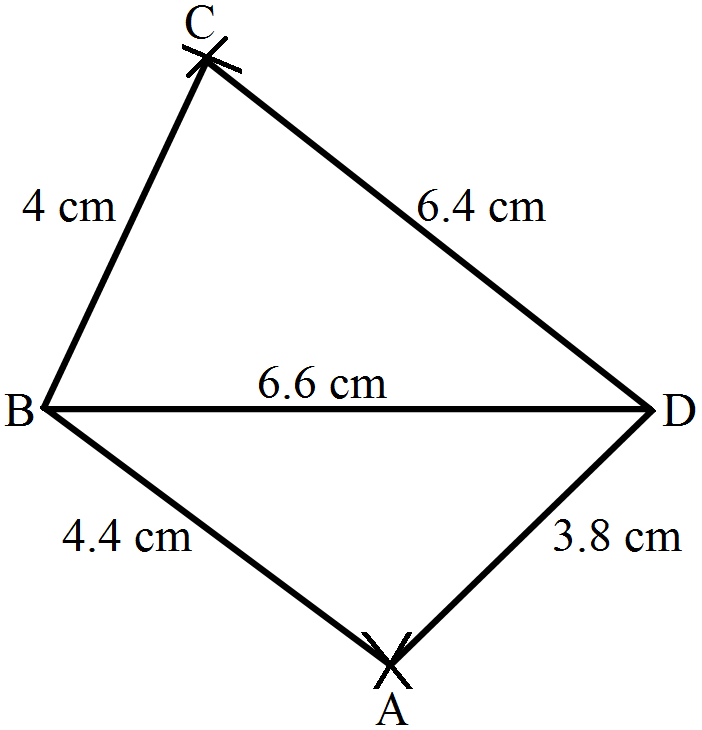
First, we draw a rough sketch of the quadrilateral $ABCD$ and write down its dimensions along the sides.
We may divide the quadrilateral into two constructible triangles $ABD$ and $BCD$.
Steps of Construction:
Step I: Draw $BD = 6.6\ cm$
Step II: With $B$ as the centre and radius $BC = 4\ cm$, draw an arc.
Step III: With $D$ as the centre and radius $6.4\ cm$, draw an are to intersect th are drawn in Step $II$ at $C$.
Step IV: With $B$ as the centre and radius $4.4\ cm$, draw an arc on the side $BD$ opposite to that of $C$.
Step V: With $D$ as the centre and radius $3.8\ cm$, draw an arc to intersect the arc drawn in Step $IV$ at $A$.
Step VI: Join $BA, DA, BC$ and $CD$ The quadrilateral $ABCD$ so obtained is the required quadrilateral. View full question & answer→Question 25 Marks
Construct a parallelogram $PQRS$ such that $PQ = 5.2\ cm, PR = 6.8\ cm$ and $QS = 8.2\ cm$.
Answer
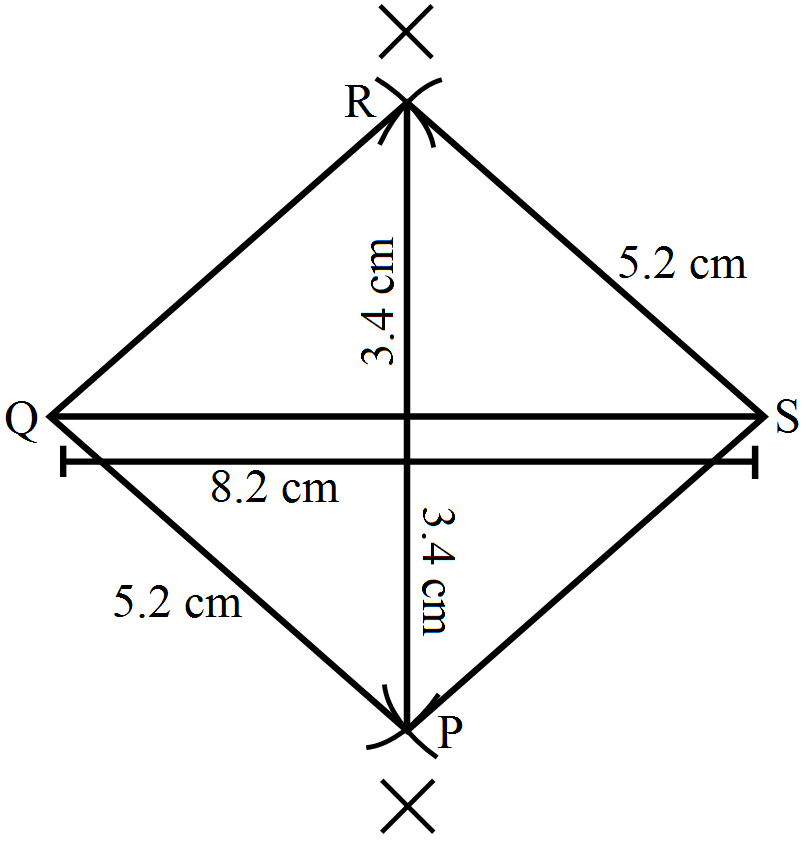
In a parallelogram opposite sides are equal.
Thus, we have to construct a quadrilateral $PQRS$ in which $PQ = 5.2\ cm, PR = 6.8\ cm$ and $QS = 8.2\ cm$.
Steps of construction:
Step $I$: Draw $QS = 8.2\ cm$
Step $II$: With $Q$ as the centre and radius $5.2\ cm$, draw an arc.
Step $III$: With $S$ as the centre and radius $5.2\ cm$, draw an arc to intersect the arc drawn in Step $II$ at $C$.
Step $IV$: With $P$ as the centre and radius $6.8\ cm$.
Step $V$: With $Q$ as the centre and radius $5.2\ cm$, draw an arc to intersect the arc drawn in Step $IV$ at $A$.
Step $VI$: Join $QR, QP, PS$ and $SR$.
The quadrilateral $PQRS$ so obtained is the required quadrilateral. View full question & answer→Question 35 Marks
Construct a quadrilateral $XYZW$ in which $XY = 5\ cm , YZ = 6\ cm , ZW = 7\ cm , WX = 3\ cm $ and $XZ = 9\ cm $.
Answer
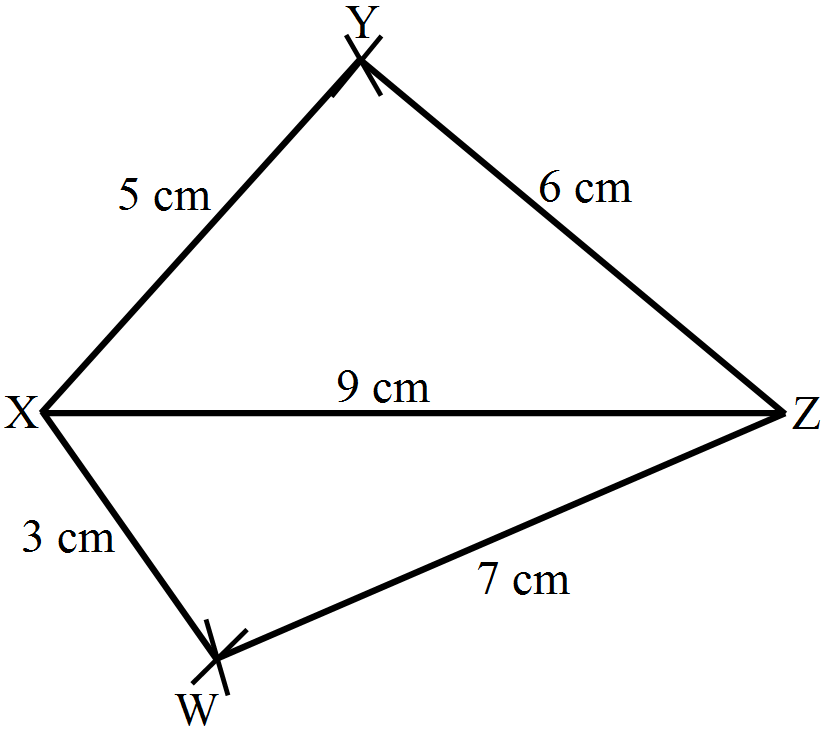
Steps of construction:
Step $I$: Draw $XZ = 9\ cm$.
Step $II$: With $X$ as the centre and radius $5\ cm$, draw an arc above $XZ$.
Step $III$: With $Z$ as the centre and radius $6\ cm$, draw an arc to intersect the arc drawn in Step II at $Y$ above $XZ$.
Step $IV$: With $Z$ as the centre and radius $7\ cm$, draw an arc below $XZ$.
Step $V$: With $X$ as the centre and radius $3\ cm$, draw an arc to intersect the arc drawn in Step $IV$ at $W$ below $XZ$.
Step $VI$: Join $XY, YZ, ZW$ and $XW$.
The quadrilateral WXYZ so obtained is the required quadrilateral. View full question & answer→Question 45 Marks
Construct a quadrilateral $ABCD$ such that $AB = BC = 5.5\ cm CD = 4\ cm , DA = 6.3\ cm $ and $AC = 9.4\ cm $ Measure $BD$.
Answer
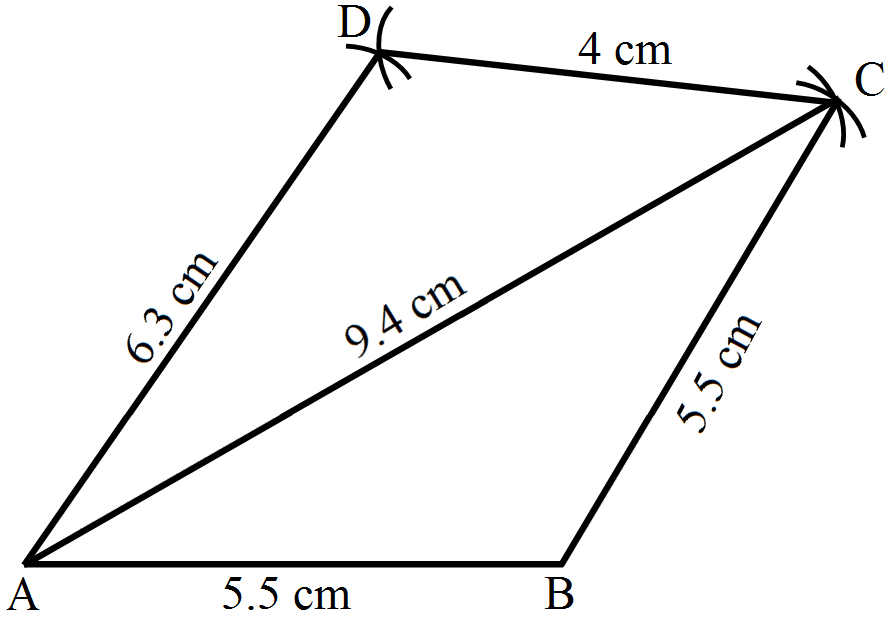
Steps of construction:
Step $I$: Draw $AB = 5.5\ cm$
Step $II$: With $B$ as the centre and radius $BC = 5.5\ cm$, draw an arc.
Step $III$: With $A$ as the centre and radius $AC = 9.4\ cm$, draw an arc to intersect the arc drawn in Step $II$ at $C$.
Step $IV$: With $C$ as the centre and radius $CD = 4\ cm$, draw an arc.
Step $V$: With $A$ as the centre and radius $AD = 6.3 \ cm$, draw an arc to intersect the arc drawn in Step $IV$ at $D$.
Step $VI$: Join $DA, BC, AC$ and $CD$.
The quadrilateral $ABCD$ so obtained is the required quadrilateral. View full question & answer→Question 55 Marks
Construct a quadrilateral $ABCD$ in which $AB = BC = 3\ cm, AD = CD = 5\ cm$, and $\angle\text{B}=120^\circ.$
Answer
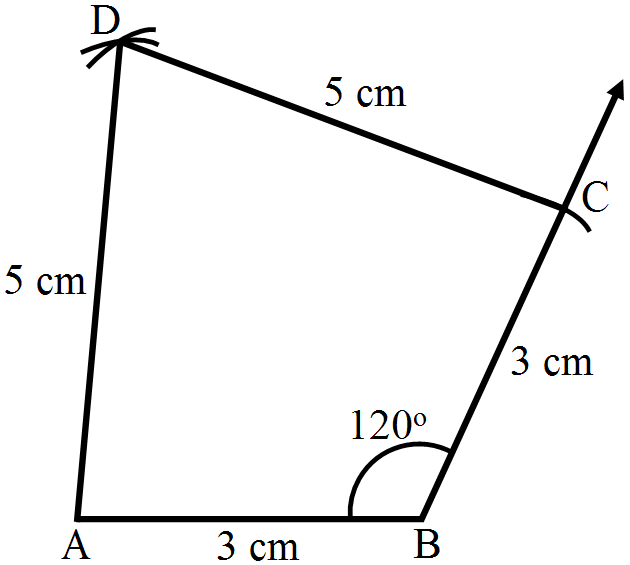
Steps of construction:
Step $I$: Draw $AB = 3\ cm.$
Step $II$: Construct $\angle\text{ABC}=120^\circ.$
Step $III$: With $B$ as the centre and radius $3\ cm$, cut off $BC = 3\ cm$.
Step $IV$: With $C$ as the centre and radius $5\ cm$, draw an arc.
Step $V$: With $A$ as the centre and radius $5\ cm$, draw an arc to intersect the arc drawn in Step $IV$ at $D$.
Step $VI$: Join $AD$ and $CD$ to obtain the required quadrilateral. View full question & answer→Question 65 Marks
Construct a quadrilateral $ABCD$ in which $AB = 7.7\ cm, BC = 6.8\ cm, CD = 5.1\ cm, AD = 3.6\ cm$ and $\angle\text{C}=120^\circ.$
Answer
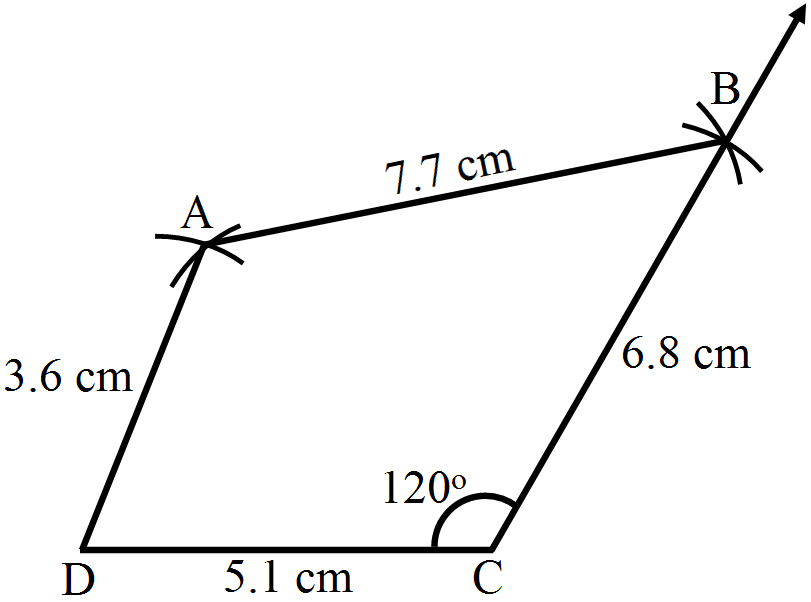
Steps of construction:
Step $I$: Draw $DC = 5.1\ cm$.
Step $II$: Construct $\angle\text{DCB}=120^\circ.$
Step $III$: With $C$ as the centre and radius $6.8\ cm$, cut off $BC = 6.8\ cm$.
Step $IV$: With $B$ as the centre and radius $7.7\ cm$, draw an arc.
Step $V$: With $D$ as the centre and radius $3.6\ cm$, draw an arc to intersect the arc drawn in Step $IV$ at $A$.
Step $VI$: Join $AB$ and $AD$ to obtained the required quadrilateral. View full question & answer→Question 75 Marks
Construct a quadrilateral $BDEF$, where $DE = 4.5\ cm, EF = 3.5\ cm, FB = 6.5\ cm$, $\angle\text{F}=50^\circ$ and $\angle\text{E}=100^\circ.$
Answer
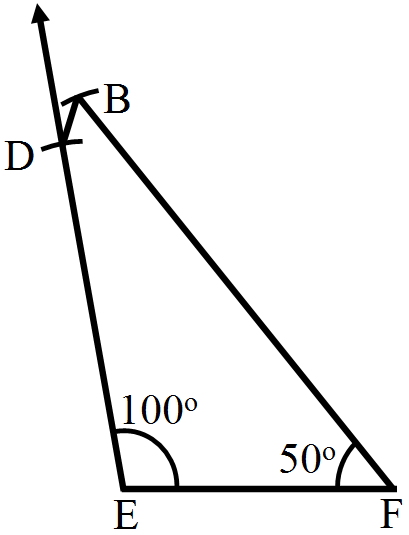
Steps of construction:
Step $I$: Draw $EF = 3.5\ cm$.
Step $II$: Construct $\angle\text{DEF}=100^\circ$ at $E$.
Step $III$: With $E$ as the centre and radius $4.5\ cm$, cut off $DE = 4.5\ cm$.
Step $IV$: Construct $\angle\text{EFB}=50^\circ$ at F.
Step $V$: With $F$ as the centre and radius $6.5\ cm$, cut off $FB = 6.5\ cm$.
Step $VI$: Join $BD$.
The quadrilateral so obtained is the required quadrilateral. View full question & answer→Question 85 Marks
Construct a quadrilateral $PQRS$, in which $PQ = 3.5\ cm, QR = 2.5\ cm, RS = 4.1\ cm$, $\angle\text{Q}=75^\circ$ and $\angle\text{R}=120^\circ.$
Answer
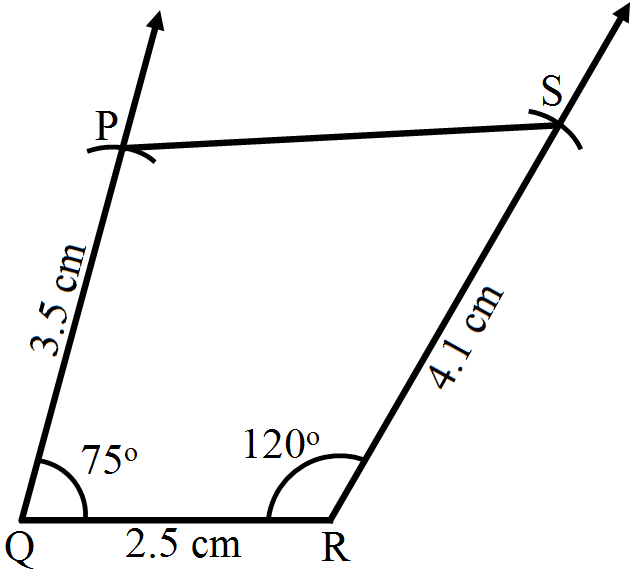
Steps of construction:
Step $I$: Draw $QR = 2.5\ cm$.
Step $II$: Construct $\angle\text{PQr}=75^\circ$ at $Q$.
Step $III$: With $Q$ as the centre and radius $3.5\ cm$, cut off $QP = 3.5\ cm$.
Step $IV$: Construct $\angle\text{QRS}=120^\circ$ at $R$.
Step $V$: With $R$ as the centre and radius $4.1\ cm$, cut off $RS = 4.1\ cm$.
Step $VI$: Join $PS$.
The quadrilateral so obtained is the required quadrilateral. View full question & answer→Question 95 Marks
Construct a quadrilateral $ABCD$ in which $AB = 3.8\ cm, BC = 3.4\ cm, CD = 4.5\ cm, AD = 5\ cm$ and $\angle\text{B}=80^\circ.$
Answer
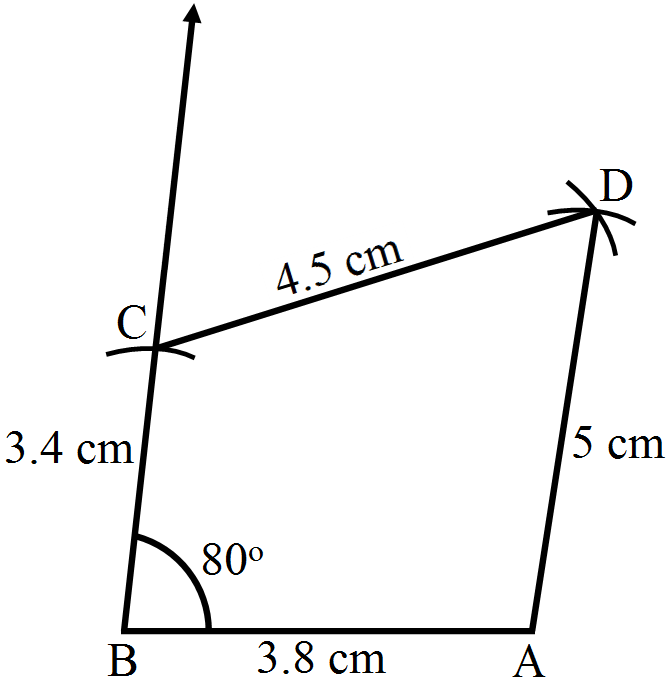
Steps of construction:
Step $I$: Draw $AB = 3.8\ cm$.
Step $II$: Construct $\angle\text{ABC}=80^\circ.$
Step $III$: With $B$ as the centre and radius $3.4\ cm$, cut off $BC = 3.4\ cm$.
Step $IV$: With $C$ as the centre and radius $4.5\ cm$, draw an arc.
Step $V$: With $A$ as the centre and radius $5.3\ cm$, draw an arc to intersect the arc drawn in Step $IV$ at $D$.
Step $VI$: Join $AD, BC$ and $CD$ to obtain the required quadrilateral. View full question & answer→Question 105 Marks
Construct a quadrilateral $ABCD$, in which $AB = 6\ cm, BC = 4\ cm, CD = 4\ cm$, $\angle\text{B}=95^\circ$ and $\angle\text{C}=90^\circ.$
Answer
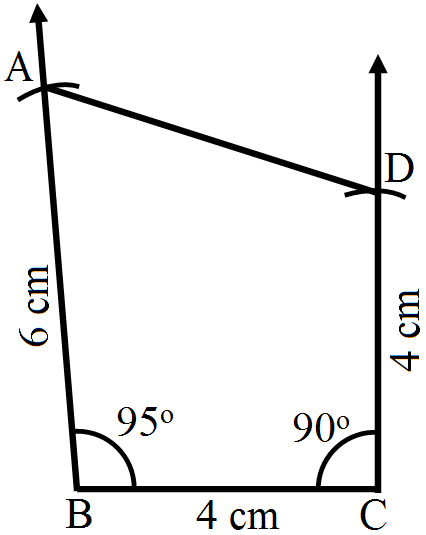
Steps of construction:
Step $I$: Draw $BC = 4\ cm$.
Step $II$: Construct $\angle\text{ABC}=95^\circ$ at $B$.
Step $III$: With $B$ as the centre and radius $6\ cm$, cut off $BA = 6\ cm$.
Step $IV$: Construct $\angle\text{BCD}=90^\circ$ at $C$.
Step $V$: With $C$ as the centre and radius $4\ cm$, cut off $BA = 4\ cm$.
Step $VI$: Join $CD$.
The quadrilateral so obtained is the required quadrilateral. View full question & answer→Question 115 Marks
Construct a quadrilateral $ABCD$ in which $AB = 3.8\ cm, BC = 3.0\ cm, AD = 2.3\ cm, AC = 4.5\ cm$ and $BD = 3.8\ cm$.
Answer
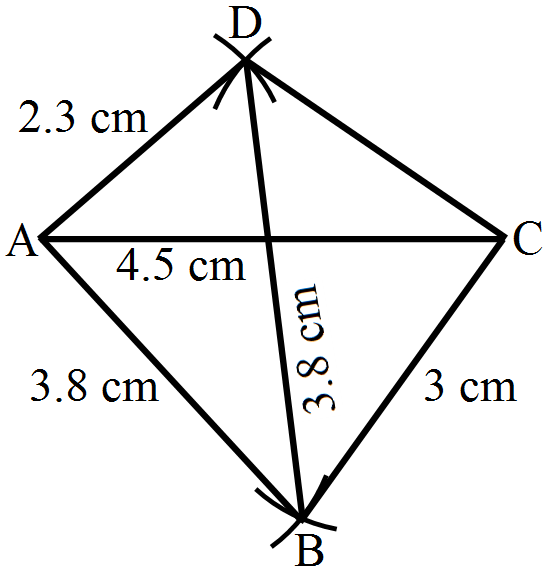
Steps of construction:
Step $I$: Draw $AC = 6\ cm$.
Step $II$: With A as the centre and radius $3.8\ cm$, draw an arc.
Step $III$: With $C$ as the centre and radius $3.0\ cm$, draw an arc to intersect the arc drawn in Step $II$ at $B$.
Step $IV$: With $B$ as the centre and radius $3.8\ cm$, draw an arc on the other side of $AC$.
Step $V$: With A as the centre and radius $2.3\ cm$, draw an arc to intersect the arc drawn in Step $IV$ at $D$.
Step $VI$: Join $BA, DA, BC$ and $CD$ to obtain the required quadrilateral. View full question & answer→Question 125 Marks
Construct, if possible, a quadrilateral $ABCD$ given $AB = 6\ cm, BC = 3.7\ cm, CD = 5.7\ cm, AD = 5.5\ cm$ and $BD = 6.1\ cm$. Give reasons for not being able to construct it, if you cannot.
Answer
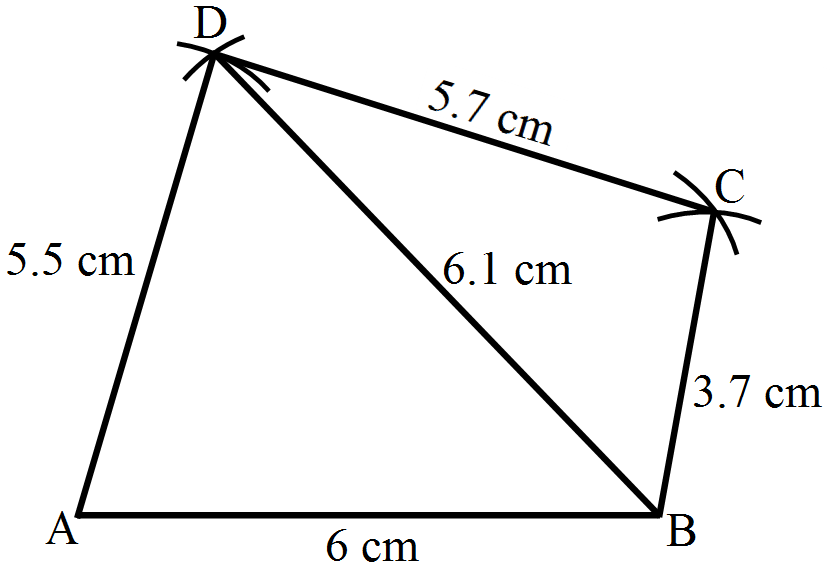
Steps of construction:
Step $I$: Draw $AB = 6\ cm$.
Step $II$: With $A$ as the centre and radius $5.5\ cm$, draw an arc.
Step $III$: With $B$ as the centre and radius $6.1\ cm$, draw an arc to intersect th arc drawn in Step $II$ at $D$.
Step $IV$: With $B$ as the centre and radius $3.7\ cm$, draw an arc on the side.
Step $V$: With $D$ as the centre and radius $5.7\ cm$, draw an arc to intersect the arc drawn in Step $IV$ at $C$.
Step $VI$: Join $BD, DA, BC$ and $CD$. The quadrilateral $ABCD$ so obtained is the required quadrilateral. View full question & answer→Question 135 Marks
Construct a quadrilateral $PQRS$, where $PQ = 3.5\ cm, QR = 6.5\ cm$, $\angle\text{P}=\angle\text{R}=105^\circ$ and $\angle\text{S}=75^\circ$
Answer
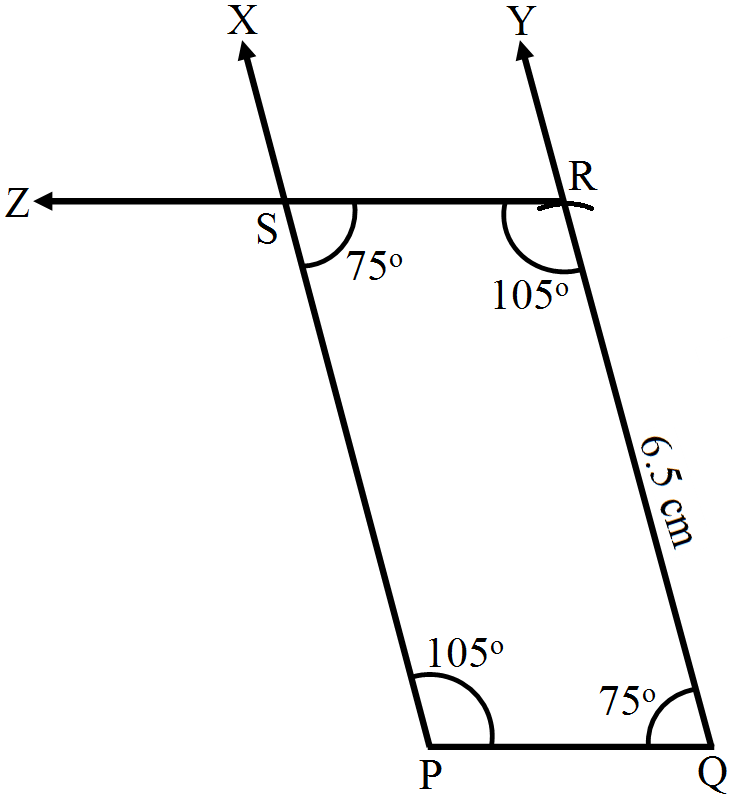
We know that the sum of all the angles in a quadrilateral is $360$.
i.e., $\angle\text{P}+\angle\text{Q}+\angle\text{R}+\angle\text{S}+360^\circ$
$\Rightarrow\angle\text{Q}=75^\circ$
Steps of construction:
Step $I$: Draw $PQ = 3.5\ cm$.
Step $II$: Construct $\angle\text{XPQ}=105^\circ$ at $P$ and $\angle\text{PQY}=75^\circ$ at $Q$.
Step $III$: With $Q$ as the centre and radius $6.5\ cm$, cut off $QR = 6.5$
Step $IV$: At $R$, draw $\angle\text{QRZ}=105^\circ$ such that it meets $PX$ at $S$.
The quadrilateral so obtained is the required quadrilateral. View full question & answer→Question 145 Marks
Construct a quadrilateral PQRS, in which $\angle\text{PQR}=45^\circ,$ $\angle\text{QRS}=90^\circ,$ $QR = 5\ cm, PQ = 9\ cm$ and $Rs = 7\ cm.$
Answer
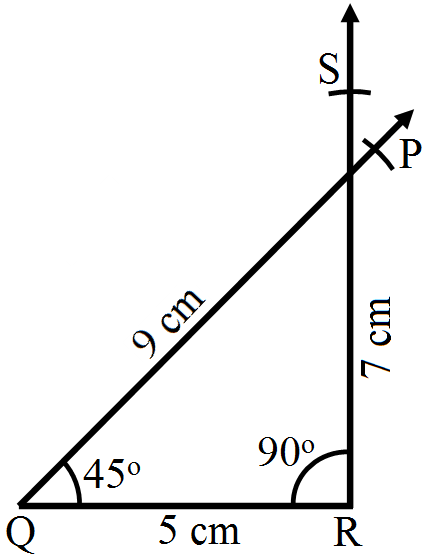
Steps of construction:
Step $I$: Draw $QR = 5\ cm.$
Step $II$: Construct $\angle\text{PQR}=45^\circ$ at $Q$.
Step $III$: With $Q$ as the centre and radius $9\ cm$, cut off $QP = 9\ cm$.
Step $IV$: Construct $\angle\text{QRS}=90^\circ$ at $R$.
Step $V$: With $R$ as the centre and radius $7\ cm$, cut off $RS = 7\ cm.$ Since, the line segment $PQ$ and $RS$ intersect each other, the quadrilateral cannot be constructed. View full question & answer→Question 155 Marks
Construct a quadrilateral $ABCD$ in which $AB = 2.8\ cm, BC = 3.1\ cm, CD = 2.6\ cm,$ and $DA = 3.3\ cm$ and $\angle\text{A}=60^\circ.$
Answer
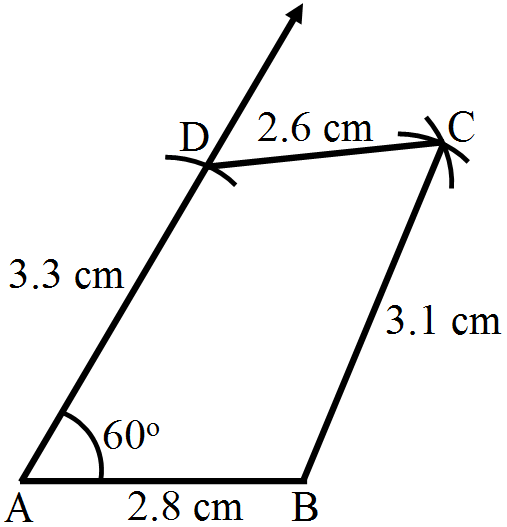
Steps of construction:
Step $I$: Draw $AB = 2.8\ cm$.
Step $II$: Construct $\angle\text{BAD}=60^\circ.$
Step $III$: With $A$ as the centre and radius $3.3\ cm$, cut off $AD = 3.3\ cm$.
Step $IV$: With $D$ as the centre and radius $2.6\ cm$, draw an arc.
Step $V$: With $B$ as the centre and radius $3.1\ cm$, draw an arc to intersect the arc drawn in Step $IV$ at $C$.
Step $VI$: Join $BC$ and $CD$ to obtained the required quadrilateral. View full question & answer→Question 165 Marks
Construct a quadrilateral $ABCD$, in which $AB = BC = 3\ cm, AD = 5\ cm,$ $\angle\text{A}=90^\circ$ and $\angle\text{B}=105^\circ.$
Answer
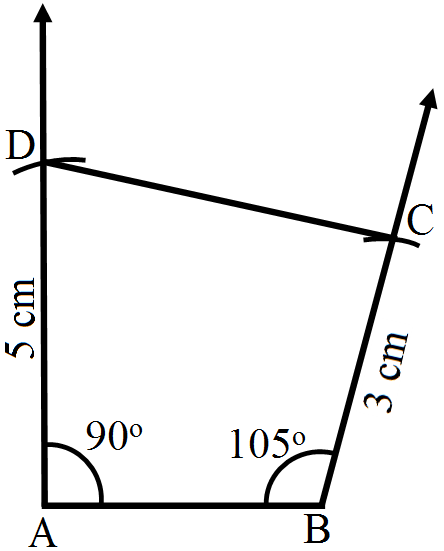
Steps of construction:
Step $I$: Draw $AB = 3\ cm$.
Step $II$: Construct $\angle\text{DAB}=90^\circ$ at $A$.
Step $III$: With $A$ as the centre and radius $5\ cm$, cut off $AD = 5\ cm$.
Step $IV$: Construct $\angle\text{ABC}=105^\circ$ at B.
Step $V$: With $B$ as the centre and radius $3\ cm$, cut off $BC = 3\ cm$.
Step $VI$: Join $CD$.
The quadrilateral so obtained is the required quadrilateral. View full question & answer→Question 175 Marks
Construct a quadrilateral $ABCD$, given that $AB = 8\ cm, BC = 8\ cm, CD = 10\ cm, AD = 10 \ cm$ and $\angle\text{A}=45^\circ.$
Answer
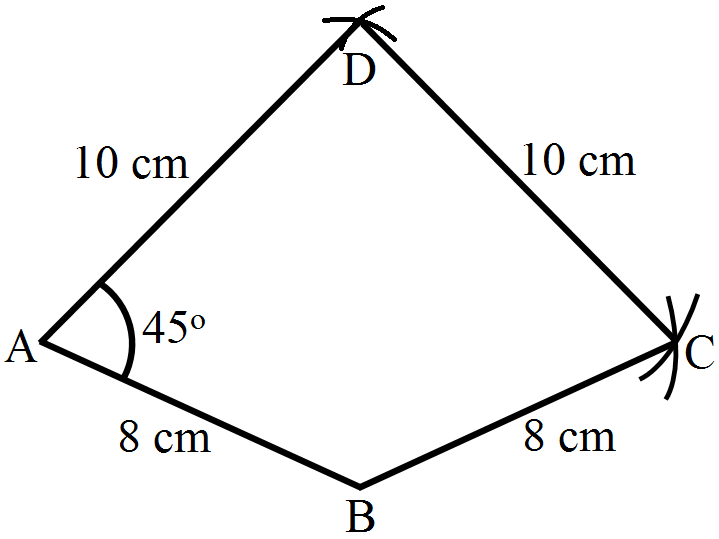
Steps of Construction:
Step $I$: Draw $AB = 8\ cm$.
Step $II$: Construct $\angle\text{BAD}=45^\circ.$
Step $III$: With $A$ as the centre and radius $10\ cm$, cut off $AD = 10\ cm$.
Step $IV$: With $D$ as the centre and radius $10\ cm$, draw an arc.
Step $V$: With $B$ as the centre and radius $8\ cm$, draw an arc to intersect the arc drawn in Step $IV$ at $C$.
Step $VI$: Join $BC$ and $CD$ to obtained the required quadrilateral. View full question & answer→Question 185 Marks
Construct a rhombus with side $6\ cm$ and one diagonal $8\ cm$. Measure the other diagonal.
Answer
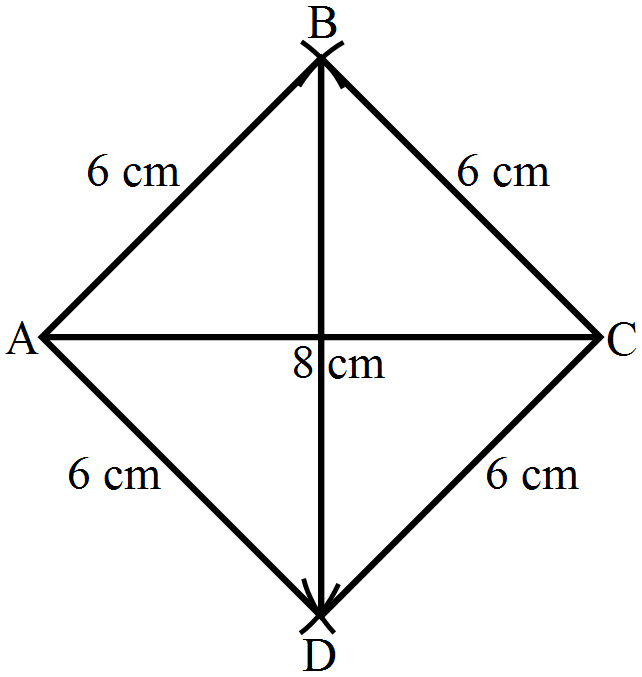
Steps of construction:
Step $1$: Draw $AC = 8\ cm$.
Step $2$: With $A$ as the centre and radius $= 6\ cm$, draw arcs on both sides.
Step $3$: With $C$ as the centre and radius $= 6\ cm$, draw arcs on both sides, intersecting the previous arcs at points $B$ and $D$.
Step $4$: Join $BD = 8.9\ cm$. Thus, $ABCD$ is the required rhombus. View full question & answer→Question 195 Marks
Construct a quadrilateral $ABCD$ in which $AB = BC = 6\ cm, AD = DC = 4.5\ cm$ and $\angle\text{B}=120^\circ.$
Answer
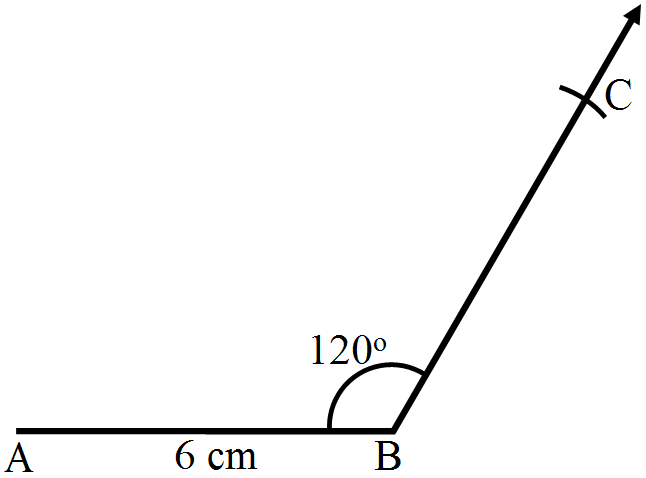
Steps of construction:
Step $I$: Draw $AB = 6\ cm$.
Step $II$: Construct $\angle\text{ABC}=120^\circ.$
Step $III$: With B as the centre and radius $6\ cm$, cut off $BC = 6\ cm$. Now, we can see that $AC$ is about $10.3\ cm$ which is greater than $AD + CD = 4.5 + 4.5 = 9\ cm$.
We know that sum of the lengths of two sides of triangle is always greater than the third side but here, the sum of $AD$ and $CD$ is less than $AC$.
So, construction of the given quadrilateral is not possible. View full question & answer→Question 205 Marks
Construct a quadrilateral $ABCD,$ where$\angle\text{A}=65^\circ,\text{B}=105^\circ,\text{C}=75^\circ,$ $BC = 5.7$ and $CD = 6.8\ cm$.
Answer
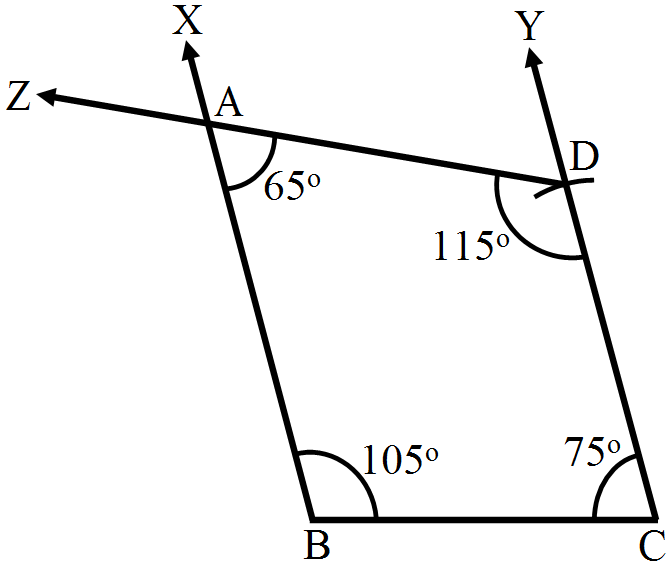
We know that the sum of all the angles in a quadrilateral is $360$.
i.e.,$\angle\text{A}+\angle\text{B}+\angle\text{C}+\angle\text{D}=360^\circ$
$\Rightarrow\angle\text{D}=115^\circ$
Steps of construction:
Step $I$: Draw $BC = 5.7\ cm$.
Step $II$: Construct $\angle\text{XBC}=105^\circ$ at $B$ and $\angle\text{BCY}=105^\circ$ at $C$.
Step $III$: With $C$ as the centre and radius $6.8\ cm$, cut off $CD = 6.8\ cm$.
Step $IV$: At $D$, draw $\angle\text{CDZ}=115^\circ$ such that it meets $BY$ at $A$.
The quadrilateral so obtained is the required quadrilateral. View full question & answer→Question 215 Marks
Construct a quadrilateral $ABCD$ given $AD = 3.5\ cm, BC = 2.5\ cm, CD = 4.1\ cm, AC = 7.3\ cm$ and $BD = 3.2\ cm$.
Answer
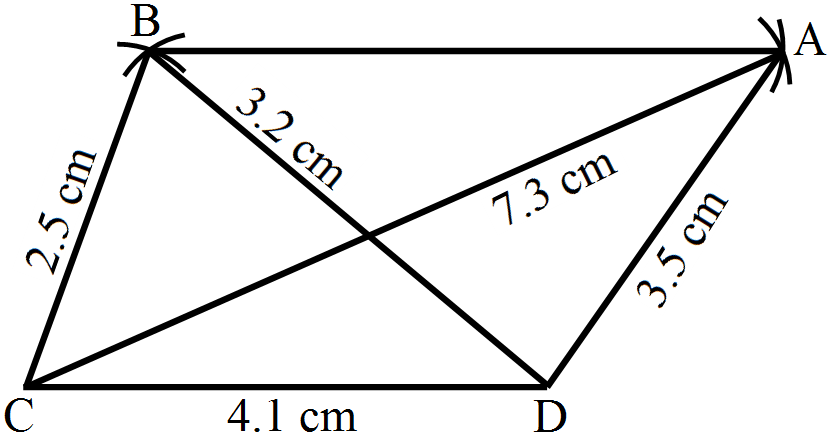
Steps of construction:
Step I: Draw $CD = 4.1\ m$.
Step II: With $C$ as the centre and radius $7.3\ cm$, draw an arc.
Step III: With $D$ as the centre and radius $3.5\ cm$, draw an arc to intersect the arc drawn in Step $II$ at $A$.
Step IV: With $D$ as the centre and radius $3.2\ cm$, draw an arc on the other side of $AC$.
Step V: With $C$ as the centre and radius $2.5\ cm$, draw an arc to intersect the arc drawn in Step $IV$ at $B$.
Step VI: Join $BA, DA, BC$ and $BD$ and $AC$ to obtain the required quadrilateral. View full question & answer→Question 225 Marks
Construct a quadrilateral $ABCD$, where $AB = 5.5\ cm, BC = 3.7\ cm,$$\angle\text{A}=60^\circ,$ $\angle\text{B}=105^\circ$ and $\angle\text{D}=90^\circ$
Answer
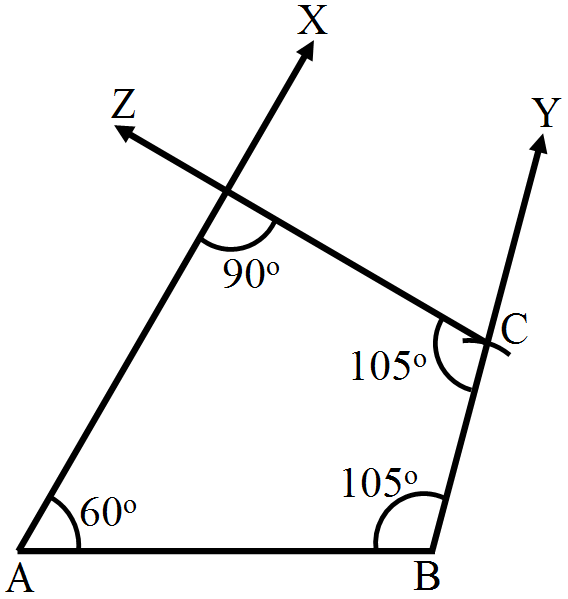
We know that the sum of all the angles in a quadrilateral is $360$.
i.e., $\angle\text{A}+\angle\text{B}+\angle\text{C}+\angle\text{D}=360^\circ$
$\Rightarrow\angle\text{C}=105^\circ$
Steps of construction:
Step $I$: Draw $AB = 5.5\ cm$.
Step $II$: Construct $\angle\text{XAB}=60^\circ$ at $A$ and $\angle\text{ABY}=105^\circ.$
Step $III$: With $B$ as the centre and radius $3.7\ cm$, cut off $BC = 3.7\ cm$.
Step $IV$: At $C$, draw $\angle\text{BCZ}=105^\circ$ such that it meets $AX$ at $D$.
The quadrilateral so obtained is the required quadrilateral. View full question & answer→Question 235 Marks
Construct a quadrilateral $ABCD$, where $AB = 4.2\ cm, BC = 3.6\ cm, CD = 4.8\ cm$, $\angle\text{B}=30^\circ$ and $\angle\text{C}=150^\circ.$
Answer
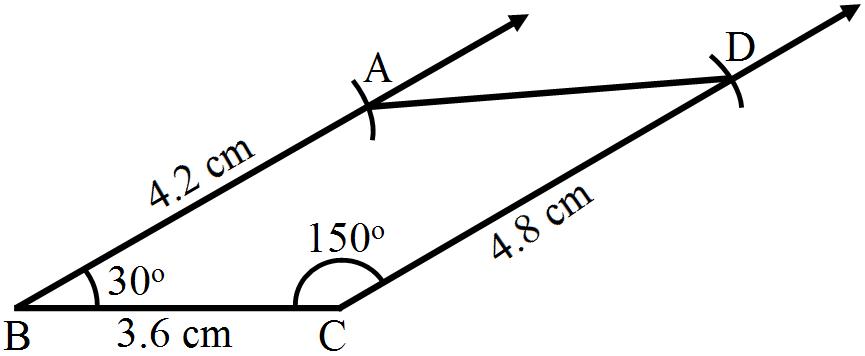
Steps of construction:
Step $I$: Draw $BC = 3.6\ cm$.
Step $II$: Construct $\angle\text{ABC}=30^\circ$ at $B$.
Step $III$: With $B$ as the centre and radius $4.2\ cm$, cut off $BA = 4.2\ cm$.
Step $IV$: Construct $\angle\text{BCD}=150^\circ$ at $C$.
Step $V$: With $C$ as the centre and radius $4.8\ cm$, cut off $CD = 4.8\ cm$.
Step $VI$: Join $AD$.
The quadrilateral so obtained is the required quadrilateral. View full question & answer→Question 245 Marks
Construct a kite $ABCD$ in which $AB = 4\ cm, BC = 4.9\ cm$ and $AC = 7.2\ cm$.
Answer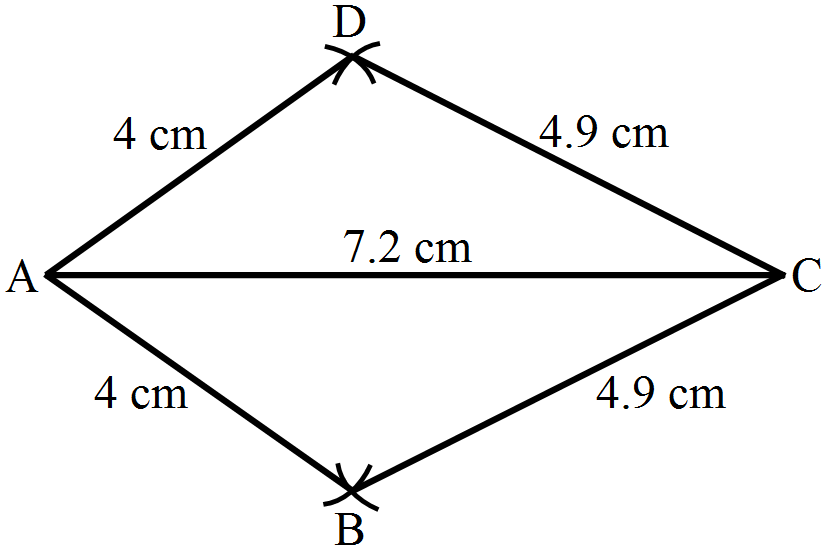
Steps of construction:
Step $I$: Draw $AC = 7.2\ cm$.
Step $II$: With $A$ as the centre and radius $4\ cm$, draw arcs on both sides of the line segment $AC$.
Step $III$: With $C$ as the centre and radius $4.9\ cm$, draw arcs on both sides of $AC$ intersecting the previous arcs of step $II$ at $B$ and $D$.
Step $IV$: Join $BA, DA, BC$ and $CD$. Thus, the quadrilateral $ABCD$ so obtained is the required kite. View full question & answer→Question 255 Marks
Construct a quadrilateral $ABCD$ given $BC = 6.6\ cm, CD = 4.4\ cm, AD = 5.6\ cm$ and $\angle\text{C}=100^\circ$ and $\angle\text{C}=95^\circ.$
Answer
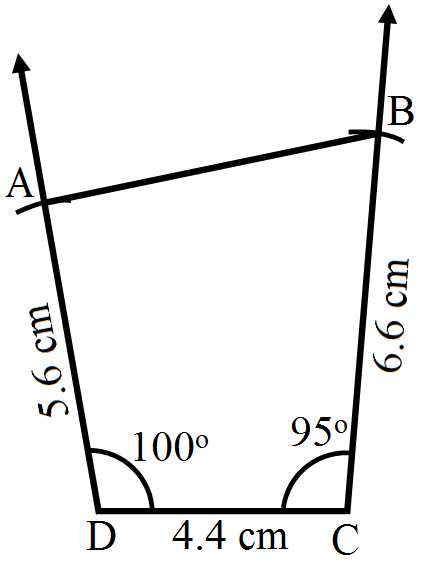
Steps of construction:
Step $I$: Draw $DC = 4.4\ cm$.
Step $II$: Construct $\angle\text{ADC}=100^\circ$ at $D$.
Step $III$: With $D$ as the centre and radius $5.6\ cm$, cut off $DA = 5.6\ cm.$
Step $IV$: Construct $\angle\text{BCD}=95^\circ$ at $C$.
Step $V$: With $C$ as the centre and radius $6.6\ cm$, cut off $CB = 6.6\ cm$.
Step $VI$: Join $AB$.
The quadrilateral so obtained is the required quadrilateral. View full question & answer→Question 265 Marks
Construct a quadrilateral $ABCD$, in which $AD = 3.5\ cm, AB = 4.4\ cm, BC = 4.7\ cm$, $\angle\text{A}=125^\circ.$ and $\angle\text{B}=120^\circ.$
Answer
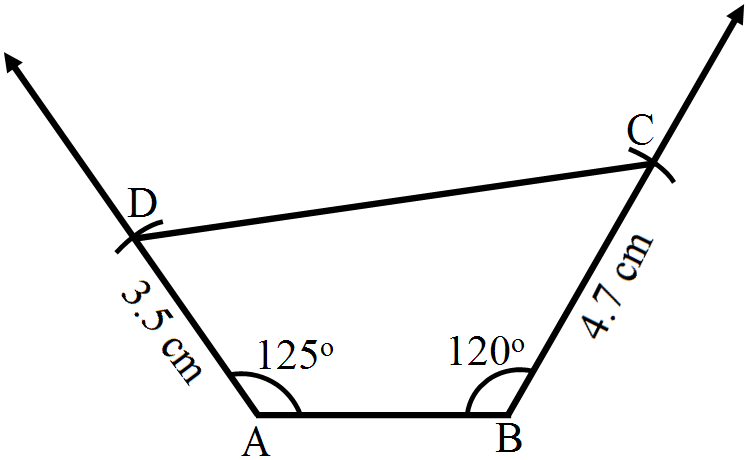
Steps of construction:
Step $I$: Draw $QR = 2.5\ cm$.
Step $II$: Construct $\angle\text{PQr}=75^\circ$ at $Q$.
Step $III$: With $Q$ as the centre and radius $3.5\ cm$, cut off $QP = 3.5\ cm$.
Step $IV$: Construct $\angle\text{QRS}=120^\circ$ at $R$.
Step $V$: With $R$ as the centre and radius $4.1\ cm$, cut off $RS = 4.1\ cm$.
Step $VI$: Join $PS$.
The quadrilateral so obtained is the required quadrilateral. View full question & answer→Question 275 Marks
Construct a quadrilateral $ABCD$ in which $BC = 4\ cm, CA = 5.6\ cm, AD = 4.5\ cm, CD = 5\ cm$ and $BD = 6.5\ cm$.
Answer
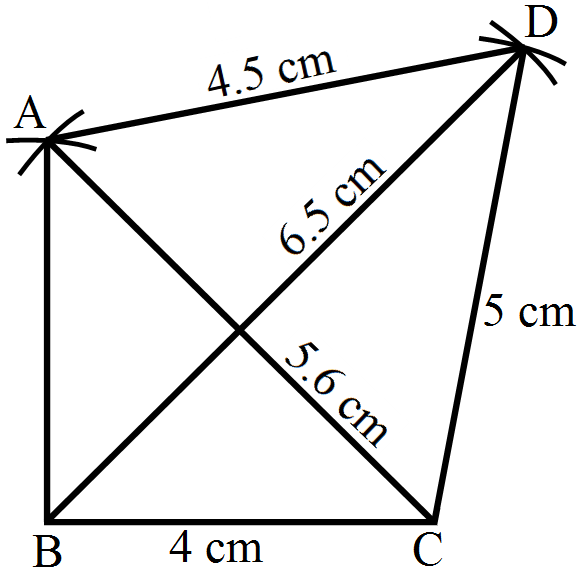
Steps of construction:
Step $I$: Draw $BC = 4\ cm$.
Step $II$: With $B$ as the centre and radius $6.5\ cm$, draw an arc.
Step $III$: With $C$ as the centre and radius $5\ cm$, draw an arc to intersect the arc drawn in Step $II$ at $D$.
Step $IV$: With $C$ as the centre and radius $5.6\ cm$, draw an arc on the same side.
Step $V$: With $D$ as the centre and radius $4.5\ cm$, draw an arc to intersect the arc drawn in Step $IV$ at $A$.
Step $VI$: Join $BA, AC, DA, BD$ and $CD$ to obtained the required quadrilateral. View full question & answer→Question 285 Marks
Construct a quadrilateral $ABCD$ in which $BC = 7.5\ cm, AC = AD = 6\ cm, CD = 5\ cm$ and $BD = 10\ cm$.
Answer
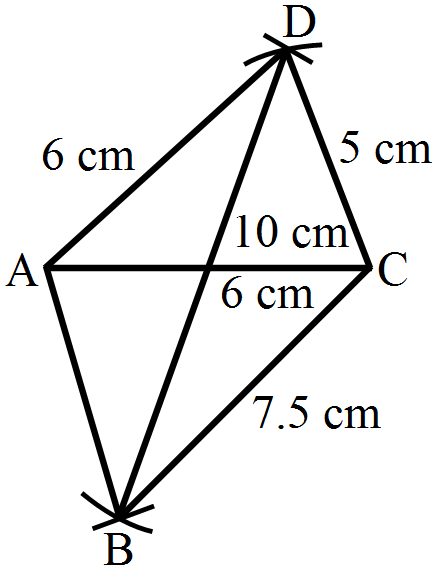
Steps of construction:
Step $I$: Draw $AC = 6\ cm$.
Step $II$: With $A$ as the centre and radius $6\ cm$, draw an arc.
Step $III$: With $C$ as the centre and radius $5\ cm$, draw an arc to intersect the arc drawn in Step $II$ at $D$.
Step $IV$: With $D$ as the centre and radius $10\ cm$, draw an arc on the other side of the line segment $AC$.
Step $V$: With $C$ as the centre and radius $7.5\ cm$, draw an arc to intersect the arc drawn in Step $IV$ at $B$.
Step $VI$: Join $BA, DA, BC$ and $CD$ to obtained the required quadrilateral. View full question & answer→Question 295 Marks
Construct a quadrilateral $PQRS$, in which $PQ = 4\ cm, QR = 5\ cm$, $\angle\text{P}=50^\circ,\angle\text{P}=110^\circ$ and $\angle\text{R}=70^\circ.$
Answer
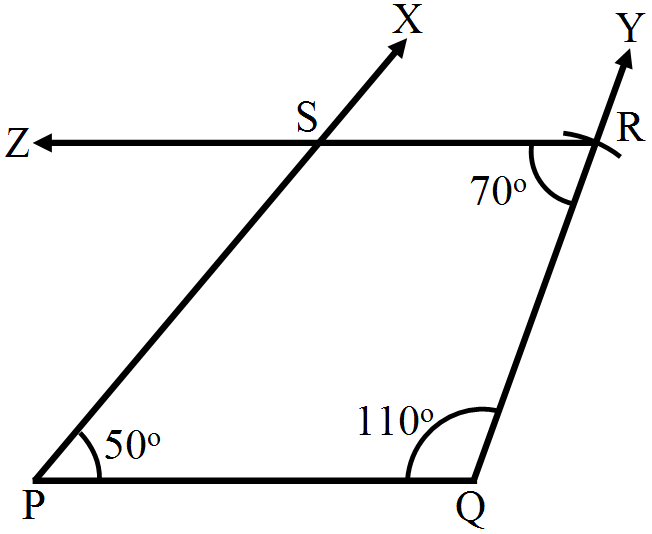
Steps of construction:
Step $I$: Draw $PQ = 4\ cm$.
Step $II$: Construct $\angle\text{XPQ}=50^\circ$ at $P$ and $\angle\text{PQY}=110^\circ$ at $Q$.
Step $III$: With $Q$ as the centre and radius $5\ cm$, cut off $QR = 5\ cm$.
Step $IV$: At $R$, draw $\angle\text{QRZ}=70^\circ$ such that it meets $PX$ at $S$.
The quadrilateral so obtained is the required quadrilateral. View full question & answer→Question 305 Marks
Construct a quadrilateral $ABCD$ given $AD = 5\ cm, AB = 5.5\ cm, BC = 2.5\ cm, AC = 7.1\ cm$ and $BD = 8\ cm$.
Answer
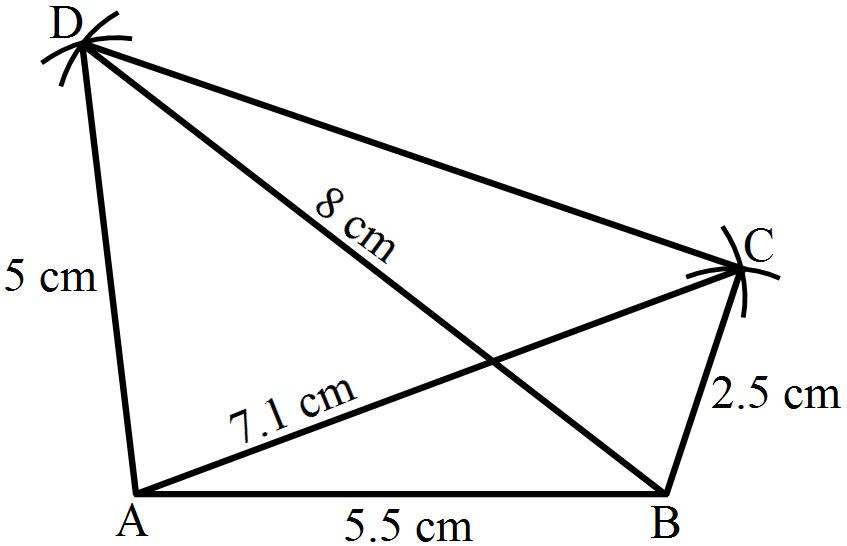
Steps of construction:
Step $I$: Draw $AB = 5.5\ cm$.
Step $II$: With $A$ as the centre and radius $7.1\ cm$, draw an arc.
Step $III$: With $B$ as the centre and radius $2.5\ cm$, draw an arc to intersect the arc drawn in Step $II$ at $C$.
Step $IV$: With $B$ as the centre and radius $8\ cm$, draw an arc.
Step $V$: With $A$ as the centre and radius $5\ cm$, draw an arc to intersect the arc drawn in Step $IV$ at $D$.
Step $VI$: Join $DA, DB, BC, AC$ and $CD$ to obtain the required quadrilateral. View full question & answer→Question 315 Marks
Construct a quadrilateral $ABCD$ when $BC = 5.5\ cm, CD = 4.1\ cm$, $\angle\text{A}=70^\circ,\text{AB}=110^\circ$ and $\angle\text{D}=85^\circ.$
Answer
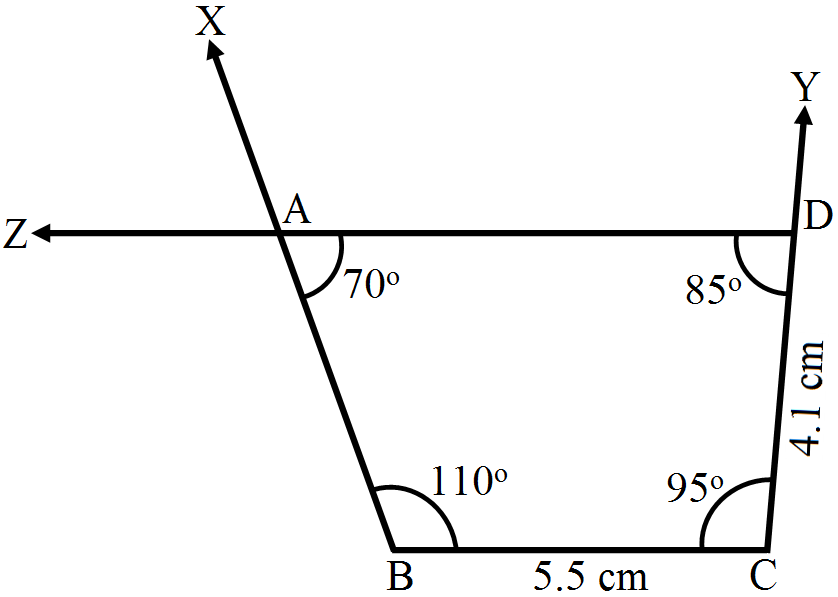
We know that the sum of all the angles in a quadrilateral is $360$.
i.e.,$\angle\text{A}+\angle\text{B}+\angle\text{C}+\angle\text{D}=360^\circ$
$\Rightarrow\angle\text{C}=95^\circ$
Steps of construction:
Step $I$: Draw $BC = 5.5\ cm$.
Step $II$: Construct $\angle\text{XBC}=110^\circ$ at A and $\angle\text{BCY}=95^\circ$
Step $III$: With $C$ as the centre and radius $4.1\ cm$, cut off $CD = 4.1\ cm$.
Step $IV$: At $D$, draw $\angle\text{CDZ}=85^\circ$ such that it meets $BY$ at $A$.
The quadrilateral so obtained is the required quadrilateral. View full question & answer→