MCQ 11 Mark
A symbol having a fixed value is called a $.........$
AnswerA symbol of having a fixed value is called a constant.
Ex. Any natural number, whole number, integers, rational number.
A symbol having the variable values is called variable.
View full question & answer→MCQ 21 Mark
If $\text{x}+\frac{1}{\text{x}}=3,$ then $\text{x}^6+\frac{1}{\text{x}^6}=$
Answer$\Big(\text{x}+\frac{1}{\text{x}}\Big)^2=\text{x}^2+\frac{1}{\text{x}^2}+2$
$\text{x}+\frac{1}{\text{x}}=3$ (given)
$\Rightarrow\text{x}^2+\frac{1}{\text{x}^2}=(3)^2-2$
$\Rightarrow\text{x}^2+\frac{1}{\text{x}^2}=7\ ...(1)$
Cubing both side of equation (1). we have
$\Big(\text{x}^2+\frac{1}{\text{x}^2}\Big)^3=(7)^3$
$\Rightarrow(\text{x}^2)^3+\Big(\frac{1}{\text{x}^2}\Big)^3+3(\text{x}^2)\frac{1}{\text{x}^2}\Big(\text{x}^2+\frac{1}{\text{x}^2}\Big)=7^3$
$\Rightarrow\text{x}^6+\frac{1}{\text{x}^6}+3(7)=7^3$
$\Rightarrow\text{x}^6+\frac{1}{\text{x}^6}=343-21$
$\Rightarrow\text{x}^6+\frac{1}{\text{x}^6}=322$
Hence, correct option is $(d).$
View full question & answer→MCQ 31 Mark
A polynomial containing one nonzero term is called a $.......$
AnswerA polynomial containing one nonzero term is called a monomial.
Example: $3 x, 5 x^2, y^3$
View full question & answer→MCQ 41 Mark
Which of the following polynomials has $(-3)$ as a zero$?$
- A
$x^2+3$
- B
$x^2-3 x$
- ✓
$x^2-9$
- D
$(x-3)$
AnswerCorrect option: C. $x^2-9$
$x^2-9$
$x^2-3^2$
$=(x+3)(x-3)\left[\text { Using identity } a^2-b^2=(a+b)(a-b)\right]$
Then the zeroes are $x + 3 = 0$ and $x - 3 = 0$
$\Rightarrow x = -3$ and $x = 3$
View full question & answer→MCQ 51 Mark
The value of the polynomial $5 x-4 x^2+3$, when $x = -1$ is:
Answer$5 x-4 x^2+3$
$=-4 x^2+5 x+3$
Putting $x = -1$ in the given polynomial, we get
$-4(-1)^2+5(-1)+3= -4 - 5 + 3$
$= -9 + 3$
$= -6$
View full question & answer→MCQ 61 Mark
If $(x+y)^3-(x-y)^3-6 y\left(x^2-y^2\right)=k y^2$, then $k=$
AnswerLet $x+y=A$ and $x-y=B$
Now, $(A-B)^3=A^3-B^3-3 A B(A-B)$
$\Rightarrow[(x+y)-(x-y)]^3=(x+y)^3-(x-y)^3-3(x+y)(x-y)[(x+y)-(x-y)]$
$=(x+y)^3-(x-y)^3-3\left(x^2-y^2\right)(2 y)$
$=(x+y)^3-(x-y)^3-6 y\left(x^2-y^2\right)$
But, $(x+y)^3-(x-y)^3-6 y\left(x^2-y^2\right)=k y^3$
$\Rightarrow[(x+y)-(x-y)]^3=(2 y)^3=k 8 y^3$
$\Rightarrow(2 y)^3=k y^3$
$\Rightarrow 8 y^3=k y^3$
$\Rightarrow k=8$
Hence, correct option is $(d).$
View full question & answer→MCQ 71 Mark
If $x + 2$ and $x - 1$ are the factor of $x^3+10 x^2+m x+n$, then the values of $m$ and $n$ are respectively.
- A
$5$ and $-3$
- ✓
$7$ and $-18$
- C
$23$ and $-19$
- D
$17$ and $-8$
AnswerCorrect option: B. $7$ and $-18$
It is given $(x+2)$ and $(x-1)$ are the factors of the polynomial $f(x)=x^3+10 x^2+m x+n$
i.e., $f(-2)=0$ and $f(1)=0$
New,
$f(-2)=(-2)^3+10(-2)^2+\mathrm{m}(-2)+\mathrm{n}=0$
$-8+40-2 \mathrm{~m}+\mathrm{n}=0$
$\Rightarrow-2 \mathrm{~m}+\mathrm{n}=-32$
$\Rightarrow 2 \mathrm{~m}-\mathrm{n}=32 \ldots . \text { (i) }$
$\mathrm{f}(1)=(1)^3+10(1)^2+\mathrm{m}(1)+\mathrm{n}=0$
$1+10+\mathrm{m}+\mathrm{n}=0$
$\mathrm{~m}+\mathrm{n}=-11 \ldots \text { (ii) }$
Solving equation $(i)$ and $(ii)$ we get,
$\mathrm{m}=7 \text { and } \mathrm{n}=-18$
View full question & answer→MCQ 81 Mark
The Zero of the polynomial $(x-2)^2-(x+2)^2$ is:
Answer $(x-2)^2-(x+2)^2$
$= (x - 2 + x + 2) (x - 2 - x - 2) [$Using identity $a^2-b^2 = (a + b) (a - b)]$
$= (2x) (-4)$
$= -8x$
Then the zero is,
$-8 = 0$
$⇒ x = 0$
View full question & answer→MCQ 91 Mark
Write the correct answer in the following: If $x + 1$ is a factor of the polynomial $2 x^2+k x$, then the value of $k$ is.
Answer Let $p(x) = 2 x^2+k x$
Since, $(x + 1)$ is a factor of $p(x)$, then
$p(-1) = 0$
$2(-1)^2 + k(-1) = 0$
$⇒ 2 - k = 0$
$⇒ k = 2$
View full question & answer→MCQ 101 Mark
If $p(x) = 5x - 4x^2 + 3$ then $p(-1) = ?$
Answer $P(x) = 5x - 4x^2 + 3$
$⇒ p(-1) = 5(-1) - 4(-1)^2 + 3$
$= -5 - 4 + 3$
$= -6$
View full question & answer→MCQ 111 Mark
The degree of the zero polynomial is.
Answer The general form of a polynomial is $a_n x^n$, where n is a natural number.
For zero polynomial $a =0 $.
Since the largest value of $n$ for which an is non-zero is negative infinity $($all the integers are bigger than negative infinity$).$
Therefore, the degree of zero polynomials is not defined.
View full question & answer→MCQ 121 Mark
If $(x + 1)$ and $(x - 1)$ are factors of $px^3 + x^2 - 2x + p$ then value of $p$ and $q$ are.
- A
$p = -1, q = 2$
- ✓
$p = 2, q = -1$
- C
$p = 2, q = 1$
- D
$p = -2, q = -2$
AnswerCorrect option: B. $p = 2, q = -1$
Given: $f(x) =px^3 + x^2 - 2x + q$
If $x + 1$ is a factor of $ f(x).$
Then $f(-1) = 0$
$p(-1)^3 + (-1)^2 - 2(1) + q = 0$
$-p + 1 + 2 + q = 0$
$-p + q = -3$
$p - q = 3 ......(i)$
Also, if $x - 1$ is a factor of $f(x),$ then
$p(1)^3 + (1)^2 - 2(1) + q = 0$
$p + 1 - 2 + q = 0$
$p + q = 1 ......(ii)$
$2p = 4$
$p = 2$
subtracting eq.$(ii)$ from eq. $(i),$
we get,
$-2q = 2$
$q = -1$
$q = -1$
Therefore, $p = 2, q = -1$
View full question & answer→MCQ 131 Mark
Write the correct answer in the following: Which one of the following is a polynomial$?$
- A
$\frac{\text{x}^2}{2}-\frac{2}{\text{x}^2}$
- B
$\sqrt{2\text{x}-1}$
- ✓
$\text{x}^2+\frac{3\text{x}^{\frac{3}{2}}}{\sqrt{\text{x}}}$
- D
$\frac{\text{x}-1}{\text{x}+1}$
AnswerCorrect option: C. $\text{x}^2+\frac{3\text{x}^{\frac{3}{2}}}{\sqrt{\text{x}}}$
$a.$Now, $\frac{\text{x}^2}{2}-\frac{2}{\text{x}^2}=\frac{\text{x}^2}{2}-2\text{x}^{-2},$ it is not a polynomial, because exponent of $x$ is $-2$ which is not a whole number.
$b.$Now, $\sqrt{2\text{x}-1}=\sqrt{\text{2}\text{x}}^{\frac{1}{2}}-1, $ it is not a polynomial, because exponent of $x$ is $-\frac{1}{2}$ which is not a whole number.
$c.$Now, $\text{x}^2+\frac{3\text{x}^{\frac{3}{2}}}{\sqrt{\text{x}}}=\text{x}^2+3\text{x}^{\frac{3}{2}-\frac{1}{2}}=\text{x}^2+3\text{x}^{\frac{2}{2}}=\text{x}^2+3\text{x},$ it is not a polynomial, because exponent of $x$ is which is a whole number.
$d.\frac{\text{x}-1}{\text{x}+1},$ it is not a polynomial because it is a rational function.
View full question & answer→MCQ 141 Mark
One of the zeroes of the polynomial $2x^2 + 7x - 4$ is:
- ✓
$\frac{1}{2}$
- B
$\frac{-1}{2}$
- C
$-2$
- D
$2$
AnswerCorrect option: A. $\frac{1}{2}$
$2x^2 + 7x - 4$
$= 2x^2 + 8x - x - 4$
$= 2x(x + 4) - 1(x + 4)$
$= (2x - 1)(x + 4)$
$2x - 1 = 0$ and $x + 4 = 0$
$\text{x}=\frac{1}{2}$ and $x = -4$
Therefore, one zero of the given polynomial is $\frac{1}{2}$
View full question & answer→MCQ 151 Mark
Which of the following expression is a monomial.
- ✓
$4x^3$
- B
$x^6 + 2x^2 + 2$
- C
$3 + x$
- D
AnswerCorrect option: A. $4x^3$
$4x^3$ because monomial means only one term in an expression.
View full question & answer→MCQ 161 Mark
The zeroes of the polynomial $p(x) = x(x - 2) (x + 3)$ are:
- A
$0, 2, -4$
- B
$0, 2, 4$
- ✓
$0, 2, -3$
- D
$0$
AnswerCorrect option: C. $0, 2, -3$
$ p(x) = x(x - 2) (x + 3)$
$⇒ x = 0$ and $x - 2 = 0$ and $x + 3 = 0$
$⇒ x = 0, x = 2$ and $x = -3$
Therefore, the zeroes are $0, 2, -3$
View full question & answer→MCQ 171 Mark
Which of the following expression is a polynomial.
AnswerCorrect option: C. $\text{x}^3-1$
In a polynomial, the power of the variable of each term should be a whole number.
Here, the power of variable $x$ is $3,$ which is a whole number.
Therefore, it is a polynomial.
View full question & answer→MCQ 181 Mark
The factors of $a^2 - 1 - 2x - x^2,$ are.
- ✓
$(a + x + 1) (a - x - 1)$
- B
$(a - x + 1) (a - x - 1)$
- C
$(a + x - 1) (a - x + 1)$
- D
AnswerCorrect option: A. $(a + x + 1) (a - x - 1)$
The given expression to be factorized is $a^2 - 1 - 2x - x^2$
Take common -1 from the last three terms and then we have
$a^2 - 1 - 2x - x^2 = a^2 - (1 + 2x + x^3)$
$= a^2 - {(1)^2 + 2.1 × x + (x)^2}$
$= a^2 - (1 + x)^2$
$= (a)^2- (1 + x)^2$
$= {a + (1 + x)} {a - (1 + x)}$
$= (a + 1 + x) (a - 1 - x)$
$= (a + x + 1) (a - x - 1)$
View full question & answer→MCQ 191 Mark
Which of the following is a linear polynomial$?$
AnswerCorrect option: B. $x + 1$
A polynomial of degree $1$ is called a linear polynomial.
Options $(a),$ and $(c)$ have degree $2,$
so ther are quadratic polynomials.
option $(d)$ has a negative power, so it is not a polynomial.
The degree of $x + 1$ is $1,$ so it is a linear polynomial.
View full question & answer→MCQ 201 Mark
If $x^2 - 1$ is a factor of $ax^4 +bx^3 + cx^2 + dx + e,$ then.
- ✓
$a +c + e = b + d$
- B
$a + b + e = c + d$
- C
$b + c + d = a + e$
- D
$a + b + c = d + e$
AnswerCorrect option: A. $a +c + e = b + d$
As $(x^2 - 1)$ Is a factor of polynomial
$f(x^2) = ax^4 + bx^3 + cx^2 + dx + e$
Therefore,
$f(x) = 0$
And,
$f(1) = 0$
$a(1)^2 + b(1)^3 + c(1)^2 + d(1) + e = 0$
$⇒ a + b + c + d + e = 0$
And,
$f(-1) = 0$
$a(-1)^4 + b(-1)^3 + c(-1)^2 + d(-1) + e = 0$
$a - b - c - d + e = 0$
Hence, $a + c + e = b + d$
View full question & answer→MCQ 211 Mark
The expression $(a - b)^3 + (b - c)^3 + (c - a)^3$ can be factorized as:
AnswerCorrect option: B. $3(a - b)(b - c)(c - a)$
By we know that $a^3 + b^3 + c^3 - 3abc = (a + b + c)(a^2 + b^2 + c^2 - ab - bc - ca)$
If $a + b + c = 0,$ then
$a^3 + b^3 + c^3 = 3abc$
In given expression,
Let $a - b = A, b - c = B, c - a = C$
Now, $a - b + b - c + c - a = 0$
i.e. $A + B + C = 0$
$⇒ A^3 + B^3 + C^3 = 3ABC$
$⇒ (a - b)^3 + (b - c)^3 + (c - a)^3 = 3(a - b)(b - c)(c - a)$
Hence, correct option is $(b).$
View full question & answer→MCQ 221 Mark
If both $x- a$ and $\text{x}-\frac{1}{2}$ are the factors of $\text{px}^2 + 5\text{x} +\text{r},$ than:
- ✓
$p = r$
- B
$2p = r$
- C
$p = 2r$
- D
AnswerCorrect option: A. $p = r$
If both $x - a$ and $\text{x}-\frac{1}{2}$ are the factors of $\text{px}^2 + 5\text{x} +\text{r},$ than $f(2) = 0$
$\Rightarrow\text{p}(2)^2+5(2)+\text{r}=0$
$\Rightarrow4\text{p}+10+\text{r} = 0$
$\Rightarrow4\text{p}+\text{r}=-10\ ...(\text{i})$
Also, $\text{f}\Big(\frac{1}{2}\Big)=0$
$\Rightarrow\text{p}\Big(\frac{1}{2}\Big)^2+5\Big(\frac{1}{2}\Big)+\text{r}=0$
$\Rightarrow\frac{\text{p}}{4}+\frac{5}{2}+\text{r}=0$
$\Rightarrow\text{p}+10+4\text{r}=0$
$\Rightarrow\text{p}+4\text{r}=-10\ ...{\text{ii}}$
From eq. $(i)$ and eq. $(ii),$ we get
$4\text{p}+\text{r}=\text{p}+4\text{r}$
$\Rightarrow3\text{p}=3\text{r}$
$\Rightarrow\text{p}=\text{r}$
View full question & answer→MCQ 231 Mark
The value of $(x - a)^3 + (x - b)^3 + (x - c)^3 - 3(x - a) (x - b) (x - c)$ when $a + b + c = 3x,$ is:
Answer$ (x - a)^3 + (x - b)^3 + (x - c)^3 - 3(x - a) (x - b) (x - c)$
$= [x - a + x - b + x - c]$
$[(x - a^2) + (x - b^2) + (x - c^2) - (x - a) (x - b) - (x - b) (x - c) - (x - c) (x - a)]$
$= [3x - ({a + b + c})]$
$[(x - a)^2 + (x - b)^2 + (x - c)^2 - (x - a) (x - b) - (x - b) (x - c) - (x - c) (x -a)]$
$= 3x - 3x$
$[(x - a)^2 + (x - b)^2 + (x - c)^2 - (x - a) (x - b) - (x - b) (x - c) - (x - c) (x - a)]$
$= 0$
$[0] [(x - a)^2 + (x - b)^2 + (x - c)^2 - (x - a) (x - b) - (x - b) (x - c) - (x - c) (x - a)]$
View full question & answer→MCQ 241 Mark
If $49\text{a}^2-{\text{b}}=\Big(7\text{a}+\frac{1}{2}\Big)\Big(7\text{a}-\frac{1}{2}\Big),$ then the value of $b$ is:
- A
$0$
- ✓
$\frac{1}{4}$
- C
$\frac{1}{\sqrt2}$
- D
$\frac{1}{2}$
AnswerCorrect option: B. $\frac{1}{4}$
$\Big(7\text{a}+\frac{1}{2}\Big)\Big(7\text{a}-\frac{1}{2}\Big)=(7\text{a})^2-\Big(\frac{1}{2}\Big)^2$
$[$by using identity $(a + b)(a - b) = a^2 - b^2]$
$\Rightarrow\Big(7\text{a}+\frac{1}{2}\Big)\Big(7\text{a}-\frac{1}{2}\Big)=49\text{a}^2-\frac{1}{4}$
$\Rightarrow49\text{a}^2-\text{b}=49\text{a}^2-\frac{1}{4}$
$\Rightarrow\text{b}=\frac{1}{4}$
Hence, correct option is $(b).$
View full question & answer→MCQ 251 Mark
Write the correct answer in the following: $\sqrt{2}$ is a polynomial of degree.
- A
$2$
- ✓
$0$
- C
$1$
- D
$\frac{1}{2}$
Answer$\sqrt{2}$ is a constant polynomial. The only term here is $\sqrt{2}$ which can be written as $\sqrt{2}\text{x}^\circ.$ So, the exponent of $x$ is zero. Therefore, the degree of the polynomial is $0.$
View full question & answer→MCQ 261 Mark
If $x - 2$ is a factor of $x^2 + 3ax - 2a$, then $a =$
AnswerAs $(x - 2)$ is a factor of $f(x) = x^2 + 3ax - 2a$
i.e., $f(2) = 0$
$(2)^2 + 3a(2) - 2a = 0$
$4 + 6a - 2a = 0$
$= -1$
View full question & answer→MCQ 271 Mark
If $p(x) = 5x - 4x^2 + 3$ then $p(-1) = ?$
Answer$p(x) = 5x - 4x^2 + 3$
Putting $x = -1$ in $p(x),$ we get
$p(-1) = 5 × (-1)-4 × (-1)^2 + 3 = -5 - 4 + 3 = -6$
View full question & answer→MCQ 281 Mark
Write the correct answer in the following: One of the zeroes of the polynomial $2x^2 + 7x - 4 $ is.
- A
$2$
- ✓
$\frac{1}{2}$
- C
$-\frac{1}{2}$
- D
$-2$
AnswerCorrect option: B. $\frac{1}{2}$
Let $p(x) = 2x^2 + 7x - 4$
$= 2x^2 + 8x - x- 4 [$by splitting middle term$]$
$= 2x(x + 4) -1(x + 4)$
$=(2x - 1)(x + 4)$
For zeroes of $p(x),$ put $p(x) = 0 ⇒ (2x - 1)(x + 4) = 0$
$⇒ 2x - 1 = 0$ and $x + 4 = 0$
$\Rightarrow\text{x}=\frac{1}{2}$ and $\text{x}=-4$
Hence, one of the zeroes of the polynomial $p(x)$ is $\frac{1}{2}.$
View full question & answer→MCQ 291 Mark
The value of $(\sqrt{\text{x}}+\sqrt{\text{y}})(\sqrt{\text{x}}-\sqrt{\text{y}})(\text{x}+\text{y})(\text{x}^2+\text{y}^2)$ is:
AnswerCorrect option: B. $(\text{x}^4-\text{y}^4)$
$(\sqrt{\text{x}}+\sqrt{\text{y}})(\sqrt{\text{x}}-\sqrt{\text{y}})(\text{x}+\text{y})(\text{x}^2+\text{y}^2)$
$[(\sqrt{\text{x}})^2-(\sqrt{\text{y}})^2](\text{x}+\text{y})(\text{x}^2+\text{y}^2)$
$=(\text{x}-\text{y})(\text{x}+\text{y})(\text{x}^2+\text{y}^2)$
$=[(\text{x})^2-(\text{y})^2](\text{x}^2+\text{y}^2)$
$=(\text{x}^2-\text{y}^2)(\text{x}^2+\text{y}^2)$
$=(\text{x}^2)^2-(\text{y}^2)^2$
$=\text{x}^2-\text{y}^2$
View full question & answer→MCQ 301 Mark
Zero of the zero polynomial is:
Answer Zero of the zero polynomial is any real number.
e.g., Let us consider zero polynomial be $0(x - k),$ where $k$ is a real number.
For determining the zero, put $x - k = 0 ⇒ x = k$ Hence, zero of the zero polynomial be any real number.
View full question & answer→MCQ 311 Mark
The value of $\frac{(2.3)^3-0.027}{(2.3)^2+0.69+0.09},$ is:
Answer $\frac{(2.3)^3-0.027}{(2.3)^2+0.69+0.09}$
$=\frac{(2.3)^3-(0.3)^3}{(2.3)^2+(0.3)^3+(2.3)(0.3)}$
$=\frac{(2.3 - 0.3)\{(2.3)^2+(0.3)^2+(2.3)(0.3)\}}{((2.3)^2+(0.3)^2+(2.3)(0.3))}$
$=2.3 - 0.3$
$=2$
Hence, correct option is $(a).$
View full question & answer→MCQ 321 Mark
The value of $\frac{(0.87)^3+(0.13)^3}{(0.87)^2-(0.87\times0.13)+(0.13)^2}$ is:
Answer $\frac{(0.87)^3+(0.13)^3}{(0.87)^2-(0.87\times0.13)+(0.13)^2}$
$=\frac{(0.87+0.13)[(0.87)^2-(0.87\times0.13)+(0.13)^2]}{(0.87)^2-(0.87\times0.13)+(0.13)^2}$
$=0.87+0.13$
$=1$
View full question & answer→MCQ 331 Mark
The zeros of the polynomial $p(x) = x^2- 3x$ are:
- A
$0, 0$
- ✓
$0, 3$
- C
$0, -3$
- D
$3, -3$
AnswerCorrect option: B. $0, 3$
Let $p(x)$ be a polynomial. If $\text{p}(\alpha)=0,$ then we say that $\alpha$ is a zero of a polynomial.
$p(x) = x^2 - 3x$
Now, $p(x) = 0$
$⇒ x^2 - 3x$
$⇒ x(x - 3) = 0$
$⇒ x = 0$ or $(x - 3) = 0$
$⇒ x = 0$ or $x = 3$
$\therefore 0$ and $3$ are the zeroes of the polynomial $p(x).$
View full question & answer→MCQ 341 Mark
When $p(x) = x^4 + 2x^3 - 3x^2 + x - 1$ is divided by $(x - 2),$ the remainder is:
Answer$x^4 + 2x^3 - 3x^2 + x - 1$
Using remainder theorem,
$= (2)^4 + 2(2)^3 - 3(2)^2 + 2 - 1$
$= 16 + 16 - 12 + 2 - 1$
$= 34 - 13$
$= 21$
View full question & answer→MCQ 351 Mark
When $p(x) = x^3 - ax^2 + x$ is divided by $(x - a),$ the remainder is:
Answer $p(x) = x^3 - ax^2 + x$
$x - a = 0 ⇒ x = a$
By the remainder theorem, we know that when $p(x)$ is divided by $(x - a)$, the remainder is $p(a).$
Now, $p(a) = a^3 - ax^2 + a$
$= a^3 - a^3 + a$
$= a$
View full question & answer→MCQ 361 Mark
- ✓
Has one and only one zero.
- B
May have more than one zero.
- C
- D
AnswerCorrect option: A. Has one and only one zero.
A polynomial which has one and only one zero, is called a linear polynomial.
View full question & answer→MCQ 371 Mark
The zeros of the polynomial $p(x) = 2x^2 + 5x - 3$ are.
- A
$1,\frac{-1}{2}$
- B
$\frac{-1}{2},3$
- ✓
$\frac{1}{2},-3$
- D
$\frac{1}{2},3$
AnswerCorrect option: C. $\frac{1}{2},-3$
The given polynomial is $p(x) = 2x^2 + 5x - 4$
Putting $\text{x}=\frac{1}{2}$ in $p(x),$ we get
$\text{p}\Big(\frac{1}{2}\Big)=2\times\Big(\frac{1}{2}\Big)^2+5\times\frac{1}{2}-3$
$=\frac{1}{2}+\frac{5}{2}-3=3-3=0$
Putting $x = -3$ in $p(x),$ we get
$\text{p}(-3)=2\times(-3)^2+5\times(-3)-3$
$= 18-15-3$
$= 0$
Therefore, $x = -3$ is a zero of the polynomial $p(x)$
Thus, $\frac{1}{2}$ and $-3$ are the zeros of the given polynomial $p(x).$
View full question & answer→MCQ 381 Mark
$\sqrt{2}$ is a polynomial of degree.
Answer $\sqrt{2}$ is a constant term. Therefore, the degree of $\sqrt{2}$ is $0.$
View full question & answer→MCQ 391 Mark
$(a - b)^3 + (b - c)^3 + (c - a)^3 =$
AnswerCorrect option: C. $3(a - b)(b - c)(c - a)$
Let
$a - b = A$
$b - c = B$
$c - a = C$
Now $(A + B + C)^3 = A^3 + B^3 + C^3 + 3(A + B)(B + C)(C + A)$
$⇒ A^3 + B^3 + C^3 = (A + B + C)^3- 3(A + B)(B + C)(C + A)$
Now putting values of $A, B$ and $C.$ we get
$(\text{a} - \text{b})^3 + (\text{b} - \text{c})^3 + (\text{c} - \text{a})^3\\=(\not\text{a}-\not\text{b}+\not\text{b}-\not\text{c}+\not\text{c}-\not\text{a})^3\\-3(\text{a}-\not\text{b}+\not\text{b}-\text{c})(\text{b}-\not\text{c}+\not\text{c}-\text{a})(\text{c}-\not\text{a}+\not\text{a}-\text{b})$
$⇒ (a - b)^3+ (b - c)^3 + (c - a)^3 = 0 - 3 (a - c)(b - a)(c - b)$
$⇒ (a - b)^3+ (b - c)^3 + (c - a)^3 = 3(a - b)(b - c)(c - a)$
Hence, correct option is $(c).$
View full question & answer→MCQ 401 Mark
The value of $(102)^3$ is:
- A
$1820058$
- B
$1001208$
- C
$1061280$
- ✓
$1061208$
AnswerCorrect option: D. $1061208$
$(102)^3 = (100 + 2)^3$
$= (100)^3 + (2)^3 + 3 × 100 × 2(100 + 2)$
$= 1000000 + 8 + 60000 + 1200$
$= 1061208$
View full question & answer→MCQ 411 Mark
If $a + b + c = 0,$ then $\frac{\text{a}^2}{\text{bc}}+\frac{\text{b}^2}{\text{ca}}+\frac{\text{c}^2}{\text{ab}}=$
Answer$a^3 + b^3 + c^3 - 3abc = (a + b + c)(a^2 + b^2 + c^2 - ab - bc - ca)$
If $a + b + c = 0,$ then
$a^3 + b^3 + c^3 - 3abc = 0$
$⇒ a^3 + b^3 + c^3 = 3abc ...(1)$
Now, consider $\frac{\text{a}^2}{\text{bc}}+\frac{\text{b}^2}{\text{ca}}+\frac{\text{c}^2}{\text{ab}}$
Multiplying dividing by $a. b.$ and $c$ in $\frac{\text{a}^2}{\text{bc}}.\frac{\text{b}^2}{\text{ca}} and \frac{\text{c}^2}{\text{ab}}$ respectively. we get
$\frac{\text{a}^3}{\text{abc}}+\frac{\text{b}^3}{\text{bca}}+\frac{\text{c}^3}{\text{cab}}$
$=\frac{\text{a}^3+\text{b}^3+\text{c}^3}{\text{abc}}$
$=\frac{3\text{abc}}{\text{abc}} ....[$From $(1)]$
$=3$
Hence, correct option is $(d).$
View full question & answer→MCQ 421 Mark
If both $(x + 2)$ and $(2x + 1)$ are factors of $ax^2 + 2x + b$, than the value of $a - b$ is:
Answer $\text{p}(\text{x})=\text{ax}^2+2\text{x}+\text{b}$
$\Rightarrow\text{a}(-2)^2 + 2(-2) + b = 0$
$\Rightarrow4\text{a} - 4+\text{b}=0\ .... (\text{i})$
Also,
$\text{p}\Big(\frac{-1}{2}\Big)=0$
$\Rightarrow\text{a}\Big(\frac{-1}{2}\Big)^2+2\Big(\frac{-1}{2}\Big)+\text{b}=0$
$\Rightarrow\frac{\text{a}}{4}-1+\text{b}=0$
$\Rightarrow\text{a}-4+4\text{b}=0\ ...(\text{ii})$
Subtracting eq. $(ii)$ from eq. $(i),$ we get
$3\text{a}+0-3\text{b}=0$
$\Rightarrow3(\text{a}-\text{b})=0$
$\Rightarrow\text{a}-\text{b}=0$
View full question & answer→MCQ 431 Mark
The factors of $x^3 - 1 + y^3 + 3xy$ are.
- ✓
$(x - 1 + y) (x^2 + 1 + y^2 + x + y - xy)$
- B
$(x - 1 + y) (x^2 - 1 - y^2 + x + y + xy)$
- C
$3(x + y - 1) (x^2 + y^2 - 1)$
- D
$(x + y + 1) (x^2 + y^2 + 1 - xy - x - y)$
AnswerCorrect option: A. $(x - 1 + y) (x^2 + 1 + y^2 + x + y - xy)$
The given expression to be factorized is $x^3 - 1 + y^3 + 3xy$
This can be written in the form
$x^3 - 1 + y^3 + 3xy = (x)^2 + (-1)^3 + (y)^3 - 3(x) × (-1).(y)$
Recall the formula $a^3 + b^3 + c^3 - 3abc = (a + b + c) (a^2 + b^2 + c^2 - ab - bc - ca)$
Using the above formula, we have,
$x^3 - 1 + y^3 + 3xy$
$= (x + (-1) + y) {(x)^2 + (-1)^2 + (y)^2 - (x) × (-1) - (-1) × (y) - (y) × (x)}$
$= (x - 1 + y) (x^2 + 1 + y^2 + x + y - xy)$
View full question & answer→MCQ 441 Mark
If $p(x) = (x - 1) (x + 1),$ then the value of $p(2) + p(1) - p(0)$ is:
Answer Given: $P(x) = (x - 1) (x + 1),$ then$p(2) + p(1) - p(0)$
$= (2 - 1) (2 + 1) + (1 - 1) (1 + 1) - (0 - 1) (0 + 1)$
$= 1 × 3 + 0 × 2 - (-1) × 1$
$= 3 + 0 + 1$
$= 4$
View full question & answer→MCQ 451 Mark
Where $p(x) = x^4 + 2x^3 - 3x^2 - 1$ is divided by $(x - 2),$ the remainder is:
Answer $p(x) = x^4 + 2x^3 - 3x^2 + x - 1$
$x - 2 = 0 ⇒ x = 2$
By the remainder theorem, we know that when $p(x)$ is divided by
$(x - 2)$, the remainder is $p(2).$
Now, $p(2) = x^4 + 2x^3 - 3x^2 + x - 1$
$= (2)^4 + 2(2)^3 - 3(2)^2 + 2 - 1$
$= 16 +16 - 12 + 2 - 1$
$= 21$
View full question & answer→MCQ 461 Mark
Write the correct answer in the following: The coefficient of $x$ in the expansion of $(x + 3)^3$ is.
Answer Now, $(x + y)^3 = x^3+ 3^3= 3.x.3(x + 3)$
$[$Using identity, $(a + b)^3 = a^3 + b^3 + 3ab(a + b)]$
$= x^3 + 27 + 9x(x + 3)$
$= x^3 + 27 + 9x^2 + 27x$
Hence, the coefficient of $x$ in $(x + 3)^3$ is $27.$
View full question & answer→MCQ 471 Mark
When $p(x) = 4x^3 - 12x^2 + 11x - 5$ is divided by $(2x - 1),$ the remainder is:
Answer $\text{p}(\text{x}) = 4\text{x}^3 - 12\text{x}^2 + 11\text{x} - 5$
$\text{x}-1=0\Rightarrow\text{x}=\frac{1}{2}$
By the remainder theorem, we know that when $p(x)$ is divided by $(2x - 1),$ the remainder is $\text{p}\Big(\frac{1}{2}\Big).$
Now, $\text{p}\Big(\frac{1}{2}\Big)= 4\text{x}^3 - 12\text{x}^2 + 11\text{x} - 5$
$=4\Big(\frac{1}{2}\Big)^3-12\Big(\frac{1}{2}\Big)^2+11\Big(\frac{1}{2}\Big)-5$
$=\frac{1}{2}-3+\frac{11}{2}-5$
$=-2$
View full question & answer→MCQ 481 Mark
If both $x - 2$ and $\text{x} -\frac{1}{2}$ are the factors of $px^2 + 5x + r,$ then.
- A
$2p = r$
- B
$p = 2r$
- ✓
$p = r$
- D
AnswerCorrect option: C. $p = r$
If both $x - 2$ and $\text{x}-\frac{1}{2}$ are the factors of $f(x) = px^2 + 5x + r,$ then $f(2) = 0$
$⇒ p(2)^2 + 5(2) + r = 0$
$⇒ 4p + 10 + r = 0$
$⇒ 4p + r = -10 .......(i)$
Also, $\text{f}\Big(\frac{1}{2}\Big)=0$
$\Rightarrow\text{p}\Big(\frac{1}{2}\Big)^2+5\Big(\frac{1}{2}\Big)+\text{r}=0$
$\Rightarrow\text{p}+10+4\text{r}=0$
$\Rightarrow\text{p}+4\text{r}=-10\ .....(\text{ii})$
From eq. $ (i)$ and eq. $(ii),$ we get
$4\text{p}+\text{r}=\text{p}+4\text{r}$
$\Rightarrow3\text{p}=3\text{r}$
$\Rightarrow\text{p}=\text{r}$
View full question & answer→MCQ 491 Mark
If $\text{x}^2+\frac{1}{\text{x}^2}=102,$ than $\text{x}-\frac{1}{\text{x}}=$
Answer $\text{x}^2+\frac{1}{\text{x}^2}=102,$
$\Rightarrow(\text{x}^2)+\Big(\frac{1}{\text{x}^2}\Big)-2\times\text{x}\times\frac{1}{\text{x}}=102-2\times\text{x}\times\frac{1}{\text{x}}$
$\Rightarrow\Big(\text{x}-\frac{1}{\text{x}}\Big)^2=100$
$\Rightarrow\text{x}-\frac{1}{\text{x}}=\sqrt{100}=10$
View full question & answer→MCQ 501 Mark
If $x + y = 8$ and $xy = 15$, than $ x ^2 + y^2$
Answer$x^2 + y^2 = (x + y)^2 - 2xy$
$⇒ x^2 + y^2 = (8)^2 - 2 × 15$
$⇒ x^2 + y^2 = 64 - 30$
$⇒ x^2 + y^2 = 34$
View full question & answer→MCQ 511 Mark
When $p(x) = x^3 - ax^2 + x$ is divided by $(x - a),$ the remainder is:
AnswerBy remainder theorem, when $p(x) = x^3 - ax^2 + x$ is divided by $(x - a),$ then the remainder $= p(a)$
Putting $x = a $ in $p(x),$ we get
$p(a) = a^3 - a × a^2 + a = ^3 - a^3 + a = a$
$\therefore$ Remainder $= a$
View full question & answer→MCQ 521 Mark
If $x^3 + 6x^2 + 4x +k$ is exactly divisible by $x + 2$ then $k =$
Answer$-8$
$f(x) = x^3 + 6x^2 + 4x + k$
$f(-2) = 0$
$\therefore (-2)^3 + 6(-2)^2 + 4(-2) + k = 0$
$\therefore -8 + 6(4) + (-8) + k = 0$
$24 - 16 + k = 0$
$k + 8 = 0$
$k = -8$
View full question & answer→MCQ 531 Mark
If $x + 1$ is a factor of the polynomial $2x^2 + kx,$ then $k =$
Answer$x + 1$ is a factor of $p(x) = 2x^2 + kx$
Then, $p(-1) = 0$
$i.e. 2(-1)^2 + k(-1) = 0$
$2 - k = 0$
$k = 2$
View full question & answer→MCQ 541 Mark
Write the correct answer in the following:The value of $249^2 - 248^2$ is.
Answer$(249)^2 - (248)^2 = (249 + 248)(249 - 248) [(a)^2 - (b)^2 = (a + b)(a - b)]$
$= (497)(1) = 497$
View full question & answer→MCQ 551 Mark
The zeros of the polynomial $\text{p(x)} = 3\text{x}^2 - 1$ are.
- A
$\frac{1}{\sqrt{3}}\text{ and }\sqrt{3}$
- B
$\frac{-1}{\sqrt{3}}\text{ and }\sqrt{3}$
- ✓
$\frac{1}{\sqrt{3}}\text{ and }\frac{-1}{\sqrt{3}}$
- D
$\frac{1}{{3}}\text{ and}\ {3}$
AnswerCorrect option: C. $\frac{1}{\sqrt{3}}\text{ and }\frac{-1}{\sqrt{3}}$
Let: $\text{p(x)} = 3\text{x}^2 - 1$
To find the zeroes of $p(x),$
We have:
$\text{p(x)}=0\Rightarrow3\text{x}^2-1=0$
$\Rightarrow3\text{x}^2=1$
$\Rightarrow\text{x}^2=\frac{1}{3}$
$\Rightarrow\text{x}=\pm\frac{1}{\sqrt{3}}$
$\Rightarrow\text{x}=\frac{1}{\sqrt{3}}\text{ and }\text{x}=\frac{-1}{\sqrt{3}}$
View full question & answer→MCQ 561 Mark
If $p(x) = (x - 1) (x + 1),$ then the value of $p(2) + p(1) - p(0)$ is:
AnswerGiven: $p(x) = (x - 1) (x + 1),$ then
$p(2) + p(1) - p(0)$
$= (2 - 1) (2 + 1) + (1 - 1) (1 + 1) - (0 - 1) (0 + 1)$
$= 1 × 3 + 0 × 2 -(-1) × 1$
$= 3 + 0 + 1$
$= 4$
View full question & answer→MCQ 571 Mark
If both $x - 2$ and $\text{x}-\frac{1}{2}$ are factor of $px^2+ 5x + r,$ then
- ✓
$p = r$
- B
$p + r = 0$
- C
$2p + r = 0$
- D
$p + 2r = 0$
AnswerCorrect option: A. $p = r$
Let $f(x) = px^2 + 5x + r$
Now,
If $x - 2$ and $\text{x}-\frac{1}{2}$ are factors of $f(x).$
Then at $x = 2$ and $\text{x}-\frac{1}{2}, f(x) = 0.$
So, $f(2) = 0, \text{f}\Big(\frac{1}{2}\Big)=0$
$⇒ p(2)^2 + 5(2) + r = 0$
And, $\text{p}\Big(\frac{1}{2}\Big)^2+5\Big(\frac{1}{2}\Big)+\text{r}=0$
$⇒ 4p + r + 10 = 0 ...(1)$
$And 4r + p + 10 = 0 ...(2)$
Subtracting equation $(2)$ from $(1),$ we have
$3p - 3r = 0$
$⇒ p = r$
View full question & answer→MCQ 581 Mark
If $\frac{\text{a}}{\text{b}}+\frac{\text{b}}{\text{a}}=-1$ then $(a^3 - b^3) = ?$
Answer$ \frac{\text{a}}{\text{b}}+\frac{\text{b}}{\text{a}}=-1$
$\Rightarrow\frac{\text{a}^2+\text{b}^2}{\text{ab}}=-1$
$⇒ a^2 + b^2 = -ab$
$⇒ a^2 + b^2 + ab = 0$
Thus, we have:
$(a^3 - b^3) = (a - b)(a^2 + b^2 + ab)$
$= (a - b) × 0$
$= 0$
View full question & answer→MCQ 591 Mark
If $\text{x}^3-\frac{1}{\text{x}^3}=14$ than $\text{x}-\frac{1}{\text{x}}=$
AnswerGiven: $\text{x}^3-\Big(\frac{1}{\text{x}^3}\Big)=14$
Let $x = a$ and $\frac{1}{\text{x}}=\text{b}$
Say, $\text{x}-\frac{1}{\text{x}}=\text{A}$
Then, $\text{a}^3-\text{b}^3=14$
$\Rightarrow(\text{a}-\text{b})(\text{a}^2+\text{ab}+\text{b}^2)=14$
$\Rightarrow(\text{a}-\text{b})(\{(\text{a}-\text{b})^2+2\text{ab}\}+2\text{ab})=14$
$\Rightarrow(\text{a}-\text{b})\{(\text{a}-\text{b})^2+3\text{ab}\}=14$
$\Rightarrow(\text{a}-\text{b})\{(\text{a}-\text{b})^2+3\}=14$
$\Rightarrow\text{A}(\text{A}^2+3)=14$
$\Rightarrow\text{A}(\text{A}^2+3)=14$
$\Rightarrow\text{A}^3+3\text{A}-14=0$
$\Rightarrow\text{A}^3-2\text{A}^2+2\text{A}^2-4\text{A}+7\text{A}-14=0$
$\Rightarrow\text{A}^2(\text{A}-2)+2\text{Y}(\text{Y}-2)+7(\text{Y}-2)=0$
$\Rightarrow(\text{A}-2)(\text{A}^2+2\text{A}+7)=0$
$\Rightarrow\text{A}-2=0,$
$\Rightarrow\text{A}=2$
$\Rightarrow\text{x}-\frac{1}{\text{x}}=2$
View full question & answer→MCQ 601 Mark
A polynomial of degree $3$ in $x$ has at most.
- A
$5$ terms
- B
$1$ term
- C
$4$ terms
- ✓
$3$ terms
AnswerCorrect option: D. $3$ terms
$3$ terms of not more than the power of $3$
View full question & answer→MCQ 611 Mark
Write the correct answer in the following: If $a + b + c = 0,$ then $a^3 + b^3 + c^3$ is equal to.
- A
$0$
- B
$abc$
- C
$3\ abc$
- ✓
$2\ abc$
AnswerCorrect option: D. $2\ abc$
Now, $a^3 + b^3 + c^3 = (a + b + c)(a^2 + b^2 + c^2 - ab - be - ca) + 3abc$
$[$Using identity, $a^3 + b^3 + c^3 – 3abc = (a + b + c)(a^2 + b^2 + c^2 - ab - be - ca)] = 0 + 3abc$
$\therefore a + b + c = 0,$ given$a^3 + b^3 + c^3 = 3abc$
View full question & answer→MCQ 621 Mark
If $x+y+z=9$ and $x y+y z+z x=23$, the value of $\left(x^3+y^3+z^3-3 x y z\right)=$ ?
Answer$x ^3 + y ^3 + z ^3 - 3xyz = (x + y + z)(x ^2 + y ^2 + z ^2 - xy - yz - zx)$
$= (x + y + z)[(x + y + z) ^2 - 3(xy + yz + zx)]$
$= 9 \times (81 - 3 \times 23)$
$= 9 \times 12$
$= 108$
View full question & answer→MCQ 631 Mark
If $a - b = -8$ and $ab = -12$, then $a ^3 - b ^3 =$
- A
$-244$
- B
$-240$
- ✓
$-224$
- D
$-260$
AnswerCorrect option: C. $-224$
$a - b = -8$
$(a - b) ^2 = 64$
$a ^2 + b ^2 - 2ab = 64$
$a ^2 + b ^2 - 2ab + 3ab = 64 + 3ab$
$a ^2 + b ^2 + ab = 64 + 3(-12)$
$a ^2 + b ^2 + ab = 64 - 36$
$a ^2 + b ^2 + ab = 28$
Now
$a ^3 - b ^3 = (a - b)(a ^2 + b ^2 + ab)$
$= (-8)(28)$
$= -224$
Hence, correct option is $(c).$
View full question & answer→MCQ 641 Mark
If $\text{x}^4+\frac{1}{\text{x}^4}=623,$ then $\text{x}+\frac{1}{\text{x}}=$
- A
$27$
- B
$25$
- ✓
$3\sqrt3$
- D
$-3\sqrt3$
AnswerCorrect option: C. $3\sqrt3$
$\Big(\text{x}+\frac{1}{\text{x}}\Big)^2=\text{x}^2+\frac{1}{\text{x}^2}+2.\text{x}.\frac{1}{\text{x}}=\text{x}^2+\frac{1}{\text{x}^2}+2$
$\Rightarrow\text{x}^2+\frac{1}{\text{x}^2}=\Big\{\Big(\text{x}+\frac{1}{\text{x}}\Big)^2-2\Big\}$
Squaring both sides.
$\Rightarrow\Big(\text{x}^2+\frac{1}{\text{x}^2}\Big)^2=\Big\{\Big(\text{x}+\frac{1}{\text{x}}\Big)^2-2\Big\}^2$
$\Rightarrow\text{x}^4+\frac{1}{\text{x}^4}+2.\text{x}^2.\frac{1}{\text{x}}=\Big\{\Big(\text{x}+\frac{1}{\text{x}}\Big)^2-2\Big\}^2$
$\Rightarrow\text{x}^4+\frac{1}{\text{x}^4}+2=\Big\{\Big(\text{x}+\frac{1}{\text{x}}\Big)^2-2\Big\}^2=(623)+2$
$\Rightarrow623+2=\Big\{\Big(\text{x}+\frac{1}{\text{x}}\Big)^2-2\Big\}^2\ \Big\{\text{x}^4+\frac{1}{\text{x}^4}=623\Big\}$
$\Rightarrow625=\Big\{\Big(\text{x}+\frac{1}{\text{x}}\Big)^2-2\Big\}^2$
$\Rightarrow\Big(\text{x}+\frac{1}{\text{x}}\Big)^2-2=\sqrt{625}=25$
$\Rightarrow\Big(\text{x}+\frac{1}{\text{x}}\Big)^2=25+2=27$
$\Rightarrow\Big(\text{x}+\frac{1}{\text{x}}\Big)^2=\sqrt{27}$
$\Rightarrow\text{x}+\frac{1}{\text{x}}=3\sqrt{3}$
Hence, correct option is $(c).$
View full question & answer→MCQ 651 Mark
If $p(x) = x + 3$, then $p(x) + p(-x)$ is equal to:
Answer$p(x) = x + 3$ and $p(-x) = -x + 3$
Then,$ p(x) + p(-x)$
$= x + 3 - x + 3$
$= 6$
View full question & answer→MCQ 661 Mark
The remainder obtained when the polynomial $p(x)$ is divided by $(b - ax)$ is:
- A
$\text{p}\Big(\frac{\text{a}}{\text{b}}\Big)$
- ✓
$\text{p}\Big(\frac{\text{b}}{\text{a}}\Big)$
- C
$\text{p}\Big(\frac{\text{-a}}{\text{b}}\Big)$
- D
$\text{p}\Big(\frac{\text{-b}}{\text{a}}\Big)$
AnswerCorrect option: B. $\text{p}\Big(\frac{\text{b}}{\text{a}}\Big)$
Given: Divisor $= b - ax$
For getting the remainder we have to find value of $x$, which is put in $p(x).$
Then, $b - ax = 0$
$\Rightarrow\text{x}=\frac{\text{b}}{\text{a}}$
Therefore, the required remainder is $\text{p}(\text{x})=\text{p}\Big(\frac{\text{b}}{\text{a}}\Big)$
View full question & answer→MCQ 671 Mark
The value of $K$ for which $x - 1$ is a factor of the polynomial $4x ^3 + 3x ^2 - 4x + k.$
Answer$4x ^3 + 3x ^2 - 4x + k$
For given condition,
$p(1) = 0$
$\Rightarrow 4(1) ^3 + 3(1) ^2 - 4(1) + k = 0$
$\Rightarrow 4 + 3 - 4 + k = 0$
$\Rightarrow k = -3$
View full question & answer→MCQ 681 Mark
Which of the following is a linear polynomial?
AnswerCorrect option: A. $x + 1$
$x + 1$ is a linear polynomial because its degree is $1.$
View full question & answer→MCQ 691 Mark
If $\text{x}+\frac{1}{\text{x}}=3,$ then $\text{x}^6+\frac{1}{\text{x}^6}=$
AnswerOn cubing we get.
$\Big(\text{x}+\frac{1}{\text{x}}\Big)^3=\text{x}^3+\Big(\frac{1}{\text{x}^3}\Big)+3\times\text{x}\times\frac{1}{\text{x}}\Big(\text{x}+\frac{1}{\text{x}}\Big)$
$\Rightarrow27=\text{x}^3+\Big(\frac{1}{\text{x}^3}\Big)+3\times\text{3}$
$\Rightarrow\text{x}^3+\Big(\frac{1}{\text{x}^3}\Big)=27-9$
$\Rightarrow\text{x}^3+\Big(\frac{1}{\text{x}^3}\Big)=18$
Now, $\Big(\text{x}^3+\frac{1}{\text{x}^3}\Big)^2=\text{x}^6+\Big(\frac{1}{\text{x}^6}\Big)+2\times\text{x}^3\times\frac{1}{\text{x}^3}$
$\Rightarrow18^2=\text{x}^6+\Big(\frac{1}{\text{x}^6}\Big)+2$
$\text{x}^6+\Big(\frac{1}{\text{x}^6}\Big)=324-2=322$
View full question & answer→MCQ 701 Mark
When polynomial $x^2 + 3x^2 + 3x + 1$ is divided by $x + 1,$ the remainder is:
Answer$p(-1) = (-1)^3 + 3(-1)^2 + 3(-1) + 1$
$= -1 + 3 × 1 - 3 + 1$
$= -1 + 3 - 3 + 1$
$= 0$
View full question & answer→MCQ 711 Mark
If $p(x) = x + 4$ then $p(x) + p(-x) = ?$
AnswerLet: $p(x) = (x + 4)$
$\therefore p(-x) = (x + 4)$
$= -x + 4$
Thus, we have: $p(x) + p(-x) =\{(x + 4) + (-x + 4)\}$
$= 4 + 4$
$= 8$
View full question & answer→MCQ 721 Mark
The coefficient of $x$ in the expansion of $(x + 3)^3$ is:
Answer$(x + 3)^3$
$= x^3 + (3)^3 + 3 × x × 3(x + 3)$
$= x^3 +27 + 9x^2 +27x$
$= x^3 + 9x^2 +27x + 27$
Therefore, the coefficient of $x,$ in the expansion of $(x + 3)^3$ is $27.$
View full question & answer→MCQ 731 Mark
If $x - 3$ is a factor of $x^2 - ax - 15,$ then $a =$
Answer$x - 3$ is a factor of $x^2 - ax - 15,$
then at $x = 3,$
$x^2 - ax - 15 = 0$
$i.e. (3)^2 - a(3) - 15 = 0$
$9 - 3a - 15 = 0$
$a = -2$
View full question & answer→MCQ 741 Mark
If $(3x - 1)^7 = a_7x^7 + a_6x^6 + a_5x^5 +\_\_\_ + a_1x + a_0,$ then $a_7 + a_6 + a_5 + \_\_\_\_ + a_1 + a_0 =$
AnswerGiven that,
$(3x - 1)^7 = a_7x^2 + a_5x^5 + \_\_\_ + a_1x + a_0$
Putting $x = 1$
We get$(3 × 1 - 1)^7 = a_6(1)^5 + a_5(1)^5 \_\_\_\_ + a_1(1) + a_0$
$⇒ a_6 + a_5 + \_\_\_\_ + a_1 + a_0 = 2^7 = 128$
View full question & answer→MCQ 751 Mark
Write the correct answer in the following: If $x^{51} + 51$ is divided by $x + 1,$ the remainder is.
AnswerIf $p(x)$ is divided by $x + a,$ then the remainder is $p(-a).$
Here $p(x) = x^{51} + 51$ is divided by $x + 1,$ then
$x = -1$
Remainder $= p(-1) = (-1)^{51} + 51 = 50 = -1 + 51 = 50$
View full question & answer→MCQ 761 Mark
Which of the following expression is a monomial.
- A
$3 + x$
- ✓
$4x^3$
- C
$x^6 + 2x^2 + 2$
- D
AnswerCorrect option: B. $4x^3$
$4x^3$ because monomial means only one term in an expression.
View full question & answer→MCQ 771 Mark
If $\frac{\text{a}}{\text{b}}+\frac{\text{b}}{\text{a}}=1,$ then $a^3 + b^3 =$
- A
$1$
- B
$-1$
- ✓
$0$
- D
$\frac{1}{2}$
AnswerHere, $\frac{\text{a}}{\text{b}}+\frac{\text{b}}{\text{a}}=1$
$\Rightarrow\frac{\text{a}^2+\text{b}^2}{\text{ab}}=1$
$\Rightarrow\text{a}^2+\text{b}^2=\text{ab}$
$\Rightarrow\text{a}^2+\text{b}^2-\text{ab}=0$
Using, $\text{a}^2+\text{b}^2=(\text{a}+\text{b})(\text{a}^2+\text{b}^2-\text{ab})$
$=(\text{a}+\text{b})(0)$
$=0$
View full question & answer→MCQ 781 Mark
Write the correct answer in the following: Zero of the polynomial $p(x) = 2x + 5$ is.
- A
$-\frac{2}{5}$
- ✓
$-\frac{5}{2}$
- C
$\frac{2}{5}$
- D
$\frac{5}{2}$
AnswerCorrect option: B. $-\frac{5}{2}$
Finding a zero of $p(x)$ is the same as solving an equation $p(x) = 0.$
Now, $p(x) = 0 ⇒ 2x + 5 = 0,$
$2x = -5$
Which give us $\text{x}=-\frac{5}{2}.$
Therefore, $-\frac{5}{2}$ is the zero of the polynomial.
View full question & answer→MCQ 791 Mark
If the volume of a cuboid is $3x^2 - 27,$ then its possible dimensions are:
- A
$3, x^2, - 27x$
- ✓
$3, x - 3, x + 3$
- C
$3, x^2, 27x$
- D
$3, 3, 3$
AnswerCorrect option: B. $3, x - 3, x + 3$
Volume of a cuboid of side $a, b$ and $c = abc$
Now, Volume $= 3x^2 - 27 ($given$)$
$abc = 3(x^2 - 9)$
$abc = 3(x - 3)(x + 3)$
So, possible dimensions are $3, x - 3$ and $x + 3$
Hence, correct option is $(b).$
View full question & answer→MCQ 801 Mark
The expression $x^4 + 4$ can be factorized as:
- ✓
$(x^2 + 2x + 2)(x^2 - 2x + 2)$
- B
$(x^2 + 2x + 2)(x^2 + 2x - 2)$
- C
$(x^2 - 2x - 2)(x^2- 2x + 2)$
- D
$(x^2 + 2)(x^2 - 2)$
AnswerCorrect option: A. $(x^2 + 2x + 2)(x^2 - 2x + 2)$
$x^4 + 4$
$= x^4 + 4 + 4x^2 - 4x^2$
$= (x^4 + 4x^2 + 4) - 4x^2$
$= (x^2 + 2)^2 - (2x)^2$
$= (x^2 + 2 - 2x)(x^2 + 2 + 2x)$
$= (x^2 + 2x + 2)(x^2 - 2x + 2)$
Hence, correct option is $(a).$
View full question & answer→MCQ 811 Mark
$75 × 75 + 2 × 75 × 25 + 25 × 25$ is equal to:
- A
$6250$
- B
$7500$
- ✓
$10000$
- D
$3750$
AnswerCorrect option: C. $10000$
We know, $(a - b)^2 = a^2 + b^2 + 2ab$
Here, $a = 75$ and $b = 25$
$⇒ (75 × 75) + (2 × 75 × 25) + (25 × 25)$
$= 75^2 + 2 × 75 × 25 + 25^2$
$= (75 + 25)^2$
$= (100)^2$
$= 10000$
View full question & answer→MCQ 821 Mark
If $\frac{\text{x}}{\text{y}}+\frac{\text{y}}{\text{x}}=-1(\text{x},\text{y}\not=0),$ the value of $x^3 - y^3$ is:
AnswerGiven: $\frac{\text{x}}{\text{y}}+\frac{\text{y}}{\text{x}}=-1$
$\Rightarrow\frac{\text{x}^2+\text{y}^2}{\text{xy}}=-1$
$\Rightarrow\text{x}^2+\text{y}^2=-\text{xy}\ ...(\text{i})$
Now, $\text{x}^3-\text{y}^3=(\text{x}^2+\text{y}^2+\text{xy})$
$\Rightarrow\text{x}^3-\text{y}^3=(\text{x}-\text{y})(\text{-xy}+\text{xy})\ \ \ [\text{from eq. (i)}]$
$\Rightarrow\text{x}^3-\text{y}^3=(\text{x}-\text{y})(0)$
$\Rightarrow(\text{x}^3-\text{y}^3)=0$
View full question & answer→MCQ 831 Mark
The value of $\frac{(0.013)^3+(0.007)^3}{(0.013)^2-0.013\times0.007+(0.007)^2},$ is:
- A
$0.0091$
- B
$0.006$
- C
$0.00185$
- ✓
$0.02$
AnswerCorrect option: D. $0.02$
Assume $a = 0.013$ and $v = 0.007.$
Than the given expression can be rewritten as $\frac{\text{a}^3+\text{b}^3}{\text{a}^2-\text{ab}+\text{b}^2}$
Recall the formula for sum of two cubes
$a^3+b^3=(a+b)\left(a^2-a b+b^2\right)$
$$Using the above formula, the expression becomes $\frac{\text{(a}+\text{b)}(\text{a}^2-\text{ab}+\text{b}^2)}{(\text{a}^2-\text{ab}+\text{b}^2)}$
Note that both $a$ and $b$ are positive. So, neither $a^3 + b^3$ nor any factor of it can be zero.
Therefore we can cancel the term $(a^2 - ab + b^2)$ from both numerator and denominator. then the expression becomes
$\frac{(\text{a}+\text{b})(\text{a}^2-\text{ab}+\text{b}^2)}{\text{a}^2-\text{ab}+\text{b}^2}=\text{a}+\text{b}$
$=0.013+0.007$
$=0.02$
View full question & answer→MCQ 841 Mark
The coefficient of $x^2$ in the polynomial $2 x^3+4 x^2+3 x+1$.
Answer A coefficient is a multiplicative factor in a term of a polynomial or any expression.
Therefore, the coefficient of $x^2$ in the polynomial $2 x^3+4 x^2+3 x+1$ is $4.$
View full question & answer→MCQ 851 Mark
Which of the following is a quadratic polynomial$?$
- A
$x^3 + x$
- B
$x^3 + 2x + 6$
- C
$x + 4$
- ✓
$x^2 + 5x + 4$
AnswerCorrect option: D. $x^2 + 5x + 4$
$x^2 + 5x + 4$ is a polynomial of deree $2.$
So, it is a quadratic polynomial.
View full question & answer→MCQ 861 Mark
If $\text{x}+\frac{1}{\text{x}}=2,$ then $\text{x}^3+\frac{1}{\text{x}^3}=$
Answer On cubing we get
$\Big(\text{x}+\frac{1}{\text{x}}\Big)^3=\text{x}^3+\Big(\frac{1}{\text{x}^3}\Big)+3\text{x}\times\frac{1}{\text{x}}\Big(\text{x}+\frac{1}{\text{x}}\Big)$
$\Rightarrow2^3=\text{x}^3+\Big(\frac{1}{\text{x}^3}\Big)+3\times2$
$\Rightarrow\text{3}^3+\Big(\frac{1}{\text{x}^3}\Big)=8-6$
$\Rightarrow\text{x}^3+\Big(\frac{1}{\text{x}^3}\Big)=2$
View full question & answer→MCQ 871 Mark
The product $(x^2 - 1)(x^4 + x^2 + 1)$ is equal to:
- A
$x^8 - 1$
- B
$x^8 + 1$
- ✓
$x^6 - 1$
- D
$x^6+ 1$
AnswerCorrect option: C. $x^6 - 1$
Given expression is $\left(x^2-1\right)\left(x^4+x^2+1\right)$
Let ${x}^2={A}$ and $1=\mathrm{B}$
Then, we have
$(A-B)\left(A^2+A B+B^2\right)$
$= A^3-B^3$
$= (X^2)^3-(1)^3$
$= X^6-1$
Hence, correct option is $(c).$
View full question & answer→MCQ 881 Mark
$(x + y)^3 - (x - y)^3$ can be factorized as:
- A
$2x(3x^2 + y^2)$
- B
$2y(3y^2 + x^2)$
- ✓
$2y(3x^2 + y^2)$
- D
$2x(x^2 + 3y^2)$
AnswerCorrect option: C. $2y(3x^2 + y^2)$
Put $a = x + y$ and $b = x - y, $ then
$(x+y)^3-(x-y)^3=a^3-b^3$
$=(a-b)\left(a^2+b^2+a b\right)$
$=(x+y-x+y)\left[(x+y)^2+(x-y)^2+(x-y)(x+y)\right]$
$=2 y\left[2\left(x^2+y^2\right)+\left(x^2-y^2\right)\right]$
$=2 y\left[3 x^2+y^2\right]$
View full question & answer→MCQ 891 Mark
The value of $x^3 + y^3 + 15xy - 125$ when $x + y = 5$ is:
Answer Given: $x + y = 5 ⇒ x = 5 - y$
$x^3+y^3+15 x y-125$
$\text { Putting the value of } x \text {, we get }$
$(5-y)^3+y^3+15(5-y) y-125$
$=125-y^3-3 \times 5 \times y(5-y)+y^3+15(5-y) y-125$
$=125-y^3-75 y+15 y^2+y^3+75 y-15 y^2-125$
$=0$
View full question & answer→MCQ 901 Mark
$3x^3 + 2x^2 + 3x + 2 = ?$
- A
$(3x - 2)(x^2 - 1)$
- B
$(3x - 2)(x^2 + 1)$
- C
$(3x + 2)(x^2 - 1)$
- ✓
$(3x + 2)(x^2 + 1)$
AnswerCorrect option: D. $(3x + 2)(x^2 + 1)$
$ 3x^3 + 2x^2 + 3x + 2$
$= x^2(3x + 2) + 1(3x + 2)$
$= (3x + 2)(x^2 + 1)$
View full question & answer→MCQ 911 Mark
The factors of $x^2 + 4y^2 + 4y - 4xy - 2x - 8,$ are:
- ✓
$(x - 2y - 4)(x - 2y + 2)$
- B
$(x - y + 2)(x - 4y - 4)$
- C
$(x + 2y - 4)(x + 2y + 2)$
- D
AnswerCorrect option: A. $(x - 2y - 4)(x - 2y + 2)$
$x^2+4 y^2+4 y-4 x y-2 x-8$
$=x^2+(2 y)^2-2 \times x(2 y)+4 y-2 x-8$
$=(x-2 y)^2+4 y-2 x-8 \ldots(1)$
Now making eq$(1)$ a perfect square by adding $1$ and $-1$
$(x-2 y)^2+4 y-2 x-8=(x-2 y)^2+4 y-2 x-8+1-1$
$=(x-2 y)^2+(1)^2-2 \times(1) \times(x-2 y)-9$
$=(x-2 y-1)^2-(3)^2$
$=[(x-2 y-1)-3][x-2 y-1+3]$
$=(x-2 y-4)(x-2 y+2)$
Hence, correct option is $(a).$
View full question & answer→MCQ 921 Mark
$(x - y) (x + y) (x^2 + y^2) (x^4+ y^4)$ is equal to:
- A
$x^{16} - y^{16}$
- ✓
$x^8 - y^8$
- C
$x^8 + y^8$
- D
$x^{16} + y^{16}$
AnswerCorrect option: B. $x^8 - y^8$
$(x-y)(x+y)=x^2-y^2\left[\text { by identity }(a+b)(a-b)=a^2-b^2\right]$
$\left(x^2-y^2\right)\left(x^2+y^2\right)=x^4-y^4$
$\left(x^4-y^4\right)\left(x^4+y^4\right)=x^8-y^8$
$\text { Now, }$
$(x-y)(x+y)\left(x^2+y^2\right)\left(x^4+y^4\right)$
$=\left(x^2-y^2\right)\left(x^2+y^2\right)\left(x^4+y^4\right)$
$=\left(x^4-y^4\right)\left(x^4+y^4\right)$
$=x^8-y^8$
Hence, correct option is $(b).$
View full question & answer→MCQ 931 Mark
$(x^2 - 4x - 21) = ?$
- A
$(x + 7) (x - 3)$
- ✓
$(x - 7) (x + 3)$
- C
$(x - 7) (x - 3)$
- D
AnswerCorrect option: B. $(x - 7) (x + 3)$
$(x^2 - 4x - 21) = x^2 - 7x + 3x - 21$
$= x(x - 7) + 3(x - 7)$
$= (x - 7) (x + 3)$
View full question & answer→MCQ 941 Mark
The value of $\frac{(0.013)^3+(0.007)^3}{(0.013)^2-0.013\times0.007+(0.007)^2},$ is:
- A
$0.006$
- ✓
$0.02$
- C
$0.0091$
- D
$0.00185$
AnswerCorrect option: B. $0.02$
By using identity $a^3 + b^3 = (a + b)(a^2 + b^2 - ab),$ we have
$\frac{(0.013)^3+(0.007)^3}{(0.013)^2-0.013\times0.007+(0.007)^2}$
$=\frac{\{(0.013)+(0.007)\}(0.013)^2-(0.013)(0.007)+(0.007)^2}{(0.013)^2-(0.013)(0.007)+(0.007)^2}$
$=0.013+0.007$
$=0.020$
$=0.02$
Hence, correct option is $(b).$
View full question & answer→MCQ 951 Mark
If $x^{140}+2x^{151}+k$ divisible by $x + 1,$ then the value of $k$ is:
AnswerZero of $(x + 1) = -1.$
By Remainder theorem,
$P(x) = x^{140}+2x^{151}+k$
$p(1) = (-1)^{140}+2(-1)^{151}+k=0$
$1 + 2(-1) + k = 0$
$1 - 2 + k = 0$
$-1 + k = 0$
$k = 1.$
View full question & answer→MCQ 961 Mark
$\frac{(\text{a}^2-\text{b}^2)^3+(\text{b}^2-\text{c}^2)^3+(\text{c}^2-\text{a}^2)^3}{(\text{a}-\text{b})^3+(\text{b}-\text{c})^3+(\text{c}-\text{a})^3}=$
- A
$3(a + b)( b+ c)(c + a)$
- B
$3(a - b)(b - c)(c - a)$
- C
$(a - b)(b - c)(c - a)$
- ✓
AnswerIf $a+b+c=0$ then, $a^3+b^3+c^3=3 a b c$
$\text { Now, }\left(a^2-b^2\right)+\left(b^2-c^2\right)+\left(c^2-a^2\right)=a^2-b^2+b^2-c^2+c^2-a^2=0$
$\Rightarrow\left(a^2-b^2\right)^3+\left(b^2-c^2\right)^3+\left(c^2-a^2\right)^3=3\left(a^2-b^2\right)\left(b^2-c^2\right)\left(c^2-a^2\right)$
$\text { Again, }(a-b)+(b-c)+(c-a)=a-b+b-c+c-a=0$
$\Rightarrow(a-b)^3+(b-c)^3+(c-a)^3=3(a-b)(b-c)(c-a)$
Thus, we have
$\frac{(\text{a}^2-\text{b}^2)^3+(\text{b}^2-\text{c}^2)^3+(\text{c}^2-\text{a}^2)^3}{(\text{a}-\text{b})^3+(\text{b}-\text{c})^3+(\text{c}-\text{a})^3}$
$=\frac{3(\text{a}^2-\text{b}^2)(\text{b}^2-\text{c}^2)(\text{c}^2-\text{a}^2)}{3(\text{a}-\text{b})(\text{b}-\text{c})(\text{c}-\text{a})}$
$=\frac{(\text{a}-\text{b})(\text{a}+\text{b})(\text{b}-\text{c})(\text{b}+\text{c})(\text{c}-\text{a})(\text{c}+\text{a})}{(\text{a}-\text{b})(\text{b}-\text{c})(\text{c}-\text{a})}$
$=(\text{a}+\text{b})(\text{b}+\text{c})(\text{c}+\text{a})$
Hence, correct option is $(d).$
View full question & answer→MCQ 971 Mark
One of the factors of $\left(16 y^2-1\right)+(1-4 y)^2$ is:
- A
$(4 - y)$
- B
$(4 + y)$
- ✓
$8y(4y - 1)$
- D
$(4y + 1)$
AnswerCorrect option: C. $8y(4y - 1)$
$\left(16 y^2-1\right)+(1-4 y)^2$
$=\left[(4 y)^2-(1)^2+(-4 y-1)\right]^2$
$=\left[(4 y-1)(4 y+1)+(4 y-1)^2\right]$
$=(4 y-1)[4 y+1+4 y-1]$
$=8 y(4 y-1)$
View full question & answer→MCQ 981 Mark
The coefficient of $x$ in the expansion of $(x + 3)^3$ is:
Answer $(x+3)^3$
$=x^3+3^3+9 x(x+3)$
$=x^3+27+9 x^2+27 x$
So, the coefficient of $x$ in $(x+3)^3$ is $27.$
View full question & answer→MCQ 991 Mark
The zeros of the polynomial $ p(x) = 2x^2 + 7x - 4 $ are:
- A
$4,\frac{-1}{2}$
- B
$4,\frac{1}{2}$
- ✓
$-4,\frac{1}{2}$
- D
$-4,\frac{-1}{2}$
AnswerCorrect option: C. $-4,\frac{1}{2}$
$ p(x) = 2x^2 + 7x - 4$
Now, $p(x) = 0$
$⇒ 2x^2 + 7x - 4 = 0$
$⇒ 2x^2 + 8x - x - 4 = 0$
$⇒ 2x(x + 4) - 1(x + 4) = 0$
$⇒ (x + 4)(2x - 1) = 0$
$⇒ x + 4 = 0$ and $2x - 1 = 0$
$⇒ x = -4 $and $\text{x}=\frac{1}{2}$
View full question & answer→MCQ 1001 Mark
$6x^2 + 17x + 5 = ?$
- A
$(2x + 1)(3x + 5)$
- ✓
$(2x + 5)(3x + 1)$
- C
$(6x + 5)(x + 1)$
- D
AnswerCorrect option: B. $(2x + 5)(3x + 1)$
$6x^2 + 17x + 5$
$= 6x^2 + 15x + 2x + 5$
$= 3x(2x + 5) + 1(2x + 5)$
$= (2x + 5)(3x + 1)$
View full question & answer→MCQ 1011 Mark
If the volume of a cuboid is $3x^2 - 27,$ than its possible dimensions are:
- A
$3, 3, 3$
- ✓
$3, x - 3, x + 3$
- C
$3, x^2, -27x$
- D
$3, x^2, 27x$
AnswerCorrect option: B. $3, x - 3, x + 3$
Given: $3x^2 - 27$
We will break down in factors,
$= 3(x^2 - 9)$
Using, $(x^2 - 9) = (x + 3) (x - 3)$
$⇒ 3(3 + 3) (x - 3)$
View full question & answer→MCQ 1021 Mark
If $a + b + c = 0$ then $\Big(\frac{\text{a}^2}{\text{bc}}+\frac{\text{b}^2}{\text{ca}}+\frac{\text{c}^2}{\text{ab}}\Big)=?$
Answer$a + b + c = 0 ⇒ a^3 + b^3 + c^3 = 3abc$
Thus, we have:
$\Big(\frac{\text{a}^2}{\text{bc}}+\frac{\text{b}^2}{\text{ca}}+\frac{\text{c}^2}{\text{ab}}\Big)=\frac{\text{a}^3+\text{b}^3+\text{c}^3}{\text{abc}}$
$=\frac{3\text{abc}}{\text{abc}}$
$=3$
View full question & answer→MCQ 1031 Mark
$(4x^2 + 4x - 3) = ?$
- A
$(2x - 1) (2x - 3)$
- B
- ✓
($2x + 3) (2x - 1)$
- D
$(2x + 1) (2x - 3)$
AnswerCorrect option: C. ($2x + 3) (2x - 1)$
$(4x^2) + (4x - 3) = 4x^2 + 6x - 2x - 3$
$= 2x(2x + 3) - 1(2x + 3)$
$= (2x + 3) (2x - 1)$
View full question & answer→MCQ 1041 Mark
The value of $(102)^3$ is:
- A
$1061280$
- ✓
$1061208$
- C
$1001208$
- D
$1820058$
AnswerCorrect option: B. $1061208$
$ (102)^3 = (100 + 2)^3$
$= (100)^3 + (2)^3 + 3 × 100 × 2(100 + 2)$
$= 1000000 + 8 + 60000 + 1200$
$= 1061208$
View full question & answer→MCQ 1051 Mark
If the polynomial $x^3 - 6x^2 + ax + 3$ leaves a remainder $7$ when divided by $(x - 1),$ than the value of $a$ is:
AnswerIf the polynomial $x^3 - 6x^2 + ax + 3$ leaves a remainder $7$ when divided by $(x - 1)$, i.e., $P(1) = 7$
Now we will calculate $P(1)$ to find the value of $a$
$P(1) = (1)^3 - 6(1)^2 + a(1) + 3$
$⇒ 7 = 1 - 6 + a + 3$
$⇒ -2 + a = 7$
$⇒ a = 9$
View full question & answer→MCQ 1061 Mark
If $x + 3$ is a factor of $x^2 - ax - 15, $ then $a =$
Answer Put $x - 3 = 0,$ then $x = 3$
Therefore, value of $x^2 - ax - 15$ at $x = 3$ is zero
$⇒ 3^2 - 3a - 15 = 0$
$⇒ -6 - 3a = 0$
$⇒ a = -2$
View full question & answer→MCQ 1071 Mark
$\sqrt{3}$ is a polynomial of degree.
- A
$1$
- B
$2$
- ✓
$0$
- D
$\frac{1}{2}$
Answer $\sqrt{3}$ is a constant term, so it is a polynomial of degree $0.$
View full question & answer→MCQ 1081 Mark
The value of $(249)^2 - (248)^2$ is:
Answer$ (249)^2 - (248)^2$
$= (249 + 248) (249 - 248) [$Using identity $a^2 - b^2 = (a + b) (a - b)]$
$= 497 × 1$
$= 497$
View full question & answer→MCQ 1091 Mark
The factors of $a^2-1-2 x-x^2$ are:
- A
$(a - x + 1)(a - x - 1)$
- B
$(a + x - 1)(a - x + 1)$
- ✓
$(a + x +1)(a - x + 1)$
- D
AnswerCorrect option: C. $(a + x +1)(a - x + 1)$
$a^2-1-2 x-x^2$
$=a^2-\left(1+2 x+x^2\right)$
$=a^2-(1+x)^2$
$=[a-(1+x)][a+(1+x)]$
$=(a-x-1)(a+x+1)$
Hence, correct option is $(c).$
View full question & answer→MCQ 1101 Mark
For what value of $ k$ is the polynomial $p(x) = 2x^3 - kx^2 + 3x + 10$ exactly divisible by $(x + 2)?$
- A
$-\frac{1}{3}$
- B
$\frac{1}{3}$
- C
$3$
- ✓
$-3$
Answer$ p(x) = 2x^3 - kx^2 + 3x + 10$
$x + 2 = 0 ⇒ x = -2$
By the factor theorem, we know that when $p(x)$ is divided by $(x + 2),$ the remainder is $p(-2).$
Now, $p(-2) = 2(-2)^3 + k(-2)^2+ 3(-2) + 10$
$⇒ 0 = -16 - 4k - 6 + 10$
$⇒ 0 = -12 - 4k$
$⇒ 4k = -12$
$⇒ k = -3$
View full question & answer→MCQ 1111 Mark
If $x - a$ is a factor of $x^3-3 x^2 a+2 a^2 x+b$, then the value of $b$ is:
Answer Let $p(x)=x^3-3 x^2 a+2 a^2 x+b$
$(\mathrm{x}-\mathrm{a})$ is a factor of $\mathrm{p}(\mathrm{x})$.
So,
$p(a)=0$
$a^3-3 a^2 a+2 a^2 a+b=0$
$a^3-3 a^3+2 a^3+b=0$
$3 a^3-3 a^3+b=0$
$b=0$
View full question & answer→MCQ 1121 Mark
A polynomial of degree ______ is called a linear polynomial.
Answer A polynomial of degree $1$ is called a linear polynomial.
Its general form is $ax + b.$
View full question & answer→MCQ 1131 Mark
If $a + b + c = 0,$ then $a^3 + b^3 + c^3$ is equal to:
AnswerCorrect option: C. $3abc$
If $a + b + c = 0,$ then
$a^3 + b^3 + c^3 - 3abc = 0$
$⇒ a^3 + b^3 + c^3 = 3abc$
View full question & answer→MCQ 1141 Mark
If $3\text{x}+\frac{2}{\text{x}}=7,$ then $\Big(9\text{x}^2-\frac{4}{\text{x}^2}\Big)=$
Answer$\Big(3\text{x}+\frac{2}{\text{x}}\Big)^2=9\text{x}^2+\frac{4}{\text{x}^2}+12\ ...(1)$
$\Big(3\text{x}-\frac{2}{\text{x}}\Big)^2=9\text{x}^2+\frac{4}{\text{x}^2}-12\ ...(2)$
Subtracting eq. $(1)$ from eq. $(2).$ we get
$\Big(3\text{x}-\frac{2}{\text{x}}\Big)^2-\Big(3\text{x}+\frac{2}{\text{x}}\Big)^2=-24$
$\Rightarrow\Big(3\text{x}-\frac{2}{\text{x}}\Big)^2=(7)^2-24=25$
$\Rightarrow3\text{x}-\frac{2}{\text{x}}=5$
Now $\Big(3\text{x}+\frac{2}{\text{x}}\Big)-\Big(3\text{x}-\frac{2}{\text{x}}\Big)=7\times5$
$\Big(9\text{x}^2-\frac{4}{\text{x}^2}\Big)=35$
Hence, correct option is $(b).$
View full question & answer→MCQ 1151 Mark
The Expanded of $(3x - 5)^3$ is:
- A
$27x^3 + 135x^2 - 225x - 125$
- B
$27x^3 + 135x^2 + 225x - 125$
- ✓
$27x^3 - 135x^2 + 225x - 125$
- D
AnswerCorrect option: C. $27x^3 - 135x^2 + 225x - 125$
$(3 x-5)^3$
$=(3 x)^3-(5)^3-3 \times 3 x \times 5(3 x-5)$
$=27 x^3-125-135 x^2+225 x$
$=27 x^3-135 x^2+225 x-125$
View full question & answer→MCQ 1161 Mark
If $(x + 2)$ and $(x - 1)$ are factors of the polynomial $p(x) = x3 + 10x2 + mx + n$ then:
- A
$m = 5, n = -3$
- ✓
$m = 7, n = -18$
- C
$m = 17, n = -8$
- D
$m = 23, n = -19$
AnswerCorrect option: B. $m = 7, n = -18$
Let $f(x) = x^3 + 10x^2 + mx + n$
Now, $x + 2 = 0 ⇒ x = -2$
and $x - 1 = 0 ⇒ x = 1$
By factor theorem,
$f(-2) = 0$
$⇒ (-2)^3 + 10(-2)^2 + m(-2) + n$
$⇒ -8 + 40 - 2m + n = 0$
$⇒ 2m - n = 32 ...(i)$
By factor theorem,
$f(1) = 0$
$⇒ (1)^3 + 10(1)^2 + m(1) + n = 0$
$⇒ m + n = -11 ...(ii)$
Adding $(i)$ and $(ii),$ we get
$3m = 21$
$⇒ m = 7$
Substituting in $(ii),$ we get
$n = -18$
View full question & answer→MCQ 1171 Mark
If $a - b = -8$ and $ab = -12,$ then $a^3 - b^3 =$
- A
$-260$
- B
$-244$
- ✓
$-224$
- D
$-240$
AnswerCorrect option: C. $-224$
$\text { Using, }(a-b)^3=a^3-b^3-3 a b(a-b)$
$\Rightarrow a^3-b^3=(a-b)^3+3 a b(a-b)$
$\Rightarrow a^3-b^3=(-8)^3+3(-12)(-8)$
$\Rightarrow a^3-b^3=-512+288=-224$
View full question & answer→MCQ 1181 Mark
The value of $k$ for which $x - 1$ is a factor of $4x^3 + 3x^2 - 4x + k,$ is:
Answer Let $p(x) = 4x^3 + 3x^2 - 4x + k$
Now,
if $(x - 1)$ is a factor of $p(x),$ then at $x = 1, p(x) = 0$
So, $p(1) = 0$
$⇒ 4(1)^3 + 3(1)^2 - 4(1) + k = 0$
$⇒ 4 + 3 - 4 + k = 0$
$⇒ k = -3$
View full question & answer→MCQ 1191 Mark
If $x + y + z + = 9$ and $xy + yz + zx = 23,$ then the value of $x^3 + y^3 + z^3 - 3xyz$ is:
Answer$\text { Given: } x+y+z=9 \text { and } x y+y z+z x=23$
$x^3+y^3+z^3-3 x y z=(x+y+z)\left(x^2+y^2+z^2-x y-y z-z x\right)$
$=(x+y+y)\left[(x+y+z)^2-2 x y-2 y z-2 z x-x y-y z-z x\right]$
$=(x+y+z)\left[(x+y+z)^2-3 x y-3 y z-3 z x\right]$
$=(x+y+z)\left[(x+y+x)^2-3(x y+y z+x x)\right]$
$=(9)\left[(9)^2-3(23)\right]$
$=9 \times[(81-69)]$
$=9 \times 12$
$=108$
View full question & answer→MCQ 1201 Mark
$x + 1$ is a factor of the polynomial.
- A
$x^3 - 2x^2 + x + 2$
- B
$x^3 + 2x^2 + x - 2$
- ✓
$x^3 + 2x^2 - x - 2$
- D
$x^3 + 2x^2 - x + 2$
AnswerCorrect option: C. $x^3 + 2x^2 - x - 2$
$ x^3 + 2x^2 - x - 2$
$= x^2 (x + 2) - 1(x + 2)$
$= (x^2 - 1) (x + 2)$
$= (x + 1) (x - 1) (x + 2)$
View full question & answer→MCQ 1211 Mark
$(x + 1)$ is a factor of the polynomial:
AnswerCorrect option: C. $x^3 + x^2 + x + 1$
$ x^3 + x^2 + x + 1$
$= x^3 (x + 1) + 1 (x + 1)$
$= (x^3 + 1) (x + 1)$
View full question & answer→MCQ 1221 Mark
If $(x + 1)$ is a factor of the polynomial $(2x^2 + kx$) then the value of $k$ is:
Answer$ (x + 1)$ is a factor of $2x^2 + kx$
So,$ -1$ is a zero of $2x^2 + kx$
Thus, we have:
$2 × (-1)^2 + k × (-1) = 0$
$⇒ 2 - k = 0$
$⇒ k = 2$
View full question & answer→MCQ 1231 Mark
If $\text{x}+\frac{1}{\text{x}}=4,$ then $\text{x}^4+\frac{1}{\text{x}^4}=$
Answer Using, $(a+b)^2=a^2+b^2+2 a b$
$\Big(\text{x}+\frac{1}{\text{x}}\Big)^2=\text{x}^2+\Big(\frac{1}{\text{x}^2}\Big)+2\times\text{x}\frac{1}{\text{x}}$
$\Rightarrow(4)^2=\text{x}^2+\Big(\frac{1}{\text{x}^2}\Big)+2$
$\Rightarrow\text{x}^2+\Big(\frac{1}{\text{x}^2}\Big)=16-2$
$\Rightarrow\text{x}^2+\Big(\frac{1}{\text{x}^2}\Big)=16-2$
$\text{x}^2+\frac{1}{\text{x}^2}=16-2$
Again, squaring both sides,
$\Rightarrow\Big(\text{x}^2+\frac{1}{\text{x}^2}\Big)^2=(14)^2$
$\Rightarrow\text{x}^4+\Big(\frac{1}{\text{x}^4}+2\text{x}^2\times\frac{1}{\text{x}^2}=196\Big)$
$\Rightarrow\text{x}^4+\Big(\frac{1}{\text{x}^4}\Big)=196-2$
$\Rightarrow\text{x}^4+\Big(\frac{1}{\text{x}^4}\Big)=194$
View full question & answer→MCQ 1241 Mark
Which of the following expression is a polynomial in one variable$?$
- A
$\text{x}+\frac{2}{\text{x}}+3$
- B
$3\sqrt{\text{x}}+\frac{2}{\sqrt{\text{x}}}+5$
- ✓
$\sqrt2\text{x}^2-\sqrt3\text{x}+6$
- D
$\text{x}^{10}+\text{y}^5+8$
AnswerCorrect option: C. $\sqrt2\text{x}^2-\sqrt3\text{x}+6$
Clearly, $\sqrt2\text{x}^2-\sqrt3\text{x}+6$ is a polynomial in one variable because it has only non-negative integral powers of $x.$
View full question & answer→MCQ 1251 Mark
The value of $(249)^2 - (248)^2$ is:
Answer$(249)^2 - (248)^2$
We know
$a^2 - b^2 = (a + b)(a - b)$
So,
$(249)^2 - (248)^2$
$(249 - 248)(249 + 248)$
$= 497$
View full question & answer→MCQ 1261 Mark
$(207 × 193) = ?$
- A
$39851$
- ✓
$39951$
- C
$39961$
- D
$38951$
AnswerCorrect option: B. $39951$
$207 × 193$
$= (200 + 7)(200 - 7)$
$= (200)^2 - (7)^2$
$= 40000 - 49$
$= 39951$
View full question & answer→MCQ 1271 Mark
If $a + b + c = 9$ and $ab + bc + ca =23,$ then $a^3+ b^3+ c^3 - 3abc =$
AnswerGiven, $a+b+c=9$
Hence, $(a+b+c)^2=81$
So, $a^2+b^2+c^2+2 a b+2 b c+2 c a=81$
i.e. $a^2+b^2+c^2+2(a b+b c+c a)=81$
i.e. $a^2+b^2+c^2+2(23)=81$
i.e. $a^2+b^2+c^2=81-46=35$
Now, $a^3+b^3+c^3-3 a b c$
$=(a+b+c)\left(a^2+b^2+c^2-a b-b c-c a\right)$
$=(a+b+c)\left[\left(a^2+b^2+c^2\right)-(a b+b c+c a)\right]$
$=(9)[35-23]$
$=9 \times 12$
$=108$
Hence, correct option is $(a).$
View full question & answer→MCQ 1281 Mark
Which of the following is a polynomial in one variable?
- A
$\text{x}^{10}+\text{y}^5+\text{8}$
- ✓
$\sqrt{2}\text{x}^2-\sqrt{3}\text{x}+6$
- C
$3\sqrt{\text{x}}+\frac{2}{\sqrt{\text{x}}}+5$
- D
$\text{x}+\frac{2}{\text{x}}+3$
AnswerCorrect option: B. $\sqrt{2}\text{x}^2-\sqrt{3}\text{x}+6$
Clearly, $\sqrt{2}\text{x}^2-\sqrt{3}\text{x}+6$ is a polynomial in one variable because it has only non$-$negative integral powers of $x.$
View full question & answer→MCQ 1291 Mark
The zeros of the polynomial $p(x) = x^2+ x - 6$ are.
- A
$-2, 3$
- B
$-2, -3$
- ✓
$2, -3$
- D
$2, 3$
AnswerCorrect option: C. $2, -3$
The given polynomial is $p(x) = x^2 + x - 6$
Putting $x = 2$ in $p(x),$ we get
$p(2) = 2^2 + 2 - 6 = 4 + 2 - 6 = 0$
Therefore, $x = 2$ is a zero of the polynomial $p(x).$
Putting $x = -3$ in $p(x),$ we get
$p(-3) = (-3)^2 - 3 - 6 = 9 - 9 = 0$
Therefore, $x = -3$ is a zero of the polynomial $p(x)$
Thus, $2$ and $-3$ are the zeros of the given polynomial $p(x).$
View full question & answer→MCQ 1301 Mark
$\sqrt3$ is a polynomial of degree:
- A
$\frac{1}{2}$
- B
$2$
- C
$1$
- ✓
$0$
AnswerThe degree of a constant polynomial is $0.$
So, $\sqrt3$ is a polynomial of degree $0.$
View full question & answer→MCQ 1311 Mark
Zero of the zero polynomial is:
AnswerLet $p(x)$ be a polynomial. If $\text{p}(\alpha)=0,$ then we say that $\alpha$ is a zero of a polynomial.
A polynomial consisting of one term, namely zero only, is called a zero polynomoial.
So, the zero of a zero polynomial is not defined.
View full question & answer→MCQ 1321 Mark
The value of $(a^2-b^2)^3+(b^2-c^2)^3+(c^2-a^2)^3$ is:
- ✓
$3(a + b) (b + c) (c + a) (a - b) (b - c) (c - a)$
- B
$3(a - b) (b - c) (c - a)$
- C
$3(a + b) (b + c) (c + a)$
- D
AnswerCorrect option: A. $3(a + b) (b + c) (c + a) (a - b) (b - c) (c - a)$
$(a^2-b^2)^3+(b^2-c^2)^3+(c^2-a^2)^3$
Here,$a^2-b^2+b^2-c^2+c^2-a^2=0$
Therefore,
$(a^2-b^2)^3+(b^2-c^2)^3+(c^2-a^2)^3=3(a^2-b^2)(b^2-c^2)(c^2-a^2)$
${[\text { Since } x^3+y^3+z^3=3 x y z \text { if } x+y+z=0]}$
$(a^2-b^2)^3+(b^2-c^2)^3+(c^2-a^2)^3=$
$3(a+b)(b+c)(c+a)(a-b)(b-c)(c-a)$
View full question & answer→MCQ 1331 Mark
If $x^2 + kx -3 = (x - 3) (x + 1),$ than the value of $'k'$ is:
Answer$x^2 + kx -3 = (x - 3) (x + 1),$
$⇒ x^2 + kx - 3 = x^2 + (-3 + 1) x + (-3) × 1$
$⇒ x^2 + kx - 3 = x^2 = 2x - 3$
On comparing the term, we get $= -2$
View full question & answer→MCQ 1341 Mark
If $x - 2$ is a factor of $x^2 + 3ax - 2a$, then $a =$
AnswerLet $p(x) = x^2 + 3ax - 2a$ be the given polynomial.
$x - 2$ is a factor of $p(x).$
Thus,
$p(2) = 0$
$(2)^2 + 3a × 2 - 2a = 0$
$4 + 4a = 0$
$a = -1$
View full question & answer→MCQ 1351 Mark
The factors of $x^4 + x^2 + 25,$ are.
- A
$(x^2 + x + 5) (x^2 - x + 5)$
- ✓
$(x^2 + 3x + 5) (x^2 - 3x + 5)$
- C
$(x^2 + 3x + 5) (x^2 + 3x - 5)$
- D
AnswerCorrect option: B. $(x^2 + 3x + 5) (x^2 - 3x + 5)$
The given expression to be factorized is $x^4+x^2+25$
This can be written in the form
$x^4+x^2+25=(x^2)+2 \times x^2 \times 5+(5)^2-9 x^2$
$=\{(x^2)^2+2 x^2 \times 5+(5)^2\}-(3 x)^2$
$=(x^2+5^2)-(3 x)^2$
$=(x^2+5)^2-(3 x)^2$
$=(x^2+5+3 x)(x^2+5-3 x)$
View full question & answer→MCQ 1361 Mark
A polynomial of degree _____ is called a quadratic polynomial.
AnswerA polynomial of degree $2$ is called a quadratic polynomial.
Its general form is $ax^2 + bx + c.$
View full question & answer→MCQ 1371 Mark
The factors of $x^4 + x^2 + 25$ are:
- ✓
$(x^2 + 3x + 5)(x^2 - 3x + 5)$
- B
$(x^2+ 3x + 5)(x^2 + 3x − 5)$
- C
$(x^2 + x +5)(x^2 - x + 5)$
- D
AnswerCorrect option: A. $(x^2 + 3x + 5)(x^2 - 3x + 5)$
For making perfect square to $x^4+x^2+25$
We add $+10 x^2$ and $-10 x^2$ to it.
$=x^4+x^2+25$
$=x^4+x^2+25+10 x^2-10 x^2$
$=[x^4+10 x^2+25]-9 x^2$
$=(x^2+5)^2+(3 x)^2$
$=[(x^2+5)+3 x][(x^2+5)-3 x]$
$=(x^2+3 x+5)(x^2-3 x+5)$
Hence, correct option is $(a).$
View full question & answer→MCQ 1381 Mark
If $\text{x}+\frac{1}{\text{x}}=4,$ then $\text{x}^4+\frac{1}{\text{x}^4}=$
Answer $\Big(\text{x}+\frac{1}{\text{x}}\Big)^2=\text{x}^2+\frac{1}{\text{x}^2}+2$
$\Big(\text{x}+\frac{1}{\text{x}}\Big)=4 ($given$)$
$\Rightarrow\text{x}^2+\frac{1}{\text{x}^2}=(4)^2-2=16-2=14\ ...(1)$
Squaring equation $(1)$
$\Big(\text{x}^2+\frac{1}{\text{x}^2}\Big)^2=(14)^2$
$\Rightarrow(\text{x}^2)^2+\Big(\frac{1}{\text{x}^2}\Big)^2+2(\text{x}^2)\frac{1}{\text{x}^2}=196$
$\Rightarrow\text{x}^4+\frac{1}{\text{x}^4}=196-2$
$\Rightarrow\text{x}^4+\frac{1}{\text{x}^4}=194$
Hence, correct option is $(b).$
View full question & answer→MCQ 1391 Mark
A polynomial containing two non-zero terms is called a ________.
Answer A polynomial containing two non-zero terms is called a binomial.
Example: $3x + 4, 5y + 1, x^2 + x$
View full question & answer→MCQ 1401 Mark
One of the zeroes of the polynomial $2x^2 + 7x - 4$ is:
- A
$-2$
- ✓
$\frac{1}{2}$
- C
$\frac{-1}{2}$
- D
$2$
AnswerCorrect option: B. $\frac{1}{2}$
$ 2x^2 + 7x - 4$
$= 2x^2 + 8x - x - 4$
$= 2x(x + 4) -1(x + 4)$
$= (2x - 1) (x + 4)$
$2x - 1 = 0$ and $x + 4 = 0$
$\text{x}=\frac{1}{2}$ and $\text{x}-4$
Therefore, one zero of the given polynomial is $\frac{1}{2}$
View full question & answer→MCQ 1411 Mark
$6x^2 + 17x + 5 = ?$
- A
- B
$(2x + 1) (3x + 5)$
- C
$(6x + 5) (x + 1)$
- ✓
$(2x + 5) (3x + 1)$
AnswerCorrect option: D. $(2x + 5) (3x + 1)$
$ (6x^2) + 17x + 5) = 6x^2 + 15x + 2x + 5$
$= 3x(2x + 5) + 1(2x + 5)$
$= (2x + 5) (3x + 1)$
View full question & answer→MCQ 1421 Mark
If $\text{x}^3+\frac{1}{\text{x}^3}=110,$ then $\text{x}+\frac{1}{\text{x}}=$
Answer $\text{x}^3-\Big(\frac{1}{\text{x}^3}\Big)=110$
$\text{x}^3+\Big(\frac{1}{\text{x}^3}\Big)+3\text{x}\times\frac{1}{\text{x}}\Big(\text{x}+\frac{1}{\text{x}}\Big)=110+\text{3}\text{x}\times\frac{1}{\text{x}}\Big(\text{x}+\frac{1}{\text{x}}\Big)$
$\Rightarrow\Big(\text{x}+\frac{1}{\text{x}}\Big)63=110+3\Big(\text{3}+\frac{1}{\text{x}}\Big)$
$\Rightarrow\Big(\text{x}+\frac{1}{\text{x}}\Big)^3-3\Big(\text{x}+\frac{1}{\text{x}}\Big)-110=0$
Let $\text{x}+\frac{1}{\text{x}}=\text{a}$
$\Rightarrow\text{a}^3-3\text{a}-110=0$
$\Rightarrow\text{a}^3-5\text{a}^2+5\text{a}^2-25\text{a}+22\text{a}-110=0$
$\Rightarrow\text{a}^2(\text{a}-5)+5\text{a}(\text{a}-5)+22(\text{a}-5)=0$
$\Rightarrow(\text{a}-5)(\text{a}^2+5\text{a}+22)=0$
$\Rightarrow\text{a}-5=0$ or $\text{a}^2+5\text{a}+22=0$ neglected
$\Rightarrow\text{a} = 5$
$\Rightarrow\text{x}+\frac{1}{\text{x}}=5$
View full question & answer→MCQ 1431 Mark
If $\text{x}^4+\frac{1}{\text{x}^4}=194,$ then $\text{x}^3+\frac{1}{\text{x}^3}=$
Answer$ \text{x}^4+\frac{1}{\text{x}^4}=194$
Now $\Big(\text{x}^2+\frac{1}{\text{x}^2}\Big)^2=\text{x}^4+\frac{1}{\text{x}^4}+2$
$\Rightarrow\Big(\text{x}^2+\frac{1}{\text{x}^2}\Big)^2=194+2=196$
$\Rightarrow\text{x}^2+\frac{1}{\text{x}^2}=14\ ...(1)$
Now $\Big(\text{x}+\frac{1}{\text{x}}\Big)^2=\text{x}^2+\frac{1}{\text{x}^2}+2 \Big\{\text{x}^2+\frac{1}{\text{x}^2}=14\Big\}$
$\Rightarrow\Big(\text{x}+\frac{1}{\text{x}}\Big)^2=14+2=16 [$From $ (1)]$
$\Rightarrow\text{x}+\frac{1}{\text{x}}=\sqrt{16}$
$\Rightarrow\text{x}+\frac{1}{\text{x}}=4\ ...(3)$
By identity $a^3 + b^3 = (a + b)(a^2 + b^2 - ab)$
$\Rightarrow\text{x}^3+\frac{1}{\text{x}^3}=\Big(\text{x}+\frac{1}{\text{x}}\Big)\Big(\text{x}^2+\frac{1}{\text{x}^2}-1\Big)$
$=(4)(14-1)$
$=4\times13$
$=52$
Hence, correct option is $(b).$
View full question & answer→MCQ 1441 Mark
If $x + 2$ is a factor of $x^2 + mx + 14$ then $m =$
Answer Firstly, we will divide $x^2 + mx + 14$ by $x + 2$
When we divide them remainder comes to be $18 - 2m ....(i)$
Since $x + 2$ is a factor of $x^2 + mx + 14$
Therefore remainder should be zero $....(ii)$
From $1$ and $2$
$18 - 2m = 0$
$2m = 18$
$m = 9$
View full question & answer→MCQ 1451 Mark
Write the correct answer in the following: If $p(x) = x + 3,$ then $p(x) + p(-x)$ is equal to.
AnswerWe have $p(x) = x + 3,$ then
$p(-x) = -x + 3$
Therefore, $p(x) + p(-x) = x + 3 + (-x + 3) = x + 3 - x + 3 = 6$
View full question & answer→MCQ 1461 Mark
The factorization of $9x^2 - 3x - 20$ is:
- A
$(3x - 4) (3x - 5)$
- ✓
$(3x + 4) (3x - 5)$
- C
$(3x + 4) (3x + 5)$
- D
$(3x - 4) (3x + 5)$
AnswerCorrect option: B. $(3x + 4) (3x - 5)$
$9x^2 - 3x - 20$
$= 9x^2 - 15x + 12x - 20$
$= 3x(3x - 5) + 4(3x - 5)$
$= (3x + 4) (3x - 5)$
View full question & answer→MCQ 1471 Mark
The degree of constant function is:
AnswerThe degree of any constant term $5 ($say$)$
We can write $5$ as $5 \times 1 = 5x^\circ [$Since $a^\circ = 1]$
Therefore, the degree of any constant term is $0$
View full question & answer→MCQ 1481 Mark
The expanded form of $(x + y - z)^2$ is:
- A
$x^2 + y^2 + z^2 + 2xy + 2yx + 2xz$
- ✓
$x^2 + y^2 + z^2- 2xy - 2yz - 2zx$
- C
$x^2 + y^2 + z^2 + 2xy + 2xy + 2zx$
- D
$x^2 + y^2 + z^2 + 2xy + 2yz - 2xz$
AnswerCorrect option: B. $x^2 + y^2 + z^2- 2xy - 2yz - 2zx$
$(x + y - z)^2 = (x)^2 + (y)^2 + (-z)^2 + 2 × x × y + 2 × y × (-z) + 2 × (-z) ×x$
$= x^2 + y^2 + z^2 + 2xy - 2yz - 2zx$
View full question & answer→MCQ 1491 Mark
Which of the following is a factor of $(x+y)^3-\left(x^3+y^3\right)?$
- A
$x^2+y^2+2 x y$
- B
$x^2+y^2-x y$
- C
$x y^2$
- ✓
$3xy$
Answer$(x+y)^3-\left(x^3+y^3\right)$
$=x^3+y^3+3 x y(x+y)-\left(x^3+y^3\right)$
$=3 x y(x+y)$
Thus, the factors of $(x+y)^3-\left(x^3+y^3\right)$ are $3 x y$ and $(x+y)$
View full question & answer→MCQ 1501 Mark
Which of the following is a polynomial in one variable?
- A
$\text{x}^2+\text{x}^{-2}$
- ✓
$\sqrt{2}-\text{x}^2+3\text{x}$
- C
$\sqrt{2\text{x}}+9$
- D
$\text{x}^2+\text{y}^8+9$
AnswerCorrect option: B. $\sqrt{2}-\text{x}^2+3\text{x}$
$\sqrt{2}-\text{x}^2+3\text{x}$ is a polynomial in one variable $x$ and also the powers of each term is a whole number.
View full question & answer→MCQ 1511 Mark
If $x^2+ kx + 6 = (x + 2) (x + 3),$ for all $x,$ then the value of $k$ is:
Answer$x^2+k x+6=(x+2)(x+3)$
$\Rightarrow x^2+k x+6=x^2+(2+3) x+2 \times 3$
$\Rightarrow x^2+k x+6=x^2+5 x+6$
On comparing the terms,
We get $k=5$
View full question & answer→MCQ 1521 Mark
$x^3+y^3+z^3-3 x y z$ is:
AnswerCorrect option: D. $(x+y+z)\left(x^2+y^2+z^2-x y-y z-z x\right)$
$x^3+y^3+z^3-3 x y z=x^3+y^3+3 x^2 y+3 x y^2+z^3-3 x y z-3 x^2 y-3 x y^2$
$=(x+y)^3+z^3-3 x y(x+y+z)$
$=(x+y+z)\left((x+y)^2+z^2-(x+y) z\right)-3 x y(x+y+z)$
$=(x+y+z)\left(x^2+2 x^2 y+y^2+z^2-x y-x z-3 x y\right)$
$=(x+y+z)\left(x^2+y^2+z^2-x y-y z-z x\right)$
View full question & answer→MCQ 1531 Mark
If $x + 2$ and $x - 1$ are the factors of $x^3 + 10x^2 + mx + n,$ then the values of $m$ and $n$ are respectively
- A
$5$ and $-3$
- B
$17$ and $-8$
- ✓
$7$ and $-18$
- D
$23$ and $-19$
AnswerCorrect option: C. $7$ and $-18$
If $(x + 2)$ and $(x - 1)$ are factors of polynomial $x^3 + 10x^2 + mx + n,$
then $x = -2, x = +1$ will satisfy the polynomial.
Let $p(x) = x^3 + 10x^2 + mx + n$
Then, $p(-2) = 0$
$(-2)^3 + 10(-2)^2 + m(-2) + n = 0$
$-8 + 40 - 2m + n = 0$
$32 - 2m + n = 0 ...(1)$
And, $p(1) = 0$
$(1)^3 + 10(1)^2 + m(1) + n = 0$
$1 + 10 + m + n = 0$
$11 + m + n = 0 ...(2)$
Substracting equation $(1)$ from equation $(2),$ we get
$-21 + 3m = 0$
$3m = 21$
$m = 7$
Substituting $m = 7$ in equation $(2),$
$11 + 7 + n = 0$
$18 + n = 0$
$n = -18$
View full question & answer→MCQ 1541 Mark
The zeros of the polynomial $p(x) = x^2 - 3x$ are:
- ✓
$0, 3$
- B
$0, 0$
- C
$3, -3$
- D
$0, -3$
AnswerCorrect option: A. $0, 3$
$p(x) = x^2 - 3x$
Now, we have
$p(x) = 0 ⇒ x^2 - 3x = 0$
$⇒ x(x - 3) = 0$
$⇒ x = 0$ and $x - 3 = 0$
$⇒ x = 0$ and $x = 3$
View full question & answer→MCQ 1551 Mark
$4a^2 + b^2 + 4ab + 8a + 4b + 4 = ?$
- A
$(2a - b + 2)^2$
- ✓
$(2a + b + a)^2$
- C
$(a + 2b + 2)^2$
- D
AnswerCorrect option: B. $(2a + b + a)^2$
We know that,
$(x+y+z)^2=x^2+y^2+z^2+2 x y+2 y z+2 z x$
$2 a^2+b^2+4+4 a b+8 a+4 b+4$
$=4 a^2+b^2+4+4 a b+8 a+4 b$
$=\left(2 a^2\right)+b^2+2^2+2(2 a) b+2(2 a)(2)+2(2 b)$
$=(2 a+b+2)^2$
View full question & answer→MCQ 1561 Mark
The value of $'a'$ for which $(x + a)$ is a factor of the polynomial $x^3 + ax^2 + a + 6$ is:
AnswerIf $(x+a)$ is a factor of the polynomial $x^3+a x^2+a+6$, than $p(-a)=0$
$\Rightarrow(-a)^3+a(-a)^2-2(-a)+a+6=0$
$\Rightarrow-a^3+a^3+2 a+a+6=0$
$\Rightarrow 3 a=-6$
$\Rightarrow a=-2$
View full question & answer→MCQ 1571 Mark
The value of $x^3 - 8y^3 - 36xy - 216,$ when $x = 2y + 6$ is:
Answer$x^3-8 y^3-36 x y-216$$\text { Putting } x=2 y+6$
$(2 y+6)^3-8 y^3-36(2 y+6) y-216$
$=8 y^3+216+3 \times 2 y \times 6(2 y+6)-8 y^3-36(2 y+6) y-216$
$=8 y^3+216+72 y^2+216 y-8 y^3-72 y^2-216 y-216$
$=0$
View full question & answer→MCQ 1581 Mark
$75 × 75 + 2 × 75 × 25 + 25 × 25$ is equal to:
- ✓
$10000$
- B
$6250$
- C
$7500$
- D
$3750$
AnswerCorrect option: A. $10000$
Given expression is $75 × 75 + 2 × 75 × 25 + 25 × 25$
Let $75 = a$ and $25 = b$
Then, we have
$a × a + 2 × a × b + b × b$
$= a^2 + 2ab + b^2$
$= (a + b)^2$
$= (75 + 25)^2$
$= (100)^2$
$= 10000$
Hence, correct option is $(a).$
View full question & answer→MCQ 1591 Mark
The remainder when $x^{31} - 31$ is divided by $x + 1$ is:
Answer$ x^{31} - 31$
Using remainder theorem.
$= (-1)^{31}- 31$
$= -1 - 31$
$= -32$
View full question & answer→MCQ 1601 Mark
If $x + 1$ is a factor of the polynomial $2x^2 + kx,$ then $k =$
AnswerIf $p(x) = x + 1$ is a factor of $2x^2 + kx,$ then$ p(-1) = 0$
$⇒ 2(-1)^2 + k(-1) = 0$
$⇒ 2 - k = 0$
$⇒ k = 2$
View full question & answer→MCQ 1611 Mark
Let $f(x)$ be a polynomial such that $\text{f}\Big(-\frac{1}{2}\Big)=0,$ then a factor of $f(x)$ is:
- A
$2x - 1$
- ✓
$2x + 1$
- C
$x - 1$
- D
$x + 1$
AnswerCorrect option: B. $2x + 1$
If $f(x)$ is a polynomial and $\text{f}(\alpha)=0.$ Then $(\text{x}-\alpha)$ is a factor of $f(x)$ or vice versa if $(\text{x}-\alpha)$ is a factor of $f(x)$ then $\text{f}(\alpha)=0.$
Now,
$\text{f}\Big(\frac{-1}{2}\Big)=0$
So, at $\text{x}=\frac{-1}{2},\text{f(x)}=0$
Or at $2x = -1, f(x) = 0$
Or at $2x + 1 = 0, f(x) = 0$
$⇒ (2x + 1)$ is a factor of $f(x).$
View full question & answer→MCQ 1621 Mark
Degree of the zero polynomial is:
AnswerA polynomial consisting of one term, namely zero only, is called a zero polynomial.
So, a zero polynomial can be defined as $p(x) = 0.$
This can also be written as $p(x) = 0 = 0x = 0x^2 = 0x^3$ and so on.
So, it is not possible to determine the degree.
Hence, the degree of a zero polynomial is not defined.
View full question & answer→MCQ 1631 Mark
When $p(x) = x^3 - 3x^2 + 4x + 32$ is divided by $(x + a),$ the remainder is:
Answer$x + 2 = 0 ⇒ x = -2$
By the remainder theorem, we know that when $p(x)$ is divided by $(x + 2),$ the remainder is $p(-2).$
Now, we have:
$p(-2) = (-2)^3 - 3 × (-2)^2 + 4 × (-2) + 32$
$= -8 - 12 - 8 + 32$
$= 4$
View full question & answer→MCQ 1641 Mark
If $a^2 + b^2 + c^2 = 30$ and $a + b + c = 10,$ then the value of $ab + bc + ca$ is:
AnswerUsing identity,
$\Rightarrow(\text{a}+\text{b}+\text{c})^2=\text{a}^2+\text{b}^2+\text{c}^2+2\text{bc}+2\text{bc}+2\text{ca}$
$\Rightarrow(\text{a}+\text{b}+\text{c})^2=\text{a}^2+\text{b}^2+\text{c}^2+2(\text{ab}+\text{bc}+\text{ca)}$
$\Rightarrow\text{ab}+\text{bc}+\text{ca}=\frac{(\text{a}+\text{b}+\text{c})^2-(\text{a}^2+\text{b}^2+\text{c}^2)}{2}$
$\Rightarrow\text{ab}+\text{bc}+\text{ca}=\frac{(10)^2-(30)}{2}$
$\Rightarrow\text{ab}+\text{bc}+\text{ca}=\frac{100-30}{2}$
$\Rightarrow\text{ab}+\text{bc}+\text{ca}=\frac{70}{2}$
$\Rightarrow\text{ab}+\text{bc}+\text{ca}=35$
View full question & answer→MCQ 1651 Mark
If $x^{51} + 51$ is divided by $x + 1,$ the remainder is:
Answer When the polynomial $p(x)$ is divided by $q(x)$ i. e. $(\text{x}\pm\alpha)$ then $\text{p}(\mp\alpha)$ is the remainder.
If $\text{x}\pm\alpha$ is the factor of polynomial, then remainder is $'0'.$
So,
If $x^{51} + 51$ is divided $x + 1$.
Remainder $= (-1)^{51} + 51 = -1 + 51 = 50.$
View full question & answer→MCQ 1661 Mark
If $(x − 1)$ is a factor of polynomial $f(x)$ but not of $g(x) ,$ then it must be a factor of:
- ✓
$f(x)g(x)$
- B
$-f(x) + g(x)$
- C
$f(x) - g(x)$
- D
$\{f(x) + g(x)\}g(x)$
AnswerCorrect option: A. $f(x)g(x)$
If $x - 1$ is a factor of $f(x)$ then definitely $f(1) = 0$
And,
$x - 1$ is not a factor of $g(x),$ then $\text{g(1)}\neq0.$
So, at $x = 1$
$a.f(1)g(1) = 0 \times g(1) = 0$
$b.-f(1) + g(1) = 0 + g(1) = g(1) \neq 0$
$c.f(1) - g(1) = 0 - g(1) = -g(1) \neq 0$
$d.\{f(1) + g(1)\}g(1) = \{0 + g(1)\}g(1) = \{g(1)\}^2 \neq 0$
So, at $x = 1$ only, $f(x)g(x) = 0$
Thus, $(x - 1)$ is factor of $f(x)g(x)$ too.
View full question & answer→MCQ 1671 Mark
The factorisation of $4x^2 + 8x + 3 $ is:
- A
$(2x - 1) (2x - 3)$
- B
$(x + 1) (x + 3)$
- ✓
$(2x + 1) (2x + 3)$
- D
$(2x + 2) (2x + 5)$
AnswerCorrect option: C. $(2x + 1) (2x + 3)$
Now, $4x^2 + 8x + 3 = 4x^2 + 6x + 2x + 3 [$by splitting middle term$]$
$= 2x(2x + 3) + 1(2x + 3)$
$= (2x + 3) (2x + 1)$
View full question & answer→MCQ 1681 Mark
Which of the following statement is false$?$
$i$.The degree of a zero polynomial is defined.
$ii$.The degree of a zero polynomial is zero.
$iii$.The zero of a zero polynomial is not defined.
$iv$.The degree of a constant polynomial is not defined.
AnswerThe degree of a zero polynomial is not defined.
View full question & answer→MCQ 1691 Mark
If $\text{x}^3+\frac{1}{\text{x}^3}=110,$ then $\text{x}+\frac{1}{\text{x}}=$
Answer $\Big(\text{x}+\frac{1}{\text{x}}\Big)^3=\text{x}^3+\frac{1}{\text{x}^3}+3\Big(\text{x}+\frac{1}{\text{x}}\Big)$
$\Rightarrow\Big(\text{x}+\frac{1}{\text{x}}\Big)^3-3\Big(\text{x}+\frac{1}{\text{x}}\Big)=\text{x}^3+\frac{1}{\text{x}^3}$
$\Rightarrow\Big(\text{x}+\frac{1}{\text{x}}\Big)^3-3\Big(\text{x}+\frac{1}{\text{x}}\Big)=110$
Let $\text{x}+\frac{1}{\text{x}}=\text{t}$
$\Rightarrow\text{t}^3-3\text{t}-110=0$
t =5 is one of it's solution which is real, other two solutions are imaginary
$\Rightarrow\text{x}+\frac{1}{\text{x}}=5$
Hence, correct option is $(a).$
View full question & answer→MCQ 1701 Mark
If $a^2+b^2+c^2-a b-b c-c a=0$, then:
- A
$a + b + c$
- B
$b + c = a$
- C
$c + a = b$
- ✓
$a = b = c$
AnswerCorrect option: D. $a = b = c$
$a^2+b^2+c^2-a b-b c-c a=0$
Multiplying by $2$ on both the sides, we have
$2\left(a^2+b^2+c^2-a b-b c-c a\right)=0$
$2 a^2+2 b^2+2 c^2-2 a b-2 b c-2 c a=0$
$a^2+a^2+b^2+b^2+c^2+c^2-2 a b-2 b c-2 c a=0$
$\left(a^2+b^2-2 a b\right)+\left(b^2+c^2-2 b c\right)+\left(a^2+c^2-2 a c\right)=0$
$(a-b)^2+(b-c)^2+(a-c)^2=0$
$(a-b)^2=0,(b-c)^2=0,(a-c)^2=0$
$(a-b)=0,(b-c)=0,(a-c)=0$
$a=b, b=c, a=c$
or we can say $\mathrm{a}=\mathrm{b}=\mathrm{c}$
Hence, correct option is $(d).$
View full question & answer→MCQ 1711 Mark
If $\frac{\text{a}}{\text{b}}+\frac{\text{b}}{\text{a}}=-1,$ then $a^3 - b^3=$
- A
$1$
- B
$-1$
- C
$\frac{1}{2}$
- ✓
$0$
Answer$\frac{\text{a}}{\text{b}}+\frac{\text{b}}{\text{a}}=-1$
$\Rightarrow\frac{\text{a}^2+\text{b}^2}{\text{ab}}=-1$
$\Rightarrow\text{a}^2+\text{b}^2+\text{ab}=0$
Now using identity
$a^3-b^3$
$=(a-b)\left(a^2+b^2+a b\right)$
$=(a-b)(0)\left(\because a^2+b^2+a b=0\right)$
$=0$
Hence, correct option is $(d).$
View full question & answer→MCQ 1721 Mark
$(x + 1)$ is a factor of $x^n+1$ only if:
AnswerCorrect option: A. $n$ is an odd integer
If $x+1$ is a factor of $x^n+1$
then, at $x=-1, x^n+1=0$
$(-1)^n+1=0$
$(-1)^n=-1$
$(-1)^{\mathrm{n}}$ will be equal to $-1$ if and only if $n$ is an odd integer.
If $n$ is even, then $(-1)^{\mathrm{n}}=1$
So, $n$ should be an odd integer.
View full question & answer→MCQ 1731 Mark
If $x^{140}+2 x^{151}+k$ is divisible by $x + 1,$ then the value of $k$ is:
AnswerLet $p(x)=x^{140}+2 x^{151}+k$
Since $p(x)$ is divisible by $(x+1)$,
$(x+1)$ is a factor of $p(x)$.
So,
$p(-1)=0$
$(-1)^{140}+2(-1)^{151}+k=0$
$1+2(-1)+k=0$
$1-2+k=0$
$k-1=0$
$k=1$
View full question & answer→MCQ 1741 Mark
Which one of the following is a polynomial$?$
- A
$\frac{\text{x}^2}{2}-\frac{2}{\text{x}^2}$
- B
$\sqrt{2\text{x}}-1$
- C
$\text{x}^2+\frac{3\text{x}^{\frac{3}{2}}}{\sqrt{\text{x}}}$
- ✓
$\frac{\text{x}-1}{\text{x}+1}$
AnswerCorrect option: D. $\frac{\text{x}-1}{\text{x}+1}$
The answer is $C.$
$(a)$
$\frac{x^2}{2}-\frac{2}{x^2}=\frac{x^2}{2}-2 x^{-2}$, It is not a polynomial because exponent of $x$ is $-2$ which is not a whole number.
$(b)$
$\sqrt{2 x}-1=\sqrt{2} x^{\frac{1}{2}}-1$, It is not a polynomial because exponent of $x$ is $\frac{1}{2}$ which is not a whole number.
$(c)$
$x^2+\frac{3 x^{\frac{3}{2}}}{\sqrt{x}}=x^2+3 x^{\frac{3}{2}} \frac{1}{2}=x^2+3 x$, it is a polynomial because exponents of $x$ are whole numbers.
$(d)$
$\frac{x-1}{x+1}$ it is not a polynomial because it is a rational function.
View full question & answer→MCQ 1751 Mark
The factors of $x^3-x^2 y-x y^2+y^3$ are:
AnswerCorrect option: D. $(x-y)^2(x+y)$
$x^3-x^2 y-x y^2+y^3=x^3+y^3-x y(x+y)$
Now by identity $x^3+y^3=(x+y)\left(x^2+y^2-x y\right)$, we have
$x^3-x^2 y-x y^2+y^3=(x+y)\left(x^2+y^2-x y\right)-x y(x+y)$
$=(x+y)\left(x^2+y^2-x y-x y\right)$
$=(x+y)\left(x^2+y^2-2 x y\right)$
$=(x+y)(x-y)^2$
Hence, correct option is $(d).$
View full question & answer→MCQ 1761 Mark
The coefficient of $'x'$ in the expansion of $(x+3)^3$ is:
Answer$(x+3)^3=x^3+(3)^3+3 \times x \times 3(x+3)=x^3+27+9 x^2+27 x=x^3+9 x^2+27 x+27$
Therefore, the coefficient of $x$. in the expansion of $(x+3)^3$ is $27.$
View full question & answer→MCQ 1771 Mark
If $P(x) = x^3-1$, then the value of $P(1) + P(-1)$ is:
Answer$P(x)=x^3-1$,
Then the value of $\mathrm{P}(1)+\mathrm{P}(-1)$
$=(1)^3-1+(-1)^3-1$
$=1-1-1-1=1-3=-2$
View full question & answer→MCQ 1781 Mark
Let $f(x)$ be a polynomial such that $\text{f}(-\frac{1}{2})=0,$ then a factor of $f(x)$ is:
- ✓
$2x + 1$
- B
$x - 1$
- C
$x + 1$
- D
$2x - 1$
AnswerCorrect option: A. $2x + 1$
Let $f(x)$ be a polynomial such that $\text{f}(-\frac{1}{2})=0,$
i.e., $\text{x}+\frac{1}{2}=0$ is a factors.
On rearranging $\text{f}(-\frac{1}{2})=0 $ can be written as $(2x + 1) = 0$
Thus, $(2x + 1)$ is a factor of $f(x).$
View full question & answer→MCQ 1791 Mark
Write the correct answer in the following: If $\text{p}\text{(x)}=\text{x}^2-2\sqrt{2\text{x}}+1,$ then is $\text{p}(2\sqrt{2})$ equal to.
- A
$0$
- ✓
$1$
- C
$4\sqrt{2}$
- D
$8\sqrt{2}+1$
AnswerWe have,
$\text{p}\text{(x)}=\text{x}^2-2\sqrt{2}\text{x}+1$
$\text{p}(2\sqrt{2})=(2\sqrt{2})^2-2\sqrt{2}(2\sqrt{2})+1$
$= 8 - 8 + 1$
$= 1$
View full question & answer→MCQ 1801 Mark
The monomial of degree $50$ is:
- A
$x + 50$
- B
$x^{50}+1$
- C
$50$
- ✓
$2 x^{50}$
AnswerCorrect option: D. $2 x^{50}$
Monomial means only one term and degree means highest power.
View full question & answer→MCQ 1811 Mark
The coefficient of $x^2$ in the expansion of $(x + 3)^4$ is:
Answer $(x+3)^4$
$=(x+3)^2 \times(x+3)^2$
$=\left[x^2+6 x+9\right]\left[x^2+6 x+9\right]$
$=x^4+36 x^2+81+12 x^3+108 x+18 x^2$
$=x^4+12 x^3+54 x^2+108 x+81$
Therefore, the coefficient of $x^2$ is $54 .$
View full question & answer→MCQ 1821 Mark
The zero of the polynomial $p(x) = 5x - 2$ is:
- A
$\frac{-2}{5}$
- ✓
$\frac{2}{5}$
- C
$\frac{5}{2}$
- D
$\frac{-5}{2}$
AnswerCorrect option: B. $\frac{2}{5}$
$p(x) = 5x - 2$
To find of the polynomial, we write $5x - 2 = 0$
$\Rightarrow5\text{x}=2$
$\Rightarrow\text{x}=\frac{2}{5}$
View full question & answer→MCQ 1831 Mark
If $\text{p}(\text{x})=\text{x}^2-2\sqrt2\text{x}+1$ then $\text{p}(2\sqrt2)=?$
Answer$\text{p}(\text{x})=\text{x}^2-2\sqrt2\text{x}+1$
$\text{p}(2\sqrt2)=(2\sqrt2)^2-2\sqrt2(2\sqrt2)+1$
$=8-8+1$
$=1$
View full question & answer→MCQ 1841 Mark
Write the correct answer in the following: The value of the polynomial $5x - 4x^2 + 3,$ when $x = -1$ is.
AnswerLet $p(x) = 5x - 4x^2 + 3 ... (i)$
On putting $x= -1$ in eq. $(i),$ we get
$p(-1) = 5(-1) - 4(-1)^2 + 3 = -5 - 4 + 3 = -6$
View full question & answer→MCQ 1851 Mark
$(x+y)^3-(x-y)^3$ can be factorized as:
- ✓
$2 y\left(3 x^2+y^2\right)$
- B
$2 x\left(3 x^2+y^2\right)$
- C
$2 y\left(3 y^2+x^2\right)$
- D
$2 x\left(x^2+3 y^2\right)$
AnswerCorrect option: A. $2 y\left(3 x^2+y^2\right)$
We know the identity
$a^3-b^3=(a-b)\left(a^2+b^2+a b\right)$
Let $x+y=a$ and $x-y=b$
Then,
$a^3-b^3$
$=(x+y)^3-(x-y)^3$
$=[(x+y)-(x-y)]\left[(x+y)^2+(x-y)^2+(x+y)(x-y)\right]$
$=2 y\left[x^2+y^2+2 x y+x^2+y^2-2 x y+x^2-y^2\right]$
$=2 y\left(3 x^2+y^2\right)$
Hence, correct option is $(a).$
View full question & answer→MCQ 1861 Mark
If $\text{a}^{\frac{1}{3}}+\text{b}^{\frac{1}{3}}+\text{c}^{\frac{1}{3}}=0,$ than.
- A
$a^3+b^3+c^3=0$
- B
$a + b + c$
- ✓
$(a+b+c)^3=27 a b c$
- D
$a + b + c = 3abc$
AnswerCorrect option: C. $(a+b+c)^3=27 a b c$
$\text{a}^{\frac{1}{3}}+\text{b}^{\frac{1}{3}}+\text{c}^{\frac{1}{3}}=0$
$\Rightarrow\text{a}^{\frac{1}{3}}+\text{b}^{\frac{1}{3}}=-\text{c}^{\frac{1}{3}}$
$\Rightarrow\Big[(\text{a}^{\frac{1}{3}})(\text{b}^{\frac{1}{3}})\Big]^3=\Big(-\text{c}^{\frac{1}{3}}\Big)^3$
$\Rightarrow\text{a}+\text{b}+\Big[3\times\text{a}^{\frac{1}{3}}\times\text{b}^{\frac{1}{3}}\Big(\text{a}^{\frac{1}{3}}+\text{b}^{\frac{1}{3}}\Big)\Big]=-\text{c}$
$\Rightarrow\text{a}+\text{b}+3\times\text{a}^{\frac{1}{3}}\times\text{b}^{\frac{1}{3}}\Big(-\text{c}^{\frac{1}{3}}\Big)=-\text{c}$
$\Rightarrow\text{a}+\text{b}+\text{c}=3\times\text{a}^{\frac{1}{3}}\times\text{b}^{\frac{1}{3}}\times\text{c}^{\frac{1}{3}}$
$\Rightarrow(\text{a}+\text{b}+\text{c})^3=\Big(3\times\text{a}^{\frac{1}{3}}\times\text{b}^{\frac{1}{3}}\times\text{c}^{\frac{1}{3}}\Big)$
$\Rightarrow(\text{a}+\text{b}+\text{c})^3=27\text{abc}$
View full question & answer→MCQ 1871 Mark
The Possible expressions for the length and breadth of the rectangle whose area is given by $4 a^2+4 a-3$ is:
AnswerCorrect option: A. $(2a - 1)$ and $(2a + 3)$
$4 a^2+4 a-3$
To find the length and breadth, we will factorize the given polynomial.
$=4 a^2-6 a-2 a-3$
$=2 a(a+3)-1(2 a+3)$
$=(2 a+3)(2 a-1)$
Therefore, the Possible expressions for the length and breadth of the rectangle whose area is given by $4 a^2+4 a-3$ is ( $2 a+3$ ) and $(2 a-1)$.
View full question & answer→MCQ 1881 Mark
Zero of the polynomial $p(x) = 2x + 5$ is:
- ✓
$\frac{-5}{2}$
- B
$\frac{-2}{5}$
- C
$\frac{5}{2}$
- D
$\frac{2}{5}$
AnswerCorrect option: A. $\frac{-5}{2}$
The zero of the polynomial $p(x)$ can be obtained by putting $p(x)$
$p(x) = 0$
$⇒ 2x + 5 = 0$
$⇒ 2x = -5$
$\Rightarrow\text{x}=\frac{-5}{2}$
View full question & answer→MCQ 1891 Mark
Write the correct answer in the following: The factorisation of $4 x^2+8 x+3$ is.
- A
$(x + 1)(x + 3)$
- ✓
$(2x + 1)(2x + 3)$
- C
$(2x + 2)(2x + 5)$
- D
AnswerCorrect option: B. $(2x + 1)(2x + 3)$
Now, $4 x^2+8 x+3=4 x^2+6 x+2 x+3 [$by splitting middle term$]$
$= 2x(2x + 3) + 1 (2x + 3)$
$= (2x + 3)(2x + 1)$
View full question & answer→MCQ 1901 Mark
The factors of $x^3-x^2 y-x y^2+y^3$, are.
AnswerCorrect option: C. $(x-y)^2(x+y)$
The given expression to be factorized is $x^3-x^2 y-x y^2+y^3$
Take common $x^2$ from the first two terms and $-y^2$ from the last two terms,
That is $x^3-x^2 y-x y^2+y^3=x^2(x-y)-y^2(x-y)$
Finally, take common $(x-y)$ from the two terms,
That is $x^3-x^2 y-x y^2+y^3=(x-y)\left(x^2-y^2\right)$
$=(x-y)\left\{\left(x^2-y^2\right)\right\}$
$=(x-y)(x+y)(x-y)$
$=(x-y)^2(x+y)$
View full question & answer→MCQ 1911 Mark
If $a + b + c = 9$ and $ab + bc + ca = 23,$ than $a^3+b^3+c^3-3 a b c=$
Answer $(a+b+c)^2=a^2+b^2+c^2+2 a b+2 b c+2 c a$
$\Rightarrow(9)^2=a^2+b^2+c^2+2(a b+b c+c a)$
$\Rightarrow(9)^2=a^2+b^2+c^2+2(23)$
$\Rightarrow a^2+b^2+c^2=81-46=35$
as we know that $a^3+b^3+c^3-3 a b c=(a+b+c)\left(a^2+b^2+c^2-a b-b c-c a\right)$
$\Rightarrow a^3+b^3+c^3-3 a b c=9 \times(35-23)$
$\Rightarrow a^3+b^3+c^3-3 a b c=108$
View full question & answer→MCQ 1921 Mark
A polynomial of degree _____ is called a cubic polynomial.
Answer A polynomial of degree $3$ is called a cubic polynomial.
Its general form is $ax^3 + bx^2 + cx + d.$
View full question & answer→MCQ 1931 Mark
Write the correct answer in the following: If $\frac{\text{x}}{\text{y}}+\frac{\text{y}}{\text{x}}=-1 \ (\text{x},\text{y}\neq0),$ the value of $\text{x}^3-\text{y}^3$ is.
- A
$1$
- B
$-1$
- ✓
$0$
- D
$\frac{1}{2}$
AnswerGiven, $\frac{\text{x}}{\text{y}}+\frac{\text{y}}{\text{x}}=-1$
$\Rightarrow\frac{\text{x}^2+\text{y}^2}{\text{xy}}=-1$
$\Rightarrow\text{x}^2+\text{y}^2=-\text{xy}$
$\Rightarrow\text{x}^2+\text{y}^2+\text{xy}=0$
Now, $\text{x}^3-\text{y}^3=(\text{x}-\text{y})(\text{x}^2+\text{xy}+\text{y}^2) \ ...(\text{i})$
$[\text{a}^3-\text{b}^3=(\text{a}-\text{b})(\text{a}^2+\text{ab}+\text{b}^2)]$
$=(\text{x}-\text{y})\times0=0 [$From Eq. $(i)]$
View full question & answer→MCQ 1941 Mark
$(x + 1)$ is a factor of $x^n +1 $ only if.
AnswerCorrect option: B. $N$ is an odd integer.
The linear polynomial $(x - 1)$ is a factor of $xn + 1,$ only if,
$f(-1) = (-1)^n+ 1 = 0$
If n is odd integer, then $f(-1) = -1 + 1 = 0$
View full question & answer→MCQ 1951 Mark
Which of the following expressions is a polynomial?
- A
$\frac{\text{x}-1}{\text{x}+1}$
- B
$\sqrt{\text{x}}-1$
- ✓
$\text{x}^2+\frac{2\text{x}^{\frac{3}{2}}}{\sqrt{\text{x}}}+6$
- D
$\text{x}^2-\frac{2}{\text{x}^2}+5$
AnswerCorrect option: C. $\text{x}^2+\frac{2\text{x}^{\frac{3}{2}}}{\sqrt{\text{x}}}+6$
We have: $\text{x}^2+\frac{2\text{x}^{\frac{3}{2}}}{\sqrt{\text{x}}}+6=\text{x}^2+2\text{x}^{\frac{3}{2}}\text{x}^{\frac{-1}{2}}+6$
$=\text{x}^2+2\text{x}+6$
It is a polynomial because it has only non$-$negative integral powers of $x$
View full question & answer→MCQ 1961 Mark
$(x + 1)$ is a factor of the polynomial.
- A
$x^3+x^2-x+1$
- ✓
$x^3+x^2+x+1$
- C
$x^4+3 x^3+3 x^2+x+1$
- D
$x^4+x^3-x^2+1$
AnswerCorrect option: B. $x^3+x^2+x+1$
$x^3+x^2+x+1=x^3(x+1)+1(x+3)=x^3+27~9 x^2+27 x=x^3+9 x^2+27 x+27$
therefore, the coefficient of $x$, in the expansion of $(x+3)^3$ is $27$ .
View full question & answer→MCQ 1971 Mark
If $\text{x}^3-\frac{1}{\text{x}^3}=14,$ then $\text{x}-\frac{1}{\text{x}}=$
Answer $\Big(\text{x}-\frac{1}{\text{x}}\Big)^3=\text{x}^3-\frac{1}{\text{x}^3}-3\not\text{x}\frac{1}{\not\text{x}}\Big(\text{x}-\frac{1}{\text{x}}\Big)$
$\text{x}^3-\frac{1}{\text{x}^3}=\Big(\text{x}-\frac{1}{\text{x}}\Big)^3+3\Big(\text{x}-\frac{1}{\text{x}}\Big)$
$\Rightarrow\Big(\text{x}-\frac{1}{\text{x}}\Big)^3+3\Big(\text{x}-\frac{1}{\text{x}}\Big)-\text{x}^3-\frac{1}{\text{x}^3}=0$
$\Rightarrow\Big(\text{x}-\frac{1}{\text{x}}\Big)^3+3\Big(\text{x}-\frac{1}{\text{x}}\Big)-14=0$
Let $\Rightarrow\text{x}-\frac{1}{\text{x}}=\text{t}$
$\Rightarrow t^3+3 t-14=0$
$\Rightarrow t^3-2 t^2+2 t^2-4 t+7 t-14=0$
$\Rightarrow t(t-2)+2 t(t-2)+7(t-2)=0$
$\Rightarrow(t-2)(t+2 t+7)=0$
$\Rightarrow t^2+2 t+7=0 \text { has no real roots }$
So, $t = 2$ is a solution
$\Rightarrow\text{x}-\frac{1}{\text{x}}=2$
Hence, correct option is $(d).$
View full question & answer→MCQ 1981 Mark
One factor of $x^4+x^2-20$ is $x^2+5$. The other factor is:
- ✓
$x^2-4$
- B
$x - 4$
- C
$x^2-5$
- D
AnswerCorrect option: A. $x^2-4$
$x^4+x^2-20$
$=x^4+5 x^2-4 x^2-20$
$=x^2\left(x^2+5\right)-4(x^2+5)$
$=\left(x^2+5\right)\left(x^2-4\right)$
So, other factor is $\mathrm{x}^2-4$
View full question & answer→MCQ 1991 Mark
If $a + b + c = 0$ then $\left(a^3+b^3+c^3\right)$ is:
AnswerCorrect option: D. $3abc$
$a+b+c=0$
$\Rightarrow a+b=-c$
$\Rightarrow(a+b)^3=(-c)^3$
$\Rightarrow a^3+b^3+3 a b(a+b)=-c^3$
$\Rightarrow a^3+b^3+3 a b(-c)=-c^3$
$\Rightarrow a^3+b^3+c^3=3 a b c$
View full question & answer→MCQ 2001 Mark
If $a + b + c = 0,$ then $\Big(\frac{\text{a}^2}{\text{bc}}+\frac{\text{b}^2}{\text{ca}}+\frac{\text{c}^2}{\text{ab}}\Big)=$
Answer $\Big(\frac{\text{a}^2}{\text{bc}}+\frac{\text{b}^2}{\text{ca}}+\frac{\text{c}^2}{\text{ab}}\Big)$
$=\frac{\text{a}^3+\text{b}^3+\text{c}^3}{\text{abc}}$
Since $a+b+c=0$, then $a^3+b^3+c^3=3 a b c$Therefore,
$=\frac{3\text{abc}}{\text{abc}}$
$=3$
View full question & answer→MCQ 2011 Mark
If $49\text{x}^2-\text{k}=\Big(7\text{x}+\frac{1}{3}\Big)\Big(7\text{x}-\frac{1}{3}\Big),$ than the value of $'k'$ is:
- ✓
$\frac{1}{9}$
- B
$\frac{-1}{9}$
- C
$\frac{1}{3}$
- D
$\frac{-1}{3}$
AnswerCorrect option: A. $\frac{1}{9}$
$ 49\text{x}^2-\text{k}=\Big(7\text{x}+\frac{1}{3}\Big)\Big(7\text{x}-\frac{1}{3}\Big),$
$\Rightarrow\text{49}\text{x}^\text{2}-\text{k}=49\text{x}^2-\frac{1}{9} [$Using identity $(a + b) (a - b) = a^2 -b^2]$
On comapring $\text{k}=\frac{1}{9}$
View full question & answer→MCQ 2021 Mark
When $p(x) = x^3-3 x^2+4 x+32$ is divided by $(x + 2),$ the remainder is:
Answer $p(x)=x^3-3 x^2+4 x+32$
$x+2=0 \Rightarrow x=-2$
By the renainder theorem, we know that when $p(x)$ is divided by
$(\mathrm{x}+2)$, the remainder is $\mathrm{p}(-2)$.
$\text { Now, } p(-2)=x^3-3 x^2+4 x+32$
$=(-2)^3-3(-2)^2+4(-2)+32$
$=-8-12-8+32$
$=4$
View full question & answer→MCQ 2031 Mark
If $\frac{\text{x}}{\text{y}}+\frac{\text{y}}{\text{x}}=+1,$ where $\text{x},\ \text{y}\neq0$ then the value of ($x^3-y^3$) is:
- A
$1$
- B
$-1$
- ✓
$0$
- D
$\frac{1}{2}$
Answer $\frac{\text{x}}{\text{y}}+\frac{\text{y}}{\text{x}}=-1$
$\Rightarrow\frac{\text{x}^2+\text{y}^2}{\text{xy}}=-1$
$\Rightarrow x^2+y^2=-x y$
$\Rightarrow x^2+y^2+x y=0$
Thus, we have:
$\left(x^3-y^3\right)=(x-y)\left(x^2+y^2+x y\right)$
$=(x-y) \times 0$
$=0$
View full question & answer→MCQ 2041 Mark
Which of the following is a binomial?
AnswerCorrect option: B. $x^2+4$
A polynomial with two non$-$zero terms is called a binomial.
$x^2+4$ is the polynomial that has two non$-$zero terms.
Hence is a binomial.
View full question & answer→MCQ 2051 Mark
If $10 x-4 x^2-3$, then the value of $p(0) + p(1)$ is:
Answer$10 x-4 x^2-3$
$p(x)-4 x^2+10 x-3$
$\Rightarrow p(0)+p(1)=\left[-4(0)^2+10(0)-3\right]+\left[-4(1)^2+10(1)-3\right]$
$\Rightarrow p(0)+p(1)=[0+0-3]+[-4+10-3]$
$\Rightarrow p(0)+p(1)=[-3]+[3]$
$\Rightarrow p(0)+p(1)=0$
View full question & answer→MCQ 2061 Mark
If $x^2-1$ is a factor of $a x^4+b x^3+c x^2+d x+e$, then
- ✓
$a + c + e = b + d$
- B
$a + b + e = c + d$
- C
$a + b + c = d + e$
- D
$b + c + d = a + e$
AnswerCorrect option: A. $a + c + e = b + d$
If $x^2-1$ is factor of $p(x)=a x^4+b x^3+c x^2+d x+e$.
Then $(x - 1)$ and $(x + 1)$ will also be factors of $p(x).$
Because $x^2 - 1 = (x - 1)(x + 1)$
Then, at $x = 1$ and $x = -1, p(x) = 0$
$⇒ p(1) = 0$ and $p(-1) = 0$
$⇒ a + b + c + d + e = 0 ...(1)$
And
$⇒ a - b + c - d + e = 0 ...(2)$
Adding equations $(1)$ and $(2).$
$2a + 2c + 2e = 0$
$⇒ a + c + e = 0 ...(3)$
Substracting equation $(2)$ from $(1)$
$2b + 2d = 0$
$⇒ b + d = 0 ...(4)$
From equations $(3)$ and $(4),$ we get
$a + c + e = b + d$
View full question & answer→MCQ 2071 Mark
Which of the following is a polynomial$?$
Answer$-4$ is a constant polynomial of degree zero.
View full question & answer→MCQ 2081 Mark
If $x^2+x+1$ is a factor of the polynomial $3 x^3+8 x^2+8 x+3+5 k$, then the value of $k$ is,
- ✓
$\frac{2}{5}$
- B
$\frac{5}{2}$
- C
$-1$
- D
$0$
AnswerCorrect option: A. $\frac{2}{5}$
Let $f(x)=3 x^3+8 x^2+8 x+3+5 k$ be the given polynomial,
since $\left(x^2+x+1\right)$ is the factor of $f(x)$.
Therefore, remainder will be zero.
Now,
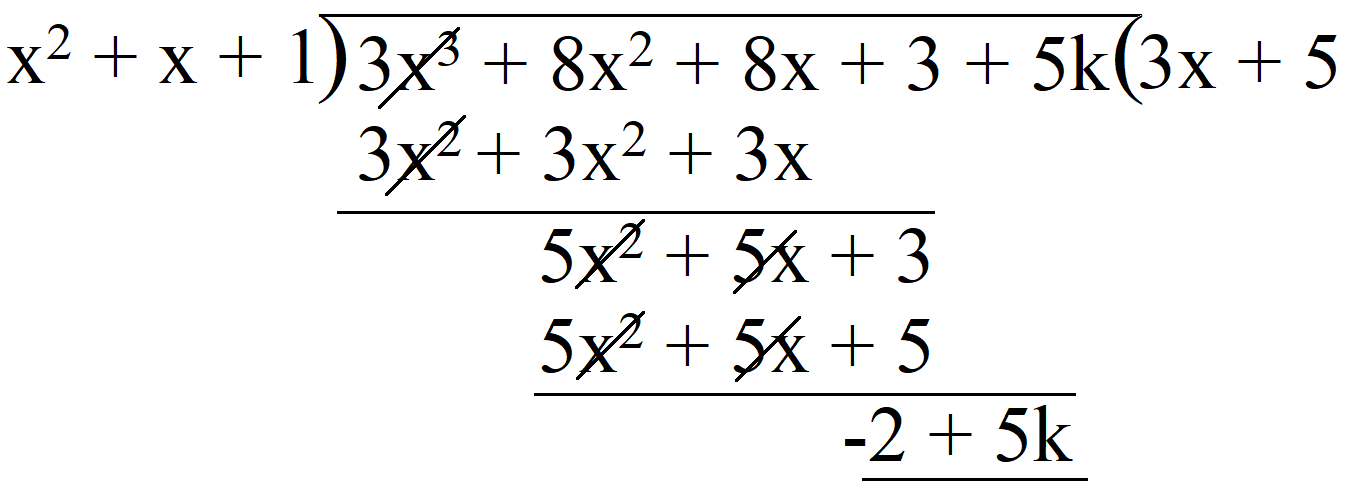
$-2+5\text{k}=0$
$\text{k}=\frac{2}{5}$ View full question & answer→MCQ 2091 Mark
If $p(x) =x^3-x^2+x+1$, than the value of $\frac{\text{p}(-1)+\text{p}(1)}{2}$ is:
Answer$p(x) = x^3-x^2+x+1$,
$=\frac{\text{p}(-1)+\text{p}(1)}{2}$
$=\frac{(-1)^3-(-1)^2+(-1)+1+(1)^3-(1)^2+(1)+1}{2}$
$=\frac{-1-1-1+1+1-1+1+1}{2}$
$=\frac{0}{2}$
$=0$
View full question & answer→MCQ 2101 Mark
If $x^2+x+1$ is a factor of the polynomial $3 x^3+8 x^2+8 x+3+5 k$, then the value of $k$ is:
- A
$0$
- ✓
$\frac{2}{5}$
- C
$\frac{5}{2}$
- D
$-1$
AnswerCorrect option: B. $\frac{2}{5}$
Let $p(x)=3 x^3+8 x^2+8 x+3+5 k$ and $q(x)=x^2+x+1$
Now,
If $q(x)$ is a factor of $p(x)$, then arranging $p(x)$ in order to have $q(x)$ in common,
$p(x)=3 x^3+3 x^2+3 x+5 x^2+5 x+3+2-2+5 k[\text { Adding }+2,-2 \text { in } p(x)]$
$=3 x\left(x^2+x+1\right)+5\left(x^2+x+1\right)+5 k-2$
$p(x)=\left(x^2+x+1\right)(3 x+5)+5 k-2 \ldots(1)$
From equation $(1),$ we can see if we divide $p(x)$ by $q(x),$ then quotient will be $(3x + 5)$ and remainder will be $(5k - 2)$
But $q(x)$ is a factor of $p(x).$
So, remainder $= 0$
$⇒ 5k - 2 = 0$
$\Rightarrow\text{k}=\frac{2}{5}$
View full question & answer→MCQ 2111 Mark
A polynomial of degree ____ is called a linear polynomial.
AnswerA polynomial of degree $1$ is called a linear polynomial.
Its general form is $ax + b$
View full question & answer→MCQ 2121 Mark
If $\text{x}^2+\frac{1}{\text{x}^2}=102,$ then $\text{x}-\frac{1}{\text{x}}=$
Answer$\Big(\text{x}-\frac{1}{\text{x}}\Big)^2=\text{x}^2+\frac{1}{\text{x}^2}-2(\text{x})\frac{1}{\text{x}}$
$\Big(\text{x}-\frac{1}{\text{x}}\Big)^2=\text{x}^2+\frac{1}{\text{x}^2}-2$
$=102-2$ $\Big\{\text{x}^2+\frac{1}{\text{x}^2}=102\Big\}$
$=100$
$\Rightarrow\text{x}-\frac{1}{\text{x}}=\sqrt{100}$
$\Rightarrow\text{x}-\frac{1}{\text{x}}=10$
Hence, correct option is $(b).$
View full question & answer→MCQ 2131 Mark
One of the factors of $\left(25 x^2-1\right)+(1+5 x)^2$ is:
- A
$5 + x$
- B
$5 - x$
- C
$5x - 1$
- ✓
$10x$
Answer$\left(25 x^2-1\right)+(1+5 x)^2$
$=(5 x-1)(5 x+1)+(1+5 x)^2$
$=(5 x+1)[(5 x-1)+(1+5 x)]$
$=(5 x+1)(10 x)$
So, the factors of $\left(25 x^2-1\right)+(1+5 x)^2$ are $(5 x+1)$ and $10 x$
View full question & answer→MCQ 2141 Mark
If $p^2+4 q^2+9 r^2=2 p q+6 p r+3 p r$, than the value of $p^3+8 q^3+27 r^3$ is:
- ✓
$18pqr$
- B
$10pqr$
- C
$12pqr$
- D
$9pqr$
AnswerCorrect option: A. $18pqr$
$p^2+4 q^2+9 r^2=2 p q+6 p r+3 p r$
$\Rightarrow p^2+4 q^2+9 r^2-2 p q-6 q r=0$
Now, $p^3+(2 q)^3+(3 r)^3$
$=(p)^3+(2 q)^3+(3 r)^3$
$=(p+2 q+3 r)\left(p^2+4 q^2+9 r^2-2 p q-6 q r-3 p r\right)$
$=(p+2 q+3 r)(0)$
$=0$
View full question & answer→MCQ 2151 Mark
$(305 × 308) = ?$
- A
$94940$
- B
$93840$
- ✓
$93940$
- D
$94840$
AnswerCorrect option: C. $93940$
$305 × 308 = (300 + 5)(300 + 8)$
$= (300)^2 + 300 × (5 + 8) + 5 × 8$
$= 90000 + 3900 + 40$
$= 93940$
View full question & answer→MCQ 2161 Mark
$(104 × 96) = ?$
- A
$9894$
- ✓
$9984$
- C
$9684$
- D
$9884$
AnswerCorrect option: B. $9984$
$104 × 96 = (100 + 4)(100 - 4)$
$= 100^2 - 4^2$
$= (10000 - 16)$
$= 9984$
View full question & answer→MCQ 2171 Mark
The degree of the polynomial $\left(x^3-2\right)\left(x^2-11\right)$ is:
Answer$\left(x^3-2\right)\left(x^2-11\right)$
$=x^3\left(x^2-11\right)-2\left(x^2-11\right)$
$=x^5-11 x^3-2 x^2+22$
Here, the highest power is $5.$
Therefore, the degree is $5.$
View full question & answer→MCQ 2181 Mark
If $\text{a}^{\frac{1}{3}}+\text{b}^{\frac{1}{3}}+\text{c}^{\frac{1}{3}}= 0,$ then:
- A
$a + b + c = 0$
- ✓
$(a+b+c)^3=27 a b c$
- C
$a + b + c = 3abc$
- D
$a^3+b^3+c^3=0$
AnswerCorrect option: B. $(a+b+c)^3=27 a b c$
Let $\text{a}^{\frac{1}{3}}=\text{A},\ \text{b}^{\frac{1}{3}}=\text{B}$ and $\text{c}^{\frac{1}{3}}=\text{C}$
Now, $A + B + C = 0 ($given$)$
$\text { If } A+B+C=0 \text {, then } A^3+B^3+C^3-3 A B C=0$
$\Rightarrow A^3+B^3+C^3-3 A B C=0$
$\Rightarrow A^3+B^3+C^3=3 A B C \ldots \text { (1) }$
$\begin{Bmatrix}\text{A}=\text{a}^{\frac{1}{3}},\ \text{B}=\text{b}^{\frac{1}{3}},\ \text{C}=\text{c}^{\frac{1}{3}}\\\text{A}^3=\text{a},\ \text{B}^3=\text{b},\ \text{C}^3=\text{c}\end{Bmatrix}$
Then, equation $(1)$ becomes
$\text{a}+\text{b}+\text{c}=3(\text{abc})^{\frac{1}{3}}$
Cubing both Sides of above equation, we get
$(a+b+c)^3=27 a b c$
Hence, correct option is $(b).$
View full question & answer→MCQ 2191 Mark
If $(x+2)$ and $(x-1)$ are factor of $\left(x^3+10 x^2+m x+n\right)$ then:
- A
$m = 5, n = -3$
- ✓
$m = 7, n = -18$
- C
$m = 17, n = -8$
- D
$m = 23, n = -19$
AnswerCorrect option: B. $m = 7, n = -18$
Let:
$p(x)=x^3+10 x^2+m x+n$ Now,
$x + 2 = 0 ⇒ x = -2$
$(x + 2)$ is a factor of $p(x).$
So, we have $p(-2)^2 + m × (-2) + n = 0$
$⇒ (-2)^3 + 10 × (-2)^2 + m × (-2) + n = 0$
$⇒ -8 + 40 - 2m + n = 0$
$⇒ 32 - 2m + n = 0$
$⇒ 2m - n = 32 ...(i)$
Now,
$x - 1 = 0 ⇒ x = 1$
Also,
$(x - 1)$ is a factor of $p(x)$
We have:
$p(1) = 0$
$⇒ 1^3 + 10 × 1^2 + m × 1 + n = 0$
$⇒ 1 + 10 + m + n = 0$
$⇒ 11 + m + n = 0$
$⇒ m + n = -11 ...(ii)$
From $(i)$ and $(ii),$
We get:
$3m = 21 ⇒ m = 7$
By substituting the value of m in $(i),$ we get $n = -18$
$\therefore\ m = 7$ and $n = -18$
View full question & answer→MCQ 2201 Mark
If $(3 x-1)^7=a_7 x^7+a_6 x^6+a_5 x^5+\ldots+a_1 x+a_0$, then $a_7+a_6+a_5+\ldots+a_1+a_0=$
Answer$(3 x-1)^7=a_7 x^7+a_6 x^6+\ldots+a_1 x+a_0...(1)$
Putting $x=1$ in equation (1), we have
$[3(1)-1]^7=a_7+a_6+\ldots . .+a_1+a_0$
So,
$a_7+a_6+a_5+\ldots . .+a_1+a_0=2^7=128$
View full question & answer→MCQ 2211 Mark
If $\text{x}+\frac{1}{\text{x}}=5,$ then $\text{x}^2+\frac{1}{\text{x}^2}=$
AnswerBy using identity $(a+b)^2=a^2+b^2+2 a b$.
we have,
$\Big(\text{x}+\frac{1}{\text{x}}\Big)^2=\text{x}^2+\Big(\frac{1}{\text{x}}\Big)^2+2\times\not\text{x}\times\frac{1}{\not\text{x}}$
$\Rightarrow\Big(\text{x}+\frac{1}{\text{x}}\Big)^2=\text{x}^2+\frac{1}{\text{x}^2}+2$
$\Rightarrow(5)^2=\text{x}^2+\frac{1}{\text{x}^2}+2$ $\Big\{\text{x}+\frac{1}{\text{x}}=5\text{ given}\Big\}$
$\Rightarrow\text{x}^2+\frac{1}{\text{x}^2}=25-2$
$\Rightarrow\text{x}^2+\frac{1}{\text{x}^2}=23$
Hence, correct option is $(c).$
View full question & answer→MCQ 2221 Mark
The coefficient of $x^2$ in $\left(2-3 x^2\right)\left(x^2-5\right)$ is:
Answer$\left(2-3 x^3\right)\left(x^2-5\right)$
$=2 x^2-10-3 x^4+15 x^2$
$=-3 x^4+17 x^2-10$
Therefore, the coefficient of $x^2$ is $17 .$
View full question & answer→MCQ 2231 Mark
Which of the following is a quadratic polynomial$?$
- A
$x + 4$
- B
$x^3+x$
- C
$x^3+2 x+6$
- ✓
$x^2+5 x+4$
AnswerCorrect option: D. $x^2+5 x+4$
A polynomial of degree $2$ is called a quadratic polynomial.
Options $(a), (b)$ and $(c)$ have degrees $1, 3$ and $3$ respectively,
so they are not quadratic polynomials.
The degree of $x^2+5 x+4$ is $2,$ so it is a quadratic polynomial.
View full question & answer→MCQ 2241 Mark
The possible expressions for the length, breadth and height of the cuboid whose volume is given by $3 x^3-12 x$ is:
- ✓
$3x, (x + 2)$ and $(x - 2)$
- B
$x, (3x + 2)$ and $(x - 2)$
- C
$x, (x + 2)$ and $(3x - 2)$
- D
AnswerCorrect option: A. $3x, (x + 2)$ and $(x - 2)$
To find the length, breadth and height, we will factorize the given polynomial.
$3 x^3-12 x$
$=3 x\left[x^2-4\right]$
$=3 x\left[x^2-(2)^2\right]$
$=3 x(x+2)(x+2)$
Therefore, the possible expressions for the length, breadth and height of the cuboid whose volume is given by $3 x^3-12 x$ are $3 x, ( x+ 2)$ and $( x-2 ).$
View full question & answer→MCQ 2251 Mark
The product $(a+b)(a-b)\left(a^2-a b+b^2\right)\left(a^2+a b+b^2\right)$ is equal to:
- ✓
$a^6-b^6$
- B
$a^3-b^3$
- C
$a^6+b^6$
- D
$a^3+b^3$
AnswerCorrect option: A. $a^6-b^6$
$(a+b)(a-b)\left(a^2-a b+b^2\right)\left(a^2+a b+b^2\right)$
$\Rightarrow\left\{(a+b)\left(a^2+b^2-a b\right)\right\}\left\{(a-b)\left(a^2+b^2+a b\right)\right\}$
$\Rightarrow\left(a^3+b^3\right)\left(a^3-b^3\right)$
$\Rightarrow\left(a^6-b^6\right)$
View full question & answer→MCQ 2261 Mark
If $x^3-3 x^2+3 x-7=(x+1)\left(a x^2+b x+c\right)$, then $a+b+c=$
AnswerThe given equation is
$x^3-3 x^2+3 x-7=(x+1)\left(a x^2+b x+c\right)$
This can be written as
$x^3-3 x^2+3 x-7=(x+1)\left(a x^2+b x+c\right)$
$=x^3-3 x^2+3 x-7=a x^3+b x^2+c x+a x^2+b x+c$
$=x^3-3 x^2+3 x-7=a x^3+(a+b) x^2+(b+c) x+c$
Comparing the cofficients on both sides of the equation.
We get,
$a = 1 ...(1)$
$a + b = 3 ...(2)$
$b + c = 3 ...(3)$
$c = -7 ...(4)$
Putting the value of a form $(1)$ in $(2)$
We get,
$1 + b = 3,$
$b = -3 - 1$
$b= -4$
So the value of $a, b$ and $c$ is $1, -4$ and $-7$ respectively.
Therefore,
$a + b + c = 1 - 4 - 7 = -10$
Hence, correct option is $(c).$
View full question & answer→MCQ 2271 Mark
If $(x + 1)$ is a factor of the polynomial $(2x^2 + kx)$ then $k = ?$
AnswerLet $p(x) = 2x^2 + kx$
Since $(x + 1)$ is a factor of $p(x),$
$= P(-1) = 0$
$⇒ 2(-1)^2 + k(-1) = 0$
$⇒ 2 - k = 0$
$⇒ k = 2$
View full question & answer→MCQ 2281 Mark
When $p(x) = 4 x^3-12 x^2+11 x-5$ is divided by $(2x - 1),$ the remainder is:
Answer$2\text{x}-1=0\Rightarrow\text{x}=\frac{1}{2}$
By the remainder theorem, we know that when $p(x)$ is divided by $(2x - 1),$ the remainder is $\text{p}\Big(\frac{1}{2}\Big)$
Now, we have:
$\text{p}\Big(\frac{1}{2}\Big)=4\times\Big(\frac{1}{2}\Big)^3-12\times\Big(\frac{1}{2}\Big)^2+11\times\frac{1}{2}-5$
$=\frac{1}{2}-3+\frac{11}{2}-5$
$=-2$
View full question & answer→MCQ 2291 Mark
Write the correct answer in the following: Degree of the zero polynomial is.
AnswerThe degree of zero polynomial is not defined, because in zero polynomial, the coefficient of any variable is zero i.e., $0x^2$ or $0x^5$, etc.
Hence, we cannot exactly determine the degree of variable.
View full question & answer→MCQ 2301 Mark
If $x - a$ is a factor of $x^3-3 x^2 a+2 a^2 x+b$, then the value of $b$ is:
AnswerIf $x - a$ is a factor then $x - a = 0$
Therefore, $x = a$
New substitute $x = a$ in polynomial
$\left(a^3\right)-3(a)^2 a+2 a^2(a)+b=0$
$a^3-3 a^3+2 a^3+b=0$
$-3 a^3+3 a^3+b=0$
$b=0$
View full question & answer→MCQ 2311 Mark
If $x + 2$ is a factor of $x^2+ mx + 14,$ then $m =$
AnswerIf $x + 2$ is a factor of $x^2 + mx + 14,$
then at $x = -2,$
$x^2 + mx + 14 = 0$
$i.e. (-2)^2 + m(-2) + 14 = 0$
$4 - 2m + 14 = 0$
$2m = 18$
$m = 9$
View full question & answer→MCQ 2321 Mark
If $\text{x}-\frac{1}{\text{x}}=\frac{15}{4},$ than $\Big(\text{x}+\frac{1}{\text{x}}\Big)=$
- A
$\frac{1}{4}$
- B
$\frac{13}{4}$
- C
$4$
- ✓
$\frac{17}{4}$
AnswerCorrect option: D. $\frac{17}{4}$
$\Rightarrow\text{x}+\frac{1}{\text{x}}=\frac{15}{4}$
Now, $\Big(\text{x}-\frac{1}{\text{x}}\Big)^2=\Big(\frac{15}{4}\Big)^2$
$\Rightarrow(\text{x}^2)+\Big(\frac{1}{\text{x}^2}\Big)-2\times\text{x}\times\frac{1}{\text{x}}=\frac{225}{16}$
$\Rightarrow(\text{x}^2)+\Big(\frac{1}{\text{x}^2}\Big)=\frac{225}{16}+2$
$\Rightarrow(\text{x})^2+\Big(\frac{1}{\text{x}^2}\Big)=\frac{257}{16}$
$\Rightarrow(\text{x}^2)+\Big(\frac{1}{\text{x}^2}\Big)+2\times\text{x}\times\frac{257}{16}+2\times\text{x}\times\frac{1}{\text{x}}$
$=\frac{257}{16}+2\times\text{x}\times\frac{1}{\text{x}}$
$\Rightarrow\Big(\text{x}+\frac{1}{\text{x}}\Big)^2=\frac{257+32}{16}=\frac{289}{16}$
$\Rightarrow\Big(\text{x}+\frac{1}{\text{x}}\Big)=\sqrt{\frac{289}{16}}=\frac{17}{4}$
View full question & answer→MCQ 2331 Mark
The degree of the polynomial $4 x^4+0 x^3+0 x^5+5 x+7$ is:
Answer$4 x^4+0 x^3+0 x^5+5 x+7$
$=4 x^4+5 x+7$
Here, the height power is $4.$
Therefore, the degree of given polynomial is $4.$
View full question & answer→MCQ 2341 Mark
If $x^{51}+51$ is divided by $x + 1,$ then the remainder is:
Answer$x^{51}+51$
If $x^{51}+51$ is divided by $x + 1,$ then using remainder theorem
$(-1)^{51}+51$
$= -1 + 51$
$= 50$
View full question & answer→MCQ 2351 Mark
If $a + b + c = 9$ and $ab + bc + ca = 23,$ then $a^2+b^2+c^2=$
AnswerWe know that $(a+b+c)^2=a^2+b^2+c^2+2(a b+b c+c a)$
Here, $a+b+c=9, a b+b c+c a=23$
Thus, we have
$(9)^2=a^2+b^2+c^2+2(23)$
$81=a^2+b^2+c^2+46$
$a^2+b^2+c^2=81-46$
$a^2+b^2+c^2=35$
Hence, correct option is $(a).$
View full question & answer→MCQ 2361 Mark
Which of the following is a polynomial$?$
AnswerA polynomial is an algebraic expression in which the variables involved have only non-negative integrals powers.
Option $(a), (b)$ and $(c)$ have negative and non-integral powers,
So they are not polynomials.
We know that, exery real number is a constant polynomial.
So, $-4$ being a real number is a polynomial.
View full question & answer→MCQ 2371 Mark
If $(x + 5)$ is a factor of $p(x) = x^3 - 20x + 5k$ then $k = ?$
Answer$(x + 5)$ is a factor or $p(x) = x^3 - 20x +5k$
$\therefore p(-5) = 0$
$⇒ (-5)^3 -20 × (-5) + 5k = 0$
$⇒ -125 + 100 + 5k = 0$
$⇒ 5k = 25$
$⇒ k = 5$
View full question & answer→MCQ 2381 Mark
The factors of $x^2 + 4y^2 + 4y - 4xy -2x - 8,$ are.
- A
$(x + 2y - 4) (x + 2y + 2)$
- ✓
$(x - 2y - 4) (x - 2y + 2)$
- C
$(x - y + 2) (x - 4y - 4)$
- D
AnswerCorrect option: B. $(x - 2y - 4) (x - 2y + 2)$
The value of $x^2+4 y^2+4 y-4 x y-2 x-8$ is.
$=x^2+4 y^2-4 x y+4 y-2 x-8$
$=(x-2 y)^2+2(2 y-x)-8$
$=(x-2 y)^2-2(x-2 y)-8$
Let $A=x-2 y$
Thus, $A^2-2 A-8$
$=(A-4)(A+2)$
Re-substitute the value of $A$.
$\text { Thus } x^2+4 y^2+4 y-4 x y-2 x-8$
$=(x-2 y-4)(x-2 y+2)$
View full question & answer→MCQ 2391 Mark
When $x^3-2 x^2+a x-b$ is divided by $x^2-2 x-3$, the remainder is $x - 6.$ The values of a and b are respectively
- A
$-2, -6$
- B
$2$ and $-6$
- ✓
$-2$ and $6$
- D
$2$ and $6$
AnswerCorrect option: C. $-2$ and $6$
Let $p(x)=x^3-2 x^2+a x-b, r(x)=x-6$ and $q(x)=x^2-2 x-3$
Then $q(x)$ is a factor of $[p(x)-r(x)]$ [because if $p(x)$ is divided by $q(x)$, remainder is $r(x)]$.
So, $[p(x)-r(x)]$ will be exactly divided by $q(x)]$
Now,
$q(x)=x^2-2 x-3=(x-3)(x+1)$
If $q(x)$ is a factor of $[p(x)-r(x)]$
Then $(x-3)$ and $(x+1)$ are also factors of $[p(x)-r(x)]$
So, at $x=3$ and $x=-1, p(x)-r(x)$ will be zero.
Now
$p(3)-r(3)=0$
i.e. $(3)^3-2(3)^2+a(3)-b-(3-6)=0$
i.e. $27-18+3 a-b+3=0$
i.e. $3 a-b+12=0$
And,
$p(-1)-r(-1)=0$
$\text { i.e. }(-1)^3-2(-1)^2+a(-1)-b-(-1-6)=0$
$\text { i.e. }-1-2-a-b+7=0$
$\text { i.e }-a-b+4=0 \ldots(2)$
Subtracting equation $(2)$ from equation $(1),$ we get
$4 a+8=0$
$a=-2$
From $(2), -(-2)-b+4=0$
$b=6$
View full question & answer→MCQ 2401 Mark
If $\left(x^{100}+2 x^{99}+k\right)$ is divisible By $(x + 1)$ then the value of $k$ is:
AnswerLet: $\left(x^{100}+2 x^{99}+k\right)$
Now, $x+1=0 \Rightarrow x=-1$
$\therefore p(-1)=0$
$\Rightarrow(1)^{100}+2 \times(-1)^{99}+k=0$
$\Rightarrow 1-2+k=0$
$\Rightarrow-1+k=0$
$\Rightarrow k=1$
View full question & answer→MCQ 2411 Mark
Which of the following expression is a polynomial$?$
- A
$\sqrt{\text{x}}-1$
- B
$\frac{\text{x}-1}{\text{x}+1}$
- C
$\text{x}^2-\frac{2}{\text{x}^2}+5$
- ✓
$\text{x}^2+\frac{2\text{x}^\frac{3}{2}}{\sqrt{\text{x}}}+6$
AnswerCorrect option: D. $\text{x}^2+\frac{2\text{x}^\frac{3}{2}}{\sqrt{\text{x}}}+6$
A polynomial is an algebraic expression in which the variables involved have only non-negative integrals powers.
Option $(a), (b)$ and $(c)$ have negative and non-integral powers,
So they are not polynomials.
In option $(d),$
$\text{x}^2+\frac{2\text{x}^\frac{3}{2}}{\sqrt{\text{x}}}+6=\text{x}^2+2\text{x}^{\frac{3}{2}-\frac{1}{2}}+6$
$x^2 + 2x^1 + 6$ Which is a polynomial.
View full question & answer→MCQ 2421 Mark
Which of the following is a polynomial$?$
- A
$x+x^{-1}+2$
- B
$x^{-2}+x^{-1}+3$
- ✓
$0$
- D
$x^{-1}$
Answer$0$ is a polynomial whose degree is not defined.
View full question & answer→MCQ 2431 Mark
Which of the following is a polynomial$?$
AnswerCorrect option: D. $\text{y}$
$y$ is a polynomial because it has a non- negative integral power $1.$
View full question & answer→MCQ 2441 Mark
If $p(x) = x + 4$ then $p(x) + p(-x) = ?$
Answer$p(x) = x + 4$
$p(-x) = -x + 4$
$p(x) + p(-x) = (x + 4) + (-x + 4)$
$= x + 4 - x + 4$
$= 8$
View full question & answer→MCQ 2451 Mark
$(305 × 308) = ?$
- A
$93840$
- B
$94840$
- ✓
$94940$
- D
$93940$
AnswerCorrect option: C. $94940$
$305 × 308 = (300 + 5) (300 + 8)$
$= 300(300 + 8) + 5(300 + 8)$
$= 90000 + 2400 + 1500 + 40$
$= 93940$
View full question & answer→MCQ 2461 Mark
If $\text{x}+\frac{1}{\text{x}}=7,$ than the value of $\text{x}^3+\frac{1}{\text{x}^3}$ is:
Answer$\text{x}+\frac{1}{\text{x}}=7,$
$\Rightarrow\Big(\text{x}+\frac{1}{\text{x}}\Big)^3=7^3$
$\Rightarrow\text{x}^3+\frac{1}{\text{x}^3}+3\times\text{x}\times\frac{1}{\text{x}}(\text{x}+\frac{1}{\text{x}})=343$
$\Rightarrow\text{x}^3+\frac{1}{\text{x}^3}+3\times7=343$
$\Rightarrow\text{x}^3+\frac{1}{\text{x}^3}=343-21$
$\Rightarrow\text{x}^3+\frac{1}{\text{x}^3}=322$
View full question & answer→MCQ 2471 Mark
The coefficient of $x^3$ in $2 x+x^2-5 x^3+x^4$ is:
AnswerThe coefficient of $x^3$ in $2 x+x^2-5 x^3+x^4$ is $-5 .$
View full question & answer→MCQ 2481 Mark
Write the correct answer in the following: $x + 1$ is a factor of the polynomial.
- A
$x^3+x^2-x+1$
- ✓
$x^3+x^2+x+1$
- C
$x^4+x^3+x^2+1$
- D
$-x^4+3 x^3+3 x^2+x+1$
AnswerCorrect option: B. $x^3+x^2+x+1$
Let assume $(x+1)$ is a factor of $x^3+x^2+x+1$
So, $x=-1$ is zero of $x^3+x^2+x+1$
$(-1)^3+(-1)^2+(-1)+1=0$
$\Rightarrow-1+1-1+1=0$
$\Rightarrow 0=0$
Hence, our assumption is true.
View full question & answer→MCQ 2491 Mark
Write the correct answer in the following: One of the factors of $\left(25 x^2-1\right)+(1+5 x)^2$ is.
- A
$5 + x$
- B
$5 - x$
- C
$5x - 1$
- ✓
$10x$
Answer$\left(25 x^2-1\right)+(1+5 x)^2=(5 x)^2-1^2+(5 x+1)^2$
$=(5 x-1)(5 x-1)+(5 x+1)^2=(5 x+1)(5 x-1+5 x+1)$
$=(5 x+1)(10 x)=10 x(5 x+1)$
Hence, one of the factors of $\left(25 x^2-1\right)+(1+5 x)^2$ is $10 x$.
View full question & answer→MCQ 2501 Mark
If $\left(x^{100}+2 x^{99}+k\right)$ is divisible by $(x + 1)$ then the value of $k$ is:
Answer$p(x)=x^{100}+2 x^{99}+k$
$x+1=0 \Rightarrow x=-1$
By the factor theorem, we know that when $p(x)$ is divided by $(x+1)$, the remainder is $p(-1)$.
Now, $p(-1)=(-1)^{100}+2(-1)^{99}+k$
$\Rightarrow 0=1-2+k \ldots($ Given that $\mathrm{p}(\mathrm{x})$ is divisible by $\mathrm{x}+1$.)
$\Rightarrow k=1$
View full question & answer→MCQ 2511 Mark
If $x + 1$ is a factor of the polynomial $2 x^2+k x+1$, then the value of $'k'$ is:
Answer If $x+1$ is a factor of $p(x)=2 x^2+k x+1$, then $p(-1)=0$
$\Rightarrow 2 x^2+k x+1=0$
$\Rightarrow 2(-1)^2+k(-1)+1=0$
$\Rightarrow 2-k+1=0$
$\Rightarrow k=3$
View full question & answer→MCQ 2521 Mark
If $\text{x}+\frac{1}{\text{x}}=5,$ then $\text{x}^2+\frac{1}{\text{x}^2}=$
AnswerUsing, $(\text{a}+\text{b})^2=\text{a}^2+\text{b}^2+2\text{ab}$
$\Big(\text{x}+\frac{1}{\text{x}}\Big)^2=\text{x}^2+\Big(\frac{1}{\text{x}^2}\Big)+2\text{x}\frac{1}{\text{x}}$
$\Rightarrow(5)^2=\text{x}^2+\Big(\frac{1}{\text{x}^2}\Big)+2$
$\Rightarrow\text{x}^2+\Big(\frac{1}{\text{x}^2}\Big)=25-2$
$\Rightarrow\text{x}^2+\Big(\frac{1}{\text{x}^2}\Big)=23$
View full question & answer→MCQ 2531 Mark
If $\text{x}^4+\frac{1}{\text{x}^4}=194,$ than $\text{x}^3+\frac{1}{\text{x}}^3=$
Answer$\Big(\text{x}^4+\frac{1}{\text{x}^4}\Big)=194$
$\Rightarrow(\text{x}^2)^2+\Big(\frac{1}{\text{x}^2}\Big)+2\times\text{x}^2\times\frac{1}{\text{x}^2}=194+2\times\text{x}^2\times\frac{1}{\text{x}^2}$
$\Rightarrow\Big(\text{x}^2+\frac{1}{\text{x}^2}\Big)^2=196$
$\Rightarrow\text{x}^2+\frac{1}{\text{x}^2}=\sqrt{196}=14$
Now,
$\Rightarrow(\text{x}^2)+\Big(\frac{1}{\text{x}^2}\Big)+2\times\text{x}\times\frac{1}{\text{x}}=14+2\times\text{x}\times\frac{1}{\text{x}}$
$\Rightarrow\Big(\text{x}+\frac{1}{\text{x}}\Big)^2=16$
$\Rightarrow\text{x}+\frac{1}{\text{x}}=\sqrt{16}=4$
Now, $\Big(\text{x}+\frac{1}{\text{x}}\Big)^3=(4)^3$
$\Rightarrow(\text{x})^3+\Big(\frac{1}{\text{x}}\Big)^3+3\times\text{x}\times\frac{1}{\text{x}}\Big(\text{x}+\frac{1}{\text{x}}\Big)=64$
$\Rightarrow(\text{x}^3)+\Big(\frac{1}{\text{x}^3}\Big)+3(4)=64$
$\Rightarrow(\text{x}^3)+\Big(\frac{1}{\text{x}^3}\Big)=64-12 = 52$
View full question & answer→MCQ 2541 Mark
A polynomial of degree $3$ in $x$ has at most.
- ✓
$3$ terms
- B
$1$ terms
- C
$5$ terms
- D
$4$ terms
AnswerCorrect option: A. $3$ terms
$3$ terms of not more than the power of $3$
View full question & answer→MCQ 2551 Mark
If $\text{x}+\frac{1}{\text{x}}=3,$ than the value of $\text{x}^2+\frac{1}{\text{x}^2}$ is:
Answer$\text{x}+\frac{1}{\text{x}}=3,$
Squaring both sides, we get
$\text{x}^2+\frac{1}{\text{x}^2}+2\times\text{x}\times\frac{1}{\text{x}}=9$
$\Rightarrow\text{x}^2+\frac{1}{\text{x}^2}+2=9$
$\Rightarrow\text{x}^2+\frac{1}{\text{x}^2}=7$
View full question & answer→MCQ 2561 Mark
The zeros of the polynomial $p(x) = 3x^2 - 1$ are:
- A
$\frac{1}{3}\ \text{and}\ 3$
- B
$\frac{1}{\sqrt3}\ \text{and}\ \sqrt3$
- C
$\frac{-1}{\sqrt3}\ \text{and}\ \sqrt3$
- ✓
$\frac{1}{\sqrt3}\ \text{and}\ \frac{-1}{\sqrt3}$
AnswerCorrect option: D. $\frac{1}{\sqrt3}\ \text{and}\ \frac{-1}{\sqrt3}$
$p(x)=3 x^2-1$
$\text { Now, } p(x)=0$
$\Rightarrow 3 x^2-1=0$
$\Rightarrow 3 x^2=1$
$\Rightarrow\text{x}^2=\frac{1}{3}$
$\Rightarrow\text{x}=\frac{1}{\sqrt3}\ \text{and}\ -\frac{1}{\sqrt3}$
View full question & answer→MCQ 2571 Mark
When $p(x) = x^3+a x^2+2 x+a$ is divided by $x + a,$ the remainder is:
Answer$x+a=0$
$\Rightarrow x=-a$
By the remainder theorem, we know that when $p(x)$ is divided by $(x+a)$, the remainder is $p(-a)$.
Thus, we have: $P(-a)=(-a)^3+a \times(-a)^2+2 \times(-a)+a$
$=-a^3+a^3-2 a+a$
$=-a$
View full question & answer→MCQ 2581 Mark
The expression $(a-b)^3+(b-c)^3+(c-a)^3$ can be factorized as.
AnswerCorrect option: A. $3(a - b) (b - c) (c - a)$
Here, $a - b + b - c + c - a = 0$
Therefore, $(a-b)^3+(b-c)^3+(c-a)^3$
$= 3(a - b) (b - c) (c - a)$
View full question & answer→MCQ 2591 Mark
If $\text{x}+\frac{1}{\text{x}}=2,$ then $\text{x}^3+\frac{1}{\text{x}^3}=$
AnswerBy using identity,
$(a+b)^3=a^3+b^3+3 a b(a+b)$
$\Big(\text{x}+\frac{1}{\text{x}}\Big)^3=\text{x}^3+\frac{1}{\text{x}^3}+3(\not\text{x})\frac{1}{\not\text{x}}\Big(\text{x}+\frac{1}{\text{x}}\Big)\\=\text{x}^3+\frac{1}{\text{x}^3}+3\Big(\text{x}+\frac{1}{\text{x}}\Big)$
Now $\text{x}+\frac{1}{\text{x}}=2$
$\Rightarrow(2)^3=\text{x}^3+\frac{1}{\text{x}^3}+3(2)$
$\Rightarrow\text{x}^3+\frac{1}{\text{x}^3}=(2)^3-3\times2=8-6=2$
$\Rightarrow\text{x}^2+\frac{1}{\text{x}^2}=23$
Hence, correct option is $(d).$
View full question & answer→MCQ 2601 Mark
Which of the following is a factor of $(x+y)^3-\left(x^3+y^3\right)?$
- A
$x y^2$
- B
$x^2+y^2+2 x y$
- ✓
$3xy$
- D
$x^2+y^2-x y$
Answer$\text { Given polynomial: }(x+y)^3-\left(x^3+y^3\right)$
$=\left(x^3+y^3+3 x^2 y+3 x y^2\right)-\left(x^3+y^3\right)\left[{\because }~(a+b)^3=\left(a^3+b^3+3 a^2 b+3 a b^2\right)\right]$
$=3 x^2 y+3 x y^2=3 x y(x+y)$
$\Rightarrow 3 x y \text { and }(x+y) \text { are factors of given polynomial. }$
View full question & answer→MCQ 2611 Mark
If $\Big(3\text{x}+\frac{1}{2}\Big)\Big(3\text{x}-\frac{1}{2}\Big)=9\text{x}^2-\text{p}$ then the value of $p$ is:
- A
$0$
- B
$-\frac{1}{4}$
- ✓
$\frac{1}{4}$
- D
$\frac{1}{2}$
AnswerCorrect option: C. $\frac{1}{4}$
$\Big(3\text{x}+\frac{1}{2}\Big)\Big(3\text{x}-\frac{1}{2}\Big)=9\text{x}^2-\text{p}$
$9\text{x}^2-\frac{1}{4}$ $\Big(\therefore\ \big(\text{a}^2-\text{b}^2\big)=(\text{a}+\text{b})(\text{a}-\text{b})\Big)$
$=9\text{x}^2-\text{p}$
$\Rightarrow\text{p}=\frac{1}{4}$
View full question & answer→MCQ 2621 Mark
The maximum number of terms in a polynomial of degree $10$ is:
AnswerThe maximum number of terms is one more than the power of the polynomial.Therefore, the maximum number of terms in a polynomial of degree $10$ is $(10 + 1) = 11$
View full question & answer→MCQ 2631 Mark
If $\text{x}^2+\frac{1}{\text{x}^2}=38,$ then the value of $\text{x}-\frac{1}{\text{x}}$ is:
Answer$\Big(\text{x}-\frac{1}{\text{x}}\Big)^2=\text{x}^2+\frac{1}{\text{x}^2}-2\times\text{x}\times\frac{1}{\text{x}}$
$\Rightarrow\Big(\text{x}-\frac{1}{\text{x}}\Big)^2=38-2$
$\Rightarrow\Big(\text{x}-\frac{1}{\text{x}}\Big)^2=36$
$\Rightarrow\text{x}-\frac{1}{\text{x}}=\pm6$
View full question & answer→MCQ 2641 Mark
Write the correct answer in the following: Degree of the polynomial $4 x^4+0 x^3+0 x^5+5 x+7$ is.
AnswerThe height power of the variable in a polynomial is called the degree of the polynomial. In this polynomial, the term with highest power of x is 4x$^4$. Highest power of x is 4, so the degree of the given polynomial is $4.$
View full question & answer→MCQ 2651 Mark
The value of $\Big(\text{x}-\frac{1}{\text{x}}\Big)\Big(\text{x}+\frac{1}{\text{x}}\Big)\Big(\text{x}^2+\frac{1}{\text{x}^2}\Big)$ is:
- ✓
$\text{x}^4-\frac{1}{\text{x}^4}$
- B
$\text{x}^2+\frac{1}{\text{x}^2}-2$
- C
$\text{x}^3+\frac{1}{\text{x}^3}+2$
- D
$\text{x}^4+\frac{1}{\text{x}^4}$
AnswerCorrect option: A. $\text{x}^4-\frac{1}{\text{x}^4}$
$\Big(\text{x}-\frac{1}{\text{x}}\Big)\Big(\text{x}+\frac{1}{\text{x}}\Big)\Big(\text{x}^2+\frac{1}{\text{x}^2}\Big)$
$=\Big(\text{x}^2-\frac{1}{\text{x}^2}\Big)\Big(\text{x}^2+\frac{1}{\text{x}^2}\Big)$ [Using identity $(a+b)(a-b)=a^2-b^2$]
$=\text{x}^4-\frac{1}{\text{x}^4}$ [Using identity $(a+b)(a-b)=a^2-b^2$]
View full question & answer→MCQ 2661 Mark
If P(x) = $x^3-1$, then the value of $p(1) + p(-1)$ is:
Answer$P(x)=x^3-1$,
Then the value of $P(1)+P(-1)$
$=(1)^3-1+(-1)^3-1$
$=1-1-1-1=1-3=-2$
View full question & answer→MCQ 2671 Mark
A polynomial containing one nonzero term is called a ______.
AnswerA polynomial containing one nonzero term is called a monomial.
$3 x, 5 x^2, y^3$
View full question & answer→MCQ 2681 Mark
The factors of $x^3-7 x-6$ are.
- A
$x(x - 6) (x - 1)$
- B
$(x - 1) (x - 3) (x + 2)$
- ✓
$(x + 1) (x + 2) (x - 3)$
- D
$\left(x^2-6\right)(x-1)$
AnswerCorrect option: C. $(x + 1) (x + 2) (x - 3)$
The given expression to be factorized is $x^3-7 x+6$
This can be written in the form
$x^3-7 x+6=x^3-(1+6) x+6$
$=x^3-x-6 x+6$
Take common $x$ from the first two terms and $-6$ from the last two terms.
Then we have,
$x^3+7 x+6=x\left(x^2-1\right)-6(x-1)$
$=x\left\{(x)^2-(1)^2\right\}-6\{x-1\}$
$=x(x+1)(x-1)-6(x-1)$
Finally, take common $(x-1)$ from the above expression,
$x^3-7 x+6=(x-1)\{(x+1)-6\}$
$=(x-1)\left(x^2+x-6\right)$
$=(x-1)\left(x^2+3 x-2 x-6\right)$
$=(x-1)\{x(x+3)-2(x+3)\}$
$=(x-1)(x+3)(x-2)$
View full question & answer→MCQ 2691 Mark
If $\text{p}(\text{x})=\text{x}^2-2\sqrt{2}\text{x}+1,$ than $\text{p}(2\sqrt{2})$ is equal to:
- A
$0$
- B
$4\sqrt{2}$
- C
$8\sqrt{2}+1$
- ✓
$1$
Answer$\text{p}(\text{x})=\text{x}^2-2\sqrt{2}\text{x}+1,$
$\Rightarrow\text{p}(2\sqrt{2})=(2\sqrt{2})^2-2\sqrt{2}(2\sqrt{2})+1$
$\Rightarrow\text{p}(2\sqrt{2})=8-8+1$
$\Rightarrow\text{p}(2\sqrt{2})=1$
View full question & answer→MCQ 2701 Mark
If $(x+y)^3-(x-y)^3-6 y\left(x^2-y^2\right)=k y^2$, then $k=$
AnswerWe have,
$=(x+y)^3-(x-y)^3-6 y\left(x^2-y^2\right)=k y^3$
$=(x+y-x+y)^3+3(x+y)(x-y)(x+y-x+y)-6 y\left(x^2-y^2\right)=k y^3$
$=2 y^3+6 y\left(x^2-y^2\right)-6 y\left(x^2-y^2\right)=k y^3$
$=8 y^3=k y^3$
$=k=8$
View full question & answer→MCQ 2711 Mark
One of the factors of $\left(25 x^2-1\right)+(1+5 x)^2$ is:
- A
$5x - 1$
- B
$5 - x$
- ✓
$10x$
- D
$5 + x$
Answer$\text { Now, }\left(25 x^2-1\right)+(1+5 x)^2$
$\left.=25 x^2-1+1+25 x^2+10 x \text { [using identity, }(a+b)^2=a^2+b^2+2 a b\right]$
$=50 x^2+10 x=10 x(5 x+1)$
Hence, one of the factor of given polynomial is $10 x$.
View full question & answer→MCQ 2721 Mark
When p(x) = $x^3+a x^2+2 x+a$ is divided by $(x + a)$, the remainder is:
Answer$p(x)=x^3+a x^2+2 x+a$
$x+a=0 \Rightarrow x=-a$
By the remainder theorem, we know that when $p(x)$ is divided by $(x+a)$, the remainder is $p(-a)$.
$\text { Now, } p(-a)=x^3+a x^2+2 x+a$
$=(-a)^3+a(-a)^2+2(-a)+a$
$=-a^3+a^3-2 a+a$
$=-a$
View full question & answer→MCQ 2731 Mark
$8$ is a polynomial of degree.
AnswerSince $8$ is a constant term.Therefore its degree is $0.$
View full question & answer→MCQ 2741 Mark
The value of $\frac{(2.3)^3-0.027}{(2.3)^20.69+0.09}.$
AnswerThe given expresstion is
$\frac{(2.3)^3-0.027}{(2.3)^20.69+0.09}$
This can be written in the form
$\frac{(2.3^3)-(0.3)^3}{(2.3)^2+2.3\times0.3+(0.3)^2}$
Assume $a = 2.3$ and $b = 0.3$. then the given expression can be rewritten as $\frac{\text{a}^3-\text{b}^3}{\text{a}^2+\text{ab}+\text{b}^2}$
Recall the formula for difference of two cubes
$a^3-b^3=(a-b)\left(a^2+a b+b^2\right)$
Using the above formula, the expression becomes $\frac{\text{(a}-\text{b})(\text{a}^2+\text{ab}+\text{b}^2)}{\text{a}^2+\text{ab}+\text{b}^2}$
Note that both a and b are positive, unequal. so, neither $a^3-b^3$ nor any factor of it can be zero.
Therefore we can cancel the term $\left(a^2+a b+b^2\right)$ from both numerator and denominator. then the expression becomes
$\frac{(\text{a}-\text{b})(\text{a}^2+\text{ab}+\text{b}^2)}{\text{a}^2+\text{ab}+\text{b}^2}=\text{a}-\text{b}$
$=2.3-0.3$
$=2$
View full question & answer→MCQ 2751 Mark
The expression $x^4+4$ can be factorized as:
- A
$\left(x^2-2 x-2\right)\left(x^2-2 x+2\right)$
- B
$\left(x^2+2\right)\left(x^2-2\right)$
- C
$\left(x^2+2 x+2\right)\left(x^2+2 x-2\right)$
- ✓
$\left(x^2+2 x+2\right)\left(x^2-2 x+2\right)$
AnswerCorrect option: D. $\left(x^2+2 x+2\right)\left(x^2-2 x+2\right)$
The given expression to be factorized is $x^4+4$This can be written in the form
$x^4+4=\left(x^2\right)^2+(2)^2+4 x^2-4 x^2$
$=\{(x^2)^2+2 \times x^2 \times 2+(2)^2\}-(2 x)^2$
$=\left(x^2+2\right)^2-(2 x)^2$
$=\left(x^2+2+2 x\right)\left(x^2+2-2 x\right)$
View full question & answer→MCQ 2761 Mark
Write the correct answer in the following: Which of the following is a factor of $(x+y)^3-\left(x^3+y^3\right)$?
- A
$x^2+y^2+2 x y$
- B
$x^2+y^2-x y$
- C
$x y^2$
- ✓
$3xy$
Answer$(x+y)^3-\left(x^3+y^3\right)=x^3+y^3+3 x y(x+y)-x^3-y^3$
${\left[(a+b)^3=a^3+b^3+3 a b(a+b)\right]}$
$=3 x y(x+y)$
So, $3 x y$ is a factor of $(x+y)^3-\left(x^3+y^3\right)$.
View full question & answer→MCQ 2771 Mark
Write the correct answer in the following: Zero of the zero polynomial is.
AnswerZero of the zero polynomial is any real number.
e.g., Let us consider zero polynomial be $0(x - k)$, where $k$ is a real number. For determining the zero, put $x - k = 0 ⇒ x = k$ Hence, zero of the zero polynomial be any real number.
View full question & answer→MCQ 2781 Mark
If $\text{x}^4+\frac{1}{\text{x}^4}=623,$ than $\text{x}+\frac{1}{\text{x}}=$
- A
$27$
- ✓
$3\sqrt{3}$
- C
$25$
- D
$-3\sqrt{3}$
AnswerCorrect option: B. $3\sqrt{3}$
$\Big(\text{x}^4+\frac{1}{\text{x}^4}\Big)=623$
$\Rightarrow(\text{x}^2)^2+\Big(\frac{1}{\text{x}^2}\Big)+2\times\text{x}^2\times\frac{1}{\text{x}^2}=623+2\times\text{x}^2\times\frac{1}{\text{x}^2}$
$\Rightarrow\Big(\text{x}^2+\frac{1}{\text{x}^2}\Big)^2=625$
$\Rightarrow\text{x}^2+\frac{1}{\text{x}^2}=\sqrt{625}=25$
Now,
$\Rightarrow(\text{x}^2)+\Big(\frac{1}{\text{x}^2}\Big)+2\times\text{x}\times\frac{1}{\text{x}}=25+2\times\text{x}\times\frac{1}{\text{x}}$
$\Rightarrow\Big(\text{x}+\frac{1}{\text{x}}\Big)^2=27$
$\Rightarrow\text{x}+\frac{1}{\text{x}}=\sqrt{27}=3\sqrt{3}$
View full question & answer→MCQ 2791 Mark
Write the correct answer in the following:
If $49\text{x}^2 -\text{b}=\Big(7\text{x}+\frac{1}{2}\Big)\Big(7\text{x}-\frac{1}{2}\Big),$ the value of b is.
- A
$0$
- B
$\frac{1}{\sqrt2}$
- ✓
$\frac{1}{4}$
- D
$\frac{1}{2}$
AnswerCorrect option: C. $\frac{1}{4}$
$49\text{x}^2 -\text{b}=\Big(7\text{x}+\frac{1}{2}\Big)\Big(7\text{x}-\frac{1}{2}\Big)$
$\Rightarrow49\text{x}^2 -\text{b}=\Big(7\text{x}\Big)^2-\Big(\frac{1}{2}\Big)^2$
$49^2-\frac{1}{4} [\therefore(\text{a}+\text{b})(\text{a}-\text{b})=\text{a}^2-\text{b}^2]$
So, we get $\text{b}=\frac{1}{4}.$
View full question & answer→MCQ 2801 Mark
If $3x = a + b + c$, then the value of $(x-a)^3+(x-b)^3+(x-c)^3-3(x-a)(x-b)(x-c)$ is:
- A
$a + b + c$
- B
$(a - b)(b - c)(c - a)$
- ✓
$0$
- D
Answer$3 x=a+b+c$$\Rightarrow a+b+c-3 x=0$
$\Rightarrow 3 x-(a+b+c)=0$
$\Rightarrow(x-a)+(x-b)+(x-c)=0 ...(1)$
Using identity if $a+b+c=0$ then, $a^3+b^3+c^3-3 a b c=0$
If we take $\mathrm{x}-\mathrm{a}=\mathrm{A}, \mathrm{x}-\mathrm{b}=\mathrm{B}, \mathrm{x}-\mathrm{c}=\mathrm{C}$ in equation $(1)$, we get
$A+B+C=0$
$\Rightarrow A^3+B^3+C^3-3 A B C=0$
$\Rightarrow(x-a)^3+(x-b)^3+(x-c)^3-3(x-a)(x-b)(x-c)=0$
Hence, correct option is $(c).$
View full question & answer→MCQ 2811 Mark
The factors of $12 x^2-x-6$ are:
- ✓
$(3x + 2) (4x - 3)$
- B
$(12x - 1) (x + 6)$
- C
$(3x - 2) (4x + 3)$
- D
$(12x + 1) (x - 6)$
AnswerCorrect option: A. $(3x + 2) (4x - 3)$
$12 x^2-x-6$
$=12 x^2-9 x+8 x-6$
$=3 x(4 x-3)+2(4 x-3)$
$=(3 x+2)(4 x-3)$
View full question & answer→MCQ 2821 Mark
Which of the following is a polynomial?
AnswerCorrect option: C. $\text{y}$
A polynomial is an algebraic expression in which the variables involved have only non-negative integrals powers.
Option $(a)$, $(b)$ and $(d)$ have negative and non-integral powers,
So they are not polynomials.
View full question & answer→MCQ 2831 Mark
Which of the following is a binomial?
AnswerCorrect option: A. $x^2+4$
Clearly, $x^2+4$ is an expresstion having two non-zero terms.
So, it is a binomial.
View full question & answer→MCQ 2841 Mark
A polynomial containing three non-zero terms is called a ________.
AnswerA polynomial containing three non-zero terms is called a trinomial.
Example: $5 x^2+2 x+3, a x^2=b x+c, 3 x+2 y-3$
View full question & answer→MCQ 2851 Mark
The factors of $x^2-9$ is:
- A
$(x - 3) (x - 3)$
- ✓
$(x + 3) ( x + 3)$
- C
$(x + 3) (x - 3)$
- D
$(x - 3) (x + 9)$
AnswerCorrect option: B. $(x + 3) ( x + 3)$
$x^2-9$
$=x^2-3^2$
Using identity $\mathrm{a}^2-\mathrm{b}^2=(\mathrm{a}+\mathrm{b})(\mathrm{a}-\mathrm{b})$
$=(x+3)(x-3)$
View full question & answer→MCQ 2861 Mark
If x + a is a factor of $x^4-a^2 x^2+3 x-6 a$, then a is:
Answer$x+a$ is a factor of polynomial $f(x)=x^4-a^2 x^2+3 x-6 a$,
$\text { Then at } x=-a, p(x)=0$
$\Rightarrow(-a)^4-a^2(-a)^2+3(-a)-6 a=0$
$\Rightarrow a^4-a^4-3 a-6 a=0$
$\Rightarrow-9 a=0$
$\Rightarrow a=0$
View full question & answer→MCQ 2871 Mark
The factors of $x^3-1+y^3+3 x y$ are:
- ✓
$(x-1+y)\left(x^2+1+y^2+x+y-x y\right)$
- B
$(x+y+1)\left(x^2+y^2+1-x y-x-y\right)$
- C
$(x-1+y)\left(x^2-1-y^2+x+y+x y\right)$
- D
$3(x+y-1)\left(x^2+y^2-1\right)$
AnswerCorrect option: A. $(x-1+y)\left(x^2+1+y^2+x+y-x y\right)$
By using identity
$a^3+b^3+c^3-3 a b c=(a+b+c)\left(a^2+b^2+c^2-a b-b c-c a\right)$
We can write,
$x^3-1+y^3+3 x y$
$=\left(x^3\right)+(-1)^3+\left(y^3\right)-3(-1)(x)(y)$
$=[x+(-1)+y]\left[x^2+(-1)^2+y^2-x(-1)-y(-1)-x y\right]$
$=(x-1+y)\left(x^2+1+y^2+x+y-x y\right)$
Hence, correct option is $(a).$
View full question & answer→MCQ 2881 Mark
If $x - 1$ is the factor of p(x) = $x^3-23 x^2+k x-120$, then the value of $'k'$ is:
AnswerIf $x-1$ is the factor of $p(x)$, then
$p(1)=0$
$(1)^3-23(1)^2+k(1)-120=0$
$1-23+k-120=0$
$1-143+k=0$
$-142+k=0$
$k=142$
View full question & answer→MCQ 2891 Mark
The value of $\frac{(\text{a}^2-\text{b}^2)^3(\text{b}^2-\text{c}^2)+(\text{c}^2-\text{a}^2)^3}{(\text{a}-\text{b})^3+(\text{b}-\text{c})^3+(\text{c}-\text{a})^3}$ is:
- A
$3(a - b) (b - c) (c - a)$
- ✓
$3(a + b) (b + c) (c + a)$
- C
$3(a + b) (b + c) (c + a) (a - b) (b - c) (c - a)$
- D
AnswerCorrect option: B. $3(a + b) (b + c) (c + a)$
$\frac{(\text{a}^2-\text{b}^2)^3(\text{b}^2-\text{c}^2)+(\text{c}^2-\text{a}^2)^3}{(\text{a}-\text{b})^3+(\text{b}-\text{c})^3+(\text{c}-\text{a})^3}$
$=\frac{3(\text{a}^2-\text{b}^2)(\text{b}^2-\text{c}^2)(\text{c}^2-\text{a}^2)}{3(\text{a}-\text{b})(\text{b}-\text{c})(\text{c}-\text{a})}$ $[\text{Since}\text{ x}^3+\text{y}^3+\text{z}^3=3\text{xyz},\text{ if}\text{ x}+\text{y}+\text{z}=0]$
$=\frac{3(\text{a}-\text{b})(\text{a}+\text{b})(\text{b}-\text{c})(\text{b}+\text{c})(\text{c}-\text{a})(\text{c}+\text{a})}{3(\text{a}-\text{b})(\text{b}-\text{c}(\text{c})-\text{a})}$
$=3(\text{a}+\text{b})(\text{b}+\text{c})(\text{c}+\text{a})$
View full question & answer→MCQ 2901 Mark
Which of the following is a polynomial?
- A
$x^{-2}+x^{-1}+3$
- B
$x+x^{-1}+2$
- C
$x^{-1}$
- ✓
$0$
AnswerA polynomial is an algebraic expression in which the variables involved have only non-negative integrals powers.
Option $(a)$, $(b)$ and $(c)$ have negative and non-integral powers,
So they are not polynomials.
We know that, exery real number is a constant polynomial.
So, 0 being a real number is a polynomial.
View full question & answer→MCQ 2911 Mark
The factors of $8 a^3+b^3-6 a b+1$ are:
- A
$(2 a+b-1)\left(4 a^2+b^2+1-3 a b-2 a\right)$
- B
$(2 a-b+1)\left(4 a^2+b^2-4 a b+1-2 a+b\right)$
- ✓
$(2 a+b+1)\left(4 a^2+b^2+1-2 a b-b-2 a\right)$
- D
$(2 a-1+b)\left(4 a^2+1-4 a-b-2 a b\right)$
AnswerCorrect option: C. $(2 a+b+1)\left(4 a^2+b^2+1-2 a b-b-2 a\right)$
We know the identity
$a^3+b^3+c^3-3 a b c=(a+b+c)\left(a^2+b^2+c^2-a b-b c-c a\right)$
So by using identity, we can write given expression as
$(2 a)^3+(b)^3+(1)^3-3(2 a)(b)(1)$
$=(2 a+b+1)\left[(2 a)^2+b^2+1^2-2 a \times b-b \times 1-2 a \times 1\right]$
$=(2 a+b+1)\left(4 a^2+b^2+1-2 a b-b-2 a\right)$
Hence, correct option is $(c).$
View full question & answer→MCQ 2921 Mark
If $x + a$ is a factor of $x^4-a^2 x^2+3 x-6 a$, then $a =$
AnswerPut $x+a=0 \Rightarrow x=-a$
Then, value of $x^4-a^2 x^2+3 x-6 a$ at $x=-a$ is zero
Therefore, $(-a)^4-a^2(-a)^2+3(-a)-6 a=0$
$-9 a=0 \Rightarrow a=0$
View full question & answer→MCQ 2931 Mark
If $(x + 5)$ is a factor of = $x^3-20 x+5 k$ then $k = ?$
Answer$p(x)=x^3-20 x+5 k$
Now, $x+5=0 \Rightarrow x=(-5)$
By factor theorem,
$p(-5)=0$
$\Rightarrow(-5)^3-20(-5)+5 \mathrm{k}=0$
$\Rightarrow-125+100+5 \mathrm{k}=0$
$\Rightarrow-25+5 \mathrm{k}=0$
$\Rightarrow 5 \mathrm{k}=25$
$\Rightarrow \mathrm{k}=5$
View full question & answer→MCQ 2941 Mark
If $x^3-3 x^2 3 x-7=(x+1)\left(a x^2+b x+c\right)$, then $a+b+c=$
AnswerFirst multiply
$(x+1)\left(a x^2+b x+c\right)$
$=a x^3+b x^2+c x+a x^2+b x+c$
$=a x^3+b x^2+a x^2+c x+c$
$=a x^3+(b+a) x^2+(c+b) x+c$
Comparing it with
$x^3-3 x^2+3 x-7$
$a=1$
$b+a=-3 \Rightarrow b+1+-3 \Rightarrow b=-4$
$c+b=3 \Rightarrow c-4=3 \Rightarrow c=7$
$\mathrm{c}=-7$ should be 7
as if we put $x=-1$ in
$x^3-3 x^2+3 x-7$
$-1-3-3-7=14$ so $x+1$ can not be factor so $x+1$ will be factor if $x^3-3 x^2+3 x-7$ is actually
$x^3-3 x^2+3 x+7$
then $-1-3-3+7=0$
Hence, we can say that
$a=1$
$b=-1$
$c=7$
so, $a+b+c=4$
View full question & answer→MCQ 2951 Mark
If $x + y + z = 0$ then $x^3+y^3+z^3$ is:
AnswerCorrect option: A. $3xyz$
$x^3+y^3+z^3-3 x y z=(x+y+z)\left(x^2+y^2+z^2-x y-y z-z x\right)$
$\Rightarrow x^3+y^3+z^3-3 x y z=(0)\left(x^2+y^2+z^2 x y-y z-z x\right)$
$\Rightarrow x^3+y^3+z^3-3 x y z=0$
$\Rightarrow x^3+y^3+z^3=3 x y z \text { if } x+y+z=0, \text { then } x^3+y^3+z^3 \text { is } 3 x y z$
View full question & answer→MCQ 2961 Mark
If $a + b + c = 9$ and $ab + bc + ca = 23$, then $a^2+b^2+c^2=$
Answer$(a+b+c)^2=a^2+b^2+c^2+2 a b+2 b c+2 c a$Hence, $9^2=a^2+b^2+c^2+2 \times 23$
$\Rightarrow a^2+b^2+c^2=35$
View full question & answer→MCQ 2971 Mark
The zeros of the polynomial p(x) = $x^2+x-6$ are:
- A
$2, 3$
- B
$-2, 3$
- ✓
$2, -3$
- D
$-2, -3$
AnswerCorrect option: C. $2, -3$
Let $p(x)$ be a polynomial. If $\text{p}(\alpha)=0,$ then we say that $\alpha $ is a zero of a polynomial.$p(x) = x ^2 + x - 6$
Now, $p(x) = 0$
$⇒ x ^2 + x - 6$
$⇒ x ^2 + 3x - 2x - 6 = 0$
$⇒ x(x + 3) - 2(x + 3) = 0$
$⇒ (x - 2)(x + 3) = 0$
$⇒ (x - 2) = 0 or (x + 3) = 0$
$⇒ x = 2 or x = -3$
\therefore 2 and -3 are the zeroes of the polynomial $p(x).$
View full question & answer→MCQ 2981 Mark
$(207 \times 193) = ?$
- A
$39961$
- B
$38951$
- ✓
$39951$
- D
$39851$
AnswerCorrect option: C. $39951$
$207 \times 193 = (200 + 7) (200 - 7)$
$= (200)$^2$ - (7)$^2$$
$= 40000 - 49$
$= 39951$
View full question & answer→MCQ 2991 Mark
If $a^2+b^2+c^2-a b-b c-c a=0$, than.
- A
$c + a = b$
- B
$b + c = a$
- C
$a + b + c$
- ✓
$a = b = c$
AnswerCorrect option: D. $a = b = c$
$\text { Given: } a^2+b^2+c^2-a b-b c-c a=0$
$\Rightarrow 2\left(a^2+b^2+c^2-a b-b c-c a\right)=0$
$\Rightarrow\left(2 a^2+2 b^2+2 c^2-2 a b-2 b c-2 c a\right)=0$
$\Rightarrow\left(\left\{a^2+b^2-2 a b\right\}+\left\{b^2+c^2-2 b c\right\}+\left\{c^2+a^2-2 c a\right\}\right)=0$
$\Rightarrow(a-b)^2+(b-c)^2+(c-a)^2=0$
Now, since the sum of all squares is zero.
$\Rightarrow a - b = 0 $
$\Rightarrow a = b$
$\Rightarrow b - c = 0 $
$\Rightarrow b = c$
$\Rightarrow c - a = 0 $
$\Rightarrow c = a$
$\Rightarrow a = b = c$
View full question & answer→MCQ 3001 Mark
The product $(a+b)(a-b)\left(a^2-a b+b^2\right)\left(a^2+a b+b^2\right)$ is equal to:
- A
$a^6+b^6$
- ✓
$a^6-b^6$
- C
$a^3-b^3$
- D
$a^3+b^3$
AnswerCorrect option: B. $a^6-b^6$
$(a+b)(a-b)\left(a^2-a b+b^2\right)\left(a^2+a b+b^2\right)$
$\left(a^2-b^2\right)\left(a^2+b^2-a b\right)\left(a^2+b^2-a b\right)$
$=\left(a^2-b^2\right)$ $\Big\{$$\left(a^2+b^2\right)^2-(a b)^2$$\Big\}$
$=\left(a^2-b^2\right)\left\{a^4+b^4+2 a^2 b^2-a^2 b^2\right\}$
$=\left(a^2-b^2\right)\left\{a^4+b^4+a^2 b^2\right\}$
$=\left\{a^6+a^2 b^4+a^4 b^2-b^2 a^4-b^6-b^4 a^2\right\}$
$=a^6-b^6$
Hence, correct option is$ (b).$
View full question & answer→MCQ 3011 Mark
Zero of the zero polynomial is:
AnswerZero of the polynomial is any real number.
e.g., Let us consider zero polynomial $x - k,$ where k is a real number.
For determining the zero, put $x - k = 0$
$\Rightarrow x = k$ Hence, zero of the zero polynomial be any real number.
View full question & answer→MCQ 3021 Mark
If $x + y + z = 9$ and $xy + zx = 23$, then the value of $x^3+y^3+z^3-3 x y z$ is:
Answer$\text { Given: } x+y+z=9 \text { and } x y+z x=23$
$x^3+y^3+z^3-3 x y z=(x+y+z)\left(x^2+y^2+z^2-x y-y z-z x\right)$
$=(x+y+z)\left[(x+y+z)^2-2 x y-2 y z-2 z x-x y-y z-z x\right]$
$=(x+y+z)\left[(x+y+z)^2-3 x y-3 y z-3 z x\right]$
$=(x+y+z)\left[(x+y+z)^2-3(x y+y z+z x)\right]$
$=9 \times[81-69]$
$=9 \times 12$
$=108$
View full question & answer→MCQ 3031 Mark
If $\left(m^2-3\right) x^2+3 m x+3 m+1=0$ has roots which are reciprocal of each other, then the value of m equals
AnswerIf the root are reciprocal then the product of the roots of the equation equals to $1.$
$\left(m^2-3\right) x^2+3 m x+3 m+1=0$
Product of the roots $=\frac{\mathrm{c}}{\mathrm{a}}$
$\frac{3 m+1}{m^2-3}=1$
or $m^2-3 m-4=0$
or $m^2-4 m+m-4=0$
or $(m+1)(m-4)=0$
$m=4$ or $m=-1$
$\therefore 4$
View full question & answer→MCQ 3041 Mark
If $3\text{x}+\frac{2}{\text{x}}=7,$ than $\Big(9\text{x}^2-\frac{4}{\text{x}^2}\Big)=$
Answer$\Rightarrow3\text{x}+\frac{2}{\text{x}}=7$
Now, $3\text{x}^2+2-7\text{x}=0$
$\Rightarrow3\text{x}^2-6\text{x}-\text{x}+2=0$
$\Rightarrow(\text{x}-2)(3\text{x}-1)=0$
$\Rightarrow\text{x}=2$ or $\text{x}=\frac{1}{4}$ (neglected)
$\Rightarrow3\text{x}-\frac{2}{\text{x}}=6-1=5$
$\Rightarrow3\text{x}+\frac{2}{\text{x}}=6+1=7$
Now,
$(3\text{x})^2-\Big(\frac{2}{\text{x}}\Big)^2=\Big(3\text{x}-\frac{2}{\text{x}}\Big)\Big(3\text{x}+\frac{2}{\text{x}}\Big)$
$\Rightarrow(3\text{x})^2-\Big(\frac{2}{\text{x}}\Big)^2=5(7)=35$
View full question & answer→MCQ 3051 Mark
The value of $\frac{0.75\times0.75\times0.75+0.25\times0.25\times0.25}{0.75\times0.75-0.75\times0.25+0.25\times0.25}$ is:
Answer$\frac{0.75\times0.75\times0.75+0.25\times0.25\times0.25}{0.75\times0.75-0.75\times0.25+0.25\times0.25}$
$=\frac{(0.75)^3+(0.25)^3}{(0.75)^2-0.75\times0.25+(0.25)^2}$
$=\frac{(0.75+0.25[(0.75)^2-0.75\times0.25+(0.25)^2]}{(0.75)^2-0.75\times0.25+(0.25)^2}$
$=0.75+0.25$
$=1$
View full question & answer→MCQ 3061 Mark
$(x + 1)$ is a factor of the polynomial:
- A
$x^3+x^2-x+1$
- ✓
$x^3+2 x^2-x-2$
- C
$x^3+2 x^2-x+2$
- D
$x^4+x^3+x^2+1$
AnswerCorrect option: B. $x^3+2 x^2-x-2$
Given, $x^3+2 x^2-x-2$
For $f(-1)$,
$-1+2(-1)^2-(-1)-2$
$-1+2-1-2=0$
$x=-1$
$x+1=0$
So, $(x+1)$ is a factor of the polynomial $x^3+2 x^2-x-2$
View full question & answer→MCQ 3071 Mark
$(104 \times 96) = ?$
- A
$9684$
- B
$9884$
- ✓
$9984$
- D
$9894$
AnswerCorrect option: C. $9984$
$104 \times 96 = (100 + 4) (100 - 4)$
$= (100) ^2 - 4 ^2$
$= 10000 - 16$
$= 9984$
View full question & answer→MCQ 3081 Mark
If $f(x) = x^2 - 5x + 1$, that the value of $f(2) + f(-1)$ is:
Answer$f(x)=x^2-5 x+1$
$f(2)+f(-1)$
$=(2)^2-5 \times 2+2+(-1)^2-5 \times(-1)+1$
$=4-10+1+1+5+1$
$=12-10$
$=2$
View full question & answer→MCQ 3091 Mark
The coefficient of $x^3$ in $2 x+x^2-5 x^3+x^4$ is:
AnswerThe coefficient of $x^3$ in $2 x+x^2-5 x^3+x^4$ is $-5.$
View full question & answer→