MCQ 11 Mark
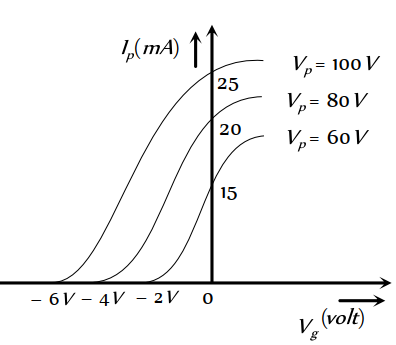
The variation of anode current in a triode corresponding to a change in grid potential at three different values of the plate potential is shown in the diagram. The mutual conductance of the triode is
- ✓
$2.5 m$ mho
- B
$5_8(0 \% \vec{m})$ mho
- C
$7.5 m$ mho
- D
$10.0 m$ mho
AnswerCorrect option: A. $2.5 m$ mho
$g_m=\frac{\Delta i_p}{\Delta V_g}=\frac{(20-15) \times 10^{-3}}{(4-2)}=2.5$ millimho
View full question & answer→MCQ 21 Mark
When forward bias is applied to a $P-N$ junction, then what happens to the potential barrier $V_B$, and the width of charge depleted region $x$
- A
$V_B$ increases, $x$ decreases
- B
$V_B$ decreases, $x$ increases
- C
$V_B$ increases, $x$ increases
- ✓
$V_B$ decreases, $x$ decreases
AnswerCorrect option: D. $V_B$ decreases, $x$ decreases
In forward biasing both $V$ and $x$ decreases.
View full question & answer→MCQ 31 Mark
A potential barrier of $0.50 \quad V$ exists across a $P-N$ junction. If the depletion region is $5.0 \times 10^{-7} m$ wide, the intensity of the electric field in this region is
- ✓
$1.0 \times 10^6 V / m$
- B
$1.0 \times 10^5 V / m$
- C
$2.0 \times 10^5 V / m$
- D
$2.0 \times 10^6 V / m$
AnswerCorrect option: A. $1.0 \times 10^6 V / m$
$ E=\frac{V}{d}=\frac{0.5}{5 \times 10^{-7}}=10^6 \mathrm{~V} / \mathrm{m}$.
View full question & answer→MCQ 41 Mark
Zener breakdown in a semi-conductor diode occurs when
- A
Forward current exceeds certain value
- ✓
Reverse bias exceeds certain value
- C
Forward bias exceeds certain value
- D
Potential barrier is reduced to zero
AnswerCorrect option: B. Reverse bias exceeds certain value
When reverse bias is increased, the electric field at the junction also increases. At some stage the electric field breaks the covalent bond, thus the large number of charge carriers are generated. This is called Zener breakdown.
View full question & answer→MCQ 51 Mark
If a full wave rectifier circuit is operating from $50 Hz$ mains, the fundamental frequency in the ripple will be
- A
$50 Hz$
- B
$70.7 Hz$
- ✓
$100 Hz$
- D
$25 Hz$
AnswerCorrect option: C. $100 Hz$
$100 Hz$
View full question & answer→MCQ 61 Mark
The thermionic emission of electron is due to
MCQ 71 Mark
In a triode valve the amplification factor is $20$ and mutual conductance is $10$ mho. The plate resistance is
- A
$2 \times 10 \Omega$
- B
$4 \times 10^4 \Omega$
- ✓
$2 \times 10^4 \Omega$
- D
$2 \times 10^3 \Omega$
AnswerCorrect option: C. $2 \times 10^4 \Omega$
$\mu=r_p \times g_m \Rightarrow r_p=\frac{20}{10^{-3}}=2 \times 10^4 \Omega$.
View full question & answer→MCQ 81 Mark
The grid in a triode valve is used
- A
To increases the thermionic emission
- ✓
To control the plate to cathode current
- C
To reduce the inter-electrode capacity
- D
To keep cathode at constant potential
AnswerCorrect option: B. To control the plate to cathode current
View full question & answer→MCQ 91 Mark
To make a $\text{PN}$ junction conducting
- ✓
The value of forward bias should be more than the barrier potential
- B
The value of forward bias should be less than the barrier potential
- C
The value of reverse bias should be more than the barrier potential
- D
The value of reverse bias should be less than the barrier potential
AnswerCorrect option: A. The value of forward bias should be more than the barrier potential
The value of forward bias should be more than the barrier potential
View full question & answer→MCQ 101 Mark
Which one of the following statements is not correct
AnswerCorrect option: C. An ideal diode is an open switch
Diode acts as open switch only when it is reverse biased
View full question & answer→MCQ 111 Mark
Avalanche breakdown is due to
- ✓
Collision of minority charge carrier
- B
Increase in depletion layer thickness
- C
Decrease in depletion layer thickness
- D
AnswerCorrect option: A. Collision of minority charge carrier
At high reverse voltage, the minority charge carriers, acquires very high velocities.
These by collision break down the covalent bonds, generating more carriers. This mechanism is called Avalanche breakdown.
View full question & answer→MCQ 121 Mark
Select the correct statement
- ✓
In a full wave rectifier, two diodes work alternately
- B
In a full wave rectifier, two diodes work simultaneously
- C
The efficiency of full wave and half wave rectifiers is same
- D
The full wave rectifier is bi-directional
AnswerCorrect option: A. In a full wave rectifier, two diodes work alternately
View full question & answer→MCQ 131 Mark
A piece of semiconductor is connected in series in an electric circuit. On increasing the temperature, the current in the circuit will
AnswerBecause with rise in temperature, resistance of semiconductor decreases, hence overall resistance of the circuit increases, which in turn increases the current in the circuit.
View full question & answer→MCQ 141 Mark
In order to forward bias a $P N$ junction, the negative terminal of battery is connected to
AnswerCorrect option: C. $N$-side
In reverse biasing negative terminal of the battery is connected to $\mathrm{N}$-side.
View full question & answer→MCQ 151 Mark
Select the correct statement
- ✓
In a full wave rectifier, two diodes work alternately
- B
In a full wave rectifier, two diodes work simultaneously
- C
The efficiency of full wave and half wave rectifiers is same
- D
The full wave rectifier is bi-directional.
AnswerCorrect option: A. In a full wave rectifier, two diodes work alternately
View full question & answer→MCQ 161 Mark
The ripple factor in a half wave rectifier is
AnswerCorrect option: A. $1.21$
Ripple factor $r=\sqrt{\left(\frac{I_{m m s}}{I_{d c}}\right)^2-1}$
$=\sqrt{\frac{\left(I_0 / 2\right)^2}{\left(I_0 / \pi\right)^2}-1}=1.21$.
View full question & answer→MCQ 171 Mark
The amplification factor of a triode is $18$ and its plate resistance is $8 \times 10 \Omega$. A load resistance of $10 \Omega$ is connected in the plate circuit. The voltage gain will be
Answer$\text { Voltage gain } A_v=\frac{\mu}{1+\frac{r_p}{R_L}}=\frac{18}{1+\frac{8 \times10^3}{10^4}}=10 .$
View full question & answer→MCQ 181 Mark
The diode shown in the circuit is a silicon diode. The potential difference between the points $A$ and $B$ will be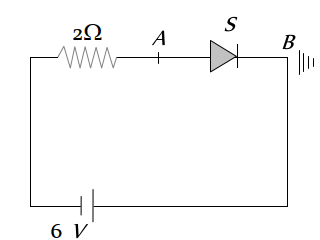
- ✓
$6 V$
- B
$0.6 V$
- C
$0.7 V$
- D
$0 V$
AnswerIn the given condition diode is in reverse biasing so it acts as open circuit.
Hence potential difference between $A$ and $B$ is $6 \mathrm{~V}$
View full question & answer→MCQ 191 Mark
Which is the correct relation for forbidden energy gap in conductor, semi conductor and insulator
- A
$\Delta E g_{ c }>\Delta E g_{ sc }>\Delta E g_{\text {insulator }}$
- ✓
$\Delta E g_{\text {insulator }}>\Delta E g_{\text {sc }}>\Delta E g_{\text {conductor }}$
- C
$\Delta E g_{\text {conductor }}>\Delta E g_{\text {insulator }}>\Delta E g_{\text {sc }}$
- D
$\Delta E g_{\text {sc }}>\Delta E g_{\text {conductor }}>\Delta E g_{\text {insulator }}$
AnswerCorrect option: B. $\Delta E g_{\text {insulator }}>\Delta E g_{\text {sc }}>\Delta E g_{\text {conductor }}$
View full question & answer→MCQ 201 Mark
The transconductance of a triode amplifier is $2.5\ mili$ mho having plate resistance of $20\ K \Omega$, amplification $10.$ Find the load resistance
- ✓
$5 k \Omega$
- B
$25 k \Omega$
- C
$20 k \Omega$
- D
$50 k \Omega$
AnswerCorrect option: A. $5 k \Omega$
$ \text { Voltage amplification } A_v=\frac{\mu}{1+\frac{r_p}{R_L}}=\frac{r_p \times g_m \times R_L}{R_L+r_p} $
$ \Rightarrow 10=\frac{20 \times 10^3 \times 2.5 \times 10^{-3} \times R_L}{\left(R_L+20 \times 10^3\right)}$
$ \Rightarrow R_L=5 \mathrm{k} \Omega .$
View full question & answer→MCQ 211 Mark
When plate voltage in diode valve is increased from $100$ volt to $150$ volt then plate current increases from $7.5\ mA$ to $12\ mA$. The dynamic plastic resistance will be
- A
$10 \ k \Omega$
- B
$11\ k \Omega$
- C
$15 \ k \Omega$
- ✓
$11.1 \ k \Omega$
AnswerCorrect option: D. $11.1 \ k \Omega$
$r_p=\frac{\Delta V_p}{\Delta i_p}=\frac{150-100}{(12-7.5) \times 10^{-3}}=\frac{50}{45} \times 10^3=11.1\ \mathrm{k} \Omega$.
View full question & answer→MCQ 221 Mark
Which one is correct relation for thermionic emission
- A
$J=A T^{1 / 2} e^{-\phi / k T}$
- ✓
$J=A T^2 e^{-\phi / k T}$
- C
$J=A T^{3 / 2} e^{-\phi / k T}$
- D
$J=A T^2 e^{-\phi / 2 k T}$
AnswerCorrect option: B. $J=A T^2 e^{-\phi / k T}$
View full question & answer→MCQ 231 Mark
Following is the relation between current and charge $I=A T^2 e^{q t / V_L}$ then value of $V$ will be
- A
$\frac{V}{k T}$
- B
$\frac{k V}{T}$
- ✓
$\frac{k T}{V}$
- D
$\frac{V T}{k}$
AnswerCorrect option: C. $\frac{k T}{V}$
Comparing the given equation with standard equation
$i=A T^2 e^{q V / k T} \Rightarrow V_L=\frac{k T}{V}.$
View full question & answer→MCQ 241 Mark
Correct relation for triode is
- ✓
$\mu=g_m \times r_p$
- B
$\mu=\frac{g_m}{r_p}$
- C
$ \mu=2 g_m \times r_p$
- D
AnswerCorrect option: A. $\mu=g_m \times r_p$
View full question & answer→MCQ 251 Mark
View full question & answer→MCQ 261 Mark
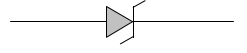
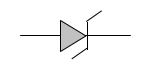
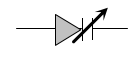
The correct symbol for zener diode is
MCQ 271 Mark
Zener breakdown takes place if
AnswerZener breakdown can occur in heavily doped diodes. In lightly doped diodes the necessary voltage is higher, and avalanche multiplication is then the chief process involved.
View full question & answer→MCQ 281 Mark
The reason of current flow in $P-N$ junction in forward bias is
- A
Drifting of charge carriers
- B
- ✓
Diffusion of charge carriers
- D
AnswerCorrect option: C. Diffusion of charge carriers
In forward biasing of $P N$ junction diode, current mainly flows due to the diffusion of majority charge carriers.
View full question & answer→MCQ 291 Mark
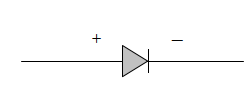
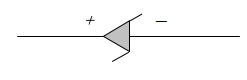
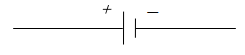
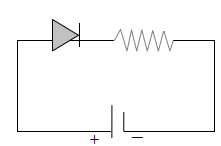
Which one is in forward bias
AnswerIn forward biasing $P$-side is connected with positive terminal and $\mathrm{N}$-side with negative terminal of the battery
View full question & answer→MCQ 301 Mark
The slope of plate characteristic of a vacuum diode is $2 \times 10^{-2} \ mA / V$. The plate resistance of diode will be
- A
$50\ \Omega$
- ✓
$50\ k \Omega$
- C
$500\ \Omega$
- D
$500 \ k \Omega$
AnswerCorrect option: B. $50\ k \Omega$
$r_p=\frac{1}{\text { slope }}=\frac{1}{2 \times 10^{-2} \times 10^{-3}}=50\ \mathrm{k} \Omega$
View full question & answer→MCQ 311 Mark
The amplification factor of a triode is $50.$ If the grid potential is decreased by $0.20\ V$, what increase in plate potential will keep the plate current unchanged
- A
$5\ V$
- ✓
$10\ V$
- C
$0.2\ V$
- D
$50\ V$
AnswerCorrect option: B. $10\ V$
$ \mu=-\frac{\Delta V_p}{\Delta V_g} $
$ \Rightarrow \Delta V_p=-\mu \times \Delta V_g=-50(-0.20)=10 \mathrm{~V}$
View full question & answer→MCQ 321 Mark
When the temperature of silicon sample is increased from $27^{\circ} C$ to $100^{\circ} C$, the conductivity of silicon will be
AnswerConductivity of semiconductors increases with rise in temperature.
View full question & answer→MCQ 331 Mark
No bias is applied to a $P-N$ junction, then the current
- A
Is zero because the number of charge carriers flowing on both sides is same
- ✓
Is zero because the charge carriers do not move
- C
- D
AnswerCorrect option: B. Is zero because the charge carriers do not move
In unbiased condition of $P N$-junction, depletion region is generated which stops the movement of charge carriers.
View full question & answer→MCQ 341 Mark
In a $P-N$ junction diode if $P$ region is heavily doped than $n$ region then the depletion layer is
- A
Greater in $P$ region
- ✓
Greater in $N$ region
- C
- D
No depletion layer is formed in this case
AnswerCorrect option: B. Greater in $N$ region
Greater in $N$ region
View full question & answer→MCQ 351 Mark
Coating of strontium oxide on Tungsten cathode in a valve is good for thermionic emission because
- ✓
- B
- C
Conductivity of cathode increases
- D
Cathode can be heated to high temperature
View full question & answer→MCQ 361 Mark
The amplification factor of a triode is $20$ and trans-conductance is $3$ milli mho and load resistance $3 \times 10^4\ \Omega$, then the voltage gain is
AnswerCorrect option: A. $16.36$
$ \text { Using voltage gain } A_v=\frac{\mu}{1+\frac{r_p}{R_L}} \text { also } \mu=r_p \times g_m $
$ \Rightarrow r_p=\frac{\mu}{g_m}=\frac{20}{3 \times 10^{-3}} $
$ \therefore A_v=\frac{20}{1+\frac{20}{3 \times 10^{-3} \times 3 \times10^4}}=\frac{180}{11}=16.36 .$
View full question & answer→MCQ 371 Mark
In a triode amplifier, $\mu=25, r_p=40$ kilo ohm and load resistance $R_L=10$ kilo ohm. If the input signal voltage is $0.5$ volt, then output signal voltage will be
- A
$1.25$ volt
- B
$5$ volt
- ✓
$2.5$ volt
- D
$10$ volt
AnswerCorrect option: C. $2.5$ volt
$ \text { Voltage gain }=\frac{V_{\text {out }}}{V_{\text {in }}}=\frac{\mu}{1+\frac{r_p}{R_L}}$
$ \Rightarrow \frac{V_{\text {out }}}{0.5}=\frac{25}{1\frac{40 \times 10^3}{10 \times 10^3}} $
$ \Rightarrow V_{\text {out }}=2.5 \mathrm{~V} .$
View full question & answer→MCQ 381 Mark
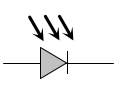
Symbolic representation of photodiode is
AnswerIn photodiode, it is illuminated by light radiations, which in turn produces electric current.
View full question & answer→MCQ 391 Mark
For a triode $r_p=10 \ kilo \ ohm$ and $g_m=3 \ milli \ mho$. If the load resistance is double of plate resistance, then the value of voltage gain will be
Answer$ \text { Voltage gain } A_V=\frac{\mu}{1+\frac{r_p}{R_L}} \text { and } \mu=r_p \times g_m $
$ \Rightarrow \mu=10 \times 10^3 \times 3 \times 10^{-3}=30 $
$ \therefore A_v=\frac{\mu}{1+\frac{r_p}{2 r_p}}=\frac{2}{3} \mu=\frac{2}{3} \times 30=20.$
View full question & answer→MCQ 401 Mark
The amplification factor of a triode is $20.$ If the grid potential is reduced by $0.2$ volt then to keep the plate current constant its plate voltage is to be increased by
- A
$10$ volt
- ✓
$4$ volt
- C
$40$ volt
- D
$100$ volt
AnswerCorrect option: B. $4$ volt
$\mu=-\frac{\Delta V_p}{\Delta V_G} \Rightarrow \Delta V_p=-\mu \Delta V_G=-20 \times(-0.2)=4 V .$
View full question & answer→MCQ 411 Mark
The triode constant is out of the following
MCQ 421 Mark
Donor type impurity is found in
AnswerOne atom of pentavalent impurity, donates one electron.
View full question & answer→MCQ 431 Mark
On adjusting the $P-N$ junction diode in forward biased
- A
Depletion layer increases
- B
- ✓
- D
View full question & answer→MCQ 441 Mark
Plate voltage of a triode is increased from $200 V$ to $225 V$. To maintain the plate current, change in grid voltage from $5 V$ to $5.75 V$ is needed. The amplification factor is
Answer(c) $\mu=\left(\frac{\Delta V_p}{\Delta V_g}\right)_{i_p=\text { constant }}=\frac{(225-200)}{(5.75-5)}=33.3$
View full question & answer→MCQ 451 Mark
The plate resistance of a triode is $2.5 \times 10^4 \Omega$ and mutual conductance is $2 \times 10^{-3} mho$. What will be the value of amplification factor
- ✓
$50$
- B
$1.25 \times 10^{-7}$
- C
$75$
- D
$2.25 \times 10^7$
Answer$\mu=r_p \times g_m=2.5 \times 10^4 \times 2 \times 10^{-3}=50$.
View full question & answer→MCQ 461 Mark
In a diode valve the cathode temperature must be ( $\phi=$ work function)
- A
High and $\phi$ should be high
- ✓
High and $\phi$ should be low
- C
Low and $\phi$ should be high
- D
Low and $\phi$ should be high
AnswerCorrect option: B. High and $\phi$ should be low
View full question & answer→MCQ 471 Mark
The correct relation for a triode is
AnswerCorrect option: B. $g_m=\left.\frac{\Delta I_p}{\Delta V_g}\right|_{V_p=\text { constt. }}$
View full question & answer→MCQ 481 Mark
Due to S.C.R in vacuum tube
AnswerCorrect option: A. $I_p \rightarrow$ Decrease
In SCR (Space charge region) electrons collect around the plate, this cloud decreases the emission of electrons from the cathode, hence plate current decreases.
View full question & answer→MCQ 491 Mark
Number of secondary electrons emitted per number of primary electrons depends on
- A
- B
Frequency of primary electrons
- ✓
- D
AnswerIntensity $\propto$ Number of electrons
View full question & answer→MCQ 501 Mark
$P$-type semiconductor is formed whenA. As impurity is mixed in $S i$B. $A$ Impurity is mixed in $S i$C. $B$ impurity is mixed in $G e$D. $P$ impurity is mixed in $G e$
- A
$A$ and $C$
- B
- ✓
$B$ and $C$
- D
AnswerCorrect option: C. $B$ and $C$
The resistance of semiconductor decreases with the increase in temperature.
View full question & answer→