Question 12 Marks
$x^{20}$ में दिए फलन के द्वितीय कोटि के अवकलज ज्ञात कीजिए।
Answerमान लीजिए $y = x^{20}$
$x$ के सापेक्ष अवकलन करने पर, $\frac{d y}{d x} = 20x^{19}$
पुनः $x$ के सापेक्ष अवकलन करने पर,
$\frac{d^{2} y}{d x^{2}}$ = $\frac{d}{d x} = (20x^{19}) = 20(19x^{18}) = 380x^{18}$
View full question & answer→Question 22 Marks
$x^2+ 3x + 2$ में दिए फलन के द्वितीय कोटि के अवकलज ज्ञात कीजिए।
Answerमान लीजिए $y = x^2+ 3x + 2,$
$x$ के सापेक्ष अवकलन करने पर, $ \frac{d y}{d x} = 2x + 3$
पुनः $x$ के सापेक्ष अवकलन करने पर, $ \frac{d^{2} y}{d x^{2}} = \frac{d}{d x} (2x + 3) = 2$
View full question & answer→Question 32 Marks
$x = a \sec \theta, y = b \tan \theta$ में $x$ तथा $y$ दिए समीकरणों द्वारा, एक दूसरे से प्राचलिक रूप में संबंधित हों, तो प्राचलों का विलोपन किए बिना, \frac{d y}{d x} ज्ञात कीजिए।
Answerदिया है,$ x = a \sec \theta$ तथा $y = b \tan \theta$
$\theta$ के सापेक्ष अवकलन करने पर,
$\frac{d x}{d \theta} = a \sec \theta \tan \theta$ तथा $ \frac{d y}{d \theta} = b \sec^2 \theta$
$\therefore$ $\frac{d y}{d x}$ = $\frac{\frac{d y}{d \theta}}{\frac{d x}{d \theta}}$ = $\frac{d y}{d \theta} $ $\times $ $\frac{d \theta}{d x}$ = $\frac{b \sec ^{2} \theta}{a \sec \theta \tan \theta}$ = $\frac{b}{a}\left(\frac{\sec \theta}{\tan \theta}\right)$ = $\frac{b}{a} \operatorname{cosec}$ $\theta$
View full question & answer→Question 42 Marks
x = cos $ \theta$ - cos 2$ \theta$, y = sin $ \theta$ - sin 2$ \theta$ में x तथा y दिए समीकरण द्वारा, एक दूसरे से प्राचलिक रूप में संबंधित हों, तो प्राचलों का विलोपन किए बिना, $\frac{d y}{d x}$ ज्ञात कीजिए।
Answerदिया है, x = cos $ \theta$ - cos 2$ \theta$ तथा y = sin $ \theta$ - sin 2$ \theta$
$ \theta$ के सापेक्ष अवकलन करने पर,
$\therefore $ $\frac{d x}{d \theta}$ = $\frac{d}{d \theta}$ (cos $ \theta$ - cos 2$ \theta$)
= - sin $ \theta$ - (- sin 2$ \theta$) 2 = - sin $ \theta$ + 2 sin 2$ \theta$
तथा
$ \frac{d y}{d \theta}$ = $\frac{d}{d \theta}$(sin $ \theta$ - sin 2 $ \theta$)
= cos $ \theta$ - (cos 2$ \theta$) 2 = cos$ \theta$ - 2 cos 2$ \theta$
$\Rightarrow $ $ \frac{d y}{d x}$ = $\frac{\frac{d y}{d x}}{\frac{d x}{d \theta}}$ = $\frac{d y}{d \theta} $ $\times$ $ \frac{d \theta}{d x}$ = $\frac{\cos \theta-2 \cos 2 \theta}{2 \sin 2 \theta-\sin \theta}$
View full question & answer→Question 52 Marks
$x = 4t, y = \frac{4}{t}$ में $x$ तथा $y$ दिए समीकरण द्वारा, एक दूसरे से प्राचलिक रूप में संबंधित हों, तो प्राचलों का विलोपन किए बिना, $\frac{d y}{d x}$ ज्ञात कीजिए।
Answerदिया है, $x = 4\ t$ तथा $y = \frac{4}{t}$
$t$ के सापेक्ष अवकलन करने पर,
$\frac{d x}{d t}$ = 4 तथा $ \frac{d y}{d t} = 4(- 1) t^{-2}$
$\therefore$ $ \frac{d y}{d x}$ = $\frac{\frac{d y}{d t}}{\frac{d x}{d t}}$ $\frac{-4 t^{-2}}{4}$ = - $\frac{1}{t^{2}}$ ($\because$ $ \frac{d y}{d x}$ = $\frac{d y / d t}{d x / d t}$)
View full question & answer→Question 62 Marks
x = sin t, y = cos 2t में x तथा y दिए समीकरण द्वारा, एक दूसरे से प्राचलिक रूप में संबंधित हों, तो प्राचलों का विलोपन किए बिना, $\frac{d y}{d x}$ ज्ञात कीजिए।
Answerदिया है,
x = sin t तथा y = cos 2t
t के सापेक्ष अवकलन करने पर,
$\therefore$ $\frac{d x}{d t}$ = cos t तथा $ \frac{d y}{d t}$ = - (sin 2t)2
$\therefore$ $ \frac{d y}{d x}$ = $\frac{\frac{d y}{d t}}{\frac{d x}{d t}}$ = $\frac{d y}{d t}$ $ \times$ $ \frac{d t}{d x} $ ($\because$ $ \frac{d y}{d x}$ = $\frac{d y / d t}{d x / d t}$)
= $\frac{-2 \sin 2 t}{\cos t}$ = $\frac{-2(2 \sin t \cos t)}{\cos t}$ = - 4 sin t ($\because $ sin 2$ \theta$ = 2 sin $ \theta$ cos $ \theta$)
View full question & answer→Question 72 Marks
x = a cos $\theta$, y = b cos $\theta$ में x तथा y दिए समीकरणों द्वारा, एक दूसरे से प्राचलिक रूप में संबंधित हों, तो प्राचलों का विलोपन किए बिना, $\frac{d y}{d x}$ ज्ञात कीजिए।
Answerदिया है, x = a cos $\theta$ तथा y = b cos $\theta$
$\theta$ के सापेक्ष अवकलन करने पर,
$\frac{d x}{d \theta}$ = a(- sin $\theta$) तथा $\frac{d y}{d \theta}$ = b (- sin $\theta$)
$\therefore$ $\frac{d y}{d x}=\frac{\frac{d y}{d \theta}}{\frac{d x}{d \theta}}=\frac{d y}{d \theta} \times \frac{d \theta}{d x}$ = $\frac{-b \sin \theta}{-a \sin \theta}=\frac{b}{a}$ ($\because$ $\frac{d y}{d x}=\frac{d y / d t}{d x / d t}$)
View full question & answer→Question 82 Marks
$x = 2at^2, y = at^4$ य में $x$ तथा $y$ दिए समीकरणों द्वारा, एक दूसरे से प्राचलिक रूप में संबंधित हों, तो प्राचलों का विलोपन किए बिना, $\frac{d y}{d x}$ ज्ञात कीजिए।
Answerदिया है, $x=2 a t^2$ तथा $y=a t^4$ $t$ के सापेक्ष अवकलन करने पर,
$\frac{d x}{d t}=(2 \mathrm{a})(2 \mathrm{t}) $ तथा $ \frac{d y}{d t}=\mathrm{a}\left(4 \mathrm{t}^3\right) $
$ \therefore \frac{d y}{d x}=\frac{\frac{d y}{d t}}{d x}=\frac{d y}{d t} \times \frac{d t}{d x}\left(\because \frac{d y}{d x}=\frac{d y / d t}{d x / d t}\right)$
$ =\frac{4 a t^3}{4 a t}=\frac{t^3}{t}=\mathrm{t}^2$
View full question & answer→Question 92 Marks
$(\log x)^{\cos x}$ प्रदत्त फलनों का $x$ के सापेक्ष अवकलन कीजिए।
Answerमान लीजिए $y = (\log x)^{\cos x}$
दोनों तरफ का लघुगणक लेने पर,
$\log y = \log{(\log x)^{\cos x}}$
$\Rightarrow \log y = \cos x \log (\log x) (\because \log m^n= n \log m)$
$x$ के सापेक्ष अवकलन करने पर,
$\frac{1}{y} \frac{d y}{d x} = \frac{d}{d x} {\cos x \log (\log x)}$
$\Rightarrow \frac{1}{y} \frac{d y}{d x} = \cos x \frac{1}{\log x} \cdot \frac{1}{x}+ \log (\log x) (- \sin x) [\because \frac{d}{d x} (u \cdot v) = u \frac{d v}{d x} + v \frac{d u}{d x}]$
$\frac{d y}{d x} = y \left\{\frac{\cos x}{x \log x}-\sin x \log (\log x)\right\} = (\log x)^{\cos x} {\frac{\cos x}{x \log x} - \sin x \log (\log x)}$
View full question & answer→Question 102 Marks
x के सापेक्ष $\frac{\cos x}{\log x}$, x > 0 अवकलन कीजिए।
Answerमान लीजिए y = $ \frac{\cos x}{\log x}$
x के सापेक्ष अवकलन करने पर,
$\Rightarrow $ $ \frac{d y}{d x}$ = $\frac{d}{d x}$ $\left(\frac{\cos x}{\log x}\right)$, x > 0
$\Rightarrow$ $\frac{d y}{d x}$ = $\frac{(\log x) \frac{d}{d x}(\cos x)-\cos x \frac{d}{d x}(\log x)}{(\log x)^{2}}$ [$\because $ $\frac{d}{d x}$ $\left(\frac{u}{v}\right)$ = $\frac{v \frac{d}{d x}(u)-u \frac{d}{d x}(v)}{v^{2}}$]
$\Rightarrow$ $ \frac{d y}{d x}$ = $\frac{(\log x)(-\sin x)-(\cos x) \frac{1}{x}}{(\log x)^{2}} $
$\Rightarrow$ $\frac{d y}{d x}$ = - $\frac{x \sin x \log x+\cos x}{x(\log x)^{2}}$, x > 0
View full question & answer→Question 112 Marks
x के सापेक्ष log (log x), x > 1 अवकलन कीजिए।
Answerमान लीजिए y = log (log x)
x के सापेक्ष अवकलन करने पर,
$\frac{d y}{d x}$ = $\frac{d}{d x}$(log (log x)) = $\frac{1}{\log x}$ $\left\{\frac{d}{d x}(\log x)\right\} $ $\Rightarrow$ $ \frac{d y}{d x}$ = $\frac{1}{\log x}$ $\cdot$ -$\frac{1}{x}$= $\frac{1}{x \log x}, $ x > 1
View full question & answer→Question 122 Marks
x के सापेक्ष $\sqrt{e^{\sqrt{x}}}, $ x > 0 अवकलन कीजिए।
Answerमान लीजिए y =$\left(e^{\sqrt{x}}\right)^{1 / 2}$
x के सापेक्ष अवकलन करने पर
$\Rightarrow$ $ \frac{d y}{d x}$ = $\frac{1}{2}\left(e^{\sqrt{x}}\right)^{\frac{1}{2}-1} \frac{d}{d x} e^{\sqrt{x}} $ $\Rightarrow $ $\frac{d y}{d x}$ = $\frac{1}{2}\left(e^{\sqrt{x}}\right)^{-\frac{1}{2}} $ $\cdot$ $ e^{\sqrt{x}} $ $\cdot $ $\frac{d}{d x}(\sqrt{x})$
$\Rightarrow $ $\frac{d y}{d x}$ = $\frac{1}{2} \frac{e^{\sqrt{x}}}{\sqrt{e^{\sqrt{x}}}} $ $\times $ $\frac{1}{2 \sqrt{x}}$ = $\frac{e^{\sqrt{x}}}{4 \sqrt{x} \sqrt{e^{\sqrt{x}}}}$ = $\frac{e^{\sqrt{x}}}{4 \sqrt{x e^{\sqrt{x}}}}$
View full question & answer→Question 132 Marks
$x$ के सापेक्ष $e^x+ e^x + ... + e^{x^{5}}$अवकलन कीजिए।
Answerमान लीजिए $y = e^x+ e^x + ... + e^{x^{5}}$
$x$ के सापेक्ष अवकलन करने पर,
$\frac{d}{d x} y$ = $\frac{d}{d x}$$\left\{e^{x}+e^{x^{2}}+e^{x^{3}}+e^{x^{4}}+e^{x^{5}}\right\}$
$= \frac{d}{d x}$ $\left(e^{x}\right)$+ $\frac{d}{d x}$$\left(e^{x^{2}}\right)$ + $\frac{d}{d x}$ $\left(e^{x^{3}}\right)$+ $\frac{d}{d x}$$\left(e^{x^{4}}\right)$+ $\frac{d}{d x}$$\left(e^{x^{5}}\right)$
$= e^{x}$ +$e^{x^{2}}$ $ \frac{d}{d x}\left(x^{2}\right)$+ $e^{x^{3}}$ $ \frac{d}{d x}$$\left(x^{3}\right)$ + $e^{x^{4}} \frac{d}{d x}$ + $\left(x^{4}\right)$ + $e^{x^{5}}$ + $ \frac{d}{d x}$ $\left(x^{5}\right)$ (श्रृंखला नियम से)
$= e^{x}$ + $e^{x^{2}}$$(2 x)$ + $e^{x^{3}}\left(3 x^{2}\right)$ + $e^{x^{4}}\left(4 x^{3}\right)$ + $e^{x^{2}}\left(5 x^{4}\right)$
$= e^{x}$ + $2 x e^{x^{2}}$ + $3 x^{2} e^{x^{3}}$ + $4 x^{3} e^{x^{4}}$ + $ x^{4} e^{x^{5}}$
View full question & answer→Question 142 Marks
$x$ के सापेक्ष $\log (\cos e^x)$ अवकलन कीजिए।
Answerमान लीजिए $y = \log (\cos e^x)$
$x$ के सापेक्ष अवकलन करने पर,
$\frac{d y}{d x}$ = $\frac{d}{d x}$$\left[\log \left\{\cos \left(e^{x}\right)\right\}\right]$ = $\frac{1}{\cos \left(e^{x}\right)}$ $\left\{\cos \left(e^{x}\right)\right\}$ (शृंखला नियम से)
$= \frac{1}{\cos \left(e^{x}\right)}$ $\left\{-\sin \left(e^{x}\right)\right\} $ $\frac{d}{d x}\left(e^{x}\right)$ (शृंखला नियम से)
$= \tan \left(e^{x}\right) \cdot e^x= - e^x \tan (e^x)$
View full question & answer→Question 152 Marks
4 के सापेक्ष $\sin(\tan^{-1} e^{-x})$ अवकलन कीजिए।
Answerमान लीजिए $y = \sin(\tan^{-1} e^{-x})$
$x$ के सापेक्ष अवकलन करने पर,
$\Rightarrow $ $ \frac{d y}{d x}$ = $\frac{d}{d x}$ $\left[\sin \left(\tan ^{-1}\left(e^{-x}\right)\right]\right.$
$= \cos \left\{\tan ^{-1}\left(e^{-x}\right)\right\} $ $\frac{d}{d x}$ $\left\{\tan ^{-1}\left(e^{-x}\right)\right\}$ (शृंखला नियम से)
$= \cos \left\{\tan ^{-1}\left(e^{-x}\right)\right\}$ $ \frac{1}{1+\left(e^{-x}\right)^{2}}$ $ \frac{d}{d x}\left(e^{-x}\right)$
$= \cos \left(\tan ^{-1}\left(e^{-x}\right)\right)$ $ \frac{1}{1+e^{-2 x}}$ $ \cdot$ $\left(-e^{-x}\right)$ = - $\frac{e^{-x} \cos \left(\tan ^{-1} e^{-x}\right)}{1+e^{-2 x}}$
View full question & answer→Question 162 Marks
x के सापेक्ष $e^{x^{3}}$ अवकलन कीजिए।
Answerमान लीजिए y = $ e^{x^{3}}$
x के सापेक्ष अवकलन करने पर,
$\Rightarrow$ $ \frac{d y}{d x}$ = $\frac{d}{d x}\left(e^{x^{3}}\right)$ = $e^{x^{3}} \frac{d}{d x}\left(x^{3}\right)$ = $e^{x^{3}}\left(3 x^{2}\right)$ = $3 x^{2} e^{x^{3}}$ [$\because$ $ \frac{d}{d x} e^{a x}$ = $e^{a x} \frac{d}{d x}(a x)$]
View full question & answer→Question 172 Marks
$e^{sin^{-1}x}$ का x के सापेक्ष अवकलन कीजिए।
Answerमान लीजिए y = $e^{sin^{-1}x}$
x के सापेक्ष अवकलन करने पर,
$\Rightarrow$ $\frac{d y}{d x}$ = $\frac{d}{d x}\left(e^{\sin ^{-1} x}\right)$ = $e^{\sin ^{-1} x} \frac{d}{d x} \sin ^{-1} x $ [$\because$ $ \frac{d}{d x} e^{a x}$ = $e^{a x} \frac{d}{d x}(a x)]$
= $e^{\sin ^{-1} x} \frac{1}{\sqrt{1-x^{2}}}$ = $\frac{e^{\sin ^{-1} x}}{\sqrt{1-x^{2}}}, x \in$ (-1, 1) [$\because$ $\frac{1}{\sqrt{1-x^{2}}},$ x $\in$ (-1, 1) के लिए परिभाषित है]
View full question & answer→Question 182 Marks
$x$ के सापेक्ष $\cos (\log x + e^x)$ अवकलन कीजिए।
Answerमान लीजिए $y = \cos (\log x + e^x)$
$x$ के सापेक्ष अवकलन करने पर,
$\Rightarrow \frac{d y}{d x} = \frac{d}{d x} \left\{\cos \left(\log x+e^{x}\right)\right\} $
$\Rightarrow \frac{d y}{d x} = - \sin (\log x + e^x) \frac{d}{d x} (\log x + e^x)$ (शृंखला नियम से)
$ \Rightarrow \frac{d y}{d x} = - \sin (\log x + e^x) \left(\frac{1}{x}+e^{x}\right)$
$\Rightarrow \frac{d y}{d x} = \frac{-\left(x e^{x}+1\right) \sin \left(\log x+e^{x}\right)}{x} $
View full question & answer→Question 192 Marks
$\frac{e^{x}}{\sin x}$ का x के सापेक्ष अवकलन कीजिए।
Answerमान लीजिए y = $ \frac{e^{x}}{\sin x}$
x के सापेक्ष अवकलन करने पर,
$\frac{d y}{d x}$ = $\frac{d}{d x}\left(\frac{e^{x}}{\sin x}\right)$ [$\because$ $ \frac{d}{d x}$$\left(\frac{u}{v}\right)$ = $\frac{v \frac{d}{d x} u-u \frac{d}{d x} v}{v^{2}}$]
= $\frac{\sin x \frac{d}{d x} e^{x}-e^{x} \frac{d}{d x} \sin x}{\sin ^{2} x}$ = $\frac{\sin x e^{x}-e^{x} \cos x}{\sin ^{2} x}$
= $\frac{e^{x}(\sin x-\cos x)}{\sin ^{2} x}$, $x \neq n \pi, n \in Z$
View full question & answer→Question 202 Marks
$\sin^2 x + \cos^2 y = 1$ में $\frac{d y}{d x} $ ज्ञात कीजिए।
Answerदिया है, $\sin^2 x + \cos^2 y = 1$
$x$ के सापेक्ष अवकलन करने पर,
$\frac{d}{d x} (\sin^2 x + \cos^2 y) = \frac{d}{d x} (1)$
$2 \sin x \cos x + 2 \cos y (- \sin y \frac{d y}{d x}) = 0 [\because \frac{d}{d x} f{g(x)} = f^{\prime}(x) \frac{d}{d x} g(x)]$
$\Rightarrow - 2 \sin y \cos y \frac{d y}{d x} = - 2 \sin x \cos x$
$\Rightarrow \frac{d y}{d x} = \frac{-\sin 2 x}{-\sin 2 y} = \frac{\sin 2 x}{\sin 2 y} (\because \sin 2x = 2 \sin x \cdot \cos x)$
View full question & answer→Question 212 Marks
$\sin^2y + \cos xy = k$ में $\frac{d y}{d x} $ ज्ञात कीजिए।
Answerदिया है, $\sin^2 y + \cos xy = k$
$x$ के सापेक्ष अवकलन करने पर,
$\frac{d}{d x} (\sin^2y + \cos xy) = \frac{d}{d x} (k) \Rightarrow \frac{d}{d x} (\sin^2y) + \frac{d}{d x} (\cos xy) = 0$
$\Rightarrow 2 \sin y \cos y \frac{d y}{d x} + (- \sin xy) \frac{d}{d x} (xy) = 0 [\because \frac{d}{d x} f\{g(x)\}= f^{\prime}(x) \frac{d}{d x} g(x)]$
$\Rightarrow \sin 2y\frac{d y}{d x} - \sin xy (x \frac{d y}{d x} + y \cdot1) = 0 (\because \sin 2x = 2 \sin x \cdot \cos x)$
$\Rightarrow \sin 2y \frac{d y}{d x} - x \sin xy \frac{d y}{d x} = y \sin xy \Rightarrow \frac{d y}{d x} = \frac{y \sin (x y)}{\sin 2 y-x \sin (x y)}$
View full question & answer→Question 222 Marks
$x^3+ x^2y + xy^2+ y^3= 81$ में $\frac{d y}{d x} $ ज्ञात कीजिए।
Answerदिया है, $x^3+ x^2y + xy^2+ y^3= 81$
$x$ के सापेक्ष अवकलन करने पर, $\frac{d}{d x} (x^3+ x^2y + xy^2+ y^3) = 81$
$3x^2+ \frac{d}{d x} (x^2y) + \frac{d}{d x} (xy^2) + 3y^2 \frac{d y}{d x} = 0$
$\Rightarrow 3x^2+ x^2 \frac{d y}{d x} + y(2x) + x\left(2 y \frac{d y}{d x}\right) + y^2\cdot1 + 3y^2 \frac{d y}{d x} = 0 [\because \frac{d}{d x} (u \cdot v) = u \frac{d v}{d x} + v \frac{d u}{d x}]$
$\Rightarrow (x^2+ 2xy + 3y^2) \frac{d y}{d x} = - 3x^2- 2xy - y^2$
$\Rightarrow \frac{d y}{d x} = - \frac{\left(3 x^{2}+2 x y+y^{2}\right)}{x^{2}+2 x y+3 y^{2}}$
View full question & answer→Question 232 Marks
$x^2+ xy + y^2= 100$ में $\frac{d y}{d x} $ ज्ञात कीजिए।
Answerदिया है, $x^2+ xy + y^2= 100$
$x$ के सापेक्ष अवकलन करने पर, $\frac{d}{d x} (x^2+ xy + y^2) = 0$
$\Rightarrow 2x + (x \frac{d y}{d x} + y \cdot1) + 2y \frac{d y}{d x} = 0 [\because \frac{d}{d x}(u \cdot v) = u \frac{d v}{d x} + v \frac{d u}{d x}]$
$\Rightarrow \frac{d y}{d x} (x + 2y) = - 2x - y \Rightarrow \frac{d y}{d x} = - \frac{(2 x+y)}{x+2 y}$
View full question & answer→Question 242 Marks
$xy + y^2 = \tan x + y$ में $\frac{d y}{d x} $ ज्ञात कीजिए।
Answerदिया है, $xy + y^2 = \tan x + y$
$x$ के सापेक्ष अवकलन करने पर, $\frac{d}{d x} (xy + y^2) = \frac{d}{d x}(\tan x + y)$
$\frac{d}{d x} (xy) + \frac{d}{d x}(y^2) = \sec^2 x + \frac{d y}{d x}$
$\Rightarrow x \frac{d y}{d x} + y\cdot1 + 2 y \frac{d y}{d x} = \sec ^{2} x + \frac{d y}{d x} [\because \frac{d}{d x} (u \cdot v) = u \frac{d v}{d x} + v \frac{d u}{d x}]$
$\Rightarrow x \frac{d y}{d x} + 2 y \frac{d y}{d x} - \frac{d y}{d x} = \sec^2x - y$
$\Rightarrow (x + 2y - 1) \frac{d y}{d x} = \sec^2 x - y \Rightarrow \frac{d y}{d x} = \frac{\sec ^{2} x-y}{x+2 y-1}$
View full question & answer→Question 252 Marks
$ax + by^2= \cos y$ में $\frac{d y}{d x} $ ज्ञात कीजिए।
Answerदिया है, $ax + by^2 = \cos y$
$x$ के सापेक्ष अवकलन करने पर,
$\frac{d}{d x} (ax + by^2) = \frac{d}{d x} (\cos y)$
$a + 2by \frac{d y}{d x} = - \sin y \frac{d y}{d x} \Rightarrow 2by \frac{d y}{d x} + \sin y \frac{d y}{d x} = - a$
$\Rightarrow \frac{d y}{d x} (2by + \sin y) = - a \Rightarrow \frac{d y}{d x} = \frac{-a}{2 b y+\sin y}$
View full question & answer→Question 262 Marks
2x + 3y = sin y में $\frac{d y}{d x} $ ज्ञात कीजिए।
Answerनिया है, 2x + 3y = sin y
x के सापेक्ष अवकलन करने पर,
$\frac{d}{d x}$(2x + 3y) = $\frac{d}{d x}$(sin y) $ \Rightarrow$ 2 + 3$\frac{d y}{d x}$ = cos y$\frac{d y}{d x}$
$\Rightarrow$ 3 $\frac{d y}{d x}$ - cos y $\frac{d y}{d x}$ = - 2 $\Rightarrow$ (3 - cos y) $ \frac{d y}{d x}$ = - 2
$\Rightarrow$ $\frac{d y}{d x}$ = $\frac{2}{\cos y-3}$
View full question & answer→Question 272 Marks
2x + 3y = sin x में $\frac{d y}{d x} $ ज्ञात कीजिए।
Answerदिया है, 2x + 3y = sin x
x के सापेक्ष अवकलन करने पर,
$\frac{d}{d x}$ (2x + 3y) = $ \frac{d}{d x}$ (sin x)
2 + 3 $\frac{d y}{d x}$ = cos x $\Rightarrow$ 3 $ \frac{d y}{d x}$ = cos x - 2 $\Rightarrow$ $\frac{d y}{d x}$ = $\frac{\cos x-2}{3}$
View full question & answer→Question 282 Marks
x के सापेक्ष फलन का अवकलन कीजिए: sec (tan $\sqrt{x}$)
Answerमान लीजिए y = sec (tan $ \sqrt{x})$
x के सापेक्ष अवकलन करने पर,
$\frac{d y}{d x}$ = $\frac{d}{d x}[\sec (\tan \sqrt{x})]$
= $\sec (\tan \sqrt{x}) $ tan (tan $\sqrt{x})$ $\frac{d}{d x}(\tan \sqrt{x})$ (शृंखला नियम से)
= $\sec (\tan \sqrt{x}) $ $\tan (\tan \sqrt{x}) \sec ^{2} $ $\sqrt{x} \frac{d}{d x}(\sqrt{x})$
= $\sec (\tan \sqrt{x}) $ tan (tan $\sqrt{x})\left(\sec ^{2} \sqrt{x}\right)$ $\left(\frac{1}{2 \sqrt{x}}\right)$
= $\frac{1}{2 \sqrt{x}} \sec$ $ (\tan \sqrt{x}) $ $\tan (\tan \sqrt{x})$ $\left(\sec ^{2} \sqrt{x}\right)$
View full question & answer→Question 292 Marks
x के सापेक्ष फलन का अवकलन कीजिए: sin (ax + b)
Answerमान लीजिए y = sin (ax + b)
x के सापेक्ष अवकलन करने पर,
$\frac{d y}{d x}$ = $\frac{d}{d x} \sin (a x+b)$ = cos (ax + b) $ \frac{d}{d x}$ (ax + b) (शृंखला नियम से)
= cos (ax + b) {a $\times$ 1 + 0} = a cos (ax + b)
View full question & answer→Question 302 Marks
x के सापेक्ष फलन का अवकलन कीजिए: cos (sin x)
Answerमान लीजिए y = cos (sin x)
x के सापेक्ष अवकलन करने पर,
$\frac{d y}{d x}$ = $\frac{d}{d x}(\cos (\sin x))$ = - sin (sin x) $\frac{d}{d x}$(sin x) (शृंखला नियम से)
= - sin (sin x) cos x = - cos x sin (sin x)
View full question & answer→Question 312 Marks
$x$ के सापेक्ष फलन का अवकलन कीजिए: $\sin (x^2 + 5)$
Answerमान लीजिए $y = \sin (x^2 + 5)$
$x$ के सापेक्ष अवकलन करने पर,
$\frac{d y}{d x} = \frac{d}{d x}\left[\sin \left(x^{2}+5\right)\right]$ = $\cos \left(x^{2}+5\right)$
$ \frac{d}{d x}$
$\left(x^{2}+5\right) ($शृंखला नियम से$)$
$= \cos (x^2+ 5) (2x + 0) = 2x \cos (x^2+ 5)$
View full question & answer→Question 322 Marks
सिद्ध कीजिए कि फलन $f(x) = x^n, x = n,$ पर संतत है, जहाँ $n$ एक धन पूर्णांक है।
Answerयहाँ, $f(x) = x^n$
$\therefore \lim \limits_{x \rightarrow n} f(x) = \lim \limits_{x \rightarrow n} x^{n} = n^n \therefore \lim \limits_{x \rightarrow n} f(x) = \lim \limits_{x \rightarrow n} x^{n} = n^n$
$तथा f(n) = n^n [\because f(x) = x^n]$
$ \therefore \lim \limits_{x \rightarrow n} f(x) = f(n)$
अतः $f(x), x = n$ पर सतत् फलन है, जहाँ $n$ एक धन पूर्णांक है।
View full question & answer→Question 332 Marks
फलन के सांतत्य की जाँच कीजिए: f(x) = |x - 5|
Answer

$x \rightarrow 5^{+}$ के लिए, $\lim \limits_{x \rightarrow 5^{+}}$ f(x) = $\lim \limits_{x \rightarrow 5^{+}}$ (x - 5) = 5 - 5 = 0
x $\rightarrow 5^{-}$ के लिए, $\lim \limits_{x \rightarrow 5^{-}}$ f(x) = $\lim \limits_{x \rightarrow 5^{-}}$(5 - x) = 5 - 5 = 0
पुनः f(5) = 5 - 5 = 0
LHL = RHL = f(5), अतः f(x), x = 5 पर सतत् फलन है।
View full question & answer→Question 342 Marks
फलन के सांतत्य की जाँच कीजिए: f(x) = $\frac{x^{2}-25}{x+5}$, x $\neq$ - 5
Answerf(x) = $\frac{x^{2}-25}{x+5}$ = $\frac{(x+5)(x-5)}{x+5}$ = x - 5
f(x) = x - 5 एक बहुपदी फलन है, अतः f(x), n के प्रत्येक मान के लिए सतत् है।
View full question & answer→Question 352 Marks
फलन के सांतत्य की जाँच कीजिए: f(x) = $\frac{1}{x-5}$, x $\neq$ 5
Answerf(x) = $\frac{1}{x-5}$ दो बहुपदी फलनों का भागफल है, अतः फलन f(x) x $\neq$ 5 के प्रत्येक मान के लिए सतत् है।
View full question & answer→Question 362 Marks
फलन के सांतत्य की जाँच कीजिए: f(x) = x - 5
Answerf(x) = x - 5 बहुपदी फलन है, अतः f(x), x के प्रत्येक मान के लिए सतत् फलन है।
View full question & answer→Question 372 Marks
$x = 3$ पर फलन $f(x) = 2x^2 - 1$ के सांतत्य की जाँच कीजिए।
Answerयहाँ, $f(x) = 2x^2 - 1$
$\therefore \lim \limits_{x \rightarrow 3} f(x) = \lim \limits_{x \rightarrow 3} \left(2 x^{2}-1\right) = 2 \times(3)^2- 1 = 18 - 1 = 17$
तथा $f(3) = 2 \times(3)^2- 1 = 18 - 1 = 17$
$\therefore \lim \limits_{x \rightarrow 3} f(x) = f(3)$
अतः $f(x), x = 3$ पर सतत् है।
View full question & answer→Question 382 Marks
f(x) = $\frac{1}{x}$, x $\neq $ 0 द्वारा परिभाषित फलन f के सांतत्य पर विचार कीजिए।
Answerकिसी एक शून्येतर ( Non-zero) वास्तविक संख्या c को सुनिश्चित कीजिए
अब $\lim \limits_{x \rightarrow c}$ f(x) = $\lim \limits_{x \rightarrow c}$ $\frac{1}{x}$ = $\frac{1}{c}$
साथ ही, चूँकि c $\neq$ 0, इसलिए f(c) = $\frac{1}{c}$ है। इस प्रकार $\lim \limits_{x \rightarrow c}$ f(x) = f(c) और इसलिए f अपने प्रांत के प्रत्येक बिंदु पर संतत है। इस प्रकार एक संतत f फलन है।
View full question & answer→Question 392 Marks
फलन $f(x) = x^3 + x^2 - 1$ के सांतत्य पर विचार कीजिए।
Answerस्पष्टतया f प्रत्येक वास्तविक संख्या c के लिए परिभाषित है और c पर इसका मान$ c^3+ c^2- 1$ है। हम यह भी जानते हैं कि
$\lim \limits_{x \rightarrow c} f(x) = \lim \limits_{x \rightarrow c} (x^3+ x^2 - 1) = c^3+ c^2- 1$
अतः $\lim \limits_{x \rightarrow c} f(x) = f(c)$ है
इसलिए प्रत्येक वास्तविक संख्या के लिए f संतत है। इसका अर्थ है कि f एक संतत फलन है।
View full question & answer→Question 402 Marks
क्या f(x) = |x| द्वारा परिभाषित फलन एक संतत फलन है?
Answerf को हम ऐसे लिख सकते हैं कि 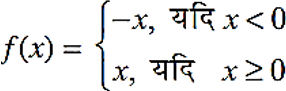
हम जानते हैं कि x = 0 पर f संतत है।
मान लीजिए कि c एक वास्तविक संख्या इस प्रकार है कि c < 0 है। अतएव f(c) = - c
साथ ही
$\lim \limits_{x \rightarrow c}$ f(x) = $\lim \limits_{x \rightarrow c}$ (- x) = - c
चूँकि $\lim \limits_{x \rightarrow c}$ f(x) = f(c), इसलिए f सभी ऋणात्मक वास्तविक संख्याओं के लिए संतत है।
अब मान लीजिए कि c एक वास्तविक संख्या इस प्रकार है कि c > 0 है। अतएव f(c) = c
साथ ही $\lim \limits_{x \rightarrow c}$ f(x) = $\lim \limits_{x \rightarrow c} $ x = c
क्योंकि $\lim \limits_{x \rightarrow c}$ f(x) = f(c), इसलिए f सभी धनात्मक वास्तविक संख्याओं के लिए संतत है। चूँकि f सभी बिंदुओं पर संतत है, अतः यह एक संतत फलन है।
View full question & answer→Question 412 Marks
सिद्ध कीजिए कि वास्तविक संख्याओं के लिए तत्समक फलन (Identity function) f(x) = x, प्रत्येक वास्तविक संख्या के लिए संतत है।
Answerस्पष्टतया यह फलन प्रत्येक बिंदु पर परिभाषित है और प्रत्येक वास्तविक संख्या c के लिए f(c) = c है।
साथ ही $\lim \limits_{x \rightarrow c} $ f(x) = $\lim \limits_{x \rightarrow c}$ x = c
इस प्रकार, $\lim \limits_{x \rightarrow c}$ f(x) = c = f(c) और इसलिए यह फलन f के प्रांत के सभी बिंदुओं पर संतत है।
View full question & answer→Question 422 Marks
उन बिंदुओं की जाँच कीजिए जिन पर अचर फलन (Constant function) f(x) = k संतत है।
Answerयह फलन सभी वास्तविक संख्याओं के लिए परिभाषित है और किसी भी वास्तविक संख्या के लिए इसका मान k है। मान लीजिए कि c एक वास्तविक संख्या है, तो $\lim \limits_{x \rightarrow c}$ f(x) = $ \lim \limits_{x \rightarrow c}$ k = k चूँकि किसी वास्तविक संख्या c के लिए f(c) = k = $\lim \limits_{x \rightarrow c}$ f(x) है इसलिए फलन f प्रत्येक वास्तविक संख्या के लिए संतत है।
View full question & answer→Question 432 Marks
दर्शाइए कि फलन 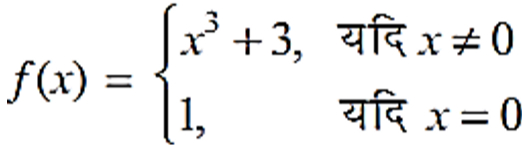
$x = 0$ पर संतत नहीं है। Answerयहाँ $x = 0$ पर फलन परिभाषित है और $x = 0$ पर इसका मान $1$ है। जब $x \neq 0, $ तब फलन बहुपदीय है। इसलिए
$\lim \limits_{x \rightarrow 0} f(x) = \lim \limits_{x \rightarrow 0} (x^3+ 3) = 0^3+ 3 = 3$
क्योंकि $x = 0$ पर f की सीमा, $f(0)$ के बराबर नहीं है, इसलिए $x = 0$ पर फलन संतत नहीं है। हम यह भी सुनिश्चित कर सकते हैं कि इस फलन के लिए असांतत्य का बिंदु केवल $x = 0$ है।
View full question & answer→Question 442 Marks
यदि $y = x^3+ \tan x$ है तो $\frac{d^{2} y}{d x^{2}}$ ज्ञात कीजिए।
Answerदिया है कि $y = x^3+ \tan x$ है। अब
$\frac{d y}{d x}$ = $3 x^{2}$ + $\sec ^{2} x$
इसलिए $\frac{d^{2} y}{d x^{2}} $ = $ \frac{d}{d x}\left(3 x^{2}+\sec ^{2} x\right) $
$= 6x + 2x \cdot \sec x \tan x = 6x + 2 \sec^2 x \tan x$
View full question & answer→Question 452 Marks
यदि $ x^{\frac{2}{3}}$ + $ y^{\frac{2}{3}}$ = $a^{\frac{2}{3}} $ है तो $\frac{d y}{d x} $ ज्ञात कीजिए।
Answerमान लीजिए कि $x = a \cos^3 \theta, y = a \sin^3 \theta $ है तब
$x^{\frac{2}{3}} + y^{\frac{3}{2}} = \left(a \cos ^{3} \theta\right)^{\frac{2}{3}} + \left(a \sin ^{3} \theta\right)^{\frac{2}{3}}$
$= a^{\frac{2}{3}}(\cos^2 \theta + (\sin^2 \theta) = a^{\frac{2}{3}}$
अतः $x = a \cos^3 \theta, y = a \sin^3 \theta, x^{\frac{2}{3}} + y^{\frac{2}{3}} = a^{\frac{2}{3}}$ का प्राचलिक समीकरण है।
इस प्रकार, $\frac{d x}{d \theta} = - 3a \cos^2 \theta \sin \theta$ और $\frac{d y}{d \theta} = 3a \sin^2 \theta \cos \theta$
इसलिए, $\frac{d y}{d x} = \frac{\frac{d y}{d \theta}}{\frac{d x}{d \theta}} = \frac{3 a \sin ^{2} \theta \cos \theta}{-3 a \cos ^{2} \theta \sin \theta} = -\tan \theta = -\sqrt[3]{\frac{y}{x}}$
View full question & answer→Question 462 Marks
यदि x = a ($\theta$ + sin $\theta$), y = a(1 - cos $\theta$) है तो $\frac{d y}{d x} $ ज्ञात कीजिए।
Answerयहाँ $ \frac{d x}{d \theta}$ = a(1 + cos $ \theta$), $ \frac{d y}{d \theta}$ = $a(\sin \theta)$
अतः $\frac{d y}{d x}$ = $\frac{\frac{d y}{d \theta}}{\frac{d x}{d \theta}}$ = $\frac{a \sin \theta}{a(1+\cos \theta)}$ = $\tan \frac{\theta}{2} $
View full question & answer→Question 472 Marks
$x$ के सापेक्ष $x^{\sin x},$ का अवकलन कीजिए, जब कि $x > 0$ है।
Answerमान लीजिए कि $y = x^{\sin x}$ है। अब दोनों पक्षों का लघुगणक लेने पर
$\log y = \sin x \log x$
अतएव $\frac{1}{y} \cdot \frac{d y}{d x} = \sin x \frac{d}{d x}(\log x) + \log x \frac{d}{d x}(\sin x)$
या $\frac{1}{y} \frac{d y}{d x} = (\sin x) \frac{1}{x} + \log x \cos x$
या $\frac{d y}{d x} = y\left[\frac{\sin x}{x}+\cos x \log x\right]$
$= x^{\sin x}. \left[\frac{\sin x}{x}+\cos x \log x\right]$
$= x^{\sin x - 1} \cdot \sin x + x^{\sin x} \cdot \cos x \log x$
View full question & answer→Question 482 Marks
$x$ के सापेक्ष $a^x$ का अवकलन कीजिए, जहाँ $a$ एक धन अचर है।
Answerमान लीजिए कि $y = a^x,$ तो
$\log y = x \log a$
दोनों पक्षों का $x$, के सापेक्ष अवकलन करने पर
$\frac{1}{y} \frac{d y}{d x} = \log a$
अथवा $ \frac{d y}{d x} = y \log a$
इस प्रकार $ \frac{d}{d x}\left(a^{x}\right) = a^x \log a$
View full question & answer→Question 492 Marks
x = 0 पर फलन f(x) = |x| के सांतत्य पर विचार कीजिए।
Answerपरिभाषा द्वारा 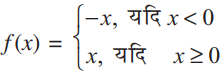
ता x = 0 पर फलन परिभाषित है और (0) = 0 है। बिंदु x =
स्पष्टतया x = 0 पर फलन परिभाषित है और f(0) = 0 है। बिंदु x = 0 पर f की बाएँ पक्ष की सीमा
$\lim \limits_{x \rightarrow 0^{-}}$ f(x) = $\lim \limits_{x \rightarrow 0^{-}}$ (-x) = 0 है।
इसी प्रकार 0 पर f की दाएँ पक्ष की सीमा के लिए
$\lim \limits_{x \rightarrow 0^{+}}$ f(x) = $\lim \limits_{x \rightarrow 0^{+}}$ x = 0 है।
इस प्रकार x = 0 पर बाएँ पक्ष की सीमा, दाएँ पक्ष की सीमा तथा फलन का मान संपाती हैं। अतः x = 0 पर f संतत है।
View full question & answer→Question 502 Marks
$x$ के सापेक्ष $e^{\cos x}$ का अवकलन कीजिए।
Answerमान लीजिए कि $y = e^{\cos x}$ है। अब शृंखला नियम द्वारा
$\frac{d y}{d x} = e^{\cos x} \cdot (- \sin x) = -(\sin x) e^{\cos x}$
View full question & answer→Question 512 Marks
$x$ के सापेक्ष $\cos^{-1}(e^x)$ का अवकलन कीजिए।
Answerमान लीजिए कि $y = \cos^{-1}(e^x)$ है। अब शृंखला नियम द्वारा
$\frac{d y}{d x}$ = $\frac{-1}{\sqrt{1-\left(e^{x}\right)^{2}}} \cdot \frac{d}{d x}\left(e^{x}\right)$ = $\frac{-e^{x}}{\sqrt{1-e^{2 x}}}$
View full question & answer→Question 522 Marks
x के सापेक्ष sin (log x), x > 0 का अवकलन कीजिए।
Answerमान लीजिए कि y = sin (log x) है। अब शृंखला नियम द्वारा
$\frac{d y}{d x}$ = cos (log x) $\cdot $ $\frac{d}{d x}$ (log x) = $\frac{\cos (\log x)}{x}$
View full question & answer→Question 532 Marks
क्या यह सत्य है कि x के सभी वास्तविक मानों के लिए $x = e^{\log x} $ है?
Answerपहले तो ध्यान दीजिए कि $\log$ फलन का प्रांत सभी धन वास्तविक संख्याओं का समुच्चय होता है। इसलिए उपर्युक्त समीकरण धनेतर वास्तविक संख्याओं के लिए सत्य नहीं है। अब मान लीजिए कि $y = e^{\log x}$ है। यदि $y > 0$ तब दोनो पक्षों का लघुगणक लेने से $\log y = \log \left(e^{\log x}\right) = \log x.\log e = \log x$ है। जिससे $y = x$ प्राप्त होता है। अतएव $x = e^{\log x}$ केवल $x$ के धन मानों के लिए सत्य है।
View full question & answer→Question 542 Marks
$f(x) = \tan^{-1}x$ का अवकलज ज्ञात कीजिए, यह मानते हुए कि इसका अस्तित्व है।
Answerमान लीजिए कि $y = \tan^{-1} x$ है तो $x = \tan y$ है। $x$ के सापेक्ष दोनों पक्षों का अवकलन करने पर
$1 = \sec^2y \frac{d y}{d x}$
$\Rightarrow$ $ \frac{d y}{d x}$ = $\frac{1}{\sec ^{2} y}$ = $\frac{1}{1+\tan ^{2} y}$ = $\frac{1}{1+\left(\tan \left(\tan ^{-1} x\right)\right)^{2}}$ = $\frac{1}{1+x^{2}}$
View full question & answer→Question 552 Marks
यदि y + sin y = cos x तो $ \frac{d y}{d x}$ ज्ञात कीजिए।
Answerहम इस संबंध का सीधे अवकलज करते हैं।
$\frac{d y}{d x}$ + $\frac{d}{d x}$ (sin y) = $\frac{d}{d x}$ (cos x)
शृंखला नियम का प्रयोग करने पर
$\frac{d y}{d x}$+ $\cos y \cdot \frac{d y}{d x}$ = - sin x
इससे निम्नलिखित परिणाम मिलता है,
$\frac{d y}{d x}$ = - $\frac{\sin x}{1+\cos y}$
जहाँ y $\neq$ (2n + 1) $\pi$
View full question & answer→Question 562 Marks
$x$ के सापेक्ष $\sin (\cos(x^2)) $ का अवकलन कीजिए।
Answerफलन $f(x) = \sin \left(\cos \left(x^{2}\right)\right), u, v$ तथा $w,$ तीन फलनों का संयोजन है।
इस प्रकार$ f(x) = (w o v o u)(x),$ जहाँ $u(x) = x^2, v(t) = \cos t $ तथा $w(s) = \sin s$ है।
$t = u(x) = x^2$ और $s = v(t) = \cos t$ रखने पर हम देखते हैं कि
$\frac{d w}{d s} = \cos s, \frac{d s}{d t} = - \sin t$ तथा $\frac{d t}{d x} = 2x$ और इन सभी का,
$x$ के सभी वास्तविक मानों के लिए अस्तित्व है।
अतः शृंखला नियम के व्यापकीकरण द्वारा
$\frac{d f}{d x} = \frac{d w}{d s} \cdot \frac{d s}{d t} \cdot \frac{d t}{d x} = (\cos s) (- \sin t) (2x) = - 2x \sin x^2 \cos (\cos x^2)$
View full question & answer→Question 572 Marks
$f(x) = \sin (x^2)$ का अवकलज ज्ञात कीजिए।
Answerध्यान दीजिए कि प्रदत्त फलन दो फलनों का संयोजन है। वास्तव में, यदि $u(x) = x^2$ और $v(t) = \sin t$ है तो
$f(x) = (vou) (x) = v(u(x)) = v (x^2) = \sin x^2$
$t = u(x) = x^2$ रखने पर ध्यान दीजिए कि $\frac{d v}{d t} = \cos $t तथा $\frac{d t}{d x} = 2x$ और दोनों का अस्तित्व भी हैं। अतः शृंखला नियम द्वारा
$\frac{d f}{d x} = \frac{d v}{d t} \cdot \frac{d t}{d x} = \cos t\cdot 2x$
सामान्यतः अंतिम परिणाम को x के पदों में व्यक्त करने का प्रचलन है अतएव
$\frac{d f}{d x} = \cos t \cdot 2x = 2x \cos x^2$
View full question & answer→Question 582 Marks
दर्शाइए कि f(x) = |1 - x + | x|| द्वारा परिभाषित फलन f, जहाँ x एक वास्तविक संख्या है, एक संतत फलन है।
Answerसभी वास्तविक संख्याओं x के लिए g को g(x) = 1 - x + |x| तथा h को h(x) = | x | द्वारा परिभाषित कीजिए। तब,
(h o g)(x) = h(g(x))
= h(1 - x + |x|)
= | 1 - x + | x || = f(x)
h एक संतत फलन है। इसी प्रकार एक बहुपद फलन और एक मापांक फलन का योग होने के कारण g एक संतत फलन है। अतः दो संतत फलनों का संयुक्त फलन होने के कारण f भी एक संतत फलन है।
View full question & answer→Question 592 Marks
दर्शाइए कि $f(x) = \sin (x^2)$ द्वारा परिभाषित फलन, एक संतत फलन है।
Answerप्रेक्षण कीजिए कि विचाराधीन फलन प्रत्येक वास्तविक संख्या के लिए परिभाषित है। फलन f को, $g$ तथा $h$ दो फलनों के संयोजन $(goh)$ के रूप में सोचा जा सकता है, जहाँ $g(x) = \sin x$ तथा $h(x) = x^2$ है। चूँकि g और h दोनों ही संतत फलन हैं, इसलिए यह निष्कर्ष निकाला जा सकता है, कि $ f$ एक संतत फलन है।
View full question & answer→Question 602 Marks
सिद्ध कीजिए कि f(x) = tan x एक संतत फलन है।
Answerदिया हुआ फलन f(x) = tan x = $\frac{\sin x}{\cos x}$ है। यह फलन उन सभी वास्तविक संख्याओं के लिए परिभाषित है, जहाँ cos x $\neq$ 0, अर्थात् x $\neq$ (2n + 1) $\frac{\pi}{2}$ है। हमने अभी प्रमाणित किया है कि sine और cosine फलन, संतत फलन हैं। इसलिए tan फलन, इन दोनों फलनों का भागफल होने के कारण, x के उन सभी मानों के लिए संतत है जिन के लिए यह परिभाषित है।
फलनों के संयोजन (composition) से संबंधित, संतत फलनों का व्यवहार एक रोचक तथ्य है। स्मरण कीजिए कि यदि f और g दो वास्तविक फलन हैं, तो
(f o g)(x) = f(g(x))
परिभाषित है, जब कभी g का परिसर f के प्रांत का एक उपसमुच्चय होता है।
View full question & answer→Question 612 Marks
sine फलन के सांतत्य पर विचार कीजिए।
Answerइस पर विचार करने के लिए हम निम्नलिखित तथ्यों का प्रयोग करते हैं:
$\lim \limits_{x \rightarrow 0} \sin x$ = 0
हमने इन तथ्यों को यहाँ प्रमाणित तो नहीं किया है, किन्तु sine फलन के आलेख को शून्य के निकट देख कर ये तथ्य सहजानुभूति (intuitively) से स्पष्ट हो जाता है।
अब देखिए कि f(x) = sin x सभी वास्तविक संख्याओं के लिए परिभाषित है। मान लीजिए कि c एक वास्तविक संख्या है। x = c + h रखने पर, यदि x $\rightarrow$ c तो हम देखते हैं कि h $\rightarrow$ 0 इसलिए
$\lim \limits_{x \rightarrow c}$ f(x) = $\lim \limits_{x \rightarrow c} \sin x$
= $\lim \limits_{h \rightarrow 0} \sin $ (c + h)
= $ \lim \limits_{h \rightarrow 0}[\sin c \cos h$ + $ \cos c \sin h]$
= sin c + 0 = sin c = f(c)
इस प्रकार $ \lim \limits_{x \rightarrow c} $ f(x) = f(c) अतः f एक संतत फलन है।
View full question & answer→Question 622 Marks
सिद्ध कीजिए कि प्रत्येक परिमेय फलन संतत होता है।
Answerस्मरण कीजिए कि प्रत्येक परिमेय फलन f निम्नलिखित रूप का होता है:
f(x) = $\frac{p(x)}{q(x)}$, q(x) $\neq$ 0
जहाँ p और q बहुपद फलन हैं। f का प्रांत, उन बिंदुओं को छोड़कर जिन पर q शून्य है, समस्त वास्तविक संख्याएँ हैं। चूँकि बहुपद फलन संतत होते हैं (उदाहरण 14), अतएव प्रमेय 1 के भाग (4) द्वारा f एक संतत फलन है।
View full question & answer→Question 632 Marks
f(x) = [x] द्वारा परिभाषित महत्तम पूर्णांक फलन के असांतत्य के समस्त बिंदुओं को ज्ञात कीजिए, जहाँ [x] उस महत्तम पूर्णांक को प्रकट करता है, जो x से कम या उसके बराबर है।
Answerपहले तो हम यह देखते हैं कि f सभी वास्तविक संख्याओं के लिए परिभाषित है। इस फलन का आलेख आकृति में दिखाया गया है।
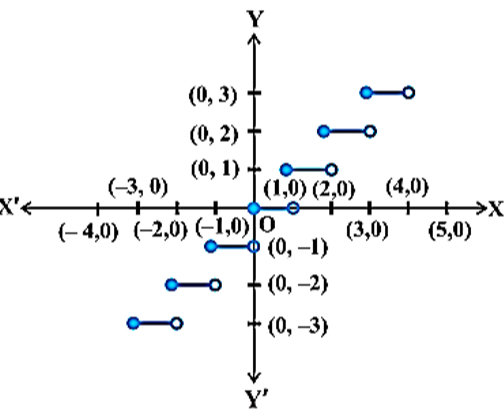
आलेख से ऐसा प्रतीत होता है कि प्रदत्त फलन x के सभी पूर्णांक मानों के लिए असंतत है। नीचे हम छानबीन करेंगे कि क्या यह सत्य है।
दशा 1 मान लीजिए कि c एक ऐसी वास्तविक संख्या है, जो किसी भी पूर्णांक के बराबर नहीं है। आलेख से यह स्पष्ट है कि c के निकट की सभी वास्तविक संख्याओं के लिए दिए हुए फलन का मान [c]; हैं, अर्थात् $\lim \limits_{x \rightarrow c}$ f(x) = $ \lim \limits_{x \rightarrow c}$ [x] = [c] साथ ही f(c) = [c] अतः प्रदत्त फलन, उन सभी वास्तविक संख्याओं के लिए संतत है, जो पूर्णांक नहीं है।
दशा 2 मान लीजिए कि c एक पूर्णांक है। अतएव हम एक ऐसी पर्याप्ततः छोटी वास्तविक संख्या r > 0 प्राप्त कर सकते हैं जो कि [c - r] = c - 1 जबकि [c + r] = c है।
सीमाओं के रूप में, इसका अर्थ यह हुआ कि
$\lim \limits_{x \rightarrow c^{-}}$ f(x) = c - 1 तथा $\lim \limits_{x \rightarrow c^{+}}$ f(x) = c
चूँकि किसी भी पूर्णांक c के लिए ये सीमाएँ समान नहीं हो सकती हैं, अतः प्रदत्त फलन x सभी पूर्णांक मानों के लिए असंतत है।
View full question & answer→Question 642 Marks
दर्शाइए कि प्रत्येक बहुपद फलन संतत होता है।
Answerस्मरण कीजिए कि कोई फलन $p,$ एक बहुपद फलन होता है यदि वह किसी प्राकृत संख्या $n$ के लिए $p(x) = a_0+ a_1 x + \ldots + a_{n} x^{n}$ द्वारा परिभाषित हो, जहाँ $a_i \in R$ तथा $a_n \neq 0$ है। स्पष्टतया यह फलन प्रत्येक वास्तविक संख्या के लिए परिभाषित है। किसी निश्चित वास्तविक संख्या $c$ के लिए हम देखते हैं कि
$\lim \limits_{x \rightarrow c} p(x) = p(c)$
इसलिए परिभाषा द्वारा $c$ पर $p$ संतत है। चूँकि $c$ कोई भी वास्तविक संख्या है इसलिए p किसी भी वास्तविक संख्या के लिए संतत है, अर्थात् $p$ एक संतत फलन है।
View full question & answer→Question 652 Marks
निम्नलिखित प्रकार से परिभाषित फलन f के समस्त (सभी) असांतत्य बिंदुओं को ज्ञात कीजिए
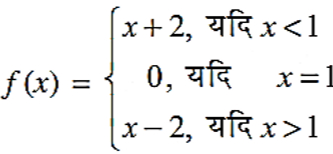
Answerहम देखते हैं प्रत्येक वास्तविक संख्या x $ \neq$1 के लिए f संतत है। x = 1 के लिए f के बाएँ पक्ष की सीमा, $\lim \limits_{x \rightarrow 1^{-}}$ f(x) = $\lim \limits_{x \rightarrow 1^{-}}$ (x + 2) = 1 + 2 = 3 है।
x = 1 के लिए f के दाएँ पक्ष की सीमा, $\lim \limits_{x \rightarrow 1^{-}}$ f(x) = $\lim \limits_{x \rightarrow 1^{-}}$ (x - 2) = 1 - 2 = - 1 है।
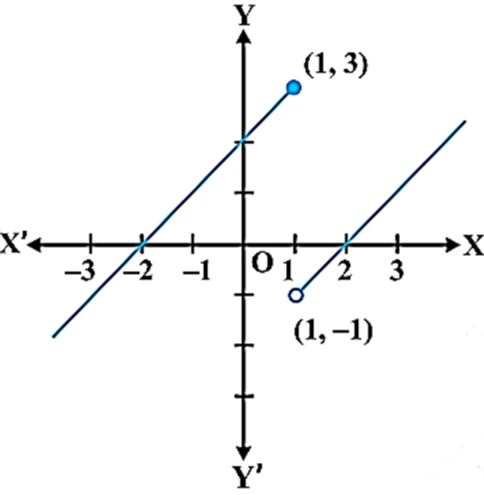
चूँकि x = 1 पर f के बाएँ तथा दाएँ पक्ष की सीमाएँ संपाती नहीं हैं, अतः x = 1 पर f संतत नहीं है। इस प्रकार f के असांतत्य का बिंदु केवल मात्र x = 1 है। इस फलन का आलेख में दर्शाया गया है।
View full question & answer→Question 662 Marks
निम्नलिखित फलन के सांतत्य पर विचार कीजिए:
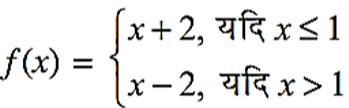
Answerफलन f वास्तविक रेखा के प्रत्येक बिंदु पर परिभाषित है।
दशा 1 यदि c < 1, तो f(c) = c + 2 है। इस प्रकार $\lim \limits_{x \rightarrow c} $ f(x) = $\lim \limits_{x \rightarrow c}$ x + 2 = c + 2 है।
अतः 1 से कम सभी वास्तविक संख्याओं पर f संतत है।
दशा 2 यदि c > 1, तो f(c) = c - 2 है।
इसलिए $\lim \limits_{x \rightarrow c}$ f(x) = $\lim \limits_{x \rightarrow c}$ (x - 2) = c - 2 = f(c) है। अतएव उन सभी बिंदुओं पर जहाँ x > 1 है, f संतत है।
अतएव उन सभी बिंदुओं पर जहाँ x > 1 है, f संतत है। दशा 3 यदि c = 1, तो x = 1 पर f के बाएँ पक्ष की सीमा, अर्थात्
$\lim \limits_{x \rightarrow 1^{-}}$ f(x) = $\lim \limits_{x \rightarrow 1^{-}}$ (x + 2) = 1 + 2 = 3
x = 1 पर f के दाएँ पक्ष की सीमा, अर्थात्
$\lim \limits_{x \rightarrow 1^{+}}$ f(x) = $\lim \limits_{x \rightarrow 1^{-}}$(x - 2) = 1 - 2 = - 1
अब चूँकि x = 1 पर f के बाएँ तथा दाएँ पक्ष की सीमाएँ संपाती (coincident) नहीं हैं, अतः x = 1 पर f संतत नहीं है। इस प्रकार f के असांतत्य का बिंदु केवल मात्र x = 1 है। इस फलन का आलेख आकृति में दर्शाया गया है।
View full question & answer→