MCQ 11 Mark
Which of the following statements is not correct according to Rutherford model?
- A
Most of the space inside an atom is empty.
- B
The electrons revolve around the nucleus under the influence of coulomb force acting on them.
- C
Most part of the mass of the atom and its positive charge are concentrated at its centre.
- ✓
The stability of atom was established by the model.
AnswerCorrect option: D. The stability of atom was established by the model.
According to Rutherford model as he was not able to explain stability of atom.
View full question & answer→MCQ 21 Mark
Consider aiming a beam of free electrons towards free protons. When they scatter, an electron and a proton cannot combine to produce a H-atom:
- A
Because of energy conservation.
- B
Without simultaneously releasing energy in the from of radiation.
- ✓
- D
Because of angular momentum conservation.
AnswerSolution:
When a beam of free electrons is aiming towards free protons, then, they scatter but an electron and a proton cannot combine to produce a hydrogen atom because of energy conservation and without simultaneously releasing energy in the form of radiation.
View full question & answer→MCQ 31 Mark
The spectra used to identify the elements in the mixture is:
AnswerTo identify the element in the mixture we used emission and obsorption spectra.
View full question & answer→MCQ 41 Mark
An ionised H-molecule consists of an electron and two protons. The protons are separated by a small distance of the order of angstrom. In the ground state:
AnswerSolution:
In a hydrogen atom, electron revolves around a fixed proton nucleus in circular path. This can be explained by Bohr model. But in case of ionised H-molecule which consists of two protons in nucleus and where protons are separated by a small distance of the order of angstrom, cannot be explained by Bohr model. Hence in this case the ground state the electron would not move in circular orbits, the electrons orbit would go around the protons.
View full question & answer→MCQ 51 Mark
When an atomic gas or vapour is excited at low pressure, by passing an electric current through it then?
- ✓
Emission spectrum is observed.
- B
Absorption spectrucm is observed.
- C
Band spectrum is observed.
- D
Both $(b)$ and $(c).$
AnswerCorrect option: A. Emission spectrum is observed.
View full question & answer→MCQ 61 Mark
Bohrs atomic model assumes:
- A
The nucleus is of infinite mass and is at rest
- B
Electron in a quantized orbit will not radiate energy
- C
Mass of the electron remains constant
- ✓
AnswerBohr's Assumption:
Electron in atoms orbit the nucleus.
Electron in a quantized orbit will not radiate energy.
Electrons can only gain and lose energy by jumping from one allowed orbit to other.
He also assumed one of the postulates of Rutherford's atomic model, that is, the mass of the nucleus is very large compared to that of the electrons and hence assumed to be infinite.
View full question & answer→MCQ 71 Mark
$O_2$ molecule consists of two oxygen atoms. In the molecule, nuclear force between the nuclei of the two atoms:
AnswerCorrect option: A. Is not important because nuclear forces are short$-$ranged.
Nuclear forces are very short range forces. So, in the molecule, nuclear force between the nuclei of the two atoms is not important.
View full question & answer→MCQ 81 Mark
The photoelectric effect proves that light consists of :
AnswerIt's been determined experimentally that when light shines on a metal surface, the surface emits electrons. For example, you can start a current in a circuit just by shining a light on a metal plate. we were saying earlier that light is made up of electromagnetic waves, and that the waves carry energy. So if a wave of light hit an electron in one of the atoms in the metal, it might transfer enough energy to knock the electron out of its atom. Light has sometimes been viewed as a particle $($photon$)$ rather than a wave. If it's waves, the energy contained in one of those waves should depend only on its amplitude$--$that is, on the intensity of the light.
View full question & answer→MCQ 91 Mark
Two photons having $.......$
- ✓
Equal wavelengths have equal linear momenta
- B
Equal energies have equal linear momenta
- C
Equal frequencies have equal linear momenta
- D
Equal linear momenta have equal wavelengths
AnswerCorrect option: A. Equal wavelengths have equal linear momenta
Equal linear momenta have equal wavelengths.
View full question & answer→MCQ 101 Mark
Ionisation energy for hydrogen atom in the ground state is $E$. What is the ionisation energy of $Li^{++}$ atom in the $2\ nd$ excited state:
View full question & answer→MCQ 111 Mark
In a $\text{CRT}$ the acceleration of electrons is controlled by changing $.......$ between the cathode and anode:
AnswerPositive potential is given to anode and negative potential is given to cathode. As a result of this potential difference, electrons generated by heating cathode are attracted towards anode due to this potential difference. If no potential difference is applied $b/ w$ anode and cathode in $\text{CRT,}$ no electron would strike the screen. It is because of this potential difference $b/ w$ anode and cathode that the whole process occurs.
View full question & answer→MCQ 121 Mark
Orbits in which electrons move according to Bohr are:
AnswerFirst electron shell which is closest to the orbit to the nucleus, called the $1s$ orbit can hold up two two electrons. This orbit is equivalent to the innermost electron shell of the Bhor model of atom. It is called the orbital because it is spherical around the nucleus.
View full question & answer→MCQ 131 Mark
An unknown hot gas emits radiation of wavelengths $46.0\ nm, 82.8\ nm$ and $103.5\ nm $ only. Assume that the atoms have only two excited states and the difference between consecutive energy levels decreases as energy is increased. Taking the energy of the highest energy state to be zero, find the energies of the ground state and the first excited state.
- ✓
$–27eV, –12eV.$
- B
$–6eV, –3eV.$
- C
$–11eV, –8eV.$
- D
$–9eV, –3eV.$
AnswerCorrect option: A. $–27eV, –12eV.$
View full question & answer→MCQ 141 Mark
In Balmer series of emission spectrum of hydrogen, first four lines with different wavelength $\text{H}\alpha $ $ \text{H}\beta$ $\text{H}\gamma$ and $\text{H}\delta$ are obtained. Which line has maximum frequency out of these?
- A
$\text{H}\alpha $
- B
$ \text{H}\beta$
- C
$\text{H}\gamma$
- ✓
$\text{H}\delta$
AnswerCorrect option: D. $\text{H}\delta$
View full question & answer→MCQ 151 Mark
Check the wrong statement:
- A
Line spectrum is characteristic of the element
- ✓
Absorption line spectrum is characteristic of the element
- C
Continuous spectrum is characteristic of the source of light
- D
There are two prominent yellow lines in the spectrum of sodium
AnswerCorrect option: B. Absorption line spectrum is characteristic of the element
Line respectrum is characteristic of the element because it obtained of atoms only. Continous spectrum is characteristics of the source of light.
In the spectrum of sodium, there are two prominent yellow lines of wavelength $589.0\ nm$ and $589.6\ nm.$
Absorption line spectrum is not characteristic of the element.
View full question & answer→MCQ 161 Mark
Why is the screen of the cathode ray tube coated ? Name the material used for coating:
AnswerThe screen is coated with florocent material.
On striking this coat on the screen the electronic beam appears as visual pattern of bright spots so that we can view it.
View full question & answer→MCQ 171 Mark
The significant result deduced from the Rutherford's scattering experiment is that:
- ✓
Whole of the positive charge is concentrated at the centre of atom.
- B
There are neutrons inside the nucleus.
- C
Electrons are embedded in the atom.
- D
Electrons are revolving around the nucleus.
AnswerCorrect option: A. Whole of the positive charge is concentrated at the centre of atom.
View full question & answer→MCQ 181 Mark
The minimum orbital angular momentum of the electron in a hydrogen atom is:
AnswerCorrect option: C. $\frac{\text{h}}{2\pi}$
According to Bohr's atomic theory, the orbital angular momentum of an electron is an integral multiplt of $\frac{\text{h}}{2\pi}$
$\therefore\ \text{L}_\text{n}=\frac{\text{nh}}{2\pi}$
Here,
$n =$ Principal quantum number
The minimum of $n$ is $1$
Thus, the minimum value of the orbit angular momentum of the electron in a hydrogen is given by $\text{L}=\frac{\text{h}}{2\pi}$
View full question & answer→MCQ 191 Mark
Whenever a stream of electrons collides with a stream of photons, in this collision, which of the following is not conserved?
AnswerWhen a stream of electrons collides with a stream of photons, then it may be possible that after the collisions, the respective velocity of some of the electrons will get changed, either it can increase or decrease depending on the orientation of the collision. But the number of electrons will remain the same.
Moreover, the photons are absorbed by electrons to change their velocities.
Also total energy and linear momentum is always conserved according to the conservation laws.
Hence, number of photons is not conserved.
View full question & answer→MCQ 201 Mark
The energy emitted by a source is in the form of:
AnswerThe energy emitted by a source is in the form of gamma radiation which is called photons. It is extremely high-frequency electromagnetic radiation.
View full question & answer→MCQ 211 Mark
Two H atoms in the ground state collide inelastically. The maximum amount by which their combined kinetic energy is reduced is:
- ✓
$10.20\ eV.$
- B
$20.40\ eV.$
- C
$13.6\ eV.$
- D
$27.2\ eV.$
AnswerCorrect option: A. $10.20\ eV.$
Key concept: Total energy $(E)$ is the sum of potential energy and kinetic energy, i.e.$ E = K + U$
$\Rightarrow\ \text{E}=-\frac{\text{kZe}^2}{2\text{r}_\text{n}}\text{also r}_\text{n}=\frac{\text{n}^2\text{h}^2\in_0}{\pi\text{mze}^2}$
Hence $\text{E}=-\bigg(\frac{\text{me}^4}{8\in_0^2\text{h}^2}\bigg)\frac{\text{Z}^2}{\text{n}^2}=-\bigg(\frac{\text{me}^4}{8\in_0^2\text{ch}^3}\bigg)\text{ch}\frac{\text{Z}^2}{\text{n}^2}$
$=-\text{R ch}\frac{\text{Z}^2}{\text{n}^2}=-13.6\frac{\text{Z}^2}{\text{n}^2}\text{eV}$
The lowest state of the atom, called the ground state, is that of the lowest energy. The energy of this state $(n = 1), E_1$ is $-13.6\ eV$
Energy level diagram of hydrogen/hydrogen like atom:
| Principal quantum number |
Orbit |
Excited state |
Energy of $H_2 -$ atom |
|
$\text{n}=\infty$
|
Infinite |
Infinite |
$0\ eV$ |
| $n = 4$ |
Fourth |
Third |
$-0.85\ eV$ |
| $n = 3$ |
Third |
Second |
$-1.51\ eV$ |
| $n = 2$ |
Second |
First |
$-3.4\ eV$ |
| $n = 1$ |
First |
Ground |
$-13.6\ eV$ |
Let two $H$ atoms initially at in the ground state.Now two stoms collide inclastically. The total energy associated with the tow $H-$atoms
$= 2 \times (13.6 eV) = 27.2\ eV$
The maximum amount by which their combined kinetic energy is reduced when any one of them goes into first excited state $(n = 2)$ after the inclastic collision.
The total energy associated with the two $H-$atoms after the collision
$=\Big(\frac{13.6}{2^2}\Big)+(13.6)=17.0\text{eV}$
Hence, maximum loss of their combined kinetic energy
$= 27.2 - 17.0 = 10.2\ eV.$ View full question & answer→MCQ 221 Mark
Which of the following series in the spectrum of hydrogen atom lies in the visible region of the electromagnetic spectrum?
AnswerTransition from higher states to $n = 2$ lead to emission of radiation with wavelengths $656.3\ nm$ and $365.0\ nm.$
These wavelengths fall in the visible region and constitute the Balmer series.
View full question & answer→MCQ 231 Mark
How many spectral lines are there in the hydrogen spectrum?
AnswerEven though hydrogen has only one electron in its outermost shell, it has multiple spectral lines.
This is because hydrogen has many energy levels.
When the electron excites from a lower level of energy into a higher level, then it releases a photon, and this photon is the one that appears as spectral lines.
View full question & answer→MCQ 241 Mark
Which of the following curves may represent the speed of the electron in a hydrogen atom as a function of the principal quantum number n?
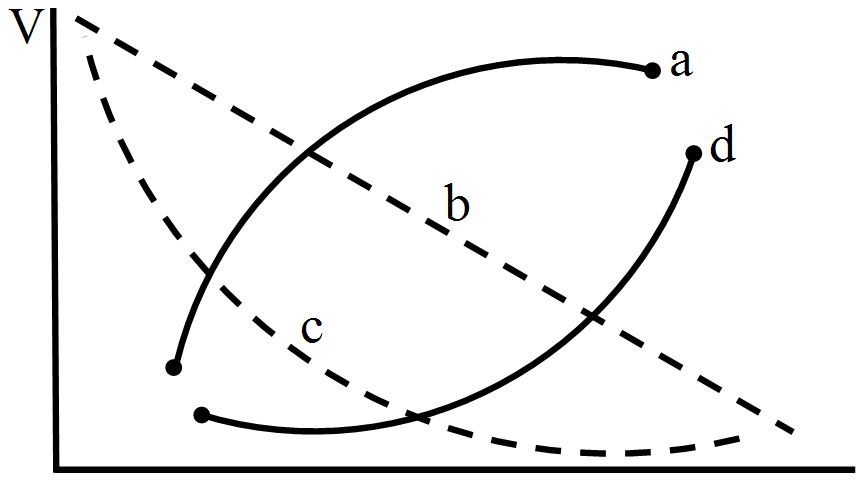
Answer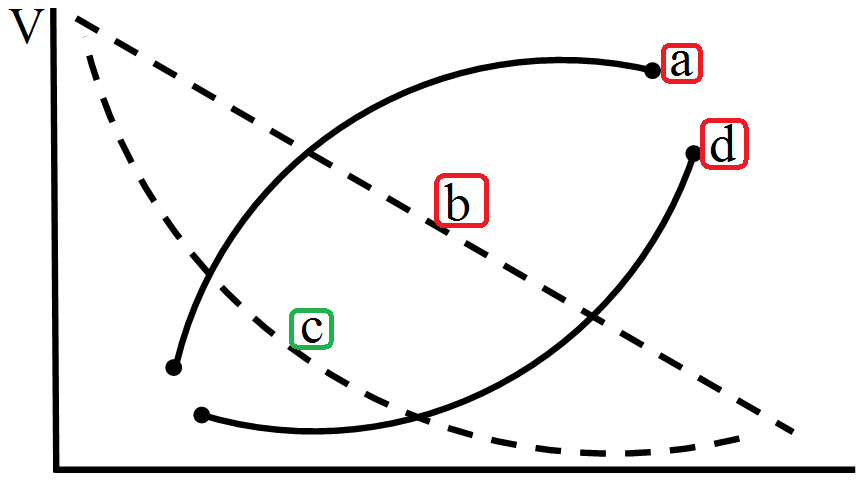
The speed $(v)$ of electron can be expressed as,
$\nu=\frac{\text{Ze}^2}{2\in_0\text{hn}}\ ....(\text{i})$
Here,
$Z =$ Number of protons in the nucleus.
$e =$ Magnitude of charge on electron charge.
$n =$ Principal quantum number.
$h =$ Planck's constant.
It can be observed from equation $(i)$ that the velocity of electron is inversely proportional to the principal quantum number $(n).$
Therefore, the graph between them must be a rectangular hyperbola. The correct curve is $(c).$ View full question & answer→MCQ 251 Mark
To get line spectrum, the substances are excited in their:
AnswerA spectral line is a dark or bright line in an otherwise uniform and continuous spectrum, resulting from emission or absorption of light in a narrow frequency range, compared with the nearby frequencies.
Spectral lines are often used to identify atoms and molecules from their characteristic spectral lines.
The characteristics spectral is produced by exciting them into atomic state.
View full question & answer→MCQ 261 Mark
Which of the following series of hydrogen spectrum is in visible range?
MCQ 271 Mark
In an electron gun the control grid is given a negative potential relative to cathode in order to:
- A
- ✓
Repel electrons and thus to control the number of electrons passing through it
- C
To select electrons of same velocity and to converge them along the axis
- D
To decrease the kinetic energy of electrons
AnswerCorrect option: B. Repel electrons and thus to control the number of electrons passing through it
You must know the working of an electron gun.
In an electron gun the control grid is given a negative potential relative to cathode in order to repel electrons and thus to control the number of electrons passing through it.
View full question & answer→MCQ 281 Mark
The angular speed of the electron in the nth orbit of Bohr hydrogen atom is?
- A
Directly proportional to $n.$
- B
Inversely proportional to $n.$
- C
Inversely proportional to $n_2$.
- ✓
Inversely proportional to $n_3$.
AnswerCorrect option: D. Inversely proportional to $n_3$.
View full question & answer→MCQ 291 Mark
For the ground state, the electron in the H-atom has an angular momentum $= h$, according to the simple Bohr model. Angular momentum is a vector and hence there will be infinitely many orbits with the vector pointing in all possible directions. In actuality, this is not true,
- ✓
Because Bohr model gives incorrect values of angular momentum.
- B
Because only one of these would have a minimum energy.
- C
Angular momentum must be in the direction of spin of electron.
- D
Because electrons go around only in horizontal orbits.
AnswerCorrect option: A. Because Bohr model gives incorrect values of angular momentum.
Using simple Bohr model, we get the only magnitude of the angular momentum of revolving electrons. But, angular momentum is vector quantity, so, statement $(a)$ is not correct.
View full question & answer→MCQ 301 Mark
In which of the following systems will the wavelength corresponding to $n = 2$ to $n = 1$ be minimum?
AnswerThe wavelength corresponding the transition from $n_2$ to $n_1$ is given by,
$\frac{1}{\lambda}=\text{RZ}^2\Big(\frac{1}{\text{n}^2_1}-\frac{1}{\text{n}^2_2}\Big)$
Here,
$R =$ Rydberg constant.
$Z =$ Atomic number of the ion.
From the given formula, it can be observed that the wavelength is inversely proportional to the square of the atomic number.
Therefore, the wavelength corresponding to $n = 2$ to $n = 1$ will be minimum in doubly ionized lithium ion because for lithium, $Z = 3.$
View full question & answer→MCQ 311 Mark
When electron changes its orbit from outer to inner energy is:
AnswerReleased When electron emits energy it becomes stable and jump from higher energy level $($outer shell$)$ to lower energy level $($inner shell$).$
View full question & answer→MCQ 321 Mark
Which of the following is found in the $UV$ region of the spectrum?
AnswerThe transitions that end at the ground level, where the principal quantum number is one, are called the Lyman series.
Here, the energies that are released are so large, and therefore, these spectral lines appear in the ultraviolet region of the spectrum.
View full question & answer→MCQ 331 Mark
Rutherford’s atomic model was unstable because:
- A
- ✓
Electrons do not remain in orbit.
- C
Orbiting electrons radiate energy.
- D
Electrons are repelled by the nucleus.
AnswerCorrect option: B. Electrons do not remain in orbit.
View full question & answer→MCQ 341 Mark
the anode is kept at positive potential with respect to the cathode:
- ✓
Themions are get attracted towards the anode and accelerate towards the anode
- B
Themions are get deviated towards the anode and accelerate towards the anode
- C
Themions get attracted towards the cathode and accelerate towards the cathode
- D
AnswerCorrect option: A. Themions are get attracted towards the anode and accelerate towards the anode
The themions are get attracted towards the anode and accelerate towards the anode due to the potential difference between anode and cathode.
View full question & answer→MCQ 351 Mark
Smallest particle in a chemical element or compound that has the chemical properties of that element or compound is:
AnswerA molecule is it smallest particle in a chemical element or compound.
They are made up of atomic that are held by chemical bonds.
View full question & answer→MCQ 361 Mark
According to the Rutherford’s atomic model, the electrons inside the atom are:
MCQ 371 Mark
The transition from the state $n = 4$ to $n = 3$ in a hydrogen like atom results in ultraviolet radiation. Infrared radiation will be obtained in the transition from:
- A
$2 \rightarrow 1.$
- B
$3 \rightarrow 2.$
- C
$4 \rightarrow 2.$
- ✓
$5 \rightarrow 4.$
AnswerCorrect option: D. $5 \rightarrow 4.$
View full question & answer→MCQ 381 Mark
In a laser tube, all the photons:
AnswerAll the photons emitted in the laser move with the speed equal to the speed of light $(c = 3 \times 10^8m/s)$. Ideally, the light wave through the laser must be coherent, but in practical laser tubes, there is some deviation from the ideal result. Thus, the photons emitted by the laser have little variations in their wavelengths and energies as well as the directions, but the velocity of all the photons remains same.
View full question & answer→MCQ 391 Mark
- A
When the electron jumps to higher energy levels.
- B
When an electric field is introduced.
- C
When a magnetic field is introduced.
- ✓
When the electron is at its ground state.
AnswerCorrect option: D. When the electron is at its ground state.
The hydrogen atom is stable when the electron rests at the ground level of energy, i.e. when the principal quantum number, $n = 1. '$
In other words, when the electron is revolving in the first orbit around the nucleus, the hydrogen atom is stable.
View full question & answer→MCQ 401 Mark
The concept of stationary orbits was proposed by:
AnswerNeil Bohr proposed the concept of stationary orbits in $1913$, which is now called the Bohr model of atom. The electron can only orbit stably, without radiating, in certain orbits at a certain discretesct of distance from the nucleus.
View full question & answer→MCQ 411 Mark
Let $A_n$ be the area enclosed by the $n^{th}$ orbit in a hydrogen atom. The graph of ln $\Big(\frac{\text{A}_\text{n}}{\text{A}_1}\Big)$ against in(n):
- A
Will pass through the origin.
- B
Will be a straight line with slope 4.
- ✓
- D
AnswerExplanation:
$\text{r}_\text{n}=\text{n}^2\text{a}_0$
Area of the nth orbit is given by,
$\text{A}_\text{n}=\pi\text{r}^2_\text{n}=\pi\text{n}^4\text{a}^2_0$
$\text{A}_1=\pi\text{a}^{2}_0$
$\text{ln}\Big(\frac{\text{A}_\text{n}}{\text{A}_1}\Big)=\text{ln}\Big(\frac{\pi\text{n}^4\text{a}_0^2}{\pi\text{a}^2_0}\Big)$
$\text{ln}\Big(\frac{\text{A}_\text{n}}{\text{A}_1}\Big)=4\text{ln n}\ ...(\text{i})$
From the above expression, the graph of in $\Big(\frac{\text{A}_\text{n}}{\text{A}_1}\Big)$ against ln(n) will be a straight line passing through the origin and having slope 4.
View full question & answer→MCQ 421 Mark
For a given value of $n$, the number of electrons in an orbit is?
- A
$n.$
- B
$n_2$.
- ✓
$2n_2$.
- D
$2n.$
AnswerCorrect option: C. $2n_2$.
View full question & answer→MCQ 431 Mark
A modified discharge tube is used as a $.......$:
AnswerA discharge tube is a tube containing charged electrodes and filled with a gas in which ionization is induced by an electric filed. $X-$ray tube, fluroscent tube and cathode rays oscilloscope can be used as a modified discharge tube in which these tubes contain charged electrodes and filled with a gas.
View full question & answer→MCQ 441 Mark
Which of the following products in a hydrogen atom are independent of the principal quantum number n? The symbols have their usual meanings.
AnswerExplanation:
Relations for energy, radius of the orbit and its velocity are given by,
$\text{E}=-\frac{\text{mZ}^2e^4}{8\in_0^2\text{h}^2\text{n}^2}$
$\text{r}=\frac{\in_0\text{h}^2\text{n}^2}{\pi\text{mZe}^2}$
$\text{v}=\frac{\text{Ze}^2}{2\in_0\text{hn}}$
Where,
Z: The atomic number of hydrogen like atom.
e: Electric charge.
h: Plank constant.
m: Mass of electron.
n: Principal quantam number of the electron.
$\in_0:$ Permittivity of vacuum
From these relations, we can see that the products independent of n are vn, Er.
View full question & answer→MCQ 451 Mark
The particle that possesses half integral spin is:
AnswerThe proton, neutron, and electron possess half$-$integer spin states
View full question & answer→MCQ 461 Mark
How will you relate velocity of cathode rays to $c$, if $‘c'$ denotes the velocity of light?
AnswerCorrect option: C. Less than $c$
Nothing can be faster or equal to the speed of light $($according to the theory of relativity$).$
View full question & answer→MCQ 471 Mark
Out of the following which one is not a possible energy for a photon to be emitted by hydrogen atom according to Bohr’s atomic model?
- A
$1.9\ eV.$
- ✓
$11.1\ eV.$
- C
$13.6\ eV.$
- D
$0.65\ eV.$
AnswerCorrect option: B. $11.1\ eV.$
View full question & answer→MCQ 481 Mark
Gases exert pressure on the walls of the container, because the gas molecules:
AnswerGases exert pressure on the walls of the container, because the gas molecules possess momentum.
View full question & answer→MCQ 491 Mark
In the Geiger-Marsden experiment, the force that scatters particles is:
AnswerCoulomb force is responsible for scattering of particles. When the alpha particles $($positive in charge$)$ get closer to the nucleus, which is positive in charge, they get repelled through various angles.
View full question & answer→MCQ 501 Mark
The simple Bohr model cannot be directly applied to calculate the energy levels of an atom with many electrons. This is because:
- ✓
Of the electrons not being subject to a central force.
- B
Of the electrons colliding with each other.
- C
- D
The force between the nucleus and an electron will no longer be given by Coulomb’s law.
AnswerCorrect option: A. Of the electrons not being subject to a central force.
The electrostatic force of attraction between electron and nucleus is a central force which provides necessary centripetal force for the circular motion of the electron.
The simple Bohr model cannot be directly applied to calculate the energy levels of an atom with many electrons. This is because of the electrons not being subject to a central force.
View full question & answer→MCQ 511 Mark
A photon will have less energy, if its:
AnswerEnergy of photon $=\frac{\text{hc}}{\gamma}$
Hence, a photon with longer wavelenght will carry less energy.
View full question & answer→MCQ 521 Mark
Who discovered the first spectral series?
AnswerBalmer discovered the first spectral series.
View full question & answer→MCQ 531 Mark
According to Bohr’s theory of $H$ atom, an electron can revolve around a proton indefinitely, if its path is:
- A
A perfect circle of any radius.
- ✓
A circle of an allowed radius.
- C
A circle of constantly decreasing radius.
- D
An ellipse with fixed focus.
AnswerCorrect option: B. A circle of an allowed radius.
View full question & answer→MCQ 541 Mark
If an element $X$ has mass number and number of proton $8$ then identify element $X :$
AnswerAtomic No $=$ no of proton $= 8$
Oxygen has atomic number $8$. So, element $X$
View full question & answer→MCQ 551 Mark
Who gave the Quantum model of hydrogen atom?
- A
$S.N.$ Bose
- ✓
- C
- D
$R. A.$ Millikan
AnswerNiels Bohr introduced the atomic Hydrogen model in $1913.$
Neils Bohr developed the Bohr model of the atom, in which he proposed that energy levels of electrons are discrete and that the electrons revolve in stable orbits around the atomic nucleus but can jump from one energy level $($or orbit$)$ to another.
View full question & answer→MCQ 561 Mark
$(A)$ Line spectra is due to atoms in gaseous state:
$(B)$ Band spectra is due to molecules:
- A
Both $A$ and $B$ are false
- B
$A$ is true but $B$ is false
- C
$A$ is false but $B$ is true
- ✓
Both $A$ and $B$ are true.
AnswerCorrect option: D. Both $A$ and $B$ are true.
The light emitted by one kind of atoms generally have widely separated wavelength components. When such a light is dispersed, we get certain sharp bright lines on a dark background. Such a spectrum is called line emission spectrum.The wavelength emitted by the molecules are grouped, each group being well separated from the other. The wavelengths in a group are close to one another and appear as continuous.The spectrum looks like separate bands of varying colors. Such a spectrum is called a band emission spectrum.So, line spectra are due to atoms in a gaseous state and band spectra are due to molecules.
View full question & answer→MCQ 571 Mark
The electrons of Rutherford’s model would be expected to lose energy because, they:
- A
- B
- ✓
Radiate electromagnetic waves.
- D
AnswerCorrect option: C. Radiate electromagnetic waves.
View full question & answer→MCQ 581 Mark
The simple Bohr modle is not applicable to He$^4$ atom because:
AnswerSolution:
Bohr model applies only to a Hydrogen-like atom (or atom having one electron). 2He$^4$ atom has two electrons. Also, these electrons are not subject to central forces.
View full question & answer→MCQ 591 Mark
Anti$-$particle of proton is:
Answerantiparticle of proton is antiproton.
View full question & answer→MCQ 601 Mark
The element which was observed in solar spectrum is:
AnswerPierre Janssen discovered the gaseous nature of the solar chromosphere and with some justification the element helium.
View full question & answer→MCQ 611 Mark
In Geiger$-$Marsden scattering experiment, the trajectory traced by an a$-$particle depends on:
View full question & answer→MCQ 621 Mark
The angular momentum of electrons in an atom produces:
- ✓
- B
$\text{ZEEMAN}$ effect.
- C
- D
View full question & answer→MCQ 631 Mark
Two electrons in an atom are moving in orbit of radii $R$ and $9R$ respectively. The ratio of their frequencies will be:
- A
$1 : 8$
- B
$8 : 1$
- C
$1 : 27$
- ✓
$27 : 1$
AnswerCorrect option: D. $27 : 1$
Radius is directly proportional to square of $n.$
Therefore, ratio of principal quantum number is $1 : 3.$
Hence, ratio of frequencies is $27 : 1.$
View full question & answer→MCQ 641 Mark
Three photons coming from excited atomic-hydrogen sample are picked up. Their energies are $12.1\ eV, 10.2\ eV$ and $1.9\ eV$. These photons must come from:
- A
- B
- C
- ✓
Either two atoms or three atoms.
AnswerCorrect option: D. Either two atoms or three atoms.
The energies of the photons emitted can be expressed as follows,
|
Energy of photon
|
Transition
|
| $12.1\ eV$ |
$n = 3$ to $n = 1$ |
| $10.2\ eV$ |
$n = 2$ to$ n = 1$ |
| $1.9\ eV$ |
$n = 3$ to $n = 2$ |
A hydrogen atom consists of only one electron. An electron can have transitions, like from $n = 3$ to $n = 2$ or from $n = 2$ to $n = 1,$ at a time.
So, it can be concluded that the photons are emitted either from three atoms $($when all the three transitions of electrons are in different atoms$)$ or from two atoms $($when an atom has $n = 3$ to $n = 2$ and then $n = 2$ to $n = 1$ electronic transition and the other has $n = 3$ to $n = 1$ electronic transition$).$ View full question & answer→MCQ 651 Mark
An element $X$ has number of protons $= 4.$ What will be its mass number if it has $3$ neutrons?
AnswerMass number of any element is equal to sum of number of neutron and number of proton.
View full question & answer→MCQ 661 Mark
How did de $–$ Broglie modify Bohr’s postulate?
- A
De $–$ Broglie suggested to not take angular momentum into consideration.
- B
De $–$ Broglie suggested introducing an electric field near the atom.
- ✓
De $–$ Broglie suggested that electrons behaved like a wave.
- D
De $–$ Broglie did not modify Bohr’s second postulate.
AnswerCorrect option: C. De $–$ Broglie suggested that electrons behaved like a wave.
de $–$ Broglie hypothesis did modify Bohr’s second postulate.
This postulate of Bohr regarding the quantization of the angular momentum of an electron was further explained by Louis de Broglie.
According to de $–$ Broglie, a moving electron in its circular orbit behaves like a particle$-$wave.
View full question & answer→MCQ 671 Mark
The angular momentum of the electron in hydrogen atom in the ground state is:
- A
$2\text{h}$
- B
$\frac{\text{h}}{2}$
- ✓
$\frac{\text{h}}{2\pi}$
- D
$\frac{\text{h}}{4\pi}$
AnswerCorrect option: C. $\frac{\text{h}}{2\pi}$
View full question & answer→MCQ 681 Mark
Suppose potential energy between electron and proton at separation r is given by $U = K$ ln $(r)$, where $K$ is a constant. For such a hypothetical hydrogen atom, the ratio of energy difference between energy levels $(n = 1$ and $n = 2)$ and $(n = 2$ and $n = 4)$ is?
View full question & answer→MCQ 691 Mark
In which of the following series, does the $121.5\ nm$ line of the spectrum of the hydrogen atom lie?
View full question & answer→MCQ 701 Mark
Bohr’s atom model is the modification of Rutherford’s atom model by the application of:
MCQ 711 Mark
According to Bohr’s model of hydrogen atom:
- A
The linear velocity of the electron is quantised.
- B
The angular velocity of the electron is quantised.
- C
The linear momentum of the electron is quantised.
- ✓
The angular momentum of the electron is quantised.
AnswerCorrect option: D. The angular momentum of the electron is quantised.
View full question & answer→MCQ 721 Mark
Light from a tungsten filament lamp gives:
AnswerLight from a tungsten filament lamp has an emission spectrum which is continuous in nature.
View full question & answer→MCQ 731 Mark
The name atom belongs to which language?
AnswerThe word atom is derived from Greek word, 'atomos'. In Greek, the prefix $"a"$ means "not" and the word "tomos" means cut. Our word atom therefore comes from atomos, a Greek word meaning uncuttable.
View full question & answer→MCQ 741 Mark
In which of the following systems will the radius of the first orbit $(n = 1)$ be minimum?
AnswerFor a hydrogen-like ion with $Z$ protons in the nucleus, the radius of the nth state is given by,
$\text{r}_\text{n}=\frac{\text{n}^2\text{a}_0}{\text{Z}}$
Here,
$a_0 = 0.53\ pm$
For lithium, $Z = 3$ Therefore, the radius of the first orbit for doubly ionised lithium will be minimum.
View full question & answer→MCQ 751 Mark
The energy of characteristic $X-$ray is a consequence of which of the following?
- A
The energy of the projectile electron
- B
The thermal energy of the target
- ✓
Transition in target atoms
- D
AnswerCorrect option: C. Transition in target atoms
The energy of characteristic $X-$ray is a consequence of transition in target atoms.
They cause emission or absorption of electromagnetic radiation.
The other options are not responsible for the energy of characteristic $X-$rays.
View full question & answer→MCQ 761 Mark
How can the brightness of the pattern on the screen or cathode ray tube be changed?
- ✓
By changing the negative potential on grid.
- B
By changing the positive potential on grid.
- C
We can't increase the brightness
- D
AnswerCorrect option: A. By changing the negative potential on grid.
By changing the negative potential of the grid, we can control the number of electrons per unit time or the current in the cathode ray tube which changes the brightness.
View full question & answer→MCQ 771 Mark
Rutherford performed his alpha scattering experiment using:
Answer Rutherford performed his alpha particle experiment using a thin gold foil, so that only one atom remain along the thickness of foil.
View full question & answer→MCQ 781 Mark
The Rutherford $\alpha -$particle experiment shows that most of the $\alpha -$particles pass through almost unscattered while some are scattered through large angles. What information does it give about the structure of the atom?
- A
- B
The whole mass of the atom is concentrated in a small centre called nucleus.
- C
Nucleus is positively charged.
- ✓
View full question & answer→MCQ 791 Mark
In a vacuum diode, the space around the cathode which is filled with electrons, is called $.......$
AnswerThe large number of free electrons emitted from the cathode is builds up at one place near the cathode and forms a cloud of free electrons. Thus cloud of free electrons near the cathode is called space charge. Due to this space charge, the further emitted electrons come back to the cathode hence no virtual emission takes place hence no current flows in the circuit.
View full question & answer→MCQ 801 Mark
The ratio of the energies of the hydrogen atom in its first to second excited states is:
- A
$\frac{1}{4}$
- B
$\frac{4}{9}$
- ✓
$\frac{9}{4}$
- D
AnswerCorrect option: C. $\frac{9}{4}$
View full question & answer→MCQ 811 Mark
The number of neutrons in an atom of ${90^{Th}}^{230}$ is:
View full question & answer→MCQ 821 Mark
The Bohr model for the spectra of a H-atom:
- A
Will not be applicable to hydrogen in the molecular from.
- B
Will not be applicable as it is for a He-atom.
- ✓
- D
Predicts continuous as well as discrete spectral lines.
AnswerSolution:
Bohr proposed a-model for hydrogen atom which is also applicable for some lighter atoms in which a single electron revolves around a stationary nucleus of positive charge Ze (called hydrogen like atom, e.g., $\mathrm{H}, \mathrm{He}^{+}, \mathrm{Li}^{+2}, \mathrm{Na}^{+1}$ etc). It is not applicable to hydrogen in the molecular form and also, it will not be applicable as it is for a He-atom.
View full question & answer→MCQ 831 Mark
Name a device which is commonly used to convert an electric signal into a visual signal:
- A
- B
$\text{RMS}$ converter
- ✓
- D
AnswerCathode ray tube is commonly used to convert an electrical signal into a visual signal. A cathode ray tube is a vacuum tube consisted of electron gun and a phosphorescent screen and is used to display images. It accelerates and deflects electron beam to create images.
View full question & answer→MCQ 841 Mark
What is the valence electron in alkali metal?
- A
$F-$electron
- B
$P-$electron
- ✓
$S-$electron
- D
$D-$electron
AnswerCorrect option: C. $S-$electron
The valence electron in an alkali metal is an s-electron.
Generally, they make up Group $1$ of the periodic table.
The different examples that come under this category are lithium, potassium, and francium.
View full question & answer→MCQ 851 Mark
Which of the following does not fit into a group:
AnswerGraviton, proton and meson are subatomic particles.
But photon is light energy particle.
View full question & answer→MCQ 861 Mark
How can the rate of emission of electrons in a cathode ray tube can be increased?
- A
Increasing resistance of filament
- ✓
Increasing filament current
- C
Decreasing filament current
- D
Increasing magnetic field inside tube
AnswerCorrect option: B. Increasing filament current
Rate of emission of electrons can be increased by increasing the temperature and temperature of cathode can be increased by increasing the filament current.
View full question & answer→MCQ 871 Mark
The first model of atom was proposed by:
- A
- B
- ✓
$J.J.$ Thomson.
- D
$\text{N.H.D}$ Bohr.
AnswerCorrect option: C. $J.J.$ Thomson.
View full question & answer→MCQ 881 Mark
According to kinetic theory of matter, a molecule is the smallest particle of a substance and it possesses :
- ✓
All the properties of the substance
- B
Some of the properties of the substance
- C
None of the properties of the substance
- D
AnswerCorrect option: A. All the properties of the substance
A molecule is defined as the smallest particle which possesses all the properties of the substance.
View full question & answer→MCQ 891 Mark
What is the order of the radius of an electron orbit in a hydrogen atom?
- A
$ 10^{-8} \mathrm{~m} $
- B
$ 10^{-9} \mathrm{~m} $
- ✓
$ 10^{-11} \mathrm{~m} $
- D
$ 10^{-13} \mathrm{~m} $
AnswerCorrect option: C. $ 10^{-11} \mathrm{~m} $
The radius of an electron orbit in a hydrogen atom is of the order of $ 10^{-11} \mathrm{~m} $.
It is equal to the most probable distance between the nucleus and the electron in a hydrogen atom in its ground state.
View full question & answer→MCQ 901 Mark
Ionization energy of a hydrogen$-$like ion A is greater than that of another hydrogen-like ion B. Let $r, u, E$ and $L$ represent the radius of the orbit, speed of the electron, energy of the atom and orbital angular momentum of the electron respectively. In ground state:
- A
$\mathrm{r}_{\mathrm{A}}>\mathrm{r}_{\mathrm{B}}$
- ✓
$\mathrm{u}_{\mathrm{A}}>\mathrm{u}_{\mathrm{B}}$
- C
$\mathrm{E}_{\mathrm{A}}>\mathrm{E}_{\mathrm{B}}$
- D
$\mathrm{L}_{\mathrm{A}}>\mathrm{L}_{\mathrm{B}}$
AnswerCorrect option: B. $\mathrm{u}_{\mathrm{A}}>\mathrm{u}_{\mathrm{B}}$
The ionisation energy of a hydrogen like ion of atomic number $Z$ is given by,
$\text{V}=(13.6\text{eV})\times\text{Z}^2$
Thus, the atomic number of ion $A$ is greater than that of B$(Z_A > Z_B)$.
The radius of the orbit is inversely proportional to the atomic number of the ion.
$\therefore\ \text{r}_\text{A}>\text{r}_\text{B}$
The speed of electron is directly proportional to the atomic number.
Therefore, the speed of the electron in the orbit of $A$ will be more than that in $B.$
Thus, $u_A > u_B$ is correct.
The total energy of the atom is given by,
$\text{E}=-\frac{\text{mZ}^2\text{e}^2}{8\in_0\text{h}^2\text{n}^2}$
As the energy is directly proportional to $Z^2$, the energy of $A$ will be less than that of $B,$ i.e. $E_A < E_B$.
The orbital angular momentum of the electron is independent of the atomic number. Therefore, the relation $L_A > L_B$ is invalid.
View full question & answer→MCQ 911 Mark
Which of the following series in the spectrum of hydrogen atom lies in the visible region of the electromagnetic spectrum?
MCQ 921 Mark
The ratio of kinetic energy to the total energy of an electron in a Bohr orbit of the hydrogen atom is:
- A
$1 : 1$
- ✓
$1 : -1$
- C
$2 : -1$
- D
$1 : -2$
AnswerCorrect option: B. $1 : -1$
View full question & answer→MCQ 931 Mark
The target used in a Coolidge tube for the production of $X-$rays is made up of $.......$.
AnswerMolybdenum is used as a target in Coolidge tube for product.
$X-$ ray tube is an energy converter and it’s a device made of cathode and anode.
An electrical current flows through the tube from cathode to anode, when electron undergoes a energy loss, which results in generation of $x -$rays.
Anode is a component in which $x-$rays are produced. It has $2$ primary functions. To convert electricity to $x-$ray
To dissipate heat in the process
For this, material such as molybdenum and tungsten are used with high atomic number which has good heat storage capacity and low rate of evaporation.
View full question & answer→MCQ 941 Mark
The band spectra $($characteristic of molecular species$)$ is due to emission of radiation:
AnswerSolids and liquids give continuous and line spectra. Only gases are known to give band spectra.
View full question & answer→MCQ 951 Mark
The ionization energy of hydrogen atom is $13.6\ eV$. Following Bohr’s theory, the energy corresponding to a transition between $3^{rd}$ and $4^{th}$ orbit is:
- A
$3.40\ eV.$
- B
$1.51\ eV.$
- C
$0.85\ eV.$
- ✓
$0.66\ eV.$
AnswerCorrect option: D. $0.66\ eV.$
View full question & answer→MCQ 961 Mark
In which of the following transitions will the wavelength be minimum?
- A
$n = 5$ to $n = 4$
- B
$n = 4$ to $n = 3$
- C
$n = 3$ to $n = 2$
- ✓
$n = 2$ to $n = 1$
AnswerCorrect option: D. $n = 2$ to $n = 1$
For the transition in the hydrogen-like atom, the wavelength of the emitted radiation is calculated by,
$\frac{1}{\lambda}=\text{RZ}^2\Big(\frac{1}{\text{n}_1}-\frac{1}{\text{n}_2}\Big)$
Here, $R$ is the Rydberg constant.
For the transition from $n = 5$ to $n = 4$, the wavelength is given by,
$\frac{1}{\lambda}=\text{RZ}^2\Big(\frac{1}{4^2}-\frac{1}{5^2}\Big)$
$\lambda=\frac{400}{9\text{RZ}^2}$
For the transition from $n = 4$ to $n = 3$, the wavelength is given by,
$\frac{1}{\lambda}=\text{RZ}^2\Big(\frac{1}{3^2}-\frac{1}{4^2}\Big)$
$\lambda=\frac{144}{7\text{RZ}^2}$
For the transition from $n = 3$ to $n = 2$, the wavelength is given by,
$\frac{1}{\lambda}=\text{RZ}^2\Big(\frac{1}{2^2}-\frac{1}{3^2}\Big)$
$\lambda=\frac{36}{5\text{RZ}^2}$
For the transition form $n = 2$ to $n = 1$, the wavelength is given by,
$\frac{1}{\lambda}=\text{RZ}^2\Big(\frac{1}{1^2}-\frac{1}{2^2}\Big)$
$\lambda=\frac{2}{\text{RZ}^2}$
From the above calculations, it can be observed that the wavelength of the radiation emitted for the transition from $n = 2$ to $n = 1$ will be minimum.
View full question & answer→MCQ 971 Mark
When an electron jumps from the fourth orbit to the second orbit, one gets the:
- A
Second line of Paschen series.
- ✓
Second line of Balmer series.
- C
First line of Pfund series.
- D
Second line of Lyman series.
AnswerCorrect option: B. Second line of Balmer series.
View full question & answer→MCQ 981 Mark
In a cathode ray tube, what is the effect on the beam of particles if it passes through the electric field?
- A
The beam will get deflected towards the cathode
- B
The beam will get deflected towards the anode
- ✓
The beam will go undeflected.
- D
AnswerCorrect option: C. The beam will go undeflected.
Beam deflects towards Positive Potential
View full question & answer→MCQ 991 Mark
The angular momentum of the $\alpha −$particles which are scattered through large angles by the heavier nuclei, is conserved because:
- A
Of the nature of repulsive forces
- B
The kinetic energy is conserved
- C
The potential energy is conserved
- ✓
There is no external torque
AnswerCorrect option: D. There is no external torque
The angular momentum of $\alpha$ particles is conserved because there is no external torque.
View full question & answer→MCQ 1001 Mark
Why was Rutherford’s atomic model unstable?
- ✓
Electrons do not remain in orbit.
- B
- C
The nucleus repels electrons.
- D
Orbiting electrons radiate energy.
AnswerCorrect option: A. Electrons do not remain in orbit.
Rutherford’s atomic model was unstable because electrons do not remain in orbit.
View full question & answer→MCQ 1011 Mark
'Electrons revolve round the nucleus in well$-$defined orbits, like planets revolve round the sun' was the brainchild of:
AnswerElectron revolves around the nucleus in walldefined.
orbits, like planets revolve around the sun was the brainchild of Niels Bohr.
View full question & answer→MCQ 1021 Mark
- A
An electron will not lose energy when jumping from the $1^{\text {st }}$ orbit to the $3^{\text {rd }}$ orbit.
- B
An electron will not give energy when jumping from the $1^{\text {st }}$ orbit to the $3^{\text {rd }}$ orbit.
- C
An electron will release energy when jumping from the $1^{\text {st }}$ orbit to the $3^{\text {rd }}$orbit.
- ✓
An electron will absorb energy when jumping from the $1^{\text {st }}$ orbit to the $3^{\text {rd }}$ orbit.
AnswerCorrect option: D. An electron will absorb energy when jumping from the $1^{\text {st }}$ orbit to the $3^{\text {rd }}$ orbit.
An electron will absorb energy when jumping from the $1^{\text {st }}$ orbit to the $3^{\text {rd }}$ orbit.
Only by absorbing energy, an electron will be able to jump from the first orbit to the third orbit in the atomic spectrum.
View full question & answer→MCQ 1031 Mark
When the particle and its anti$-$particle unite, the result is:
- A
- B
Two or more smaller particles
- ✓
- D
Partly matter and partly photons
View full question & answer→MCQ 1041 Mark
What is the purpose of filament in electron gun inside a cathode ray tube?
AnswerWhen current passes through the filament it gets heated.
The heated filament transfers it's heat to the cathode plate.
View full question & answer→MCQ 1051 Mark
The mass of a neutron is:
- ✓
$1.00866u$
- B
$1.0866u$
- C
$1.866u$
- D
$0.1866u$
AnswerCorrect option: A. $1.00866u$
View full question & answer→MCQ 1061 Mark
An element has number of proton $= 7.$ Then what will be its atomic number?
AnswerAtomic number of any element is equal to number of proton or number of electron
Atomic Number $=$ no. of proton $=$ no of electron.
View full question & answer→MCQ 1071 Mark
The radius of the shortest orbit in a one$-$electron system is $18\ pm$. It may be
- A
- B
- C
$\mathrm{He}^{+}$
- ✓
$\mathrm{Li}^{++}$
AnswerCorrect option: D. $\mathrm{Li}^{++}$
The radius of the $\mathrm{n}^{\text {th }}$ orbit in one electron system is given by,
$\mathrm{r}_{\mathrm{n}}=\frac{\mathrm{n}^2 \mathrm{a}_0}{\mathrm{z}}$
Here, $a_0=53 \mathrm{pm}$
For the shortest orbit, $\mathrm{n}=1$
For hydrogen, $Z=1$
$\therefore$ Radius of the first state of hydrogen atom $=53 \mathrm{pm}$
For deuterium, $Z=1$
$\therefore$ Radius of the first state of deuterium atom $=53 \mathrm{pm}$
For $\mathrm{He}^{+}, \mathrm{Z}=2$
$\therefore$ Radius of $\mathrm{He}^{+}$atom $=\frac{53}{2} \mathrm{pm}=26.5 \mathrm{pm}$
For $\mathrm{Li}^{++}, \mathrm{Z}=3$
$\therefore$ Radius of $\mathrm{Li}^{++}$atom $=\frac{53}{3} \mathrm{pm}=17.66 \approx 18 \mathrm{pm}$
The given one$-$electron system having radius of the shortest orbit to be $18\ pm$ may be $\mathrm{Li}^{++}$
View full question & answer→MCQ 1081 Mark
The first spectral series was disscovered by:
MCQ 1091 Mark
Energy required for the electron excitation in $Li++$ from the first to the third Bohr orbit is:
- A
$36.3\ eV.$
- ✓
$108.8\ eV.$
- C
$122.4\ eV.$
- D
$12.1\ eV.$
AnswerCorrect option: B. $108.8\ eV.$
View full question & answer→MCQ 1101 Mark
What is the correct order in which the listed atomic models were advanced and accepted, earliest first?
- A
Planetary, Bohr, plum pudding
- B
Plum pudding, Bohr, planetary
- C
Plum pudding, planetary, Bohr
- ✓
Planetary, plum pudding, Bohr
AnswerCorrect option: D. Planetary, plum pudding, Bohr
$J.J$. Thomson proposed plum pudding model in $1904$. Ernest Rutherford introduced the planetary model of an atom in $1911$ which was modified by Neils Bohr in $1913$ as Bohr model of an atom.
Order in which the atomic models were advanced: Plum pudding, planetary, Bohr.
View full question & answer→MCQ 1111 Mark
According to classical theory, the path of an electron in Rutherford atomic model is:
MCQ 1121 Mark
Corpuscles are the tiny particles of:
AnswerAccording to the Corpuscles theory, corpuscles are the tiny particles of light.
View full question & answer→MCQ 1131 Mark
In a cathode ray oscillograph, the focusing of beam on the screen is achieved by:
AnswerIn the oscilloscope, the signal to be studied is first amplified and then applied to the vertical plate to deflect the beam vertically and at the same time, a voltage that increases linearly with time is applied to the horizontal plate thus causing the beam to be deflected horizontally. The signal applied to the vertical plate is thus displayed on the screen as a function of time.
Hence focussing of beam on screen is achieved by changing electric potential or the voltage with time across the horizontal plate.
View full question & answer→MCQ 1141 Mark
The largest wavelength in the ultraviolet region of the hydrogen spectrum is $122\ nm$. The smallest wavelength in the infrared region of the hydrogen spectrum $($to the nearest integer$)$ is?
- A
$802\ nm.$
- ✓
$823\ nm.$
- C
$1882\ nm.$
- D
$1648\ nm.$
AnswerCorrect option: B. $823\ nm.$
View full question & answer→MCQ 1151 Mark
What is the purpose of anode in a Cathode ray tube?
- ✓
To provide potential energy to electrons
- B
To provide kinetic energy to protons
- C
To provide potential energy to protons
- D
To provide kinetic energy to electrons
AnswerCorrect option: A. To provide potential energy to electrons
In a Cathode ray tube electrons comes out from cathode. After cathode, anode is placed, which as being $+$ ively charged, accelerates electrons and provide them kinetic energy.
View full question & answer→MCQ 1161 Mark
An element $X$ has mass number $10$, and number of neutrons $= 7$. Then what will be the number of proton?
AnswerMas number of any element is equal to sum of proton and neutrons
$\therefore A = p + n$
So, $p = A − n = 10 − 7 = 3$
View full question & answer→MCQ 1171 Mark
The empirical atom model was given by:
AnswerCorrect option: A. $J.J.$ Thomson.
View full question & answer→MCQ 1181 Mark
Electron$-$volt $(eV)$ is the measure of:
View full question & answer→MCQ 1191 Mark
When hydrogen atom is in its first excited level, it’s radius is:
- ✓
Four times, it ground state radius.
- B
Twice times, it ground state radius.
- C
Same times, it ground state radius.
- D
Half times, it ground state radius.
AnswerCorrect option: A. Four times, it ground state radius.
View full question & answer→MCQ 1201 Mark
In Bohr model of hydrogen atom, let $P.E$. represents potential energy and $T.E$. represents the total energy. In going to a higher level:
- A
$P. E$. decreases, $T.E$. increases.
- B
$P. E$. increases, $T.E$. decreases.
- C
$P. E$. decreases, $T.E$. decreases.
- ✓
$P. E.$ increases, $T.E$. increases.
AnswerCorrect option: D. $P. E.$ increases, $T.E$. increases.
View full question & answer→MCQ 1211 Mark
Of the following properties, the photon does not process:
AnswerA particle representing a quantum of light or other electromagnetic radiation.
A photon carries energy proportional to the radiation frequency but has zero rest mass.
View full question & answer→MCQ 1221 Mark
A substance consisting of atoms which all have the same number of protons is called a/ an:
AnswerAn element is a substance consisting of atoms which all have the same number of proton i.e. the same atomic number.
View full question & answer→MCQ 1231 Mark
- A
- ✓
Different for different elements.
- C
- D
Is different for lighter elements but same for heavier elements.
AnswerCorrect option: B. Different for different elements.
View full question & answer→MCQ 1241 Mark
Hydrogen atom excites energy level from fundamental state to $n = 3$. Number of spectral lines according to Bohr, is?
View full question & answer→MCQ 1251 Mark
Balmer series lies in which spectrum?
AnswerBalmer series lies in the visible spectrum.
View full question & answer→MCQ 1261 Mark
When an alpha particle is emitted from a radioactive source:
- A
Its atomic number increases by $4$
- ✓
Its atomic number decreases by $2$
- C
Its atomic number increases by $2$
- D
It atomic number decreases by $4$
AnswerCorrect option: B. Its atomic number decreases by $2$
When an alpha particle is emitted from a radioactive source or substance, its atomic number decreases by $2$ and its atomic mass decreases by $4$, which is same as that of helium ion.
View full question & answer→MCQ 1271 Mark
An element has number of electrons $= 2$. Then what will be its atomic number?.
AnswerAtomic number of any element is equal to number of protons or number of electrons.
Atomic no $=$ no of proton $=$ no of electron.
View full question & answer→MCQ 1281 Mark
The Lyman transitions involve:
- ✓
Largest changes of energy.
- B
Smallest changes of energy.
- C
Largest changes of potential energy.
- D
Smallest changes of potential energy.
AnswerCorrect option: A. Largest changes of energy.
View full question & answer→MCQ 1291 Mark
Chadwick was awarded the Nobel Prize in Physics in $1935$ for his discovery of:
View full question & answer→MCQ 1301 Mark
How did de $–$ Broglie conclude the modification of Bohr’s II postulate?
- A
De $–$ Broglie concluded that electrons cannot be quantized.
- B
De $–$ Broglie concluded that the wavelength of electrons should be reduced.
- C
De $–$ Broglie concluded that angular momentum cannot be quantized.
- ✓
De $–$ Broglie concluded that wavelengths of matter waves can be quantized.
AnswerCorrect option: D. De $–$ Broglie concluded that wavelengths of matter waves can be quantized.
de $–$ Broglie concluded his modification of Bohr’s second postulate by stating that the wavelengths of matter waves can be quantized.
This implies that the electrons can exist in those orbits which had a complete set of several wavelengths.
View full question & answer→MCQ 1311 Mark
Which of the following statements is correct in case of Thomson’s atomic model?
- A
It explains the phenomenon of thermionic emission, photoelectric emission and ionisation.
- B
It could not explain emission of line spectra by elements.
- ✓
It could not explain scattering of α-particles.
- D
AnswerCorrect option: C. It could not explain scattering of α-particles.
View full question & answer→MCQ 1321 Mark
Which theory explained that electrons revolved in circular orbits?
- A
- ✓
- C
- D
De $–$ Broglie theory
AnswerNiels Bohr explained the line spectrum of the hydrogen atom with the assumption that electrons revolved around an atom in circular orbits and that the orbit closer to the nucleus represented the ground state and the farther orbits represented the higher levels of energy.
View full question & answer→MCQ 1331 Mark
Cathode rays are passing through a discharge tube. In the tube, there is:
- A
An electric field but no magnetic field
- B
A magnetic field but no electric field
- ✓
An electric as well as a magnetic field
- D
Neither an electric nor a magnetic field.
AnswerCorrect option: C. An electric as well as a magnetic field
Cathode ray consists of beams of electrons that constitute current and, hence magnetic field. We know electric field is produced by a charge, whether it is stationary or moving. So electric field will also be present inside the tube.
View full question & answer→MCQ 1341 Mark
Emission spectrum of $\mathrm{CO}_2$ gas:
- A
- ✓
- C
- D
Does not fall in the visible region
AnswerThe emission spectrum of $\mathrm{CO}_2$ gas that has been studied by the electron beam excitation method is a band spectrum.
View full question & answer→MCQ 1351 Mark
When electron remains between orbits, its momentum is:
AnswerThe first postulate of Bhor theory is that the orbital momentum of the electron is quantized ie, $L = mvr = nh$ where $h$ is Drac constant.
View full question & answer→MCQ 1361 Mark
In which of the following fields cathode rays show minimum deflection?
AnswerGravitational field applies minimum force on cathode rays because gravitational forces are proportional to masses but not charges.
View full question & answer→MCQ 1371 Mark
The lamp whose working is based on a discharge tube is $.......$:
- A
- B
- C
$\text{CFL}$
- ✓
Both $(A)$ and $(C)$
AnswerCorrect option: D. Both $(A)$ and $(C)$
Fluroscent lamp and compact fluroscent lamp works based on the low pressure gas discharge principle.
The glass tube if low pressure gas discharge lamp is filled with noble gas at low pressure and small quantity of mercury.
View full question & answer→MCQ 1381 Mark
In a hydrogen atom, which of the following electronic transitions would involve the maximum energy change:
- A
$n = 2$ to $n = 1.$
- ✓
$n = 3$ to $n = 1.$
- C
$n = 4$ to $n = 2.$
- D
$n = 3$ to $n = 2.$
AnswerCorrect option: B. $n = 3$ to $n = 1.$
View full question & answer→MCQ 1391 Mark
An electron with kinetic energy $5\ eV$ is incident on a hydrogen atom in its ground state. The collision:
- ✓
- B
May be partially elastic.
- C
Must be completely inelastic.
- D
May be completely inelastic.
AnswerThe minimum energy required to excite a hydrogen atom from its ground state to $1^{\text {st }}$ excited state is approximately $10\ eV.$ As the incident electron energy is not sufficient for excitation of the hydrogen atom so electron will not get absorbed in the hydrogen atom so it can not be an inelastic collision. Also this collision can not be partially elastic because in an partially elastic collision, there is a net loss on kinetic energy. If the energy is lost then corresponding amount of heat should have been produced but it is not so which implies that the collision is completely elastic.
View full question & answer→MCQ 1401 Mark
How can the brightness of the pattern on the screen of cathode ray tube be changed?
- A
- B
By changing the current on grid
- ✓
By changing the negative potential on grid
- D
AnswerCorrect option: C. By changing the negative potential on grid
Since the brightness or intensity of the display depends on the number of electrons that strike the screen, the control grid is used to control the brightness of the $\text{CRT.}$
View full question & answer→MCQ 1411 Mark
Let $\text{E}_\text{n}=\frac{-1}{8\in_0^2}\frac{\text{me}^4}{\text{n}^2\text{h}^2}$ be the energy of the nth level of H-atom. If all the H-atoms are in the ground state and radiation of frequency $\frac{(\text{E}_2-\text{E}_1)}{\text{h}}$ falls on it:
- A
It will not be absorbed at all.
- B
No atoms will make a transition to the n = 3 state.
- C
All atoms will be excited to the n = 2 state.
- ✓
AnswerSolution:
Let $\mathrm{E}_2$ and $\mathrm{E}_1$be the energy corresponding to n = 2 and n = 1 respectively. If radiation of energy $\Delta\text{E}=(\text{E}_2-\text{E}_1)=\text{hf}$ incident on a sample where all the H-atoms are in the ground state, according to Bohr model some of the atoms will move to the first excited state. As this energy is not sufficient for transition from n = 1 to n =3, hence no atoms will make a transition to the n = 3 state.
View full question & answer→MCQ 1421 Mark
The energy of an atom $($or ion$)$ in its ground state is $-54.4\ eV.$ It may be:
AnswerCorrect option: C. $He^+$
The total energy of a hydrogen$-$like ion, having $Z$ protons in its nucleus, is given by,
$\text{E}=-\frac{13.6\text{Z}^2}{\text{n}^2}\text{eV}$
Here, $n =$ Principal quantum number.
For ground state, $n = 1$
$\therefore$ Total energy, $E = -13.6Z^2\ eV$
For hydrogen, $Z = 1$
$\therefore$ Total energy, $E = -13.6\ eV$
For deuterium, $Z = 1$
$\therefore$ Total energy, $e = -13.6\ eV$
For $He^+, Z = 2$
$\therefore$ Total energy $E = -13.6 \times 2^2 = -54.4eV$
For $Li^{++}$,
$Z = 3$
$\therefore$ Total energy, $E = -13.6 \times 3^2 = -122.4\ eV$
Hence, the ion having an energy of $-54.4\ eV$ in its ground state may be $He^+$
View full question & answer→MCQ 1431 Mark
In Bohr’s model of an atom which of the following is an integral multiple of $\frac{\text{h}}{2\pi}$?
AnswerAngular momentum $L=\text{mvr}=\frac{\text{nh}}{2\pi}$
View full question & answer→MCQ 1441 Mark
Mark out the incorrect statement:
- ✓
A free neutron can transform itself into photon
- B
A free proton can transform itself into neutron
- C
In beta minus decay, the electron originates from nucleus
- D
AnswerCorrect option: A. A free neutron can transform itself into photon
In beta minus decay, a neutron decays into a proton, an electron.
A free neutron is unstable, decaying to a proton, electron and antineutrino.
Inside a nucleus, a proton can transform into a neutron via inverse beta.
View full question & answer→MCQ 1451 Mark
The main defect of Bohr's atom model is :
- A
mixing of classical and quantum theories
- B
exclusion of nuclear motion
- C
failed to explain the fine structure of spectral lines
- ✓
failed to explain larger atoms
AnswerCorrect option: D. failed to explain larger atoms
Bohr's model can only clearly explain hydrogen or hydrogen-like atoms, it fails when applied to larger and heavier atoms like iron, gold, mercury, etc.
View full question & answer→MCQ 1461 Mark
State the approximate potential difference applied between the anode and filament cathode ray tube.
AnswerCorrect option: A. $1000V$
The electrons are accelerated by a second anode at high potential, more than $500V$
View full question & answer→MCQ 1471 Mark
Of the following pairs of species which one will have the same electronic configuration for both members?
AnswerCorrect option: D. $C$ and $\mathrm{N}^{+}$
Carbon and the positive ion of nitrogen $(N^+)$ will have the same electronic configuration.
The electronic configuration of both Carbon and the positive ion of nitrogen is as follows:
$1s^22s^22p^6$.
View full question & answer→MCQ 1481 Mark
In Bohr’s model electrons are revolving in a circular orbits around the nucleus called as:
MCQ 1491 Mark
How many spectral lines does hydrogen have?
AnswerNiels Bohr calculated the energies that a hydrogen atom would have in each of its energy levels, based on the wavelength of the spectral lines.
Then he found out that there are four spectral lines for hydrogen, namely, Lyman, Balmer, Paschen, and Brackett series.
The Lyman series lies in the $UV$ region, whereas the Balmer series lies in the visible region, and the last two lie in the infrared region.
View full question & answer→MCQ 1501 Mark
The possible values of principal quantum number can be:
- ✓
$1, 2, 3...8$
- B
$0, 1, 2...8$
- C
- D
AnswerCorrect option: A. $1, 2, 3...8$
Values of Principle quantum number are $1, 2, 3, 4.....8. 0$ is not a Principle quantum number.
Only odd numbers are not Principle quantum numbers either.
Odd numbers, as well as even numbers, are Principle quantum number except $0$ and negative integers.
View full question & answer→MCQ 1511 Mark
Identify which of the following is the smallest discrete value of electromagnetic energy?
AnswerQuantum is the minimum amount of any physical entity involved in an interaction. It is a discrete quantity of energy proportional in magnitude to the frequency of the radiation it represents. It implies that the magnitude of the physical property can take on only certain discrete values.
A photon is a quantum of electromagnetic energy, which means, that the electromagnetic energy is composed of a number of the smallest particles possible called photons, whose energy depends upon the frequency of them.
View full question & answer→MCQ 1521 Mark
A set of atoms in an excited state decays.
- ✓
In general to any of the states with lower energy.
- B
Into a lower state only when excited by an external electric field.
- C
All together simultaneously into a lower state.
- D
To emit photons only when they collide.
AnswerCorrect option: A. In general to any of the states with lower energy.
When hydrogen atom is excited, it returns to its normal unexcited $($or ground state$)$ state by emitting the energy it had absorbed earlier. This energy is given out by the atom in the form of radiations of different wavelengths from different orbits cause different wavelengths, these constitute spectral series which are characteristic of the atom emitting then. When observed through a spectroscope, these radiations ate imaged as sharp and straight vertical lines of a single colour.
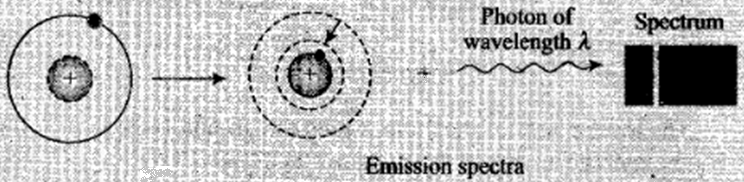
The spectral lines arising from the transition of electron forms a spectra series.
- Mainly there are five series and each series is named after its discoverser as Lyman series, Balmer series, Paschen series, Bracked series and pfumd series.
- According to the Bohr's theory, the wavelength of the rediations emitted from hydrogen atom is given by
$\frac{1}{\lambda}=\text{R}\bigg[\frac{1}{\text{n}_1^2}-\frac{1}{\text{n}_2^2}\bigg]\Rightarrow\ \lambda=\frac{\text{n}_1^2\text{n}_2^2}{(\text{n}_2^2-\text{n}_1^2)\text{R}}=\frac{\text{n}_1^2}{\Big(1-\frac{\text{n}_1^2}{\text{n}_2^2}\Big)\text{R}}$
A set of atoms in an excited state decays in general to any of the states with lower energy. View full question & answer→MCQ 1531 Mark
The possible values of $ml$ are:
- ✓
from $-1$ to $+ 1$
- B
from $0$ to $8$
- C
from $0$ to $+ 1$
- D
AnswerCorrect option: A. from $-1$ to $+ 1$
Values for the quantum number ml are $ -1, 0, + 1$
View full question & answer→MCQ 1541 Mark
Pick out correct statement from the following regarding photons:
- A
Zero rest mass and zero spin
- B
Zero rest mass and half integral spin
- ✓
Zero rest mass and spin of unity
- D
Unit rest mass and spin of unity
AnswerCorrect option: C. Zero rest mass and spin of unity
Rest mass of photon is zero because it is just a form of energy.
Spin of a photon is $1.$
View full question & answer→MCQ 1551 Mark
Which of the following is $\text{NOT}$ a postulate of Bohr's model of the hydrogen atom?
AnswerCorrect option: B. The position of an electron in the hydrogen atom is not defined.
Bohr showed that the electron in the hydrogen atom could only be found in certain selected $($quantized$)$ orbits, and no others.
View full question & answer→MCQ 1561 Mark
In the ground state in $...A...$ electrons are in stable equilibrium while in $...B...$ electrons always experiences a net force. Here, $A$ and $B$ refer to?
- A
Dalton’s theory, Rutherford model.
- B
Rutherford’s model, Bohr’s model.
- ✓
Thomson’s model, Rutherford’s model.
- D
Rutherford’s model, Thomson’s model.
AnswerCorrect option: C. Thomson’s model, Rutherford’s model.
View full question & answer→MCQ 1571 Mark
In terms of Bohr radius $r_0$, the radius of the second Bohr orbit of a hydrogen atom is given by:
- ✓
$4r_0$.
- B
$8r_0$.
- C
$2r.$
- D
$2ri.$
AnswerCorrect option: A. $4r_0$.
View full question & answer→MCQ 1581 Mark
If the spins of electrons of atoms in a substance are paired, then the substance will have:
AnswerSpins are paired means clockwise and anticlock wise rotation cancel each other, so it does not have any free electron.
$\therefore$ it is in dimagnetic in nature.
View full question & answer→MCQ 1591 Mark
As an electron makes a transition from an excited state to the ground state of a hydrogen $-$ like atom/ion?
- A
Kinetic energy decreases, potential energy increases but total energy remains same.
- B
Kinetic energy and total energy decrease but potential energy increases.
- ✓
Its kinetic energy increases but potential energy and total energy decrease.
- D
Kinetic energy, potential energy and total energy decrease.
AnswerCorrect option: C. Its kinetic energy increases but potential energy and total energy decrease.
View full question & answer→MCQ 1601 Mark
The hyperfine lines in the spectrum is related to:
AnswerIn atomic physics, hyperfine structure is the different effects leading to small shifts and splitting in the energy levels of atoms, molecules and ions. The name is a reference to the fine structure which results from the interaction between the magnetic moments associated with electron spin and the electrons' orbital angular momentum. Hyperfine structure, with energy shifts is typically orders of magnitude smaller than the fine structure, results from the interactions of the nucleus $($or nuclei, in molecules$)$ with internally generated electric and magnetic fields.
View full question & answer→MCQ 1611 Mark
Which of the following did Bohr use to explain his theory?
- A
Conservation of linear momentum.
- ✓
The quantization of angular momentum.
- C
Conservation of quantum frequency.
- D
AnswerCorrect option: B. The quantization of angular momentum.
To explain his theory, Niels Bohr used the quantization of angular momentum.
It means the radius of the orbit and the energy will be quantized.
The Boundary conditions for the wave function are periodic.
View full question & answer→MCQ 1621 Mark
According to Planck’s quantum theory any electromagnetic radiation is:
- A
- B
- ✓
Emitted or absorbed in discrete units.
- D
AnswerCorrect option: C. Emitted or absorbed in discrete units.
View full question & answer→MCQ 1631 Mark
Rutherford’s $a-$particle experiment showed that the atoms have:
View full question & answer→MCQ 1641 Mark
If an element has $22$ electrons then what will be its atomic number?
AnswerAtomic number of any element is equal no of electron.
Atomic no. $=$ no. of proton $=$ no of electron.
View full question & answer→MCQ 1651 Mark
According to classical theory, Rutherford’s atomic model is:
- A
- B
- C
- ✓
Both $(a)$ and $(b).$
AnswerCorrect option: D. Both $(a)$ and $(b).$
View full question & answer→MCQ 1661 Mark
The ground state energy of hydrogen atom is $-13.6 eV$. The kinetic and potential energies of the electron in this state are:
- A
$-13.6 eV, 27.2 eV$
- B
$13.6 eV,-13.6 eV$
- ✓
$13.6 eV,-27.2 eV$
- D
$27.2 eV,-27.2 eV$
AnswerCorrect option: C. $13.6 eV,-27.2 eV$
View full question & answer→MCQ 1671 Mark
The idea of parmanu was given by:
AnswerJohn Dalton $(1766 – 1844)$, an English chemist and physicist, is the man credited today with the development of atomic theory. However, a theory of atoms was actually formulated $2,500$ years before Dalton by an Indian sage and philosopher, known as Acharya Kanad.
View full question & answer→MCQ 1681 Mark
When a photon stimulates the emission of another photon, the two photons have:
AnswerExplanation: d. All of the above
When a photon stimulates the emission of another photon, the two photons have same energy, direction, phase, and wavelength or we can say that the two photons are coherent. When an atom is present in its excited state then if a photon of energy equal to the energy gap between the excited state and any lower stable state is incident on this atom then the atom transits from upper state to the lower stable state by emitting a photon of energy equal to the energy gap between the two states. It is called stimulated emission. The emitted photon and incident photon have same energy and hence same wavelength. Also these two photons will be in phase and in the same direction. This process of producing monochromatic and unidirectional light is called lasing action.
View full question & answer→MCQ 1691 Mark
The time taken by a photo$-$electron to come out after the photon strikes is approximately:
AnswerCorrect option: C. $ 10^{-10} \mathrm{sec} $
The time by a photoeletron to come out after the photon strikes is approximately $10^{-10}$ seconds. This is a fact.
View full question & answer→MCQ 1701 Mark
Taking the Bohr radius as $a_0 = 53\ pm$, the radius of $Li^{++}$ ion in its ground state, on the basis of Bohr’s model, will be about:
- A
$53\ pm.$
- B
$27\ pm.$
- ✓
$18\ pm.$
- D
$13\ pm.$
AnswerCorrect option: C. $18\ pm.$
Key concept: Bohr's redius of orbit $($for Hydrogen and $H_2$-like atoms$)$: For an electron around a stationary nucleus, the electrostatics force of attraction provides the necessary centripetal force.
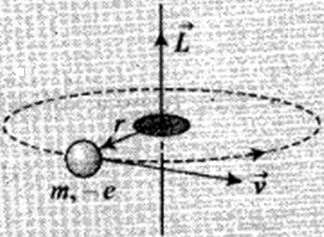
i.e., $\frac{1}{4\pi\in_0}\frac{(\text{Ze})\text{e}}{\text{r}^2}=\frac{\text{mv^2}}{\text{r}}\ .....(\text{i})$
Also $\text{mvr}=\frac{\text{nh}}{2\pi}\ .....(\text{ii})$
From equation $(i)$ and $(ii),$ radius of $n^{th}$ orbit
$\text{r}_\text{n}=\frac{\text{n}^2\text{h}^2}{4\pi^2\text{kZme}^2}=\frac{\text{n}^2\text{h}^2\in_0}{\pi\text{mZe}^2}=0.53\frac{\text{n}^2}{\text{Z}}\mathring{\text{A}}\ \Big(\text{k}=\frac{1}{4\pi\in_0}\Big)$
$\Rightarrow\ \text{r}_\text{n}\propto\frac{\text{n}^2}{\text{Z}}\text{ or }\text{r}_\text{n}\propto\frac{1}{\text{Z}}$
$\text{r}_\text{n}=\text{a}_0\frac{\text{n}^2}{\text{Z}},$ where $a_0 =$ the Bohr radius $= 53\ pm$
The atomic number $(Z)$ of lithium is $3.$
As $\text{r}_\text{n}=\text{a}_0\frac{\text{n}^2}{\text{Z}},$
Therefore, the radius of $Li^{++}$ ion in its ground statr, on the basis of Bohr's model, will be about $\frac{1}{3}$ times to that of Bohr radius.
Therefore, the radius of lithium ion is near $\text{r}=\frac{53}{3}\approx18\text{pm}.$
View full question & answer→MCQ 1711 Mark
The fine structure of hydrogen spectrum can be explained by:
- A
the presence of neutrons in the nucleus.
- B
the finite size of nucleus.
- C
the orbital angular momentum of electrons.
- ✓
the spin angular momentum of electrons.
AnswerCorrect option: D. the spin angular momentum of electrons.
The fine structure describes the splitting of the spectral lines of atoms due to electron spin angular momentum.
View full question & answer→MCQ 1721 Mark
Solar spectrum is an example of:
- A
- B
- ✓
- D
Continuous emission spectrum
AnswerSolar spectrum is a line absorption spectrum which is also called as Fraunhofer lines of missing wavelengths.
View full question & answer→MCQ 1731 Mark
When an electron jumps from its orbit to another orbit, energy is:
- A
- B
- C
Both absorbed and emitted
- ✓
Depends on the energy levels of the orbits
AnswerCorrect option: D. Depends on the energy levels of the orbits
When an electron jumps from lower energy level to higher energy level it absorbs energy and when it jumps from higher energy level to lower energy level it emits energy.
So whether the electron emits or absorbs energy depends on the energy levels of the orbit
View full question & answer→MCQ 1741 Mark
Suppose, the electron in a hydrogen atom makes transition from $n = 3$ to $n = 2$ in $10^{-8}s$. The order of the torque acting on the electron in this period, using the relation between torque and angular momentum as discussed in the chapter on rotational mechanics is:
- A
$10^{-34} \mathrm{Nm}$
- B
$10^{-24} \mathrm{Nm}$
- ✓
$10^{-42} \mathrm{Nm}$
- D
$10^{-8} \mathrm{Nm}$
AnswerCorrect option: C. $10^{-42} \mathrm{Nm}$
The angular momentum of the electron for the $n^{th}$ state is given by,
$\text{L}_\text{n}=\frac{\text{nh}}{2\pi}$
Angular momentum of the electron for $\text{n}=3,\ \text{L}_\text{i}=\frac{3\text{h}}{2\pi}$
Angular momentum of the electron for $\text{n}=2,\ \text{L}_\text{f}=\frac{2\text{h}}{2\pi}$
The torque is the time rate of change of the angular momentum.
Torque, $\tau=\frac{\text{L}_\text{f}-\text{L}_\text{i}}{\text{t}}$
$=\frac{\big(\frac{2\text{h}}{2\pi}\big)-\big(\frac{3\text{h}}{2\pi}\big)}{10^{-8}}$
$=\frac{-\big(\frac{\text{h}}{2\pi}\big)}{10^{-8}}$
$=\frac{-10^{-34}}{10^{-8}}$ $\Big[\because\frac{\text{h}}{2\pi}\approx10^{-34}\text{J}-\text{s}\Big]$
$=-10^{-42}\text{N}-\text{m}$
The magnitude of the torque is $10^{-42}$N-m.
View full question & answer→MCQ 1751 Mark
What did Rutherford’s alpha particle experiment prove?
AnswerRutherford’s alpha particle experiment proved the existence of the nucleus.
View full question & answer→MCQ 1761 Mark
AnswerExplanation: d. None of the above
Raman effect deals with inelastic scattering of photon particles by interaction with vibrational and rotational transitions in the bonds( Raman scattering can occur with a change in energy of a molecule due to a transition) it has nothing to do with polarisation, quantum nature, wave nature (photon scattering ) and Brillouin zone scattering.
View full question & answer→MCQ 1771 Mark
A set of atoms in an excited state decay.
- ✓
In general, to any of the states with lower energy.
- B
Into a lower state only when excited by an external electric field.
- C
All together simultaneously into a lower state.
- D
To emit photons only when they collide.
AnswerCorrect option: A. In general, to any of the states with lower energy.
View full question & answer→MCQ 1781 Mark
In a laboratory experiment on emission from atomic hydrogen in a discharge tube, only a small number of lines are observed whereas a large number of lines are present in the hydrogen spectrum of a star. This is because in a laboratory:
- A
The amount of hydrogen taken is much smaller than that present in the star.
- ✓
The temperature of hydrogen is much smaller than that of the star.
- C
The pressure of hydrogen is much smaller than that of the star.
- D
The gravitational pull is much smaller than that in the star.
AnswerCorrect option: B. The temperature of hydrogen is much smaller than that of the star.
The number of lines of the hydrogen spectrum depends on the excitation of the hydrogen atom. This is dependent on the heat energy absorbed by the hydrogen atoms. More the temperature of the hydrogen sample, more is the heat energy. The temperature of hydrogen at the star is much more than that can be produced in the laboratory. Hence, less number of lines are observed in the hydrogen spectrum in the laboratory than that in a star.
View full question & answer→MCQ 1791 Mark
Which of the following are in the ascending order of wavelength?
AnswerCorrect option: D. Both $(b)$ and $(c).$
View full question & answer→MCQ 1801 Mark
In a Rutherford scattering experiment when a projectile of charge $Z_1$ and mass $M_1$ approaches a target nucleus of charge $Z_2$ and mass $\mathrm{M}_2$, the distance of closest approach is r . The energy of the projectile is?
- ✓
Directly proportional to $Z_1 Z_2$.
- B
Inversely proportional to $Z_1$.
- C
Directly proportional to mass $M_1$.
- D
Directly proportional to $\text{M}_1 \times \text{M}_2$
AnswerCorrect option: A. Directly proportional to $Z_1 Z_2$.
View full question & answer→MCQ 1811 Mark
Spectrum of sunlight is an example for:
- A
- ✓
- C
Continuous emission spectrum
- D
Continuous absorption spectrum
AnswerDark/ Bright light seen in an otherwise uniform and continous spectrum is a spectral line, this is due to emission or absorption of light in a narrow frequency range, compared with the nearby frequencies.
Spectrum of sunlight is an example for line absorption spectrum.
View full question & answer→MCQ 1821 Mark
What causes spectral lines?
- A
The transition of electrons between two energy levels.
- B
The transition of electrons between two wavelength ranges.
- ✓
Magnetic and electric field exiting in an atom.
- D
The transition of electrons from electric to magnetic field.
AnswerCorrect option: C. Magnetic and electric field exiting in an atom.
The observed spectral lines are caused by the transition of electrons between two energy levels in an atom.
The emission spectrum of the hydrogen atom is divided into many spectral series, with wavelengths that are given by Rydberg’s formula.
View full question & answer→MCQ 1831 Mark
There are seven orbitals in a subshell then the value of l for it will be:
- A
$1 = 4$
- ✓
$1 = 3$
- C
$1 = 2$
- D
$1 = 1$
AnswerCorrect option: B. $1 = 3$
The shape of orbitals i.e. number of orbitals depends on the subshell in which they are found.
The maximum possible number of orbitals i.e. the allowed orientations in space are denoted by magnetic quantum number and is given by.$ml = 2l + 1$
$7 = 2l + 1$
$2l = 6$
$l = 3$
View full question & answer→MCQ 1841 Mark
As the quantum number increases, the difference of energy between consecutive energy levels?
- A
- B
- ✓
- D
Sometimes increases and sometimes decreases.
View full question & answer→MCQ 1851 Mark
Full wave rectifier uses:
MCQ 1861 Mark
In the Geiger$-$Marsden scattering experiment, is case of head$-$on collision the impact parameter should be:
View full question & answer→MCQ 1871 Mark
An incandescent filament emits a spectrum which is:
AnswerAn electric bulb, a candle or a red hot iron piece emits light, which has continuously varying wavelengths.
So it shows continuous emission spectrum.
View full question & answer→MCQ 1881 Mark
When a photon stimulates the emission of another photon, the two photons have:
AnswerA photon with of a particular wavelength stimulates the emission of a photon of same wavelength which will stimulate another photon and so on and therfore the collection of these photons with same wavelength these are called monochromatic they will have same wavelength phase energy and direction and combine to form the laser beam.
View full question & answer→MCQ 1891 Mark
Which one did Rutherford consider to be supported by the results of experiments in which $\alpha -$particles were scattered by gold foil?
AnswerCorrect option: B. The force of repulsion between an atomic nucleus and an $\alpha -$particle varies with distance according to inverse square law.
View full question & answer→MCQ 1901 Mark
Which one of the following properties is not found in cathode rays?
AnswerCorrect option: D. Cathode rays are not deflected by electric and magnetic field
Properties of cathode rays:
They are produced by the negative electrode, or cathode, in an evacuated tube, and travel towards the anode.
They travel in straight lines and cast sharp shadows.
They have energy and can do work.
They are deflected by electric and magnetic fields and have a negative charge.
View full question & answer→MCQ 1911 Mark
The angular momentum of an electron in an orbit is quantized because it is a necessary condition for the compatibility with:
- A
- ✓
Particle nature of electron
- C
Pauli's exclusion behaviour
- D
AnswerCorrect option: B. Particle nature of electron
Quantization of angular momentum comes from the particle nature of electrons, and all of its postulates.
View full question & answer→MCQ 1921 Mark
According to the uncertainty principle for an electron, time measurement will become uncertain if which of the following is measured with high certainty?
AnswerAccording to the uncertainty principle,
$\triangle\text{E}.\triangle\text{t}>=\frac{\text{h}}{2\pi}.$
Thus the time measured will become uncertain if $\triangle\text{E}$ is measured with high certainty.
View full question & answer→MCQ 1931 Mark
In a cathode ray tube, what is the effect on the beam of particles if the anode voltage is increased ?
- ✓
Kinetic Energy of electron beam increase
- B
Rate of electron emission increase
- C
Kinetic energy of electron beam remains unchanged
- D
Rate of electron emission decrease
AnswerCorrect option: A. Kinetic Energy of electron beam increase
Electrons emitted by the cathode are attracted to the focusing anode if the anode voltage is increased.
Thus, Kinetic Energy of electron beam increase.
View full question & answer→MCQ 1941 Mark
The first model of atom in $1898$ was proposed by:
AnswerCorrect option: C. $J.J.$ Thomson
View full question & answer→MCQ 1951 Mark
The fluorescence of the glass $($discharge$)$ tube at very low pressure is characteristic of $......$
- ✓
The phosphors in the material of the glass
- B
- C
- D
AnswerCorrect option: A. The phosphors in the material of the glass
Fluorescence is the emission of light by a substance that as absorbed light as other electromagnetic radiation. It occurs due to presence of phosphorous in the metal tube. Because phosphorous is a material that glows when exposed to electrical energy. Because actual conversion of electrical to light energy takes place on display screen when electron strike phosphorous.
View full question & answer→MCQ 1961 Mark
Electrons in the atom are held to the nucleus by:
MCQ 1971 Mark
According to the classical theory, the circular path of the electrons is:
AnswerAccording to classical theory, the circular path of the electrons is spiral.
View full question & answer→MCQ 1981 Mark
In the hydrogen atom, an electron makes a transition from $n = 2$ to $n = 1$. The magnetic field produced by the circulating electron at the nucleus?
- A
Decreases $16$ times.
- B
Increases $4$ times.
- C
Decreases $4$ times.
- ✓
Increases $32$ times.
AnswerCorrect option: D. Increases $32$ times.
View full question & answer→MCQ 1991 Mark
Excitation energy of a hydrogen like ion in its excitation state is $40.8\ eV$. Energy needed to remove the electron from the ion in ground state is:
- ✓
$54.4\ eV.$
- B
$13.6\ eV.$
- C
$40.8\ eV.$
- D
$27.2\ eV.$
AnswerCorrect option: A. $54.4\ eV.$
View full question & answer→MCQ 2001 Mark
Number of spectral lines in hydrogen atom is:
AnswerInfinitely large transition are possible $($in principle$)$ for the hydrogen atom
View full question & answer→MCQ 2011 Mark
According to the quantum theory of light, the energy of light is carried in discrete units called:
AnswerAccording to the quantum theory of light, energy of light is carried in discrete units called photons.
View full question & answer→MCQ 2021 Mark
If an α-particle collides head$-$on with a nucleus, what is its impact parameter?
AnswerThe perpendicular distance between the path of a projectile and the center of the potential field is the impact parameter.
Therefore, for a head$-$on collision of the $\alpha -$particle with a nucleus, the impact parameter is equal to zero.
View full question & answer→MCQ 2031 Mark
Number of spectral lines in hydrogen atom is:
AnswerCorrect option: D. $\infty $
Number of spectral lines in hydrogen atom $\infty .$
View full question & answer→MCQ 2041 Mark
Which one of the following device makes use of the electrons to strike certain substances to produce fluorescence?
AnswerThe device which makes use of the electrons to strike certain substances to produce fluorescence is Cathode ray oscilloscope.
View full question & answer→MCQ 2051 Mark
A hydrogen atom in ground state absorbs $10.2\ eV$ of energy. The orbital angular momentum of the electron is increased by:
- ✓
$ 1.05 \times 10^{-34} \mathrm{Js} $
- B
$ 2.11 \times 10^{-34} \mathrm{Js} $
- C
$ 3.16 \times 10^{-34} \mathrm{Js} $
- D
$ 4.22 \times 10^{-34} \mathrm{Js} $
AnswerCorrect option: A. $ 1.05 \times 10^{-34} \mathrm{Js} $
Let after absorption of energy, the hydrogen atom goes to the nth excited state.
Therefore, the energy absorbed can be written as,
$10.2=13.6\times\Big(\frac{1}{1^2}-\frac{1}{\text{n}^2}\Big)$
$\Rightarrow\frac{10.2}{13.6}=1-\frac{1}{\text{n}^2}$
$\Rightarrow\frac{1}{\text{n}^2}=\frac{13.6-10.2}{13.6}$
$\Rightarrow\frac{1}{\text{n}^2}=\frac{3.4}{13.6}$
$\Rightarrow\text{n}^2=4$
$\Rightarrow\text{n}=2$
The orbital angular momentum of the electron in the $n^{th}$ state is given by,
$\text{L}_\text{n}=\frac{\text{nh}}{2\pi}$
Change in the angular momentum, $\Delta\text{L}=\frac{2\text{h}}{2\pi}-\frac{\text{h}}{2\pi}=\frac{\text{h}}{2\pi}$
$\therefore\Delta\text{T}=1.05\times10^{-34}\text{Js}$
View full question & answer→MCQ 2061 Mark
The visible region of hydrogen spectrum was first studied by:
AnswerVisible region of hydrogen spectrum was first studied by Balmer, therefore they are also called as Balmer lines.
View full question & answer→MCQ 2071 Mark
Name a device which is commonly used to convert an electric signal into a visual signal:
AnswerCathode$-$ray tubes that are used to convert electric signals into visible images may be divided into, for example, the following categories: television picture tubes, or kinescopes; cathode$-$ray oscillograph tubes; numerical indicator tubes; the indicator tubes used in radar sets
View full question & answer→MCQ 2081 Mark
Which source is associated with a line emission spectrum?
AnswerNeon street sign gives a line emission spectrum.
When neon atoms gain enough energy to become excited, light is produced. Atom releases a photon when it returns to a lower energy state.
Therefore, the source associated with a line emission spectrum is the neon street sign.
View full question & answer→MCQ 2091 Mark
Choose the wrong statement:
AnswerCorrect option: D. Electrons cannot be diffracted by crystals
Fast moving electrons are associated with wave and hence they show diffraction.
View full question & answer→MCQ 2101 Mark
According to Bohr hypothesis, discrete quantity is:
AnswerBohr's hypothesis
Electrons revolves round the nucleus in water orbits.
Orbit of the electron around the nucleus can take only some special values of radius.
The energy of the atom as a definite value in these orbits.
In this Orbits, Angular momentum $(e)$ of the electron is integral multiple of the plank's constant h divided by $2n$
$\text{i.e. l}=\text{n}\frac{\text{h}}{2\text{n}}.$
View full question & answer→MCQ 2111 Mark
Find out the minimum energy required to take out the only one electron from the ground state of $Li^+$?
- A
$13.6\ eV$
- ✓
$122.4\ eV$
- C
$25.3\ eV$
- D
$67.9\ eV$
AnswerCorrect option: B. $122.4\ eV$
Ionization energy is given as:
$E = 13.6 Z2 eV$
For $Li^+, Z = 3$
$E = 13.6 \times 9$
$E = 122.4 eV$
View full question & answer→MCQ 2121 Mark
Which of the following can be chosen to analogously represent the behavior of a particle?
AnswerA string is used to represent the behavior of a particle analogously to the waves traveling on it.
Particle waves can lead to standing waves held under resonant conditions.
When a stationary string is plucked, it causes several wavelengths to be excited. But, we know that only the ones which have nodes at the ends will survive.
View full question & answer→MCQ 2131 Mark
The ratio between Bohr radii is:
- A
$1 : 2 : 3$
- B
$2 : 4 : 6$
- ✓
$1 : 4 : 9$
- D
$1 : 3 : 5$
AnswerCorrect option: C. $1 : 4 : 9$
$1 : 4 : 9$, In Bohr’s atomic model, $r_n n^2$
View full question & answer→MCQ 2141 Mark
Which of the following parameters are the same for all hydrogen$-$like atoms and ions in their ground states?
- A
- B
- C
- ✓
Orbital angular momentum of the electron.
AnswerCorrect option: D. Orbital angular momentum of the electron.
According to Bohr's atomic theory, the orbital angular momentum of an electron in a one$-$electron system is given by,
$\text{L}_\text{n}=\frac{\text{nh}}{2\pi}$
Here,
$n =$ Principal quantum number.
The angular momentum is independent of the atomic number of the one$-$electron system. Therefore, it is same for all hydrogen$-$like atoms and ions in their ground states. The other parameters given here are dependent on the atomic number of the hydrogen$-$like atom or ion taken.
View full question & answer→MCQ 2151 Mark
The property of cathode rays used in the monitor of a computer is:
- A
High velocity of the rays
- B
High ionization power of the rays
- ✓
The property to cause fluorescence
- D
AnswerCorrect option: C. The property to cause fluorescence
View full question & answer→MCQ 2161 Mark
In a cathode ray tube, what is the effect on the beam of particles if a hotter filament is used?
- A
Rate of electron emission remains unchanged
- B
Rate of electron emission decreases
- ✓
Rate of electron emission increases
- D
Rate of electron emission increases then decreases
AnswerCorrect option: C. Rate of electron emission increases
Hotter filament will increase the temperature.
Hence rate of electron emission will increase.
View full question & answer→MCQ 2171 Mark
The binding energy of a H-atom, considering an electron moving around a fixed nuclei $($proton$)$, is $\text{B}=-\frac{\text{me}^4}{8\text{n}^2\in_0^2\text{h}^2}. (m =$ electron mass$).$
If one decides to work in a frame of reference where the electron is at rest, the proton would be moving arround it. By similar arguments, the binding energy would be,
$\text{B}=-\frac{\text{me}^4}{8\text{n}^2\in_0^2\text{h}^2} (M =$ proton mass$)$
This last expression is not correct because:
AnswerCorrect option: C. The frame in which the electron is at rest is not inertial.
In a hydrogen atom, electron revolving around a fixed proton nucleus have some centripetal acceleration. Therefore its frame of reference is non$-$inertial. If the frame of reference, where the electron is at rest, the given expression is not true as it forms the non$-$inertial frame of reference.
View full question & answer→MCQ 2181 Mark
In a cathode ray tube, the screen is coated with fluorescent material:
- ✓
It produces spots on the screen
- B
Beam of light is not in a straight line
- C
Light deviates away after striking
- D
AnswerCorrect option: A. It produces spots on the screen
When the electron beam strikes the screen coated with fluorescent material the electrical signals appear as visual pattern or spots on the screen.
View full question & answer→MCQ 2191 Mark
The shortest wavelength in Balmer’s series for Hydrogen atom is $...A...$ and this is obtained by substituting $...B ...$ in Balmer’s formula. Here, $A$ and $B$ refer to?
- A
$656.3\ nm, n = 3$
- B
$486.1\ nm, n = 4$
- C
$410.2\ nm, n = 5$
- ✓
$364.6\ nm, n = \infty$
AnswerCorrect option: D. $364.6\ nm, n = \infty$
View full question & answer→MCQ 2201 Mark
In Rutherford's $\alpha\text{ - particle}$ scattering experiment, what will be correct angle for α scattering for an impact parameter $b = 0?$
- A
$90^\circ .$
- B
$270^\circ .$
- C
$0^\circ .$
- ✓
$180^\circ .$
AnswerCorrect option: D. $180^\circ .$
View full question & answer→MCQ 2211 Mark
As one considers orbits with higher values of n in a hydrogen atom, the electric potential energy of the atom?
MCQ 2221 Mark
The possible values of orbital quantum numbers are: $[$n is the principle quantum number$]$
- ✓
from $0$ to $(n - 1)$
- B
from $0$ to $n$
- C
from $0$ to $(n + 1)$
- D
AnswerCorrect option: A. from $0$ to $(n - 1)$
The orbital quantum number, $l,$ divides the shells up into smaller groups of subshells called orbitals. The orbital quantum number describes shape of subshells. The principal quantum number$(n)$ determines the possible values of l. For $n = 1$ i.e.$ K-$shell there is no subshell so, $l = 0$ i.e. $(n − 1)$. Hence, The possible values of orbital quantum numbers are from $0$ to $(n − 1).$
View full question & answer→MCQ 2231 Mark
The transition of electron from $n = 4, 5, 6, .......$ to $n = 3$ corresponds to:
AnswerIn transition from $n_1 = 3$ and $n_2 = 4, 5, 6,….$
Infrared radiation of Paschen spectral is emitted.
View full question & answer→MCQ 2241 Mark
The purpose of cathode in cathode ray tube is $......$
AnswerThe heated filament transfers its heat to the cathode the cathode coated by oxides of Barium or Strantium emit electrons on heating.
View full question & answer→MCQ 2251 Mark
Which of the following in a hydrogen atom is independent of the principal quantum number n?$ ($The symbols have their usual meanings$).$
View full question & answer→MCQ 2261 Mark
What is the electronic configuration of phosphorus?
- ✓
$2, 8, 5$
- B
$2, 8, 4$
- C
$2, 8, 6$
- D
$2, 8, 3$
AnswerCorrect option: A. $2, 8, 5$
Phosphorus has atomic no$-17.$ so its $k$ shell has $2$ electron, $L$ shell has $8$ electron and $M$ shell has $5$ electron.
View full question & answer→