Question 13 Marks
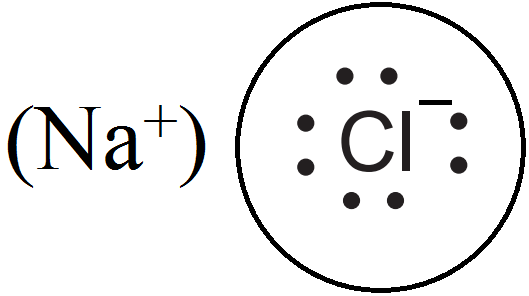
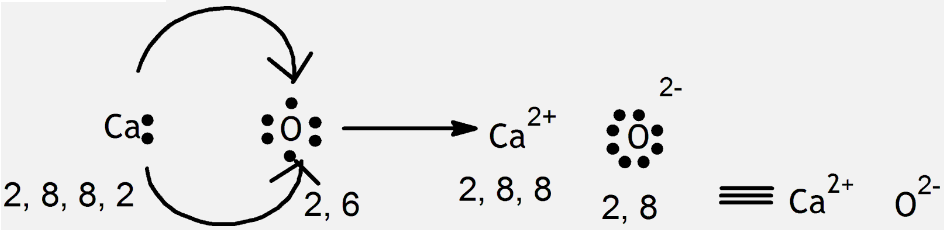
Use Lewis symbols to show electron transfer between the following atoms to form cations and anions: Ca and O
Answer
Ca and O:
The electronic configurations of Ca and O are as follows:
Ca: 2, 8, 8, 2
O: 2, 6
Oxygen requires two electrons more to complete its octet, whereas calcium has two electrons more than the nearest noble gas i.e., Argon. Hence, the electron transfer takes place as:
View full question & answer→Question 23 Marks
Use molecular orbital theory to explain why the $\mathrm{Be}_2$ molecule does not exist.
AnswerThe electronic configuration of Beryllium is $1 \mathrm{~s}^2 2 \mathrm{~s}^2$ The molecular orbital electronic configuration for $\mathrm{Be}_2$ molecule can be written as:
$\sigma_{1 \mathrm{~s}}^2 \sigma_{1 \mathrm{~s}}^2 \sigma_{2 \mathrm{~s}}^2 \sigma_{2 \mathrm{~s}}^2$
Hence, the bond order for $\mathrm{Be}_2$ is $\frac{1}{2}\left(\mathrm{~N}_{\mathrm{b}}-\mathrm{N}_{\mathrm{a}}\right)$.
Where
$N_b=$ Number of electrons in bonding orbitals
$N_a=$ Number of electrons in anti-bonding orbitals
$\therefore$ Bond order of $\mathrm{Be}_2=\frac{1}{2}(4-4)=0$
A negative or zero bond order means that the molecule is unstable. Hence, $\mathrm{Be}_2$ molecule does not exist.
View full question & answer→Question 33 Marks
Arrange the bonds in order of increasing ionic character in the molecules: $\mathrm{LiF}, \mathrm{K}_2 \mathrm{O}, \mathrm{N}_2, \mathrm{SO}_2$ and $\mathrm{ClF}_3$.
AnswerThe ionic character in a molecule is dependent upon the electronegativity difference between the constituting atoms. The greater the difference, the greater will be the ionic character of the molecule.
On this basis, the order of increasing ionic character in the given molecules is
$\mathrm{N}_2<\mathrm{SO}_2<\mathrm{ClF}_3<\mathrm{K}_2 \mathrm{O}<\mathrm{LiF}$
View full question & answer→Question 43 Marks
Explain why $\mathrm{BeH}_2$ molecule has a zero dipole moment although the Be–H bonds are polar.
AnswerThe Lewis structure for $\mathrm{BeH}_2$ is as follows:
$\text{H}:\text{Be}:\text{H}$
There is no lone pair at the central atom ( Be ) and there are two bond pairs. Hence, $\mathrm{BeH}_2$ is of the type $\mathrm{AB}_2$. It has a linear structure.

Dipole moments of each H -Be bond are equal and are in opposite directions. Therefore, they nullify each other.
Hence, $\mathrm{BeH}_2$ molecule has zero dipole moment. View full question & answer→Question 53 Marks
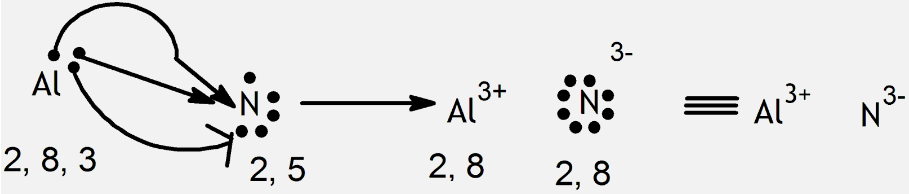
Use Lewis symbols to show electron transfer between the following atoms to form cations and anions:
Al and N.
AnswerAl and N:
The electronic configurations of Al and N are as follows:
Al: 2, 8, 3
N: 2, 5
Nitrogen is three electrons short of the nearest noble gas (Neon), whereas aluminium has three electrons more than Neon. Hence, the electron transference can be shown as:
View full question & answer→Question 63 Marks
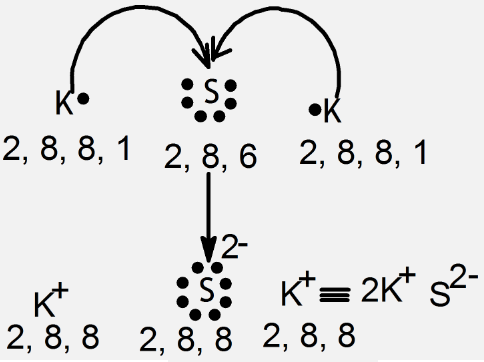
Use Lewis symbols to show electron transfer between the following atoms to form cations and anions: K and S.
Answer
K and S:
The electronic configurations of K and S are as follows:
K: 2, 8, 8, 1S: 2, 8, 6
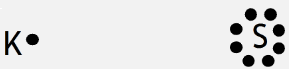
Sulphur (S) requires 2 more electrons to complete its octet. Potassium (K) requires one electron more than the nearest noble gas i.e., Argon. Hence, the electron transfer can be shown as:
View full question & answer→Question 73 Marks
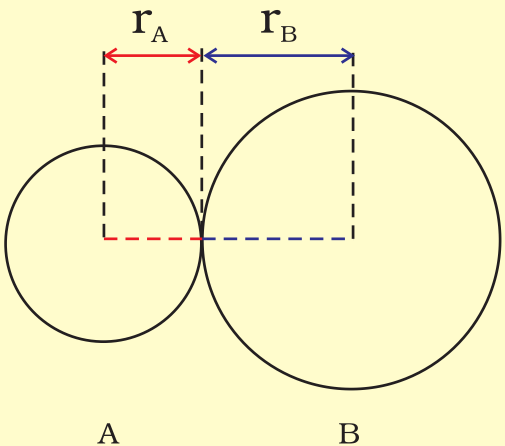
AnswerBond length is defined as the equilibrium distance between the nuclei of two bonded atoms in a molecule.Bond lengths are expressed in terms of Angstrom ( $10^{-10} \mathrm{~m}$ ) or picometer ( $10^{-12} \mathrm{~m}$ ) and are measured by spectroscopic Xray diffractions and electron-diffraction techniques.
In an ionic compound, the bond length is the sum of the ionic radii of the constituting atoms ( $d=r_{+}+r_{-}$). In a covalent compound, it is the sum of their covalent radii $\left(d=r_A+r_B\right)$.
View full question & answer→Question 83 Marks
Is there any change in the hybridisation of B and N atoms as a result of the following reaction? $\text{BF}_3+\text{NH}_3\rightarrow\text{F}_3\text{B}.\text{NH}_3$
AnswerBoron atom in BF3 is sp2 hybridized. The orbital picture of boron in the excited state can be shown as: https://api.studentbro.in/web/sciEn5UI.png" style="height:50%; width:50%"> Nitrogen atom in NH3 is sp3 hybridized. The orbital picture of nitrogen can be represented as: https://api.studentbro.in/web/AjTlfxKW.png" style="height:50%; width:50%"> After the reaction has occurred, an adduct F3B⋅NH3 is formed as hybridization of ‘B’ changes to sp3. However, the hybridization of ‘N’ remains intact.
View full question & answer→Question 93 Marks
What do you understand by bond pairs and lone pairs of electrons? Illustrate by giving one exmaple of each type.
Answer
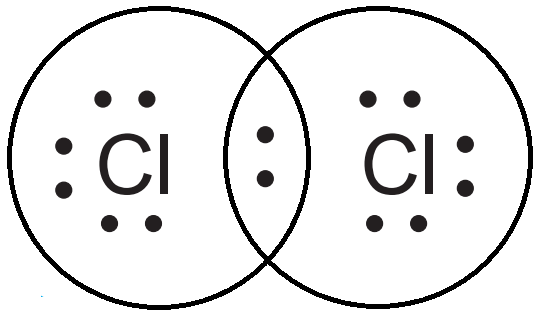
Bond pairs are the pairs of electrons taking part in bonding e.g.,
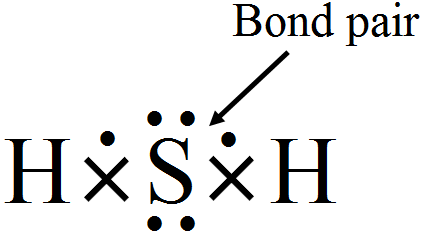
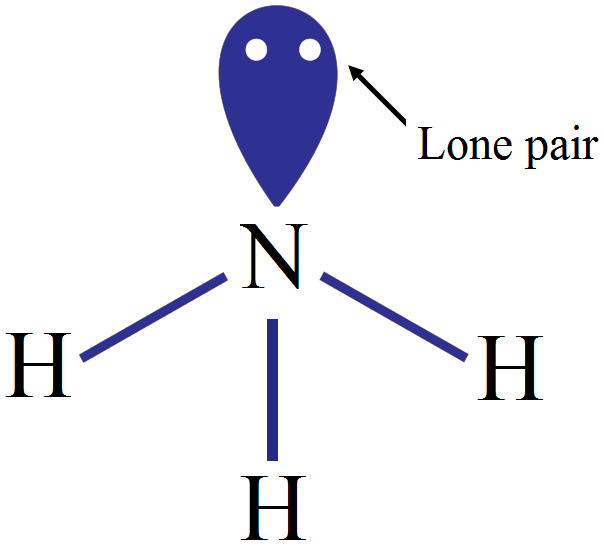
A pair of electrons in a molecule which is not shared by any of the two constituent atoms i.e., does not take part in the direct bonding is called a lone pair e.g.,
View full question & answer→Question 103 Marks
Write the important conditions required for the linear combination of atomic orbitals to form molecular orbitals.
Answer
- The combining atomic orbitals should have comparable energies.
For example, Is orbital of one atom can combine with Is atomic orbital of another atom, 2s can combine with 2s.
- The combining atomic orbitals must have proper orientations. So that they are able to overlap to a considerable extent.
- The extent of overlapping should be large.
View full question & answer→Question 113 Marks
Define electronegativity. How does it differ from electron gain enthalpy?
AnswerThe relative tendency of a bonded atom to attract the shared electron pair towards itself is called electronegativity while electron gain enthalpy is the energy change that occurs for the process of adding an electron to a gaseous isolated atom to convert it into a negative ion i.e., to form, a monovalent anion. Electron gain enthalpy and electronegativity both measure the power of attracting electrons, but electron gain enthalpy is concerned with an isolated gaseous atom while electronegativity is concerned with the atom in combination.
View full question & answer→Question 123 Marks
Describe the change in hybridisation (if any) of the Al atom in the following reaction. $\text{AlCl}_3\text{Cl}^-\rightarrow\text{AlCl}^-_4$
AnswerThe valence orbital picture of aluminium in the ground state can be represented as:
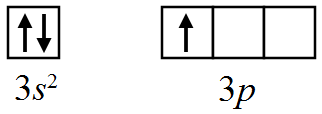
The orbital picture of aluminium in the excited state can be represented as:
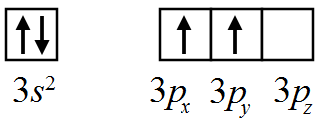
Hence, it undergoes $\mathrm{sp}^2$ hybridization to give a trigonal planar arrangement (in $\mathrm{AlCl}_3$ ).
To form $\mathrm{AlCl}_{4^{-}}$, the empty $3 \mathrm{p}_z$ orbital also gets involved and the hybridization changes from $\mathrm{sp}^2$ to $\mathrm{sp}^3$. As a result, the shape gets changed to tetrahedral. View full question & answer→Question 133 Marks
- Write the molecular orbital configuration of $\text{O}^+_2.$ Calculate its bond order and predict its magnetic behaviour.
- Using VSEPR model, predict the geometery of SF molecule.
Answer
- $\text{O}^+_2(15):\sigma\text{ls}^2\ \stackrel{*\ \ \ \ \ }{\sigma\text{ls}^2}\sigma\text{ls}^2\ \stackrel{*\ \ \ \ \ }{\sigma\text{ls}^2}\ \sigma2\text{s}^2\ \sigma2\text{p}_\text{z}^2\ \pi\text{2p}_\text{x}\ \pi\text{2p}_\text{y}^2\ \stackrel{*\ \ \ \ \ \ \ \ \ }{\pi2\text{p}_\text{x}^1}$
$\text{B.O.}=\frac12(10-5)=\frac52$
It is paramagnetic.
- It has 6 pb of electrons.
$\therefore$ it has octahedral geometry. View full question & answer→Question 143 Marks
Elements X, Y and Z have 4, 5 and 7 valence electrons respectively:
- Write the molecular formula of the compounds formed by these elements individually with hydrogen.
- Which of there compound will have the highest dipole moment?
Answer
-
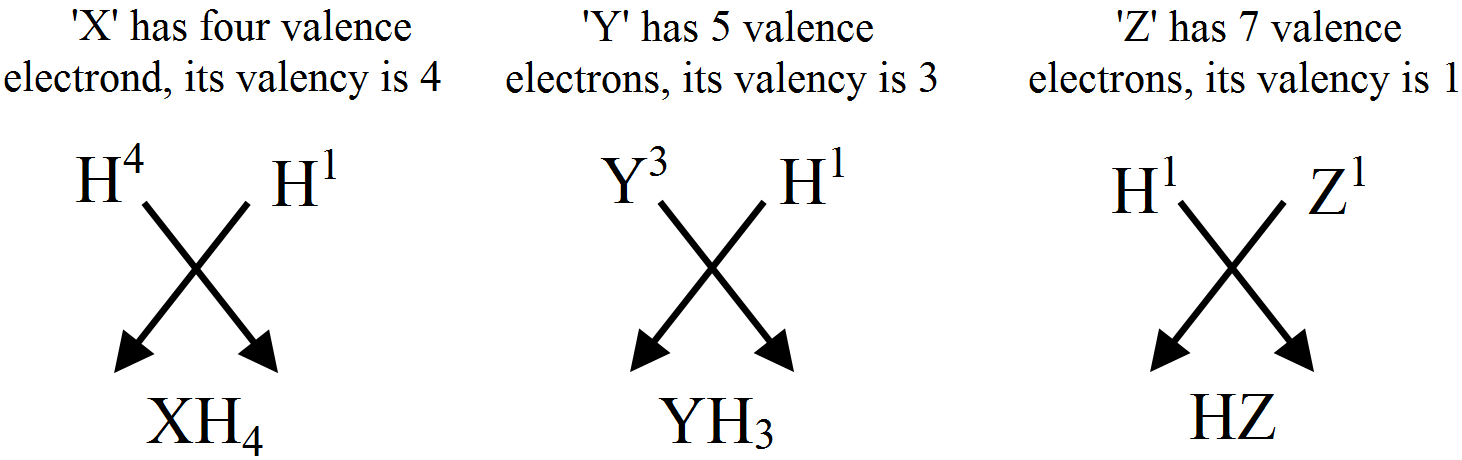
- HZ will have highest dipole moment because Z belongs to group 17, it is most electronegative.
$\therefore$ HZ is most polar, hence highest dipole moment. View full question & answer→Question 153 Marks
Discuss the hybridisation of Be in gaseous state and solid state.
AnswerIn gaseous state at high temperature, $\mathrm{BeCl}_2$ exists as linear molecule, $\text{Cl}-\text{Be}-\text{Cl},$ thus the hybridisation of the central atoms is sp.$\ \ \ \ \ \text{Cl}-\text{Be}-\text{Cl} \\\ \ \ \ \ \ \text{Structure of}\\\ \text{BeCl in gaseous state}$
In solid state, it has a polymeric structure with chlorine bridges as follows.

Two Cl-atoms are listed to be atom by two coordination bonns and two by covalent bonds. For these bonds to be formed, Be in the excited state with the configuration $\text{1s}^2\ \text{2s}^1\ 2\text{p}_\text{x}^1\ 2\text{p}^0_\text{y}\ 2\text{p}_\text{z}^0$ undergoes $\mathrm{sp}^3$ hybridisation. Two half-filled hybrid orbitals will form normal covalent bonds with two Cl-atom. The other two Cl-atoms are coordinated to Be-atom by donating electron pairs into the empty hybrid orbtitals. View full question & answer→Question 163 Marks
What is an ionic bond? Give two suitable examples explain the difference between ionic and covalent bond.
AnswerThe bond which is formed by transfer of electron is called ionic bond.
|
S. No.
|
Ionic bond
|
Covalent bond
|
|
i.
|
It is formed by transfer of electrons.
|
It is formed by sharing of electrons.
|
|
ii.
|
It is formed metal and non metals. e.g.
|
It can be formed between two non metals also. e.g.
|
View full question & answer→Question 173 Marks
What is meant by the term bond order? Calculate the bond order of $\text{N}_2,\text{O}_2,\text{O}^+_2$ and $\text{O}^-_2.$
AnswerBond order is defined as one half the difference between the number of electrons present in the bonding and anti-bonding orbitals, i.e.
Bond order (BO) $=\frac12(\text{N}_\text{b}-\text{N}_\text{a})$
A positive bond order means a stable molecule while a negative or zero bond order means an unstable molecule.
$\text{Stability fo a molecule}\propto\text{bond order}$
$\text{Bond length}\propto\frac{1}{\text{bond order}}$
Bond order values 1,2 or 3 correspond to single, double or triple bonds respectively.
Calculation of the bond order of $\text{N}_2,\text{O}_2,\text{O}^+_2$ and $\text{O}^-_2$
Electronic configuration of $N_2$ (14 electrons)
$\sigma\text{ls}^,\ \stackrel{*\ \ \ \ \ \ \ }{\sigma\text{ls}^2},\ \sigma2\text{s}^2,\ \stackrel{*\ \ \ \ \ \ \ \ \ }{\sigma2\text{s}^2},\ (\pi2\text{p}_\text{x}^2\approx\pi2\text{p}_\text{y}^2),\sigma2\text{p}_\text{z}^2$
Bond order $=\frac12[\text{N}_\text{b}-\text{N}_\text{a}]=\frac12\times(10-4)=3$
EC of $O_2$ (16 electrons)
$=\sigma\text{ls}^2\stackrel{*\ \ \ \ \ \ \ }{\sigma\text{ls}^2},\sigma2\text{s}^2,\stackrel{*\ \ \ \ \ \ \ }{\sigma2\text{s}^2},\sigma2\text{p}_\text{z}^2,\$\pi2\text{p}^2_\text{x}\approx\pi2\text{p}^2_\text{y}),\ (\stackrel{*\ \ \ \ \ \ \ \ \ }{\pi2\text{p}^1_\text{x}}\ \approx\ \stackrel{*\ \ \ \ \ \ \ \ \ \ \ \ }{\pi2\text{p}_\text{y}^1)}$
Bond order $=\frac12(\text{N}_\text{b}-\text{N}_\text{a})=\frac12(10-6)=2$
EC of $\text{O}^+_2$ (15 electrons)
$=\sigma\text{ls}^2,\ \stackrel{*}{\sigma\text{ls}^2},\sigma\text{2s}^2,\stackrel{*}{\sigma2\text{s}^2},\sigma2\text{p}^2_\text{z},\$\pi2\text{p}^2_\text{x}\approx\pi2\text{p}^2\text{y}),(\stackrel{*} {\pi2\text{p}^1_\text{x}}\ \approx\ \stackrel{*}{\pi2\text{p}_\text{y}})$
Bond order $=\frac12(\text{N}_\text{b}-\text{N}_\text{a})=\frac12(10-5)=2.5{}{}$
EC of $\text{O}^-_2$ (17 electrons)
$=\sigma\text{ls}^2,\stackrel{*\ \ \ \ \ \ \ }{\sigma\text{ls}^2},\sigma\text{2s}^2,\stackrel{*\ \ \ \ \ \ \ \ }{\sigma2\text{s}^2},\sigma2\text{p}^2_\text{z},\\ (\pi2\text{p}_\text{x}^2\approx\pi\text{2p}^2_\text{y}),(\stackrel{*\ \ \ \ \ \ \ \ \ }{\pi2\text{p}^2_\text{x}}\ \approx\ \stackrel{*\ \ \ \ \ \ \ \ \ }{\pi2\text{p}^1_\text{y}})$
Bond order $=\frac12(\text{N}_\text{a}-\text{N}_\text{a})=\frac12(10-7)=1.5$
View full question & answer→Question 183 Marks
Discuss the significance/ applications of dipole moment.
AnswerDipole moment plays very important role in understanding the nature of chemical bond. A few applications are given below:
- Distinction between, polar and non-polar molecules. The measurement of dipole moment can help us to distinguish between polar and non-polar molecules. Non-polar molecules have zero dipole moment while polar molecules have some value of dipole moment.
- Degree of polarity in a molecule. Dipole moment measurement also gives an idea about the degree of polarity specially in a diatomic molecule. The greater the dipole moment, the greater is the polarity in such a molecule.
- Shape of molecules. In case of molecules containing more than two atoms, the dipole moment not only depends upon the individual dipole moments of the bonds but also on the arrangement of bonds. Thus, dipole moment is used to find the shapes of molecules.
- Ionic character in a molecule. Knowing the electronegativities of atoms involved in a molecule, it is possible to predict the nature of chemical bond formed. If the difference in electronegativities of two atoms is large, the bond will be highly polar. As an extreme case, when the electron is completely transferred from one atom to another, an ionic bond is formed. Therefore, the ionic bond is regarded as an extreme case of covalent bond. The greater the difference in electronegativities of the bonded atoms, the higher is the ionic character.
- Distinguish between cis and trans isomers. Dipole moment measurements help to distinguish between cis and trans isomers because ds-isomer has usually higher dipole moment than trans isomer.
- Distinguish between ortho, meta and para isomers. Dipole moment measurements help to distinguish between o-, m- and p-isomers because the dipole moment of p-isomer is zero and that of o-isomers is more than that of m-isomer.
View full question & answer→Question 193 Marks
With the help of molecular orbital theory, predict which of the following species is diamagnetic $\text{H}^+_2,\text{O}_2,\text{O}^{2+}_2?$
AnswerThe diamagnetic species are those which contain only paired electrons. This can be predicted from the molecular orbital electronic configurations as given below.
$\text{H}^+_2:\sigma\text{ls}^1$
$\text{O}_2:\sigma\text{ls}^2,\ \stackrel{*\ \ \ \ \ \ \ }{\sigma\text{ls}^2},\ \sigma2\text{s}^2,\ \stackrel{*}{\sigma2\text{p}^2_\text{z}},\\\pi\text{p}^2_\text{x}=\pi\text{2p}_\text{y}^2,\ \stackrel{*\ \ \ \ \ \ \ \ \ }{\pi2\text{p}_\text{x}}\ \approx\ \stackrel{*\ \ \ \ \ \ }{\pi2\text{p}^1_\text{x}},\ \pi\stackrel{*}{\pi2\text{p}_\text{x}}=\stackrel{*\ \ \ \ \ \ \ \ \ }{\pi2\text{p}_\text{y}^1}$
$\text{O}^{2+}_2:\sigma\text{ls}^2,\ \stackrel{*\ \ \ \ \ \ \ }{\sigma\text{ls}^2},\ \sigma\text{2s}^2,\ \stackrel{*\ \ \ \ \ \ \ \ \ }{\sigma\text{2s}^2}\sigma2\text{p}_\text{z}^2,\ \pi2\text{p}^2_\text{x},\ \pi2\text{p}_\text{y}^2$
Since, $\text{O}^+_2$ contain all paired electrons, it will be diamagnetic.
View full question & answer→Question 203 Marks
Consider the following structure:
$\ \ \ \ \ \ \ \ \ \ \ \ \ \ \ \ \ \ \ \ \ \ \ \ \ \ \ \ \ {\text{O}}\\\ \ \ \ \ \ \ \ \ \ \ \ \ \ \ \ \ \ \ \ \ \ \ \ \ \ \ \ \ \ \|\\\ ^1\text{C}_3-\ ^2\text{CH}_2-\ ^3\text{C}-\ ^4\text{C}_2-\ ^5\text{C}\equiv\ ^6\text{CH}$
- How many σ and π-bonds are present in this compound?
- Arrange carbon no. 2, 3, 5 in decreasing order of s-character.
- Which atoms have same hybrid state?
Answer$\ \ \ \ \ \ \ \ {\text{H}\ \ \ \ \text{H}\ \ \ \ \ \text{O}\ \ \ \ \ \text{H}}\\ \ \ \ \ \ \ \ \ \ |\ \ \ \ \ \ |\ \ \ \ \ \ \|\ \ \ \ \ \ \ | \\\text{H}-\text{C}-\text{C}-\text{C}-\text{C}-\text{C}\equiv\text{CH}\\\ \ \ \ \ \ \ \ \ |\ \ \ \ \ \ \ |\ \ \ \ \ \ \ \ \ \ \ \ \ \ | \\\ \ \ \ \ \ \ \ \text{H}\ \ \ \ \ \text{H}\ \ \ \ \ \ \ \ \ \ \ \ \text{H}$
- $14\sigma$ and $3\pi$ bonds.
- ii. $5>3>2$ is decreasing order of $s$-character of carbon atoms, i.e. $s p>s p^2>s p^3 s p$ has $50 \% s$-character, $s p$ has $33 \%$ s-character, sp has $25 \%$ s-character.
- Carbon number 1, 2, 4 are $\mathrm{sp}^3$ hybridised. Carbon number 5 and 6 are sp hybridised.
View full question & answer→Question 213 Marks
Elements X, Y and Z have 4, 5 and 7 valence electrons respectively:
-
Write the molecular formula of the compounds formed by these elements individually with hydrogen.
-
Which of these compounds will have the highest dipole moment?
Answer
-

- Z will be most electrongative element and hence HZ will have highest dipole moment.
View full question & answer→Question 223 Marks
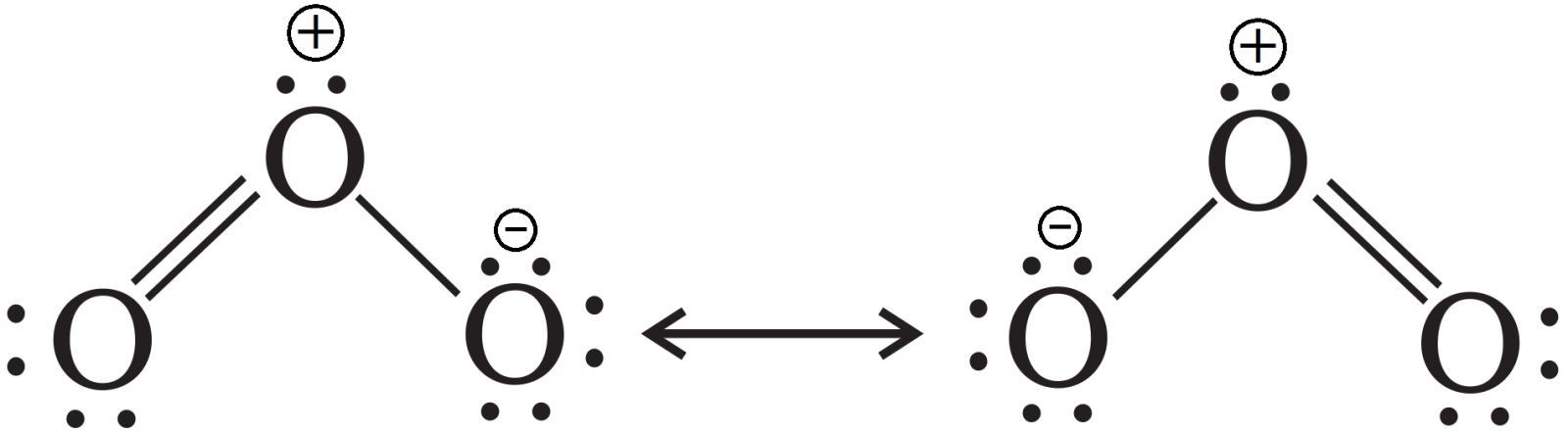
The two $\text{O}-\text{O}$ bond distances in ozone molecule are equal. Justify.
AnswerIt is due to resonance.
View full question & answer→Question 233 Marks
What is hybrid state of each carbon in:
- $\text{CH}_2=\text{C}=\text{CH}_2$
- $\ \ \ \ \ \ \ {\text{O}}\\\ \ \ \ \ \ \ \ \|\\\text{H}-\text{C}-\text{H}?$
Answer
- $\text{CH}_2=\text{C}=\text{CH}_2\\\text{sp}^2\ \ \ \ \ \ \ \ \text{sp}\ \ \ \ \ \ \text{sp}^2$
- $\ \ \ \ \ \ \ {\text{O}}\\\ \ \ \ \ \ \ \ \|\\\text{H}-\text{C}-\text{H}\\\ \ \ \ \ \ \ \ \text{sp}^2$
Reason: ' C ' with single bond $\mathrm{sp}^3$, ' C ' with double bond $\mathrm{sp}^2$. ' C ' with double bond on both sides 'sp'. View full question & answer→Question 243 Marks
- What is the state of hybridisation of nitrogen in $\text{NH}_4^+$ ion?
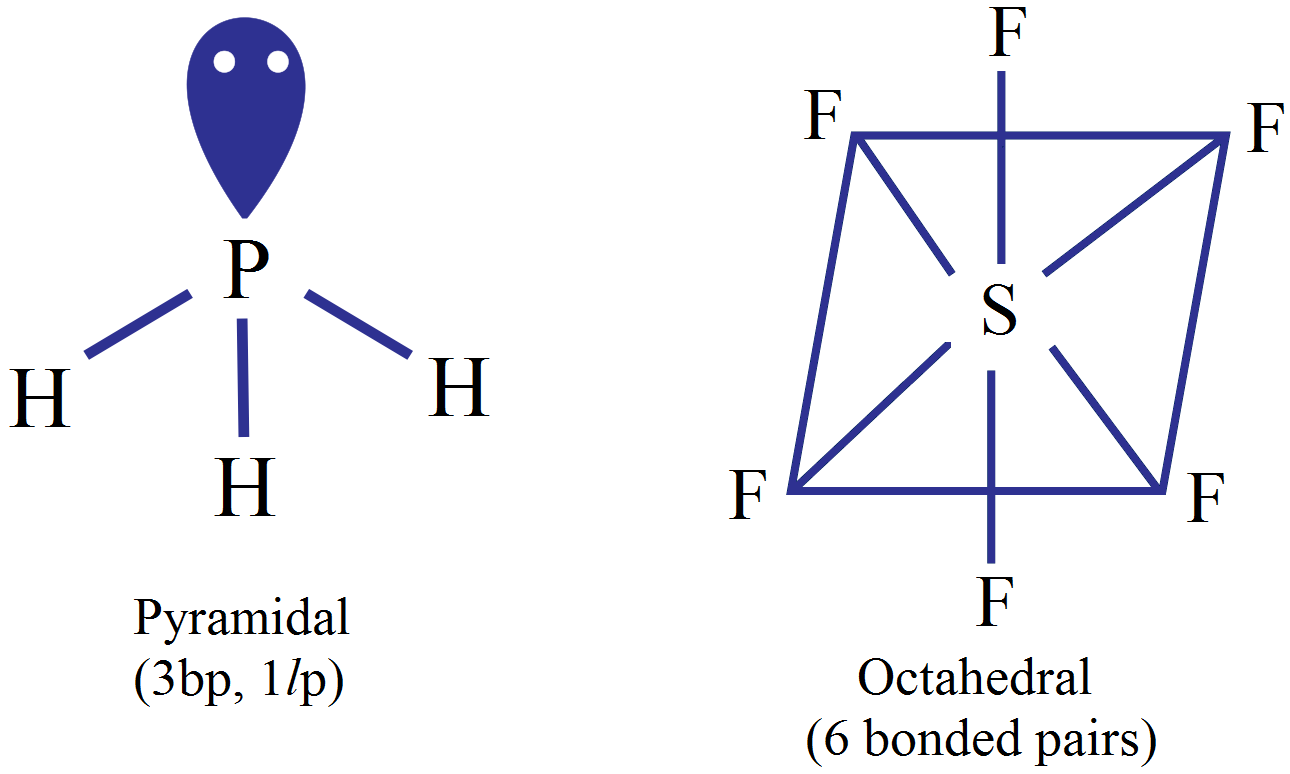
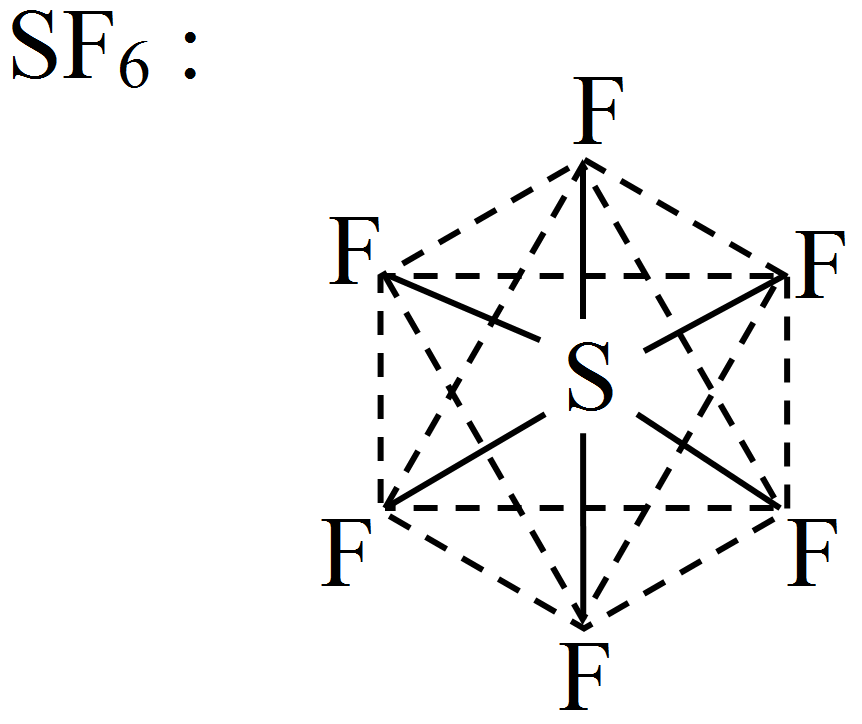
- Draw the shape of $\mathrm{PH}_3$ and $\mathrm{SF}_6$ according to VSEPR theory.
- Which hybrid orbitals are used by carbon atoms in $\text{CH}_3-\text{CHO}?$
Answer
- In NH3, 'N" is more electronegative than 'H'.
$\therefore$ dipoles are toward lone pair dipole moment increase. In $\mathrm{NH}_3$, 'F' is more electronegative $\therefore$ depoles are away from lone pair, dipole moment decrease.
- $\mathrm{H}_2 \mathrm{O}$ molecules are associated with inter molecular H -bond where as $\mathrm{H}_2 \mathrm{~S}$ in not.
View full question & answer→Question 253 Marks
Explain why $\text{CO}^{2-}_3$ ion cannot be represented by a single Lewis structure. How can it be represented?
AnswerA single Lewis structure of $\text{CO}^{2-}_3$ ion cannot explain all the properties of this ion. It can be represented as a resonance hybrid of the following structures
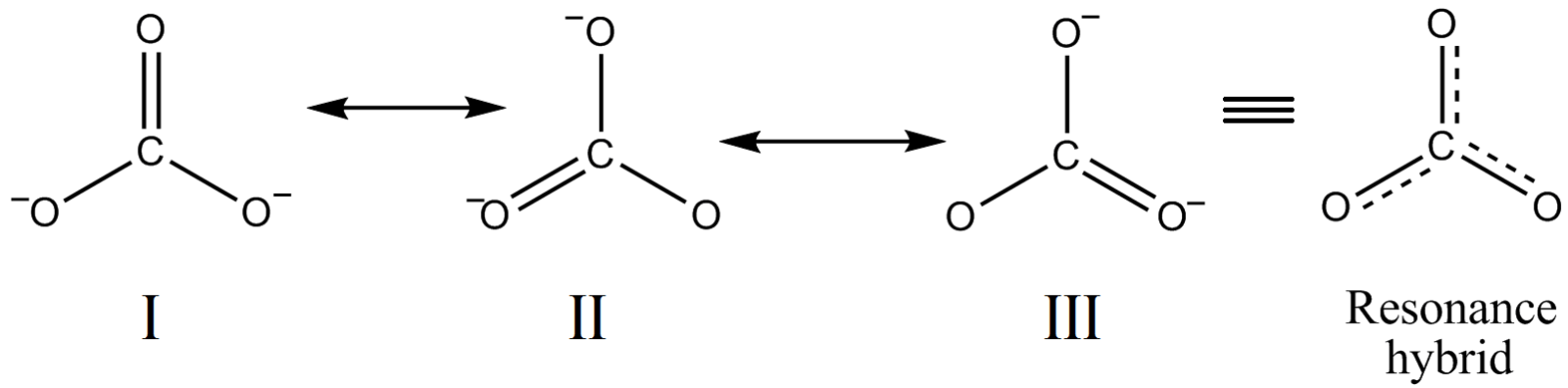
If, it were represented only by one structure, there should be two types of bonds, i.e. $\text{C}=\text{O}$ double bond and $\text{C}-\text{O}$ single bonds but actually all bonds are found to be identical with same bond length and same bond strength. View full question & answer→Question 263 Marks
Arrange the following bonds ‘in order of increasing ionic character giving reason.
N-H, F-H, C-H and O-H
AnswerElectronegativity difference:
$\text{N}-\text{H}\ \ \ \ \ \ \text{F}-\text{H}\ \ \ \ \ \ \ \ \text{C}-\text{H}\ \ \ \ \ \ \ \ \text{O}-\text{H}\\ \ =0.9 \ \ \ \ \ = 1.19\ \ \ \ \ \ =0.4\ \ \ \ \ \ \ \ \ \ =1.4$
Increasing order of electronegativity difference: C-H < N-H < 0-H < F-H
Greater is the difference in electronegativity between two bonded atoms, greater is the ionic character.
View full question & answer→Question 273 Marks
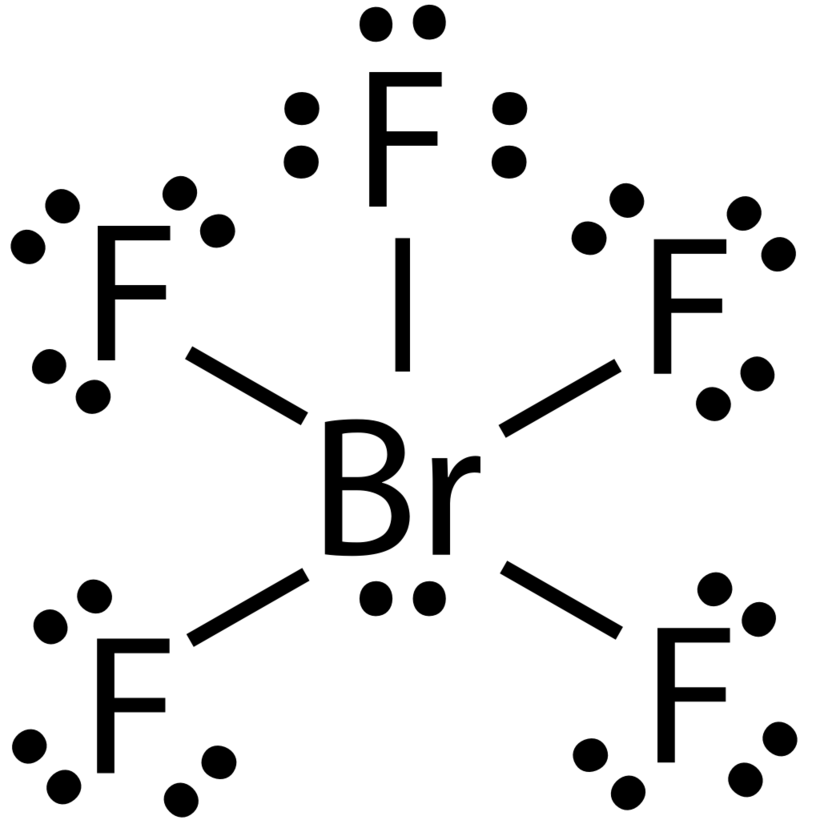
Explain the shape of $BrF_5$.
AnswerBr-atom has configuration:
$1s^2, 2s^22p^6 , 3s^23p^63d^{10}, 4s^24p^5$
To get pentavalency, two of the p-orbitals are unpaired and electrons are shifted to 4d-orbitals.
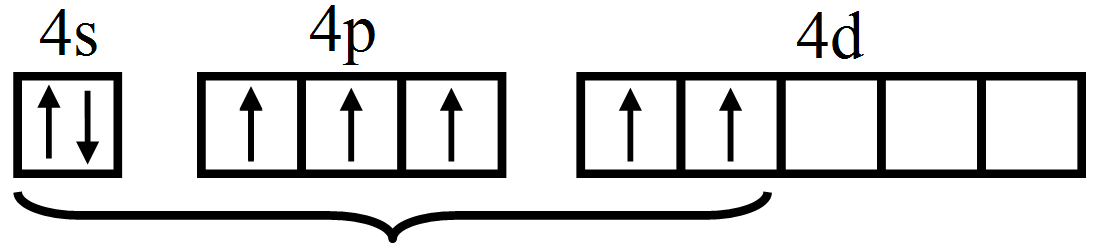
In this excited state, $sp^3d^2$ hybridisation occurs giving octahedral structure. Five positions are occupied by $F$ atoms forming sigma bonds with hybrid bonds and one position occupied by lone pair, i.e., the molecule as a square pyramidal shape.
View full question & answer→Question 283 Marks
Arrange the following sets of molecules in the decreasing order of bond angle.
i. $\mathrm{SF}_6, \mathrm{CCl}_4, \mathrm{H}_2 \mathrm{O}, \mathrm{NH}_3$
ii. $\mathrm{CH}_4, \mathrm{NH}_3, \mathrm{H}_2 \mathrm{O}, \mathrm{BF}_3$
Answer
- $\text{CCl}_4(109.5^\circ),\ \text{NH}_3(107^\circ),\ \text{H}_2\text{O}(104.5^\circ),\ \text{SF}_6(90^\circ)\\^{\text{Tetrahedral}\ \ \ \ \ \ \ \ \ \ \ \ \ \ \ \ \text{Pyramidal} \ \ \ \ \ \ \ \ \ \ \ \ \ \ \ \ \ \text{Angular}\ \ \ \ \ \ \ \ \ \ \ \ \ \ \text{Octahedral}}$
- $\text{BF}_3(120^\circ),\ \text{CH}_4(109.5^\circ),\ \text{NH}_3(107^\circ),\ \text{H}_2\text{O}(104.5^\circ)\\^{\ \ \ \ \ \ \ \ \text{Planar}\ \ \ \ \ \ \ \ \ \ \ \ \ \text{Tetrahedral} \ \ \ \ \ \ \ \ \ \ \ \ \ \ \ \ \ \ \text{Pyramidal}\ \ \ \ \ \ \ \ \ \ \ \ \ \ \ \ \text{Angular}}$
- $\text{BeH}_2(180^\circ),\ \ \text{AlCl}_3(120^\circ),\ \ \text{H}_2\text{O}(104.5^\circ),\ \ \ \text{H}_2\text{S}(100^\circ)\\^{\ \ \ \ \ \ \ \ \ \ \text{Linner}\ \ \ \ \ \ \ \ \ \ \ \ \ \ \ \ \ \ \ \ \ \text{Planar}\ \ \ \ \ \ \ \ \ \ \ \ \ \ \ \ \ \ \text{Angular}\ \ \ \ \ \ \ \ \ \ \ \ \text{Angular but S is less}\\ \ \ \ \ \ \ \ \ \ \ \ \ \ \ \ \ \ \ \ \ \ \ \ \ \ \ \ \ \ \ \ \ \ \ \ \ \ \ \ \ \ \ \ \ \ \ \ \ \ \ \ \ \ \ \ \ \ \ \ \ \ \ \ \ \ \ \ \ \ \ \ \ \ \ \ \ \ \ \ \ \ \ \ \ \ \ \ \ \ \ \ \ \ \ \ \ \ \ \text{electronegative than O}}$
View full question & answer→Question 293 Marks
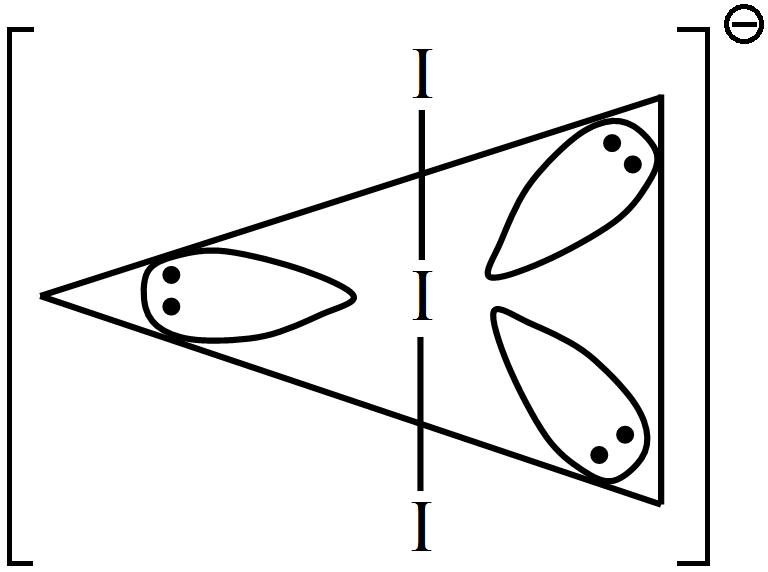
- Explain the shape of $\text{I}^-_3$ ion.
- Why is $\mathrm{KO}_2$ paramagnetic?
Answer
- ‘l' atom has 7 valence electrons. It forms one covalence bond with another iodine atom and coordinate bond with lion in which empty orbital accepts a lone pair. The central atom has 2 bonded pair and 3 lone pair it is linear.
- $\mathrm{KO}_2$ is paramagnetic because $\text{O}^-_2$ has one unpaired electron.
$\text{O}^-_2(17)=\sigma\text{l}^2\ \sigma*\text{ls}^2\ \sigma2\text{s}^2\ \sigma*\text{2s}^2\ \sigma\text{2p}_\text{z}^2\ \pi2\text{p}_\text{x}^2\ \pi2\text{p}_\text{y}^2\ \pi*2\text{p}_\text{x}^2\ \pi*\text{2p}_\text{s}^1$ View full question & answer→Question 303 Marks
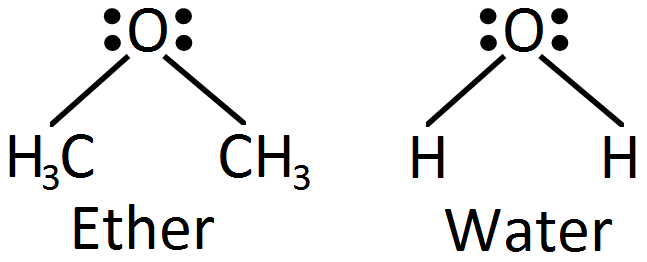
In both water and dimethyl ether oxygen atom is central atom, and has the same hybridisation, yet they have different bond angles. Which one has greater bond angle? Give reason.
AnswerDimethyl ether will have larger bond angle. There will be more repulsion between bond pairs of $\mathrm{CH}_3$ groups attached in ether than between bond pairs of hydrogen atoms attached to oxygen in water. The carbon of $\mathrm{CH}_3$ in ether is attached to three hydrogen atoms through $\sigma$ bonds and electron pairs of these bonds add to the electronic charge density on carbon atom. Hence, repulsion between two $-\mathrm{CH}_3$ groups will be more than that between two hydrogen atoms.
View full question & answer→Question 313 Marks
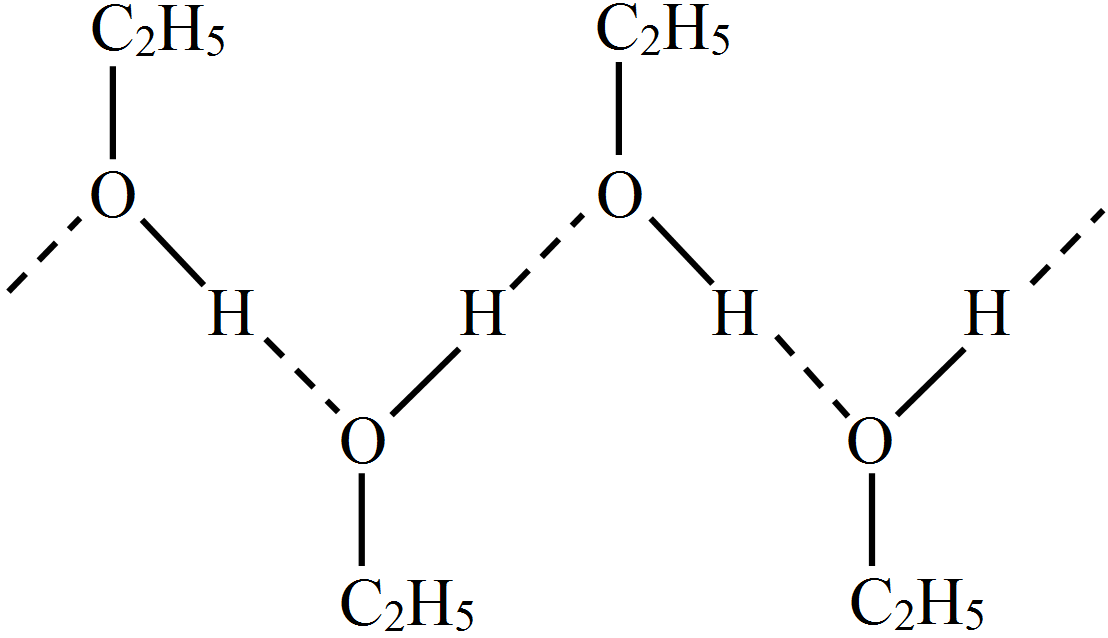
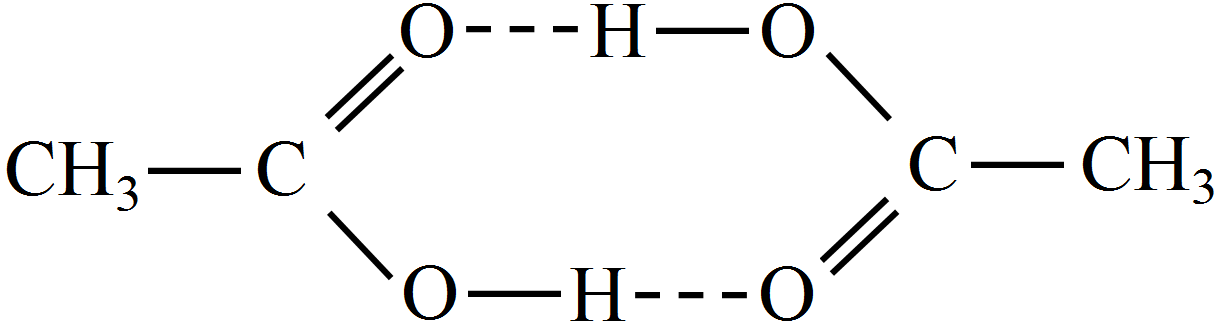
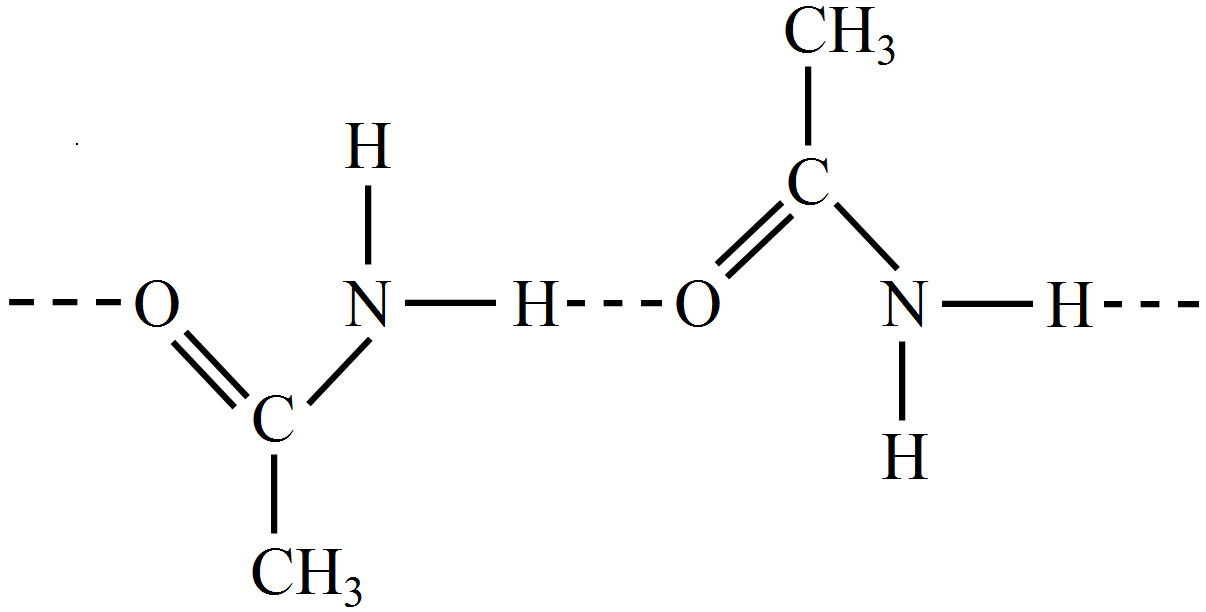
Which of the following substances exhibit H-bonding? Draw the H-bonds between two molecules of the substance where appropriate.
- $\text{CH}_3\text{CH}_2\text{OH}$
- $\ \ \ \ \ \ \ \ \ \ \ \ \text{O}\\\ \ \ \ \ \ \ \ \ \ \ \ \ \|\\\text{CH}_3-\text{C}-\text{OH}$
- $\ \ \ \ \ \ \ \ \ \ \ \ \text{O}\\\ \ \ \ \ \ \ \ \ \ \ \ \ \|\\\text{CH}_3-\text{C}-\text{CH}_3$
- $\ \ \ \ \ \ \ \ \ \ \ \ \text{O}\\\ \ \ \ \ \ \ \ \ \ \ \ \ \|\\\text{}\text{CH}_3-\text{C}-\text{NH}_2$
Answer
- $\text{CH}_3\text{CH}_2\text{OH}$
- $\ \ \ \ \ \ \ \ \ \ \ \ \text{O}\\\ \ \ \ \ \ \ \ \ \ \ \ \ \|\\\text{CH}_3-\text{C}-\text{OH}$
- $\ \ \ \ \ \ \ \ \ \ \ \ \text{O}\\\ \ \ \ \ \ \ \ \ \ \ \ \ \|\\\text{CH}_3-\text{C}-\text{CH}_3$
Acetone cannot form H-bonds.
- $\ \ \ \ \ \ \ \ \ \ \ \ \text{O}\\\ \ \ \ \ \ \ \ \ \ \ \ \ \|\\\text{}\text{CH}_3-\text{C}-\text{NH}_2$
View full question & answer→Question 323 Marks
Account for the following:
- What is the state of hybridisation of stared carbon atoms in,
$\text{CH}_3-\text{}*\text{CH}=\text{CH}_2?$
- Write the molecular orbital electronic configuration of $\text{O}^-_2.$ Calculate its bond order and predict its magnetic behaviour.
Answer
- It has $\mathrm{sp}^2$ hybridisation.
- $\text{O}^-_2(17)\sigma_1^2,\ \sigma^{*2}_{2\text{s}}\ \sigma^2_{2\text{s}}\ \sigma_{2\text{p}_\text{z}}\ \pi_{\text{2x}}\ \pi_{\text{2p}^2_4}\ \pi_{\text{2p}^1_\text{x}}$
$\text{B.O.}=\frac12(10-7)=\frac32$
It is paramagnetic in nature. View full question & answer→Question 333 Marks
Write the molecular orbital electronic configurations of the following species:
- $\text{N}_2$
- $\text{N}^+_2$
- $\text{N}^-_\text{2}$
- $\text{N}^{2-}_2$
- Calculate their bond orders.
- Predict their magnetic behaviour.
- Which of these shows highest para-magnetism?
Answer
- $\text{N}_2 (14)$:
$\sigma\text{ls}^2,\ \sigma*\text{ls}^2,\ \sigma\text{2s}^2,\ \sigma*\text{2s}^2,\ \pi2\text{p}_\text{x}^2=\pi\text{2}\text{p}_\text{y}^2,\ \sigma\text{2p}^2_\text{z}$
$\text{B.O.}=\frac12(10-4)=\frac62=3$
$\text{N}_2$ is diamagnetic because it does not have unpaired electron.
- $\text{N}^+_2(13)\text{:}$
$\sigma\text{ls}^2,\ \sigma*\text{ls}^2,\ \sigma\text{2s}^2,\ \sigma*\text{2s}^2,\ \pi2\text{p}_\text{x}^2=\pi2\text{p}_\text{y}^2,\ \sigma2\text{p}_\text{z}^1$
$\text{B.O.}=\frac12(9-4)=\frac52=2.5$
It is paramagnetic due to the presence of one unpaired electron.
- $\text{N}^-_2(15)\text{:}$
$\sigma\text{ls}^2\ \sigma*\text{ls}^2,\ \sigma\text{2s}^2,\ \sigma*2\text{s}^2,\ \pi2\text{p}_\text{x}^2=\pi2\text{p}_\text{y}^2,\ \sigma2\text{p}_\text{z}^2,\ \pi*2\text{p}^1_\text{x}$
$\text{B.O.}=\frac{1}{2}(10-5)=\frac52=2.5$
It is paramagnetic due to the presence of one unpaired electron.
- $\text{N}^2_2\ (\text{16):}$
$\sigma\text{ls}^2,\ \sigma*\text{ls}^2,\ \sigma2\text{s}^2,\ \sigma*2\text{s}^2,\ \pi2\text{p}_\text{x}^2$
$=\pi\text{ls}^2,\ \sigma\text{22}^2_\text{z},\ \pi*2\text{p}_\text{x}^1$
$=\ \pi*2\text{p}_\text{y}^1$
$\text{B.O.}=\frac12(10-6)=\frac42=2$
It has highest paramagnetic character due to the presence of two unpaired electrons. View full question & answer→Question 343 Marks
- Deduce the structures of:
- $BrF_5$
- $PF_5$
- on the basis of VSEPR theory.
- Which out of $NH_3$ and $NF_3 $has higher dipole moment and why?
Answer
-
- In $BrF_5$, there are 5 bonded pairs of electrons and one lone pair of electrons, therefore, it is square pyramidal.
- In $PF_5$, there are 5 bonded pairs of electrons due to which it is trigonal bipyramidal.
-
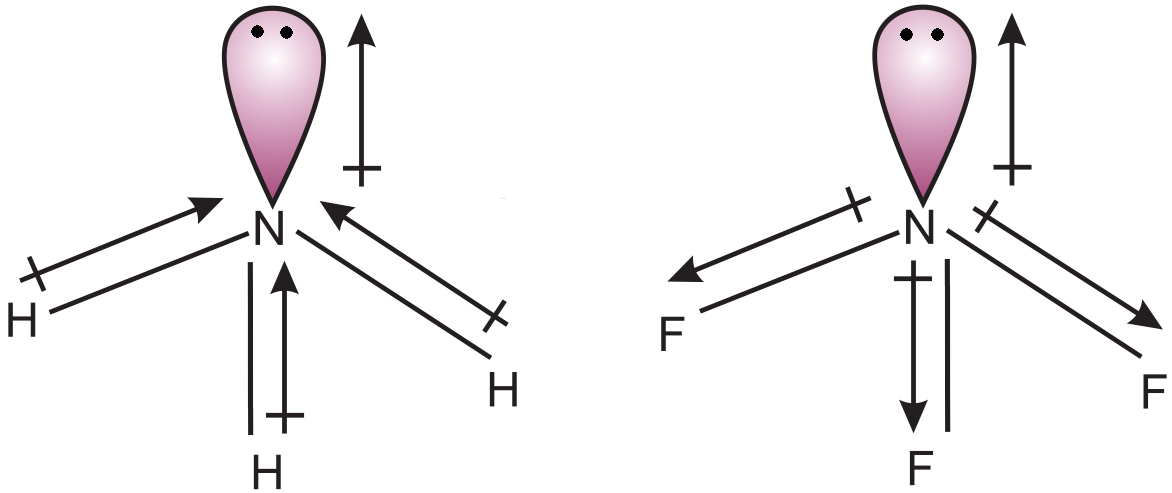
In $NH_3,$ dipoles are being added and they are towards lone pair of electrons therefore its dipole moment is higher than $NF_3$ in which dipoles are away from lone pair of electrons. View full question & answer→Question 353 Marks
Write the bond angles in $\mathrm{CH}_4, \mathrm{NH}_3$ and $\mathrm{H}_2 \mathrm{O}$ molecules and give reason.
Answer$\mathrm{CH}_4$ has bond angle $109.5^{\circ}$ because it has 4 bp and no lone pair. $\mathrm{NH}_3$ has bond angle $\because 107^{\circ}$, it has 3 bp and 1 lp .
$\mathrm{H}_2 \mathrm{O}$ has bond angle $104.59, \because$ it has 2 bp and 1 lp .
View full question & answer→Question 363 Marks
Using molecular orbital theory, compare the bond energy and magnetic character of $\mathrm{O}_2^{+}$and $\mathrm{O}_2^{-}$.
Answer$\text{O}^{+}_{2}(15):\sigma\ 1\text{s}^{2}\ \sigma^{*}1\text{s}^{2}\ \sigma^{*}2\text{s}^{2}=\pi\ 2\text{p}^\text{2}_{\text{y}}\ \pi^{*}2\text{P}_{\text{x}} $
$\text{B}.\text{O}.=\frac{1}{2}(10-5)=2.5$
$\text{O}^{+}_{2}(15):\sigma\ 1\text{s}^{2}\ \sigma^{*}1\text{s}^{2}\ \sigma^{*}2\text{s}^{2}=\pi\ 2\text{p}^\text{2}_{\text{y}}\ \pi^2\text{P}_{\text{y}} =\pi^{*}2\text{p}_{\text{y}}$
$\text{B}.\text{O}.=\frac{1}{2}(10-7)=1.5$
Both are paramagnetic due to presence of unparired electrons.
View full question & answer→Question 373 Marks
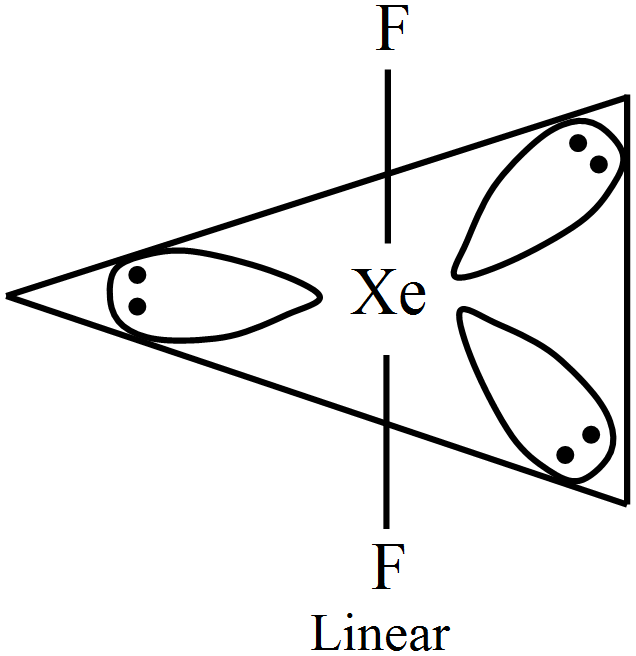
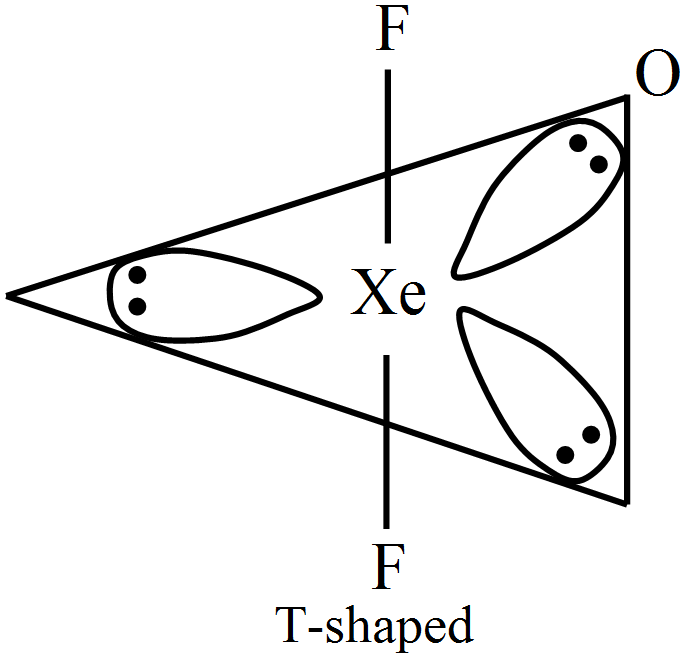
Draw the molecular structures of:
- $\text{XeF}_2,$
- $\text{XeOF}_2$
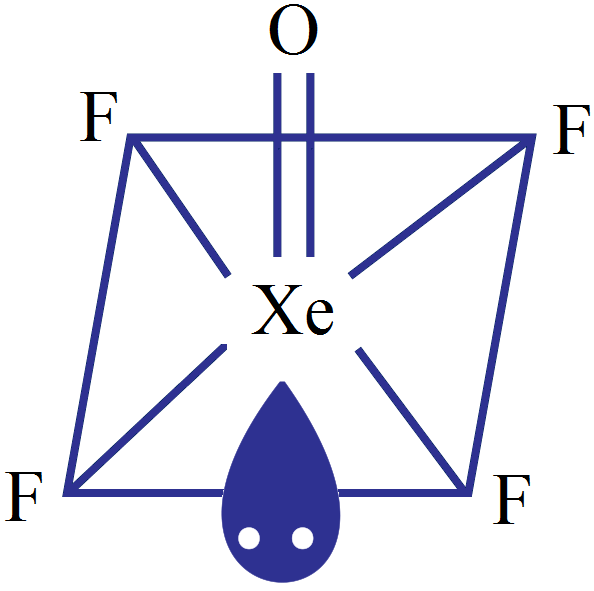
- $\text{XeOF}_4$
View full question & answer→Question 383 Marks
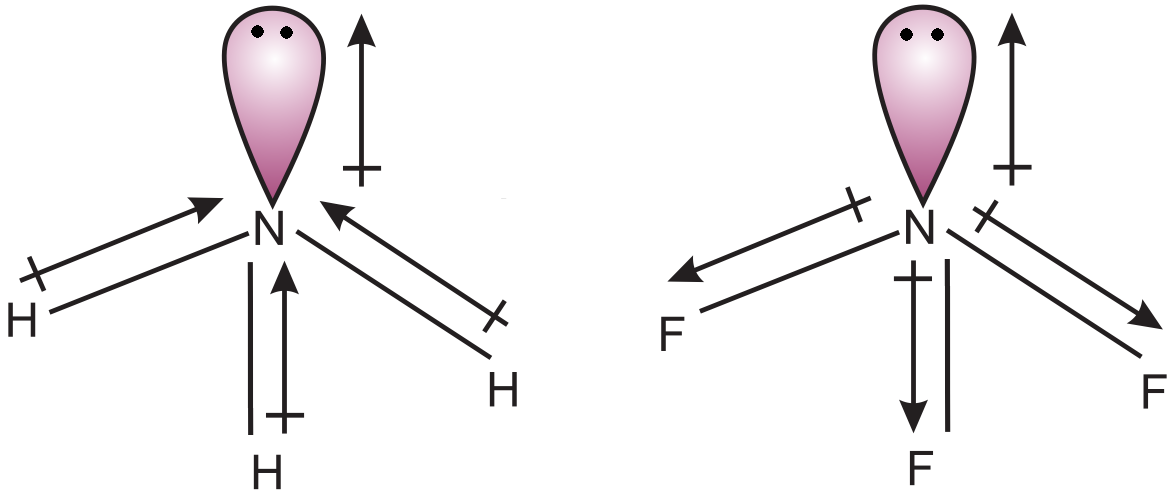
- $NH_3$ has more dipole moment than $NF_3$ although $\text{N}-\text{F}$ bond is more polar than $\text{N}-\text{H}$ bond, why?
- $H_2O$ is liquid while $H_2S$ is gas, why?
Answer
- In $NH_3$, 'N' is more electronegative than 'H', dipoles are toward lone pair dipole moment increases.
In $NF_3,$ 'F' is more electronegative dipoles are away from lone pair, $\therefore$ dipole moment decrease.
- $H_2O$ molecules are associated with inter molecular H-bond where as $H_2S$ in not.
View full question & answer→Question 393 Marks
Indicate the number of $\sigma$ and $\pi$ bonds in the molecule $\text{CH}_2=\text{C}=\text{CH}_2.$
Answer$\ \ \ \ \ \ \ \ {\text{H}\ \ \ \ \ \ \ \ \ \ \ \ \ \ \text{H}} \\\ \ \ \ \ \ \ \ \ |\ \ \ \ \ \ \ \ \ \ \ \ \ \ \ \ | \\\ \text{H}-\text{C}=\text{C}=\text{C}-\text{H}$
Number of σ bonds = 6, Number of π bonds = 2
Reason: All single bonds are $\sigma$ bonds. Each double bond has $1\sigma$ and $1\pi$ bond.
View full question & answer→Question 403 Marks
Explain the following on the basis of valence bond theory:
i. $\mathrm{BF}_3$ is planar but $\mathrm{NH}_3$ is not.
ii. $\mathrm{CCl}_4$ and $\mathrm{SiCl}_4$ are tetrahedral.
iii. The HSH bond angle is $\mathrm{H}_2 \mathrm{~S}$ is closer to $90^{\circ}$ than HOH bond angle in $\mathrm{H}_2 \mathrm{O}$.
Answeri. In $\mathrm{BF}_3, \mathrm{~B}$-atom undergoes $\mathrm{sp}^2$ hybridisation. Hence, $\mathrm{BF}_3$ is triangular planar. In $\mathrm{NH}_3, \mathrm{~N}$-atom undergoes $\mathrm{sp}^3$ hybridisation.
Hence, $\mathrm{NH}_3$ has pyramidal shape with one lone pair on N -atom.
ii. Both C in $\mathrm{CCl}_4$ and Si and $\mathrm{SiCl}_4$ undergo $\mathrm{sp}^3$ hybridisation.
Hence, they are tetrahedral.
iii. This is because of lower electronegativity of S as compared to O .
View full question & answer→Question 413 Marks
Represent diagrammatically the bond moments and the resultant dipole moment in $\mathrm{CO}_2, \mathrm{NF}_3$ and $\mathrm{CHCl}_3$.
View full question & answer→Question 423 Marks
Write the molecular orbital configuration of $\text{N}_2$.Calculate its bond order and predict its magnetic behaviour.
Answer$\text{N}_2(14)=\sigma\text{ls}^2\ \sigma*\text{ls}^2\ \sigma2\text{s}^2\ \sigma2\text{s}^2\ \pi2\text{p}_\text{x}^2\ \pi2\text{p}_4^3\ \pi2\text{p}^2_\text{z}$
$\text{B.O.}=\frac12(10-4)=\frac62=3$
It is diamagnetic in nature.
View full question & answer→Question 433 Marks
Draw the shape of the following hybrid orbitals $\mathrm{sp}$, $\mathrm{sp}^2$ and $\mathrm{sp}^3$.
Answer
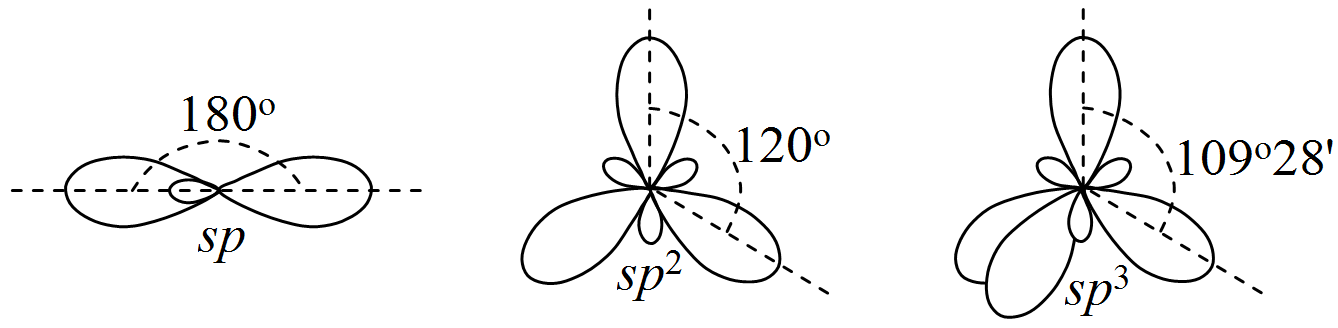
All the hybrid orbitals have same shape. However, their sizes are in the order : $\mathrm{sp}< \mathrm{sp}^2<\mathrm{sp}^3$.

View full question & answer→Question 443 Marks
i. Write the resonance structures for $\mathrm{CO}_2$.
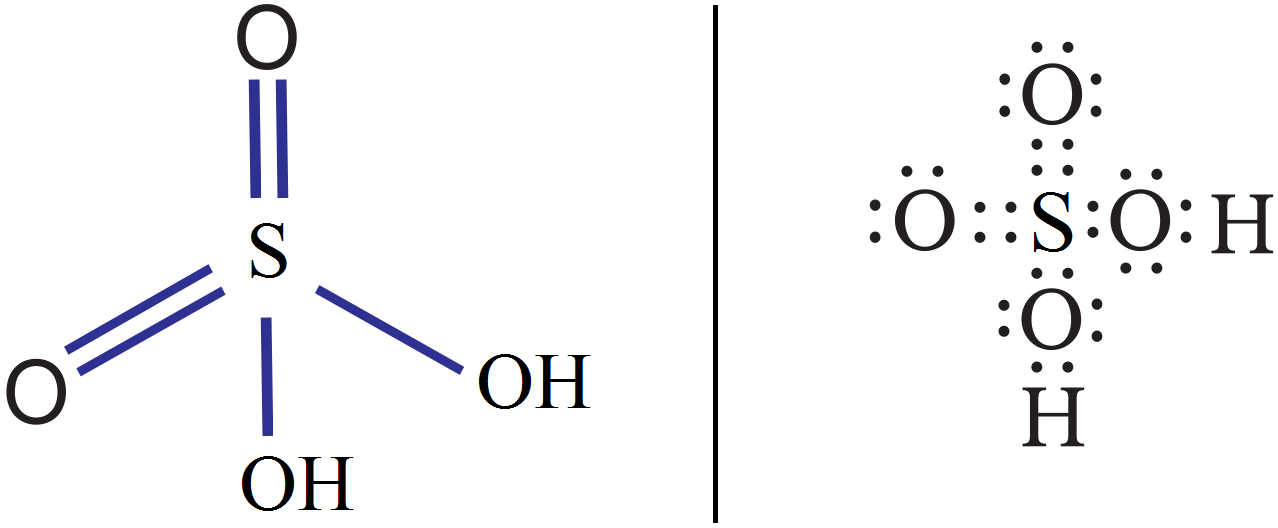
ii. Draw Lewis structure of $\mathrm{H}_2 \mathrm{SO}_4$.
iii. Why $\mathrm{KHF}_2$ exist but $\mathrm{KHCl}_2$ does not?
Answer
-

-
- KF forms H-bond with HF whereas KCI cannot form H-bond with HCI.
View full question & answer→Question 453 Marks
How many $\sigma$ and $\sigma-$bonds are present in $\text{CH}_2=\text{C}-\text{CH}=\text{CH}_2?$
Answer$\ \ \ \ \ \ \ \ \ {\text{H}\ \ \ \ \ \ \text{H} \ \ \ \ \text{H} \ \ \ \ \ \text{H}} \\\ \ \ \ \ \ \ \ \ \ |\ \ \ \ \ \ \ \ | \ \ \ \ \ \ | \ \ \ \ \ \ \ | \\\ \text{H}-\text{C}=\text{C}-\text{C}=\text{C}-\text{H}$
There are 9 $\sigma-$bonds and $2\pi-$bonds.
Reason: Each single bond is sigma bond each double bond has $1\sigma$ and $1\pi$ bond.
View full question & answer→Question 463 Marks
- How bond energy varies from $\text{N}^-_2$ to $\text{N}^+_2$ and why?
- On the basis of molecular orbital theory what is similarly between,
- $\text{F}_2\text{0}^{2-}_2$
- $\text{CO},\text{N}_2,\text{NO}^+?$
Answer
- Bond energy of $\text{N}^+_2=$ Bond energy of $\text{N}^-_2.$ This is because they have the same bond order.
(Strictly speaking, $\text{N}^-_2$ is slightly less stable and hence, has less bond energy then $\text{N}^+_2$ due to presence of greater number of electrons in the antibonding molecular orbitals).
-
- Same bond order and bond length.
- Same bond order and bond length.
View full question & answer→Question 473 Marks
The dipole moment of a molecule AB is 0.54D and the bond distance is $1.41\mathring{\text{A}}.$ Calculate the fractional change $\delta$ on A and B atom in AB molecule (electronic charge, $\mathrm{e}=4.8 \times 10^{-10} \mathrm{esu}$.)
AnswerDipole moment, $\mu=\text{q}\times\text{r}$
$\mu=0.54$
$\Rightarrow\text{D}=0.54\times10^{-18}$ stat C cm
$\delta=\text{}1.41\times10^{-8}\text{cm}$
$\therefore\text{q}=\frac{0.54\times10^{-8}\text{stat C cm}}{1.41\times10^{-8}\text{cm}}$
$=0.38\times10^{-10}\text{stat}$
Now, fraction of charge $=\frac{\text{Change present}}{\text{Electronic charge}}$
$=\frac{0.38\times10^{-10}}{4.8\times10^{-10}}=0.08$
$\therefore\delta_\text{A}=0.08,\delta_\text{B}=-0.08$
View full question & answer→Question 483 Marks
Indicate the type of bonds present in $\mathrm{NH}_4 \mathrm{NO}_3$ and state the mode of hybridisation of two N -atoms in it.
Answer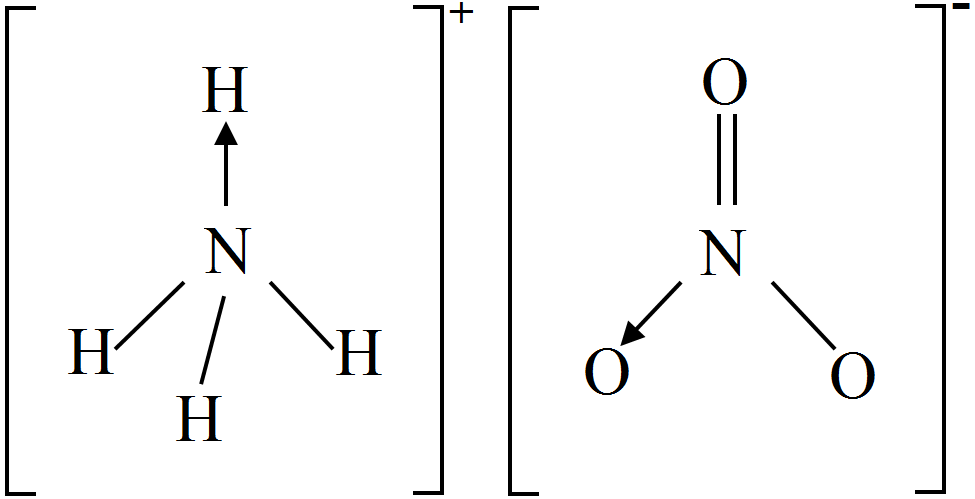
$\mathrm{NH}_4^{+}$ion contains covalent and dative bonds. (It is formed by donation of lone pair of electrons on N in $\mathrm{NH}_3$ to $\mathrm{H}^{+}$ ion). $\mathrm{NH}_3^{-}$ion also contains covalent and dative bonds. Bond between $\mathrm{NH}_4^{+}$and $\mathrm{NH}_4^{-}$ions is ionic.
N of $\mathrm{NH}_3^{+}$ion is sp hybridised and is tetrahedral. N of $\mathrm{NH}_3^{-}$ion is $\mathrm{sp}^2$ hybridised and is planar. View full question & answer→Question 493 Marks
In each of the following pairs of compounds, which one is more covalent and why?
i. $\mathrm{AgCl}, \mathrm{Agl}$
ii. $\mathrm{BeCl}_2, \mathrm{MgCl}_2$
iii. $\mathrm{SnCl}_2, \mathrm{SnCl}_4$
iv. $\mathrm{CuO}, \mathrm{CuS}$
AnswerAlpplying Fajans' rules, the result can be obtained in each case as follows:
i. Agl is more covalent that AgCl . This is because $\mathrm{I}^{-}$ion is larger in size than $\mathrm{Cl}^{-}$ion and hence, is more polarised than $\mathrm{Cl}^{-}$ion.
ii. $\mathrm{BeCl}_2$ is more covalent than $\mathrm{MgCl}_2$. This is because $\mathrm{Be}^{2+}$ ion is smaller in size than $\mathrm{Mg}^{2+}$ ion and hence has the greater polarising power.
iii. $\mathrm{SnCl}_4$ is more covalent than $\mathrm{SnCl}_2$. This is because $\mathrm{Sn}^{4+}$ ion has greater charge and smaller size than $\mathrm{Sn}^{2+}$ ion and hence has greater polarising power.
iv. CuS is more covalent than Cuo. This is because $\mathrm{s}^{2-}$ ion has larger size than $\mathrm{O}^{2-}$ ion and hence is more polarised than $\mathrm{O}^{2-}$ ion.
View full question & answer→Question 503 Marks
Which of the compounds in pair of compounds has higher dipole moment?
i. $\mathrm{BCl}_3$ and $\mathrm{BF}_3$
ii. $\mathrm{SO}_2$ and $\mathrm{SO}_3$
iii. $\mathrm{H}_2 \mathrm{O}$ and $\mathrm{H}_2 \mathrm{S}$
Answeri. Both $\mathrm{BCl}_3$ and $\mathrm{BF}_3$ has zero dipole moment.
ii. $\mathrm{SO}_2$ has higher dipole moment than $\mathrm{SO}_3$.
iii. $\mathrm{H}_2 \mathrm{O}$ has higher dipole moment than $\mathrm{H}_2 \mathrm{S}$.
View full question & answer→Question 513 Marks
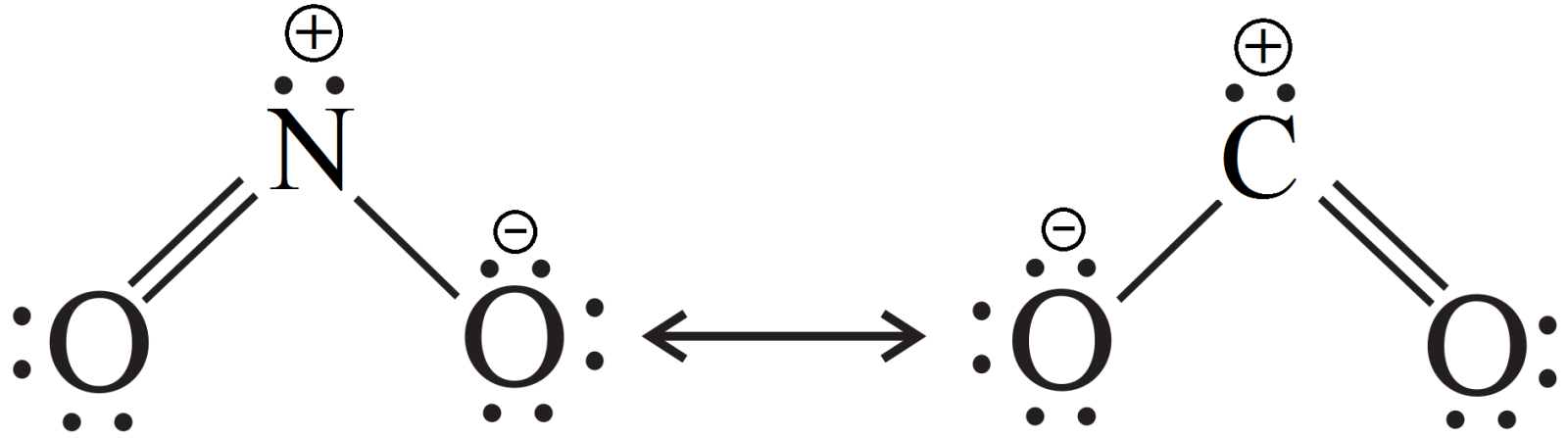
Which of the species have similar shape and why? $\text{NO}^-_2,\text{NO}^+_2,\text{CO}_2,\text{O}$
Answer
$\text{NO}_2^+$ and $\text{CO}_2$ are 'sp hybridised, therefore, they have linear shape NO, and $\text{O}_3$ are bent molecules.
View full question & answer→Question 523 Marks
Arrange the following according to bond length and bond dissociation energy giving reasons:
- $\text{H}-\text{F},\text{H}-\text{Cl},\text{H}-\text{Br},\text{H}-\text{I}$
- $\text{C}-\text{C},\text{C}=\text{C},\text{C}\equiv\text{C}$
- $\text{C}-\text{H}$ bond lenth in $CH_4, C_2H_4$ and $C_2H_2$
Answer
- Bond length: $H-F < H-Cl < H-Br < H-I$
Bond dissociation energy:
$H-F > H-CI > H-Br > H-I$
Greater the length, lesser the bond dissociation energy.
- $\text{C}\equiv\text{C}<\text{C}=\text{C}<\text{C}-\text{C}$ (bond length),
$\text{C}\equiv\text{C}>\text{C}=\text{C}>\text{C}-\text{C}$ (bond dissociation energy)
- $\text{H}-\text{C}\equiv\text{C}-\text{H}<\text{H}_2\text{C}=\text{CH}_2<\text{CH}_4$
$\therefore\text{sp-s}<\text{sp}^2\text{-s}<\text{sp}^3\text{-s}$
The bond length of $sp^3 > sp^2 > sp.$ View full question & answer→Question 533 Marks
Compare the relative stability of the following species on the basis of molecular orbital theory and indicate their magnetic properties:
$\text{O}^+_2,\text{O}^-_2,\text{O}_2^{-2}$
Answer$\text{O}^+_2(15):\sigma\text{ls}^2\sigma*\text{ls}^2\sigma2\text{s}^2\sigma*2\text{s}^2\sigma2\text{p}_\text{z}^2\pi2\text{p}_4^2\pi*2\text{p}_\text{x}^1$
$\text{B.O.}=\frac12(\text{N}_\text{b}-\text{N}_\text{a})=\frac12(10-5)=\frac52$
It is paramagnetic.
$\text{O}^-_2(17):\sigma\text{ls}^2\ \sigma*\text{ls}^2\ \sigma2\text{s}^2\ \text{s}*2\text{s}^2\ \sigma2\text{p}^2_\text{z}\ \pi^2\text{p}_\text{x}^2\ \pi2\text{p}^2_\text{x}\ \pi2\text{p}^2_\text{y}$
$\pi*2\text{p}_\text{x}^2\pi*2\text{p}^1_4$
$\text{B.O.}=\frac12(\text{N}_\text{b}-\text{N}_\text{a})=\frac12(10-7)=\frac32$
It is paramagnetic.
$\text{O}^{-2}_2(18):\sigma\text{s}^2\ \sigma*\text{ls}^2\ \sigma2\text{s}^2\ \sigma*2\text{s}^2\ \sigma2\text{p}_\text{z}^2\ \pi2\text{p}_\text{x}^2\ \pi2\text{p}_4^2$
$\pi*2\text{p}_\text{x}^2\pi*2\text{p}^2_\text{y}$
$\text{B.O.}=\frac12(\text{N}_\text{b}-\text{N}_\text{a})=\frac12(10-8)=1$
It is diamagnetic.
Higher the bond order, higher will be stability.
$\text{O}^+_2>\text{O}^-_2>\text{O}^{-2}_2.$
View full question & answer→Question 543 Marks
What is the hybrid state of:
i. B in $\mathrm{BF}_3$.
ii. Al in $\mathrm{AlCl}_3$,
iii. Be in $\mathrm{BeCl}_2$,
iv. C in $\mathrm{CO}_2$ and $\mathrm{C}_2 \mathrm{H}_4$,
v. S in $\mathrm{SO}_2$ and $\mathrm{SO}_3$ ?
Answeri. $\mathrm{sp}^2$,
ii. $s p^2$,
iii. $s p$
iv. $s p, s p^2$,
v. $\mathrm{sp}^2, \mathrm{sp}^2$
View full question & answer→Question 553 Marks
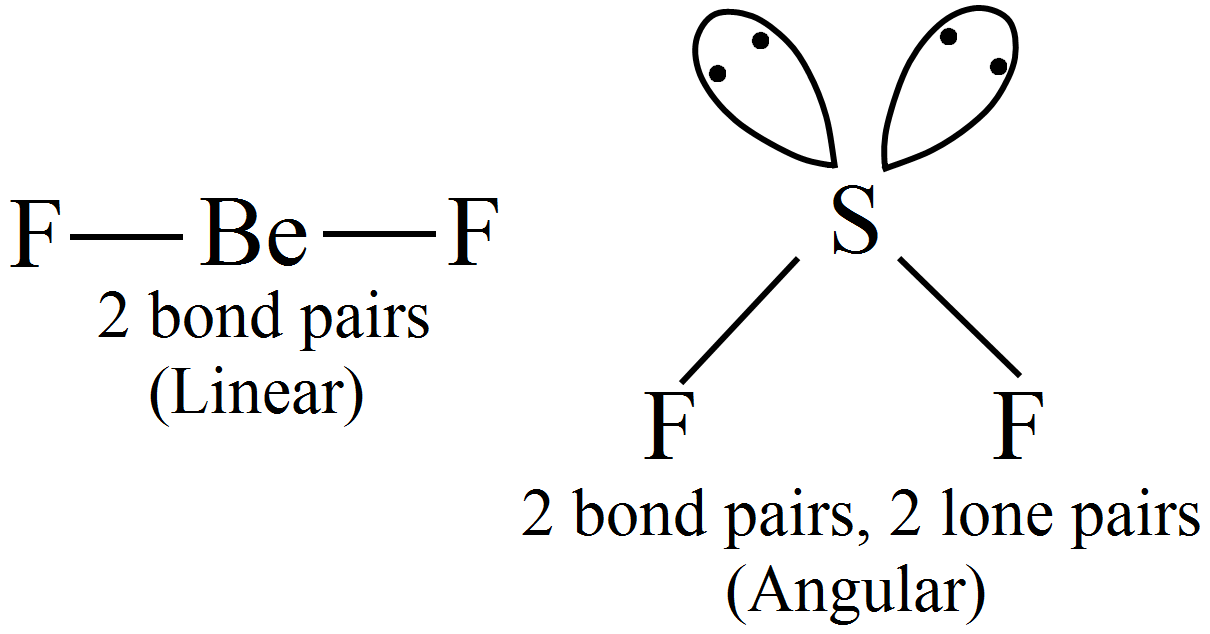
$\mathrm{BeF}_2$ molecule is linear while $\mathrm{SF}_2$ is angular through both are triatomic?
AnswerIn $\mathrm{BeF}_2$, Be is the central atom and is surrounded by 2 bond pairs only therefore, the molecule is linear. On the other hand, in $\mathrm{SF}_2$, the central atom S is surrounded by 2 bond pairs and 2 lone pairs. Since at is surrounded by 4 electron pairs, the geometry is expected to be tetrahedral with two position occupied by lone pairs.
View full question & answer→Question 563 Marks
Which of the species have same bond order and paramagnetic? Give reason.$\text{N}_2,\text{F}^+_2,\text{N}^-_2,\text{O}^-_2$
Answer$\text{F}^+_2$ and $\text{O}^-_2$ have same bond order, i.e. $\frac32$ because these are isoelectronic $\text{F}^+_2$ and $\text{O}^-_2$ are paramagnetic due to presence of unpaired electrons.
View full question & answer→Question 573 Marks
What is meant by hydrogen bond? What is bond energy of hydrogen bond? Why is $\mathrm{HF}, \mathrm{H}_2 \mathrm{O}$ are liquids whereas $\mathrm{HCl}, \mathrm{HBr}, \mathrm{HI}$ and $\mathrm{H}_2 \mathrm{~S}$ are gases?
AnswerThe force of attraction between hydrogen atom attached to nitrogen, oxygen or fluorine and other electronegative atom having lone pair is called H -bond. The energy of H -bond is of the order of 4 to $40 \mathrm{~kJ} \mathrm{~mol}^{-1}$. HF molecules are associated with intermolecular H -bonding where $\mathrm{HCl}, \mathrm{HBr}, \mathrm{HI}$ are not associated with H -bonding.
Water molecules are associated with intermolecular H -bonding that is why water is liquid whereas $\mathrm{H}_2 \mathrm{~S}$ is gas because $\mathrm{H}_2 \mathrm{~S}$ molecules are not associated with intermolecular H -bonding.
View full question & answer→Question 583 Marks
Which of the following Lewis structure of $\text{CO}_2$ molecule is least significant resonating form?

Answer
- Is least contributing towards resonance hybrid because negative charge is at less electronegative carbon, positive charge is on oxygen which is more electronegative, which makes it unstable.
View full question & answer→Question 593 Marks
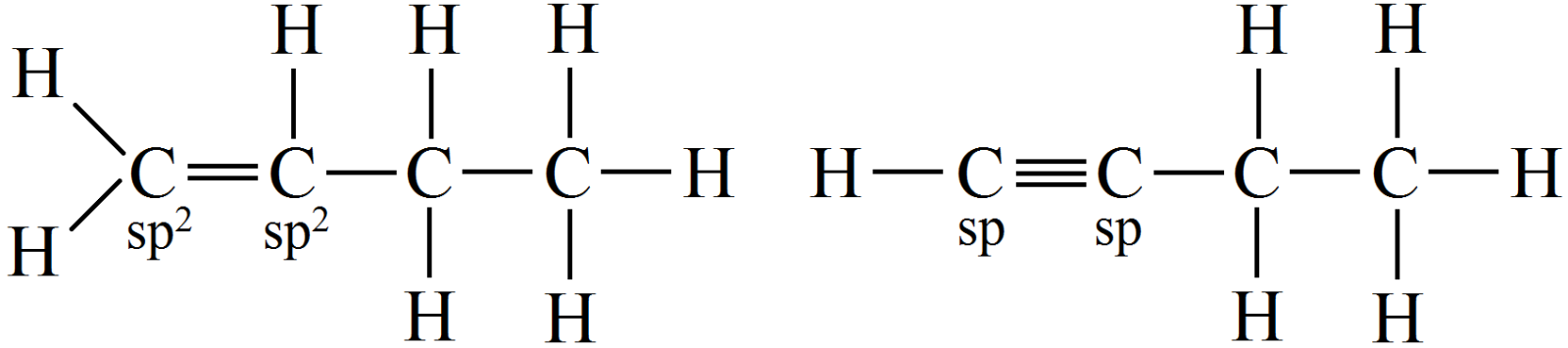
Which of the following has higher dipole moment:
1-butene or 1-butyne, why?
Answer1-Butyne has higher dipole moment as it is more polar as it has sp hybridised carbon which is more electronegative due to more s-character (50%).
View full question & answer→Question 603 Marks
Describe the hybridization scheme in case of $\mathrm{PCl}_5$. Why are the axial bonds longer as compared to equitorial bonds.
Answer$\text{P}(15)=\text{ls}^2\ 2\text{s}^2\ 2\text{p}^6\ 3\text{s}^2\ 3\text{p}^1_\text{x}\ 3\text{p}_\text{y}^1\ \text{3p}_\text{z}^1$
P(15) in excited state
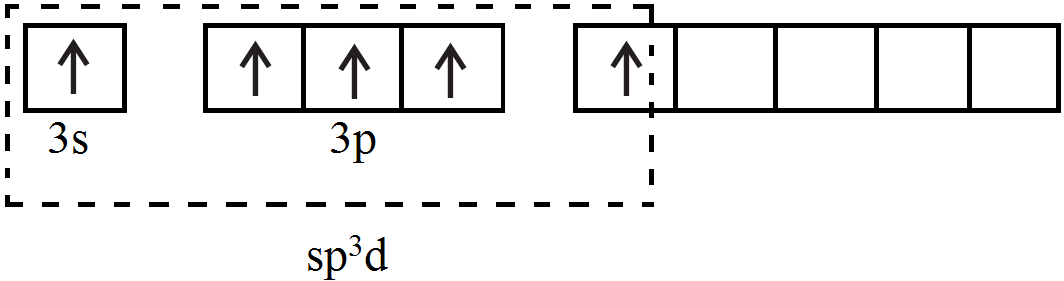
It has $s p^3$d hybridization and trigonal bipyramidal shape. Axial bonds are weaker than equitorial bonds due to more repulsion. View full question & answer→Question 613 Marks
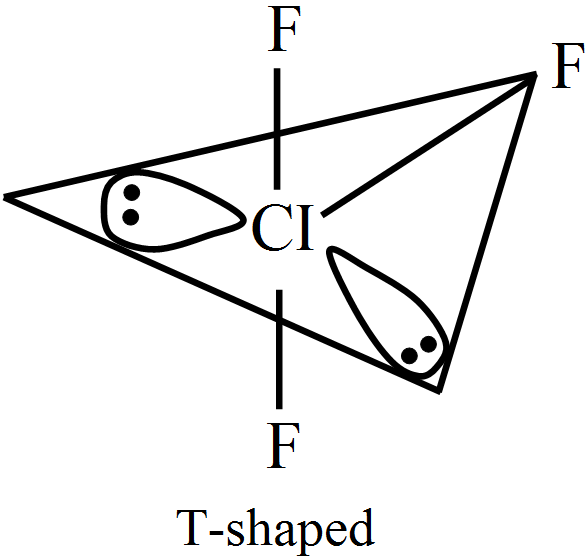
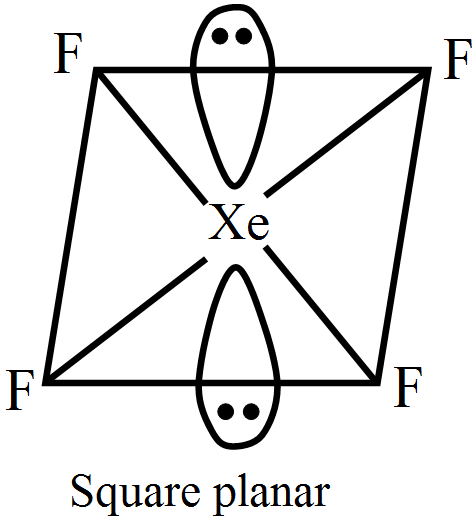
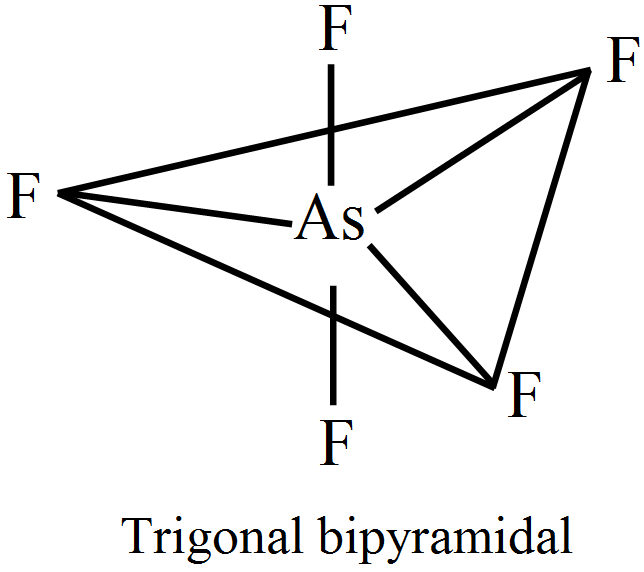
Give the shapes of following covalent molecules using VSEPR theory:
i. $\mathrm{ClF}_3$
ii. $\mathrm{XeF}_4$
iii. $\mathrm{AsF}_5$
View full question & answer→Question 623 Marks
Give example each of molecules which have the following geometrics:
- Linar.
- Trigular planar.
- Tetrahedral.
- Trigonal biphramidal.
- Octahedral.
Answer
- $\text{BeF}_2;\text{F}-\text{Be}-\text{F}:$
-
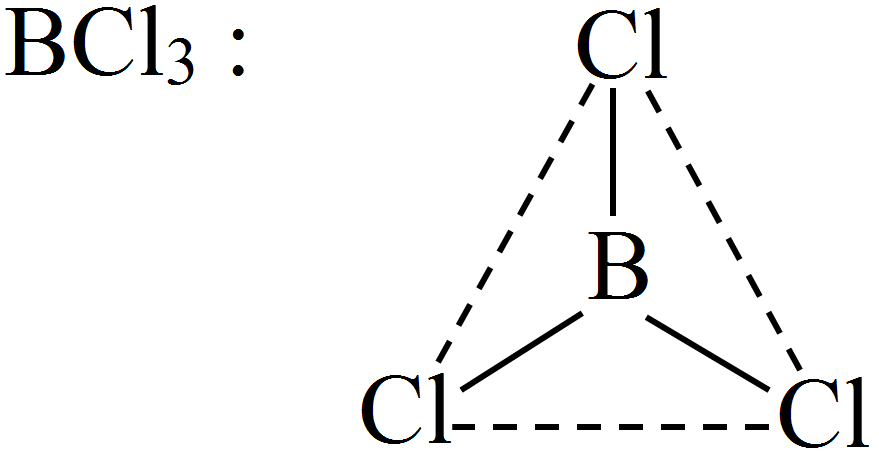
-
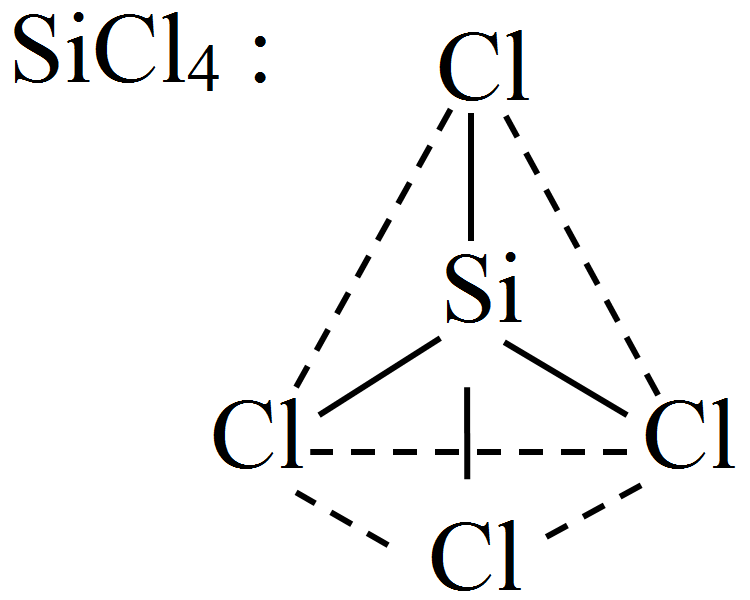
-
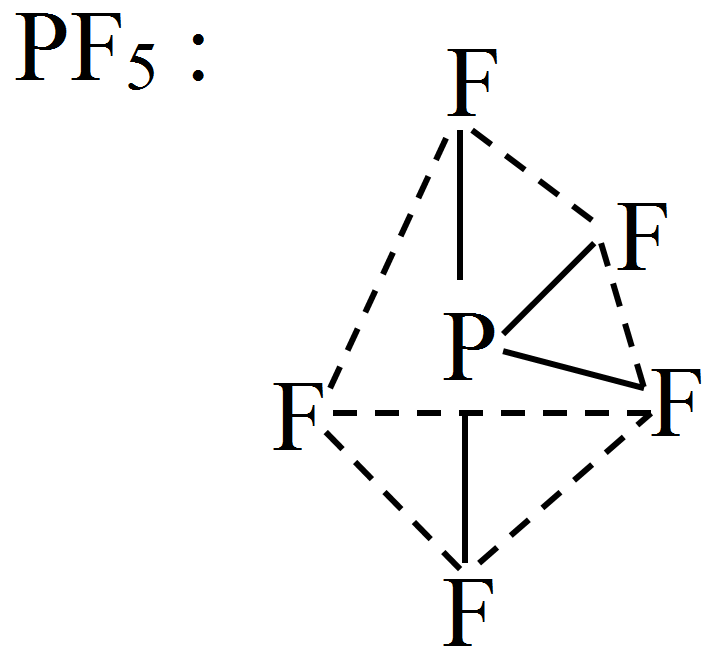

View full question & answer→Question 633 Marks
- How can one non-polar molecule induce a dipole in a nearby non-polar molecule?
- Write the molecular orbital configurations of the following species:
- $\text{O}^-_2$
- $\text{C}_2.$
Calculate their bond order.Answer
- Intermolecular forces of attraction arise as a result of instantaneous dipoles created in nonpolar molecules. Even in non-polar molecules, the electrons move at a certain distance from the nucleus. At any instant, it is likely that the atom has a dipole moment created by specific position of electrons. It is called instantaneous dipole because it lasts for just a fleeting moment. In the next instant, the electrons are in different locations and the atom has a new instantaneous dipoles and so on. Instantaneous dipoles can induce a dipole in each of the nearest neighbours and thus there are dispersion forces between non polar molecules.
-
- $\text{O}^-_2(17)\text{:}\ \sigma\text{ls}^2,\ \sigma*\text{ls}^2,\ ,\sigma2\text{s}^2,\ \sigma*\text{2s},\ \sigma2\text{p}_\text{z}^2,\ \pi\text{2p}_\text{x}^2$
$=\pi2\text{p}_\text{y}^2,\ \pi*\text{2p}_\text{x}^2=\pi*2\text{p}_\text{y}^1$
$\text{B.O.}=\frac12(10-7)=\frac32$
- $\text{O}_2(17)\text{:}\ \sigma\text{ls}^2,\ \sigma*\text{ls}^2,\ \sigma2\text{s}^2,\ \sigma*2\text{s}^2,\ \pi2\text{p}_\text{x}^2=\pi\text{2p}_\text{y}^2$
$\text{B.O.}=\frac12(10-7)=\frac32$ View full question & answer→Question 643 Marks
-
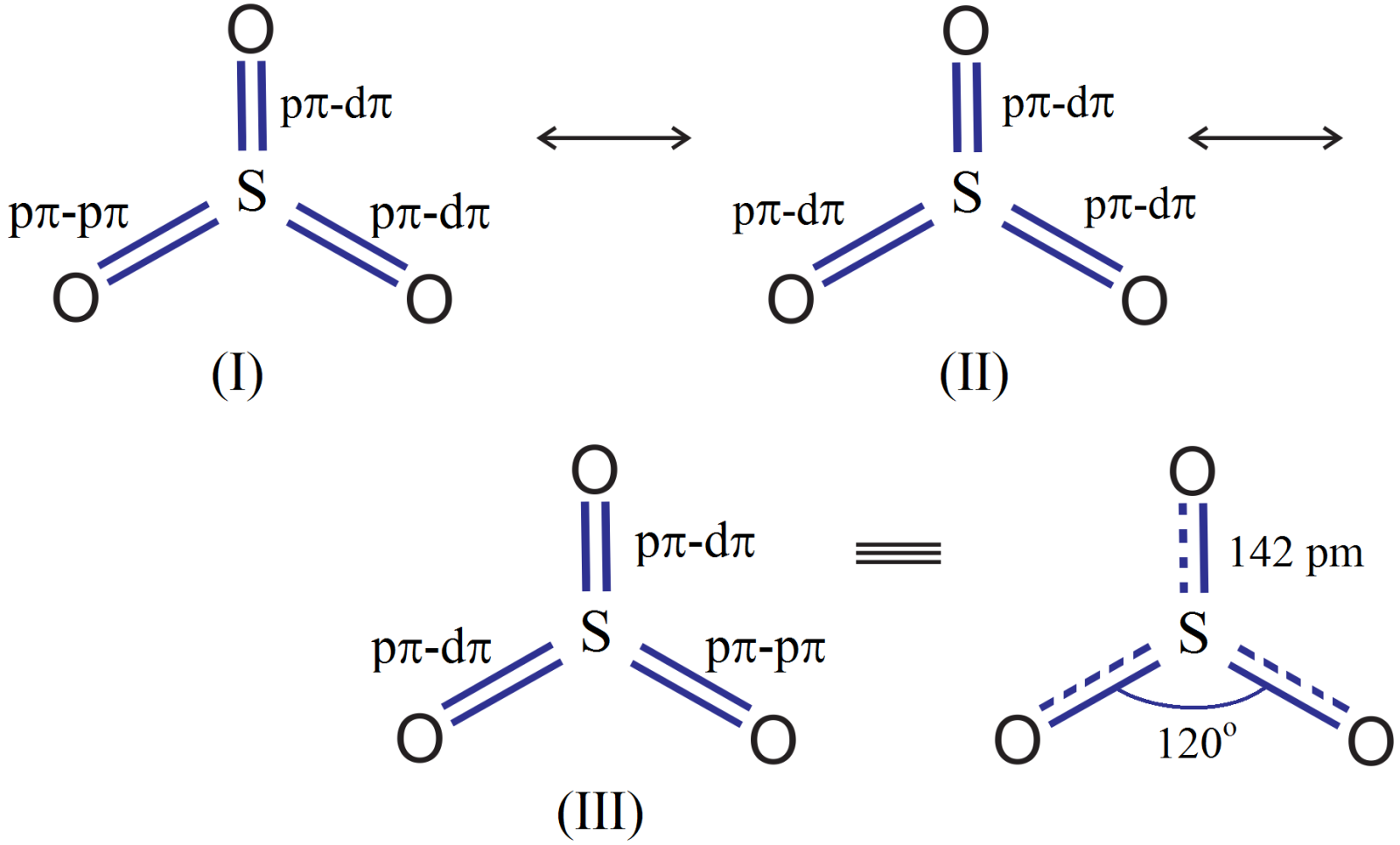
Write the resonating structures for $SO_3$ and $NO_2.$
-
Which hybrid orbitals are used by C-atoms in the following molecules:
- $\text{CH}_3-\text{CH}=\text{CH}_2$
- $\text{CH}_2\text{CHO}$
- Although geometries of $NH_3$ and $H_2O$ molecules are distorted tetrahedral, bond angle in water is less than that of ammonia. Discuss.
Answer
-

- $\ 3\ \ \ \ \ \ \ \ \ 2\ \ \ \ \ \ \ \ \ 1\\\text{CH}-\text{CH}=\text{CH}_2$
$C_1 = sp^2$
$C_2 = sp^2$
$C_3 = sp^3$
- $\ \ \ \ \ \ \ \ \ \ \ \ \text{O}\\\ 1\ \ \ \ \ \ \ \ 2\|\\\text{CH}_3-\text{C}-\text{H}$
$C_1 = sp^2$
$C_2 = sp^3$
- In both $NH _3$ and $H _2 O ; N$ and O are $sp ^3$ hybridised but due to the presence of lone pair/ s on central atom N and O respectively, they acquire distorted tetrahedral geometries. There is only one lone pair on N but 2 lone pairs on 0; There by since lone pair-lone pair repulsion > lone pair-bond pair repulsion; lone pairs on o push the bond pairs in $H _2 O$ more closer decreasing the bond angle in water more than in ammonia.
View full question & answer→Question 653 Marks
- Determine group and block of elements with atomic number 29 and 35.
- Define $\pi$ bonds.
Answer
- $\text{Cu}(29):\text{ls}^2\ \text{2s}^2\ 2\text{p}^6\ 3\text{3s}^6\ \text{4s}^1\ \text{3d}^{10}$
It belongs to group 11, $4^{\text {th }}$ period and d-block of periodic table.
$\text{Br}(35):\text{ls}^2\ \text{2s}^2\ 2\text{p}^6\ 3\text{s}^2\ 3\text{p}^6\ 4\text{s}^2\ 3\text{d}^{10}\ 4\text{P}^5$
It belongs to Group 17, $4^{\text {th }}$ period and p-block of periodic table.
- $\pi-\text{bond:}$ It is formed by lateral or sideways overlapping of parallel p-orbital above and below the plane of inter nuclear axis.
View full question & answer→Question 663 Marks
Predict the dipole moment of:
a. A molecule $\mathrm{AX}_4$ with square planar geometry.
b. A molecule $\mathrm{AX}_5$ with trigonal bipyramidal geometry.
c. A molecule $\mathrm{AX}_6$ with octahedral geometry.
d. A molecule $\mathrm{AX}_3$ with pyramidal shape.
Answer
- Zero.
- Zero.
- Zero.
- It has high dipole moment because dipoles do not get cancelled and there is net dipole moment.
View full question & answer→Question 673 Marks
Predict the hybridization of each carbon in the molecule of organic compound given below. Also indicate the total number of sigma and pi bonds in this molecule.
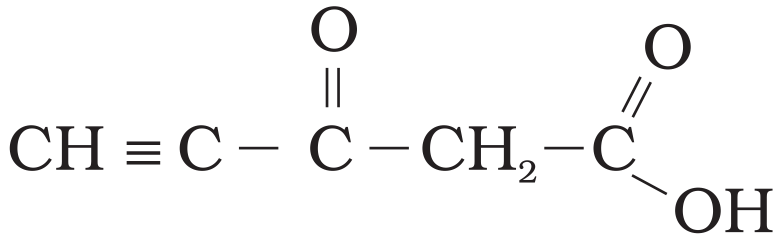
Answerin the given structure, there are total 5 carbon atom, two carbon atoms are Sp hybridized and linked throught triple bond, two carbon atoms are throught double bonds to O atoms and one is $\mathrm{Sp}^3$ hybridized thet is linked to two C atoms throught single bonds and to two H atoms throught single bonds.
In the molecule, there are 11 bonds.
View full question & answer→Question 683 Marks
i. Explain, why $\mathrm{Be}_2$ molecule does not exist by using molecular orbital theory.
ii. Describe the state of hybridization in $\mathrm{PCl}_5$ Why are the axial bonds longer as compared to equatorial bonds?
Answer
- i. Electronic configuration of $\mathrm{Be}=1 \mathrm{~s}^2 2 \mathrm{~s}^2$
M.O. configuration of $\text{Be}_2=(\sigma\text{ls})^2(\sigma*\text{ls})^2(\sigma\text{2s})^2(\sigma*2\text{s})$
Bond order of $\text{Be}_2=\frac12(4-4)=0$
Since bond of $\text{Be}_2=\frac{1}{2}(4-4)=0$
- $\text{P}(15)=\text{ls}^2\ \text{2s}^2\ \text{2p}^6\ \text{3s}^2\ \text{3p}^3$
$\therefore$ Hydridization in $\mathrm{PCl}_5$ is $\mathrm{sp}^3 \mathrm{~d}$
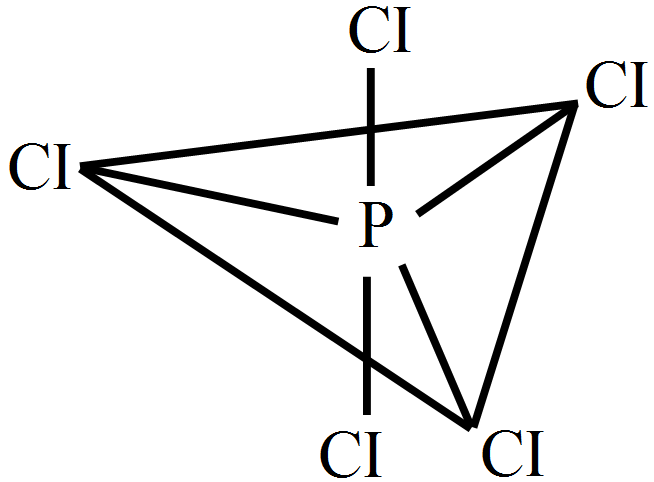
Axial bonds experience more electronic repulsion from three equatorial bond pairs and equatorial bonds experience repulsion from only two axial bond pairs hence axial bonds are longer as compared to equatorial bonds. View full question & answer→