Questions · Page 3 of 3

5 Marks Questions

Question 1015 Marks
Three thin prisms are combined as shown in figure. The refractive indices of the crown glass for red, yellow and violet rays are $\mu_\text{r},\mu_\text{y}$ and $\mu_\text{v}$ respectively and those for the flint glass are $\mu'_\text{r},\mu'_\text{y}$ and $\mu'_\text{v}$ respectively. Find the ratio $\frac{\text{A}'}{\text{A}}$ for which.
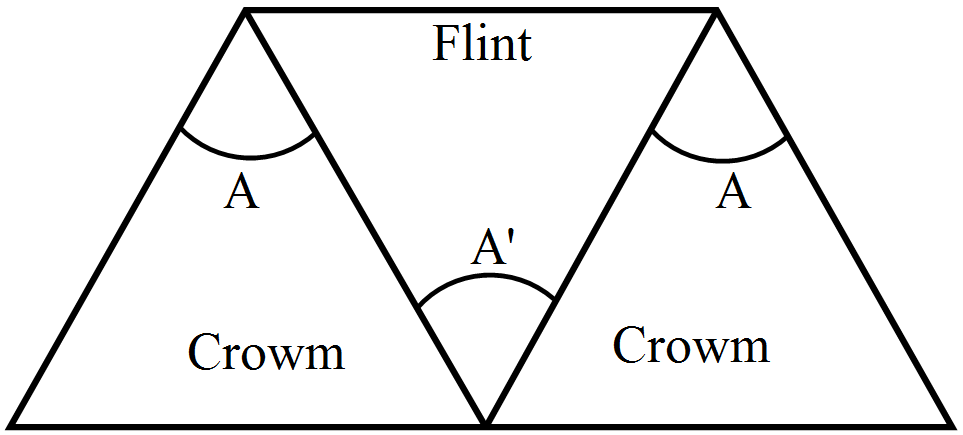
  1. There is no net angular dispersion.
  2. There is no net deviation in the yellow ray.
Answer
Total deviation for yellow ray produced by the prism combination is,
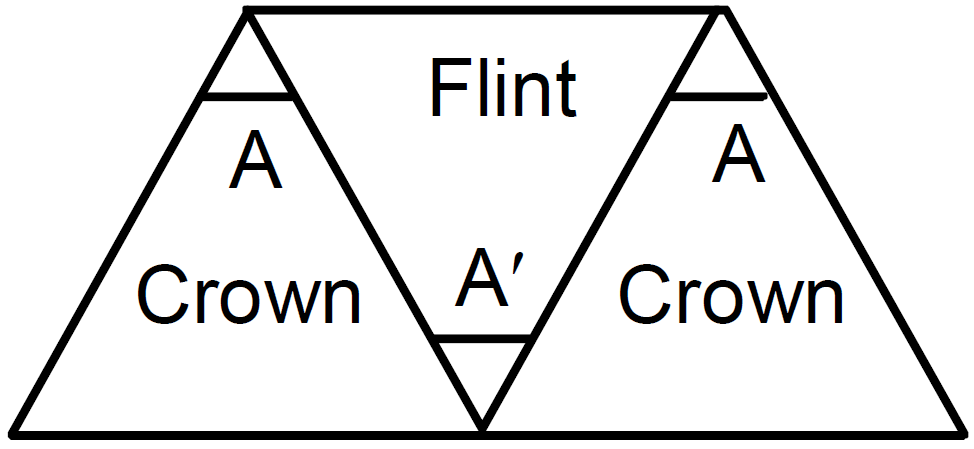
$\delta_\text{y}=\delta_\text{cy}-\delta_\text{fy}+\delta_\text{cy}=2\delta_\text{cy}-\delta_\text{fy}$ $=2(\mu_\text{cy}-1)\text{A}-(\mu_\text{cy}-1)\text{A}'$
Similarly the angular dispersion produced by the combination is
$\delta_\text{v}-\delta_\text{r}=\big[(\mu_\text{vc}-1)\text{A}-(\mu_\text{vf}-1)\text{A}'+(\mu_\text{vc}-1)\text{A}\big]\\\big[(\mu_\text{rc}-1)\text{A}-(\mu_\text{rf}-1)\text{A}'+(\mu_\text{r}-1)\text{A})\big]$
$=2(\mu_\text{vc}-1)\text{A}-(\mu_\text{vf}-1)\text{A}'$
  1. For net angular dispersion to be zero,
$\delta_\text{v}-\delta_\text{r}=0$

$\Rightarrow2(\mu_\text{vc}-1)\text{A}=(\mu_\text{vf}-1)\text{A}'$

$\Rightarrow\frac{\text{A}'}{\text{A}}=\frac{2(\mu_\text{cv}-\mu_\text{rc})}{(\mu_\text{vf}-\mu_\text{rf}}$

$=\frac{2(\mu_\text{v}-\mu_\text{r})}{(\mu'_\text{v}-\mu'_\text{r})}$
  1. For net deviation in the yellow ray to be zero,
$\delta_\text{y}=0$

$\Rightarrow2(\mu_\text{cy}-1)\text{A}=(\mu_\text{fy}-1)\text{A}'$

$\Rightarrow\frac{\text{A}'}{\text{A}}=\frac{2(\mu_\text{cy}-1)}{(\mu_\text{fy}-1)}$

$=\frac{2(\mu_\text{y}-1)}{(\mu'_\text{y}-1)}$
View full question & answer
Question 1025 Marks
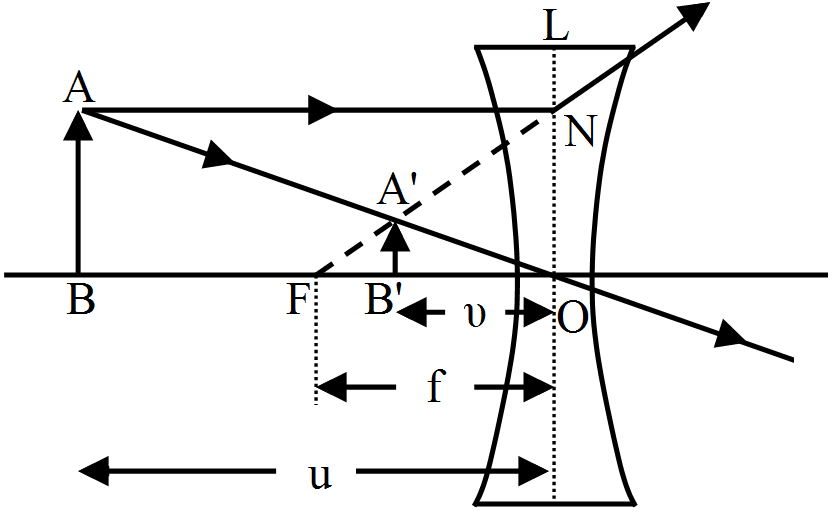
Derive the lens formula $\frac{1}{\text{f}}=\frac{1}{\text{v}}-\frac{1}{\text{u}}$ for a thin concave lens, using the necessary ray diagram.
Answer
The formation of image by a concave lens 'L' is shown in fig. AB is object and A' B' is the image. Triangles ABO and A' B' O are similar $\frac{\text{AB}}{\text{A}'\text{B}}=\frac{\text{OB}}{\text{OB}'}\dots(\text{i})$ Also triangles NOF and A' B' F are similar $\frac{\text{NO}}{\text{A}'\text{B}}=\frac{\text{OP}}{\text{FB}'}$ But NO = AB $\frac{\text{AB}}{\text{A}'\text{B}'}=\frac{\text{OB}}{\text{FB}'}\dots(\text{i})$ Comparing equation (i) and (ii) $\frac{​\text{OB}​}{\text{OB}'}=\frac{\text{OF}}{\text{FB}'}$ $\Rightarrow\frac{\text{OB}}{\text{OB}'}=\frac{\text{OF}}{\text{OF}-\text{OB}'}$ Using sign conventions of coordinate geometry OB = -u, OB' = -v, OF = -f
$\frac{-\text{u}}{-\text{v}}=\frac{-\text{f}}{-\text{f}+\text{v}}$ $\Rightarrow\text{uf}-\text{uv}=\text{vf}$ $\Rightarrow\text{uv}=\text{uf}-\text{uf}$ Dividing throughout by uvf, we get $\frac{1}{\text{f}}=\frac{1}{\text{v}}-\frac{1}{\text{u}}$ This is the required lens formula.
View full question & answer
Question 1035 Marks
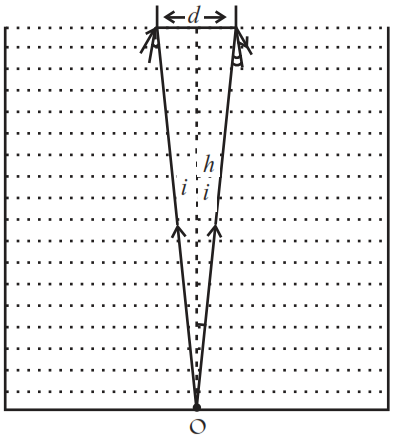
A jar of height h is filled with a transparent liquid of refractive index μ (Fig). At the centre of the jar on the bottom surface is a dot. Find the minimum diameter of a disc, such that when placed on the top surface symmetrically about the centre, the dot is invisible.
Answer
Key concept:

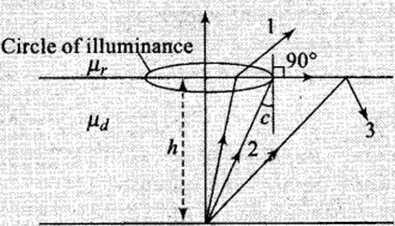
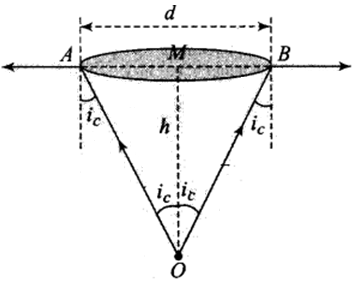
In the figure, ray 1 strikes the surface at an angle less than critical angle c and gets refracted in rarer medium. Ray 2 srtikes the surface at critical angle and grazes the interface. Ray 3 strikes the surface making an angle greater than the crirical angle and gets internally reflected. The locus of points where ray strikes at critical angle is a circlr, called circle of illuminance (C.O.I). All light rays striking inside the circle of illuminance get refracted in the rarer medium. If an observer is in the rarer mecdium, he/she will see light coming out only from within the circle of illuminance. If a circular opaque plate covers the circle of illuminance, no ligth will get refraced in the rarer medium and then the object cannot be seen from the rarer medium. In figure, O is a smll dot at the bottom of the jar. the ray from the dot emerges out of a circular pathc of water surface of diameter AB till the angle of incidence for the rays OA and OB exceeds the critical angle $(i_C).$

Rays of light incident at an angle greater than $i_C$, are totally reflected within water and consequently cannot emerge out of the water surface. As $\sin\text{i}_\text{C}=\frac{1}{\mu}\Rightarrow\ \tan\text{i}_\text{C}=\frac{1}{\sqrt{\mu^2-1}}$ Now, $\frac{\frac{\text{d}}{2}}{\text{h}}=\tan\text{i}_\text{C}$ $\Rightarrow\ \frac{\text{d}}{2}=\text{h}\tan\text{i}_\text{c}=\text{h}\frac{1}{\sqrt{\mu^2-1}}$ $\Rightarrow\ \text{d}=\frac{2\text{h}}{\sqrt{\mu^2-1}}$ Thsi is the required expression of d.
View full question & answer
Question 1045 Marks
The mixture a pure liquid and a solution in a long vertical column (i.e, horizontal dimensions < < vertical dimensions) produces diffusion of solute particles and hence a refractive index gradient along the vertical dimension. A ray of light entering the column at right angles to the vertical is deviated from its original path. Find the deviation in travelling a horizontal distance d < < h, the height of the column.
Answer
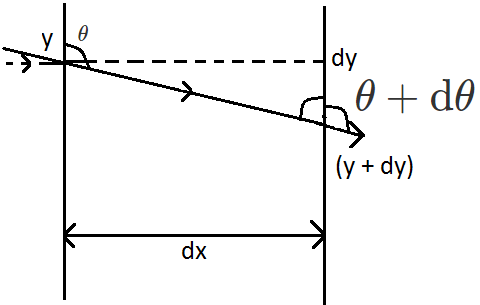
Let us consider a portion of a ray between x and x + dx inside the liquid. Let us suppose the angle of incidence at x be $\theta$ and let it enter the thin column at height y
Because of the bending it shall emerge at x = dx with an angle $\theta+\text{d}\theta$ and at a height y + dy. From Snell's law,

$\mu(\text{y})\sin\theta=\mu(\text{y}+\text{dy})\sin(\theta+\text{d}\theta)$
$\Rightarrow\ \mu(\text{y})\sin\theta=\Big(\mu(\text{y})+\frac{\text{d}\mu}{\text{dy}}\text{dy}\Big)(\sin\theta\cos\text{d}\theta+\cos\theta\sin\text{d}\theta)$
$\big[\because\ \sin(\text{A}+\text{B})=\sin\text{A}\cos\text{B}+\sin\text{B}\cos\text{A}\big]$
Since $\text{d}\theta$ is too small.
Hence, $\cos\text{d}\theta\approx1\text{ and }\text{d}\theta=\text{d}\theta$
$\therefore\ \mu(\text{y})\sin\theta=\Big(\mu(\text{y})+\frac{\text{d}\mu}{\text{dy}}\text{dy}\Big)(\sin\theta+\cos\theta\text{d}\theta)$
$\Rightarrow\ \mu(\text{y})\sin\theta=\mu(\text{y})\sin\theta+\mu(\text{y})\cos\theta\text{d}\theta+\sin\theta\frac{\text{d}\mu}{\text{dy}}\text{dy}+\frac{\text{d}\mu}{\text{dy}}\text{dy}\cos\theta\text{d}\theta$
$\Rightarrow\ \mu(\text{y})\cos\theta\text{d}\theta=-\frac{\text{d}\mu}{\text{dy}}\text{dy}\sin\theta\ \ \bigg[\text{Neglecting}\frac{\text{d}\mu}{\text{dy}}\text{dy}\cos\theta\text{d}\theta\bigg]$
$\Rightarrow\ \text{d}\theta=\frac{-\text{d}\mu}{\mu\text{dy}}\text{dy}\tan\theta$
From the figute, we have $\tan\theta=\frac{\text{dx}}{\text{dy}}$
$\therefore\ \text{d}\theta=\frac{-1\text{d}\mu}{\mu\text{dy}}\text{dx}$
Solving this variable separable from of differential equation, we get
$\therefore\ \theta=\frac{-1\text{d}\mu}{\mu\text{dy}}\int_0^\text{d}\text{dx}=\frac{-1\text{d}\mu}{\mu\text{dy}}\text{d}$
View full question & answer
Question 1055 Marks
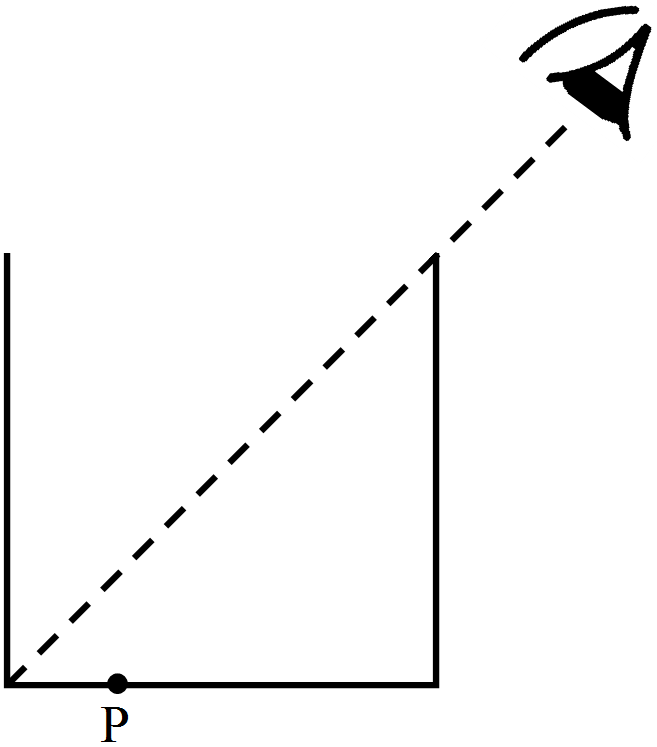
A cylindrical vessel, whose diameter and height both are equal to 30cm, is placed on a horizontal surface and a small particle P is placed in it at a distance of 5.0cm from the centre. An eye is placed at a position such that the edge of the bottom is just visible. The particle P is in the plane of drawing. Up to what minimum height should water be poured in the vessel to make the particle P visible?
Answer

For the given cylindrical vessel, dimetre = 30cm
⇒ r = 15cm and h = 30cm
Now, $\frac{\sin\text{i}}{\sin\text{r}}=\frac{3}{4}\Big[\mu_{\text{w}}=1.33=\frac{4}{3}\Big]$
$\Rightarrow\sin\text{i}=\frac{3}{4\sqrt{2}} \ \big[\because \text{r}=45^{\circ}\big]$
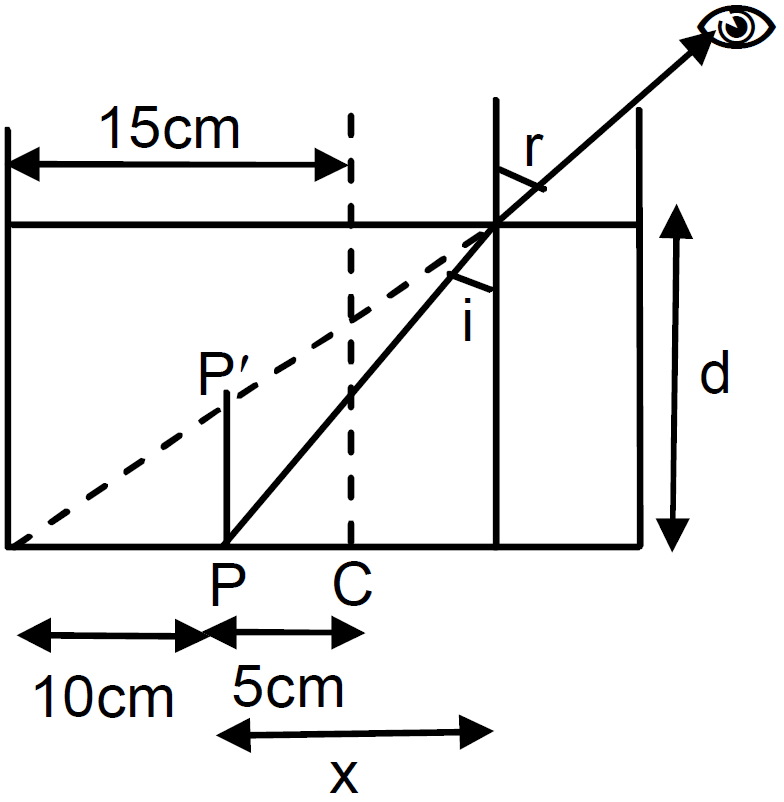
The point P will be visible when the refracted ray makes angle 45° at point of refraction.
Let x = distance of point P from X.
Now, $\tan45^{\circ}=\frac{\text{x}+10}{\text{d}}$
$\Rightarrow\text{d}=\text{x}+10 \ ...(1)$
Again, $\tan\text{i}=\frac{\text{x}}{\text{d}}$
$\Rightarrow\frac{3}{\sqrt{23}}=\frac{\text{d}-10}{\text{d}} \ \Big[\text{Since,} \ \sin\text{i}=\frac{3}{4\sqrt{2}}\Rightarrow\tan\text{i}=\frac{3}{4\sqrt{2}}\Big]$
$\Rightarrow\frac{3}{\sqrt{23}}-1=-\frac{10}{\text{d}}\Rightarrow\text{d}=\frac{\sqrt{23}\times10}{\sqrt{23}-3}=26.7\text{cm}$
View full question & answer
Question 1065 Marks
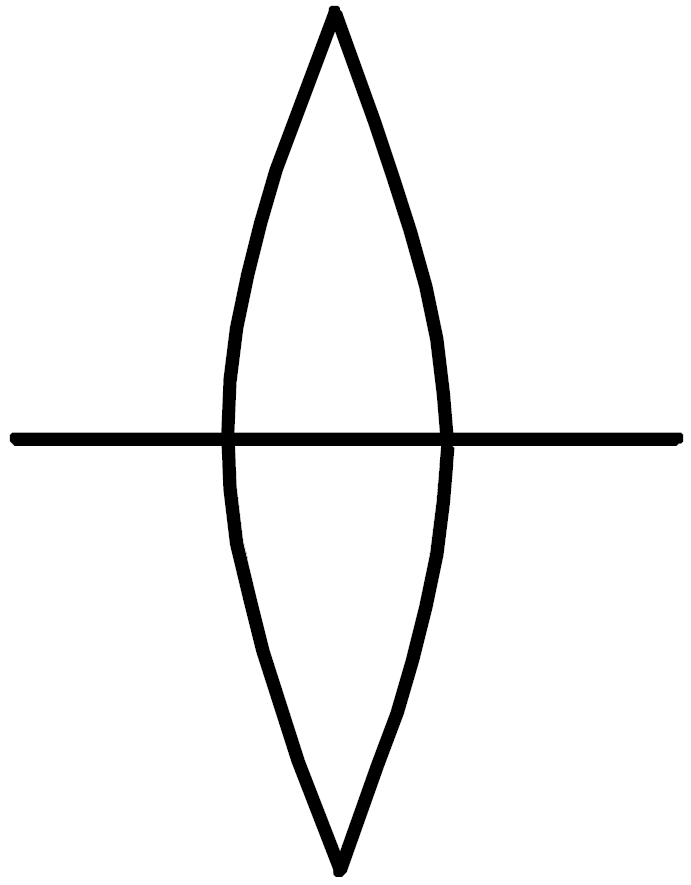
Lenses are constructed by a material of refractive index 1.50. The magnitude of the radii of curvature are 20cm and 30cm. Find the focal lengths of the possible lenses with the above specifications.
Answer
Given $\mu=1.5$
Magnitude of radii of curvatures = 20cm and 30cm
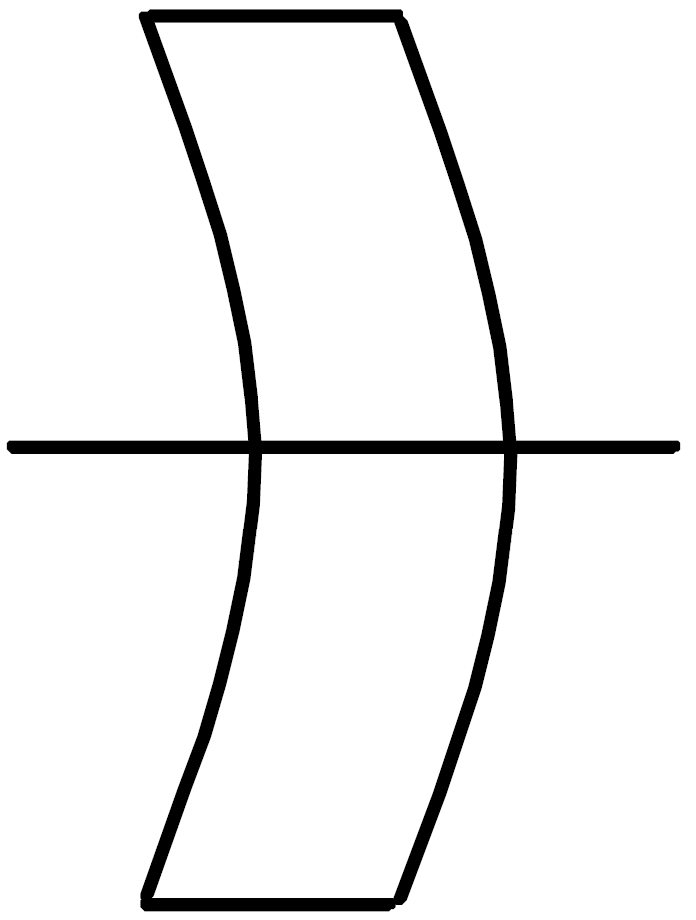
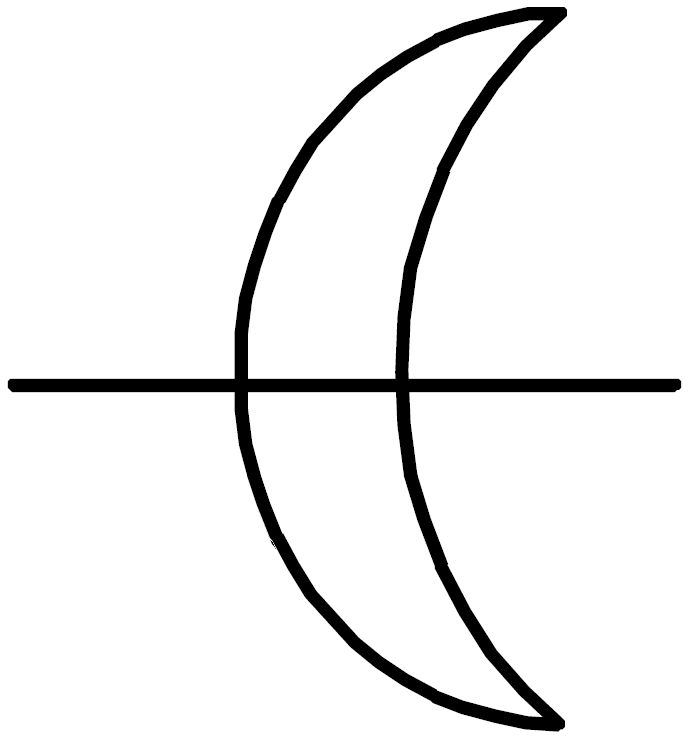
The 4types of possible lens are as below.
$\frac{1}{\text{f}}=(\mu-1)\Big(\frac{1}{\text{R}_1}-\frac{1}{\text{R}_2}\Big)$
Case (1): (Double convex) $[R_1 = +ve,\ R_2 = -ve]$
$\frac{1}{\text{f}}=(15-1)\Big(\frac{1}{20}-\frac{1}{30}\Big)\Rightarrow\text{f}=24\text{cm}$

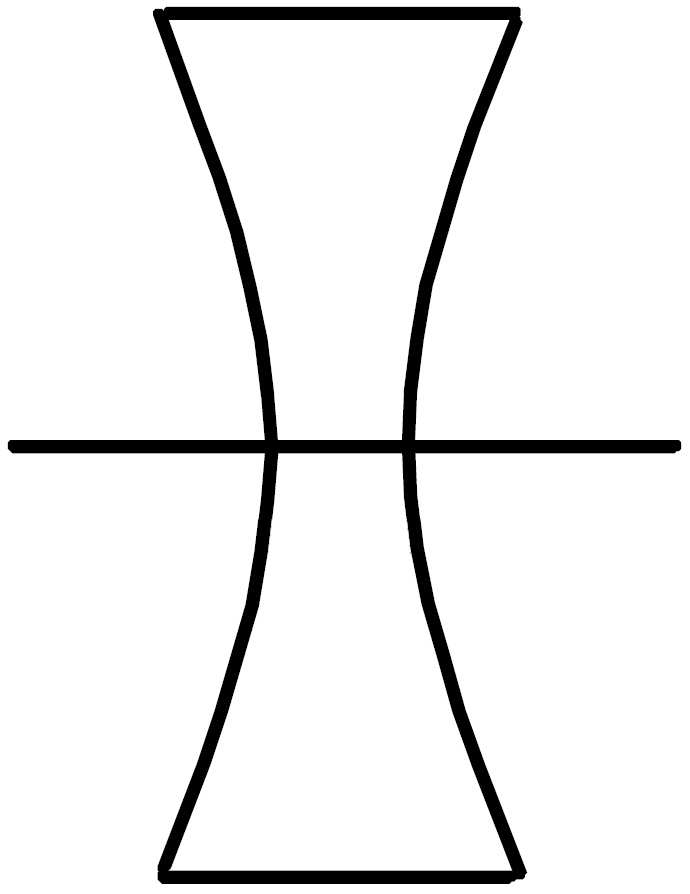
Case (2): (Double concave) $[R_1 = -ve,\ R_2 = +ve]$
$\frac{1}{\text{f}}=(15-1)\Big(\frac{-1}{20}-\frac{1}{30}\Big)\Rightarrow\text{f}=-24\text{cm}$

Case (3): (Concave concave) $ [R_1 = -ve,\ R_2 = -ve]$
$\frac{1}{\text{f}}=(15-1)\Big(\frac{1}{-20}-\frac{1}{-30}\Big)\Rightarrow\text{f}=-120\text{cm}$

Case (4): (Concave convex) $[R_1 = +ve,\ R_2 = +ve]$
$\frac{1}{\text{f}}=(15-1)\Big(\frac{1}{20}-\frac{1}{30}\Big)\Rightarrow\text{f}=+120\text{cm}$
View full question & answer
Question 1075 Marks
k transparent slabs are arranged one over another. The refractive indices of the slabs are $\mu_1,\mu_2,\mu_3, \ ...\mu_{\text{k}}$ and the thicknesses are $t_1, t_2, t_3, ... t_k$ . An object is seen through this combination with nearly perpendicular light. Find the equivalent refractive index of the system which will allow the image to be formed at the same place.
Answer
Total no. of slabs = k, thickness $= t_1, t_2, t_3, ... t_k$ Refractive index $=\mu_1,\mu_2,\mu_3, \ ...\mu_{\text{k}}$
$\therefore$ The shift $\Delta\text{t}=\Big(1-\frac{1}{\mu_1}\Big)\text{t}_1+\Big(1-\frac{1}{\mu_2}\Big)\text{t}_2+ \ ... \ \Big(1-\frac{1}{\mu_{\text{k }}}\Big)\text{t}_{\text{k}} \ ...(1)$
If, $\mu\rightarrow$ refractive index of combination of slabs and image is formed at same place,
$\Delta\text{t}=\Big(1-\frac{1}{\mu}\Big)(\text{t}_1+\text{t}_2+...+\text{t}_{\text{k}}) \ ...(2)$
Equation (1) and (2), we get,
$\Big(1-\frac{1}{\mu}\Big)(\text{t}_1+\text{t}_2+...+\text{t}_{\text{k}})$
$=\Big(1-\frac{1}{\mu_1}\Big)\text{t}_1+\Big(1-\frac{1}{\mu_2}\Big)\text{t}_2+ ...+\Big(1-\frac{1}{\mu_{\text{k}}}\Big)\text{t}_{\text{k}}$
$=(\text{t}_1+\text{t}_2+...+\text{t}_{\text{k}})-\Big(\frac{\text{t}_1}{\mu_1}+\frac{\text{t}_2}{\mu_2}+...+\frac{\text{t}_{\text{k}}}{\mu_{\text{k}}}\Big)$
$=-\frac{1}{\mu}\sum\limits_{\text{i}=1}^\text{k}\text{t}_1=-\sum\limits_{\text{i}=1}^\text{k}\Big(\frac{\text{t}_1}{\mu_1}\Big)\Rightarrow\mu=\frac{\sum\limits_{\text{i}=1}^\text{k}\text{t}_1}{\sum\limits_{\text{i}=1}^\text{k}\big(\frac{\text{t}_1}{\mu_1}\big)}.$
View full question & answer
Question 1085 Marks
An eye can distinguish between two points of an object if they are separated by more than 0.22mm when the object is placed at 25cm from the eye. The object is now seen by a compound microscope having a 20D objective and 10D eyepiece separated by a distance of 20cm. The final image is formed at 25cm from the eye. What is the minimum separation between two points of the object which can now be distinguished?
Answer
For the given compound microscope$\text{f}_0=\frac{1}{20\text{D}}=0.05\text{m}=5\text{cm},$ $\text{f}_\text{e}=\frac{1}{10\text{D}}=0.1\text{m}=10\text{cm.}$
D = 25cm, separation between objective & eyepiece= 20cm
For the minimum separation between two points which can be distinguished by eye using the microscope, the magnifying power should be maximum.
For the eyepiece$, v_0 = -25cm, f_e = 10cm$
So, $\frac{1}{\text{u}_\text{e}}=\frac{1}{\text{v}_\text{e}}-\frac{1}{\text{f}_\text{e}}=\frac{1}{-25}-\frac{1}{10}$
$=-\Big[\frac{2+5}{50}\Big]\Rightarrow\text{u}_\text{e}=-\frac{50}{7}\text{cm}$
So, the image distance for the objective lens should be,
$\text{v}_0=20-\frac{50}{7}=\frac{90}{7}\text{cm}$
Now, for the objective lens,
$\frac{1}{\text{u}_0}=\frac{1}{\text{v}_0}-\frac{1}{\text{f}_0}=\frac{7}{90}-\frac{1}{5}=-\frac{11}{90}$
$\Rightarrow\text{u}_\text{o}=-\frac{90}{11}\text{cm}$
So, the maximum magnifying power is given by,
$\text{m}=\frac{-\text{V}_0}{\text{u}_0}\Big[1+\frac{\text{D}}{\text{f}_\text{e}}\Big]$
$=\frac{\big(\frac{90}{7}\big)}{\big(-\frac{90}{11}\big)}\Big[1+\frac{25}{10}\Big]$
$=\frac{11}{7}\times3.5=5.5$
Thus, minimum separation eye can distinguish $=\frac{0.22}{5.5}\text{mm}=0.04\text{mm}$
View full question & answer
Question 1095 Marks
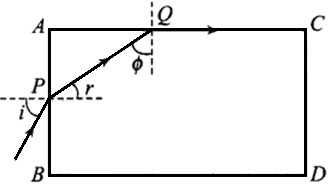
Show that for a material with refractive index $\mu\geq\sqrt{2}$, light incident at any angle shall be guided along a length perpendicular to the incident face.
Answer
Let the ray incident on face AB at angle i, after refraction, it travels along PQ and then interact with face AC which is perpendicular to the incident face.

Any ray is guided along AC if the angle ray makes with the face AC $(\phi)$ is greater than the critical angle. From figure
$\phi+\text{r}=90^\circ,\ \therefore\ \sin\phi=\cos\text{r}\ .....(\text{i})$
If $\phi$ is the critical angle it means, $\sin\phi\geq\frac{1}{\mu}\ .....(\text{ii})$
From (i) and (ii), $\cos\text{r}\geq\frac{1}{\mu_2}\text{ or }1-\cos^2\text{r}\leq1-\frac{1}{\mu^2}$
i.e., $\sin^3\text{r}\leq\frac{1}{\mu^2}\Rightarrow\ \sin^2\text{r}\leq1-\frac{1}{\mu^2}\ .....(\text{iii})$
Applying Snell's law on face AB,
$1.\sin\text{i}=\mu\sin\text{r}$
or $\sin^2\text{i}=\mu^2\sin^2\text{r}\Rightarrow\ \sin^2\text{r}=\frac{1}{\mu^2}\sin^2\text{i}\ .....(\text{iv})$
From (i) and (ii), $\frac{1}{\mu_2}\sin^2\text{i}\leq1-\frac{1}{\mu^2}$
of $\sin^2\text{i}\leq\mu^2-1\ .....(\text{v})$
When $\text{i}=\frac{\pi}{2}$, then we have smallest angle $\phi$.
If it is greater than the critical angle, then all other angles of incidebce shall be more than the critical angle.
Thus, $1\geq\mu^2-1\text{ or }\mu^2\geq2$
$\Rightarrow\ \mu\geq\sqrt{2}$. This is the requires result.
View full question & answer
Question 1105 Marks
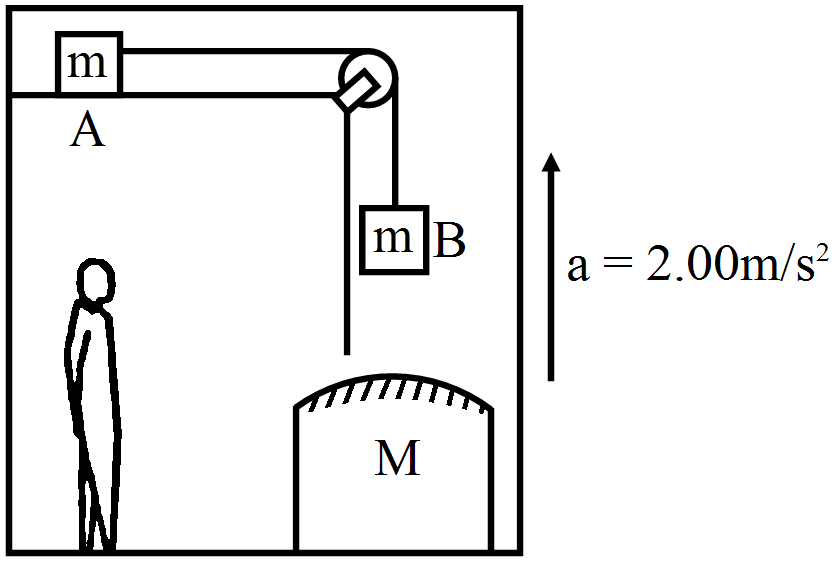
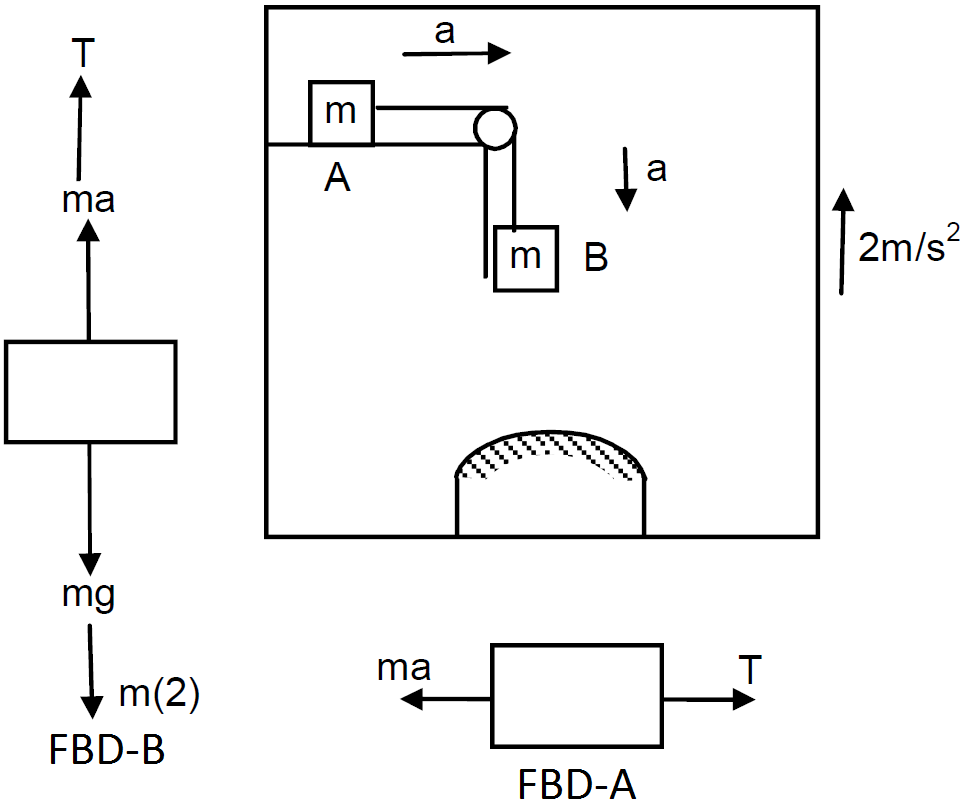
Consider the situation shown in figure. The elevator is going up with an acceleration of $2.00m/s^2$ and the focal length of the mirror is 12.0cm. All the surfaces are smooth and the pulley is light. The mass-pulley system is released from rest (with respect to the elevator) at t = 0 when the distance of B from the mirror is 42.0cm. Find the distance between the image of the block B and the mirror at $t = 0.200s$. Take $g = 10m/s^2$.
Answer


Let a = acceleration of the masses A and B (w.r.t. elevator). From the freebody diagrams,
$T - mg + ma - 2m = 0 …(1)$
Similarly, $T - ma = 0 …(2)$
From (1) and (2),
$2ma - mg - 2m = 0$
$\Rightarrow2\text{ma}=\text{m}(\text{g}+2)$
$\Rightarrow\text{a}=\frac{10+2}{2}=\frac{12}{2}=6$
so, distance travelled by B in t = 0.2 sec is,
$\text{s}=\frac{1}{2}\text{at}^2=\frac{1}{2}\times6\times(0.2)^2=0.12\text{m}=12\text{cm}$
So, Distance from mirror, $\text{u}=-(42-12)=-30\text{cm};\text{f}=+12\text{cm}$
From mirror equation, $\frac{1}{\text{v}}+\frac{1}{\text{u}}=\frac{1}{\text{f}}\Rightarrow\frac{1}{\text{v}}+\Big(-\frac{1}{30}\Big)=\frac{1}{12}$
$\Rightarrow\text{v}=8.57\text{cm}$
Distance between image of block B and mirror = 8.57cm.
View full question & answer
Question 1115 Marks
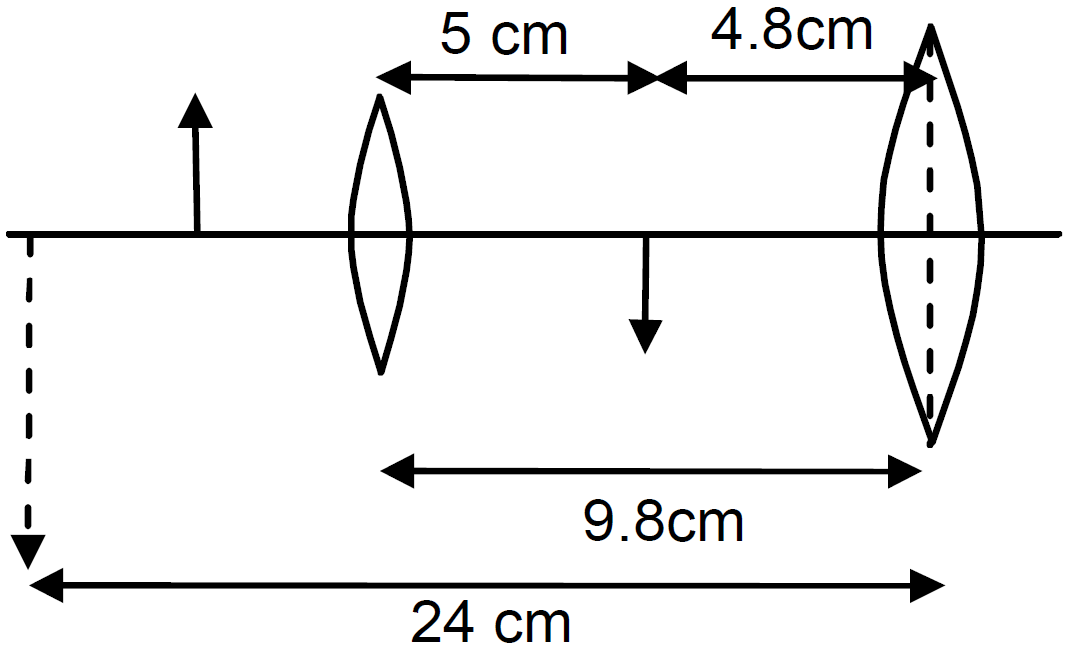
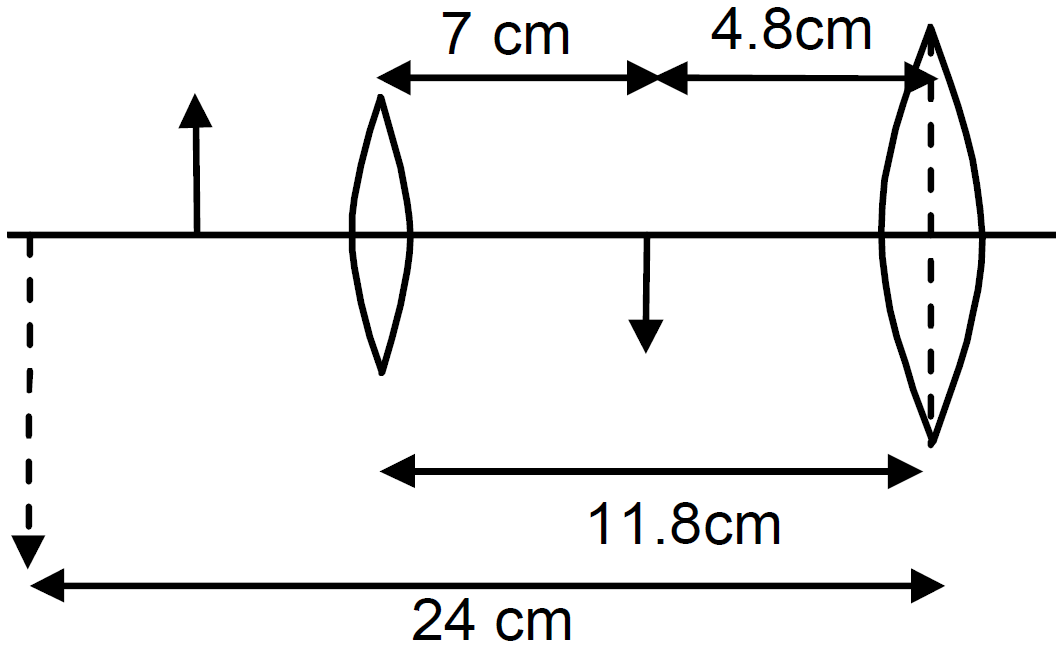
The separation between the objective and the eyepiece of a compound microscope can be adjusted between 9.8cm to 11.8cm. If the focal lengths of the objective and the eyepiece are 1.0cm and 6cm respectively, find the range of the magnifying power if the image is always needed at 24cm from the eye.
Answer
For the given compound microscope $f_0 = 1cm, f_e = 6cm, D = 24cm$
For the eye piece, $v_e= -24cm, f_e = 6cm$
Now, $\frac{1}{\text{v}_\text{e}}-\frac{1}{\text{u}_\text{e}}=\frac{1}{\text{f}_\text{e}}$
$\Rightarrow\frac{1}{\text{u}_\text{e}}=\frac{1}{\text{v}_\text{e}}-\frac{1}{\text{f}_\text{e}}\Rightarrow-\Big[\frac{1}{24}+\frac{1}{6}\Big]=-\frac{5}{24}$
$\Rightarrow \text{u}_\text{e}=-4.8\text{cm}$
  1. When the separation between objective and eye piece is 9.8cm, the image distance for the objective lens must be $(9.8) - (4.8) = 5.0cm$
Now, $\frac{1}{\text{v}_0}-\frac{1}{\text{u}_0}=\frac{1}{\text{f}_0}$
$\Rightarrow\frac{1}{\text{u}_0}=\frac{1}{\text{v}_0}-\frac{1}{\text{f}_0}=\frac{1}{5}-\frac{1}{1}=-\frac{4}{5}$
$\Rightarrow\text{u}_0=-\frac{5}{4}=-1.25\text{cm}$
So, the magnifying power is given by,
$\text{m}=\frac{\text{v}_0}{\text{u}_\text{0}}\Big[1+\frac{\text{D}}{\text{f}}\Big]=\frac{-5}{-1.25}\Big[1+\frac{24}{6}\Big]=4\times5=20$
  1. When the separation is 11.8cm,
$v_0 = 11.8 - 4.8 = 7.0cm, f_0 = 1cm$
$\Rightarrow\frac{1}{\text{u}_0}=\frac{1}{\text{v}_0}-\frac{1}{\text{f}_0}=\frac{1}{7}-\frac{1}{1}=-\frac{6}{7}$
So, $\text{m}=-\frac{\text{v}_0}{\text{u}_\text{o}}\Big[1+\frac{\text{D}}{\text{f}}\Big]=\frac{-7}{-\Big(\frac{7}{6}\Big)}\Big[1+\frac{24}{6}\Big]=6\times5=30$
So, the range of magnifying power will be 20 to 30.
View full question & answer
Question 1125 Marks
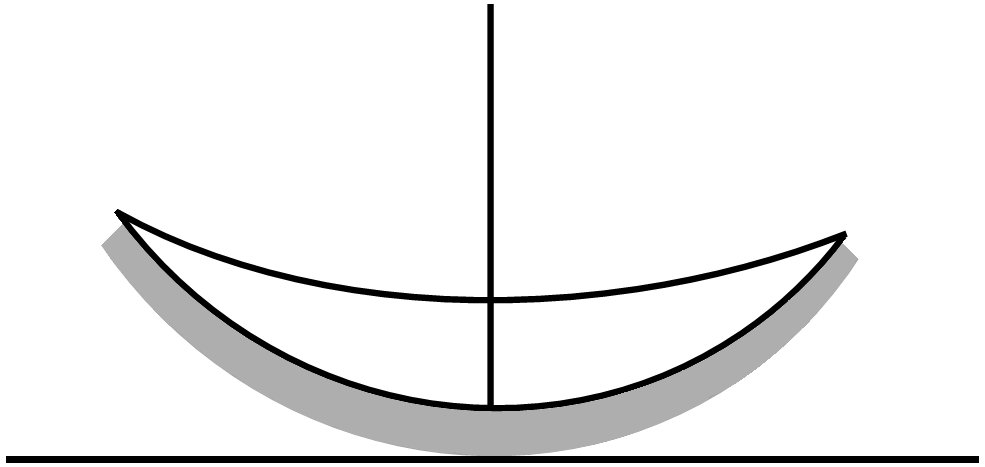
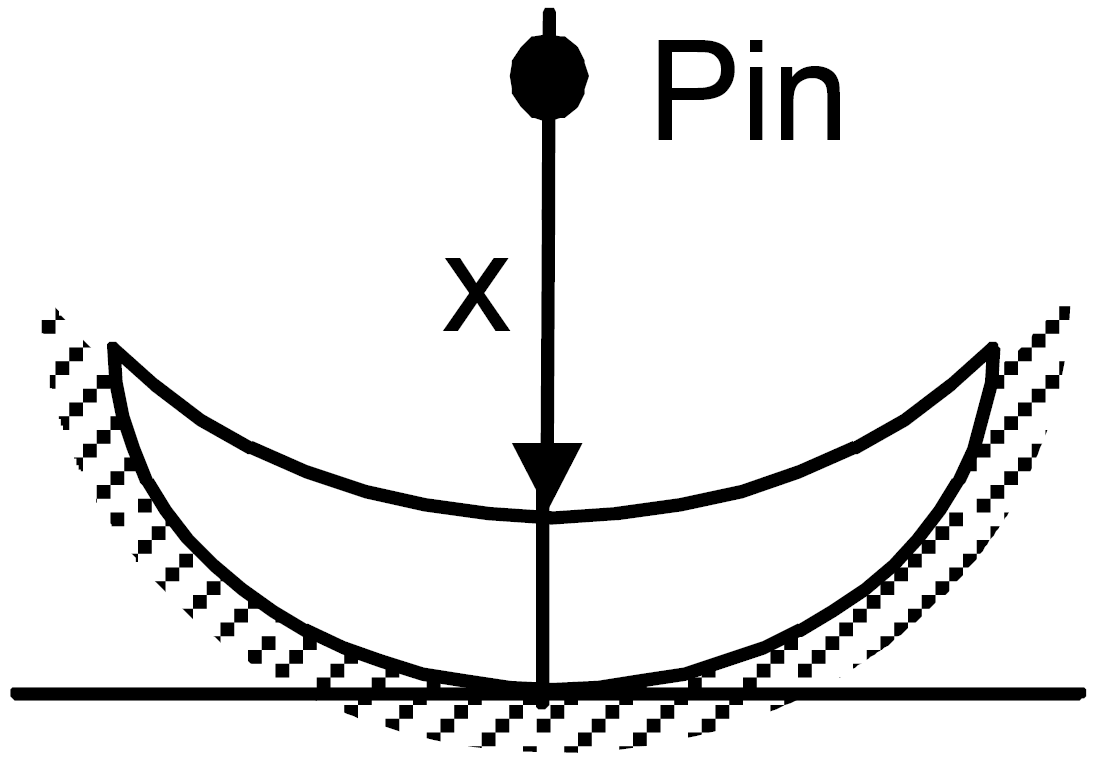
The convex surface of a thin concavo-convex lens of glass of refractive index 1.5 has a radius of curvature 20cm. The concave surface has a radius of curvature 60cm. The convex side is silvered and placed on a horizontal surface as shown in figure.
  1. Where should a pin be placed on the axis so that its image is formed at the same place?
  2. If the concave part is filled with water $\Big(\mu=\frac{4}{3}\Big),$ find the distance through which the pin should be moved so that the image of the pin again coincides with the pin.
Answer

Let the pin is at a distance of x from the lens.
Then for $1^{st}$ refraction, $\frac{\mu_2}{\text{v}}-\frac{\mu_1}{\text{u}}=\frac{\mu_2-\mu_1}{\text{R}}$
Here, $\mu_2=1.5, \ \mu_1=1, \ \text{u}=-\text{x}, \ \text{R}=-60\text{cm}$
$\therefore \ \frac{1.5}{\text{v}}-\frac{1}{-\text{x}}=\frac{0.5}{-60}$
$\Rightarrow120(1.5\text{x}+\text{v})=-\text{vx} \ ...(1)$
$\Rightarrow\text{v}(120+\text{x})=-180\text{x}$
$\Rightarrow\text{v}=\frac{-180\text{x}}{120+\text{x}}$
This image distance is again object distance for the concave mirror.
$\text{u}=\frac{-180\text{x}}{120+\text{x}}, \ \text{f}=-10\text{cm} \ \Big(\therefore \ \text{f}=\frac{\text{R}}{2}\Big)$
$\therefore \ \frac{1}{\text{v}}+\frac{1}{\text{u}}=\frac{1}{\text{f}}\Rightarrow\frac{1}{\text{v}_1}=\frac{1}{-10}-\frac{-(120+\text{x})}{180\text{x}}$
$\Rightarrow\frac{1}{\text{v}_1}=\frac{120+\text{x}-18\text{x}}{180\text{x}}\Rightarrow\text{v}_1=\frac{180\text{x}}{120-17\text{x}}$
Again the image formed is refracted through the lens so that the image is formed on the object taken in the $1^{st}$ refraction. So, for $2^{nd}$ refraction.
According to sign conversion $\text{v}=-\text{x}, \ \mu_2=1, \ \mu_1=1.5, \ \text{R}=-60$
Now, $\frac{\mu_2}{\text{v}}-\frac{\mu_1}{\text{u}}=\frac{\mu_2-\mu_1}{\text{R}} \ \Big[\text{u}=\frac{180\text{x}}{120-17\text{x}}\Big]$
$\Rightarrow\frac{1}{-\text{x}}-\frac{1.5}{180\text{x}}(120-17\text{x})=\frac{-0.5}{-60}$
$\Rightarrow\frac{1}{\text{x}}+\frac{120-17\text{x}}{120\text{x}}=\frac{-1}{120}$
Multiplying both sides with 120m, we get
$120 + 120 - 17x = -x$
$⇒ 16x = 240 ⇒ x = 15cm$
$\therefore$ Object should be placed at 15cm from the lens on the axis.
View full question & answer
Question 1135 Marks
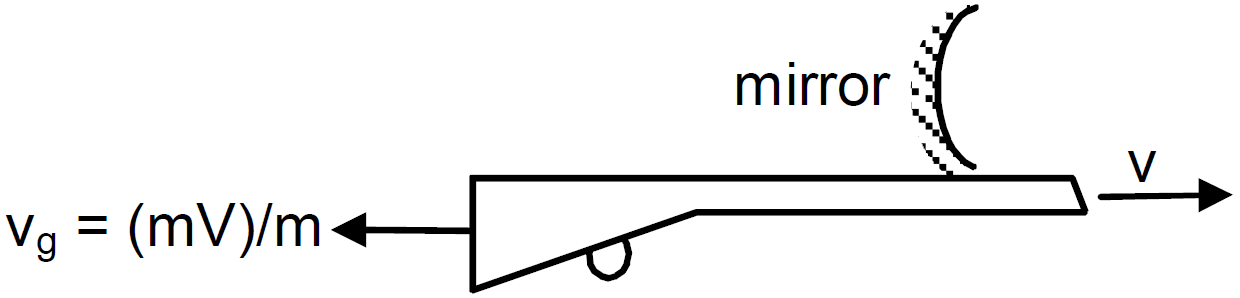
A gun of mass M fires a bullet of mass m with a horizontal speed V. The gun is fitted with a concave mirror of focal length f facing tpwards the receding bullet. Find the speed of separation of the bullet and the image just after the gun was fired.
Answer

Recoil velocity of gun $=\text{V}_{\text{g}}=\frac{\text{mV}}{\text{M}}$
At any time ‘t’, position of the bullet w.r.t. mirror $=\text{V}_{\text{t}}=\frac{\text{mV}}{\text{M}}{\text{t}}=\Big(1+\frac{\text{m}}{\text{M}}\Big)\text{Vt}$
For the mirror, $=\text{u}=-\Big(1+\frac{\text{m}}{\text{M}}\Big)\text{Vt}=\text{kVt}$
v = position of the image
From lens formula,
$\frac{1}{\text{v}}=\frac{1}{\text{f}}-\frac{1}{\text{u}}\Rightarrow\frac{1}{\text{v}}=\frac{1}{-\text{f}}+\frac{1}{\text{kVt}}=\frac{1}{\text{kVt}}-\frac{1}{\text{f}}=\frac{\text{f}-\text{kVt}}{\text{kVtf}}$
Let $\Big(1+\frac{\text{m}}{\text{M}}=\text{k}\Big),$
So, $\text{v}=\frac{\text{kVtf}}{-\text{kVt}+\text{f}}=\Big(\frac{\text{kVtf}}{\text{f}-\text{kVt}}\Big)$
So, velocity of the image with respect to mirror will be,
$\text{v}_1=\frac{\text{dv}}{\text{dt}}=\frac{\text{v}}{\text{dt}}\Big[\frac{\text{kVtf}}{\text{f}-\text{kVt}}\Big]=\frac{(\text{f}-\text{kVt})\text{kVf}-\text{kVtf}(-\text{kV})}{(\text{f}-\text{kVt})^2}=\frac{\text{kVt}^2}{(\text{f}-\text{kVt})^2}$
Since, the mirror itself is moving at a speed of $\text{m}\frac{\text{V}}{\text{M}}$ and the object is moving at ‘V’, the velocity of separation between the image and object at any time ‘t’ will be,
$\text{v}_{\text{s}}=\text{V}+\frac{\text{mV}}{\text{M}}+\frac{\text{kVf}^2}{(\text{f}-\text{kVt})^2}$
When, t = 0 (just after the gun is fired),
$\text{v}_{\text{s}}=\text{V}+\frac{\text{mV}}{\text{M}}+\text{kV}=\text{V}+\frac{\text{m}}{\text{M}}\text{V}+\Big(1+\frac{\text{m}}{\text{M}}\Big)\text{V}=2\Big(1+\frac{\text{m}}{\text{M}}\Big)\text{V}$
View full question & answer
Question 1145 Marks
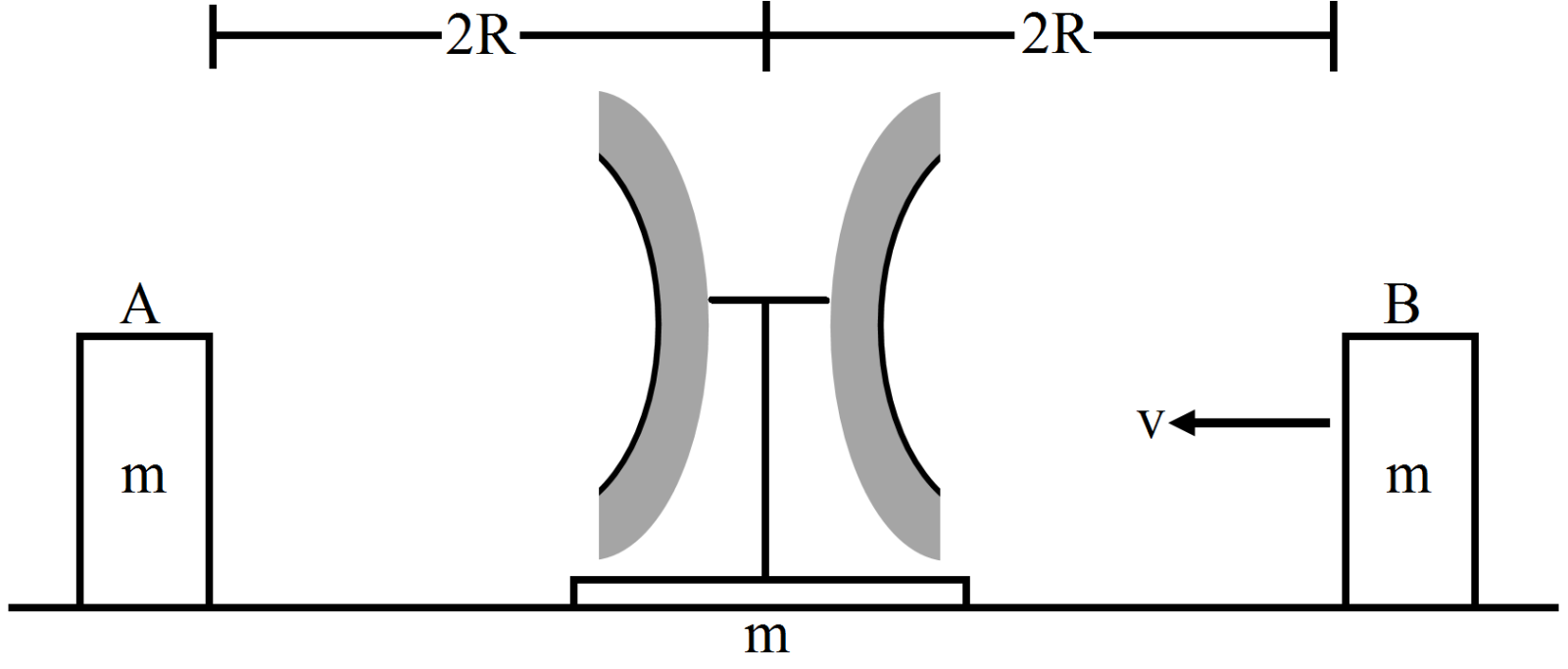
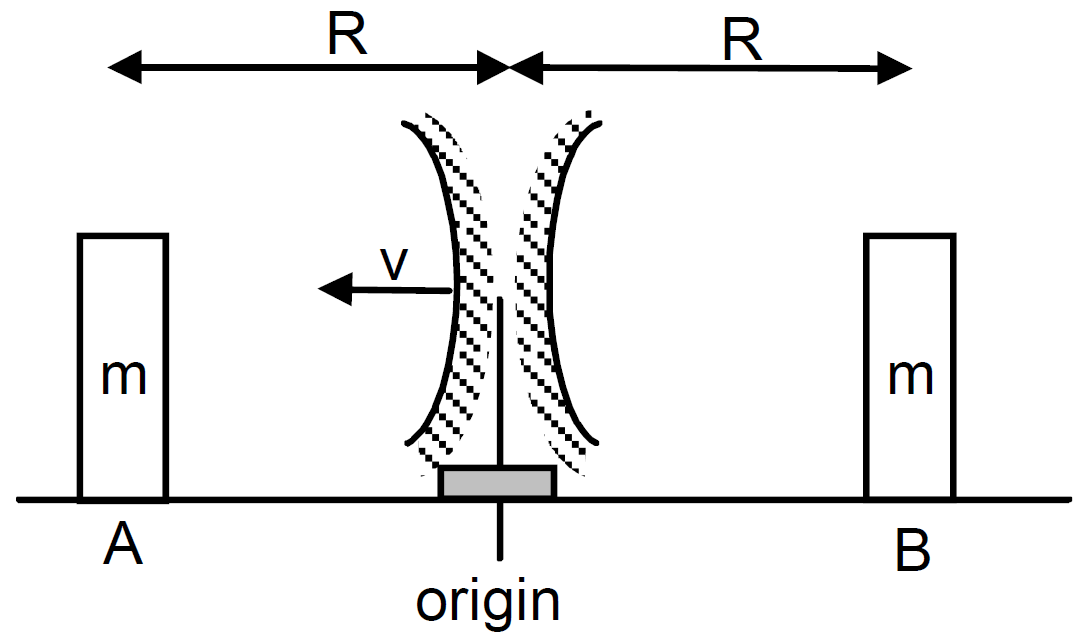
Two concave mirrors of equal radii of curvature R are fixed on a stand facing opposite directions. The whole system has a mass m and is kept on a frictionless horizontal table.

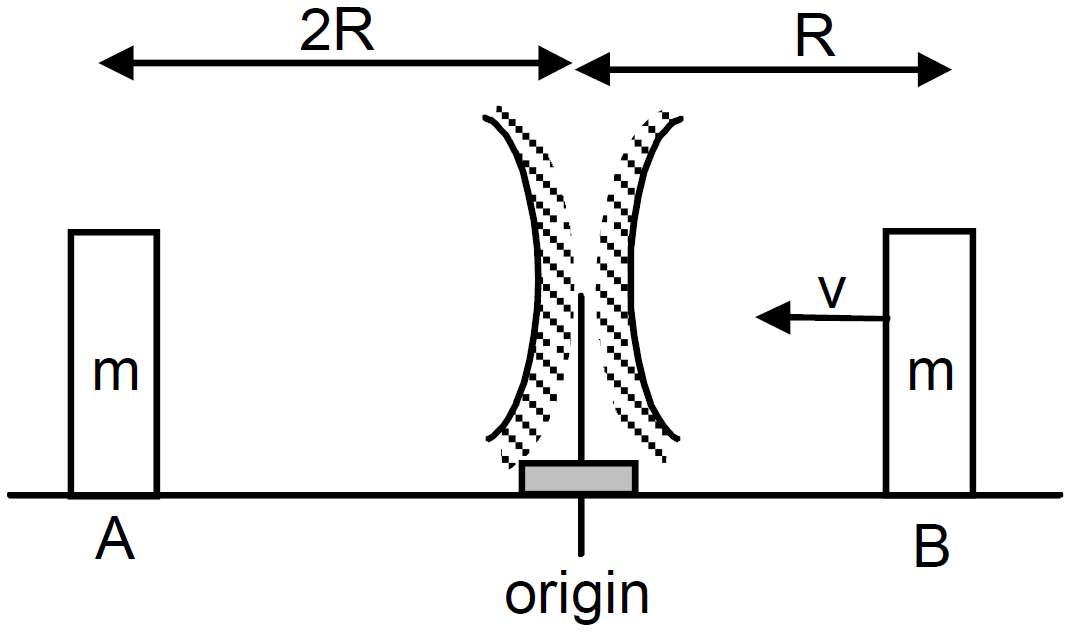
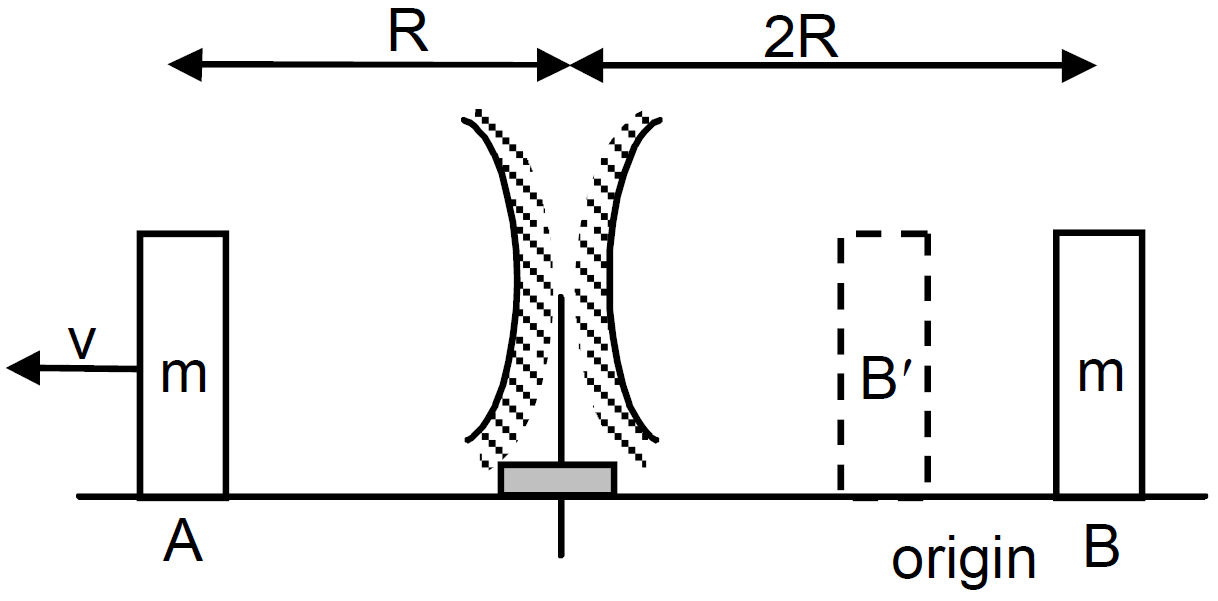
Two blocks A and B, each of mass m, are placed on the two sides of the stand. At t = 0, the separation between A and the mirrors is 2 R and also the separation between B and the mirrors is 2 R. The block B moves towards the mirror at a speed v. All collisions which take place are elastic. Taking the original position of the mirrors-stand system to be x = 0 and X-axis along AB, find the position of the images of A and B at t =
  1. $\frac{\text{R}}{\text{v}}$
  2. $\frac{3\text{R}}{\text{v}}$
  3. $\frac{5\text{R}}{\text{v}}$
Answer
  1. In time, $\text{t}=\frac{\text{R}}{\text{V}}$ the mass B must have moved $\Big(\text{v}\times\frac{\text{R}}{\text{v}}\Big)=\text{R}$ closer to the mirror stand
So,

For the block B:

$\text{u}=-\text{R}, \ \text{f}=-\frac{\text{R}}{2}$

$\therefore \ \frac{1}{\text{v}}=\frac{1}{\text{f}}-\frac{1}{\text{u}}=-\frac{2}{\text{R}}+\frac{1}{\text{R}}=-\frac{1}{\text{R}}$

$\Rightarrow\text{v}=-\text{R}$ at the same place

For the block A:

$\text{u}=-2\text{R}, \ \text{f}=-\frac{\text{R}}{2}$

$\therefore \ \frac{1}{\text{v}}=\frac{1}{\text{f}}-\frac{1}{\text{u}}=-\frac{2}{\text{R}}+\frac{1}{2\text{R}}=\frac{-3}{2\text{R}}$

$\Rightarrow\text{v}=\frac{-2\text{R}}{3}$ image of A at $\frac{2\text{R}}{3}$ from PQ in the x-direction.

So, with respect to the given coordinate system,

$\therefore$ Position of A and B are $\frac{-2\text{R}}{3},$ R respectively from origin.
  1. When $\text{t}=\frac{3\text{R}}{\text{v}},$ the block B after colliding with mirror stand must have come to rest (elastic collision) and the mirror have travelled a distance R towards left form its initial position.
So, at this point of time,

For block A:

$\text{u}=-\text{R}, \ \text{f}=-\frac{\text{R}}{2}$

Using lens formula, v = -R (from the mirror),

So, position xA = -2R (from origin of coordinate system)

For block B:

Image is at the same place as it is R distance from mirror.

Hence, position of image is ‘0’.

Distance from PQ (coordinate system)

$\therefore$ positions of images of A and B are = -2R, 0 from origin.
  1. Similarly, it can be proved that at time $\text{t}=\frac{5\text{R}}{\text{v}},$
The position of the blocks will be -3R and $-\frac{4\text{R}}{3}$ respectively.
View full question & answer
Question 1155 Marks
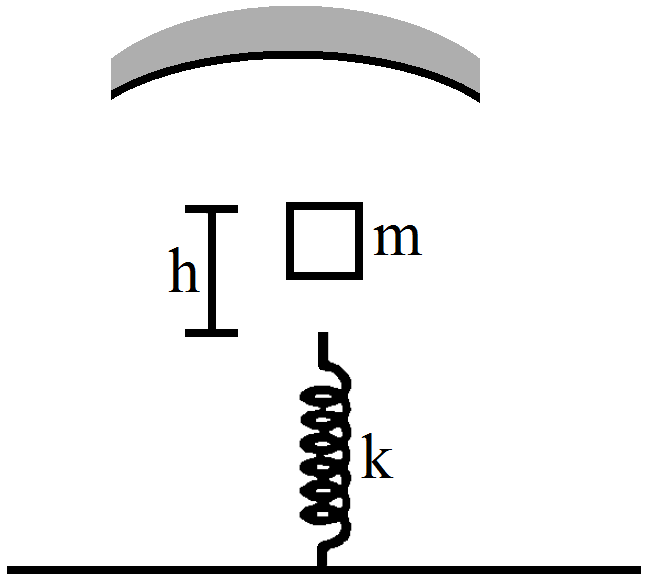
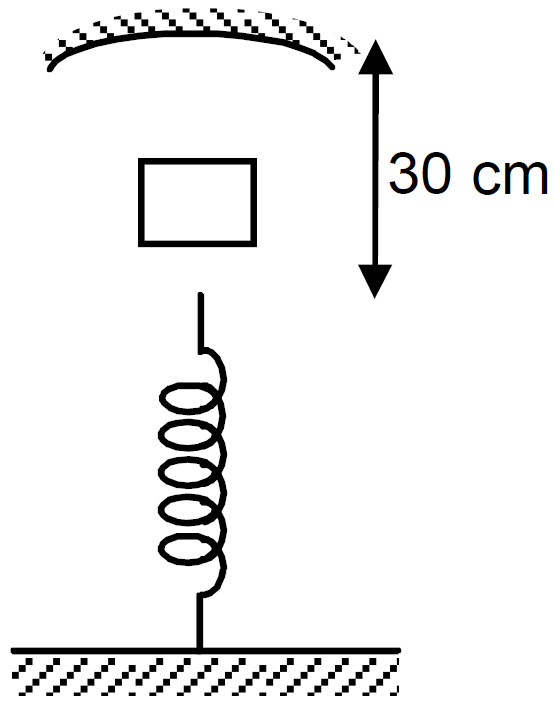
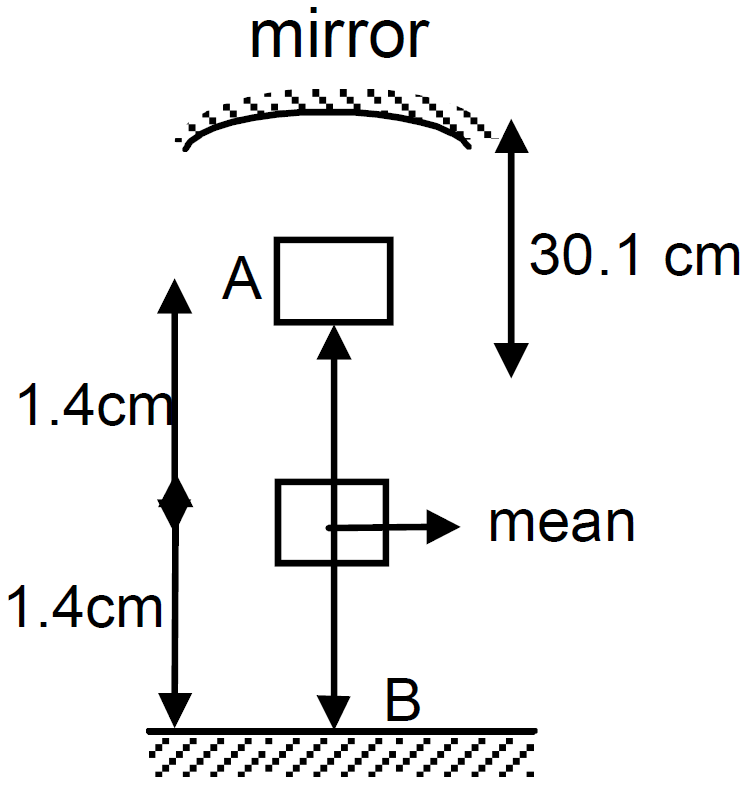
A mass m = 50g is dropped on a vertical spring of spring constant 500N/m from a height h = 10cm as shown in figure. The mass sticks to the spring and executes simple harmonic oscillations after that. A concave mirror of focal length 12cm facing the mass is fixed with its principal axis coinciding with the line of motion of the mass, its pole being at a distance of 30cm from the free end of the spring. Find the length in which the image of the mass oscillates.
Answer

Due to weight of the body suppose the spring is compressed by which is the mean position of oscillation.
$m = 50 \times 10^{-3}kg, g = 10ms^{-2}, k = 500Nm^{-2}, h = 10cm = 0.1m$
For equilibrium, $\text{mg}=\text{kx}\Rightarrow\text{x}=\frac{\text{mg}}{\text{k}}=10^{-3}\text{m}=0.1\text{cm}$
So, the mean position is at 30 + 0.1 = 30.1cm from P (mirror).
Suppose, maximum compression in spring is $\delta.$
Since, E.K.E. - I.K.E. = Work done
$\Rightarrow0-0=\text{mg}(\text{h}+\delta)-\frac{1}{2}\text{k}\delta^2$ (work energy principle)
$\Rightarrow\text{mg}(\text{h}+\delta)-\frac{1}{2}\text{k}\delta^2\Rightarrow50\times10^{-3}\times10(0.1+\delta)-\frac{1}{2}500\delta^2$
So, $\delta=\frac{0.5\pm\sqrt{0.25+50}}{2\times250}=0.015\text{m}=1.5\text{cm}$

Amplitude of the vibration $= 31.5 - 30.1 - 1.4.$
Position A is $30.1 - 1.4 = 28.7cm$ from pole.
For A $u = -31.5, f = -12cm$
$\therefore \ \frac{1}{\text{v}}=\frac{1}{\text{f}}-\frac{1}{\text{u}}=-\frac{1}{12}+\frac{1}{31.5}$
$\Rightarrow\text{V}_{\text{A}}=-19.38\text{cm}$
For B $ f = -12cm, u = -28.7cm$
$\frac{1}{\text{v}}=\frac{1}{\text{f}}-\frac{1}{\text{u}}=-\frac{1}{12}+\frac{1}{28.7}$
$\Rightarrow \ \text{V}_\text{B}=-20.62\text{cm}$
The image vibrates in length $(20.62 - 19.38) = 1.24cm.$
View full question & answer
Question 1165 Marks
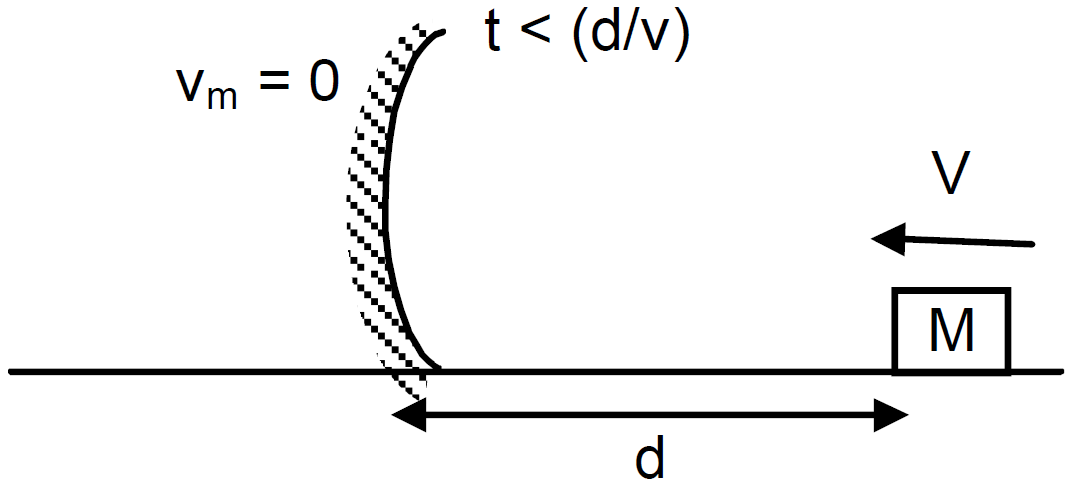
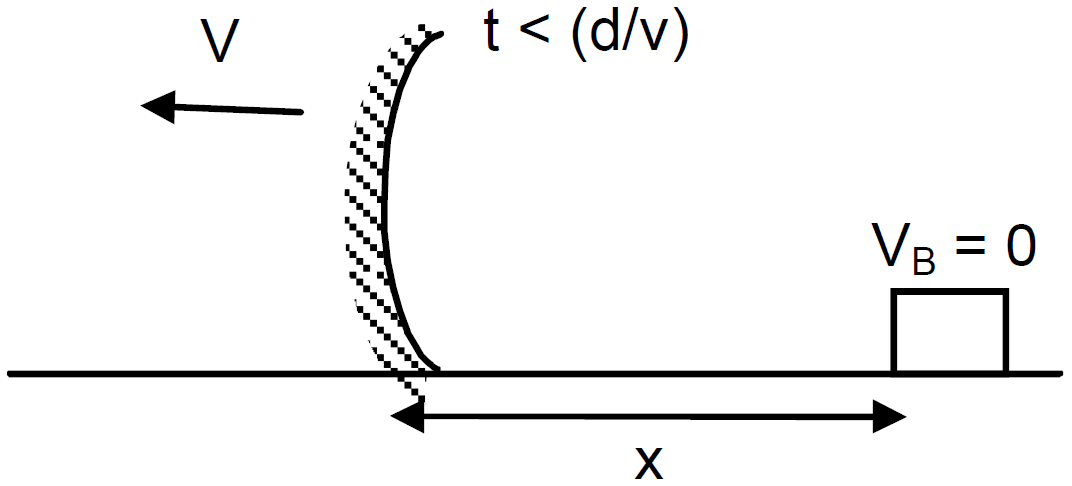
A small block of mass m and a concave mirror of radius R fitted with a stand lie on a smooth horizontal table with a separation d between them. The mirror together with its stand has a mass m. The block is pushed at t = 0 towards the mirror so that it starts moving towards the mirror at a constant speed V and collides with it. The collision is perfectly elastic. Find the velocity of the image:
  1. At a time $\text{t}<\frac{\text{d}}{\text{V}}$
  2. At a time $\text{t}>\frac{\text{d}}{\text{V}}.$
Answer
  1. When $\text{t}<\frac{\text{d}}{\text{V}},$ the object is approaching the mirror
As derived in the previous question,
$\text{V}_{\text{image}}=\frac{\text{Velocity of object}\times\text{R}^2}{\big[2\times\text{distance between them}-\text{R}\big]^2}$
$\Rightarrow\text{V}_{\text{image}}=\frac{\text{V}\text{R}^2}{\big[2\big(\text{d}-\text{Vt}\big)-\text{R}\big]^2}$ [At any time, x = d - Vt]
  1. After a time $\text{t}<\frac{\text{d}}{\text{V}},$ there will be a collision between the mirror and the mass.
As the collision is perfectly elastic, the object (mass) will come to rest and the mirror starts to move away with same velocity V.
At any time $\text{t}>\frac{\text{d}}{\text{V}},$ the distance of the mirror from the mass will be
$\text{x}=\text{V}\Big(\text{t}-\frac{\text{d}}{\text{V}}\Big)=\text{Vt}-\text{d}$
Here, $\text{u}=-\big(\text{Vt}-\text{d}\big)=\text{d}-\text{Vt}; \ \text{f}=-\frac{\text{R}}{2}$
So, $\frac{1}{\text{v}}+\frac{1}{\text{u}}=\frac{1}{\text{f}}\Rightarrow\frac{1}{\text{v}}=\frac{1}{\text{d}-\text{Vt}}+\frac{1}{\big(-\frac{\text{R}}{2}\big)}=-\Big[\frac{\text{R}+2(\text{d}-\text{Vt})}{\text{R}(\text{d}-\text{Vt})}\Big]$
$\Rightarrow\text{v}=-\Big[\frac{\text{R}(\text{d}-\text{Vt})}{\text{R}-2(\text{d}-\text{Vt})}\Big]= $ Image distance
So, Velocity of the image will be,
$\text{V}_{\text{image}}=\frac{\text{d}}{\text{dt}}$ (Image distance)
$=\frac{\text{d}}{\text{dt}}\Big[\frac{\text{R}(\text{d}-\text{Vt})}{\text{R}+2(\text{d}-\text{Vt})}\Big]$
Let, y = (d - Vt)
$\Rightarrow\frac{\text{dy}}{\text{dt}}=-\text{V}$
So, $\text{V}_{\text{image}}=\frac{\text{d}}{\text{dt}}\Big[\frac{\text{Ry}}{\text{R}+2\text{y}}\Big]=\frac{(\text{R}+2\text{y})\text{R}(-\text{V})-\text{Ry}(+2)(-\text{V})}{(\text{R}+2\text{y})^2}$
$=-\text{Vr}\Big[\frac{\text{R}+2\text{y}-2\text{y}}{(\text{R}+2\text{y})^2}\Big]=\frac{-\text{VR}^2}{(\text{R}+2\text{y})^2}$
Since, the mirror itself moving with velocity V,
Absolute velocity of image $=\text{V}\Big[1-\frac{\text{R}^2}{(\text{R}+2\text{y})^2}\Big]$ $($since, $V = V_{mirror}+ V_{image})$
$=\text{V}\Big[1-\frac{\text{R}^2}{[2(\text{Vt}-\text{d})-\text{R}^2}\Big]$
View full question & answer
Question 1175 Marks
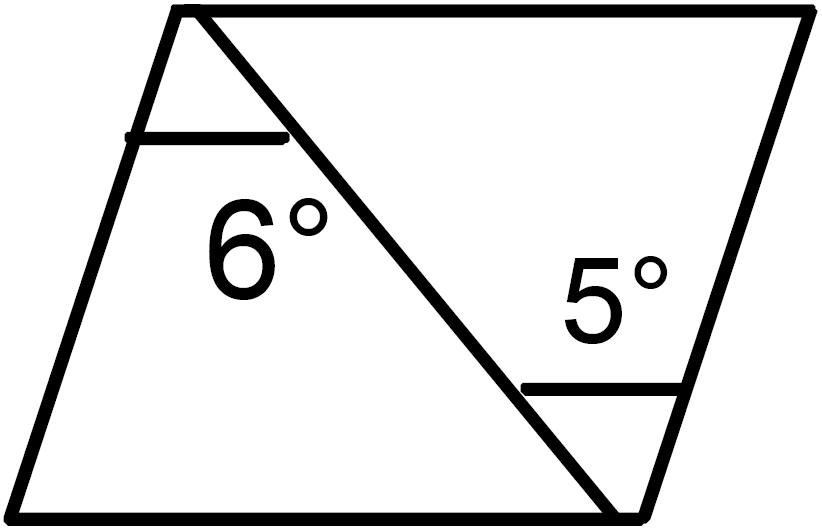
A thin prism of angle $6.0^\circ,\omega=0.07$ and $\mu_\text{y}=1.50$ is combined with another thin prism having $\omega=0.08$ and $\mu_\text{y}=1.60.$ The combination produces no deviation in the mean ray.
  1. Find the angle of the second prism.
  2. Find the net angular dispersion produced by the combination when a beam of white light passes through it.
  3. If the prisms are similarly directed, what will be the deviation in the mean ray
  4. Find the angular dispersion in the situation described in (c).
Answer
Given that, $\text{A}'=6^\circ,\ \omega'=0.07,\ \mu'_\text{y}=1.50$
$\text{A}=?\ \omega=0.08,\ \mu_\text{y}=1.60$
The combination produces no deviation in the mean ray.
  1. $\delta_\text{y}=(\mu_\text{y}-1)\text{A}-(\mu'_\text{y}-1)\text{A}'=0$ [Prism must be oppositely directed]


$\Rightarrow(1.60-1)\text{A}=(1.50-1)\text{A}'$

$\Rightarrow\text{A}=\frac{0.50\times6^\circ}{0.60}=5^\circ$
  1. When a beam of white light passes through it,
Net angular dispersion $=(\mu_\text{y}-1)\omega\text{A}-(\mu'_\text{y}-1)\omega'\text{A}'$

$\Rightarrow(1.60-1)(0.08)(5^\circ)-(1.50-1)(0.07)(6^\circ)$

$\Rightarrow0.24^\circ-0.21^\circ=0.03^\circ$
  1. If the prisms are similarly directed,


$\delta_\text{y}=(\mu_\text{y}-1)\text{A}+(\mu'_\text{y}-1)\text{A}$

$=(1.60-1)5^\circ+(1.50-1)6^\circ=3^\circ+3^\circ=6^\circ$
  1. Similarly, if the prisms are similarly directed, the net angular dispersion is given by,
$\delta_\text{v}-\delta_\text{r}=(\mu_\text{y}-1)\omega\text{A}-(\mu'\text{y}-1)\omega'\text{A}'$ $=0.24^\circ+0.21^\circ=0.45^\circ$
View full question & answer
Question 1185 Marks
With the help of a ray diagram, show the formation of image of a point object due to refraction of light at a spherical surface separating two media of refractive indices $n_1$ and $n_2 (n_2 > n_1)$ respectively. Using this diagram, derive the relation.
$\frac{\text{n}_2}{\text{v}}-\frac{\text{n}_1}{\text{u}}=\frac{\text{n}_1-\text{n}_2}{\text{R}}$
Write the sign conventions used. What happens to the focal length of convex lens when it is immersed in water?
Answer
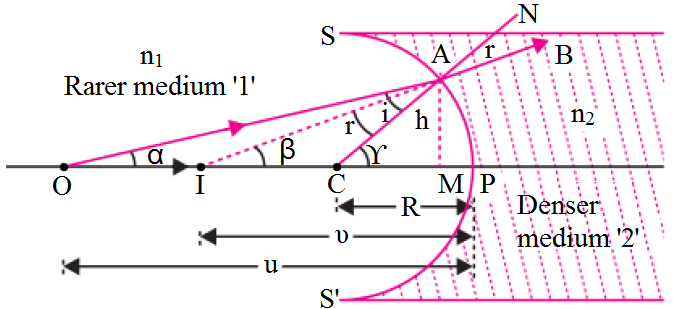
Formula for Refraction at Spherical Surface Concave Spherical Surface:Let SPS′ be a spherical refracting surface, which separates media '1' and '2'. Medium '1' is rarer and medium '2' is denser. The refractive indices of media '1' and '2' are $n_1$ and $n_2$ respectively $(n_1 < n_2)$ Let P be the pole and C the centre of curvature and PC the principal axis of spherical refracting surface.

O is a point-object on the principal axis. An incident ray OA, after refraction at A on the spherical surface bends towards the normal CAN and moves along AB. Another incident ray OP falls on the surface normally and hence passes undeviated after refraction. These two rays, when produced backward meet at point I on principal axis. Thus I is the virtual image of O. Let angle of incidence of ray OA be i and angle of refraction be r i.e.
$\angle\text{OAC} = \text{i}\text{ and } \angle\text{NAB}= \text {r}$
Let $\angle\text{AOP}=\alpha,\angle\text{AIP}=\beta\text{ and }\angle\text{ACP}=\gamma$
In triangle OAC, $\gamma=\alpha+\text{i}\text{ or}\text{ i}=\gamma-\text{a}\dots(\text{i})$
In triangle AIC, $\gamma=\beta+\text{i}\text{ or}\text{ i}=\gamma-\text{a}\dots(\text{ii})$
From Snell's law $\frac{\sin\text{i}}{\sin\text{r}}=\frac{\text{n}_2}{\text{n}_1}\dots(\text{iii})$
If point A is very near to P, then angles $\text{i},\text{r},\alpha,\beta\ \gamma$ will be very small, therefore $\sin \text{i} = \text{i} \text{ and }\sin \text{r} =\text{r}$
Substituting values of i and r from (i) and (ii) we get
$\frac{\gamma-\alpha}{\gamma-\beta}=\frac{\text{n}_2}{\text{n}_1}\text{ or }\text{n}_1(\gamma-\alpha)=\text{n}_2(\gamma-\beta)\dots(\text{iv})$
The length of perpendicular AM dropped from A on the principal axis is h i.e. AM = h. As angles $\alpha,\ \beta\ \text{and}\ \gamma$ are very small, therefore
$\tan\alpha=\alpha,\tan \beta=\beta,\gamma=\gamma$
Substituting these values in equation (iv)
$\text{n}_1(\tan\gamma-\tan\alpha)=\text{n}_2(\tan\gamma-\tan\beta)\dots(\text{v})$
As point A is very close to P, point M is coincident with P
$\tan\alpha=\frac{\text{perpendicular}}{\text{Base}}=\frac{\text{AM}}{\text{MO}}=\frac{\text{h}}{\text{PO}}$
$\tan\beta=\frac{\text{AM}}{\text{MI}}=\frac{\text{h}}{\text{PI}},$
$\tan\gamma=\frac{\text{AM}}{\text{MC}}=\frac{\text{h}}{\text{PC}}$
Substituting this value in (v), we get
$\text{n}_1\Big(\frac{\text{h}}{\text{PC}}-\frac{\text{h}}{\text{PO}}\Big)=\text{n}_2\Big(\frac{\text{h}}{\text{PC}}-\frac{\text{h}}{\text{PI}}\Big)$
$\text{or }\frac{\text{n}_1}{\text{PC}}-\frac{\text{n}_1}{\text{PC}}=\frac{\text{n}_2}{\text{PC}}-\frac{\text{n}_2}{\text{PI}}$
Let u, v and R be the distances of object O, image I and centre of curvature C from pole P. By sign convention PO, PI and PC are negative, i.e. u = -PO, v = -PI and R = -PC
Substituting these values in (vi), we get
$\frac{\text{n}_1}{(-\text{R})}-\frac{\text{n}_1}{(-\text{u})}=\frac{\text{n}_2}{(-\text{R})}-\frac{\text{n}_2}{(-\text{v})}$
$\text{or }\frac{\text{n}_2}{\text{v}}-\frac{\text{n}_1}{\text{u}}=\frac{\text{n}_2-\text{n}_1}{\text{R}}$
Sign Conventions:
  1. All the distances are measured from optical centre (P) of the lens.
  2. Distances measured in the direction of incident ray of light are taken positive and vice-versa.
As we know
$\frac{1}{\text{f}}=(\text{n}-1)\big[\frac{1}{\text{R}_1}-\frac{1}{\text{R}_2}\big]$
When convex lens is immersed in water, refractive index n decreases and hence focal length will increase i.e., the focal length of a convex lens increases when it is immersed in water.
View full question & answer
5 Marks Questions - Page 3 - Physics STD 12 Science Questions - Vidyadip