Question 515 Marks
A gravitational lens may be assumed to have a varying width of the form
$\text{w}(\text{b})=\text{k}_1\text{ In }\Big(\frac{\text{k}_2}{\text{b}}\Big)\ \ \text{b}_\text{min}<\text{b}<\text{b}_\text{max}$
$=\text{k}_1\text{ In }\Big(\frac{\text{k}_2}{\text{b}_\text{min}}\Big)\ \ \text{b}<\text{b}_\text{min}$
Show that an observer will see an image of a point object as a ring about the center of the lens with an angular radius
$\beta=\sqrt{\frac{(\text{n}-1)\text{k}_1\frac{\text{u}}{\text{v}}}{\text{u}+\text{v}}}$
$\text{w}(\text{b})=\text{k}_1\text{ In }\Big(\frac{\text{k}_2}{\text{b}}\Big)\ \ \text{b}_\text{min}<\text{b}<\text{b}_\text{max}$
$=\text{k}_1\text{ In }\Big(\frac{\text{k}_2}{\text{b}_\text{min}}\Big)\ \ \text{b}<\text{b}_\text{min}$
Show that an observer will see an image of a point object as a ring about the center of the lens with an angular radius
$\beta=\sqrt{\frac{(\text{n}-1)\text{k}_1\frac{\text{u}}{\text{v}}}{\text{u}+\text{v}}}$
Answer
View full question & answer→It this case, differentiating expression of time taken t w.r.t.b.
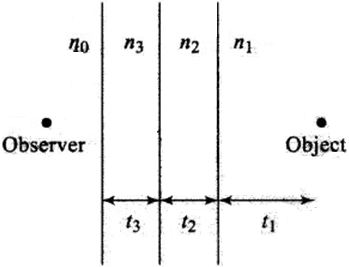
$\text{t}=\frac{1}{\text{c}}\bigg(\text{u}+\text{v}+\frac{1}{2}\frac{\text{b}^2}{\text{D}}+(\text{n}-1)\text{k}_1\text{ In }\Big(\frac{\text{k}_2}{\text{b}}\Big)\bigg)$
$\frac{\text{dt}}{\text{db}}=0=\frac{\text{b}}{\text{D}}-(\text{n}-1)\frac{\text{k}_1}{\text{b}}$
$\Rightarrow\ \text{b}^2=(\text{n}-1)\text{k}_1\text{D}$
$\therefore\ \text{b}=\sqrt{(\text{n}-1)\text{k}_1\text{D}}$
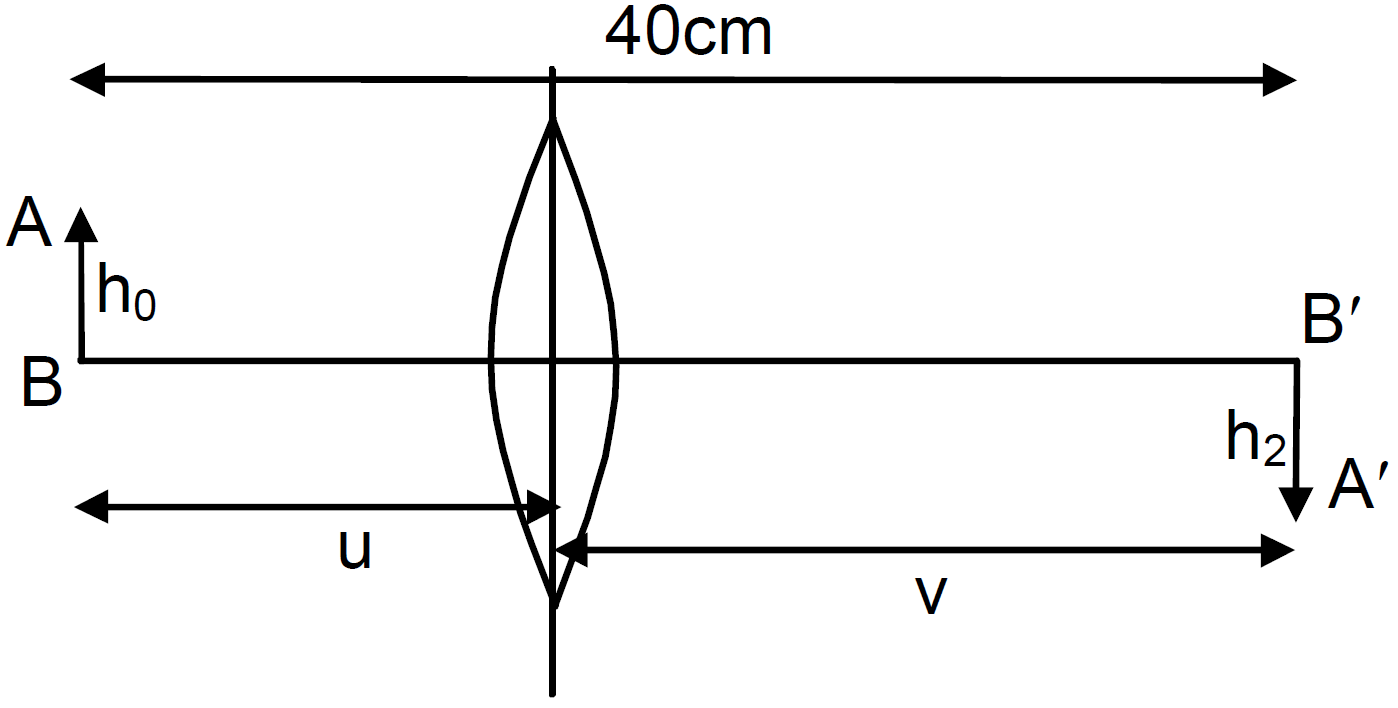
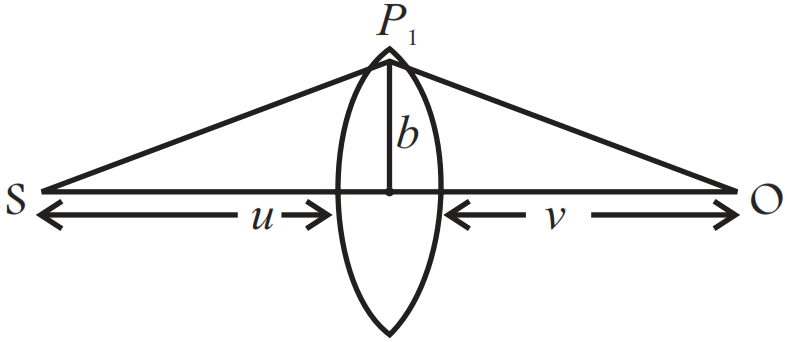
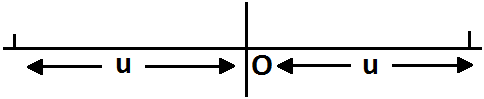
Thus, all rays passing at a height b shall contribute to the image. They ray paths make an angle.
$\beta=\frac{\text{b}}{\text{v}}=\frac{\sqrt{(\text{n}-1)\text{k}_1\text{D}}}{\text{v}}=\sqrt{\frac{(\text{n}-1)\text{k}_1\text{uv}}{\text{v}^2(\text{u}+\text{v})}}=\sqrt{\frac{(\text{n}-1)\text{k}_1\text{u}}{(\text{u}+\text{v})\text{v}}}$. This is the required expression.
$\text{t}=\frac{1}{\text{c}}\bigg(\text{u}+\text{v}+\frac{1}{2}\frac{\text{b}^2}{\text{D}}+(\text{n}-1)\text{k}_1\text{ In }\Big(\frac{\text{k}_2}{\text{b}}\Big)\bigg)$
$\frac{\text{dt}}{\text{db}}=0=\frac{\text{b}}{\text{D}}-(\text{n}-1)\frac{\text{k}_1}{\text{b}}$
$\Rightarrow\ \text{b}^2=(\text{n}-1)\text{k}_1\text{D}$
$\therefore\ \text{b}=\sqrt{(\text{n}-1)\text{k}_1\text{D}}$
Thus, all rays passing at a height b shall contribute to the image. They ray paths make an angle.
$\beta=\frac{\text{b}}{\text{v}}=\frac{\sqrt{(\text{n}-1)\text{k}_1\text{D}}}{\text{v}}=\sqrt{\frac{(\text{n}-1)\text{k}_1\text{uv}}{\text{v}^2(\text{u}+\text{v})}}=\sqrt{\frac{(\text{n}-1)\text{k}_1\text{u}}{(\text{u}+\text{v})\text{v}}}$. This is the required expression.
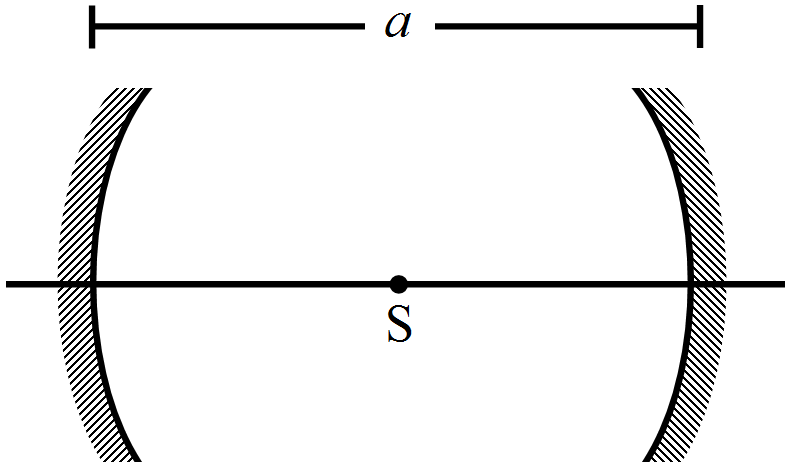
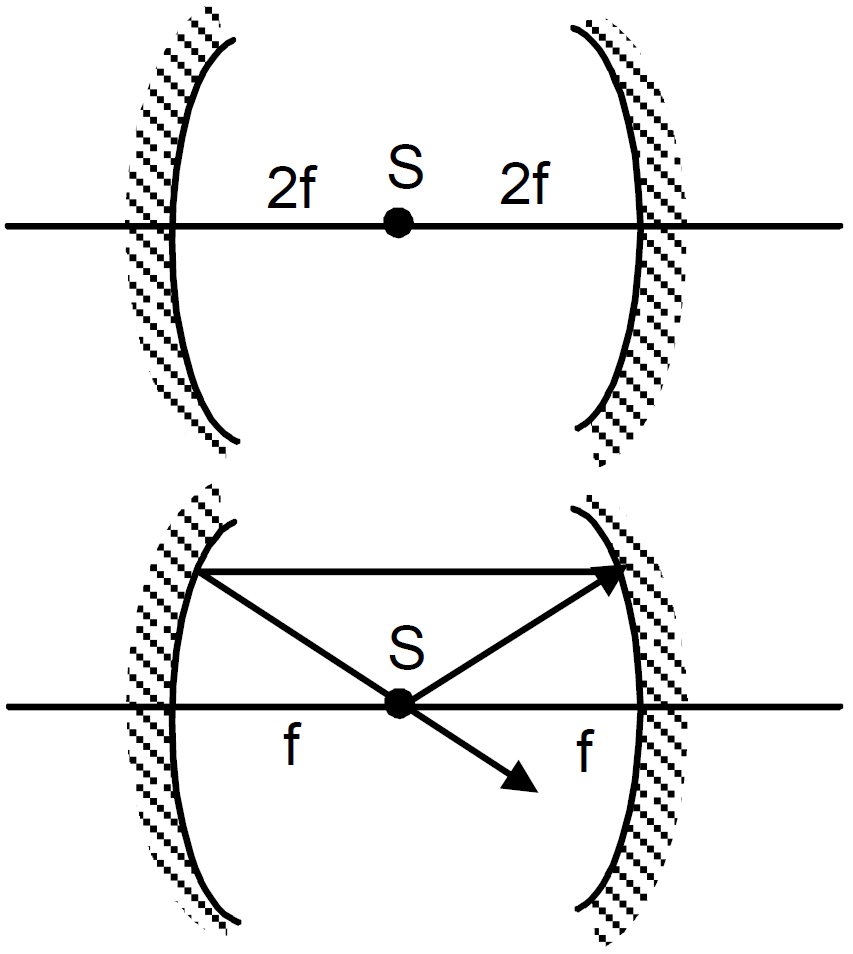 Both the mirrors have equal focal length f.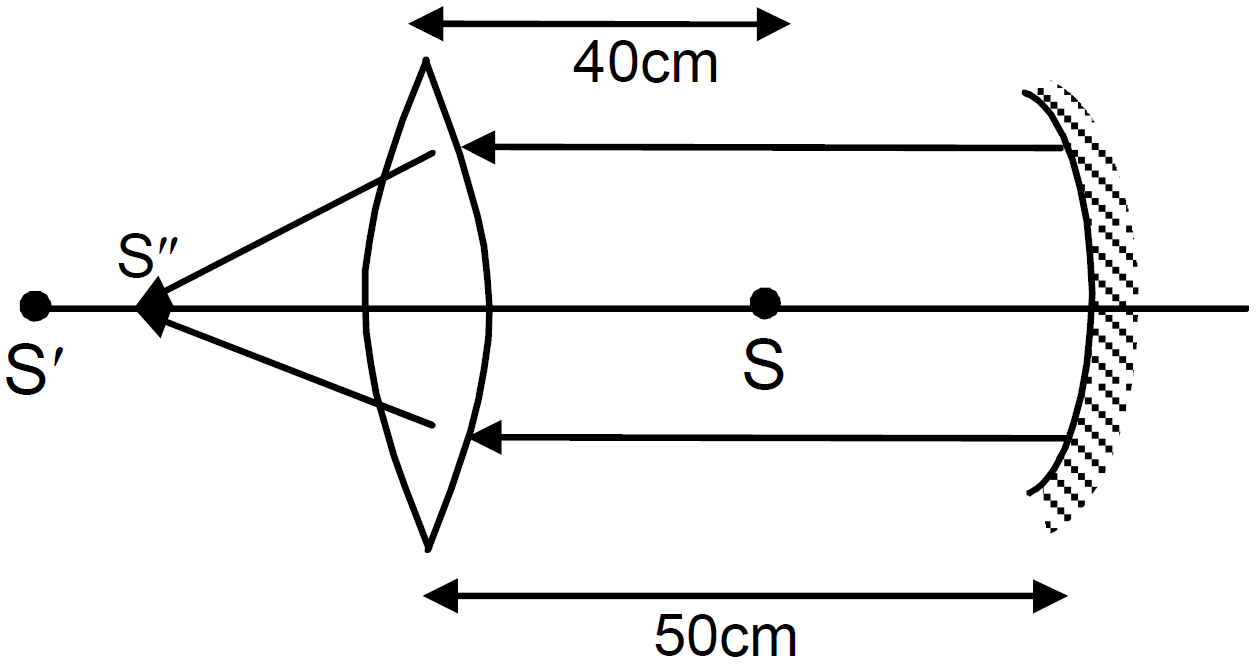
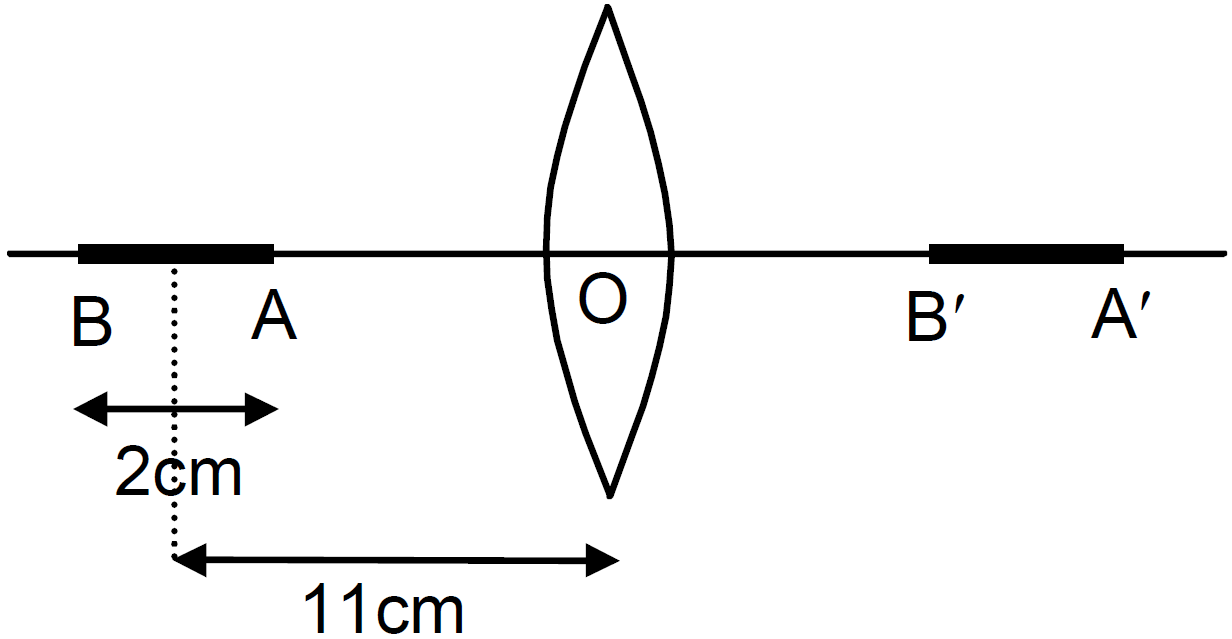
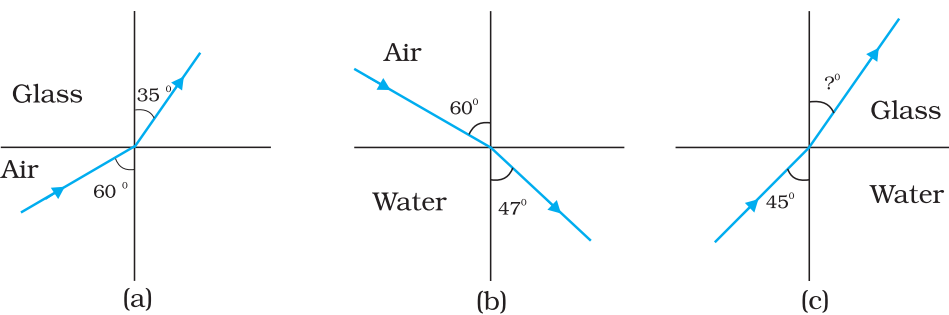
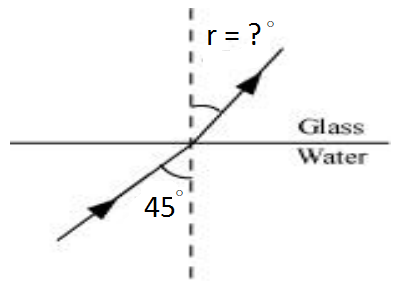
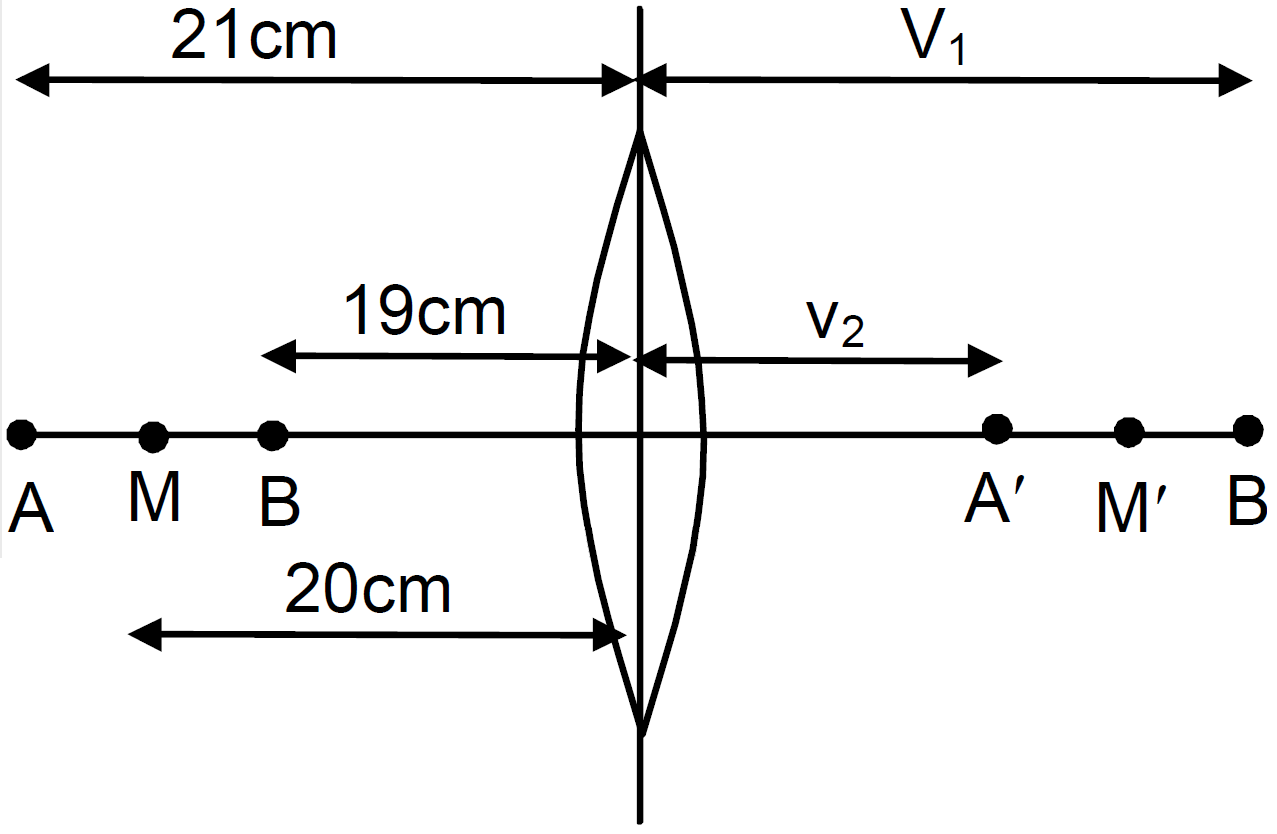
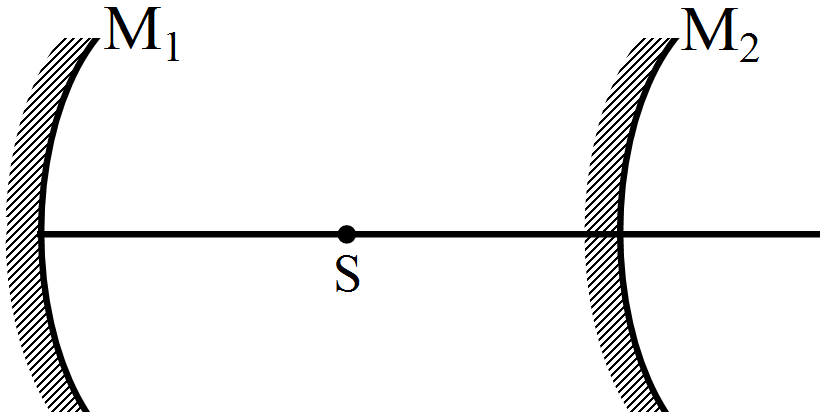
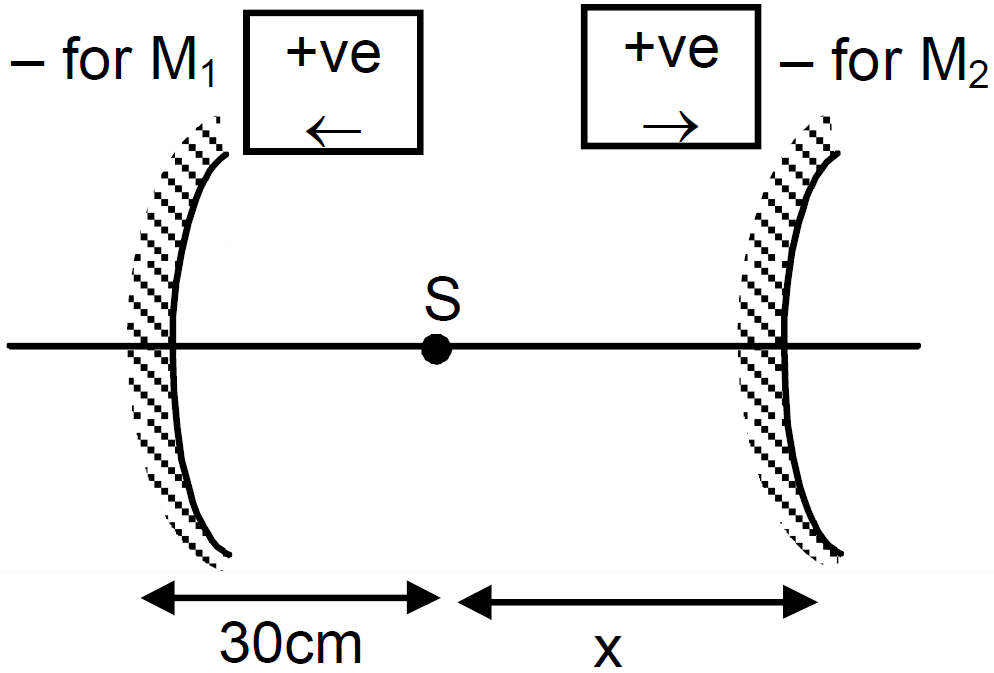
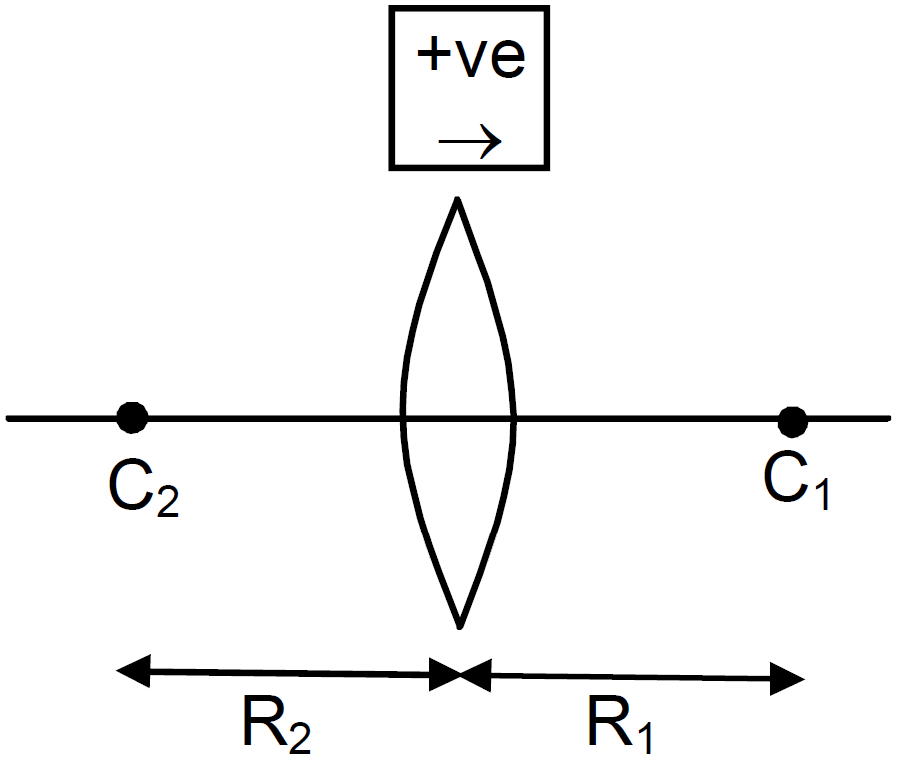
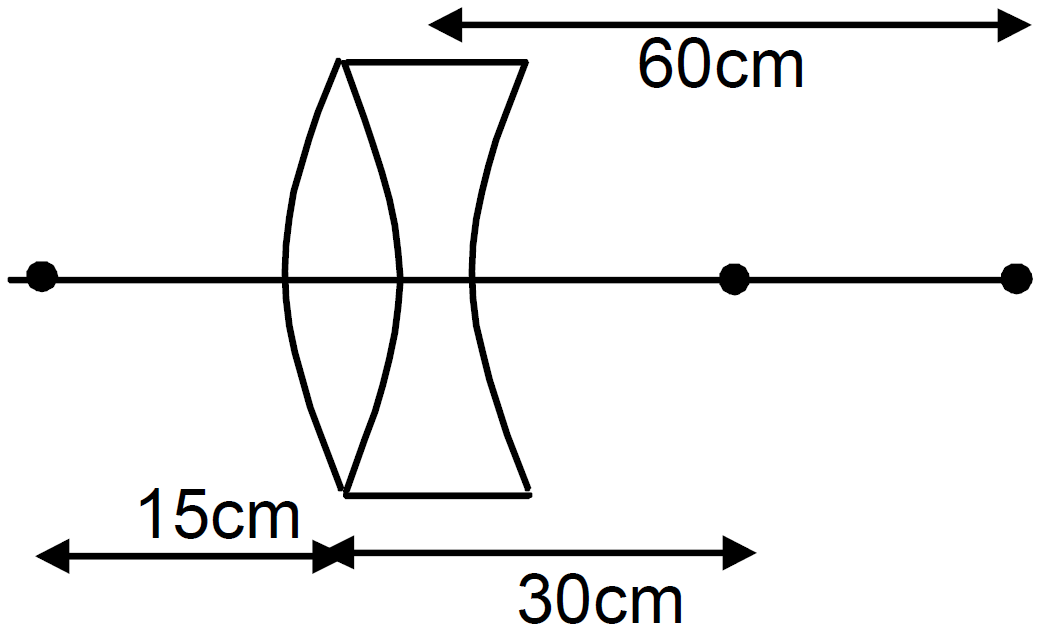
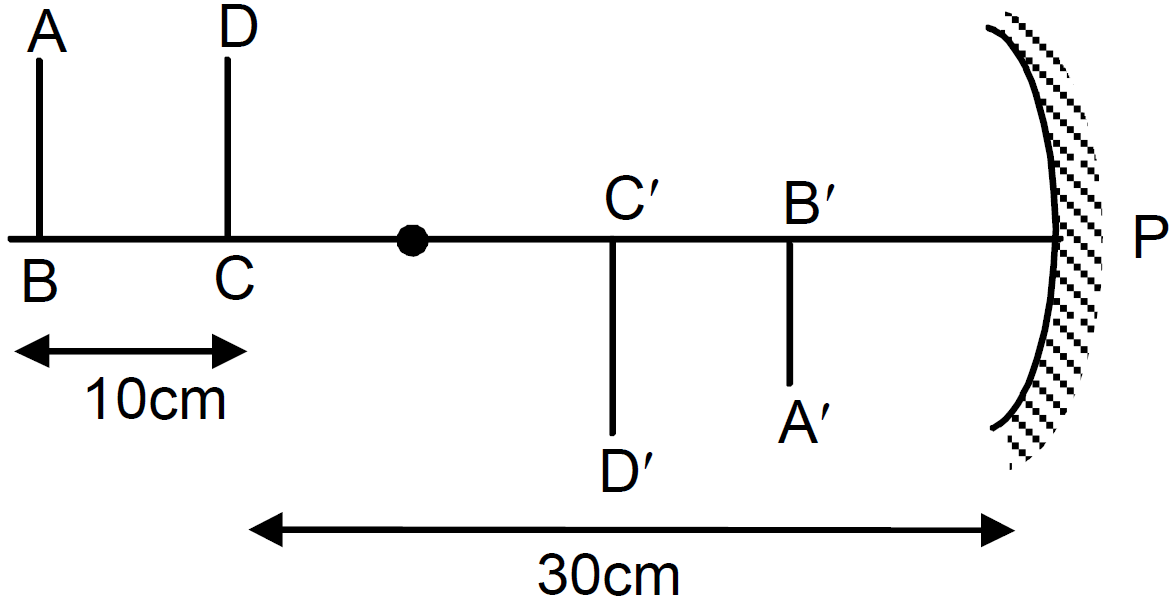
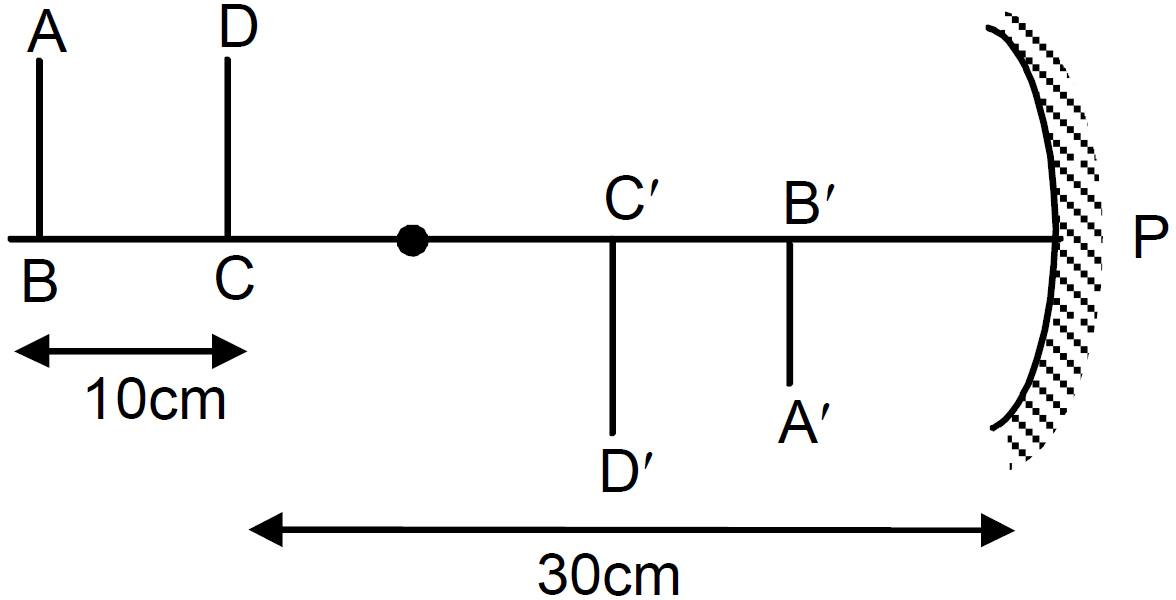 $\text{R}=20\text{cm}, \ \text{f}=\frac{\text{R}}{2}=-10\text{cm}$ For part AB, PB = 30 + 10 = 40cm So, $\text{u}=-40\text{cm}$$\Rightarrow\frac{1}{\text{v}}=\frac{1}{\text{f}}-\frac{1}{\text{u}}=-\frac{1}{10}-\Big(\frac{1}{-40}\Big)=-\frac{3}{40}$
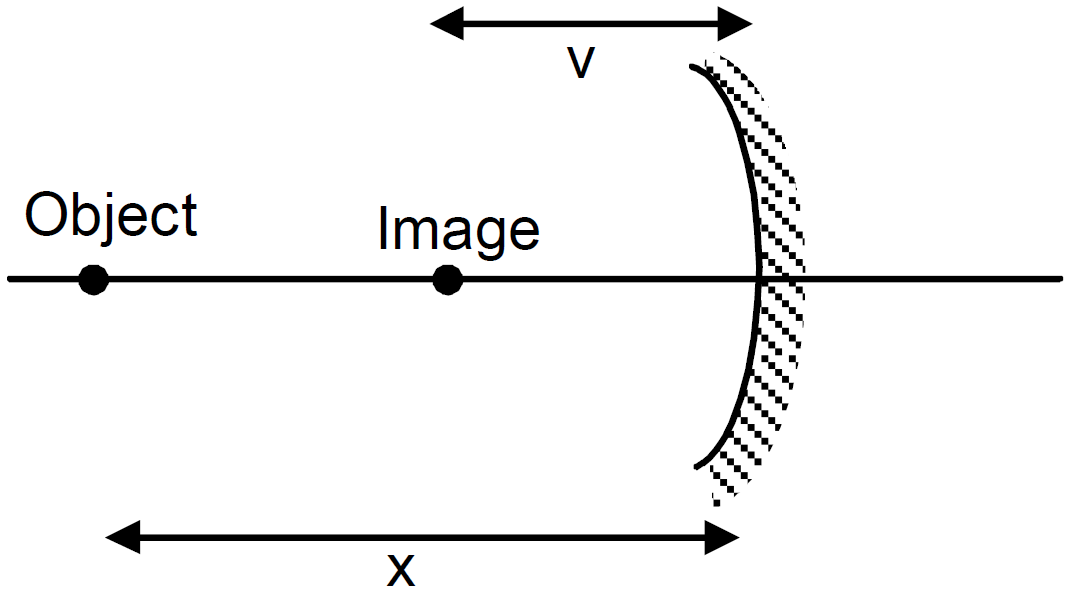
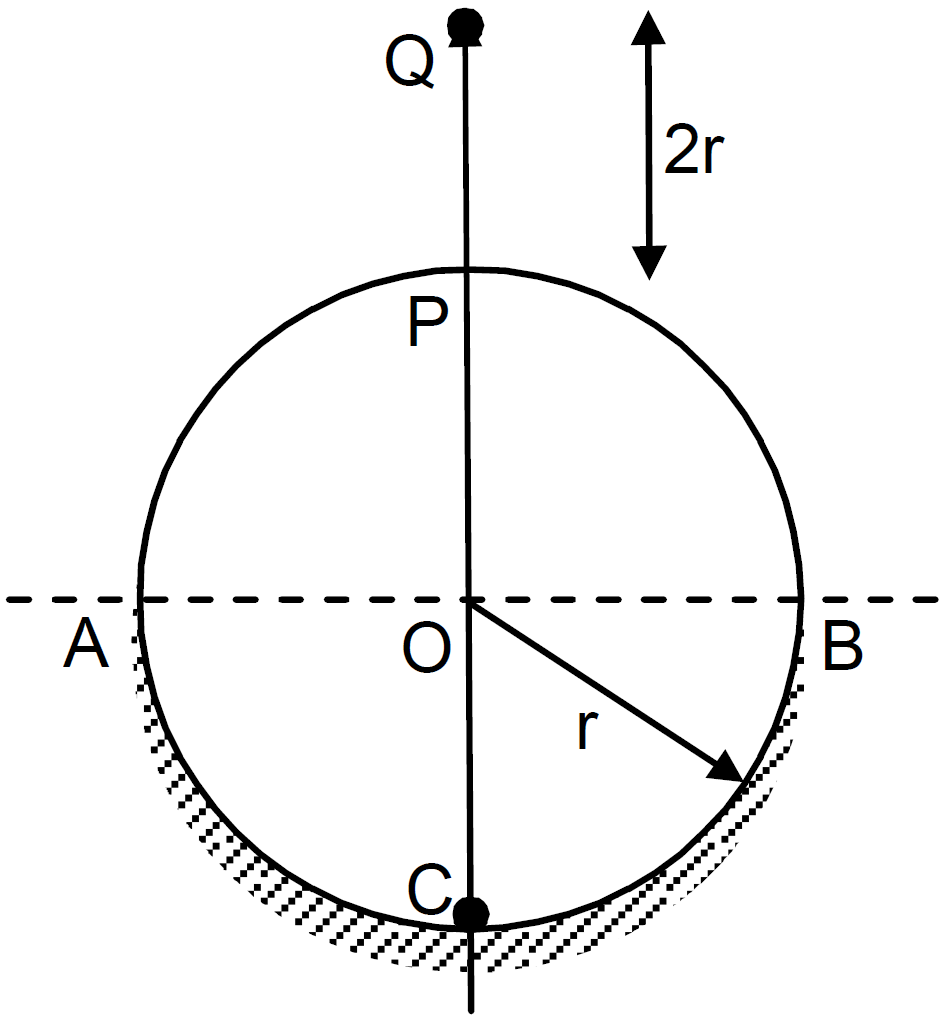
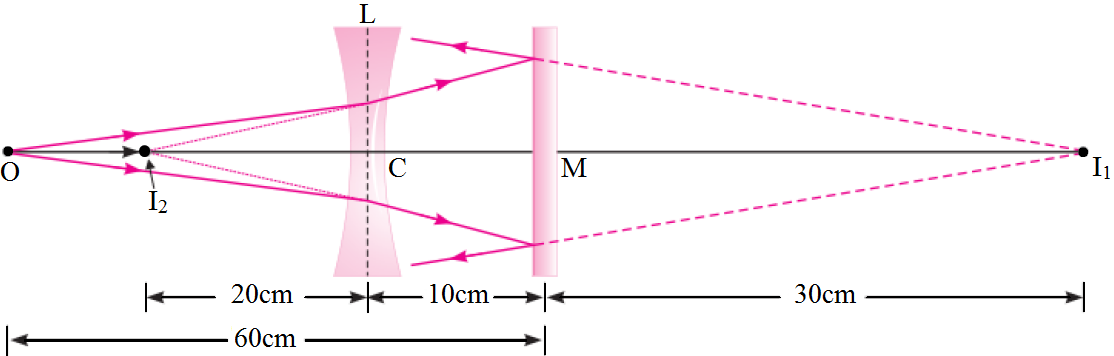
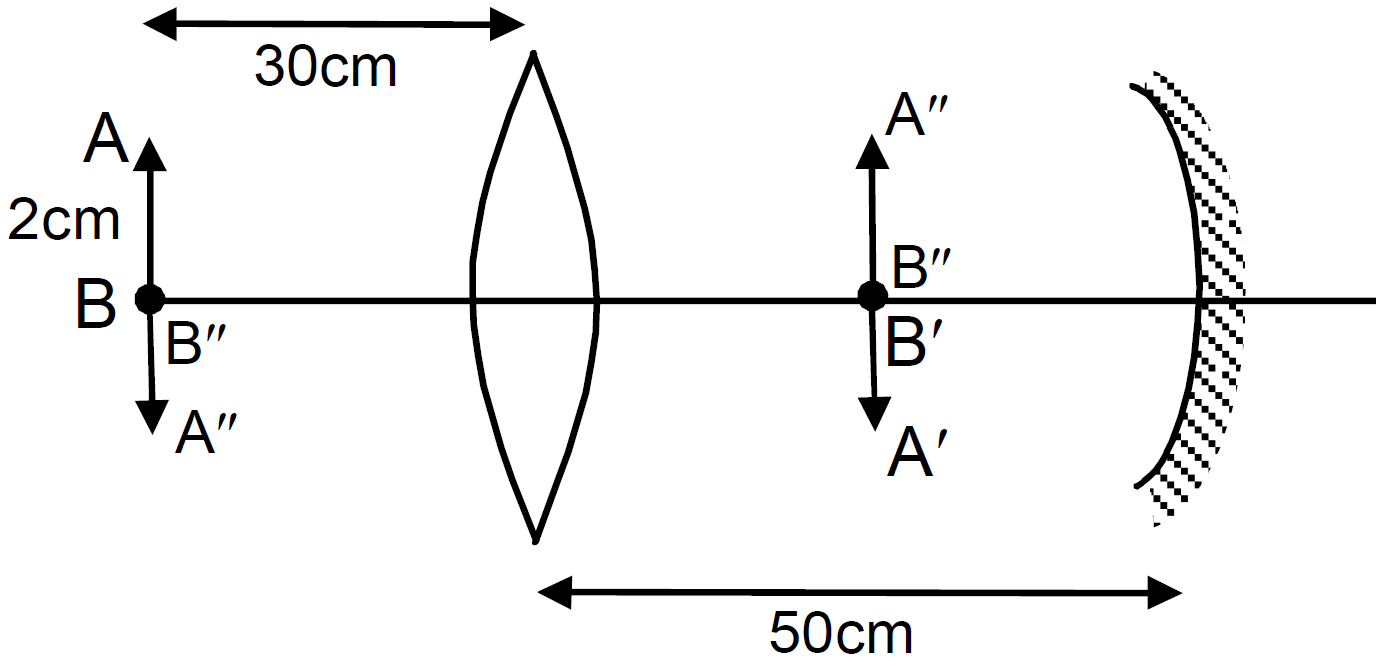
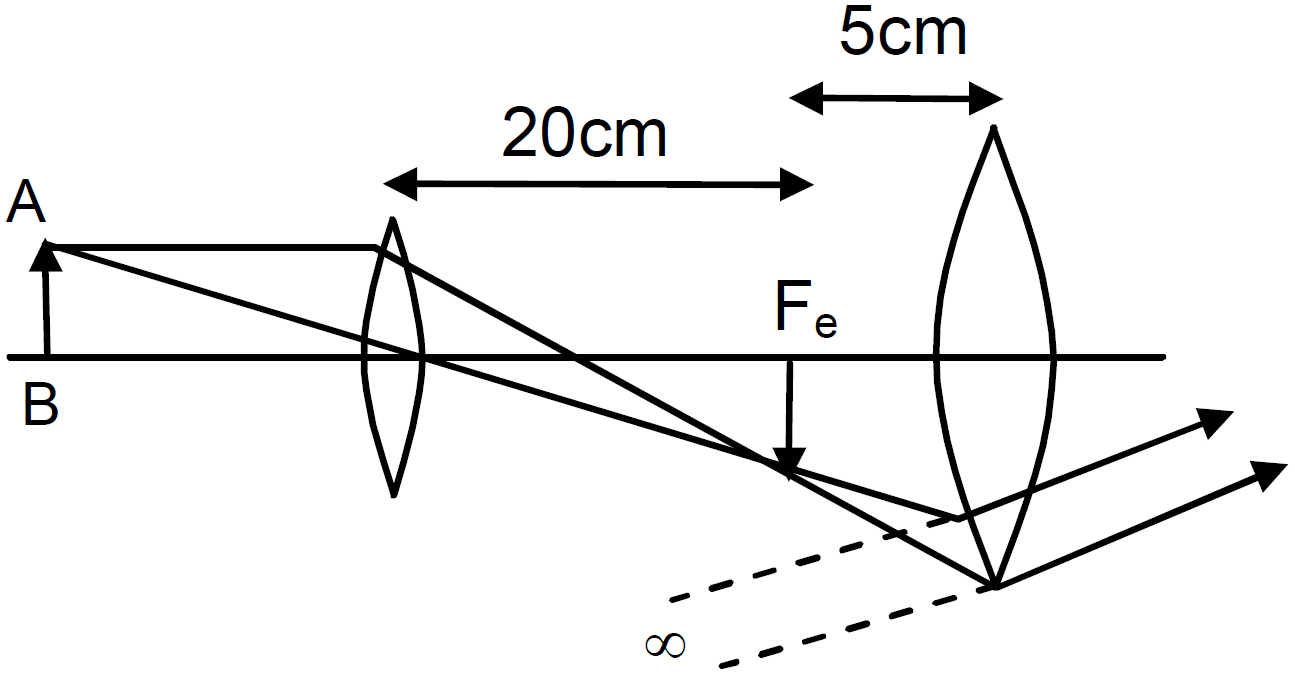
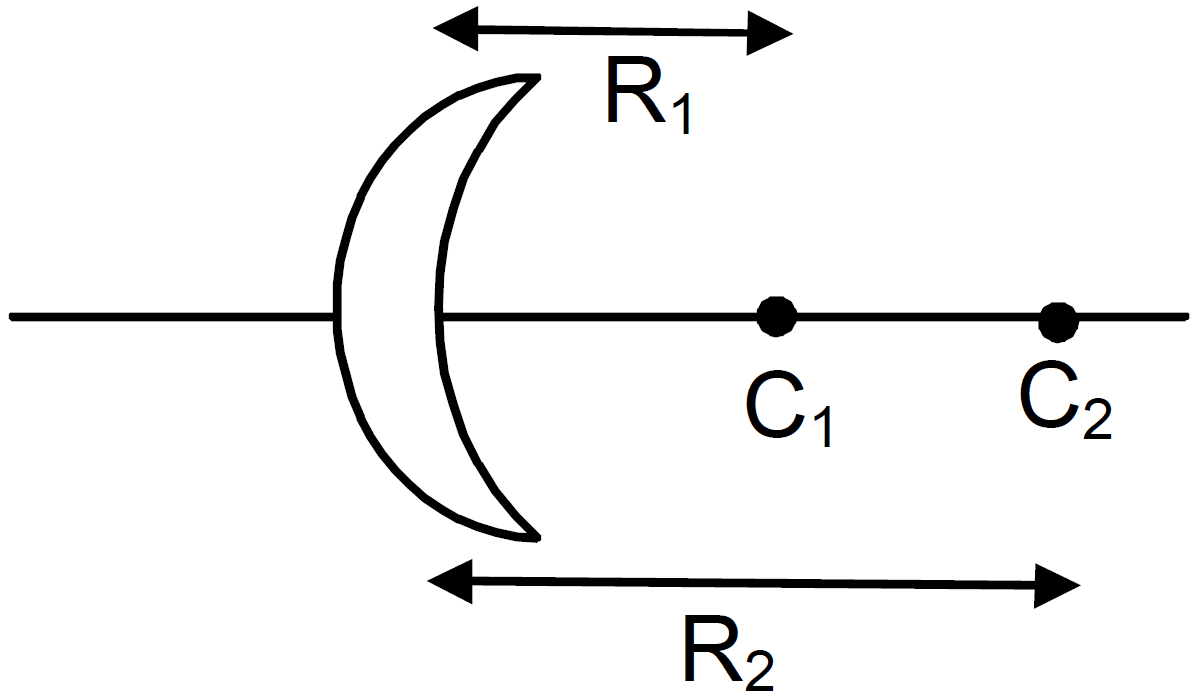
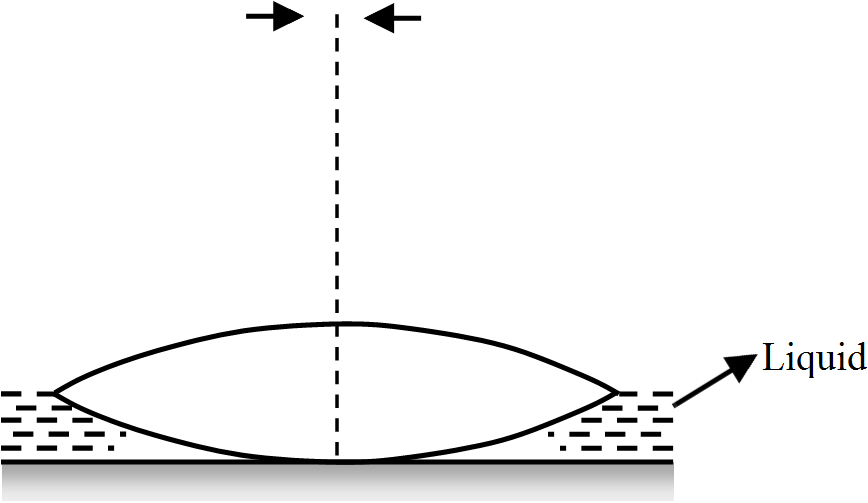
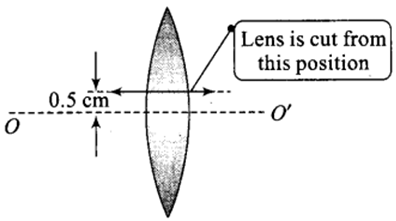 The top part is placed at (0, 0) and an object placed at (-50cm, 0). There is no effect on the lenght of the lens.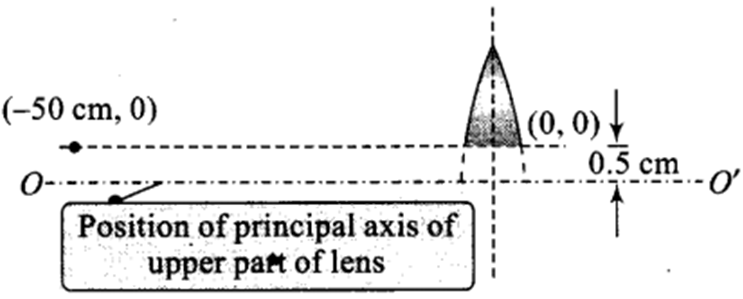
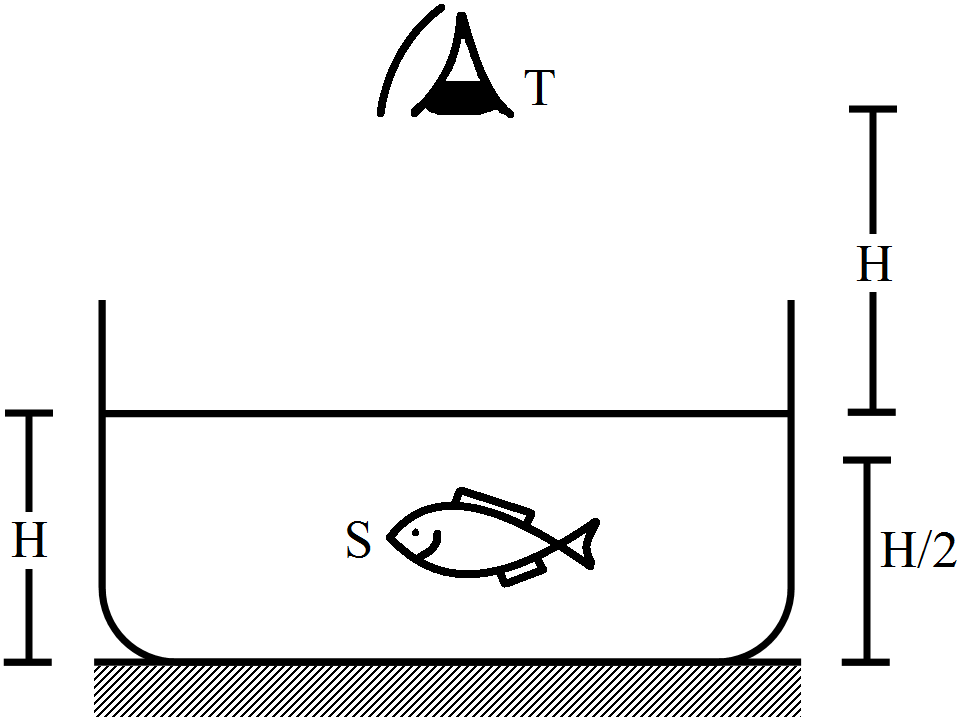
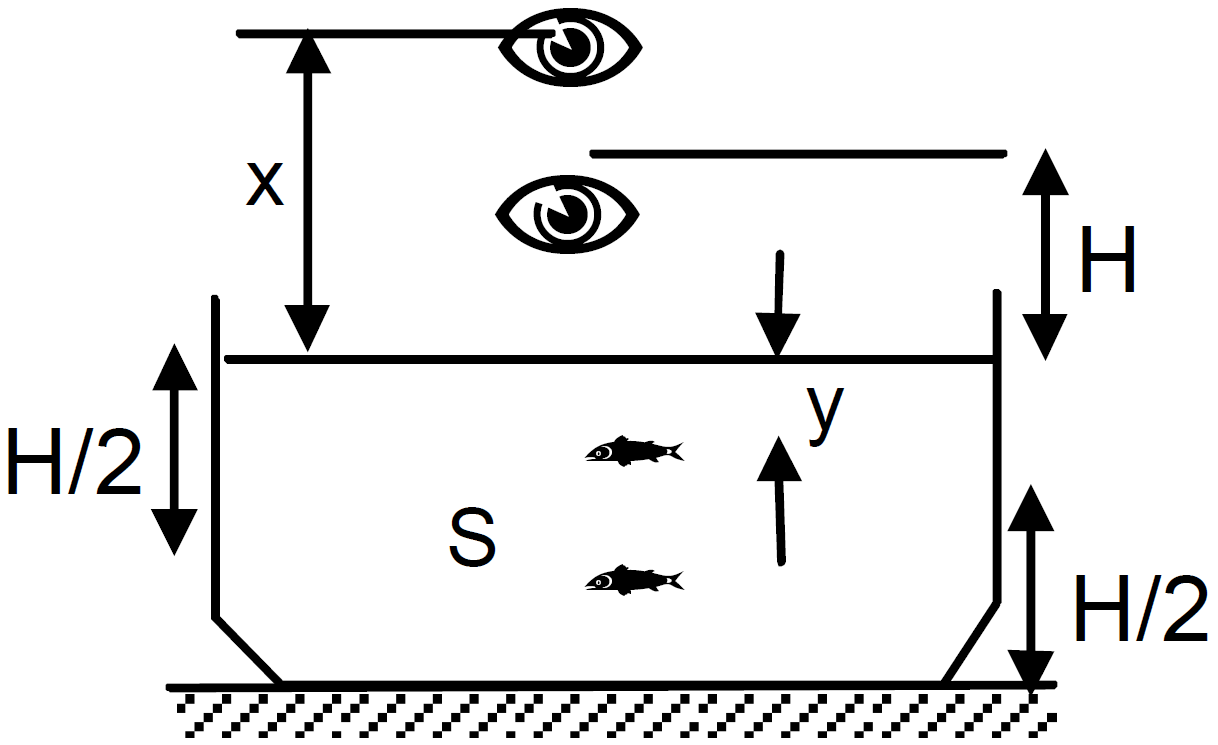
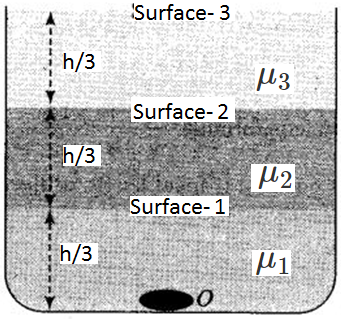
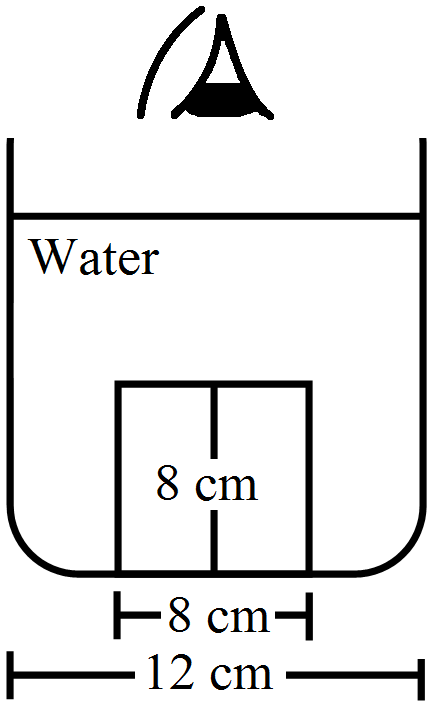
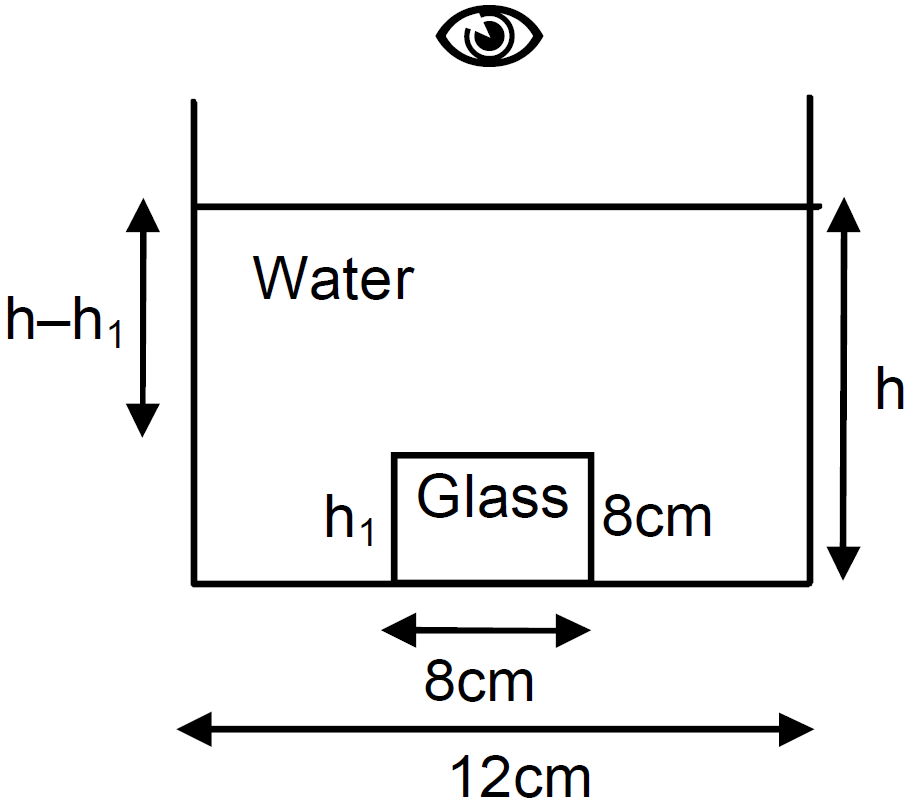
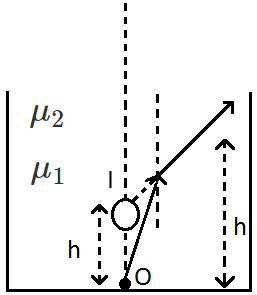 The position of image if O after refraction from surface-1. If seen from $\mu_2$ the apparent depth is $ h_1. \text{h}_1=-\frac{\mu_2}{\mu_1}\frac{\text{h}}{3}$ The nagative sign shows that it is on the side of the object.