Questions

5 Marks Questions

Take a timed test

44 questions · self-marked practice — reveal the answer and mark yourself.
Question 15 Marks
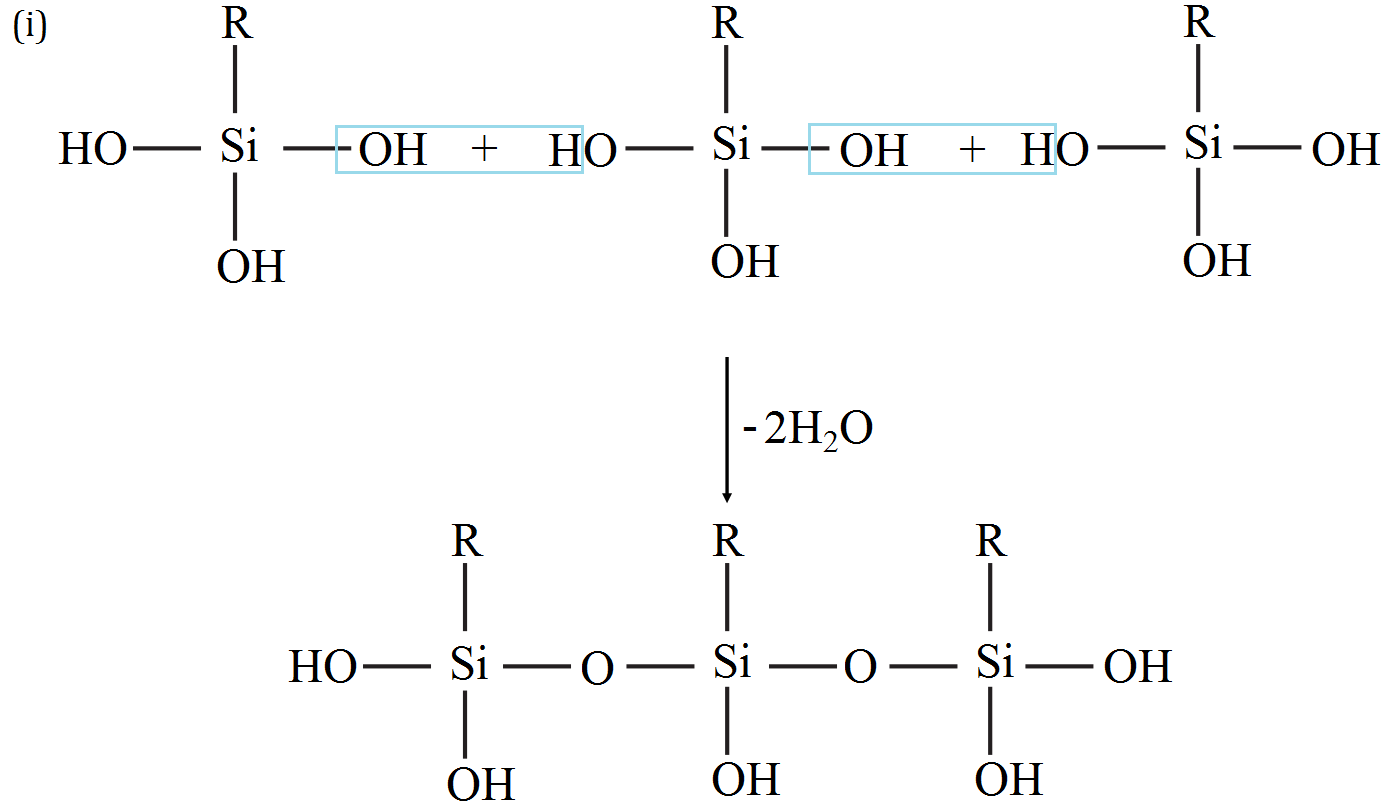
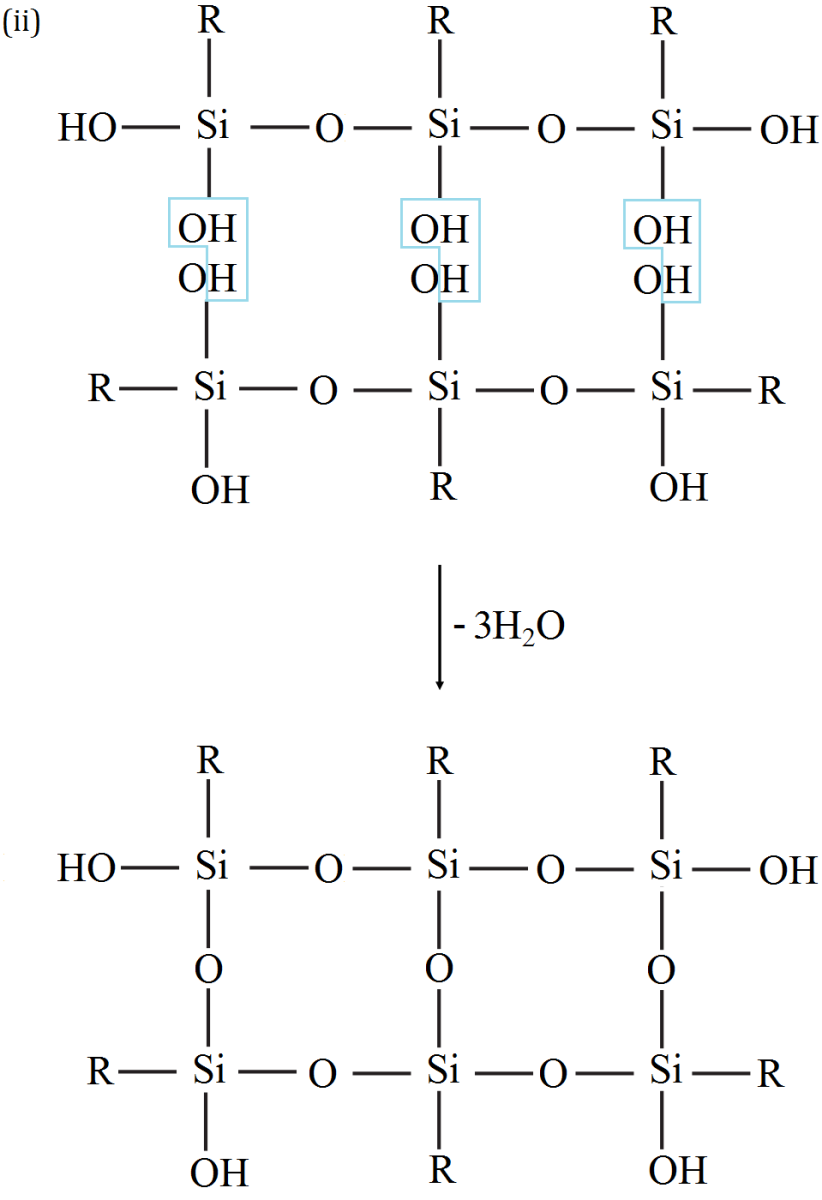
If the starting material for the manufacture of silicones is $RSiCl_3$, write the structure of the product formed.
Answer
$RSiCl_3 + 3H_2O → RSi(OH)_3 + 3HCl$

View full question & answer
Question 25 Marks
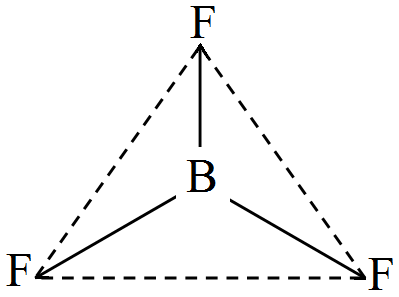
Why does boron triflouride behave as a Lewis acid?
Answer
The electric configuration of boron is $ns^2 np^1$. It has three electrons in its valence shell. Thus, it can form only three covalent bonds. This means that there are only six electrons around boron and its octet remains incomplete. When one atom of boron combines with three fluorine atoms, its octet remains incomplete. Hence, boron trifluoride remains electron-deficient and acts as a Lewis acid.
View full question & answer
Question 35 Marks
If B-Cl bond has a dipole moment, explain why $BCl_3$ molecule has zero dipole moment.
Answer
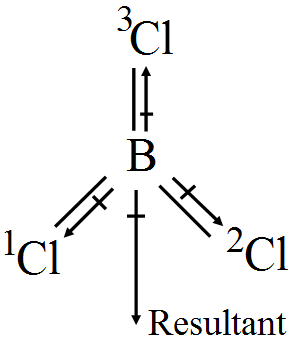
The dipole moment of any molecule is the vector sum total of each of the dipole moments. In $BCl_3$, molecule, although the B-Cl bonds individually are polar, the resultant dipole moment becomes zero.

We can see that the dipole moments of $B-^1Cl$ and $B-^2Cl$ produce a resultant which is equal in magnitude but opposite in direction to $B-^3Cl$ and hence cancels it out. That is why the net dipole moment of $BCl_3$, is zero.
View full question & answer
Question 45 Marks
What is the state of hybridisation of carbon in,
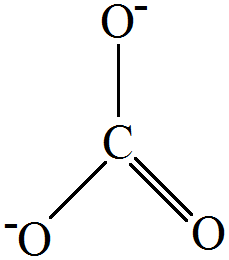
  1. $\text{CO}_3^{2-}$
  2. Diamond.
  3. Graphite.
Answer
  1. C in $\text{CO}_3^{2-}$ ion is $sp^2$ htpridised.
This can be explained as:
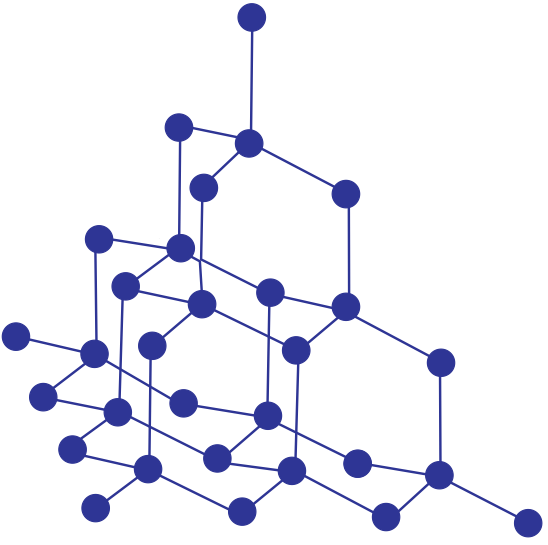
  1. Diamond: C is $sp^3$ hybridised in diamond. This gives it a tetrahedral structure rendering it hard.
  2. Graphite: C is $sp^2$​​​​​​​ hybridised in graphite. It forms 3 bonds with 3 other carbon atoms in the same plane while the fourth covalency is satisfied by $\pi$-bonding. These $\pi$-elements are delocalised over the whole sheet.
View full question & answer
Question 55 Marks
Explain the following reactions: Silicon is heated with methyl chloride at high temperature in the presence of copper.
Answer
When silicon reacts with methyl chloride in the presence of copper (catalyst) and at a temperature of about 537K, a class of organosilicon polymers called methyl-substituted chlorosilanes $(MeSiCl_3, Me_2SiCl_2, Me_3SiCl$, and $Me_4Si)$ are formed.
View full question & answer
Question 65 Marks
What are electron deficient compounds? Are $\mathrm{BCl}_3$ and $\mathrm{SiCl}_4$ electron deficient species? Explain.
Answer
In an electron-deficient compound, the octet of electrons is not complete, i.e., the central metal atom has an incomplete octet. Therefore, it needs electrons to complete its octet.
i. $\mathbf{B C l}_3: \mathrm{BCl}_3$ is an appropriate example of an electron-deficient compound. B has 3 valence electrons. After forming three covalent bonds with chlorine, the number of electrons around it increases to 6 . However, it is still short of two electrons to complete its octet.
ii. $\mathbf{S i C l}_4$ : The electronic configuration of silicon is $\mathrm{ns}^2 \mathrm{np}^2$. This indicates that it has four valence electrons. After it form four covalent bonds with four chlorine atoms, its electron count increases to eight. Thus, $\mathrm{SiCl}_4$ is not an electron-deficient compound.
View full question & answer
Question 75 Marks
Explain the difference in properties of diamond and graphite on the basis of their structures.
Answer
Diamond
Graphite
It has a crystalline lattice.
It has a layered structure.
In diamond, each carbon atom is $s p^3$ hybridised and is bonded to four other carbon atoms through a $\sigma$ bond.
In graphite, each carbon atom is $s p^2$ hybridised and is bonded to three other carbon atoms through a $\sigma$ bond. The fourth electron forms a $\pi$ bond.
It is made up of tetrahedral units.
It has a planar geometry.
The C-C bond length in diamond is 154pm.
The C-C bond length in graphite is 141.5pm.
It has a rigid covalent bond network which is difficult to break.
It is quite soft and its layers can be separated easily.
It acts as an electrical insulator.
It is a good conductor of electricity.
View full question & answer
Question 85 Marks
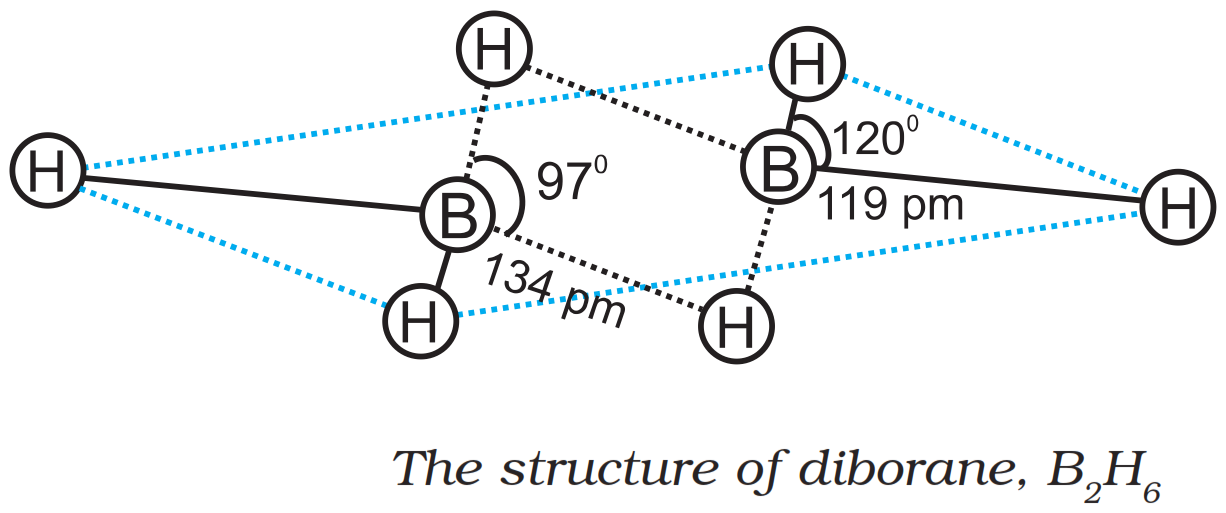
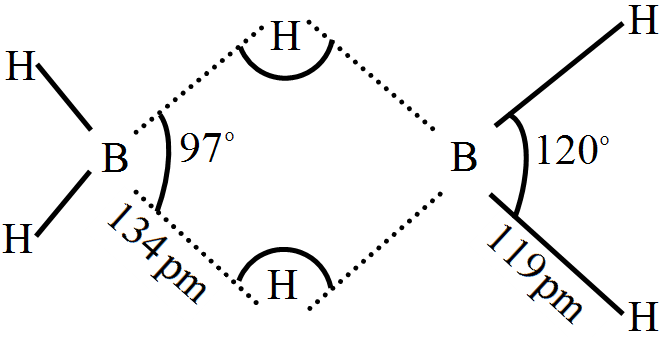
Explain structures of diborane.
Answer
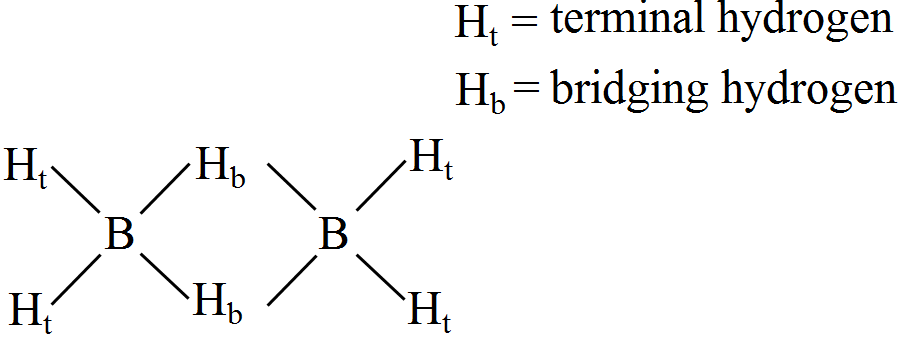
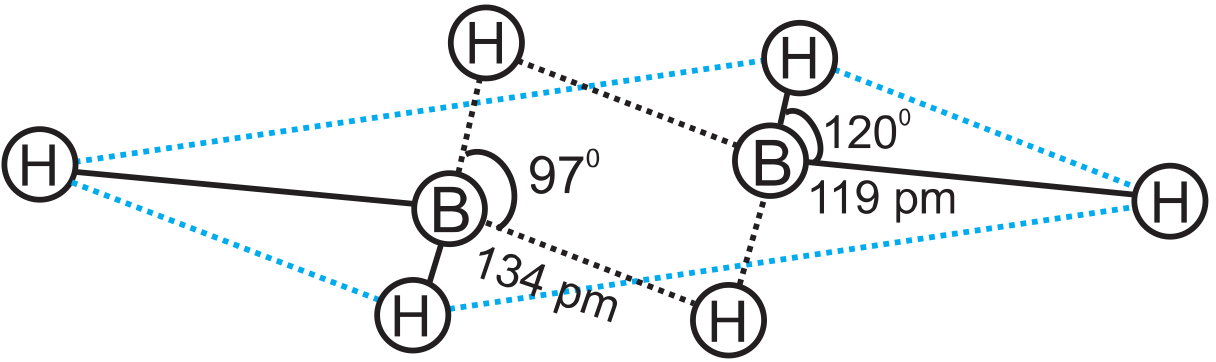
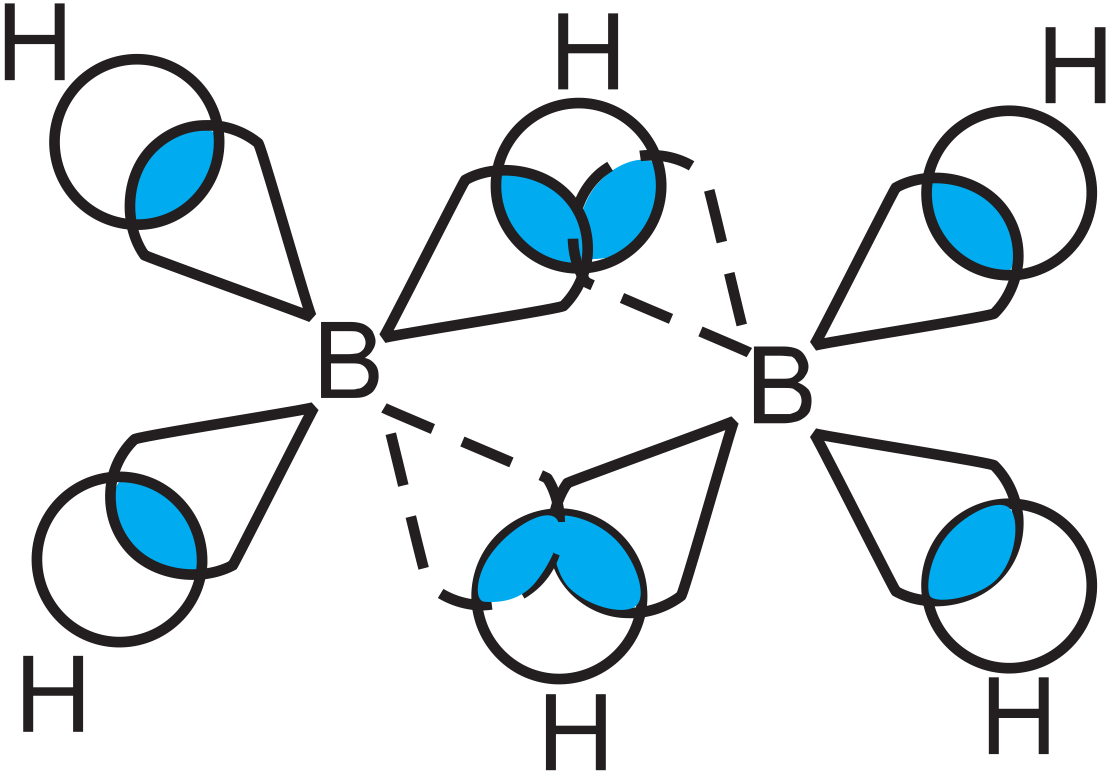
Diborane: $B_2H_6$ is an electron-deficient compound. $B_2H_6$ has only 12 electrons $-6e^-$ from 6 H atoms and $3e^-$ each from 2B atoms. Thus, after combining with 3H atoms, none of the boron atoms has any electrons left. X-ray diffraction studies have shown the structure of diborane as:

2 boron and 4 terminal hydrogen atoms $(H_t)$ lie in one plane, while the other two bridging hydrogen atoms $(H_b)$ lie in a plane perpendicular to the plane of boron atoms. Again, of the two bridging hydrogen atoms, one H atom lies above the plane and the other lies below the plane. The terminal bonds are regular two-centre two-electron $(2c - 2e^-)$ bonds, while the two bridging (B-H-B) bonds are three-centre two-electron $(3c - 2e^-)$ bonds.
View full question & answer
Question 95 Marks
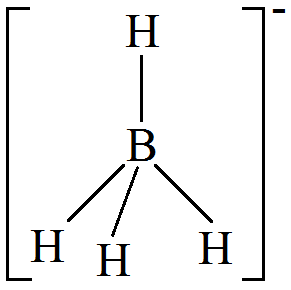
Describe the shapes of $BF_3$ and $\text{BH}_4^-$. Assign the hybridisation of boron in these species.
Answer
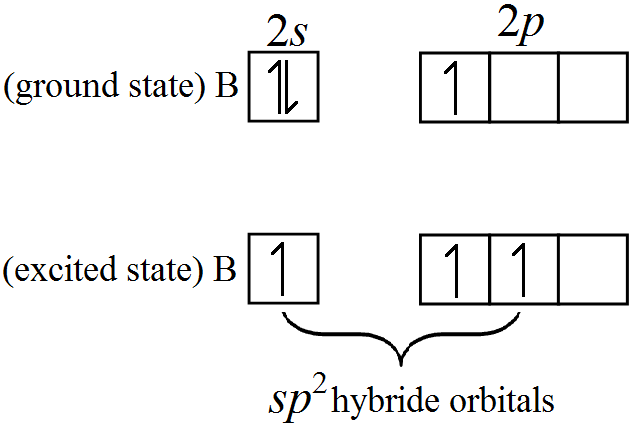
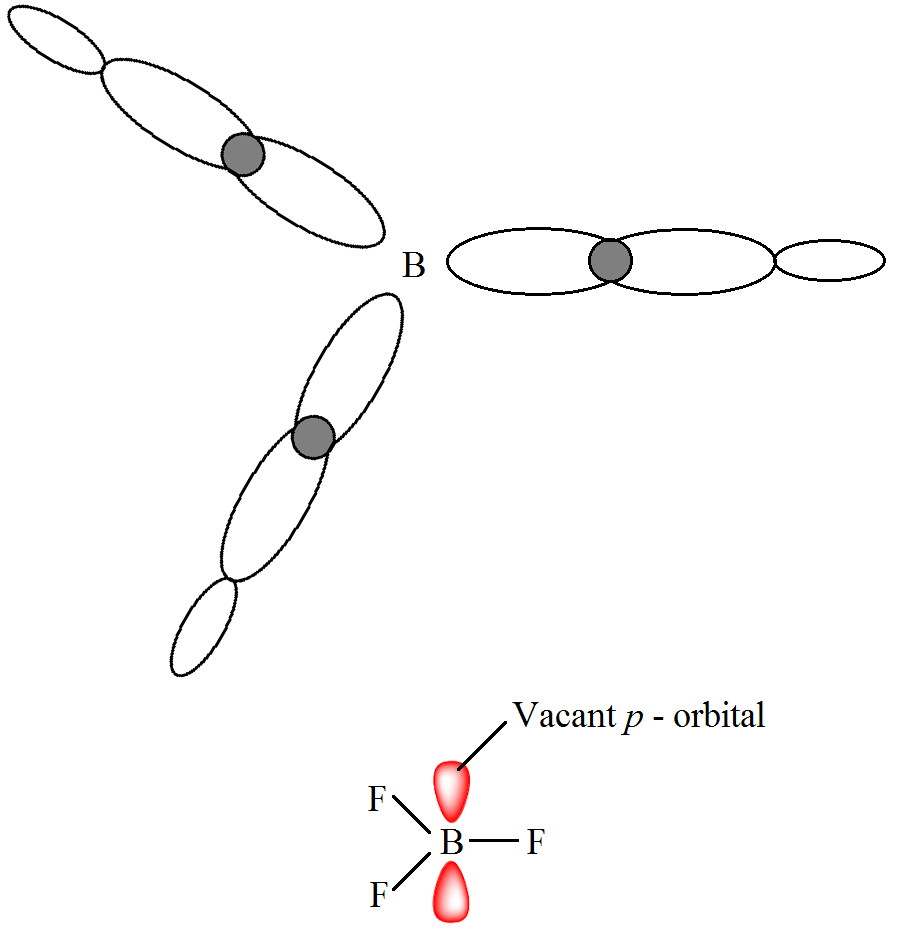
$BF_3$ has a planar triangular structure which arises from the $sp^2$ hybrid orbitals.

These three $sp^2$ hybrid orbital’s are directed towards the corners of triangle and $BF^3$ has a trigonal structure.

$\text{BH}_4^-$ may be assumed to be made of a central B atom, 3H atoms and one hydride ion $H^-$.

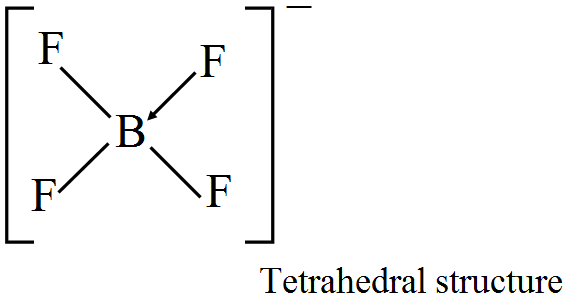
In order to accommodate the 3H atoms and one $H^-$ ion, B undergoes $sp^3$ hybridization yielding four orbital's, 3 of which contain one $e^-$ each and one is empty. The fourth, empty orbital accommodates the $H^-$ ion. Thus, the structure of $\text{BH}_4^-$ is tetrahedral.
View full question & answer
Question 105 Marks
A certain salt X, gives the following results.
  1. Its aqueous solution is alkaline to litmus.
  2. It swells up to a glassy material Y on strong heating.
  3. When conc. $H_2SO_4$ is added to a hot solution of X, white crystal of an acid Z separates out.
Write equations for all the above reactions and identify X, Y and Z.
Answer
The given salt is alkaline to litmus. Therefore, X is a salt of a strong base and a weak acid. Also, when X is strongly heated, it swells to form substance Y. Therefore, X must be borax.
When borax is heated, it loses water and swells to form sodium metaborate. When heating is continued, it solidifies to form a glassy material Y. Hence, Y must be a mixture of sodium metaborate and boric anhydride.
$\text{Na}_2\text{B}_4\text{O}_7 \ \ \ +\ \ \ 7\text{H}_2\text{O} \ \ \ \ \ \xrightarrow{\text{water}} \ \ \ \ \ 2\text{NaOH} \ \ \ \ \ + \ \ \ \ \ 4\text{H}_3\text{BO}_3 \\ \text{Borax (X)} \ \ \ \text{Sodium hydroxide} \ \ \ \ \ \ \ \ \ \text{Othoboric acid}$
$\text{Na}_2\text{B}_4\text{O}_7.10\text{H}_2\text{O} \ \ \ \ \xrightarrow{\Delta} \ \ \ \ \ \ \ \ \ \ \ \ \ \ \ \text{Na}_2\text{B}_4\text{O}_7\ \ \ \ \ \ \ \ \ \ \ \ \ \ \xrightarrow{\Delta} \ \ \ \ \ \ \ \ \ \ \ \ \ \text{B}_2\text{O}_3 \ \ \ \ \ \ \ \ + \ \ \ \ \ \ \ \ 2\text{NaBO}_2 \\ \ \ \ \ \text{Borax (X)} \ \ \ \ \ \ \ \ \ \ \ \ \ \ \ \ \ \ \ \ \ \ \ \ \ \text{Sodium metaborate} \ \ \ \ \ \ \ \ \ \ \ \ \ \ \ \ \ \ \text{Boric anhydride} \\ \ \ \ \ \ \ \ \ \ \ \ \ \ \ \ \ \ \ \ \ \ \ \ \ \ \ \ \ \ \ \ \ \ \ \ \ \ \ \ \ \ \ \ \ \ \ \ \ \ \ \ \ \ \ \ \ \ \ \ \ \ \ \ \ \ \ \ \ \ \ \ \ \ \ \ \ \ \ \ \ \ \ \ \ \ \ \ \ \ \ \ \ \ \ \ \ \ \ \text{(Glassy material)}$
When concentrated acid is added to borax, white crystals of orthoboric acid (Z) are formed.
$\text{Na}_2\text{B}_4\text{O}_7.10\text{H}_2\text{O} \ \ \ \ + \ \ \ \ \text{H}_2\text{SO}_4 \ \ \ \ \xrightarrow{\Delta} \ \ \ \ \text{Na}_2\text{SO}_4 \ \ \ \ + \ \ \ \ \text{H}_3\text{BO}_3 \ \ \ \ + \ \ \ \ 5\text{H}_2\text{O} \\ \ \ \ \ \ \ \ \text{Borax (X)} \ \ \ \ \ \ \ \ \ \ \ \ \ \ \ \ \ \ \ \ \ \ \ \ \ \ \ \ \ \ \ \ \ \ \ \ \ \ \ \ \ \ \ \ \ \ \ \ \ \ \ \ \ \ \ \ \ \ \ \ \ \ \text{Orthoboric acid (Z)}$
View full question & answer
Question 115 Marks
Explain structures of boric acid.
Answer
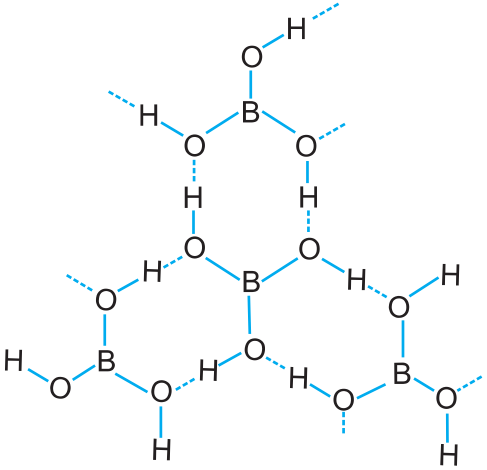
Boric acid: Boric acid has a layered structure. Each planar $\mathrm{BO}_3$ unit is linked to one another through H atoms. The H atoms form a covalent bond with a $\mathrm{BO}_3$ unit, while a hydrogen bond is formed with another $\mathrm{BO}_3$ unit. In the given figure, the dotted lines represent hydrogen bonds.
View full question & answer
Question 125 Marks
When metal X is treated with sodium hydroxide, a white precipitate (A) is obtained, which is soluble in excess of NaOH to give soluble complex (B). Compound (A) is soluble in dilute HCl to form compound (C). The compound (A) when heated strongly gives (D), which is used to extract metal. Identify (X), (A), (B), (C) and (D). Write suitable equations to support their identities.
Answer
The given metal X gives a white precipitate with sodium hydroxide and the precipitate dissolves in excess of sodium hydroxide. Hence, X must be aluminium.
The white precipitate (compound A) obtained is aluminium hydroxide. The compound B formed when an excess of the base is added is sodium tetrahydroxoaluminate(III).
$ \ \ \ \ \ \ \ \ \ \ 2\text{Al} \ \ \ \ \ \ \ \ + \ \ \ \ \ \ \ \ 3\text{NaOH} \ \ \ \ \ \ \ \ \rightarrow \ \ \ \ \ \ \ \ \text{Al(OH)}_3\downarrow+3\text{Na}^+ \\ \text{Aliminium (X)} \ \ \ \ \text{Sodium hydroxide} \ \ \ \ \ \ \ \ \ \ \ \ \text{White ppt. (A)}$
$\text{Al(OH)}_3 \ \ \ \ \ \ \ + \ \ \ \ \ \ \ \text{NaOH} \ \ \ \ \ \ \ \ \rightarrow \ \ \ \ \ \ \ \ \text{Na}^+\big[\text{Al(OH)}_4\big]^- \\ \ \ \ \ \text{(A)} \ \ \ \ \ \ \ \ \ \ \ \ \ \ \ \ \ \ \ \ \ \ \ \ \ \ \ \ \ \ \ \ \ \ \ \ \ \ \ \ \ \ \ \ \ \text{Sodium tetrahydroxoaliminate (iii)} \\ \ \ \ \ \ \ \ \ \ \ \ \ \ \ \ \ \ \ \ \ \ \ \ \ \ \ \ \ \ \ \ \ \ \ \ \ \ \ \ \ \ \ \ \ \ \ \ \ \ \ \ \ \ \ \ \ \ \ \ \ \ \ \ \ \ \text{(Soluble complex B)}$
Now, when dilute hydrochloric acid is added to aluminium hydroxide, aluminium chloride (compound C) is obtained.
$\text{Al(OH)}_3+3\text{HCl}\rightarrow\text{AlCl}_3+\text{H}_2\text{O} \\ \ \ \ (\text{A}) \ \ \ \ \ \ \ \ \ \ \ \ \ \ \ \ \ \ \ \ \ \ \ \ \ \ \ \ \text{(C)}$
Also, when compound A is heated strongly, it gives compound D. This compound is used to extract metal X. Aluminium metal is extracted from alumina. Hence, compound D must be alumina.
$2\text{Al(OH)}_3\xrightarrow{\Delta}\text{Al}_2\text{O}_3+3\text{H}_2\text{O} \\ \ \ \ \ \text{(A)} \ \ \ \ \ \ \ \ \ \ \ \ \ \ \ \ \ \text{(D)}$
View full question & answer
Question 135 Marks
Aluminium trifluoride is insoluble in anhydrous HF but dissolves on addition of NaF. Aluminium trifluoride precipitates out of the resulting solution when gaseous $BF_3$ is bubbled through. Give reasons.
Answer
Hydrogen fluoride (HF) is a covalent compound and has a very strong intermolecular hydrogen-bonding. Thus, it does not provide ions and aluminium fluoride (AlF) does not dissolve in it. Sodium fluoride (NaF) is an ionic compound and when it is added to the mixture, AlF dissolves. This is because of the availability of free $F^-$. The reaction involved in the process is:$\text{AlF}_3 \ \ \ + \ \ \ 3\text{NaF} \ \ \ \ \ \ \ \rightarrow \ \ \ \ \ \ \ \ \text{Na}_3[\text{AlF}_6] \\ \ \ \ \ \ \ \ \ \ \ \ \ \ \ \ \ \ \ \ \ \ \ \ \ \ \ \ \ \ \ \ \ \ \ \text{Sodium hexafluoroaluminate (III)}$
When boron trifluoride $(BF_3)$ is added to the solution, aluminium fluoride precipitates out of the solution. This happens because the tendency of boron to form complexes is much more than that of aluminium. Therefore, when $BF_3$ is added to the solution, B replaces Al from the complexes according to the following reaction:
$\text{Na}_3[\text{AlF}_6]+3\text{BF}_33\rightarrow 3\text{Na}[\text{BF}_4]+\text{AlF}_3$
View full question & answer
Question 145 Marks
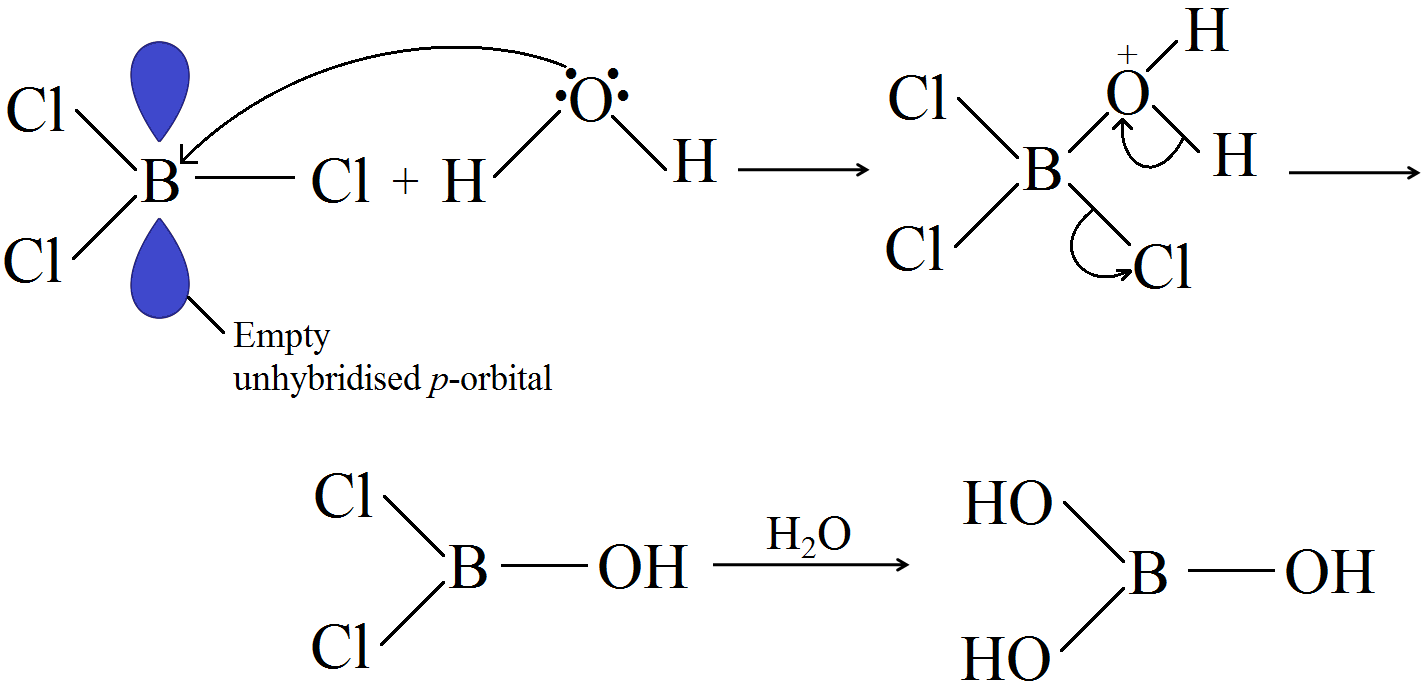
Consider the compounds, $BCl_3$ and $CCl_4$. How will they behave with water? Justify.
Answer
$BCl_3$ is an electron deficient compound. Also, it has an empty unhybridised p-orbital which can accept electrons. In presence of water, $BCl_3$ hydrolyses and forms $B(OH)_3$.

But, when $CCl_4$ is mixed with water, no reaction takes place because carbon neither has any unhybridised, empty p-orbital where it can accommodate electrons from water nor it has empty d-orbital.
$CCl_4 + H_2O$ → No reaction.
View full question & answer
Question 155 Marks
Give one method for industrial preparation and one for laboratory preparation of $CO$ and $CO_2$ each.
Answer
Carbon monoxide (CO): Industrial preparation. It is formed by incomplete combustion of carbon in the limited air.
$2\text{C(S)}+\text{O}_2(\text{g})\xrightarrow[\text{air}]{\text{Limited}}2\text{CO(g)} \\$
Laboratory preparation: Pure carbon monoxide is obtained by the dehydration of formic acid with concentrated $H_2SO_4$ at 373K.
$\text{HCOOH}\xrightarrow[373\text{k}]{\text{H}_2\text{SO}_4}\text{CO}+\text{H}_2\text{O}\\$
Carbon dioxide: Industrial preparation: It is prepared by burning carbon in excess of air or oxygen.
$\text{C(s)}+\text{O}_2\text{(g)}\rightarrow\text{CO}_2\text{(g)}$
Laboratory preparation: It is prepared by the action of acids on carbonates.
$CaCO_3(s) + 2HCl(l) → CaCl_2(aq) + CO_2(g) + H_2O(l)$
View full question & answer
Question 165 Marks
Suggest reasons why the B-F bond lengths in $BF_3$ (130pm) and $\text{BF}_4^{-}$ (143pm) differ.
Answer
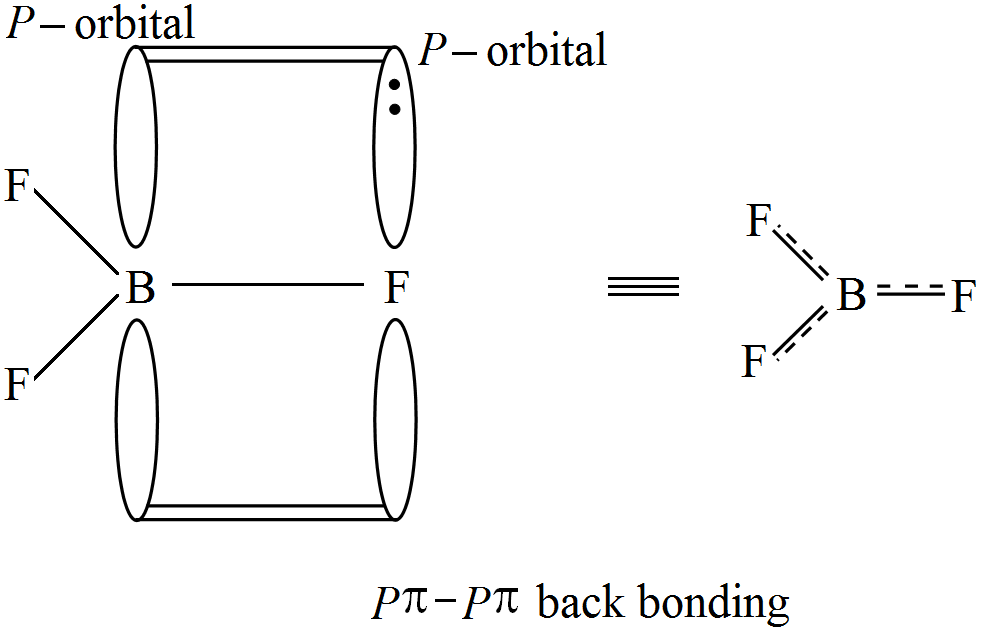
The B-F bond length in $BF_3$ is shorter than the B-F bond length in $\text{BF}_4^{-}$. $BF_3$ is an electron-deficient species. With a vacant p-orbital on boron, the fluorine and boron atoms undergo $\text{p}\pi-\text{p}\pi$ back-bonding to remove this deficiency. This imparts a double-bond character to the B-F bond.

This double-bond character causes the bond length to shorten in $BF_3$ (130 pm). However, when $BF_3$ coordinates with the fluoride ion, a change in hybridisation from $sp^2$ (in $BF_3$) to $sp^3$ $\big(\text{in BF}_4^{-}\big)$ occurs. Boron now forms $4\sigma$ bonds and the double-bond character is lost. This accounts for a B-F bond length of 143pm in $\text{BF}_4^{-}$ ion.
View full question & answer
Question 175 Marks
Discuss the pattern of variation in the oxidation states of,
  1. B to Tl.
  2. C to Pb.
Answer
The aspect common in the variation of oxidation state within group 13( B to Tl$)$ and group 14( C to Pb$)$ is that of inert pair effect. As we move down the group (13 or 14), we find that the lower oxidation state becomes more stable. In case of group 13 elements, it is +1 oxidation state that becomes stable while in group 14 it is +2 oxidation states that becomes stable. This behavior can be understood if we consider the fact that as we move from the $2^{\text {nd }}$ period to the $3^{\text {rd }}$ a d-subshell is added. Similarly, upon moving further down the group there is an f -subshell which is added, f subshells have a poor shielding effect. As a result, the s-electrons in the heavier elements of the $13^{\text {th }}$ and $14^{\text {th }}$ group are held more tightly and thus, are reluctant to get oxidized. This causes the lower oxidation state to become more stable.
Element
Oxidation state
Element
Oxidation state
B
+3
C
+4
Al
+3
Si
+4
Ga
+1, +3
Ge
+2, +4
In
+1, +3
Sn
+2, +4
TI
+1, +3
Pb
+2, +4
View full question & answer
Question 185 Marks
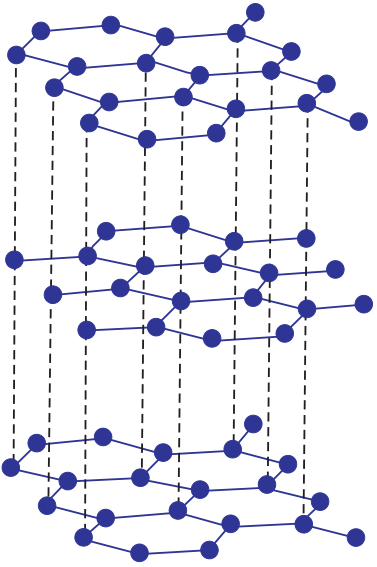
What are allotropes? Sketch the structure of two allotropes of carbon namely diamond and graphite. What is the impact of structure on physical properties of two allotropes?
Answer
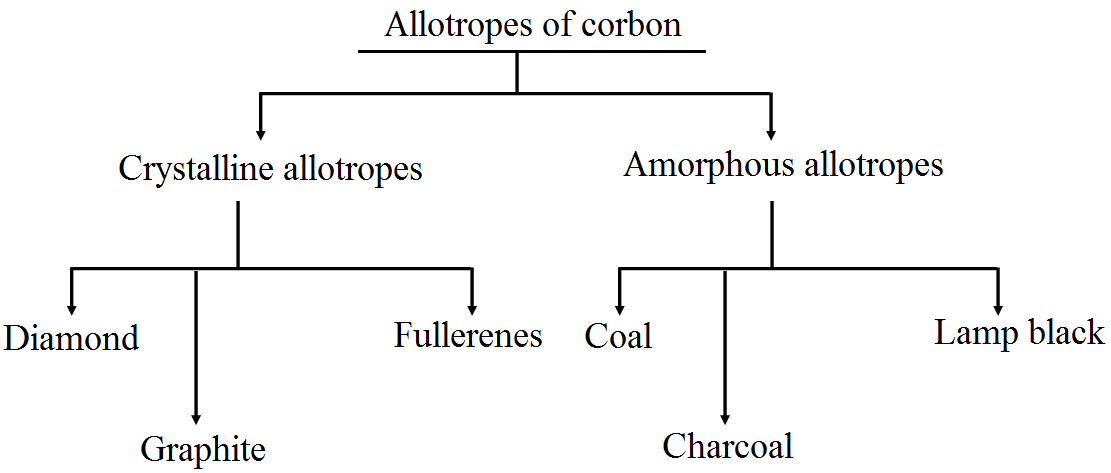
Allotropy is the existence of an element in more than one form, having the same chemical properties but different physical properties. The various forms of an element are called allotropes.

Diamond:

The rigid 3-D structure of diamond makes it a very hard substance. In fact, diamond is one of the hardest naturally-occurring substances. It is used as an abrasive and for cutting tools.
Graphite:

It has $\text{sp}^2$ hybridised carbon, arranged in the form of layers. These layers are held together by weak van der Walls’ forces. These layers can slide over each other, making graphite soft and slippery. Therefore, it is used as a lubricant.
View full question & answer
Question 195 Marks
  1. Classify following oxides as natural, acidic, basic or amphoteric:
$CO, B_2O_3, SiO_2, CO_2, Al_2O_3, PbO_2, Tl_2O_3$
  1. Write suitable chemical equations to show their nature.
Answer
$CO$ = Natural
$B_2O_3$ = Acidic Being acidic, it reacts with bases to form salts. It reacts with $NaOH$ to form sodium metaborate.
$b_2O_3 + 2NaOH \rightarrow 2NaBO_2 + H_2O$
$SiO_2$= Acidic
Being acidic, it reacts with bases to form salts. It reacts with $NaOH$ to form sodium silicate.
$SiO_2 + 2NaOH \rightarrow 2Na_2SiO_2 + H_2O$
$CO_2$ = Acidic
Being acidic, it reacts with bases to form salts. It reacts with $NaOH$ to form sodium carbonate.
$CO_2 + 2NaOH \rightarrow Na_2CO_2 + H_2O$
$Al_2O_3$ = Amphoteric
Amphoteric substances react with both acids and bases. $Al_2O_3$ reacts with both $NaOH$ and $H_2SO_4$.
$Al_2O_3 + 2NaOH \rightarrow NaAlO_2$
$Al_2O_3 + 3H_2SO_4 \rightarrow Al_2(SO_4) + 3H_2O$
$PbO_2$ = Amphoteric
Amphoteric substances react with both acids and bases. $PbO_2$ reacts with both $NaOH$ and $H_2SO_4$
$PbO_2 + 2NaOH \rightarrow Na_2PbO_3 + H_2O$
$2PbO_2 + 2H_2SO_4 \rightarrow 2PbSO_4 + 2H_2O + O_2$
$Tl_2O_3$ = Basic
Being basic, it reacts with acids to form salts. It reacts with $HCl$ to form thallium chloride.
$Tl_2O_3 + 6HCl \rightarrow 2TICl_3 + 3H_2O$
View full question & answer
Question 205 Marks
Boron fluoride exists as $\mathrm{BF}_3$ but boron hydride doesn't exist as $\mathrm{BH}_3$. Give reason. In which form does it exist? Explain its structure.
Answer
$\mathrm{BF}_3$ exists as a monomer due to $\mathrm{p} \pi$-prtback bonding. Fluorine transfers two electrons to vacant 2 p -orbital of boron. The delocalisation reduces the deficiency of electrons on boron thereby increasing the stability of $\mathrm{BF}_3$ molecule. Due to absenceof lone pair of electrons on H , the back bonding does not occur in $\mathrm{BH}_3$. In other words, electron deficiency of boron remains and $\mathrm{BH}_3$ does not exist. To reduce electron deficiency $\mathrm{BH}_3$ dimerises to form $\mathrm{B}_2 \mathrm{H}_6$. Hence, boron hydride exists in dimeric form and known as diborane.
View full question & answer
Question 215 Marks
Account for the following observations:
The +1 oxidation state of thallium is more stable than its +3 state.
Answer
The +3 oxidation state does not necessarily have high oxidising character for all the elements. When we consider group 13 elements, we find that the heavier members of the group show both +1 and +3 oxidation states. However, the stability of +1 oxidation state increases from Ga to TI . In other words, the +1 oxidation state is more stable for TI than the +3 oxidation state. So $\mathrm{Tl}^{+3}$ ion has a high tendency to get converted into the more stable $\mathrm{Tl}^{+1}$ ion. Thus in a reaction, it will readily accept electrons and get reduced to the $\mathrm{Tl}^{+1}$ ion, thereby oxidising the other reactant. This is why it has high oxidising character.
View full question & answer
Question 225 Marks
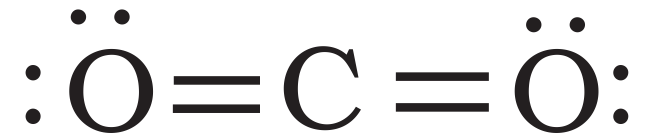
Explain the following: $CO_2$ is a gas whereas $SiO_2$ is a solid.
Answer
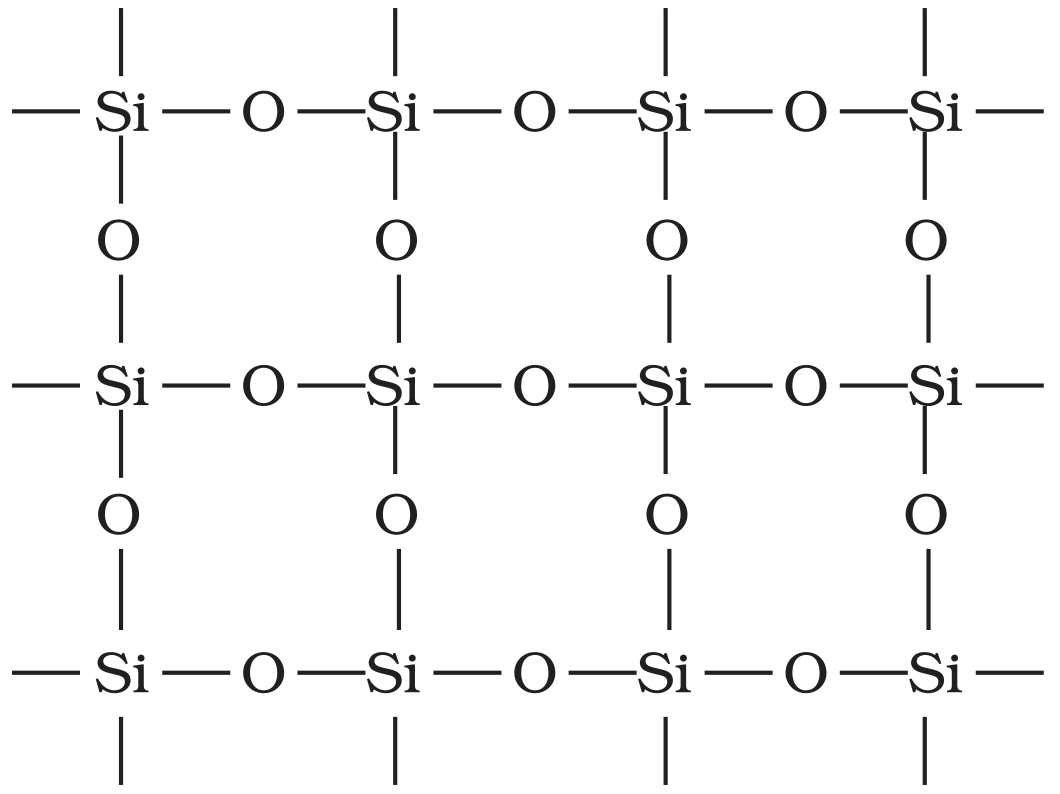
In $CO_2$, carbon atom undergoes sp hybridization. Two sp hybridized orbitals of carbon atom overlap with two p orbitals of oxygen atoms to make two sigma bonds while other two electrons of carbone atom are involved in $\text{p}\pi-\text{p}\pi$ bonding with oxygen atom. This results in its linear shape[with both C-O bonds of equal length(115 pm) with no dipole moment.Silicone dioxide is a covalent, three-dimensional network solid in which each silicon atom is covalently bonded in a tetrahedral manner to four oxygen atoms. Each oxygen atom in turn covalently bonded ti another silicon atoms as shown in diagram. Each comer is shared with another tetrahedron. The entire crystal may be considered as giant molecule in which eight membered rings are formed with alternate silicon and oxygen atoms.
View full question & answer
Question 235 Marks
Account for the following observations:
$\mathrm{PbO}_2$ is a stronger oxidising agent than $\mathrm{SnO}_2$.
Answer
In $\mathrm{pbO}_2, \mathrm{pb}$ is in +4 oxidation state and in $\mathrm{SnO}_2$ also Sn is in +4 oxidation state. Due to the inert pair effect which is due to weak screening effect of electrons of $d$ subshell which increases from top to bottom in group thus the stability of oxidation state 2 less than common oxidation state increases on down the group thus +2 oxidation state is more stable for lead ( pb ) than +4 oxidation state thus pb changes from its +4 state to more stable +2 state easily thus it's a good oxidising agent.
View full question & answer
Question 245 Marks
Direction: Match Column I with Column II.
S. No.
Column I
S. No.
Column II
(a)
$\text{BF}^-_4$
(i)
Oxidation state of central atom is +4
(b)
$AlCl_3$
(ii)
Strong oxidising agent
(c)
$SnO$
(iii)
Lewis acid
(d)
$PbO_2$
(iv)
Can be further oxidised
 
 
(v)
Tetrahedral shape
Answer
S. No.
Column I
S. No.
Column II
(a)
$\text{BF}^-_4$
(v)
Tetrahedral shape
(b)
$AlCl_3$
(iii)
Strong oxidising agent Lewis acid
(c)
$SnO$
(iv)
Can be further oxidised
(d)
$PbO_2$
(i)
Oxidation state of central atom is +4
View full question & answer
Question 255 Marks
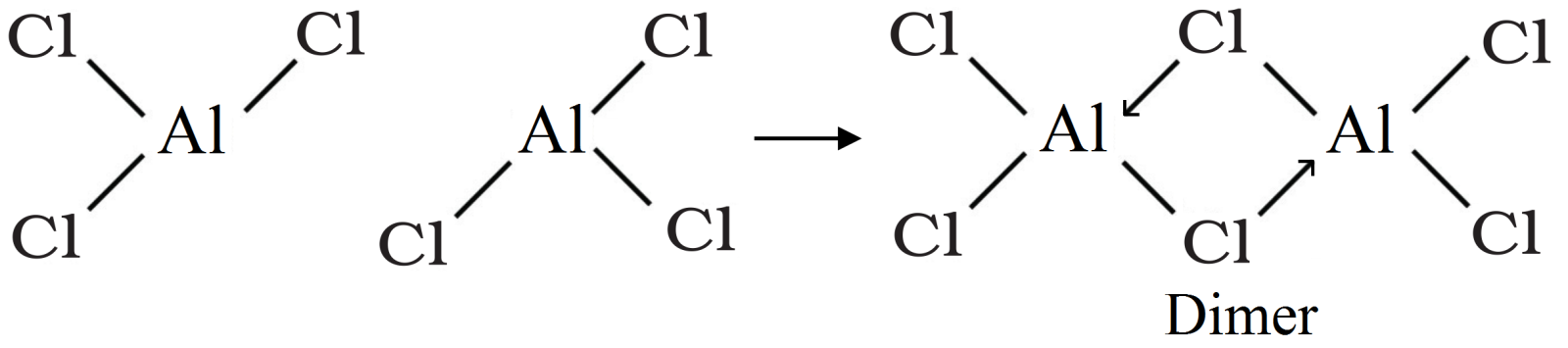
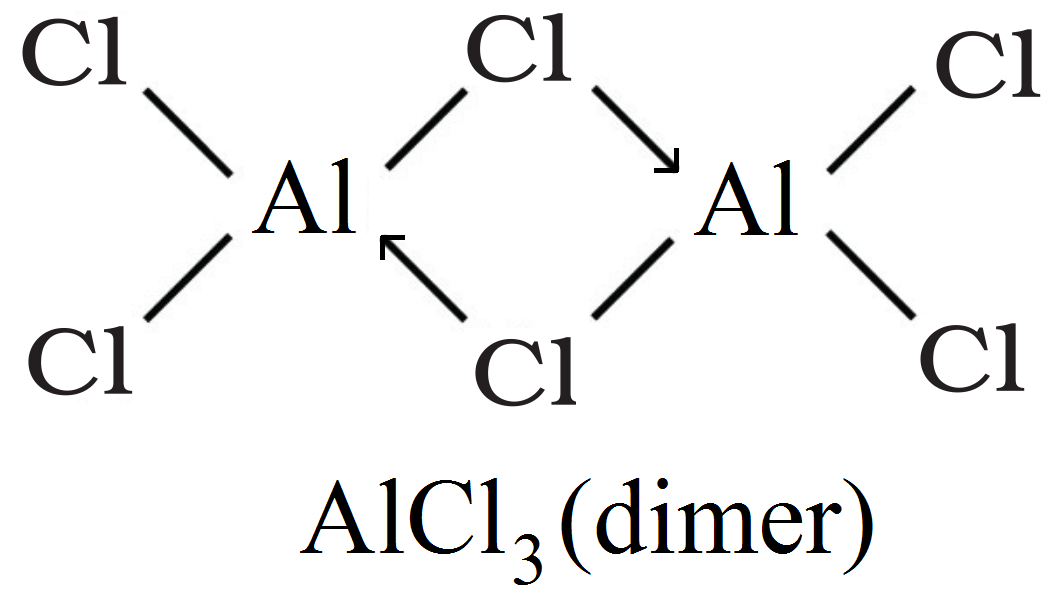
$\mathrm{BCl}_3$ exists as monomer whereas $\mathrm{AlCl}_3$ is dimerised through halogen bridging. Give reason. Explain the structure of the dimer of $\mathrm{AlCl}_3$ also.
Answer
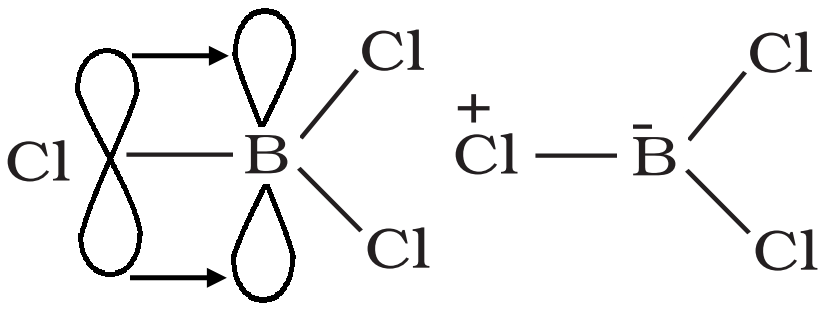
$\mathrm{BCl}_3$ exists as monomer in spite of the fact that it is an electron deficient compound. It achieves stability by forming $p \pi$ - $\mathrm{p} \pi$ back bonding. Chlorine transfers two electrons to vacant $2 p$-orbital of boron. All the three bond lengths are same. Thus, the back

bonding giving double bond character is delocalized in the molecule. $\mathrm{AlCl}_3$ is also an electron deficient compound. Since, aluminium has larger size than boron, the back bonding is not possible in $\mathrm{AlCl}_3$. Aluminium metal complete its octet by forming coordinate bond with chlorine atom of the other molecule, $\mathrm{AlCl}_3$. Thus, coordinate bond forming bridges by chlorine atoms between two Al atoms make a dimer molecule.
View full question & answer
Question 265 Marks
Explain the following: Why does the element silicon, not form a graphite like structure whereas carbon does.
Answer
In graphite, carbon is $\mathrm{sp}^2$-hybridised and each carbon is linked to three other carbon atoms by forming hexagonal rings. Each carbon is now left with one unhybridised p-orbital which undergoes sideways overlap to form three p-p double bonds. Thus, graphite has two-dimensional sheet like (layered) structure consisting of a number of benzene rings fused together. Silicon, on the other hand, does not form an analogue of carbon because of the following reason:
Due to bigger size and smaller electronegativity of Si than $\mathrm{C}_{\text {, }}$ it does not undergo $\mathrm{sp}^2$-hybridisation and hence it does not form p-p double bonds needed for graphite like structure. Instead, it prefers to undergo only $\mathrm{sp}^3$-hybridisation and hence silicon has diamond like three dimensional network.
View full question & answer
Question 275 Marks
Give reasons for the following:
$\mathrm{CCl}_4$ is immiscible in water, whereas $\mathrm{SiCl}_4$ is easily hydrolysed.
Answer
$\mathrm{CCl}_4$ is a covalent compound while $\mathrm{H}_2 \mathrm{O}$ is a polar compound. Therefore, it is insoluble in water. Alternatively, $\mathrm{CCl}_4$ is insoluble in water because carbon does not have (l-orbitals to accommodate the electrons donated by oxygen atom of water molecules. As a result, there is no interaction between $\mathrm{CCl}_4$ and water molecules and hence $\mathrm{CCl}_4$ is insoluble in water. On the other hand, $\mathrm{SiCl}_4$ has d-orbitals to accommodate the lone pair of electrons donated by oxygen atom of water molecules. As a result, there is a strong interaction between $\mathrm{SiCl}_4$ and water molecules. Consequently, $\mathrm{SiCl}_4$ undergoes hydrolysis by water to form silicic acid.
View full question & answer
Question 285 Marks
When conc $\text{H}_2\text{SO}_4$ was added into unknown salt present in a test tube, a brown gas ‘A’ was evolved. The gas intensified when copper turnings were also added into this test tube. On cooling, the gas ‘A’ changed into a colourless gas 'B'.
  1. Identify A and B.
  2. Wrtie the equations for the reactions involved.
Answer
$\text{NaNO}_3$ (nitrate salt) 'A' is $\text{NO}_2$ gas. $2\text{NaNO}_3+\text{H}_2\text{SO}_4(\text{conc})\xrightarrow{\text{Heat}}2\text{HNO}_3+\text{Na}_2\text{SO}_4$ $4\text{HNO}_3(\text{conc})\xrightarrow{\text{Heat}}4\text{NO}_2+\text{O}_2+2\text{H}_2\text{O}\\ \ \ \ \ \ \ \ \ \ \ \ \ \ \ \ \ \ \ \ \ \ \ \ \ \ \ \ \ \ \ \ \ \ \text{(Brown)}\\\ \ \ \ \ \ \ \ \ \ \ \ \ \ \ \ \ \ \ \ \ \ \ \ \ \ \ \ \ \ \ \ \ \ \ \ \ \ \ \text{'A'}$ $\text{Cu}+4\text{HNO}_3(\text{conc})\xrightarrow{\text{Heat}}\text{Cu(NO}_3)_2+2\text{NO}_2+2\text{H}_2\text{O}\\\ \ \ \ \ \ \ \ \ \ \ \ \ \ \ \ \ \ \ \ \ \ \ \ \ \ \ \ \ \ \ \ \ \ \ \ \ \ \ \ \ \ \ \ \ \ \ \ \ \ \ \ \ \ \ \ \ \ \ \ \ \ \ \ \ \ (\text{Brown})\\ \ \ \ \ \ \ \ \ \ \ \ \ \ \ \ \ \ \ \ \ \ \ \ \ \ \ \ \ \ \ \ \ \ \ \ \ \ \ \ \ \ \ \ \ \ \ \ \ \ \ \ \ \ \ \ \ \ \ \ \ \ \ \ \ \ \ \ \ \ \ \ \text{'A'}$
View full question & answer
Question 295 Marks
The +1 oxidation state in group 13 and +2 oxidation state in group 14 becomes more and more stable with increasing atomic number. Explain.
Answer
The increasing stability of oxidation states that are 2 less than the group valency for the heavier elements of groups 13, 14, 15 and 16 is due to inert pair effect. The term "inert pair" was first proposed by Sidgwick in 1927.
As an example in group 13 the +1 oxidation state of TI is the most stable and $\mathrm{Tl}^{3+}$ compounds comparatively rare. The stability increases in the following sequence:
$\mathrm{AI}^{+}<\mathrm{Ga}^{+}<\mathrm{In}^{+}<\mathrm{TI}^{+}$
The situation in groups 14,15 and 16 is that the stability trend is similar going down the group, but for the heaviest members, e.g. lead, bismuth and polonium both oxidation states are known.
The lower oxidation state in each of the elements has 2 valence electrons in s-orbitals. These valence electrons in a s-orbital are more tightly bound are of higher energy than electrons in p-orbitals and therefore less likely to be involved in bonding.
View full question & answer
Question 305 Marks
  1. Give one method for industrial preparation and one for laboratory preparation of $CO$ and $CO_2$ each.
  2. Select the members of group 14 that (a) forms the most acidic dioxide (b) used as semiconductor.
  3. Explain structure of Diborane.
  4. What are silicones?
Answer
  1. Carbon monoxide:
Industrial preparation
$2\text{C(s)}+\text{O}_2\text{(g)}\xrightarrow[\text{air}]{\ \ \text{lim ited}\ \ }2\text{CO(g) }$
Lab preparation
$\text{HCOOH}\xrightarrow{\ \ \text{conc H}_2\text{SO}_4\ \ }\text{CO}+\text{H}_2\text{O}$
Carbon diaxide:
Industrial preparation
$\text{C(s)}+\text{O}_2\text{(g)}\xrightarrow[\text{air}]{\ \ \text{Excess}\ \ }\text{CO}_2\text{(g)}$
Lab preparation
$\text{CaCO}_3\text{(s)}+2\text{HCl(aq)}\xrightarrow{\ \ \ \ \ \ \ \ }\text{CaCl}_2\text{(aq)}\\+\text{CO}_2\text{(g)}+\text{H}_2\text{O(l)}$
  1. Member of group 14 that
  1. Forms the most acidic oxide → Carbon (i.e. $CO_2$)
  2. Is used as semiconductor → Silicon or Germanium
  1. Structure of Diborane: Each boron atom in diborane is $sp^3$ hybridised. Three of those $sp^3$ hybridised orbitals are used for bonding with hydrogen. One of the $sp^3$ hybridised orbital is without any electron (shown by dotted lines) towards which the B—H bond electron density of the other $BH_3$ unit moves to. The central B—H—B bonds are called banana bonds and are two electrons - three centres bonds.
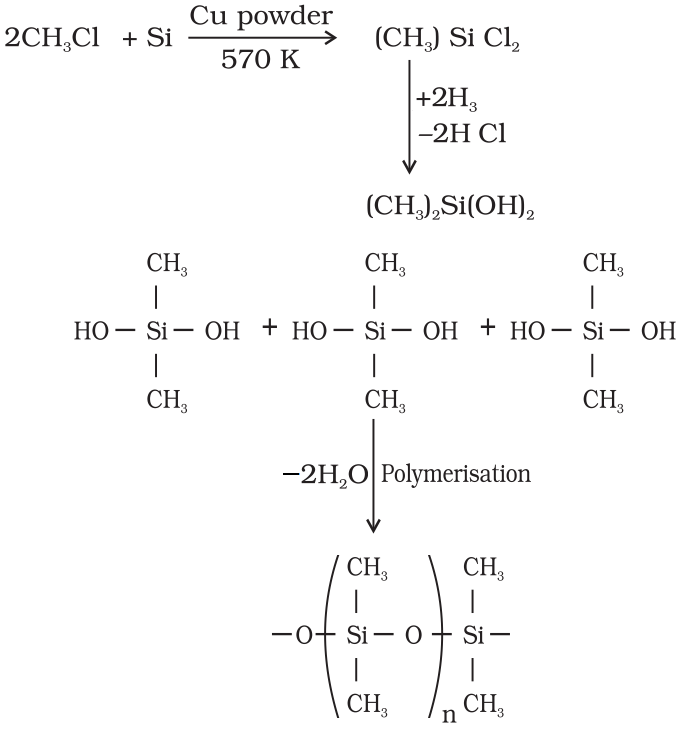
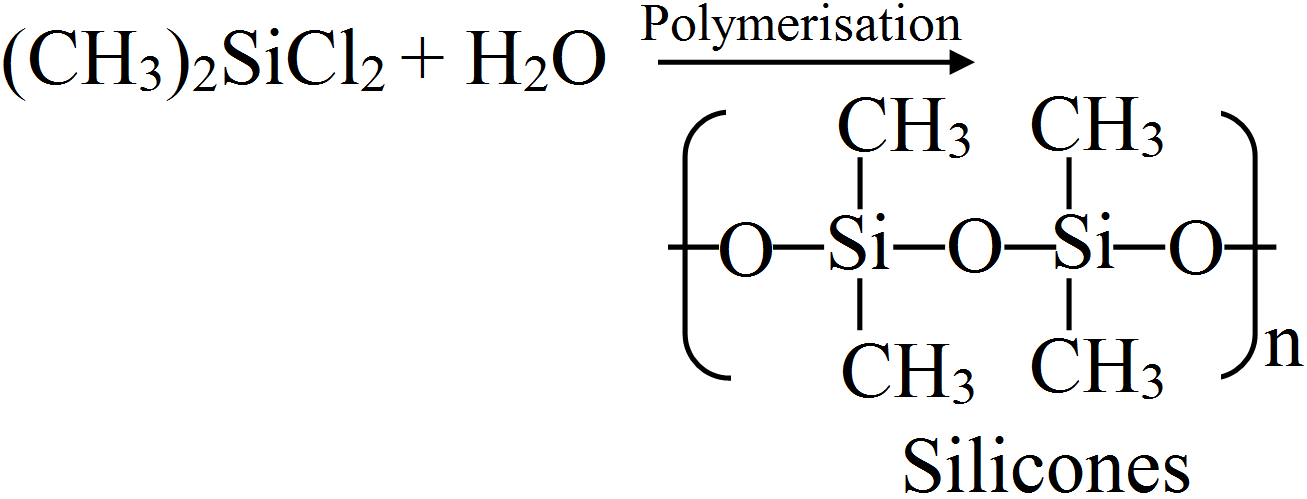
  1. Silicones are synthetic organosilicon compounds containing repeated $R_2SiO$ units held as Si-O-Si-linkages. R may be any alkyl or aryl group.
View full question & answer
Question 315 Marks
Give reasons for the following:
  1. $[\text{SiF}_6]^{2-}$ is known whereas $[\text{SiCl}_6]^{2-}$ is not known.
  2. Diamond is covalent, yet has high melting point.
  3. Boric acid is considered as a weak acid.
  4. Boron is unable to form $\text{BF}^{3-}_6$ ion.
  5. $\text{BF}_{3}$ behaves as a Lewis acid.
Answer
i. $\left[\mathrm{SiF}_6\right]^{2-}$ is known whereas $\left[\mathrm{SiCl}_6\right]^{2-}$ is not known since six large size atoms i.e. six chlorine atoms cannot be accommodated around silicon atoms but six small size atoms (F atoms) can be comfortably accomodated.
ii. Diamond is a covalent solid but has a high melting point due to its three dimensional network structure.
iii. Boric acid is not able to release $\mathrm{H}^{+}$ions on its own, hence is a weak acid. It first receives $\mathrm{OH}^{-}$ions from water molecule to complete its octet and inturn releases $\mathrm{H}^{+}$ions.
iv. Boron is unable to form $\mathrm{BF}_6^{3-}$ ion due to the non availability of d-orbitals.
v. Boron in $\mathrm{BF}_3$ has only six electrons and hence can accept a pair of electron, thereby can act as Lewis acid.
View full question & answer
Question 325 Marks
  1. Complete the equations for:
  1. $\text{BF}_3+\text{LiH}\rightarrow$
  2. $\text{B}_2\text{H}_6+\text{H}_2\text{O}\rightarrow$
  1. Give reasons:
  1. Conc $HNO_3$ is transported in aluminium container.
  2. Graphite is used as lubricant.
  3. Lead (IV) chloride is highly unstable towards heat.
Answer
  1.  
  1. $2\text{BF}_3+6\text{LiH}\xrightarrow{\ \ \ \ \ \ }\text{B}_2\text{H}_6+6\text{LiF}\\ \ \ \ \ \ \ \ \ \ \ \ \ \ \ \ \ \ \ \ \ \ \ \ \ \ \ \ \ \ \ ^\text{Diborane}$
  2. $\text{B}_2\text{H}_6+6\text{H}_2\text{O}\xrightarrow{\ \ \ \ \ \ }2\text{H}_3\text{BO}_3+6\text{H}_2\\ \ \ \ \ \ \ \ \ \ \ \ \ \ \ \ \ \ \ \ \ \ \ \ \ \ \ \ \ \ \ \ \ \ \ \ \ \ \ \ \ \ \ ^\text{Boric acid}$
  1.  
  1. Aluminium metal reacts with concentrated $HNO_3$ to form protective layer of aluminium oxide on its surface that prevents the lower layers to react with $HNO_3$​​​​​​​, i.e., rendering (making) lower layers passive for further reaction. Hence $HNO_3$​​​​​​​ can be stored and transported in Al vessels.
$2\text{Al}+6\text{HNO}_3(\text{conc.})\xrightarrow{\ \ \ \ \ \ \ }\text{Al}_2\text{O}_3\\+6\text{NO}_2+3\text{H}_2\text{O}$
  1. Graphite has hexagonal layer structure where layers can slide over one another due to weak van der Waals' forces between them ($\text{p}\pi-\text{p}\pi$ bonds). Therefore graphite can be used as lubricant.
  2. Lead can exit in +2 and +4 oxidation states. Down the group stability of lower oxidation state increases and that of higher oxidation state decreases due to inert pair effect. Hence lead (IV) chloride is unstable towards heat and readily decomposes to lead (II) chloride.
$\text{PbCl}_4\xrightarrow{\ \ \ \Delta\ \ \ }\text{PbCl}_2+\text{Cl}_2$
View full question & answer
Question 335 Marks
  1. A certain salt 'X' gives the following results:
  1. Its aqueous solution is alkaline to litmus.
  2. It swells up to a glassy material ‘Y' on strong heating.
  3. When conc. HCl is added to a hot solution of 'X' white crystals of an acid 'Z' separates out.
Write equations for all the above reactions and identify 'X', 'Y' and 'Z'.
  1. Select the members of group $14$ that:
  1. Forms the most acidic dioxide.
  2. Is commonly found in $+2$ oxidation state
Answer
  1. 'X' is borax $(Na_2B_4O_7.10H_2O)$.
  1. Its aqueous solution is alkaline to litmus.
$\text{Na}_2\text{B}_4\text{O}_7+2\text{H}_2\text{O}\xrightarrow{\ \ \ \ \ \ \ \ }2\text{NaOH}+\text{H}_2\text{B}_4\text{O}_7$
  1. It swells up to glassy material ‘Y'on strong heating.
$\text{Na}_2\text{B}_4\text{O}_7\xrightarrow{\ \ \ 1000\text{K}\ \ \ }2\text{NaBO}_2+\text{B}_2\text{O}_3\\ \ \ \ \ \ \ \ \ \ \ \ \ \ \ \ \ \ \ \ \ \ \ \ \ \ \ \ ^\text{(Sodium metaborate)}\\ \ \ \ \ \ \ \ \ \ \ \ \ \ \ \ \ \ \ \ \ \ \ \ \ \ \ \ \ \ \ \ ^\text{(glassy solid)}$
  1. When conc. HCl is added to hot solution of 'X', white crystals of an acid $‘Z’H_3BO_3$ (boric acid) separates out.
$\text{Na}_2\text{B}_4\text{O}_7+2\text{HCl}+5\text{H}_2\text{O}\xrightarrow{\ \ \ \ \ }\\2\text{NaCl}+4\text{H}_3\text{BO}_3$
  1.  
  1. Carbon dioxide is most acidic dioxide formed by carbon.
  2. Lead (Pb) is commonly found in +2 oxidation state due to inert pair effect, $Pb^{2+}$ is more stable than $Pb^{4+}$​​​​​​​.
View full question & answer
Question 345 Marks
Explain the following:
  1. Silicones are used for making water proof fabrics.
  2. Boron does not form $B^{3+}$ ion.
  3. Boric acid is considered as a weak acid.
  4. Carbon forms covalent compounds while lead forms ionic compounds.
  5. Graphite is used as a lubricant.
Answer
  1. Silicones are synthetic polymers containing repeated units of $R_2SiO$ where 'R' is alkyl group. Therefore are water repellants i.e. do not absorb water and are used for making water proof fabrics.
  2. Boron has small size and very high 3rd ionisation energy. Therefore $B^{3+}$ ion does not form.
  3. Boron is metalloid so $B_2O_3$ is weakly acidic, boric acid does not ionize completely in aqueous solution due to less ionic character. It accepts a pair of electrons from OH ion. Hence boric acid is weak acid.
$\text{H}-\text{OH}+\text{B(OH})_3\xrightarrow{\ \ \ \ \ \ \ \ }[\text{B(OH})_4]^-+\text{H}^+$
  1. 'C' has small size and high ionisation energy. Therefore forms covalent compound whereas 'Pb' has bigger size. Therefore has low ionisation energy, so it forms ionic compound.
  2. Graphite is soft and slippery and have high melting point. That's why it is used as lubricant in machine parts to reduce friction.
View full question & answer
Question 355 Marks
  1. Write chemical equations when:
  1. Borax is heated strongly.
  2. Aluminium is treated with dilute NaOH.
  3. Dimethyldichlorosilane is hydrolysed followed by condensation polymeri-sation.
  1.  
  1. Explain that $CO_2$ is a gas while $SiO_2$ is solid at room temperature.
  2. $SnCl_2$​​​​​​​ acts as reducing agent. Explain.
Answer
  1.  
  1. $\text{Na}_2\text{B}_4\text{O}_7.10\text{H}_2\text{O}\xrightarrow{\ \ \ \text{heat}\ \ \ }\text{Na}_2\text{B}_4\text{O}_7\\ \ \ \ \ \ \ \ ^\text{Borax}\\ \xrightarrow{\ \ \text{heat}\ \ }2\text{NaBO}_2+\text{B}_2\text{O}_3\\ \ \ \ \ \ \ \ \ \ \ \ \ \ \ ^\text{Sodium}\ \ \ \ \ \ \ \ ^\text{Boric}\\ \ \ \ \ \ \ \ \ \ \ \ \ ^\text{metaborate}\ \ \ ^\text{anhydride}$
  2. $2\text{Al}+2\text{NaOH}+2\text{H}_2\text{O}\xrightarrow{\ \ \ \ }2\text{NaAlO}_2+3\text{H}_2\\ \ \ \ \ \ \ \ \ \ \ \ \ \ \ \ \ \ \ \ \ \ \ \ \ \ \ \ \ \ \ \ \ \ \ \ \ \ \ \ \ \ \ \ \ \ \ \ \ ^\text{Sodium}\\ \ \ \ \ \ \ \ \ \ \ \ \ \ \ \ \ \ \ \ \ \ \ \ \ \ \ \ \ \ \ \ \ \ \ \ \ \ \ \ \ \ \ \ ^\text{metaaluminate}$
  3.  
  1.  
  1. $CO_2$ exists as descrete molecules whereas $SiO_2$ is three dimensional covalent solid.
  2. $Sn^{4+}$ is more stable than $Sn^{2+}$, therefore $SnCl_2$ is good reducing agent.
View full question & answer
Question 365 Marks
i. Explain:
1. $\mathrm{CCl}_4$ doesn't hydrolyse unlike $\mathrm{SiCl}_4$.
2. Ga has a lower atomic radius compared to Al.
ii. Write balanced equations for:
a. Silicon dioxide is treated with hydrogen fluoride.
b. Boric acid is added to water.
iii. Diborane reacts with $\mathrm{NH}_3$ followed by heating.
Answer
  1.  
  1. It is because 'C' does not have d-orbitals.
  2. It is due to poor sheilding effect of d-electrons present in Ga as a result of which effective nuclear charge increases.
  1.  
  1. $\text{SiO}_2\ +\ 6\text{HF}\ \xrightarrow{\ \ \ \ \ \ \ \ }\ \text{H}_2\text{SiF}_6\ +\ 2\text{H}_2\text{O}$
  2. $\text{H}_3\text{BO}_3\text{}\ +\ \text{H}_2\text{O}\ \xrightarrow{\ \ \ \ \ \ }[\text{B(OH})_4]^{-}\ +\ \text{H}^+$
  1. $ 3\text{B}_2\text{H}_6\ +\ 6\text{NH}_3\ \xrightarrow{\ \ \ \Delta\ \ \ }\ 2\text{B}_3\text{N}_3\text{H}_6\ +\ 12\text{H}_2\\ ^\text{Diborane}\ \ \ \ \ ^\text{Ammonia}\ \ \ \ \ \ \ \ \ \ \ \ \ \ ^\text{Borazole}\ \ \ \ \ \ \ \ \ ^\text{Hydrogen}$
View full question & answer
Question 375 Marks
Explain why the following compounds behave as Lewis acids?
  1. $BCl_3$.
  2. $AlCl_3$.
Answer

Lewis acids are basically electron deficient species. They can readily accept electron from Lewis bases, which are electron rich and can donate electrons.
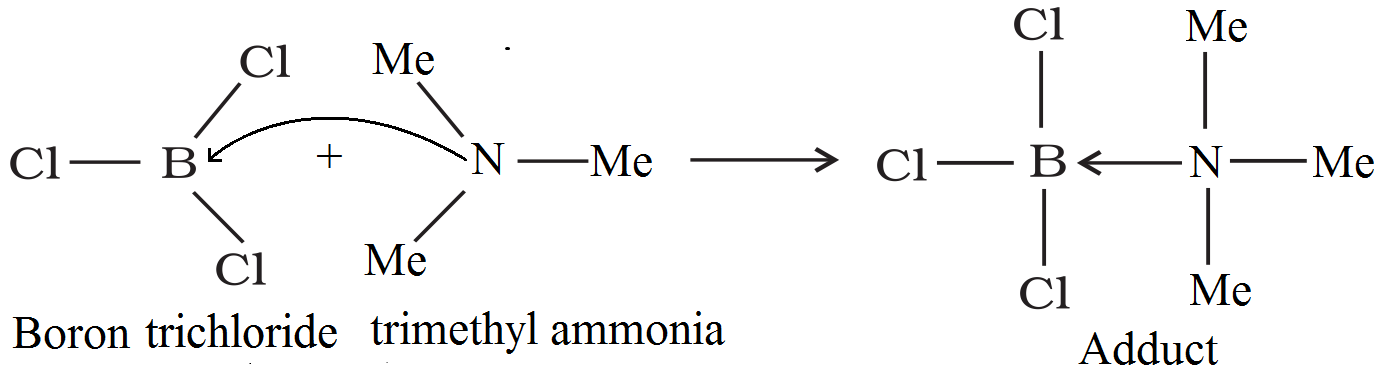
In $BCl_3$, the central atom boron is electron deficient and has only six electrons. Hence it is termed as Lewis acid. It can readily accept electron from ammonia or its derivatives.
Reaction:
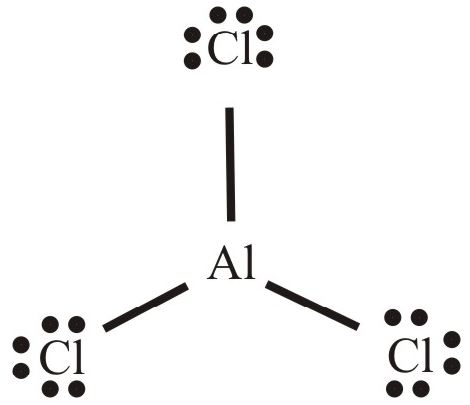
In $AlCl_3$, Al has empty p orbitals to accept the electrons to complete its octet, so it acts as a lewis acid.Structure of $AlCl _3$ :
View full question & answer
Question 385 Marks
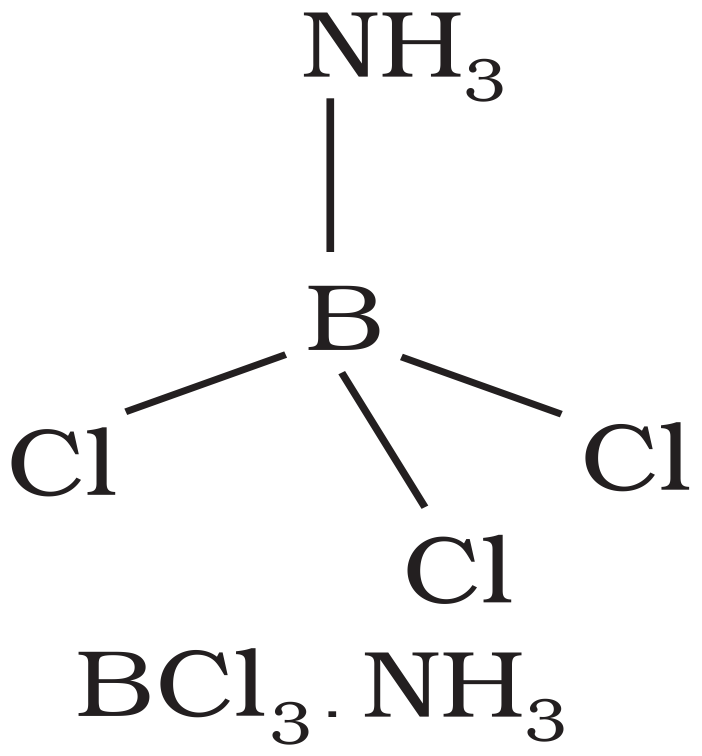
Draw the structures of $\mathrm{BCl}_3$. $\mathrm{NH}_3$ and $\mathrm{AlCl}_3$ (dimer).
Answer
In $\mathrm{BCl}_3$, the central B atom has six electrons in the valence shell. It is, therefore, an electron deficient molecule and needs two more electrons to 'complete its octet. In other words, $\mathrm{BCl}_3$ acts as a Lewis acid. $\mathrm{NH}_3$, on the other hand, has a lone pair of electrons which it can donate easily. Therefore, $\mathrm{NH}_3$ acts as a Lewis base. The Lewis acid $\left(\mathrm{BCl}_3\right)$ and the Lewis base $\left(\mathrm{NH}_3\right)$ combine together to form an adduct as shown below:

In $\mathrm{AlCl}_3$, Al has six electrons in the valence shell. Therefore, it is an electron deficient molecule and needs two more electrons to complete its octet. Chlorine, on the other hand, has three lone pairs of electrons. Therefore, to complete its octet, the central AI atom of one molecule accepts a lone pair of electrons from Clatom of the other molecule forming a dimeric structure as shown below.
View full question & answer
Question 395 Marks
Direction: Match Column I with Column II.
S. No.
Column I
S. No.
Column II
(a)
Diborane
(i)
Used as a flux for soldering metals
(b)
Galluim
(ii)
Crystalline form of silica
(c)
Borax
(iii)
Banana bonds
(d)
Aluminosilicate
(iv)
Low melting, high boiling, useful for measuring high temperatures
(e)
Quartz
(v)
Used as catalyst in petrochemical industries
Answer
S. No.
Column I
S. No.
Column II
(a)
Diborane
(iii)
Banana bonds
(b)
Galluim
(iv)
Low melting, high boiling, useful for measuring high temperatures
(c)
Borax
(i)
Used as a flux for soldering metals
(d)
Aluminosilicate
(ii)
Crystalline form of silica
(e)
Quartz
(v)
Used as catalyst in petrochemical industries
View full question & answer
Question 405 Marks
  1. Complete the following reactions:
  1. $8\text{BF}_3+6\text{LiH}\xrightarrow{\ \ \ \ \ \ \ \ \ \ }\ ........$
  2. $\text{H}_3\text{BO}_3\xrightarrow{\ \ \ \Delta\ \ \ }\ .........$
  3. $2\text{Al}+6\text{HCl}\xrightarrow{\ \ \ \ \ \ \ \ }\ .........$
  1. What are fullerenes? How are they prepared?
Answer
  1.  
  1. $8\text{BF}_3+6\text{LiH}\xrightarrow{\ \ \ \ \ \ \ \ \ \ }\text{B}_2\text{H}_6+6\text{LiBF}_4$
  2. $\text{H}_3\text{BO}_3\xrightarrow{\ \ \ \Delta\ \ \ }\text{HBO}_2+\text{H}_2\text{O}$
  3. $2\text{Al}+6\text{HCl}\xrightarrow{\ \ \ \ \ \ \ \ }2\text{AlCl}_3+3\text{H}_2$
  1. Fullerenes are the purest form of carbon consisting of mainly $\mathrm{C}_{60}$ units. $\mathrm{C}_{60}$ unit has a shape of football and called Buckminster-fullerene. Fullerenes are prepared by heating graphite in an electric arc in the presence of inert gas such as helium or argon.
View full question & answer
Question 415 Marks
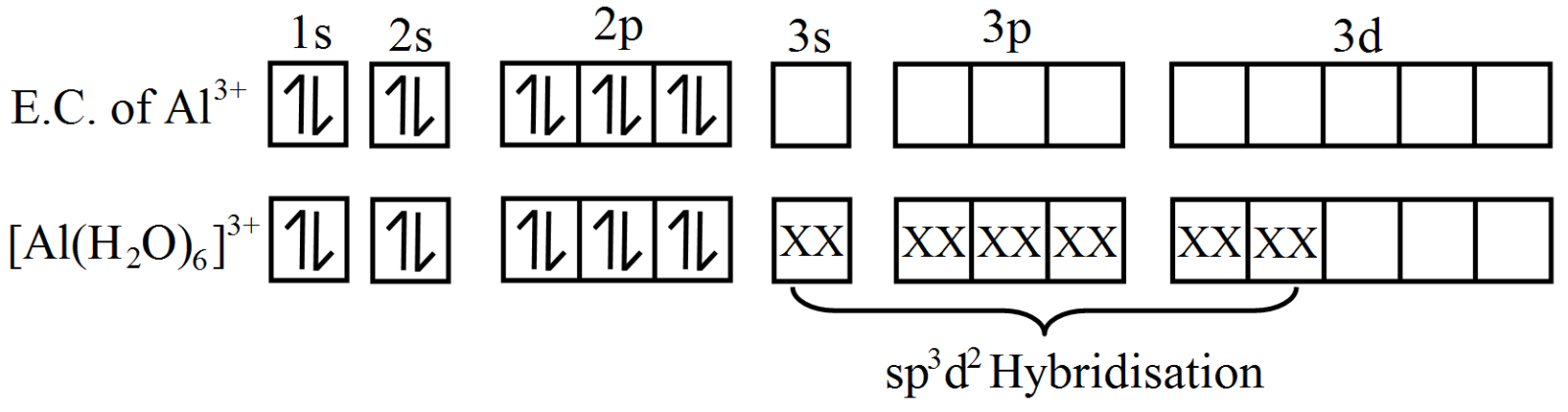
When $\mathrm{BCl}_3$ is treated with water, it hydrolyses and forms $\left[\mathrm{B}[\mathrm{OH}]_4\right]^{-}$only whereas $\mathrm{AlCl}_3$ in acidified aqueous solution forms $\left[\mathrm{Al}\left(\mathrm{H}_2 \mathrm{O}\right)_6\right]^{3+}$ ion. Explain what is the hybridisation of boron and aluminium in these species?
Answer
$\mathrm{BCl}_3+3 \mathrm{H}_2 \mathrm{O} \rightarrow \mathrm{~B}(\mathrm{OH})_3+3 \mathrm{HCl}$.
$\mathrm{B}(\mathrm{OH})_3+\mathrm{H}_2 \mathrm{O} \rightarrow\left[\mathrm{~B}(\mathrm{OH})_4^{-}+\mathrm{H}^{+}\right.$
$\mathrm{B}(\mathrm{OH})_3$ due to its incomplete octet accepts an electron pair (as $\mathrm{OH}^{-}$) to give $\left[B(\mathrm{OH})_4\right]^{-}$. Boron in this ion involves one $2 s$ orbital and three $2 p$ orbitals. Thus, hybridisation of $B$ in $\left[B(\mathrm{OH})_4\right]^{-}$is $\mathrm{sp}^3$.
$\text{AlCl}_3+6\text{H}_2\text{O}\xrightarrow{\text{HCL}}[\text{Al(H}_2\text{O})_6]^{3+}+3\text{Cl}^-$

Hence, hybridisation of Al is $sp^{_3}d^2$.
View full question & answer
Question 425 Marks
  1. Draw the structure of $B_2H_6$.
  2. What happens when:
  1. boric acid is added to water?
  2. aluminium is treated with dilute NaOH?
  1. Give suitable reason for the following:
  1. $[\text{SiF}_6]^{2-}$ is known whereas $[\text{SiCl}_6]^{2-}$ not.
  2. In group $14$, the tendency for catenation decreases with increasing atomic number.
Answer
  1.  
  1.  
  1. $\text{H}_3\text{BO}_3+2\text{H}_2\text{O}\xrightarrow{\ \ \ \ \ \ \ \ }\text{H}_3\text{O}^++\text{B(OH})_4^-$
  2. $2\text{Al}+2\text{NaOH}+2\text{H}_2\text{O}\xrightarrow{\ \ \ \ \ }2\text{NaAlO}_2+3\text{H}_2$
  1.  
  1. It is because $F^-$ is more stable than $Cl^-$. ‘F' is stronger oxidising agent than ‘Cl’. It is also due to more repulsion between $6Cl^-$ due to larger size than $6F^-$.
  2. It is due to decrease in bond dissociation energy due to increase in atomic size.
View full question & answer
Question 435 Marks
  1. Give reasons for the following:
  1. Conc. $HNO_3$ can be transported in Al container.
  2. Diamond is used as an abrasive.
  1. What happens when borax is heated strongly?
  2. What is the state of hybridization of C in:,
    1. $\text{CO}^{2-}_3$
    2. Diamond?
Answer
  1.  
  1. It is because it forms oxide layer on its surface which does not react further.
  2. Diamond is a hard substance therefore it is used as an abrasive.
  1. $\text{Na}_2\text{B}_4\text{O}_7.10\text{H}_2\text{O}\xrightarrow{\ \ \ \ \ \Delta\ \ \ \ }\text{Na}_2\text{B}_4\text{O}_7\\ \ \ \ \ \ \ \ \ \ \ \ ^\text{Borax}$
$\text{Na}_2\text{B}_4\text{O}_7\xrightarrow{\ \ \ \Delta\ \ \ }2\text{NaBO}_2+\text{B}_2\text{O}_3\\ \ \ \ \ \ \ \ \ \ \ \ \ \ \ \ \ \ \ \ \ \ \ \ \ \ \ \ \ \ \ ^\text{Sodium}\ \ \ \ \ \ \ ^\text{Boron}\\ \ \ \ \ \ \ \ \ \ \ \ \ \ \ \ \ \ \ \ \ \ \ \ \ \ \ \ \ ^\text{metaborate}\ \ \ \ \ ^\text{oxide}$
  1.  
  1. $sp^2$
  2. $sp^3$
View full question & answer
Question 445 Marks
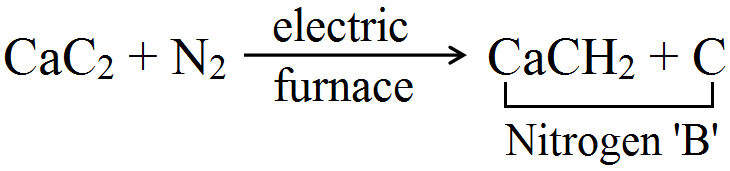
When a mixture of ammonium chloride and potassium dichromate was heated, a stable colourless gas ‘A’ is evolved which did not support combustion, but Mg continued burning in it. The gas reacted with $CaC_2$ in electric furnace forming a solid 'B'. Which was slowly hydrolysed by water forming a insoluble substance 'C' and a solution of substance 'D' which turns red litmus blue and gives white fumes with conc HCl to form ‘E'. Identify A to E and write chemical reactions involved.
Answer
$2\text{NH}_4\text{Cl}+\text{K}_2\text{Cr}_2\text{O}_7\xrightarrow{\ \ \ \ \ \ \ \ }(\text{NH}_4)_2\text{Cr}_2\text{O}_7+2\text{KCl}$
$(\text{NH}_4)_2\text{Cr}_2\text{O}_7\xrightarrow{\text{Heat}}\text{N}_2+4\text{H}_2\text{O}+\text{Cr} _2\text{O}_3\\ \ \ \ \ \ \ \ \ \ \ \ \ \ \ \ \ \ \ \ \ \ \ \ \ \ \ \ \ \ \ \ \ \ \ \ \text{'A'}$
A is $N_2$ which does not support combustion.
$3\text{Mg}+\text{N}_2\xrightarrow{\ \ \ \\ \ \ \ }\text{Mg}_3\text{N}_2$
Magnesium ribbon keeps on burning in $N_2$ due to formation of $Mg_3 N_2$

$\text{CaCN}_2+3\text{H}_2\text{O}\xrightarrow{\ \ \ \ \ \ \ \ \ }\text{CaCO}_3+2\text{NH}_3\\\ \ \ \ \ \ \ \ \ \ \ \ \ \ \ \ \ \ \ \ \ \ \ \ \ \ \ \ \ \ \ \ \ \ \ \ \ \ \ \ \ \ \ \text{'C'}\ \ \ \ \ \ \ \ \ \ \ \text{'D'}$
$\text{NH}_3+\text{HCl}\xrightarrow{\ \ \ \ \ \ \ }\text{NH}_4\text{Cl}\\\ \ \ \ \ \ \ \ \ \ \ \ \ \ \ \ \ \ \ \ \ \ \ \ \ \ \ \ \ \ \ \ \ \ \ \text{'E'}$
$\text{'A'}$ is $\text{N}_2,\text{'B'}$ is $\text{CaCN}_2(\text{calcium cyanamide})\text{'C'}$ is $\text{CaCO}_3\text{'D'}$ is $\text{NH} _3\text{'E'}$ is $\text{NH}_4\text{Cl .}$
View full question & answer