Questions · Page 1 of 5

[2 Mark Questions]

Take a timed test

50 questions · self-marked practice — reveal the answer and mark yourself.

Question 12 Marks
The refractive indices of three media are given below :
MediumRefractive Index
A1.6
B1.8
C1.5
A ray of light is travelling from $A$ to $B$ and another ray is travelling from $B$ to $C$.
(a) In which of the two cases the refracted ray bends towards the normal?
(b) In which case does the speed of light increase in the second medium?
Give reasons for your answer.
Answer
a) When light travels from an optically rarer medium to an optically denser medium it moves towards the normal. Since $n_B>n_A$ hence the light ray will bend towards the normal on passing from medium $A$ to $B$.
b) The speed of the light will increase when the light travels from B to C, Since $n c<n_B$ and $v =( c / n )$, the speed of light ray will increase in the second medium.
View full question & answer
Question 22 Marks
An object is placed at a distance of 15 cm from a concave lens of focal length 30 cm. List four characteristics (nature, position, etc.) of the image formed by the lens.
Answer
Given, u = -15cm (It is to the left of the lens) f = -30 cm (It is a concave lens) Using the lens formula $\frac{1}{\text{f}}=\frac{1}{\text{v}}-\frac{1}{\text{u}}$$\Rightarrow \frac{1}{\text{v}}=\frac{1}{\text{f}}+\frac{1}{\text{u}} =\frac{1}{(-30)} + \frac{1}{(-15)}$
$\therefore \frac{1}{\text{v}}=-\frac{3}{30}=-\frac{1}{10}$
$\therefore \text{v}=-10\text{cm}$
The negative sign of the image distance shows that the image is fromed on the left side of the concave mirror. Thus, the image formed by a mirror is virtual, erect and on the same side as the object.
View full question & answer
Question 32 Marks
A student focuses the image of a candle flame, placed at about 2 m from a convex lens of focal length 10 cm, on a screen. After that he moves gradually the flame towards the lens and each time focuses its image on the screen.
  1. In which direction does he move the lens to focus the flame on the screen?
  2. What happens to the size of the image of the flame formed on the screen?
  3. What difference is seen in the intensity (brightness) of the image of the flame on the screen?
  4. What is seen on the screen when the flame is very close (at about 5 cm) to the lens?
Answer
  1. He moves the lens away from the screen to focus the image.
  2. Size of the image increases.
  3. The intensity of image decreases as the flame moves towards the lens.
  4. Nothing can be seen on the screen as in this case the image formed is virtual which can't be obtained on the screen.
View full question & answer
Question 42 Marks
The refractive indices of glass and water with respect to air are 3/2 and 4/3 respectively. If speed of light in glass is 2×10⁸ m/s, find the speed of light in water.
Answer
$\text{Refractive index of a medium} = \frac{\text{Speed of light in air}}{\text{Speed of light in the medium}}$$\frac{3}{2} = \frac{\text{Speed of light in air}}{\frac{2 \times 10^{8} \text{m/s}}{\text{Speed of light in air = 3} {\times 10^{8} \text{m/s}}}}$
$\text{Speed of light in water} = \frac{3 \times 10^{8} \text{m/s}}{4/3} 2.25 \times 10^{8} \text{m/s}$
View full question & answer
Question 52 Marks
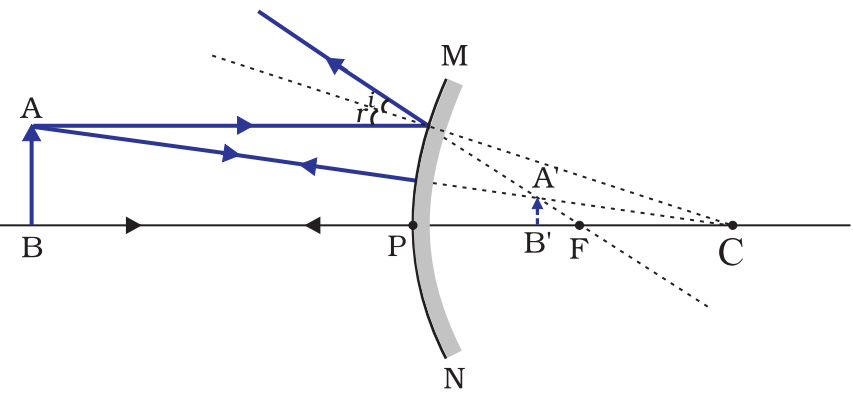
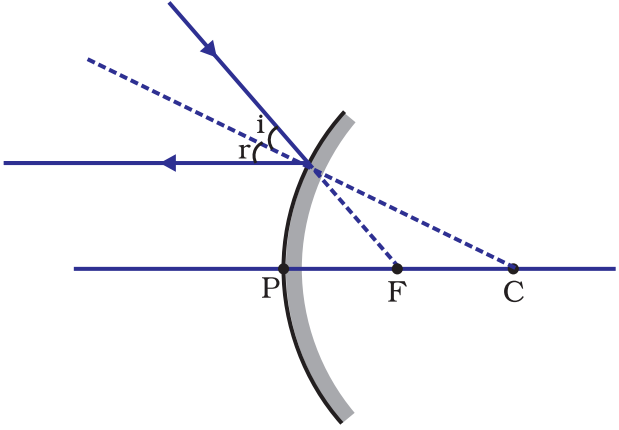
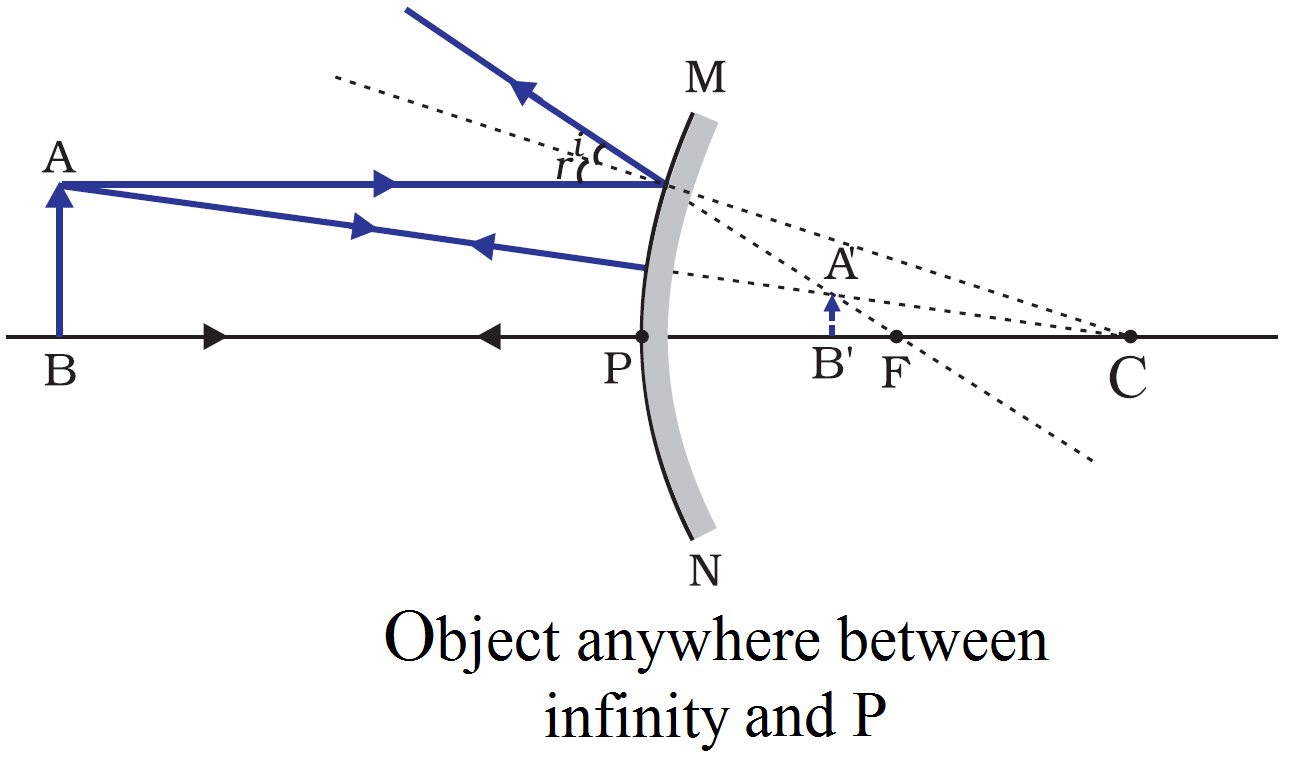
Draw a ray diagram to show the path of the reflected ray corresponding to an incident ray of light parallel to the principal axis of a convex mirror and show the angle of incidence and angle of reflection on it.
Answer
Ray diagram to show the path of the reflected ray corresponding to an incident ray of light parallel to the principal axis of a convex mirror:
View full question & answer
Question 62 Marks
‘‘A concave mirror of focal length 15cm can form a magnified erect as well as inverted image of an object placed in front of it.’’ Justify this statement stating the position of the object with respect to the pole of the mirror in both cases for obtaining the images.
Answer
The two cases can be there for the position of object with respect to the pole of the mirror:
  1. When object is placed between pole and focus of concave mirror and the distance is less than 15cm, the image obtained will be a magnified, erect and virtual image.
  2. When object is placed between focus and center of curvature, 15 to 30cm, the image obtained will be magnified, real and inverted.
View full question & answer
Question 72 Marks
An object is placed at a distance of 15 cm. from a convex lens of focal length 20 cm. List four characteristics (nature, position, etc.) of the image formed by the lens.
Answer
If an object is placed at a distance of 15cm from a convex lens of focal length 20cm, the image formed by the lens will have following characteristics.
  1. The image will be virtual and erect.
  2. It will be a magnified image; this means that the size of the image will be larger than the size of the object.
  3. The position of the image will be at the same side where the object is placed.
View full question & answer
Question 82 Marks
“The magnification produced by a spherical mirror is - 3”. List four informations you obtain from this statement about the mirror/ image.
Answer
  1. Inverted image.
  2. Magnified.
  3. Concave mirror.
  4. Real image.
View full question & answer
Question 92 Marks
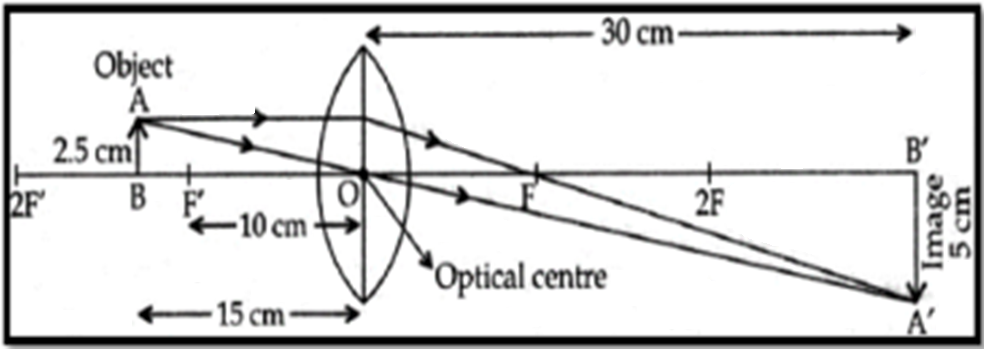
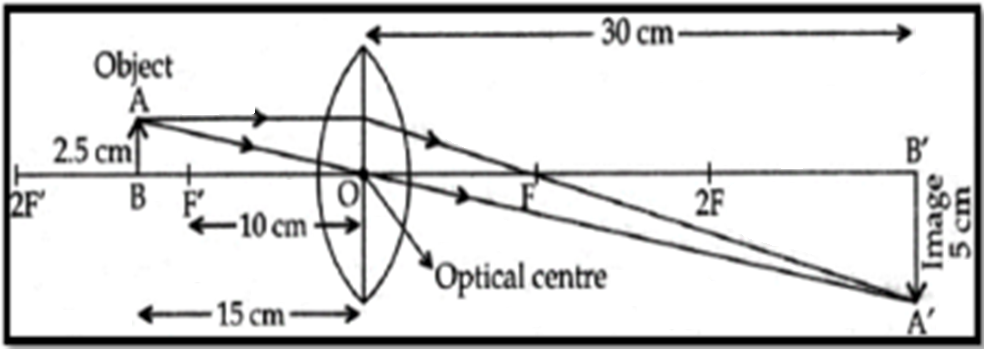
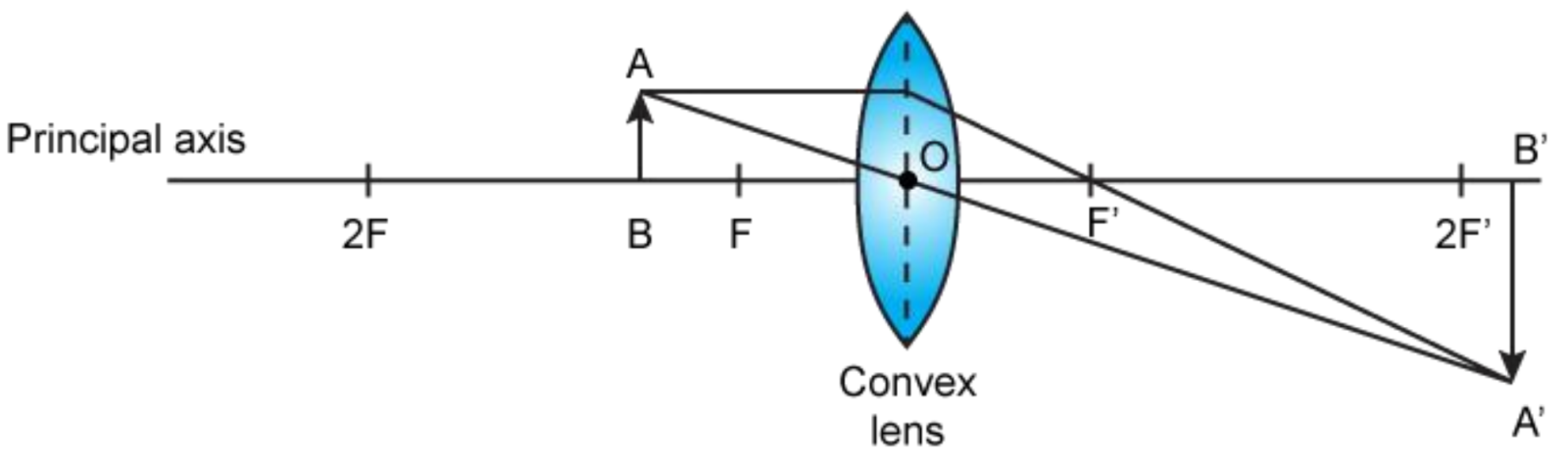
An object of height 2.5 cm is placed at a distance of 15 cm from the optical centre ‘O' of a convex lens of focal length 10 cm. Draw a ray diagram to find the position and size of the image formed. Mark optical centre ‘O', principal focus F and height of the image on the diagram.
Answer
The ray diagram is as follows:

The size of the image formed is 5 cm beyond 2F.
View full question & answer
Question 102 Marks
A 4 cm tall object is placed on the principal axis of a convex lens. The distance of the object from the optical centre of the lens is 12cm and its sharp image is formed at a distance of 24cm from it on a screen on the other side of the lens. If the object is now moved a little away from the lens, in which way (towards the lens or away from the lens) will he have to move the screen to get a sharp image of the object on it again? How will the magnification of the image be affected?
Answer
  1. When the object is moved a little away from the lens, then the screen should be moved towards the lens. A sharp image is formed.
  2. When the object is moved a little away from the lens, then the magnification of the mage decreases.
View full question & answer
Question 112 Marks
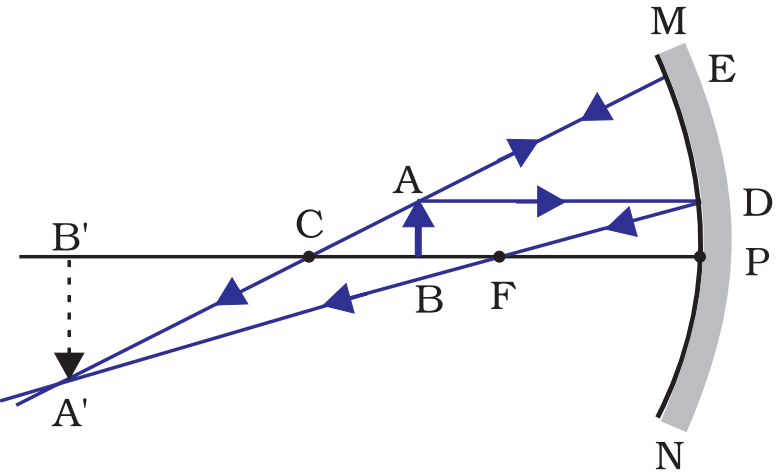
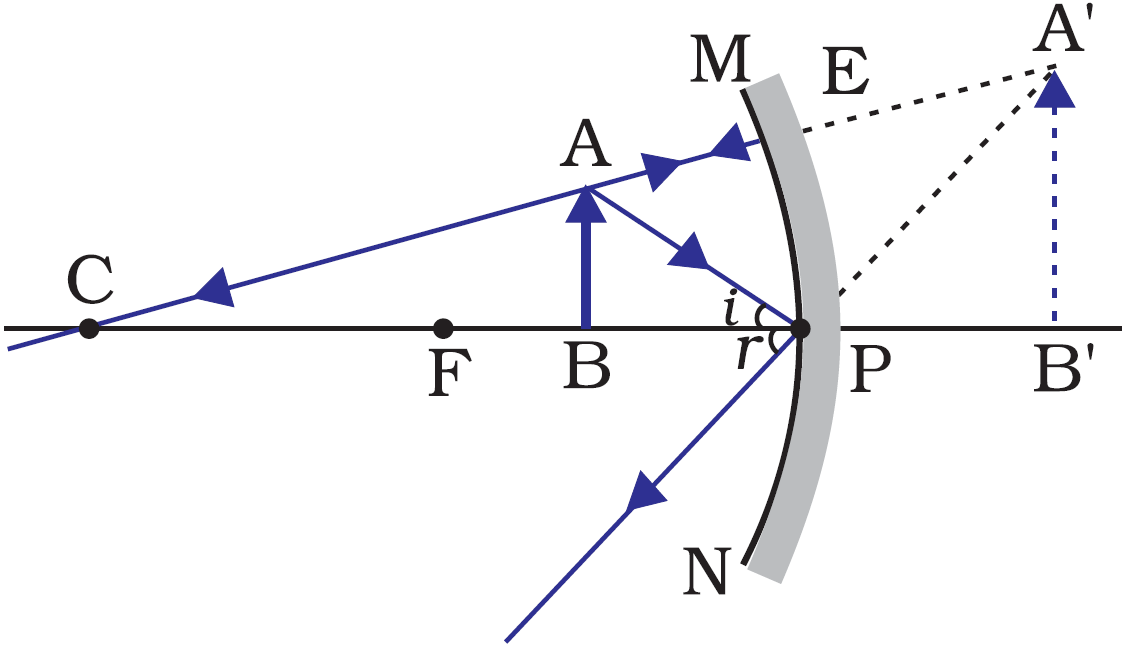
The image formed by a concave mirror is observed to be virtual, erect and larger than the object. Where should the position of the object be relative to the mirror? Draw ray diagram to justify your answer.
Answer

When the object is located between the focus (F) and the pole (P) of the mirror, the image is formed behind the mirror; this image is virtual, erect and large.
View full question & answer
Question 122 Marks
An object is placed at a distance of 30 cm from a concave lens of focal length 15 cm. List four characteristics (nature, position, etc.) of the image formed by the lens.
Answer
U = -30cm f = -15cm $\frac{1}{\text{f}} = \frac{1}{\text{v}}-\frac{1}{\text{u}}$
$\frac{1}{\text{v}} = \frac{1}{\text{f}}-\frac{1}{\text{u}}$
$\frac{1}{\text{v}}=\Big(\frac{1}{-15}\Big)+\Big(\frac{1}{-30}\Big)$
$\frac{1}{\text{v}}=\Big(\frac{1}{-10}\Big)$
On substituting v = -10cm$\text{m}=\frac{\text{v}}{\text{u}}$
$\text{m}=\frac{-10}{-30}$
$\text{m}=\frac{1}{3}=.33$
The magnification is positive so it is a virtual erect image, m is less than 1 so the image is diminished and v is negative so the image is formed on the same side of the lens.
View full question & answer
Question 132 Marks
Name the type of mirrors used in the design of solar furnaces. Explain how high temperature is achieved by this device.
Answer
  • Concave Mirrors/Converging Mirrors.
  • When a solar furnace is placed at the focus of a large concave mirror/reflector, it focuses a parallel beam of light on the furnace, consequently a high temperature is achieved after some time.
View full question & answer
Question 142 Marks
An object of height 2.5cm is placed at a distance of 15cm from the optical centre ‘O' of a convex lens of focal length 10cm. Draw a ray diagram to find the position and size of the image formed. Mark optical centre ‘O', principal focus F and height of the image on the diagram.
Answer
The ray diagram is as follows:

The size of the image formed is 5cm beyond 2F.
View full question & answer
Question 152 Marks
The absolute refractive indices of glass and water are $4 / 3$ and $3 / 2$ respectively. If the speed of light in glass is $2 \times 10^8$ $m / s$, calculate the speed of light in (i) vacuum, (ii) water.
Answer
  1. $\text{n}_{g} = \frac{4}{3};$
$\text{n}_{w} = \frac{3}{2};$

$\text{v}_{g} = 2\times10^{8}\text{m/s}$

$\text{n}_{g} = \frac{\text{C}}{\text{v}_{g}}$

$\therefore\text{c} = \text{n}_{g}\text{v}_{g} =\frac{4}{3}\times2\times10^{8}\text{m/s} = 2.67\times10^{8}\text{m/s}$
  1. $\text{n}_{w} = \frac{\text{C}}{\text{V}_{w}}$
$\therefore\text{V}_{w} =\frac{\text{C}}{\text{n}_{w}} =\frac{2.67\times2\times10^{8}}{3} = 1.78\times10^{8}\text{m/s}.$
View full question & answer
Question 162 Marks
List two possible ways in which a concave mirror can produce a magnified image of an object placed in front of it. State the difference, if any, between these two images.
Answer
Case 1: Concave mirror can produce an erect, magnified, virtual image when the object is placed between pole and focus of the mirror.
Case 2: Concave mirror can produce an inverted, magnified, real image when the object is placed between the focus and the centre of curvature.
Difference between these two images:
  • The image produced in first case will be virtual and erect.
  • The image produced in the second case will be real and inverted.
View full question & answer
Question 172 Marks
“A concave mirror of focal length ‘f’ can form a magnified erect as well as an inverted image of an object placed in front of it.” Justify this statement stating the position of the object with respect to the mirror in each case for obtaining these images.
Answer
When the object is placed at a distance less than ‘f’ (focal length) from the mirror, the image formed is virtual, magnified and erect. When the object is placed at a distance of ‘f’ (focal length) from the mirror, the image is real, inverted and highly magnified. When the object is placed at a distance more than (focal length) but less than ‘2f’, the image formed is real, inverted and magnified. When the object is placed at the distance of “If from the mirror, the image is real, inverted and same size of the object. When the object is placed at a distance more than ‘If from the mirror, the image formed is real, inverted and diminished.
View full question & answer
Question 182 Marks
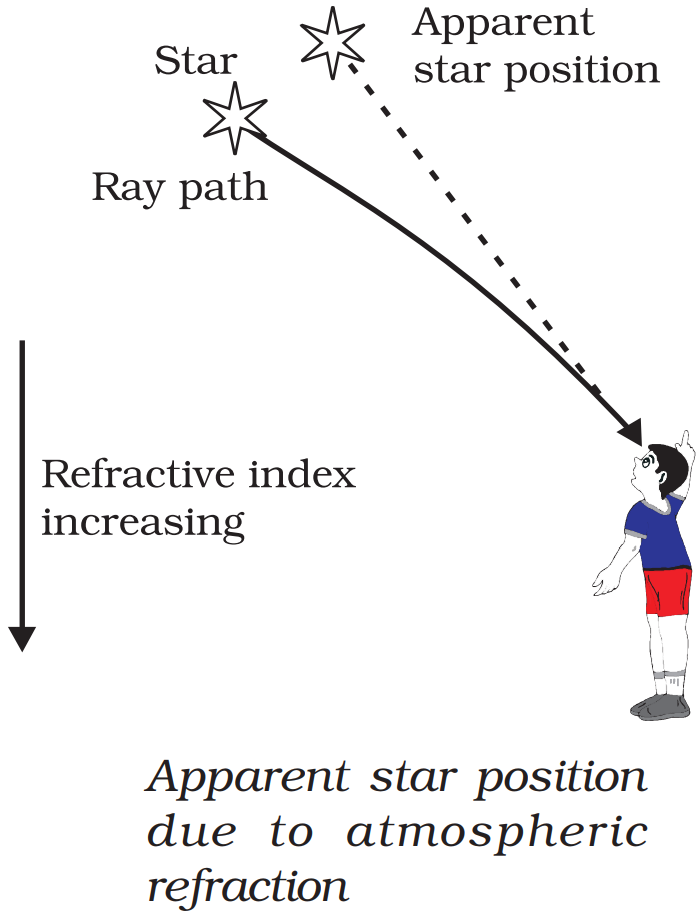
A star appears slightly higher (above) than its actual position in the sky illustrate it with the help of a labelled diagram.
Answer
The gradual change in the refractive index of different layers of the atmosphere due to the varying conditions of it causes atmospheric refraction. When starlight enters the atmosphere, it gets refracted continuously. The higher level of air acts as a rarer medium while the dense air near the surface of earth acts as a denser medium. So, the atmosphere bends the starlight towards the normal. As a result, the apparent position of star is slightly different from its actual position. Thus, star appears slightly higher (above) than its actual position in the sky.
View full question & answer
Question 192 Marks
To construct ray diagram we use two light rays which are so chosen that it is easy to know their directions after reflection from the mirror. List these two rays and state the path of these rays after reflection. Use these rays to locate the image of an object placed between centres of curvature and focus of a concave mirror.
Answer
  1. Ray incident parallel to the principal axis after reflection passes through the focus (for concave mirror) or appears to have diverged from. (for convex mirror)
  2. Incident ray passing through the principal focus (for concave mirror) or directed towards the focus (for convex mirror) after reflection emerges or appears to emerge parallel to the principal axis.
  3. Incident ray passing through centre of curvature (for concave mirror) or directed towards the centre of curvature (for convex mirror) is reflected back along the same path.
  4. A ray incident obliquely to the principal axis towards pole of the mirror obliquely. The incident ray and the reflected ray make the same angle with the principal axis.
View full question & answer
Question 202 Marks
State any four characteristics of the image of an object formed by a plane mirror.
Answer
Characteristics of the images formed by plane mirrors are:
  1. The image formed is of the same size as that of the object.
  2. Images are formed behind the mirrors and are at the same distance from the mirror as that of the object.
  3. The virtual and erect image is formed.
  4. The images are laterally inverted.
View full question & answer
Question 212 Marks
In an experiment with a rectangular glass slab, a student observed that a ray of light incident at an angle of $55^{\circ}$ with the normal on one face of the slab, after refraction strikes the opposite face of the slab before emerging out into air making an angle of $40^{\circ}$ with the normal. Draw a labelled diagram to show the path of this ray.' What value would you assign to the angle of refraction and angle of emergence?
Answer


OA - Incident ray
1 is angle of incidence $=50^{\circ}$
Given $r_2=40^{\circ}$
$r_1$ and $r_2$ are alternate interior angles,
$\therefore \angle r_1=\angle r_2=40^{\circ}
So, angle of refraction $=40^{\circ}$
Since, the emergent ray is parallel to the incidnt ray, the angle of emergent must be equal to angle of incidence, i.e.
$\angle e=\angle i=55^{\circ}$
View full question & answer
Question 222 Marks
To find the image distance for varying object distances in case of a convex lens of focal length 15 cm, a student obtains on a screen a sharp image of a bright object by placing it at 20 cm distance from the lens. After that he gradually moves the object away from the lens and each time focuses the image on the screen.
  1. In which direction-towards or away from the lens does he move the screen to focus the object?
  2. How does the size of image change?
  3. Approximately at what distance does he obtain the image of magnification -1?
  4. How does the intensity of image change as the object moves farther and farther away from the lens?
Answer
  1. Towards the lens.
  2. Size decreases gradually.
  3. Nearly 30 cm from the lens.
  4. Intensity of the image gradually increases.
View full question & answer
Question 232 Marks
The linear magnification produced by a spherical mirror is +3. Analyse this value and state the (i) type of mirror and (ii) position of the object with respect to the pole of the mirror. Draw ray diagram to show the formation of image in this case.
Answer
  1. Concave mirror.
  2. Between the pole and focus.
View full question & answer
Question 242 Marks
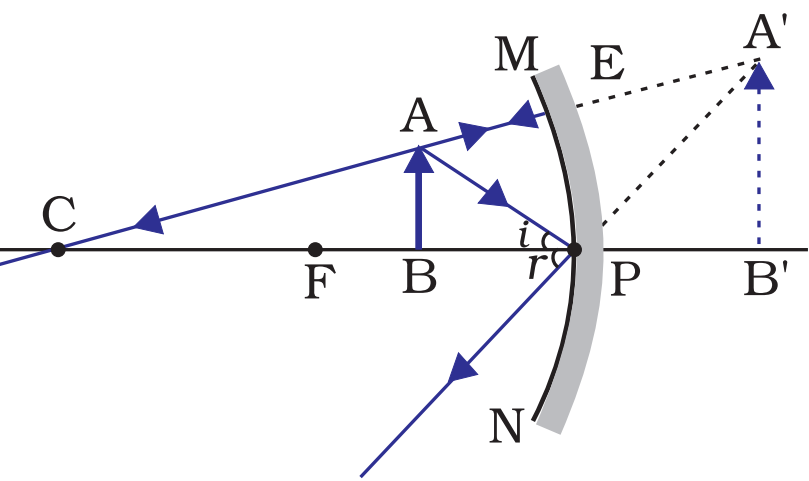
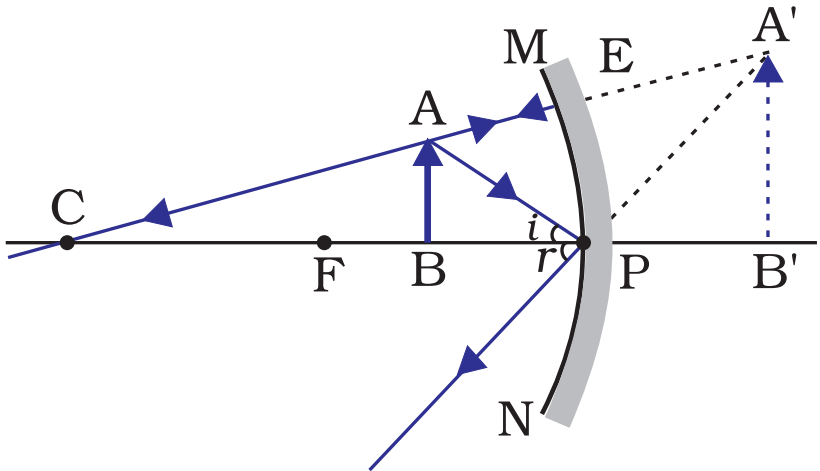
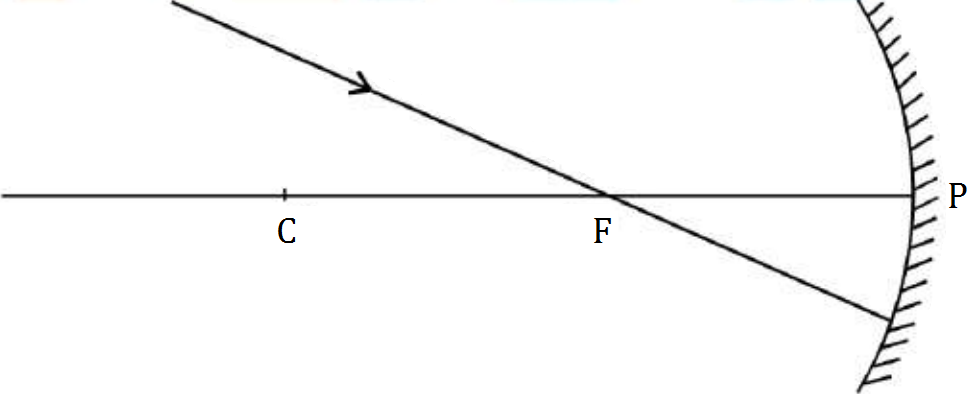
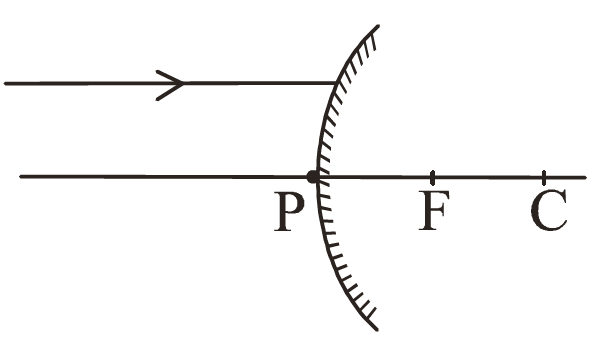
Redraw the following diagram on your answer-sheet and show the path of the reflected ray. Also mark the angle of incidence $(\angle\text{i})$ and the angle of reflection $(\angle\text{r})$ on the diagram.
View full question & answer
Question 252 Marks
List two properties of the images formed by convex mirrors. Draw ray diagram in support of your answer.
Answer
The images formed by convex mirrors are: Virtual, erect and smaller than the object.
View full question & answer
Question 262 Marks
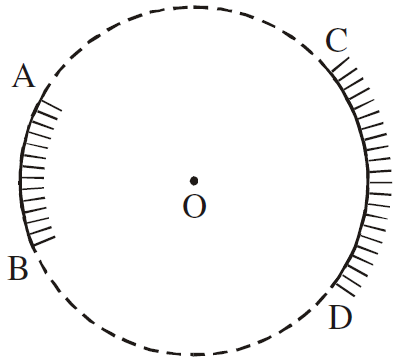
AB and CD, two spherical mirrors, form parts of a hollow spherical ball with its centre at O as shown in the diagram. If arc $\text{AB}=\frac{1}{2}$ arc CD, what is the ratio of their focal lengths? State which of the two mirrors will always form virtual image of an object placed in front of it and why.
Answer
Focal length of both the mirrors will be the same/ 1: 1
Mirror AB will always form virtual image as it is a diverging/convex mirror.
View full question & answer
Question 272 Marks
An object is placed at a distance of 12cm in front of a concave mirror of radius of curvature 30cm. List four characteristics of the image formed by the mirror.
Answer
Here u = -20cm, f = +15cm, v = ? Using mirror formula, we have,$\frac{1}{\text{v}}+\frac{1}{\text{u}}=\frac{1}{\text{f}}$
$\frac{1}{\text{v}}-\frac{1}{20}=\frac{1}{15}$
$\frac{1}{\text{v}}=\frac{1}{15}+\frac{1}{20}$
$\frac{1}{\text{v}}=\frac{4+3}{60}$
$\text{v}=\frac{60}{7}=8.5\text{cm}$
Therefore, the image formed behind the mirror and forms virtual, erect, diminished, image.
View full question & answer
Question 282 Marks
What is meant by power of a lens? What does its sign (+ve or -ve) indicate? State its S.I. unit. How is this unit related to focal length of a lens?
Answer
The power of a lens may be defined as the reciprocal of its focal length in meters. Its SI unit is dioptre (D) and it is denoted as P. Power $\text{P}=\frac{1}{\text{Focal length (f) in meters}}$$=\frac{1}{\text{f}}=\frac{100}{\text{f (in cm)}}$
This expression indicates that the power of a lens of shorter focal length is greater than the power of a lens of longer focal length. Power of a convex lens is positive and that of a concave lens is negative.
View full question & answer
Question 292 Marks
List four specific characteristics of the images of the objects formed by convex mirrors.
Answer
The images of the objects formed by convex mirrors are always:
  1. Virtual and erect.
  2. Diminished.
  3. formed behind the mirror between focus and pole of the mirror when the objects are placed anywhere between the poles and infinity.
  4. The images are formed behind the mirrors at the focus of mirror when object is at infinity.
View full question & answer
Question 302 Marks
Draw a ray diagram to show the path of the reflected ray corresponding to an incident ray which is directed towards the principal focus of a convex. mirror. Mark on it the angle of incidence and the angle of reflection.
View full question & answer
Question 312 Marks
An object is placed at a distance of 40cm in front of a convex mirror of radius of curvature 40cm. List four characteristics of the image formed by the mirror.
Answer
Four properties of the image formed by the given convex mirror are:
  1. Image is always erect.
  2. Small in size.
  3. Virtual.
  4. Always forms behind the mirror between focus and pole.
View full question & answer
Question 322 Marks
A ray of light is incident on a convex mirror as shown. Redraw the diagram and complete the path of this ray after reflection from the mirror. Mark angle of incidence and angle of reflection on it.
View full question & answer
Question 332 Marks
To find-the image-distance for varying object-distances in case of a convex lens, a student obtains on a screen a sharp image of a bright object placed very far from the lens. After that he gradually moves the object towards the lens and each time focuses its image of the screen.
  1. In which direction - towards or away from the lens, does he move the screen to focus the object?
  2. What happens to the size of the image - does it increase or decrease?
  3. What happen when he moves the object very close to the lens?
Answer
  1. The position of the object moves away from the lens, as the student moves the object towards the lens. The screen should be moved away from the lens in order to obtain a sharp image.
  2. When the object is moved near the lens, size of the image increases.
  3. When the object is moved very close to the lens, it can be assumed to be placed between the focus and the optical centre. Then, the image formed is virtual, erect and enlarged.
View full question & answer
Question 342 Marks
Draw a ray diagram to show the path of the reflected ray corresponding to an incident ray which is directed parallel to the principal axis of a convex mirror. Mark on it the angle of incident and the angle of reflection.
View full question & answer
Question 352 Marks
An object is placed at a distance of 30cm in front of a convex mirror of focal length 15cm. Write four characteristics of the image formed by the mirror.
Answer
Formula related to focal length f, object-to-mirror distance u and image-to-mirror distance v is given by$\frac{1}{\text{v}}+\frac{1}{\text{u}}=\frac{1}{\text{f}}$
$\frac{1}{30}+\frac{1}{\text{v}}=\frac{1}{15}$
Solving the above e.q. for v, we get v = 30cm
  1. Image is formed at a distance 30 cm from concave mirror.
  2. Since image distance and object distance are same (both are at 2F),
  1. Magnification = 1
  2. Image and object are same size.
  1. Image is real.
  2. Image is inverted.
View full question & answer
Question 362 Marks
A student places a candle flame at a distance of about 60 cm from a convex lens of focal length 10 cm and focuses the image of the flame on a screen. After that he gradually moves the flame towards the lens and each time focuses the image on the screen.
  1. In which direction-toward or away from the lens, does he move the screen to focus the image?
  2. How does the size of the image change?
  3. How does the intensity of the image change as the flame moves towards the lens?
  4. Approximately for what distance between the flame and the lens, the image formed on the screen is inverted and of the same size?
Answer
  1. As the candle is moved towards the lens, the image distance increases. Thus, the student moves the lens away from the screen to focus the image.
  2. The size of the image increases when the object is moved towards the lens.
  3. Intensity decreases.
  4. When the candle is moved very close to the lens, no image is formed on the screen. A virtual image is formed behind the candle on the same side of the screen.
View full question & answer
Question 372 Marks
A student focuses the image of a well illuminated distant object on a screen using a convex lens. After that he gradually moves the object towards the lens and each time focuses its image on the screen by adjusting the lens.
  1. In which direction-towards the screen or away from the screen, does he move the lens?
  2. What happens to the size of the image-does it decrease or increase?
  3. What happens to the image on the screen when he moves the object very close to the lens?
Answer
  1. As the object is moved towards the lens, the image distance increases. Thus, the student moves the lens away from the screen to focus the image.
  2. The size of the image increases when the object is moved towards the lens.
  3. When the object is moved very close to the lens, no image is formed on the screen. A virtual image is formed behind the object on the same side of the screen
View full question & answer
Question 382 Marks
State two positions in which a concave mirror produces a magnified image of a given object. List two differences between the two images.
Answer
  • When the object is placed in front of the mirror –
  1. Between its pole and focus.
  2. Between the focus and centre of curvature.
  • In case (i) The image is virtual and erect.
In case (ii) The image is real and inverted.
View full question & answer
Question 392 Marks
List four characteristics of the images formed by plane mirrors.
Answer
The four characteristics of images formed by plane mirrors are as following:
  1. The image formed in a plane mirror is virtual. It cannot be received on a screen.
  2. The image formed is erect and of same size as the object.
  3. The image formed is at the same distance behind the mirror as the object is in front of the mirror.
  4. The image formed in a plane mirror is laterally inverted.
View full question & answer
Question 402 Marks
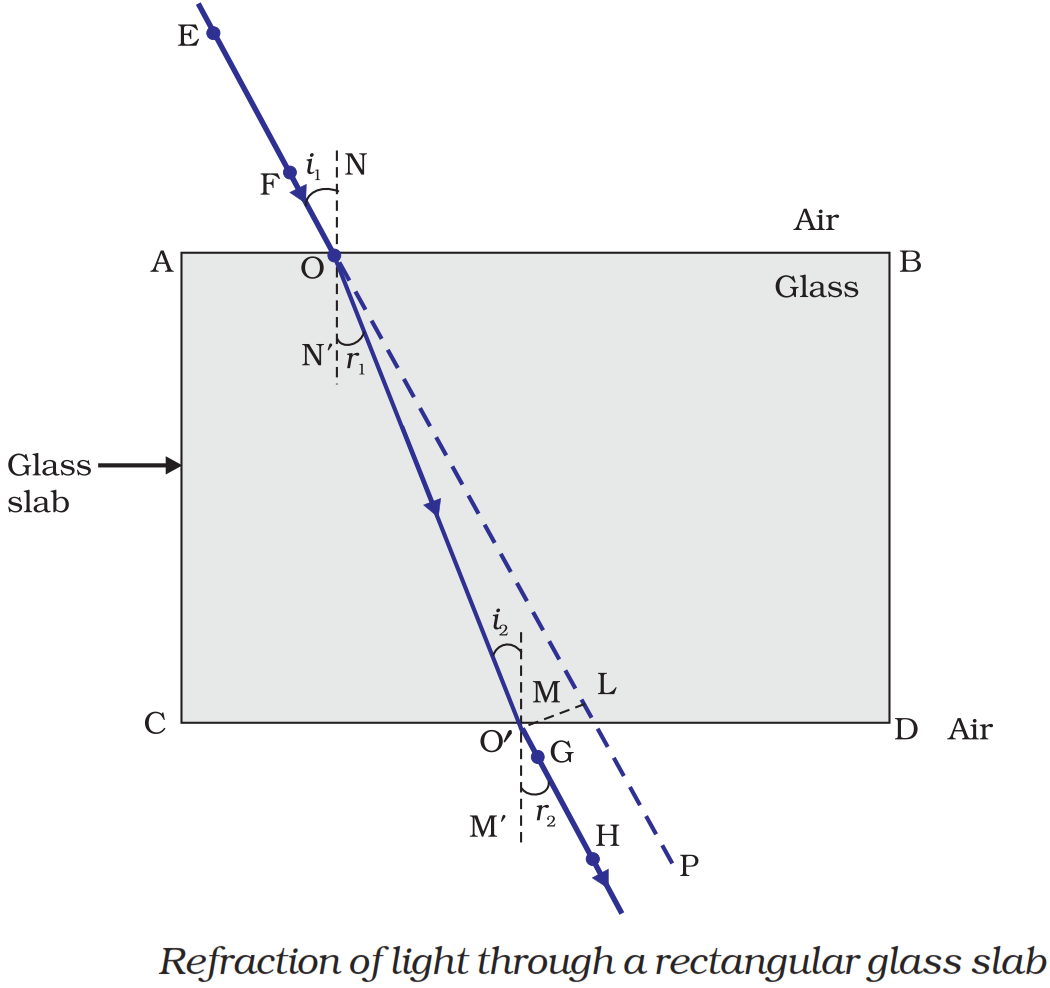
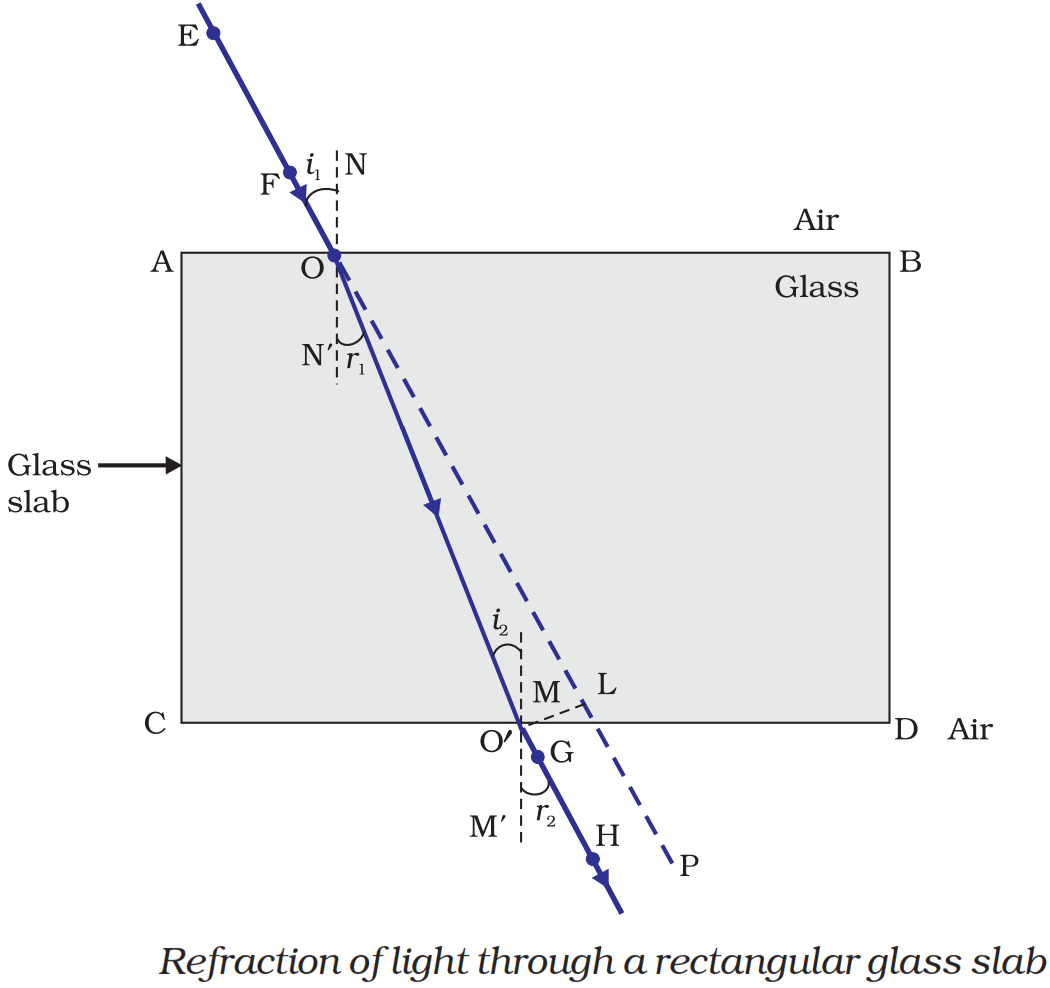
“A ray of light incident on a rectangular glass slab immersed in any medium emerges parallel to itself.” Draw labeled ray diagram to justify this statement.
Answer

EF is the incident ray and GH is the emergent ray which is parallel to the incident ray.
View full question & answer
Question 412 Marks
List four properties of the image formed by a plane mirror.
Answer
The four characteristics of images formed by plane mirrors are as following:
  1. The image formed in a plane mirror is virtual. It cannot be received on a screen.
  2. The image formed is erect and of same size as the object.
  3. The image formed is at the same distance behind the mirror as the object is in front of the mirror.
  4. The image formed in a plane mirror is laterally inverted.
View full question & answer
Question 422 Marks
State the two laws of reflection of light.
Answer
Laws of reflection of light:
  1. The incident ray, reflected ray and the normal at the point of incidence, all lie in the same plane.
  2. At the point of incidence, angle of incidence is equal to angle of reflection/$\angle\text{i} = \angle\text{r}$.
View full question & answer
Question 432 Marks
What is the minimum number of rays required for locating the image formed by a concave mirror for an object. Draw a ray diagram to show the formation of a virtual image by a concave mirror.
Answer
2 rays are required for the image to be located!
View full question & answer
Question 442 Marks
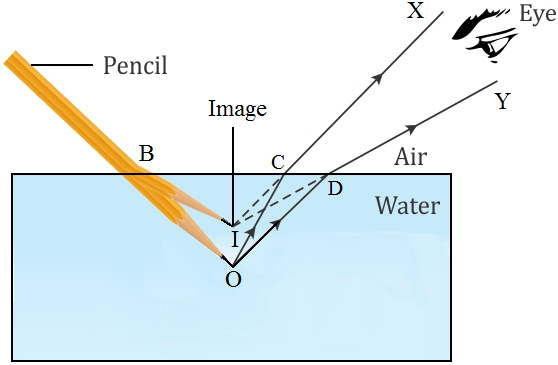
Explain with the help of a diagram, why a pencil partly immersed in water appears to be bent at the water surface.
Answer

A pencil half immersed in water at an angle apperas bent due to refraction of light ar the air water surface. Figure shows a straight pencil AO whose lower portion BO is immersed in water. it appears to be bent at point B in the direction BI. A ray of light OC coming from the lower end O passes from water into air at C and gets refracted away from the normal in the direction CX Another ray OD gets refracted in the direction DY. The two refracted ray CX and DY, when produced backward, appear to meet at point I, nearer to the water surface than O Similarly each part of the immersed portion of the pencil raides. As A result immersed portion of the pencil appears to be bent when viewed at an angle from outside.
Alternate Answer
Incident rays from pecil travel form water to air, and they bend away from normal, To an observer image of the immersed part of the pencil forms at a different position and pencil appears to be bent.
View full question & answer
Question 452 Marks
An object of height 4.0cm is placed at a distance of 30cm from the optical centre ‘O’ of a convex lens of focal length 20cm. Draw a ray diagram to find the position and size of the image formed. Mark optical centre ‘O’ and principal focus ‘F’ on the diagram. Also find the approximate ratio of size of the image to the size of the object.
Answer


Object size $\left(h_1\right)=4 cm$
Object distance (u) = -30cm
Focal length (f) = 20cm
$\frac{1}{\text{f}}=\frac{1}{\text{v}}-\frac{1}{\text{u}}$
$\frac{1}{+20}=\frac{1}{\text{v}}-\frac{1}{-30}$
$\frac{1}{\text{v}}=\frac{1}{20}-\frac{1}{30}=0.016$
⇒ Image distance (v)= 62cm
We know that,
$\text{m}=\frac{\text{height of image (h}_2)}{\text{height of object (h}_1)}=\frac{\text{v}}{\text{u}}=\frac{62}{-30}=-2.0$
Thus the approximate ratio of height of image to height of object is -2cm.
Negative sign denotes that image formed is inverted and real.
As the value of magnification is 2, the image is magnified.
Thus nature of image is real, inverted and magnified.
View full question & answer
Question 462 Marks
If the image formed by a spherical mirror for all positions of the object placed in front of it is always erect and diminished, what type of mirror is it? Draw a labelled ray diagram to support your answer.
Answer
The image formed by a convex mirror is always virtual, erect and diminished, irrespective of the position of the object. Hence, the mirror is a convex mirror.
View full question & answer
Question 472 Marks
What is observed when 2mL of dilute hydrochloric acid is added to 1g of sodium carbonate taken in a clean and dry test tube? Write chemical equation for the reaction involved.
Answer
On adding dilute hydrochloric acid to sodium carbonate taken in a clean and dry test tube, a brisk effervescence will be observed due to the evolution of carbon dioxide gas.$2\text{HCl}+\text{Na}_2\text{CO}_3\xrightarrow{\ \ \ \ \ \ \ }2\text{NaCl}+\text{H}_2\text{O}+\text{CO}_2$
View full question & answer
Question 482 Marks
List four precautions which a student should observe while determining the focal length of a given convex lens by obtaining image of a distant object on a screen.
Answer
Following are the precautions while making the image by hte help of convex lens:
  1. Fix the convex lens vertically in the lens holder.
  2. The base of the lens and white screen should be in a line with the measuring scale.
  3. Record the position of the lens and screen only when a well defined sharp image is formed.
  4. There should not be any obstacle in the path of the convex lens.
View full question & answer
Question 492 Marks
An object 1cm tall is placed 30cm in front of a convex mirror of focal length 20cm. Find the size and position of the image formed by the convex mirror.
Answer
$h_1=1 cm, u =-30 cm, f =20 cm, h _2=?, v =?$
$\frac{1}{\text{v}}+\frac{1}{\text{u}}=\frac{1}{\text{f}}$
$\frac{1}{\text{v}}+\frac{1}{-30}=\frac{1}{20}$
$\frac{1}{\text{v}}=\frac{1}{30}+\frac{1}{20}$
$\text{v}=12\text{cm}$
The image is formed 12cm behind the mirror.$\text{m}=-\frac{\text{v}}{\text{u}}=\frac{\text{h}_2}{\text{h}_1}$
$\text{m}=-\frac{12}{-30}=\frac{\text{h}_2}{14}$
${\text{h}_2}=0.4\text{cm}$
View full question & answer
Question 502 Marks
A lens has a focal length of, -10cm. What is the power of the lens and what is its nature?
Answer
$\text{f}=-10\text{cm}=0.1\text{m}$$\text{P}=\frac{1}{\text{f}}=\frac{1}{(-0.1)}=-10\text{D}$
It is a concave lens.
View full question & answer
[2 Mark Questions] - Science STD 10 Questions - Vidyadip