MCQ 11 Mark
Fusion reactions take lace at high temperature because:
- A
Atoms are ionized at high temperature.
- B
Molecules break up at high temperature.
- C
Nuclei break up at high temperature.
- ✓
Kinetic energy is high enough to overcome repulsion between nuclei.
AnswerCorrect option: D. Kinetic energy is high enough to overcome repulsion between nuclei.
Extremely high temps needed for fusion because $K.E.$ should large enough to overcome repulsion between nuclei.
View full question & answer→MCQ 21 Mark
Which of the following statement best describe Nuclear fusion reaction ?
- ✓
Two smaller nuclei are combined into a more massive nuclei.
- B
The electrons are exchanged from one or more substances to produce a different substance, and the elements are the same in the products and reactants.
- C
The nucleus of a large atom is split into two or more fragments.
- D
AnswerCorrect option: A. Two smaller nuclei are combined into a more massive nuclei.
When two or smaller nuclei combine to form a bigger nucleus, then the reaction is known as nuclear fusion reaction. A huge amount of energy is released in such reactions.
View full question & answer→MCQ 31 Mark
Which one of the following properties of an element is not variable?
AnswerAtomic weight is specific for a particular element and does not change under any circumstances.
View full question & answer→MCQ 41 Mark
An $\alpha$-particle captures an electron. What does it change to?
- A
$He^{2+}$
- B
$He$
- ✓
$He^+$
- D
$\alpha$
AnswerCorrect option: C. $He^+$
An $\alpha $ particle has two protons and two neutrons and zero electrons. It is written as $^4_2\text{He}^{2+}$.
So if it captures an electron, the reaction is:
$^4_2\text{He}^{2+} + +e^- \rightarrow ^4_2\text{He}^{+}$
View full question & answer→MCQ 51 Mark
In $\gamma\ \text{ray}$ emission from a nucleus:
- A
Only the proton number changes.
- B
Both the neutron number and the proton number change.
- ✓
There is no change in the proton number and the neutron number.
- D
Only the neutron number changes.
AnswerCorrect option: C. There is no change in the proton number and the neutron number.
View full question & answer→MCQ 61 Mark
When ${ }_{15} \mathrm{P}^{30}$ decays to become ${ }_{14} \mathrm{Si}^{30}$, which particle is released?
AnswerThe nuclear reaction: ${ }_{15} \mathrm{P}^{30} \rightarrow{ }_4 \mathrm{Si}^{30}+{ }_{+1} \mathrm{e}^0$
Thus a positron is emitted during the decay of ${ }_{15} \mathrm{P}^{30}$ into ${ }_{14} \mathrm{Si}^{30}$
View full question & answer→MCQ 71 Mark
The binding energy per nucleon of iron atom is approximately.
- A
$13.6\ eV$
- ✓
$8.8\ MeV$
- C
- D
$10\ MeV$
AnswerCorrect option: B. $8.8\ MeV$
The maximum binding energy per nucleon occurs at around mass number $A = 50$, and corresponds to the most stable nuclei. Iron nucleus $F^{56}$ is located close to the peak with a binding energy per nucleon value of approximately $8.8\ MeV$ . It’s one of the most stable nuclides that exist.
View full question & answer→MCQ 81 Mark
Two atoms of the same element are found to have different number of neutrons in their nuclei. These two atoms are:
AnswerIsotopes are atoms with the same number of protons but that have a different number of neutrons.
Since the atomic number is equal to the number of protons and the atomic mass is the sum of protons and neutrons, we can also say that isotopes are elements with the same atomic number but different mass numbers.
View full question & answer→MCQ 91 Mark
The $\gamma\ \text{radiations}$ are:
- ✓
Electromagnetic radiation with high energy.
- B
Electromagnetic radiation with low energy.
- C
Charged particles emitted by the nucleus.
- D
Electrons orbiting the nucleus.
AnswerCorrect option: A. Electromagnetic radiation with high energy.
View full question & answer→MCQ 101 Mark
Li nucleus has three protons and four neutrons. Mass of lithium nucleus is $7.03.6005\ amu$. Mass of proton is $1.007277\ amu$ and mass of neutron is $1.008665\ amu$. Mass defect for lithium nucleus in amu is:
- A
$0.04048$
- ✓
$0.04050$
- C
$0.04052$
- D
$0.04055$
AnswerCorrect option: B. $0.04050$
Mass defect $=$ mass of nucleons $-$ mass of nucleus
$= (3 \times 1.007277 + 4008665) − 7.016005$
$= 0.040486\ amu$
$ \approx 0.04050$
View full question & answer→MCQ 111 Mark
Fusion reaction takes place at very high temperature because:
- A
Atoms are ionised at high temperatures
- B
Molecules breakup at high temperature
- C
Nuclei break up at high temperature
- ✓
Kinetic energy is high enough to overcome repulsion between nuclei
AnswerCorrect option: D. Kinetic energy is high enough to overcome repulsion between nuclei
Fusion reactions takes place at temperature about $10^7\ K$ it requires this high temperature so that nucleus are moving at very high speed, so that they have high kinetic energy and can overcome the repulsion between nuclei and come together.
View full question & answer→MCQ 121 Mark
$^{22}$Ne nucleus, after absorbing energy, decays into two $\alpha-$particles and an unknown nucleus. The unknown nucleus is:
Answer$^{22}$Ne decays
$\alpha$ particle $= He^{2+}$
Mass No $= 4$
$p = 2, n = 2$
So, New mass no. $= 22 − 8 = 14$
Atomic No. $= 10 − 4 = 6$
So, the new element is ${6^C}^{14}$
View full question & answer→MCQ 131 Mark
The average binding energy per nucleon is maximum for the nucleus:
- A
$_2 \mathrm{H}^4 $
- B
$_8 \mathrm{O}^{16} $
- ✓
$_{26} \mathrm{Fe}^{56}$
- D
$_{92} \mathrm{U}^{238}$
AnswerCorrect option: C. $_{26} \mathrm{Fe}^{56}$
Binding energy per nucleon increases with atomic number. The greater the binding energy per nucleon the more stable is the nucleus.
For $_{26} \mathrm{Fe}^{56}$number of nucleons is $56.$
This is most stable nucleus, since maximum energy is needed to pull a nucleon away from it.
View full question & answer→MCQ 141 Mark
In an energy emitting nuclear reaction the binding energies of reactants and products are $e_1, e_2$ respectively.Then which is correct of the following?
- ✓
$ e_1 < e_2 $
- B
$ e_1 = e_2 $
- C
$ e_1 > e_2 $
- D
$ e_1 \geq e_2 $
AnswerCorrect option: A. $ e_1 < e_2 $
In exothermic reaction the binding energy of reactants is less than the binding energy of products.
View full question & answer→MCQ 151 Mark
When the number of nucleons in nuclei increases, the binding energy per nucleon?
- A
Increases continuously with mass number.
- B
Decreases continuously with mass number.
- C
Remains constant with mass number.
- ✓
First increases and then decreases with increase of mass number.
AnswerCorrect option: D. First increases and then decreases with increase of mass number.
View full question & answer→MCQ 161 Mark
Why high temperature is required for Nuclear fusion?
- A
All nuclear reactions absorb heat.
- ✓
The particles can not come together unless they are moving rapidly.
- C
The binding energy must be supplied from an external source.
- D
The mass defect must be supplied.
AnswerCorrect option: B. The particles can not come together unless they are moving rapidly.
Fusion reaction takes place at temperatures around $10^7k$. It requires this high temperature so that nucleus start moving at rapidly speed, which in turn increases their kinetic, so that they overcome the repulsion between them and can come together.
View full question & answer→MCQ 171 Mark
- ✓
$3.7 \times 10^{10}$ Disintegration$/ \sec.$
- B
$3.2 \times 10^8$ Disintegration$/ \sec.$
- C
$2.8 \times 10^{10}$ Disintegration$/ \sec.$
- D
AnswerCorrect option: A. $3.7 \times 10^{10}$ Disintegration$/ \sec.$
View full question & answer→MCQ 181 Mark
Which of the following sometimes requires initiation from a neutron?
- ✓
- B
- C
- D
Radioactive carbon dating
AnswerThe process of splitting a nucleus is called nuclear fission. Uranium or plutonium isotopes are normally used as the fuel in nuclear reactors, because their atoms have relatively large nuclei that are easy to split, especially when hit by neutrons.
When fission of an element takes place when hit by a neutron, further more neutrons are released. The additional neutrons released may also hit other uranium or plutonium nuclei and cause them to split. Even more neutrons are then released, which in turn can split more nuclei. This is called a chain reaction.
View full question & answer→MCQ 191 Mark
Which of the following is the radio isotope in this pair? $39\text{K}\\19$,$40\text{K}\\19$
- A
$39\text{K}\\19$
- ✓
$40\text{K}\\19$
- C
- D
AnswerCorrect option: B. $40\text{K}\\19$
View full question & answer→MCQ 201 Mark
Hydrogen has $......$ isotopes.
AnswerHydrogen has $3$ isotopes namely. protium $1\text{H}\\1$, deuterium $2\text{H}\\1$ and tritium $3\text{H}\\1$
View full question & answer→MCQ 211 Mark
Ten grams of $^{57}$ Co kept in an open container beta$-$decays with a half$-$life of $270$ days. The weight of the material inside the container after $540$ days will be very nearly:
- ✓
$10g$
- B
$5g$
- C
$2.5g$
- D
$1.25g$
Answer$^{57}Co$ is undergoing beta decay, i.e. electron is being produced. But an electron has very less mass $(9.11 \times 10^{-31}kg)$ as compared to the $Co$ atom. Therefore, after $570$ days, even though the atoms undergo large beta decay, the weight of the material in the container will be nearly $10g.$
View full question & answer→MCQ 221 Mark
The decay constant of a radioactive sample is $\lambda.$ The half$-$life and the average$-$life of the sample are respectively:
- A
$\frac{1}{\lambda}$ and $\Big(\text{ln}\frac{2}{\lambda}\Big)$
- ✓
$\Big(\text{ln}\frac{2}{\lambda}\Big)$ and $\frac{1}{\lambda}$
- C
$\lambda(\text{ln}2)$ and $\frac{1}{\lambda}$
- D
$\frac{\lambda}{(\text{ln})2}$ and $\frac{1}{\lambda}$
AnswerCorrect option: B. $\Big(\text{ln}\frac{2}{\lambda}\Big)$ and $\frac{1}{\lambda}$
The half$-$life of a radioactive sample $\Big(\text{t}_{\frac{1}2{}}\Big)$ is defined as the time elapsed before half the active nuclei decays.
Let the initial number of the active nuclei present in the sample be $N_0$.
$\frac{\text{N}_{0}}{2}=\text{N}_{\text{0}}\text{e}^{-\lambda\text{t}_{\frac{1}2{}}}$
$\Rightarrow\text{t}_{\frac{1}{2}}=\frac{\text{In}2}{\lambda}$
Average life of the nuclei, $\text{t}_{\text{av}}=\frac{\text{S}}{\text{N}_{0}}=\frac{1}{\lambda}$
Here, $S$ is the sum of all the lives of all the $N$ nuclei that were active at $t = 0$ and $\lambda$ is the decay constant of the sample.
View full question & answer→MCQ 231 Mark
Isotopes of same element exists in nature.How they differ from each other?
- A
They will have different locations on the periodic table.
- B
They will have undergo different chemical reactions.
- C
They have different numbers of protons.
- ✓
They have different numbers of neutrons.
AnswerCorrect option: D. They have different numbers of neutrons.
Explanation: d. They have different numbers of neutrons.
Isotopes of the same element must have same number of protons but different number of neutrons.
Also the isotopes of same element are located at same place in the periodic table and undergo same chemical reaction.
View full question & answer→MCQ 241 Mark
If mass$-$energy equivalence is taken into account, when water is cooled to form ice, the mass of water should:
- ✓
- B
- C
- D
First increase then decrease
AnswerBecause thermal energy decreases, therefore mass should increase.
View full question & answer→MCQ 251 Mark
During $\beta^-$ emission:
- ✓
A neutron in the nucleus decays emitting an electron.
- B
An atomic electron is ejected.
- C
A part of the binding energy of the nucleus is converted into an electron.
- D
A proton in the nucleus decays emitting an electron.
AnswerCorrect option: A. A neutron in the nucleus decays emitting an electron.
$\beta^-$ emission is due to decay of neutron in the nucleus $n \rightarrow p + e^-$.
View full question & answer→MCQ 261 Mark
If the $Q$ value of an endothermic reaction is $11.32\ MeV$, then the minimum energy of the reactant nuclei to carry out the reaction is $($in laboratory frame of reference$)$
- A
$11.32\ MeV$
- B
Less than $11.32\ MeV$
- ✓
Grater than $11.32\ MeV$
- D
AnswerCorrect option: C. Grater than $11.32\ MeV$
From conservation of energy:
Change in energy $=$ Energy of reactants $−$ Energy of products $− Q>0 ($Endothermic$)$
Therefore, minimum energy of reactants $>Q=11.32\ MeV$
View full question & answer→MCQ 271 Mark
The mass of a neutral carbon atom in ground state is:
- ✓
Exact $12u$
- B
Less than $12u$
- C
More than $12u$
- D
Depends on the form of carbon such as graphite or charcoal.
AnswerCorrect option: A. Exact $12u$
In nuclear physics, a unit used for measurement of mass is unified atomic mass unit, which is denoted by $u.$
It is defined such that
$1\text{u}=\frac{1}{12}\times ($Mass of neutral carbon atom in its ground state$)$
Mass of neutral carbon atom in its ground state $= 12 \times 1u = 12u$
Thus, the mass of neutral carbon atom in its ground state is exactly $12u.$
View full question & answer→MCQ 281 Mark
The explosion of hydrogen bomb is based on the principle of:
- A
Uncontrolled fission reaction
- ✓
- C
Controlled fission reaction
- D
AnswerNuclear fusion is a reaction in which two or more atomic nuclei come close enough to form one or more different atomic nuclei and subatomic particles $($neutrons and/or protons$).$
The difference in mass between the products and reactants is manifested as the release of large amounts of energy.
A hydrogen bomb derives its energy from this type of nuclear reaction.
View full question & answer→MCQ 291 Mark
The radius of a nucleus is:
- A
Directly proportional to its mass number.
- B
Inversely proportional to its atomic weight.
- ✓
Directly proportional to the cube root of its mass number.
- D
AnswerCorrect option: C. Directly proportional to the cube root of its mass number.
View full question & answer→MCQ 301 Mark
- A
Spin dependent and have no non$-$central part.
- B
Spin dependent and have a non$-$central part.
- C
Spin independent and have no non$-$central part.
- ✓
Spin independent and have a non$-$central part.
AnswerCorrect option: D. Spin independent and have a non$-$central part.
View full question & answer→MCQ 311 Mark
The gravitational force between a $H-$atom and another particle of mass $m$ will be given by Newton’s law: $\text{F}=\text{G}\frac{\text{M.m}}{\text{r}^2}$, where $r$ is in $km$ and,
- A
$M = m_{proton}+ m_{electron}$.
- ✓
$M = m_{proton}+ m_{electron} - \frac{\text{B}}{\text{C}^2} (B = 13.6\ eV).$
- C
$M$ is not related to the mass of the hydrogen atom.
- D
$M = m_{proton}+ m_{electron}$ - $\frac{|\text{V}|}{\text{c}^2} (|V| =$ magnitude of the potential energy of electron in the $H-$atom$)$.
AnswerCorrect option: B. $M = m_{proton}+ m_{electron} - \frac{\text{B}}{\text{C}^2} (B = 13.6\ eV).$
Given, $\text{F}=\frac{\text{GMm}}{\text{r}^2}$
$M =$ Effective mass of hydrogen atom $=$ mass of electron $+$ mass of proton $- \frac{\text{B}^2}{\text{C}}$
Where $B$ is $BE$ of hydrogen atom $= 13.6\ eV.$
View full question & answer→MCQ 321 Mark
Samples of two radioactive nuclides A and B are taken. λA and λB are the disintegration constants of A and B respectively. In which of the following cases, the two samples can simultaneously have the same decay rate at any time?
- A
Initial rate of decay of $A$ is twice the initial rate of decay of $B$ and $\lambda_A=\lambda_B$.
- B
Initial rate of decay of $A$ is twice the initial rate of decay of $B$ and $\lambda_A>\lambda_B$.
- C
Initial rate of decay of $B$ is same as the rate of decay of $A$ at $t=2 h$ and $\lambda_B<\lambda_A$.
- ✓
AnswerSolution:
The two samples of the Two radioactive nuclides A and B can simultaneously have the same decay rate at any time if initial rate of decay of A is twice the initial fate of decay of B and $\lambda_\text{A}>\lambda_\text{B}$. Also, when initial rate of decay of B is same as rate of decay of A at t = 2h and $\lambda_\text{B}>\lambda_\text{A}$.
View full question & answer→MCQ 331 Mark
Charge on an $\alpha - \text{particle}$ is:
- A
$ 1.6 \times 10^{-19} \mathrm{C} $
- ✓
$ 3.2 \times 10^{-19} \mathrm{C} $
- C
$ 1.6 \times 10^{-20} \mathrm{C} $
- D
$ 4.8 \times 10^{-19} \mathrm{C} $
AnswerCorrect option: B. $ 3.2 \times 10^{-19} \mathrm{C} $
View full question & answer→MCQ 341 Mark
The relative atomic masses of many elements are not whole numbers because:
- A
Of different natural abundance of different isotopes
- B
Of the concept average atomic masses
- C
Of the existence of isotopes
- ✓
View full question & answer→MCQ 351 Mark
If the binding energy per nucleon for ${ }_3 \mathrm{Li}^7$ is $5.6\ MeV,$ the total binding energy of a lithium nucleus is?
- A
$139.2\ MeV$
- ✓
$39.2\ MeV$
- C
$15.8\ MeV$
- D
$115.8\ MeV$
AnswerCorrect option: B. $39.2\ MeV$
Binding energy per nucleon $= 5.6MeV$
No. of nucleon $=$ No. of proton $+$ No. of neutron
$= 3 + 4 = 7$
So, for $7$ Nucleon $= 7 \times 5.6 = 39.2\ MeV$
View full question & answer→MCQ 361 Mark
Which of the following statement is not true regarding Einsteins mass energy relation?
- A
Mass disappears to reappear as energy.
- B
Energy disappears to reappear as mass.
- C
Mass and energy are two different forms of the same entity.
- ✓
Mass and energy can never be related to each other.
AnswerCorrect option: D. Mass and energy can never be related to each other.
View full question & answer→MCQ 371 Mark
The high temperature required to initiate the nuclear fusion reaction is to overcome the $........$ present between the atoms.
AnswerIonic bonding is the electrostatic force of attraction between positively and negatively charged ions. The ions have been produced as a result of transfer of electrons between two atoms with a large difference in electronegativity.
As the ionic bond is a strong bond high energy is required to break the bond. Hence high temperature is needed to indicate the nucleus fusion reaction.
View full question & answer→MCQ 381 Mark
Fusion processes, like combining two deuterons to form a He nucleus are impossible at ordinary temperatures and pressure. The reasons for this can be traced to the fact:
- A
Nuclear forces have short range.
- B
Nuclei are positively charged.
- ✓
$A$ and $B$ both
- D
The original nuclei must first break up before combining with each other.
AnswerCorrect option: C. $A$ and $B$ both
Key coneept:
Nuclear Fusion: In nuclear fusion two or more than two lighter nuclei combine to form a single heavy nucleus. The mass of a single nucleus so formed is less than the sum of the masses of parent nuclei. This difference in mass results in the release of tremendous amount of energy To achieve fusion, you need to create special conditions to overcome this tendency.
Here are the conditions that make fusion possible:
High Temperature: The high temperature gives the hydrogen atoms enough energy to overcome the electrical repulsion between the protons.
- Fusion requires temperatures about $100$ million Kelvin $($approximately six times hotter titan the sun’s core$).$
- At these temperatures, hydrogen is a plasma, not a gas. Plasma is a high$-$energy state of matter in which all the electrons are stripped from atoms and move freely about.
- The sun achieves these temperatures by its large mass and the force of gravity compressing this mass in the core. We must use energy from microwaves, lasers and ion particles to achieve these temperatures.
High pressure: Pressure squeezes the hydrogen atoms together. They must be within $1 \times 10^{-15}$ metres of each other to fuse.
- The sun uses its mass and the force of gravity to squeeze hydrogen atoms together in its core.
- We must squeeze hydrogen atoms together by using intense magnetic fields, powerful lasers or ion beams.
Fusion processes are impossible at ordinary temperatures and pressures. The reason is that nuclei are positively charged and nuclear forces are short range strongest forces. In order to force two hydrogen nuclei together, we need to have a very high pressure, or a very high temperature, or both. A high pressure helps because it causes all the hydrogen nuclei in the sun to squeeze into a smaller space. Then there is more chance of one hydrogen bumping into another. A high temperature helps because it makes the hydrogen nuclei move faster. They need this extra speed so that they can get close together and join. It is as if the nucleus has to break through a barrier, and so the faster it is moving, the greater chance it has.
So, at the "normal" temperature and pressure on earth, a hydrogen nucleus has basically no chance of ever joining with another hydrogen nucleus.
Important point: We know that in the middle of the sun, where the temperature is about $16$ million degrees, and the pressure is $250$ billion atmospheres, hydrogen nuclei will sometimes have enough energy to join together. $($An atmosphere is the "normal", pressure of the air here on earth. A pressure of $250$ billion atmospheres is like having a large mountain piled on top of you!$)$ View full question & answer→MCQ 391 Mark
Radiocarbon is produced in the atmosphere as a result of:
- ✓
Collision between fast neutrons and nitrogen nuclei present in the atmosphere.
- B
Action of ultraviolet light from the sun on atmospheric oxygen.
- C
Action of solar radiations particularly cosmic rays on carbon dioxide present in the atmosphere.
- D
Lightning discharge in atmosphere.
AnswerCorrect option: A. Collision between fast neutrons and nitrogen nuclei present in the atmosphere.
Radiocarbon is produced in the atmosphere as result of collision between fast neutrons and nitrogen nuclei present in the atmosphere.
Nuclear reaction is given as:
${ }_7 \mathrm{~N}^{14}+{ }_0 \mathrm{n}^1 \rightarrow{ }_6 \mathrm{C}^{14}+{ }_1 \mathrm{H}^1$
View full question & answer→MCQ 401 Mark
In a Bainbridge mass spectrometer positive rays of the same element produce different traces. The traces correspond to:
AnswerIn a Bainbridge mass spectrometer positive rays of the same element produce different traces. The traces correspond to isotopes. Isotopes are atoms of same element. They have same atomic number $($nuclear charge$)$ but different mass number $($number of neutrons$)$. Positive rays $($or anode rays or canal rays$)$ contains ions obtained by knocking out electrons from gaseous atoms.
View full question & answer→MCQ 411 Mark
Neutron decay in free space is given as follows $n^1 \rightarrow 1 H^1+e^{-1}+[\ ]$ Then the parenthesis $[\ ]$ represents a:
View full question & answer→MCQ 421 Mark
The half$-$life period and the mean life period of a radioactive element are denoted respectively by $T_h$ and $T_m$ Then?
- A
$T_h = T_m$.
- B
$T_h > T_m$.
- ✓
$T_h < T_m$.
- D
$T_h \geq T_m$.
AnswerCorrect option: C. $T_h < T_m$.
View full question & answer→MCQ 431 Mark
In a nuclear reaction some mass converts into energy. In this reaction total $B.E$ of reactants when compared with that of products is:
AnswerThe difference in mass between the separate particles and the nuclide is called the mass defect. This 'missing mass' accounts for the binding energy.
Binding energy of the products is always greater than the binding energy of the reactants and the difference is released as energy.
View full question & answer→MCQ 441 Mark
A nuclei having same number of neutron but different number of protons/ atomic number are called:
MCQ 451 Mark
What is the molar mass of ammonium carbonate $\left(\mathrm{NH}_4\right)_2 \mathrm{CO}_3$?
- A
$48\ g/mol$
- ✓
$96\ g/mol$
- C
$78\ g/mol$
- D
$192\ g/mol$
AnswerCorrect option: B. $96\ g/mol$
$\left(\mathrm{NH}_4\right)_2 \mathrm{CO}_3$ is the chemical formula of ammonium carbonate.
$N = 14 \times (2) = 28$
$H = 1 \times (4\times 2) = 8$
$C = 12 \times 1 = 12$
$O = 16 \times 3 = 48$
Molar mass $= 28 + 8 + 12 + 48 = 96\ g/mol$
View full question & answer→MCQ 461 Mark
Magnetic field does not cause deflection in:
- A
$\alpha-\text{rays}$
- B
$\beta^+-\text{rays}$
- C
$\beta^--\text{rays}$
- ✓
$\gamma-\text{rays}$
AnswerCorrect option: D. $\gamma-\text{rays}$
Magnetic force acts on a charged particle, due to which it deflects from its path. The magnitude of this force is measured as $\Big|\overrightarrow{\text{F}}\Big|=\Big|\text{q}\Big(\overrightarrow{\text{v}}\times\overrightarrow{\text{B}}\Big)\Big|.$
Here, $q$ is the charge on the particle that is moving with speed v in a uniform magnetic field $B$.
Since alpha, beta$-$plus and beta$-$minus are charged particles, they suffer deflection due to the field applied. On the other hand, gamma rays are photons and due to zero charge, they do not suffer any deflection.
View full question & answer→MCQ 471 Mark
Which of the following is correct?
- A
There are $78$ neutrons in ${ }_{78} \mathrm{Pt}^{192}$
- B
$ { }_{84} \mathrm{Po}^{214} \rightarrow{ }_{82} \mathrm{~Pb}^{210}+\beta $
- ✓
$ 92 \mathrm{U}^{238} \rightarrow{ }_{90} \mathrm{Th}^{234}+{ }_2 \mathrm{He}^4 $
- D
$ 90 \mathrm{Th}^{234} \rightarrow{ }_{91} \mathrm{~Pa}^{234}+{ }_2 \mathrm{He}^4$
AnswerCorrect option: C. $ 92 \mathrm{U}^{238} \rightarrow{ }_{90} \mathrm{Th}^{234}+{ }_2 \mathrm{He}^4 $
After release of helium, there will be decrease in atomic number by $2$ and mass number by $4.$
View full question & answer→MCQ 481 Mark
A moderator is used in nuclear reactors in order to:
- A
Slow down the speed of the nuetrons.
- B
Acceleerate the neutrons.
- ✓
Increase the number of neutrons.
- D
Decrease the number of neutrons.
AnswerCorrect option: C. Increase the number of neutrons.
View full question & answer→MCQ 491 Mark
Which of the following isotopes is used for treatment of cancer?
- ✓
$ \mathrm{Co}^{60} $
- B
$ \mathrm{~K}^{40} $
- C
$ \mathrm{Sr}^{90} $
- D
$ \mathrm{I}^{131} $
AnswerCorrect option: A. $ \mathrm{Co}^{60} $
Cobalt therapy or cobalt $-60$ therapy is the medical use of gamma rays from the radioisotope cobalt $60$ to treat conditions such as cancer.
View full question & answer→MCQ 501 Mark
Which of the following subatomic particle is lightest?
AnswerAlpha particle has highest mass of the given option which is he rest mass of the alpha particle amounts to $6.64424 \times 10^{-27} \mathrm{~kg}$. Mass of neutron is $1.0086654 a.m.u.$
Mass of electrons $=9.10938291 \times 10^{-31}$ kilograms.
Hence mass of alpha particle is greatest.
View full question & answer→MCQ 511 Mark
As compared to ${ }^{12} \mathrm{C}$ atom, ${ }^{14} \mathrm{C}$ atom has:
- A
Two extra protons and two extra electrons.
- B
Two extra protons but no extra electron.
- ✓
Two extra neutrons and no extra electron.
- D
Two extra neutrons and two extra electrons.
AnswerCorrect option: C. Two extra neutrons and no extra electron.
${ }^{12} \mathrm{C}$ and ${ }^{14} \mathrm{C}$ are the two isotopes of carbon atom that have same atomic number, but different mass numbers. This means that they have same number of protons and electrons, but different number of neutrons. Therefore, ${ }^{12} \mathrm{C}$ has $6$ protons, $6$ electrons and 6 neutrons, whereas ${ }^{14} \mathrm{C}$ has $6$ electrons, $6$ protons and $8$ neutrons.
View full question & answer→MCQ 521 Mark
After losing two electrons, an atom of Helium becomes equivalent to:
- ✓
$\alpha -$particle
- B
$\beta -$particle
- C
$\gamma -$particle
- D
AnswerCorrect option: A. $\alpha -$particle
$^4_2He→^4_2He^{2+}+2e^-$
$^4_2He^{2+}$ is alpha particle. Because it has charge equal to $+2e$ and mass is four times the mass of one proton.
View full question & answer→MCQ 531 Mark
The mass number of a nucleus is:
- A
Always less than its atomic number.
- B
Always more than its atomic number.
- C
Equal to its atomic number.
- ✓
Sometimes more than and sometimes equal to its atomic number.
AnswerCorrect option: D. Sometimes more than and sometimes equal to its atomic number.
Mass number of a nucleus is defined as the sum of the number of neutron and protons present in the nucleus, i.e. the number of nucleons in the nucleus, whereas atomic number is equal to the number of protons present. Therefore, the atomic number is smaller than the mass number. But in the nucleus $($like that of hydrogen ${ }^1 \mathrm{H}_1)$, only protons are present. Due to this, the mass number is equal to the atomic number.
View full question & answer→MCQ 541 Mark
In the options below which one of the isotope of the uranium can cause fission reaction?
- A
$ \mathrm{U}_{234} $
- ✓
$\mathrm{U}_{235} $
- C
$ \mathrm{U}_{237} $
- D
$\mathrm{U}_{238} $
AnswerCorrect option: B. $\mathrm{U}_{235} $
$2.5$ neutrons on the average are released by the fission of each Uranium$-235$ nucleus that absorbs a low energy neutron.
View full question & answer→MCQ 551 Mark
Which of the following is wrong statement about binding energy?
- A
It is the sum of the rest mass energies of nucleons minus the rest mass energy of the nucleus.
- B
It is the energy released when the nucleons combine to form a nucleus.
- C
It is the energy required to break a given nucleus into its constituent nucleons.
- ✓
It is the sum of the kinetic energies of all the nucleons in the nucleus.
AnswerCorrect option: D. It is the sum of the kinetic energies of all the nucleons in the nucleus.
The first three options are correct from the definition of Binding energy.
$B.E.$ has nothing to do with $K.E.$ of the nucleons in nucleus.
View full question & answer→MCQ 561 Mark
$M, M_n$ and $M_p$ denotes the masses of a nucleus of ${ }_Z X^A$, a neutron, and a proton respectively. If the nucleus is separated into its individual protons and neutrons then,
- A
$ M=(A-Z) M_n+Z M_p $
- B
$ M=Z M_n+(A-Z) M_p $
- C
$ M>(A-Z) M_n+Z M_p $
- ✓
$ M<(A-Z) M_n+Z M_p $
AnswerCorrect option: D. $ M<(A-Z) M_n+Z M_p $
$\mathrm{Mc}^2+$ Bindingenergy $=\left[(\mathrm{A}-\mathrm{Z}) \mathrm{Mn}+\mathrm{ZMp]} \mathrm{c}^2\right.$
Therefore, mass of nucleus is less than total mass of its free nucleons.
View full question & answer→MCQ 571 Mark
In $...X...$ water is circulated though the reactor vessel and transfers energy to steam generator in the $...Y...$ Here, $X$ and $Y$ refer to:
- A
Primary loop, secondary loop.
- ✓
- C
Secondary loop, primary loop.
- D
View full question & answer→MCQ 581 Mark
Which of the following is the radio isotope in this pair?$12\text{C}\\\ 2,14\text{C}\\\ 2$
- A
$12\text{C}\\\ 2$
- ✓
$14\text{C}\\\ 2$
- C
- D
AnswerCorrect option: B. $14\text{C}\\\ 2$
The $14\text{C}\\\ 2$ has more number of neutrons than protons, so it is the radio isotope in this pair.
View full question & answer→MCQ 591 Mark
Find $x$ in the following nuclear reaction. ${ }_2 \mathrm{He}^4+{ }_{13} \mathrm{Al}^{27} \rightarrow{ }_x \mathrm{P}^{30}+{ }_0 \mathrm{n}^1$
Answer${ }_2 \mathrm{He}^4+{ }_{13} \mathrm{Al}^{27} \rightarrow{ }_x \mathrm{P}^{30}+{ }_0 \mathrm{n}^1$
View full question & answer→MCQ 601 Mark
When the number of nucleons in a nucleus increases, the binding energy per nucleon:
- A
Increases continuously with mass number.
- B
Decreases continuously with mass number.
- C
Remains constant with mass number.
- ✓
First increases and then decreases with increase in mass number.
AnswerCorrect option: D. First increases and then decreases with increase in mass number.
The binding energy is the energy released when a nucleus is assembled from its constituent nucleons. It is thus a measure of the amount of energy held within the bonds of the atom and corresponds to the energy required to be put in again to pull the nucleons apart. Hence, the energy equivalent of the mass-defect is called the binding$-$energy of the nucleus.
The larger the nucleus, the greater is the internal repulsive forces due to the greater number of protons and less energy must be applied to remove a nucleon from the nucleus, hence the binding energy is lower. The greater the binding energy, the more stable the atom is.
This variation in the binding energy per nucleon $(\frac{\text{BE}}{\text{A}})$ is easily seen when the average $\frac{\text{BE}}{\text{A}}$ is plotted versus atomic mass number $(A),$ as shown in the figure, as the atomic mass number increases i.e. the number of particles in a nucleus increases, the total binding energy also increases first and then decreases for $A > 56.$
View full question & answer→MCQ 611 Mark
A freshly prepared radioactive source of half$-$life $2h$ emits radiation of intensity which is $64$ times the permissible safe level. The minimum time after which it would be possible to work safely with this source is:
AnswerA freshly prepared radioactive source emits radiation of intensity that is $64$ times the permissible level. This means that it is possible to work safely till $6$ half$-$lives $(as 2^6 = 64)$ of the radioactive source. Since the half$-$life of the source is $2h$, the minimum time after which it would be possible to work safely with this source is $12h.$
View full question & answer→MCQ 621 Mark
Beta rays emitted by a radioactive material are:
- A
Electromagnetic radiations.
- B
The electrons orbiting around the nucleus.
- ✓
Charged particles emitted by nucleus.
- D
AnswerCorrect option: C. Charged particles emitted by nucleus.
View full question & answer→MCQ 631 Mark
In which of the following decays the element does not change?
- A
$\alpha-\text{decay}$
- B
$\beta^+-\text{decay}$
- C
$\beta^--\text{decay}$
- ✓
$\gamma-\text{decay}$
AnswerCorrect option: D. $\gamma-\text{decay}$
In alpha particle decay, the unstable nucleus emits an alpha particle reducing its proton number $Z$ by $4$ and neutron number $N$ by $2$ such that the element gets changed.
$\text{ }^{\text{A}}_{\text{Z}}\text{X}\rightarrow\text{ }^{\text{A}-4}_{\text{Z}-2}\text{Y}+\text{ }^4_2\text{He}$
During $\beta^--\text{decay},$ a neutron is converted to a proton, an electron and an antineutrino, i.e. an active nucleus gets converted to one of its isobars and hence the element gets changed.
$\text{ }^{\text{A}}_{\text{Z}}\text{X}\rightarrow\text{ }^{\text{A}}_{\text{Z}+1}\text{Y}+\text{e}+\bar{\text{v}}$
During $\beta^+-\text{decay},$ a proton in the nucleus is converted to a neutron, a positron and a neutrino in order to maintain the stability of the nucleus, i.e. an active nucleus gets converted to one of its isobars and hence the element gets changed.
$\text{ }^{\text{A}}_{\text{Z}}\text{X}\rightarrow\text{ }^{\text{A}}_{\text{Z}-1}\text{Y}+\beta^++\text{v}$
When a nucleus is in higher excited state or has excess of energy, it comes to the ground state in order to become stable and release energy in the form of electromagnetic radiation called gamma ray. Hence, the element in gamma decay doesn't change.
View full question & answer→MCQ 641 Mark
Which of the following is a fusion reaction?
- ✓
$ { }_1 \mathrm{H}^2+{ }_1 \mathrm{H}^2 \rightarrow{ }_2 \mathrm{He}^4 $
- B
$ { }_1 \mathrm{H}^2+{ }_1 \mathrm{H}^2 \rightarrow 2{ }_1 \mathrm{He}^2 $
- C
$ { }_1 \mathrm{H}^1+{ }_1 \mathrm{H}^1 \rightarrow{ }_2 \mathrm{He}^4 $
- D
$ { }_1 \mathrm{H}^1+{ }_1 \mathrm{H}^2 \rightarrow{ }_2 {\mathrm{He}^4+n}$
AnswerCorrect option: A. $ { }_1 \mathrm{H}^2+{ }_1 \mathrm{H}^2 \rightarrow{ }_2 \mathrm{He}^4 $
$ { }_1 \mathrm{H}^2+{ }_1 \mathrm{H}^2 \rightarrow{ }_2 \mathrm{He}^4 $ is a fusion reaction because here two smaller nuclei fuse together to form a single stable nuclei.
View full question & answer→MCQ 651 Mark
AnswerThe fission bomb or atom bomb works on the principle that it takes energy to put together a nucleus with many protons and neutrons.
View full question & answer→MCQ 661 Mark
In the process of fission, the binding energy per nucleon:
AnswerFor fission, energy to be realeased
$E = (\mathrm{BE})_{\text {products }}-(\mathrm{BE})_{\text {reactants }}$
If products have to be more stable than the reactant, the $BE$ per nucleon has to be higher for products.
Hence, it releases the energy and reaction continues.
View full question & answer→MCQ 671 Mark
Control rods used in nuclear reactors are made of:
MCQ 681 Mark
When two light nuclei fuse to form a relatively heavier nucleus, the specific binding energy of the product nucleus is:
- A
Lower than that of the reacting nuclei
- B
Equal to that of the reacting nuclei
- ✓
Greater than that of the reacting nuclei
- D
Equal to exactly half of either of the reacting nuclei
AnswerCorrect option: C. Greater than that of the reacting nuclei
The binding energy of the product nucleus will be greater than that of the reacting nuclei, because when two light nuclei fuse to form relatively heavier nucleus, energy is released. And the higher the binding energy, the more stable the nucleus is.
View full question & answer→MCQ 691 Mark
Critical mass is minimum mass necessary for:
AnswerThe minimum amount of fissile material needed to maintain a nuclear chain reaction.
View full question & answer→MCQ 701 Mark
The two alpha particles are released along with energy, when $Li-7$ is bombarded with a proton. It was found that the mass of the two alpha particles weighs less that the original product in the reaction. Now the mass that was converted to energy is called as:
AnswerThe two alpha particles are released along with energy when $Li−7$ is bombarded with a proton. It was found that the mass of the two alpha particles weighs less that the original product in the reaction. Now, the mass that was converted to energy is called as Mass defect.
The difference between the expected mass and the actual mass of an isotope is called mass defect.
The expected mass is calculated by adding the masses of protons, neutrons and electrons present.
View full question & answer→MCQ 711 Mark
Find the value of x in the following nuclear reaction. ${ }_7 \mathrm{~N}^{14}+{ }_2 \mathrm{He}^4 \rightarrow \mathrm{xO}^{17}+{ }_1 \mathrm{H}^1$
AnswerFrom conservation of charge
$7 + 2 = x + 1$
$9 = x + 1$
$x = 8$
View full question & answer→MCQ 721 Mark
A certain mass of Hydrogen is changed to Helium by the process of fusion. The mass defect in fusion reaction is $0.02866u$. The energy liberated per $u$ is $($Given $1 u = 931\ MeV)$
- A
$2.67\ MeV$
- B
$26.7\ MeV$
- ✓
$6.675\ MeV$
- D
$13.35\ MeV$
AnswerCorrect option: C. $6.675\ MeV$
View full question & answer→MCQ 731 Mark
Which atom contains exactly $15$ neutrons?
- ✓
$ \mathrm{P}^{32}(\text { atomic number }=17) $
- B
$ \mathrm{S}^{32}(\text { atomic number }=16) $
- C
$ \mathrm{O}^{15}(\text { atomic number }=8) $
- D
$ \mathrm{N}^{15}(\text { atomic number }=7) $
AnswerCorrect option: A. $ \mathrm{P}^{32}(\text { atomic number }=17) $
mass number $=$ no.of protons $+$ no.of neutrons
Given that mass number of $P = 32$
Atomic number $($no. of electrons $=$ no. of protons$) = 17$
Number of neutrons $= 32 − 17 = 15$
Hence, $P$ satisfies the requirement.
View full question & answer→MCQ 741 Mark
The rate of disintegration at a given instant, is directly proportional to the number of atoms present at that instant. This is the statement of:
- ✓
Law of radioactive decay.
- B
- C
Law of radioactive transformation.
- D
AnswerCorrect option: A. Law of radioactive decay.
View full question & answer→MCQ 751 Mark
The binding energy of a nucleus is equivalent to:
- A
- B
- C
- ✓
The mass defect of nucleus
AnswerCorrect option: D. The mass defect of nucleus
To find the binding energy, add the masses of the individual protons, neutrons, and electrons, subtract the mass of the atom, and convert that mass difference to energy.
View full question & answer→MCQ 761 Mark
Fusion reaction take place at high temperature because:
- A
Atoms are ionized at high temperature.
- B
Molecules break up at high temperatures.
- C
Nuclei break up at high temperature.
- ✓
Kinetic energy is high enough to overcome repulsion between nuclei.
AnswerCorrect option: D. Kinetic energy is high enough to overcome repulsion between nuclei.
Fusion reaction takes place at temperature about $10^7K.$
It requires this high temperature so that nucleus are moving rapidly, so that they have high kinetic energy and can come together by overcoming repulsion between them.
View full question & answer→MCQ 771 Mark
Binding energy of a nucleus is of the order of.
AnswerCorrect option: C. Mega electron volt $(MeV)$
Atomic energies are of order of electron volts and kilo electron volts but binding energy of nucleus that is energy required to keep the nucleus together has very high magnitude. It is of the order of Mega electron volt.
View full question & answer→MCQ 781 Mark
Back isotopes of hydrogen has $........$ proton. Fill in the blank.
AnswerEach isotopes in the nucleus of hydrogen has one proton $(Z = 1)$. but protium has no neutron, deutrium has $1$ neutron and tritium has $2$ neutrons.
View full question & answer→MCQ 791 Mark
The mass of an atomic nucleus is less than the sum of the masses of its constituents. This mass defect is converted into?
- A
- B
- C
- ✓
Eenergy which binds nucleons together.
AnswerCorrect option: D. Eenergy which binds nucleons together.
View full question & answer→MCQ 801 Mark
The constituents of nucleus are:
- A
- ✓
- C
- D
Electrons, protons and neutrons.
View full question & answer→MCQ 811 Mark
Six protons and six neutrons are brought together to form a carbon nucleus, but the mass of the carbon nucleus is less than the sum of the masses of the individual particles due to the mass defect, This deducted mass has been:
- ✓
Converted into the binding energy of the nucleus.
- B
Converted into electrons.
- C
Converted into energy to hold the electrons in orbit.
- D
AnswerCorrect option: A. Converted into the binding energy of the nucleus.
Nuclear binding energy accounts for a noticeable difference between the actual mass of an atom's nucleus and its expected mass based on the sum of the masses of its non$-$bound components. The release in energy accounts for the stability of the bound atom.
Quantitatively, mass defect $= \triangle M =M_{\text {protons }}+M_{\text {neutrons }}-M_{\text {atom }}$
View full question & answer→MCQ 821 Mark
Atomic mass of an element is:
- A
Actual mass of one atom of the element.
- ✓
Average mass of an atom of different atoms of the element.
- C
- D
AnswerCorrect option: B. Average mass of an atom of different atoms of the element.
Atomic mass is an average mass of different atoms of an element, as most elements have different isotopes. Atomic mass is usually not a whole number. It can be a fraction.
View full question & answer→MCQ 831 Mark
When a radioactive substance is kept in a vessel, the atmosphere around it is rich with:
AnswerA radioactive substance will emit $\alpha$ radiation and alpha radiation is nothing but nucleus of Helium atom so the atmosphere will be rich with He.
View full question & answer→MCQ 841 Mark
The fusion of light elements take place at about the temperatures of about:
- A
$30^\circ C$
- B
$100^\circ C$
- C
$10,000^\circ C$
- ✓
$2\times 10^\circ C$
AnswerCorrect option: D. $2\times 10^\circ C$
Thermonuclear reaction, fusion of two light atomic nuclei into a single heavier nucleus by a collision of the two interacting particles at extremely high temperatures, with the consequent release of a relatively large amount of energy.
The Sun is a main$-$sequence star, and thus generates its energy by nuclear fusion of hydrogen nuclei into helium. In its core, the Sun fuses $620$ million metric tons of hydrogen each second.
as shown in the figure that hydrogen atom are fusses to helium atom.
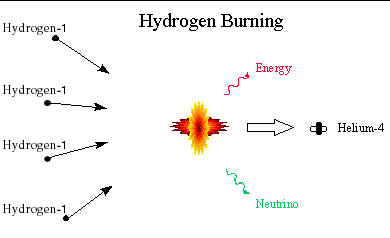
View full question & answer→MCQ 851 Mark
The energy needed to break a nucleus into its individual nucleons in a nuclear reaction is called:
AnswerThe protons and the neutrons exist together inside the nucleus due to attractive nuclear forces, thus some energy is required to break the nuclear forces.
Hence the binding energy is defined as the energy needed to break the nucleus into its individual nucleons in a nuclear reaction.
View full question & answer→MCQ 861 Mark
Heavy stable nucle have more neutrons than protons. This is because of the fact that:
- A
Neutrons are heavier than protons.
- ✓
Electrostatic force between protons are repulsive.
- C
Neutrons decay into protons through beta decay.
- D
Nuclear forces between neutrons are weaker than that between protons.
AnswerCorrect option: B. Electrostatic force between protons are repulsive.
Key concept:
Neutron$-$protob ratio $\Big(\frac{\text{N}}{2}\text{ ratio}\Big)$: The chemical properties of an atom are governed entirely by the number of protons $(Z)$ in the nucleus, the stability of an atom appears to depend on both the number of protons and the number of neutrons.
For lighter nuclei, the greatest atablity is achieved when the number of protons and neutrins are approximately equal $(N ≈ Z)$, i.e. $\frac{\text{N}}{\text{Z}}=1$.
Heavy nuclei are stable olny when they have more neutrons than protons. Thus heavy nuclei are neutron rich compared to lighter nuclei $($for heavy nuclei, more is the number of protons in the nucleus, greater is the elelctrical repulsive force between them. Therefore more neutrons are added to provide the strong attractive forces necessary to keep the nucleus stable.$)$
View full question & answer→MCQ 871 Mark
The short range attractive nuclear forces that are responsible for the binding of nucleons in a nucleus are supposed to be caused by the role played by the particles called:
- A
- B
$m-$Meson
- C
$K-$Meson
- ✓
$\pi-$ Meson
AnswerCorrect option: D. $\pi-$ Meson
The nuclear force between a neutron and proton is the result of the exchange of charged mesons $(\pi^+\pi^-)$ between them.
View full question & answer→MCQ 881 Mark
When an atom undergoes $\beta-$decay, its atomic number:
- A
- ✓
Increases by $1$
- C
Decreases by $1$
- D
Increases by $2$
AnswerCorrect option: B. Increases by $1$
When an atom undergoes $\beta-$decay the atomic number increases by $1.$
When an atom undergoes $\beta-$decay, one of the neutrons breaks into one proton and one electron. The resultant electron is then ejected out of the nucleus and this is called as the $\beta$ particle.
While the resultant proton stays inside the nucleus which results in increase of atomic number by $1$, whereas the atomic mass remains invariant.
View full question & answer→MCQ 891 Mark
- A
$16$ Isotopes.
- ✓
$32$ Isotopes.
- C
$96$ Isotopes.
- D
$173$ Isotopes.
AnswerCorrect option: B. $32$ Isotopes.
View full question & answer→MCQ 901 Mark
A proton and a neutron combine to give a deuterium nucleus.If mo and mp be the mass of neutron and proton respectively, then mass of deuterium nucleus is:
AnswerCorrect option: C. Less than $m_0+m_p$
The energy released during this during this in form of gamma photon comes from mass defect $(i.e., E = mc^2$, where m is the mass defect$).$
The mass of the deuterium nucleus $(2.01355 u)$ is less than the sum of the masses of the proton $(1.00728 u)$ and the neutron $(1.00866 u)$, which is $2.01594 u.$
View full question & answer→MCQ 911 Mark
Suppose we consider a large number of containers each containing initially $10000$ atoms of a radioactive material with a half life of $1$ year. After $1$ year:
- A
All the containers will have $5000$ atoms of the material.
- B
All the containers will contain the same number of atoms of the material but that number will only be approximately $5000.$
- ✓
The containers will in general have different numbers of the atoms of the material but their average will be close to $5000.$
- D
None of the containers can have more than $5000$ atoms.
AnswerCorrect option: C. The containers will in general have different numbers of the atoms of the material but their average will be close to $5000.$
Key concept:
Half life $(T_{1/2})$: Radioactivity is a process due to which a radioactive material spontaneously decays. Time interval in which the mass of a radioactive substance or the number of its atom reduces to half of its initial value is called the half life of the substance.
i.e., if $\text{N}=\frac{\text{N}_0}{2}$
Then $\text{t}=\text{T}_\frac{1}{2}$
Hence from $\text{N}=\text{N}_0\text{e}^{-\lambda\text{t}}$
$\frac{\text{N}_0}{2}=\text{N}_0\text{e}^{-\lambda\Big(\text{T}_\frac{1}{2}\Big)}\Rightarrow\ \text{T}_\frac{1}{2}=\frac{\log_\text{e}2}{\lambda}=\frac{0.693}{\lambda}$
In half$-$life $(t = 1yr)$ of the material on the average half the number of atoms will decay.
Therefore, the containers will in general have different number of atoms of the material, but their average will be approx $5000.$
View full question & answer→MCQ 921 Mark
Which of the following represents the binding energy of a nucleus:
- A
The average energy of each nucleon.
- ✓
The energy needed to split the nucleus into its parts.
- C
The energy necessary to overcome the neutron-neutron repulsion.
- D
The energy required to remove a proton from the nucleu.
AnswerCorrect option: B. The energy needed to split the nucleus into its parts.
It is observed that mass of a stable nucleus is always less than the total mass of constituent nucleons.This difference of mass is known as mass defect. When a nucleus is formed from the free nucleons mass defect is released in the form of energy by Einstein's mass$-$energy relation.
This energy is used to bind the nucleons to form a nucleus therefore an equivalent amount of energy is required to split the nucleus into its parts, that is called binding energy of nucleus.
View full question & answer→MCQ 931 Mark
Which of the following change the activity of radioisotope?
AnswerThe activity of radioisotope is not affected by any external condition of temperature, pressure or chemical change.
View full question & answer→MCQ 941 Mark
The source of stellar energy is:
AnswerStellar and solar energy is due to fusion reactions. So, source of stellar energy is Nuclear fusion.
View full question & answer→MCQ 951 Mark
${ }_ {92} \mathrm{U}^{238} $ absorbs a neutron. The product emits an electron. This product further emits an electron. The result is
- ✓
${ }_ {94} \mathrm{Pu}^{239} $
- B
$ { }_{90} \mathrm{Pu}^{239} $
- C
$ { }_{93} \mathrm{Pu}^{237} $
- D
$ { }_{94} \mathrm{Pu}^{237} $
AnswerCorrect option: A. ${ }_ {94} \mathrm{Pu}^{239} $
$_{92} V^{238}+n \rightarrow _{92}A^{239}$
$_{92}A^{239}\rightarrow _{93}B^{239}+e$
$_{92}A^{239}\rightarrow _{93}C^{239}+e$
Finding the element $C$ from periodic table
${ }_ {94} \mathrm{Pu}^{239} $
View full question & answer→MCQ 961 Mark
Which is the lightest element in the universe?
AnswerHydrogen is the lightest element in the universe with atomic number $1$ and so, it has the simplest atomic structure.
View full question & answer→MCQ 971 Mark
For a nuclear fusion process, suitable nuclei are:
- A
- B
- ✓
- D
Nuclei lying in the middle of periodic table.
View full question & answer→MCQ 981 Mark
A chlorine atom whose nucleus contains $17$ protons and $20$ neutrons. Find out the composition of the nucleus of an isotope of chlorine?
- A
$20$ protons, $17$ neutrons
- B
$19$ protons, $18$ neutrons
- C
$18$ protons, $18$ neutrons
- ✓
$17$ protons, $19$ neutrons
AnswerCorrect option: D. $17$ protons, $19$ neutrons
Isotope nucleus means that those nucleus has same protons number but different neutrons and mass number. Since chlorine has $17$ protons so its isotope also will have $17$ protons.
View full question & answer→MCQ 991 Mark
What parameter is used to measure the stability of a nucleus?
AnswerStability of nucleus is based on average binding energy i.e. binding energy per nucleon. This much energy will be needed for nucleon to break free.
View full question & answer→MCQ 1001 Mark
An $\alpha$-particle is bombarded on $^{14} \mathrm{N}$. As a result, a $^{17} \mathrm{O}$ nucleus is formed and a particle is emitted. This particle is a:
AnswerIf an alpha particle is bombarded on a nitrogen $(N-14)$ nucleus, an oxygen $(O-17)$ nucleus and a proton are released.
According to the conservation of mass and charge,
$^4_2\text{He}+\text{ }^{14}_7\text{N}\rightarrow\text{ }^{17}_6\text{O}+\text{ }^1_1\text{p}$
So, the emitted particle is a proton.
View full question & answer→MCQ 1011 Mark
The value of $1$ amu is equal to:
- A
$ 1.66 \times 10^{-8} \mathrm{~g} $
- B
$ 1.66 \times 10^{-4} \mathrm{~g} $
- C
$ 1.66 \times 10^{-16} \mathrm{~g} $
- ✓
$ 1.66 \times 10^{-24} \mathrm{~g} $
AnswerCorrect option: D. $ 1.66 \times 10^{-24} \mathrm{~g} $
One an amu is $\frac{1}{10}$ of the mass of one carbon$-12$ atom.
It is equal to $\frac{1}{\text{NA}}$
$\frac{1}{6.022\times10^{23}}$
$= 1.66 \times 10^{-24} \mathrm{~g} $
View full question & answer→MCQ 1021 Mark
The antiparticle of electron is:
MCQ 1031 Mark
As the mass number $A$ increases, the binding energy per nucleon in a nucleus:
AnswerCorrect option: D. Varies in a way that depends on the actual value of $A.$
Binding energy per nucleon in a nucleus first increases with increasing mass number $(A)$ and reaches a maximum of $8.7\ MeV$ for A $(50 - 80)$. Then, again it slowly starts decreasing with the increase in $A$ and drops to the value of $7.5\ MeV.$
View full question & answer→MCQ 1041 Mark
What describe the Einsteins equation for the relativity of mass and energy?
- ✓
A small amount of mass contains a lot of energy.
- B
A small amount of energy can be converted into a large amount of mass.
- C
Mass can be converted into energy, but energy cannot be converted mass.
- D
Energy can be converted into mass, but mass cannot be converted into energy.
AnswerCorrect option: A. A small amount of mass contains a lot of energy.
Sir Einstein's mass$-$energy equation states that mass and energy can be converted into each other by the following relation.
$\mathrm{E}=\mathrm{mc}^2,(\mathrm{c}=\text { speed of light })$
This implies that a small amount of mass contains a lot of energy, which can be proved with an example.
Let we have a mass of $1 \mathrm{~g}=10^{-3} \mathrm{~kg}$, therefore energy produced by it will be:
$E=10^{-3} \times\left(3 \times 10^8\right) 2=9 \times 10^{13} \mathrm{~J}$ which is a vast amount energy produced by only one gram $($small mass$)$ of mass.
Whereas a small amount of energy doesn't give a large amount of mass because for that we have to divide the energy by $\mathrm{c}^2$, which gives a small mass.
View full question & answer→MCQ 1051 Mark
In a nuclear reactor, moderators slow down the neutrons which come out in a fission process. The moderator used have light nuclei. Heavy nuclei will not serve the purpose because:
- A
- ✓
Elastic collision of neutrons with heavy nuclei will not slow them down.
- C
The net weight of the reactor would be unbearably high.
- D
Substances with heavy nuclei do not occur in liquid or gaseous state at room temperature.
AnswerCorrect option: B. Elastic collision of neutrons with heavy nuclei will not slow them down.
The moderator used have light nuclei like proton. When protons undergo perfectly elastic collision with the neutron emitted their velocities are exchanged, it means, neutrons come to rest and protons move with the velocity of neutrons.
View full question & answer→MCQ 1061 Mark
Free $^{238}U$ nuclei kept in a train emit alpha particles. When the train is stationary and a uranium nucleus decays, a passenger measures that the separation between the alpha particle and the recoiling nucleus becomes $x$ in time $t$ after the decay. If a decay takes place when the train is moving at a uniform speed $v$, the distance between the alpha particle and the recoiling nucleus at a time $t$ after the decay, as measured by the passenger will be:
- A
$x + vt$
- B
$x - vt$
- ✓
$x$
- D
depends on the direction of the train.
AnswerWhen the train is stationary, the separation between the alpha particle and recoiling uranium nucleus is $x$ in time $t$ after the decay. Even if the decay is taking place in a moving train and the separation is measured by the passenger sitting in it, the separation between the alpha particle and nucleus will be $x$. This is because the observer is also moving with the same speed with which the alpha particle and recoiling nucleus are moving, i.e. they all are in the same frame that is moving at a uniform speed.
View full question & answer→MCQ 1071 Mark
If a radioactive element is placed in an evacuated chamber, then the rate of radioactive decay will:
MCQ 1081 Mark
The heavier nuclei tend to have larger $\frac{\text{N}}{\text{Z}}$ ratio because:
- A
A neutron is heavier than a proton.
- B
Coulomb forces have longer range compared to the nuclear forces.
- C
A neutron does not exert electric repulsion.
- ✓
AnswerExplanation:
This is because in heavy nuclei, the $\frac{\text{N}}{\text{Z}}$ ratio becomes larger in order to maintain their stability and reduce instability caused due to the repulsion among the protons. The neutrons exert only attractive short-range nuclear forces on each other as well as on the neighbouring protons, whereas the protons exert attractive short-range nuclear forces on each other as well as the electrostatic repulsive force. Thus, the nuclei with high mass number, in order to be stable, have large neutron to proton ratio $\frac{\text{N}}{\text{Z}}.$
View full question & answer→MCQ 1091 Mark
As the mass number A increases, which of the following quantities related to a nucleus do not change?
AnswerRadius of a nucleus with mass number $A$ is given as
$\text{R}=\text{R}_{\text{0}}\text{A}^{\frac{1}{3}}$
Here, $\text{R}_0=1.2\text{fm}$
$\therefore$ Volume of the nucleus $=\frac{4\pi\text{R}^3}{3}=\frac{4\pi\text{R}^3\text{A}}{3}$
This depends on $A.$ With an increase in $A, V$ increases proportionally.
Mass of the nucleus $\simeq\text{Am}_{\text{N}}$
Here, $m_N <$ is the mass of a nucleon.
Therefore, mass of the nucleus also increases with the increasing mass number. Binding energy also depends on mass number $($number of nucleons$)$ as it is the difference between the total mass of the constituent nucleons and the nucleus. Therefore, it also varies with the changing mass number.
On the other hand,
$\text{Density}=\frac{\text{Mass}}{\text{Volume}}$
$=\frac{\text{Am}_{\text{N}}}{\frac{4\pi\text{R}3}{3}}=\frac{\text{Am}_{\text{N}}}{\frac{4\pi\text{R}_0^3\text{A}}{3}}=\frac{\text{m}_{\text{N}}}{\frac{4\pi\text{R}_0^3}{3}}=\frac{3\text{m}_{\text{N}}}{4\pi\text{R}_{0}^3}$
This is independent of $A$ and hence does not change as mass number increases.
View full question & answer→MCQ 1101 Mark
Which of the following is not a mode of radioactive decay?
MCQ 1111 Mark
For a fast chain reaction, the size of $U^{235}$ block, as compared to its critical size, must be:
AnswerIn fast chain reaction neutron released in previous fission again strikes $^{235}U$, So size of $^{235}U$ block should be greater than it's critical size.
View full question & answer→MCQ 1121 Mark
Which of the following is used as standard for determination of atomic mass unit?
- A
$ \mathrm{O}^{16} $
- ✓
$ \mathrm{C}^{12} $
- C
$ \mathrm{H}^1 $
- D
$ \mathrm{O}^{17} $
AnswerCorrect option: B. $ \mathrm{C}^{12} $
Atomic mass of a compound is measured in atomic mass units abbreviated as amu or $u.$ One atomic mass unit is defined as $\frac{1}{12}$th of mass of a single carbon$-12$ atom.
View full question & answer→MCQ 1131 Mark
In which of the following decays the atomic number decreases?
- A
$\alpha-\text{decay}$
- B
$\beta^+-\text{decay}$
- ✓
- D
$\gamma-\text{decay}$
AnswerExplanation:
In alpha particle decay, the unstable nucleus emits an alpha particle reducing its proton number (atomic number) Z as well as neutron number N by 2.
$\text{ }^{\text{A}}_{\text{Z}}\text{X}\rightarrow\text{ }^{\text{A}-4}_{\text{Z}-2}\text{Y}+\text{ }^4_2\text{He}$
During $\beta^--\text{decay},$ a neutron is converted to a proton, an electron and an antineutrino. Thus, there is an increase in the atomic number.
$\text{ }^{\text{A}}_{\text{Z}}\text{X}\rightarrow\text{ }^{\text{A}}_{\text{Z}+1}\text{Y}+\text{e}^-+\bar{\text{v}}$
During $\beta^+-\text{decay},$ a proton in the nucleus is converted to a neutron, a positron and a neutrino in order to maintain the stability of the nucleus. Thus, there is a decrease in the atomic number.
$\text{ }^{\text{A}}_{\text{Z}}\text{X}\rightarrow\text{ }^{\text{A}}_{\text{Z}-1}\text{Y}+\beta^++\text{v}$
When a nucleus is in higher excited state or has excess of energy, it comes to the lower state in order to become stable and release energy in the form of electromagnetic radiation called gamma ray. The element in the gamma decay doesn't change.
Therefore, alpha and beta plus decay suffer decrease in atomic number.
View full question & answer→MCQ 1141 Mark
Radioactive substance emits:
- A
$\alpha - \text{rays} $
- B
$\beta - \text{rays}$
- C
$\gamma - \text{rays}$
- ✓
View full question & answer→MCQ 1151 Mark
Joining of light nuclei of elements to form a heavy nucleus with the release of energy is called:
AnswerIn nuclear physics, nuclear fusion is a nuclear reaction in which two or more atomic nuclei collide at a very high speed and join to form a new type of atomic nucleus. During this process, matter is not conserved because some of the matter of the fusing nuclei is converted to photons $($energy$).$
View full question & answer→MCQ 1161 Mark
Mass energy equation was propounded by:
MCQ 1171 Mark
Nucleus of an atom whose atomic mass is $24$ consists of:
- A
$11$ Electrons, $11$ protons and $13$ neutrons.
- B
$11$ Electrons, $13$ protons and $11$ neutrons.
- ✓
$11$ Protons and $13$ neutrons.
- D
$11$ Protons and $13$ electrons.
AnswerCorrect option: C. $11$ Protons and $13$ neutrons.
View full question & answer→MCQ 1181 Mark
Which of the following is the radio isotope in this pair?$30\text{P}\\ \ 15$,$32\text{P}\\ \ 15$
- ✓
$32\text{P}\\ \ 15$
- B
$30\text{P}\\ \ 15$
- C
- D
AnswerCorrect option: A. $32\text{P}\\ \ 15$
$32\text{P}\\ \ 15$ is the radioactive isotope of phosphorous element.
As it has more number of neutrons than number of protons.
View full question & answer→MCQ 1191 Mark
Consider a sample of a pure beta$-$active material:
- A
All the beta particles emitted have the same energy.
- B
The beta particles originally exist inside the nucleus and are ejected at the time of beta decay.
- C
The antineutrino emitted in a beta decay has zero mass and hence zero momentum.
- ✓
The active nucleus changes to one of its isobars after the beta decay.
AnswerCorrect option: D. The active nucleus changes to one of its isobars after the beta decay.
In a beta decay, either a neutron is converted to a proton or a proton is converted to a neutron such that the mass number does not change. Also, the number of the nucleons present in the nucleus remains the same. Thus, the active nucleus gets converted to one of its isobars after beta decay.
View full question & answer→MCQ 1201 Mark
For the nuclie with mass number $> 100:$
- ✓
Binding energy of the nucleus decreases on an average as A increases.
- B
Binding energy of the nucleus increases on an average as A increases.
- C
The two nuclei fuse to form a bigger nuclide releasing energy.
- D
The nucleus essentially breaks up into two nuclides of equal mass releasing energy.
AnswerCorrect option: A. Binding energy of the nucleus decreases on an average as A increases.
From the above figure it is clearly visible that the binding energy of the nucleus decreases on an average as A increases
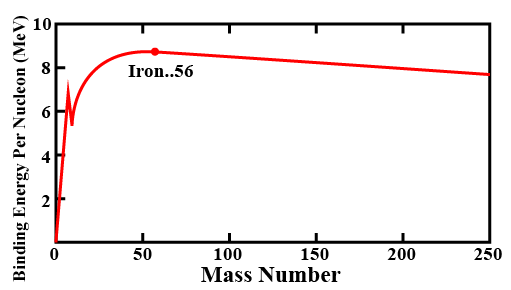
View full question & answer→MCQ 1211 Mark
$Q$ value for neutron decay is:
- ✓
$0.782\ MeV$
- B
$0.782\ eV$
- C
$78.2\ MeV$
- D
$0$
AnswerCorrect option: A. $0.782\ MeV$
For neutron decay, some mass disappears as neutrons convert to a proton, electron and antineutrino.
$Q=\left(m_n-m_p-m{_v}^--m_e\right) c^2=0.782 \mathrm{MeV}$
View full question & answer→MCQ 1221 Mark
$\mathrm{M}_{\mathrm{x}}$ and $\mathrm{M}_{\mathrm{y}}$ denote the atomic masses of the parent and the daughter nuclei respectively in a radioactive decay. The $Q -$value for a $\beta^{-}$decay is $Q_1$ and that for a $\beta^{+}$decay is $Q_2$. If me denotes the mass of an electron, then which of the following statements is correct?
- ✓
$ Q_1=\left(M_x-M_y\right) c_2 \text { and } Q_2=\left(M_x-M_y-2 m_e\right) c^2 $
- B
$ Q_1=\left(M_x-M_y\right) c_2 \text { and } Q_2=\left(M_x-M_y\right) c_2 $
- C
$ Q_1=\left(M_x-M_y-2 m_e\right) c^2 \text { and } Q_2=\left(M_x-M_y+2 m_e\right) c^2 $
- D
$ Q_1=\left(M_x-M_y+2 m_e\right) c^2 \text { and } Q_2=\left(M_x-M_y+2 m_e\right) c^2 $
AnswerCorrect option: A. $ Q_1=\left(M_x-M_y\right) c_2 \text { and } Q_2=\left(M_x-M_y-2 m_e\right) c^2 $
Key concept: $Q$ value or energy of nuclear reaction: The energy absorbed or released during a nuclear reaction is known as $Q-$value of nuclear reaction.
$Q-$value $= ($Mass of reactants $–$ mass of products$)c^2$ Joules $= ($Mass of reactants $–$ mass of products$)$ amu
If $Q < 0$, the nuclear reaction is known as endothermic. $($The energy is absorbed in the reaction$).$
If $Q > 0$, the nuclear reaction is known as exothermic. $($The energy is released in the reaction$).$
Let the nucleus be $_ZX^A$.
$\beta$ decay is respresented as: $_\text{Z}\text{X}^\text{A}\rightarrow_{\text{z}+1}\text{Y}^{\text{A}}+_{-1}\text{e}^0+\overline{\text{v}}+\text{Q}_2$
$ Q_1=\left[m_n\left(z X^A\right)-m_n\left(_{z+1} Y^A\right)-m_e\right] c^2 $
$ =\left[m_n\left(z X^A\right)+Z m_e-m_n\left(_{z+1} Y^A\right)-(Z+1) m_e\right] c^2 $
$ =\left[m\left(z X^A\right)-m\left(_{z-1} Y^A\right)\right] c^2 $
$ \Rightarrow Q_1=\left(M_x-M_y\right) c^2 $
$\beta^+$ decay is represented as; $_\text{Z}\text{X}^\text{A}\rightarrow_{\text{z}-1}\text{Y}^{\text{A}}+_{+1}\text{e}^0+{\text{v}}+\text{Q}_2$
$ Q_2=\left[m_n\left(_z X^A\right)-m_n\left(_{z-1} Y^A\right)-m_e\right] c^2 $
$ =\left[m_n\left(z X^A\right)+Z m_e-M_n\left(_{z-1} Y^A\right)-(Z-1) m_e-2 m_e\right] c^2 $
$ =\left[m\left(z X^A\right)^{\prime}-m\left(_{z-1} Y^A\right)-2 m_e\right] c^2 $
$ \Rightarrow Q 2=\left(M_X-M_y-2 m_e\right) c^2 $
View full question & answer→MCQ 1231 Mark
What is the atomic mass $(u)$ of calcium?
AnswerAtomic mass $(u)$ of Calcium is $40 u.$
View full question & answer→MCQ 1241 Mark
In an endothermic reaction the binding energies of reactants and products are $e_1 , e_2$ respectively, then:
- A
$ e_1 < e_2 $
- B
$ e_1=e_2 $
- ✓
$ e_1 > e_2 $
- D
$ e_1 \geq e_2 $
AnswerCorrect option: C. $ e_1 > e_2 $
In endothermic reaction the binding energy of reactants is more than the binding energy of products.
View full question & answer→MCQ 1251 Mark
Sun maintains its shining because of:
- A
- B
- ✓
Fusion of hydrogen nuclei
- D
AnswerCorrect option: C. Fusion of hydrogen nuclei
The Sun produces energy by the nuclear fusion of hydrogen into helium in its core.
View full question & answer→MCQ 1261 Mark
Which of the following are electromagnetic waves?
- A
$\alpha-\text{decay}$
- B
$\beta^+-\text{decay}$
- C
$\beta^--\text{decay}$
- ✓
$\gamma-\text{decay}$
AnswerCorrect option: D. $\gamma-\text{decay}$
Alpha rays, beta$-$plus and beta$-$minus rays carry charged particles that show particle behaviour. On the other hand, gamma rays carry photons that show particle as well as wave behaviour. Hence, only gamma rays are electromagnetic waves.
View full question & answer→MCQ 1271 Mark
Statement$-I :$ Energy is released when heavy nuclei undergo fission or light nuclei undergo fusion and Statement$-II:$ For heavy nuclei, binding energy per nucleon increases with increasing $Z$. while for light nuclei it decreases with increasing $Z$.
- A
Both the statements are true and Statement $2$ is the correct explanation for Statement $1.$
- B
Both the statements are true but Statement $2$ is not the correct explanation for Statement $1.$
- ✓
Statement $1$ is true but Statement $2$ is false.
- D
Statement $1$ is false but Statement $2$ is true.
AnswerCorrect option: C. Statement $1$ is true but Statement $2$ is false.
Statement$-I:$ Both, heavy nuclei and light nuclei have low value of binding energy per nucleon. Heavy nuclei splits $($fission$)$ into light nuclei and light nuclei combine $($fusion$)$ to attain the stability i.e. higher value of binding energy per nucleon. In both processes, some mass is disappeared which is converted into energy i.e. release of energy. $($statement is $TRUE).$
Statement$-II:$ For heavy nuclei the binding energy decreases with increasing $Z$ and for light nuclei binding energy per nucleon increases with increasing $Z.$
View full question & answer→MCQ 1281 Mark
What is the atomic mass $(u)$ of sodium?
AnswerSodium is a chemical element with the symbol $Na$ and atomic number $11.$
Atomic mass $(u)$ of sodium $= 23u$.
It is a soft, silvery$-$white, highly reactive metal.
View full question & answer→MCQ 1291 Mark
A free neutron decays to a proton but a free proton does not decay to a neutron. This is because:
- A
Neutron is a composite particle made of a proton and an electron whereas proton is a fundamental particle.
- B
Neutron is an uncharged particle whereas proton is a charged particle.
- ✓
Neutron has large rest mass than the proton.
- D
Weak forces can operate in a neutron but not in a proton.
AnswerCorrect option: C. Neutron has large rest mass than the proton.
A nucleus is made up of two fundamental particles$-$neutrons and protons. If a nucleus has more number of neutrons than what is needed to have stability, then neutrons decay into protons and if there's an excess of protons, then they decay to form neutrons. Since a neutron has larger rest mass than a proton, the $Q-$value of its decay reaction is positive and a free neutron decays to a proton, while an isolated proton cannot decay to a neutron as the $Q-$value of its decay reaction is negative. Hence, it is physically not possible.
View full question & answer→MCQ 1301 Mark
The neutron was discovered by:
AnswerJames Chadwick discovered the neutron.
View full question & answer→MCQ 1311 Mark
Nuclear forces exists between:
- A
Neutron $-$ neutron.
- B
Proton $-$ proton.
- C
Neutron $-$ proton.
- ✓
View full question & answer→MCQ 1321 Mark
The 'rad' is the correct unit used to report the measurement of:
- A
The ability of a beam of gamma ray photons to produce ions in a target.
- B
The energy delivered by radiation to a target.
- ✓
The biological effect of radiation.
- D
The rate of decay of a radioactive source.
AnswerCorrect option: C. The biological effect of radiation.
View full question & answer→MCQ 1331 Mark
Half life of radioactive element depends upon:
- A
Amount of element present.
- B
- C
- ✓
View full question & answer→MCQ 1341 Mark
Complete the reaction: ${ }_{86} \mathrm{Rn}^{220} \rightarrow{ }_{84} \mathrm{Po}^{216}+ ......$
- A
$\beta$
- B
$\gamma$
- ✓
$\alpha$
- D
$\text{H}^1_1$
AnswerCorrect option: C. $\alpha$
${ }_{86} \mathrm{Rn}^{220} \rightarrow{ }_{84} \mathrm{Po}^{216}+z \mathrm{X}^A$
$Z + 84 = 86$ and $220 = 216 + A$
So, $Z = 2$ and $A = 4$
$2\alpha^4$
So, it is $\alpha$ particle.
View full question & answer→MCQ 1351 Mark
Two lithium nuclei in a lithium vapour at room temperature do not combine to form a carbon nucleus because:
- A
A lithium nucleus is more tightly bound than a carbon nucleus.
- B
Carbon nucleus is an unstable particle.
- C
It is not energetically favourable.
- ✓
Coulomb repulsion does not allow the nuclei to come very close.
AnswerCorrect option: D. Coulomb repulsion does not allow the nuclei to come very close.
Lithium atom contains $3$ protons and $3$ neutrons in the nucleus and $3$ valence electrons. When two lithium nuclei are brought together, they repel each other. The attractive nuclear forces being short$-$range are insignificant as compared to the electrostatic repulsion. Thus, the nuclei do not combine to form carbon atom because of coulomb repulsion.
View full question & answer→MCQ 1361 Mark
Radioactive samples are stored in lead boxes because it is:
MCQ 1371 Mark
Identify the similarity between isotopes of the same element.
- A
They have the same particles in the nucleus.
- B
They are equally abundant in nature.
- C
They have the same number of protons
- ✓
AnswerIsotopes of the same element must have same number of protons but different number of neutrons and hence they have different mass.
Also the isotopes of same element are not equally abundant in nature.
View full question & answer→MCQ 1381 Mark
The critical mass of a fissionable material is:
AnswerCorrect option: B. The minimum mass needed for chain reaction.
If the mass of fissionable material exceeds a critical value, chain reaction or self propagating fission reaction or self propagating fission reaction takes place.
View full question & answer→MCQ 1391 Mark
What is the average binding energy per nucleon over a wide range?
- ✓
$8\ MeV$
- B
$8.8\ MeV$
- C
$7.6\ MeV$
- D
$1.1\ MeV$
AnswerCorrect option: A. $8\ MeV$
The average binding energy per nucleon is just the total binding energy divided by the number of nucleons. If we consider Na atom, its binding energy is $194\ MeV.$
Its binding energy per nucleon is given by $\frac{194\text{MeV}}{24}$
$= 8.08\ MeV$
View full question & answer→MCQ 1401 Mark
When a nucleus in an atom undergoes a radioactive decay, the electronic energy levels of the atom:
- A
Do not change for any type of radioactivity.
- ✓
Change for $\alpha $ and $\beta$ radioactivity but not for $γ-$radioactivity.
- C
Change for $\alpha -$radioactivity but not for others.
- D
Change for $\beta-$radioactivity but not for others.
AnswerCorrect option: B. Change for $\alpha $ and $\beta$ radioactivity but not for $γ-$radioactivity.
Key Concept:
|
Features
|
$\alpha - $particles |
$\beta-$ particles |
$β-$ particles
|
$γ-$rays
|
| $1.$ |
Identity
|
Helium nucleus or doubly ionised helium atom ($_2{He}^4$)
|
Fast moving electron $(-\beta^0\text{ or }\beta^-)$
|
Photons $(E.M.$ waves$)$
|
| $2.$ |
Charge
|
+2e
|
$-e$
|
Zero
|
| $3.$ |
Mass
|
$4 m_p$ ($m_p =$ mass of proton$) = 1.87 \times 10^{-27}$
|
$m_e$
|
Massless
|
| $4.$ |
Equation of decay
|
$_\text{Z}\text{X}^\text{A} \xrightarrow{\alpha-\text{decay}}\ _{\text{z}-2}\text{Y}^{\text{A}-4}+_2\text{He}^4$
$\text{n}_\alpha=\frac{\text{A}-\text{A}'}{4}$
|
$_\text{Z}\text{X}^\text{A}\rightarrow_{\text{z}-2}\text{Y}^{\text{A}}+_{-1}\text{e}^0+\overline{\text{v}}$
$_\text{Z}\text{Y}^\text{A}\xrightarrow{^\text{n}\beta}\ _{\text{z}'}\text{Y}^{\text{A}}$
$\Rightarrow\ \text{n}_\beta=(2\text{n}_\alpha-\text{Z}+\text{Z}')$
|
$_\text{Z}\text{X}^\text{A}\rightarrow\ _\text{Z}\text{X}^\text{a}+\gamma$
|
$A/3-$particle carries one unit of negative charge $(-e),$ an $\alpha -$particle carries $2$ units of positive charge $(+2e )$ and $γ ($particle$)$ carries no charge. Hence electronic energy levels of the atom charges for $\alpha $ and $\beta$ decay, but not for $γ-$decay. View full question & answer→MCQ 1411 Mark
The binding energies of a deutron and an $\alpha-$particle are $1.125, 7.2\ MeV$ nucleon respectively. Which is more stable of the two?
AnswerCorrect option: B. $\alpha-$practicle
The binding energy is a energy that holds the nucleus together.
Thus, more binding energy will give more stable nuclei. Here alpha particle has more binding energy so it will be more stable than deutron.
View full question & answer→MCQ 1421 Mark
The difference between the mass of a nucleus and the combined mass of its nucleons is:
- A
- B
- ✓
- D
Zero, positive or negative
AnswerWe know that mass defect $=$ combined mass of nucleons $−$ mass of the nucleus.
Since mass defect is always positive quantity so the difference of nucleus and the combined mass of its nucleons will be negative. The combined mass is greater than the mass of nucleus.
View full question & answer→MCQ 1431 Mark
Particles which can be added to the nucleus of an atom without changing its chemical properties are called:
MCQ 1441 Mark
Isotopes of an element contain:
- ✓
The same number of protons but different number of neutrons.
- B
The same number of neutrons but different number of protons.
- C
Equal number of protons and electrons.
- D
Equal number of nucleons.
AnswerCorrect option: A. The same number of protons but different number of neutrons.
Isotopes of an element must have same atomic number $(Z)$ but different mass number $A.$
Number of protons is equal to the atomic number.
So, isotopes of an element have same number of protons.
Mass number is equal to the sum of number of protons and neutrons i.e. $A = p + n$
As isotopes of an element have different mass number but same number of protons, thus they must have different number of neutrons.
View full question & answer→MCQ 1451 Mark
The curve of binding energy per nucleon as a function of atomic mass number has a sharp peak for helium nucleus. This implies that helium?
- A
- ✓
- C
Can be used as fissionable meterial.
- D
View full question & answer→MCQ 1461 Mark
Which of the following is the radio$-$isotope?
$^{39}_{19}{\text{K}}$, $^{40}_{19}{\text{K}}$
AnswerCorrect option: B. $^{40}_{19}{\text{K}}$
$^{40}_{19}{\text{K}}$ is the radioactive isotope of Potassium element.
As it has more number of neutrons than number of protons.
View full question & answer→MCQ 1471 Mark
Let $\mathrm{F}_{\mathrm{pp}}, \mathrm{F}_{\mathrm{pn}}$ and $\mathrm{F}_{\mathrm{nn}}$ fill denote the magnitudes of the nuclear force by a proton on a proton, by a proton on a neutron and by a neutron on a neutron respectively. When the separation is $1fm:$
- A
$\mathrm{F}_{\mathrm{pp}}>\mathrm{F}_{\mathrm{pn}}=\mathrm{F}_{\mathrm{nn}}$
- B
$\mathrm{F}_{\mathrm{pp}}=\mathrm{F}_{\mathrm{pn}}=\mathrm{F}_{\mathrm{nn}}$
- C
$\mathrm{F}_{\mathrm{pp}}>\mathrm{F}_{\mathrm{pn}}>\mathrm{F}_{\mathrm{nn}}$
- ✓
$\mathrm{F}_{\mathrm{pp}}<\mathrm{F}_{\mathrm{pn}}=\mathrm{F}_{\mathrm{nn}}$
AnswerCorrect option: D. $\mathrm{F}_{\mathrm{pp}}<\mathrm{F}_{\mathrm{pn}}=\mathrm{F}_{\mathrm{nn}}$
Protons and neutrons are present inside the nucleus and they exert strong attractive nuclear forces on each other, which are equal in magnitude. Due to their positive charge, protons repel each other. Hence the net attractive force between two protons gets reduced, but the nuclear force is stronger than the electrostatic force at a separation of 1fm.
View full question & answer→MCQ 1481 Mark
The same radioactive nucleus may emit?
- A
All the three $\alpha,\ \beta$ and $\gamma$ one after another.
- B
All the three $\alpha,\ \beta$ and $\gamma$ radiations simultaneously.
- C
Only $\alpha$ and $\beta$ simultaneously.
- ✓
Only one $\alpha,\ \beta$ and $\gamma$ at a time.
AnswerCorrect option: D. Only one $\alpha,\ \beta$ and $\gamma$ at a time.
View full question & answer→MCQ 1491 Mark
When the nucleus of a radioactive element emits an alpha particle, the atomic number is decreased by:
AnswerWhen an alpha particle is emitted from the nucleus the nucleus losses two protons and two neutrons. This means that the atomic number is decreased by $2.$
View full question & answer→MCQ 1501 Mark
The nuclear radius is of the order of?
- A
$10^{-10} \mathrm{m}$
- B
$10^{-6} \mathrm{~m}$
- C
$10^{-15} \mathrm{~m}$
- ✓
$10^{-14} \mathrm{m}$
AnswerCorrect option: D. $10^{-14} \mathrm{m}$
View full question & answer→MCQ 1511 Mark
The nuclear fusion reaction between deuterium and tritium takes place:
- A
At ordinary temperature and pressure.
- B
At low temperature and low pressure.
- ✓
At very high temperature and very high pressure.
- D
When the temperature is near absolute zero.
AnswerCorrect option: C. At very high temperature and very high pressure.
Nuclear fusion occurs at very high temperature and very high pressure. It is the primary phenomenon for the generation of heat energy in the sun.
View full question & answer→MCQ 1521 Mark
Artificial radioactivity was discovered by:
MCQ 1531 Mark
Which of the following of a radioactive material is a measure of its instability?
MCQ 1541 Mark
The correct equation of nuclear fusion reaction is:
- A
${ }_1 \mathrm{H}^1+{ }_1 \mathrm{H}^1 \rightarrow \mathrm{H}_2$
- B
${ }_1 \mathrm{H}^2+{ }_1 \mathrm{H}^1 \rightarrow{ }_2 \mathrm{He}^4+{ }_0 \mathrm{n}^1$
- ✓
${ }_1 \mathrm{H}^2+{ }_1 \mathrm{H}^2 \rightarrow{ }_2 \mathrm{He}^4+$ energy
- D
${ }_2 \mathrm{H}^2+{ }_3 \mathrm{H}^2 \rightarrow{ }_5 \mathrm{H}^2$
AnswerCorrect option: C. ${ }_1 \mathrm{H}^2+{ }_1 \mathrm{H}^2 \rightarrow{ }_2 \mathrm{He}^4+$ energy
In nuclear fusion reactions, the heavy isotopes of Hydrogen take part like deuterium ${ }_1 H^2$ and tritium ${ }_1 H^3$ as they have extra neutron.
View full question & answer→MCQ 1551 Mark
Which scientist proposed the concept of atomic mass?
AnswerThe concept of atomic mass was proposed by William Prout. Early atomic mass theory was proposed by the English chemist William Prout in a series of published papers in $1815$ and $1816$. Known as Prout's Law, Prout suggested that the known elements had atomic weights that were whole number multiples of the atomic mass of hydrogen.
View full question & answer→MCQ 1561 Mark
Boron rods in a nuclear reactor are used to:
MCQ 1571 Mark
Modern atomic mass scale is based on the mass of:
- A
$H−1$
- ✓
$C−12$
- C
$C−14$
- D
$C−16$
AnswerCorrect option: B. $C−12$
Modern atomic weight scale is based on $C−12.$
The standard unit for expressing the mass of atom is amu $($atomic mass unit$).$
It is equal to $\frac{1}{12}$ of the mass of an atom of carbon$-12$ equal to $1.6605 \times 10^{-19} \mathrm{~g}$.
amu is also called as avogram.
Avogram is a unit of mass and weight equal to one gram divided by the Avogadro's number.
View full question & answer→MCQ 1581 Mark
Fusion reactions take place at about:
- A
$ 3 \times 10^2 \mathrm{~K} $
- B
$ 3 \times 10^3 \mathrm{~K} $
- C
$ 3 \times 10^4 \mathrm{~K} $
- ✓
$ 3 \times 10^6 \mathrm{~K} $
AnswerCorrect option: D. $ 3 \times 10^6 \mathrm{~K} $
Fusion reaction takes place at $10^7$k
So, the correct choice is $ 3 \times 10^6 \mathrm{~K} $
View full question & answer→MCQ 1591 Mark
Let $\mathrm{E}_1$ and $\mathrm{E}_2$ be the binding energies of two nuclei $A$ and $B$. It is observed that two nuclei of $A$ combine together to form a $B$ nucleus. This observation is correct only if:
- A
$ \mathrm{E}_1 > \mathrm{E}_2 $
- B
$ \mathrm{E}_2 > \mathrm{E}_1$
- ✓
$\mathrm{E}_2 < 2 \mathrm{E}_1$
- D
AnswerCorrect option: C. $\mathrm{E}_2 < 2 \mathrm{E}_1$
$2A \rightarrow B$
Possible if $B$ is more stable than $A$
$⟹$ Energy of $B$ is less than two atoms of $A$
$\mathrm{E}_2 < 2 \mathrm{E}_1$
View full question & answer→MCQ 1601 Mark
Which of the following property of an element never changes?
AnswerThe atomic weight is a characteristic property of an element and can never vary.
The valency of an element can vary. For example, when the ion is in $+2$ and $+3$ oxidation state, its valency is $2$ and $3$ respectively.
View full question & answer→MCQ 1611 Mark
If $M$ is atomic weight, A is mass number then $\frac{\text{M - A}}{\text{A}}$ represents:
AnswerPacking fraction is the mass defect per nucleon i.e. elementary particle in the nucleus. The difference between atomic weight and mass number i.e. mass of elementary particle in the nucleus is known as mass defect. Hence,
$\text{p}=\frac{\Delta\text{m}}{\text{A}}$
$\text{p}=\frac{\text{M - A}}{\text{A}}$
View full question & answer→MCQ 1621 Mark
The number of protons in an atom of atomic number $Z$ and mass number $A$ is:
View full question & answer→MCQ 1631 Mark
Fusion reactions take place at high temperature because:
- A
Atoms are ionised at high temperature.
- B
Molecules break up at high temperature.
- C
Nuclei break up at high temperature.
- ✓
Kinetic enrgy is high enough to overcome repulsion between nuclei.
AnswerCorrect option: D. Kinetic enrgy is high enough to overcome repulsion between nuclei.
View full question & answer→MCQ 1641 Mark
The difference between the mass of a nucleus and the total mass of the constituents is its.
AnswerMass defect is the amount by which the mass of an atomic nucleus differs from the sum of the masses of the consistuent particles, being the mass equivalent of the energy released in the formation of the nucleus. It is also the measure of binding energy of the nucleus.
View full question & answer→MCQ 1651 Mark
One $\text{a.m.u}$ is defined as mass of:
- A
$\frac{1}{16}th$ mass of one oxygen atom
- B
$\frac{1}{14}th$ mass of one atom of nitrogen
- ✓
$\frac{1}{12}th$ mass of one carbon$-12$ atom
- D
AnswerCorrect option: C. $\frac{1}{12}th$ mass of one carbon$-12$ atom
One $\text{a.m.u.}$ is defined as mass of $\frac{1}{12}th$ the mass of one carbon$-12$ atom.
View full question & answer→MCQ 1661 Mark
- A
- B
Self disintegration process.
- C
- ✓
View full question & answer→MCQ 1671 Mark
In a radioactive decay, neither the atomic number nor the mass number changes. Which of the following particles is emitted in the decay?
AnswerThe atomic number and mass number of a nucleus is defined as the number of protons and the sum of the number of protons and neutrons present in the nucleus, respectively. Since in the decay, neither the atomic number nor the mass number change, it cannot be a beta$-$decay $($release of electron, proton or neutron$)$. Hence, the particle emitted can only be a photon.
View full question & answer→MCQ 1681 Mark
Which one of them is a radioisotope?
- ✓
Cobalt$-60$
- B
Carbon$-12$
- C
Carbon$-14$
- D
AnswerCorrect option: A. Cobalt$-60$
Radioactive isotopes have unstable nucleus which emits energy and particles when it converts to stable form. Cobalt$-60$ is an isotope used to treat Cancer like problems.
View full question & answer→MCQ 1691 Mark
What is the atomic mass $(u)$ of chlorine?
- A
$34$
- ✓
$35.5$
- C
$35$
- D
Find the accurate expressions.
AnswerCorrect option: B. $35.5$
Chlorine is a chemical element with the symbol $Cl$ and atomic number $17$. The second$-$lightest of the halogens, it appears between fluorine and bromine in the periodic table and its properties are mostly intermediate between them.
View full question & answer→MCQ 1701 Mark
Carbon has $......$ isotopes.
- A
$1 ($one$)$
- B
$2 ($two$)$
- ✓
$3 ($three$)$
- D
$4 ($four$)$
AnswerCorrect option: C. $3 ($three$)$
Carbon has three isotopes $12\text{C}\\ \ 6$, $13\text{C}\\ \ 6$ and $14\text{C}\\ \ 6$
View full question & answer→MCQ 1711 Mark
The difference between the sum of the masses of the constituent particles and the mass of an atom is called $......$.
AnswerThe difference between the sum of the masses of the constituent particles and the mass of an atom is called mass defect.
The energy released due to mass defect was given by Einstein
$E = \triangle mc^2$
View full question & answer→MCQ 1721 Mark
The binding energy of Helium nucleus is $28\ Mev$. What is it's average binding energy per nucleon?
- A
$102\ MeV$
- B
$56\ MeV$
- C
$14\ MeV$
- ✓
$7\ MeV$
AnswerCorrect option: D. $7\ MeV$
$(BE)_{Hc} = 28\ MeV, A$ of $He = 4$
$(BE)_{He} = \frac{28}{4}\ MeV$
$= 7\ MeV$
View full question & answer→MCQ 1731 Mark
On an average, the number of neutrons and the energy of a neutron released per fission of a uranium atom are respectively?
- A
$2.5$ And $2\ keV.$
- B
$3$ And $l\ keV.$
- ✓
$2.5$ And $2\ meV.$
- D
$2$ And $2\ keV.$
AnswerCorrect option: C. $2.5$ And $2\ meV.$
View full question & answer→MCQ 1741 Mark
Nuclear fusion reactions cannot be harnessed for productive applications because:
- A
These reactions require very high temperature and are controllable.
- ✓
These reactions require very high temperature and are uncontrollable.
- C
These reactions require very low temperature and are uncontrollable.
- D
These reactions require very low temperature and are controllable.
AnswerCorrect option: B. These reactions require very high temperature and are uncontrollable.
Fusion reaction is the combining of atom to form heavier nuclei. Fusion reaction requires high temperature. God fusion to occur on earth a, we need a temperature of at least $100$ million degree Celsius. It is also an uncontrollable reaction.
View full question & answer→MCQ 1751 Mark
When two deuterium nuclei fuse together to form a tritium nucleus, we get a:
AnswerHere the nuclear reaction: $2^2_1 H($deutron$)\rightarrow _1^3 H($tritium$)$
For balancing the reaction: $2^2_1 H\rightarrow _1^3 H+ _1^1 H($proton$)$
Thus, we will get a proton in this reaction.
View full question & answer→MCQ 1761 Mark
Find x in the following nuclear reaction. ${ }_{12} \mathrm{Mg}^{24}+{ }_2 \mathrm{He}^4 \rightarrow{ }_{14} \mathrm{Si}^x+{ }_0n^1$
AnswerFrom conservation of mass
$24 + 4 = x + 1$
$x = 28 − 1 = 27$
View full question & answer→MCQ 1771 Mark
Let $F_{p p}, F_{p n}$ and $F_{n n}$ denote the magnitudes of the net force by a proton on a proton, by a proton on a neutron and by a neutron on a neutron respectively. Neglect gravitational force. When the separation is 1fm:
- A
$ \mathrm{F}_{\mathrm{pp}} > \mathrm{F}_{\mathrm{pn}} = \mathrm{F}_{\mathrm{nn}} $
- ✓
$ \mathrm{F}_{\mathrm{pp}} = \mathrm{F}_{\mathrm{pn}} = \mathrm{F}_{\mathrm{nn}} $
- C
$ \mathrm{F}_{\mathrm{pp}} > \mathrm{F}_{\mathrm{pn}} > \mathrm{F}_{\mathrm{nn}}$
- D
$ \mathrm{F}_{\mathrm{pp}} < \mathrm{F}_{\mathrm{pn}} = \mathrm{F}_{\mathrm{nn}}$
AnswerCorrect option: B. $ \mathrm{F}_{\mathrm{pp}} = \mathrm{F}_{\mathrm{pn}} = \mathrm{F}_{\mathrm{nn}} $
Protons and neutrons are present inside the nucleus and they exert strong attractive nuclear force on each other. These forces are equal in magnitude, irrespective of the charge present on the nucleons.
$\therefore$ $ \mathrm{F}_{\mathrm{pp}} = \mathrm{F}_{\mathrm{pn}} = \mathrm{F}_{\mathrm{nn}} $
Here,$ \mathrm{F}_{\mathrm{pp}} = \mathrm{F}_{\mathrm{pn}} = \mathrm{F}_{\mathrm{nn}} $
denote the magnitudes of the nuclear force by a proton on a proton, by a proton on a neutron and by a neutron on a neutron, respectively.
View full question & answer→MCQ 1781 Mark
The mass number of a nucleus is equal to:
- A
The number of neutrons in the nucleus.
- B
The number of protons in the nucleus.
- ✓
The number of nucleons in the nucleus.
- D
AnswerCorrect option: C. The number of nucleons in the nucleus.
Mass number of a nucleus is defined as the sum of the number of neutron and protons present in the nucleus, i.e. the number of nucleons in the nucleus.
View full question & answer→MCQ 1791 Mark
The Sun's mean density is:
- A
$1.4 \times \mathrm{kg} / \mathrm{m}^3$
- ✓
$1.4 \times 10^3 \mathrm{~kg} / \mathrm{m}^3$
- C
$1.4 \times 10^3 \mathrm{~kg} / \mathrm{cc}$
- D
$1.4 \times \mathrm{kg} / \mathrm{cc}$
AnswerCorrect option: B. $1.4 \times 10^3 \mathrm{~kg} / \mathrm{m}^3$
Density of water is $= 1000\ kg/m^3$
Density of sun $= 1.4\times 1000$
$= 1.4 \times 10^3 \mathrm{~kg} / \mathrm{m}^3$
View full question & answer→MCQ 1801 Mark
The electrons cannot exist inside the nucleus because:
- A
De-Broglie wavelength associated with electron in $\beta - \text{decay}$ is much less than the size of nucleus.
- ✓
De-Broglie wavelength associated with electron in $\beta - \text{decay}$ is much greater than the size of nucleus.
- C
De-Broglie wavelength associated with electron in $\beta - \text{decay}$ is equal to the size of nucleus.
- D
Negative charge cannot exist in the nucleus.
AnswerCorrect option: B. De-Broglie wavelength associated with electron in $\beta - \text{decay}$ is much greater than the size of nucleus.
View full question & answer→MCQ 1811 Mark
During a nuclear fusion reaction:
- A
A heavy nucleus breaks into two fragments by itself.
- B
A light nucleus bombarded by thermal neutrons breaks up.
- C
A heavy nucleus bombarded by thermal neutrons breaks up.
- ✓
Two light nuclei combine to give a heavier nucleus and possibly other products.
AnswerCorrect option: D. Two light nuclei combine to give a heavier nucleus and possibly other products.
A nuclear reaction in which atomic nuclei of low atomic number fuse to form a heavier nucleus with the release of energy is called nuclear fusion.
View full question & answer→MCQ 1821 Mark
The graph of ln$\Big(\frac{\text{R}}{\text{R}_{\text{0}}}\Big)$ versus In $A (R =$ radius of a nucleus and $A -$ its mass number$)$ is:
AnswerThe average nuclear radius $(R)$ and the mass number of the element $(A)$ has the following relation:
$\text{R}=\text{R}_{0}\text{A}^{\frac{1}{2}}$
$\frac{\text{R}}{\text{R}_{0}}=\text{A}^{\frac{1}{3}}$
In $\Big(\frac{\text{R}}{\text{R}_0}\Big)=\frac{1}{3}$ In $A$
Therefore, the graph of ln$\Big(\frac{\text{R}}{\text{R}_0}\Big)$ versus ln $A$ is a straight line passing through the origin with slope $\frac{1}{3}.$
View full question & answer→MCQ 1831 Mark
Which of the following reaction must be initiated by the neutron?
- ✓
- B
Radioactive carbon dating
- C
- D
AnswerThe process of splitting a nucleus is called nuclear fission. Uranium or plutonium isotopes are normally used as the fuel in nuclear reactors because their atoms have relatively large nuclei that are easy to split, especially when hit by neutrons.
When fission of an element takes place when hit by a neutron, furthermore neutrons are released. The additional neutrons released may also hit other uranium or plutonium nuclei and cause them to split.
Even more, neutrons are then released, which in turn can split more nuclei. This is called a chain reaction.
View full question & answer→MCQ 1841 Mark
The electron emitted in beta radiation originates from:
- A
- B
Free electrons existing in nuclei
- ✓
Decay of a neutron in a nucleus
- D
Photon escaping from the nucleus
AnswerCorrect option: C. Decay of a neutron in a nucleus
The electron emitted in beta radiation may originates from neutron and it increases the atomic number $1.$
View full question & answer→MCQ 1851 Mark
Which of the following describe that two lighter atoms combine to form one heavier atom?
- A
- B
- ✓
- D
Radioactive carbon dating
AnswerNuclear fusion reactions are the nuclear reactions in which two or smaller $($lighter$)$ nuclei combine to form a bigger $($heavier$)$ nucleus giving off a huge amount of energy.
View full question & answer→MCQ 1861 Mark
Two protons are kept at a separation of $10\ nm$. Let $F_n$ and $F_e$ be the nuclear force and the electromagnetic force between them:
- A
$ \mathrm{F}_{\mathrm{e}}=\mathrm{F}_{\mathrm{n}} $
- ✓
$ \mathrm{F}_{\mathrm{e}}>>\mathrm{F}_{\mathrm{n}} $
- C
$ \mathrm{F}_{\mathrm{e}}<<\mathrm{F}_{\mathrm{n}}$
- D
$F_e$ and $F_n$ differ only slightly.
AnswerCorrect option: B. $ \mathrm{F}_{\mathrm{e}}>>\mathrm{F}_{\mathrm{n}} $
Two protons exert strong attractive nuclear force and repulsive electrostatic force on each other. Nuclear forces are short range forces existing in the range of a few fms. Therefore, at a separation of 10nm, the electromagnetic force is greater than the nuclear force, i.e. $ \mathrm{F}_{\mathrm{e}}>>\mathrm{F}_{\mathrm{n}} $
View full question & answer→MCQ 1871 Mark
The nuclei having same number of protons but different number of neutrons are called $......$.
- A
- B
$\alpha$-particles
- ✓
- D
$\gamma$-particles
AnswerIsotopes are each of two or more forms of the same element that contain equal numbers of protons but different numbers of neutrons in their nuclei, and hence differ in relative atomic mass but not in chemical properties.
View full question & answer→MCQ 1881 Mark
The mass number of sulfur atom is: $($Given: Atomic number $= 16$ and number of neutrons $= 16)$
AnswerAtomic number $=$ number of protons $= 16$
Mass number $=$ Number of protons $+$ number of neutrons
So the mass number of sulfur $= 32$
View full question & answer→MCQ 1891 Mark
The reaction $^2_1\text{H}+^2_1\text{H}\rightarrow ^3_2\text{H}+^1_0\text{n}$ is called:
AnswerFusion is the process that powers the sun and the stars. It is the reaction in which two atoms of hydrogen combine together or fuse to form an atom of helium. In this process some of the mass of the hydrogen converted into energy.
View full question & answer→MCQ 1901 Mark
Hydrogen bomb is based on:
- A
Controlled chain reaction
- B
Uncontrolled chain reaction
- ✓
- D
AnswerHydrogen bomb is based on nuclear fusion. A large amount of nuclear energy is released by fusion of two light elements $($elements with low atomic numbers$).$
In a hydrogen bomb, two isotopes of hydrogen, deuterium $(1$ proton, $1$ neutron$)$ and tritium $(1$ proton, $2$ neutron$)$ are fused to form a nucleus of helium and a neutron.
This fusion releases $17.6\ MeV$ of energy. Also, there is no limit on the amount of the fusion that can occur.
View full question & answer→MCQ 1911 Mark
Which decay increases the atomic number?
- A
$\beta^-$decay
- ✓
$\beta^+$ decay
- C
- D
AnswerCorrect option: B. $\beta^+$ decay
$\beta^-$ decay: $_\text{Z}^\text{A}\text{X}→_{\text{Z}+1}^{\text{A}}\text{Y} + _{−1}^0\text{e}$
Thus, the atomic number is increased in $\beta^-$ decay.
View full question & answer→MCQ 1921 Mark
The radiant energy of the sun results from:
AnswerThe radient energgy of is result of nuclear fusion. The energy from both heat and light originates from a nuclear fusion.
View full question & answer→MCQ 1931 Mark
AnswerCorrect option: A. Neutron $+$ proton
The mass number, also called atomic mass number, is the total number of protons and neutrons in an atomic nucleous.i.e. Mass number $=$ Neutron $+$ Proton.
View full question & answer→MCQ 1941 Mark
When a hydrogen bomb explodes, which of the following is used?
AnswerHydrogen bomb is based on nuclear fusion and hence hydrogen atoms combine to form Helium atoms.
View full question & answer→MCQ 1951 Mark
Tritium is an isotope of hydrogen whose nucleus Triton contains $2$ neutrons and $1$ proton. Free neutrons decay into $\text{p}+\overline{\text{e}}+\overline{\text{v}}$. If one of the neutrons in Triton decays, it would transform into $He^3$ nucleus. This does not happen. This is because:
- ✓
Triton energy is less than that of a $He^3$ nucleus.
- B
The electron created in the beta decay process cannot remain in the nucleus.
- C
Both the neutrons in triton have to decay simultaneously resulting in a nucleus with $3$ protons, which is not a $He^3$ nucleus.
- D
Because free neutrons decay due to external perturbations which is absent in a triton nucleus.
AnswerCorrect option: A. Triton energy is less than that of a $He^3$ nucleus.
The nucleus of Tritium (${ }_1 \mathrm{H }^3$) contains $1$ proton and $2$ neutrons.
A neutron decays as $\text{n}\rightarrow\ \text{p}+\overline{\text{e}}+\overline{\text{v}},$ the nucleus may have $2$ protons and one neutron i.e., tritium will transform into ${ }_2 \mathrm{He}^3$. It means triton energy is less that of ${ }_2 \mathrm{He}^3$ nucleaus. Tirton energy is less than that of ${ }_2 \mathrm{He}^3$ nucleus, which simple mean transformation is not allowed energetically.
View full question & answer→MCQ 1961 Mark
The percentage of mass lost during nuclear fusion is:
- A
$0.1\%$
- B
$0.4\%$
- C
$0.5\%$
- ✓
$0.65\%$
AnswerCorrect option: D. $0.65\%$
In fusion reaction $0.65\%$ of mass is converted into energy.
So, $0.65\%$ of mass is lost during nuclear fusion.
View full question & answer→MCQ 1971 Mark
In one average$-$life:
- A
Half the active nuclei decay.
- B
Less than half the active nuclei decay.
- ✓
More than half the active nuclei decay.
- D
AnswerCorrect option: C. More than half the active nuclei decay.
The average life is the mean life time for a nuclei to decay.
It is given as
$\tau=\frac{1}{\lambda}=\frac{\text{T}_{\frac{1}{2}}}{0.693}$
Here, $\tau,\lambda$ and $\text{T}_{\frac{1}{2}}$ are the average life, decay constant and half life$-$time of the active nuclei, respectively. The value of the average lifetime comes to be more than the average lifetime. Therefore, in one average life, more than half the active nuclei decay.
View full question & answer→MCQ 1981 Mark
Identify which of the following statement best describe a nuclear reaction.
- ✓
The particles in the nucleus are changed, and one element is transformed into another element when particles in the nucleus are gained or lost.
- B
The electrons are exchanged from one or more substances to produce a different substance, and the elements are the same in the products and reactants.
- C
Two smaller nuclei are combined into a more massive nuclei giving off tremendous amounts of energy in the process.
- D
AnswerCorrect option: A. The particles in the nucleus are changed, and one element is transformed into another element when particles in the nucleus are gained or lost.
A nuclear reaction is a process, such as fission, fusion or radioactive decay, in which the structure of an atomic nucleus is altered through release of energy or mass or by being broken apart. The number of nuclei in the element atom changes resulting in release of energy.
View full question & answer→MCQ 1991 Mark
A nucleus of element $X$ is represented as $^{56}_{26}\text{X}$
Which is an isotope of element $X?$
- A
$^{26}_{56}\text{X}$
- ✓
$^{54}_{26}\text{X}$
- C
$^{56}_{24}\text{X}$
- D
$^{54}_{28}\text{X}$
AnswerCorrect option: B. $^{54}_{26}\text{X}$
Isotopes are variants of a particular chemical element which differ in neutron number, and consequently in nucleon number. All isotopes of a given element have the same number of protons but different numbers of neutrons in each atom.
Since, the isotopes has same number of proton.
View full question & answer→MCQ 2001 Mark
A freshly prepared radioactive source of half life $2 hr$ emits radiation of intensity which is $64$ times the permissible safe level. The minimum time after which it would be possible to work safely with this source is:
- A
$6$ hours.
- ✓
$12$ hours.
- C
$24$ hours.
- D
$128$ hours.
AnswerCorrect option: B. $12$ hours.
View full question & answer→MCQ 2011 Mark
The process of radioactive radiations remains unaffected due to:
- A
- B
- C
Electric or magnetic fields.
- ✓
View full question & answer→MCQ 2021 Mark
Fusion reaction is also known as $......$
AnswerIn nuclear physics,nuclear fusion is a nuclear reaction in which two or more atomic nuclei collide at very high speed and join to form a new type of atomic nucleus. During this process matter is not conserved because some of the matter of fusing nuclei is converted to photons also known as thermonuclear reaction.
View full question & answer→MCQ 2031 Mark
Which one of the following has the identical property for isotopes?
MCQ 2041 Mark
A radioactive material undergoes decay by ejecting electrons. The electron ejected in this process is:
AnswerCorrect option: A. The electron from the decay of a neutron.
View full question & answer→MCQ 2051 Mark
Mass number is denoted by:
AnswerThe mass number $(A)$ is the number of nucleons, which is the total number of protons and neutrons in the nucleus of an atom.
View full question & answer→MCQ 2061 Mark
In beta decay, the typical $Q$ value is approximately:
- A
$2\ MeV$
- ✓
$1\ MeV$
- C
$1\ eV$
- D
$10\ MeV$
AnswerCorrect option: B. $1\ MeV$
The $Q$ value for a reaction is the amount of energy released by that reaction.
In beta decay, a typical $Q$ is around $1\ MeV.$
View full question & answer→MCQ 2071 Mark
Chadwick was awarded the $1935$ nobel prize in physics for his discovery of the:
View full question & answer→MCQ 2081 Mark
Three specimens $\text{A, B, C}$ of same radioactive element has activities $1$ microcurie, $1$ rutherford and $1$ becquerel respectively. Which specimen has maximum mass?
View full question & answer→MCQ 2091 Mark
The variation of decay rate of two radioactive samples A and B with time is shown in Fig. Which of the following statements are true?
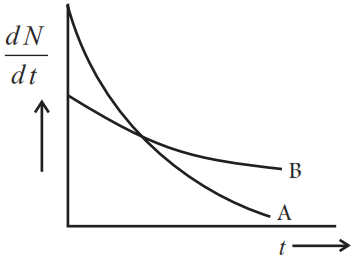
- A
Decay constant of A is greater than that of B, hence A always decays faster than B.
- B
Decay constant of B is smaller than that of A but still its decay rate becomes equal to that of A at a later instant.
- C
Decay constant of A is greater than that of B but it does not always decay faster than B.
- ✓
AnswerSolution:
It can be observed from the figure that the slope of curve A is greater that thet of curve B, it means the rate of decay is faster for A than that of B.
According to Rutherford and Soddy law for radioactive decay $-\Big(\frac{\text{dN}}{\text{dt}}\Big)\propto\lambda$, where decay,
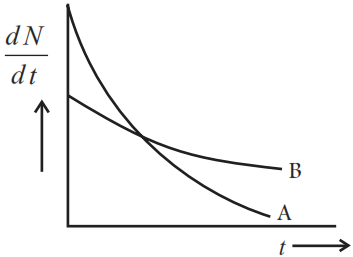
Hence at point P, rate of decay for both A and B is the same. View full question & answer→MCQ 2101 Mark
Binding energy per nucleon for $\mathrm{C}^{12}$ is $7.68\ MeV$ and for $\mathrm{C}^{13}$ is $7.74\ MeV.$ The energy required to remove a neutron from $\mathrm{C}^{13}$ is:
- A
$5.49\ MeV$
- ✓
$8.46\ MeV$
- C
$9.45\ MeV$
- D
$15.49\ MeV$
AnswerCorrect option: B. $8.46\ MeV$
$\mathrm{C}^{13}+$ energy $\rightarrow \mathrm{C}^{12}+\mathrm{n}$
Energy required to remove one neutron $=$ Difference in total binding energy
$= 13 \times 7.74 − 12 \times 7.68\ MeV$
$= 8.46\ MeV$
View full question & answer→MCQ 2111 Mark
During a nuclear fission reaction:
- A
A heavy nucleus breaks into two fragments by itself a light nucleus bombarded by thermal neutrons breaks up.
- B
A light nucleus bombarded by thermal neutrons breaks up.
- ✓
A heavy nucleus bombarded by thermal neutrons breaks up.
- D
Two light nuclei combine to give a heavier nucleus and possible other products.
AnswerCorrect option: C. A heavy nucleus bombarded by thermal neutrons breaks up.
In a nuclear reactor, a large fissile atomic nucleus like uranium$-235$ absorbs a thermal neutron and undergoes a nuclear fission reaction. The heavy nucleus splits into two or more lighter nuclei releasing gamma radiation and free neutrons.
View full question & answer→MCQ 2121 Mark
Atomic number $(Z)$ of a neutral atom and mass number $(A)$ of an atom are equal to:$($Here $n =$ number of neutrons and $p =$ number of protons$):$
- A
$Z = n$ and $A = n+p$
- B
$Z = e$ and $A = n+e$
- ✓
$Z = p$ and $A = n+p$
- D
$Z = n$ and $A = p+e$
AnswerCorrect option: C. $Z = p$ and $A = n+p$
The atomic number $= Z =$ no. of protons $= p$
The mass no. $= A =$ no. of protons $(p) +$ no. of neutrons$(n) = n + p$
View full question & answer→MCQ 2131 Mark
If a star can convert all the He nuclei completely into oxygen nuclei. The energy released per oxygen nuclei is $[$Mass of He nucleus is $4.0026$ amu and mass of Oxygen nucleus is $15.9994$ amu$]:$
- A
$7.6\ MeV.$
- B
$56.12\ MeV.$
- ✓
$10.24\ MeV.$
- D
$23.9\ MeV.$
AnswerCorrect option: C. $10.24\ MeV.$
View full question & answer→MCQ 2141 Mark
The rest energy involved in a mass of one atomic mass unit is $...... \ eV.$
- ✓
$931\ MeV$
- B
$1.6\ eV$
- C
$9.3\ MeV$
- D
$9.1$
AnswerCorrect option: A. $931\ MeV$
The mass of $1$ amu is equivalent to an energy of $931\ MeV.$
View full question & answer→MCQ 2151 Mark
The order of magnitude of radius of nucleus is $......$
- ✓
$ 10^{-15} \mathrm{~m} $
- B
$ 10^{15} \mathrm{~m} $
- C
$ 10^{-10} \mathrm{~m} $
- D
$ 10^{10} \mathrm{~m} $
AnswerCorrect option: A. $ 10^{-15} \mathrm{~m} $
The order of magnitude of nuclear radii is $1$ fermi $= 10^{-15}$ meters.
View full question & answer→MCQ 2161 Mark
Deuterium is the most common isotope of hydrogen. How many neutrons does it have?
AnswerDeuterium: $\frac{2}{1}H$
Mass number: $A = 2$
Atomic number $($or number of protons$), Z = 1$
Number of neutrons, $Nn = A − Z = 2 − 1 = 1$
View full question & answer→MCQ 2171 Mark
Which of the following is a wrong description of binding energy of a nucleus?
- A
It is the energy required to break a nucleus into its constituent nucleons.
- B
It is the energy made available when free nucleons combine to form a nucleus.
- C
It is the sum of the rest mass energies of its nucleons minus the rest mass energy of the nucleus.
- ✓
It is the sum of the kinetic energy of all the nucleons in the nucleus.
AnswerCorrect option: D. It is the sum of the kinetic energy of all the nucleons in the nucleus.
Binding energy of a nucleus is defined as the energy required to break the nucleus into its constituents. It is also measured as the $Q-$value of the breaking of nucleus, i.e. the difference between the rest energies of reactants $($nucleus$)$ and the products $($nucleons$)$ or the difference between the kinetic energies of the products and the reactants.
View full question & answer→MCQ 2181 Mark
The mass defect per nucleon is called:
AnswerNuclear binding energy can be computed from the difference in mass of a nucleus, and the sum of the masses of the number of free neutrons and protons that make up the nucleus. Once this mass difference, called the mass defect or mass deficiency, is known, Einstein's mass$-$energy equivalence formula can be used to compute the binding energy of any nucleus.
Early nuclear physicists used to refer to computing this value as a "packing fraction" calculation.
View full question & answer→MCQ 2191 Mark
During a negative beta decay:
- A
An atomic electron is ejected.
- B
An electron which is already present within the nucleus is ejected.
- ✓
A neutron in the nucleus decays emitting an electron.
- D
A proton in the nucleus decays emitting an electron.
AnswerCorrect option: C. A neutron in the nucleus decays emitting an electron.
Negative beta decay is given as
$\text{n}\rightarrow\text{p + e}^-+\bar{\text{v}}$
Neutron decays to produce proton, electron and anti$-$neutrino.
View full question & answer→MCQ 2201 Mark
Mass of atom expressed in atomic mass unit is:
AnswerThe mass of an atom expressed in amu is known as atomic mass. atomic mass unit defined as a unit of mass used to express atomic and molecular weights, equal to one$-$twelfth of the mass of an atom of carbon$-12.$
View full question & answer→MCQ 2211 Mark
$\gamma - \text{rays}$ are deflected by:
- A
An electric field but not by a magnetic field.
- B
A magnetic field but not by an electric field.
- C
Both electric and magnetic field.
- ✓
Neither by electric field nor by magnetic field.
AnswerCorrect option: D. Neither by electric field nor by magnetic field.
View full question & answer→MCQ 2221 Mark
Substances which have identical chemical properties but differ in atomic weight are called.
AnswerIsotopes are atoms of the same element having the same numbers of protons, but different numbers of neutrons. They have same chemical properties due to the same electronic configuration but different physical properties.
View full question & answer→MCQ 2231 Mark
A nuclear reaction with positive $Q$ value is:
- A
- ✓
- C
Either endothermic or exothermic
- D
Neither endothermic nor exothermic
AnswerAn exothermic reaction is that in which heat is released.
An exothermic reaction is that in which heat is absorbed.
In a nuclear reaction, if the mass of the product nucleus and outgoing particle is less than the mass of the target nucleus and bombarding particle, then energy is released $($exothermic reaction$),$ and $Q-$value is $+ve.$
View full question & answer→MCQ 2241 Mark
Which of the following isotopes is likely to be most stable?
- A
$71\text{Zn}\\30$
- B
$66\text{Zn}\\30$
- ✓
$40\text{Ca}\\20$
- D
AnswerCorrect option: C. $40\text{Ca}\\20$
The nucleus of each atom contains protons and neutrons. While the number of proton defines the element and the number of neutrons defines the isotope of the element. Radioactive isotopes are unstable and decays into other elements.
View full question & answer→MCQ 2251 Mark
- A
The binding energy of the nucleus decreases on an average as A increases.
- B
The binding energy per nucleon decreases on an average as A increases.
- C
If the nucleus breaks into two roughly equal parts, energy is released.
- ✓
AnswerExplanation:
Binding energy per nucleon varies in a way that it depends on the actual value of mass number (A). As the mass number (A) increases, the binding energy also increases and reaches its maximum value of 8.7MeV for A(50-80) and for A > 100. The binding energy per nucleon decreases as A increases and the nucleus breaks into two or more atoms of roughly equal parts so as to attain stability and binding energy of mass number between 50-80.
View full question & answer→