MCQ 11 Mark
An electric field $\overrightarrow{\text{E}}$ and a magnetic field $\overrightarrow{\text{B}}$ exist in a region. The fields are not perpendicular to each other.
- A
- B
No electromagnetic wave is passing through the region.
- ✓
An electromagnetic wave may be passing through the region.
- D
An electromagnetic wave is certainly passing through the region.
AnswerCorrect option: C. An electromagnetic wave may be passing through the region.
For an electromagnetic wave,electric field, magnetic field and direction of propagation are mutually perpendicular to each other. We can have a region in which electric and magnetic fields are applied at an angle with each other. In transmission lines Different modes exist. In transverse electric $(TE)$ mode$-$no electric field exist in the direction of propagation. These are sometimes called $H$ modes because there is only a magnetic field along the direction of propagation $($His the conventional symbol for magnetic field$).$
View full question & answer→MCQ 21 Mark
The $EM$ waves when travel into different media gets:
View full question & answer→MCQ 31 Mark
Monica wanted to take photographs of a monument. But since the surrounding is filled with smoke, she is not able to take good photos. Which one of the following electromagnetic waves can be used in this situation to help Monica?
AnswerInfrared waves can be used to take photographs during conditions of smoke, fog, etc. as these waves are scattered less than visible rays and hence travel longer distances through the atmosphere. So, using infrared waves can help Monica out.
View full question & answer→MCQ 41 Mark
Which of the following cannot travel in vacuum?
AnswerRadio waves, gamma waves, and infrared waves are electromagnetic waves and due to this they do not need any material medium to travel and hence, can travel in vacuum. Whereas, infrasonic waves are mechanical waves and so, they need a material medium to travel. Therefore, infrasonic waves cannot travel in vacuum.
View full question & answer→MCQ 51 Mark
Which of the following electromagnetic waves is used in medicine to destroy cancer cells?
AnswerGamma rays has property to kill cancer cell because the energy released by gamma ray is perfect to kill and leave out the healthy ones.
View full question & answer→MCQ 61 Mark
Choose the correct answer from alternatives given. If $\overrightarrow{\text{E}}$ and $\overrightarrow{\text{B}}$ represent electric and magnetic field vectors of an electromagnetic wave, the direction of propagation of the wave is along.
- A
$\overrightarrow{\text{B}}\times\overrightarrow{\text{E}}$
- B
$\overrightarrow{\text{B}}$
- C
$\overrightarrow{\text{E}}$
- ✓
$\overrightarrow{\text{E}}\times\overrightarrow{\text{B}}$
AnswerCorrect option: D. $\overrightarrow{\text{E}}\times\overrightarrow{\text{B}}$
Electromagnet waves have electric field as well as magnetic field which are perpendicular to each other and the electromagnetic waves propagate in a direction
which is perpendicular to both the fields.
Thus the propagation vector of $EM$ waves $\overrightarrow{\text{k}}=\overrightarrow{\text{E}}\times\overrightarrow{\text{B}}$
View full question & answer→MCQ 71 Mark
Assume you are sitting in sun for $2.5$ hours. The area of your body exposed normally to sun rays $1.3 m^2$. The intensity of sun rays is $\frac{1.1 \text { Kilowatt }}{ m ^2}$ If your body completely absorbs the sun rays then the momentum transferred to your body will be $($in $Kg -\frac{ m }{ s } ):$
- ✓
$0.043$
- B
$0.037$
- C
$0.61$
- D
$-0.91$
AnswerCorrect option: A. $0.043$
Power $=$ intensity $\times$ area
Intensity and area are given,
Power $= 1.3 \times 1.1KW$
Energy $=$ power $\times$ time
Time is $2.5hr$
Energy $= 1300 \times 1.1 \times 2.5 \times 3600J$
$= 12870000J$
$\text{Momentum}=\frac{\text{energy}}{\text{c}}$
$=\frac{12870000}{3\times10^8}$
$=0.043$
View full question & answer→MCQ 81 Mark
In the propagation of electromagnetic waves the angle between the direction of propagation and the plane of vibration is $.....$
- A
$\pi$
- ✓
$\frac{\pi}{2}$
- C
$\frac{\pi}{4}$
- D
$0$
AnswerCorrect option: B. $\frac{\pi}{2}$
Axis of propagation always lie perpendicular to the plane of vibrations, therefor angle between them is $\frac{\pi}{2}$
View full question & answer→MCQ 91 Mark
Which of the following statement is false for the properties of em waves?
- A
The energy of em wave is divided equally between electric and magnetic fields.
- ✓
Both electric and magnetic field vectors are parallel to each and perpendicular to the direction of propagation of wave.
- C
These waves do not require any material medium for propagation.
- D
Both electric and magnetic field vectors attain the maximum and minimum at the same place and same time.
AnswerCorrect option: B. Both electric and magnetic field vectors are parallel to each and perpendicular to the direction of propagation of wave.
View full question & answer→MCQ 101 Mark
Which of the following statement is false for the properties of electromagnetic waves?
- A
Both electric and magnetic field vectors attain the maxima and minima at the same place and same time.
- B
The energy in electromagnetic waves is divided equally between electric and magnetic field vectors.
- ✓
Both electric and magnetic field vectors are parallel to each other and perpendicular to the direction of propagation of wave.
- D
These waves do not require any material medium for propagation.
AnswerCorrect option: C. Both electric and magnetic field vectors are parallel to each other and perpendicular to the direction of propagation of wave.
View full question & answer→MCQ 111 Mark
Calculate the wavelength of electromagnetic waves of frequency $300\ MHz.$
View full question & answer→MCQ 121 Mark
A compass needle is placed in the gap of a parallel plate capacitor. The capacitor is connected to a battery through a resistance. The compass needle:
- A
- B
Deflects for a very short time and then comes back to the original position.
- C
Deflects and remains deflected as long as the battery is connected.
- ✓
Deflects and gradually comes to the original position in a time that is large compared to the time constant.
AnswerCorrect option: D. Deflects and gradually comes to the original position in a time that is large compared to the time constant.
The compass needle deflects due to the presence of the magnetic field. Inside the capacitor, a magnetic field is produced when there is a changing electric field inside it. As the capacitor is connected across the battery, the charge on its plates at a certain time tis given by,
$\text{Q}=\text{CV}\Big(1-\text{e}^{-\tau/\text{RC}}\Big),$
$Q =$ Charge developed on the plates of the capacitor.
$R =$ Resistance of the resistor connected in series with the capacitor.
$C =$ Capacitance of the capacitor.
$V =$ Potential difference of the battery.
The time constant of the capacitor is given, $\tau=\text{RC}$
The capacitor keeps on charging up to the time $\tau$. The development of charge on the plates will be gradual after $\tau=\text{RC}$ The change in electric field will be up to the time the charge is developing on the plates of the capacitor. Thus, the compass needle deflects and gradually comes to the original position in a time that is large compared to the time constant.
View full question & answer→MCQ 131 Mark
If $E$ and $B$ represent electric and magnetic field vectors of the electromagnetic wave, the direction of propagation of electromagnetic wave is along,
- A
$E.$
- B
$B.$
- C
$B \times E.$
- ✓
$E \times B.$
AnswerCorrect option: D. $E \times B.$
Key concept: A changing electric field produces a changing magnetic field and vice versa which gives rise to a transverse wave known as electromagnetic wave. The time varying electric and magnetic field are mutually perpendicular to each other and also perpendicular to the direction of propagation of this wave. The electric vector is responsible for the optical effects of an $EM$ wave and is called the light vector.
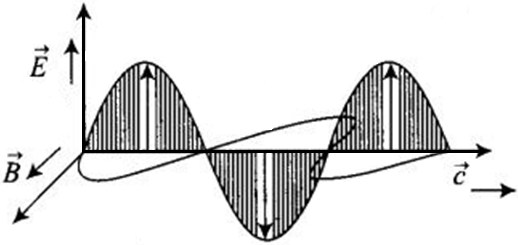
The direction of propagation of electromagnetic wave is perpendicular to both electric field vector $(\vec{\text{E}})$ and $\vec{\text{B}}$ magnetic field vector $B$, i.e., in the direction of $\vec{\text{E}}\times\vec{\text{B}}$.
Here, elecromagnetic wave is along the $z-$direction which is given by the cross product of $E$ and $B.$
View full question & answer→MCQ 141 Mark
The period of the wave will be.
- A
$2.5\mu\text{s}$
- B
$0.25\mu\text{s}$
- ✓
$0.025\mu\text{s}$
- D
$\text{None of these}$
AnswerCorrect option: C. $0.025\mu\text{s}$
Time period, $\text{T}=\frac{1}{\text{v}}$
$\text{T}=\frac{1}{40\times10^6}$
$\Rightarrow\text{T}=0.25\mu\text{s}$
View full question & answer→MCQ 151 Mark
If the frequency of $EM$ radiations is halved then the energy of $EM$ radiation will become:
View full question & answer→MCQ 161 Mark
For which frequency of light, the human eye is most sensitive?
- A
$55.405 \times 10^{14} Hz$
- B
$95.405 \times 10^{14} Hz$
- ✓
$5.405 \times 10^{14} Hz$
- D
$79.405 \times 10^{14} Hz$
AnswerCorrect option: C. $5.405 \times 10^{14} Hz$
Human eye is sensitive to light of wavelength $\rightarrow \lambda=5550$ angstrom.
So its frequency is $v =\frac{ c }{\lambda}$
$v=\frac{5550}{3 \times 10^8} \times 10^{-10}$
$v=5.405 \times 10^{14} Hz$
View full question & answer→MCQ 171 Mark
Which of the following cannot be polarized?
AnswerAll the longitudinal waves like sound etc cannot be polarized because the motion of the particles is already in one dimension that is the direction of propagation of wave.
Thus all the transverse waves like electromagnetic waves can be polarized.
Thus, $(B)$ Ultrasonic waves being sound waves having frequency greater than $20\ kHz$ but being longitudinal in nature cannot be polarized
View full question & answer→MCQ 181 Mark
The waves which are electromagnetic in nature are:
- A
Sound waves and light waves
- B
Water waves and radio waves
- ✓
Light waves and $X-$rays
- D
Sound waves and water waves
AnswerCorrect option: C. Light waves and $X-$rays
Light waves and $X-$rays are electromagnetic waves.
View full question & answer→MCQ 191 Mark
If the directions of electric and magnetic field vectors of a plane electromagnetic wave are along positive $y-$direction and positive $z-$direction respectively, then the direction of propagation of the wave is along:
- A
positive $z-$direction
- B
negative $z-$direction
- C
negative $y-$direction
- ✓
positive $x-$direction
AnswerCorrect option: D. positive $x-$direction
$e = E \times B$, direction of propagation is always perpendicular to plane of $E$ and $B$. It will be positive in x-direction.
View full question & answer→MCQ 201 Mark
Radiation pressure on any surface:
- A
Is dependent on wavelength of the light used
- ✓
Is dependent on nature of surface and intensity of light used
- C
Is dependent on frequency and nature of surface
- D
Depends on the nature of source from which light is coming and on nature of surface on which it is falling.
AnswerCorrect option: B. Is dependent on nature of surface and intensity of light used
Radiation pressure is given by $\text{P}_\text{R}=\frac{(1+\alpha)\text{I}}{\text{C}}$
where α is the coefficient of reflection of the surface.
For completely reflecting surface $\alpha=1$
For completely absorbing surface $\alpha=0$
So, radiation pressure depends on the nature of surface on which the light is falling but independent of wavelength of light falling.
View full question & answer→MCQ 211 Mark
$10\ cm$ is a wavelength corresponding to the spectrum of:
AnswerMicrowaves have wavelength around $10\ cm.$
View full question & answer→MCQ 221 Mark
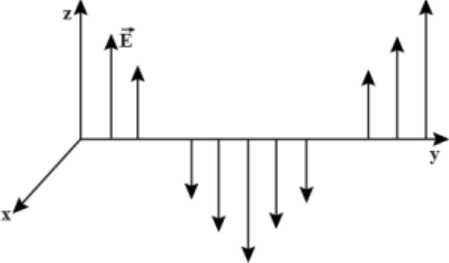
The electric field for a plane, electomagnetic wave travelling in the $+y$ direction is shown in figure.If the electric field of the wave $\overline{\text{E}}$ is in the $Z$ direction , then the $\overline{\text{B}}$ field is.
- ✓
In the $x$ direction and in phase with the $\overline{\text{E}}$ field
- B
In the $x$ direction and out of phase with the $\overline{\text{E}}$ field
- C
In the $z$ direction and in phase with the $\overline{\text{E}}$ field
- D
In the $z$ direction and one fourth of a cycle out of phase with the $\overline{\text{E}}$ field
AnswerCorrect option: A. In the $x$ direction and in phase with the $\overline{\text{E}}$ field
The wave equation for a plane electric wave traveling in the $x$ direction in space is
$\frac{\delta^2\text{E}}{\delta^2\text{y}}=\frac{1}{\text{c}^2}\frac{\delta^2\text{E}}{\delta\text{t}^2}$
with the same form applying to the magnetic field wave in a plane perpendicular the electric field. Both the electric field and the magnetic field are perpendicular to the direction of travel $y.$
View full question & answer→MCQ 231 Mark
An electromagnetic waves can be produced, when charge is:
- A
Moving with constant velocity
- B
Moving in a circular orbit
- C
Falling in an electric field
- ✓
both $(b)$ and $(c)$
AnswerCorrect option: D. both $(b)$ and $(c)$
An accelerated charge is the source of electromagnetic waves $\text{(EMWs).}$ When the charge is in a circular motion, the direction of its velocity continuously changes and thus it is in accelerated motion and produces $\text{EMWs.}$
A charge falling in an electric field is accelerated by the electric force and thus produces $\text{EMWs.}$
View full question & answer→MCQ 241 Mark
The displacement current was first populated by.
AnswerIn electromagnetism, displacement current is a quantity appearing in Maxwell's equations that is defined in terms of the rate of change of electric displacement field.
View full question & answer→MCQ 251 Mark
Speed of electromagnetic waves is the same:
AnswerFor any given medium, the speed $(c)$ of an electromagnetic wave is given by,
$\text{C}=\text{v}\lambda$
Where,
$V =$ Frequency of the electromagnetic wave.
$\lambda=$ wavelength of the electromagnetic wave.
As the frequency and wavelength are changed, the speed of the electromagnetic wave changes. So, the speed of an electromagnetic wave is not same for all wavelengths and all frequencies in any medium. The velocity of an electromagnetic wave changes with change in medium. Also, the speed of an electromagnetic wave is same for all the intensities in any medium.
View full question & answer→MCQ 261 Mark
Consider an electromagnetic wave propagating in vacuum. Choose the correct statement:
- A
For an electromagnetic wave propagating in $+y$ direction the $1$ A electric field is $\overrightarrow{\text{E}}=\frac{1}{\sqrt{2}}\text{E}_\text{yz}(\text{x,t})\hat{\text{z}}$ and the magnetic field is $\overrightarrow{\text{B}}=\frac{1}{\sqrt{2}}\text{B}_\text{z}(\text{x,t})\hat{\text{y}}$
- B
For an electromagnetic wave propagating in $+y$ direction the electric field is $\overrightarrow{\text{E}}=\frac{1}{\sqrt{2}}\text{E}_\text{yz}(\text{x,t})\hat{\text{y}}$ and the magnetic field is $\overrightarrow{\text{B}}=\frac{1}{\sqrt{2}}\text{B}_\text{z}(\text{x,t})\hat{\text{z}}$
- C
For an electromagnetic wave propagating in $+x $ direction the electric field is $\overrightarrow{\text{E}}=\frac{1}{\sqrt{2}}\text{E}_\text{yz}(\text{y,z,t})(\hat{\text{y}}+\hat{\text{z}})$ and the magnetic field is $\overrightarrow{\text{B}}=\frac{1}{\sqrt{2}}\text{E}_\text{yz}(\text{x,t})(\hat{\text{y}}+\hat{\text{z}})$
- ✓
For an electromagnetic wave propagating in $+x$ direction the electric field is $\overrightarrow{\text{E}}=\frac{1}{\sqrt{2}}\text{E}_\text{yz}(\text{x,t})(\hat{\text{y}}-\hat{\text{z}})$ and the magnetic field is $\overrightarrow{\text{B}}=\frac{1}{\sqrt{2}}\text{E}_\text{yz}(\text{x,t})(\hat{\text{y}}+\hat{\text{z}})$
AnswerCorrect option: D. For an electromagnetic wave propagating in $+x$ direction the electric field is $\overrightarrow{\text{E}}=\frac{1}{\sqrt{2}}\text{E}_\text{yz}(\text{x,t})(\hat{\text{y}}-\hat{\text{z}})$ and the magnetic field is $\overrightarrow{\text{B}}=\frac{1}{\sqrt{2}}\text{E}_\text{yz}(\text{x,t})(\hat{\text{y}}+\hat{\text{z}})$
Electromagnetic waves travel in the direction perpendicular to electric as well as magnetic field. Cross product of electric and magnetic field should give the direction of electromagnetic wave.
View full question & answer→MCQ 271 Mark
Is the ratio of frequencies of $UV$ rays and $IR$ rays in the glass more than, less than or equal to $1?$
- A
- B
Equal to $1$
- C
Less than $1$
- ✓
More than $1$
AnswerCorrect option: D. More than $1$
The ratio of frequencies of $UV$ rays and $IR$ rays in the glass is more than $1$. This is because the frequency of $UV$ rays is greater than that of infrared rays. This situation is applicable in glass or vacuum or air.
View full question & answer→MCQ 281 Mark
A parallel plate capacitor is charged to $60\mu\text{c}$ Due to a radioactive source, the plate loses charge at the rate of $1.8\times10^{-8}\frac{\text{C}}{\text{s}}$ The magnitude of displacement current is:
- ✓
$1.8\times10^{-8}\frac{\text{C}}{\text{s}}$
- B
$3.6\times10^{-8}\frac{\text{C}}{\text{s}}$
- C
$1.8\times10^{-8}\frac{\text{C}}{\text{s}}$
- D
$5.7\times10^{-12}\frac{\text{C}}{\text{s}}$
AnswerCorrect option: A. $1.8\times10^{-8}\frac{\text{C}}{\text{s}}$
The displacement current is that current which comes into play in the region in which the electric field and hence the electric flux is changing with time.
Maxwell found that conduction current $(I)$ and displacement current $\left(I_d\right)$ together have the property of continuity, although individually they may not be continuous. Maxwell also predicted that this current produces the same magnetic field as a conduction current can produce.
Displacement current is given by
$I _{ d }=\frac{ dq }{ dt }=1.8 \times 10^{-8} \frac{ C }{ s }$
View full question & answer→MCQ 291 Mark
An electromagnetic radiation has an energy of $13.2 keV$. Then the radiation belongs to the region of.
AnswerCorrect option: D. $X-$ray
View full question & answer→MCQ 301 Mark
The value of electric field in an electromagnetic wave originating from a point source of light at a distance of $10$ meter is $\text{E}=\frac{500\text{Volt}}{\text{m}}$ The electric field at a distance of $5$ meter will be.
- A
$\frac{1000\text{Volt}}{\text{meter}}$
- ✓
$\frac{2000\text{Volt}}{\text{meter}}$
- C
$\frac{50\text{Volt}}{\text{meter}}$
- D
$\frac{25\text{Volt}}{\text{meter}}$
AnswerCorrect option: B. $\frac{2000\text{Volt}}{\text{meter}}$
As we know, $\text{E}\propto\text{R}^{-2}$
Therefore, $\text{E}(\text{R}=5)=\frac{500}{10^{-2}}5^{-2}=\frac{2000\text{V}}{\text{m}}$
View full question & answer→MCQ 311 Mark
The amplitude of the magnetic field of a harmonic electromagnetic wave in vacuum is $B_0=510 nT$. The amplitude of the electric field part of the wave is:
- A
$120 N C ^{-1}$
- B
$163 N C ^{-1}$
- C
$510 N C ^{-1}$
- ✓
$153 N C ^{-1}$
AnswerCorrect option: D. $153 N C ^{-1}$
d. $153 N C ^{-1}$
Explanation:
Given,
$B _0=510 nT$
$c =3 \times 10^8 m / s$
The magnitude of electric field is given by
$E_0=B_0 C$
$E_0=510 \times 10^{-9} \times 3 \times 10^8$
$E_0=153 N C ^{-1}$
View full question & answer→MCQ 321 Mark
In an electromagnetic wave.
- A
Power is equally transferred along electric and magnetic fields
- ✓
Power is transmitted in a direction perpendicular to both the field
- C
Power is transmitted along electric field
- D
Power is transmitted along magnetic field
AnswerCorrect option: B. Power is transmitted in a direction perpendicular to both the field
For electromagnetic waves $E$ and $B$ are always perpendicular to each other and perpendicular to the direction of propagation. The direction of propagation is the direction of $E \times B.$
The direction of propagation of the wave is the direction of propagation of its energy and power.
View full question & answer→MCQ 331 Mark
Microwaves are electromagnetic waves with frequency in the range of:
MCQ 341 Mark
An $EM$ wave radiates outwards from a dipole antenna, with $E_0$ as the amplitude of its electric field vector. The electric field $E_0$ which transports significant energy from the source falls off as:
- A
$\frac{1}{\text{r}^3}$
- B
$\frac{1}{\text{r}^2}$
- ✓
$\frac{1}{\text{r}}$
- D
AnswerCorrect option: C. $\frac{1}{\text{r}}$
A diode antenna radiates the electromagnetic waves outwards. The amplitude of electric field vector $\left(E_0\right)$ which transports significant energy from the source falls intensity inversely as the distance $(r)$ from the antenna, i.e., $E _0 \propto \frac{1}{ r }$.
View full question & answer→MCQ 351 Mark
A charged particle oscillates about its mean equilibrium position with a frequency of $109 Hz$. The frequency of electromagnetic waves produced by the oscillator is:
- A
$10^6 Hz$
- B
$10^7 Hz$
- C
$10^8 Hz$
- ✓
$10^9 Hz$
AnswerCorrect option: D. $10^9 Hz$
View full question & answer→MCQ 361 Mark
In Thomson's experiment to measure e/ m of electron, the electric and the magnetic fields are.
AnswerCorrect option: D. Perpendicular to each other
The experimental set up of Thomson's experiment is shown in figure,
According to this figure, the electric field is applied between two horizontal parallel plates, this field is directed in downward direction.
The cross in figure shows the magnetic field is directed inside the paper. Therefore, both the fields are perpendicular to each other.
View full question & answer→MCQ 371 Mark
What is the ratio of the speed of infrared and ultraviolet rays in a vacuum?
AnswerRatio $= 1$ because the speed of an electromagnetic wave in vacuum is independent of its wavelength or frequency. Therefore, the ratio of speed of infrared and ultraviolet rays in a vacuum is one.
View full question & answer→MCQ 381 Mark
Which of the following radiations are used to treat muscle ache?
AnswerInfrared rays are used to treat muscle aches.
View full question & answer→MCQ 391 Mark
Which of the following statement$(s)$ is/ are correct?
- ✓
Conduction current obeys Ohm's law whereas displacement current does not.
- B
Conduction current is the actual current whereas displacement current is the apparent current produced by time varying electric field.
- C
Conduction current density is represented by $\overrightarrow{\text{J}_\text{c}}=\sigma\overrightarrow{\text{E}}$ whereas displacement current density is given by $\overrightarrow{\text{J}_\text{d}}=\frac{\overrightarrow{\delta\text{E}}}{\delta\text{t}};\sigma=$ conductivity of the element, $\overrightarrow{\text{E}}=$ electric field.
- D
AnswerCorrect option: A. Conduction current obeys Ohm's law whereas displacement current does not.
Displacement current is the current that occurs due to charging electric field introduced by maxwell. It depends on the frequency of electric field while conduction current follows ohms law, requires medium displacement.Current doesnot follow ohms law nor require medium.
View full question & answer→MCQ 401 Mark
Instantaneous displacement current $1A$ in the space between the parallel plates of $1\mu\text{F}$ capacitor can be established by changing the potential difference at the rate of:
- A
$\frac{0.1\text{V}}{\text{s}}$
- B
$\frac{1\text{V}}{\text{s}}$
- ✓
$\frac{10^6\text{V}}{\text{s}}$
- D
$\frac{10^{-6}\text{V}}{\text{s}}$
AnswerCorrect option: C. $\frac{10^6\text{V}}{\text{s}}$
In a capacitor of capacitance $C,$
$\text{V}=\frac{\text{q}}{\text{C}}$
$\Rightarrow\frac{\text{dV}}{\text{dt}}=\frac{\text{i}}{\text{C}}=\frac{1\text{A}}{1\mu\text{F}}=\frac{10^6\text{V}}{\text{s}}$
View full question & answer→MCQ 411 Mark
The cellular mobile radio frequency band is:
- A
$88 – 108 \ MHz$
- B
$54 – 72\ MHz$
- C
$540 – 1600\ KHz$
- ✓
$840 – 935\ MHz$
AnswerCorrect option: D. $840 – 935\ MHz$
View full question & answer→MCQ 421 Mark
If the magnetic field of an electromagnetic wave is given as $B_y=2 \times 10^{-7} \sin \left(10^3 x+1.5 \times 10^{12} t \right)$ tesla, the wavelength of the electromagnetic wave is.
- A
$0.314\ mm$
- B
$0.628\ mm$
- ✓
$6.28\ mm$
- D
$0.0628\ mm$
AnswerCorrect option: C. $6.28\ mm$
The general equation of an electromagnetic wave is $B = A \sin ( kx +\omega t )$
Comparing this equation with the given equation, $A =2 \times 10^{-7}, k =10^3$ and $\omega=1.5 \times 10^{12}$
So, $10^3=\frac{2 \pi}{\lambda}$
or $\lambda=6.28 \times 10^{-3} m=6.28 mm$
View full question & answer→MCQ 431 Mark
A plane electromagnetic wave with a single frequency moves in vacuum in the positive x direction. Its amplitude is uniform over the yz plane. the amplitude of its magnetic field.
AnswerThe same amount of energy passes through equal areas parallel to the $yz$ plane as the wave travels in the $+x$ direction, so the amplitude and the intensity, which is proportional to the square of the amplitude, do not change.
View full question & answer→MCQ 441 Mark
Which of the following is not true for electromagnetic waves?
- A
- B
- ✓
They travel at different speeds in air depending on their frequency.
- D
They travel at different speeds in medium depending on their frequency.
AnswerCorrect option: C. They travel at different speeds in air depending on their frequency.
They travel at different speed in air depending on their frequency. At constant as the speed will be same irrespective of frequency. Also frequency is source dependent and doesn't controls speed.
View full question & answer→MCQ 451 Mark
A plane electromagnetic wave of frequency $28\ MHz$ travels in free space along the positive $x-$direction. At a particular point in space and time, electric field is $9.3V/m$ along positive y-direction. The magnetic field $($in $T)$ at that point is
- ✓
$3.1 \times 10^{-8}$ along positive $z$-direction
- B
$3.1 \times 10^{-8}$ along negative $z$-direction
- C
$3.2 \times 10^7$ along positive $z$-direction
- D
$3.2 \times 10^7$ along negative $z$-direction
AnswerCorrect option: A. $3.1 \times 10^{-8}$ along positive $z$-direction
$\text{B}=\frac{\text{E}}{\text{C}}$
$=\frac{9.3}{3\times10^8}$
$=3.1\times10^{-8}$
View full question & answer→MCQ 461 Mark
Which waves are used by artificial satellites for communication?
AnswerMicrowaves are used by artificial satellites for communication.
View full question & answer→MCQ 471 Mark
What is the frequency of electromagnetic waves in a vacuum that have the same wavelength as a $500.0 Hz$ sound wave moving at $\frac{345\text{m}}{\text{s}}$?
- A
$500.0 Hz$
- B
$0.690 Hz$
- C
$2.30 \times 10^9 Hz$
- ✓
$1.45 Hz$
AnswerCorrect option: D. $1.45 Hz$
$2.30 \times 10^9 Hz$
View full question & answer→MCQ 481 Mark
When is the conduction current the same as the displacement current?
- ✓
- B
- C
When the source is either an ac or a dc
- D
When the source is neither dc nor ac
AnswerThe conduction current is the same as the displacement current when the source is ac.
View full question & answer→MCQ 491 Mark
An electromagnetic wave, going through vacuum is described by $\text{E}=\text{E}_0\sin(\text{kx}-\omega\text{t}.)$ Which of the following is independent of wavelength?
AnswerCorrect option: C. $\frac{\text{k}}{\omega}$
$\text{k}=\frac{2\pi}{\lambda}$
$\omega=\frac{2\pi\text{c}}{\lambda},$ where c is the velocity of light
Hence, $=\frac{\text{k}}{2\pi}=\frac{\omega}{2\pi\text{c}}$
$\Rightarrow\frac{\text{k}}{\omega}$ is independent of the wavelength.
View full question & answer→MCQ 501 Mark
When electromagnetic waves enter the ionised layer of ionosphere, then the relative permittivity i.e. dielectric constant of the ionised layer:
- A
- B
- ✓
- D
Sometimes appears to increase and sometimes to decrease
View full question & answer→MCQ 511 Mark
According to Maxwell's equation, the velocity of light in any medium is expressed as.
- A
$\frac{1}{\mu_0\in_0}$
- ✓
$\frac{1}{\sqrt\mu\in}$
- C
$\sqrt\frac{\mu}{\in}$
- D
$\sqrt\frac{\mu_0}{\in}$
AnswerCorrect option: B. $\frac{1}{\sqrt\mu\in}$
Velocity of light in a medium,
$\text{c}=\frac{1}{\sqrt{\mu_0\in_0\mu_\text{r}\in_\text{r}}}=\frac{1}{\mu_0\in_0}$
View full question & answer→MCQ 521 Mark
Electromagnetic waves travel only through.
- A
- B
- C
oscillating electric and magnetic fields
- ✓
oscillating electric and magnetic fields whose directions are perpendicular to each other
AnswerCorrect option: D. oscillating electric and magnetic fields whose directions are perpendicular to each other
Electromagnetic waves travel through oscillating electric and magnetic fields whose directions are perpendicular to each other.
View full question & answer→MCQ 531 Mark
Choose the correct answer from the alternatives given. The amplitude of an electromagnetic wave in vaccum is doubled with no other changes made to the wave. As a result of this doubling of the amplitude, which of the following statement is correct?
- A
The frequency of the wave changes only
- B
The wave length of the wave changes only
- C
The speed of the wave propagation changes only
- ✓
None of the above is correct
AnswerCorrect option: D. None of the above is correct
As we know, velocity of electromagnetic wave,
$\text{c}=\frac{1}{\sqrt{\mu_0\in_0}}=\frac{3\times10^8\text{m}}{\text{s}}$
which is constant
So It is independent of amplitude of electromagnetic wave, frequency and wavelength of electromagnetic wave.
so none of the above is correct.
View full question & answer→MCQ 541 Mark
A plane electromagnetic wave travels in vacuum along $\hat{\text{k}}$ direction, where $\hat1\hat{\text{j}}$ and $\hat{\text{k}}$ are unit vectors along the $x, y$ and $z$ directions. The direction along which the electric and the magnetic field vectors point may be respectively.
- ✓
$\hat{\text{k}}\text{ and }\hat{\text{j}}$
- B
$\hat{\text{k}}\text{ and }\hat{-\text{j}}$
- C
$\hat{\text{j}}\text{ and }\hat{\text{i}}$
- D
$\hat{\text{k}}\text{ and }\hat{\text{i}}$
AnswerCorrect option: A. $\hat{\text{k}}\text{ and }\hat{\text{j}}$
Electromagnetic wave is a transverse wave that means the electric and magnetic field associated to it will not only be perpendicular to each other but will also be
perpendicular to the direction in which the wave travels.
So, if waves travel along $\hat{\text{k}}$ direction then the electric and the magnetic field will be along $\hat{\text{i}}$ and $\hat{\text{j}}$ directions.
View full question & answer→MCQ 551 Mark
Choose the correct answer from the alternatives given. The conduction current is the same as displacement current when the source is.
AnswerCorrect option: A. $AC$ only
For a capacitor, we have:
$Q = CV$
If $Q$ is changing, there will be a current in capacitor plates,
$\text{I}=\frac{\text{dQ}}{\text{dt}}=\frac{\text{CdV}}{\text{dt}}$when voltage across the capacitor is constant, $\frac{\text{dV}}{\text{dt}}=0$
therefore,$ I = 0$
It implies that, for a $DC ($constant$)$ voltage, the capacitor current is zero.
Hence, for a $DC$ source the conduction current and displacement current $($capacitor current$)$ are not same.
Whereas, by Maxwell's equation for a time varying voltage $(AC$ voltage$),$ both conduction and displacement currents are same.
View full question & answer→MCQ 561 Mark
The condition under which a microwave over heats up a food item containing water molecules most efficiently is:
- ✓
The frequency of the microwaves must match the resonant frequency of the water molecules.
- B
The frequency of the microwaves has no relation with natural frequency of the water molecules.
- C
Microwaves are heat waves, so always produce heating.
- D
Infrared waves produce heating in a microwave oven.
AnswerCorrect option: A. The frequency of the microwaves must match the resonant frequency of the water molecules.
When frequency of microwave matches with frequency of water molecules i.e., resonant condition. Maximum energy is transferred to water molecules as their $K.E.$ energy.
View full question & answer→MCQ 571 Mark
Which of the following type of radiations are radiated by on oscillating electric charge?
AnswerAny stationary charge produce static electric field. And the field strength is given by:
$r$, is the radial distance from the point charge.
$Q,$ is the charge in Coulomb.
When electric charge oscillates electric field at any point also oscillates.And according to Maxwell's equations varying electric field produces magnetic field and an oscillating electric field produces oscillating magnetic field. This thing is used in antennas in which oscillating current of certain frequency produces oscillating electric and magnetic field which propagates through space $($electromagnetic waves$).$
View full question & answer→MCQ 581 Mark
Two opposite charged particles oscillate about their mean equilibrium position in free space, with a frequency of $10^9 \ Hz$. The wavelength of the corresponding electromagnetic wave produced is$..........$
- ✓
$0.3m$
- B
$10^9 m$
- C
$3 \times 10^{17} m$
- D
$3.3m$
AnswerCorrect option: A. $0.3m$
Electromagnetic wave $V=3 \times 10^8 m / s$
Given frequency $(f) =10^9 Hz$
$\text{V}=\text{f}\lambda$
$\lambda=\frac{\text{V}}{\text{f}}$
$=\frac{3 \times 10^8} {10^9}$
$= 0.3m$
View full question & answer→MCQ 591 Mark
Which of the following effects could not be explained by Maxwell's electromagnetic wave theory?
AnswerPhotoelectric effect was discovered by heinrich Rudoy Hertz.
Compton effect was discovered by Aethur Holl Compton.
Raman effect was discovered by Sir Chandrasekhar Venbata Ram.
So, none of these effect was discovered by Maxwell.
View full question & answer→MCQ 601 Mark
The ozone layer in the atmosphere absorbs:
AnswerCorrect option: D. $X-$rays and ultraviolet rays
View full question & answer→MCQ 611 Mark
An electromagnetic wave can be produced when the charge is
- A
moving in a circular orbit
- B
moving with a constant velocity
- C
falling in an electric field
- ✓
Both $(a)$ and $(c)$
AnswerCorrect option: D. Both $(a)$ and $(c)$
An accelerated charge is the source of electromagnetic waves $\text{(EMWs)}$. When the charge is in a circular motion, the direction of its velocity continuously changes and thus it is in accelerated motion and produces $\text{EMWs}$. A charge falling in an electric field is accelerated by the electric force and thus produces $\text{EMWs.}$
View full question & answer→MCQ 621 Mark
A $1000\Omega$ resistance and a capacitor of $100\Omega$ resistance are connected in series a $220V$ source. when the capacitor is $50\%$ charged, the value of the displacement current is.
- A
$11.\sqrt{2}\text{A}$
- ✓
$2.2A$
- C
$11A$
- D
$4.4A$
AnswerCorrect option: B. $2.2A$
Displacement current $=\text{I}_\text{D}=\text{C}\frac{\text{dV}}{\text{dT}}=\text{C}\omega\text{V}_\text{o}=\frac{\text{V}_\text{o}}{\text{X}_\text{c}}=\frac{220\text{V}}{100\Omega}=2.2\text{A}$
As we are asked amplitude of displacement current. So, we don't have to worry about charge on capacitor.
View full question & answer→MCQ 631 Mark
A plane electromagnetic wave of frequency $20\ MHz$ travels through a space along $x$ direction. If the electric field vector at a certain point in space is $6 V m ^{-1}$, what is the magnetic field vector at that point?
AnswerCorrect option: A. $2\times10^{-8}\text{T}$
Velocity of $EM$ wave $\text{v}=\frac{3\times10^8\text{m}}{\text{s}}$
Electric field vector $\text{E}=\frac{6\text{V}}{\text{m}}$
Thus magnetic field vector $\text{B}=\frac{\text{E}}{\text{v}}$
$\therefore\text{B}=\frac{6}{3\times10^8}=2\times10^{-8}\text{T}$
View full question & answer→MCQ 641 Mark
The energy contained in a small volume through which an electromagnetic wave is passing oscillates with:
- A
- B
The frequency of the wave.
- C
Half the frequency of the wave.
- ✓
Double the frequency of the wave.
AnswerCorrect option: D. Double the frequency of the wave.
The energy per unit volume of an electromagnetic wave,
$\text{u}=\frac{1}{2}\in_0\text{E}^2+\frac{\text{B}^2}{2\mu_0}$
The energy of the given volume can be calculated by multiplying the volume with the above expression.
$\text{U}=\text{u}\times\text{V}=\Big(\frac{1}{2}\in_0\text{E}^2+\frac{\text{B}^2}{2\mu_0}\Big)\times\text{V}\ ....(\text{i})$
Let the direction of propagation of the electromagnetic wave be along the $z-$axls. Then, the electric and magnetic fields at a particular point are given by,
$\text{E}_\text{x}=\text{E}_0\sin(\text{kz}-\omega\text{t})$
$\text{B}_\text{y}=\text{B}_0\sin(\text{kz}-\omega\text{t})$
Substituting the values of electric and magnetic fields in $(1)$ we get,
$\text{U}=\Big(\frac{1}{2}\in_0\big(\text{E}_0^2\sin^2(\text{kz}-\omega\text{t})+\frac{\text{B}^2_0\sin^2(\text{kz}-\omega\text{t})}{2\mu_0}\Big)\times\text{V}$
$\text{U}=\Big(\in_0\text{E}^2_0\frac{(1-\cos(2\text{kz}-2\omega\text{t}))}{4}+\frac{\text{B}_0^2(1-\cos(2\text{kz}-2\omega\text{t}))}{4\mu_0}\Big)\times\text{V}$
From the above expression, it can be easily understood that the energy of the electric and magnetic fields have angular frequency $2\omega$ Thus. the frequency of the energy of the electromagnetic wave will also be double.
View full question & answer→MCQ 651 Mark
From Maxwell’s hypothesis, a charging electric field gives rise to:
AnswerA charging electric field gives rise to a magnetic field.
View full question & answer→MCQ 661 Mark
Light with an energy flux of $20 W / cm ^2$ falls on a non-reflecting surface at normal incidence. If the surface has an area of $30 cm^2$. the total momentum delivered (for complete absorption) during $30$ minutes is:
- A
$36 \times 10^{-5} kg m / s$
- ✓
$36 \times 10^{-4} kg m / s$.
- C
$108 \times 10^4 kg m / s$.
- D
$1.08 \times 10^7 kg m / s$
AnswerCorrect option: B. $36 \times 10^{-4} kg m / s$.
b. $36 \times 10^{-4} kg m / s$.
Solution:
Givne energy flux $\phi=20\frac{\text{W}}{\text{cm}^2}$
Area, $A=30 cm^2$
Time, $t =30 min=30 \times 60 s$
Now, total energy falling on the surface in time t is,
$\text{U}=\phi\text{At}=20\times30\times(30\times60)\text{J}$
Momentum of the incident light $=\frac{\text{U}}{\text{c}}$
$=\frac{20\times30\times(30\times60)}{3\times10^{8}}=36\times10^{-4}\text{kg-ms}^{-1}$
Momentum of the reflected light $= 0$
$\therefore$ Momentum delivered to the surface
$=36\times10^{-4}-0=36\times10^{-4}\text{kg-ms}^{-1}$
Important points
Mass of photon:
Actually rest mass of the photon is zero. But its effective mass is given as $\text{E}=\text{mc}^2=\text{hv}\Rightarrow\ \text{m}=\frac{\text{E}}{\text{C}^2}=\frac{\text{hv}}{\text{C}^2}=\frac{\text{h}}{\text{c}\lambda}$. Thsi mass is also known as kintic mass of the photon.
Momentum of the photon:
Momentum $\text{p}=\text{m}\times\text{c}=\frac{\text{E}}{\text{c}}=\frac{\text{hv}}{\text{c}}=\frac{\text{h}}{\lambda}$
Number of emitted photons:
The number of photons emitted per second from a source of monochromatic radiation of wavelengh $\lambda$ and power P is given as $\text{(n)}=\frac{\text{P}}{\text{E}}=\frac{\text{P}}{\text{hv}}=\frac{\text{P}\lambda}{\text{hc}}$; where E = energy of each photon
Inrensity of light (I):
Energy crossing per unit area normally per second is called intensity or energy flux
i.e. $\text{I}=\frac{\text{E}}{\text{At}}=\frac{\text{P}}{\text{A}}\Big(\frac{\text{E}}{\text{t}}=\text{P}=\text{radiation Power}\Big)$
At a distance r from a point source of power P intensity is given by $\text{I}=\frac{\text{P}}{4\pi\text{r}^2}\Rightarrow\ \text{I}\propto\frac{1}{\text{r}^2}$.
View full question & answer→MCQ 671 Mark
The frequency of incident light falling on a photosensitive metal plate is doubled, the kinetic energy of the emitted photoelectrons is.
Answer$v \rightarrow 2 vhv - hv v _0= KG _{\max }$
$So , KG _{\max }>2 KG _{\max }$
as $h v_0$ is constant
View full question & answer→MCQ 681 Mark
Dimensions of $\frac{1}{(\mu_0\in_0)}$ is:
- A
$\frac{\text{L}}{\text{T}}$
- B
$\frac{\text{T}}{\text{L}}$
- ✓
$\frac{\text{L}^2}{\text{T}^2}$
- D
$\frac{\text{T}^2}{\text{L}^2}$
AnswerCorrect option: C. $\frac{\text{L}^2}{\text{T}^2}$
The speed of light, $\text{C}=\frac{1}{\sqrt{\mu_0\in_0}}$
The dimensions of $\frac{1}{\sqrt{\mu_0\in_0}}$ are of velocity, i.e., $\frac{\text{L}}{\text{T}}$
Therefore, $\frac{1}{\in_0\mu_0}$ will have dimensions $\frac{\text{L}^2}{\text{T}^2}$
View full question & answer→MCQ 691 Mark
$A.$ Current flow inside the capacitor due to accumulation of charges on the capacitor walls is called displacement current.
$B.$ Current due to the flow of electrons due to some potential difference is called as conduction current.
$C.$ Displacement current came into existence when Maxwell observed that if a magnetic compass is placed between the capacitors the needle gets deflected which signifies presence of magnetic fields which would possibly caused due to some changing current.
$D.$ Displacement current change the actual motion of electric charges.
Which of the above statement(s) is/ are correct?
- A
$A$ and $B$ only
- ✓
$A, B$ and $C$ only
- C
$C$ only
- D
$A, B, C$ and $D$
AnswerCorrect option: B. $A, B$ and $C$ only
Displacement current is a quantity appearing in Maxwell's equations that is defined in terms of the rate of change of electric displacement field. Displacement current came into existence when Maxwell observed that if a magnetic compass is placed between the capacitors the needle gets deflected which signifies presence of magnetic fields which would possibly caused due to some changing current. Current flow inside the capacitor due to accumulation of charges on the capacitor walls is called displacement current.However it is not an electric current of moving charges, but a 'time-varying electric field'.
View full question & answer→MCQ 701 Mark
Electromagnetic wave of intensity $1400 W / m ^2$ falls on metal surface on area $1.5 m^2$ is completely absorbed by it. Find out force exerted by beam.
- A
$14 \times 10^{-5} N$
- B
$14 \times 10^{-6} N$
- C
$7 \times 10^{-5} N$
- ✓
$7 \times 10^{-6} N$
AnswerCorrect option: D. $7 \times 10^{-6} N$
For a perfectly absorbing surface,
$\text{F}=\frac{\text{IA}}{\text{C}}$
$=\frac{(1400\text{W/m}^2\times 1.5\text{m}^2)}{(3\times 10^8\text{m/s})}$
$=7\times10^{−6}\text{N}.$
View full question & answer→MCQ 711 Mark
The ratio of contributions made by the electric field and magnetic field components to the intensity of an $EM$ wave is:
- A
$c : 1.$
- B
$c^2: 1$
- ✓
$1 : 1.$
- D
$\sqrt{\text{c}}:1.$
AnswerCorrect option: C. $1 : 1.$
The intensity of electromagnetic wave is given by,
$I = U _{ av } C$, where $U _{ av }=$ Average energy and $c =$ speed of light
Intensity in relation with electric field $\text{U}_\text{av}=\frac{1}{2}\in_0\text{E}_0^2$
Intensity relation with magnetic field $\text{U}_\text{av}=\frac{1}{2}\frac{\text{B}_0^2}{\mu_0}$
Now taking the intensity in terms of electric field,
$(\text{U}_\text{av})_\text{electric field}=\frac{1}{2}\in_0\text{E}_0^2=\frac{1}{2}\in_0(\text{cB}_0)^2\ \ (\because\ \text{E}_0=\text{cB}_0)$
But, $\text{c}=\frac{1}{\sqrt{\mu_0\in_0}}$
$\therefore\ (\text{U}_\text{av})_\text{Electric field}=\frac{1}{2}\in_0\times\frac{1}{\mu_0\in_0}\text{B}_0^2=\frac{1}{2}\frac{\text{B}_0^2}{\mu_0}$
$=(\text{U}_\text{av})_\text{magnetic field}$
Hence the energy in electromagnetic wave is divided equally between electric field vector and magnetic field vector.
It means the ratio of contributions by the electric field and magnetic field components to the intensity of an electromagnetic wave is $1:1.$
Impotant point:
Propertioe of $EM$ waves
Speed: In free, its speed $\text{c}=\frac{1}{\sqrt{\mu_0\in_0}}=\frac{\text{E}_0}{\text{B}_0}=3\times10^8\text{m/s}$.
In medium $\text{v}=\frac{1}{\sqrt{\mu\in}}$; where $\mu_0$ = Absolute permeability, $\in_0$ = Absolute permittivity, E = Amplitude of electric of field and magnetic field vectors.
Energy: The energy in an $EM$ waves is divided equally between the electric and magnetic fields.
Energy density of electric field $\text{u}_\text{e}=\frac{1}{2}\in_0\text{E}^2$, Energy density of magnetic field $\text{u}_\text{B}=\frac{1}{2}\frac{\text{B}^2}{\mu_0}$
It is found that $u _{ e }= u _{ B }$. Also $\text{u}_\text{av}=\text{u}_\text{e}+\text{u}_\text{B}=2\text{u}_\text{e}=2\text{u}_\text{B}=\in_0\text{E}^2=\frac{\text{B}^2}{\mu_0}$
Intensity (I): The energy crossing per unit area unit time, perpendicular to the direction of propagation of $EM$ wave is called intensity.
$\text{I}=\text{u}_\text{av}\times\text{c}=\frac{1}{2}\in_0\text{E}^2\text{c}=\frac{1}{2}\frac{\text{B}^2}{\mu_0}.\text{c}$
Momentum: EM waves also carries momentum, if a portion of $Em$ wave of energy u propagating with speed $c$, then linear momentum $=\frac{\text{Energy (u)}}{\text{Speed (c)}}$
When the incident $EM$ wave is completely absorbed by a surface, it delivers energy $u$ and momentum $u/c$ to the surface.
When a wave of energy us is totally reflected from the surface, the momentum delivered to surface is $2u/c.$
Poynting vector $(\vec{\text{S}})$: In $EM$ waves, the rate of flow of energy crossing a unit area is described by the poynting vector. Its unit is watt/m and $\vec{\text{S}}=\frac{1}{\mu_0}(\vec{\text{E}}\times\vec{\text{B}})=\text{c}^2\in_0(\vec{\text{E}}\times\vec{\text{B}})$. Because in $EM$ waves, $\vec{\text{E}}$ and $\vec{\text{B}}$ are perpendicular to each other, the magnitude of $\vec{\text{S}}$ is $|\vec{\text{S}}|=\frac{1}{\mu_0}\text{E B}\sin90^\circ=\frac{\text{EB}}{\mu_0}=\frac{\text{E}^2}{\mu_\text{C}}$.
The direction of the Poynting vector $\vec{\text{S}}$ at any point gives the wave's direction of travel and direction of energy transport the point.
Radiation Pressure: Is the momentum imparted per second per unit area on which the light falls.
For a perfectly reflecting surface $\text{P}_\text{r}=\frac{2\text{S}}{\text{c}}; S =$ Poynting vector; $c =$ speed of light
For a perfectly absorbing surface $\text{P}_\text{a}=\frac{\text{S}}{\text{c}}$.
The radiation pressure is real that's why tails of comet point away from the sun.
View full question & answer→MCQ 721 Mark
An AM radio wave is emitted by a radio antenna and travels across flat ground. Find out the direction of the magnetic field component of the wave?
- ✓
Parallel to the ground and perpendicular to the direction of propagation
- B
Perpendicular to the ground and to the direction of propagation
- C
Perpendicular to the ground and parallel to the direction of propagation
- D
Parallel to the electric field component of the wave
AnswerCorrect option: A. Parallel to the ground and perpendicular to the direction of propagation
According to Maxwell an accelerated charge produces a sinusoidal time varying magnetic field which in turn produces a time varying electric field .The two fields so produced are mutually perpendicular to each other and constitute an electromagnetic wave and propagate in space in the direction perpendicular to both the fields. An $AM$ wave is also an electromagnetic wave therefore its magnetic field component would be parallel to ground and perpendicular to the direction of propogation.
View full question & answer→MCQ 731 Mark
The matter$-$wave picture of electromagnetic wave/radiation elegantly incorporated the:
- ✓
Heinsenbergs uncertainty principle
- B
- C
- D
AnswerCorrect option: A. Heinsenbergs uncertainty principle
The matter$-$wave picture of electromagnetic wave/radiation elegantly incorporated the Heisenberg uncertainty principle.
View full question & answer→MCQ 741 Mark
In the propagation of electromagnetic waves, the angle between the direction of propagation and plane of polarisation is
- ✓
$0^\circ$
- B
$45^\circ$
- C
$90^\circ$
- D
$180^\circ$
AnswerCorrect option: A. $0^\circ$
Plane of polarization is a confinement of the electric/ magnetic field vector to a given plane along the direction of propagation. Therefore angle between them is $0^\circ .$
View full question & answer→MCQ 751 Mark
The polarisation of electromagnetic wave is in:
- A
The directions of electric and magnetic field
- ✓
The directions of electric field
- C
The direction of magnetic field
- D
AnswerCorrect option: B. The directions of electric field
View full question & answer→MCQ 761 Mark
Mark the correct option in impure spectrum:
- A
Order of colours is reverse
- B
Order of colours is irregular
- ✓
- D
AnswerThe order of colours is are straight, hence option a is false.
Order of colours are regular.
Colours are overlapped each other in impure spectrum.
Colours are present in impure spectrum.
View full question & answer→MCQ 771 Mark
Which of the following proves that electromagnetic waves are transverse?
AnswerOnly transverse waves can be polarised.
View full question & answer→MCQ 781 Mark
Which among the following has a frequency range of $500\ kHz$ to $1000\ MHz?$
AnswerRadio Waves are generally in the frequency range $➔ 500\ kHz$ to $1000\ MHz$. Radio waves are used for long$-$distance communication, such as in television, mobiles, and radios. These devices receive radio waves and convert them to mechanical vibrations in the speaker to create sound waves.
View full question & answer→MCQ 791 Mark
What is the phase difference between electric and magnetic fields in an electromagnetic wave?
- A
$0$
- ✓
$\pi$
- C
$\frac{\pi}{2}$
- D
$\frac{\pi}{4}$
AnswerThe phase difference between electric and magnetic fields in an electromagnetic wave is$\pi$.
View full question & answer→MCQ 801 Mark
Ultraviolet rays coming from sun are absorbed by:
MCQ 811 Mark
Which of the following is used to investigate the structure of solids?
AnswerCorrect option: C. $X-$Rays
$X-$Rays are used to investigate the structure of solids.
View full question & answer→MCQ 821 Mark
Which of the following has/have zero average value in a plane electromagnetic wave?
- ✓
Both magnetic and electric field
- B
- C
- D
AnswerCorrect option: A. Both magnetic and electric field
View full question & answer→MCQ 831 Mark
A plane electromagnetic wave with a single frequency moves in vacuum in the positive $x$ direction. Its amplitude is uniform over the $yz$ plane its wavelength:
AnswerThe same amount of energy passes through equal areas parallel to the $yz$ plane as the wave travels in the $+x$ direction, so the amplitude and the intensity, which is proportional to the square of the amplitude, do not change.
View full question & answer→MCQ 841 Mark
The concept of displacement current introduced by Maxwell removes asymmetry between.
- A
Gauss's law in electrostatics and Gauss's law in magnetism
- ✓
Faraday's law and Ampere' law
- C
Gauss's law and Ampere's law
- D
Gauss's law and Faraday's law
AnswerCorrect option: B. Faraday's law and Ampere' law
Maxwell added the concept of displacement current in AMpere Circuit Law which governs the conduction in the wire of conduction current. After the deviation compass between capacitor Maxwell thought of magnetic lines which would be the result of varying current known as displacement current. So by continuing the displacement in Amperes law, Maxwell was able to show the result of Amperes conduction in circuit moving electrons and also the result of faraday generation of $ME$ waves.
View full question & answer→MCQ 851 Mark
Choose the correct answer from the alternatives given.
Displacement current goes through the gap between the plates of a capacitor when the charge of the capacitor.
AnswerDisplacement current inside a capacitor is given by:-
$\text{i}_\text{d}=\in_0\frac{\phi\text{E}}{\text{dt}}$
where $\phi_\text{E}$ is the electric flux inside the capacitor
The displacement current is developed inside a capacitor when there is a change in the electric flux linked with the capacitor.
The change in electric flux can occur in both the cases either the charge increases or decreases on the capacitor. This will lead to a change in flux linked with the coil.
View full question & answer→MCQ 861 Mark
According to Maxwell’s Hypothesis, a changing electric field gives rise to?
AnswerA changing electric field gives rise to a magnetic field.
View full question & answer→MCQ 871 Mark
In the propagation of light waves, the angle between the plane of vibration $\&$ plane of polarisation is:
- A
$0^\circ$
- ✓
$90^\circ$
- C
$45^\circ$
- D
$80^\circ$
AnswerCorrect option: B. $90^\circ$
The plane of polarisations is that plane in which there is no vibration. While a plane including the direction of light propagation and the direction of electric field is called the plane of vibration. The angle between them is $90^\circ .$
View full question & answer→MCQ 881 Mark
Who first proposed the light as an electromagnetic wave?
AnswerIn $1864$, Maxwell predicted the existence of electromagnetic waves, the existence of which had not been confirmed before that time, and out of his prediction came the concept of light being a wave, or more specifically, a type of electromagnetic wave. It is a wide intuition that Albert Einstein proposed the dual nature theory but is not correct.
View full question & answer→MCQ 891 Mark
A magnetic field can be produced by:
- A
- B
A changing electric field.
- C
- ✓
AnswerAccording to Ampere$-$Maxwell's Law, a magnetic field is produced due to the conduction current in a conductor and the displacement current. The conduction current is actually the motion of the charge. The displacement current is due to the changing electric field. The displacement current is given by,
$\text{i}_\text{d}=\in_0\frac{\text{d}\phi_\text{E}}{\text{dt}}$ $\big(\because\phi_\text{E}$ is the electric flux$\big)$
Thus, the magnetic field is produced by the moving charge as well as the electric field.
View full question & answer→MCQ 901 Mark
The wavelength of the wave is.
- A
$3.5m$
- B
$5.5m$
- ✓
$7.5m$
- D
$9.5m$
AnswerCorrect option: C. $7.5m$
Using $\text{v}=\text{v}\lambda$ where $v$ is the speed of $EM$ wave.
As $\text{V}=\text{c}=3\times\frac{10\text{m}}{\text{s}}$
$\Rightarrow3\times10^8=40\times10^6\lambda$
$\Rightarrow\lambda=7.5\text{m}$
View full question & answer→MCQ 911 Mark
A linearly polarized electromagnetic wave given as $\text{E}=\text{E}_0\hat{\text{i}}\cos(\text{kz}-\omega\text{t})$ is incident normally on a perfectly reflecting infinite wall at $z = a$. Assuming that the material of the wall is optically inactive, the reflected wave will be given as:
- A
$\text{E}_\text{r}=-\text{E}_0\hat{\text{i}}\cos(\text{kz}-\omega\text{t})$
- ✓
$\text{E}_\text{r}=\text{E}_0\hat{\text{i}}\cos(\text{kz}+\omega\text{t})$
- C
$\text{E}_\text{r}=-\text{E}_0\hat{\text{i}}\cos(\text{kz}+\omega\text{t})$
- D
$\text{E}_\text{r}=\text{E}_0\hat{\text{i}}\sin(\text{kz}-\omega\text{t})$
AnswerCorrect option: B. $\text{E}_\text{r}=\text{E}_0\hat{\text{i}}\cos(\text{kz}+\omega\text{t})$
Key concept: When a wave is reflected from a denser medium or perfectly reflecting wall made with optically inactive material, then the type of wave doesn't change but only its phase changes by $180^\circ $ or $\hat{\text{I}}€$ radian.
View full question & answer→MCQ 921 Mark
In case of the electromagnetic waves the angle between the electric and magnetic field vectors is.
AnswerCorrect option: B. $\frac{\pi}{2}$
Electromagnetic waves are formed when an electric field couples with a magnetic field. The magnetic and electric fields of an electromagnetic wave are perpendicular to each other and to the direction of the wave, as shown in figure.
View full question & answer→MCQ 931 Mark
In an electromagnetic wave, the direction of the magnetic induction $B$ is
- A
parallel to the electric field $E$
- ✓
perpendicular to the electric field $\overrightarrow{\text{E}}$
- C
antiparallel to the pointing vector $\overrightarrow{\text{S}}$
- D
AnswerCorrect option: B. perpendicular to the electric field $\overrightarrow{\text{E}}$
The electric field is always perpendicular to the magnetic field, and both fields are directed at right$-$angles to the direction of propagation of the wave. In fact, the wave propagates in the direction $\overrightarrow{\text{E}}\times\overrightarrow{\text{B}}$ Electromagnetic waves are clearly a type of transverse wave.
View full question & answer→MCQ 941 Mark
- ✓
continuous when electric field is changing in the circuit
- B
continuous when magnetic field is changing in the circuit
- C
continuous in both types of fields
- D
continuous through wires and resistance only
AnswerCorrect option: A. continuous when electric field is changing in the circuit
View full question & answer→MCQ 951 Mark
Electromagnetic waves are produced by:
AnswerA static charge produces an electrostatic field. A moving charge produces a magnetic field. Electromagnetic waves are produced by an accelerating charge.
View full question & answer→MCQ 961 Mark
Pick out the correct increasing order of energy of electromagnetic waves from the following:
- A
$E _{\text {infrared }}< E _{\text {micro }}< E _{\text {visible }}< E _{\text {ultraviolet }}< E _{\text {gamma }}$
- ✓
$E _{\text {micro }}< E _{\text {infrared }}< E _{\text {visible }}< E _{\text {ultraviolet }}< E _{\text {gamma }}$
- C
$E _{\text {micro }}< E _{\text {infrared }}< E _{\text {visible }}< E _{\text {gamma }}< E _{\text {ultraviolet }}$
- D
$E _{\text {micro }}$
AnswerCorrect option: B. $E _{\text {micro }}< E _{\text {infrared }}< E _{\text {visible }}< E _{\text {ultraviolet }}< E _{\text {gamma }}$
The energy of electromagnetic waves is directly proportional to the frequency of the electromagnetic waves. So the order of frequency is given as:
$v_{\text {micro }} < v_{\text {infrared }}$ Since $E=h v$
$\rightarrow E \propto v$
The order of energy is as follows:
$E _{\text {micro }} < E _{\text {infrared }} < E _{\text {visible }} < E _{\text {ultraviolet }} < E _{\text {gamma }}$
View full question & answer→MCQ 971 Mark
Unpolarized light falls first on polarizer (P) and then on analyzer (A). If the intensity of the transmitted light from the analyser is $\frac{1}{8}\text{th}$ of the incident unpolarized light. What will be the angle between optic axes of P and A?
AnswerExplanation:
Given,
$\text{I}=\frac{\text{I}_\text{0}}{2}....(\text{i})$
$\text{I}=\text{I}\cos^2\theta$ $\Big(\because\text{I}=\frac{\text{I}_0}{8}\Big)$
$\therefore\frac{\text{I}_0}{8}=\frac{\text{I}_0}{2}\cos^2\theta$
From the equation (i), we have
$\frac{1}{4}=\cos^2\theta$
$\Rightarrow\cos\theta=\frac{1}{2}$
$\Rightarrow\cos\theta=\cos60^\circ$
$\Rightarrow\theta=60^\circ$
View full question & answer→MCQ 981 Mark
Radiations of intensity $\frac{0.5\text{W}}{\text{m}^2}$ are striking a metal plate. The pressure on the plate is.
- ✓
$\frac{0.166\times10^{-8}\text{N}}{\text{m}^2}$
- B
$\frac{0.332\times10{-8}\text{N}}{\text{m}^2}$
- C
$\frac{0.111\times10{-8}\text{N}}{\text{m}^2}$
- D
$\frac{0.083\times10{-8}\text{N}}{\text{m}^2}$
AnswerCorrect option: A. $\frac{0.166\times10^{-8}\text{N}}{\text{m}^2}$
Intensity or power per unit area of the radiations,
$P = pv$
$\Rightarrow\text{P}=\frac{\text{P}}{\text{v}}=\frac{0.5}{3\times10^8}=\frac{0.166\times10^{-8}\text{N}}{\text{m}^2}$
View full question & answer→MCQ 991 Mark
A parallel plate capacitor consists of two circular plates each of radius $12\ cm$ and separated by $5.0\ mm$. The capacitor is being charged by an external source. The charging current is constant and is equal to $0.15A$.The displacement current is:
- A
$15A$
- B
$1.5A$
- ✓
$0.15A$
- D
$0.015A$
AnswerCorrect option: C. $0.15A$
According to Maxwell's hypothesis, a displacement current will flow through a capacitor when the potential difference across its plates is varying.
Thus a varying electric field will exist between the plates and this displacement current is same in magnitude to the current flowing in outer circuit.
Here, the current in the outer circuit is $0.15 A$. Thus $0.15A$ will be the displacement current.
View full question & answer→MCQ 1001 Mark
Infrared radiation are detected by:
AnswerInfrared radiation is detected by photometer.
View full question & answer→MCQ 1011 Mark
According to the electromagnetic wave theory, light consists of electric and magnetic fields which are $.........$
AnswerLight consists of electric and magnetic field that are perpendicular $90^\circ $ to each other.
$\text{APPOACH}$ by example
Electric field inside plates. The magnetic field this given rise to via the displacement current is along the perimeter of the circle parallel to capauatates plates.
So $B$ and $E$ are perpendicular in this case.
View full question & answer→MCQ 1021 Mark
The angular frequency of emf wave will be (in $\frac{\text{rad}}{\text{s}}$)
- ✓
$8_p \times 107$
- B
$4_p \times 106$
- C
$2 p \times 105$
- D
$\pi \times 104$
AnswerCorrect option: A. $8_p \times 107$
a. $8_p \times 107$
Explanation:
Frequency of wave $f =40 \times 106 Hz$
Angular frequency, $\omega=2\pi\text{v}$
$\omega=2\pi\times40\times10^6$
$\Rightarrow\omega=8\pi\times10^7\frac{\text{rad}}{\text{s}}$
View full question & answer→MCQ 1031 Mark
An electromagnetic wave is propagating along $Y-$axis. Then.
- A
oscillating electric field is along $X-$axis and oscillating magnetic field is along $Y-$axis
- ✓
oscillating electric field is along $Z-$axis and oscillating magnetic field is along $X-$axis
- C
both oscillating electric and magnetic fields are along $Y-$axis, but phase difference between them is $90^{\circ}$
- D
both oscillating electric and magnetic fields are mutually perpendicular in arbitrary direction
AnswerCorrect option: B. oscillating electric field is along $Z-$axis and oscillating magnetic field is along $X-$axis
electromagnetic radiation consists of electromagnetic waves, which are synchronized oscillations of electric and magnetic fields that propagate at the speed of light through a vaccum. The oscillations of the two fields are perpendicular to each other and perpendicular to the direction of energy and wave propagation, forming a transverse wave. so if propogation is along $Y-$direction ,Electric field will be along $X$ or $Z$, if it is along $Z -$direction than Magnetic field has to be in $X -$direction.
View full question & answer→MCQ 1041 Mark
The electric field intensity produced by the radiations coming from $100W$ bulb at a $3 m$ distance is $E$. The electric field intensity produced by the radiations coming from $50W$ bulb at the same distance is:
AnswerCorrect option: D. $\sqrt{2}\text{E}.$
We know the electric field intensity on a surface due to incident rediation is,
$\text{I}_\text{av}\propto\text{E}_0^2$
$\frac{\text{P}_\text{av}}{\text{A}}\propto\text{E}_0^2$
Here $\text{P}_\text{av}\propto\text{E}_0^2$ [$\because A$ is same in both cases$]$
We know that, $\text{E}_0\propto\sqrt{\text{P}_\text{av}}$
$\therefore\ \frac{(\text{E}_0)_1}{(\text{E}_0)_1}=\sqrt{\frac{(\text{P}_\text{av})_1}{(\text{P}_\text{av})_2}}\ .....(\text{i})$
$\Rightarrow\ \frac{\text{E}}{(\text{E}_0)_2}=\sqrt{\frac{1000}{5}}$
$(\text{E}_0)_2=\frac{\text{E}}{\sqrt{2}}$
Nowa according to question, $P' = 50W, P = 100W$
$\therefore$ Putting these value in Eq. $(i),$ we get
$\frac{\text{E}'}{\text{E}}=\frac{50}{100}\Rightarrow\ \frac{\text{E}'}{\text{E}}=\frac{1}{2}\Rightarrow\ \text{E}'=\frac{\text{E}}{2}$
View full question & answer→MCQ 1051 Mark
Which among the following is an application of microwaves?
AnswerMicrowave ovens are an application of microwaves. In microwave ovens, the frequency of microwave produced is matched with the natural frequency of water molecules so that resonance occurs and water molecules in the material vibrate at the higher amplitude and transfer energy to nearby food molecules, results in heating the food.
View full question & answer→MCQ 1061 Mark
For television broadcasting the frequency employed is normally:
- ✓
$30-300 \ MHz$
- B
$30-300 \ GHz$
- C
$30-300 \ kHz$
- D
$30-300 \ Hz$
AnswerCorrect option: A. $30-300 \ MHz$
View full question & answer→MCQ 1071 Mark
The part of the spectrum of the electromagnetic radiation used to cook food is then:
AnswerMicrowaves are used to cook food. Microwave oven is a domestic application of these waves.
View full question & answer→MCQ 1081 Mark
Generation, propagation and detection of electromagnetic waves is the basis of:
AnswerThe communication and broadcasting following the base on generation, propagation, and detection of electromagnetic waves.
The electromagnetic spectrum describes a different range of electromagnetic waves. These $\text{EM}$ waves are a special type of wave that can travel without a medium.
Electromagnetic waves are named like this due to the fact that they have both an electric and a magnetic component. In a vacuum, $\text{EM}$ waves always travel at the same speed i.e. the speed of light. So, other $\text{EM}$ waves besides light are infrared, ultraviolet, radio waves, and microwaves.
Therefore radio and television both are based on $\text{EM}$ wave properties. Other options like lasers, reactors, and computers are not guided by $\text{EM}$ waves.
View full question & answer→MCQ 1091 Mark
If a source is transmitting electro$-$magnetic waves of frequency $8.196 \times 10^6 \ Hz$, then the wavelength of the electromagnetic waves transmitted from the source will be:
- A
$5090\ cm$
- B
$4050\ cm$
- C
$4230\ cm$
- ✓
$3660\ cm$
AnswerCorrect option: D. $3660\ cm$
Given, frequency of $EM$ waves
$v=8.196 \times 10^6 Hz$
velocity of EM waves $(v)=3 \times 10^8 m / s$
Wavelength of $EM$ waves $\lambda=\frac{ v }{ v }$
$=\frac{3 \times 10^8}{8.196 \times 10^6}$
$=36.60 m$
$=3660 \ cm$
View full question & answer→MCQ 1101 Mark
An electromagnetic wave propagating along north has its electric field vector upwards. Its magnetic field vector point towards.
AnswerElectric field and magnetic field vectors for an electromagnetic wave are cross $-$ field vectors.
So, the direction of an electromagnetic wave is given by the product of electric field vector and magnetic field vector.
According to the question, electric field vector is directed upwards and $\text{EM}$ wave is directed towards North. So, according to the right $-$ hand thumb rule, the magnetic field vector points towards the East.
View full question & answer→MCQ 1111 Mark
A metal block is exposed to beams of $X-$ray of different wavelength. $X-$rays of which wavelength penetrate most?
- ✓
$2\mathring{\text{A}}$
- B
$4\mathring{\text{A}}$
- C
$6\mathring{\text{A}}$
- D
$8\mathring{\text{A}}$
AnswerCorrect option: A. $2\mathring{\text{A}}$
Penetrating power is greater for lower wavelength.
View full question & answer→MCQ 1121 Mark
The frequency of electromagnetic wave in free space is $2 MHz.$ When it passes through a region of relative permittivity $\in_\text{r}=4.0,$ then its wave length $......... \&$ frequency $.........$
- A
Becomes double, becomes half
- B
Becomes double, remains constant
- C
Become half, become double
- ✓
Becomes half, remains constant
AnswerCorrect option: D. Becomes half, remains constant
View full question & answer→MCQ 1131 Mark
The propagation constant of a photon of wavelength $6284 A^{\circ}$.
- A
$6284$ meter $^{-1}$
- ✓
$105 cm^{-1}$
- C
$105$ meter $^{-1}$
- D
$10^7 cm^{-1}$
AnswerCorrect option: B. $105 cm^{-1}$
The propagation constant can be written as
$\text{K}=\frac{2pi}{\lambda}=\frac{60284}{6284\times10^{-8}}=10^5\text{cm}^{-1}$
View full question & answer→MCQ 1141 Mark
The oscillating electric and magnetic vectors of an electromagnetic wave are oriented along:
AnswerCorrect option: C. Mutually perpendicular directions and are in phase
$\overrightarrow{E}$ and $\overrightarrow{B}$ are mutually perpendicular to each other and are in phase i.e., they become zero and minimum at the same place and at the same time.
View full question & answer→MCQ 1151 Mark
When light propagates in vaccum there is an electric field and a magnetic field. Which of the following is not true about these field?
- ✓
They are constant in time
- B
They have zero average value
- C
They are perpendicular to the direction of propagation of light
- D
They are mutually perpendicular
AnswerCorrect option: A. They are constant in time
They vary with time following a wave function $($sinuosoidal$)$ and average value of these function is zero and also we can see in figure they are mutually perpendicular and also perpendicular to direction of propagation.
View full question & answer→MCQ 1161 Mark
A plane electromagnetic wave is incident on a material surface. The wave delivers momentum $p$ and energy $E.$
- A
$\text{p}=0,\text{ E}\neq0$
- B
$\text{p}\neq0,\text{ E}=0$
- ✓
$\text{p}\neq0,\text{ E}\neq0$
- D
$\text{p}=0,\text{ E}=0$
AnswerCorrect option: C. $\text{p}\neq0,\text{ E}\neq0$
When an electromagnetic wave strikes a material surface, it transports the momentum, as well as the energy, to the surface. The striking electromagnetic wave exerts pressure on the surface. The total energy transferred to the surface by the electromagnetic wave is given by $\text{E}=\text{pc}$ Therefore, $\text{p}\neq0,\text{ E}\neq0$
View full question & answer→MCQ 1171 Mark
In electromagnetic spectrum, the frequencies $\gamma-$rays, $X-$rays and ultraviolet rays are denoted by $n_1, n_2$ and $n_3$ respectively then:
- ✓
$n _1 > n _2 > n _3$
- B
$n_1 < n_2 < n_3$
- C
$n _1 > n _2 < n _3$
- D
$n _1 < n _2 > n _3$
AnswerCorrect option: A. $n _1 > n _2 > n _3$
From electromagnetic spectrum, frequencies of $\gamma-$rays is greater than frequency of $X-$rays. Frequency of Xrays is greater than frequency of ultraviolet rays.
View full question & answer→MCQ 1181 Mark
If the wavelength of electromagnetic radiation is doubled, what will happen to the energy of photons?
AnswerEnergy of a photon,
$\text{E} = \text{hv} = \frac {\text{hc}}{\lambda}.$
$\text{E}\propto\frac{1}{\lambda}.$
When the wavelength of electromagnetic radiation is doubled, the energy of the photons is halved.
View full question & answer→MCQ 1191 Mark
Consider the following two statements regarding a linearly polarised, plane electromagnetic wave:
- The electric field and the magnetic field have equal average values.
- The electric energy and the magnetic energy have equal average values.
- ✓
Both $A$ and $B$ are true.
- B
$A$ is false but $B$ is true.
- C
$B$ is false but $A$ is true
- D
Both $A$ and $B$ are false.
AnswerCorrect option: A. Both $A$ and $B$ are true.
For a linearly polarised, plane electromagnetic wave,
$E = E _0 \sin \omega\left( t -\frac{ x }{ c }\right)$
$B = B _0 \sin \omega\left( t -\frac{ x }{ c }\right)$
The average value of either $E$ or Bover a cycle is zero $($average of $\sin (\theta)$ over a cycle is zero$).$
Also the electric energy density $\left(U_E\right)$ and magnetic energy density $\left(U_B\right)$ are equal.
$u _{ E }=\frac{1}{2} \in_0 E ^2=\frac{ B ^2}{2 \mu_0}= u _{ B }$
Energy can be found out by integrating energy density over the entire volume of full space. As the energy of the electromagnetic wave is equally shared between electric and magnetic field so their average values will also be equal.
View full question & answer→MCQ 1201 Mark
Identify the electromagnetic wave which is also known as heatwaves.
AnswerInfrared waves are heat radiations also known as heatwaves. These waves are produced by hot bodies and molecules. They do heating because water molecules present in most of the materials readily absorb infrared waves and their thermal motion increases, so they heat themselves and also heat their surroundings.
View full question & answer→MCQ 1211 Mark
In electromagnetic wave, according to Maxwell, changing electric field gives.
- A
Stationary magnetic field
- B
- C
- ✓
AnswerBy Maxwell
$I _{ d }=\frac{ EdE }{ dt }$
$d E$ is electric field
$I_d$ is displacement current per unit area.
Hence changing electric field gives displacement current.
View full question & answer→MCQ 1221 Mark
The ratio of contributions made by the magnetic field and electric field components to the intensity of an $EM$ wave is:
- ✓
$1:1$
- B
$c:1$
- C
$c^2: 1$
- D
$\sqrt{\text{c}}:1$
AnswerThe ratio of contributions made by the magnetic field and electric field components to the intensity of an $EM$ wave is $1:1.$
View full question & answer→MCQ 1231 Mark
Which of the following has zero average value in a plane electromagnetic wave?
AnswerCorrect option: D. Both $(b)$ and $(©)$
The average of $\sin\theta$ and $\cos\theta$ for whole cycle is is zero.
Step $1:$ Analyzing the average value of Kinetic energy.
Kinetic Energy is always a positive quantity, therefore its average will also be a positive quantity.
Step $2:$ Finding the average of electric and the magnetic field.
The equations for the electric field and the magnetic field are given as
View full question & answer→MCQ 1241 Mark
The electric field intensity at a point in vacuum is equal to:
- A
- B
Force a proton would experience there.
- C
Force an electron would experience there.
- ✓
Force a unit positive charge would experience there.
AnswerCorrect option: D. Force a unit positive charge would experience there.
The electric field intensity at a point in a vacuum is equal to force experienced by a unit positive charge placed at that point.
View full question & answer→MCQ 1251 Mark
An electromagnetic wave travelling along $z-$axis is given as: $\text{E}=\text{E}_0\cos(\text{kz}-\omega\text{t})$. Choose the correct options from the following;
- ✓
The associated magnetic field is given as $\text{B}=\frac{1}{\text{c}}\text{k}\times\text{E}=\frac{1}{\omega}(\hat{\text{k}}\times\text{E})$.
- B
The electromagnetic field can be written in terms of the associated magnetic field as $\text{E}=\text{c}(\text{B}\times\hat{\text{k}})$.
- C
$\hat{\text{k}}.\text{E}=0,\hat{\text{k}}.\text{B}=0.$
- D
$\hat{\text{k}}\times\text{E}=0,\hat{\text{k}}\times\text{B}=0.$
AnswerCorrect option: A. The associated magnetic field is given as $\text{B}=\frac{1}{\text{c}}\text{k}\times\text{E}=\frac{1}{\omega}(\hat{\text{k}}\times\text{E})$.
- The associated magnetic field is given as $\text{B}=\frac{1}{\text{c}}\text{k}\times\text{E}=\frac{1}{\omega}(\hat{\text{k}}\times\text{E})$.
- The electromagnetic field can be written in terms of the associated magnetic field as $\text{E}=\text{c}(\text{B}\times\hat{\text{k}})$.
- $\hat{\text{k}}.\text{E}=0,\hat{\text{k}}.\text{B}=0.$
Solution:
- The direction of propagation of an eletromagnetic wave is always along the direction of vector product $\vec{\text{E}}\times\vec{\text{B}}$. Refer to Figure.
$\vec{\text{B}}=\text{B}\hat{\text{j}}=\text{B}(\hat{\text{k}}\times\hat{\text{i}})=\frac{\text{E}}{\text{C}}(\hat{\text{k}}\times\hat{\text{i}})$
$=\frac{1}{\text{c}}[\text{k}\times\text{E}\hat{\text{i}}]=\frac{1}{\text{c}}[\hat{\text{k}}\times\vec{\text{E}}]\bigg(\text{as}\frac{\text{E}}{\text{B}}=\text{c}\bigg)$
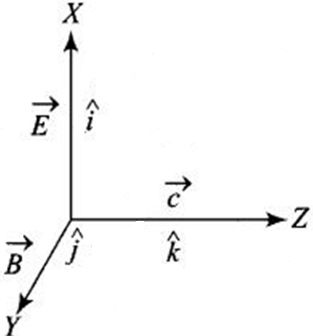
- $\vec{\text{E}}=\text{E}\hat{\text{i}}=\text{cB}(\hat{\text{j}}\times\hat{\text{k}})=\text{c}(\text{B}\hat{\text{j}}\times\text{k})=\text{c}(\vec{\text{B}}\times\hat{\text{k}})$
- $\hat{\text{k}}.\vec{\text{E}}=\hat{\text{k}}.(\text{E}\hat{\text{i}})=0,\vec{\text{k}}.\vec{\text{B}}=\vec{\text{k}}.(\text{B}\hat{\text{j}})=0$
- $\hat{\text{k}}\times\vec{\text{E}}=\hat{\text{k}}\times(\text{E}\hat{\text{i}})=\text{E}(\hat{\text{k}}\times\hat{\text{i}})=\text{E}\hat{\text{j}}$ and $\hat{\text{k}}\times\vec{\text{B}}=\hat{\text{k}}\times(\text{B}\hat{\text{j}})=\text{B}(\hat{\text{k}}\times\hat{\text{j}})=-\text{B}\hat{\text{i}}$.
View full question & answer→MCQ 1261 Mark
An electromagnetic wave going through vacuum is described by $\text{E}=\text{E}_0\sin(\text{kx}-\omega\text{t}),\text{ B}=\text{B}_0\sin(\text{kx}-\omega\text{t})$ Then:
- ✓
$\text{E}_0\text{k}=\text{B}_0\omega$
- B
$\text{E}_0\text{B}_0=\omega\text{k}$
- C
$\text{E}_0\omega=\text{B}_0\text{k}$
- D
AnswerCorrect option: A. $\text{E}_0\text{k}=\text{B}_0\omega$
The relation between $E _0$ and $B _0$ id given by $\frac{\text{E}_0}{\text{B}_0}=\text{c}\ ....(\text{i})$
Here, $c =$ Speed of the electromagnetic wave,
The relation between $\omega ($the angular frequency$)$ and $k\ ($wave number$),$
$\frac{\omega}{\text{k}}=\text{c}\ ...(\text{ii})$
Therefore, from $(i)$ and $(ii),$ we get
$\frac{\text{E}_0}{\text{B}_0}=\frac{\omega}{\text{k}}=\text{c}$
$\text{E}_0\text{k}=\text{B}_0\omega$
View full question & answer→MCQ 1271 Mark
An electromagnetic wave radiates outwards from a dipole antenna, with $E _0$ as the amplitude of its electric field vector. The electric field $B _0$ which transports significant energy from the source falls off as:
- A
$\frac{1}{\text{r}^3}$
- B
$\frac{1}{\text{r}^2}$
- ✓
$\frac{1}{\text{r}}$
- D
AnswerCorrect option: C. $\frac{1}{\text{r}}$
An antenna that produces the Electromagnetic wave are radiated outwards. The amplitude of electric field vector $(E _0)$. This electric field vector transports the energy from the source through the medium.
The electric field intensity of the wave from the source at a distance is inversely proportional to the distance between the source and the point.
$\text{E}_0=\frac{1}{\text{r}}$
View full question & answer→MCQ 1281 Mark
A charged particle oscillates about its mean equilibrium position with a frequency of $10^9\ Hz$. The frequency of electromagnetic waves produced by the oscillator is:
- A
$10^6\ Hz$
- B
$10^7\ Hz$
- C
$10^8\ Hz$
- ✓
$10^9\ Hz$
AnswerCorrect option: D. $10^9\ Hz$
The frequency of the electromagnetic wave is same as that of oscillating charged particle about its equilibrium position, which is $10^9\ Hz$
View full question & answer→MCQ 1291 Mark
According to Maxwell's hypothesis, changing of electric filed give rise to.
AnswerAccording to Maxwell's hypothesis, changing of electric field gives rise to Magnetic field.
We know that $F = qE$,, where $F$ is force and $E$ is electric field.
We can relate magnetic field and force by $F = qvB$, where $v$ is velocity and $B$ is the magnetic field.
Therefore we can obtain magnetic field by changing electric field.
View full question & answer→MCQ 1301 Mark
Two waves having same velocity enter electric and magnetic fields respectively. If $\lambda_1$ and $\lambda_2$ are their wavelengths as they move in the fields, then.
- A
$\lambda_1,\lambda_2$ are constants
- ✓
$\lambda_1$ and $\lambda_2$ are variable
- C
$\lambda_1$ is variable $\lambda_2$ is constant
- D
$\lambda_2$ is variable, $\lambda_1$ is constant
AnswerCorrect option: B. $\lambda_1$ and $\lambda_2$ are variable
Velocity of a wave is given by:
$\text{v}=\frac{\text{E}}{\text{B}}$
Hence wave velocity change in both the cases.
Frequency of the wave remains the same.
Using $\text{v}=\text{f}\lambda,$ it can be concluded that both $\lambda_1$ and $\lambda_2$ are variable.
View full question & answer→MCQ 1311 Mark
When an electromagnetic wave enters an ionised layer of earth’s atmosphere present in ionosphere:
AnswerCorrect option: D. The electron cloud will oscillate in the electric field of wave with a phase retardation of $90^\circ $ for a sinusoidal electromagnetic wave.
View full question & answer→MCQ 1321 Mark
According to Maxwell's hypothesis, a changing electric field gives rise to.
- A
- B
electric displacement current
- ✓
- D
View full question & answer→MCQ 1331 Mark
If the wavelength of red light in air is $7500 A$, then the frequency of light in air is.
- A
$7.5 \times 10^{10}\ Hz$
- B
$3 \times 10^{14}\ Hz$
- ✓
$4 \times 10^{14}\ Hz$
- D
$5 \times 10^{14}\ Hz$
AnswerCorrect option: C. $4 \times 10^{14}\ Hz$
Velocity of wave $=$ wavelength $\times $ frequency
$\text{v}=3\times10^8\frac{\text{m}}{\text{s}}$
$\lambda=7500\text{A}=7500\times10^{-10}\text{m}$
$\text{f}=\frac{3\times10^8}{7500\times10^{-10}}=4\times10^{14}\text{Hz}$
View full question & answer→MCQ 1341 Mark
An electromagnetic wave going through vacuum is described by $\text{E}=\text{E}_0\sin(\text{kx}- \omega\text{t});\text{B}=\text{B}_0\sin(\text{kx}- \omega\text{t}).$ Which of the following equation is true?
- ✓
$\text{E}_0\text{k}=\text{B}_0\omega$
- B
$\text{E}_0\omega=\text{B}_0\text{k}$
- C
$\text{E}_0\text{B}_0=\omega\text{k}$
- D
AnswerCorrect option: A. $\text{E}_0\text{k}=\text{B}_0\omega$
$\frac{\text{E}_0}{\text{B}_0}=\text{c},$ also $\frac{2\pi}{\lambda}$ and $\omega=2\pi\text{v}.$
$\Rightarrow\frac{\text{E}_0}{\text{B}_0}=\frac{\omega}{\text{k}}$
$\text{E}_0\text{k}=\text{B}_0\omega$
View full question & answer→MCQ 1351 Mark
$X−$ray falling on a material.
AnswerThe emitted $X-$rays transfer energy to the material on which it is falling.
View full question & answer→MCQ 1361 Mark
If $\overrightarrow{\text{E}}$ and $\overrightarrow{\text{B}}$ are the electric and magnetic field vectors of electromagnetic waves then the direction of propagation of electromagnetic wave is along the direction of:
- A
$\overrightarrow{\text{E}}$
- B
$\overrightarrow{\text{B}}$
- ✓
$\overrightarrow{\text{E}}\times\overrightarrow{\text{B}}$
- D
$\text{None of the above}$
AnswerCorrect option: C. $\overrightarrow{\text{E}}\times\overrightarrow{\text{B}}$
The direction of propagation of electromagnetic wave is perpendicular to the variation of electric field $\overrightarrow{\text{E}}$ as well as to the magnetic field $\overrightarrow{\text{B}}$
View full question & answer→MCQ 1371 Mark
Which of the following conclusion can be drawn from the result $\oint\overline{\text{B}}\cdot\text{d}\overline{\text{A}}=0$
- A
Magnetic field is zero everywhere
- ✓
Magnetic monopole cannot exist
- C
Magnetic lines of force do not intersect each other
- D
A current produces magnetic field
AnswerCorrect option: B. Magnetic monopole cannot exist
Flux of certain closed surface is zero and so it tells that net magnetic charge is equal to zero. This is possible when there are two equal and opposite poles.
View full question & answer→MCQ 1381 Mark
Beyond which frequency, the ionosphere bands any incident electromagnetic radiation but do not reflect it back towards the earth?
- A
$50MHz$
- ✓
$40MHz$
- C
$30MHz$
- D
$20MHz$
AnswerCorrect option: B. $40MHz$
The ionosphere can reflect electromagnetic waves of frequency less than $40MHz$ but not of frequency more than $40MHz.$
View full question & answer→MCQ 1391 Mark
The ratio of amplitude of a magnetic field to the amplitude of electric field for an electromagnetic wave propagating in vacuum is equal to:
- A
The speed of light in vacuum
- ✓
Reciprocal of speed of light in vacuum
- C
The ration of magnetic permeability to the electric susceptibility of vacuum.
- D
AnswerCorrect option: B. Reciprocal of speed of light in vacuum
Both electric field and magnetic field are vector quantities.
They both are components of electromagnetic waves.
We know that,
$\text{c}=\frac{\text{E}_0}{\text{B}_0}$
$\frac{\text{B}_0}{\text{E}_0}=\frac{1}{\text{c}}$
View full question & answer→MCQ 1401 Mark
Which is the frequency range of gamma rays from the following?
- A
$1 \times 10^{18}$ to $3 \times 10^{22} Hz$
- B
$3 \times 10^{-18} \text { to } 5 \times 10^{22} Hz$
- ✓
$3 \times 10^{18} \text { to } 5 \times 10^{22} Hz$
- D
$3 \times 10^{-18} \text { to } 5 \times 10^{-22} Hz$
AnswerCorrect option: C. $3 \times 10^{18} \text { to } 5 \times 10^{22} Hz$
The frequency range of Gamma rays is $3 \times 10^{18}$ to $5 \times 10^{22} Hz$. These rays have a wavelength of $6 \times 10^{-13}$ to $10^{-10} m$. Gamma rays are produced in nuclear reactions and are also emitted by radioactive nuclei.
View full question & answer→MCQ 1411 Mark
The absorption of radio waves by the atmosphere depends upon:
- ✓
- B
- C
Their distance from the transmitter
- D
View full question & answer→MCQ 1421 Mark
Light wave is travelling along $y -$ direction. If the corresponding $E$ vector at any time along the $x -$ axis, the direction of $B$ vector at that time is along.
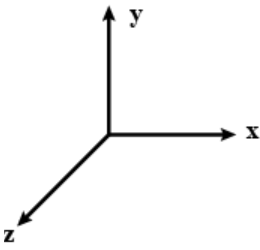
- A
$y -$ axis
- B
$x -$ axis
- ✓
$z -$ axis
- D
$-z -$ axis
AnswerCorrect option: C. $z -$ axis
Light wave is an electromagnetic wave in which $E$ and $B$ are at right angles to each other as well as at right angles to the direction of wave propagation. So from the given information in the question, the direction of $B$ vector is in positive $z$ direction.
View full question & answer→MCQ 1431 Mark
Waves in decreasing order of their wavelength are:
- A
$X-$rays, infrared rays, visible rays, radio waves
- B
radio waves, visible rays, infrared rays, $X-$rays.
- ✓
radio waves, infrared rays, visible rays, $X-$rays.
- D
radio waves, ultraviolet rays, visible rays, $X-$rays.
AnswerCorrect option: C. radio waves, infrared rays, visible rays, $X-$rays.
View full question & answer→MCQ 1441 Mark
If a variable frequency ac source is connected to a capacitor then with decrease in frequency the displacement current will:
- A
- ✓
- C
- D
First decrease then increase
View full question & answer→MCQ 1451 Mark
Maxwell in his famous equations of electromagnetism introduced the concept of:
MCQ 1461 Mark
The displacement current flows in the dielectric of a capacitor when the potential difference across its plates.
- A
- B
has assumed a constant value
- ✓
- D
AnswerAccording to Maxwell's hypothesis, a displacement current will flow through a capacitor when the potential difference across its plates is varying. Thus a varying electric field will exist between the plates and this displacement current is same in magnitude to the current flowing in outer circuit. When a $D.C$ voltage applied across its plates, constant voltage appears across its plates and so there will be no displacement current flowing through the capacitor. Thus the displacement current will flow when the potential is increasing with time.
View full question & answer→MCQ 1471 Mark
On what basis is the classification of electromagnetic waves done?
AnswerThe classification of electromagnetic waves done according to the frequency called the electromagnetic spectrum. The basic difference various type of electromagnetic waves lies in their wavelength or frequency since all of them travel through vacuum at the same speed and also, the waves differ in their mode of interaction with matter.
View full question & answer→MCQ 1481 Mark
Wavelength of, monochromatic light is $5000 A^o$. It's wave number is:
AnswerCorrect option: C. $2 \times 106 m^{-1}$
Wave number $=\frac{1}{\text{wavelength}}$
$=\frac{1}{5000\times10^{-10}}$
$=2\times10^6\text{m}^{-1}$
View full question & answer→MCQ 1491 Mark
Ultraviolet spectrum can be studied by using a:
MCQ 1501 Mark
Which one of the following has the shortest wavelength?
MCQ 1511 Mark
The amplitude of the sinusoidally oscillating electric field of a plane wave is $60v/m$. Then the amplitude of the magnetic field is:
- A
$12 \times 10^{-7} T$
- B
$6 \times 10^{-7} T$
- C
$6 \times 10^{-8} T$
- ✓
$2 \times 10^{-7} T$
AnswerCorrect option: D. $2 \times 10^{-7} T$
Given: Electric field $=60 v / m$
$C =3 \times 10^8 m / s ^2$
To find: Magnetic field
Solution:
We know, $C =\frac{ E _0}{B_0}$
Therefore, $B _0=\frac{ E _0}{ C }$
$\frac{60}{3 \times 10^8}=2 \times 10^7 T$
View full question & answer→MCQ 1521 Mark
An electron oscillating with a frequency of $3 \times 10^6 Hz$, would generate:
View full question & answer→MCQ 1531 Mark
Which one of the following is the primary effect of $UV$ radiation caused due to depletion of ozone layer?
AnswerThe ozone layer prevents most harmful $UV$ wavelengths of ultraviolet light $(UV$ light$)$ from passing through the Earth's atmosphere. These wavelengths cause skin cancer, sunburn and cataracts, which were projected to increase dramatically as a result of thinning ozone, as well as harming plants and animals.
View full question & answer→MCQ 1541 Mark
Displacement current is continuous:
- ✓
when electric field is changing in the circuit
- B
when magnetic field is changing in the circuit
- C
- D
through wires and resistance only
AnswerCorrect option: A. when electric field is changing in the circuit
Displacement current is a quantity appearing in Maxwell's equations that is defined in terms of the rate of change of electric displacement field.
When electric field is changing with time continuously, the displacement current is constant.
View full question & answer→MCQ 1551 Mark
In Maxwell's velocity distribution curve area under the graph:
- A
Increases when temperature is increased.
- B
Deccreases when temperature is increased.
- ✓
Remains same at all temperature.
- D
Depends on the pressure of the gas.
AnswerCorrect option: C. Remains same at all temperature.
Area under the Maxwell's velocity distribution curve gives the number of particles. Since number of particles remains the same at all the temperatures, so the area under the curve also remains the same at all temperature.
View full question & answer→MCQ 1561 Mark
In an electromagnetic wave, the electric magnetising fields are $\frac{100\text{V}}{\text{m}}$ and $\frac{0.265\text{A}}{\text{m}}$ The maximum energy flow is?
- ✓
$\frac{26.5\text{W}}{\text{m}^2}$
- B
$\frac{36.5\text{W}}{\text{m}^2}$
- C
$\frac{46.7\text{W}}{\text{m}^2}$
- D
$\frac{765\text{W}}{\text{m}^2}$
AnswerCorrect option: A. $\frac{26.5\text{W}}{\text{m}^2}$
Maximum rate of energy flow, $S = E _0 \times H _0$
Given, $\text{E}_0=\frac{100\text{V}}{\text{m}},\text{H}_0=\frac{0.265\text{A}}{\text{m}}$
$\therefore\text{S}=100\times0.265=\frac{26.5\text{W}}{\text{m}^2}$
View full question & answer→MCQ 1571 Mark
The figure here gives the electric field of an $EM$ wave at a certain poiunt and a certain instrant. the wave is transporting energy in the negative $z$ direction. what is tha direction of the magnetic field of the wave at that point and instant.
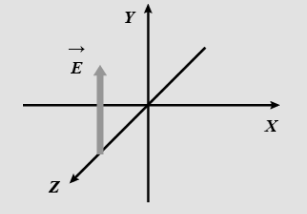
- ✓
Towards $+X$ direction
- B
Towards $-X$ direction
- C
Towards $+Z$ direction
- D
Towards $-Z$ direction
AnswerCorrect option: A. Towards $+X$ direction
The direction of $EM$ wave is given by the direction of $\overrightarrow{\text{E}}\times\overrightarrow{\text{B}}$
View full question & answer→MCQ 1581 Mark
Electromagnetic waves are transverse in nature is evident by.
MCQ 1591 Mark
The conduction current is same as displacement current when source is:
- A
$Ac$ only
- B
$Dc$ only
- ✓
Either $ac$ or $dc$
- D
Neither $dc$ nor $ac$
AnswerCorrect option: C. Either $ac$ or $dc$
View full question & answer→MCQ 1601 Mark
The speeds of microwaves, infrared waves, and ultraviolet waves are $V_m, V_i$, and $V_u$ respectively. Identify the correct combination showing the different waves in vacuum.
AnswerCorrect option: B. $V_m=V_i=V_u$
The correct combination is $\rightarrow Vm = Vi = Vu$. This is because, in vacuum, all the electromagnetic waves in question will travel at the same speed. The speed with which they travel in vacuum is the speed of light. $( c =3 \times 108 m / s ).$
View full question & answer→MCQ 1611 Mark
Maxwell's equation describe the fundamental laws of.
AnswerCorrect option: D. both $(A)$ and $(B)$
Maxwell's equation describe the fundamental laws of electricity and magnetism. His equations describe how electric and magnetic fields are generated and altered by each other and by charges and currents.
View full question & answer→MCQ 1621 Mark
One requires $11eV$ of energy to dissociate a carbon monoxide molecule into carbon and oxygen atoms. The minimum frequency of the appropriate electromagnetic radiation to achieve the dissociation lies in:
AnswerHere it is given, the energy required to dissociate a carbon monoxide molecule into catbon and oxygon atoms is $E = 11 eV$
We know that, $E=h f=6.62 \times 10^{-34} J- s$
$f =$ frequency
$\Rightarrow 11 eV = hf$
$f =\frac{11 \times 1.6 \times 10^{-19}}{6.62 \times 10^{-34}}=2.65 \times 10^{15} Hz$
This frequency radiation belongs to ultraviolet region.
Important point:
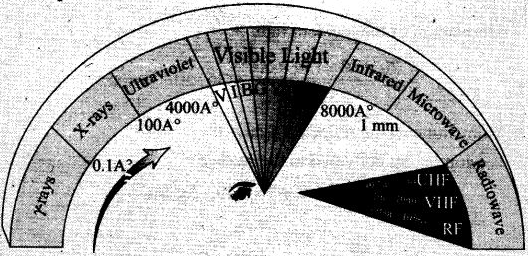
View full question & answer→MCQ 1631 Mark
Which of the following waves have a maximum frequency?
AnswerGamma rays have a maximum frequency.
View full question & answer→MCQ 1641 Mark
A free electron is placed in the path of a plane electromagnetic wave. The electron will start moving:
- ✓
Along the electric field.
- B
Along the magnetic field.
- C
Along the direction of propagation of the wave.
- D
In a plane containing the magnetic field and the direction of propagation.
AnswerCorrect option: A. Along the electric field.
As the electron is at rest initially, only the electric field will exert force on it. There will be no magnetic force on the electron in the stating. Hence, the electron will start moving along the electric field.
View full question & answer→MCQ 1651 Mark
Pick out the electromagnetic wave which is highly harmful to humans.
AnswerUltraviolet $(UV)$ radiations in large quantities are highly harmful to humans. These rays in solar radiation on reaching earth are absorbed by the ozone layer in the atmosphere. $UV$ rays are produced by special lamps such as mercury and from arc lamps and by very hot bodies like the sun.
View full question & answer→MCQ 1661 Mark
Choose the correct answer from the alternatives given. Electromagnetic wave consists of periodically oscillating electric and magnetic vectors:
AnswerCorrect option: D. In mutually perpendicular planes but vibrating in phase
The Electromagnetic wave consists of the two mutually perpendicular electric and magnetic fields present in the medium and also both being perpendicular to the direction of propagation of the wave. The two fields are in same phase as they obtain their peaks at the same instant.
An electromagnetic wave consists of periodically oscillating electric and the magnetic vector in mutually perpendicular planes but vibrating in phase.
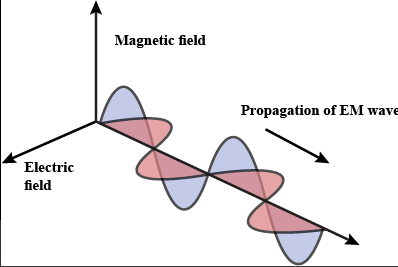
View full question & answer→MCQ 1671 Mark
What is the full form of $\text{UHF?}$
Answer$\text{UHF}$ stands for Ultra high frequency. Cellular phones used radio waves to transmit voice communication in the Ultra high$-$frequency Band. The $\text{UHF}$ band extends from $900 MHz$ to $5 \times 109 Hz$ or $5000 MHz$. Radio waves are produced by oscillating circuits having an inductor and capacitor.
View full question & answer→MCQ 1681 Mark
The pressure exerted by an electromagnetic wave of intensity I$\Big(\frac{\text{watt}}{\text{m}^2}\Big)$ on a non-reflecting surface is : $[c$ is the velocity of light$].$
AnswerCorrect option: C. $\frac{\text{I}}{\text{c}}$
Momentum of a photon
$=\frac{\text{h}}{\lambda}=\frac{\text{h}}{\frac{\text{c}}{\text{v}}}=\frac{\text{hv}}{\text{c}}=\frac{\text{E}}{\text{c}}$
Momentum over unit area
$=\frac{\text{E}}{\text{Ac}}=\frac{\text{I}}{\text{c}}\Big[\text{I}=\frac{\text{E}}{\text{A}}\text{ For wave}\Big]$
Since surface is non reflecting, final momentum of photon $= 0,$ change in momentum $=\frac{\text{I}}{\text{c}}$
So, force per unit area $=\frac{\text{I}}{\text{c}}$
Pressure of radiation $=\frac{\text{I}}{\text{c}}$
View full question & answer→