MCQ 11 Mark
Two unequal resistors are connected in series across a battery. Then the:
- A
Potential difference across each resistor is the same.
- B
Current in the smaller resistor is larger.
- ✓
Potential difference across the bigger resistor is greater.
- D
Power dissipated in both resistors is the same.
AnswerCorrect option: C. Potential difference across the bigger resistor is greater.
View full question & answer→MCQ 21 Mark
The focal length of the objective of a compound microscope is:
- A
Greater than the focal length of eyepiece.
- ✓
Lesser than the focal length of eyepiece.
- C
Equal to the focal length of eyepiece.
- D
Equal to the length of its tube.
AnswerCorrect option: B. Lesser than the focal length of eyepiece.
View full question & answer→MCQ 31 Mark
A biconvex lens of glass having refractive index $1.47$ is immersed in a liquid. It becomes invisible and behaves as a plane glass plate. The refractive index of the liquid is:
- ✓
$1.47$
- B
$1.62$
- C
$1.33$
- D
$1.51$
AnswerCorrect option: A. $1.47$
As per the question, the biconvex lens of glass having refractive index $1.47$ is immersed in a liquid and then behaves like a plane glass plate.
This shows that the ray will pass undeviated through it.
This is only possible when the medium's refractive index is the same as that of a biconvex lens.
Thus, the refractive index of the liquid must be $1.47.$
View full question & answer→MCQ 41 Mark
For a glass prism, the angle of minimum deviation will be smallest for the light of:
AnswerWhen a ray of light passes through a prism, it disperses the ray of light into seven colours. They are $-$ Violet, Indigo, Blue, Green, Yellow, Orange, Red i.e., $\text{VIBGYOR.}$
The angle of deviation increases in order.
It means that Violet bends the most and Red the least. The extent of bending depends on their wavelength. Red has larger wavelength than blue.
View full question & answer→MCQ 51 Mark
The resistance of a metal wire increases with increasing temperature on account of:
- A
Decrease in free electron density.
- ✓
Decrease in relaxation time.
- C
Increase in mean free path.
- D
Increase in the mass of electron.
AnswerCorrect option: B. Decrease in relaxation time.
$\rho=\frac{1}{\rho}=\frac{\text{m}}{\text{ne}^2\tau}$
As we increase temperature, average speed of the electrons, which act as the carriers of current, increases resulting in more frequent collisions. The average time of collisions $\tau,$ thus decreases with temperature.
View full question & answer→MCQ 61 Mark
Larger aperture of objective lens in an astronomical telescope:
- ✓
Increases the resolving power of telescope.
- B
Decreases the brightness of the image.
- C
Increases the size of the image.
- D
Decreases the length of the telescope.
AnswerCorrect option: A. Increases the resolving power of telescope.
The larger the objective, the more light the telescope collects and increases the brightness of image.
The field of view of the telescope decreases as the aperture increases, but the resolving power increases.
The objective lens of a telescope forms an real image of the night sky, the size of that image is in proportion to the focal length of the objective lens. It increases with increase in size of objective lens.
View full question & answer→MCQ 71 Mark
When a wave travels from one medium to another, the quantity which will not change is its:
AnswerWhen a wave travels from one medium to another, the amplitude, wavelength, velocity and intensity change but frequency does not change.
View full question & answer→MCQ 81 Mark
You are given four sources of light each one providing a light of a single colour $–$ red, blue, green and yellow. Suppose the angle of refraction for a beam of yellow light corresponding to a particular angle of incidence at the interface of two media is $90^\circ $. Which of the following statements is correct if the source of yellow light is replaced with that of other lights without changing the angle of incidence?
- A
The beam of red light would undergo total internal reflection.
- B
The beam of red light would bend towards normal while it gets refracted through the second medium.
- ✓
The beam of blue light would undergo total internal reflection.
- D
The beam of green light would bend away from the normal as it gets refracted through the second medium.
AnswerCorrect option: C. The beam of blue light would undergo total internal reflection.
Key Concept: According to Couchy relationship,
$\lambda\propto\frac{1}{\mu}$
Smaller the wavelengh higher the refractive index and consequently smaller the critical angle.
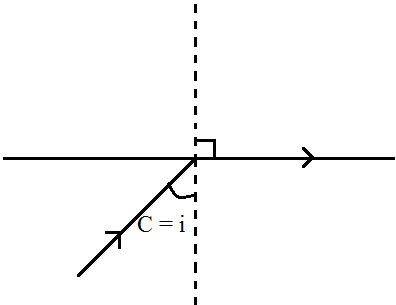
We know $\text{v}=\text{f}\lambda$ the frequency of wave remains unchanged with medium hence $\text{v}\propto\lambda$.
The critical angle, sin $\text{C}=\frac{1}{\mu}$
Also, velocity of light, $\text{v}\propto\frac{1}{\mu}$
According to $\text{VIBGYOR}$, among all given sources of light, the blue light have smallest wavelength. As $\lambda_{\text{blue}}<\lambda_\text{yellow}$ hence $\text{v}_{\text{blue}}<\text{v}_\text{yellow}$, it means $\mu_{\text{blue}}<\mu_\text{yellow}$.
It means critical angle for blue is less than yellow colour, the critical angle is least which facilitates total internal reflection for the beam of blue light.
View full question & answer→MCQ 91 Mark
Which of the following has a larger chromatic aberration?
- A
Crown$-$glass lens
- ✓
Flint$-$glass lens
- C
Both have equal chromatic aberration
- D
AnswerCorrect option: B. Flint$-$glass lens
Flint$-$glass lens has a larger chromatic aberration because the dispersive power of flint$-$glass is higher.
View full question & answer→MCQ 101 Mark
The focal length of a lens of refractive index $\mu$ is f. If the lens is immersed in a liquid of refractive index $\mu$ then the focal length of lens is:
Answer$\frac{1}{\text{f}}=(\text{n}−1)\Big( \frac{1}{\text{R}_1}-\frac{1}{\text{R}_2}\Big)$
where, n is refractive index of lens material with respect to its surrounding medium.
If lens is immersed in the liquid of refractive index equal to its own then $n = 1$ and hence above equation becomes: $\frac{1}{\text{f}}=0$
$\Rightarrow f = \infty$
View full question & answer→MCQ 111 Mark
Four modifications are suggested in the lens formula to include the effect of the thickness $t$ of the lens. Which one is likely to be correct?
- A
$\frac{1}{\text{v}}-\frac{1}{\text{u}}=\frac{1}{\text{uf}}$
- B
$\frac{1}{\text{v}^2}-\frac{1}{\text{u}}=\frac{1}{\text{f}}$
- ✓
$\frac{1}{\text{v}-\text{t}}-\frac{1}{\text{u}+\text{t}}=\frac{1}{\text{f}}$
- D
$\frac{1}{\text{v}}-\frac{1}{\text{u}}+\frac{\text{t}}{\text{uv}}=\frac{\text{t}}{\text{f}}$
AnswerCorrect option: C. $\frac{1}{\text{v}-\text{t}}-\frac{1}{\text{u}+\text{t}}=\frac{1}{\text{f}}$
View full question & answer→MCQ 121 Mark
The working of optical instruments like camera, microscope, telescope, etc. having glass lenses is based on a phenomenon of light. Identify the phenomenon.
MCQ 131 Mark
In the white light of sun, maximum scattering by the air molecules present in the earth's atmosphere is for:
AnswerBy Rayleigh's Criterion intensity of scattered light is given by, $\text{I}\propto\frac{1}{\lambda^4}$
Intensity of scattered light is more for smaller wavelengths of light.
In the visible spectrum, the blue side of the spectrum has a smaller wavelength compared to the red side. Hence blue light is scattered more by air molecules present in earth's atmosphere.
View full question & answer→MCQ 141 Mark
Figure shows the ray diagram of a:
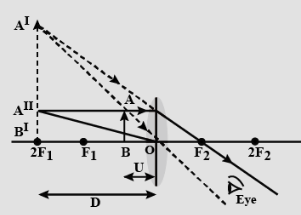
AnswerThe given figure is representing the ray diagram of a simple microscope.
View full question & answer→MCQ 151 Mark
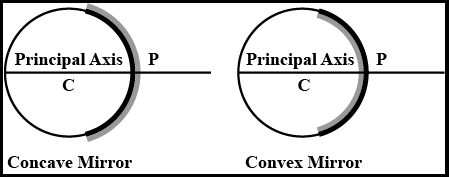
The line joining the pole and the centre of curvature of a mirror is called the:
AnswerThe line joining the pole and the center of curvature of a mirror is called the principal axis.
View full question & answer→MCQ 161 Mark
The relation among $u, v$ and $f$ for a mirror is:
- ✓
$\text{f}=\frac{\text{uv}}{\text{u+v}}$
- B
$\text{v}=\frac{\text{fu}}{\text{u+f}}$
- C
$\text{u}=\frac{\text{fv}}{\text{f+v}}$
- D
AnswerCorrect option: A. $\text{f}=\frac{\text{uv}}{\text{u+v}}$
As we know,
$\frac{1}{\text{f}}=\frac{1}{\text{v}}+\frac{1}{\text{u}}$
$\frac{1}{\text{f}}=\frac{\text{u+v}}{\text{uv}}$
$\text{f}=\frac{\text{uv}}{\text{u+v}}$
View full question & answer→MCQ 171 Mark
A point source of light is placed in front of a plane mirror:
- ✓
All the reflected rays meet at a point when produced backward.
- B
Only the reflected rays close to the normal meet at a point when produced backward.
- C
Only the reflected rays making a small angle with the mirror, meet at a point when produced backward.
- D
Light of different colours make different images.
AnswerCorrect option: A. All the reflected rays meet at a point when produced backward.
View full question & answer→MCQ 181 Mark
The bluish colour of water in deep sea is due to:
- A
The presence of algae and other plants found in water.
- B
Reflection of sky in water.
- ✓
- D
Absorption of light by the sea.
AnswerAs we look deep into the sea in a direction away from the sun as the blue light is more scattered more than red. The light reaching our eyes has more of violet and blue and hence the deep sea appears blue.
View full question & answer→MCQ 191 Mark
A thin lens with focal length f to be used as magnifying glass. Which of the following statements regarding the situation is true?
- A
A converging lens may be used, and the object be placed at a distance greater than $2f$ from the lens.
- B
A diverging lens may be used, and the object be placed between $f$ and $2f$ from the lens.
- ✓
A converging lens may be used, and the object be placed at a distance less than $f$ from the lens.
- D
A diverging lens may be used, and the object be placed at any point other than the focal point.
AnswerCorrect option: C. A converging lens may be used, and the object be placed at a distance less than $f$ from the lens.
A converging lens, magnifies the image of an object if it is placed at a distance less than the focal length of the lens.
View full question & answer→MCQ 201 Mark
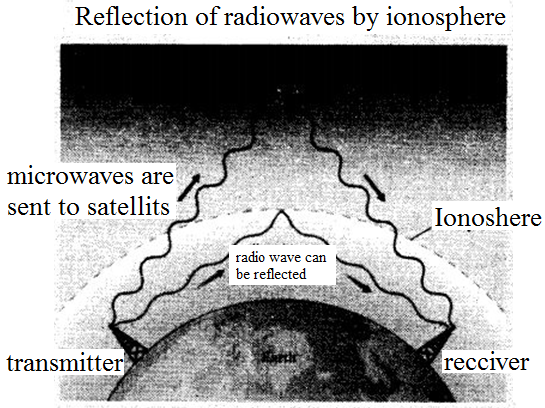
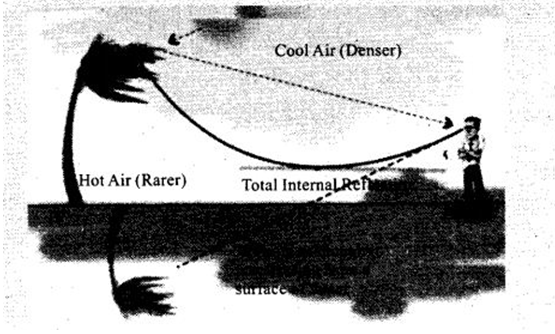
The phenomena involved in the reflection of radiowaves by ionosphere is similar to:
- A
Reflection of light by a plane mirror.
- ✓
Total internal reflection of light in air during a mirage.
- C
Dispersion of light by water molecules during the formation of a rainbow.
- D
Scattering of light by the particles of air.
AnswerCorrect option: B. Total internal reflection of light in air during a mirage.
Radio waves are reflected by a layer of atmosphere called the Ionosphere, so they can reach distant parts of the Earth. The reflection of radio waves by ionosphere is due to total internal reflection. It is the same as total internal reflection of light in air during a mirage, i.e., angle of incidence is greater than critical angle.
Important point: The ionized part of the Earth’s atmosphere is known as the ionosphere. Ultraviolet light from the sun collides with atoms in this region knocking electrons loose. The creates ions, or atoms with missing electrons. This is what gives the Ionosphere its name$-$ and it is the free electrons that cause the reflection and absorption of ratio waves.
View full question & answer→MCQ 211 Mark
Which of the following would you prefer to use while reading small letters found in a dictionary?
AnswerConvex lens can form an erect, virtual and enlarged image when the object is positioned between its pole and focus.
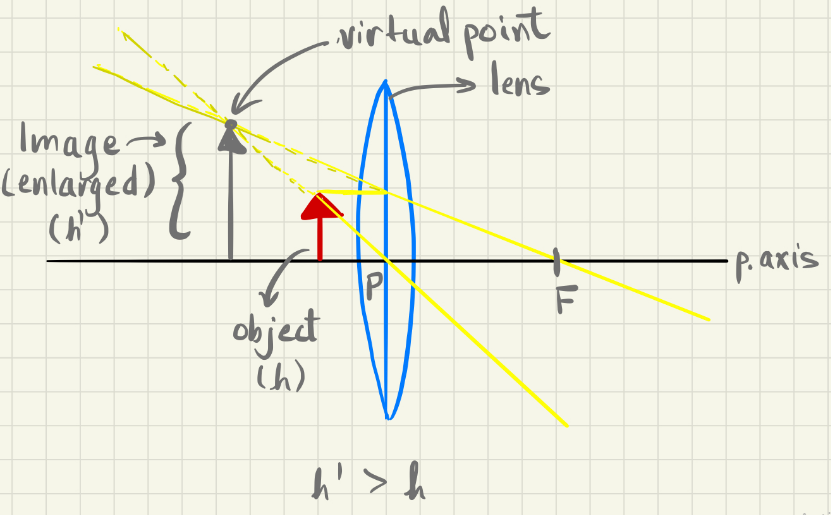
View full question & answer→MCQ 221 Mark
A tall man of height $6$ feet, want to see his full image. Then required minimum length of the mirror will be$-$
- A
$12$ feet
- ✓
$3$ feet
- C
$16$ feet
- D
AnswerCorrect option: B. $3$ feet
View full question & answer→MCQ 231 Mark
A magnifying glass is used to read the newspaper. As it is moved far away from the newspaper:
- ✓
Text becomes blurred and magnification reduces.
- B
Text becomes more focussed and magnification reduces.
- C
Text becomes more focused and magnification increases.
- D
Text becomes blurred and magnification increases.
AnswerCorrect option: A. Text becomes blurred and magnification reduces.
As the magnifying lens $($convex lens$)$ is moved far away from the eye, the image formed is real and inverted and is formed inside the human eye and hence it blurs. Since the object is far away from the mirror, the image formed is diminished and hence magnification reduces.
View full question & answer→MCQ 241 Mark
The instrument that is based on the principle that when an object is placed between first principal focus and the optic centre of convex lens, an upright, virtual and enlarged image on the same side of the object is formed, is:
AnswerIn astronomical telescope $2$ convex lens called eyepiece and objective lens are used and object is placed before eyepiece lens, such that final image inverted, a camera and eye also form inverted image on the screen.
Whereas simple microscope gives an erect, virtual and enlarged image of the object placed between first principal focus and the optic nerve of the convex lens.
In a projector, the image formed is real, inverted magnified on the other side of the lens. This inverted image is again inverted by the film.
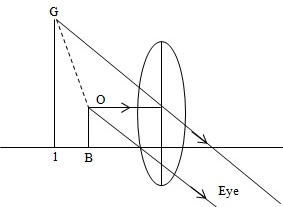
View full question & answer→MCQ 251 Mark
For reading small letters with a lens:
AnswerCorrect option: D. One has to keep a convex lens at a distance less than the an focal length from the book
A concave lens always produces virtual, erect and diminished images and the decrease in the size of the image depends on the position of the object.
Concave lens will shrink the size of the already small letters.
A convex lens produces real and virtual, erect and inverted, diminished, same sized and magnified image of the object, depending upon the position of the object on the principal axis.
When the object is placed between $F$ and $2F$ of convex lens, an enlarged but inverted image of the object is formed. The magnified image makes it easier to read small letters but the inverted image is undesirable.
When the object is placed at a distance less than the focal length of convex lens, an enlarged and erect image of the object is formed, which makes it easier to read small letters.
View full question & answer→MCQ 261 Mark
One cannot see through fog because $.......... :$
- A
- B
Refractive index of fog is unity.
- C
Light suffers total internal reflection at the droplets in fog.
- ✓
Light is scattered by the droplets in fog.
AnswerCorrect option: D. Light is scattered by the droplets in fog.
We cannot see through fog because of scattering.
Atoms and molecules in the air, including anything carried in the air like dust or smoke, will scatter light. Water droplets, as they are present in fog, also scatter light.
The light falling on an object and reflected to a viewer can be scattered to heck and back before it gets to the place where it can be 'seen' by an observer.
So the observer just sees a 'whiteout' instead of being able to make out anything beyond a few meters or so.
View full question & answer→MCQ 271 Mark
The phenomenon of light bending due to change of medium is called:
- A
- ✓
- C
- D
Total internal reflection
AnswerWhen light enters from one medium to another, its speed and direction changes, and hence the light seems to be bending towards or away from the normal. This phenomenon is called refraction of light.
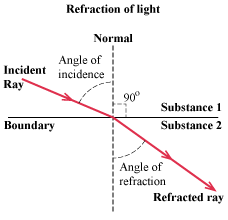
View full question & answer→MCQ 281 Mark
The maximum focal length of the eye$-$lens of a person is greater than its distance from the retina. The eye is:
- ✓
Always strained in looking at an object.
- B
Strained for objects at large distances only.
- C
Strained for objects at short distances only.
- D
Unstrained for all distances.
AnswerCorrect option: A. Always strained in looking at an object.
The maximum focal length of a normal eye is equal to the distance of the lens from the retina. In case it is greater than the distance, the eye will be strained while focusing the objects on the retina that is at a fixed distance from the eye lens.
View full question & answer→MCQ 291 Mark
A ray of light incident at an angle $\theta$ on a refracting face of a prism emerges from the other face normally. If the angle of the prism is $5^{\circ}$ and the prism is made of a material of refractive index $1.5$ , the angle of incidence is:
- ✓
$7.5^{\circ}$.
- B
$5^{\circ}$.
- C
$15^{\circ}$.
- D
$2.5^{\circ}$.
AnswerCorrect option: A. $7.5^{\circ}$.
Key concept:
In thin prisms, the distance between the refracting surfaces is ineligible and the angle of prism $(A)$ is very small. Since $A=r_1+r_2$, therefore if $A$ is small then both $r_1$, and $r_2$ are also small, and the same is true for $i_1$ and $i_2$.
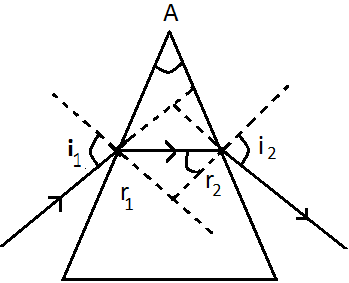
According to Snell's law, $1 \sin i _1=\mu$. $\sin r _1 \Rightarrow i _1=\mu . r _1$
Also, $1 . \sin i _2=\mu \cdot \sin r _2 \Rightarrow i _2=\mu \cdot r _2$
Therefore, deviation, $\delta=\left( i _1- r _1\right)+\left( i _2- r _2\right)$
$\Rightarrow \delta=\left( i _1+ i _2\right)-\left( r _1+ r _2\right)=\left( r _1+ r _2\right)(\mu-1)$
$\Rightarrow \delta= A (\mu-1)$
Since, deviation $\delta=(\mu-1) A$
$=(1.5-1) \times 5^{\circ}=2.5^{\circ}$
The angle of the prism is $5^{\circ}$. The ray emerges from refracting face of a prism normally.
Then, $i _2= r _2=0$
As $A=r_1+r_2 \Rightarrow A$ or $r_1=5^{\circ}$
But $i _1=\mu . r _1=\frac{3}{2} \times 5=7.5^{\circ}$
View full question & answer→MCQ 301 Mark
A convex lens is made of a material having refractive index $1.2$. Both the surfaces of the lens are convex. If it is dipped into water $(\mu=1.33),$ it will behave like:
Answer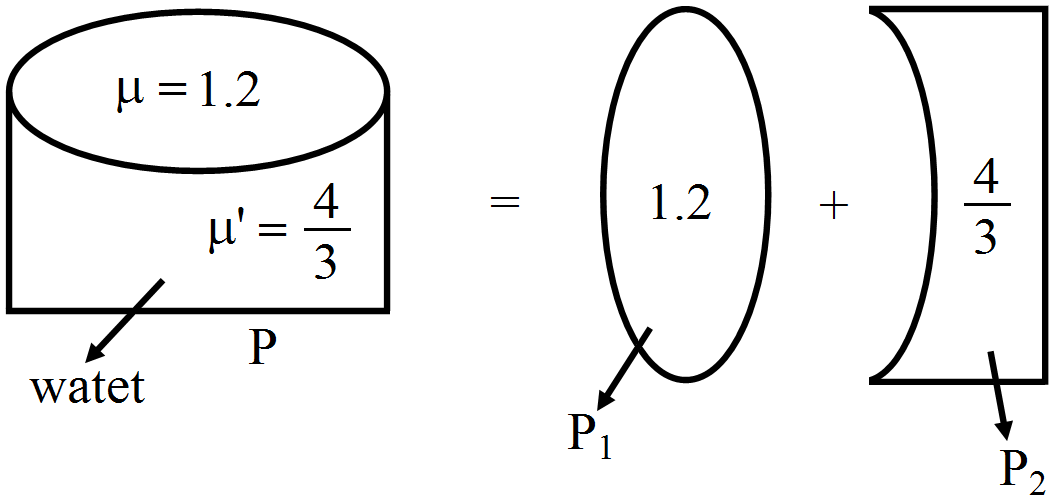
Here $P, P_1 \ P_2$ are the Power of Lenses.
$P=P_1+P_2$
$\frac{1}{\text{f}}=\frac{1}{\text{f}_1}=\frac{1}{\text{f}_2}$
$(\mu-1)\Big(\frac{2}{\text{R}}\Big)+(\mu'-1)\Big(\frac{-1}{\text{R}}\Big)$
$(1.2-1)\Big(\frac{2}{\text{R}}\Big)-\Big(\frac{4}{3}-1\Big)\Big(\frac{1}{\text{R}}\Big)$
$\frac{1}{\text{f}}=\frac{2}{5\text{R}}-\frac{1}{3\text{R}}$
$\frac{1}{\text{f}}=\frac{6-5}{15\text{R}}$
$\text{f}=15\text{R}$
Focal lenght of combined is positive, but it's magnitude in capair to $f_1 \ f_2$ is High. So it will be hare like a divergent lens.
View full question & answer→MCQ 311 Mark
When a ray of light passes from a denser to a rarer medium:
- ✓
It bends away from the normal.
- B
It bends away from incident ray.
- C
It bends toward the incident ray.
- D
Goes parallel to the interface separating two media.
AnswerCorrect option: A. It bends away from the normal.
When a ray of light passes from a denser to a rarer medium, some part of it gets refracted into the rarer medium such that it bends away from the normal. Some part of it gets reflected back into the denser medium. The light reflected back into the denser medium is said to be internally reflected.
View full question & answer→MCQ 321 Mark
The perpendicular distance between the original path of the incident ray and the convergent ray of light coming out of a glass slab is called:
- A
- ✓
- C
Total internal reflection
- D
AnswerThe perpendicular distance between the original path of the incident ray and the emergent ray of light coming out of a glass slab is called lateral displacement. It is proportional to the thickness glass slab.
View full question & answer→MCQ 331 Mark
An object approaches a convergent lens from the left of the lens with a uniform speed $5m/s$ and stops at the focus. The image.
- A
Moves away from the lens with an uniform speed $5m/s.$
- B
Moves away from the lens with an uniform accleration.
- ✓
Moves away from the lens with a non$-$uniform acceleration.
- D
Moves towards the lens with a non$-$uniform acceleration.
AnswerCorrect option: C. Moves away from the lens with a non$-$uniform acceleration.
If an object approaches a convergent lens from the left of the lens with a uniform speed of $5m/s$, then the image moves away from lens with a non$-$uniform acceleration.
View full question & answer→MCQ 341 Mark
$..........$ happens when a wave passes from one medium to another at an angle.
AnswerRefraction is a phenomenon in which when a ray passes from one medium to another it bends away from its straight-line path due to the difference in optical densities or refractive indices of the two mediums.
View full question & answer→MCQ 351 Mark
A person using a lens as a simple microscope sees an:
- A
- B
Inverted real magnified image
- ✓
- D
Upright real magnified image
AnswerA simple microscope is just a convex lens with object lying between optical centre and focus of the lens.
View full question & answer→MCQ 361 Mark
A convex lens of $.........$ focal length gives a greater magnification than lenses of $.........$ focal length.
AnswerA convex lens of short focal length gives a greater magnification than lenses of long focal length.
View full question & answer→MCQ 371 Mark
Which of the following quantities related to a lens depend on the wavelength or wavelengths of the incident light?
AnswerExplanation:
The focal length, power and chromatic aberration are dependent on the refractive index of the lens, which itself is dependent on the wavelength of the light.
View full question & answer→MCQ 381 Mark
By properly combining two prisms made of different materials, it is possible to:
- A
Have dispersion without average deviation.
- B
Have deviation without dispersion.
- C
Have both dispersion and average deviation.
- ✓
AnswerExplanation:
Consider the case of prisms combined such that the refractive angles are reversed w.r.t. each other. Then, the net deviation of the yellow ray will be,
$\delta_\text{y}=(\mu_\text{y}-1)\text{A}-(\mu_\text{y}'-1)\text{A}'$
And, the net angular dispersion will be
$\delta_\text{y}-\delta_\text{r}=(\mu_\text{y}-1)\text{A}(\omega-\omega')$
Thus, by choosing appropriate conditions, we can have the above mentioned cases.
View full question & answer→MCQ 391 Mark
A person $A$ can clearly see objects between $25\ cm$ and $200\ cm$. Which of the following may represent the range of clear vision for a person $B$ having muscles stronger than $A$, but all other parameters of eye identical to that of $A?$
- A
$25\ cm$ to $200\ cm.$
- ✓
$18\ cm$ to $200\ cm.$
- C
$25\ cm$ to $300\ cm.$
- D
$18\ cm$ to $300\ cm.$
AnswerCorrect option: B. $18\ cm$ to $200\ cm.$
Person $B$ has stronger ciliary muscles than person $A$. So, the muscles in his case can be strained more and the focal length of his eye can be reduced more compared to those of person $A$. While seeing far objects, the muscles are relaxed, so their strength will not affect the far point of the eye.
View full question & answer→MCQ 401 Mark
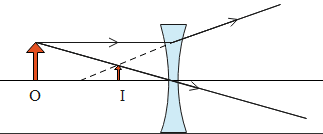
What kind of image is obtained always for concave lens?
- ✓
Virtual, Erect and Diminished
- B
- C
Real, Erect and Diminished
- D
AnswerCorrect option: A. Virtual, Erect and Diminished
As can be seen in image, Virtual, Erect and Diminished image is obtained always for concave lens.
View full question & answer→MCQ 411 Mark
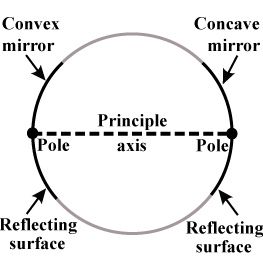
The central point of a spherical mirror is called:
AnswerThe central point of a spherical mirror is called the Pole of the mirror.
View full question & answer→MCQ 421 Mark
An ellipsometer is an instrument for.
- A
Measuring stellar distance.
- B
Measuring the path of celestial bodies.
- C
Ending curvature of elliptical surfaces.
- ✓
Studying thin films on a solid surface.
AnswerCorrect option: D. Studying thin films on a solid surface.
An ellipsometer is a device used for studying thin films on a solid surface.
Ellipsometry is an optical technique for investigating the di electric properties of thin films.
View full question & answer→MCQ 431 Mark
In case of a real and inverted image, the magnification created by the mirror is:
AnswerMagnification of image created by mirror is defined as
$\text{m}=\frac{\text{size of object}}{\text{size of image}}$
and in case of inverted image. Size of image is negative whereas size of object is positive. Hence , magnification produced is negative and it can be unity when object is placed at center of curvature and infinity when object is at focus.
View full question & answer→MCQ 441 Mark
An achromatic combination of lenses produce:
- A
Images in black and white
- B
- ✓
Images unaffected by variation of refractive index with wavelength
- D
AnswerCorrect option: C. Images unaffected by variation of refractive index with wavelength
An achromatic combination of lenses provide deviation without dispersion. So, images are unaffected by variation of refractive index with wavelength.
View full question & answer→MCQ 451 Mark
Consider an extended object immersed in water contained in a plane trough. When seen from close to the edge of the trough the object looks distorted because:
- A
The apparent depth of the points close to the edge are nearer the surface of the water compared to the points away from the edge.
- B
The angle subtended by the image of the object at the eye is smaller than the actual angle subtended by the object in air.
- C
Some of the points of the object far away from the edge may not be visible because of total internal reflection.
- ✓
AnswerSolution:
Key concept: The light from the pencil is refracted when it passes from the water into air, bending away from the normal as it moves from high to low refractive index.
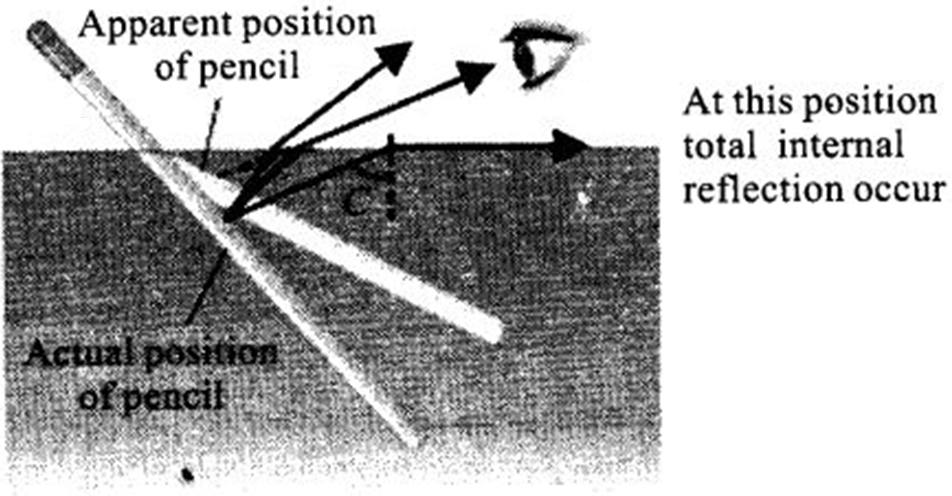
When light from the submerged object before reaching to the observer gets, refracted from water surface, the rays bend away from normal and the angle subtended by the image of the object at the eye is smaller than the actual angle subtended by the object in air. Also the apparent depth of the .points close to the edge are nearer the surface of the water compared to the points away from the edge.
As we move towards right, the angle of incident increases and becomes equal to critical angle. Hence some of the points of the object far away from the edge may not be visible because of total internal reflection.
View full question & answer→MCQ 461 Mark
Two concave lenses $L_1$ and $L_2$ are kept in contact with each other. If the space between the two lenses is filled with a material of refractive index $\mu\approx1,$ the magnitude of the focal length of the combination:
Answer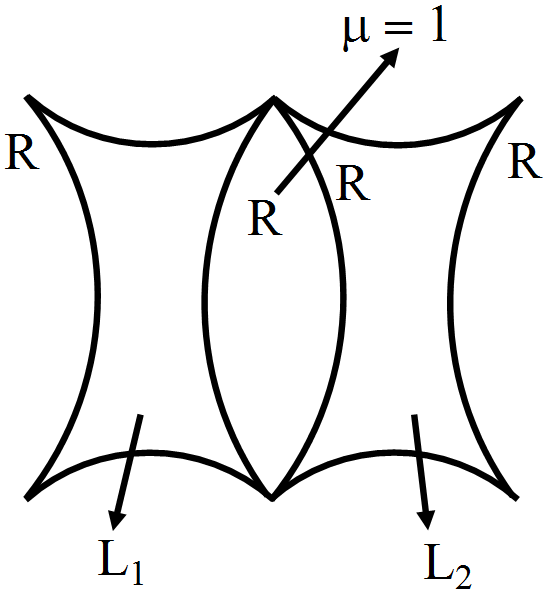
$\frac{1}{\text{f}}=\frac{1}{\text{f}_{\text{L}_1}}+\frac{1}{\text{f}_{\text{L}_2}}$
$\frac{1}{\text{f}_{\text{L}_1}}=(\mu-1)\Big(\frac{-2}{\text{R}}\Big)=\frac{1}{\text{f}_{\text{L}_2}}$
Local length of the combination.
$\frac{1}{\text{f}}=(\mu-1)\Big(\frac{-2}{\text{R}}\Big)+(\mu-1)\Big(\frac{-2}{\text{R}}\Big)$
$\frac{1}{\text{f}}=-4(\mu-1)\Big(\frac{1}{\text{R}}\Big)$
$\text{f}=\frac{\text{R}}{4(\mu-1)}$
Where $\text{f}_{\text{L}_1}=\text{f}_{\text{L}_2}=\frac{\text{R}}{2(\mu-1)}$
$(\text{f}_{\text{L}_1}=\text{f}_{\text{L}_2})>\text{f}$ View full question & answer→MCQ 471 Mark
Magnification of an optical instrument is expressed in:
Answer$\text{Magnification}=\frac{\text{Image Height}}{\text{Object Height}} $
because unit of image height and object height is same hence unit of magnification is none because it is a constant number. So, it has got to unit.
View full question & answer→MCQ 481 Mark
The magnifying power of a simple microscope can be increased if we use an eyepiece of:
AnswerThe only difference between simple microscope and compound microscope is an eyepiece of smaller focal length than objective which increases magnifying power.
View full question & answer→MCQ 491 Mark
Consider three converging lenses $L_1, L_2$ and $L_3$ having identical geometrical construction. The index of refraction of $L_1$ and $L_2$ are $\mu_1$ and $\mu_2$ respectively. The upper half of the lens $L_3$ has a refractive index $\mu_1$ and the lower half has $\mu_2$. A point object $O$ is imaged at $O_1$ by the lens $L_1$ and at $O_2$ by the lens $L_2$ placed in same position. If $L_3$ is placed at the same place:
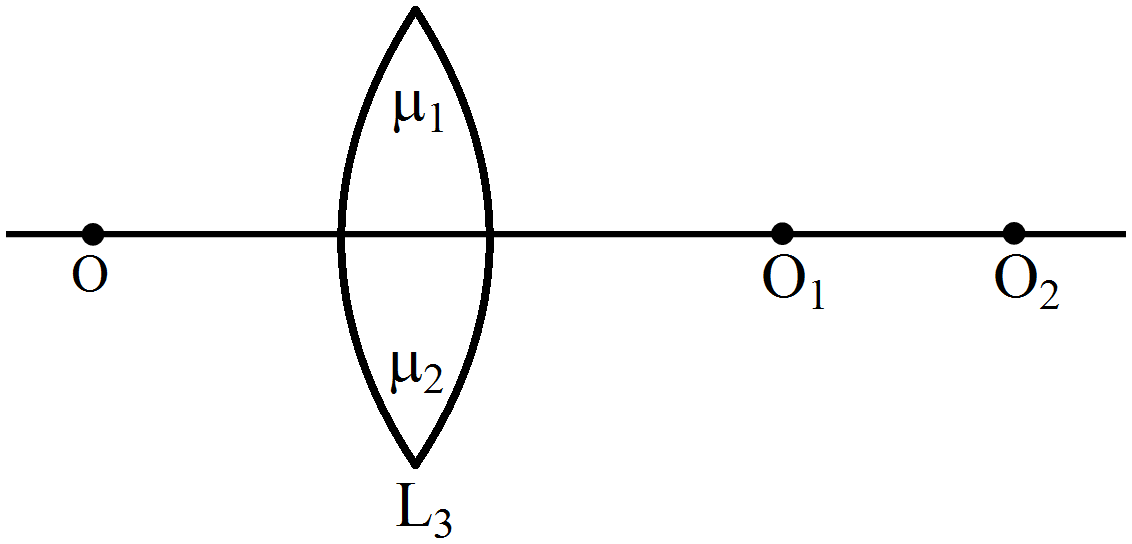
- A
There will be an image at $O_1$
- B
There will be an image at $O_2$
- ✓
- D
The only image will form away from $O_2$.
AnswerExplanation:
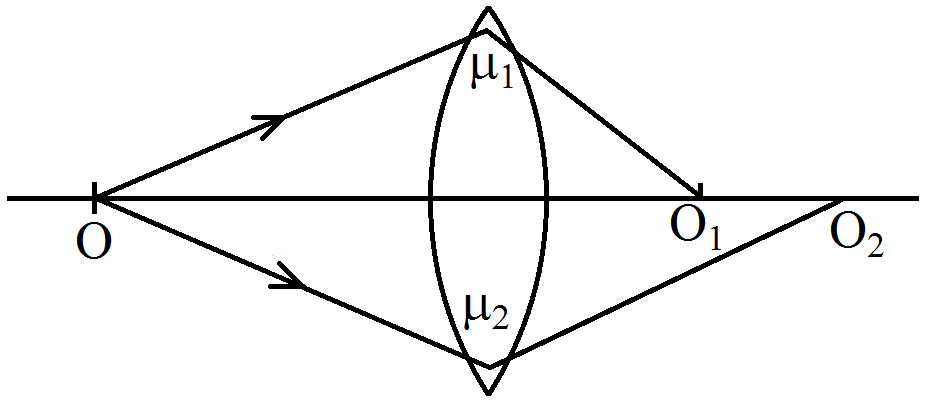
It rays are Passing through $m_1$ then Image will be form at "$O_1$" and If rays are Passing through $m_2$ then Image will be form at "$O_2$". View full question & answer→MCQ 501 Mark
A passenger in an aeroplane shall:
- A
- ✓
May see a primary and a secondary rainbow as concentric circles.
- C
May see a primary and a secondary rainbow as concentric arcs.
- D
Shall never see a secondary rainbow.
AnswerCorrect option: B. May see a primary and a secondary rainbow as concentric circles.
As aeroplane is at higher altitude, the passenger in an aeroplane may see a primary and a secondary rainbow like concentric circles.
Key Concept:
If an object move with constant speed ($V_0$) towards a convex lens from infinity to focus, the image will move slower in the beginning and then faster. Also $\text{V}_\text{i}=\Big(\frac{\text{f}}{\text{f}+\text{u}}\Big)^2\text{V}_0$.
If an object approaches the lens, the image moves away from lens with a non$-$uniform acceleratiion.
View full question & answer→MCQ 511 Mark
What type of lens from the following would you have in your magnifying lens to read a page in small print?
- A
A convex lens of focal length $80\ cm.$
- B
A concave lens of focal length $80\ cm.$
- C
A concave lens of focal length $4\ cm.$
- ✓
A convex lens of focal length of $4\ cm.$
AnswerCorrect option: D. A convex lens of focal length of $4\ cm.$
A concave lens always produces virtual, erect and diminished images and the decrease in the size of the image depends on the position of the object.
Concave lens will shrink the size of the already small letters. Hence, it is undesirable.
A convex lens produces real and virtual, erect and inverted, diminished, same sized and magnified image of the object, depending upon the position of the object on the principal axis.
When the object is placed at a distance less than the focal length of convex lens, an enlarged and erect image of the object is formed, which will make it easier to read small letters.
View full question & answer→MCQ 521 Mark
The phenomenon due to which a ray of light $.........$ from its path while travelling from one optical medium to another optical medium is called refraction.
AnswerRefraction is a phenomenon in which when a ray passes from one medium to another it bends away from its straight$-$line path due to the difference in optical densities or refractive indices of the two mediums. This bending is known as deviation.
View full question & answer→MCQ 531 Mark
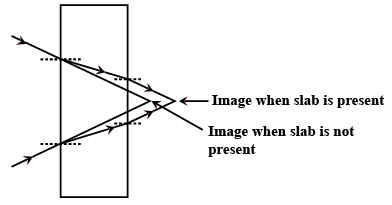
A glass slab is placed in the path of beam of convergent light. The point of convergence of light:
- A
Moves towards the glass slab
- ✓
Moves away from the glass slab
- C
Remains at the same point
- D
Undergoes a lateral shift
AnswerCorrect option: B. Moves away from the glass slab
As a glass has refractive index of $\frac{3}{2}$ with respect to air, the convergent light will bend towards the normal in the glass and again bend away from the normal, but in the whole process the beam is displaced parallel to initial path as shown in figure and converge at a greater distance from the glass slab.
View full question & answer→MCQ 541 Mark
Two rays $A$ and $B$ being reflected by a mirror and going as $A'$ and $B'$. The mirror:
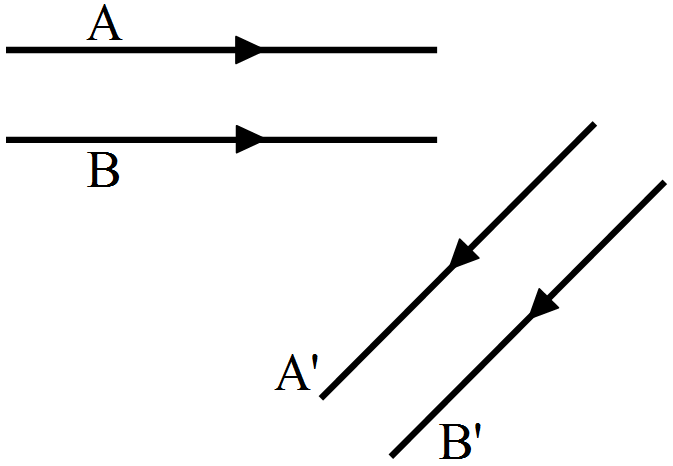
- ✓
- B
- C
- D
May be any spherical mirror.
Answer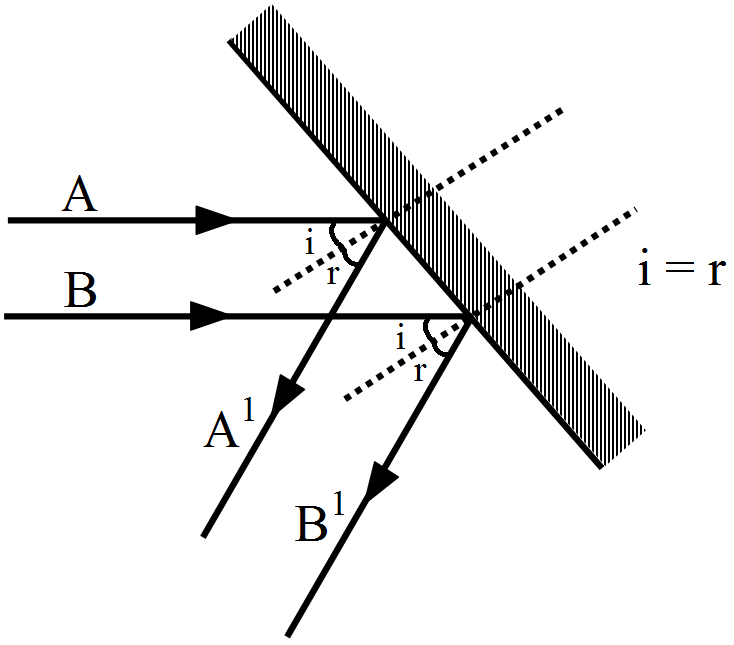
Here initially $A\ \&\ B$ is parallel to each other after reflection by teh plane mirror $A'\ \&\ B'$ goes Parallel to each other.
View full question & answer→MCQ 551 Mark
The lateral displacement depends on $.........$
- A
- B
Refractive index of the medium
- C
- ✓
AnswerLateral displacement due to a slab is given by $\delta=\text{t}(\mu−1)$; where t is thickness of the medium and $\mu $ is refractive index of medium.
View full question & answer→MCQ 561 Mark
prism can produce a minimum deviation $\delta$ in a light beam. If three such prisms are combined, the minimum deviation that can be produced in this beam is:
- A
$0$
- ✓
$\delta$
- C
$2\delta$
- D
$3\delta$
AnswerCorrect option: B. $\delta$
In combination $($refractive angles of prisms reversed with respect to each other$)$, the deviations through two prisms cancel out each other and the net deviation is due to the third prism only.
View full question & answer→MCQ 571 Mark
The phenomenon of change in the $.........$ of light when it passes from one transparent medium to another is refraction.
AnswerCorrect option: C. Both $A\ \&\ B$
The phenomenon of change in the path of light when it passes from one transparent medium to another is refraction. This change in path is due to the change in the speed of light in different media.
View full question & answer→MCQ 581 Mark
If a glass prism is dipped in water, its dispersive power:
- A
- ✓
- C
- D
May increase or decrease depending on whether the angle of the prism is less than or greater than 60°.
AnswerIf $\mu$ is the refractive index and A is the angle of prism, then the angular dispersion produced by the prism will be given by $\delta=(\mu-1)\text{A}.$
Because the relative refractive index of glass with respect to water is small compared to the refractive of glass with respect to air, the dispersive power of the glass prism is more in air than that in water.
View full question & answer→MCQ 591 Mark
If a ray of light goes from a rarer medium to a denser medium, will it bend towards the normal or away from it?
- A
Bends away from the normal
- ✓
- C
- D
AnswerRefraction is the bending of light rays after entering a medium where its speed is different. Due to refraction of light, when a ray of light passes from a rarer medium to a denser medium, bends towards the normal to the boundary between the two media. The amount of bending depends on the indices of refraction of the two media. Hence, when a ray of light from air enters a denser medium, it bends towards the normal.
View full question & answer→MCQ 601 Mark
A symmetric double convex lens is cut in two equal parts by a plane containing the principal axis. If the power of the original lens was $4D$, the power of a divided lens will be:
Answer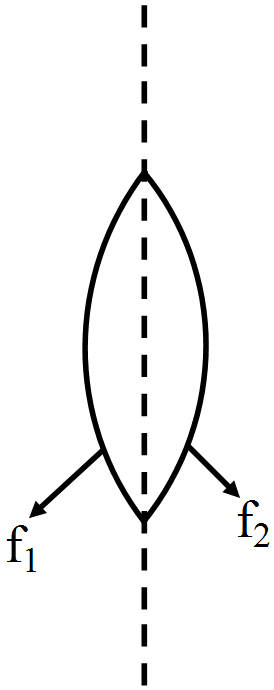
Before cut
$\frac{1}{\text{f}}=(\mu-1)\Big(\frac{2}{\text{R}}\Big)=4\text{D}$
After cut
$\frac{1}{\text{f}_1}=(\mu-1)\Big(\frac{1}{\text{R}}\Big)=\text{P}_1$
$\&\frac{1}{\text{f}_2}=(\mu-1)\Big(\frac{1}{\text{R}}\Big)=\text{P}_2$
Power of a divided lens will be = $P_1 + P_2$
$=(\mu-1)\Big(\frac{2}{\text{R}}\Big)$
$=4\text{D}$
View full question & answer→MCQ 611 Mark
The rays of different colors fail to converge at a point after going through a converging lens. This defect is called $.........$.
AnswerChromatic aberation is the defect due to which rays of different wavelength converge at various point after passing through converging lens. It is due to varying refractive index for various wavelength.
View full question & answer→MCQ 621 Mark
In producing a pure spectrum, the incident light is passed through a narrow slit placed in the focal plane of an achromatic lens because a narrow slit:
- A
Produces less diffraction.
- B
- C
Allows only one colour at a time.
- ✓
Allows a more parallel beam when it passes through the lens.
AnswerCorrect option: D. Allows a more parallel beam when it passes through the lens.
To produce a pure spectrum, a parallel light beam is required to be incident on the dispersing element. So, the incident light is passed through a narrow slit placed in the focal plane of an achromatic lens.
View full question & answer→MCQ 631 Mark
In case of a virtual and erect image, the magnification created by the mirror is:
AnswerMagnifaction of a mirror is defined as
$\text{m}=\frac{\text{size of image}}{\text{size of object}}$
and since, in case of virtual and errect image, size of image and object both are positive. Hence magnification created by mirror is positive.
View full question & answer→MCQ 641 Mark
A screen is placed a distance $40\ cm$ away from an illuminated object. A converging lens is placed between the source and the screen and it is attempted to form the image of the source on the screen. If no position could be found, the focal length of the lens:
- A
Must be less than $10\ cm.$
- ✓
Must be greater than $20\ cm.$
- C
Must not be greater than $20\ cm.$
- D
Must not be less than $10\ cm.$
AnswerCorrect option: B. Must be greater than $20\ cm.$
$\text{v}=(40-4)$
$\frac{1}{\text{f}}=\frac{1}{40-4}-\frac{1}{(-\text{u})}$
$\frac{\text{df}}{\text{du}}=0$ for f minimum.
$\frac{\text{df}}{\text{du}}=1-\frac{\text{u}}{20}=0$
$\text{u}=20$
$\text{f}_{\text{min}}=10\text{cm}$
View full question & answer→MCQ 651 Mark
The danger signals installed at the top of tall buildings are red in colour. These can be easily seen from a distance because among all other colours, the red light:
- A
Is scattered the most by smoke or fog.
- ✓
Is scattered the least by smoke or fog.
- C
Is absorbed the most by smoke or fog.
- D
AnswerCorrect option: B. Is scattered the least by smoke or fog.
The amount of scattering is inversely proportional to the fourth power of wavelength. And since the wavelength of red has the longest wavelength, the amount of scattering becomes smaller.
Danger signals installed at the top of tall buildings or traffic signals are red so that they can be easily seen from a distance.
View full question & answer→MCQ 661 Mark
Mark the correct options:
- A
If the incident rays are converging, we have a real object.
- ✓
If the final rays are converging, we have a real image.
- C
The image of a virtual object is called a virtual image.
- D
If the image is virtual, the corresponding object is called a virtual object.
AnswerCorrect option: B. If the final rays are converging, we have a real image.
This is because a real image is formed by converging reflected/ refracted rays from a mirror/ lens.
View full question & answer→MCQ 671 Mark
The angular dispersion produced by a prism:
- ✓
Increases if the average refractive index increases.
- B
Increases if the average refractive index decreases.
- C
Remains constant whether the average refractive index increases or decreases.
- D
Has no relation with average refractive index.
AnswerCorrect option: A. Increases if the average refractive index increases.
If $\mu$ is the average refractive index and A is the angle of prism, then the angular dispersion produced by the prism is given by $\delta=(\mu-1)\text{A}.$
View full question & answer→MCQ 681 Mark
A narrow beam of white light goes through a slab having parallel faces.
- A
The light never splits in different colours.
- B
The emergent beam is white.
- C
The light inside the slab is split into different colours.
- D
The light inside the slab is white.
View full question & answer→MCQ 691 Mark
An experiment is performed to find the refractive index of glass using a travelling microscope. In this experiment distances are measured by:
- A
A screw gauge provided on the microscope
- B
A standard laboratory scale
- ✓
A vernier scale provided on the microscope
- D
A meter scale provided on the microscope
AnswerCorrect option: C. A vernier scale provided on the microscope
The travelling microscope moves horizontally on a main scale provided with the vernier scale provided with the microscope that's why, In a travelling microscope to find the refractive index of glass we measure distance by a vernier scale provided on the microscope.
View full question & answer→MCQ 701 Mark
A man is looking at a small object placed at his near point. Without altering the position of his eye or the object, he puts a simple microscope of magnifying power $5X$ before his eyes. The angular magnification achieved is:
AnswerWe have,
$h =$ Object height
$u =$ Object distance $= 25cm$
$D =$ Near point $= 25cm$
Now,
$\text{m}=\frac{\frac{\text{h}}{\text{u}}}{\frac{\text{h}}{\text{D}}}$
$\Rightarrow\text{m}=\frac{\frac{\text{h}}{25}}{\frac{\text{h}}{25}}$
$\Rightarrow \text{m}=1$
View full question & answer→MCQ 711 Mark
A short pulse of white light is incident from air to a glass slab at normal incidence. After travelling through the slab, the first colour to emerge is:
AnswerAs velocity of wave is given by the relation $\text{v}=\text{f}\lambda$. When light ray goes from one medium to other medium, the frequency of light remains unchanged. Hence $\text{v}\propto\lambda$ or greater the wavelength, greater the speed.
The light of red colour is of highest wavelength and therefore of highest speed. Therefore, after travelling through the slab, the red colour emerges first.
View full question & answer→MCQ 721 Mark
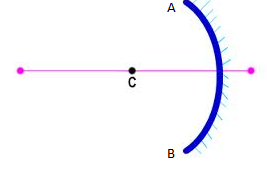
The distance between the extreme points on the periphery of the mirror is called:
AnswerPrincipal section is also defined as the normal 'side view' of the mirror for a ray diagram. In the diagram $AB$ is the principal section.
View full question & answer→MCQ 731 Mark
How can we explain the reddish appearance of sun at sunrise or sunset?
- ✓
Scattering of blue light is more than the scattering of red light.
- B
Scattering of red light is more than the scattering of blue light.
- C
Intensity of sun reduces during sunrise and sunset.
- D
Due to the view angle, it appears blue.
AnswerCorrect option: A. Scattering of blue light is more than the scattering of red light.
During sunrise or sunset, the light has to pass through greater distance in the atmosphere. The blue light is removed as it gets scattered the most while the red colour is less scattered and reaches the observer. Thus, we find reddish colour of the sun during sunrise or sunset.
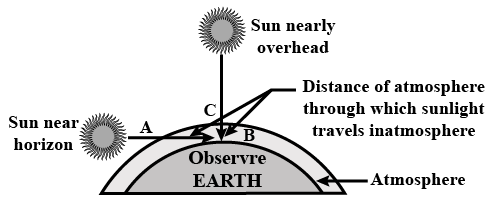
View full question & answer→MCQ 741 Mark
Why does a straight rod appear bent in water?
- A
Due to reflection of light
- ✓
Due to refraction of light
- C
Due to variable refractive index of water.
- D
AnswerCorrect option: B. Due to refraction of light
This phenomenon occurs due to the property of light called refraction of light. When a stick is immersed in water, in actually we are putting it from rarer medium to denser medium. So, when the rays of light pass from a rarer medium to the denser medium they move towards the normal, the part of stick immersed in water appears to bend when immersed in water and this refraction causes an apparent shift in the position of the part of the rod within the water.
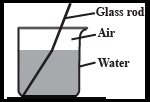
View full question & answer→MCQ 751 Mark
A plane mirror produces an image that is:
- A
Real, inverted and larger than the object.
- B
Real, upright and same size as the object.
- C
Real upright and smaller than the object.
- ✓
Virtual, upright and the same size of the object.
AnswerCorrect option: D. Virtual, upright and the same size of the object.
So a plane mirror always forms a virtual, upright and same sized image.
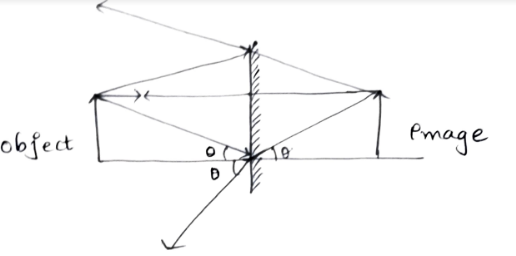
View full question & answer→MCQ 761 Mark
The rays parallel and close to the principal axis are called:
AnswerThe rays parallel and close to the principal axis are called paraxial rays. The rays parallel but not close to the principal axis are called peripheral rays.
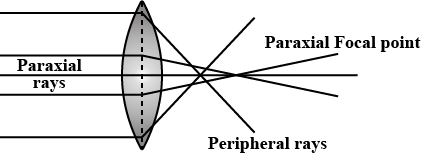
View full question & answer→MCQ 771 Mark
When a ray of light passes from a denser to a rarer medium, some part of it gets $.......$ into the denser medium:
AnswerWhen a ray of light passes from a denser to a rarer medium, some part of it gets refracted into the rarer medium such that it bends away from the normal. Some part of it gets reflected back into the denser medium. The light reflected back into the denser medium is said to be internally reflected.
View full question & answer→MCQ 781 Mark
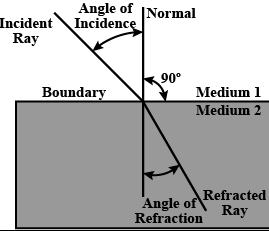
The bending of light as it passes from one medium into another is commonly known as:
AnswerIn refraction ray of light passes from one medium to another medium. The ray of light bends towards normal in the denser medium.
View full question & answer→MCQ 791 Mark
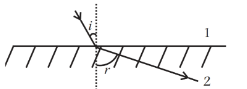
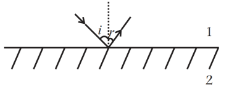
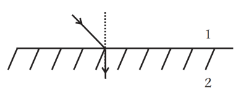
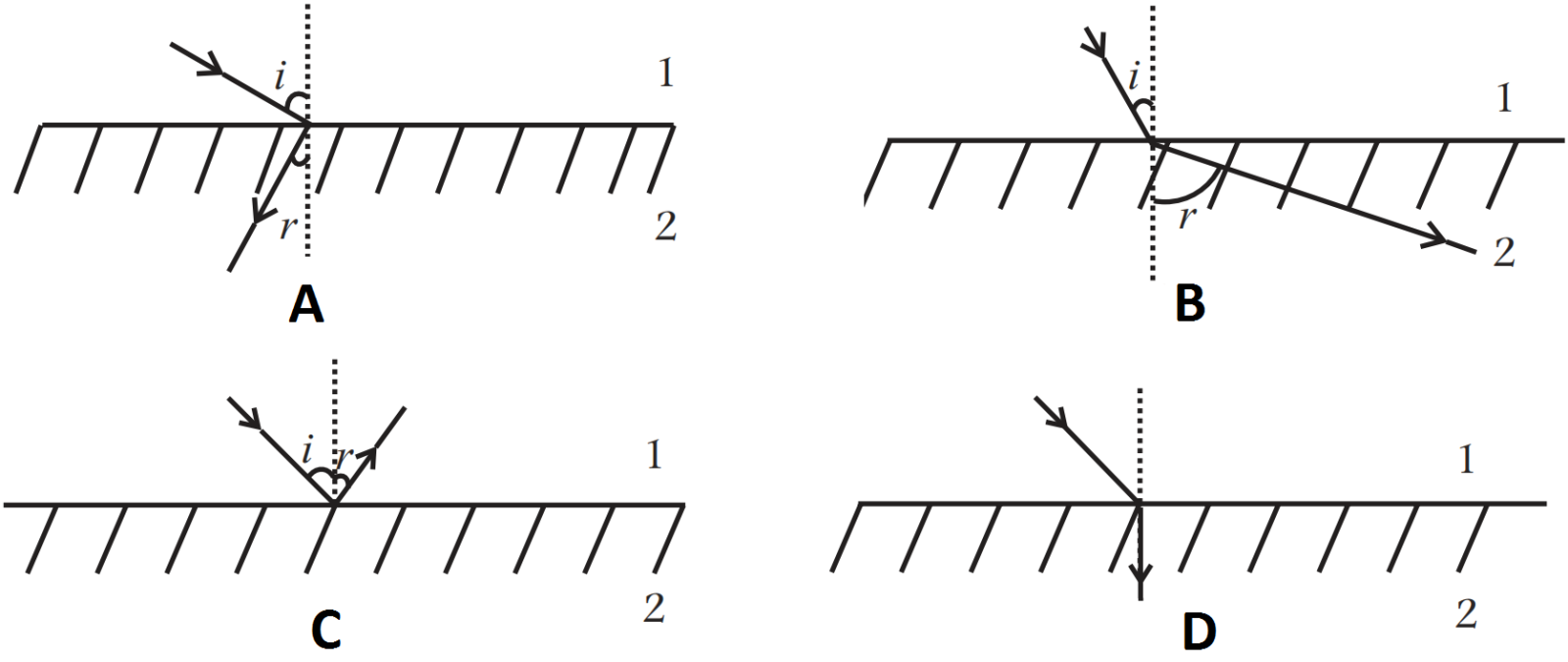
There are certain material developed in laboratories which have a negative refractive index (Fig). A ray incident from air (medium 1) into such a medium (medium 2) shall follow a path given by:
Answer
Solution:
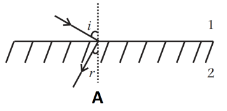
The materials with negative refractive index responds to Snell’s law just opposite way. If incident ray from air (Medium 1) incident on those material, the ray refract or bend same side of the normal as in option (a).
View full question & answer→MCQ 801 Mark
The size of an object as perceived by an eye depends primarily on:
- A
Actual size of the object.
- B
Distance of the object from the eye.
- C
- ✓
Size of the image formed on the retina.
AnswerCorrect option: D. Size of the image formed on the retina.
An eye consists of a lens that works on the principle on which a glass lens works. It forms the image on the screen called retina. The magnification, in this case, depends on the ratio of the image to the object height.
View full question & answer→MCQ 811 Mark
To increase the angular magnification of a simple microscope, one should increase:
- A
The focal length of the lens.
- ✓
- C
The aperture of the lens.
- D
AnswerFor a simple microscope in normal adjustment, the object is placed at a distance equal to $f ($the focal length$)$ from the lens, And the angular magnification is given by the relation
$\text{m}=\frac{\text{D}}{\text{f}}$
for $\text{u}<\text{f},\text{m}=\frac{\text{D}}{\text{f}}+1$
power of lens $=\frac{1}{\text{f}}$
Angular magnification depends on power.
View full question & answer→MCQ 821 Mark
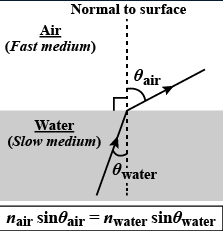
A ray of light travels from a denser to a rarer medium then, the ray:
- A
- B
- ✓
Bends away from the normal
- D
AnswerCorrect option: C. Bends away from the normal
When light travels from denser to rarer medium, the velocity of light increases which results in bending of light away from the normal.
View full question & answer→MCQ 831 Mark
The direction of ray of light incident on a concave mirror is shown by $PQ$ while directions in which the ray would travel after reflection is shown by four rays marked $1, 2, 3$ and $4 (Fig)$. Which of the four rays correctly shows the direction of reflected ray?
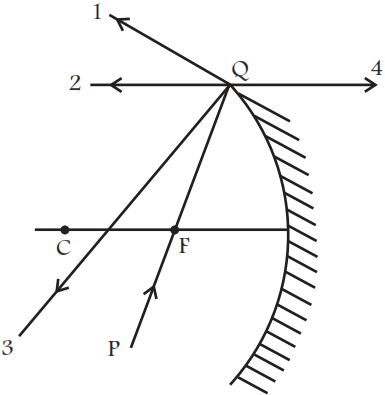
AnswerThe ray $PQ$ of light passes through focus $F$ and incident on the concave mirror, after reflection, should become parallel to the principal axis and shown by ray $2$ in the figure.
Important points: We can locate the image of any extended object graphically by drawing any two of the following four special rays:
A ray initially parallel to the principal axis is reflected through the focus of the mirror $(1).$
A ray passing through the center of curvature is reflected back along itself $(3).$
A ray initially passing through the focus is reflected parallel to the principal axis $(2).$
A ray incident at the pole is reflected symmetrically.
View full question & answer→MCQ 841 Mark
A manufacturer uses a concave lens instead of a convex lens in a magnifying glass by mistake. What will be the effect on the working of the lens?
- A
- B
- ✓
Images will be diminished.
- D
Images will be further magnified.
AnswerCorrect option: C. Images will be diminished.
Images formed by a concave lens are always diminished.
View full question & answer→MCQ 851 Mark
The refraction of light is commonly known as:
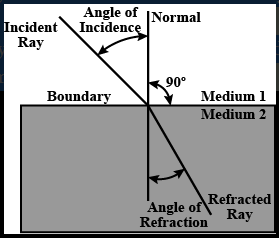
AnswerThe refraction of light is commonly known as bending.
The refracted rays bend towards the normal when they enter from rarer to denser medium.
The refracted rays bend away from the normal when they enter from denser to rarer medium.
View full question & answer→MCQ 861 Mark
Shift by which the object appears to be raised depends on:
- A
The refractive index of the medium
- B
The thickness of denser medium
- C
- ✓
AnswerShift by which the object appears to be raised depends on these $4$ factors. The shift increases with increase in refraction index of medium and also with the thickness of denser medium.
View full question & answer→MCQ 871 Mark
Which of the following (referred to a spherical mirror) do (does) not depend on whether the rays are paraxial or not?
AnswerExplanation:
If Paraxial rays comes to parallel to the spherical mirror is pasees to the Focus of the spherical mirror.
View full question & answer→MCQ 881 Mark
The apparent vertical shift of the image of a coin placed at the bottom of a water tank having constant depth of water is proportional to $($given refractive index of water $= \mu).$
- A
$\mu$
- ✓
$\frac{1}{\mu}$
- C
$\mu-1$
- D
$\mu+1$
AnswerCorrect option: B. $\frac{1}{\mu}$
The apparent vertical shift is given by the equation $\text{AD}=\frac{\text{RD}}{\mu}$, that is, $\mu=\frac{\text{RD}}{\text{AD}}$, where $AD$ is the apparent vertical shift, $RD$ is the real depth of the tank and $n$ is the refractive index of the denser medium, that is, water.
As real depth and refractive index is going to be constant always, the apparent shift or depth will be independent of viewing angle.
From the above equation, we can see that the apparent vertical shift is inversely proportional to the refractive index. That is, $\frac{1}{\mu}$.
View full question & answer→MCQ 891 Mark
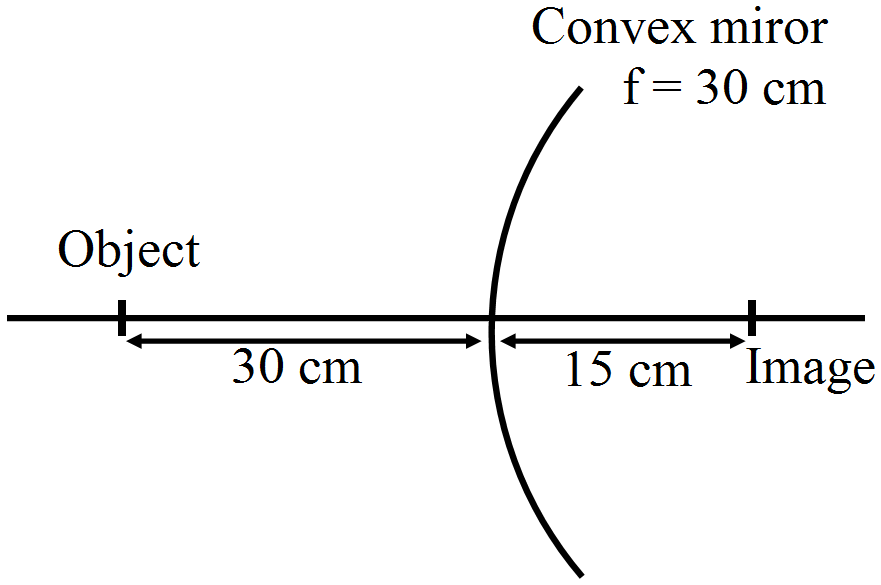
A point object is placed at a distance of $30\ cm$ from a convex mirror of focal length $30\ cm$. The image will form at:
AnswerBy mirror formula:
$\frac{1}{\text{V}}+\frac{1}{\text{u}}=\frac{1}{\text{f}}$
Here $ u = -30\ cm$
$f = +30\ cm$
So, $\frac{1}{\text{V}}-\frac{1}{30}=\frac{1}{30}$
$Þ v= 15\ cm$ behind the mirror.
View full question & answer→MCQ 901 Mark
A thin lens is made with a material having refractive index $\mu=1.5.$ Both the sides are convex. It is dipped in water $(\mu=1.33).$ It will behave like:
Answer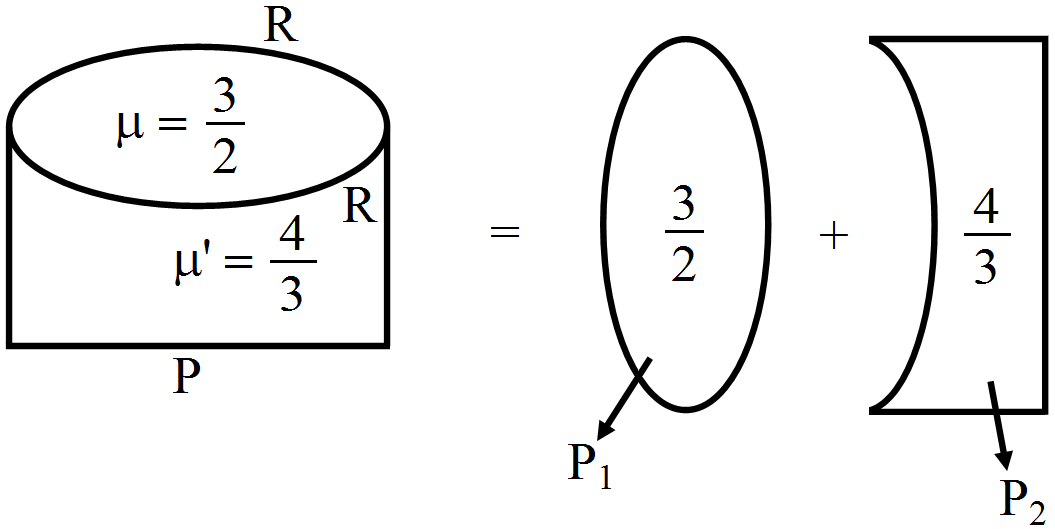
Here $P, P_1\ \&\ P_2$ are the power of Lenses.
$P = P_1+P_2$
$\frac{1}{\text{f}}=\frac{1}{\text{f}_1}+\frac{1}{\text{f}_2}$
$=(\mu-1)\Big(\frac{2}{\text{R}}\Big)+(\mu'-1)\Big(\frac{-1}{\text{R}}\Big)$
$=\Big(\frac{3}{2}-1\Big)\Big(\frac{2}{\text{R}}\Big)-\Big(\frac{4}{3}-1\Big)\Big(\frac{1}{\text{R}}\Big)$
$\frac{1}{\text{f}}=\frac{1}{\text{R}}-\frac{1}{3\text{R}}$
$\frac{1}{\text{f}}=\frac{3-1}{3\text{R}}$
$\text{f}=\frac{3\text{R}}{2}$
focal length of combined is positive means it will behave like a canvergent lens.
View full question & answer→MCQ 911 Mark
What are the colours of the Sun observed most during sunrise/sunset and noon?
AnswerDuring sunrise and sunset the sun rays have to pass through a larger distance and also a greater thickness of air since it is low in the sky. At t hese positions, the sky looks orange$-$red colour because photons of red and orange light are least scattered through the atmosphere and are able to reach our eyes.
View full question & answer→MCQ 921 Mark
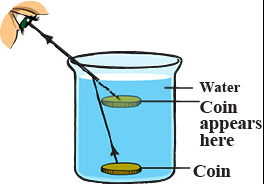
A coin kept in a container and not visible can be viewed by pouring water into the container. It happens because of the:
- A
- ✓
- C
Variable refractive index of water.
- D
AnswerWhen water is poured then it is due to refraction of light the coin becomes visible. When the light rays travel from the water medium $($denser$)$ to the air medium $($rarer$)$ it bends away from the normal due to the refraction. Therefore, an image of the coin is formed at a smaller depth causing it to be visible $($as shown in the figure$)$.
View full question & answer→MCQ 931 Mark
$\mu_\text{V}>\mu_\text{R}$ indicates:
- ✓
Shift is more for violet colour
- B
Shift is more for red colour
- C
Shift is equal for both red and voilet
- D
AnswerCorrect option: A. Shift is more for violet colour
Since, $\mu_\text{V}>\mu_\text{R}$, the shift is more for he violet light than the red light in a given medium.
View full question & answer→MCQ 941 Mark
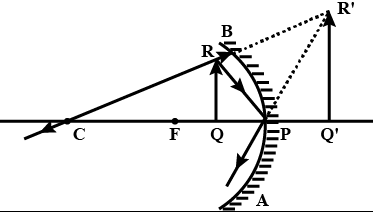
The image formed behind a mirror and a virtual image:
- ✓
- B
- C
Are of same nature only in space
- D
Are of different nature only in space
AnswerThe image formed behind a mirror is virtual in nature. So, they are of the same nature always.
View full question & answer→MCQ 951 Mark
Consider the following two statements:
- Line spectra contain information about atoms.
- Band spectra contain information about molecules.
- A
Both $A$ and $B$ are wrong
- B
$A$ is correct but $B$ is wrong.
- C
$B$ is correct but $A$ is wrong
- ✓
Both $A$ and $B$ are correct.
AnswerCorrect option: D. Both $A$ and $B$ are correct.
Because line spectra contain wavelengths that are absorbed by atoms and band spectra contain bunch wavelengths that are absorbed by molecules, both statements are correct.
View full question & answer→MCQ 961 Mark
The radius of curvature of the curved surface of a plano$-$convex lens is $20\ cm$. If the refractive index of the material of the lens be $1.5,$ it will.
- A
Act as a convex lens only for the objects that lie on its curved side.
- B
Act as a concave lens for the objects that lie on its curved side.
- ✓
Act as a convex lens irrespective of the side on which the object lies.
- D
Act as a concave lens irrespective of side on which the object lies.
AnswerCorrect option: C. Act as a convex lens irrespective of the side on which the object lies.
We know that, $\text{f}=\frac{\text{R}}{\mu-1}$
Substituting $\text{R}=20\text{cm},\mu=1.5,$ we get
$\text{f}=\frac{20}{1.5-1}=40\text{cm}$
Since, the focal length is greater than zero.
Therefore, lens act as a convex lens irrespective of the side on which the object lies.
View full question & answer→MCQ 971 Mark
The ratio of real depth to apparent depth is called the the:
Answer$\text{refractive index} = \frac{\text{actual depth}}{\text{apparent depth}}$
View full question & answer→MCQ 981 Mark
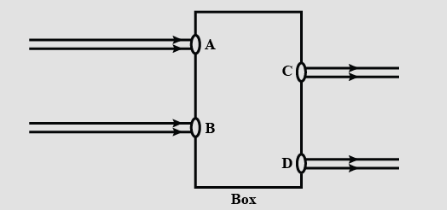
Beams of light are incident through the holes $A$ and $B$ and emerge out of the box through the holes $C$ and $D$ respectively as shown in the Figure. Which of the following could be inside the box?
AnswerSince lateral displacement is taking place in the parallel rays, a rectangular glass slab could be inside the box. Lateral displacement is the distance by which the incident light has been displaced after bending through the glass slab.
View full question & answer→MCQ 991 Mark
As our eyes can not retrace the bent path of light, a stick, dipped in water, appears:
AnswerA straight stick, dipped in water, appears to be bent upward as our eyes can not retrace the bent path of light.
View full question & answer→MCQ 1001 Mark
In image formation from spherical mirrors, only paraxial rays are considered because they:
- A
Are easy to handle geometrically.
- B
Contain most of the intensity of the incident light.
- ✓
Form nearly a point image of a point source.
- D
Show minimum dispersion effect.
AnswerCorrect option: C. Form nearly a point image of a point source.
In Image formation from spherical mirrors, only paraxial rays are considered because they form nearly a point Image of a point source. Angle of Incidence of Paraxial rays is very small.
View full question & answer→MCQ 1011 Mark
The critical angle of a material is the angle of incidence for which the angle of refraction is:
- A
$0^\circ$
- ✓
$90^\circ$
- C
$180^\circ$
- D
$360^\circ$
AnswerCorrect option: B. $90^\circ$
critical angle: It is the angle of incidence for which angle of refraction is $90^\circ . $
View full question & answer→MCQ 1021 Mark
When objects at different distances are seen by the eye, which of the following remain constant?
- A
The focal length of the eye$-$lens.
- B
The object$-$distance from the eye$-$lens.
- C
The radii of curvature of the eye$-$lens.
- ✓
The image-distance from the eye$-$lens.
AnswerCorrect option: D. The image-distance from the eye$-$lens.
In the human eye, the image is formed on the retina, which is at a fixed distance from the eye lens.
View full question & answer→MCQ 1031 Mark
A point object $O$ is placed on the principal axis of a convex lens of focal length $f = 20\ cm$ at a distance of $40\ cm$ to the left of it. The diameter of the lens is $10\ cm$. An eye is placed $60\ cm$ to right of the lens and a distance h below the principal axis. The maximum value of h to see the image is:
- A
$0$
- ✓
$2.5\ cm$
- C
$5\ cm$
- D
$10\ cm.$
AnswerCorrect option: B. $2.5\ cm$
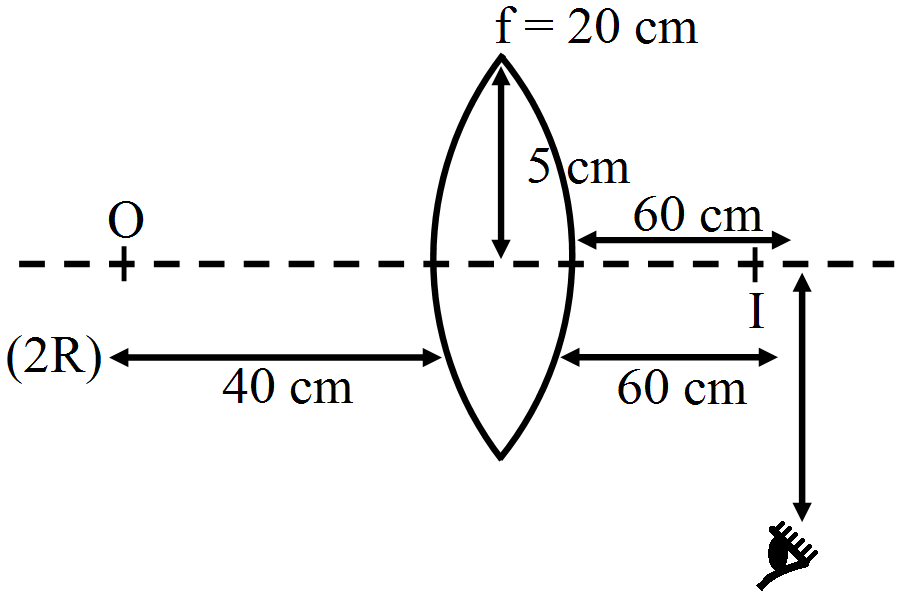
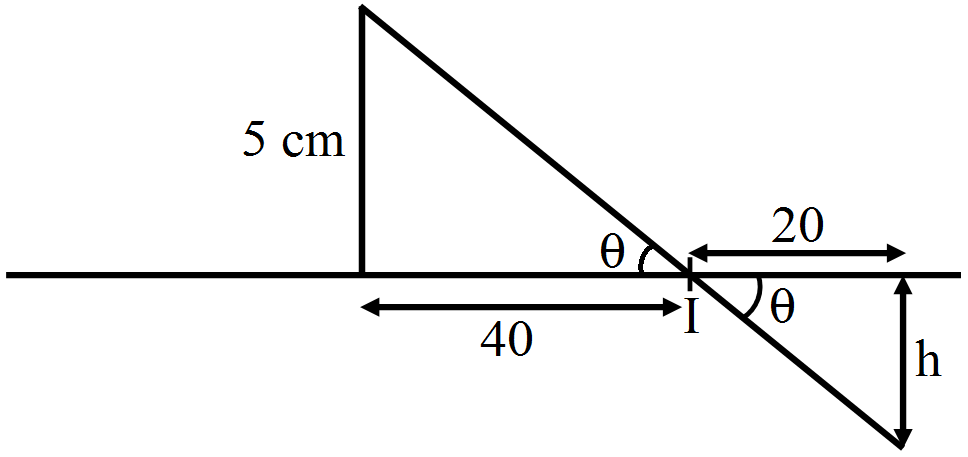
$\tan\theta=\frac{5}{40}=\frac{\text{h}}{20}$
$\text{h}=\frac{5}{2}=\frac{\text{h}}{20}$
$\text{h}=\frac{5}{2}=2.5\text{cm}$
The maximum value of $"h =2.5\ cm"$ to see the Image of the object. View full question & answer→MCQ 1041 Mark
The imaginary line passing through the pole and the center of curvature of the curved mirror is called its $.........$.
AnswerThe imaginary line passing through the pole and the center of curvature of the curved mirror is called its principal axis.
View full question & answer→MCQ 1051 Mark
The image which can not be taken on the screen is called:
- A
- ✓
- C
Either a real or a virtual image
- D
Neither a real nor a virtual image
AnswerThe image which can not be taken on the screen is called a virtual image.
View full question & answer→MCQ 1061 Mark
Which of the following will produce greater chromatic aberration?
- ✓
- B
- C
Both produce equal chromatic aberration
- D
AnswerA lens may be considered as made up of a number of prisms placed one above the other. In a thick lens, the angles of prisms are larger than those in a thin lens. Since, angular dispersion produced by a prism is directly proportional to the angle of prism, a thick lens suffers from greater chromatic aberration.
View full question & answer→MCQ 1071 Mark
When is the real image formed?
- A
When the rays of light after reflection or refraction actually go away from some point.
- ✓
When the rays of light after reflection or refraction actually meet at some point.
- C
When the sun rays after reflection or refraction actually meet at some point.
- D
When the rays of light after deflection actually meet at some point.
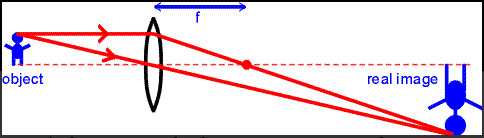
AnswerCorrect option: B. When the rays of light after reflection or refraction actually meet at some point.
Real image formed when the rays of light after reflection or refraction actually converge at some point and when objects are placed outside the focal length of a converging lens or outside the focal length of a converging mirror.
View full question & answer→MCQ 1081 Mark
Which of the following cannot be seen by a microscope?
AnswerA microscope is an instrument used to see objects too small for the naked eye. microscope is used to look into smaller details like the structure of the cells and the unicellular organism. On the other hand larger objects that are very far off are the targets of a telescope. hence,stars cannot be seen by a microscope.
View full question & answer→MCQ 1091 Mark
A double convex lens has two surfaces of equal radii R and refractive index $\mu=1.5$ We have,
AnswerCorrect option: B. $\text{f}=\text{R}$
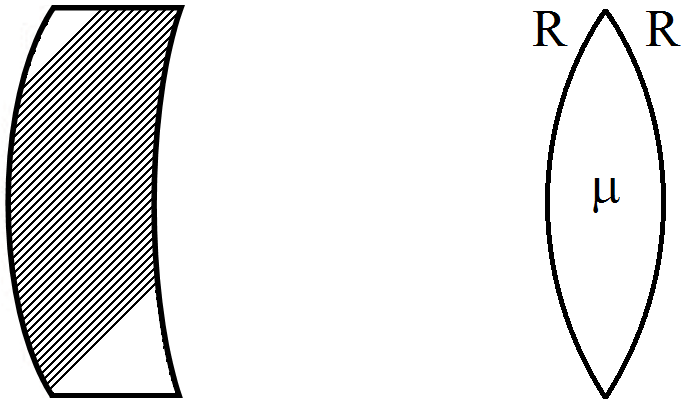
$\Rightarrow\frac{1}{\text{f}}=(\mu-1)\Big(\frac{1}{\text{R}_1}-\frac{1}{\text{R}_2}\Big)$
$\Rightarrow\frac{1}{\text{f}}=\Big(\frac{3}{2}-1\Big)\Big(\frac{1}{\text{R}}-\Big(-\frac{1}{\text{R}}\Big)\Big)$
$\frac{1}{\text{f}}=\frac{1}{\text{R}}$
$\text{f}=\text{R}$
View full question & answer→MCQ 1101 Mark
The distance between the focus and the pole of the mirror is called:
AnswerThe distance between the focus and the pole of the mirror is called focal length.
View full question & answer→MCQ 1111 Mark
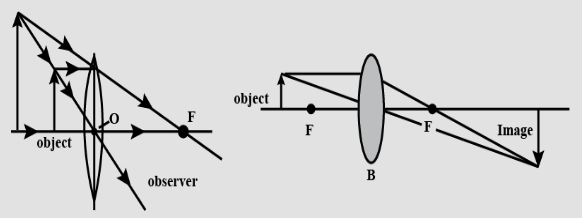
Choose the correct option:
- ✓
$A$: Virtual Image, $B$: Real Image
- B
$A$: Real Image, $B$: Virtual Image
- C
$A$: Real Image, $B$: Real Image
- D
$A$: Virtual Image, $B$: Virtual Image
AnswerCorrect option: A. $A$: Virtual Image, $B$: Real Image
As shown in figure $A$, a virtual image is formed because refracted rays only appear to meet at the image.
As shown in figure $B$, a real image is formed because refracted rays actually meet at the image.
View full question & answer→MCQ 1121 Mark
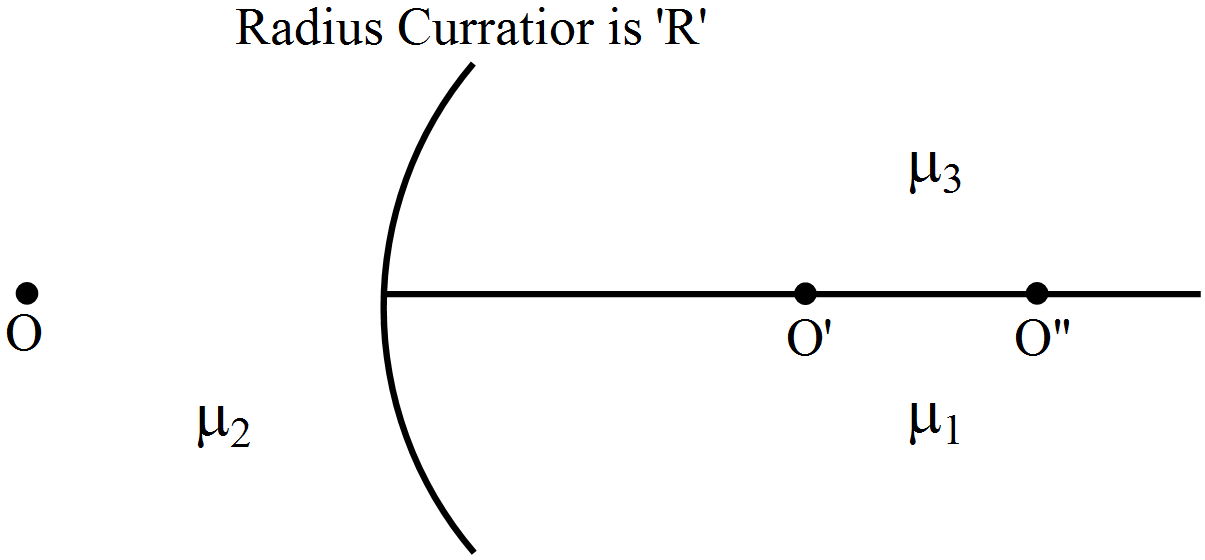
Three transparent media of refractive indices $\mu_1,\mu_2$ and $\mu_3.$ A point object $O$ is placed in the medium $\mu_2.$ If the entire medium on the right of the spherical surface has refractive index $\mu_1,$ the image forms at $O'$. If this entire medium has refractive index $\mu_3,$ the image forms at $O"$. In the situation shown:
- A
The image forms between $O'$ and $O"$
- B
The image forms to the left of $O'$
- C
The image forms to the right of $O"$
- ✓
Two images form, one at $O'$ and the other at $O".$
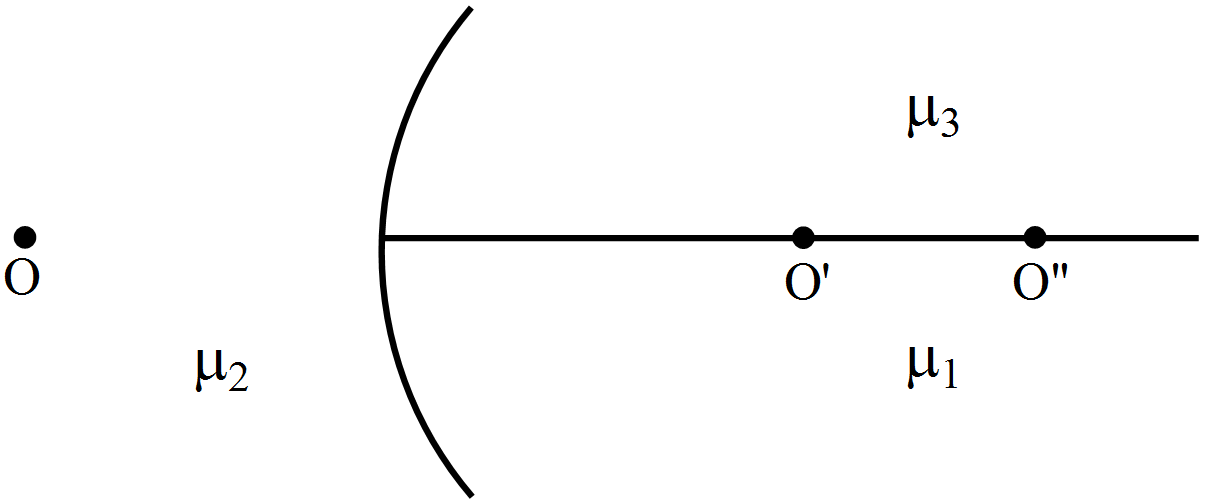
AnswerCorrect option: D. Two images form, one at $O'$ and the other at $O".$
$m_1$, Image is $O^1$
$m_3$, Image is $O^{11}$
Spherical Surface formula
$\frac{\mu^{11}}{\text{v}}-\frac{\mu_1}{\mu}=\frac{\mu^{11}-\mu^1}{\text{R}}$
If ray goes to $m^2$ to $m^1$ than Image is formed at $O^1$ and if ray goes to $m_2$ to $m_3$ than Image is formed at $O^{11}$.
View full question & answer→MCQ 1131 Mark
The optical density of turpentine is higher than that of water while its mass density is lower. Fig. shows a layer of turpentine floating over water in a container. For which one of the four rays incident on turpentine in Fig, the path shown is correct?
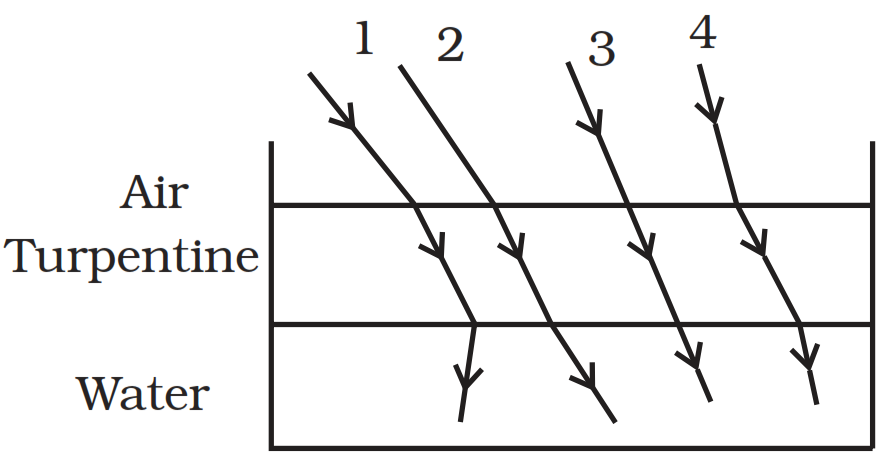
AnswerKey concept: The Snell's law describes the relation between angle of incidence $\theta_1$ and angle of refraction $\theta_2$:
$\mu\sin\theta_1=\mu_2\sin\theta_2=\text{constant}\ .....(\text{i})$
where $\mu_1$ and $\mu_1$ are refractive indices of the two media.
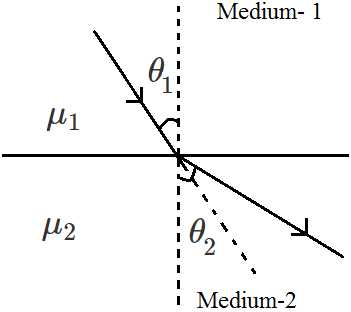
When a light ray goes from $($optically$)$ denser medium to $($optically$)$ rarer medium, then it bends away the normal, i.e., $\theta_1<\theta_2$ and vice-versa.
Here, light ray goes from $($optically$)$ rarer medium air to optically denser medium turpentine, then it bends towards the normal, i.e., $\theta_1>\theta_2$ whereas when it goes from to optically denser medium turpentine to rarer medium water, then it bends away the normal.
View full question & answer→MCQ 1141 Mark
The shift by which object appears to be raised $.........$ with the increase in the thickness of the denser medium.
AnswerThe shift increase with the increase in the thickness of the denser medium, but the shift decrease with the increase in wavelength of light used.
View full question & answer→MCQ 1151 Mark
- A
- ✓
- C
Both $A$ and $B$
- D
Neither $A$ nor $B$
AnswerA magnifying lens is simply a convex lens and forms a magnified erect virtual image of objects.
View full question & answer→MCQ 1161 Mark
In order to increase the angular magnification of a simple microscope, one should increase:
- A
- B
- C
The focal length of the lens
- ✓
AnswerWhen the image is formed at infinity
$m = Df = DPm = Df = DP$
when the image is formed at the near point
$m = (1+Df) = 1 + DP$
View full question & answer→MCQ 1171 Mark
A real image is formed by:
- ✓
Actual intersection of the refracting or reflecting rays.
- B
Imaginary intersection of the refracting or reflecting rays produced backwards.
- C
Either actual or imaginary intersection of the reflecting or refracting rays.
- D
Neither actual nor imaginary intersection of the reflecting or refracting rays.
AnswerCorrect option: A. Actual intersection of the refracting or reflecting rays.
When the refracting or reflecting rays actually intersect, rather than pretending to be meeting at a point, a real image is formed. A real image hence can be obtained on a screen.
View full question & answer→MCQ 1181 Mark
The image formed by a concave mirror:
- A
- B
- ✓
Is certainly real if the object is virtual.
- D
Is certainly virtual if the object is real.
AnswerCorrect option: C. Is certainly real if the object is virtual.
|
Object
|
Image
|
|
$O_1$
|
$I_1$
|
|
$O_2$
|
$I_2$
|
|
$O_3$
|
$I_3$
|
|
$O_4$
|
$I_4$
|
Here $O_4$ is virtual oblect $\&\ I_4$ is real image.
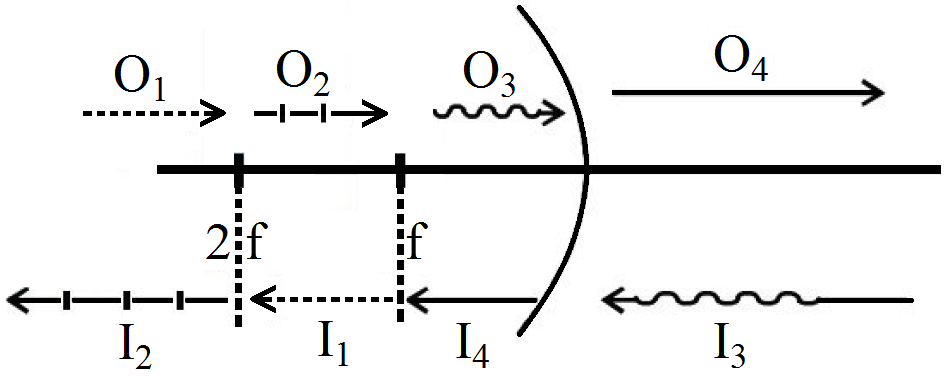
View full question & answer→MCQ 1191 Mark
Lateral displacement of the emergent ray of light increases with:
- ✓
Increase in angle of incidence.
- B
Decrease in refractive index of medium.
- C
Increase in the wavelength of light.
- D
AnswerCorrect option: A. Increase in angle of incidence.
Lateral displacement produced by a glass slab of thickness $t$, incident on it at angle of incidence i is
Lateral displacement $ \delta=\frac{\text{t}}{\text{cosr}}\text{sin}(\text{i - r})$
View full question & answer→MCQ 1201 Mark
Banding of a stick when placed in water is because:
- ✓
Rays bend away from the normal at the surface of seperation between water and the air.
- B
Rays bend towards the normal at the interface.
- C
- D
AnswerCorrect option: A. Rays bend away from the normal at the surface of seperation between water and the air.
Because water is an optically denser medium than air. So these rays bend away from the normal at the surface of separation.
View full question & answer→MCQ 1211 Mark
A printed page is seen through a glass slab place on it. The printed words appear raised. This is due to:
- ✓
Refraction at the upper surface of the slab.
- B
Refraction at the lower surface of the slab.
- C
Partial reflection at the upper surface of the slab.
- D
Partial reflection at the lower surface of the slab.
AnswerCorrect option: A. Refraction at the upper surface of the slab.
View full question & answer→MCQ 1221 Mark
The apparent depth of an object lying in a denser medium is always $.........$ than the real depth.
AnswerThe apparent depth of an object lying in a dense need always less than its real depth for all angles of observation in a rarer medium.
View full question & answer→MCQ 1231 Mark
The focal length of a converging lens are $f_v$ and $f_r$ for violet and red light respectively:
- A
$\mathrm{f}_{\mathrm{v}}>\mathrm{f}_{\mathrm{r}} $
- B
$\mathrm{f}_{\mathrm{v}}-\mathrm{f}_{\mathrm{r}} $
- ✓
$\mathrm{f}_{\mathrm{v}}<\mathrm{f}_{\mathrm{r}} $
- D
Any of the three is possible depending on the value of the average refractive index $\mu$.
AnswerCorrect option: C. $\mathrm{f}_{\mathrm{v}}<\mathrm{f}_{\mathrm{r}} $
Focal length is inversely proportional to refractive index and refractive index is inversely proportional to $\lambda^2.$
So, keeping other parameters the same, we can say:
$\text{f}\propto\frac{1}{\lambda^2}\ \ (\because\lambda_\text{r}<\lambda_\upsilon)$
$\therefore\text{f}_\text{v}<\text{f}_\text{r}$
View full question & answer→MCQ 1241 Mark
When the reflecting or refracting rays do not actually intersect but appear to intersect when produced backwards,
- A
- ✓
A virtual image is formed.
- C
Either a real or a virtual image is formed.
- D
Neither a real nor a virtual image is formed.
AnswerCorrect option: B. A virtual image is formed.
A virtual image is formed when the refracting or reflecting rays do not actually intersect but appear to intersect when they are produced backwards.
View full question & answer→MCQ 1251 Mark
In optical instruments, the lenses are used to form images by:
AnswerA lens is a piece of glass $($plastic$)$ with two refracting surfaces, which are either curved $($e.g., a segment of a sphere$)$ or plain.
Lenses are used to form images by refraction in optical instruments $($microscopes, telescopes, cameras, etc.$)$
There are two types of lenses: converging $($thickest in the middle$)$ and diverging $($thickest at the edges$)$.
View full question & answer→MCQ 1261 Mark
The distance $CP$ is the:
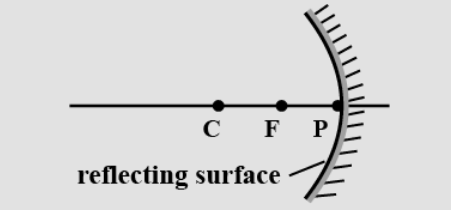
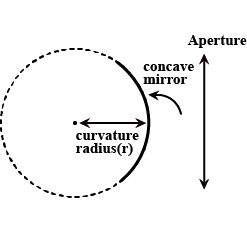
AnswerThe distance $CP$ is the radius of curvature.
View full question & answer→MCQ 1271 Mark
- ✓
The image that cannot be caught on a screen.
- B
The image that can be caught on a screen.
- C
The image that cannot be converged on a screen.
- D
AnswerCorrect option: A. The image that cannot be caught on a screen.
When the actual rays diverge then they can never meet to form an image. Therefore the rays are assumed to meet in the backward direction of their propagation.
As the imaginary light rays meet and form the image, therefore the image can not be caught on a screen.
View full question & answer→MCQ 1281 Mark
A pencil dipped partially in water appears bent because of:
- A
Reflection at water surface
- B
Diffraction at water surface
- ✓
Refraction at water surface
- D
AnswerCorrect option: C. Refraction at water surface
Refraction is a phenomenon in which a light ray incident on a surface separating two transparent media bends at the change of medium.
Snell's law gives the relation between angle of incidence and refraction and the Refractive index of the respective medium.
$\mu_1 \sin (i) = \mu_2 \sin(r)$
where, i, r are the angles of incidence and refraction respectively.
View full question & answer→MCQ 1291 Mark
Why are red coloured lights are used in traffic signals to stop the vehicles?
- A
Minimum wavelength and less scatter.
- B
Maximum wavelength and more scatter.
- ✓
Maximum wavelength and less scatter.
- D
Less wavelength and less scatter.
AnswerCorrect option: C. Maximum wavelength and less scatter.
We know among the seven colours of white light, red colour has maximum wavelength. That is why red colour is least scattered by atmospheric dust and other particles. Hence red colour is used to indicated any danger sign.
View full question & answer→MCQ 1301 Mark
Comparing real and virtual images, we may say that:
- A
Real images can not be obtained on a screen and virtual images can be.
- ✓
Virtual images can not be obtained on a screen and real images can be.
- C
Both real and virtual images can be obtained on a screen.
- D
Neither real nor virtual images can be obtained on a screen.
AnswerCorrect option: B. Virtual images can not be obtained on a screen and real images can be.
Real images can be obtained on a screen. On$-$screen rays meet in real.
Virtual images can not be obtained on a screen. Because there is no meaning of screen for the virtual image.
View full question & answer→MCQ 1311 Mark
The phenomenon of light passing through the object is called:
- A
- ✓
- C
- D
Total internal reflection
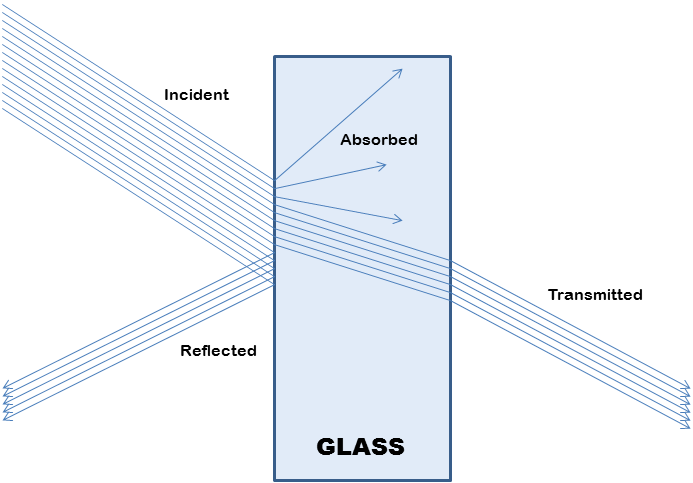
AnswerThe phenomena when light passes through the object $($a medium$)$ is known as refraction. Refraction is defined as the bending of light ray when it passes from one medium to another.
View full question & answer→MCQ 1321 Mark
At noon the sun appears white because:
- ✓
Light is least scattered.
- B
All the colours of the white light are scattered away.
- C
Blue colour is scattered the most.
- D
Red colour is scattered the most.
AnswerCorrect option: A. Light is least scattered.
At noon because the sun is overhead, the light is scattered the least and hence appears white. When it is overhead, it has lesser air to travel through and the scattering from dust and other particles is reduced if the distance to be travelled in air is reduced.
View full question & answer→MCQ 1331 Mark
Total internal reflection can take place only if:
AnswerCorrect option: B. Light goes from optically denser medium to rarer medium.
$T.I.R. ($Total Internal reflection$)$
$i < C ($condition for $T.I.R.)$
By Snell's Law
$\text{n}_1\sin\text{i}=\text{n}_2\sin90^{\circ}$
$\sin\text{i}=\frac{\text{n}_2}{\text{n}_1}=\sin\text{C}$
$\text{þ} \ \text{C}=\sin^{-1}$
$\because \ -1\leq\sin\text{i}\leq1$
$n_1 > n_2($ so we can conclude that light goes from optically denser medium to rarer medium & incident angle is greater than the critical angle$.)$
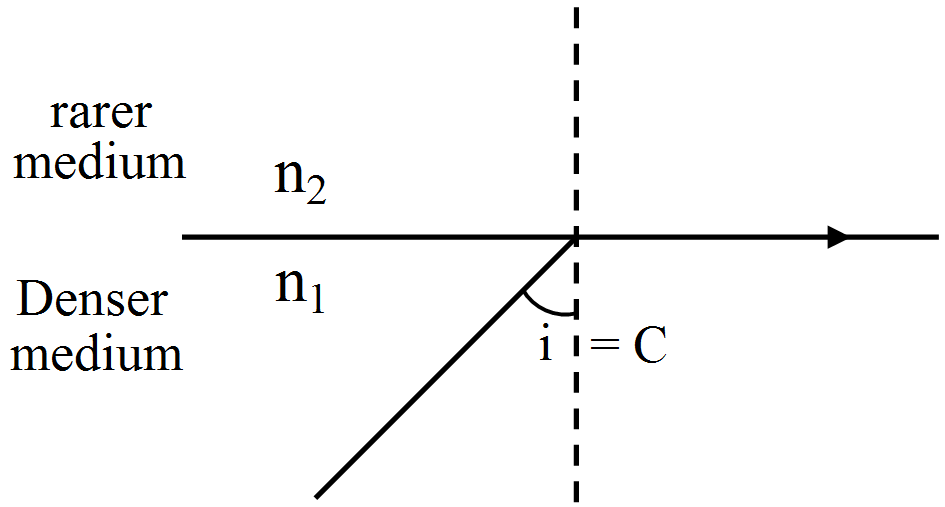
View full question & answer→MCQ 1341 Mark
The image which can be obtained on a screen is called:
- A
- ✓
- C
Either a real or a virtual image
- D
Neither a real nor a virtual image
AnswerThe image which can be obtained on a screen is called a real image.
View full question & answer→MCQ 1351 Mark
What causes chromatic aberration?
- A
- B
- C
Difference in radii of curvature of its surfaces
- ✓
Variation of focal length of lens with colour
AnswerCorrect option: D. Variation of focal length of lens with colour
Chromatic aberration occurs when a lens is either unable to bring all wavelengths of color to the same focal plane and/or wavelengths of color are focused at different positions in the focal plane.
View full question & answer→MCQ 1361 Mark
A car is moving with at a constant speed of 60kmh$^{-1}$ on a straight road. Looking at the rear view mirror, the driver finds that the car following him is at a distance of 100m and is approaching with a speed of $5\ kmh ^{-1}$. In order to keep track of the car in the rear, the driver begins to glance alternatively at the rear and side mirror of his car after every $2s$ till the other car overtakes. If the two cars were maintaining their speeds, which of the following statement $(s)$ is/are correct?
AnswerCorrect option: D. In the side mirror, the speed of the approaching car would appear to increase as the distance between the cars decreases.
We know that, the image formed by convex mirror does not depend on the relative position of object wit mirror. Therefore, the speed of the approaching car would appear to increase as the distance between the cars decreases in the side mirror.
View full question & answer→MCQ 1371 Mark
The image of an extended object, placed perpendicular to the principal axis of a mirror, will be erect if:
- A
The object and the image are both real.
- B
The object is virtual but the image is real.
- C
The object is real but the image is virtual.
- ✓
AnswerExplanation:
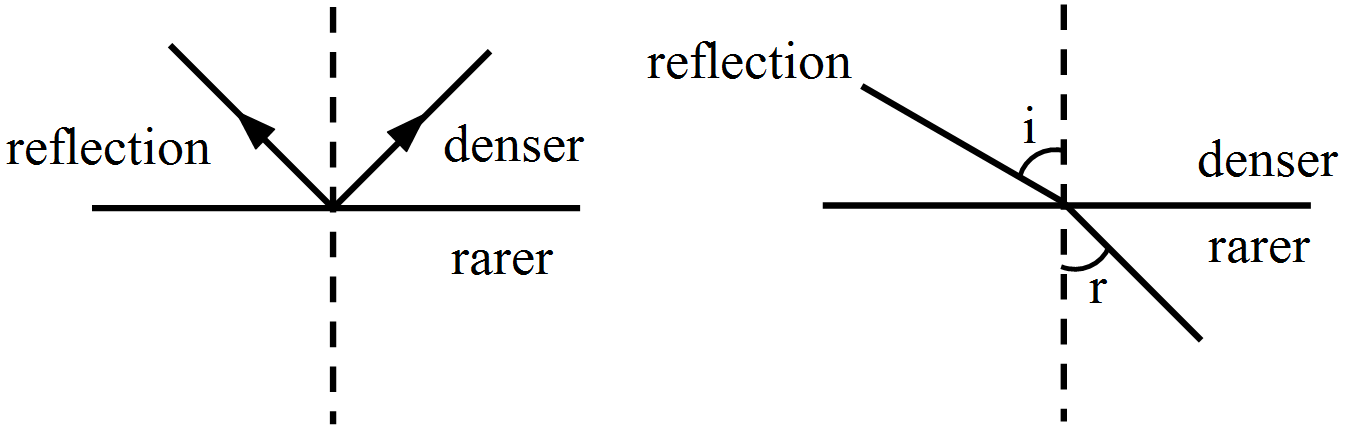
$\text{m}=\frac{-\text{v}}{\mu}=\frac{\text{h}_1}{\text{h}_0}$ (for mirror)
Image will be erect mean height of the object and Image will e lies in same side. It mean if object isreal then Image in virtual. If object is virtula then Image is real. View full question & answer→MCQ 1381 Mark
The angle which subtends the periphery of the spherical mirror at the centre of curvature is called:
Answerdistance between extreme points on the periphery of the spherical mirror is called linear aperture and the angle which the periphery of the spherical mirror subtends at the centre of curvature is called angular aperture.
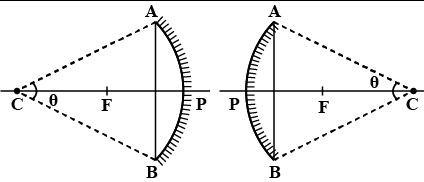
View full question & answer→MCQ 1391 Mark
How should people wearing spectacles work with a microscope?
- A
They should keep on wearing their spectacles.
- B
They should never use the microscope.
- ✓
They should take off their spectacles.
- D
They may either put on their spectacles or they may take off their spectacles.
AnswerCorrect option: C. They should take off their spectacles.
If operators using a microscope usually wear spectacles $($glasses$)$ for activities such as working at their $PC$, they often need to remove them when looking through a microscope so they can align their eyes correctly with the eyepieces.
View full question & answer→MCQ 1401 Mark
The sum of the reciprocals of object distance and image distance is equal to the $.........$ of a mirror.
- A
- ✓
Reciprocal of the focal length
- C
- D
Reciprocal of the radius of curvature
AnswerCorrect option: B. Reciprocal of the focal length
$\frac{1}{\text{v}}+\frac{1}{\text{u}}=\frac{1}{\text{f}}$
View full question & answer→MCQ 1411 Mark
- ✓
- B
- C
- D
Neither erect nor inverted
AnswerStep $1:$ Virtual Image
It is formed when ray of light appear to meet at a point.
Step $2:$ Ray Diagram
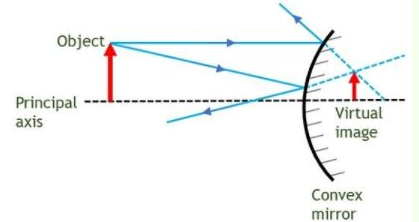
View full question & answer→MCQ 1421 Mark
The distance of the eye$-$lens from the retina is $x$. For a normal eye, the maximum focal length of the eye$-$lens:
- ✓
$= x.$
- B
$< x.$
- C
$> x.$
- D
$= 2x.$
AnswerCorrect option: A. $= x.$
For a normal eye, we have:
Far point at which the object can be placed, $\text{u}=\infty$
Distance between the eye lens and the retina, $\text{v}=\text{x}$
Thus, we have:
$\frac{1}{\text{f}}=\frac{1}{\text{v}}-\frac{1}{\text{u}}$
$\Rightarrow \frac{1}{\text{f}}=\frac{1}{\text{x}}-\frac{1}{\infty}$
$\Rightarrow\text{f}=\text{x}$
View full question & answer→MCQ 1431 Mark
In which of the following the final image is erect?
AnswerOnly in simple microscope the image formed is erect, while it is inverted in compound microscope and astronomical telescope.
View full question & answer→MCQ 1441 Mark
Blue colour of sky is due to:
AnswerBlue light is scattered the most. Hence, as sunlight travels the earth, most of the blue colour is scattered and hence spread. This causes the sky to appear blue in the day.
View full question & answer→MCQ 1451 Mark
An object is placed at a distance u from a simple microscope of focal length $f$. The angular magnification obtained depends:
AnswerCorrect option: C. On $f$ as well as $u.$
The angular magnification is the ratio of the angle subtended by the image to the angle subtended by the object on an unaided eye.
In a simple microscope,
$\text{m}=\frac{\frac{\text{h}}{\text{x}}}{\frac{\text{h}}{\text{D}}}$
Here,
$u =$ Object distance from the lems
$D =$ Image distance form the lens
$h =$ Height of the object
In normal adjustment, the object is placed at a distance equal to focal length $(f)$ from the lens and then magnification is given by m
$=\frac{\text{D}}{\text{f}}$
for $\text{u}<\text{f},\text{ m}=\frac{\text{D}}{\text{f}}+1$
View full question & answer→MCQ 1461 Mark
Select the correct alternative, The angle between the normal and refracted ray is called:
AnswerThe angle formed between the normal and refracted ray at the point of refraction is called angle of refraction.
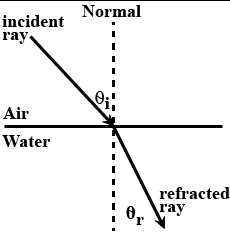
View full question & answer→MCQ 1471 Mark
The focal length of a normal eye$-$lens is about:
- A
$1\ mm.$
- ✓
$2\ cm.$
- C
$25\ cm.$
- D
$1m.$
AnswerCorrect option: B. $2\ cm.$
Given:
Near point of the human eye, $u = -25\ cm$
Distance between the retina and the eye lens, $v = 2\ cm ($approximately$)$
thus, we have the focal length, $f.$
$\frac{1}{\text{f}}=\frac{1}{\text{v}}-\frac{1}{\text{u}}$
$\Rightarrow\frac{1}{\text{f}}\cong\frac{1}{2}-\frac{1}{-25}$
$\Rightarrow\frac{1}{\text{f}}\cong\frac{27}{50}$
$\Rightarrow\text{x}\cong2\text{cm}$
View full question & answer→MCQ 1481 Mark
Which of the following phenomena contributes significantly to the reddish appearance of the sun at sunrise or sunset?
- A
- ✓
- C
Total internal reflection of light
- D
Reflection of light from the earth
AnswerWe see red colour of the sun at sunrise or sunset as the sun at horizon and light rays need to travel a greater distance. In the process of scattering, violet, blue and green rays in the original sunlight are removed and the transmitted beam has yellow and red dominant.
View full question & answer→MCQ 1491 Mark
A man wearing glasses of focal length $+1m$ cannot clearly see beyond $1m:$
AnswerThe man is wearing glasses of positive power $($converging lens$)$. Hence, he cannot see nearby objects clearly. In other words, he is farsighted. Since he cannot see beyond $1m,$ he is nearsighted. If a person with normal vision wears glasses of focal length $+1m,$ then the person will not be able to see beyond $1m.$
View full question & answer→MCQ 1501 Mark
When light travels from one medium into another it suffers:
AnswerWhen light travels from one medium into another it suffers refraction.
View full question & answer→MCQ 1511 Mark
A normal eye is not able to see objects closer than $25\ cm$ because:
- A
The focal length of the eye is $25\ cm.$
- B
The distance of the retina from the eye$-$lens is $25\ cm.$
- C
The eye is not able to decrease the distance between the eye$-$lens and the retina beyond a limit.
- ✓
The eye is not able to decrease the focal length beyond a limit.
AnswerCorrect option: D. The eye is not able to decrease the focal length beyond a limit.
The ciliary muscles adjust the focal length to form an image on the retina, but the muscles cannot be strained beyond a limit. Hence, if the object is brought too close to the eye, the focal length cannot be adjusted to form the image on the retina.
View full question & answer→MCQ 1521 Mark
A parallel beam of light is incident on a converging lens parallel to its principal axis. As one moves away from the lens on the other side on its principal axis, the intensity of light:
- A
- B
- C
- ✓
First increases then decreases.
AnswerCorrect option: D. First increases then decreases.
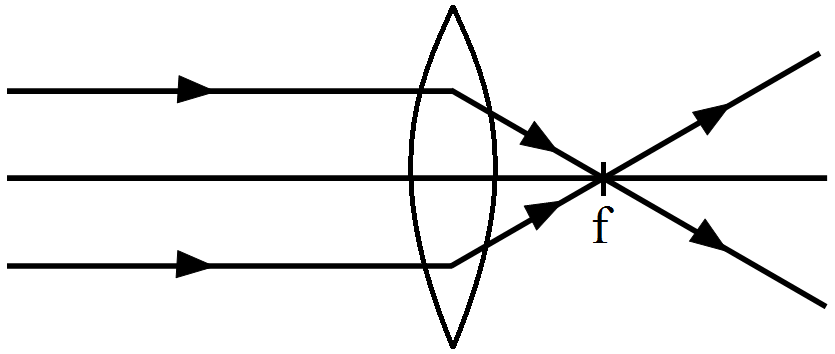
The intensity o light is first increases then decreases.
View full question & answer→MCQ 1531 Mark
A symmetric double convex lens is cut in two equal parts by a plane perpendicular to the principal axis. If the power of the original lens was $4D$, the power of a cutlens will be:
Answer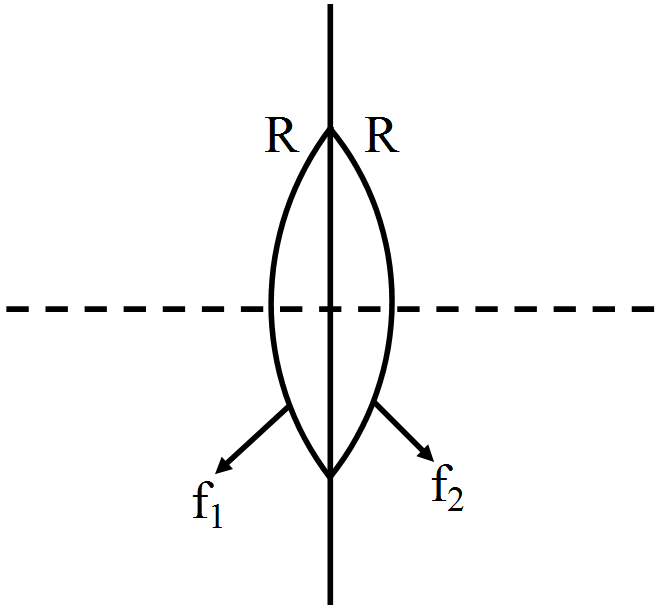
Before cut
$\frac{1}{\text{f}}=(\mu-1)\Big(\frac{2}{\text{R}}\Big)=4\text{D} \ ...(1)$
After cut
$\frac{1}{\text{f}_1}=(\mu-1)\Big(\frac{1}{\text{R}}\Big)+\frac{1}{\text{f}_2}=(\mu-1)\Big(\frac{1}{2}\Big) \ ...(2)$
From eq. $(1)$ we get Power of $f_1$ = power of $f_2$
$\text{P}=\frac{1}{\text{f}_1}=\frac{1}{\text{f}_2}=2\text{D}$
View full question & answer→MCQ 1541 Mark
If a drop of water is introduced between the glass plate and a convex lens in a Newton's ring system, the ring system:
- A
- ✓
- C
- D
First expands then contracts
AnswerWhen a drop of water is introduced between the glass plate and a convex lens then the refractive index of the medium between them increases. So the ring system contracts in Newton's ring system.
View full question & answer→MCQ 1551 Mark
A point source of light is placed at a distance, of $2f$ from a converging lens of focal length $f$. The intensity on the other side of the lens is maximum at a distance:
- A
$f$
- B
between $f$ and $2$
- ✓
$2f$
- D
more than $2f.$
Answer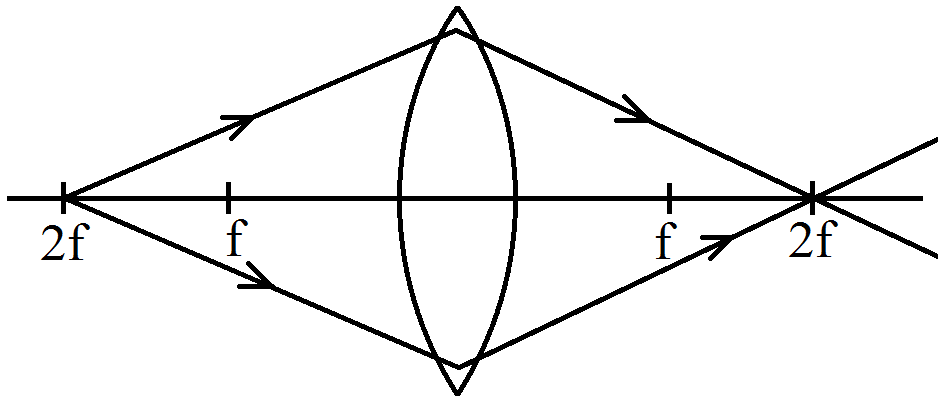
The Intensity on the other side of the lans is maximum at a distance $2f.$
View full question & answer→MCQ 1561 Mark
Whenever light travels from denser medium to a rarer medium:
- ✓
It bends away from the normal
- B
It bends towards the normal
- C
- D
AnswerCorrect option: A. It bends away from the normal
Whenever light travels from a denser medium to a rarer medium, it bends away from the normal due to refraction.
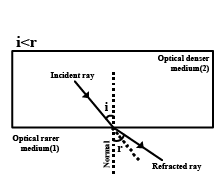
View full question & answer→MCQ 1571 Mark
Red light is used as danger signal because it is:
AnswerRed light is used as danger signal because it is having high wavelength, less scattering ,hence can travel larger distances.
View full question & answer→MCQ 1581 Mark
When the length of a microscope tube increases, its magnifying power:
- ✓
- B
- C
- D
May decrease or increase depending on observer and place of observation.
View full question & answer→MCQ 1591 Mark
- A
$2$ convex lens
- B
$2$ concave lens
- ✓
$1$ convex lens
- D
$1$ concave lens
AnswerCorrect option: C. $1$ convex lens
A simple microscope is made up of a single convex lens fitted in a round metallic frame with a handle.
View full question & answer→MCQ 1601 Mark
A fisherman is standing on the bank of a lake. To a fish underwater viewing obliquely the man looks:
- ✓
Taller than what he actually is
- B
Shorter than what he actually is
- C
The same height as he actually is
- D
AnswerCorrect option: A. Taller than what he actually is
As shown in the diagram,
The due to the refraction of the light, the light will move away from the normal $(NN')$ and consequently, the fish $($denoted as $F)$ will see a longer image of the fisherman $(AB)$ as $AB\ '.$
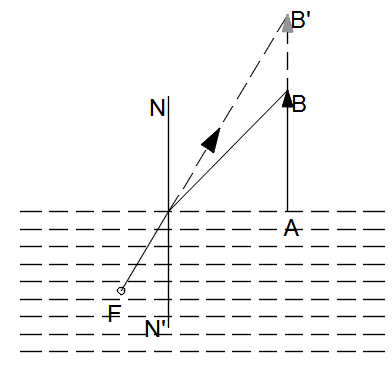
View full question & answer→MCQ 1611 Mark
The muscles of a normal eye are least strained when the eye is focused on an object:
AnswerA normal eye can see from $25\ cm$ to infinity, it faces least difficulty and strain focusing on the object as far as it could be.
View full question & answer→MCQ 1621 Mark
A rectangular block of glass $\text{ABCD}$ has a refractive index $1.6.$ A pin is placed midway on the face $AB ($Fig$)$. When observed from the face $AD$, the pin shall:
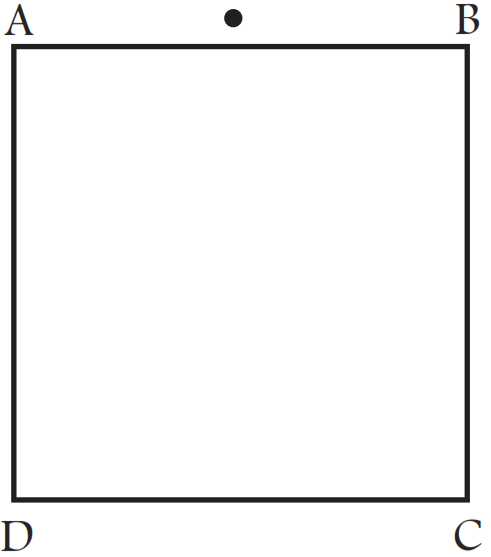
AnswerWe know that, $\Box=\frac{1}{\sin\text{C}}$ Substituting $\Box=1.6$, we get $C = 38.7^\circ$ As long as angle of incidence on $AD$ of the ray emanating from pin is greater than the critical angle, the light suffers from total internal reflection and the pin cannot be seen through $AD.$
View full question & answer→MCQ 1631 Mark
The clear sky appears blue because:
- A
Blue light gets absorbed in the atmosphere.
- B
Ultraviolet radiations are absorbed in the atmosphere.
- ✓
Violet and blue lights get scattered more than lights of all other colours by the atmosphere.
- D
Light of all other colours is scattered more than the violet and blue colour lights by the atmosphere.
AnswerCorrect option: C. Violet and blue lights get scattered more than lights of all other colours by the atmosphere.
The scattering of light depends on the size of the dust particles and the wavelength of the light. The amount of scattering is inversely proportional to the fourth power of wavelength.
Since, violet and blue lights get scattered more than lights of all other colours by the atmosphere the sky appears blue.
View full question & answer→MCQ 1641 Mark
The rays of different colours fail to converge at a point after going through a converging lens. This defect is called:
AnswerBy definition, chromatic aberration is the inability of a converging lens to converge rays of different colour at a point after passing through it.
View full question & answer→MCQ 1651 Mark
The rays of different colours fail to converge at a point after going through a converging lens. This defect is called:
AnswerThe rays of different colours fail to converge at a Point after going through a converging Lens. This defect is called chromatic oberration.
View full question & answer→MCQ 1661 Mark
Finger prints are observed by the use of:
AnswerMicroscope is used for enlarging tiny objects or details which our eyes cannot detect. It is used to highly magnify the patterns and design of Finger prints and is widely used for Fingerprint tracing.
View full question & answer→