MCQ 11 Mark
When the current through the electromagnet of a relay reaches a particular value:
- A
- B
It open the circuit by pulling in an iron contact.
- C
It closes the circuit by pulling in an iron contact.
- ✓
Both $A$ or $C.$
AnswerCorrect option: D. Both $A$ or $C.$
They are ways of switching using a low current to use an electromagnet to close or open a spring steel contact.They are often used to isolate a user from a high voltage that needs to be switched, using low current, low voltage to operate the relay, rather than having a user come in direct proximity to the higher voltage that needs to be switched.When the current through the electromagnet of a relay reaches a particular value it either breaks the circuit by repllening or closes the circuit by pulling in an iron contact.
View full question & answer→MCQ 21 Mark
The magnetic compass is not useful for navigation near the magnetic poles, since:
- A
$R = 0$
- B
$V = 0$
- ✓
$H = 0$
- D
$\theta=0^\circ$
AnswerCorrect option: C. $H = 0$
View full question & answer→MCQ 31 Mark
According to Lenz's law there is conversion of:
AnswerLenz's law deals with conversion of mechanical energy into electromagnetic energy in case of electromagnetic induction. Hence Lenz's law is basically a conversion of energy from one form to another.
View full question & answer→MCQ 41 Mark
The magnetic susceptibility is negative for:
- ✓
Diamagnetic material only.
- B
Paramagnetic material only.
- C
Ferromagnetic material only.
- D
Paramagnetic and ferromagnetic materials.
AnswerCorrect option: A. Diamagnetic material only.
View full question & answer→MCQ 51 Mark
The hysteresis cycle for the material of permanent magnet is:
MCQ 61 Mark
The upper limit temperature of a super conductor is:
- A
$115K$
- B
$120K$
- ✓
$125K$
- D
$130K$
AnswerCorrect option: C. $125K$
Superconductors are materials that conduct electricity with no resistance. This means that, unlike the more familiar conductors such as copper or steel, a superconductor can carry a current indefinitely without losing any energy.
The upper limit temperature of a superconductor is $125K$
View full question & answer→MCQ 71 Mark
The substances which are attracted towards a magnet are called $.......$.
AnswerCorrect option: B. Ferro$-$magnetic materials
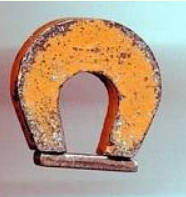
The substances which are attracted towards a magnet are called ferro-magnetic materials Materials that can be magnetized, which are also the ones that are strongly attracted to a magnet, are called ferromagnetic $($or ferrimagnetic$)$. These include iron, nickel, cobalt, some alloys of rare$-$earth metals, and some naturally occurring minerals such as lodestone.
View full question & answer→MCQ 81 Mark
The value of Curie temperature for $Ni$ is nearly:
- ✓
$631K$
- B
$770K$
- C
$890K$
- D
$1100K$
AnswerCorrect option: A. $631K$
Above $631K \ Ni$ behaves like paramagnetic material.
View full question & answer→MCQ 91 Mark
Which of the following is the most suitable material for making permanent magnet?
MCQ 101 Mark
Permanent magnets should have:
- A
High retentivity and low coercivity.
- B
Low retentivity and high coercivity.
- ✓
High retentivity and high coercivity.
- D
Low retentivity and low coercivity.
AnswerCorrect option: C. High retentivity and high coercivity.
Permanent magnets should have high retentivity so that a strong magnetic field persists on removal of magnetic field.
Permanent magnets should have high coercivity so that external magnetic field in opposite direction cannot easily demagnetize the magnet.
View full question & answer→MCQ 111 Mark
When does a magnetic dipole possess maximum potential energy inside a magnetic field?
- ✓
Magnetic moment and magnetic field are antiparallel.
- B
Magnetic moment and magnetic field are parallel.
- C
The magnetic moment is zero.
- D
The magnetic field is zero.
AnswerCorrect option: A. Magnetic moment and magnetic field are antiparallel.
A magnetic dipole possess maximum potential energy when its magnetic moment and the magnetic field are antiparallel. When the magnetic dipole is aligned along the magnetic field, i.e. when $\theta = 180^\circ,$ it is in unstable equilibrium having maximum potential energy.
View full question & answer→MCQ 121 Mark
The hysteresis cycle for the material of permanent magnet is:
AnswerPermanent magnet should have large coercivity and large retentivity. Therefore, the hysteresis cycle of the material should be tall and wide.
View full question & answer→MCQ 131 Mark
The line of force in a magnetic field represents the direction at each point that a magnetic needle placed at the point takes up. Do they also represent the direction of the force on a moving charge at each point?
- ✓
- B
Represent circular motion.
- C
Represent tangential motion.
- D
Represents translatory motion.
AnswerNo. The force on a charge is perpendicular to the direction of the magnetic field at each point.
$F = q (v \times B).$
It is inappropriate to call magnetic field lines as lines of force.
View full question & answer→MCQ 141 Mark
The inherent property of all materials is:
AnswerDiamagnetism $($where orbital motion of electrons creates tiny atomic current loops, which produce magnetic fields$)$ is a property of all materials and opposes applied magnetic fields, but is very weak.
View full question & answer→MCQ 151 Mark
The permanent magnetic moment of the atoms of a material is zero. The material:
AnswerThe permanent magnetic moment of the atoms of a material is zero. The material must be diamagnetic.
View full question & answer→MCQ 161 Mark
The primary origin $(s)$ of magnetism lies in:
- ✓
- B
Polar nature of molecules.
- C
Extrinsic spin of electron.
- D
View full question & answer→MCQ 171 Mark
ike magnetic force $.......$ each other.
AnswerLike magnetic force repel each other whereas unlike magnetic poles attract each other.
View full question & answer→MCQ 181 Mark
Lenz's law is a consequence of the law of conservation of:
AnswerAccording to Lenz's law an induced electromotive force $(emf)$ always gives rise to a current whose magnetic field opposes the original change in magnetic flux.
It is a common way of understanding how electromagnetic circuits obey newton's third law and the conservation of energy.
View full question & answer→MCQ 191 Mark
Magnetic field can be defined as the:
- ✓
Space surrounding the magnet in which magnetic force acts.
- B
Space surrounding the magnet in which electric force acts.
- C
Space surrounding the magnet in which no force acts.
- D
AnswerCorrect option: A. Space surrounding the magnet in which magnetic force acts.
A magnetic field is generated when electric charge carriers such as electrons move through space or within an electrical conductor. It is the space surrounding the magnet in which magnetic force acts. Its intensity is represented by magnetic lines of force.
View full question & answer→MCQ 201 Mark
The magnetic force required to demagnetise the material is:
AnswerCoercivity is the magnetic force required to demagnetise the material.
View full question & answer→MCQ 211 Mark
In the hysteresis cycle, the value of $H$ needed to make the intensity of magnetism zero is called:
AnswerThe value of $H$ needed to remove the residual magnetism is coercive force or coercivity.
View full question & answer→MCQ 221 Mark
The permanent magnetic moment of the atoms of a material is not zero. The material:
AnswerUnlike paramagnetic materials, the atomic moments in ferromagnetic materials exhibit very strong interactions. These interactions are produced by electronic exchange forces and result in a parallel or antiparallel alignment of atomic moments.
This results in permanent non-zero magnetic moment of atoms in these materials.
View full question & answer→MCQ 231 Mark
On cutting a solenoid in half, the field lines remain $...A...$ emerging from one face of the solenoid and entering into the other face. Here, A refers to.
View full question & answer→MCQ 241 Mark
Which of the following statements can help you to determine the direction of induced current in Electromagnetic Induction?
- A
Induced current flows such that it increase the total value of current.
- B
Induced current flows such that it reduces the total value of current.
- ✓
Induced current flows such that direction of magnetic field produced from induced current opposes change in external magnetic field.
- D
Induced current flows such that direction of magnetic field produced from induced current opposes external magnetic field.
AnswerCorrect option: C. Induced current flows such that direction of magnetic field produced from induced current opposes change in external magnetic field.
Lenz's Law states that the direction of an induced current is always such as to oppose the change in the circuit or the magnetic field that produces it. So according to this law, induced current flows to oppose the cause.
View full question & answer→MCQ 251 Mark
Demagnetisation of magnets can be done by:
- A
- B
- C
Magnetising in the opposite direction.
- ✓
View full question & answer→MCQ 261 Mark
Consider the two idealized systems: $(i)$ a parallel plate capacitor with large plates and small separation and $(ii)$ a long solenoid of length$ L > > R$, radius of cross-section. In $(i)$ E is ideally treated as a constant between plates and zero outside. In $(ii)$ magnetic field is constant inside the solenoid and zero outside. These idealised assumptions, however, contradict fundamental laws as below:
- A
Case $(i)$ contradicts Gauss’s law for electrostatic fields.
- ✓
Case $(ii)$ contradicts Gauss’s law for magnetic fields.
- C
Case $(i)$ agrees with $\oint\text{E.dl=0.}$
- D
Case $(ii)$ contradict $\oint\text{H.dl}=\text{I}_\text{en}$.
AnswerCorrect option: B. Case $(ii)$ contradicts Gauss’s law for magnetic fields.
Key concept: The electrostatic field lines, do not form a continuous closed path (this follows from the conservative nature of electric field) while the magnetic field lines form the closed paths.
According to the Gauss' law, $\oint\text{E.ds}=\frac{\text{q}}{\in_0}$ for electronstatic field. It does not contradict foe eletrostatic fields as the elecric field lines do not form a continuous closed path.
According to Gauss' law in magnetism.
$\oint\text{B.ds}=0$
Which implies that number of magnetic field lines entering the Gaussian surface is equal to the number of magnetic field lines leaving it. Therefore case $(ii)$ is not possible.
View full question & answer→MCQ 271 Mark
If $\mu_0$is absolute permeability of vacuum and $\mu\text{r}$ is relative magnetic permeability of another medium, then permeability $\mu$ of the medium is:
- ✓
$\mu\ \mu_\text{r}$
- B
$\frac{\mu}{\mu_\text{r}}$
- C
$\frac{\mu_\text{r}}{\mu}$
- D
$\frac{1}{\mu\ \mu_\text{r}}$
AnswerCorrect option: A. $\mu\ \mu_\text{r}$
View full question & answer→MCQ 281 Mark
Core of elctromagnets are made of ferromagnetic materials which have:
- A
Low permeability and low retentivity.
- B
High permeability and high retentivity.
- ✓
High permeability and high retentivity.
- D
Low permeability and high retentivity.
AnswerCorrect option: C. High permeability and high retentivity.
View full question & answer→MCQ 291 Mark
A magnetic needle of magnetic moment $6.7 \times 10^{-2} Am ^2$ and moment of inertia $7.5 \times 10^{-6} \ kg \ m m ^2$ is performing simple harmonic oscillations in a magnetic field of $0.01 T$ . Time taken for $10$ complete oscillations is:
- A
$6.98 s.$
- B
$8.76 s.$
- ✓
$6.65 s.$
- D
$8.89 s.$
AnswerCorrect option: C. $6.65 s.$
View full question & answer→MCQ 301 Mark
Which one of the following, when suspended freely, slowly sets itself parallel to the direction of the magnetic field?
AnswerParamagnetic materials are those when suspended freely inside the magnetic field, it slowly sets itself parallel to the direction of the magnetic field. When placed in a non$-$uniform magnetic field, it tends to move from weaker to a stronger magnetic field.
View full question & answer→MCQ 311 Mark
A magnetic field can be produced by:
- A
- B
A changing electric field.
- C
- ✓
AnswerA moving charge and changing electric field both produces magnetic field.
View full question & answer→MCQ 321 Mark
The narrowest hysterisis loop is for:
AnswerA narrow hysteresis loop implies a small amount of dissipated energy. This occurs as a result of its small area and therefore more frequently repeated reversals of applied magnetising force. Soft magnetic are materials used in devices that require alternating magnetic fields have these narrow hysteresis shapes.
View full question & answer→MCQ 331 Mark
Permanent magnets are made from:
- A
- B
- ✓
Ferromagnetic substances.
- D
AnswerCorrect option: C. Ferromagnetic substances.
Ferromagnetic substance, Because they get magnetize in external magnetic field and don't lose their magnetic property.
View full question & answer→MCQ 341 Mark
Which of the following group is diamagnetic?
- ✓
Copper, hydrogen, silver.
- B
- C
- D
AnswerCorrect option: A. Copper, hydrogen, silver.
Diamagnetic substances are those which are freebly repelled by the magnetic field
$\therefore$ Copper, Hydrogen, Silver are diamagnetic as their atoms have net magnetic dipole moment zero.
View full question & answer→MCQ 351 Mark
When a straight wire is moved up and down rapidly between two poles of a horseshoe magnet then $.......$ is produced in the wire.
AnswerAn electric current is produced in the wire. The production of electricity from magnetism is called electromagnetic induction.
View full question & answer→MCQ 361 Mark
A space or region around a magnet in which a force is experienced by magnetic pole is called.
AnswerA surrounding around a magnet in which source is felt is due to magnetic property of the magnet term as magnetic field.
View full question & answer→MCQ 371 Mark
Consider a magnetic dipole kept in the north to south direction. Let $P_1, P_2, Q_1, Q_2$ be four points at the same distance from the dipole towards north, south, east and west of the dipole respectively. The directions of the magnetic field due to the dipole are the same at:
- A
$P_1$ and $P_2$
- B
$Q _1$ and $Q _2$
- ✓
- D
$P_2$ and $Q_2$
Answera. $P_1$ and $P_2$
b. $Q_1$ and $Q_2$
Explanation
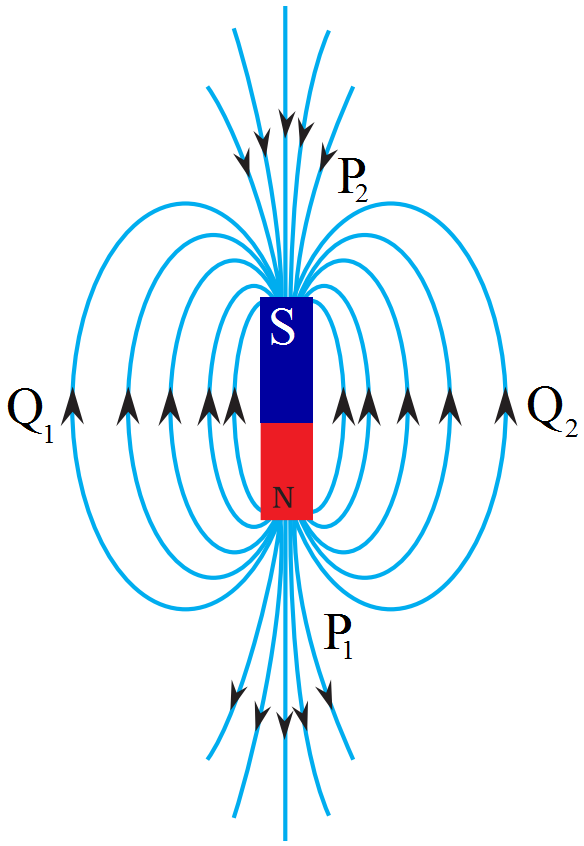
We know that magnetic field lines are directed from the north pole to the south pole. From the given figure, we can say that the direction of magnetic field $\vec{B}$ is the same only at points $P_1$ and $P_2$ and at points $Q_1$ and $Q_2$. View full question & answer→MCQ 381 Mark
The curie weiss law is obeyed by iron:
- A
- ✓
Above the curie temperature.
- C
Below the curie temperature.
- D
At the curie temperature.
AnswerCorrect option: B. Above the curie temperature.
Curie $-$ Wiess Law states that all ferromagnetic substances become paramagnteic above the curie temperature.
View full question & answer→MCQ 391 Mark
Find the false statement.
AnswerCorrect option: C. Magnetic intensity and intensity of magnetization are the same.
The statement magnetic intensity and intensity of magnetization are the same is the false one. They are not the same. When a magnet is entering a magnetic field, then the poles of the magnet experiences certain forces. Magnetic intensity refers to the measure of these forces. But, the intensity of magnetization explains the change in the magnetic moment of a magnet as a function of volume. All the other statements are valid.
View full question & answer→MCQ 401 Mark
A horse-shoe magnet is an example of $.......$
- A
- ✓
- C
Neither natural nor artificial.
- D
AnswerArtificial magnets are man-made magnets. Magnets that are made from iron in different components shapes and sizes for different uses are called artificial magnets.
View full question & answer→MCQ 411 Mark
Which of the following is another term for magnetization?
AnswerMagnetization is also termed as magnetic polarization. Magnetic polarization is basically a balance between the magnetic flux density in a space which is devoid of matter and the magnetic flux density in a space with matter, i.e. in a material.
View full question & answer→MCQ 421 Mark
A circular coil and a bar magnet moves with the same velocity. Then
- ✓
There will be no induced emf in the coil.
- B
There will be an induced emf in the coil.
- C
An emfwill be induced in the magnet.
- D
AnswerCorrect option: A. There will be no induced emf in the coil.
Since the coil and the magnet are moving with same velocity, so there will be no change in magnetic flux linked with the coil due to magnet. Hence no emf is induced in the coil.
View full question & answer→MCQ 431 Mark
Materials suitable for permanent magnet, must have which of the following properties?
- A
High retentivity, low coercivity and high permeability.
- B
Low retentivity, low coercivity and low permeability.
- C
Low retentivity, high coercivity and low permeability.
- ✓
High retentivity, high coercivity and high permeability.
AnswerCorrect option: D. High retentivity, high coercivity and high permeability.
View full question & answer→MCQ 441 Mark
One can define $...A...$ of a place as the vertical plane which passes through the imaginary line joining the magnetic North and the South–poles.Here, $A$ refers to.
View full question & answer→MCQ 451 Mark
In an atom, electrons revolve around the nucleus. This gives rise to:
- A
- B
- ✓
Both electric and magnetic fields.
- D
AnswerCorrect option: C. Both electric and magnetic fields.
When a charge electron starts to move, electric current generates and this electric current generates magnetic field, a charge at rest also can generate electric field.
View full question & answer→MCQ 461 Mark
A circular loop carrying a current is replaced by an equivalent magnetic dipole. A point on the axis of the loop is in:
- ✓
End$-$on position.
- B
Broadside$-$on position.
- C
- D
AnswerCorrect option: A. End$-$on position.
View full question & answer→MCQ 471 Mark
Which of the following is the definition for magnetic meridian of Earth?
- ✓
Vertical plane passing through the axis of a freely suspended or pivoted magnet.
- B
Horizontal plane passing through the axis of a freely suspended or pivoted magnet.
- C
Vertical plane passing through the geographical North Pole and South Pole at a given place.
- D
Horizontal plane passing through the geographical North Pole and South Pole at a given place.
AnswerCorrect option: A. Vertical plane passing through the axis of a freely suspended or pivoted magnet.
A vertical plane passing through the axis of a freely suspended or pivoted magnet is known as magnetic meridian of Earth. The vertical plane passing through the geographical North Pole and South Pole at a given place is known as the geographical meridian of that place.
View full question & answer→MCQ 481 Mark
When a ferromagnetic material goes through a hysteresis loop, the magnetic susceptibility:
AnswerExplanation:
When a ferromagnetic material goes through a Hysteresis loop, the Magnetic susceptibility may be zero, may be infinity or may be negative.
View full question & answer→MCQ 491 Mark
The value of resistivity of super conductor is:
AnswerIn superconductors, the resistance drops abruptly to zero when the material is cooled below its critical temperature. Thus resistivity of superconductors is zero below its critical temperature.
View full question & answer→MCQ 501 Mark
The magnetism of magnet is due to:
- A
Pressure of big magnet inside the earth.
- B
- C
- ✓
The spin motion of electron.
AnswerCorrect option: D. The spin motion of electron.
View full question & answer→MCQ 511 Mark
The ratio of magnetic fields due to a smaller bar magnet in the end on position to broad side on position is:
MCQ 521 Mark
The hysterisis curve is studied generally for:
MCQ 531 Mark
Meena draws magnetic field lines of the field close to the axis of a current carrying circular loop. As she moves away from the center of the circular loop she observes that the lines keep ?
AnswerMeena draws a magnetic field lines of field close to the axis of a current carrying circular loop.as she moves away from the centre of the circular loop she observes that the lines keep on diverging.Strength of the magnetic field falls as distance increases. This is indicated by the decrease in degree of closeness of the lines of field.
View full question & answer→MCQ 541 Mark
A circular loop carrying a current is replaced by ann equivalent magnetic dipole. A point on the axis of the loop is in:
- ✓
End$-$on position.
- B
Broadside$-$on position.
- C
- D
AnswerCorrect option: A. End$-$on position.
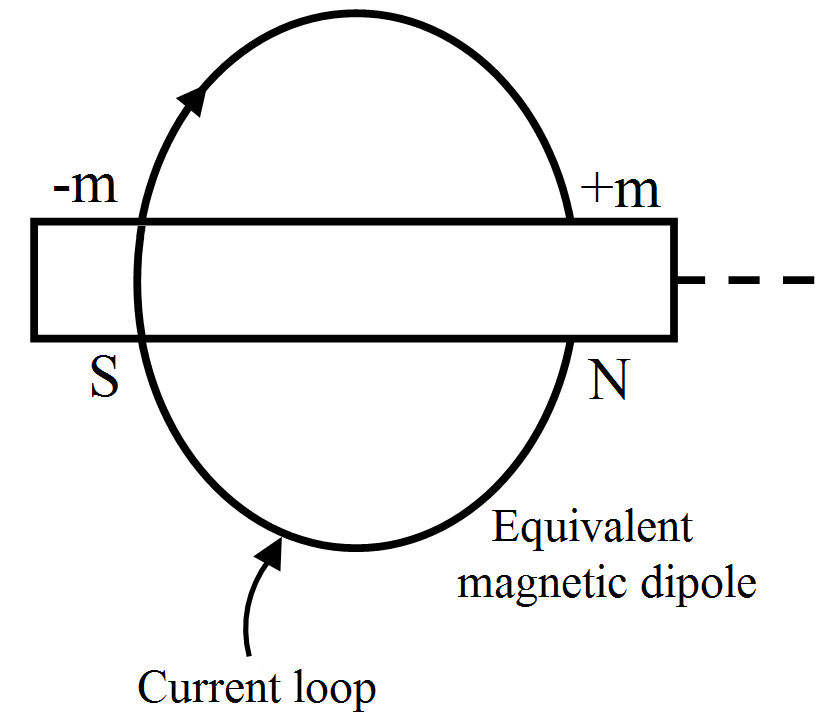
Points lying on the axis of a magnet are called end$-$on points. In our case, the point on the axis of the loop $($on replacing the circular loop with an equivalent magnetic dipole$)$ lies on the axis of the magnetic dipole or on the end$-$on position.
If P was the point on the axis of the loop, then it is clear from the figure that $P$ lies on the end$-$on position of the equivalent magnetic dipole.
View full question & answer→MCQ 551 Mark
The desirable properties for making permanent magnets are:
- ✓
High retentivity and high coercive force.
- B
High retentivity and low coercive force.
- C
Low retentivity and high coercive force.
- D
Low retentivity and low coercive force.
AnswerCorrect option: A. High retentivity and high coercive force.
Permanent magnetis are High retentivity and High coercive force.
View full question & answer→MCQ 561 Mark
A dip circle is taken to geomagnetic equator. The needle is allowed to move in a vertical plane perpendicular to the magnetic meridian. The needle will stay:
- A
In horizontal direction only.
- B
In vertical direction only.
- C
In any direction except vertical and horizontal.
- ✓
In the direction it is released.
AnswerCorrect option: D. In the direction it is released.
At the geomagnetic equator, the needle tries to suspend itself in horizontal direction. But here the needle is restricted to move only in the vertical plane perpendicular to the magnetic meridian. Hence, the needle will stay in the direction it is released.
View full question & answer→MCQ 571 Mark
A watch glass containing some powdered substance is placed between the pole pieces of a magnet. Deep concavity is observed at the centre. The substance in the watch glass is:
AnswerIron is a ferromagnetic substance the property which makes it attach to magnets. This causes the concavity. Chromium is anti$-$ferromagnetic, wood and carbon are not magnetic materials.
View full question & answer→MCQ 581 Mark
At Curie temperature the ferromagnetic materials get converted into.
AnswerAbove curie temperature ferromagnetic material behaves like paramganetic materials. There magnetic susceptibilty starts varying linearly with temperature. Their I becomes too small above curies temperature.
Therefore, nature of ferrromagnetic materials becomes paramagnetic.
View full question & answer→MCQ 591 Mark
S is the surface of a lump of magnetic material:
- A
Lines of B are necessarily continuous across S.
- B
Some lines of B must be discontinuous across S.
- C
Lines of H cannot all be continuous across S.
- ✓
AnswerSolution:
Key concept: Here we are introducing properties of magnetic field lines (B), for any magnet, it forms continuous closed loops. This is unlike the electric dipole where these field lines begin from a positive charge and end on the negative charge or escape to infinity.
Also, magnetic intensity (H) outside any magnet is $\text{H}=\frac{\text{B}}{\mu_0}$ and for inside the magnet $\text{H}=\frac{\text{B}}{\mu_0\mu_\text{r}}$, where $\mu_\text{r}$ is the relative permeability of material (magnetic).
Magnetic field lines for magnetic field $(\vec{\text{B}})$ is continuous upon a transition through the interface.
Also, magnetic intensity $(\vec{\text{H}})$ varies for inside and ojutside the lump. So, lines of $(\vec{\text{H}})$ cannot all be continuous across S.
View full question & answer→MCQ 601 Mark
Choose the correct statement about the properties of magnetic lines of forces.
- A
Lines of force are not imaginary lines.
- B
Lines of force cannot be mapped on paper.
- ✓
Lines of force do not intersect each other.
- D
Lines of force always intersect each other.
AnswerCorrect option: C. Lines of force do not intersect each other.
Magnetic lines of force start from the North Pole and end at the South Pole out side the bar magnet.
They are continuous through the body of magnet.
Magnetic lines of force are closed circular loops.
Two magnetic lines of force can not intersect each other because, if they intersect there will be two directions of magnetic field at the point of intersection, which is impossible.
Crowded magnetic lines of force show greater magnetic strength and vice$-$versa.
View full question & answer→MCQ 611 Mark
Which of the following is/ are true for "magnetic lines of force around a bar magnet"?
- A
Are closed continuous curves.
- B
Travel from north to south outside the magnet.
- C
Bend around the length of magnet.
- ✓
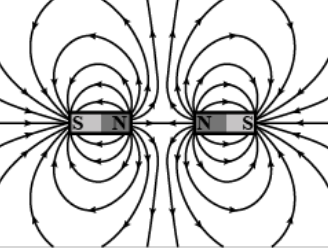
AnswerThe properties of magnetic lines are.
They travel from a north pole to south pole.
They bend around the length of the magnet.
They form a closed loop with continuous lines.
View full question & answer→MCQ 621 Mark
Curie temperature is the temperature above which:
- ✓
A ferromagnetic material becomes paramagnetic.
- B
A paramagnetic material becomes diamagnetic.
- C
A ferromagnetic material becomes diamagnetic.
- D
A paramagnetic material becomes ferromagnetic.
AnswerCorrect option: A. A ferromagnetic material becomes paramagnetic.
Curie Tempearture is the temperature at which certain materials lose their permanent magnetic properties, to be replaced by induced magnetism. In other words, it is the temperature above which a ferromagnetic material becomes paramagnetic.
View full question & answer→MCQ 631 Mark
How are the field lines in a uniform magnetic field ?
AnswerCorrect option: B. Parallel equidistant straight lines.
A uniform magnetic field is a magnetic field that has the same magnitude and direction throughout the region under consideration, thus the field lines need to be both parallel and spaced out evenly. The density of field lines at a specific point decide the strength of the field at that point, thus a uniform magnetic field or any uniform field for that matter must have the same number of field lines at every point under consideration.
So a uniform magnetic field would look like a bunch of parallel lines spaced out at equal distance from one another.
View full question & answer→MCQ 641 Mark
Among which of the following the magnetic susceptibility does not depend on the temperature?
- ✓
Dia$-$magnetism.
- B
Para$-$magnetism.
- C
Ferro$-$magnetism.
- D
AnswerCorrect option: A. Dia$-$magnetism.
View full question & answer→MCQ 651 Mark
Magnetic dipole moment is a vector quantity directed from:
- ✓
South pole to north pole.
- B
North pole to south pole.
- C
- D
AnswerCorrect option: A. South pole to north pole.
View full question & answer→MCQ 661 Mark
Magnetic field intensity is defined as:
- A
Magnetic moment per unit volume.
- ✓
Magnetic induction force acting on a unit magnetic pole.
- C
Number of lines of force crossing per unit area.
- D
Number of lines of force crossing per unit volume.
AnswerCorrect option: B. Magnetic induction force acting on a unit magnetic pole.
View full question & answer→MCQ 671 Mark
The magnetic materials having negative magnetic susceptibility are:
AnswerMagnetic susceptibility is a dimensionless proportionality constant that indicates the degree of magnetisation of a material in response to an applied magnetic field.
Substances such as copper, iron have negative susceptibility as these substances are diamagnetic substances.
Substances with negative susceptibility signifies that they are repelled by magnets.
View full question & answer→MCQ 681 Mark
Which among the following is not attracted by magnets?
AnswerA magnet is a material that has both attractive and directive properties. It attracts small pieces of iron, nickel, cobalt, etc. This property of attraction is called magnetism. Going by this criteria, copper is not attracted by magnets.
View full question & answer→MCQ 691 Mark
A freely suspended magnet aligns in which direction?
- A
South$-$west
- B
East$-$west
- ✓
North$-$south
- D
North$-$west
AnswerCorrect option: C. North$-$south
A freely suspended magnet aligns in north$-$south direction.
View full question & answer→MCQ 701 Mark
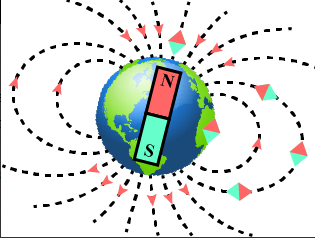
A compass needle, which shows the direction at the earth's magnetic pole is:
AnswerFor a compass to show the direction of magnetic pole moment, they must be placed at ether of the $2$ geographic poles. It is because the direction of magnetic moment is from south to north pole.
The compass therefore will be vertical at both the poles.
View full question & answer→MCQ 711 Mark
A small magnet is placed perpendicular to a uniform magnet field. The forces acting on the magnet will result in:
- ✓
- B
- C
- D
Both straight line and rotational motion.
AnswerA magnet placed in a magnetic field will feel a torque that will try to align the magnet with the magnetic field.This magnetic torque is the basis for how compasses work.
View full question & answer→MCQ 721 Mark
Susceptibility is positive for:
- A
- B
- C
- ✓
Option $(a)$ and $(b).$
AnswerCorrect option: D. Option $(a)$ and $(b).$
Susceptibility is positive for ferromagnetic as well as paramagnetic materials.
View full question & answer→MCQ 731 Mark
A circular loop carrying a current is replaced by an equivalent magnetic dipole. A point on the loop is in:
- A
End$-$on position.
- ✓
Broadside$-$on position.
- C
- D
AnswerCorrect option: B. Broadside$-$on position.
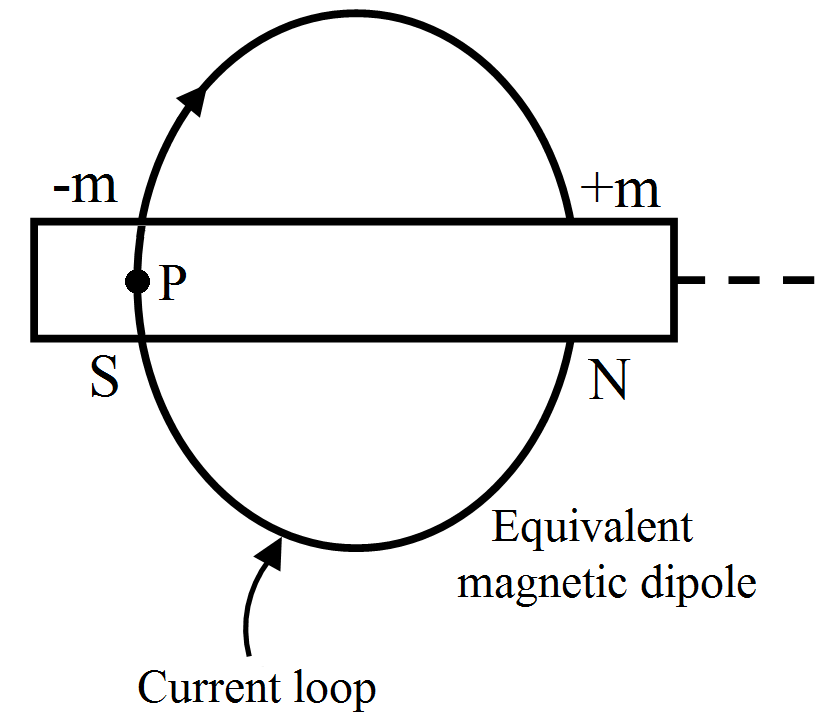
The position of the points lying on the equator of a magnetic dipole is called the broadside$-$on position. In our case, the point on the loop $($after replacement of the circular loop with an equivalent magnetic dipole$)$ lies on the equatorial position of the equivalent magnetic dipole. Hence, the point lies on the broadside$-$on position.
If $P$ was the point on the loop, then it is clear from the figure that point $P$ lies on the broadside$-$on position of the equivalent magnetic dipole.
View full question & answer→MCQ 741 Mark
What is the direction of magnetic field at the centre of a coil carrying clockwise current ?
- A
- B
normal to the axis of coil inwards.
- ✓
Along the axis of coil inwards.
- D
Along the axis of coil outwards.
AnswerCorrect option: C. Along the axis of coil inwards.
A solenoid is a long coil of wire wrapped in many turns. The magnetic field within a solenoid depends upon the current and density of turns. Its direction depends on the direction of the current. When a current passes through it, it creates a nearly uniform magnetic field inside or along the axis of the solenoid. Outside the coil or solenoid, that is, at the ends and beyond the magnetic field is small and appears to diverge.
When the current flows through the solenoid in the clockwise direction, then the magnetic lines of force inside or center of the coil will be along the axis inwards according to Fleming's right hand rule. Hence Magnetic field at the centre of a coil carrying a clockwise current will be along the axis of coil inwards.
View full question & answer→MCQ 751 Mark
Pick out the material that cannot be used to make permanent magnets.
AnswerPermanent magnets are made up of materials having high retentivity, high coercivity, and high permeability such as steel. Other suitable materials for making permanent magnets are alnico $($an alloy of iron, aluminum, nickel, copper, and cobalt$),$ cobalt steel, and ticonal. That leaves zinc as the one that cannot be used to make permanent magnets.
View full question & answer→MCQ 761 Mark
- A
Has its own persistent magnetic field.
- ✓
Acts as a magnet when an electric current passes through it.
- C
Both $A$ and $B.$
- D
AnswerCorrect option: B. Acts as a magnet when an electric current passes through it.
Electromagnets are a different from permanent magnets. Electromagnets are made of coils of wire with electricity passing through them.
When the coils of wire in an electromagnet have an electric current passing through them then magnetic field produced around the coils so the coils behave like a magnet.
View full question & answer→MCQ 771 Mark
Figure shows the magnetic field lines in a magnetic field. $A, B.$ and $C$ are three points in this field. At what point is the magnetic field strong ?
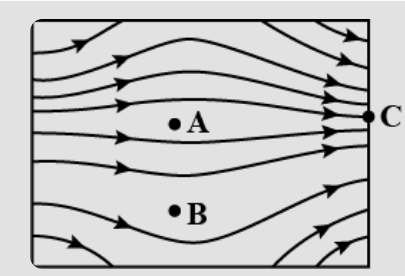
AnswerThe close continuous curves in a magnetic field are called magnetic lines of force. Curved lines are used to represent a magnetic field, drawn such that the number of lines relates to the magnetic field's strength at a given point and the tangent of any curve at a particular point is along the direction of magnetic force at that point.
The magnetic lines of force are uniform and strong at the point $C$ and they diverge as they move towards points $A$ and $B$ and the distance between the lines increases. Eventually, the strength of the magnetic field is strong where the lines are closer and they weaken as the closeness decreases.
View full question & answer→MCQ 781 Mark
When the temperature of a magnetic material decreases, the magnetization.
- A
Decreases in a diamagnetic material.
- B
Decreases in a paramagnetic material.
- C
Decreases in a ferromagnetic material.
- ✓
Remains the same in a diamagnetic material.
AnswerCorrect option: D. Remains the same in a diamagnetic material.
View full question & answer→MCQ 791 Mark
A horizontal circular loop carries a current that looks clockwise when viewed from above. It is replaced by an equivalent magnetic dipole consisting of a south pole S and a north pole N:
- A
The line SN should be along a diameter of the loop.
- B
The line SN should be perpendicular to the plane of the loop.
- C
The south pole should be slow the loop.
- ✓
AnswerA horizontal circular loop carrying current in clockwise direction acts like the south pole of a magnet. Hence, the south pole of the magnet coincides with the loop.
Now, when the loop carrying current in clockwise direction is viewed from above, it looks like the magnetic lines of force are entering the loop thus it acts like south pole of a magnet. And if we view from below the loop then it appears that magnetic lines of force are leaving the loop. Hence, the north pole should be below the loop.
View full question & answer→MCQ 801 Mark
The SI unit of magnetic flux is:
AnswerThe $SI$ unit of magnetic flux is Weber.
View full question & answer→MCQ 811 Mark
The primary origin(s) of magnetism lies in:
- A
- B
Pauli exclusion principle.
- C
Intrinsic spin of electron.
- ✓
AnswerSolution:
The primary origin of magnetism lies in the fact that the electrons are revolving and spinning about the nucleus of an atom, and we know that an moving charge carries current along with it. We meant this current here as atomic current and which is responsible to produce an orbital magnetic moment. This atomic current gives rise to magnetism. The revolving and spinning about nucleus of an atom is called intrinsic spin of electron, which gives rise to spin magnetic moment. So, total magnetic moment is the sum of orbital magnetic moment and spin magnetic moment.
View full question & answer→MCQ 821 Mark
A perpendicular material is place in a magnetic fields. Consider the following statemetns:
- If the magnetic field is increased, the magnetization is increased.
- If the temperature is increased, the magnetization is increased.
- A
Both $A$ and $B$ are true.
- ✓
$A$ is true but $B$ is false.
- C
$B$ is true but $A$ is false.
- D
Both $A$ and $B$ are false.
AnswerCorrect option: B. $A$ is true but $B$ is false.
A paramagnetic material is placed in a magnetic field.
$Þ$ If the magnetic field is increased, the magnetization is increased.
$\therefore\text{Magnetiazation}\overrightarrow{\text{I}}=\frac{\text{Magnetic Moment}}{\text{volume}}=\frac{\overrightarrow{\text{M}}}{\text{V}}$
$Þ$ If the temperature is increaed, the magnetization is decreased.
Because susceptibility of a paramagnetic substance is inversely proportional to the absolute temperarue.
$\text{X}=\frac{\text{C}}{\text{T}}$
after curie temperature susceptibility varies with temperature as $\text{X}=\frac{\text{C}^1}{\text{T}-\text{T}_\text{C}}$
View full question & answer→MCQ 831 Mark
Identify the direction in which a thin long piece of magnet comes to rest when suspended freely.
- A
East$-$west
- ✓
North$-$south
- C
Northeast$-$southeast
- D
Northwest$-$southwest
AnswerCorrect option: B. North$-$south
When suspended freely, a thin long piece of magnet comes to rest nearly in the geographical north$-$south direction. When placed in a non$-$uniform magnetic field, it tends to move from weaker to stronger magnetic field.
View full question & answer→MCQ 841 Mark
Who discovered the magnetic effect of electric current?
AnswerOersted's law is the law that a steady electric current creates a magnetic field around it. This was discovered on April $21, 1820$, by Danish physicist Hans Christian Oersted $(1777–1851),$ when he noticed that the needle of a compass next to a wire carrying current turned.
View full question & answer→MCQ 851 Mark
The lines of force due to earth’s horizontal magnetic field are:
MCQ 861 Mark
Two magnetic lines of force:
- ✓
- B
- C
Cut according to the position of the magnet.
- D
AnswerA magnetic field line is that path in space that points in the direction of the magnetic field at every point along it. Walk along a magnetic field line carrying a compass, and the needle will always point in the direction you need to go in order to stay on that magnetic field line $($the needle has to be able to pivot up and down as well as around in a circle like most compasses$).$
If two field lines crossed, then that is resembling that the magnetic field points in two different directions, at one place. There is only one direction to the magnetic field at any place at any time, so this doesn't happen.
View full question & answer→MCQ 871 Mark
Among the following $.......$ has the highest retentivity.
AnswerThe power of magnetism after the inducing agency is removed, is called Retentivity of a substance.
Retentivity is used for remanence measured in units of magnetic flux density.
Steel retains magneto-field longer, iron acquires the field easier but decays sooner.
View full question & answer→MCQ 881 Mark
The narrowest hysterisis loop is for:
MCQ 891 Mark
A bar magnet of the magnetic moment $5 Am ^2$ has poles $20 \ cm$ apart. Calculate the pole strength.
- A
$250\ Am$
- B
$4\ Am$
- C
$100\ Am$
- ✓
$25\ Am$
AnswerCorrect option: D. $25\ Am$
Magnetic dipole moment $=$ Pole strength $\times $ Magnetic length.
Pole strength $=\frac{\text{Magnetic dipolemoment}}{\text{Magnetic length}}$
Pole strength $=\frac{5}{0.2}$
Pole strength $= 25 \ Am.$
View full question & answer→MCQ 901 Mark
A long straight horizontal cable carries a current of $2.5$ A in the direction $10^\circ$ south of west to $10^\circ$ north of east. The magnetic meridian of the place happens to be $10^\circ$ west of the geographic meridian. The earth’s magnetic field at the location is $0.33$ Gauss, and the angle of dip is zero. Locate the line of neutral points. $($Ignore the thickness of the cable$).$
- ✓
$1.5\ cm.$
- B
$2.5\ cm.$
- C
$3.5\ cm.$
- D
$2.0\ cm.$
AnswerCorrect option: A. $1.5\ cm.$
View full question & answer→MCQ 911 Mark
Out of dia, para and ferromagnetism, the universal property of all substances is:
AnswerDiamagnetic materials create an induced magnetic field in a direction opposite to an externally applied magnetic field, and are repelled by the applied magnetic field. In contrast, the opposite behavior is exhibited by paramagnetic materials. Ferromagnetic substances having a high susceptibility to magnetization.
View full question & answer→MCQ 921 Mark
Two current carrying loops of same area but of different materials have same current flowing in them in anti$-$clockwise direction. if a magnetic field is applied in upward direction then potential energy of loop $1$ and loop $2$ will always be:
- A
- ✓
- C
Can be different or equal depend upon material
- D
Answerpotential energy in magnetic feild is given by $U = \mu B \sin \ \theta $ Two current carrying loops of same area but of different materials have same current flowing in them in anti$-$clockwise direction.if a magnetic field is applied in upward direction then potential energy of loop $1$ and loop $2$ will always be Equal.
View full question & answer→MCQ 931 Mark
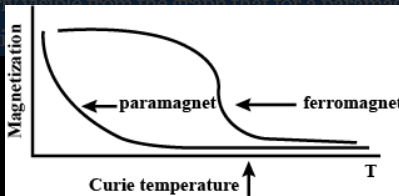
A paramagnetic material is kept in a magnetic field. The field is increased till the magnetization becomes constant. If the temperature is now decreased, the magnetization:
- A
- ✓
- C
- D
May increase or decrease.
AnswerAs it's clearly visible from the graph that for a paramagnetic material magnetization increases with decrease in temperature.
View full question & answer→MCQ 941 Mark
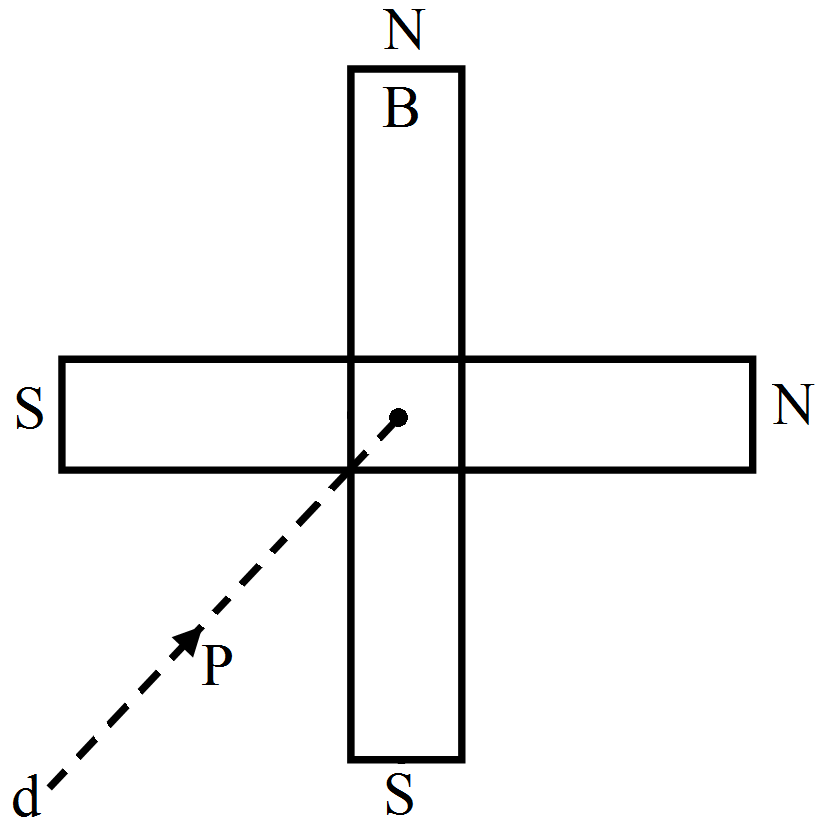
Two short magnets of equal dipole moments $M$ are fastened perpendicularly at their centre $($figure$)$. The magnitude of the magnetic field at a distance d from the centre on the bisector of the right angle is:
- A
$\frac{\mu_0}{4\pi}\frac{\text{m}}{\text{d}^3}$
- B
$\frac{\mu_0}{4\pi}\frac{\sqrt{2}\text{M}}{\text{d}^3}$
- ✓
$\frac{\mu_0}{4\pi}\frac{\sqrt[2]{2}\text{M}}{\text{d}^3}$
- D
$\frac{\mu_0}{4\pi}\frac{2\text{M}}{\text{d}^3}$
AnswerCorrect option: C. $\frac{\mu_0}{4\pi}\frac{\sqrt[2]{2}\text{M}}{\text{d}^3}$
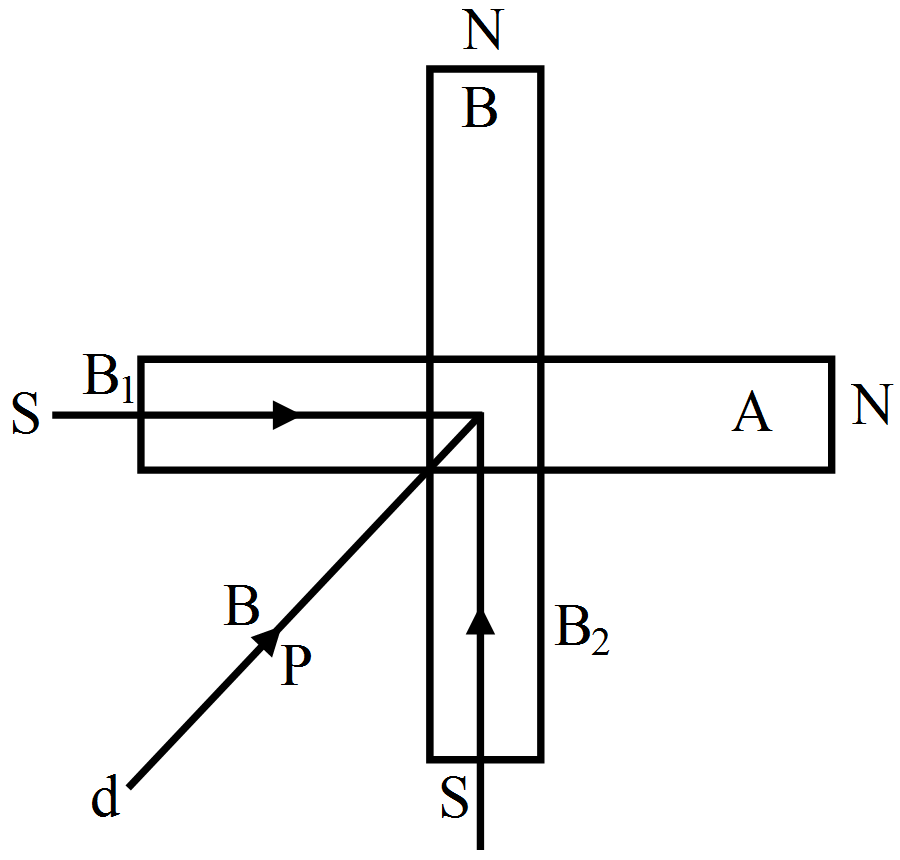
Magnetic field $(B_1)$ due to the short dipole $A$ of dipole moment $M$ at an axial point is given by,
$\vec{\text{B}_1}=\frac{\mu_0}{4\pi}\frac{2\text{M}}{\text{d}^3}\dots(1)$
Magnetic field $(B_2)$ due to the short dipole $B$ of dipole moment $M$ at an axial point is given by,
$\vec{\text{B}_2}=\frac{\mu_0}{4\pi}\frac{2\text{M}}{\text{d}_3}\dots(2)$
Resultant magnetic field $(B)$ will be,
$\text{B}=\sqrt{\text{B}_1^2+\text{B}_2^2}$
$\text{B}=\frac{\mu_0}{4\pi}\frac{\sqrt[2]{2}\text{M}}{\text{d}^3}$ View full question & answer→MCQ 951 Mark
The energy resides in a current carrying inductor in the form of:
AnswerWhen current is passed through a current carrying inductor, energy is stored in it in form of magnetic field.
Energy density is given by: $\text{n}_\text{B}=\frac{\text{B}^2}{2\mu}$
View full question & answer→MCQ 961 Mark
Magnetic lines of force can pass through:
AnswerCorrect option: C. Both $(a)$ and $(b).$
Magnetic field can penetrate through both magnetic and non$-$magnetic substances.
View full question & answer→MCQ 971 Mark
What is the net magnetic flux through a closed surface?
- A
- B
- ✓
- D
Depends on the nature of the surface
AnswerGauss’s law indicates that there are no sources or sinks of the magnetic field inside a closed surface. A “closed surface” is a surface that completely encloses a volume with no holes. Therefore, the net magnetic flux through a closed surface is zero.
View full question & answer→MCQ 981 Mark
Pick the correct options.
- A
All electrons have magnetic moment.
- B
All protons have magnetic moment.
- C
- ✓
All atoms have magnetic moment.
AnswerCorrect option: D. All atoms have magnetic moment.
Explanation:
All the electrons have magnetic moment & All the protons have magnetic moment.
View full question & answer→MCQ 991 Mark
The time period of oscillation of a magnet in a vibration magnetometer is $1.5 \sec.$ The time period of oscillation of another magnet similar in size, shape and mass but having $1/4$ magnetic moment than that of the 1st magnet oscillating at the same place will be:
- A
$0.75 \sec.$
- B
$1.5 \sec.$
- ✓
$3.0 \sec.$
- D
$6.0 \sec.$
AnswerCorrect option: C. $3.0 \sec.$
View full question & answer→MCQ 1001 Mark
The relative permeability of a material is $0.9.$ The material is:
AnswerDiamagnetic material
$−1\leq \text{x}<0$
$0 \leq \mu < 1$
$χ =$ Magnetic susceptibility
$\mu =$ permeability
View full question & answer→MCQ 1011 Mark
Domain formation is the necessary feature of:
AnswerThis problem is based on Magnetism.
Ferro$-$magnetism is the property of certain substances due to which they get strongly attracted to a magnet and strongly influenced in a magnetic field.
Certain substances like iron, nickel, cobalt, etc, are ferro$-$magnetic in nature.
Every atom of such materials, behave like small bar$-$magnets. The proper word is magnetic dipoles. In ferromagnetic materials, there are small regions known as domains. In each domain, all the atoms are alligned in one direction. All of them have their north$-$pole facing one side and their south$-$pole facing the other side. Hence every domain behaves like a dipole.
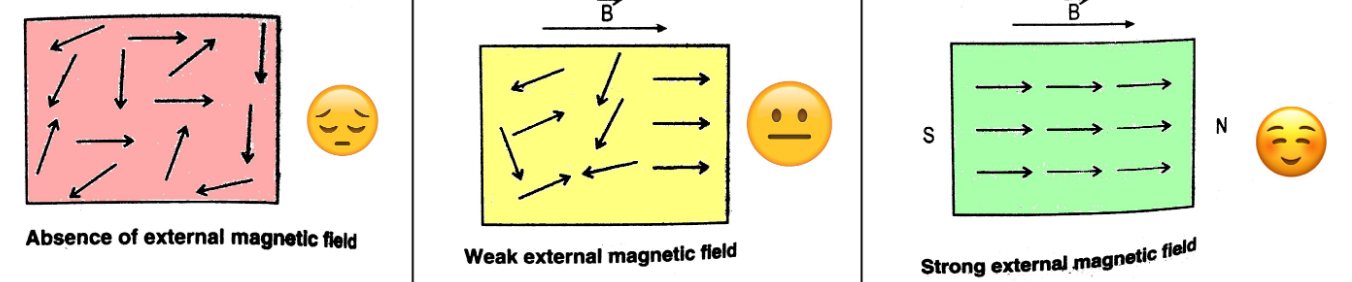
In the above picture, the arrows indicate the domains, pointing towards their north$-$poles.
In the absence of any magnetic field, all the domains are alligned randomly and so, the substance doesn't have any magnetic properties.
When the substance is placed in a weak magnetic field, a few domains turn and allign in the direction of the field, some domains which are already in the direction of the field expand slightly, and those alligned in direction opposite to the field, reduce in size. As a result, the entire substance has a mild dipole$-$like properties.
When the substance is placed in a strong magnetic field, many domains rapidly turn and allign in the direction of the field, the domains which are already in the direction of the field expand tremendously, and those alligned in direction opposite to the field, shrink so much that they almost disappear. As a result, all the domains are parallel to each other and alligned in one direction. The entire substance now becomes a strong bar$-$magnet.
View full question & answer→MCQ 1021 Mark
A dip circle is so set that its needle moves freely in the magnetic meridian. In this position, the angle of dip is $40^\circ .$ Now the dip circle is rotated so that the plane in which the needle moves makes an angle of $30^\circ $ with the magnetic meridian. In this position, the needle will dip by an angle:
- A
$40^\circ$
- ✓
$30^\circ$
- C
More than $40^\circ $
- D
Less than $40^\circ $
AnswerCorrect option: B. $30^\circ$
View full question & answer→MCQ 1031 Mark
Magnetic force required to demagnetize the material:
AnswerFor a ferromagnetic substance, coercivity is the intensity of the magnetic field that need to be applied to reduce the magnetization to zero when the sample's magnetization reaches saturation.
It is 'Intensity of the magnetic field' rather than 'Magnetic force'.
View full question & answer→MCQ 1041 Mark
A very small magnet is placed in the magnetic meridian with its south pole pointing north. The null point is obtained $20\ cm$ away from the centre of the magnet. If the earth¢s magnetic field (horizontal component) at this point be $0.3$ gauss, the magnetic moment of the magnet is:
- A
$8.0 \times 10^2$ e.m.u
- ✓
$1.2 \times 10^3$ e.m.u.
- C
$2.4 \times 10^3$ e.m.u.
- D
$3.6 \times 10^3$ e.m.u.
AnswerCorrect option: B. $1.2 \times 10^3$ e.m.u.
b. $1.2 \times 10^3$ e.m.u.
View full question & answer→MCQ 1051 Mark
Which among the following is denoted by $\delta$?
AnswerMagnetic dip or inclination at a place is defined as the angle made by the Earth’s magnetic field with the horizontal in the magnetic
meridian. It is denoted by $\delta$.
Magnetic declination at a place is defined as the angle between the geographic meridian and magnetic meridian.
View full question & answer→MCQ 1061 Mark
AnswerMagnetic meridian at a place is not a line but a vertical plane passing through the axis of a freely suspended magnet.
View full question & answer→MCQ 1071 Mark
Space surrounding a magnet in which magnetic force is executed, is called a:
AnswerSpace surrounding a magnet in which magnetic force is executed, is called a magnetic field.
A magnetic field is a vector field that describes the magnetic influence of electrical currents and magnetized materials. In everyday life, the effects of magnetic fields are most readily encountered with nearby permanent magnets, which pull on magnetic materials $($such as iron$)$ and attract or repel other magnets.
View full question & answer→MCQ 1081 Mark
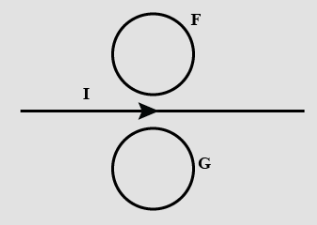
Two conducting circular loops $F$ and $G$ are kept in a plane on either side of a straight current$-$carrying wire as shown in the figure below.
If the current in the wire decreases in magnitude, the induced current in the loops will be:
- A
Clockwise in $F$ and clockwise in $G.$
- ✓
Anti$-$clockwise in $F$ and clockwise in $G.$
- C
Clockwise in $F$ and anti$-$clockwise in $G.$
- D
Anti-clockwise in $F$ and anti$-$clockwise in $G.$
AnswerCorrect option: B. Anti$-$clockwise in $F$ and clockwise in $G.$
The magnetic field above the wire is out of the plane. This flux is decreasing and should be compensated by the current in the loop $F$ and so the current in loop $F$ will be anti$-$clockwise. For loop $G$ the situation is opposite
View full question & answer→MCQ 1091 Mark
Which one of the following is feebly repelled by a magnet?
AnswerDiamagnetic materials are those which when placed in a magnetizing field are feebly magnetized in a direction opposite to that of the magnetizing field. Therefore, it is feebly repelled by a magnet. Example: zinc, gold, etc.
View full question & answer→MCQ 1101 Mark
Susceptibility is positive and large for a:
AnswerFor ferromagnetic substances,$\chi_\text{m}$is large and positive.
View full question & answer→MCQ 1111 Mark
A paramagnet magnet behaves like a solenoid because both contain currents in the form of:
AnswerA paramagnet magnet behaves like a solenoid because both contain currents in the form of circle. The magnetic field is generated by the circular motion of the electron inside the atom.
View full question & answer→MCQ 1121 Mark
The $.......$ drawn at any point on the magnetic lines of force gives direction of magnetic field at that point.
AnswerAs the magnetic field and electric field are perpendicular thus magnetic field direction is along tangent at that point.
View full question & answer→MCQ 1131 Mark
The $B-H$ curve $(i)$ and $(ii)$ shown in fig., associated with:
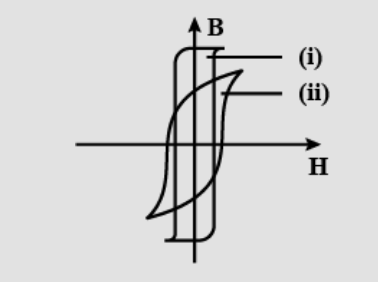
- A
$(i)$ diamagnetic and $(ii)$ paramagnetic substance.
- B
$(i)$ paramagnetic and $(ii)$ ferromagnetic substance.
- ✓
$(i)$ soft iron and $(ii)$ steel respectively.
- D
$(i)$ steel and $(ii)$ soft iron respectively.
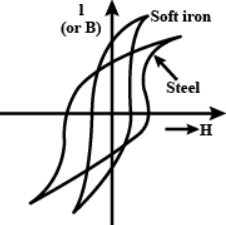
AnswerCorrect option: C. $(i)$ soft iron and $(ii)$ steel respectively.
Retentivity of soft iron is more than steel but coercivity of steel is more.
Retentivity$-$the ability of a substance to retain or resist magnetization, frequently measured as the strength of the magnetic field that remains in a sample after removal of an inducing field.
Coercivity$-$the resistance of a magnetic material to changes in magnetization, equivalent to the field intensity necessary to demagnetize the fully magnetized material.
View full question & answer→MCQ 1141 Mark
At the magnetic North Pole of the Earth, what is the value of the angle of dip?
AnswerAngle of dip is $90^o$ at geographical North Pole because attraction on the North Pole of needle is very strong and the needle remains in vertical plane. At the magnetic equator, the needle will point horizontally, i.e. dip angle is $0^o$. As you move from the magnetic equator towards the magnetic pole, the angle increases in the northern hemisphere. So, the angle of dip is maximum.
View full question & answer→MCQ 1151 Mark
Which of the following are best suited to make the core of a transformer?
AnswerThe core needs to be magnetized and demagnetized frequently during the working of a transformers.
Soft iron is used as core.
Since it easy to magnetize and demagnetize with less energy loss.
View full question & answer→MCQ 1161 Mark
If the field lines in a magnetic field are parallel and equidistant, the magnetic field is $.......$.
AnswerThe close continuous curves in a magnetic field are called magnetic lines of force. Curved lines are used to represent a magnetic field, drawn such that the number of lines relates to the magnetic field's strength at a given point and the tangent of any curve at a particular point is along the direction of magnetic force at that point.
The magnetic lines of force are uniform and strong at the center or middle and they diverge as they move towards the ends and the distance between the lines increases. Eventually, the strength of the magnetic field is strong where the lines are closer and they weaken as they closeness decreases. Hence, if the field lines in a magnetic field are parallel and equidistant, the magnetic field is uniform.
View full question & answer→MCQ 1171 Mark
Which of the following best describes the field due to a magnet ?
AnswerCorrect option: A. The region where its effects are felt.
The Earth has a huge magnetic field. Because the core of our planet is filled with molten iron $(Fe)$, there is a large field that protects the Earth from space radiation and particles such as the solar wind. When you look at tiny magnets, they are working in a similar way. The magnet has a field around it.The region where its effects are felt describes the field due to a magnet.
View full question & answer→MCQ 1181 Mark
- A
- B
Cannot be mapped on paper.
- ✓
Do not intersect each other.
- D
Always intersect each other.
AnswerCorrect option: C. Do not intersect each other.
lines of force do not intersect each other because at the point of intersection we will have two different direction of the force, as their will be two tangential direction corresponding to the two intersecting lines.
View full question & answer→MCQ 1191 Mark
The strength of the earth’s magnetic field is:
- A
- B
- C
- ✓
Vary from place to place on the earths surface.
AnswerCorrect option: D. Vary from place to place on the earths surface.
View full question & answer→MCQ 1201 Mark
Which of the following is the use of superconductor?
AnswerThe uses of superconductors are as follows:
Superconductors are used to make extremely powerful electromagnets to accelerate charged particles very fast.
Used in Maglev $($magnetic levitation$)$ trains. These work because a superconductor repels a magnetic field so a magnet will float above a superconductor $–$ this virtually eliminates the friction between the train and the track
The development of superconductors has improved the field of MRI as the superconducting magnet can be smaller and more efficient than an equivalent conventional magnet.
They are also used in microwaves.
View full question & answer→MCQ 1211 Mark
Current I is flowing in a coil of area A and number of turns is $N$, then magnetic moment of the coil in $M$ equal to
- ✓
$NIA.$
- B
$NI^3/A.$
- C
$NI/A.$
- D
$N ^2 Al$.
AnswerCorrect option: A. $NIA.$
View full question & answer→MCQ 1221 Mark
Alnico is used for making permanent magnets because it has:
- ✓
High coercivity and high retentivity.
- B
High coercivity and low retentivity.
- C
Low coercivity and low retentivity.
- D
Low coercivity and high retentivity.
AnswerCorrect option: A. High coercivity and high retentivity.
Alnico is used for making permanent magnet because it can be easily magnetised in external magnetic field and It will not lose its magnetic property due to its high coercivity and low retentivity.
View full question & answer→MCQ 1231 Mark
The force which a magnet exerts on iron and steel is called the:
AnswerThe force is strongest at the poles of a magnet. Like poles exert a pushing force and repel each other. Unlike poles exert a pulling force and attract each other. magnet A material that attracts steel, iron, cobalt, and nickel.
The force which a magnet exerts on iron and steel is called the magnetic field.
View full question & answer→MCQ 1241 Mark
Susceptibility is positive and large for a:
MCQ 1251 Mark
A compass needle which is allowed to move in a horizontal plane is taken to a geomagnetic pole. It:
AnswerCorrect option: D. Will stay in any position.
When taken to a geomagnetic pole, a compass needle that is allowed to move in a horizontal plane will try to suspend itself vertically to the horizontal plane containing the compass. In other words, the horizontal plane containing the compass will restrict the compass to suspend itself in vertical direction; hence, the compass will stay in any position.
However, a freely suspended magnet will become vertical at poles, with its north pole pointing towards Earth at its north pole $($which is magnetic south$).$
View full question & answer→MCQ 1261 Mark
A material is placed in a magnetic field, and it is thrown out of it. Then the material is:
MCQ 1271 Mark
AnswerCorrect option: B. The magnetic susceptibility of diamagnetic substances are temperature independent.
The magnetic susceptibility of diamagnetic materials doesn’t depend upon temperature. This is often because there’s an outsized barrier between the bottom state and therefore the excited states of diamagnetic substances. Hence, it remains constant during the change of temperature. All the other statements are false.
View full question & answer→MCQ 1281 Mark
The magnetic susceptibility for diamagnetic materials is:
MCQ 1291 Mark
A magnet can only repel another magnet. So, $‘X\ ’$ is a surer test of magnetism. Identify $X.$
AnswerA magnet can attract another magnet or a magnetic substance like iron. However, a magnet can repel another magnet only. So repulsion is the surer test of magnetism.
View full question & answer→MCQ 1301 Mark
A bar magnet is moved along the axis of a copper ring placed far away from the magnet, Looking from the side of the magnet an anticlockwise current is found to be induced in the ring. Which of the following may be true?
- A
The south pole faces the ring and the magnet moves towards it.
- B
The north pole faces the ring and the magnet moves towards it.
- C
The south pole faces the ring and the magnet moves away from it.
- ✓
AnswerExplanation:
þ
The north pole faces the ring and the magnet moves towards it.
þ
The south pole faces the ring and the magnet moves away from it.
View full question & answer→MCQ 1311 Mark
A toroid of n turns, mean radius $R$ and cross$-$sectional radius a carries current I. It is placed on a horizontal table taken as $x-y$ plane. It's magnetic moment m:
- A
Is non$-$zero and points in the $z-$direction by symmetry.
- B
Points along the axis of the tortoid $(\text{m}=\text{m}\phi)$.
- ✓
Is zero, otherwise there would be a field falling as $\frac{1}{\text{r}^3}$ at large distances outside the toroid.
- D
Is pointing radially outwards.
AnswerCorrect option: C. Is zero, otherwise there would be a field falling as $\frac{1}{\text{r}^3}$ at large distances outside the toroid.
Key concept: Toroid'. A toroid can be considered as a ring shaped closed solenoid. Hence it is like an endless cylindrical solenoid.
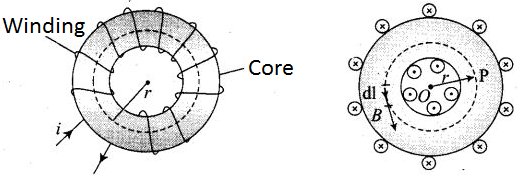
The magnetic field is only confined inside the body of a toroid in the form of concentric magnetic lines of force. For any point inside the empty space surrounded by toroid and outside the toroid, the magnetic field $B$ is zero because the net current enclosed in these spaces is zero. Thus, the magnetic moment of toroid is zero.
In general, if we take $r$ as a large distance outside the toroid, then $\text{m}\propto\frac{1}{\text{r}^3}$. But this case is not possible here.
View full question & answer→MCQ 1321 Mark
The most important features of superconductor is that:
- ✓
Once current is set up in a superconductor ring, it will continue indefinitely even if the battery is off.
- B
It has high efficiency compared to other conductors.
- C
It can pass maximum no of electrons when current is passed through it.
- D
AnswerCorrect option: A. Once current is set up in a superconductor ring, it will continue indefinitely even if the battery is off.
The most important features of superconductor is:
In a superconductor, the electric resistance is equal to zero. This is why an electric current can circulate forever in a superconducting ring even when the battery has been unplugged.
View full question & answer→MCQ 1331 Mark
Liquids and gases never exhibit:
- A
- B
Para magnetic properties.
- ✓
Ferro magnetic properties.
- D
Electro magnetic properties.
AnswerCorrect option: C. Ferro magnetic properties.
Ferromagnetic substances have high susceptibility to magnetisation. Liquid and gases aren't prone to be magnetised.
View full question & answer→MCQ 1341 Mark
A magnetic dipole of length 10cm has pole strength of 20Am. Find the magnetic moment of the dipole.
- ✓
$2 Am ^2$
- B
$200 Am ^2$
- C
$20 Am ^2$
- D
$0.2 Am ^2$
AnswerCorrect option: A. $2 Am ^2$
a. $2 Am ^2$
Explanation:
Magnetic dipole moment $=$ Pole strength $\times$ Magnetic length.
Magnetic dipole moment $=20 Am \times 0.1 m$
Magnetic dipole moment $=2 Am ^2$
View full question & answer→MCQ 1351 Mark
When a bar magnet is broken into two pieces:
- A
We will have a single pole on each piece.
- ✓
Each piece will have two unlike poles.
- C
Each piece will have two like poles.
- D
AnswerCorrect option: B. Each piece will have two unlike poles.
When we break a magnet into two, both act as magnets, that is both have a north and south pole each. In both these pieces the corresponding north and south poles remain on the sides as in the original magnet. This means that the $2$ broken sides must get oppositely polarized.
View full question & answer→MCQ 1361 Mark
At the magnetic north pole of the earth, the value of the horizontal component of earth’s magnetic field and angle of dip are respectively:
MCQ 1371 Mark
Which among the following is the source of the magnetic field $($magnetism$)?$
AnswerMagnetism is of electrical origin. The electrons revolving in an atom behave as tiny current loops and these current loops give rise to magnetism. An electric current produces a magnetic field. This magnetic field can be visualized as a pattern of circular field lines circling a wire.
View full question & answer→MCQ 1381 Mark
Magnetic lines of force due to a bar magnet do not intersect because:
- ✓
A point always has a single net magnetic field.
- B
The lines have similar charges and so repel each other.
- C
The lines always diverge from a single force.
- D
The lines need magnetic lenses to be made to interest.
AnswerCorrect option: A. A point always has a single net magnetic field.
View full question & answer→MCQ 1391 Mark
Which of the following is responsible for the earth’s magnetic field?
- ✓
Convective currents in earth’s core.
- B
Diversive current in earth’s core.
- C
Rotational motion of earth.
- D
Translational motion of earth.
AnswerCorrect option: A. Convective currents in earth’s core.
View full question & answer→MCQ 1401 Mark
Let r be the distance of a point on the axis of a magnetic dipole from its centre. The magnetic field at such a point is proportional to:
- A
$\frac{1}{\text{r}}$
- B
$\frac{1}{\text{r}^2}$
- ✓
$\frac{1}{\text{r}^3}$
- D
AnswerCorrect option: C. $\frac{1}{\text{r}^3}$
Magnetic field $B$ due to a bar magnet of magnetic moment $M$ at distance r of the point on the axis from its centre is given by
$\text{B}=\frac{\mu_02\text{Mr}}{4\pi(\text{r}^2-\text{l}^2)^2}$
Here, $2l$ is the length of the magnet.
When the distance of the point where the magnetic field has to be calculated is greater than the length of the magnet, i.e $r >> l$, the bar magnet acts like a magnetic dipole whose magnetic field is
$\text{B}\propto\frac{1}{\text{r}^3}$
Now, $l$ in the denominator can be neglected.
So, the correct option is $(c).$
View full question & answer→MCQ 1411 Mark
The force with which a magnet attracts objects like iron is called $............$
AnswerThe force which attracts objects like iron is called magnetic force.
The force of attraction or repulsion which are present between two magnetic materials is known as magnetic force iron is a ferromagnetic materials.
View full question & answer→MCQ 1421 Mark
Which among the following materials display higher magnetic susceptibility?
AnswerFerromagnetic materials display higher magnetic susceptibility.
View full question & answer→MCQ 1431 Mark
Give the SI unit of magnetic dipole moment.
- A
$A ^{-2} m$
- B
$Am ^{-2}$
- C
$A ^2 m$
- ✓
$Am ^2$
AnswerCorrect option: D. $Am ^2$
The magnetic dipole moment of a magnetic dipole is defined as the product of its pole strength and magnetic length. The $SI$ unit of magnetic dipole moment is ampere metre ${ }^2\left( Am ^2\right)$. Magnetic dipole moment is a vector quantity and is directed from south to north pole of the magnet.
View full question & answer→MCQ 1441 Mark
What is the torque exerted by a bar magnet on itself due to its field?
- A
- ✓
- C
- D
Depends on the direction of the magnetic field
AnswerA bar magnet does not exert a force or torque on itself due to its field. But an element of a current$-$carrying conductor experiences forces due to another element of the conductor. So, the torque exerted by a bar magnet on itself is zero.
View full question & answer→MCQ 1451 Mark
The magnetic susceptibility is negative for:
- A
Pramagnetic materials only.
- ✓
Diamagnetic materials only.
- C
Ferromagnetic materials only.
- D
Paramagnetic and ferromagnetic materials.
AnswerCorrect option: B. Diamagnetic materials only.
The magnetic susceptibility is negative for diamagnetic materials only.
View full question & answer→MCQ 1461 Mark
At magnetic poles, the angle of dip is:
- A
$45^\circ .$
- B
$30^\circ .$
- C
- ✓
$90^\circ .$
AnswerCorrect option: D. $90^\circ .$
View full question & answer→MCQ 1471 Mark
Which magnetic materials have negative susceptibility?
MCQ 1481 Mark
For protecting a sensitive equipment from external magnetic field, it should be:
- ✓
Placed inside an iron can.
- B
Placed inside an aluminium can.
- C
Surrounded with fine copper sheet.
- D
Wrapped with insulation around it when passing current through it.
AnswerCorrect option: A. Placed inside an iron can.
Iron is a ferromagnetic substance, so there are no magnetic lines of force inside it. So to protect the sensitive equipment from external magnetic field, it should be placed inside an iron can.
View full question & answer→MCQ 1491 Mark
A dip circle is taken to geomagnetic equator. The needle is allowed to move in a vertical plane perpendicular to the mangetic meridian. the needle will stay in:
- A
Horizontal direction only.
- B
- C
Any direction except vertical and horizontal.
- ✓
Any direction it is released.
AnswerCorrect option: D. Any direction it is released.
View full question & answer→MCQ 1501 Mark
Permanent magnets are the substances having the property of:
- ✓
Ferromagnetism at room temperature for a long period of time.
- B
Paramagnetism at room temperature for a long period of time.
- C
Anti ferromagnetism at room temperature for a long period of time.
- D
Diamagnetism at room temperature for a long period of time.
AnswerCorrect option: A. Ferromagnetism at room temperature for a long period of time.
View full question & answer→MCQ 1511 Mark
How many quantities are required to specify the magnetic field of the earth?
AnswerThree quantities are needed to specify the magnetic field of the earth on its surface, namely, the horizontal component, the magnetic declination and the magnetic dip. These are known as elements of the earth’s magnetic field or magnetic elements.
View full question & answer→MCQ 1521 Mark
Lenz's law is a direct consequence of:
- A
The law of conservation of momentum.
- B
The law of conservation of charge.
- ✓
The law of conservation of energy.
- D
The law of conservation of emf.
AnswerCorrect option: C. The law of conservation of energy.
Lenz's law states that the current induced in a circuit due to a change or a motion in a magnetic field is so directed as to oppose the change in flux.
We know that induced EMF produces a current that opposes the change in flux, because a change in flux means a change in energy.Energy can enter or leave, but not instantaneously. So, Lenz' law is a consequence of the law of conservation of energy.
View full question & answer→MCQ 1531 Mark
Hysterisis is the phenomenon of lagging of:
- A
$I$ behind $B.$
- B
$B$ behind $I.$
- ✓
$I$ and $B$ behind $H.$
- D
$H$ behind $I.$
AnswerCorrect option: C. $I$ and $B$ behind $H.$
View full question & answer→MCQ 1541 Mark
$.......$ exists in the region surrounding a magnet, in which force of the magnet can be detected.
AnswerMagnet has some limited region where the magnetic field lines,representation of magnetism is felt.
Though magnetism has a extent to a large distance but the region where its effect is felt is termed as magnetic field.
View full question & answer→MCQ 1551 Mark
Out of dia, para and ferromagnetism, the universal property of all substances is:
AnswerDiamagnetic materials create an induced magnetic field in a direction opposite to an externally applied magnetic field, and are repelled by the applied magnetic field. In contrast, the opposite behavior is exhibited by paramagnetic materials. Ferromagnetic substances having a high susceptibility to magnetization.
View full question & answer→MCQ 1561 Mark
Arrange the following in the increasing order of magnetic susceptibility.
- A
Paramagnetic $<$ Diamagnetic $<$ Ferromagnetic.
- B
Paramagnetic $<$ Ferromagnetic $<$ Diamagnetic.
- C
Ferromagnetic $<$ Paramagnetic $<$ Diamagnetic.
- ✓
Diamagnetic $<$ Paramagnetic $<$ Ferromagnetic.
AnswerCorrect option: D. Diamagnetic $<$ Paramagnetic $<$ Ferromagnetic.
Diamagnetic materials have a small and negative value of magnetic susceptibility. Paramagnetic materials have a small and positive value of magnetic susceptibility and ferromagnetic materials have a large and positive value of magnetic susceptibility.
View full question & answer→MCQ 1571 Mark
Which among the following has a relative permeability much larger than $1?$
AnswerThe relative permeability of ferromagnetic materials is much larger than $1$. Ferromagnetic substances are those, which when placed in a magnetic field are strongly magnetized in the direction of the magnetizing field, i.e., it is strongly attracted by a magnet.
View full question & answer→MCQ 1581 Mark
Which metal is used to make ferromagnets ?
AnswerFerromagnetic materials exhibit a long$-$range ordering phenomenon at the atomic level which causes the unpaired electron spins to line up parallel with each other in a region called a domain. Within the domain, the magnetic field is intense, but in a bulk sample the material will usually be unmagnetized because the many domains will themselves be randomly oriented with respect to one another. Ferromagnets will tend to stay magnetized to some extent after being subjected to an external magnetic field. This tendency to "remember their magnetic history" is called hysteresis.
\Nickel, iron and cobalt are such materials. Ferromagnetic materials exhibit a long$-$range ordering phenomenon at the atomic level which causes the unpaired electron spins to line up parallel with each other in a region called a domain. Within the domain, the magnetic field is intense, but in a bulk sample the material will usually be unmagnetized because the many domains will themselves be randomly oriented with respect to one another.Ferromagnets will tend to stay magnetized to some extent after being subjected to an external magnetic field. This tendency to "remember their magnetic history" is called hysteresis. Nickel, iron and cobalt are such materials.
View full question & answer→MCQ 1591 Mark
The magnetic dipole moment of a magnetic dipole is given by the formula $.......$.
- ✓
$M = m \times 2I$
- B
$M = m + 2I$
- C
$M = m – 2I$
- D
$M = m/ 2I$
AnswerCorrect option: A. $M = m \times 2I$
The magnetic dipole moment of a magnetic dipole is given by the formula $M = m \times 2I$. Where: m is pole strength and $2I$ is dipole length directed from $S$ to $N.$
View full question & answer→MCQ 1601 Mark
Pick out the temperature at which iron becomes paramagnetic?
- ✓
$800^\circ C$
- B
$700^\circ C$
- C
$600^\circ C$
- D
$500^\circ C$
AnswerCorrect option: A. $800^\circ C$
Iron is a ferromagnetic material. Ferromagnetism decreases with a rise in temperature, and above a certain temperature called “Curie’s temperature,” ferromagnets become paramagnets. For iron, it is approximately, $800^\circ C.$
View full question & answer→MCQ 1611 Mark
The force which makes magnet move:
AnswerMagnetic field created by the electric coils in the guideway walls and track propel the magnet to move forward.
View full question & answer→MCQ 1621 Mark
Electromagnets are made of soft iron because soft iron has:
- A
High retentivity and high coercive force.
- B
High retentivity and low coercive force.
- C
Low retentivity and high coercive force.
- ✓
Low retentivity and low coercive force.
AnswerCorrect option: D. Low retentivity and low coercive force.
Electro magnets arc made of soft iron because soft iron has Low retentivity and Low coercive force.
View full question & answer→MCQ 1631 Mark
Which of the following is a natural magnet?
AnswerPieces of naturally occurring iron ore, lodestone or magnetite had the property of attracting small pieces of iron. Hence, magnetite is a natural magnet. All natural magnets are permanent magnets, meaning they will never lose their magnetic power.
View full question & answer→MCQ 1641 Mark
Which of the following statements is wrong ? Magnetic lines of force:
- A
- B
- C
Are densest near the poles.
- ✓
AnswerAll the facts are correct.
Magnetic lines of force closed loops, and they never intersect.
Also they are densest at poles which means that the magnetic field is stronger at the poles.
View full question & answer→MCQ 1651 Mark
Let r be the distance of a point on the axis of a bar magnet from its centre. The magnetic field at such a point is proportional to:
- A
$\frac{1}{\text{r}}$
- B
$\frac{1}{\text{r}^2}$
- C
$\frac{1}{\text{r}^3}$
- ✓
AnswerMagnetic field $B$ due to a bar magnet of magnetic moment $M$ at distance $r$ of the point on the axis of the magnet from its centre is given by.
$\text{B}=\frac{\mu_\text{o}}{4\pi}\frac{2\text{Mr}}{(\text{r}^2-\text{l}^2)^2}$
Here, $2I$ is the length of the magnet.
So, from the above formula, it can be easily seen that $\text{B}\propto\frac{\text{r}}{(\text{r}^2-\text{r}^2)^2}$
View full question & answer→MCQ 1661 Mark
The magnetising field required to be applied in opposite direction to reduce residual magnetism to zero is called:
AnswerThe coercivity is the intensity of the applied magnetic field required to reduce the magnetization of that material to zero.
View full question & answer→MCQ 1671 Mark
Curie temperature is the temperature above which:
- A
Paramagnetic material becomes ferromagnetic material.
- B
Ferromagnetic material becomes diamgnetic material.
- ✓
Ferromagnetic material becomes paramagnetic material.
- D
Paramagnetic material becomes diamagnetic material.
AnswerCorrect option: C. Ferromagnetic material becomes paramagnetic material.
The Curie temperature $(T_C)$ is the temperature at which certain materials lose their permanent magnetic properties, to be replaced by induced magnetism, that is, they go from becoming ferromagnetic to paramagnetic.
Above curie temperature, ferromagnetic material behaves as paramegnetic material.
View full question & answer→MCQ 1681 Mark
How will the force between the two poles change if the two poles are connected by an iron rod keeping the distance between two magnetic poles constant ?
AnswerAn iron rod placed between the poles of a magnet provides a better path than air for the magnetic flux. The flux density in iron is greater than it is in air; therefore, iron is said to have a high permeability. Hence the force between the poles increases. Also the Iron rod gets magnetised with north pole at the end in contact with south pole and south pole at the end in contact with the north pole of the bar magnet.
View full question & answer→MCQ 1691 Mark
The magnetic moment of a bar magnet is thus $...A...$ to the magnetic moment of an equivalent solenoid that produces the same magnetic field. Here, $A$ refers to.
View full question & answer→MCQ 1701 Mark
Which among the following is true about magnetic susceptibility?
AnswerCorrect option: C. It is the ratio of intensity of magnetization to magnetic intensity.
Magnetic susceptibility of a magnetic substance is defined as the ratio of the intensity of magnetization $(I)$ to the magnetic intensity $(H).$ The expression is given by:
$\text{Xm}=\frac{\text{I}}{\text{H}}$
Magnetic susceptibility measures the aptness of a magnetic substance to acquire magnetism. It is a unit less constant of magnetic substance.
View full question & answer→MCQ 1711 Mark
Hysterisis is the phenomenon of lagging of:
- A
$I$ behind $B$
- B
$B$ behind $I$
- ✓
$I$ and $B$ behind $H$
- D
$H$ behind $I$
AnswerCorrect option: C. $I$ and $B$ behind $H$
When we increase $H$ then $I$ also increases but when we decrease $HI$ does not becomes zero, and so as $B$ if we plot BvsH curve instead of IvsH.
View full question & answer→MCQ 1721 Mark
Mark the incorrect statement.
- A
The direction of the magnetic field is taken to be the direction in which a north pole of the compass needle moves inside it.
- B
The magnetic field lines are closed curves.
- C
No two field-lines are found to cross each other.
- ✓
AnswerThe direction of the magnetic field is taken to be the direction in which a north pole of the compass needle moves inside it. Therefore it is taken by convention that the field lines emerge from the north pole and merge at the south pole. Inside the magnet, the direction of field lines is from its south pole to its north pole. Thus the magnetic field lines are closed curves. The relative strength of the magnetic field is shown by the degree of closeness of the field lines. The field is stronger, that is, the force acting on the pole of another magnet placed is greater where the field lines are crowded. No two field-lines are found to cross each other. If they did, it would mean that at the point of intersection, the compass needle would point towards two directions, which is not possible.
View full question & answer→MCQ 1731 Mark
A diamagnetic material in a magnetic field moves:
- A
Perpendicular to the field.
- ✓
From stronger to the weaker parts of the field.
- C
From weaker to the stronger parts of the field.
- D
AnswerCorrect option: B. From stronger to the weaker parts of the field.
View full question & answer→MCQ 1741 Mark
The materials suitable for making electromagnets should have:
- A
High retentivity and low coercivity.
- ✓
Low retentivity and low coercivity.
- C
High retentivity and high coercivity.
- D
Low retentivity and high coercivity.
AnswerCorrect option: B. Low retentivity and low coercivity.
View full question & answer→MCQ 1751 Mark
If a diamagnetic substance is brought near north or south pole of a bar magnet, it is:
- A
- ✓
- C
Replaced by north pole and attracted by south pole.
- D
Attracted by north pole and repelled by south pole.
View full question & answer→MCQ 1761 Mark
A magnetic dipole is acted upon by two magnetic fields which are inclined to each other at an angle of $75^\circ $ One of the fields has a magnitude of $15 \ mT.$ The dipole attains stable equilibrium at an angle of $30^\circ $ with this field. The magntidue of the other field $($in $mT)$ is close to:
View full question & answer→MCQ 1771 Mark
Which of the following is not a basic property of magnets.
- ✓
Magnet exists as a monopole.
- B
- C
- D
Like poles repel and unlike poles attract.
AnswerCorrect option: A. Magnet exists as a monopole.
Attractive property, directive property and the law of magnetic poles are some of the important properties of magnets. So unlike electric charges, magnetic monopoles do not exist. Every magnet exists as a dipole.
View full question & answer→MCQ 1781 Mark
A paramagnetic material is kept in a magnetic field. The field is increased till the magnetization becomes constant. If the temperature is now decreased, the magnetization
- A
- B
- ✓
- D
May increase or decrease.
View full question & answer→MCQ 1791 Mark
When a current in a circular loop is equivalently replaced by a magnetic dipole:
- A
The pole strength m of each pole is fixed.
- B
The distance d between the poles is fixed.
- ✓
- D
AnswerWhen we replace a circular current-carrying loop with a magnetic dipole to resemble field lines of the circular loop, the pole strength m and the distance between the poles are not fixed.
But the magnetic dipole moment of both systems is always fixed. It is the product of the magnetic moment and the distance between the poles. In other words, md is fixed.
A current loop of area $A$ and current $I$ can be replaced with a magnetic dipole of dipole moment md.
i.e. md $= IA$
View full question & answer→MCQ 1801 Mark
A temporary magnet is made of:
MCQ 1811 Mark
A bar magnet is cut into two equal halves by a plane parallel to the magnetic axis. Of the following physical quantities the one which remains unchanged is:
- A
- B
- ✓
Intensity of magnetisation.
- D
AnswerCorrect option: C. Intensity of magnetisation.
View full question & answer→MCQ 1821 Mark
A permanent magnet has the capacity to attract:
- A
- B
- ✓
Only ferromagnetic substances.
- D
AnswerCorrect option: C. Only ferromagnetic substances.
A permanent magnet has the capacity to attract only ferromagnetic substances.
View full question & answer→MCQ 1831 Mark
Identify the correct statement about the magnetic field lines:
- A
These start from the $N-$pole and terminate on the $S-$pole.
- ✓
These lines always form closed loops.
- C
Both $(a)$ and $(b)$ are correct.
- D
Both $(a)$ and $(b)$ are wrong.
AnswerCorrect option: B. These lines always form closed loops.
The magnetic field lines of a simple magnet are shown in the picture below.They point from the north pole to the south pole. However, the magnetic field lines do not just end at the tip of the magnet. They go right through it, so that inside the magnet the magnetic field points from the south pole to the north pole.
Magnetic field lines form closed loops since magnetic monopoles doesn't exist unlike an electric charge.
View full question & answer→MCQ 1841 Mark
The material suitable for making electromagnets should have:
- A
High retentivity and high coercivity.
- B
Low retentivity and low coercivity.
- ✓
High retentivity and low coercivity.
- D
Low retentivity and high coercivity.
AnswerCorrect option: C. High retentivity and low coercivity.
An electromagnet is necessary for the material that even if the current is turned off, the material losses its magnetic field. So, it should be made from such a material that its retentivity is very high. And there must be enough coercion force for the material which can restore its pre-magnetization state. For that its coercivity should be as minimum as possible.
View full question & answer→MCQ 1851 Mark
The earth’s magnetic field always has a vertical component except at the:
- ✓
- B
- C
- D
Latitude $45^\circ .$
View full question & answer→MCQ 1861 Mark
In case of a bar magnet, lines of magnetic induction:
- A
start from the north pole and end at the south pole.
- ✓
run continuously through the bar magnet and outside.
- C
emerge in circular paths from the middle of the bar.
- D
are produced only at the north pole like rays of light from a bulb.
AnswerCorrect option: B. run continuously through the bar magnet and outside.
Magnetic lines of force in a bar magnet are continuous forming closed loops as shown in the figure.
Outside the magnet, the lines run from north pole to south pole whereas oppositely inside.
View full question & answer→MCQ 1871 Mark
- A
- B
- C
Are crowded together near the poles.
- ✓
All the above are correct.
AnswerCorrect option: D. All the above are correct.
They always form complete closed loops. Unlike lines of electric flux which radiate from and terminate at the charged surfaces, lines of magnetic flux exist all the way through the magnet.
They behave as if they are elastic. That is, when distorted they try to return to their natural shape and spacing.
The lines of force of magnetic field are radiated from the north $(N)$ pole to the south $(S)$ pole.
Flux lines do not cross or interact to each other.
The density of lines of magnetic force indicates the strength of field at the point. Since strength is greatest at the poles, the magnetic lines of force are crowded there.
View full question & answer→MCQ 1881 Mark
The magnetic field of the earth can be modelled by that of a point dipole placed at the centre of the earth. The dipole axis makes an angle of $11.3^\circ $ with the axis of the earth. At Mumbai, declination is nearly zero. Then,
AnswerCorrect option: A. The declination varies between $11.3^\circ W$ to $11.3^\circ E.$
View full question & answer→MCQ 1891 Mark
In a permanent magnet at room temperature.
AnswerCorrect option: D. Domains are all perfectly aligned.
View full question & answer→MCQ 1901 Mark
Identify the mismatched pair:
- A
Hard magnet $-$ Alnico.
- B
Soft magnet $-$ Soft iron.
- C
Bar magnet $-$ Equivalent solenoid.
- ✓
Permanent magnet $-$ Loud speaker.
AnswerCorrect option: D. Permanent magnet $-$ Loud speaker.
View full question & answer→MCQ 1911 Mark
A magnetic dipole is under the influence of two magnetic fields The angle between the field directions is $60^{\circ}$ and one of the fields has a magnitude of $1.2 \times 10^{-2} T$. If the dipole comes to stable equilibrium at an angle of $15^{\circ}$ with this field, what is the magnitude of other field?
- ✓
$4.4 \times 10^{-3}$ tesla.
- B
$5.2 \times 10^{-3}$ tesla.
- C
$3.4 \times 10^{-3}$ tesla.
- D
$7.8 \times 10^{-3}$ tesla.
AnswerCorrect option: A. $4.4 \times 10^{-3}$ tesla.
a. $4.4 \times 10^{-3}$ tesla.
View full question & answer→MCQ 1921 Mark
Mark out the correct options.
- A
Diamagnetism occurs in all materials.
- B
Diamagnetism results from the partial alignment of permanent magnetic moment.
- C
The magnetizing field intensity H is always zero in free space.
- ✓
The magnetic field of induced magnetic moment is opposite to the applied field.
AnswerCorrect option: D. The magnetic field of induced magnetic moment is opposite to the applied field.
$Þ$ Diamagnctism occurs in all materials.
$Þ$ The Magnetic field of Induced magnetic moment is opposite to the applied field.
View full question & answer→MCQ 1931 Mark
On applying an external magnetic field, to a ferromagnetic substance domains.
- ✓
Align in the direction of magnetic field.
- B
Align in the direction opposite to magnetic field.
- C
- D
AnswerCorrect option: A. Align in the direction of magnetic field.
On applying an external magnetic field, to a ferromagnetic substance domains Align in the direction of magnetic field. as shown in figure of ferromagnetic substance.
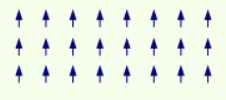
View full question & answer→MCQ 1941 Mark
The magnetic field of Earth can be modelled by that of a point dipole placed at the centre of the Earth. The dipole axis makes an angle of $11.3^\circ $ with the axis of Earth. At Mumbai, declination is nearly zero. Then:
AnswerCorrect option: A. The declination varies between $11.3^\circ W$ to $11.3^\circ E.$
The magnetic field lines of the earth resemble that of a hypothetical magnetic dipole located at the centre of the earth.
The axis of the dipole does not coincide with the axis of rotation of the earth and it is tilted at some angle $($angle of declination$)$. Here in this situation the angle of declination is approximately $11.3^\circ $ with respect to the later. Here two possibilities arises as shown in the figure below.
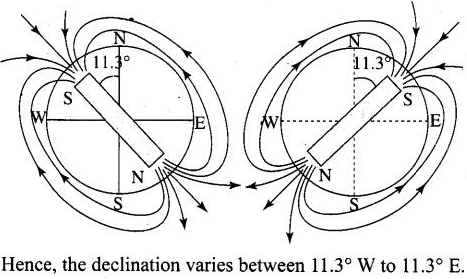
View full question & answer→MCQ 1951 Mark
What does a superconductor exhibit?
AnswerA superconductor exhibits diamagnetism.
View full question & answer→MCQ 1961 Mark
The ratio of intensity of magnetisation and magnetising field is called:
MCQ 1971 Mark
- A
- B
Have no physical reality.
- C
Can be used to indicate the direction of the magnetic field at point.
- ✓
All the above are correct.
AnswerCorrect option: D. All the above are correct.
A pictorial representation of magnetic lines of force is very useful in visualizing the strength and direction of the magnetic field. The direction of magnetic lines of force is defined to be the direction in which the north end of a compass needle points. They have no physical existence.
View full question & answer→MCQ 1981 Mark
A powerful magnet attracts:
- A
- ✓
Only ferromagnetic materials and their ores.
- C
Some materials and repels some other materials.
- D
Only iron and its ores but does not repel any material.
AnswerCorrect option: B. Only ferromagnetic materials and their ores.
There are only three types of materials diamagnetic, paramagnetic and ferromagnetic.
Diamagnetic materials will be repeled feebly.
Paramagnetic materials will be attracted feebly.
Only Ferromagnetic materials gets attracted very strongly.
As well as their ores also because they will also be ferromagnetic in nature.
View full question & answer→MCQ 1991 Mark
A superconductor exhibits perfect:
AnswerA superconductor exhibits perfect diamagnetism.
View full question & answer→MCQ 2001 Mark
What is the unit of magnetic flux?
AnswerThe $SI$ unit of magnetic flour is weber.
It is expressed as $W b= kg \cdot M ^2 S^{-2} A^{-1}$
View full question & answer→MCQ 2011 Mark
The coercivity of a small magnet where the ferromagnet gets demagnetized is $3 \times 10^3 Am ^{-1}$. The current required to be passed in a solenoid of length $10 \ cm$ and number of turns $100$ , so that the magnet gets demagnetized when inside the solenoid, is:
- A
$30 \ mA.$
- B
$60 \ mA.$
- ✓
$3 A.$
- D
$6 A.$
AnswerCorrect option: C. $3 A.$
View full question & answer→MCQ 2021 Mark
What conclusion is drawn regarding the magnetic field at a point if a compass needle at that point rests in any direction?
- A
Magnetic field is non zero.
- ✓
- C
Magnetic field is more than zero.
- D
Magnetic field is less than zero.
AnswerIf the compass needle rest in any direction at a certain point it shows that the net magnetic force acting on the point is zero.Hence, the resultant magnetic field is zero.This point is also known as null or neutral point.
View full question & answer→MCQ 2031 Mark
Field lines are shown close together where the
- A
Magnetic field is far apart.
- B
- ✓
Magnetic fields is greater.
- D
AnswerCorrect option: C. Magnetic fields is greater.
Field lines are used to represent a magnetic field a field line is the path along which a hypothetical free north pole would tend to move. The direction of the magnetic field at a point is given by the direction that a north pole placed at that point would take. Field lines are shown closer together where the magnetic field is greater.
View full question & answer→MCQ 2041 Mark
Ferromagnetic ore properties are due to:
- A
filled inner sub$-$shells.
- B
vacant inner sub$-$shells.
- ✓
partially filled inner sub$-$shells.
- D
all the sub$-$shells equally filled.
AnswerCorrect option: C. partially filled inner sub$-$shells.
Partially filled inner sub-shells, due to the magnetic moment of unpaired electrons in partially filled inner sub$-$shells which got align in a particular direction in the presence of external magnetic field.
View full question & answer→MCQ 2051 Mark
A paramagnetic sample shows a net magnetisation of $8 Am ^{-1}$ when placed in an external magnetic field of $0.6 T$ at a temperature of $4 K$ . When the same sample is placed in an external magnetic field of $0.2 T$ at a temperature of $16 K$ , the magnetisation will be
AnswerCorrect option: B. $\frac{2}{3}\text{Am}^{-1}$
From the Curie’s law explains, $\text{I}\propto\frac{\text{B}}{\text{T}}$
Here, $B$ is magnetic field induction, $I$ is the intensity of magnetisation and $T$ is absolute temperature.
$\Rightarrow\ \Big(\frac{\text{I}_2}{\text{I}_1}\Big)=\Big(\frac{\text{B}_2}{\text{B}_1}\Big)\times\Big(\frac{\text{T}_1}{\text{T}_2}\Big)$
Given,
$I _1=8 Am ^{-1}, B_1=0.6 T, T _1=4 K, B _2=0.2 T, T _2=16 K, I _2=?$
By putting values in equation $…(i),$ we have,
$\text{I}_2=\Big(\frac{2}{3}\Big)\text{Am}^{-1}.$
View full question & answer→MCQ 2061 Mark
A long, straight wire carries a current i. The magnetizing field intensity $H$ is measured at a point $P$ close to the wire. A long, cylindrical iron rod is brought close to the wire so that the point $P$ is at the centre the rod. The value of $H$ at $P$ will:
Answer$\overrightarrow{\text{H}}=\frac{\overrightarrow{\text{B}}}{\mu_0}=\frac{1}{4\pi}\frac{\text{id}\overrightarrow{\text{l}}\times\overrightarrow{\text{r}}}{\text{r}^3}$
The value of $H$ at $P$ will remain almost constant.
View full question & answer→MCQ 2071 Mark
Lenz's law is a consequence of the law of conservation of:
AnswerHINT: Lenz’s law of electromagnetic induction corresponding to the law of conservation of energy.
The induced electromotive force with different polarities induces a current whose magnetic field opposes the change in magnetic flux through the loop in order to ensure that original flux is maintained through the loop when current flows in it.
Lenz’s law depends on the principle of conservation of energy and Newton’s third law.
View full question & answer→MCQ 2081 Mark
The susceptibility of a diamagnetic substance is:
AnswerDiamagnetic sultance
$-1 \leq χ<0$
$\theta =\mu <1$
$χ=$ susceptibility
View full question & answer→MCQ 2091 Mark
The direction of the induced current in the coil can also be found by:
AnswerThe direction of the induced current in the coil can also be found by lenz's law which states that the direction of induced correct is such that it the opposes the change producing it.
View full question & answer→MCQ 2101 Mark
In a cassette player, material used for coating magnetic tapes is:
- A
- B
$\ce{CoFe_2O_4}$
- ✓
$\ce{NiFe_2O_4}$
- D
AnswerCorrect option: C. $\ce{NiFe_2O_4}$
In cassette player, materials used for magnetic tapes is $\ce{NiFe_2O_4}$.
Ferrites $($Ferromagnetic material$)$ is used for Coating magnetic tapes.
In cassette player or for building memory store in modern computers.
Most common ones are $\ce{MnFe_2O_4, FeFe_2O_4}$, $\ce{NiFe_2O_4}$ etc.
View full question & answer→MCQ 2111 Mark
Which of the following is not a consequence of Gauss’s law?
- A
The magnetic poles always exist as unlike pairs of equal strength.
- B
If several magnetic lines of force enter a closed surface, then an equal number of lines of force must leave that surface.
- ✓
There are abundant sources or sinks of the magnetic field inside a closed surface.
- D
Isolated magnetic poles do not exist.
AnswerCorrect option: C. There are abundant sources or sinks of the magnetic field inside a closed surface.
Gauss‘s law indicates that there are no sources or sinks of the magnetic field inside a closed surface. In other words, there are no free magnetic charges. Hence, magnetic monopoles do not exist.
View full question & answer→MCQ 2121 Mark
Two points $A$ and $B$ are situated at a distance $x$ and $2x$ respectively from the nearer pole of a magnet $2\ cm$ long. The ratio of magnetic field at $A$ and $B$ is:
- A
$4 : 1$ exactly.
- B
$4 : 1$ approximately
- ✓
$8 : 1$ approximately.
- D
$1 : 1$ approximately.
AnswerCorrect option: C. $8 : 1$ approximately.
View full question & answer→MCQ 2131 Mark
Bell laboratory has developed superconductor at a temperature of:
AnswerBell laboratory has developed superconductor at a temperature of $40 K$.Superconductivity is a phenomenon of exactly zero electrical resistance and expulsion of magnetic flux fields occurring in certain materials, called superconductors, when cooled below a characteristic critical temperature. It was discovered by Dutch physicist Heike Kamerlingh Onnes on April $8, 1911$, in Leiden.
View full question & answer→MCQ 2141 Mark
Calculate the surface integral of a magnetic field over a surface.
- A
- B
- C
- ✓
Equal to its magnetic flux through that surface.
AnswerCorrect option: D. Equal to its magnetic flux through that surface.
he Gauss’s law states that the surface integral of a magnetic field over a closed surface is always zero. But the surface integral of a magnetic field over a surface gives magnetic flux through that surface.
View full question & answer→MCQ 2151 Mark
A ferromagnetic material is placed in an external magnetic field. The magnetic domains:
- A
- B
- ✓
May increase or decrease in size.
- D
Have no relation with the field.
AnswerCorrect option: C. May increase or decrease in size.
A ferromagnetic material is placed in a external magnetic field. The Magnetic domains may increase or decrease in size.
View full question & answer→MCQ 2161 Mark
When is the angle of dip at a place equal to $45^{\circ}$ ?
- ✓
When the vertical and horizontal components of earth’s magnetic field are equal.
- B
When the vertical component is twice the horizontal component of earth’s magnetic field.
- C
When the vertical component is half the horizontal component of earth’s magnetic field.
- D
When either the vertical component or the horizontal components of earth’s magnetic field is equal to zero.
AnswerCorrect option: A. When the vertical and horizontal components of earth’s magnetic field are equal.
Yes, the angle of dip at a place is equal to $45^\circ$, when the vertical and horizontal components of earth’s magnetic field are equal. In this case $\rightarrow δ=45^\circ$
$\tan\delta=\frac{\text{B}_\text{v}}{\text{B}_\text{v}}=1$
So, $B_v=B_H$.
View full question & answer→MCQ 2171 Mark
Which of the following statements given below is not true in the context of magnetic lines of force?
- A
Magnetic lines of forces are closed continuous curves.
- B
No two magnetic lines of force can intersect each other.
- C
Magnetic lines of force are close to each other at the poles.
- ✓
They start from the north pole and end on the south pole.
AnswerCorrect option: D. They start from the north pole and end on the south pole.
The magnetic lines of force are closed concentric circles and hence, the starting or ending point cannot be specified exactly except the direction. Therefore, the direction of magnetic field lines outside the magnet is from North Pole to South Pole and the direction of magnetic field lines inside the magnet is from south pole to the north pole. Start and end cannot be found.
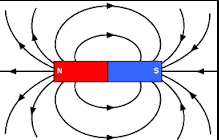
View full question & answer→MCQ 2181 Mark
A thin diamagnetic rod is placed vertically between the poles of an electromagnet. When the current in the electromagnet is switched on, then the diamagnetic rod is pushed up, out of the horizontal magnetic field. Hence, the rod gains gravitational potential energy. The work required to do this comes from:
- ✓
- B
- C
The induced electric field due to the changing magnetic field.
- D
The lattice structure of the material of the rod.
View full question & answer→MCQ 2191 Mark
The temperature bellow which a material becomes a superconductor is called:
AnswerCritical temperature is the temperature below which metals when taken exhibit zero resistivity and turns into a superconductor. The critical temperature varies with the individual material. Because these materials have no electrical resistance, meaning electrons can travel freely through them, they can carry large amounts of electrical current for long periods of time without losing energy as heat. The transition is so sudden and complete that it appears to be a transition to a different phase of matter; known as the superconducting phase.
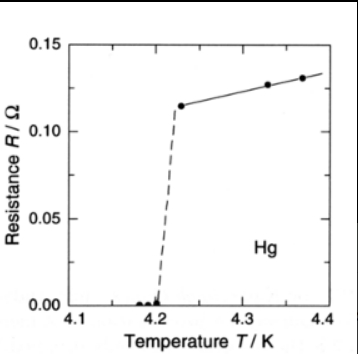
View full question & answer→MCQ 2201 Mark
A susceptibility of a certain magnetic material is $400.$ What is the class of the magnetic material?
AnswerMagnetic susceptibility of a ferromagnetic material is very very greater than $1$, that of diamagnetic material is negative whereas that of a paramagnetic material is small and positive.
Hence, the given material is a ferromagnetic material.
View full question & answer→MCQ 2211 Mark
Metals getting magnetised by orientation of atomic magnetic moments in external magnetic field are called:
MCQ 2221 Mark
Which of the following is not correct about relative magnetic permeability $(\mu,)$?
- A
It is a dimensionsless pure ratio.
- B
For vacuum medium its value is one.
- C
For ferromagnetic materials $\mu,>>1$
- ✓
For paramagnetic materials $\mu,>1$
AnswerCorrect option: D. For paramagnetic materials $\mu,>1$
View full question & answer→MCQ 2231 Mark
Curie temperature is the temperature above which:
- ✓
A ferromagnetic material becomes paramagenetic.
- B
A paramagnetic material becomes diamagnetic.
- C
A ferromagnetic material becomes diamagnetic.
- D
A paramagnetic meterial becomes ferromagnetic.
AnswerCorrect option: A. A ferromagnetic material becomes paramagenetic.
View full question & answer→MCQ 2241 Mark
Which of the following statements given below is not true in the context of magnetic lines of force?
- A
Magnetic lines of forces are closed continuous curves.
- B
No two magnetic lines of force can intersect each other.
- ✓
Magnetic lines of force are far away from each other at the poles.
- D
The start from the north pole and end on the south pole.
AnswerCorrect option: C. Magnetic lines of force are far away from each other at the poles.
Magnetic line of forces have some properties that they are closed continuous curves which are nearer to one another at the point where magnetic field is strong but are far away from each other at the point where magnetic field is weak. At the poles, magnetic field is the strongest. Thus at poles, magnetic line of forces are nearest to each other.
Also, magnetic line of forces start from north pole and end at south pole and no two magnetic line of forces intersect with each other.
View full question & answer→MCQ 2251 Mark
The magnetic lines of force inside a bar magnet:
AnswerCorrect option: D. Are from $S-$pole of magnet.
View full question & answer→MCQ 2261 Mark
The hysteresis cycle curve for the material of a permanent magnet is:
AnswerHysteresis cycle curve for the material of a permanent magnet is given in the image.
It is clear from the image that hysteresis cycle curve for the material of a permanent magnet is tall and wide.
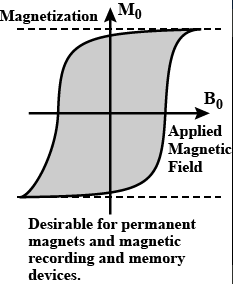
View full question & answer→MCQ 2271 Mark
Core of electromagnets are made of ferromagnetic material which has:
- ✓
High permeability and Low retentivity.
- B
High permeability and High retentivity.
- C
Low permeability and High retentivity.
- D
Low permeability and Low retentivity.
AnswerCorrect option: A. High permeability and Low retentivity.
Electromagnetic cores should have:
High permeability so that it supports the formation of a magnetic field within itself.
Low retentivity so that the magetic field so that it gets demagnetized easily.
View full question & answer→