Questions · Page 1 of 3

3 Marks Question

🎯

Test yourself on this topic

50 questions · timed · auto-graded

Question 13 Marks
A 60μF capacitor is connected to a 110V, 60Hz ac supply. Determine the rms value of the current in the circuit.
Answer
Capacitance of capacitor, $\text{C}=60\mu\text{F}=60\times10^{-6}\text{F}$
Supply voltage, V = 110V
Angular frequency, $\omega=2\pi\text{V}$
Capacitive reactance $\text{X}_{\text{c}}=\frac{1}{\omega\text{C}}$
$=\frac{1}{2\pi\text{vC}}$
$=\frac{1}{2\times3.14\times60\times60\times10^{-6}}\Omega^{-1}$
Rms value of current is given as:
$\text{I}=\frac{\text{v}}{\text{X}_{\text{c}}}$
$= 110 \times 2 \times 3.14 \times 60 \times 10^{-6} \times 60 = 2.49A$
Hence, therms value of current is 2.49A.
View full question & answer
Question 23 Marks
A series LCR circuit with R = 20Ω, L = 1.5H and C = 35μF is connected to a variable-frequency 200V ac supply. When the frequency of the supply equals the natural frequency of the circuit, what is the average power transferred to the circuit in one complete cycle?
Answer
At resonance, the frequency of the supply power equals the natural frequency of the given LCR circuit.
Resistance, $\text{R}=20\Omega$
Inductance, L = 1.5H
Capacitance, $C = 35μF = 30 \times 10^{-6}F$
AC supply voltage to the LCR circuit, V = 200V
Impedance of the circuit is given by the relation,
$\text{Z}=\sqrt{\text{R}^2+\Big(\omega\text{L}-\frac{1}{\omega\text{C}}\Big)^2}$
At resonance, $\omega\text{L}=\frac{1}{\omega\text{C}}$
$\therefore\ \text{Z}=\text{R}=20\Omega$
Current in the circuit can be calculated as:
$\text{I}=\frac{\text{V}}{\text{Z}}$
$=\frac{200}{20}=10\text{A}$
Hence, the average power transfer-red to the circuit in one complete cycle= VI
= 200 × 10 = 2000W.
View full question & answer
Question 33 Marks
A radio can tune over the frequency range of a portion of MW broadcast band: (800kHz to 1200kHz). If its LC circuit has an effective inductance of 200μH, what must be the range of its variable capacitor?
[Hint: For tuning, the natural frequency i.e., the frequency of free oscillations of the LC circuit should be equal to the frequency of the radiowave.]
Answer
The range of frequency (v) of a radio is 800kHz to 1200kHz.
Lower tuning frequency, $v_1 = 800kHz = 800 \times 10^3Hz$
Upper tuning frequency, $v_2 = 1200kHz = 1200 \times 10^3Hz$
Effective inductance of circuit $L = 200\mu H = 200 \times 10^{-6}H$
Capacitance of variable capacitor for $v_1$ is given as:
$\text{C}_1=\frac{1}{\omega_1^2\text{L}}$
Where,
$\omega_1=$ Angular frequency for capacitor $C_1$
$=2\pi\text{v}_1=2\pi\times800\times10^3\text{rad}\text{ s}^{-1}$
$\therefore\ \text{C}_1=\frac{1}{(2\pi\times800\times10^3)^2\times200\times10^{-6}}$
$= 1.9809 \times 10^{-10}F = 198.1\ pF$
Capacitance of variable capacitor for $v_2,$
$\text{C}_2=\frac{1}{\omega_2^2\text{L}}$
Where,
$\omega_2=$ Angular frequency for capacitor $C_2$
$=2\pi\text{v}_2=2\pi\times1200\times10^3\text{rad}\text{ s}^{-1}$
$\therefore\ \text{C}_2=\frac{1}{(2\pi\times1200\times10^3)^2\times200\times10^{-6}}$
= 88.04 pF
Hence, the range of the variable capacitor is from 88.04 pF to 198.1 pF
View full question & answer
Question 43 Marks
Obtain the resonant frequency and Q-factor of a series LCR circuit with L = 3.0H, C = 27μF, and R = 7.4Ω. It is desired to improve the sharpness of the resonance of the circuit by reducing its ‘full width at half maximum’ by a factor of 2. Suggest a suitable way.
Answer
Inductance, $L = 3.0H$
Capacitance, $C = 27\mu F = 27 \times 10^{-6}F$
Resistance, $\text{R}=7.4\Omega$
At resonance, angular frequency of the source for the given LCR series circuit is given as:
$\omega_{\text{r}}=\frac{1}{\sqrt{\text{LC}}}$
$=\frac{1}{\sqrt{3\times27\times10^{-6}}}=\frac{10^3}{9}=111.11\text{rad }\text{s}^{-1}$
Q-factor of the series:
$\text{Q}=\frac{\omega_{\text{r}}\text{L}}{\text{R}}$
$=\frac{111.11\times3}{7.4}=45.0446$
To improve the sharpness of the resonance by reducing its 'full width at half maximum'
by a factor of 2 without changing $\omega_{\text{r}},$ we need to reduce R to half i.e.,
$\text{Resistance}=\frac{\text{R}}{2}=\frac{7.4}{2}=3.7\Omega.$
View full question & answer
Question 53 Marks
Obtain the resonant frequency ωr of a series LCR circuit with L = 2.0H, C = 32μF and R = 10Ω. What is the Q-value of this circuit?
Answer
Inductance, $L = 2.0H$
Capacitance, $C = 32\mu F = 32 \times 10^{-6}F$
Resistance, $\text{R}=10\Omega$
Resonant frequency is given by the relation,
$\omega_{\text{r}}=\frac{1}{\sqrt{\text{LC}}}$
$=\frac{1}{\sqrt{2\times32\times10^{-6}}}=\frac{1}{8\times10^{-3}}=125\text{s}^{-1}$
Now, Q-value of the circuit is given as:
$\text{Q}=\frac{1}{\text{R}}\sqrt{\frac{\text{L}}{\text{C}}}$
$=\frac{1}{10}\sqrt{\frac{2}{32\times10^{-6}}}=\frac{1}{10}\times\frac{1}{4\times10^{-3}}=25$
Hence, the Q-Value of this circuit is 25.
View full question & answer
Question 63 Marks
Suppose the circuit in Exercise 7.18 has a resistance of $15\Omega.$ Obtain the average power transferred to each element of the circuit, and the total power absorbed
Answer
Here,
Reistance, $\text{R}=15\Omega$
$\therefore\ \text{Impedance},\ \text{Z}=\sqrt{\text{R}^2+\Big(\omega\text{L}-\frac{1}{\omega\text{C}}\Big)^2}$
$\text{Z}=\sqrt{15^2+\Big(2\pi\times50\times80\times10^{-3}-\frac{1}{2\pi\times50\times60\times10^{-6}}\Big)^2}$
$=\sqrt{225+779.5}\Omega=31.7\Omega$
$\therefore\ \text{I}_{\text{rms}}=\frac{\text{V}_{\text{rms}}}{\text{Z}}=\frac{230}{31.7}=7.255\text{A}$
Average power transferred to inductor, $\text{L}=\text{E}_{\text{v}}\text{I}_{\text{v}}\cos\frac{\pi}{2}=0$
Average power transferred to capacitor $=\text{E}_{\text{v}}\text{I}_{\text{v}}\cos\Big(\frac{-\pi}{2}\Big)=0$
Average power transferred to $R = I^2rms \times R$
$= (7.255)^2 \times 15$
$= 789.5W.$
View full question & answer
Question 73 Marks
Obtain the answers (a) to (b) in Exercise 7.13 if the circuit is connected to a high frequency supply (240V, 10kHz). Hence, explain the statement that at very high frequency, an inductor in a circuit nearly amounts to an open circuit. How does an inductor behave in a dc circuit after the steady state?
Answer
Here given,
Inductance,$ L = 0.50H$
Resistance, $\text{R}=100\Omega$
Rms value of voltage, $V_{rms} = 240V$
Frequency of Ac supply, $f = 10kHz = 10^4Hz$
Therefore,
Angular frequency, $\omega=2\pi\text{f}=2\pi\times10^4\text{rad }\text{s}^{-1}\ \text{Peak voltage},$
$\text{V}_0=\sqrt{2}\text{V}_{\text{rms}}$
$=\sqrt{2}\times240$
$= 339.36V$
Maximum current,
$\text{I}_0=\frac{\text{V}_0}{\sqrt{\text{R}^2+\omega^2\text{L}^2}}$
$=\frac{339.36}{\sqrt{(100)^2+(2\pi\times10^4\times0.5)^2}}\text{A}$
$=\frac{339.36}{31416}\text{A}$
$= 0.01212\ A = 1.12 \times 10^{-2}A$
This current is much smaller than for the low frequency case (1.82 A in above question), showing that the inductive reactance is very large at high frequencies and inductor in circuit nearly amounts to an open circuit.
In d.c. circuit (after steady state) $\omega=0.$
$\therefore\ \text{Z}_{\text{L}}=\omega\text{L}=0$
i.e., inductance L behaves like a pure inductor.
View full question & answer
Question 83 Marks
  1. For a glass prism $(\mu =\sqrt{3} )$ the angle of minimum deviation is equal to the angle of the prism. Calculate the angle of the prism.
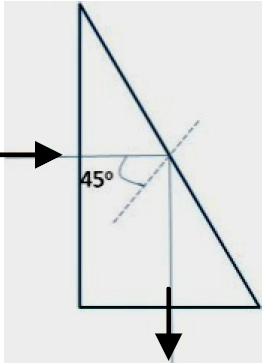
  2. Draw ray diagram when incident ray falls normally on one of the two equal sides of a right angled isosceles prism having refractive index $\mu = \sqrt{3} . $
Answer
  1. $\mu = \frac{\sin(\frac{\text{A} + \text{D}}{2})}{\sin\frac{\text{A}}{2}}$
$ = \frac{\sin(\frac{2\text{A}}{2})}{\sin\frac{\text{A}}{2}} =2 \cos\text{A}\sqrt{2} = \sqrt{3}$
$\therefore\text{A} = 60 ^{o}$
  1. $\mu = \sqrt{3} = \frac{1}{\sin\text{i}_{c}}$

$\therefore\sin\text{i}_{c} = \frac{1}{\sqrt{3}}\cong0.58$
Lies between $30^\circ$ and $45^\circ$
Hence, TIR takes place.
Alternate Answer
$\sin\text{C} = \frac{1}{\sqrt{3}}$ which is less than $\frac{1}{\sqrt{2}}$
$\therefore $ Angle of incidence $ > i_c$
$\therefore\text{TIR}$
View full question & answer
Question 93 Marks
  1. Define the term intensity of radiation' in photon picture.
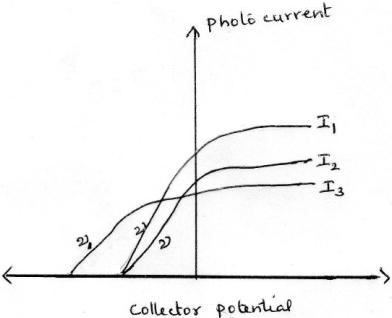
  2. Plot a graph showing the variation of photo current vs collector potential for three different intensities $I_1 >  I_2 > I_3$, two of which $(I_1$ and $I_2)$ have the same frequency v and the third has frequency $v_1 > v.$
  3. Explain the nature of the curves on the basis of Einstein's equation.
Answer
  1. Intensity of radiation equals the energy of all the Photons incident normally per unit area per unit time.
Alternate Answer
The intensity of radiation is proportional to the number of photons emitted per unit area per unit time.
  1.  
  1. As per Einstein’s equation:
  1. The stopping potential is same for $I_1$ and $I_2$ as they have the same frequency.
  2. The saturation currents are as shown, because $I_1 > I_2 > I_3.$
View full question & answer
Question 103 Marks
Mention any three applications of the internet. Explain one of these in detail.
Answer
Applications of internet: e-mail, social networking sites, e–commerce, mobile telephony, GPS.E-mail:
Electronic Mail (email or e-mail) is a method of exchanging messages between people using electronic devices. Email first entered substantial use in the 1960s and by the mid-1970s had taken the form now recognized as email. Email operates across computer networks, which today is primarily the Internet. Some early email systems required the author and the recipient to both be online at the same time, in common with instant messaging. Today's email systems are based on a store-and-forward model. Email servers accept, forward, deliver, and store messages. Neither the users nor their computers are required to be online simultaneously; they need to connect only briefly, typically to a mail server or a webmail interface, for as long as it takes to send or receive messages.
View full question & answer
Question 113 Marks
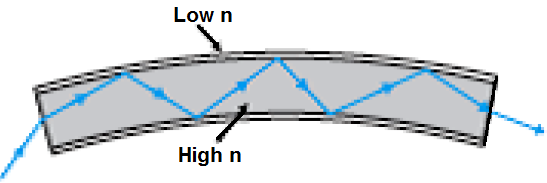
  1. Name the phenomenon on which the working of an optical fibre is based.
  2. What are the necessary conditions for this phenomenon to occur?
  3. Draw a labelled diagram of an optical fibre and show how light propagates through the optical fibre using this phenomenon.
Answer
  1. Total internal reflection.
  2. Rays of light have to travel from optically denser medium to optically rarer medium and Angle of incidence in the denser medium should be greater than critical angle.
  3.  
View full question & answer
Question 123 Marks
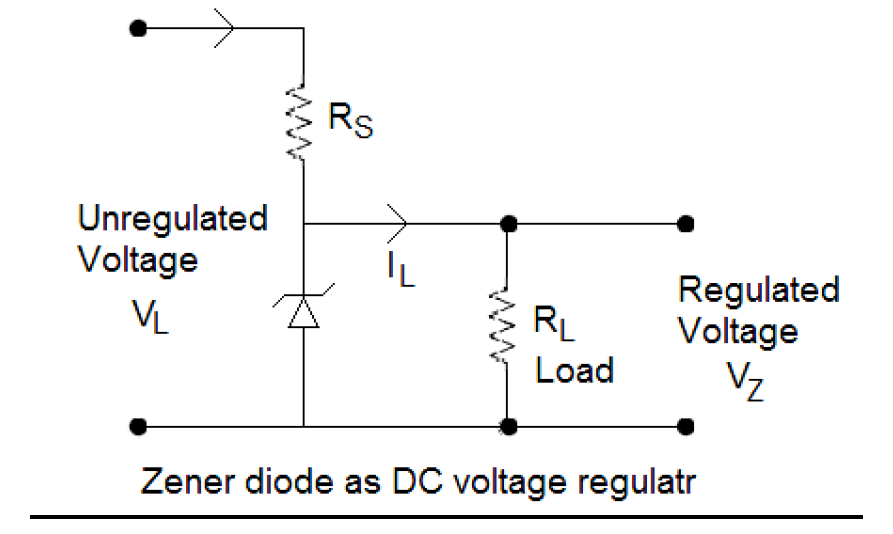
Write two important considerations used while fabricating a Zener diode. Explain, with the help of a circuit diagram, the principle and working of a Zener diode as voltage regulator.
Answer
Two important considerations:
Heavy doping of both p and n sides.
Appropriate "break down voltage‟ under reverse bias.
Circuit diagram:

Principle: Even small reverse bias voltage (5V) can produce a very high electric field because the depletion region is very thin.
Working: The unregulated DC voltage is connected to the Zener diode through a series resistance RS such that the Zener diode is reverse biased. In breakdown region, the Zener voltage remains constant even though the current through Zener diode changes. This helps to regulate the output voltage.
View full question & answer
Question 133 Marks
Write symbolically the nuclear $\beta^{+}$decay process of $^{11}_{6}\text{C}$ . Is the decayed product X an isotope or isobar of $^{11}_{6}\text{C}$?
Given the mass values m $(^{11}_{6}\text{C})$ = 11·011434 u and m (X) = 11·009305 u. Estimate the Q-value in this process.
Answer
Equation $^{11}_{6}\text{C}\rightarrow^{11}_{5}\text{X} + \text{i}^{e} + \text{v} + \text{Q}$
(? ?? ? on the R.H.S.)
X is an isobar
Mass defect $(\Delta\text{m}) = \text{m}(^{11}_{6}\text{C}) - \text{m}(^{11}_{5}\text{X})$
$ = ( 11.011434 - 11.009305) \text{u}$
$ = 0.002129\text{u}$
$\text{Q} = \Delta\text{m}\times931.5\text{ MeV}$
$=0.002129\times931.5 \text{ MeV}$
$ = 1.98\text{ MeV}$.
View full question & answer
Question 143 Marks
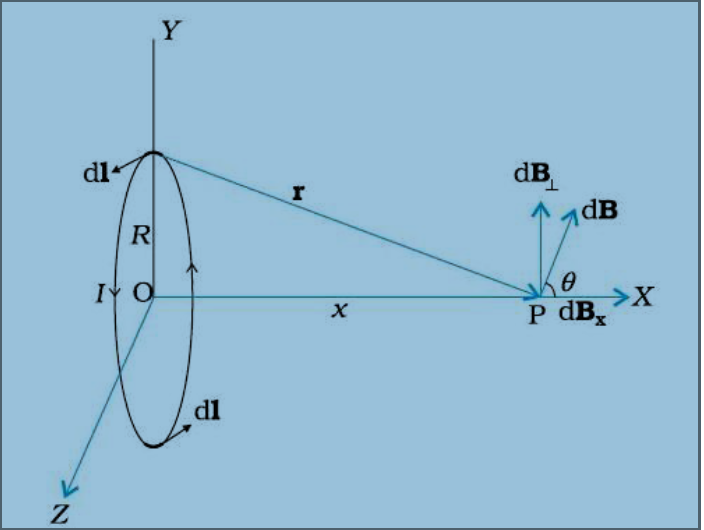
State Biot – Savart law. Deduce the expression for the magnetic field at a point on the axis of a current carrying circular loop of radius ‘R’, distant ‘x’ from the centre. Hence write the magnetic field at the centre of a loop.
Answer
Biot Savart’s law $\overrightarrow{\text{dB}}\propto\text{I}\frac{\overrightarrow{\text{dl}}\times\overrightarrow{\text{r}}}{{{\text{r}^{3}}}}$
$\overrightarrow{\text{dB}} = \frac{\mu_{\circ}}{4\pi}\text{I}\frac{\overrightarrow{\text{dl}}\times\hat{\text{r}}}{{{\text{r}^{2}}}}$
[?? ∝ ?, ?? ∝ ?? ??? ?? ∝ $\frac{1}{\text{r}^{2}} ]$

Derivation:
The resultant magnetic field will be along the axis as the perpendicular (to the axis) components cancel out in pairs.
$\text{B} = \int_{\circ}^{e\pi\text{R}}\text{dB}\cos\theta$
$\int_{\circ}^{2\pi\text{R}}\frac{\mu_{\circ}}{4\pi}\frac{\text{Idl}}{(\text{R}^{2} + \text{x}^{2})}\frac{\text{R}}{(\text{R}^{2} + \text{x}^{2})^{1/2}}$
$=\frac{\mu_o{\text{I}}}{4\pi} \frac{2\pi{\text{R}}^{2}}{{(R}^{2}+{\text{x}}^{2})^{3/2}}=\frac{\mu_o{\text{I}{\text{R}}}^{2}}{{2(R}^{2}+{\text{x}}^{2})^{3/2}}$
At centre, x= 0
$\therefore \text{B}_{\circ} = \frac{\mu_{\circ}\text{I}}{2\text{R}}$.
View full question & answer
Question 153 Marks
Explain briefly the process of charging a parallel plate capacitor when it is connected across a d.c. battery. A capacitor of capacitance ‘C’ is charged to ‘V’ volts by a battery. After some time the battery is disconnected, and the distance between the plates is doubled. Now a slab of dielectric constant, 1 < k < 2, is introduced to fill the space between the plates. How will the following be affected:
  1. The electric field between the plates of the capacitor.
  2. The energy stored in the capacitor.
Justify your answer by writing the necessary expressions.
Answer
Process of charging:
The electrons, from the plate of the capacitor, which is connected to the positive terminal of the battery, move towards the battery. The reverse happens at the other plate. Hence, the plates get positively and negatively charged respectively.
Effect of dielectric:
  1. Electric fields decreases Justification.
Because initially $\text{E}_{1} = \frac{\sigma}{\varepsilon}_{\circ}$ and finally $\text{E}_{2} =\frac{1}{\text{k}}.\frac{\sigma}{\varepsilon}_{\circ}$

$\text{E} = \frac{\text{E}_{1}}{\text{K}}$
  1. Energy stored increases:
New capacitance$\text{C} = \bigg(\frac{\varepsilon_\circ\text{A}}{2\text{d}}\bigg)\text{k}$

$ = \frac{\text{K}}{2}\text{C}_{\circ} , $

$\therefore\text{C} < \text{C}_{\circ}$

Initially Energy $ = \frac{\text{Q}^{2}}{2\text{c}}$ and Energy $ = \frac{\text{Q}^{2}}{\text{c}}.\frac{2}{\text{k}}\text{as }1 < \text{K} < 2.$
View full question & answer
Question 163 Marks
Arrange the following electromagnetic waves in the order of their increasing wavelength:
  1. $\gamma- \text{rays}$.
  2. Microwaves.
  3. X-rays.
  4. Radio waves.
How are infra-red waves produced? What role does infra-red radiation play in (i) Maintaining the Earth’s warmth and (ii) Physical therapy?
Answer
Gamma $(\gamma)$ rays, X-rays, Microwaves, Radiowaves.
Infrared rays are produced by hot bodies/vibration of atoms and molecules.
Infrared rays:
  1. Maintain Earth’s warmth through green house effect.
  2. Produce heat.
View full question & answer
Question 173 Marks
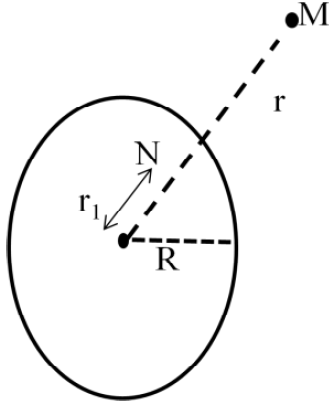
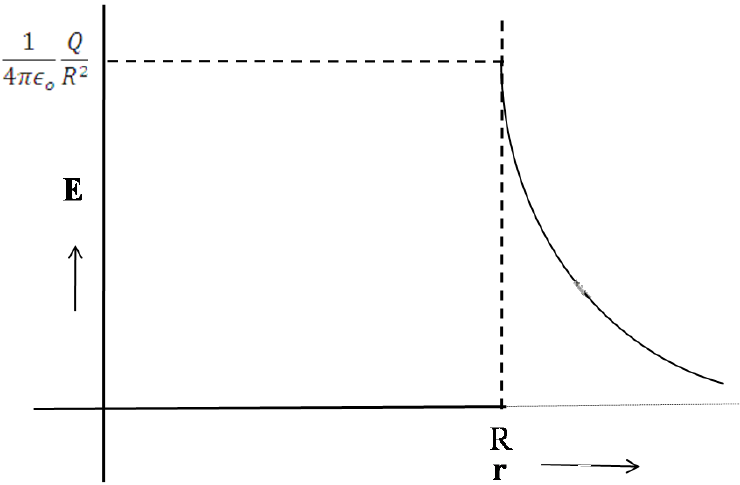
Find the electric field intensity due to a uniformly charged spherical shell at a point (i) outside the shell and (ii) inside the shell. Plot the graph of electric field with distance from the centre of the shell.
Answer
We have by Gauss’s law $\oint\overrightarrow{\text{E}}.\overrightarrow{\text{ds}} = \frac{\text{Q}_{eclosed}}{\in_{0}}$Let Q be the total charge on the shell.
  1. For the point M outside the shell, we have

$\text{E}.4\pi\text{r}^{2} = \frac{\text{Q}}{\in_{0}}$
$\therefore\text{E} = \frac{1}{4\pi\in_{0}}\frac{\text{Q}}{\text{r}^{2}}$
  1. For the point N inside the shell, as charge enclosed inside the shell is zero.
$\text{E}.4\pi\text{r}^{2}_{1} = 0 $
$\therefore\text{E} = 0 $
The graph is as shown
View full question & answer
Question 183 Marks
  1. When an AC source is connected to an ideal capacitor, show that the average power supplied by the source over a complete cycle is zero.
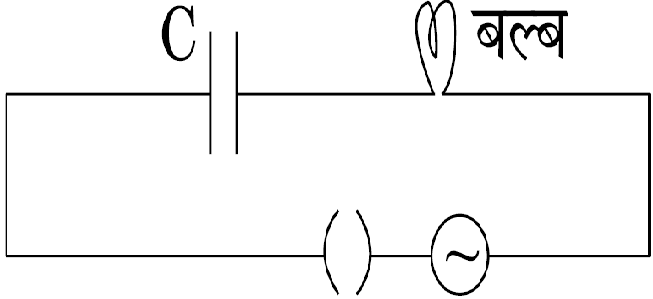
  2. A bulb is connected in series with a variable capacitor and an A.C. source as shown. What happens to the brightness of the bulb when the key is the capacitor is gradually reduced?
Answer
  1. Let the applied voltage be
$\text{V}= \text{V}_{o}\sin\omega\text{t}$

The current through an ideal capacitor, would then be

$\text{I} = \text{I}_{o}\sin(\omega\text{t} + \frac{\pi}{2}) = \text{I}_{0}\cos\omega\text{t}$

$\therefore\text{P}_{inst} = \text{VI}$

$\therefore\text{P}_{AV} = \frac{1}{\text{T}}\int^{T}_{0}\text{VIdt}$

$\therefore\text{P}_{AV} = \frac{\text{V}_{0}\text{I}_{0}}{2}\langle\sin2\omega\text{t}\rangle$

$=0.$
  1. $\text{X}_{c} = \frac{1}{\omega\text{C}}$
$\therefore\text{X}_{c}$ increases as C decreases. Hence, with decreasing C, the brightness of the bulb would decrease.
View full question & answer
Question 193 Marks
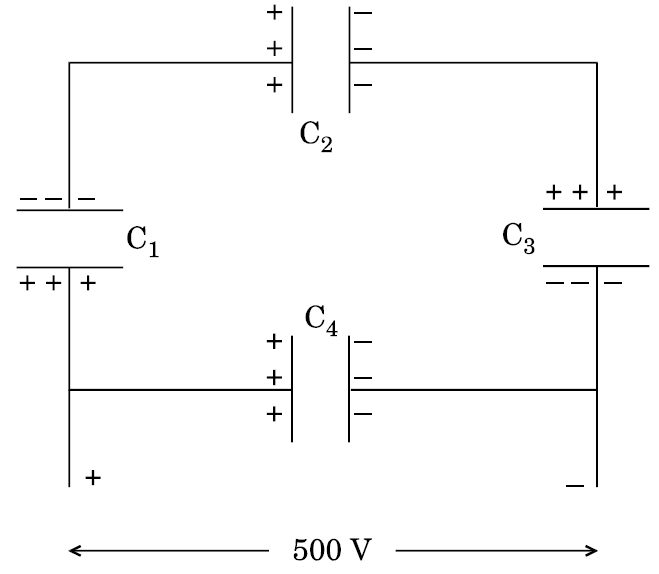
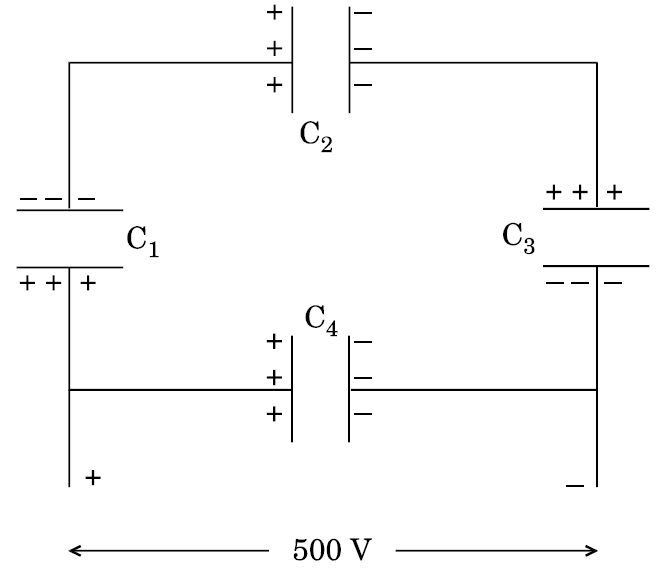
A network of four 10 $\mu$F capacitors is connected to a 500 V supply as shown in the figure. Determine the
  1. equivalent capacitance of the network and.
  2. charge on each capacitor.
Answer
  1. Equivalent capacitance $(\text{C}_{n}) = \frac{\text{C}}{3} + \text{C}$
$ = \frac{4\text{C}}{3} = \frac{40}{3}\mu\text{F}$
  1. $\text{Charge on } \text{C}_{4}, \text{q}_{4} = \text{C}_{4}\times\text{V}=10\times500 \mu\text{C}$
$ = 5\times10^{-3}\text{C} = 5 \text{mC}$

$\text{Charge on } \text{C}_ {1},\text{C}_{2},\text{C}_{3}\text{ is same and is equal to} \frac{\text{C}}{3}\times\text{V}$

$ = \frac{5}{3}\times10^{-3}\text{C}$

$ = 1.67\text{mC}$.
View full question & answer
Question 203 Marks
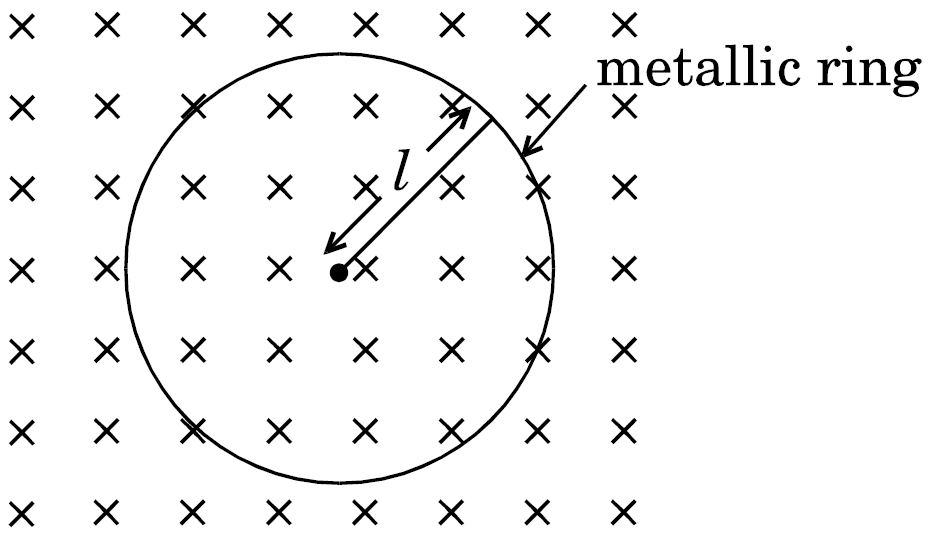
A metallic rod of length ‘l’ is rotated with a frequency ‘v’, with one end hinged at the centre and the other end at the circumference of a circular metallic ring, about an axis passing through the centre and perpendicular to the plane of the ring. A constant and uniform magnetic field B parallel to the axis is present everywhere.
  1. Obtain the expression for the emf induced between the centre and the ring.
  2. Given that the rod has resistance ‘R’, then how much power will be generated?
Answer
  1. Emf induced $\int^{1}_{0}\text{Bwrdr}$
$ = \frac{1}{2}\text{Bwl}^{2}$

$\because \omega = 2\pi\text{v}$

$\therefore\varepsilon = \pi\text{Bvl}^{2}$
  1. $\text{P} = \frac{\varepsilon^2}{\text{R}} = \frac{(\pi\text{Bvl}^{2})^{2}}{\text{R}}$
$ = \frac{\pi^{2}\text{B}^{2}\text{V}^{2}\text{l}^{4}}{\text{R}}.$
View full question & answer
Question 213 Marks
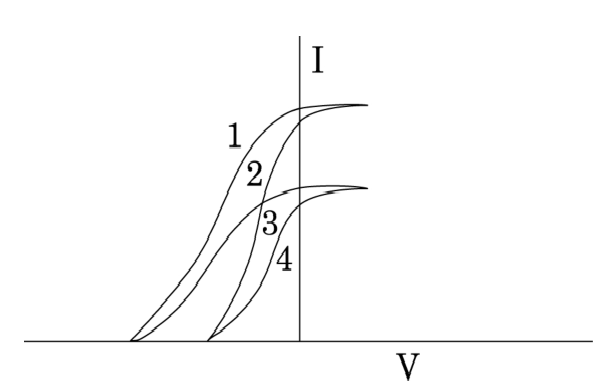
The given graph shows the variation of photo-electric currently) with the applied voltage(V) for two different materials and for two different intensities of the incident radiations. Identify and explain using Einstein's photo electric equation the pair of curves that correspond to (i) different materials but same intensity of incident radiation (ii) different intensities but same materials.
Answer
(1, 2) correspond to same intensity but different material.
(3, 4) correspond to same intensity but different material.
As saturation currents are same and stopping potentials are different.
(1, 3) correspond to different intensity but same material.
(2, 4) correspond to different intensity but same material.
As stopping potentials are same but saturation currents are different.
View full question & answer
Question 223 Marks
What is Global Positioning System? Explain its working principle in brief.
Answer
Global Positioning System is method of identifying location or position of any point or a person on earth using a system of 24 satellites, which are continuously orbiting, observing, monitoring and mapping the earth.
Working Principle:
  1. The unique location of GPS user is determined by measuring its distance from at least three GPS satellites.
  2. Using these values of distances, obtained from three satellites, a microprocessor, fitted in GPS device, determines the exact location.
View full question & answer
Question 233 Marks
  1. What is total internal reflection? Under what conditions does it occur?
  2. Find a relation between critical angle and refractive index.
  3. Name one phenomenon which is based on total internal reflection.
Answer
  1. When a ray of light travels from a denser medium into a rarer medium at an angle greater than the critical angle, it reflects back into the denser medium. This phenomenon is called total internal reflection. Conditions for total internal reflection.
    1. Light should travel from denser medium to rarer medium.
    2. Angle of incidence should be greater than critical angle.
  2. $\frac{1}{\mu} = \frac{\sin\text{ i}}{\sin\text{ r}} , $ for total internal reflection to occur $i \geq i _{c}$ at critical angle, angle of refraction$\text{?}=90^{o}$, hence, $\frac{1}{\mu} = \frac{\sin\text{i}_{c}}{\sin90^{o}}$
$\Rightarrow\mu = \frac{1}{\sin\text{i}_{c}}$
  1. Mirage/sparkling of diamond/ optical fiber/totally reflecting Prism/shinning of air bubbles in water.
View full question & answer
Question 243 Marks
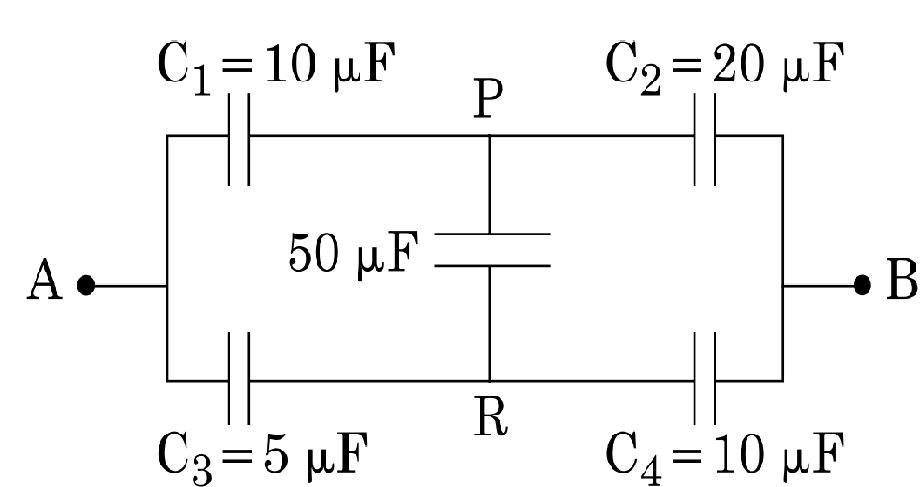
Calculate the equivalent capacitance between points A and B in the circuit below. If a battery of 10 V is connected across A and B, calculate the charge drawn from the battery by the circuit.
Answer
$\because\frac{\text{C}_{1}}{\text{C}_{2}} = \frac{\text{C}_{3}}{\text{C}_{4}}$
This is the condition of balance so there will be no current across PR (50 μF capacitor)
Now $?_1$ and $?_2$ are in series,
$\text{C}_{12} = \frac{\text{C}_{1}\text{C}_{2}}{\text{C}_{1} + \text{C}_{2}} = \frac{10\times20}{10 + 20 } = \frac{200}{30} =\frac{20}{3}\mu\text{F}$
$\because$ $?_3$ and $?_4$ are in series,
$\text{C}_{34} = \frac{\text{C}_{3}\text{C}_{4}}{\text{C}_{3} + \text{C}_{4}} =\frac{5\times10}{5 + 10 } =\frac{50}{15} = \frac{10}{3}\mu\text{F}$
Equivalent capacitance between A and B is
$\text{C}_{AB} = \text{C}_{12} + \text{C}_{34} =\frac{20}{3} + \frac{10}{3} = 10 \mu\text{F}$
Charge drawn from battery (q) = CV
$ = 10 \times 10 \mu\text{C}$
$ = 10\mu\text{C} \text{ or }10^{-4}\text{ C}.$
View full question & answer
Question 253 Marks
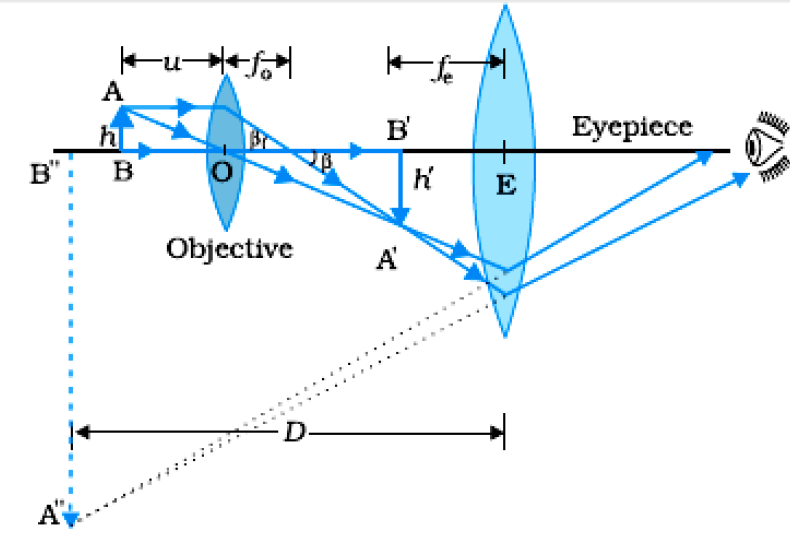
  1. Draw a schematic ray diagram of a compound microscope when image is formed at distance of distinct vision.
  2. Write the expression for resolving power of a compound microscope. How can the resolving power of a microscope be increased?
Answer
  1.  

Resolving power of compound microscope $ = \frac{2\mu\sin\theta}{1.22\lambda}.$
Resolving power can be increased by decreasing wavelength and by increasing refracting index of medium.
View full question & answer
Question 263 Marks
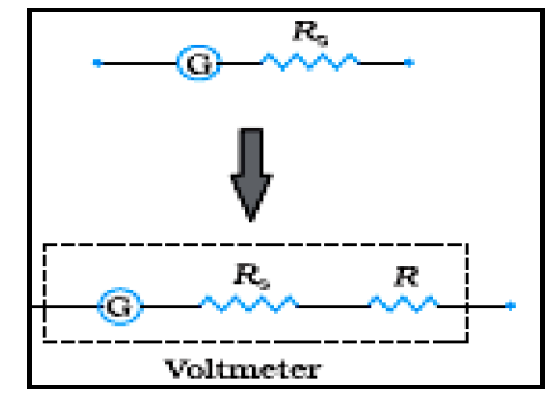
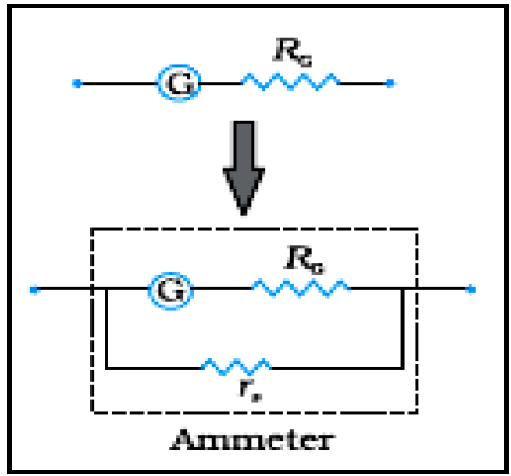
How is a galvanometer converted into a voltmeter and an ammeter? Draw the relevant diagrams and find the resistance of the arrangement in each case. Take resistance of galvanometer as G.
Answer
A galvanometer is converted into a voltmeter by connecting a high resistance ‘R’ in series with it. A galvanometer is converted into an ammeter by connecting a small resistance (called shunt) in parallel with it.


Resistance of voltmeter, $?_? = G + R$
Resistance for Ammeter, $\text{R}_{A} = \frac{\text{G }\text{ r}_{s}}{\text{G} + \text{r}_{s}}$.
View full question & answer
Question 273 Marks
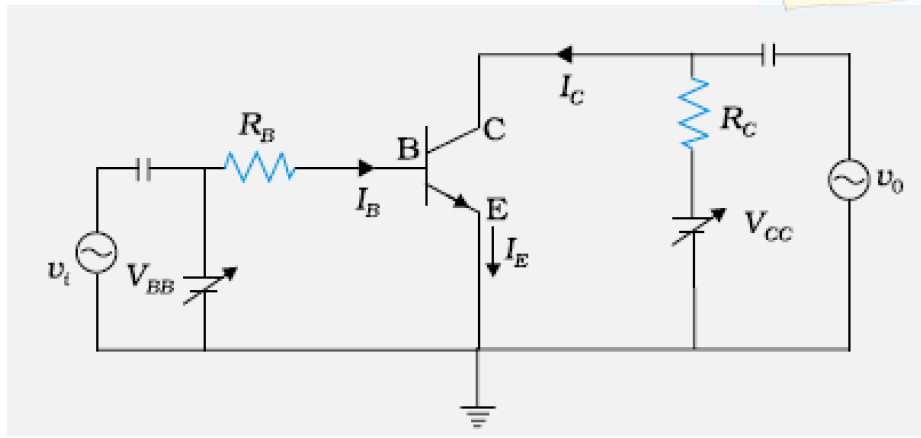
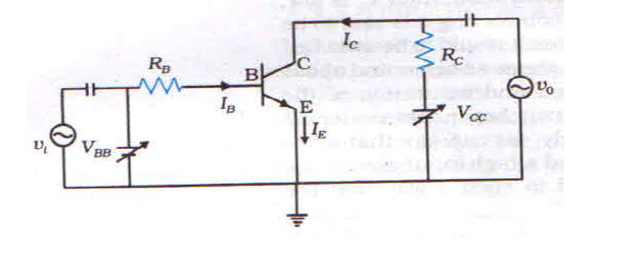
Draw a circuit diagram of a C.E. transistor amplifier. Briefly, explain its working and write the expression for (i) current gain, (ii) voltage gain of the amplifier.
Answer

The input signal, connected between the emitter and base, along with the forward bias, causes corresponding large changes in output voltage across R.
Current gain $\beta_{ac} = \bigg|\frac{\Delta\text{I}_{c}}{\Delta\text{I}_{B}}\bigg|$
Voltage gain $\text{V}_{Gain} = \frac{\Delta\text{V}_{o}}{\Delta\text{V}_{I}}.$
View full question & answer
Question 283 Marks
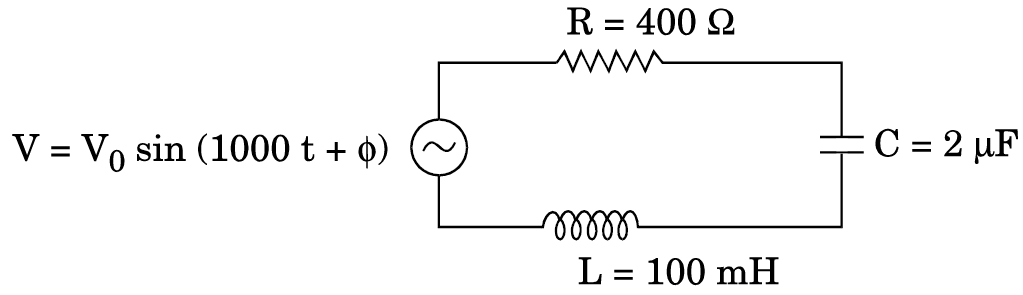
  1. Determine the value of phase difference between the current and the voltage in the given series LCR circuit.
  1. Calculate the value of the additional capacitor which may be joined suitably to the capacitor C that would make the power factor of the circuit unity.
Answer
  1. In LCR circuit: $\tan\varphi= \frac{\text{X}_{L} - \text{X}_{c}}{\text{R}} = \frac{\text{wL} - \frac{1}{\text{wC}}}{\text{R}}$
Now $\text{X}_{L} = \text{wL} = ( 1000\times100\times10^{-3})\Omega$
$= 100\Omega$
and $\text{X}_{c} = \frac{1}{\text{wc}} = \bigg(\frac{1}{100\times2\times10^{-6}}\bigg)\Omega$
$\therefore\text{X}_{c} = 500 \Omega$
$\therefore\tan\varphi = \frac{500 - 100}{400} = 1 $
$\tan\varphi = 1 $
$\varphi = 45^{o}$
  1. Power Factor:
When power factor = 1, we have $X_L=X_C$
$\therefore\text{X'}_{c} = \frac{1}{\omega\text{C}'} = 100 \Omega$
This gives $\text{C'} = \frac{1}{100\omega} = 10 \mu\text{F}$
We, therefore, need to add a capacitor of capacitance (10-2) μF = 8μF in parallel with the given capacitor.
Alternate Answer
Let addition capacitance $C_1$ be connected:
$\text{X}'_{c} = \frac{1}{1000(2 + \text{C}_{1})\times10^{-6}}$
$\therefore100 = \frac{1}{1000(2 + \text{C}_{1})\times10^{-6}}$
$\therefore2 + \text{C}_{1} = 10 $
$\text{C}_{1} = 8 \mu\text{F}$.
View full question & answer
Question 293 Marks
  1. Write the important properties of photons which are used to establish Einstein’s photoelectric equation.
  2. Use this equation to explain the concept of (i) threshold frequency and, (ii) Stopping potential.
Answer
  1.  
  1. The energy of a photon is hv.
  2. Each photon is completely absorbed by a single electron.
  1. $\text{E}_{k} = \text{hv} - \text{W}$
Alternate Answer

$\text{hv} =\text{hv}_{o} + \frac{1}{2}\text{mv}_{max^{2}} \text{ or }\text{hv} = \text{hv}_{o} + \text{eV}_{o}\text{ or }\text{E}_{k} = \text{h}(\text{v - v}_{o})$
  1. When Incident frequency < Threshold frequency, there will be no emission of electrons. Hence , frequency of incident radiation should be greater than threshold frequency. $\bigg(\text{v}_{o} = \frac{\text{w}}{\text{h}}\bigg)$
$\text{E}_{k} = \text{eV}_{o} = \text{hv} - \text{W}$

$\therefore\text{V}_{o} = \frac{\text{h}}{\text{e}}\text{v} - \frac{\text{W}}{\text{e}}$
  1. At $\text{v} =\text{v}_{0} , \text{E}_{k} = \text{eV}_{o} = 0 $
$V_o$ is called stopping potential.
View full question & answer
Question 303 Marks
Answer the following:
  1. In what way is diffraction from each slit related to the interference pattern in a double slit experiment?
  2. When a tiny circular obstacle is placed in the path of light from a distant source, a bright spot is seen at the centre of the shadow of the obstacle. Explain, why.
  3. How does the resolving power of a microscope depend on (i) the wavelength of the light used and (ii) the medium used between the object and the objective lens?
Answer
The intensity of interference fringes in double slit arrangement is modulated by the diffraction pattern of each slit.
Alternate Answer
In double slit experiment, the interference pattern on the screen is actually superposition of single slit diffraction for each slit.
Waves diffracted from the edges of the circular obstacle interfere constructively at the centre of the shadow producing a bright spot.
Resolving power $\frac{2\mu\sin\theta}{1.22\lambda}.$
$\therefore$ Resolving power is inversely proportional to wavelength and directly proportional to the refractive index.

Alternate Answer
  1. $\text{R.P}\propto\frac{1}{\lambda}$.
  2. $\text{R.P}\propto\mu$.
View full question & answer
Question 313 Marks
Draw a circuit diagram of a common emitter amplifier using n-p-n transistor. Derive an expression for the current gain $\beta_{ac}.$
Answer
  1.  
  1. $\text{A}_{v} = \beta_{ac}.\frac{\text{R}_{L}}{\text{r}}$
$\therefore\beta_{ac} = \text{A}_{c}\frac{\text{r}}{\text{R}_{L}}$
Alternate Answer
$\beta_{ac} = \frac{\delta\text{l}_{c}}{\Delta\text{I}_{B}}$
View full question & answer
Question 323 Marks
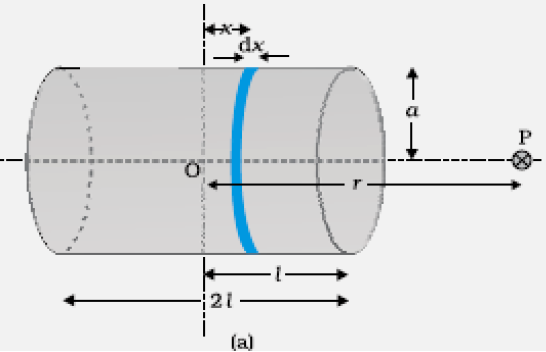
Derive an expression for the axial magnetic field of a finite solenoid of length 2l and radius r carrying current I. Under what condition does the field become equivalent to that produced by a bar magnet?
Answer

  1. The magnitude of the total field is obtained due to small elements
$\text{dB} = \frac{\mu_{o}\text{ndxla}^{2}}{2[(\text{r} - \text{x})^{2} + \text{a}^{2}]\frac{3}{2}}$

x varies from $\text{x} = - l \text{ to } \text{x} = + l $

$\text{B} = \frac{\mu_{o}\text{nla}^{2}}{2} \int\limits^{l}_{-l}\frac{\text{dx}}{[(\text{r} - \text{x})^{2} +\text{a}^{2}] \frac{3}{2}}$

For $\text{r} >> \text{a} \text{ and } , \text{we have } \text{r} > > \text{x}$

$\text{B}\simeq\frac{\mu_{o}n\text{la}^{2}}{2\text{r}^3}\int\limits^{l}_{-l}\text{dx} =\text{B} = \frac{\mu_{o}\text{nla}^{2}(2\ell)}{2\text{r}^{3}}$

Here magnetic moment m = n2l $(\pi\text{a}^{2}) $

$\text{Thus }\text{B} = \frac{\mu_{o}2\text{m}}{4\pi\text{r}^{3}}$

This is also the far axial magnetic field of a bar magnet. Hence, the magnetic field, due to current carrying solenoid along its axial line is similar to that of a bar magnet for far off axial points.
View full question & answer
Question 333 Marks
A capacitor of unknown capacitance, a resistor of 100 $\Omega$ and an inductor of self inductance L = $( 4 /\pi^{2})$henry are connected in series to an ac source of 200V and 50 Hz. Calculate the value of the capacitance and impedance of the circuit when the current is in phase with the voltage. Calculate the power dissipated in the circuit.
Answer
Capacitance = C $ =\frac{1}{\text{L}\omega^{2}}$
$ = \frac{1}{\frac{4}{\pi^{2}}(2\pi\times50)^{2}}\text{F}$
$ = 2.5 \times10^{-5}\text{F}$
Impedence= resistance (since V and I are in phase)
$\therefore\text{Impedence} = 100\Omega$
Power discipated $ =\frac{\text{E}^{2}_{rms}}{\text{R}}$
$ =\frac{(200)^{2}}{100}\text{W} = 400 \text{ watt}$.
View full question & answer
Question 343 Marks
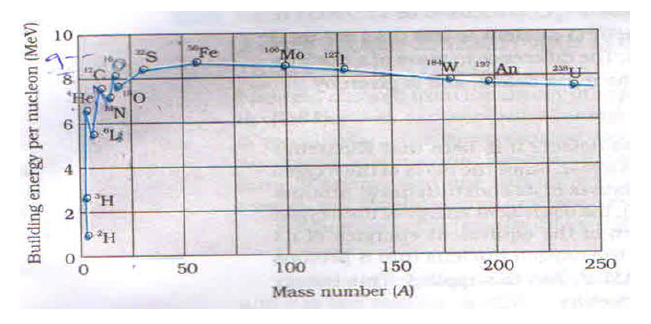
Plot a graph showing the variation of binding energy per nucleon as a function of mass number. Which property of nuclear force explains the approximate constancy of binding energy in the range 30 < A < 170? How does one explain the release of energy in both the processes of nuclear fission and fusion from the graph?
Answer

Nuclear force is Saturated, or short ranged The final system is more tightly bound when heavy nucleus undergoes nuclear fission. Hence, there is a release of energy. The final system is more tightly bound when light nuclei undergoes nuclear fusion. Hence, there is a releases of energy.
Alternate Answer
There is an increase in BE/nucleon both during:
  1. Nuclear fission of heavy nuclei and,
  2. Nuclear fussion of light nuclei Nuclear.
View full question & answer
Question 353 Marks
Two harmonic waves of monochromatic light$\text{y}_{1} = \text{a} \cos\omega\text{t}\text{ and } \text{y}_{2} = \text{a} \cos(\omega\text{t} + \Phi)$
are superimposed on each other. Show that maximum intensity in interference pattern is four times the intensity due to each slit. Hence write the conditions for constructive and destructive interference in terms of the phase angle$\Phi$.
Answer
Resultant displacement $\text{y} = \text{y}_{1} + \text{y}_{2}$ $ = \text{a}[ \cos(\omega\text{t}) + \cos(\omega\text{t} + \phi)]$ $ = 2 \text{ a}\cos\big(\frac{\phi}{2}\big)\cos\big(\omega\text{t} +\frac{\phi}{2}\big)$ $\therefore$ amplitude of resultant wave $= 2 \text{ a}\cos(\frac{\phi}{2} )$$\therefore$ Intensity $ = 4 \text{I}_{o}\cos^{2}(\frac{\phi}{2}) , \text{where } \text{I}_{o} =\text{a}^{2}$ is the intensity of each harmonic wave
At the maxima, $\phi =\pm2\text{n}\pi\therefore\cos^{2}\frac{\phi}{2} = 1 $ At the maxima, $\text{I} = 4 \text{ I}_{o} = 4 \times\text{intensity due to one slit }$ $\text{I} = 4 \text{ I}_{o}\cos^{2}(\frac{\phi}{2})$ For constructive interference, I is maximum It is possible when $\cos^{2}(\frac{\phi}{2}) =1 ; \frac{\phi}{2} =\text{n}\pi; \phi = 2 \text{n}\pi$ For destructive interference, I is minimum, i.e, I=0 It is possible when $\cos^{2}(\frac{\phi}{2}) = 0 ; \frac{\phi}{2} = \frac{(2\text{n} - 1 )\pi}{2}; \phi = (2\text{n}\pm1 )\frac{\phi}{2}$.
View full question & answer
Question 363 Marks
  1. What are the three basic units in communication systems? Write briefly the function of each of these.
  2. Write any three applications of the internet used in communication systems.
Answer
Three Basic units:
Transmitter:
  • Processing & transmission of message signal.
Communication channel:
  • The link for propagating the signal from transmitter to receiver.
Receiver:
  • Extracting the message signal from the signal received by it.
Three applications of internet:
  1. Internet surfing.
  2. E-mails.
  3. E-banking.
  4. E-shopping.
  5. E-booking (e-ticketing).
  6. Social networking.
View full question & answer
Question 373 Marks
  1. Define the term ‘intensity of radiation’ in terms of photon picture of light.
  2. Two monochromatic beams, one red and the other blue, have the same intensity. In which case (i) The number of photons per unit area per second is larger, (ii) The maximum kinetic energy of the photoelectrons is more? Justify your answer.
Answer
  1. Intensity of radiation is determined by the number of photons incident per unit area per unit time.
  2.  
  1. Red Light.
Reason: Energy of photon of red light is less than that of a photon of blue light.

Alternate Answer

$\text{hv}_{red} < \text{hv}_{blue}$
  1. Blue Light.
Reason: Energy of photon of Blue light is more than that of a photon of red light.

Alternate Answer

$\text{hv}_{red} > \text{hv}_{blue}$

Note: [The Einstein's photoelectric equation:

$\text{hv} = \text{hv}_{\circ} + \frac{1}{2}\text{mv}^{2}_{max}$

Instead of the reason in part.]
View full question & answer
Question 383 Marks
In what way is Gauss’s law in magnetism different from that used in electrostatics? Explain briefly. The Earth’s magnetic field at the Equator is approximately 0.4 G. Estimate the Earth’s magnetic dipole moment. Given: Radius of the Earth = 6400 km.
Answer
In magnetism, Gauss’s law states: $\oint\overrightarrow{\text{B}}.\overrightarrow{\text{ds}} = 0 $
In electrostatistics, Gauss’s law states: $\oint\overrightarrow{\text{B}}.\overrightarrow{\text{ds}} = \frac{\text{q}}{\varepsilon_\circ}$
Reason: Isolated magnetic poles do not exist,
$\text{B} = \frac{\mu_{\circ}}{4\pi}\bigg(\frac{\text{m}}{\text{R}^{3}}\bigg) = 10^{-7}\bigg(\frac{\text{m}}{\text{R}^{3}}\bigg)$
$\text{m} = \frac{0.4\times 10^{−4}\times (6400 \times 10^{3})^{3}}{10^{-7}}$
$ = 1.1\times10^{23}\text{Am}^{2}.$
View full question & answer
Question 393 Marks
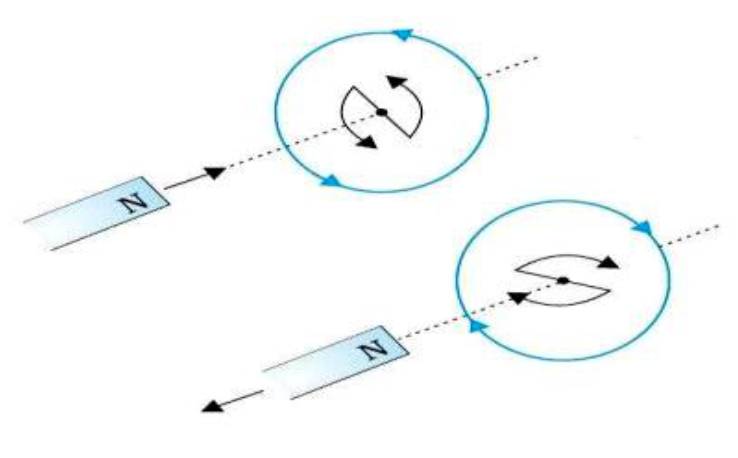
State Lenz’s law. Illustrate, by giving an example, how this law helps in predicting the direction of the current in a loop in the presence of a changing magnetic flux.
In a given coil of self-inductance of 5 mH, current changes from 4 A to 1 A in 30 ms. Calculate the emf induced in the coil.
Answer
Lenz’s law applies to closed circuit determining the direction of induced current states. “The induced emf will appear in such a direction that it opposes the change that produced it.”

$| \varepsilon| =\text{L}\frac{\text{di}}{\text{dt}}$
$| \varepsilon| =5\times10^{-3}\times\frac{(4 - 1 )}{30\times10^{-3}}\text{V} = 0.5\text{V}.$
View full question & answer
Question 403 Marks
State the underlying principle of a potentiometer. Write two factors by which current sensitivity of a potentiometer can be increased. Why is a potentiometer preferred over a voltmeter for measuring the emf of a cell?
Answer
Principle: The potential drop, across a part of a length l of a uniform wire of length L (L>l), is proportional to the length l.
Two factors:
  1. Increasing the length L of the wire.
  2. Connecting a suitable resistance, R, in series with the potentiometer wire.
Reason: At the balance position, there is no net current drawn, from the cell and the cell is effectively in an open circuit condition. This is not so for a voltmeter.
View full question & answer
Question 413 Marks
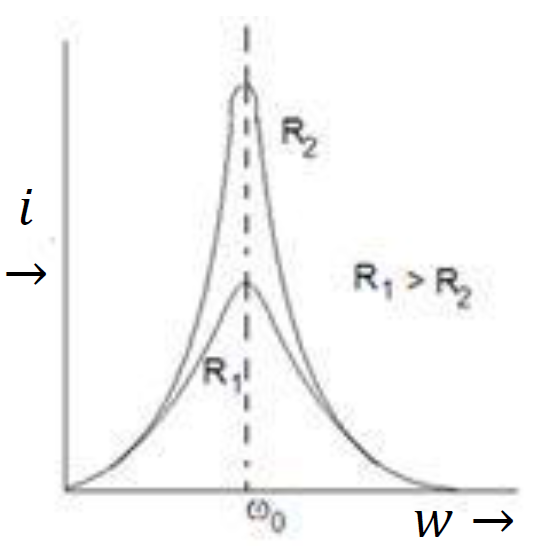
A series LCR circuit is connected across an a.c. source of variable angular frequency $' \omega'$. Plot a graph showing variation of current ‘i’ as a function of $' \omega'$ for two resistances $R_1$ and $R2 (R_1 > R_2).$
Answer the following questions using this graph:
  1. In which case is the resonance sharper and why?
  2. In which case is the power dissipation more and why?
Answer
  1. Sharper for $R = R_2​​​​​​​$​​​​​​​
Sharpness of resonance $ = \frac{\omega_{\circ}\text{L}}{\text{R}}\propto\frac{1}{\text{R}}.$
  1. More power dissipation for $\text{R} = \text{R}_{2}$
At Resonance, power dissipation $ = \frac{\text{V}^{2}}{\text{R}}\propto\frac{1}{\text{R}}$ (for same V).
View full question & answer
Question 423 Marks
How are electromagnetic waves produced? What is the source of energy of these waves? Write mathematical expressions for electric and magnetic fields of an electromagnetic wave propagating along the z-axis. Write any two important properties of electromagnetic waves.
Answer
$\varepsilon.\text{M}.$ waves are produced by accelerated/oscillating charges.
Source of energy is the source that accelerates the charges Expression for the electric and magnetic fields (for an e.m. wave propagating along the z – axis) can be
$\text{E}_{x} = \text{E}_{0}\sin(kz - \omega\text{t})$
$\text{B}_{y} - \text{B}_{0}\sin(kz - \omega\text{t})$
Properties:
  1. Transverse nature.
  2. Have a definite speed (for all frequencies) in vacuum.
  3. Can be polarised.
  4. Can show the phenomenon of interference and diffraction.
  5. Can transport energy from one point to another.
  6. Have oscillating electric and magnetic fields along mutually perpendicular directions.
  7. Have a momentum associated with them.
  8. Their speed, in a medium, depends upon the values of $\mu$ and $\varepsilon$ for that medium.
View full question & answer
Question 433 Marks
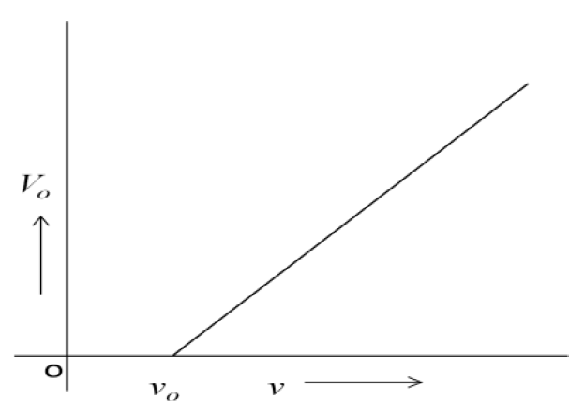
State two important properties of photon which are used to write Einstein's photoelectric equation. Define (i) Stopping potential and (ii) Threshold frequency, using Einstein's equation and drawing necessary plot between relevant quantities.
Answer
Properties of Photon:
  1. For a radiation of frequency$\upsilon$, each photon has an energy, $\text{E} = \text{h}v,$ associated with it.
  2. The energy of a photon is independent of the intensity of incident radiation.
  3. During the collision of a photon, with an electron, the total energy of the photon gets absorbed by the electron.
Einstein’s photoelectric equation is,

$\text{K}_{max} = \text{hv} - \phi_{0}$

or $\text{eV}_{0} = \text{hv} -\phi_{0}$
  1. Stopping potential, $\text{V}_{0}$ equals that value of the negative potential for which
$|\text{eV}_{0}| =\text{K}_{max}$

Alternate Answer

(The stopping potential ($\text{V}_{0}$) equals that (least) value of the (negative) plate potential that just stops the most energetic emitted photoelectrons from reaching the plate.)
  1. Threshold frequency $(\vartheta_{o})$ equals that value of the frequency of incident radiation for which $\text{K}_{max} = 0 . $
Alternate Answer

(For a given photosensitive surface, its threshold frequency is the minimum value of the frequency of incident radiation for which photoelectrons can be just emitted from that surface or that maximum frequency of incident radiation below which no photo emission takes place.)

The plot, between $\text{V}_{0}$ and$\vartheta , $ , has the form shown:
View full question & answer
Question 443 Marks
State the principle of a cyclotron. Show that the time period of revolution of particles in a cyclotron is independent of their speeds. Why is this property necessary for the operation of a cyclotron?
Answer
The cyclotron uses both electric and magnetic fields, in combination, to increase the energy of the charged particles.
Alternate Answer
Cyclotron uses:
  1. A magnetic field to make the charged particles move in a circular path.
  2. An alternating electric field which accelerates the charged particles as they repeatedly cross it in a way that makes them gain energy continuously.
We have,
$\frac{\text{mv}^{2}}{\text{r}} = \text{qvB}$
$\therefore\text{r} = \frac{\text{mv}}{\text{qB}}$
Also $\text{T} = \frac{2\pi\text{r}}{\text{v}}$
$\therefore\text{T} = \frac{2\pi\text{m}}{\text{qB}}$
$\therefore$ T is ondependent of v, the speed of the charged particles.
This property ensures that if the frequency of the applied alternating electric field matches the cyclotron frequency, the particle whould keep on getting accelerated every time it crosses the gap between the dees.
Alternate Answer
Because of the property, the applied alternating electric field can be made to accelerate the charged particles continuously. This property ensures that the resonance condition can be satisfied and the particle gets accelerated continously.
This property ensures that we can have $\vartheta = \vartheta_{c} , $ the resonance condition.
View full question & answer
Question 453 Marks
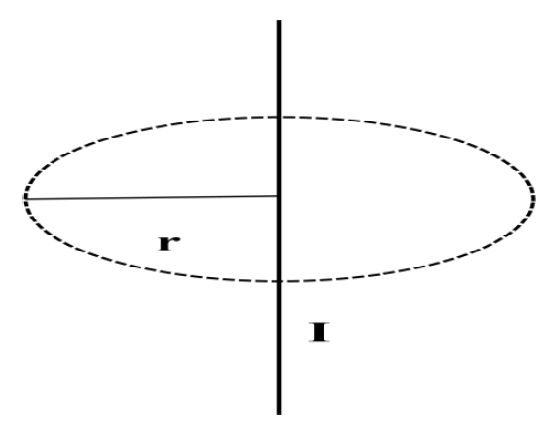
State Ampere's circuital law. Use this law to find magnetic field due to straight infinite current carrying wire. How are the magnetic field lines different from the electrostatic field lines?
Answer
According to Ampers’s circuital law, “ The line integral of the magnetic field, around a closed loop, equals $\mu_{o}$ times the total current passing through the surface enclosed by that loop.”
Alternate Answer
$\oint\overrightarrow{\text{B}}.\overrightarrow{\text{d}l} = \mu_{o}\text{I}$
For the infinite current carrying wire, we get
$\text{B}.\oint\text{d}l = \mu_{o}\text{I}$
or $\text{B} 2 \pi\text{r} = \mu_{o}\text{I}$
or $\text{B} = \frac{\mu_{o}\text{I}}{2\pi\text{I}}$

The magnetic field lines form closed loops while the electric field lines originate from positive charges and end at negative charges.
View full question & answer
Question 463 Marks
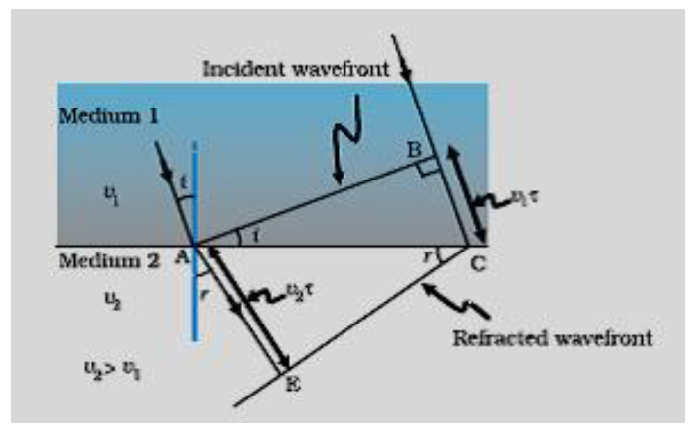
  1. Derive Snell's law on the basis of Huygen's wave theory when light is travelling from a denser to a rarer medium.
  2. Draw the sketches to differentiate between plane wavefront and spherical wavefront.
Answer
  1.  

We have BC $ = \vartheta_{1}\tau\text{ and }\text{AE} = \vartheta_{2}\tau$
Also $\sin\text{i} = \frac{\text{BC}}{\text{AC}}\text{ and } \sin\text{r} = \frac{\text{AE}}{\text{AC}}$
$\therefore\frac{\sin\text{i}}{\sin\text{r}} = \frac{\text{BC}}{\text{AE}} = \frac{\vartheta_{1}}{\vartheta_{2}} = \frac{\text{n}_{2}}{\text{n}_{1}}$
= a constant
This is Snell’s law.
  1. Plane wavefront:

Spherical wavefront:
View full question & answer
Question 473 Marks
Compare and explain three distinguishing features observed in Young’s double slit interference pattern with those seen for a coherently illuminated single slit producing diffraction pattern.
Answer
Interference Diffraction
  1. Equally spaced fringes.
  2. All maxima have equal brightness.
  3. Formed by superposition of wavefronts from two coherent sources.
  4. There is a maxima at the angle $\lambda$/a.
  5. Quite a large number of fringes are easily observable.
  1. Fringes are not equally spaced.
  2. Intensity of maxima keeps on decreasing.
  3. Formed through superposition of wavelets from a single wavefront.
  4. First minima occurs at an angle $\lambda$/a.
  5. It becomes difficult to distinguish maxima and minima after a few fringes.
View full question & answer
Question 483 Marks
A network of four 10 $\mu$F capacitors is connected to a 500 V supply as shown in the figure. Determine the
  1. equivalent capacitance of the network and
  2. charge on each capacitor
Answer
  1. Equivalent capacitance $(\text{C}_{n}) = \frac{\text{C}}{3} + \text{C}$
$ = \frac{4\text{C}}{3} = \frac{40}{3}\mu\text{F}$
  1. $\text{Charge on } \text{C}_{4}, \text{q}_{4} = \text{C}_{4}\times\text{V}=10\times500 \mu\text{C}$
$ = 5\times10^{-3}\text{C} = 5 \text{mC}$

$\text{Charge on } \text{C}_ {1},\text{C}_{2},\text{C}_{3}\text{ is same and is equal to } \frac{\text{C}}{3}\times\text{V}$

$ = \frac{5}{3}\times10^{-3}\text{C}$

$ = 1.67\text{mC}$.
View full question & answer
Question 493 Marks
Use Bohr's postulates hydrogen atom to deduce the expression for the kinetic energy (K.E.) of the electron revolving in the $\mathrm{n}^{\text {th }}$ orbit and show that, K.E. $\frac{\mathrm{e}^2}{8 \pi \varepsilon_0 e_n}$, where $r_n$ is the radius of the $n^{\text {th }}$ orbit. How is the orbit. How is the potential energy in the orbit related to the orbital radius orbit related to the orbital radius $r_n$ ?
Answer
For an electron (mass ‘m’ and charge ‘e’) revolving in $n^{th} $ stable circular orbit of radius $'r_n’$, with velocity $v_{n,}$ in the hydrogen atom (z=1), we have
$\frac{\text{mv}^{2}_{n}}{\text{r}_{n}} = \frac{1}{4\pi\varepsilon_{0}}\frac{\text{e}^{2}}{\text{r}_{n}^{2}}$
$\therefore = \text{E}_{k} = \frac{1}{2}\text{mv}^{2}_{n} = \frac{\text{e}^{2}}{8\pi\in_{0}\text{r}_{n}}$
$\therefore\text{E}_{p} = \frac{1}{4\pi\varepsilon_{0}}\frac{(+\text{e})\times( - \text{e})}{\text{r}_{n}}$
$ =- \frac{\text{e}^{2}}{4\pi\varepsilon_{0}\text{r}_{n}}$
View full question & answer
Question 503 Marks
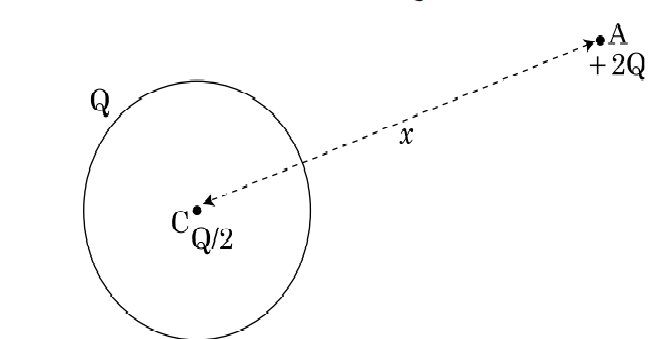
A thin metallic spherical shell of radius R carries a charge Q on its surface. A point charge Q/2 is placed at the centre C, and another charge + 2Q is placed outside the shell at A at a distance x from the centre as shown in the figure.
  1. Find the electric flux through the shell.
  2. State the law used.
  3. Find the force on the charges at the centre C of the shell and at the point A.
Answer
  1. Electric flux through a Gaussian surface,
$\varphi = \frac{\text{total enclosed charge }}{\in_{0}}$

Net charge enclosed inside the shell q = 0

$\therefore$ Electric flux through the shell $\frac{\text{q}}{\in_{o}} = 0 $

even when the student writes - Electric flux through the shell is zero as electric field inside the shell is zero.
  1. Gauss Law - Electric flux through a Gaussian surface is $^1/∈_0$ times the net charge enclosed within it.
Alternate Answer

$\oint\overrightarrow{\text{E}}.\overrightarrow{\text{d}S} = \frac{\text{q}}{\text{E}_{o}}$
  1. Force on the charge at the centre i.e. Charges $^?/2 =0$
$\text{F}_{A} = \frac{1}{4\pi\text{E}_{o}}\frac{2\text{Q}(\text{Q} + \text{Q} / 2)}{\text{x}^{2}}$

$ = \frac{1}{4\pi\text{E}_{o}}\frac{3\text{Q}^{2}}{\text{x}^{2}}$.
View full question & answer
3 Marks Question - Physics STD 12 Science Questions - Vidyadip