MCQ 11 Mark
The conductivity of a metal decreases with the increase in temperature on account of:
- A
Decrease in number density of electrons.
- ✓
- C
Decrease in relaxation time.
- D
Increase in mean free path.
Answer$\rho=\frac{1}{\sigma}=\frac{\text{m}}{\text{ne}^2\tau}$
As we increase temperature, average speed of the electrons, which act as the carriers of current, increases resulting in more frequent collisions. The average time of collisions $\tau,$ thus decreases with temperature.
View full question & answer→MCQ 21 Mark
Kirchhoff ’s first rule at a junction in an electrical network, deals with conservation of:
AnswerThe Kirchoff law is applied to find the charge/ current in the circuit by applying loop rule and junction rule.
View full question & answer→MCQ 31 Mark
A potentiometer can measure emf of a cell because:
- A
The sensitivity of potentiometer is large.
- B
No current is drawn from the cell at balance.
- ✓
No current flows in the wire of potentiometer at balance.
- D
Internal resistance of cell is neglected.
AnswerCorrect option: C. No current flows in the wire of potentiometer at balance.
Potentiometer is preferred over voltmeter because it measures true emf of the cell. It uses null method so that no current is drawn from cell in balanced condition, as $E - Ir = V$ and $I = 0$ then $V = E.$
Hence emf measurement is more accurate.
View full question & answer→MCQ 41 Mark
Two resistors $R _1$ and $R _2$ of $4 \Omega$ and $6 \Omega$ are connected in parallel across a battery. The ratio of power dissipated in them, $P _1: P _2$ will be:
- A
$4 : 9$
- ✓
$3 : 2$
- C
$9 : 4$
- D
$2 : 3$
AnswerCorrect option: B. $3 : 2$
$\text{P}=\frac{\text{V}^2}{\text{R}}$
As the resistors on connected in paralled to battorty, both have same patential,
$\text{p}=\frac{1}{\text{R}}$
$\frac{\text{P}_1}{\text{P}_2}=\frac{\text{R}_2}{\text{R}_1}$
$=\frac{6}{4}$
$=\frac{3}{2}$
$3:2$
View full question & answer→MCQ 51 Mark
Appliances based on heating effect of current work on:
- A
Only $a.c.$
- B
Only $d.c.$
- ✓
Both $a.c.$ and $d.c.$
- D
AnswerCorrect option: C. Both $a.c.$ and $d.c.$
View full question & answer→MCQ 61 Mark
Identify the factor which does not depend on the resistance of a conductor.
- A
- B
Area of cross$-$section
- C
- ✓
AnswerThe resistance of a conductor is directly proportional to its length, inversely proportional to the area of cross$-$section, and nature of the material. The resistance of the conductor does not depend on viscosity.
View full question & answer→MCQ 71 Mark
The cold junction of a thermocouple is maintained at $10^\circ C$. No thermo $e.m.f.$ is developed when the hot junction is maintained at $530^\circ C.$ The neutral temperature is:
- A
$260^\circ C.$
- B
$265^\circ C.$
- ✓
$270^\circ C.$
- D
$520^\circ C.$
AnswerCorrect option: C. $270^\circ C.$
View full question & answer→MCQ 81 Mark
An energy source will supply a constant current into the load if its internal resistance is:
- A
Very large as compared to the load resistance.
- B
Equal to the resistance of the load.
- C
Non-zero but less than the resistance of the load.
- ✓
View full question & answer→MCQ 91 Mark
Unit of conductance is $......$
AnswerUnit of conductance is siemen.
View full question & answer→MCQ 101 Mark
Two cells of emfs approximately $5V$ and $10V$ are to be accurately compared using a potentiometer of length $400\ cm.$
- A
The battery that runs the potentiometer should have voltage of $8V.$
- ✓
The battery of potentiometer can have a voltage of $15V$ and $R$ adjusted so that the potential drop across the wire slightly exceeds $10V.$
- C
The first portion of $50\ cm$ of wire itself should have a potential drop of $10V.$
- D
Potentiometer is usually used for comparing resistances and not voltages.
AnswerCorrect option: B. The battery of potentiometer can have a voltage of $15V$ and $R$ adjusted so that the potential drop across the wire slightly exceeds $10V.$
View full question & answer→MCQ 111 Mark
In a current carrying conductor the net charge is:
MCQ 121 Mark
A current passes through a wire of non-uniform cross-section. Which of the following quantities are independent of the cross-section?
- A
The charge crossing in a given time interval.
- B
- C
- ✓
AnswerExplanation:
$\text{v}_\text{f}=\Big(\frac{\text{e}}{\text{qm}}\Big)\tau$
$\text{E}=\frac{\text{i}}{\text{A ne}}$
$\text{j}=\frac{\text{i}}{\text{A}}$
Vd → drift speed
j → current density
i → current
A → cross-section area.
View full question & answer→MCQ 131 Mark
Identify the combination which is not a series connection.
AnswerDomestic appliances in a house are connected in parallel combinations, and not in series combinations. This arrangement is done so that each of the appliances can switched on and off independently, which is essential in a house’s wiring.
View full question & answer→MCQ 141 Mark
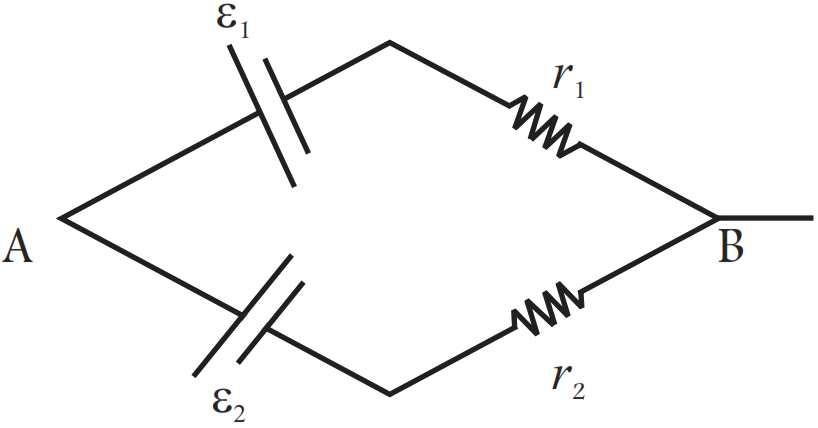
Two batteries of emf $\epsilon_1$ and $\epsilon_2\left(\epsilon_2 > \epsilon_1\right)$ and internal resistances $r_1$ and $r_2$ respectively are connected in parallel as shown in Fig.
- ✓
The equivalent emf $\in_\text{eq}$ of the two cells is between $\in_1$ and $\in_2\text{ i.e., }\in_1<\in_\text{eq}<\in_2.$
- B
The equivalent emf $\in_\text{eq}$ is smaller than $\in_1$.
- C
The $\in_\text{eq}$ is given by $\in_\text{eq}=\in_1+\in_2$ always.
- D
$\in_\text{eq}$ is independent of internal resistances $r_1$ and $r_2$
AnswerCorrect option: A. The equivalent emf $\in_\text{eq}$ of the two cells is between $\in_1$ and $\in_2\text{ i.e., }\in_1<\in_\text{eq}<\in_2.$
a. The equivalent emf $\epsilon_{\text {eq }}$ of the two cells is between $\epsilon_1$ and $\epsilon_2$ i.e., $\epsilon_1 < \epsilon_{\text {eq }} < \epsilon_2$.
Solution:
In the above combination, the equivalent $\epsilon_{\text {eq }}$ is given by $\epsilon_{\text {eq }}=\frac{\left(\epsilon_1 r_1+\epsilon_2 r_2\right)}{\left(r_1+r_2\right)}$ The above equation shows that for any value of $r_1$ and $r_2 \in_{\text {eq }}$ will always lie between $\in_1$ and $\in_2$, In the given question, $\epsilon_2>\epsilon_1$, therefore, $\in_1<\epsilon_{\text {eq }}<\epsilon_2$.
View full question & answer→MCQ 151 Mark
When no current is passed through a conductor?
- A
The free electrons do not move.
- B
The average speed of a free electron over a large period of time is not zero.
- C
The average velocity of a free electron over a large period of time is zero.
- ✓
The average of the velocities of all the free electrons at an instant is non zero.
AnswerCorrect option: D. The average of the velocities of all the free electrons at an instant is non zero.
View full question & answer→MCQ 161 Mark
An electrical cable of copper has just one wire of radius $9\ mm$. Its resistance is $5 \ ohm$. This single copper wire of the cable is replaced by $6$ different well insulated copper wires each of radius $3\ mm$. The total resistance of the cable will now be equal to:
- ✓
$7.5 \ ohm.$
- B
$45 \ ohm.$
- C
$90 \ ohm.$
- D
$270 \ ohm.$
AnswerCorrect option: A. $7.5 \ ohm.$
View full question & answer→MCQ 171 Mark
A resistor of resistance $R$ is connected to an ideal battery. If the value of $R$ is decreased, the power dissipated in the resistor will:
AnswerPower $=\frac{\text{V}^2}{\text{R}},\text{R}\downarrow\text{thanpower}\uparrow$
Because Power $\propto\frac{1}{\text{R}}.$
View full question & answer→MCQ 181 Mark
Identify the dimensional formula of electric current.
- A
$\left[M L T^{-2}\right]$
- ✓
$\left[ M ^0 L^0 T^0 A^1\right]$
- C
$\left[ M L ^3 T^0\right]$
- D
$\left[ M L ^2 T^{-3}\right]$
AnswerCorrect option: B. $\left[ M ^0 L^0 T^0 A^1\right]$
The flow of charge per unit time is defined as current. The fundamental unit of current is Ampere $($named after Andre Marie Ampere$).$
View full question & answer→MCQ 191 Mark
What is the driving force in a working Electrical Circuit?
AnswerWhen a potential difference is applied across a resistor then randomly moving free electrons start to move towards positive terminal due to force applied by electric field generated due to voltage difference. thus a start to Current Flows from High Voltage to Low Voltage.
Voltage is cause and current is effect.
View full question & answer→MCQ 201 Mark
In meter bridge or Wheatstone bridge for measurement of resistance, the known and the unknown resistance are interchanged. The error so removed is:
- ✓
- B
- C
Due to temperature effect.
- D
View full question & answer→MCQ 211 Mark
What is the reciprocal of resistance of a material called? Give its unit.
- ✓
Conductance, $ohm { }^{-1}$
- B
Conductivity, $ohm { }^{-1} m^{-1}$
- C
Conductance, $ohm { }^{-1} m^{-1}$
- D
Conductivity, $ohm { }^{-1}$
AnswerCorrect option: A. Conductance, $ohm { }^{-1}$
The conductance of a material is the ease with which electric charges flow through it.
Conductance $=\frac{1}{\text{Resistance.}}$
SI unit of conductance $=\frac{1}{\text{ohm}}$
$= ohm { }^{-1}$
View full question & answer→MCQ 221 Mark
Identify the correct statement from the following about discharging of a cell.
- A
The direction of current in the cell is from positive to negative terminal.
- B
Terminal potential difference is greater than emf of the cell.
- ✓
Terminal potential difference is lesser than emf of the cell.
- D
The current increases and decreases frequently.
AnswerCorrect option: C. Terminal potential difference is lesser than emf of the cell.
During discharging of a cell terminal potential difference, the terminal potential difference is lesser than the emf of the cell. The direction of current inside the cell is from negative terminal to positive terminal.
View full question & answer→MCQ 231 Mark
Which of the following is correct when one cell is wrongly connected in series circuit?
- A
The total emf reduces by e.
- B
The total emf increases by e.
- ✓
The total emf increases by 2e.
- D
The total emf decreases by 2e.
AnswerCorrect option: C. The total emf increases by 2e.
c. The total emf increases by 2 e .
Explanation:
When one cell is wrongly connected in series of $n$ identical cells, each of emf $e$, it will reduce the total emf by $2$ e . So, effective emf is calculated as $e_{\text {EFF }}=n e-2 e$. This happens in case of mixed grouping.
View full question & answer→MCQ 241 Mark
Two non-ideal batteries are connected in parallel. Consider the following statements:
- The equivalent emf is smaller than either of the two emfs.
- The equivalent internal resistance is smaller than either of the two internal resistances.
- A
Both $A$ and $B$ are correct.
- B
$A$ is correct but $B$ is wrong.
- ✓
$B$ is correct but $A$ is wrong.
- D
Both $A$ and $B$ are wrong.
AnswerCorrect option: C. $B$ is correct but $A$ is wrong.
Equivalent emf $\in_0=\frac{\in_1\text{r}_1+\in_2\text{r}_2}{\text{r}_1+\text{r}_2}$
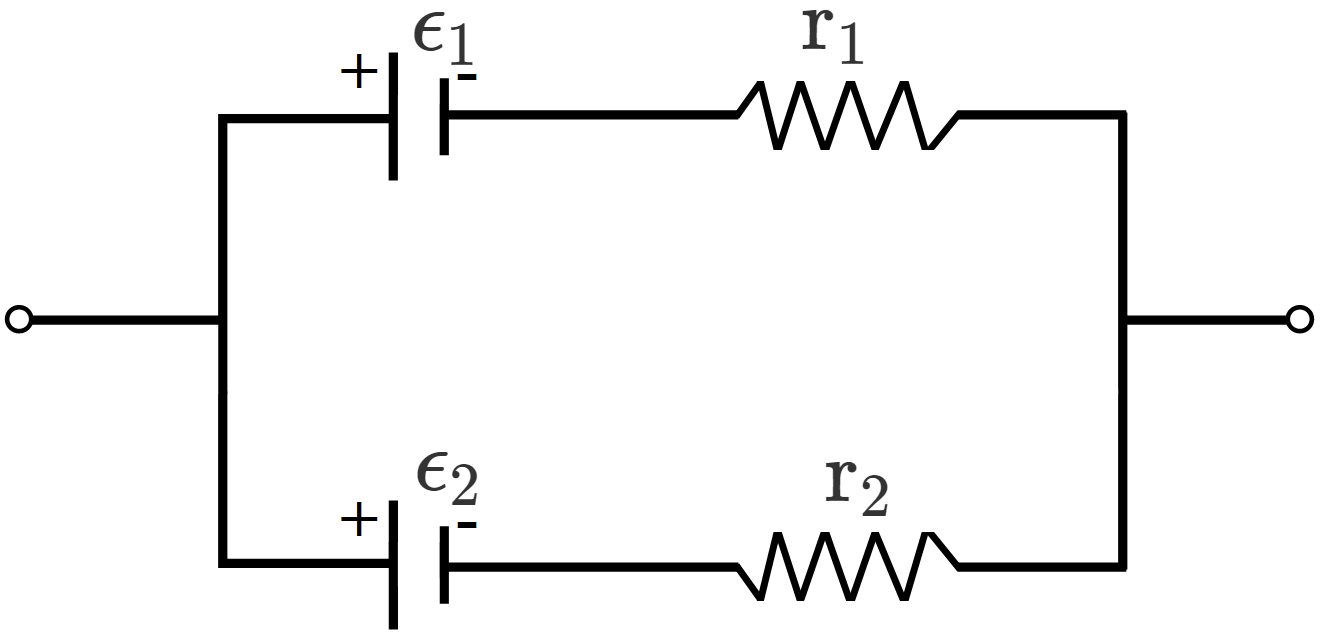
Equivalent resistance $=\text{r}_0=\frac{\text{r}_1\text{r}_2}{\text{r}_1+\text{r}_2}$
$\phi$ The equivalent emf is smaller than either of the two emfs.
$\phi$ The equivalent internal resistance is smaller than either of the two internal resistances.
View full question & answer→MCQ 251 Mark
The resistivity of certain metals or alloys drops to zero when they are cooled below a certain temperature, this phenomenon is known as $......$.
AnswerThe resistivity of certain metals or alloys drops to zero when they are cooled below a certain temperature, this phenomenon is known as superconductivity.
View full question & answer→MCQ 261 Mark
Identify the correct options:
- A
An ammeter should have small resistance.
- B
An ammeter should have large resistance.
- C
A voltmeter should have large resistance.
- ✓
AnswerExplanation:
Þ An ammeter should have small resistane. To measure the accurate reading of current in the circuit by Ammeter.
þ A voltmeter should have large resistance. To measure the accurate reading of voltage across voltmeter.
View full question & answer→MCQ 271 Mark
$......$ represents the most significant digits of the resistance value in finding the resistance of carbon resistor.
AnswerSince first and second color bands has higher multiplier, they represents the most significant digits of the resistance value in finding the resistance of carbon resistor.
View full question & answer→MCQ 281 Mark
Potentiometer measures the potential difference more accurately than a voltmeter because:
- A
it has a wire of high resistance.
- B
it has a wire of low resistance.
- ✓
it does not draw current from external circuit.
- D
it draws a heavy current from external circuit.
AnswerCorrect option: C. it does not draw current from external circuit.
When we measure the emf of a cell by the potentiometer then no current flows in the circuit in zero$-$deflection condition ie, cell is in open circuit. Thus, in this condition the actual value of a cell is found. In this way, potentiometer is equivalent to an ideal voltmeter of infinite resistance.
Note. The emf in the potentiometer is measured by null method in which zero deflection position is found on the wire.
View full question & answer→MCQ 291 Mark
A current passes through a resistor. If $K _1$ and $K _2$ represent the average kinetic energy of the conduction electrons and the metal ions respectively then:
- A
$K _1 < K _2$
- B
$K _1= K _2$
- ✓
$K _1 > K _2$
- D
Any of these three may occur.
AnswerCorrect option: C. $K _1 > K _2$
View full question & answer→MCQ 301 Mark
Figure $(a)$ below shows a Wheatstone bridge in which $\text{P, Q, R, S}$ are fixed resistances, $G$ is a galvanometer and $B$ is a battery. For this particular case the galvanometer shows zero deflection. Now, only the positions of $B$ and $G$ are interchanged,. as shown in figure $(b).$ The new deflection of the galvanometer.
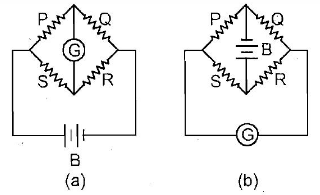
AnswerThis is one charactristic of a wheatstone bridge, that if we interchange the position of galvanometer and battery, there will no any change in the output.
View full question & answer→MCQ 311 Mark
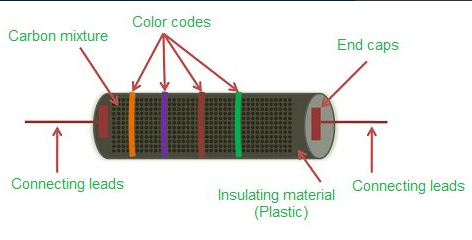
Which resistor has color bands on it?
AnswerThe carbon composition resistor is a type of fixed resistor that reduces or restricts the electric current flow to a certain level.
View full question & answer→MCQ 321 Mark
Which of the following is not a correct statement with respect to the given circuit?
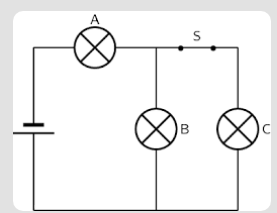
AnswerCorrect option: C. $B$ and $C$ are connected in series
View full question & answer→MCQ 331 Mark
In the series combination of two or more than two resistances:
- ✓
The current through each resistance is same.
- B
The voltage through each resistance is same.
- C
Neither current nor voltage through each resistance is same.
- D
Both current and voltage through each resistance are same.
AnswerCorrect option: A. The current through each resistance is same.
View full question & answer→MCQ 341 Mark
Given a current carrying wire of non$-$uniform cross-section. Which one of the following is constant through out the length of wire ?
- ✓
- B
- C
- D
Current, electric field and drift speed.
AnswerCurrent is uniform throughout the wire even if it is of non$-$uniform thickness. This is because charge passing through every cross sectional area per unit time remains the same throughout the wire. So, current remains the same.
View full question & answer→MCQ 351 Mark
For small currents, $‘X’$ obeys Ohm’s law. But when large currents are passed through the same conductor, it deviates from ohmic behaviour. Identify $X.$
- ✓
- B
- C
- D
$p-n$ junction diode.
Answer$‘X\ ’$ is a metallic conductor. For small currents, it obeys Ohms’s law and its $V-I$ graph is a straight line. But when large currents are passed through the same conductor, it gets heated up and its resistance increases. It no longer obeys Ohm’s law at higher currents.
View full question & answer→MCQ 361 Mark
The electric resistance of a certain wire of iron is R. If its length and radius are both doubled, then:
- A
The resistance and the specific resistance, will both remain unchanged.
- B
The resistance will be doubled, and the specific resistance will be halved.
- ✓
The resistance will be halved and the specific resistance will remain unchanged.
- D
The resistance will be halved and the specific resistance will be doubled.
AnswerCorrect option: C. The resistance will be halved and the specific resistance will remain unchanged.
View full question & answer→MCQ 371 Mark
Why is the Wheatstone bridge better than the other methods of measuring resistances?
- A
It does not involve Ohm's law.
- B
It is based on Kirchoff's law.
- C
It has four resistor arms.
- ✓
AnswerThe Wheatstone bridge is used to measure the unknown resistance by using null method. i.e, when the bridge is balanced, no current through the galvanometer. Using this null method, we can easily measure the unknown resistance if the other three arm's resistor are given.
View full question & answer→MCQ 381 Mark
Two cells of emf’s approximately $5V$ and $10V$ are to be accurately compared using a potentiometer of length $400\ cm.$
- A
The battery that runs the potentiometer should have voltage of $8V.$
- ✓
The battery of potentiometer can have a voltage of $15V$ and $R$ adjusted so that the potential drop across the wire slightly exceeds $10V.$
- C
The first portion of $50\ cm$ of wire itself should have a potential drop of $10V.$
- D
Potentiometer is usually used for comparing resistances and not voltages.
AnswerCorrect option: B. The battery of potentiometer can have a voltage of $15V$ and $R$ adjusted so that the potential drop across the wire slightly exceeds $10V.$
Key concept: The potential drop along the wires of potentiometer should be greater than emfs of cells.
In a potentiometer experiment, the emf of a cell can be measured if the potential drop along the potentiometer wire is more than the emf of the cell to be determined. Here, values of emfs of two cells are given as $5V$ and $10V$, therefore, the potential drop along the potentiometer wire must be more than $10V.$
View full question & answer→MCQ 391 Mark
Identify the material whose resistivity is more than $10^{14} \Omega m$.
Answera. Bakelite
Explanation:
Insulators are materials which do not conduct electric current, and thereby, offer high resistance to the flow of charges. Insulators like bakelite and hard rubber have very high resistivities in the range of $10^{14}$ to $10^{16} \Omega m$.
View full question & answer→MCQ 401 Mark
In series connection of resistors, what happens to the current across each resistor?
- A
- B
- ✓
- D
Initially increases and then decreases
AnswerWhen the resistors are connected in series, and current is passed through them, the current passing through each of the resistor is the same. This is because, the resistors are connected end to the end and, therefore, there is only one path for the current to flow through.
View full question & answer→MCQ 411 Mark
For a chosen non$-$zero value of voltage, there can be more than one value of current in:
AnswerThermistor are made up of substance with high $\alpha ,$ which is very much sensitive to temperature thereby a slight change in temperature varies its resistance with huge amount. hence making more than one value of current possible for chosen non$-$zero value of voltage.
View full question & answer→MCQ 421 Mark
The relaxation time in conductors:
- A
Increases with the increases of temperature.
- ✓
Decreases with the increases of temperature.
- C
It does not depends on temperature.
- D
All of sudden changes at 400K.
AnswerCorrect option: B. Decreases with the increases of temperature.
View full question & answer→MCQ 431 Mark
What is the effect on null deflection of galvanometer, when the radius of the wire is tripled?
- ✓
- B
- C
Reduces by $\frac{1}{3}$
- D
Thrice the original value.
AnswerFor a balanced Meter Bridge $\frac{\text{P}}{\text{Q}}=\frac{\text{x}}{(100-\text{x})}.$ From this, we can understand that the null deflection of galvanometer does not depend on the radius of the wire. So, even if the radius of the wire is tripled, the null deflection of the galvanometer undergoes no change.
View full question & answer→MCQ 441 Mark
The opposition offered by the electrolyte of the cell to the flow of current through itself is known as $......$.
AnswerThe opposition offered by the electrolyte of the cell to the flow of current through itself is known as internal resistance.
View full question & answer→MCQ 451 Mark
Drift velocity of electrons is due to:
AnswerCorrect option: B. Motion of conduction electrons due to electric field .$\rightarrow E$
View full question & answer→MCQ 461 Mark
To get maximum current in a resistance of $3 \ ohms$, one can use n rows of m cells $($connected in series$)$ connected in parallel. If the total number of cells is $24$ and the internal resistance of a cell is $0.5 \ ohms$ then:
- ✓
$M = 12, n = 2.$
- B
$M = 8, n = 3.$
- C
$M = 2, n = 12.$
- D
$M = 6, n = 4.$
AnswerCorrect option: A. $M = 12, n = 2.$
View full question & answer→MCQ 471 Mark
Two resistors $A$ and $B$ have resistances $R_A$ and $R_B$, respectively, and $R_A<R_B$. The resistivities of their materials are $\rho_A$ and $\rho_{ B }$.
- A
$\rho _\text{A}>\rho _\text{B}$
- B
$\rho _\text{A}=\rho _\text{B}$
- C
$\rho _\text{A}<\rho _\text{B}$
- ✓
The information is not sufficient to find the relation between $\rho _\text{A}$ and $\rho _\text{B}.$
AnswerCorrect option: D. The information is not sufficient to find the relation between $\rho _\text{A}$ and $\rho _\text{B}.$
d. The information is not sufficient to find the relation between $P_A$ and $P_B$.
Explanation:
$R =\frac{\rho \ell}{ A }$
Resistance is depend on Material, length & Area.
So $R A<R B$ is information is not sufficient to ding.
The relation between $\rho_{ A }$ and $\rho_{ B }$.
View full question & answer→MCQ 481 Mark
Resistors are generally colour coded to:
- A
Indicate the type of the circuit in which they are to be used.
- B
Identify whether they are ohmic or non-ohmic.
- ✓
Determine their values in ohm.
- D
Determine whether they are wire wound or composition resistors.
AnswerCorrect option: C. Determine their values in ohm.
Components and wires are coded with colors to identify their value and function. The colors brown, red, green, blue, and violet are used as tolerance codes on $5-$band resistors only.
So,Resistors are generally colour coded to determine their values in ohm.
View full question & answer→MCQ 491 Mark
To draw a maximum current from a combination of cells, how should the cells be grouped?
- A
- B
- C
- ✓
Depends upon the relative values of internal and external resistances.
AnswerCorrect option: D. Depends upon the relative values of internal and external resistances.
View full question & answer→MCQ 501 Mark
In the circuit shown here, at which point is the current least?
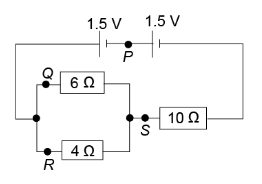
AnswerCurrent flowing through $S$ is the combined current from $Q$ and $R.$
Current flowing through $S$ is the same as the current from through $P.$
Current follows the path of least resistance.
Hence more current would flow through the $4\ ohm$ resistor.
View full question & answer→MCQ 511 Mark
Calculate the current through a lamp of $25w$ operating at $220v.$
- A
$2A$
- B
$25A$
- ✓
$0.114A$
- D
$6A$
AnswerCorrect option: C. $0.114A$
Given: $P = 25W$
$V = 220$ volts
$\therefore$ Current through the lamp $\text{I}=\frac{\text{P}}{\text{V}}=\frac{25}{220}=0.114\text{A}$
View full question & answer→MCQ 521 Mark
Which color band in the color coding of a resistor has the tolerance $\pm2\%$?
AnswerRed color band in the color coding of a resistor has the tolerance of $\pm2\%$
View full question & answer→MCQ 531 Mark
An experiment to verify ohm's law, a conductor of resistance $R$ is taken. During the experiment, temperature of the conductor increases with the flow of current. Resistance of the conductor will:
- A
- B
- ✓
- D
First increases then decreases.
AnswerResistance of conductor $\text{RT}=\text{R}\text{o}(1+αΔ\text{T})$ where $α > 0$
Thus resistance of the conductor increases with increase in temperature.
View full question & answer→MCQ 541 Mark
Identify the type of conductors in which both positive and negative charges can move.
AnswerElectrolytic solutions are those that are capable of conducting an electrical current. They are generally ions, in which both positive and negative charges can move. Polymers and thermosets do not conduct electric charge. Electrons are the charge carriers in metallic conductors.
View full question & answer→MCQ 551 Mark
The speed at which the current travels, in conductor, is nearly equal to:
- A
$3 \times 10^4 m / s$
- B
$3 \times 10^5 m / s$
- C
$4 \times 10^6 m / s$
- ✓
$3 \times 10^8 m / s$
AnswerCorrect option: D. $3 \times 10^8 m / s$
d. $3 \times 10^8 m / s$.
View full question & answer→MCQ 561 Mark
As the temperature of a metallic resistor is increased, the product of its resistivity and conductivity:
- A
- B
- C
- ✓
May increase or decrease.
AnswerCorrect option: D. May increase or decrease.
The product of resistivity and conductivity is independent of temperature. As the temperature of a metallic resistor is increased, the resistivity increases and conductivity decreases. Hence, both the conductivity and resistivity of the metallic resistor nullify the effect of the change in temperature.
View full question & answer→MCQ 571 Mark
Choose the correct statement:
AnswerCorrect option: D. The difference between the emf of a cell and potential difference across the ends of the cell is called lost volts.
When the battery is discharging, the terminals voltage of the battery is always $≤$ Emf of cell $[∵\text{r}>0]$
$\therefore$ There will always be a difference which is defined to be lost volt.
View full question & answer→MCQ 581 Mark
A hank of uninsulated wire consisting of seven and a half turns is stretched between two nails hammered into a board to which the ends of the wire are fixed. The resistance of the circuit between the nails is determined with the help of electrical measuring instruments. Determine the proportion in which the resistance will change if the wire is unwound so that the ends remain to be fixed to the nails.
- ✓
$225.$
- B
$15.$
- C
$240.$
- D
$250.$
AnswerCorrect option: A. $225.$
View full question & answer→MCQ 591 Mark
Which of the following is not the disadvantage of wire wound resistor?
AnswerCorrect option: C. Resistance value gets changed by a change in temperature, humidity etc.
In wired resistors are mainly produced with alloys, since pure metal has a high temperature co$-$efficient.
Due to alloy temperature co$-$efficient of wire wound resistor is very low.
Therefore it is very less effected by temperature change.
View full question & answer→MCQ 601 Mark
Kirchoffs law of junctions is also called the law of conservation of:
AnswerKirchoff's second law:- According to the law, at a particular junction the charge entering the junction is equal to charge exiting that junction.
$\Rightarrow $ There is no charge accumulated at junction. This is also called as law of conservation of charge.
View full question & answer→MCQ 611 Mark
Which type of current is flowing through a circuit?
AnswerThe carriers of electric current are electrons. The current in a circuit is due to the flow of electrons. Therefore, the direction of the conventional current is opposite to the direction of flow of electrons.
View full question & answer→MCQ 621 Mark
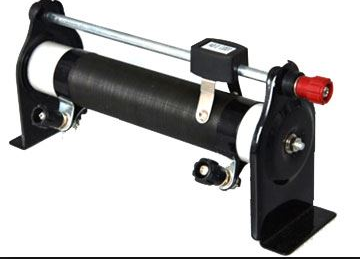
The wire wound resistor is also known as:
AnswerCorrect option: D. Both $a$ and $b$
It is rheostat
View full question & answer→MCQ 631 Mark
The $\text{EMF}$ of a cell can be defined as:
- A
Work done in taking a unit positive charge once round the circuit.
- B
The open circuit voltage of the cell.
- C
The terminal voltage when the current is zero.
- ✓
Answer$\text{EMF}$ of cell can be defined as:
$\rightarrow $ Workdone in taking unit positive charge once round the circuit.
$\rightarrow $ The open circuit voltage of cell.
$\rightarrow $ The terminal voltage when current is zero.
View full question & answer→MCQ 641 Mark
The length of a conductor is doubled and its radius is halved, its specific resistance is:
AnswerSpecific resistance $($ or resistivity $)$ is an intrinsic property of a material i.e. it depends only on the nature of material but not on the dimensions of the conductor. Thus specific resistance remains the same even if the length of the conductor is doubled and its radius is halved.
View full question & answer→MCQ 651 Mark
The electric field intensity $E$, current density $J$ and specific resistance k are related to each other through the relation:
- A
$E = J/k$
- ✓
$E = J k.$
- C
$E = k/J.$
- D
$k = J E.$
AnswerCorrect option: B. $E = J k.$
View full question & answer→MCQ 661 Mark
Two or more resistors are said to be in $...A...$ if one end of all resistors is joined together and similarly the other ends joined together, Here, A refers to:
- A
- ✓
- C
Either $(a)$ or $(b).$
- D
View full question & answer→MCQ 671 Mark
Consider a current carrying wire $($current $I)$ in the shape of a circle.
- A
- ✓
Electric field produced by charges accumulated on the surface of wire.
- C
The charges just behind a given segment of wire which push them just the right way by repulsion.
- D
AnswerCorrect option: B. Electric field produced by charges accumulated on the surface of wire.
View full question & answer→MCQ 681 Mark
The current which is assumed to be flowing in a circuit from positive terminal to negative, is called:
MCQ 691 Mark
Two resistors $R$ and $2R$ are connected in series in an electric circuit. The thermal energy developed in $R$ and $2R$ are in the ratio:
- ✓
$1 : 2.$
- B
$2 : 1.$
- C
$1 : 4.$
- D
$4 : 1.$
AnswerCorrect option: A. $1 : 2.$
Thermal Energy developed $=1^2 Rt ($Because in series, current is same$)$
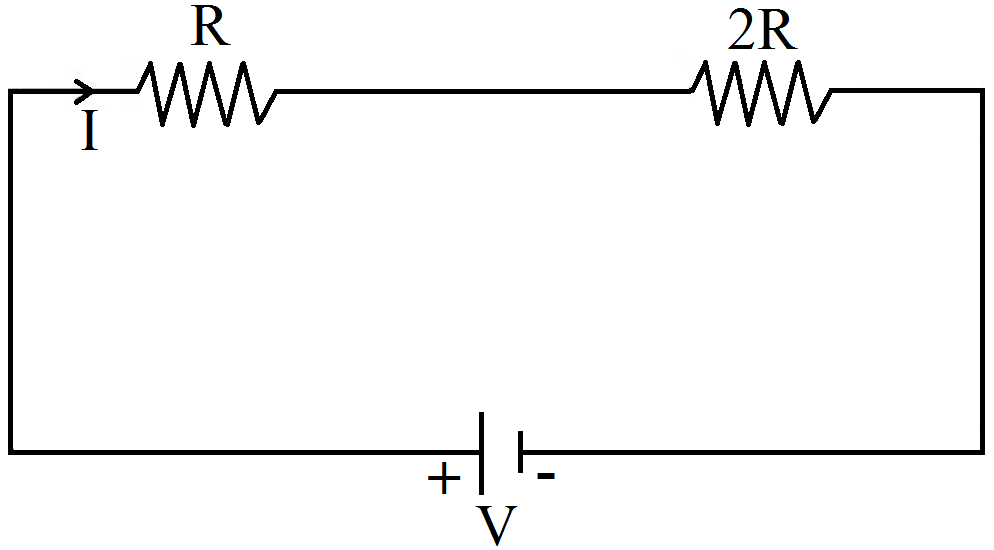
$\frac{\text{Thermal Energy developedin "R"}}{\text{Thermal Energy developedin "2R"}}=\frac{\text{I}^2\text{Rt}}{\text{I}^2(2\text{R})\text{t}}=\frac{1}{2}$
View full question & answer→MCQ 701 Mark
Which type of a physical quantity is electric current?
AnswerThe electric current is a scalar quantity. Laws of ordinary algebra are used to add electric currents and the law of vector algebra are not applicable.
View full question & answer→MCQ 711 Mark
What happens when negative terminal of cell is connected to other negative terminal of cell in a particular circuit?
- ✓
Current will not flow in circuit.
- B
Current will flow in circuit.
- C
Temperature of cell will increase.
- D
AnswerCorrect option: A. Current will not flow in circuit.
Current means flow of electrons and electrons are negative charged and so are attracted to the positive end of the battery and repelled by the negative end.
When battery is connected in a circuit that lets the electron flow through it, they flow from negative to positive.
When negative terminal of cell is connected to other negative terminal of the cell in a particular circuit then, current will not flow in circuit as electrons cannot flow from negative to negative terminal.
View full question & answer→MCQ 721 Mark
The resistance of a metal increases with increasing temperature because:
- ✓
The collisions of the conducting electrons with the electrons increase.
- B
The collisions of the conducting electrons with the lattice consisting of the ions of the metal increase.
- C
The number of conduction electrons decreases.
- D
The number of conduction electrons increases.
AnswerCorrect option: A. The collisions of the conducting electrons with the electrons increase.
View full question & answer→MCQ 731 Mark
$‘X’$ is a type of commercial resistor made from a mixture of clay, carbon black, and resin binder which are pressed and then molded into cylindrical rods by heating. Identify $X$.
AnswerCarbon resistors are made from a mixture of carbon black, clay and resin binder which are pressed and then molded into cylindrical rods by heating. The rods are enclosed in a ceramic or plastic jacket. They are used in circuits of radio receivers, amplifiers, etc.
View full question & answer→MCQ 741 Mark
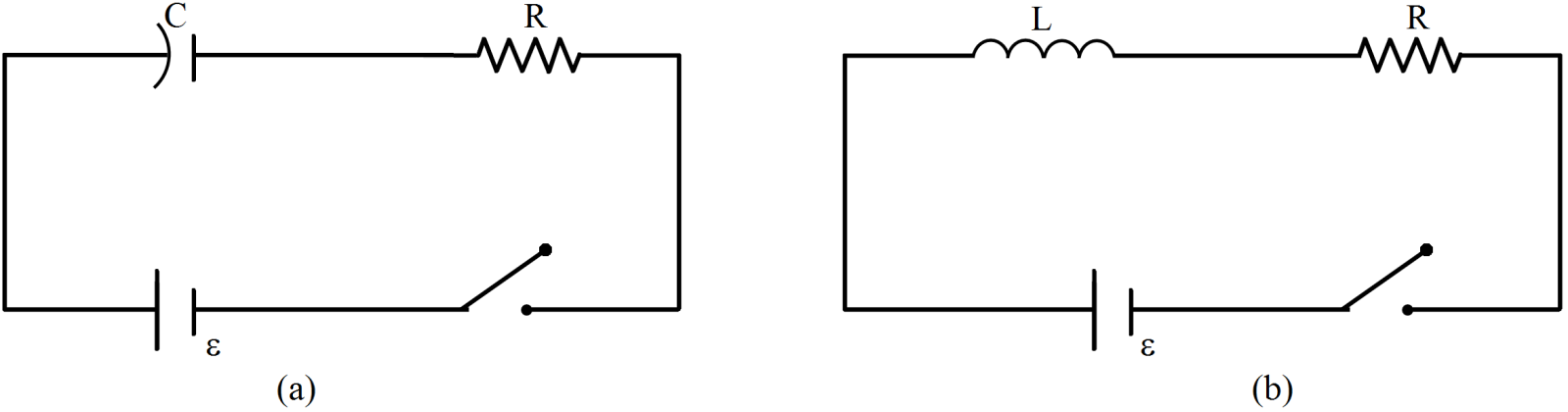
The switches in figure are closed at $t=0$ and reopened after a long time at $t=t_0$ :
- A
The charge on $C$ just after $t = 0$ is $\in\text{C}.$
- B
The charge on $C$ long after $t = 0$ is $\in\text{C}.$
- ✓
- D
The current in $L$ long after $t = t_o$ is $\frac{\in}{\text{R}}.$
AnswerExplanation:
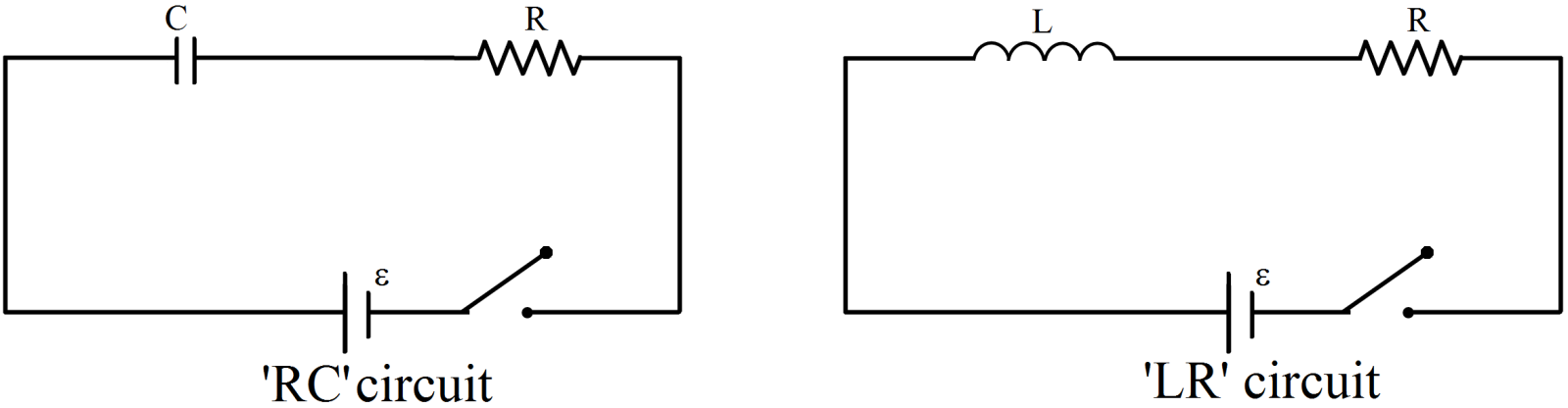
þ A long time after capacitor is fully charged is equal to
$\text{Q}=\text{CV}=\text{C}\hat{\text{I}}$
$\text{Q}=\text{C}\hat{\text{I}}\Big(1-\text{e}^{-\frac{\text{t}}{\text{t}}}\Big)$
þ The current in $'L'$ just before t $t = t_o$ is
$\text{i}=\frac{\hat{\text{I}}}{\text{R}}\Big(1-\text{e}^{-\frac{\text{t}}{\text{t}}}=\frac{\hat{\text{I}}}{\text{R}}\Big)$ View full question & answer→MCQ 751 Mark
Which of the following is non-ohmic resistance?
AnswerA non$-$ohmic resistance is a resistance that does not obey $ohm’s$ law. Among the given options, a diode is a non$-$ohmic resistance.
View full question & answer→MCQ 761 Mark
Which resistor is difficult to make of having a value less than about $2 \ Ohms?$
AnswerCarbon resistor is difficult to make of having a value less than about $20 \ Ohms$ because they have ability to withstand high energy pulses, when current flow through the carbon composition body conducts the energy. So carbon resistor can be made with a higher resistance.
View full question & answer→MCQ 771 Mark
When no current is passed through a conductor:
- A
The free electrons do not move.
- B
The average of the velocities of all the free electrons at an instant is zero.
- C
The average velocity of a free electron over a large period of time is zero.
- ✓
AnswerExplanation:
No current is passed through a conductor means. That the average velocity of a free elecron over a large period of time is zero or the average of the velocity of all the free electrons at an instant is zero.
View full question & answer→MCQ 781 Mark
Which error is removed when the known and unknown resistances are interchanged in a Meter Bridge?
AnswerEnd error is removed when the known and unknown resistances are interchanged in a Meter Bridge. This additional length has a resistance known as end resistance. So, when an end error arises, it can be removed by interchanging the known and unknown resistances and taking the mean of the resistances determined.
View full question & answer→MCQ 791 Mark
The amount of work done by the cell on a unit positive charge carrier to force it to go to the point of higher potential is called:
AnswerThe rate at which energy is drawn from a source of energy when unit current flows through the circuit or device is called $e.m.f.$ It is measured in volts.
View full question & answer→MCQ 801 Mark
The product of resistivity and conductivity of a cylindrical conductor depends on:
AnswerConductivity $\sigma=\frac{1}{\rho }$ Where r is resistivily.
Product of conductity and resistivity $= 1.$
View full question & answer→MCQ 811 Mark
A capacitor with no dielectric is connected to a battery at $t = 0$. Consider a point A in the connecting wires and a point $B$ in between the plates.
- A
There is no current through $A.$
- B
There is no current through $B.$
- C
There is a current through $A$ as long as the charging is not complete.
- ✓
$B$ and $C$ both
AnswerCorrect option: D. $B$ and $C$ both
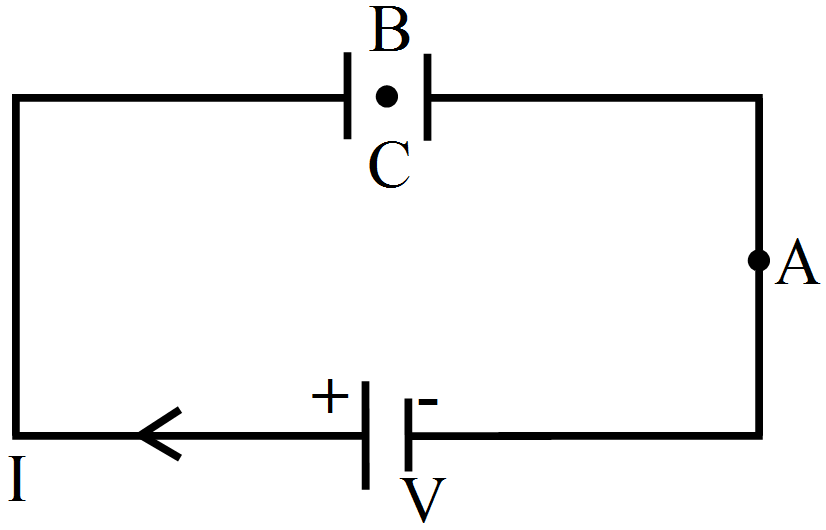
$Þ$ There is no current through $B.$
$Þ$ There is a current through $A$ as long as the charging is not complete.
View full question & answer→MCQ 821 Mark
Constantan wire is used for making standard resistance, because it has:
- A
- B
- C
High specific resistance.
- ✓
Negligible temperature coefficient of resistance.
AnswerCorrect option: D. Negligible temperature coefficient of resistance.
Constantan is a copper-nickel alloy. Its main feature is its resistivity, which is constant over a wide range of temperatures. Thus it has low temperature coefficient of resistance.that's why it is used for making of standard resistances.
View full question & answer→MCQ 831 Mark
To maintain a steady current through the conductor, some external device must do work. What does the external device provide?
AnswerTo maintain steady current through the conductor, electromotive force must be provided by the external device to take positive charge from lower potential to higher potential i.e. in the direction opposite to that of the electric field.
View full question & answer→MCQ 841 Mark
The color coding of earth, live and neutral wire respectively is:
AnswerThe electric power line enters our house through three wires$-$ namely the live wire, the neutral wire and the earth wire. To avoid confusion we follow a colour code for insulating these wires. The red wire is the live wire, and the black wire is neutral. The earth wire is given green plastic insulation. The colour coding of wires is green for earth red for live and black for neutral.
View full question & answer→MCQ 851 Mark
Which of the following is used for the formation of thermistor?
MCQ 861 Mark
Identify the correct statement from the following.
- A
While traversing in a closed loop, if negative pole of cell is encountered first, then the emf is negative.
- B
The product of resistance and current in an arm is taken to be positive if the direction of current is opposite to the direction in which one moves along the closed loop.
- C
Current flowing away from a junction is taken as positive.
- ✓
While traversing in a closed loop, if positive pole of cell is encountered first, then the emf is positive.
AnswerCorrect option: D. While traversing in a closed loop, if positive pole of cell is encountered first, then the emf is positive.
According to sign convention while traversing a closed loop $($in clockwise or anti$-$clockwise direction$)$, if positive pole of the cell is encountered first then its emf is negative or else, it will be positive.
View full question & answer→MCQ 871 Mark
Which of the following devices is the more accurate one for the measurement of emf?
AnswerPotentiometer is the more accurate device to measure emf than the other ones such as multimeter or voltmeter. Potentiometer is highly sensitive and thus, even small emfs can be measured using this device. Moreover, potentiometers do not draw current from the circuit during measurements, like voltmeters.
View full question & answer→MCQ 881 Mark
In an electric circuit containing a battery, the charge $($assumed positive$)$ inside the battery:
- A
Always goes from the positive terminal to the negative terminal.
- ✓
May go from the positive terminal to the negative terminal.
- C
Always goes from the negative terminal to the positive terminal
- D
AnswerCorrect option: B. May go from the positive terminal to the negative terminal.
The charge $($Positive$)$ inside the bottery my go from the positive terminal to the negative terminal.
View full question & answer→MCQ 891 Mark
Which of these is a correct definition of electronic current?
- ✓
Current that flows from lower potential to higher potential.
- B
The current which remains static.
- C
Current constituted by the flow of ions.
- D
Current that flows from higher potential to lower potential.
AnswerCorrect option: A. Current that flows from lower potential to higher potential.
The current that flows from a point at the lower $($negative$)$ potential to a point at higher $($positive$)$ potential is called electronic current. Electronic current is produced by the movement of negatively charged electrons.
View full question & answer→MCQ 901 Mark
In a potentiometer of ten wires, the balance point is obtained on the sixth wire. To shift the balance point to eighth wire, we should:
AnswerCorrect option: A. Increase resistance in the primary circuit.
By increasing resistance in the primary circuit the $P.G$ of the wire decreases thereby it requires more length to measure the emf of secondary cell.
By increasing the resistance in series circuit we can move balancing point from sixth to eight wire.
View full question & answer→MCQ 911 Mark
Identify the type of materials which develop electric currents in them, when an electric field is applied.
AnswerWhen an electric field is applied across the ends of conductors, the electrons begin to move under the action of the electric field. The flow of electrons constitutes electric current through the conductor.
View full question & answer→MCQ 921 Mark
Identify the material which is suitable for making standard resistors.
AnswerAlloys like constantan or manganin are used for making standard resistance coils due to their high resistivity values and very small temperature coefficient.
View full question & answer→MCQ 931 Mark
Which among the following is true?
- A
According to Kirchhoff’s law, the current flowing towards a junction is equal to the voltage drop.
- B
According to Kirchhoff’s law, the current flowing towards a junction is equal to the resistance across the junction.
- ✓
According to Kirchhoff’s law, the current flowing towards a junction is equal to the current leaving the junction.
- D
According to Kirchhoff’s law, the current flowing towards a junction is equal to all the currents in the circuit.
AnswerCorrect option: C. According to Kirchhoff’s law, the current flowing towards a junction is equal to the current leaving the junction.
c. According to Kirchhoff's law, the current flowing towards a junction is equal to the current leaving the junction.
Explanation:
According to Kirchhoff's first law, the current flowing towards the junction is equal to the current leaving the junction. Mathematically, this law can be expressed as $\sum^n{ }_{K-1} I_K=0$ (where n is the number of branches carrying current towards or away from the junction)
View full question & answer→MCQ 941 Mark
Kirchhoff ’s junction rule is a reflection of:
- A
Conservation of current density vector.
- B
- C
The fact that there is no accumulation of charges at a junction.
- ✓
AnswerSolution:
Key concept: Junction rule: At any junction, the sum of the currents entering the junction is equal to the sum of currents leaving the junction.
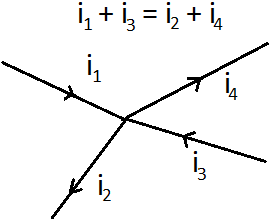
Or
Algebraic sum of the currents flowing towards any point in an electric network is zero, i.e., charges are conserved in an electric network.
The proof of this rule follows from the fact that when currents are steady, there is no accumulation of charges at any junction or at any point in a line.
Thus, the total current flowing in, (which is the rate at which charge flows into the junction), must equal the total current flowing out.
Kirchhoffs junction rule is also known as Kirchhoff’s current law.
So, Kirchhoffs junction rule is the reflection of conservation of charge
Important point: Sign convention of current from a junction: We are taking outgoing current from a junction as negative. And we are taking incoming current towards a junction as positive.
View full question & answer→MCQ 951 Mark
Identify the type of material based on the $T-ρ$ graph given below.
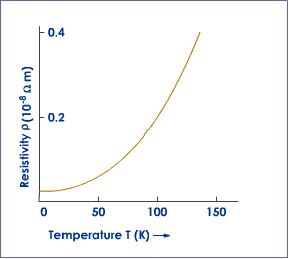
AnswerFor metals, the temperature coefficient of resistivity is positive. At lower temperatures, the resistivity of a pure metal increases as a higher power of temperature. So, the answer is copper, which is a metal.
View full question & answer→MCQ 961 Mark
Electromotive Force $\text{(EMF)}$ may be defined as:
- ✓
Work done per coulomb on the charge.
- B
Drift velocity of electrons.
- C
- D
The number of coulombs of charge per second.
AnswerCorrect option: A. Work done per coulomb on the charge.
Electromotive Force $\text{(EMF)}$ may be defined as work done per coulomb on the charge.
View full question & answer→MCQ 971 Mark
The Kirchhoff's second law $\Big(\sum\text{iR}=\sum\text{E}\Big)$ where the symbols have their usual meanings, is based on:
- A
Conservation of momentum.
- B
- C
Conservation of potential.
- ✓
View full question & answer→MCQ 981 Mark
In the absence of an electric field, the mean velocity of free electrons in a conductor at absolute temperature $(T)$ is:
- ✓
- B
Independent of $T$
- C
Proportional to $T$
- D
Proportional to $t^2$
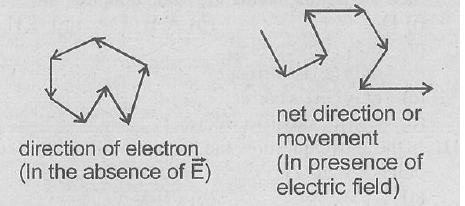
AnswerIn the absence of electric field, the electron moves in zig$-$zag direction as shown in figure. So net displacement is zero, hence mean velocity of free electrons in a conductor at absolute temperature is zero.
View full question & answer→MCQ 991 Mark
The resistance of carbon $......$ with rise in the temperature.
- A
- ✓
- C
- D
First increases then decreases
AnswerThe resistance of the conductor increases with the rise in temperature. However, substances classified as insulator tends to show opposite behaviour. Carbon is an insulator.
View full question & answer→MCQ 1001 Mark
Which one of the following is the practical unit of power?
- A
Watt $(W)$
- B
Kilowatt hour $(kWh)$
- ✓
Horse power $(hp)$
- D
Kilojoule $(kJ)$
AnswerCorrect option: C. Horse power $(hp)$
The practical unit of power is horse power $(hp)$. Kilo watt is also another practical unit of power. $1$ kilowatt $= 1000$ watt; $1 hp = 746$ watt. It is usually used in reference to the output of engines or motors.
View full question & answer→MCQ 1011 Mark
A constant voltage is applied between the two ends of a uniform metallic wire. Some heat is developed in it. The heat developed is doubled if.
- A
Both the length and the radius of the wire are halved.
- ✓
Both the length and the radius of the wire are doubled.
- C
The radius of the wire is doubled.
- D
The length of the wire is doubled.
AnswerCorrect option: B. Both the length and the radius of the wire are doubled.
View full question & answer→MCQ 1021 Mark
Which of these relation holds good for an Ohmic conductor?
- A
$V-I$ relationship is non-linear.
- ✓
The straight$-$line $V-I$ graph pass through the origin.
- C
$V-I$ relationship is non-unique.
- D
$V-I$ relationship depends on the sign of $V$ for the same absolute value of $V.$
AnswerCorrect option: B. The straight$-$line $V-I$ graph pass through the origin.
The conductors which obey $Ohm’s$ law are called Ohmic conductors. The linear relationship between voltage and current for these conductors hold good. The resistance $(\text{R}=\frac{\text{V}}{\text{I}})$is independent of the current through the conductor. The magnitude of current changes linearly with voltage. Hence the $V-I$ graph for ohmic conductors is a straight line passing through the origin.
View full question & answer→MCQ 1031 Mark
What is the study of electric charges in motion called?
AnswerThe study of motion or dynamics of charges constitute an electric current. Therefore, the study of electric charges in motion is called current electricity.
View full question & answer→MCQ 1041 Mark
Identify the wrong statement describing the color code for carbon resistors.
- A
The first band indicates the first significant figure.
- B
The second band indicates the second significant figure.
- ✓
The third band indicates the third significant figure.
- D
The fourth band indicates the possible variation in the percent of the indicated value.
AnswerCorrect option: C. The third band indicates the third significant figure.
The third band indicates the power of ten with which the first and second significant figures must be multiplied to get the resistance value in ohms. All the other statements are valid.
View full question & answer→MCQ 1051 Mark
A potentiometer wire is $100\ cm$ long and a constant potential difference is maintained across it. Two cells are connected in series first to support one another and then in opposite direction. The balance points are obtained at $50\ cm$ and $10\ cm$ from the positive end of the wire in the two cases. The ratio of emf's is:
- A
$5 : 1.$
- B
$5 : 4.$
- C
$3 : 4.$
- ✓
$3 : 2.$
AnswerCorrect option: D. $3 : 2.$
View full question & answer→MCQ 1061 Mark
Potentiometer measures potential more accurately because:
- ✓
It measures potential in open circuit.
- B
It uses sensitive galvanometer for null deflection.
- C
It uses high resistance potentiometer wire.
- D
It measures potential in closed circuit.
AnswerCorrect option: A. It measures potential in open circuit.
View full question & answer→MCQ 1071 Mark
Pick out the correct statement from the following about parallel combination of resistors.
- A
The current across the resistors are the same.
- B
The resistance offered by all resistors are the same.
- ✓
The potential difference is same across each resistor.
- D
The equivalent overall resistance is larger than the largest resistor.
AnswerCorrect option: C. The potential difference is same across each resistor.
In parallel combination, the resistors are connected together at one end, and are also all connected together at the other end. So, the potential difference across the resistors will not change and thus, remains the same.
View full question & answer→MCQ 1081 Mark
Which of the following is not a valid reason for using alloys to make standard resistors?
- A
Alloys have a high value of resistivity.
- B
They are least affected by air and moisture.
- ✓
Alloys have a large temperature coefficient.
- D
Their contact potential with copper is small.
AnswerCorrect option: C. Alloys have a large temperature coefficient.
Alloys have a high value of resistivity. They have a very small temperature coefficient. So their resistance does not change appreciably even for several degrees rise of temperature. That leaves the answer $–$ alloys have a large temperature coefficient.
View full question & answer→MCQ 1091 Mark
Identify the type of conductors whose $V-I$ relationship is linear.
- A
- B
Non$-$ohmic conductors
- ✓
- D
AnswerThe conductors which obey Ohm’s law are called Ohmic conductors. The linear relationship between voltage and current for these conductors hold good.
View full question & answer→MCQ 1101 Mark
At temperature $0K,$ the germanium behaves as a/ an:
View full question & answer→MCQ 1111 Mark
Current density is a $.......$.
AnswerCurrent density is a vector quantity.
View full question & answer→MCQ 1121 Mark
Which of the following is not true for wire wound resistor?
AnswerCorrect option: A. It has a lower order of stability and reliability.
A wire wound resistor is an electrical passive component that limits current. The resistive element exists out of an insulated metallic wire that is winded around a core of non$-$conductive material. The wire material has a high resistivity, and is usually made of an alloy such as Nickel$-$chromium $($Nichrome$)$ or a copper$-$nickel$-$manganese alloy called Manganin. Common core materials include ceramic, plastic and glass. It has a lower order of stability and reliability is not true for wire wound resistor.
View full question & answer→MCQ 1131 Mark
Identify the type of conductor in which the variation of current with potential difference may depend upon the sign of the potential difference applied.
AnswerCorrect option: D. $p-n$ junction diode
p-n junction diode consists of $p-$type and $n-$type semiconductors. The $V-I$ relationship is non-linear. When a voltage is applied across junction, very little current flows for the fairly high negative voltage and a current begins to flow for much smaller positive $($forward$)$ bias. The magnitude of variation depends upon the sign of potential difference applied across it.
View full question & answer→MCQ 1141 Mark
The equation $\rightarrow ∑e = ∑IR$ is applicable to which law?
- ✓
- B
Kirchhoff’s junction rule.
- C
- D
AnswerThe equation $\rightarrow ∑e = ∑IR$ is applicable to Kirchhoff’s second law. This law is also known as Kirchhoff’s loop rule. This expression tells us that in a closed loop, the algebraic sum of the emfs is equal to the algebraic sum of the products of the resistance and currents flowing through them.
View full question & answer→MCQ 1151 Mark
Kirchoff's first law, i.e., $\sum\text{i}=0$ at a junction, deals with the conservation of:
AnswerThe principle of conservation of electric charge implies that: at any node $($junction$)$ in an electrical circuit , the sum of currents flowing into that node is equal to the sum of currents flowing out of that node. This is known as Kirchhoff's current law.
View full question & answer→MCQ 1161 Mark
Which of these is a correct definition of conventional current?
- A
Current that flows from lower potential to higher potential.
- B
The current which remains static.
- C
Current constituted by the flow of ions.
- ✓
Current that flows from higher potential to lower potential.
AnswerCorrect option: D. Current that flows from higher potential to lower potential.
The current that flows from a point at the higher $($positive$)$ potential to a point at lower $($negative$)$ potential is called conventional current. The direction of motion of positive charges is taken as the direction of electric current.
View full question & answer→MCQ 1171 Mark
$\text{E.M.F.}$ ofa cell is expressed in:
Answer$\text{E.m.f}$ of a cell is defined as the maximum potential difference across the cell when no current flows through the circuit.
View full question & answer→MCQ 1181 Mark
How many resistances are used in a Wheatstone bridge?
AnswerWheatstone bridge is an arrangement of four resistors $\text{P, Q, R,}$ and $S$, such that if we know the value of the resistances of any three of them, we can obtain the value of fourth unknown resistance. Therefore, there are $4$ resistances in a Wheatstone bridge.
View full question & answer→MCQ 1191 Mark
- ✓
The maximum potential difference between the terminals of a cell when no current is drawn from the cell.
- B
The force required to push the electrons in the circuit.
- C
The potential difference between the positive and negative terminal of a cell in a closed circuit.
- D
Less than terminal potential difference of the cell.
AnswerCorrect option: A. The maximum potential difference between the terminals of a cell when no current is drawn from the cell.
View full question & answer→MCQ 1201 Mark
$1 kWh =............. ?$
- ✓
$3.6 \times 10^6$ J
- B
$3.6 \times 10^5 J$
- C
$0.36 \times 10^6 J$
- D
$0.36 \times 10^5 J$
AnswerCorrect option: A. $3.6 \times 10^6$ J
a. $3.6 \times 10^6 J$
Explanation:
The commercial unit of electric energy is kilowatt-hour $(kWh)$.
$1 kWh =1000 Wh =3.6 \times 10^6 J=$ one unit of electricity consumed.
The electric energy used in factories, industries and houses are measured in $kWh$ .
View full question & answer→MCQ 1211 Mark
Identify the definition of sensitivity of a galvanometer from the following.
- A
Ratio of unit change in unknown resistance to the deflection in the galvanometer.
- B
Ratio of unit change in unknown resistance to twice the deflection in the galvanometer.
- ✓
Ratio of deflection in the galvanometer to the unit change in unknown resistance.
- D
Ratio of deflection in the galvanometer to half the unit change in unknown resistance.
AnswerCorrect option: C. Ratio of deflection in the galvanometer to the unit change in unknown resistance.
Sensitivity of a galvanometer is defined as ratio of deflection in the galvanometer to the unit change in unknown resistance. Sensitivity of a galvanometer can be increased by increasing the number of turns, increasing the area of the coil, or using a strong magnet.
View full question & answer→MCQ 1221 Mark
A cell of internal resistance $r$ is connected to an external resistance $R.$ The current will be maximum in $R$, if:
AnswerCorrect option: A. $\text{R}=\text{r}$
View full question & answer→MCQ 1231 Mark
Which of the following relation is significant for metals when the temperature increases?
- ✓
Resistivity increases and conductivity decreases.
- B
Resistivity decreases and conductivity decreases.
- C
Resistivity and conductivity do not change with temperature.
- D
Temperature dependence is non-linear.
AnswerCorrect option: A. Resistivity increases and conductivity decreases.
The resistivity of a metal increases and the conductivity decreases with the increase in temperature. With an increase in temperature, the free electrons collide more frequently with the metal ions. The mean collision time also decreases.
View full question & answer→MCQ 1241 Mark
Find the false statement.
AnswerCorrect option: C. Kirchhoff’s $2^{nd}$ law is applied at nodes.
Kirchhoff’s $2^{nd}$ year is applied in a closed loop. Kirchhoff’s $2^{nd}$ law supports the law of conservation of energy. This means that energy is neither created nor destroyed in the closed loop. Whatever energy enters the loop, same amount leaves the loop.
View full question & answer→MCQ 1251 Mark
The current density $($number of free electrons per $m ^3 )$ in metallic conductor is of the order of:
- A
$10^{22}$
- B
$10^{24}$
- C
$10^{26}$
- ✓
$10^{28}$
AnswerCorrect option: D. $10^{28}$
View full question & answer→MCQ 1261 Mark
A constant current i is maintained in a solenoid. Which of the following quantities will increase if an iron rod is inserted in the soleniod along axis?
- A
Magnetic field at the centre.
- B
Mangetic flux linked with the solenoid.
- C
Self-inductance of the solenoid.
- ✓
View full question & answer→MCQ 1271 Mark
Which of the following statements is false?
- A
A rheostat can be used as a potential divider.
- B
Kirchhoff's second law represents energy conservation.
- C
Wheatstone bridge is the most sensitive when all the four resistances are of the same order of magnitude.
- ✓
In a balanced wheatstone bridge if the cell and the galvanometer are exchanged, the null point is disturbed.
AnswerCorrect option: D. In a balanced wheatstone bridge if the cell and the galvanometer are exchanged, the null point is disturbed.
View full question & answer→MCQ 1281 Mark
Two solenoids have identical geometrical construction but one is made of thick wire and the other of thin wire. Which of the following quantities are different for the two solenoids?
- A
- B
Rate of Joule heating if the same current goes through them.
- C
Magnetic field energy if the same current goes through them.
- D
Time constant if one solenoid is connected to one battery and the other is connected to another battery.
Answerb. Rate of Joule heating if the same current goes through them.
d. Time constant if one solenoid is connected to one battery and the other is connected to another battery.
Explanation:
$R =\frac{\rho l }{ A }$
A - Crossectional Area
Thick wire "A" is large than thin wire.
$R_{\text {thick }}$ wire $ $p$ time constant
$p \tau=\frac{ L }{ R }$
p Power dissipatedin Heating $= I ^2 R$
View full question & answer→MCQ 1291 Mark
In the experiment of potentiometer, at balance point, there is no current in the:
- A
- ✓
- C
- D
Both main and galvanometer circuits.
View full question & answer→MCQ 1301 Mark
A metallic resistor is connected across a battery. If the number of collisions of the free electrons with the lattice is somehow decreased in the resistor (for example, by cooling it), the current will:
Answera. Increase.
Explanation:
If the number of collisions of the free electrons with the lattice is decreased, then the drift velocity of the electrons increases.
Current i is directly proportional to the drift velocity ' $V_d$ ' and is given by the following relation: $i = neAV _{ d }$
View full question & answer→MCQ 1311 Mark
A resistance $R$ is to be measured using a meter bridge. Student chooses the standard resistance $S$ to be $100 \Omega$. He finds the null point at $I _1=2.9 \ cm$. He is told to attempt to improve the accuracy. Which of the following is a useful way?
- A
He should measure $I_1$ more accurately.
- B
He should change S to $1000 \Omega$ and repeat the experiment.
- ✓
He should change $S$ to $3 \Omega$ and repeat the experiment.
- D
He should give up hope of a more accurate measurement with a meter bridge.
AnswerCorrect option: C. He should change $S$ to $3 \Omega$ and repeat the experiment.
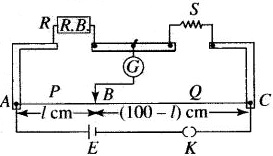 Key concept: In this problem, the concept of balanced Wheatstone bridge is to be used.
Condition of balanced wheat stone bridge: The bridge is said to be balanced if the ratio of the resistances in same branch is equal $\frac{R}{S}=\frac{I_1}{\left(100-I_1\right)}$.
Wheatstone bridge is an arrangement of four resistances which can be used to measure one unknown resistance of them in terms of rest.
The percentage error in $R$ can be minimised by adjusting the balance point near the middle of the bridge, i.e., when is close to $50 \ cm $. This requires a suitable choice of $S$.
Since, $\frac{R}{S}=\frac{I_1}{\left(100-I_1\right)}$
Since here, $R: S=2.9: 97.1$
Then the value of $S$ is nearly $33$ times to that of $R$. In order to make this ratio $1: 1$, it is necessary to reduce the value of $S$ nearly $\frac{1}{33}$ times, i.e., nearly $3 \Omega$.
View full question & answer→MCQ 1321 Mark
An Aluminium $(Al)$ rod with area of cross-section $4 \times 10^{-6} m^2$ has a current of $5$ ampere. Flowing through it. Find the drift velocity of electron in the rod. Density of $AI =2.7 \times 10^3 kg / m ^3$ and Atomic wt. $=27$. Assume that each AI atom provides one electron:
- A
$8.6 \times 10^{-4} m / s$.
- ✓
$1.29 \times 10^{-4} m / s$.
- C
$2.8 \times 10^{-2} m / s$.
- D
$3.8 \times 10^{-3} m / s$.
AnswerCorrect option: B. $1.29 \times 10^{-4} m / s$.
b. $1.29 \times 10^{-4} m / s$.
View full question & answer→MCQ 1331 Mark
The SI unit of electrical energy is $.......$?
- A
Kilojoule $(KJ)$
- ✓
Joules $(J)$
- C
Watt $(W)$
- D
Kilowatt $(KW)$
AnswerCorrect option: B. Joules $(J)$
Electric energy is defined as the total electric work done or energy supplied by the source of emf in maintaining the current in an electric circuit for a given time. The $SI$ unit of electrical energy is joule $(J).$ The commercial unit of electric energy is kilowatt$-$hour $(kWh).$
View full question & answer→MCQ 1341 Mark
Under what condition will the strength of current in a wire of resistance $R$ be the same for connection is series and in parallel of n identical cells each of the internal resistance r?
AnswerCorrect option: C. $\text{R}=\text{r}$
View full question & answer→MCQ 1351 Mark
In comparing $e.m.f.s$ of $2$ cells with the help of potentiometer, at the balance point, the current flowing through the wire is taken from:
- A
- B
- ✓
Battery in the main circuit.
- D
AnswerCorrect option: C. Battery in the main circuit.
emf of secondary cell $= I r l$
where
$I -$ current in the main circuit from battery.
$r -$ resistance per unit length of wire.
$l -$ balancing length.
View full question & answer→MCQ 1361 Mark
Consider the following two statements:
- Kirchhoff's junction law follows from conservation of charge.
- Kirchhoff's loop law follows from conservative nature of electric field.
- ✓
Both $A$ and $B$ are correct.
- B
$A$ is correct but $B$ is wrong.
- C
$B$ is correct but $A$ is wrong.
- D
Both $A$ and $B$ are wrong.
AnswerCorrect option: A. Both $A$ and $B$ are correct.
$\phi$ Kirchhoff's Junction Law follows from conservation of charge.
$\phi$ Kirchhoff's loop law fallows from conservation nature of electric field.
View full question & answer→MCQ 1371 Mark
Your are given three equal resistances. In how many combinations can they be arranged?
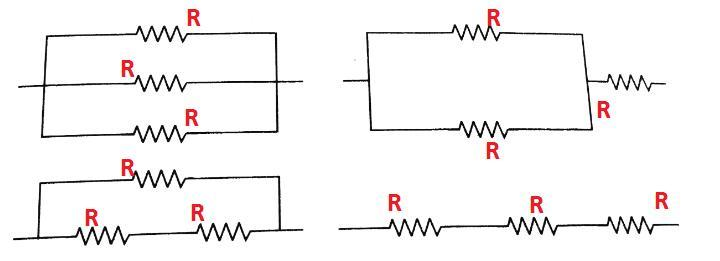
AnswerThree equal resistances can be connected in four different combinations:
All three in parallel.
Two in parallel and third in series.
Two in series and third in parallel of both.
All three in series.
View full question & answer→MCQ 1381 Mark
In the equation $AB = C$, A is the current density, $C$ is the electric field, Then $B$ is:
View full question & answer→MCQ 1391 Mark
A potentiometer is an accurate and versatile device to make electrical measurements of $\text{E.M.F.}$ because the method involves:
- A
- ✓
A condition of no current flow through the galvanometer.
- C
A combination of cells, galvanometer and resistances.
- D
AnswerCorrect option: B. A condition of no current flow through the galvanometer.
View full question & answer→MCQ 1401 Mark
Potentiometer measures potential more accurately because
- ✓
it measures potential in the open circuit.
- B
it uses sensitive galvanometer for null deflection.
- C
it uses high resistance potentiometer wire.
- D
it measures potential in the closed circuit.
AnswerCorrect option: A. it measures potential in the open circuit.
A potentiometer has very large resistance. To read load voltage or voltage across any circuit element, potentiometer is connected parallel across it. Thus, the load voltage or circuit voltage gets applied across the potentiometer but as the resistance is very high compared to load resistance, you can safely assume their is almost no current flowing through potentiometer. As power $= VI$, the power loss in potentiometer is almost equal to zero as current through it remains zero.
View full question & answer→MCQ 1411 Mark
An electric heating element in vacuum is surrounded by a cavity at constant temperature of $227^\circ C;$ it consumes $60W$ of power to maintain a temperature of $727^\circ C$. What is the power consumed by the element to maintain a temperature of $1227^\circ C?$
- A
$101W.$
- B
$304W.$
- C
$90W.$
- ✓
$320W.$
AnswerCorrect option: D. $320W.$
View full question & answer→MCQ 1421 Mark
Which of the following is an example of an Ohmic conductor?
AnswerMost of the metals obey Ohm’s law and they are called ohmic conductors. Whereas semiconductors are non$-$ohmic. Nichrome metal is an ohmic conductor in which the $V-I$ characteristic has a straight line passing through the origin.
View full question & answer→MCQ 1431 Mark
Which of the following component is connected in parallel in the circuit?
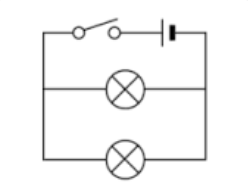
AnswerSince the current in both bulbs is not same but they have same potential so they are connected in parallel.
View full question & answer→MCQ 1441 Mark
For making standard resistance, wire of following material is used:
AnswerManganin is used to make standard resistors because
They have high value of resistivity.
Temperature coefficient of resistance is less.
They are least affected by temperature.
View full question & answer→MCQ 1451 Mark
Nichrome or Manganin is widely used in wire bound standard resistors because of their:
- A
Temperature independent resistivity.
- ✓
Very weak temperature dependent resistivity.
- C
Strong dependence of resistivity with temperature.
- D
AnswerCorrect option: B. Very weak temperature dependent resistivity.
View full question & answer→MCQ 1461 Mark
Two non ideal batteries are connected in series. Consider the following statements
$(A)$ The equivalent emf is larger than either of the two emfs.
$(B)$ The equivalent internal resistance is smaller than either of the two internal resistances.
- A
Both $A$ and $B$ are correct.
- ✓
$A$ is correct but $B$ is wrong.
- C
$B$ is correct but $A$ is wrong.
- D
Both $A$ and $B$ wrong.
AnswerCorrect option: B. $A$ is correct but $B$ is wrong.
If we add two non ideal batteries in series then.
so in case $(a)$ the equivalent $e.m.f.$ may be larger than either of two $e.m.f.$, but in case $(b)$ the equivalent $e.m.f.$ may be smaller than either of two $e.m.f.$
In series total resistance is always greater than individual resistance, whether batteries are connected in any way
[i.e. either according to case $(a)$ or case $(b)].$
View full question & answer→MCQ 1471 Mark
For measuring voltage of any circuit, potentiometer is preferred to voltmeter because:
- A
The potentiometer is cheap and easy to handle.
- B
Calibration in the voltmeter is sometimes wrong.
- ✓
The potentiometer almost draws no current during measurement.
- D
Range of the voltmeter is not as wide as that of the potentiometer.
AnswerCorrect option: C. The potentiometer almost draws no current during measurement.
View full question & answer→MCQ 1481 Mark
Predict the effect of length of conductor on drift velocity of electrons.
- A
Drift velocity varies linearly with the length of conductor.
- B
Drift velocity does not depend on the length of conductor.
- C
Drift velocity increases with the increasing length of conductor.
- ✓
Drift velocity decreases with the increasing length of conductor.
AnswerCorrect option: D. Drift velocity decreases with the increasing length of conductor.
The drift velocity of electrons decreases when the length of the conductor is increased.
Drift velocity $=\frac{\text{Potentialdifference}}{\text{(numberofelectrons×chargeofelectron×lengthofconductor×density).}}$
View full question & answer→MCQ 1491 Mark
In the absence of an electric field, the mean velocity of free electrons in a conductor at absolute temperature $(T)$ is:
- ✓
- B
Independent of $T.$
- C
Proportional to $T.$
- D
Proportional to $T2.$
View full question & answer→MCQ 1501 Mark
In a wheatstone bridge in the battery and galvanometer are interchanged then the deflection in galvanometer will:
- A
Change in previous direction.
- ✓
- C
Change in opposite direction.
- D
View full question & answer→MCQ 1511 Mark
If the equivalent resistance is to be increased, then the number of resistances should be connected in:
AnswerEquivalent resistance is maximum and current flow is minimum when number of resistances are connected in series.
$R_{\text {eq }}=R_1+R_2+R_3$; where $R_1, R_2, R_3$ are resistances.
View full question & answer→MCQ 1521 Mark
In potentiometer a balance point is obtained, when:
- A
The $e.m.f.$ of the battery becomes equal to the $e.m.f.$ of the experimental cell.
- ✓
The $p.d.$ of the wire between the $+ve$ end of battery to jockey becomes equal to the $e.m.f.$ of the experimental cell.
- C
The $p.d.$ of the wire between $+ve$ point of cell and jockey becomes equal to the $e.m.f.$ of the battery.
- D
The $p.d.$ across the potentiometer wire becomes equal to the $e.m.f.$ of the battery.
AnswerCorrect option: B. The $p.d.$ of the wire between the $+ve$ end of battery to jockey becomes equal to the $e.m.f.$ of the experimental cell.
View full question & answer→MCQ 1531 Mark
The net resistance of a voltmeter should be large to ensure that:
- A
It does not get overheated.
- B
It does not draw excessive current.
- C
It can measure large potential differences.
- ✓
It does not appreciably change the potential difference to be measured.
AnswerCorrect option: D. It does not appreciably change the potential difference to be measured.
The net resistance of a voltmeter should be large to ensure that it does not appreciably change the potential difference to be measured.
View full question & answer→MCQ 1541 Mark
The sensitivity of a potentiometer can be increased by:
$a.$ increasing the series resistance in the primary circuit.
$b.$ decreasing the length of the potentiometer wire.
$c.$ using a thin and high resistivity wire as a potentiometer wire.
$d.$ increasing the length of the wire.
- A
$a$ and $c$ are correct.
- B
$b$ and $d$ are correct.
- C
$b$ and $c$ are correct.
- ✓
$a$ and $d$ are correct.
AnswerCorrect option: D. $a$ and $d$ are correct.
The sensitivity of potentiometer is inversely proportional to the potential gradient.
With increase in the series resistance the potential gradient of the wire decreases thereby helps us to measure the emf more accurately.
Increase in the length of the wire decrease the potential gradient of the wire thereby helps us to measure the emf more accurately.
View full question & answer→MCQ 1551 Mark
To minimise the power loss in the transmission cables connecting the power stations to homes and factories, the transmission cables carry current:
- A
- ✓
- C
At $220$ volt.
- D
Neither at a very high voltage nor at a very low voltage.
View full question & answer→MCQ 1561 Mark
Give the SI unit of current density and its dimensional formula.
- ✓
$Am ^{-2},\left[A^1 L^{-2}\right]$
- B
$Am ^2,\left[A^1 L^2\right]$
- C
$Am ^{-1},\left[A^1 L^{-1}\right]$
- D
$Am ^1,\left[A^1 L^1\right]$
AnswerCorrect option: A. $Am ^{-2},\left[A^1 L^{-2}\right]$
a. $Am ^{-2},\left[A^1 L^{-2}\right]$
Explanation:
Current density is the amount of charge flowing per second through a unit area.
The SI unit of current density is ampere per square metre $\left( Am ^{-2}\right)$ and its dimensions are $\left[A^1 L^{-2}\right]$.
View full question & answer→MCQ 1571 Mark
Calculate the value of current $I_4$
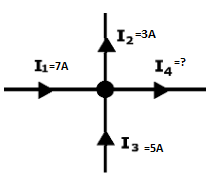
AnswerCurrent $I_4$ can be calculated using Kirchhoff’s first law. The sum of current arriving at a junction is equal to the currents leaving the junction.
Here, Currents arriving at a junction: $7A + 5A = 12A$
Currents leaving the junction: $3A + I_4$
Equating both the currents: $12A = 3A +I_4$
$I_4 = 9A$
View full question & answer→MCQ 1581 Mark
Identify the material whose resistivity lie between $10^{-6} \Omega m$ and $10^4 \Omega m$.
AnswerThe resistivities of semiconductors lie between $10^{-6} \Omega m$ and $10^4 \Omega m$.. A semiconductor material has an electrical conductivity value falling between that of a conductor, such as metallic aluminum, and an insulator, such as wood. Silicon and germanium are typical semiconductors.
View full question & answer→MCQ 1591 Mark
Which of the following characteristics of electrons determines the current in a conductor?
- ✓
- B
- C
Both drift velocity and thermal velocity.
- D
Neither drift nor thermal velocity.
View full question & answer→MCQ 1601 Mark
The internal resistance of dry cell is $...A...,$ than the internal resistance of common electrolytic cell. Here, $A$ refers to:
View full question & answer→MCQ 1611 Mark
Which among the following can be used to analyze circuits?
AnswerKirchhoff’s Law is used to analyze circuits. This law is important because they represent connections of a circuit. Kirchhoff’s Law provide the constraints that let us find the current flowing and voltage across every circuit element.
View full question & answer→MCQ 1621 Mark
With increase in temperature the conductivity of:
- A
Metals increases and of semiconductor decreases.
- ✓
Semeconductors increases and metals decreases.
- C
In both metals and semiconductors increases.
- D
In both metal and semiconductor decreases.
AnswerCorrect option: B. Semeconductors increases and metals decreases.
View full question & answer→MCQ 1631 Mark
Sensitivity of potentiometer can be increased by:
AnswerCorrect option: B. Increasing the length of the potentiometer.
View full question & answer→MCQ 1641 Mark
Kirchoff’s first law, i.e., $S i = 0$ at a junction, deals with the conservation of:
View full question & answer→MCQ 1651 Mark
Kirchoff's junction law is equivalent to $......$.
- A
- ✓
- C
Conservation of electric potential.
- D
Conservation of electric flux.
AnswerKirchhoff's junction rule is an application of the principle of conservation of electric charge: current is flow of charge per time, and if current is constant, that which flows into a point in a circuit must equal that which flows out of it.
View full question & answer→MCQ 1661 Mark
Pick out the application of potentiometer from the following.
- A
- ✓
It measures internal resistance.
- C
It measures external resistance.
- D
It is used to compare two currents.
AnswerCorrect option: B. It measures internal resistance.
Potentiometer is an electric instrument used to measure internal resistance, electromotive force $(emf)$, and it is also used for comparing the emfs of different cells. Potentiometer can be used as a variable resistor as well.
View full question & answer→MCQ 1671 Mark
In a large building, there are $15$ bulbs of $40W, 5$ bulbs of $100W, 5$ fans of $80W$ and $1$ heater of $1kW$. The voltage of electric mains is $220V$. The minimum capacity of the main fuse of the building will be:
- A
$8A.$
- B
$10A.$
- ✓
$12A.$
- D
$14A.$
AnswerCorrect option: C. $12A.$
View full question & answer→MCQ 1681 Mark
Which of the following quantities do not change when a resistor connected to a battery is heated due to the current?
- A
- B
- C
- ✓
Number of free electrons.
AnswerCorrect option: D. Number of free electrons.
When a resistor connected to a battery is heated due to the current that causes drift speed, resistivity $\&$ resistance may e change But number of free electrons remains same.
View full question & answer→MCQ 1691 Mark
If in the experiment of Wheatstone’s bridge, the positions of cells and galvanometer are interchanged, then balance point will:
- A
- ✓
- C
Depend on the internal resistance of cell and resistance of galvanometer.
- D
View full question & answer→MCQ 1701 Mark
The unit of specific resistance is:
AnswerCorrect option: C. $\Omega1$
View full question & answer→MCQ 1711 Mark
In a meter bridge the point D is a neutral point (Fig).
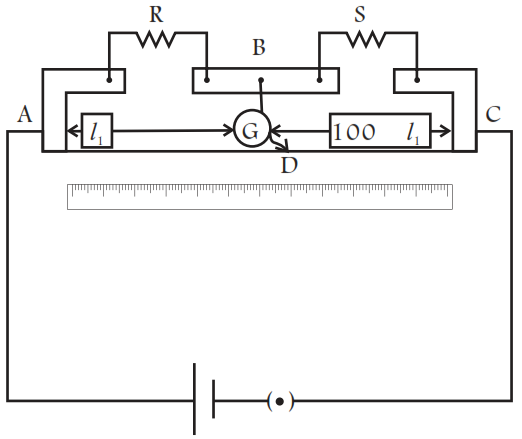
- A
The meter bridge can have no other neutral point for this set of resistances.
- B
When the jockey contacts a point on meter wire left of D, current flows to B from the wire.
- C
When the jockey contacts a point on the meter wire to the right of D, current flows from B to the wire through galvanometer.
- ✓
AnswerSolution:
Key concept: Meter bridge: In case of meter bridge, the resistance wire AC is 100cm long. Varying the position of tapping point B, bridge is balanced. If in balanced position of bridge AB = l, BC = (100 - l) so that $\frac{\text{Q}}{\text{P}}=\frac{(100-\text{I})}{\text{I}}$. Also $\frac{\text{P}}{\text{Q}}=\frac{\text{R}}{\text{S}}>\text{S}=\frac{(100-\text{I})}{\text{I R}}$.
When there is no deflection in galvanometer there is no current across the galvanometer, then points B and D are at same potential. That point at which galvanometer shows no deflection is called null point, then potential at B and neutral point D are same. When the jockey contacts a point on the meter wire to the right of D, the potential drop across AD is more than potential drop across AB, which brings the potential of point D less than that of B, hence current flows from B to D in the galvanometer wire.
View full question & answer→MCQ 1721 Mark
Unit of $e.m.f.$ of a cell is:
AnswerEmf is voltage generated by the battery and hence, the unit of emf is same as that of voltage,which is volts.
View full question & answer→MCQ 1731 Mark
A source of electromotive force $(emf) $ is a:
AnswerA source of $\text{EMF}$ can be cell, battery or generator.
View full question & answer→MCQ 1741 Mark
Which of the following is an example of a non$-$ohmic conductor?
AnswerSilicon is an example of a non$-$ohmic conductor. It exhibits non$-$linear behaviour. After a certain voltage, the current decreases as the voltage increases. The $V-I$ plot for silicon is non-linear.
View full question & answer→MCQ 1751 Mark
Which among the following has weak temperature dependence values with resistivity?
AnswerAlloys have high resistivity. The resistivity of nichrome has weak temperature dependence. At absolute zero, a pure metal has negligibly small resistivity while an alloy like nichrome has some residual resistivity.
View full question & answer→MCQ 1761 Mark
As the temperature of a conductor increases, its resistivity and conductivity change. The ratio of resistivity to conductivity:
- ✓
- B
- C
- D
May increase or decrease, depending on the actual temperature.
AnswerTemperature of a cunductor increases that causes resistivity $(r)$ is increases due conductivity $(s)$ is decrease.
$\therefore\sigma=\frac{1}{\rho}$
$\Rightarrow\text{ratio of}\frac{\text{resistivity}}{\text{conductivity}}=\frac{\rho}{\sigma}=\rho^2$ is increase.
View full question & answer→MCQ 1771 Mark
Which instrument is used as the null detector in the Wheatstone bridge?
AnswerA galvanometer is used as the null detector in a Wheatstone bridge. The null point means the situation in which no current flows through the circuit. The galvanometer is used for measuring the current and also to determine the voltage between any two points of the circuit. Galvanometer is used due to its sensitivity and therefore, even small currents can be measured.
View full question & answer→MCQ 1781 Mark
The example of non$-$ohmic resistance is:
View full question & answer→MCQ 1791 Mark
Wheatstones’s bridge cannot be used for measurement of very $......$ resistances.
AnswerFrom wheatstone bridge while measuring For resistances of very low value like few ohms , the effect of other components of the circuit like wires , galvanometer etc. might come into account. these components might introduce stray resistance to the calculation.
View full question & answer→MCQ 1801 Mark
A graph is plotted between the potential difference $($applied across the ends of a conductor$)$ and the current $($following through the conductor$)$. The graph is a straight line
AnswerAccording to $Ohm's$ law, the potential difference across a conductor is directly proportional to the current through it.
$V = IR$
Hence the curve is a straight line passing through origin.
View full question & answer→MCQ 1811 Mark
A strip of copper and another of germanium are cooled from room temperature to $80K$. The resistance of:
- A
- B
- C
Copper strip increases and that of germanium decreases.
- ✓
Copper strip decreases and that of germanium increases.
AnswerCorrect option: D. Copper strip decreases and that of germanium increases.
View full question & answer→MCQ 1821 Mark
The specific resistance of a rod of copper as compared to that of thin wire of copper is:
- A
- B
- ✓
- D
Depends upon the length and area of wire
AnswerSpecific resistance of a conductor depends on the nature of material but is independent of the dimension of the conductor. Thus specific resistance of rod of copper as compared to that of thin wire of copper is same.
View full question & answer→MCQ 1831 Mark
When a potential difference $V$ is applied across a conductor at a temperature $T$, the drift velocity of electrons is proportional to:
- A
$\text{V}$
- ✓
$\sqrt{\text{V}}$
- C
$\text{T}$
- D
$\sqrt{\text{T}}$
AnswerCorrect option: B. $\sqrt{\text{V}}$
View full question & answer→MCQ 1841 Mark
An engine uses $30A$ of current. The resistance offered is $15$ ohms. Calculate the power consumed by the engine in horse power.
- ✓
$18hp$
- B
$19hp$
- C
$17hp$
- D
$13500hp$
AnswerCorrect option: A. $18hp$
a. $18 hp$
Explanation:
Current used $=30 A$; Resistance $=15$ ohms
The required equation is: Power $=$ current $^2 \times$ resistance
$=30 \times 30 \times 15$
$=13,500 Watts$
We know that, $1$ Watt $= 746$ horse power (hp).
So, $13,500$ Watts $=18.096 hp$, which can approximately be equal to 18 hp .
View full question & answer→MCQ 1851 Mark
In the electrolysis of $\text{NaCl:}$
- ✓
$Cl ^{-}$is oxidised at anode.
- B
$Cl ^{-}$ is reduced at anode.
- C
$Cl ^{-}$ is reduced at cathode.
- D
$Cl ^{-}$ is neither reduced nor oxidised.
AnswerCorrect option: A. $Cl ^{-}$is oxidised at anode.
Electrolysis of an aqueous solution of table salt $(\text{NaCl}$, or sodium chloride$)$ produces aqueous sodium hydroxide and chlorine, although usually only in minute amounts. $\text{NaCl} ($aq$)$ can be reliably electrolysed to produce hydrogen. Hydrogen gas will be seen to bubble up at the cathode, and chlorine gas will bubble at the anode.
As the electricity from the battery passes through and between the electrodes, the water splits into hydrogen and chlorine gas, which collect as very tiny bubbles around the electrode tips. Hydrogen collects around the cathode and chlorine gas collects around the anode.
View full question & answer→MCQ 1861 Mark
$36$ cells, each of emf $4V$ are connected in series and kept in a box. The combination shows an emf of $88V$ on the outside. Calculate the number of cells reversed.
AnswerNumber of cells $(n)=36$; Emf of each cell $(e)=4 V$; Total emf $(E)=88 V$;
Let the number of reversed cells be ' $y$ '
The required equation: $E_{E F F}= n \times e -2 y \times e$
$88=36 \times 4-2 y \times 4$
$88=144-8 y$
$8 y=56$
$y=7$
View full question & answer→MCQ 1871 Mark
Find the false statement.
- A
Wheatstone bridge is analogous to simple level system.
- B
A galvanometer with low resistance in series is an ammeter.
- C
Wheatstone bridge cannot be used forprecision measurement because of the error introduced in contact resistance.
- ✓
Wheatstone bridge is susceptible to high dc current.
AnswerCorrect option: D. Wheatstone bridge is susceptible to high dc current.
The false statement is Wheatstone bridge is susceptible to high dc current. It is actually not susceptible to high dc current and can give inaccurate readings if not balanced. The Wheatstone bridge measures resistance from few ohms tomega ohms.All the other statements are valid.
View full question & answer→MCQ 1881 Mark
What is the driving force in a working Electrical Circuit?
AnswerWhen a potential difference is applied across a resistor then randomly moving free electrons start to move towards positive terminal due to force applied by electric field generated due to voltage difference. thus a start to Current Flows from High Voltage to Low Voltage.
Voltage is cause and current is effect.
View full question & answer→MCQ 1891 Mark
Carbon resistors are of two types:
- ✓
Composition type resistor and film type resistor.
- B
Rheostat and film type resistor.
- C
Rheostat and variable resistor.
- D
Composition type resistor and rheostat.
AnswerCorrect option: A. Composition type resistor and film type resistor.
Carbon resistors are of two types composition type resistor and film type resistor.
There are a number of different types of fixed resistor:
Carbon composition: These types were once very common, but are now seldom used.
Carbon film: This resistor type is formed by "cracking" a hydrocarbon onto a ceramic former.
View full question & answer→MCQ 1901 Mark
Consider a capacitor$-$charging circuit. Let $Q_1$ be the charge given to the capacitor in a time interval of $10 \ ms$ and $Q_2$ be the charge given in the next time interval of $10 \ ms$ . Let $10 \ mC$ charge be deposited in time interval $t _1$ and another $10 \ mC$ charge be deposited in the next time interval $t _2$.
AnswerCorrect option: B. $Q _1> Q _2, t _1< t _2$
Condition for charging capacitor-
$\text{Q}=\text{Q}_0\Big(1-\text{e}^\frac{-\text{t}}{\text{Rc}}\Big)$
$\text{Q}=\text{Q}_0\Big(1-\text{e}^\frac{-10\text{m}}{\text{Rc}}\Big)\ ...(1)$
$\text{Q}_1=\text{Q}_2=\text{Q}_0\Big(1-\text{e}^\frac{{-(10\text{m}+10\text{m})}}{\text{Rc}}\Big)$
$\text{Q}_1=\text{Q}_2=\text{Q}_0\Big(1-\text{e}^\frac{{-20\text{m}}}{\text{Rc}}\Big)\ ...(2)$
From eq. $(1)$ and $(2)$ we get-
$\text{Q}_1 > \text{Q}_2$
Given
$\text{Q}=\text{Q}_0\Big(1-\text{e}^\frac{-\text{t}}{\text{Rc}}\Big)$
$10\text{mc}=\text{Q}_0\Big(1-\text{e}^{\frac{-\text{t}}{\text{Rc}}}\Big)\ ...(3)$
$10\mu\text{c}+10\mu\text{c}=\text{Q}_0\Big(1-\text{e}^{\frac{-(\text{t}_1+\text{t}_2)}{\text{Rc}}}\Big)\rightarrow$
$20\mu\text{c}=\text{Q}_0\Big(1-\text{e}^{\frac{-(\text{t}_1+\text{t}_2)}{\text{Rc}}}\Big)\ ...(4)$
From eq. $(3)$ and $(4)$ we get,
$\text{t}_2 > \text{t}_1$
View full question & answer→MCQ 1911 Mark
If the length of potentiometer wire is increased, then the length of the previously obtained balance point will:
AnswerWhen the length of potentiometer wire is increased, the potential gradient decreases and the length of previous balance point is increased.
View full question & answer→MCQ 1921 Mark
A capacitor of capacitance $500\mu\text{F}$ is connected to a battery through a $10\text{k}\Omega$ resistor. The charge stored in the capacitor in the first $5s$ is larger than the charge stored in the next:
AnswerCorrect option: C. $500s$
$\text{Q}=\text{CE}\Big(1-\text{e}^{\frac{-\text{t}}{\text{Rc}}}\Big)$
$\text{C}-500\times10^{-6}\text{F}$
$\text{R}=10^4\text{W}$
$\text{t}=\text{Rc}=10^4\times500\times10^{-6}=5$
$\text{t}=5\text{sec}$
$\text{Q}=\text{C}\in\Big(1-\text{e}^{-\text{t}}\Big)=\text{C}\in\Big(1-\frac{1}{\text{e}}\Big)=0.63\text{c}\in$
Thus, $63\%$ of the maximum charge is deposited in one time constant.
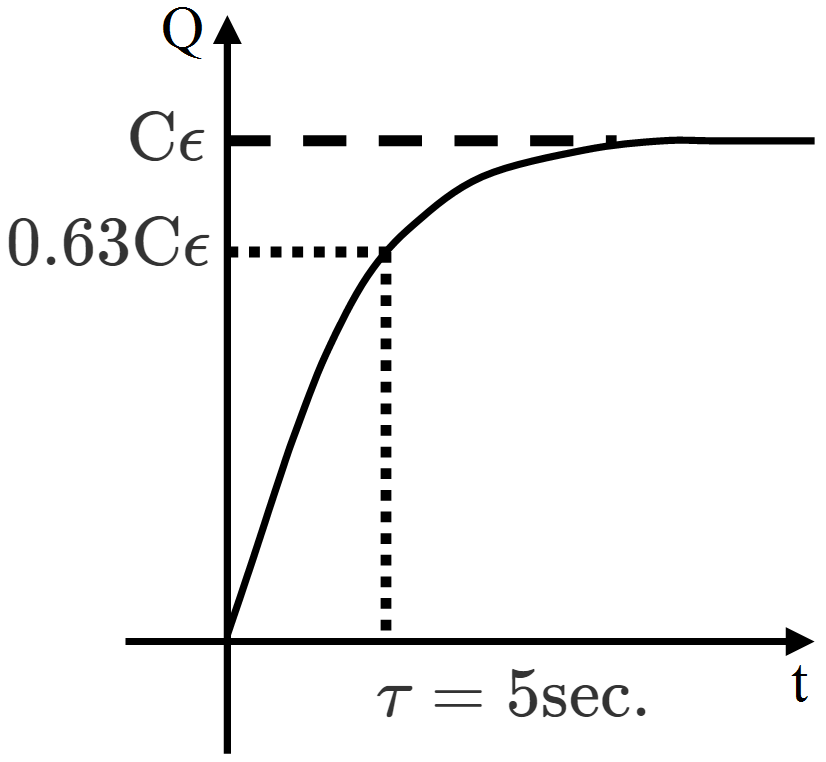
With the help of the figure we can say that the capacitor in the first $5s$ is larger than the charge stored in the next any second.
$\Rightarrow\text{at}\ \text{t}=\infty$
$\text{Q}=\text{Q}_0\Big(1-\text{e}^{-\infty}\Big)=\text{Q}_0=\text{C}\in$
$\therefore\text{t}_\infty-\text{t}_5=\text{C}\in-63=37$
after $t = 5 \sec$., maximum charge is deposited is only $37\%.$
View full question & answer→MCQ 1931 Mark
Consider a current carrying wire $($current $I)$ in the shape of a circle. Note that as the current progresses along the wire, the direction of j $($current density$)$ changes in an exact manner, while the current $I$ remain unaffected. The agent that is essentially responsible for is:
- A
- ✓
Electric field produced by charges accumulated on the surface of wire.
- C
The charges just behind a given segment of wire which push them just the right way by repulsion.
- D
AnswerCorrect option: B. Electric field produced by charges accumulated on the surface of wire.
Key concept: Current per unit area $($taken normal to the current$), \frac{\text{I}}{\text{A}}$, is called current density and is denoted by $\vec{\text{J}}$.
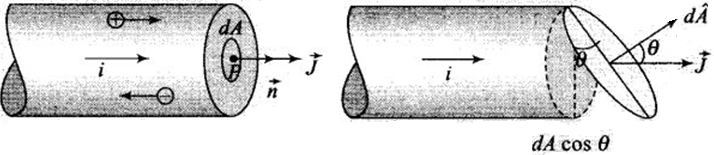
The is unti of the currnt density are $\frac{\text{A}}{\text{m}^2}$. The current density is also directed along $E$ and which is also a vector quantity and the relationship is given by
$\vec{\text{J}}=\sigma\vec{\text{E}}=\frac{\vec{\text{E}}}{\rho}$
where $\sigma$ = conductivity and $\rho =$ resistivity of specific resistance of the the surface of wire.
View full question & answer→MCQ 1941 Mark
Which of the following is the correct statement regarding electrochemical cell?
- ✓
It converts chemical energy to electrical energy.
- B
It converts electric energy to chemical energy.
- C
It converts chemical energy to thermal energy.
- D
It does not maintain the flow of charge in a circuit.
AnswerCorrect option: A. It converts chemical energy to electrical energy.
An electrochemical cell is a device which converts chemical energy to electric energy, and maintains the flow of charge in a circuit. There are $2$ types of electrochemical cells $–$ Galvanic cell and Electrolytic cell.
View full question & answer→MCQ 1951 Mark
In conductor when electrons move between two collisions, their paths are $... A...$ when external fields are absent and $... B...$ when external filed is present. Here, $A$ and $B$ refer to:
- ✓
Straight lines, straight lines.
- B
Straight lines, curved lines.
- C
Curved lines, straight lines.
- D
Curved lines, curved lines.
AnswerCorrect option: A. Straight lines, straight lines.
View full question & answer→MCQ 1961 Mark
Temperature dependence of resistivity $\rho\text{(T)}$ of semiconductors, insulators and metals is significantly based on the following factors:
- A
Number of charge carriers can change with temperature T.
- B
Time interval between two successive collisions can depend on T.
- C
Length of material can be a function of T.
- ✓
AnswerSolution:
Resistivity is the intrinsic property of the substance.
For a metallic conductor, resistivity is given by
$\rho=\frac{\text{m}}{\text{ne}^2\tau}$
where n is the number of charge carries per unit volume (number density) whcih can change with temperature T and $\tau$ is relaxation time (time interval between two successive collisions) which decreases with the increase of temperature $\bigg(\text{T}\propto\frac{1}{\tau}\bigg)$.
View full question & answer→MCQ 1971 Mark
Which of the following statements are true?
- A
During electrolysis, charge flows through electrolytic solution via electrons.
- ✓
The randomly moving electrons in a metal wire will start moving in a particular direction when a potential difference is applied across it.
- C
A negatively charged particle has higher electric potential than a positively charged particle.
- D
Charge flows only through negative charge carriers like electrons.
AnswerCorrect option: B. The randomly moving electrons in a metal wire will start moving in a particular direction when a potential difference is applied across it.
The electrons in any conductor are under continuous motion but in random way. There's no net crossing of charge carriers through a given cross-section. Without potential difference, the electrons move randomly in all directions.The randomly moving electrons in a metal wire will start moving in a particular direction when a potential difference is applied across it.
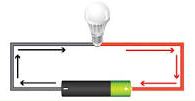
View full question & answer→MCQ 1981 Mark
A metal rod of length $10\ cm$ and a rectangular cross$-$section of $1\text{cm}\times\frac{1}{2}\text{cm}$ is connected to a battery across opposite faces. The resistance will be:
- ✓
Maximum when the battery is connected across $1\text{cm}\times\frac{1}{2}\text{cm}$ faces.
- B
Maximum when the battery is connected across $10\text{cm}\times\frac{1}{2}\text{cm}$ faces.
- C
Maximum when the battery is connected across $10\text{cm}\times\frac{1}{2}\text{cm}$ faces.
- D
Same irrespective of the three faces.
AnswerCorrect option: A. Maximum when the battery is connected across $1\text{cm}\times\frac{1}{2}\text{cm}$ faces.
As, $\text{R}=\rho\Big(\frac{\text{I}}{\text{A}}\Big)$
If we calculate $R$ with the help of above relation then,
From option $(a)$ we will get $\text{R}=20\rho\Omega$
From option $(b)$ we will get $\text{R}=\Big(\frac{\rho}{20}\Big)\Omega$
From option $(c)$ we will get $\text{R}=\Big(\frac{\rho}{5}\Big)\Omega$
Clearly, the resistance will be maximum when the battery is connected across $1\text{cm}\times\frac{1}{2}\text{cm}$ faces.
View full question & answer→MCQ 1991 Mark
Which color band in the resistor is having highest tolerance?
AnswerTolerance level of
Green: $0.5\%$
Blue: $0.25\%$
Violet: $0.1\%$
View full question & answer→MCQ 2001 Mark
Ten identical cells connected in series are needed to heat a wire of length one meter and radius $‘r’$ by $10^\circ C$ in time $‘t’.$ How many cells will be required to heat the wire of length two meter of the same radius by the same temperature in time $‘t’$?
View full question & answer→MCQ 2011 Mark
What will be the grouping of cells when the current in the circuit is $\frac{\text{ne}}{(\text{R+nr})}$?
- A
- ✓
- C
- D
When there is no grouping.
AnswerWhen n identical cells, each of emf $' e\ '$ and internal resistance $' r\ '$ are connected to the external resistance $' R\ '$ in series, its called series grouping. In series grouping $e _{ eq }= ne$ and $r _{ eq }= nr$ Therefore, current in the circuit $( l )=\frac{ ne }{( R + nr )}$
View full question & answer→MCQ 2021 Mark
Which of the following is a widely used variety of commercial resistor?
- A
Bio amplification resistor
- ✓
Wire$-$bound resistor
- C
- D
AnswerCorrect option: B. Wire$-$bound resistor
A wire bound resistor is an electrical passive component that limits current. Wire$-$bound resistors are made by winding the wires of an alloy like manganin on an insulating base. They are relatively insensitive to temperature.
View full question & answer→MCQ 2031 Mark
A uniform wire of resistance $50\Omega$ is cut into $5$ equal parts. These parts are now connected in parallel. The equivalent resistance of the combination is:
- ✓
$2\Omega$
- B
$10\Omega$
- C
$250\Omega$
- D
$6250\Omega$
AnswerCorrect option: A. $2\Omega$
View full question & answer→MCQ 2041 Mark
The resistivity of $‘X’$ decreases with temperature and its coefficient of resistivity is negative. Identify $X.$
AnswerThe coefficient of resistivity is negative for semiconductors and their resistivity decreases with temperature. The relaxation time does not change with temperature but the number density of free electrons increases exponentially with the increase in temperature. Consequently, the resistivity decreases exponentially with the increase in temperature.
View full question & answer→MCQ 2051 Mark
Electromotive force of a battery represents:
- A
- B
- ✓
Electric potential energy per unit charge.
- D
AnswerCorrect option: C. Electric potential energy per unit charge.
When a voltage is generated by a battery, this generated voltage has been traditionally called an electromotive force or emf. The emf represents electric potential energy per unit charge $($voltage$)$ which has been made available to free electrons by the generating mechanism and is not a force.
The term emf is useful to distinguish voltage generated by the battery from those which occur in a circuit as a result of energy dissipation $($ Like Voltage drop across a resistor$).$
View full question & answer→MCQ 2061 Mark
Predict the effect of temperature of the conductor on the drift velocity of electrons.
- A
Drift velocity varies linearly with temperature.
- B
Drift velocity does not depend on the temperature.
- C
Drift velocity increases with increasing temperature.
- ✓
Drift velocity decreases with increasing temperature.
AnswerCorrect option: D. Drift velocity decreases with increasing temperature.
On increasing the temperature of a conductor, the value of resistivity of its material increases. Resistivity is indirectly proportional to drift velocity. Therefore, the drift velocity of electrons decreases with the increasing temperature of the conductor.
View full question & answer→MCQ 2071 Mark
Two resistances $R$ and $2R$ are connected in parallel in an electric circuit. The thermal energy developed in $R$ and $2R$ are in the ratio:
- A
$1 : 2$
- ✓
$2 : 1$
- C
$1 : 4$
- D
$4 : 1$
AnswerCorrect option: B. $2 : 1$
Thermal Energy developed $=\frac{\text{v}_2}{\text{R}}\text{t} ($Because in Parallel, voltage is same$)$
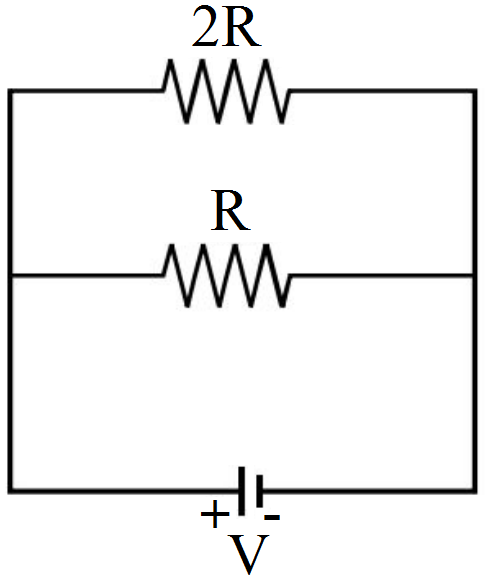
$\frac{\text{Thermal Energy developedin "R"}}{\text{Thermal Energy developedin "2R"}}=\frac{\frac{\text{v}^2}{\text{R}}\text{t}}{\frac{\text{v}^2}{2\text{R}}\text{t}}=2:1$
View full question & answer→MCQ 2081 Mark
A current passes through a wire of nonuniform crosssection. Which of the following quantities are independent of the cross$-$section?
- A
- B
- C
- ✓
Free$-$electron density.
AnswerCorrect option: D. Free$-$electron density.
View full question & answer→MCQ 2091 Mark
Electrons are emitted by a hot filament and are accelerated by an electric field, as shown in the figure. The two stops at the left ensure that the electron beam has a uniform cross-section.
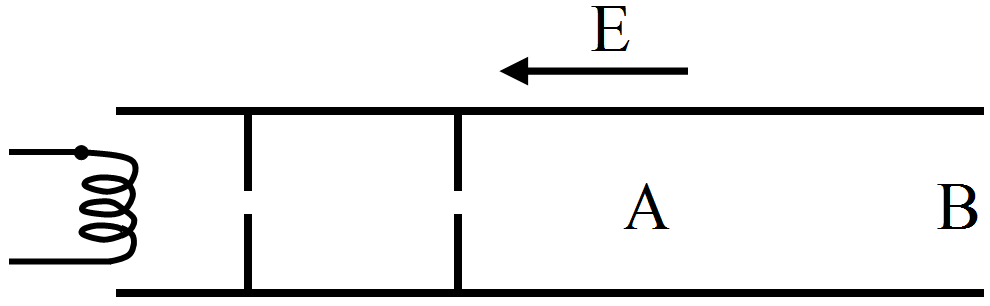
- ✓
The speed of the electrons is more at $B$ than at $A.$
- B
The electric current is from left to right.
- C
The magnitude of the current is larger at $B$ than at $A.$
- D
The current density is more at $B$ than at $A.$
AnswerCorrect option: A. The speed of the electrons is more at $B$ than at $A.$
Electric field goes higher potential to Lower potential. The drift velocity of the electron at higher potentail is greater than the lower potential.
So the speed of the electron is more at $B$ that at $A.$
View full question & answer→MCQ 2101 Mark
Identify the type of conductor represented by the $V-I$ characteristic curve given below.
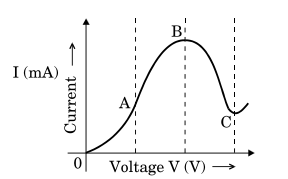
AnswerThe $V-I$ graph gives the characteristic of a semiconductor. It exhibits non$-$linear behaviour. After a certain voltage, the current decreases as the voltage increases. Gallium arsenide shows this type of behaviour.
View full question & answer→MCQ 2111 Mark
The resistivity of a wire varies with:
AnswerResistivity of the wire is an intrinsic property of the material with which the wire is made and thus depends only on the material of the wire, not on the dimensions of the wire.
View full question & answer→MCQ 2121 Mark
Which is the factor that internal resistance does not depend on?
- A
Distance between the electrodes.
- ✓
Temperature of the electrolyte.
- C
Nature of electrode and electrolyte.
- D
Area of the electrode, immersed in the electrolyte.
AnswerCorrect option: B. Temperature of the electrolyte.
Internal resistance is defined as the resistance offered by the electrolyte and electrodes of a cell when the current flows through it. Internal resistance depends on distance between the electrodes, the nature of electrodes and electrolyte, and area of the electrode immersed in the electrolyte. So, that leaves temperature of the electrolyte out, which is the answer.
View full question & answer→MCQ 2131 Mark
Identify the type of materials which have resistivities in the range of $10^{-8} \Omega m$ to $10^{-6} \Omega m$.
AnswerConductors have low resistivities in the range of $10^{-8} \Omega m$ to $10^{-6} \Omega m$.. Metals are good conductors. Conductors are objects or types of material that allows the flow of charge in one or more directions, and a result, the resistance offered against the flow of charge will be less.
View full question & answer→MCQ 2141 Mark
One watt is equal to $.......$?
- A
- B
One kilo joule per second.
- ✓
- D
AnswerWatt is the $SI$ unit of power.
$\text{Power}=\frac{\text{Work done}}{\text{time}}$.
The $SI$ unit of work done is the same as energy, that is, joule and that of time is seconds. Therefore, one watt is equal to one joule per second.
View full question & answer→MCQ 2151 Mark
When potential difference is applied across an electrolyte, then $Ohm's$ law is obeyed at:
AnswerWhen voltage is applied to an electrolyte, dissociation of ions starts.
At low voltages as the voltage increases the number of ions conducting also increases making a non linear increase of current.
After a certain voltage when the ions are dissociated and no more dissociation, the electrolyte behaves as a conductor and obeys ohm's law.
Thus at high voltages, an electrolyte obeys ohm's law.
View full question & answer→MCQ 2161 Mark
A current passes through a resistor. Let $K _1$ and $K _2$ represent the average kinetic energy of the conduction electrons and the metal ions, respectively:
- A
$K _2 < K _2$
- B
$K _1= K _2$
- ✓
$K _1> K _2$
- D
Any of these three may occur.
AnswerCorrect option: C. $K _1> K _2$
vd drift velocity $=\frac{1}{2}\Big(\frac{\text{eE}}{\text{m}}\Big)\text{t}$
$\text{K.E}.=\frac{1}{2}\text{mv}^2_\text{d}=\frac{1}{2}\text{m}\Big(\frac{1}{4}\frac{\text{e}^2\text{E}^2\text{t}^2}{\text{m}^2}\Big)$
$\text{K.E}.=\frac{1}{8}\frac{\text{e}^2\text{E}^2\text{t}^2}{\text{m}}$
$\text{p}=\text{K.E}.\propto\frac{1}{\text{m}}$
Mass of electron $<$ mass of metalions.
$K.E.$ of electron $> K.E.$ of metalions.
View full question & answer→MCQ 2171 Mark
The net resistance of an ammeter should be small to ensure that:
- A
It does not get overheated.
- B
It does not draw excessive current.
- C
It can measure large currents.
- ✓
It does not appreciably change the current to be measured.
AnswerCorrect option: D. It does not appreciably change the current to be measured.
The net resistance of an ammeter should be small to ensure that it does not oppreciably change the current to be measured.
View full question & answer→MCQ 2181 Mark
L, C and R represent the physical quantities inductance, capacitance and resistance respectively. Which of the following combinations have dimensions of frequency?
AnswerExplanation:
þ Time constant t = RC in RC circuit
frequency $=\frac{1}{\tau}=\frac{1}{\text{RC}} \ ...(\text{i})$
þ Time constant in LR circuit is $\tau=\frac{\text{L}}{\text{RC}}$
frequency $\frac{1}{\tau}=\frac{\text{R}}{\text{L}} \ ...(\text{ii})$
þ eq. (i) & (ii) multiply
frequency $=\frac{1}{\text{LC}}$
frequency $=\frac{1}{\sqrt{2\text{C}}}$
View full question & answer→MCQ 2191 Mark
A steady current is passing through a linear conductor of non uniform cross$-$section. The net quantity of charge crossing any cross section per second is:
- ✓
Independent of area of cross-section.
- B
Directly proportional to the length of the conductor.
- C
Directly proportional to the area of cross section.
- D
Inversely proportional to the length of the conductor.
AnswerCorrect option: A. Independent of area of cross-section.
The quantity of charge passing through any cross$-$section per second is nothing but current flowing in the conductor.
As given, the current is steady current, means current is uniform throughout the cross$-$section. Hence it is independent of Area of cross section.
View full question & answer→MCQ 2201 Mark
The rate of flow of electric charge through any cross-section of a conductor is known as $.......$
AnswerThe rate of flow of electric charge through any cross$-$section of a conductor is known as electric current.
View full question & answer→MCQ 2211 Mark
What is the suitable material for electric fuse?
AnswerCorrect option: C. Tin$-$lead alloy.
View full question & answer→MCQ 2221 Mark
In the circuit shown below, calculate the current flowing through $20V$ cell.
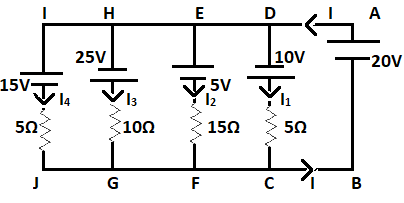
- A
$12A$
- B
$15A$
- ✓
$12.5A$
- D
$12.3A$
AnswerCorrect option: C. $12.5A$
Here, we can apply Kirchhoff's loop rule in closed loops $\text{ADCBA, AEFBA, AHGBA,}$ and $\text{AIJBA.}$Thus, we get
$20+10-5 I_1=0 \rightarrow I_1=6 A$
$-5+20-15 I_2=0 \rightarrow I_2=1 A$
$25+20-10 I _3=0 \rightarrow I _3=4.5 A$
$-15+20-5 I _4=0 \rightarrow I _4=1 A$
Therefore, the current flowing through the $20 V$ cell $=6+1+4.5+1=12.5 A$
View full question & answer→MCQ 2231 Mark
A metal wire is subjected to a constant potential difference. When the temperature of the metal wire increases, the drift velocity of the electron in it:
- A
Increases, thermal velocity of the electron increases.
- ✓
Decreases, thermal velocity of the electron increases.
- C
Increases, thermal velocity of the electron decreases.
- D
Decreases, thermal velocity of the electron decreases.
AnswerCorrect option: B. Decreases, thermal velocity of the electron increases.
View full question & answer→MCQ 2241 Mark
In series combination of resistances:
AnswerCorrect option: C. current is same in each resistance.
Components connected in series are connected along a single path, so the same current flows through all of the components. The current through each of the components is the same, and the voltage across the circuit is the sum of the voltages across each component. In a series circuit, every device must function for the circuit to be complete. One bulb burning out in a series circuit breaks the circuit. A circuit composed solely of components connected in series is known as a series circuit.
The total resistance of resistors in series is equal to the sum of their individual resistances. Hence, the Equivalent resistance is more than the individual resistances because a sum is taken of all the individual resistances. That is, $R_{\text {total }}=R_1+R_2$. The current is given as $I=I_1=I_2$.
Below is the diagrammatic representation of $2$ resistors $R_1$ and $R_2$ connected in series.
View full question & answer→