Question 15 Marks
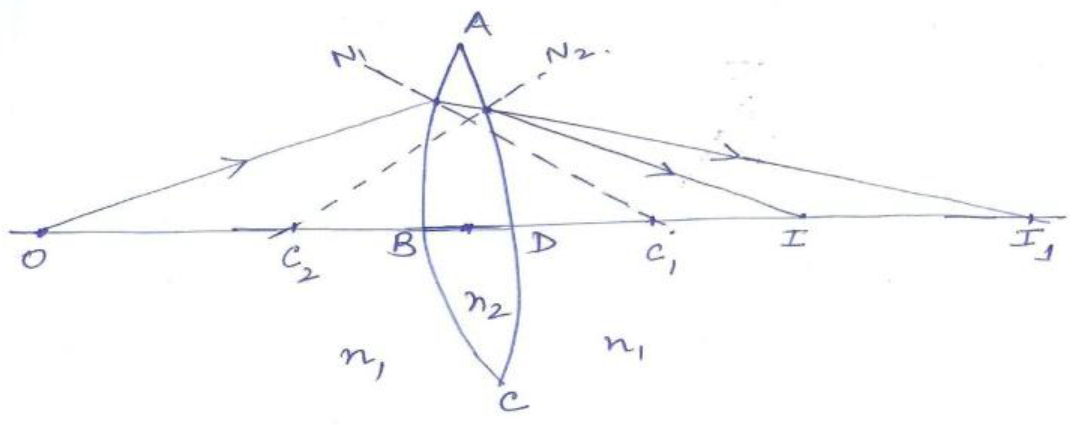
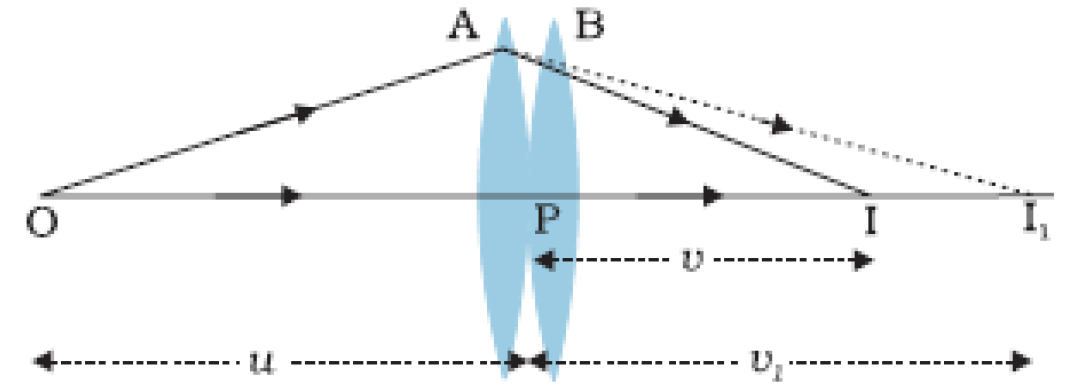
What is the focal length of a convex lens of focal length 30cm in contact with a concave lens of focal length 20 cm? Is the system a converging or a diverging lens? Ignore thickness of the lenses.
Answer
View full question & answer→Focal length of the convex lens, $f_1 = 30$ cm
Focal length of the concave lens, $f_2 = - 20$ cm
Focal length of the system of lenses = f
The equivalent focal length of a system of two lenses in contact is given as:
$\frac{1}{\text{f}}=\frac{1}{\text{f}_1}+\frac{1}{\text{f}_2}$
$\frac{1}{\text{f}}=\frac{1}{30}-\frac{1}{20}=\frac{2-3}{60}=-\frac{1}{60}$
$\therefore \ \text{f}=-60 \ \text{cm}$
Hence, the focal length of the combination of lenses is 60 cm. The negative sign indicates that the system of lenses acts as a diverging lens.
Focal length of the concave lens, $f_2 = - 20$ cm
Focal length of the system of lenses = f
The equivalent focal length of a system of two lenses in contact is given as:
$\frac{1}{\text{f}}=\frac{1}{\text{f}_1}+\frac{1}{\text{f}_2}$
$\frac{1}{\text{f}}=\frac{1}{30}-\frac{1}{20}=\frac{2-3}{60}=-\frac{1}{60}$
$\therefore \ \text{f}=-60 \ \text{cm}$
Hence, the focal length of the combination of lenses is 60 cm. The negative sign indicates that the system of lenses acts as a diverging lens.
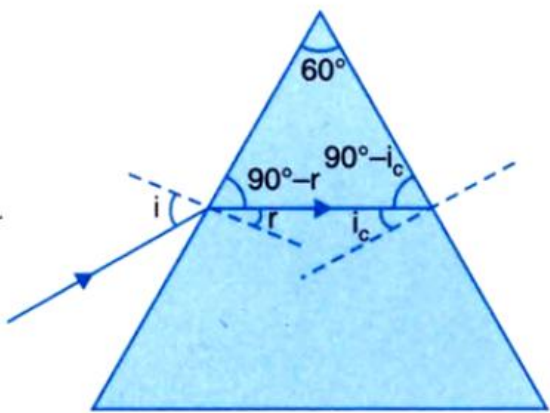
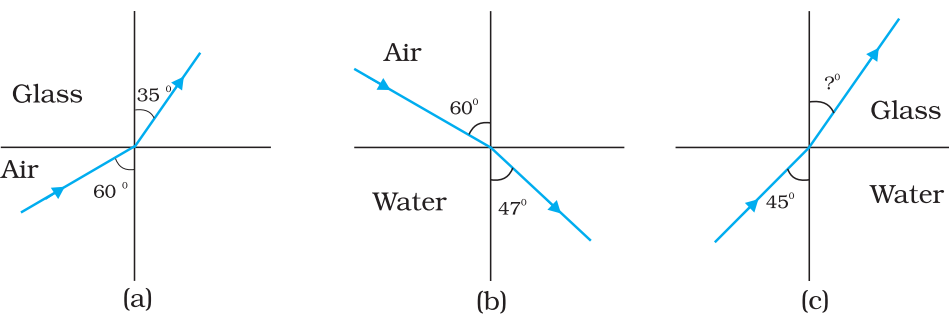
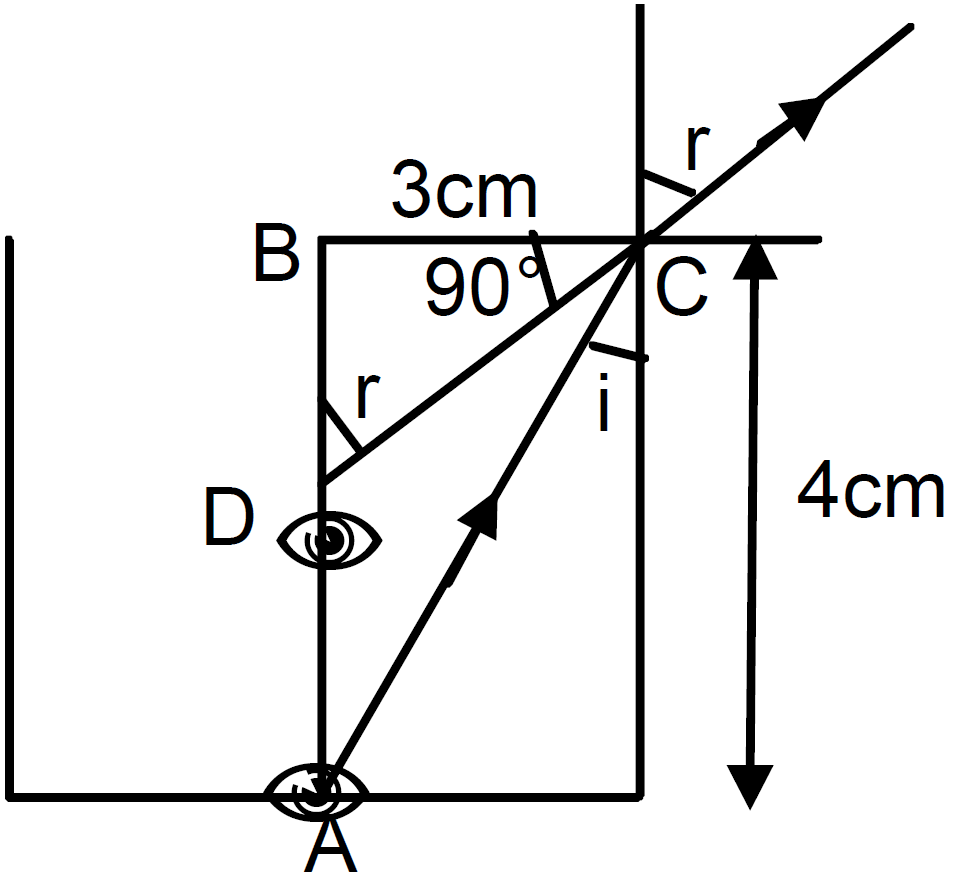
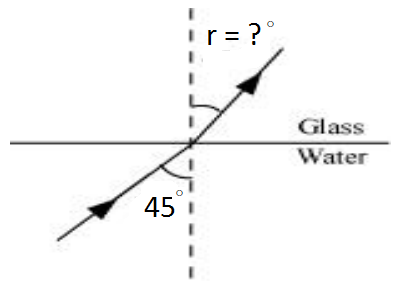 Angle of incidence, i= 45° Angle of refraction = r From Snell's law, rcan be calculated as: $\frac{\sin\text{i}}{\sin\text{r}}=\mu^\text{w}_\text{g}$ $\frac{\sin45^\circ}{\sin\text{r}}=1.275$ $\sin\text{r}=\frac{\frac{1}{\sqrt2}}{1.275}=0.5546$ $\therefore \ \text{r}=\sin^{-1}(0.5546)=38.67^\circ$ Hence, the angle of refraction at the water - glass interface is 38.68°.

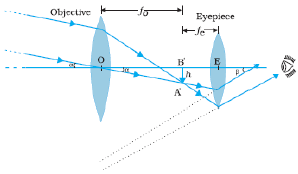


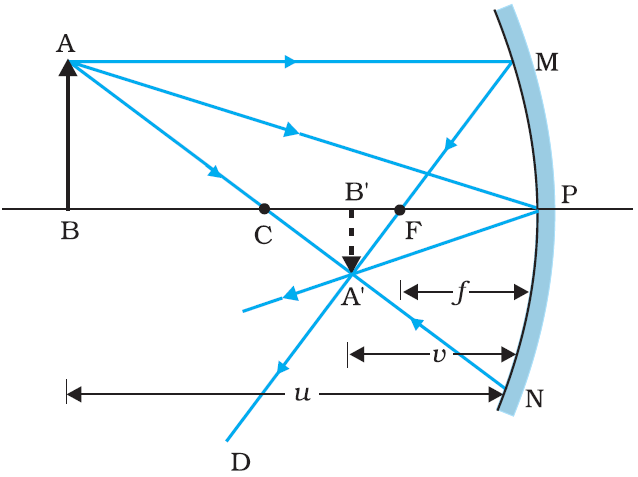
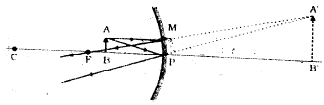
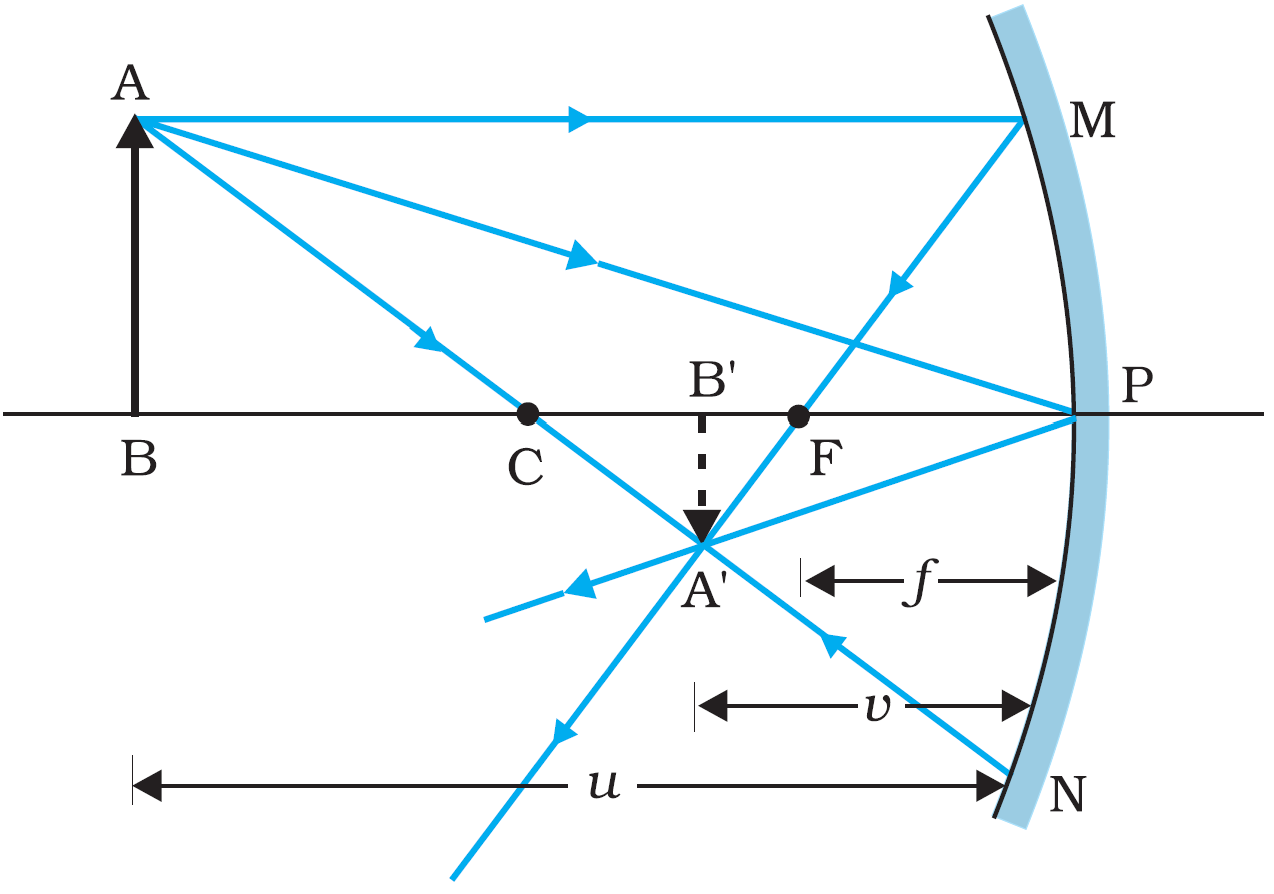
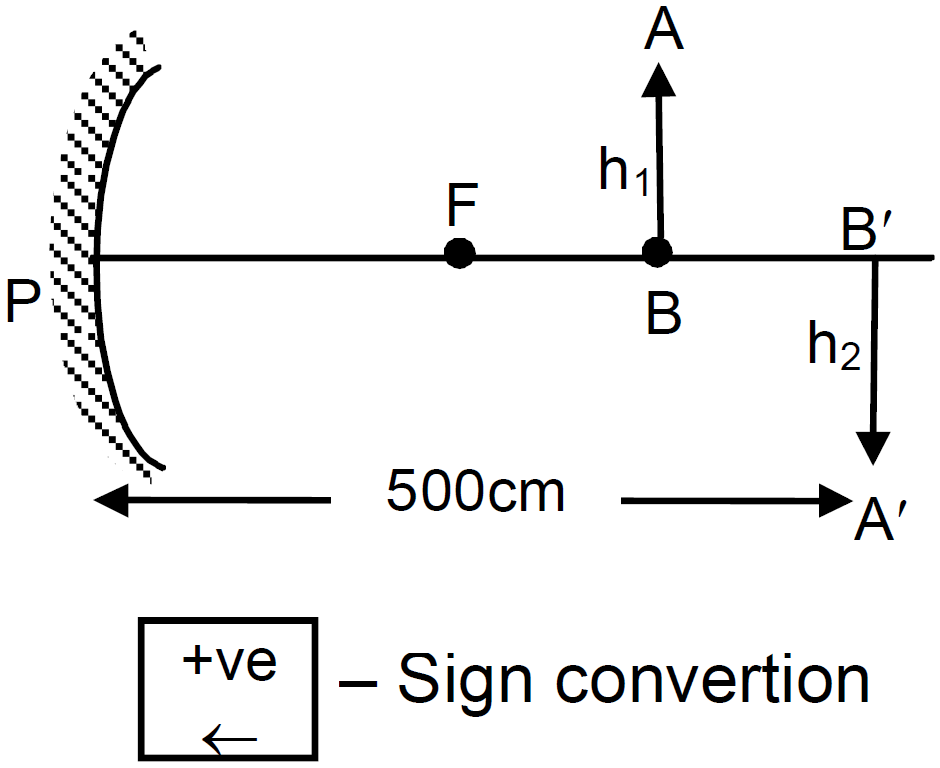
 Triangle A' B'F is similar to $\Delta$MPF.