Question 15 Marks
The oxygen molecule has a mass of $5.30 \times 10^{-26}kg$ and a moment of inertia of $1.94 \times 10^{-46}kgm^2$ about an axis through its centre perpendicular to the lines joining the two atoms. Suppose the mean speed of such a molecule in a gas is $500m/s$ and that its kinetic energy of rotation is two thirds of its kinetic energy of translation. Find the average angular velocity of the molecule.
AnswerMass of an oxygen molecule, $m = 5.30 \times 10^{-26}kg$ Moment of inertia, $I = 1.94 \times 10^{-46}kgm^2$^ Velocity of the oxygen molecule, v = 500m/s The separation between the two atoms of the oxygen molecule = 2r Mass of each oxygen atom $=\frac{\text{m}}{2}$ Hence, moment of inertia I, is calculated as, $\Big(\frac{\text{m}}{2}\Big)\text{r}^2+\Big(\frac{\text{m}}{2}\Big)\text{r}^2=\text{mr}^2$
$\text{r}=\Big(\frac{\text{l}}{\text{m}}\Big)^{\frac{1}{2}}$
$\Big(\frac{1.94\times10^{-46}}{5.36\times10^{-26}}\Big)=0.60\times10^{-10}\text{m}$ It is given that, $\text{kE}_{\text{rot}}=\Big(\frac{2}{3}\Big)\times\Big(\frac{1}{2}\Big)\times\text{mv}^2$
$\text{m}\text{r}^2\omega^2=\Big(\frac{2}{3}\Big)\text{mv}^2$
$\omega=\Big(\frac{2}{3}\Big)^{\frac{1}{2}}\Big(\frac{\text{v}}{\text{r}}\Big)$
$\omega=\Big(\frac{2}{3}\Big)^{\frac{1}{2}}\Big(\frac{500}{0.6\times10^{-10}}\Big)$
$\omega=6.80\times10^{12}\text{rad/s}$
View full question & answer→Question 25 Marks
As shown in the two sides of a step ladder BA and CA are 1.6m long and hinged at A. A rope DE, 0.5m is tied half way up. A weight 40kg is suspended from a point F, 1.2m from B along the ladder BA. Assuming the floor to be frictionless and neglecting the weight of the ladder, find the tension in the rope and forces exerted by the floor on the ladder. (Take $g = 9.8m/s^2$) (Hint: Consider the equilibrium of each side of the ladder separately).
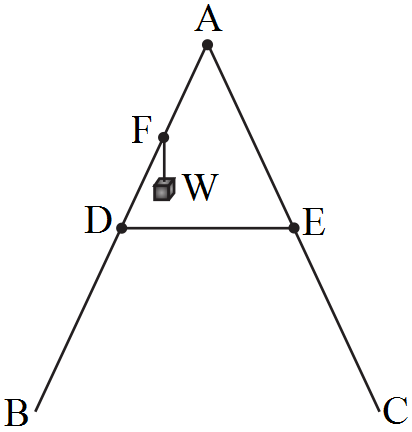
AnswerThe given situation can be shown as:
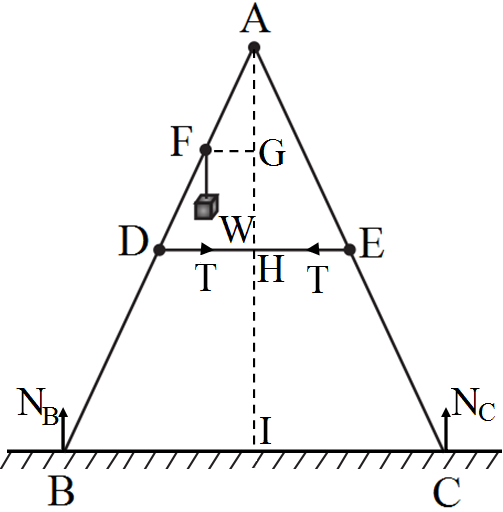
$N _{ B }=$ Force exerted on the ladder by the floor point
$B N _{ C }=$ Force exerted on the ladder by the floor point
$C T=$ Tension in the rope
$B A=C A=1.6 m D E=0.5 m B F=1.2 m$ Mass of the weight,
$m =40 kg$ Draw a perpendicular from A on the floor BC .
This intersects DE at mid-point $H . \Delta ABI$ and $\triangle AIC$ are similar
$\therefore BI = IC$
Hence, I is the midpoint of $B C$. $D E \| B C B C$
$=2 \times D E=1 m A F=B A-B F=0.4 m \ldots \ldots$ (i)
$D$ is the mid-point of $A B$.
Hence, we can write, $AD =\left(\frac{1}{2}\right) \times BA =0.8 m \ldots (ii)$
Using equations (i) and (ii),
we get, $FE =0.4 m$ Hence, F is the mid-point of AD .
$FG \| DH$ and F is the mid-point of AD .
Hence, G will also be the mid-point of $AH . \triangle AFG$ and $\triangle ADH$ are similar
$\therefore \frac{ FG }{ DH }=\frac{ AF }{ AD } \frac{ FG }{ DH }=\frac{0.4}{0.8}=\frac{1}{2}=\left(\frac{1}{2}\right) \times 0.25=0.125 m \ln \Delta ADH , AH =\left( AD ^2- DH ^2\right)^{1 / 2}=\left(0.8^2-0.25^2\right)^{1 / 2}=$
0.76 m For translational equilibrium of the ladder,
the upward force should be equal to the downward force.
$N _{ C }+ N _{ B }$ $= mg =392$.....(iii)
For rotational equilibrium of the ladder, the net moment about A is,
$- N _{ B } \times BI + mg \times FG + N _{ C } \times$
$Cl + T \times AG - T \times AG =0- N _{ B } \times 0.5+40 \times 9.8 \times 0.125+ N _{ C } \times 0.5$
$=0\left(N_{ C }- N _{ B }\right) \times 0.5=49 N_{ C }- N _{ B }=98 \ldots..(iv)$
Adding equations (iii) and (iv),
we get, $N_C=245 N N_B=147 N$
For rotational equilibrium of the side AB , consider the moment about
$A .- N _{ B } \times BI + mg \times FG + T \times AG $
$=0-245 \times 0.5+40 \times 9.8 \times 0.125+ T \times 0.76=0 T$
$=96.7 N$ View full question & answer→Question 35 Marks
A solid sphere rolls down two different inclined planes of the same heights but different angles of inclination.
- Will it reach the bottom with the same speed in each case?
- Will it take longer to roll down one plane than the other?
- If so, which one and why?
Answer
- Mass of the sphere = m
Height of the plane = h
Velocity of the sphere at the bottom of the plane = v
At the top of the plane, the total energy of the sphere = Potential energy = mgh
At the bottom of the plane, the sphere has both translational and rotational kinetic energies.
Hence, total energy $=\Big(\frac{1}{2}\Big)\text{mv}^2+\bigg(\frac{\frac{1}{2}}{\omega^2}\bigg)$
Using the law of conservation of energy, we can write,
$\Big(\frac{1}{2}\Big)\text{mv}^2+\bigg(\frac{\frac{1}{2}}{\omega^2}\bigg)=\text{mgh}$
For a solid sphere, the moment of inertia about its centre, $\text{I}=\Big(\frac{2}{5}\Big)\text{mr}^2$
Hence, equation (i) becomes,
$\Big(\frac{1}{2}\Big)\text{mv}^2+\Big(\frac{1}{2}\Big)\Big[\Big(\frac{2}{5}\Big)\text{mr}^2\Big]\omega^2=\text{mgh}$
$\Big(\frac{1}{2}\Big)\text{v}^2+\Big(\frac{1}{5}\Big)\text{r}^2\omega^2=\text{gh}$
But we have the relation, $\text{v}=\text{r}\omega$
$\therefore\Big(\frac{1}{2}\Big)\text{v}^2+\Big(\frac{1}{5}\Big)\text{v}^2=\text{gh}$
$\text{v}^2\Big(\frac{7}{10}\Big)=\text{gh}$
$\text{v}=\sqrt{\Big(\frac{10}{7}\Big)}\text{gh}$
Hence, the velocity of the sphere at the bottom depends only on height (h) and acceleration due to gravity (g). Both these values are constants. Therefore, the velocity at the bottom remains the same from whichever inclined plane the sphere is rolled.
- Consider two inclined planes with inclinations $\theta_1$ and $\theta_2$ related as,
$\theta_1<\theta_2$
The acceleration produced in the sphere when it rolls down the plane inclined at $\theta_1$ is,
$\text{g}\sin\theta_1$
The various forces acting on the sphere are shown in the following figure:
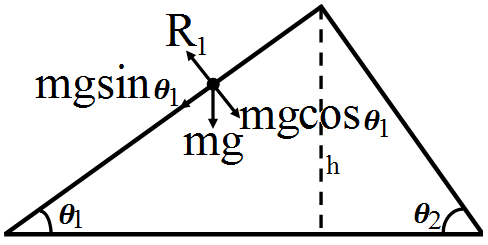
$R_1$ is the normal reaction to the sphere.
Similarly, the acceleration produced in the sphere when it rolls down the plane inclined at $\theta_2$ is,
$\text{g}\sin\theta_2$
- The various forces acting on the sphere are shown in the following figure:
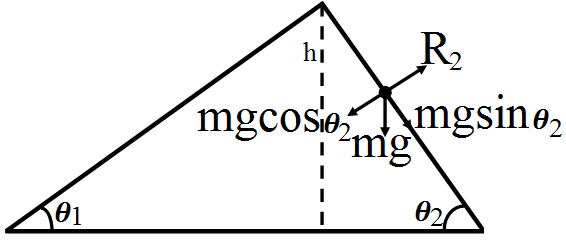
$R_2$ is the normal reaction to the sphere.
$\theta_2>\theta_1,\sin\theta_2>\sin\theta_1\ ...(\text{i})$
$\therefore\text{ a}_2>\text{a}_1\ ...(\text{ii})$
Initial velocity, u = 0
Final velocity, v = Constant
Using the first equation of motion, we can obtain the time of roll as,
$\text{v}=\text{u}+\text{at}$
$\therefore\ \text{t}\propto\Big(\frac{1}{\alpha}\Big)$
For inclination $\theta_1: \text{t}\propto\Big(\frac{1}{\alpha_1}\Big)$
For inclination $\theta_2: \text{t}\propto\Big(\frac{1}{\alpha_2}\Big)$
From above equations, we get,
$t_2< t_1$
Hence, the sphere will take a longer time to reach the bottom of the inclined plane having the smaller inclination. View full question & answer→Question 45 Marks
- Prove the theorem of perpendicular axes.
(Hint: Square of the distance of a point (x, y) in the x - y plane from an axis through the origin and perpendicular to the plane is $x^2+ y^2$).
- Prove the theorem of parallel axes.
(Hint: If the centre of mass of a system of n particles is chosen to be the origin $\sum\text{m}_{\text{i}}\text{r}_\text{i}=0)$Answer
- According to the theorem of perpendicular axes the moment of inertia of a planar body (lamina) about an axis perpendicular to its plane is equal to the sum of the moments of inertia of the lamina about any two mutually perpendicular axes in its plane and intersecting each other at the point where the perpendicular axis passes through it. let us consider a physical body with center O and a point mass m,in the x-yplane at (x, y) is shown in the following figure:
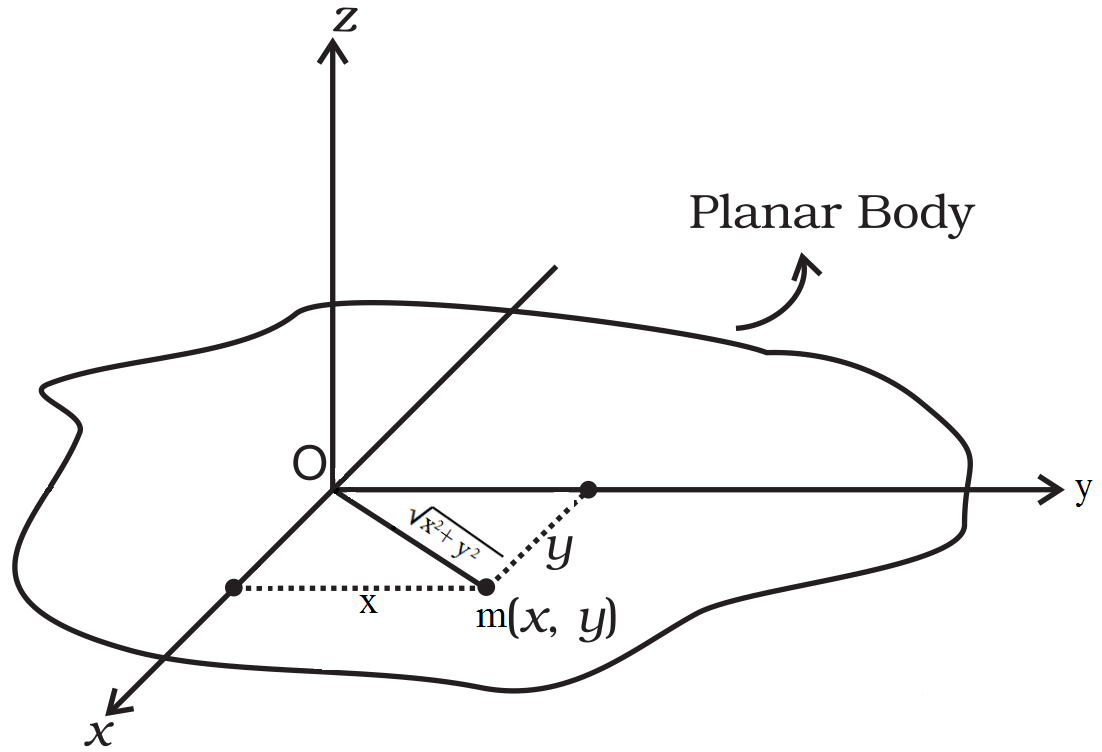
Moment of inertia about x-axis, $I_x = mx^2$
Moment of inertia about y-axis, $I_y = my^2$
Moment of inertia about z-axis, $I_z = m(x^2 + y^2)^{1/2}$
$I_x + I_y = mx^2 + my^2$
$= m(x^2 + y^2)$
$= m [(x^2 + y^2)^{1/2}]^{1/2}$
$I_x + I_y = I_z$
Thus, the theorem is verified.
- According to the theorem of parallel axes the moment of inertia of a body about any axis is equal to the sum of the moment of inertia of the body about a parallel axis passing through its center of mass and the product of its mass and the square of the distance between the two parallel axes.
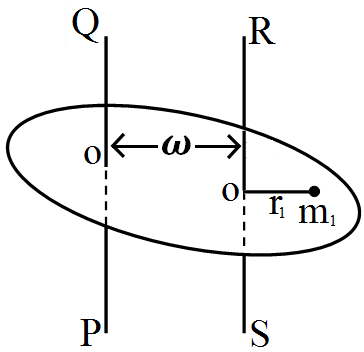
Suppose a rigid body is made up of n number of particles, having masses $m_1, m_2, m_3, … ,m_n$, at perpendicular distances $r_1, r_2, r_3, … , r_n$ respectively from the center of mass O of the rigid body.
The moment of inertia about axis RS passing through the point O,
$\text{I}_{\text{RS}}=\sum\limits^\text{n}_{\text{i}=1}=\text{m}_{\text{i}}\text{r}_{\text{i}}^2$
The perpendicular distance of mass $m_i$ from the axis $QP = a+ r_i$
$\text{I}_{\text{QR}}=\sum\limits^\text{n}_{\text{i}=1}\text{m}_{\text{i}}(\text{a}+\text{r}_\text{i})^2$
$\text{I}_{\text{QR}}=\sum\limits^\text{n}_{\text{i}=1}\text{m}_{\text{i}}(\text{a}^2+\text{r}_\text{i}^2+2\text{ar}_{\text{i}})$
$\text{I}_{\text{QR}}=\sum\limits^\text{n}_{\text{i}=1}\text{m}_{\text{i}}\text{a}^2+\sum\limits^\text{n}_{\text{i}=1}\text{m}_{\text{i}}\text{r}_\text{i}^2+\sum\limits^\text{n}_{\text{i}=1}\text{m}_{\text{i}}2\text{ar}_{\text{i}}$
$\text{I}_{\text{QR}}=\text{I}_{\text{RS}}=\sum\limits^\text{n}_{\text{i}=1}\text{m}_{\text{i}}\text{a}^2+2\sum\limits^\text{n}_{\text{i}=1}\text{m}_{\text{i}}\text{ar}^2_{\text{i}}$
We know, the moment of inertia of all particles about the axis passing through the center of mass is zero.
$2\sum\limits^\text{n}_{\text{i}=1}\text{m}_{\text{i}}\text{ar}_{\text{i}}=0$
as $\text{a}\neq0$
Therefore, $\sum\text{m}_{\text{i}}\text{r}_{\text{i}}=0$
Also,
Therefore, $\sum\text{m}_{\text{i}}$
= M; M = Total mass of the rigid body.
Therefore, $IQP = IRS + Ma^2$
Therefore the theorem is verified. View full question & answer→Question 55 Marks
Two discs of moments of inertia $I_1$ and $I_2$ about their respective axes (normal to the disc and passing through the centre), and rotating with angular speeds $\omega_1$ and $\omega_2$ are brought into contact face to face with their axes of rotation coincident.
- What is the angular speed of the two-disc system?
- Show that the kinetic energy of the combined system is less than the sum of the initial kinetic energies of the two discs. How do you account for this loss in energy? Take $\omega_1\neq\omega_2$
Answer
- Moment of inertia of dise $\text{I}=\text{I}_{1}$
Angular speed of disc $\text{I}=\omega_1$
Angular speed of disc $\text{II}=\text{I}_2$
Angular momentum of disc $\text{II}=\omega_1$
Angular momentum of disc $\text{I},\text{L}_1=\text{I}_1\omega_1$
Angular momentum of disc $\text{II},\text{L}_2=\text{I}_2\omega_2$
Total initial angular momentum, $\text{L}_{\text{i}}=\text{I}_1\omega_1+\text{I}_2+\omega_2$
When the two discs are joined together, their moments of inertia get added up.
Moment of inertia of the system of two discs $\text{I}=\text{I}_1+\text{I}_2$
Let $\omega$ be the angular speed of the system.
Total final angular momentum, $\text{L}_{\text{f}}=(\text{I}_1+\text{I}_2)\omega$
Using the law of conservation of angular momentum, we have,
$\text{L}_{\text{i}}=\text{L}_{\text{f}}$
$\text{I}_1\omega_1+\text{I}_2\omega_2=(\text{I}_1+\text{I}_2)\omega$
$\therefore\ \omega=\frac{\text{I}_1\omega_1+\text{I}_2\omega_2}{\text{I}_1+\text{I}_2}$
- Kinetic energy of disc I, $\text{E}_1=\frac{1}{2}\text{I}_1\omega^2_1$
Kinetic energy of disc II, $\text{E}_2=\frac{1}{2}\text{I}_2\omega^2_2$
Total initial kinetic energy, $\text{E}_{\text{i}}=\frac{1}{2}\big(\text{I}_1\omega^2_1+\text{I}_2\omega^2_2\big)$
When the discs are joined, their moments of inertia get added up.
Moment of inertia of the system, $\text{I}=\text{I}_1+\text{I}_2$
Angular speed of the system $=\omega$
Final kinetic energy $E_f$
$=\frac{1}{2}(\text{I}_1+\text{I}_2)\omega^2$
$=\frac{1}{2}(\text{I}_1+\text{I}_2)\Big(\frac{\text{I}_1\omega_1+\text{I}_2\omega_2}{\text{I}_1+\text{I}_2}\Big)^2=\frac{1}{2}\frac{(\text{I}_1\omega_1+\text{I}_2\omega_2)^2}{\text{I}_1+\text{I}_2}$
$\therefore\ \text{E}_{\text{i}}-\text{E}_{\text{f}}$
$=\frac{1}{2}\big(\text{I}_1\omega^2_1+\text{I}_2\omega^2_2\big)-\frac{(\text{I}_1\omega_1+\text{I}_2\omega_2)^2}{2(\text{I}_1+\text{I}_2)}$
$=\frac{1}{2}\text{I}_1\omega_1^2+\frac{1}{2}\text{I}_2\omega_2^2-\frac{1}{2}\frac{\text{I}^2_1\omega^2_1}{(\text{I}_1+\text{I}_2)}-\frac{1}{2}\frac{\text{I}^2_2\omega^2_2}{(\text{I}_1+\text{I}_2)}-\frac{1}{2}\frac{2\text{I}_1\text{I}_2\omega_1\omega_2}{(\text{I}_1+\text{I}_2)}$
$=\frac{1}{(\text{I}_1+\text{I}_2)}\Big[\frac{1}{2}\text{I}^2_1\omega^2_1+\frac{1}{2}\text{I}_1\text{I}_2\omega^2_1+\frac{1}{2}\text{I}_1\text{I}_2\omega^2_2+\frac{1}{2}\text{I}^2_2\omega^2-\frac{1}{2}\text{I}^2_1\omega^2_1-\frac{1}{2}\text{I}_2^2\omega^2_2-\text{I}_1\text{I}_2\omega_1\omega_2\Big]$
$=\frac{\text{I}_1\text{I}_2}{2(\text{I}_1+\text{I}_2)}\big[\omega^2_1+\omega^2_2-2\omega_1\omega_2\big]$
$=\frac{\text{I}_1\text{I}_2(\omega_1-\omega_2)^2}{2(\text{I}_1+\text{I}_2)}$
All the qauantities on RHS are positive.
$\therefore\ \text{E}_{\text{i}}-\text{E}_{\text{f}}>0$
$\text{E}_{\text{i}}>\text{E}_{\text{f}}$
The loss of KE can be attributed to the frictional force that comes into play when the two discs come in contact with each other. View full question & answer→Question 65 Marks
A solid disc and a ring, both of radius $10cm$ are placed on a horizontal table simultaneously, with initial angular speed equal to $10 π$ rad $s^{-1}$. Which of the two will start to roll earlier? The co-efficient of kinetic friction is $\mu_\text{k}=0.2$
AnswerGiven, Radii of the ring and the disc, r = 5cm = 0.05m Initial angular speed, $\omega_0=8\pi\text{rads}^{-1}$ Coefficient of kinetic friction, $\mu_\text{k}=0.2$ Initial velocity of both the objects, u = 0a Motion of the two objects is caused by force of friction. According Newton’s second, force of friction, $\text{f}=\text{ma}$
$\mu_\text{k}\text{mg}=\text{ma}$ Where, a = Acceleration produced in the disc and the ring m = Mass $\therefore\ \text{a}=\mu_{\text{k}}\text{g}\ ...(\text{i})$ Using the first equation of motion, $\text{v}=\text{u}+\text{at}$
$=0+\mu_\text{k}\text{gt}$
$=\mu_\text{k}\text{gt}\ ...(\text{ii})$ The frictional force applies a torque in perpendicularly outward direction and reduces the initial angular speed. Torque, $\text{T}=-\text{I}\alpha$ Where, $\alpha=$ Angular acceleration $\mu_\text{k}\text{mgr}=-\text{I}\alpha$
$\therefore\alpha=\frac{-\mu_\text{k}\text{mgr}}{\text{I}}\ ...(\text{iii})$ According to the first equation of rotational motion, we have, $\omega=\omega_0+\alpha\text{t}$
$=\omega_0+\Big(\frac{-\mu_\text{k}\text{mgr}}{\text{I}}\Big)\text{t}\ ...(\text{iv})$ Rolling starts when linear velocity, $\text{v}=\text{r}\omega$
$\therefore\ \text{v}=\text{r}\Big(\omega_0-\frac{\mu_\text{k}\text{mgrt}}{\text{I}}\Big)\ ...(\text{v})$ Using equation (ii) and equation (v), we have, $\mu_\text{k}\text{gt}=\text{r}\Big(\omega_0-\frac{\mu_\text{k}\text{mgrt}}{\text{I}}\Big)$
$=\text{r}\omega_0-\frac{\mu_\text{k}\text{mgr}^2\text{t}}{\text{I}}\ ....(\text{vi})$ For the ring, $\text{I}=\text{mr}^2$
$\therefore\ \mu_\text{k}\text{gt}=\text{r}\omega_0-\frac{\mu_\text{k}\text{mgr}^2\text{t}}{\text{mr}^2}$
$=\text{r}\omega_0-\mu_\text{k}\text{gt}$
$2\mu_\text{k}\text{gt}=\text{r}\omega_0$
$\therefore\ \text{t}=\frac{\text{r}\omega_0}{2\mu_\text{k}\text{g}}$
$=\frac{(0.05\times8\times3.14)}{(2\times0.2\times9.8)}=0.32\text{s}\ ...(\text{vii})$ For the disc, $\text{I}=\Big(\frac{1}{2}\Big)\text{mr}^2$
$\therefore\ \mu_\text{k}\text{gt}=\text{r}\omega_0-\frac{\mu_\text{k}\text{mgr}^2\text{t}}{\big(\frac{1}{2}\big)\text{mr}^2}$
$=\text{r}\omega_0-2\mu_\text{k}\text{gt}$
$3\mu_\text{k}\text{gt}=\text{r}\omega_0$
$\therefore\ \text{t}=\frac{\text{r}\omega_0}{3\mu_\text{k}\text{g}}$
$=\frac{(0.05)\times8\times3.14}{(3\times0.2\times9.8)}=0.213\text{s}\ ...(\text{viii})$ Since $\text{t}_\text{D}>\text{t}_\text{R},$ the disc will start rolling before the ring.
View full question & answer→Question 75 Marks
3 A man stands on a rotating platform, with his arms stretched horizontally holding a 5kg weight in each hand. The angular speed of the platform is 30 revolutions per minute. The man then brings his arms close to his body with the distance of each weight from the axis changing from 90cm to 20cm. The moment of inertia of the man together with the platform may be taken to be constant and equal to $7.6kgm^2$.
- What is his new angular speed? (Neglect friction).
- Is kinetic energy conserved in the process? If not, from where does the change come about?
Answer
- Moment of inertia of the man-platform system = $7.6kgm^2$
Moment of inertia when the man stretches his hands to a distance of 90cm,
$2 \times mr^2$
$= 2 \times 5 \times (0.9)^2$
$= 8.1kgm^2$
Initial moment of inertia of the system, $I_i = 7.6 + 8.1 = 15.7kgm^2$
Angular speed, $\omega_{\text{i}}=300\text{rev/min}$
Angular momentum, $\text{L}_{\text{i}}=\text{I}_{\text{i}}\omega_{\text{i}}=15.7\times30\ ...(\text{i})$
Moment of inertia when the man folds his hands to a distance of 20cm,
$2 \times mr^2$
$= 2 \times 5 (0.2)^2 = 0.4kgm^2$
Final moment of inertia, $I_f = 7.6 + 0.4 = 8kgm^2$
Final angular speed $\omega_{\text{f}}$
Final angular momentum, $\text{L}_\text{f}=\text{I}_\text{f}\omega_\text{f}=0.798\omega_\text{f}\ ...(\text{ii})$
From the conservation of angular momentum, we have,
$\text{I}_{\text{i}}\omega_{\text{i}}=\text{I}_\text{f}\omega_\text{f}$
$\therefore\omega_\text{f}=15.7\times\frac{30}{8}=58.88\text{rev/min}$
- Kinetic energy is not conserved in the given process. In fact, with the decrease in the moment of inertia, kinetic energy increases. The additional kinetic energy comes from the work done by the man to fold his hands toward himself.
View full question & answer→Question 85 Marks
Prove the result that the velocity v of translation of a rolling body (like a ring, disc, cylinder or sphere) at the bottom of an inclined plane of a height h is given by $\text{v}^2=\frac{2\text{gh}}{\Big(\frac{1+\text{k}^2}{\text{R}^2}\Big)}$ using dynamical consideration (i.e. by consideration of forces and torques).
Note: k is the radius of gyration of the body about its symmetry axis, and R is the radius of the body. The body starts from rest at the top of the plane.
AnswerA body rolling on an inclined plane of height h,is shown in the following figure:
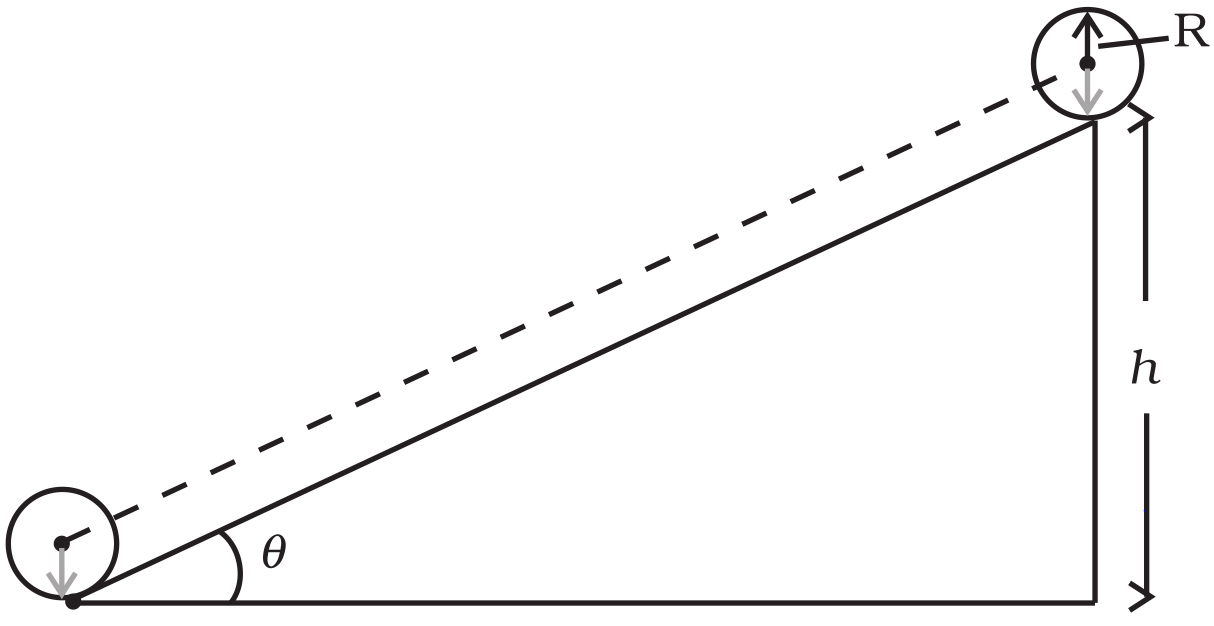
m = Mass of the body. R = Radius of the body. K = Radius of gyration of the body. v = Translational velocity of the body. h =Height of the inclined plane. g = Acceleration due to gravity. Total energy at the top of the plane, $E_1= mgh$ Total energy at the bottom of the plane,$ E_b = KE_{rot} + KE_{trans}$ $=\frac{1/2}{\omega^2}+\frac{1}{2}\text{mv}^2$ But $I = mk^2$ and $\omega=\frac{\text{v}}{\text{R}}$
$\therefore\ \text{E}_{\text{b}}=\frac{1\text{mk}^2\text{v}^2}{2\text{R}^2}+\frac{1}{2}\text{mv}^2$ From the law of conservation of energy, we have, $\text{E}_{\text{T}}=\text{E}_{\text{b}}$ $\text{mgh}=\Big(\frac{1\text{mv}^21+\text{k}^2}{2\text{R}^2}\Big)$
$\therefore\ \text{v}^2=\frac{2\text{gh}}{\Big(\frac{1+\text{k}^2}{\text{R}^2}\Big)}$ Hence, the given result is proved. View full question & answer→Question 95 Marks
A disc rotating about its axis with angular speed $\omega_0$ is placed lightly (without any translational push) on a perfectly frictionless table. The radius of the disc is R. What are the linear velocities of the points A, B and C on the disc shown in will the disc roll in the direction indicated?
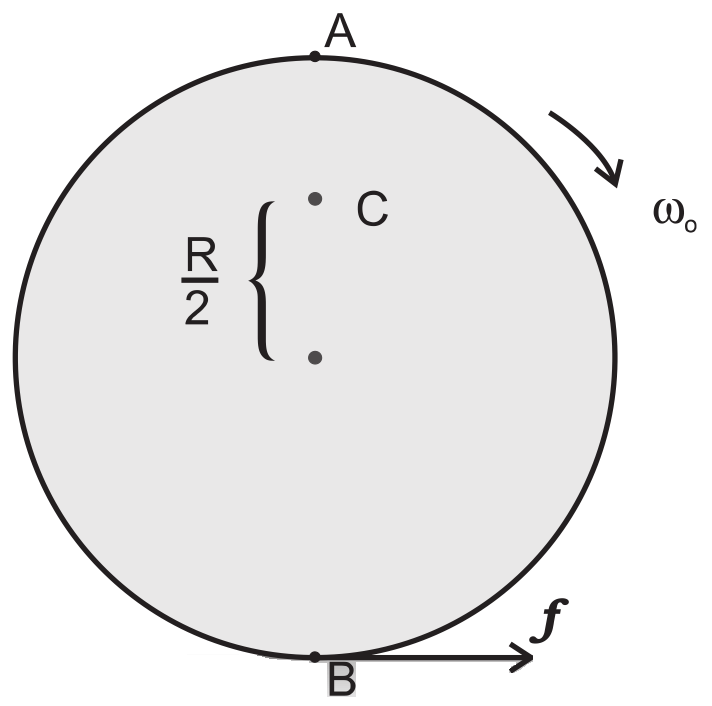
Answer$\text{v}_{\text{A}}=\text{R}\omega_0,\text{ v}_\text{B}=\text{R}\omega_0,\text{ v}_\text{C}=\Big(\frac{\text{R}}{2}\Big)\omega_0$ The disc will not roll, Angular speed of the disc $=\omega_0$ Radius of the disc = R Using the relation for linear velocity, $\text{v}=\omega_0\text{R}$
For point A: $\text{v}_{\text{A}}=\text{R}\omega_0,$ in the direction tangential to the right. For point B: $\text{v}_{\text{B}}=\text{R}\omega_0,$ in the direction tangential to the left. For point C: $\Big(\frac{\text{R}}{2}\Big)\omega_0$ in the direction same as that of $v_A$. The directions of motion of points A, B, and C on the disc are shown in the following figure:
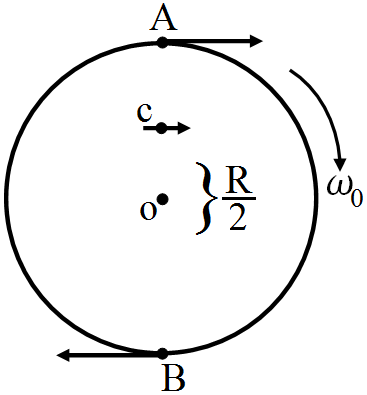
Since the disc is placed on a frictionless table, it will not roll. This is because the presence of friction is essential for the rolling of a body. View full question & answer→Question 105 Marks
A non-uniform bar of weight W is suspended at rest by two strings of negligible weight as shown in. The angles made by the strings with the vertical are $36.9°$ and $53.1°$ respectively. The bar is $2m$ long. Calculate the distance d of the centre of gravity of the bar from its left end.
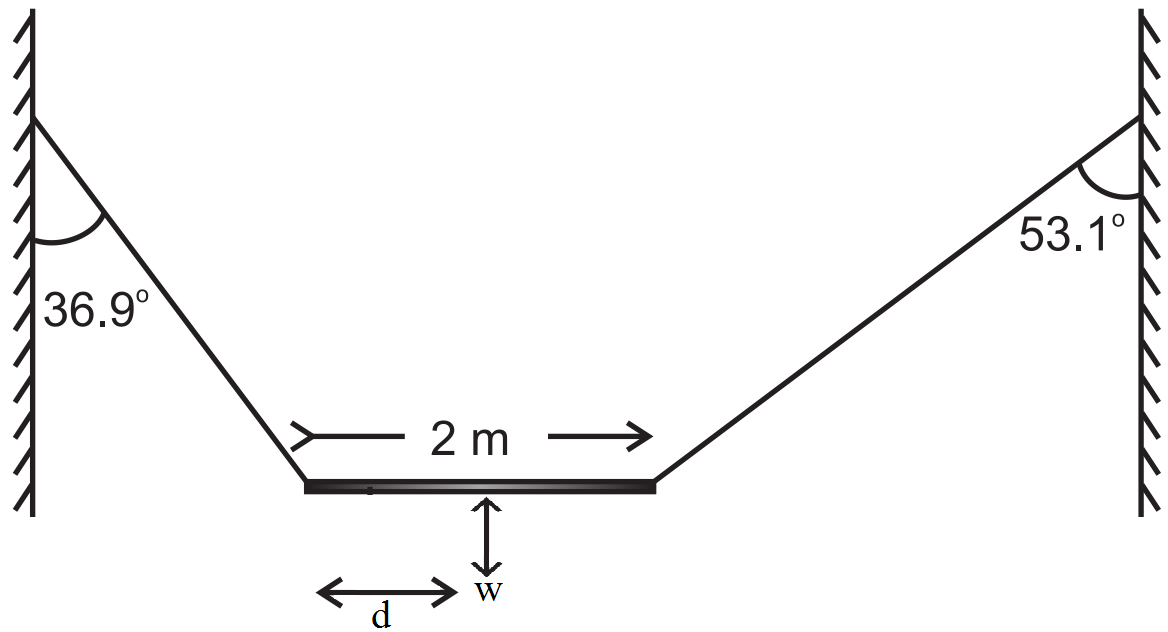
AnswerThe free body diagram of the bar is shown in the following figure:
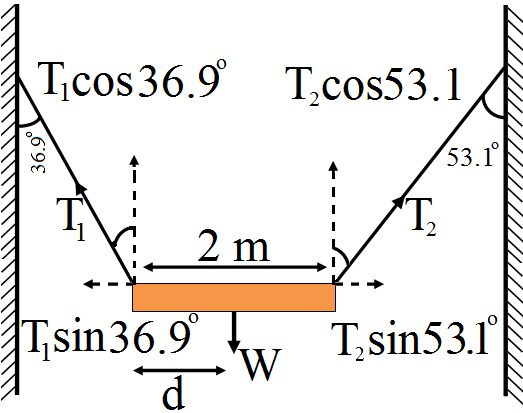
Length of the bar, $l = 2m T_1$ and $T_2$ are the tensions produced in the left and right strings respectively. At translational equilibrium, we have, $\text{T}_1\sin36.9^{\circ}=\text{T}_2\sin53.1$
$\frac{\text{T}_1}{\text{T}_2}=\frac{\sin53.1^{\circ}}{\sin36.9}$
$=\frac{0.800}{0.600}=\frac{4}{3}$
$\text{T}_1=\frac{4}{3}\text{T}_2$ For rotational equilibrium, on taking the torque about the centre of gravity, we have, $\text{T}_1\cos36.9\times\text{d}=\text{T}_2\cos53.1(2-\text{d})$
$\text{T}_1\times0.800\text{d}=\text{T}_20.600(2-\text{d})$
$\frac{4}{3}\times\text{T}_2\times0.800\text{d}=\text{T}_2\big[0.600\times2-0.600\text{d}\big]$
$1.067\text{d}+0.6\text{d}=1.2$
$\therefore\ \text{d}=\frac{1.2}{1.67}$
$=0.72\text{m}$ Hence, the C.G. (centre of gravity) of the given bar lies 0.72m from its left end. View full question & answer→Question 115 Marks
In the HCl molecule, the separation between the nuclei of the two atoms is about $1.27\mathring{\text{A}}\big(1\mathring{\text{A}}= 10^{-10} \text{m}\big).$ Find the approximate location of the CM of the molecule, given that a chlorine atom is about 35.5 times as massive as a hydrogen atom and nearly all the mass of an atom is concentrated in its nucleus.
Answer
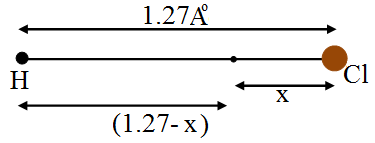 Distance between H and Cl atoms $=1.27\mathring{\text{A}}$
Mass of H atom = m
Mass of Cl atom = 35.5m
Let the centre of mass of the system lie at a distance x from the Cl atom.
Distance of the centre of mass from the H atom = (1.27 - x)
Let us assume that the centre of mass of the given molecule lies at the origin. Therefore, we can have,
[m(1.27 - x) + 35.5mx] / (m + 35.5m) = 0
m(1.27 - x) + 35.5mx = 0
1.27 - x = -35.5x
$\therefore\text{ x}=-1.27/(35.5-1)=-0.37\mathring{\text{A}}$
Here, the negative sign indicates that the centre of mass lies at the left of the molecule. Hence, the centre of mass of the HCl molecule lies $0.37\mathring{\text{A}}$ from the Cl atom. View full question & answer→Question 125 Marks
From a uniform disk of radius R, a circular hole of radius $\frac{\text{R}}{2}$ is cut out. The centre of the hole is at $\frac{\text{R}}{2}$ from the centre of the original disc. Locate the centre of gravity of the resulting flat body.
Answer$\frac{\text{R}}{6},$ from the original centre of the body and opposite to the centre of the cut portion. Mass per unit area of the original disc $=\sigma$ Radius of the original disc = R Mass of the original disc, $\text{M}=\pi\text{R}^2\sigma$ The disc with the cut portion is shown in the following figure: 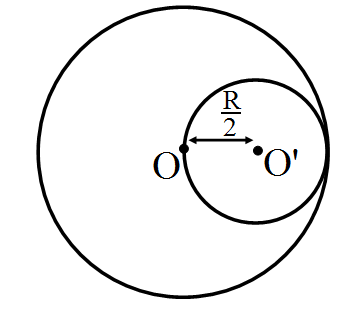 Radius of the smaller disc $=\frac{\text{R}}{2}$ Mass of the smaller disc, $\text{M}'=\pi\Big(\frac{\text{R}}{2}\Big)^2\sigma=\frac{\pi\text{R}^2\sigma}{4}=\frac{\text{M}}{4}$ Let O and O′ be the respective centres of the original disc and the disc cut off from the original. As per the definition of the centre of mass, the centre of mass of the original disc is supposed to be concentrated at O, while that of the smaller disc is supposed to be concentrated at O′. It is given that, $\text{OO}'=\frac{\text{R}}{2}$ After the smaller disc has been cut from the original, the remaining portion is considered to be a system of two masses. The two masses are, M (concentrated at O), and $-\text{M}'=\Big(\frac{\text{M}}{4}\Big)$ concentrated at O′ (The negative sign indicates that this portion has been removed from the original disc). Let x be the distance through which the centre of mass of the remaining portion shifts from point O. The relation between the centres of masses of two masses is given as, $\text{x}=\frac{(\text{m}_1\text{r}_1+\text{m}_2\text{r}_2)}{(\text{m}_1+\text{m}_2)}$ For the given system, we can write, $\text{x}=\frac{\big[\text{M}\times0-\text{M}'\times\big(\frac{\text{R}}{2}\big)\big]}{(\text{M}+\text{M}'))}=\frac{-\text{R}}{6}$ (The negative sign indicates that the centre of mass gets shifted toward the left of point O).
 View full question & answer→Question 135 Marks
Explain why friction is necessary to make the disc in roll in the direction indicated.
- Give the direction of frictional force at B, and the sense of frictional torque, before perfect rolling begins.
- What is the force of friction after perfect rolling begins?
AnswerA torque is required to roll the given disc. As per the definition of torque, the rotating force should be tangential to the disc. Since the frictional force at point B is along the tangential force at point A, a frictional force is required for making the disc roll.
- Force of friction acts opposite to the direction of velocity at point B. The direction of linear velocity at point B is tangentially leftward. Hence, frictional force will act tangentially rightward. The sense of frictional torque before the start of perfect rolling is perpendicular to the plane of the disc in the outward direction.
- Since frictional force acts opposite to the direction of velocity at point B, perfect rolling will begin when the velocity at that point becomes equal to zero. This will make the frictional force acting on the disc zero.
View full question & answer→Question 145 Marks
Separation of Motion of a system of particles into motion of the centre of mass and motion about the centre of mass: Show $\frac{\text{dL}}{\text{dt}}=\sum\text{r}'_\text{i}\times\frac{\text{dp}'}{\text{dt}}$ Further, show that $\frac{\text{dL}'}{\text{dt}}=\tau'_\text{ext}$ where $\tau'_\text{ext}$ is the sum of all external torques acting on the system about the centre of mass. (Hint: Use the definition of centre of mass and third law of motion. Assume the internal forces between any two particles act along the line joining the particles)
AnswerWe have the relation, $\text{L}'=\sum\limits_\text{i}\text{r}'_\text{i}\times\text{p}'_\text{i }$
$\frac{\text{dL}'}{\text{dt}}=\frac{\text{d}}{\text{dt}}\Big(\sum\limits_\text{i }\text{r}'_\text{i}\times\text{p}'_\text{i}\Big)$
$=\frac{\text{d}}{\text{dt}}\Big(\sum\limits_\text{i }\text{r}'_\text{i}\Big)\times\text{p}'_\text{i }+\sum\limits_\text{i}\text{r}'_\text{i}\times\frac{\text{d}}{\text{dt}}(\text{p}'_\text{i})$
$=\frac{\text{d}}{\text{dt}}\Big(\sum\limits_\text{i}\text{m}_\text{i}\text{r}'_\text{i}\Big)\times\text{v}'_\text{i}+\sum\limits\limits\text{r}'_\text{i} \times\frac{\text{d}}{\text{dt}}(\text{p}'_\text{i})$ Where, $r'_i$ is the position vector with respect to the centre of mass of the system of particles.
$\therefore\ \sum\limits_\text{i}\text{m}_\text{i}\text{r}'_\text{i}=0$
$\therefore\ \frac{\text{dL}'}{\text{dt}}=\sum\limits_\text{i}\text{r}'_\text{i}\times\frac{\text{d}}{\text{dt}}(\text{p}'_\text{i})$ We have the relation, $\frac{\text{dL}'}{\text{dt}}=\sum\limits_\text{i}\text{r}'_\text{i}\times\frac{\text{d}}{\text{dt}}(\text{p}'_\text{i})$
$=\sum_\limits{\text{i}}\text{r}'_\text{i}\times\text{m}_\text{i}\frac{\text{d}}{\text{dt}}(\text{v}'_\text{i})$ Where, $\frac{\text{d}}{\text{dt}}(\text{v}'_\text{i})$ is the rate of change of velocity of the $i^{th}$ particle with respect ot the centre of mass of the system. Therefore, according to Newton's third law of motion, we can write, $\text{m}_\text{i}\frac{\text{d}}{\text{dt}}(\text{v}'_\text{i})$ = Extrenal force acting on the ith particle $=\sum\limits_\text{i}(\tau'_\text{i})_\text{ext}$ i.e., $\sum\limits_\text{i}\text{r}'\times\text{m}_\text{i}\frac{\text{d}}{\text{dt}}(\text{v}'_\text{i})=\tau'_\text{ext}=$ External torque acting on the system as a whole, $\therefore\ \frac{\text{dL}'}{\text{dt}}=\tau'_\text{ext}$
View full question & answer→Question 155 Marks
A hoop of radius $2m$ weighs $100kg$. It rolls along a horizontal floor so that its centre of mass has a speed of $20cm/s$. How much work has to be done to stop it?
AnswerRadius of the hoop, r = 2m Mass of the hoop, m = 100kg Velocity of the hoop, v = 20cm/s = 0.2m/s Total energy of the hoop = Translational KE + Rotational KE $\text{E}_{\text{r}}=\frac{1}{2}\text{mv}^{2}+\frac{1}{2}\text{I}\omega^2$ Moment of inertia of the hoop about its centre, $I = mr^2 \text{E}_{\text{r}}=\frac{1}{2}\text{mv}^{2}+\frac{1}{2}\text{mr}^2\omega^2$ But we have the relation, $\text{v}=\text{r}\omega$
$\therefore\ \text{E}_{\text{r}}=\frac{1}{2}\text{mv}^{2}+\frac{1}{2}\text{mr}^2\omega^2$
$\therefore\ \text{E}_{\text{r}}=\frac{1}{2}\text{mv}^{2}+\frac{1}{2}\text{mv}^2$
$\therefore\ \text{E}_{\text{r}}=\text{mv}^2$ The work required to be done for stopping the hoop is equal to the total energy of the hoop. $\therefore$ Required work to be done, $W = mv^2 = 100 \times (0.2)^2 = 4J$
View full question & answer→Question 165 Marks
Separation of Motion of a system of particles into motion of the centre of mass and motion about the centre of mass: Show $\text{L}=\text{L}'+\text{R}\times\text{MV}$ where $\text{L}'=\sum\text{r}'_\text{i}\times\text{p}'_\text{i}$ is the angular momentum of the system about the centre of mass with velocities taken relative to the centre of mass. Remember $\text{r}'_\text{i}=\text{r}_\text{i}-\text{R},$ rest of the notation is the standard notation used in the chapter.
Note: $\text{L}'$ and $\text{MR}\times\text{V}$ can be said to be angular momenta, respectively, about and of the centre of mass of the system of particles.
AnswerPosition vector of the $i^{th}$ particle with respect to origin = $r_i$ Position vector of the $i^{th}$ particle with respect to the centre of mass = $r'_i$ Position vector of the centre of mass with respect to the origin = R It is given that, $\text{r}'_\text{i}=\text{r}_\text{i}-\text{R}$
$\text{r}_\text{i}=\text{r}'_\text{i}+\text{R}$ We have from part (a), $\text{P}_\text{i}=\text{}\text{p}'_\text{i}+\text{m}_\text{i}\text{V}$ Taking the cross product of this relation by $\text{r}_\text{i},$ we get $\sum\limits_\text{i}\text{r}_\text{i}\times\text{p}_\text{i}=\sum\limits_\text{i}\text{r}_\text{i}\times\text{p}'_\text{i}+\sum\limits_\text{i}\text{r}_\text{i}\times\text{m}_{\text{i}}\text{V}$
$\text{L}=\sum\limits_\text{i}(\text{r}'_\text{i}+\text{R})\times\text{p}'_1+\sum\limits_\text{i}(\text{r}'_\text{i}+\text{R})\times\text{m}_\text{i}\text{V}$
$=\sum\limits_\text{i}\text{r}'_\text{i}\times\text{p}'_\text{i}+\sum\limits_\text{i}\text{R}\times\text{p}'_\text{i}+\sum\limits_\text{i}\text{r}'_\text{i}\times\text{m}_\text{i}\text{V}+\sum\limits_\text{i}\text{R}\times\text{m}_\text{i}\text{V}$
$=\text{L}'+\sum\limits_\text{i}\text{R}\times\text{p}'_\text{i}+\sum\limits_\text{i}\text{r}'_\text{i}\times\text{m}_\text{i}\text{V}+\sum\limits_\text{i}\text{R}\times\text{m}_\text{i}\text{V}$ Where, $\text{R}\times\sum\limits_\text{i}\text{p}'_\text{i}=0$ and $\Big(\sum\limits_\text{i}\text{r}'_\text{i}\Big)\times\text{MV}=0$
$\sum\limits_\text{i}\text{m}_\text{i}=\text{M}$
$\therefore\ \text{L}=\text{L}'+\text{R}\times\text{MV}$
View full question & answer→Question 175 Marks
Separation of Motion of a system of particles into motion of the centre of mass and motion about the centre of mass: Show $\text{K}=\text{K}'+\frac{1}{2}\text{M}\text{V}^2$ where K' is the total kinetic energy of the system of particles, K′ is the total kinetic energy of the system when the particle velocities are taken with respect to the centre of mass and $\frac{\text{MV}^2}{2}$ is the kinetic energy of the translation of the system as a whole (i.e. of the centre of mass motion of the system). The result has been used in $\sec7.14$
AnswerWe have the relation for velocity of the $I^{th}$ particle as, $\text{v}_\text{i}=\text{v}'_\text{i}+\text{V}$
$\sum\limits_\text{i}\text{m}_\text{i}\text{v}_\text{i}=\sum\limits_\text{i}\text{m}_\text{i}\text{v}_\text{i}'+\sum\limits_\text{i}\text{m}_\text{i}\text{V}\ ...(\text{ii})$ Taking the dot product of equation (ii) with itself, we get $\sum\limits_\text{i}\text{m}_\text{i}\text{v}_\text{i}\cdot\sum_\limits\text{i}\text{m}_\text{i}\text{v}_\text{i}=\sum\limits_\text{i}\text{m}_\text{i}\big(\text{v}'_\text{i}+\text{V}\big)\cdot\sum\limits_\text{i}\text{m}_\text{i}\big(\text{v}'_\text{i}+\text{V}\big)$
$\text{M}^2\sum\limits_\text{i}\text{v}_\text{i}^2=\text{M}^2\sum\limits_\text{i}\text{v}'{_\text{i}^2}+\text{M}^2\sum\limits_\text{i}\text{v}_\text{i}\cdot\text{v}_\text{i}'+\text{M}^2\sum\limits_\text{i} \text{v}'_\text{i}\cdot\text{v}_\text{i}+\text{M}^2\text{V}^2$ Here, for the centre of mass of the system of particles, $\sum\limits_\text{i}\text{v}_\text{i}\cdot\text{v}'_\text{i}=-\sum\limits_\text{i}\text{v}'_\text{i}\cdot\text{v}_\text{i}$
$\text{M}^2\sum\limits_\text{i}\text{v}_\text{i}^2=\text{M}^2\sum\limits_\text{i}\text{v}'{_\text{i}^2}+\text{M}^2\text{V}^2$
$\text{M}^2\sum\limits_\text{i}\text{v}_\text{i}^2=\text{M}^2\sum\limits_\text{i}\text{v}'{_\text{i}^2}+\text{M}^2\text{V}^2$
$\frac{1}{2}\text{M}\sum\limits_\text{i}\text{v}^2_\text{i}=\frac{1}{2}\text{M}\sum\limits_\text{i}\text{v}'^2_\text{i}+\frac{1}{2}\text{MV}^2$
$\text{K}=\text{K}'+\frac{1}{2}\text{MV}^2$ Where, $\text{K}=\frac{1}{2}\text{M}\sum\limits_\text{i}\text{v}^2_\text{i}$ = Total kinetic energy of the system of particles $\text{K}'=\frac{1}{2}\text{M}\sum\limits_\text{i}\text{v}'^2_\text{i}$ = Total kinetic energy of the system of particles with respect to the centre of mass $\frac{1}{2}\text{MV}^2$ = Kinetic energy of the translation of the system as a whole.
View full question & answer→Question 185 Marks
A car weighs $1800kg$. The distance between its front and back axles is $1.8m$. Its centre of gravity is $1.05m$ behind the front axle. Determine the force exerted by the level ground on each front wheel and each back wheel.
AnswerMass of the car, m = 1800kg Distance between the front and back axles, d = 1.8m Distance between the C.G. (centre of gravity) and the back axle = 1.05m The various forces acting on the car are shown in the following figure: 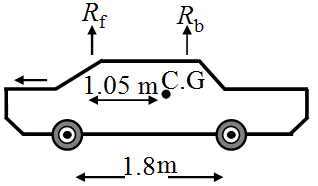
$R_f$ and $R_b$ are the forces exerted by the level ground on the front and back wheels respectively. At translational equilibrium: $R_f+R_b=m g=1800 \times 9.8=17640 \mathrm{~N} \ldots .$. (i) For rotational equilibrium, on taking the torque about the C.G., We have, $R_f(1.05)=R_b(1.8-1.05) \frac{R_b}{R_f}=\frac{7}{5} R_b=1.4 R_f \ldots$...(ii) Solving equations (i) and (ii), we get $1.4 R_f+R_f=$ $17640 R_f=7350 \mathrm{~N} \therefore R_b=17640-7350=10290 \mathrm{NT}$
Therefore, the force exerted on each front wheel $=\frac{7350}{2}=3675 \mathrm{~N}$ and, The force exerted on each back wheel $=\frac{10290}{2}=5145 \mathrm{~N}$ View full question & answer→Question 195 Marks
Torques of equal magnitude are applied to a hollow cylinder and a solid sphere, both having the same mass and radius. The cylinder is free to rotate about its standard axis of symmetry, and the sphere is free to rotate about an axis passing through its centre. Which of the two will acquire a greater angular speed after a given time.
AnswerLet $m$ and $r$ be the respective masses of the hollow cylinder and the solid sphere. The moment of inertia of the hollow cylinder about its standard axis, $\mathrm{I}_{\mathrm{I}}=\mathrm{mr}^2$ The moment of inertia of the solid sphere about an axis passing through its centre, $\mathrm{I}_{\|}=2 / 5 \mathrm{mr}^2$ We have the relation: $\mathrm{T}=\mathrm{I} \alpha$ Where, $\alpha=$ Angular acceleration $\mathrm{T}=$ Torque $\mathrm{I}=$ Moment of inertia For the hollow cylinder, $\mathrm{T}_{\mathrm{I}}=\mathrm{I}_{\mathrm{I}} \alpha_{\mathrm{I}}$ For the solid sphere, $\mathrm{T}_{\mathrm{II}}=\mathrm{I}_{\mathrm{II}} \alpha_{\mathrm{II}}$ As an equal torque is applied to both the bodies, $\mathrm{T}_I=\mathrm{T}_2$
$ \therefore \frac{\alpha_{\mathrm{II}}}{\alpha_{\mathrm{I}}}=\frac{\mathrm{I}_{\mathrm{I}}}{\mathrm{I}_{\mathrm{II}}}=\frac{\mathrm{mr}^2}{\frac{2}{3 \mathrm{sm}{ }^2}}=\frac{2}{5} \alpha_{\mathrm{II}}>\alpha_{\mathrm{I}} \ldots$ (i) Now, using the relation, $\omega=\omega_0+\alpha \mathrm{t}$
Where, $\omega_0=$ Initial angular velocity $t=$ Time of rotation $\omega=$ Final angular velocity For equal $\omega_0$ and $t$, we have, $\omega \propto \alpha .$. (ii) From equations (i) and (ii), we can write, $\omega_{\text {II }}>\omega_I$ Hence, the angular velocity of the solid sphere will be greater than that of the hollow cylinder.
View full question & answer→Question 205 Marks
Separation of Motion of a system of particles into motion of the centre of mass and motion about the centre of mass: Show $\text{p}=\text{p}'_\text{i}+\text{m}_\text{i}\text{V}$ where $p_i$ is the momentum of the ith particle (of mass $m_i$ ) and $p′_i = m_iv′_i.$ Note: $v′_i$ is the velocity of the ith particle relative to the centre of mass. Also, prove using the definition of the centre of mass.
AnswerTake a system of i moving particles. Mass of the $i^{th}$ particle = $m_i$ Velocity of the $i^{th}$ particle = $v_i$ Hence, momentum of the $i^{th}$ particle, $\text{p}_\text{i}=\text{m}_\text{i}\text{v}_{\text{i}}$ Velocity of the centre of mass = V The velocity of the $i^{th}$ particle with respect to the centre of mass of the system is given as, $\text{v}'_{\text{i}}=\text{v}_\text{i}-\text{V}\ ...(\text{i})$ Multiplying $m_i$ throughout equation (i), we get, $\text{m}_\text{i}\text{v}'_\text{i}=\text{m}_\text{i}\text{v}_\text{i}-\text{m}_\text{i}\text{V}$
$\text{p}'_\text{i}-\text{m}_\text{i}\text{V}$ Where, $\text{p}'_\text{i}=\text{m}_\text{i}\text{v}_\text{i}'=$ Momentum of the $i^{th}$^ particle with respect to the centre of mass of the system, $\therefore\text{ p}_\text{i}=\text{p}'_\text{i}+\text{m}_\text{i}\text{V}$ We have the relation, $\text{p}'_\text{i}=\text{m}_\text{i}\text{v}_\text{i}'$ Taking the summation of momentum of all the particles with respect to the centre of mass of the system, we get $\sum_\limits\text{i}\text{p}'_\text{i}=\sum_\limits\text{i}\text{m}_\text{i}\text{v}'_\text{i}=\sum\limits_\text{i}\frac{\text{dr}'_\text{i}}{\text{dt}}$ Where, $\text{r}'_\text{i}=$ Position vector of $i^{th}$ particle with respect to the centre of mass. $\text{v}'_\text{i}=\frac{\text{dr}'_\text{i}}{\text{dt}}$ As per the definition of the centre of mass, we have, $\sum\limits_\text{i}\text{m}_\text{i}\text{r}'_\text{i}=0$
$\therefore\ \sum\limits_\text{i}\text{m}_\text{i}\frac{\text{dr}'_\text{i}}{\text{dt}}=0$
$\sum\limits_\text{i}\text{p}'_\text{i}=0$
View full question & answer→Question 215 Marks
Show that a(b × c) is equal in magnitude to the volume of the parallelepiped formed on the three vectors a, b and c.
AnswerA parallelepiped with origin O and sides a, b, and c is shown in the following figure: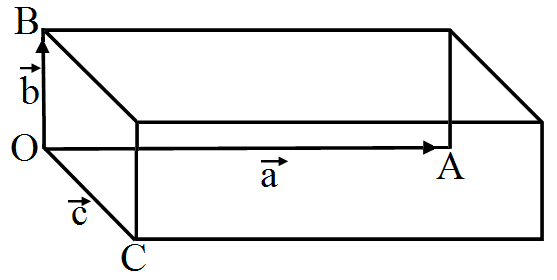
Volume of the given parallelepiped = abc $\vec{\text{O}}\text{C}=\vec{\text{a}}$ $\vec{\text{O}}\text{B}=\vec{\text{b}}$ $\vec{\text{O}}\text{C}=\vec{\text{c}}$ Let $\widehat{\text{n}}$ be a unit vector perpendicular to both b and c. Hence, $\widehat{\text{n}}$ and a have the same direction. $\therefore\ \vec{\text{b}}\times\vec{\text{c}}=\text{bc}\sin\theta\widehat{\text{n}}$ $=\text{bc}\sin90^{\circ}\widehat{\text{n}}$ $=\text{bc}\widehat{\text{n}}$ $\vec{\text{a}}\cdot\big(\vec{\text{b}}\times\vec{\text{c}}\big)$ $=\text{a}\cdot(\text{bc}\widehat{\text{n}})$ $=\text{abc}\cos\theta\widehat{\text{n}}$ $=\text{abc}\cos0^{\circ}$ $=\text{abc}$ = Volume of the parallelepiped. View full question & answer→Question 225 Marks
A metre stick is balanced on a knife edge at its centre. When two coins, each of mass 5g are put one on top of the other at the 12.0cm mark, the stick is found to be balanced at 45.0cm. What is the mass of the metre stick?
AnswerLet W and W′ be the respective weights of the metre stick and the coin. 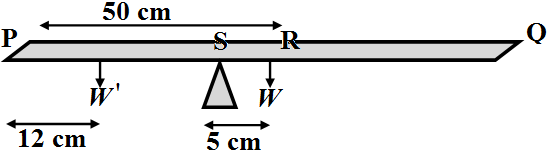 The mass of the metre stick is concentrated at its mid-point, i.e., at the 50cm mark. Mass of the meter stick = m' Mass of each coin, m = 5g When the coins are placed 12cm away from the end P, the centre of mass gets shifted by 5cm from point R toward the end P. The centre of mass is located at a distance of 45cm from point P. The net torque will be conserved for rotational equilibrium about point R. $10\times\text{g}(45-12)-\text{m}'\text{g}(50-45)=0$ $\therefore\ \text{m}'=\frac{10\times33}{5}=66\text{g}$ Hence, the mass of the metre stick is 66g.
 View full question & answer→Question 235 Marks
Find the components along the x, y, z axes of the angular momentum l of a particle, whose position vector is r with components x, y, z and momentum is p with components px, py and pz. Show that if the particle moves only in the x-y plane the angular momentum has only a z-component.
Answer$\text{l}_{\text{x}}=\text{yp}_{\text{z}}-\text{zp}_{\text{y}}$ $\text{l}_{\text{y}}=\text{zp}_{\text{x}}-\text{zp}_{\text{z}}$ $\text{l}_{\text{z}}=\text{xp}_{\text{y}}-\text{yp}_{\text{x}}$ Linear momentum of the particle, $\vec{\text{p}}=\text{p}_{\text{x}}\hat{\text{i}}+\text{p}_{\text{y}}\hat{\text{j}}+\text{p}_{\text{z}}\hat{\text{k}}$ Position vector of the particle, $\vec{\text{r}}={\text{x}}\hat{\text{i}}+{\text{y}}\hat{\text{j}}+{\text{z}}\hat{\text{k}}$ Angular momentum, $\vec{\text{l}}=\vec{\text{r}}\times\vec{\text{p}}$ $=({\text{x}}\hat{\text{i}}+{\text{y}}\hat{\text{j}}+{\text{z}}\hat{\text{k}})\times(\text{p}_{\text{x}}\hat{\text{i}}+\text{p}_{\text{y}}\hat{\text{j}}+\text{p}_{\text{z}}\hat{\text{k}})$ $=\begin{vmatrix}\vec{\text{i}}&\vec{\text{j}}&\vec{\text{k}}\\\text{x}&\text{y}&\text{z}\\\text{p}_{\text{x}}&\text{p}_{\text{y}}&\text{p}_{\text{z}}\end{vmatrix}$ $=\text{l}_{\text{x}}\hat{\text{i}}+\text{l}_{\text{y}}\hat{\text{j}}+\text{l}_{\text{z}}\hat{\text{k}}$ $=\hat{\text{i}}(\text{yp}_{\text{z}}-\text{zp}_{\text{y}})-\hat{\text{j}}(\text{zp}_{\text{x}}-\text{zp}_{\text{z}})+\hat{\text{k}}(\text{xp}_{\text{y}}-\text{yp}_{\text{x}})$ Comparing the coefficients of $\hat{\text{i}},\hat{\text{j}}$ and $\hat{\text{k}},$ we get $ \text{l}_{\text{x}}=\text{yp}_{\text{z}}-\text{zp}_{\text{y}},\text{ l}_{\text{y}}=\text{zp}_{\text{x}}-\text{zp}_{\text{z}},\text{ l}_{\text{z}}=\text{xp}_{\text{y}}-\text{yp}_{\text{x}}\ ...(\text{i})$ The particle moves in the x-y plane. Hence, the z-component of the position vector and linear momentum vector becomes zero, i.e., Z = Pz = 0 Thus, equation (i) reduces to, $\text{l}_{\text{x}}=0,\text{ l}_{\text{y}}=0,\text{ l}_{\text{y}}=\text{x}\text{p}_{\text{y}}-\text{y}\text{p}_{\text{x}}\ ...(\text{ii})$ Therefore, when the particle is confined to move in the x-y plane, the direction of angular momentum is along the z-direction.
View full question & answer→Question 245 Marks
Two particles, each of mass m and speed v, travel in opposite directions along parallel lines separated by a distance d. Show that the angular momentum vector of the two particle system is the same whatever be the point about which the angular momentum is taken.
AnswerLet at a certain instant two particles be at points P and Q, as shown in the following figure:
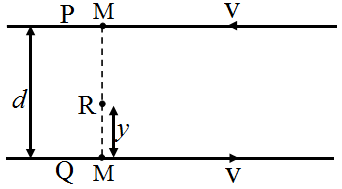
Angular momentum of the system about point $P$,
$L_p=m v \times 0+m v \times d=m v d \ldots$...(i) Angular momentum of the system about point $Q L_Q=m v \times d+m v \times 0=m v d \ldots$
(ii) Consider a point $R$, which is at a distance $y$ from point $Q$ i.e., $Q R=y \therefore P R=d-y$ Angular momentum of the system about point $R, L_R=m v \times(d-y)+m v \times y m v d-m v y+m v y=m v d$...(iii) Comparing equations (i), (ii), and (iii), we get, $L_p=L_Q=L_R \ldots$..(iv) We infer from equation (iv) that the angular momentum of a system does not depend on the point about which it is taken. View full question & answer→Question 255 Marks
A uniform disc of radius R and mass M is mounted on an axis supported in fixed frictionless bearing. A light chord is wrapped around the rim of the wheel and suppose that we hang a body of mass m from the chord. Find the angular acceleration of the disc and tangential acceleration of point on the rim.
AnswerThe situation is shown in the fig.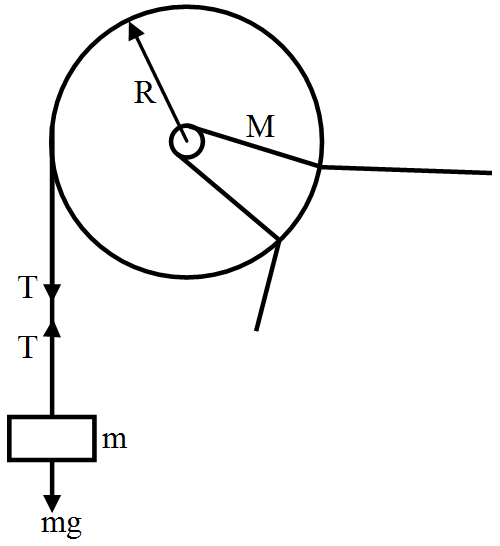
Let f be the tension in the chord. Now, $\text{mg}-\text{T}=\text{ma},\dots(1)$ where a is the tangential acceleradon of a point
on the rim of the disc We know that $\tau=\text{l}\alpha.$ But the resultant torque on the disc = TR and
the rotational inertia $\text{l}=\frac{1}{2}\text{MR}^2$ $\therefore\text{TR}=\frac{1}{2}\text{MR}^2\Big(\frac{\text{a}}{\text{R}}\Big)(\because\alpha=\frac{\text{a}}{\text{R}})$ or $2\text{TR}=\text{Ma}$ or $\text{a}=\frac{2\text{T}}{\text{M}}\dots(2)$ From equations (r) and (ir), we get $\text{mg}-\Big(\frac{\text{Ma}}{2}\Big)=\text{ma}$ or $\text{a}=\Big(\frac{2\text{m}}{\text{M+2M}}\Big)\text{g}\dots(3)$ Again,$\text{mg}-\text{T}=\text{m}\times\Big(\frac{2\text{T}}{\text{M}}\Big)$ or $\text{T}=\Big(\frac{\text{mM}}{\text{M}+2\text{m}}\Big)\text{g}\dots(4)$ View full question & answer→Question 265 Marks
Two masses $M_1$ and $M_2$ are separated by a distance r. Find the moment of inertia of this arrangement about an axis passing through the centre of mass and perpendicular to the line joining them.
Answer
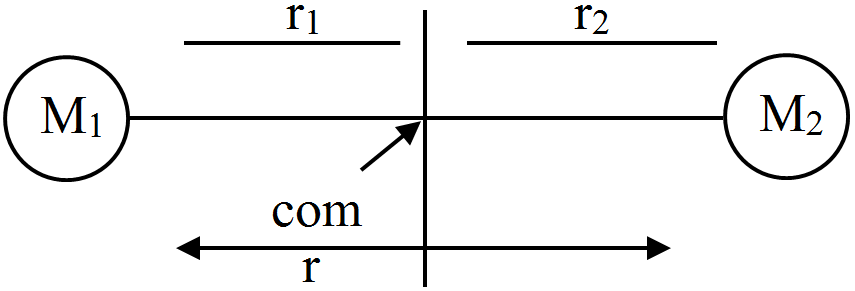
If COM is origin, $M_1r_1 = M_2r_2$
Also, $r_1 + r_2 = r$
Using the equations, $\text{r}_1=\frac{\text{M}_2\text{r}}{\text{M}_1+\text{M}_2}\text{ and }\text{r}_2=\frac{\text{M}_1\text{r}}{\text{M}_1+\text{M}_2}$
$\text{I}_{\text{cm}}=\text{M}_1\text{r}^2_1+\text{M}_2\text{r}^2_2$
$=\frac{1}{(\text{M}_1+\text{M}_2)}[\text{M}_1\text{ M}^2_2\text{ r}^2+\text{M}_2\text{ M}^2_1\text{ r}^2]$
$=\frac{\text{M}_1\text{ M}_2\text{ r}^2[\text{M}_2+\text{M}_1]}{(\text{M}_1+\text{M}_2)}$
$=\frac{\text{M}_1\text{M}_2\text{r}^2}{(\text{M}_1+\text{M}_2)}$ View full question & answer→Question 275 Marks
A uniform square plate S(side c) and a uniform rectangular plate R(sides b, a) have identical areas and masses: 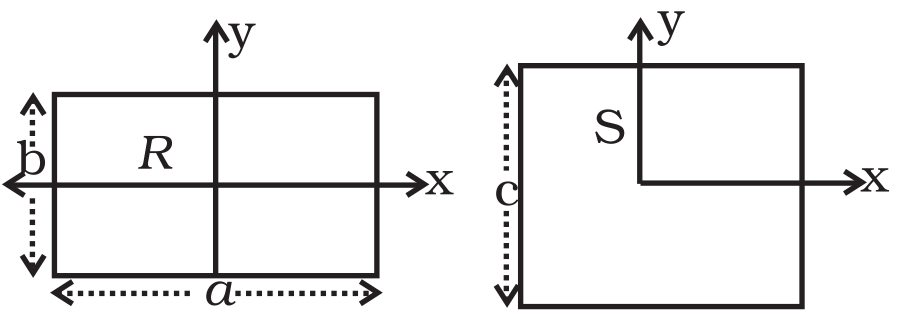
Show that:
- $\frac{\text{I}_\text{xR}}{\text{I}_\text{xS}}<1$
- $\frac{\text{I}_\text{ys}}{\text{I}_\text{ys}}>1$
- $\frac{\text{I}_{2\text{R}}}{\text{I}_{2\text{s}}}>1$
AnswerAccording to the problem, Area of square = Area of rectangular plate $\Rightarrow c^2 = a \times b \Rightarrow c^2 = ab$
- $\frac{\text{I}_\text{XR}}{\text{I}_\text{XS}}=\frac{\text{b}^2}{\text{c}^2}$
It is clear from diagram that b < c.
$\Rightarrow\ \frac{\text{I}_\text{XR}}{\text{I}_\text{XS}}=\Big(\frac{\text{b}}{\text{c}}\Big)^2<1$
$\Rightarrow{\text{I}_\text{XR}}<{\text{I}_\text{XS}}$
- $\frac{\text{I}_\text{YR}}{\text{I}_\text{RS}}=\frac{\text{a}^2}{\text{c}^2}$ (It is clear that a > c)
$\Rightarrow\ \frac{\text{I}_\text{YR}}{\text{I}_\text{RS}}=\Big(\frac{\text{a}}{\text{c}}\Big)^2>1$
- $\text{I}_\text{zR}=\frac{1}{12}\text{M}(\text{a}^2+\text{b}^2)$
$\Rightarrow\ \text{I}_\text{zS}=\frac{1}{12}\text{M}(\text{c}^2+\text{c}^2)$
Now, $\text{I}_\text{zR}-\text{I}_\text{zS}=\frac{1}{12}\text{M}\big[\text{a}^2+\text{b}^2-2\text{c}^2\big]$
$\Rightarrow\ \text{I}_\text{zR}-\text{I}_\text{zS}=\frac{1}{12}\text{M}\big(\text{a}^2+\text{b}^2-2\text{ab}\big)$
$\Rightarrow\ \text{I}_\text{zR}-\text{I}_\text{zS}=\frac{1}{12}\text{M}\big(\text{a}-\text{b}\big)^2>0$
$\Rightarrow\ \frac{\text{I}_\text{zR}}{\text{I}_\text{zS}}>1$ View full question & answer→Question 285 Marks
An isolated particle of mass m is moving in a horizontal plane (x - y), along the x-axis at a certain height about the ground. It explodes suddenly into two fragments of masses $\frac{\text{m}}{4}$ and $3\frac{\text{m}}{4}.$ An instant later, the smaller fragment is at y = + 15 cm. What is the position of larger fragment at this instant?
AnswerAs isolated particle is moving along x-axis at a certain height above the ground, there is no motion along Y-axis. Further, the explosion is under internal forces only. Therefore, centre of mass remains stationary along Y-axis after collision. Let the co-ordinates of centre of mass be $\left(\mathrm{x}_{\mathrm{cm}}{ }^{\prime} 0\right)$ Now, $\text{y}_{\text{cm}}=\frac{\text{m}_1\text{y}_1+\text{m}_2\text{y}_2}{\text{m}_1+\text{m}_2}=0$
$\therefore\text{m}_1\text{y}_1+\text{m}_2\text{y}_2=0$
$\text{or }\text{y}_2=-\frac{\text{m}_1\text{y}_1}{\text{m}_2}$
$=-\frac{\frac{\text{m}}{4}}{3\frac{\text{m}}{4}}\times15=-5\text{cm}$
$\therefore$ Larger fragment will be at y = -5cm; along x-axis.
View full question & answer→Question 295 Marks
Show that for an isolated system the centre of mass moves with a uniform velocity along a straight line path.
AnswerLet M be the total mass of a system supposed to be concentrated at the centre of mass whose position vector is $\vec{\text{r}}$ then in the presence of an external force $\vec{\text{F}},$we have $\vec{\text{F}}=\text{M}\frac{\text{d}^2\vec{\text{r}}}{\text{dt}^2}=\text{M}\frac{\text{d}}{\text{dt}}\Big(\frac{\overrightarrow{\text{dr}}}{\text{dt}}\Big)$ $=\text{M}\frac{\text{d}}{\text{dt}}(\vec{\text{v}}_{\text{cm}})$ However for an isolated system, force $\vec{\text{F}}=0$ and hence, we have $\text{M}\frac{\text{d}}{\text{dt}}(\vec{\text{v}}_{\text{cm}})=0$ $\text{or }\frac{\text{d}}{\text{dt}}(\vec{\text{v}}_{\text{cm}})=0$ $\text{or }\vec{\text{v}_{\text{cm}}}=\text{a}\text{ constant}$ It means that for an isolated system the centre of mass moves with a uniform velocity along a straight line path.
View full question & answer→Question 305 Marks
A uniform rod pivoted at its upper end hangs vertically. It is displaced through an angle of $60°$ and then released. Find the magnitude of the force acting on a particle of mass dm at the tip of the rod when the rod makes an angle of $37°$ with the vertical.
Answer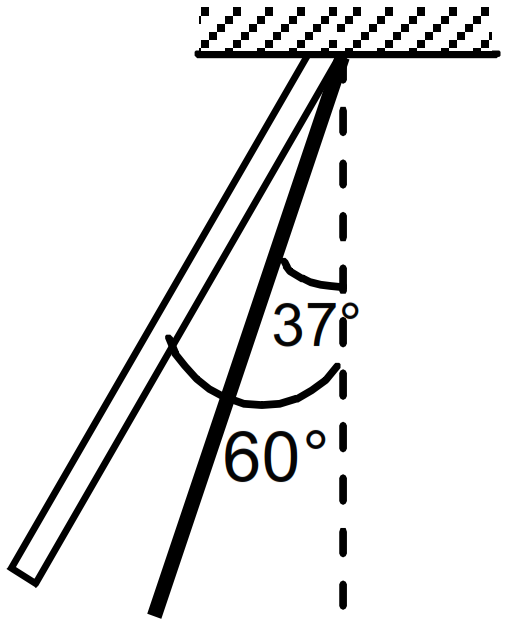
Let l = length of the rod, and m = mass of the rod. Applying energy principle $\Big(\frac{1}{2}\Big)\text{l}\omega^2-0=\text{mg}\Big(\frac{1}{2}\Big)(\cos37^\circ-\cos60^\circ)$
$\Rightarrow\frac{1}{2}\times\frac{\text{ml}^2}{3}\omega^2$
$=\text{mg}\times\frac{1}{2}\Big(\frac{4}{5}-\frac{1}{2}\Big)\text{t}$
$\Rightarrow\omega^2=\frac{9\text{g}}{10\text{l}}=0.9\Big(\frac{\text{g}}{\text{l}}\Big)$ Again $\Big(\frac{\text{ml}^2}{3}\Big)\alpha=\text{mg}\Big(\frac{1}{2}\Big)\sin37^\circ=\text{mgl}\times\frac{3}{5}$
$\therefore\alpha=0.9\Big(\frac{\text{g}}{\text{l}}\Big)=$ angular acceleration. So, to find out the force on the particle at the tip of the rod $F_i$ = centrifugal force $=(\text{dm})\omega^2\text{l}=0.9(\text{dm})\text{g}$
$F_t$ = tangential force $=(\text{dm})\alpha\text{l}=0.9(\text{dm})\text{g}$ So, total force $\text{F}=\sqrt{\big(\text{F}_{\text{i}}^2+\text{F}_{\text{t}}^2\big)}=0.9\sqrt2(\text{dm})\text{g}$ View full question & answer→Question 315 Marks
A ball is whirled in a circle by attaching it to a fixed point with a string. Is there an angular rotation of the ball about its centre? If yes, is this angular velocity equal to the angular velocity of the ball about the fixed point?
AnswerYes, there is an angular rotation of the ball about its centre. Yes, angular velocity of the ball about its centre is same as the angular velocity of the ball about the fixed point. Explanation: Let the time period of angular rotation of the ball be T. Therefore, we get: Angular velocity of the ball about the fixed point $=\frac{2\pi}{\text{T}}$ After one revolution about the fixed centre is completed, the ball has come back to its original position. In this case, the point at which the ball meets with the string is again visible after one revolution. This means that it has undertaken one complete rotation about its centre. The ball has taken one complete rotation about its centre. Therefore, we have: Angular displacement of the ball $=2\pi$ Time period = T So, angular velocity is again $\frac{2\pi}{\text{T}}.$ Thus, in both the cases, angular velocities are the same.
View full question & answer→Question 325 Marks
A square plate of edge d and a circular disc of diameter d are placed touching each other at the midpoint of an edge of the plate as shown in figure. Locate the centre of mass of the combination, assuming same mass per unit area for the two plates.
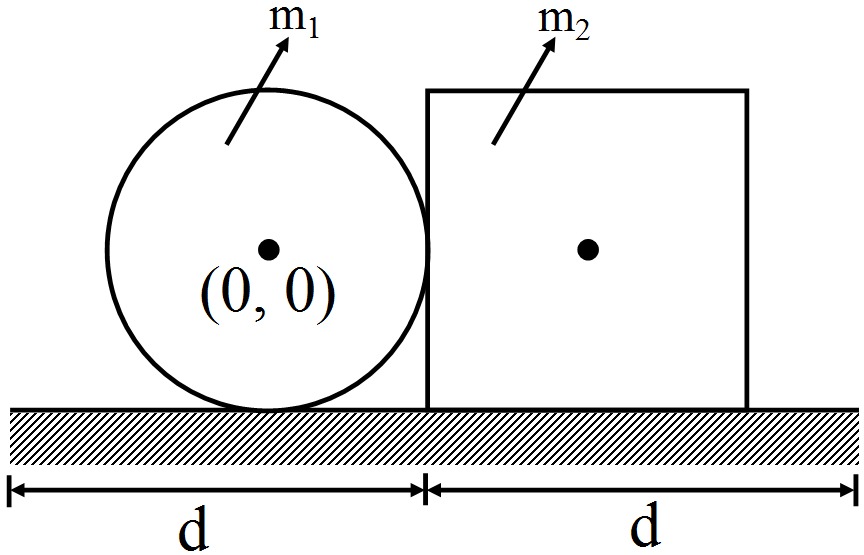
AnswerLet m be the mass per unit area.
$\therefore$ Mass of the square plate = $M_1 = d^2m$ Mass of the circular disc $=\text{M}_2=\frac{\pi\text{d}^2}{4}\text{m}$ Let the centre of the circular disc be the origin of the system.
$\therefore$ Position of centre of mass
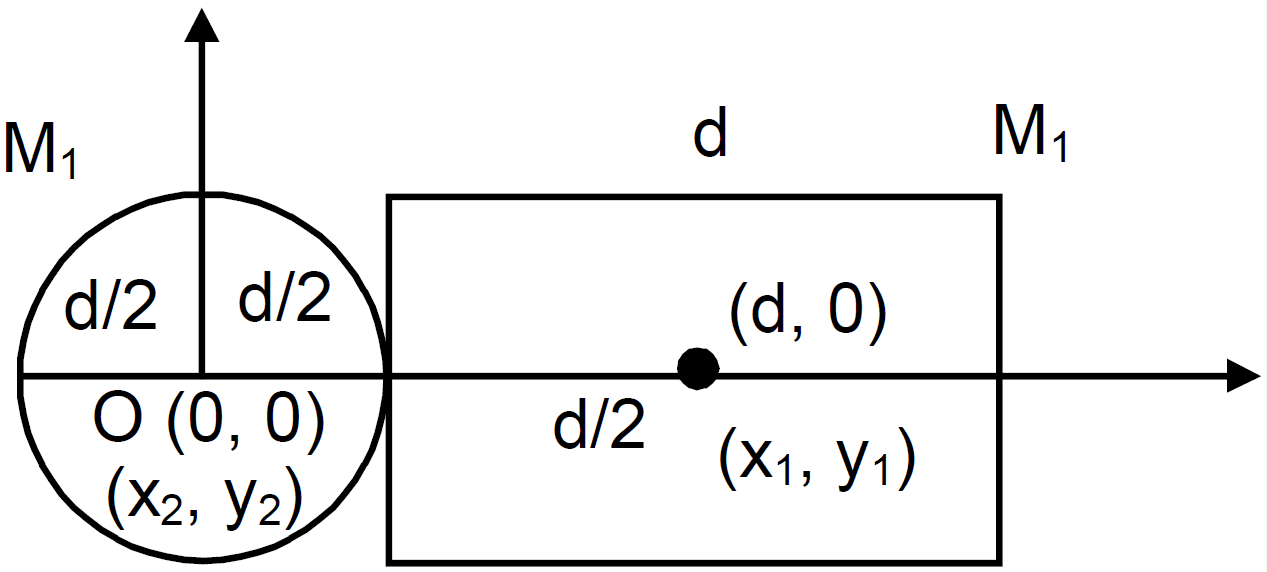
$=\Bigg(\frac{\text{d}^2\text{md}+\pi\Big(\frac{\text{d}^2}{4}\Big)\text{m}\times0}{\text{d}^2\text{m}+\pi\Big(\frac{\text{d}^2}{4}\Big)\text{m}},\frac{0+0}{\text{M}_1+\text{M}_2}\Bigg)$
$=\Bigg(\frac{\text{d}^3\text{m}}{\text{d}^2\text{m}\big(1+\frac{\pi}{4}\big)},0\Bigg)$
$=\Big(\frac{\text{4d}}{\pi+4},0\Big)$ The new centre of mass is $\Big(\frac{\text{4d}}{\pi+4}\Big)$ right of the centre of circular disc. View full question & answer→Question 335 Marks
Establish the relation $\theta=\omega_0\text{t}+\frac{1}{2}\alpha\text{t}^2$ where the letters have their usual meanings.
AnswerWe know that angular velocity is defined as $\omega=\frac{\text{d}\theta}{\text{dt}}$
$\therefore\text{ d}\theta=\omega\text{dt}=(\omega_0+\alpha\text{t})\text{dt},$ where $w_0$ is the value of initial angular velocity at time t = 0 and $\alpha=$ uniform angular acceleration. On integrating, we get $\int\limits^\theta_0\text{d}\theta=\int\limits^\text{t}_0(\omega_\circ+\alpha\text{t})\ \text{dt}$
$\therefore\ [\theta]^\theta_0=\Big[\omega_\circ\text{t}+\frac{1}{2}\alpha\text{t}^2\Big]^\text{t}_0$
$\text{or }\theta-0=\omega_0(\text{t)}-0+\frac{1}{2}\alpha\ (\text{t}^2-0)$
$\Rightarrow\theta=\omega_0\text{t}+\frac{1}{2}\alpha\text{t}^2,$ which is the requisite relation.
View full question & answer→Question 345 Marks
A cylinder is suspended by two strings wrapped around the cylinder near each end, the free ends of the string being attached to hooks on the ceiling, such that the length of the cylinder is horizontal. From the position of rest, the cylinder is allowed to roll down as suspension strings unwind. Calculate: (i) the downward linear acceleration of the cylinder and (ii) tension in the strings. Mass of cylinder is 12kg.
Answer
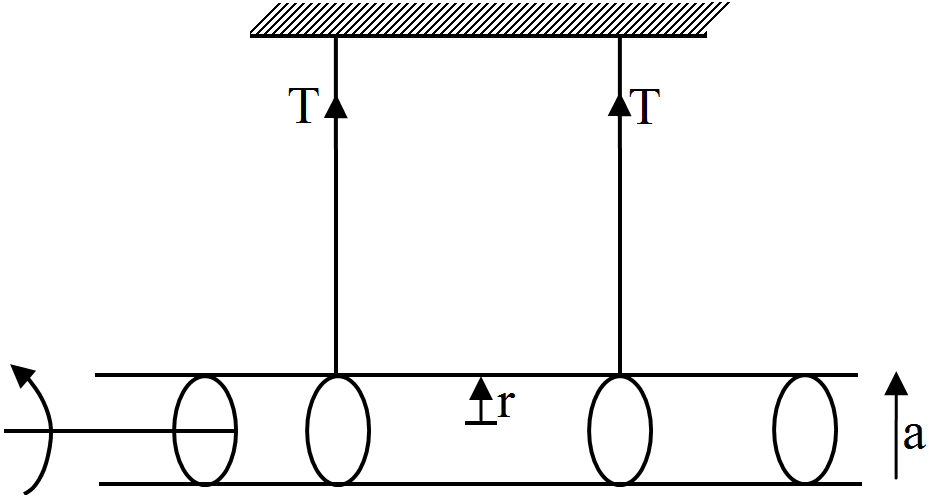 Let the downward linear acceleration of the cylinder be a. If M be the mass of the cylinder, then
$\text{Mg}-2\text{T}=\text{Ma}$
$\text{or }\text{T}=\frac{1}{2}\text{m}(\text{g}-\text{a})\dots(1)$
Now, Torque = Moment of inertia × angular acceleration
$\text{i.e.,}2\text{Tr}=\text{I}\alpha$
(when $\alpha$ = liner acceleration/ r)
$\text{or }2\text{Tr}=\frac{1}{2}\text{mr}^2\times\Big(\frac{\text{a}}{\text{r}}\Big)$
$\text{or }\text{T}=\frac{\text{ma}}{4}\dots(2)$
From eqns (1) and (2), we get
$\text{m}\frac{\text{a}}{4}=\frac{1}{2}\text{m}(\text{g}-\text{a})$
Solving eqns (3), we get $\text{a}=\Big(\frac{2}{3}\Big)\text{g}$
Substituting the value of a in eq. (2), we get
$\text{T}=\frac{\text{m}\Big(\frac{2}{3}\Big)\text{g}}{4}$
$=\frac{\text{m}\times2\text{g}}{12}=\frac{12\times2\text{g}}{12}=2\text{kgf}.$ View full question & answer→Question 355 Marks
A star of mass twice the solar mass and radius $106km$ rotates about its axis with an angular speed of $10^{‑6}$ rad per sec. What is the angular speed of the star when it collapses (due to inward gravitational forces) to a radius of $10^4km$? Solar mass = $1.99 \times 10^{23}kg$.
AnswerAccording to the law of conservation of angular momentum, $\text{I}_1\omega_1=\text{I}_2\omega_2$ Since sun is a asphere, so $\text{I}_1=\frac{2}{5}\text{MR}^2_1, R_1$ = Radius of sun M.I. of star $\text{I}_2\frac{2}{5}2\text{M}\text{R}^2_2,R_2$ = radius of star
$\therefore\frac{3}{5}\text{MR}^2_1\omega_1=\frac{4}{5}\text{MR}^2_2\omega_2$
$\text{or }\omega_2=\frac{\text{R}^2_1}{2\text{R}^2_2}\omega_1$ Since $R_1 = 10^6km; R_2 = 10^4km$; $\omega_1=10^{-6}\text{/sec}$
$\therefore\omega_2=\frac{(10^6)^2}{2(10^4)^2}\times10^{-6}$
$=5\times10^{-3}\text{rad/sec.}$
View full question & answer→Question 365 Marks
A solid cylinder of mass M and radius R has a light flexible rope wound around it. The rope carries a mass m at its free end. The mass is rest at a height h above the floor. Find the angular velocity of the cylinder at the instant the mass m, after release, strikes the floor. Assume friction to be absent and the cylinder to rotate about its own axis.
AnswerAs the mass m descends, its initial potential energy gets converted into the kinetic energy of the falling mass M itself and kinetic energy of the cylinder set into rotation. We thus have $\text{mgh}=\frac{1}{2}\text{mv}^2+\frac{1}{2}\text{I}\omega^2$ Now I, the moment of intertia of the cylinder about its own axis is $\frac{1}{2}\text{MR}^2\text{ Also }\omega=\frac{\text{v}}{\text{R}}$ 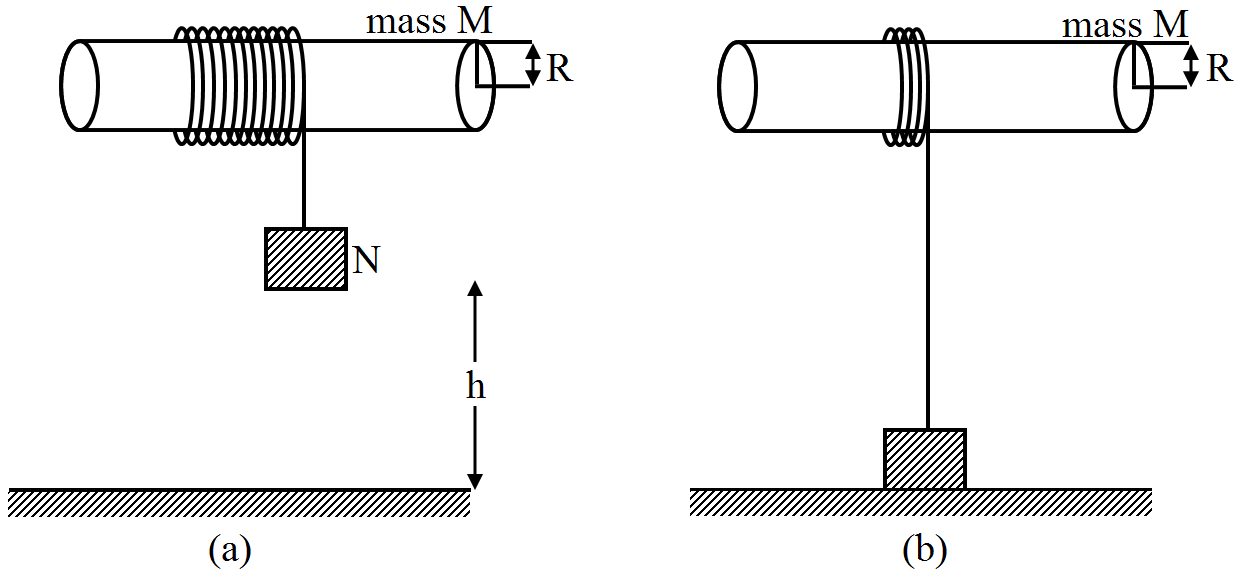 We thus have $\text{mgh}=\frac{1}{2}\text{mv}^2+\frac{1}{4}\text{MR}^2\frac{\text{v}^2}{\text{R}^2}$ $\Rightarrow\text{v}^2=\frac{2\text{mgh}}{\text{m}+\Big(\frac{\text{M}}{2}\Big)}=\Bigg[\frac{2\text{gh}}{1+\Big(\frac{\text{M}}{2\text{m}}\Big)}\Bigg]$ Thus the require angular velocity, $\omega=\frac{\text{v}}{\text{R}}=\frac{1}{\text{R}}\sqrt{\frac{2\text{gh}}{1+\Big(\frac{\text{M}}{2\text{m}}\Big)}}$
 View full question & answer→Question 375 Marks
The structure of a water molecule is shown in figure. Find the distance of the centre of mass of the molecule from the centre of the oxygen atom.
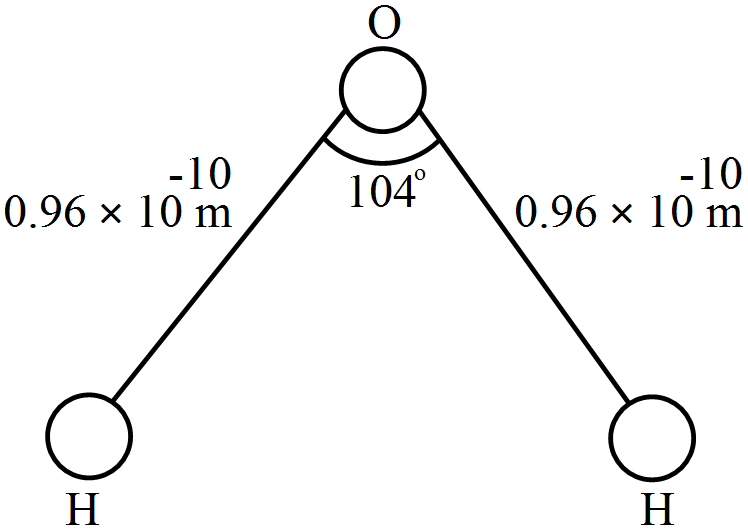
AnswerLet OX be the x-axis, OY be the Y-axis and O be the origin. Mass of O atom, $m_1 = 16$ unit Let the position of oxygen atom be origin $\Rightarrow\text{x}_1=\text{y}_1=0$ Mass of H atom, $m_2 = 1$ unit $\text{x}_2=-0.96\times10^{-10}\text{sim}52^\circ$ $\text{y}_2=-0.96\times10^{-10}\cos52^\circ$ Now, $m_3 = 1$ unit $\text{x}_3=0.96\times10^{-10}\sin52^\circ$ $\text{y}_3=-0.96\times10^{-10}\cos52^\circ$ The X coordinate of the center or mass is given by: $\text{x}_\text{cm}=\frac{\text{m}_1\text{x}_1+\text{m}_2\text{x}_2+\text{m}_3\text{x}_3}{\text{m}_1+\text{m}_2+\text{m}_3}$ $=\frac{16\times0\times1\times(-0.96\times10^{-10}\text{sin}52^\circ)+1\times0.96\times10^{10}\sin52^\circ}{1+1+16}=0$ The Y coordinate of the center of mass is given by: $\text{y}_\text{cm}=\frac{\text{m}_1\text{y}_1+\text{m}_2\text{y}_2+\text{m}_3\text{y}_3}{\text{m}_1+\text{m}_2+\text{m}_3}$ $=\frac{16\times0+2\times0.96\times10^{10}\cos52^\circ}{1+1+16}$ $=\frac{2\times0.96\times10^{-10}\cos52^\circ}{18}$ $=6.4\times10^{-12}\text{m}$ Hence, the distance of centre of mass of the molecule from the centre of the oxygen atom is $\text{s}(=6.4\times10^{1-12}\text{m})$
View full question & answer→Question 385 Marks
From a circular disc of radius R and mass 9M, a small disc of radius $\frac{\text{R}}{3}$ is removed as shown in Fig. Find the moment of inertia of the remaining disc about an axis perpendicular to the plane of the disc and passing through the point O.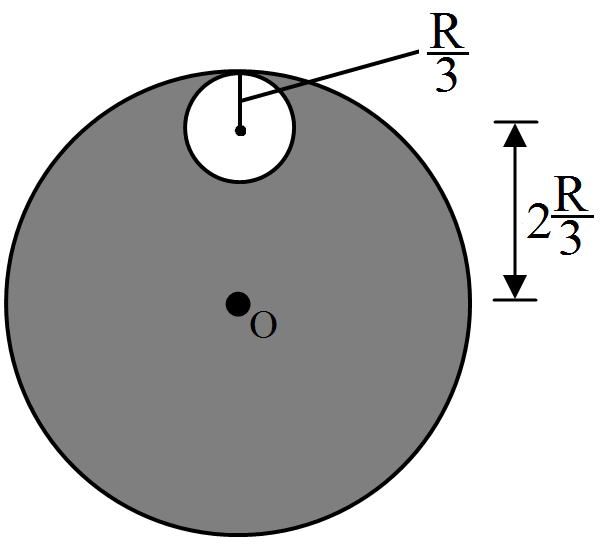
AnswerMoment of inertia of the complete disc about the given axis $=\frac{1}{2}(9\text{M})\text{R}^2$ Moment of removed disc $=\frac{9\text{M}}{\pi\text{R}^2}\pi\Big(\frac{\text{R}}{3}\Big)^2=\text{M}$ Moment of intertia of this disc about the given axis $=\frac{1}{2}\text{M}\Big(\frac{\text{R}}{3}\Big)^2+\text{M}\Big(\frac{2\text{R}}{3}\Big)^2=\frac{1}{2}\text{MR}^2$ $\therefore$ Moment of inertia of the remaining disc about the given axis $=\frac{9}{2}\text{MR}^2-\frac{1}{2}\text{MR}^2=4\text{MR}^2$
View full question & answer→Question 395 Marks
Particles of masses $1g, 2g, 3g, ........, 100g$ are kept at the marks $1cm, 2cm, 3cm, ........, 100cm$ respectively on a metre scale. Find the moment of inertia of the system of particles about a perpendicular bisector of the metre scale.
AnswerMasses of $1gm, 2gm ........ 100gm$ are kept at the marks $1cm, 2cm, ......... 1000cm$ on he x axis respectively. A perpendicular axis is passed at the $50^{th}$ particle.

Therefore on the L.H.S. side of the axis there will be 49 particles and on the R.H.S. side there are 50 particles.
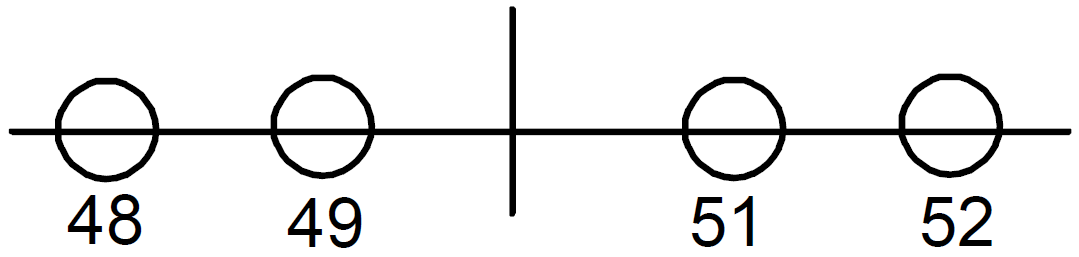
Consider the two particles at the position 49 cm and 51 cm . Moment inertial due to these two particle will be $=49 \times$ $1^2+51+1^2=100 \mathrm{gm}-\mathrm{cm}^2$ Similarly, if we consider $48^{\text {th }}$ and $52^{\text {nd }}$ term we will get $100 \times 2^2 \mathrm{gm}-\mathrm{cm}^2$ Therefore we will get 49 such set and one lone particle at 100 cm . Therefore total moment of inertia $=100\big\{1^2+2^2+3^2+\dots+49^2\big\}+100(50)^2$ $=100\times\frac{(50\times51\times101)}{6}=4292500\text{gm}\text{-cm}^2$ $=0.429\text{kg}-\text{m}^2=0.43\text{kg}\text{-m}^2$ View full question & answer→Question 405 Marks
The oxygen molecule has a mass of $5.30 \times 10^{-26}kg$ and a moment of inertia of $1.94 \times 10^{-46}kgm^2$ about an axis through its centre perpendicular to the lines joining the two atoms. Suppose the mean speed of such a molecule in a gas is 500m/s and that its kinetic energy of rotation is two thirds of its kinetic energy of translation. Find the average angular velocity of the molecule.
AnswerMass of an oxygen molecule, $m = 5.30 \times 10^{-26}kg$ Moment of inertia, $I = 1.94 \times 10^{-46}kgm^2$^ Velocity of the oxygen molecule, v = 500m/s The separation between the two atoms of the oxygen molecule = 2r Mass of each oxygen atom $=\frac{\text{m}}{2}$ Hence, moment of inertia I, is calculated as, $\Big(\frac{\text{m}}{2}\Big)\text{r}^2+\Big(\frac{\text{m}}{2}\Big)\text{r}^2=\text{mr}^2$
$\text{r}=\Big(\frac{\text{l}}{\text{m}}\Big)^{\frac{1}{2}}$
$\Big(\frac{1.94\times10^{-46}}{5.36\times10^{-26}}\Big)=0.60\times10^{-10}\text{m}$ It is given that, $\text{kE}_{\text{rot}}=\Big(\frac{2}{3}\Big)\times\Big(\frac{1}{2}\Big)\times\text{mv}^2$
$\text{m}\text{r}^2\omega^2=\Big(\frac{2}{3}\Big)\text{mv}^2$
$\omega=\Big(\frac{2}{3}\Big)^{\frac{1}{2}}\Big(\frac{\text{v}}{\text{r}}\Big)$
$\omega=\Big(\frac{2}{3}\Big)^{\frac{1}{2}}\Big(\frac{500}{0.6\times10^{-10}}\Big)$
$\omega=6.80\times10^{12}\text{rad/s}$
View full question & answer→Question 415 Marks
A uniform disc of radius R is put over another uniform disc of radius 2R of the same thickness and density. The peripheries of the two discs touch each other. Locate the centre of mass of the system.
AnswerLet the centre of the bigger disc be the origin. 2R = Radius of bigger disc R = Radius of smaller disc $\text{m}_1=\pi\text{R}^2\times\text{T}\times\rho$ $\text{m}_2=\pi(\text{2R})^2\times\text{T}\times\rho$ where T = Thickness of the two discs $\rho=$ Density of the two discs $\therefore$ The position of the centre of mass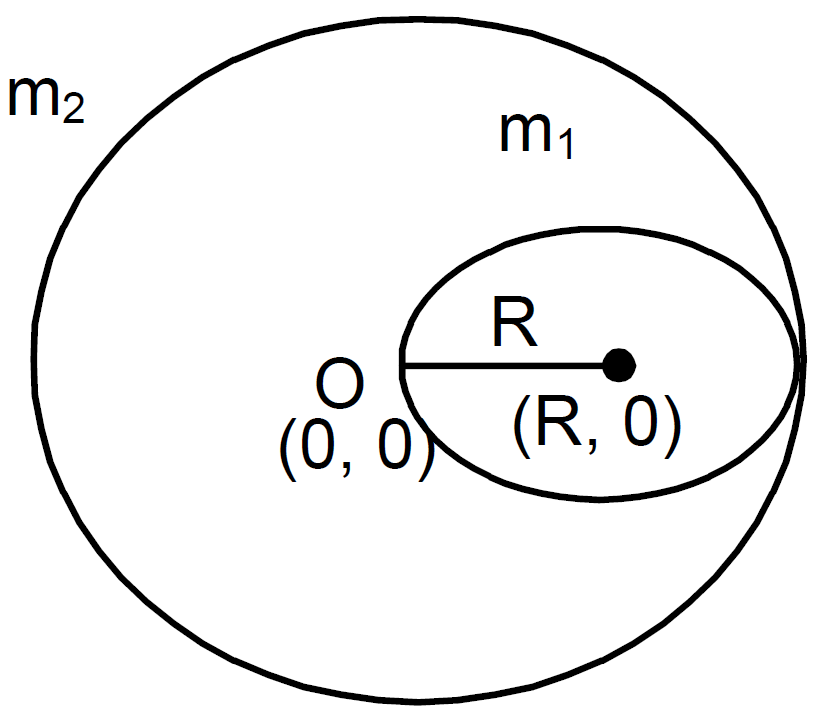
$\Big(\frac{\text{m}_1\text{x}_1+\text{m}_2\text{x}_2}{\text{m}_1+\text{m}_2},\frac{\text{m}_1\text{y}_1+\text{m}_2\text{y}_2}{\text{m}_1+\text{m}_2}\Big)$ $\text{x}_1=\text{R},\ \text{y}_1=0$ $\text{x}_2=0,\ \text{y}_2=0$ $\Big(\frac{\pi\text{R}^2\text{T}\rho\text{R}+0}{\pi\text{R}^2\text{T}\rho+\pi(2\text{R})^2\text{T}\rho},\frac{0}{\text{m}_1+\text{m}_2}\Big)=\Big(\frac{\pi\text{R}^2\text{T}\rho\text{R}}{5\pi\text{R}^2\text{T}\rho},0\Big)=\Big( \frac{\text{R}}{5},0\Big)$ At $\frac{\text{R}}5{}$ from the centre of bigger disc towards the centre of smaller disc. View full question & answer→Question 425 Marks
A uniform sphere of mass m and radius R is placed on a rough horizontal surface. The sphere is struck horizontally at a height h from the floor. Match the following: 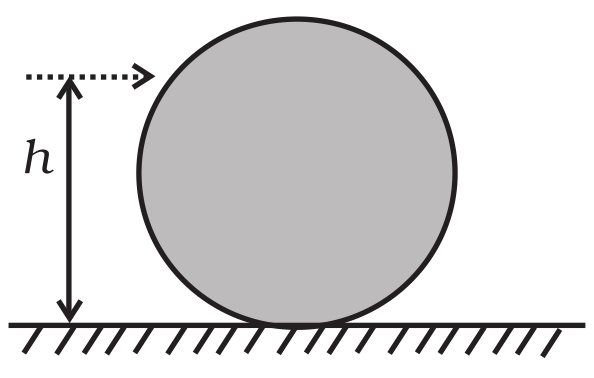
| a. |
$\text{h}=\frac{\text{R}}{2}$ |
i. |
Sphere rolls without slipping with a constant velocity and no loss of energy. |
| b. |
$\text{h}=\text{R}$ |
ii. |
Sphere spins clockwise, loses energy by friction. |
| c. |
$\text{h}=\frac{3\text{R}}{2}$ |
iii. |
Sphere spins anti-clockwise, loses energy by friction. |
| d. |
$\text{h}=\frac{7\text{R}}{5}$ |
iv. |
Sphere has only a translational motion, looses energy by friction. |
Answer
|
a.
|
$\text{h}=\frac{\text{R}}{2}$
|
i.
|
Sphere spins anti-clockwise, loses energy by friction.
|
|
b.
|
$\text{h}=\text{R}$
|
ii.
|
Sphere has only a translational motion, looses energy by friction.
|
|
c.
|
$\text{h}=\frac{3\text{R}}{2}$
|
iii.
|
Sphere spins clockwise, loses energy by friction.
|
|
d.
|
$\text{h}=\frac{7\text{R}}{5}$
|
iv.
|
Sphere rolls without slipping with a constant velocity and no loss of energy.
|
Explanation:
Mass of the sphere = m
Radius = R
h = height from the floor The sphere will roll without slipping when
$\omega=\frac{\text{V}}{\text{R}}$
where, v is linear velocity and to is angular velocity of the sphere.
Now, angular momentum of sphere, about centre of mass [We are applying conservation of angular momentum just before and after struck]
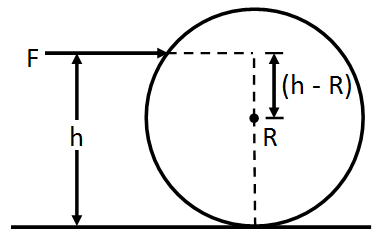
$\text{mv}(\text{h}-\text{R})=\text{I}\omega=\Big(\frac{2}{5}\text{mR}^2\Big)\Big(\frac{\text{v}}{\text{R}}\Big)$
$\Rightarrow\text{mv}(\text{h}-\text{R})=\frac{2}{5}\text{mvR}$
$\Rightarrow\text{h}-\text{R}=\frac{2}{5}\text{R}$
$\Rightarrow\text{h}=\frac{7}{5}\text{R}$
Therefore, the sphere will roll without slipping with a constant velocity and hence, no loss of energy when $\text{h}=\frac{7}{5}\text{R},$ so, (d) matches with (i).
Torque due to applied force about $\text{C.M}.,\tau=\text{F}(\text{h}-\text{R})$ (clockwise)
For, $\tau=0,\text{ h}=\text{R}$ sphereb will have only translationa motion. It would lose energy by friction. View full question & answer→Question 435 Marks
A uniform wheel of radius R is set into rotation about its axis at an angular speed $\omega.$ This rotating wheel is now placed on a rough horizontal surface with its axis horizontal. Because of friction at the contact, the wheel accelerates forward and its rotation decelerates till the wheel starts pure rolling on the surface. Find the linear speed of the wheel after it starts pure rolling.
AnswerA uniform wheel of radius R is set into rotation about its axis (case-I) at an angular speed $\omega.$ 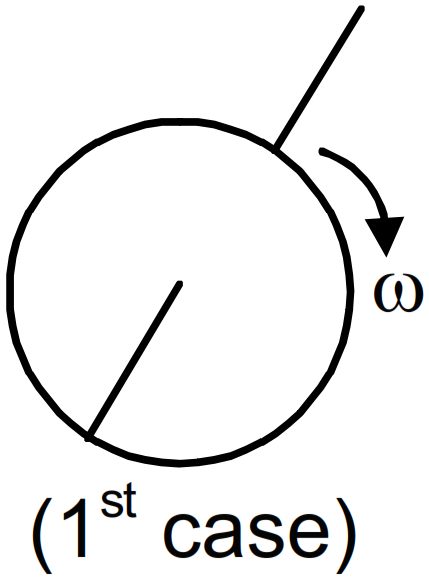 This rotating wheel is now placed on a rough horizontal. Because of its friction at contact, the wheel accelerates forward and its rotation decelerates. As the rotation decelerates the frictional force will act backward.
 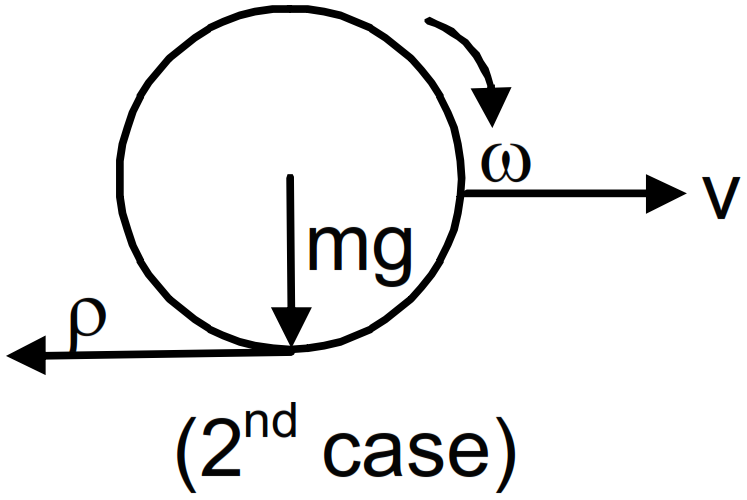 If we consider the net moment at A then it is zero. Therefore the net angular momentum before pure rolling & after pure rolling remains constant Before rolling the wheel was only rotating around its axis. Therefore Angular momentum $=\ell\omega=\Big(\frac{1}{2}\Big)\text{MR}^2\omega\ \dots(1)$ After pure rolling the velocity of the wheel let v Therefore angular momentum $=\ell_{\text{cm}}\omega+\text{m}(\text{v}\times\text{R})$ $=\Big(\frac{1}{2}\Big)\text{m}\text{R}^2\Big(\frac{\text{v}}{\text{R}}\Big)+\text{mvR}=\frac{3}{2}\text{mvR}\ \dots(2)$ Because, Eq. (1) and (2) are equal Therefore, $\frac{3}{2}\text{mvR}=\frac{1}{2}\text{mR}^2\omega$ $\Rightarrow\text{V}=\omega\frac{\text{R}}{3}$
 View full question & answer→Question 445 Marks
The door of an almirah is 6ft high, 1.5ft wide and weighs 8kg. The door is supported by two hinges situated at a distance of 1ft from the ends. If the magnitudes of the forces exerted by the hinges on the door are equal, find this magnitude.
Answer
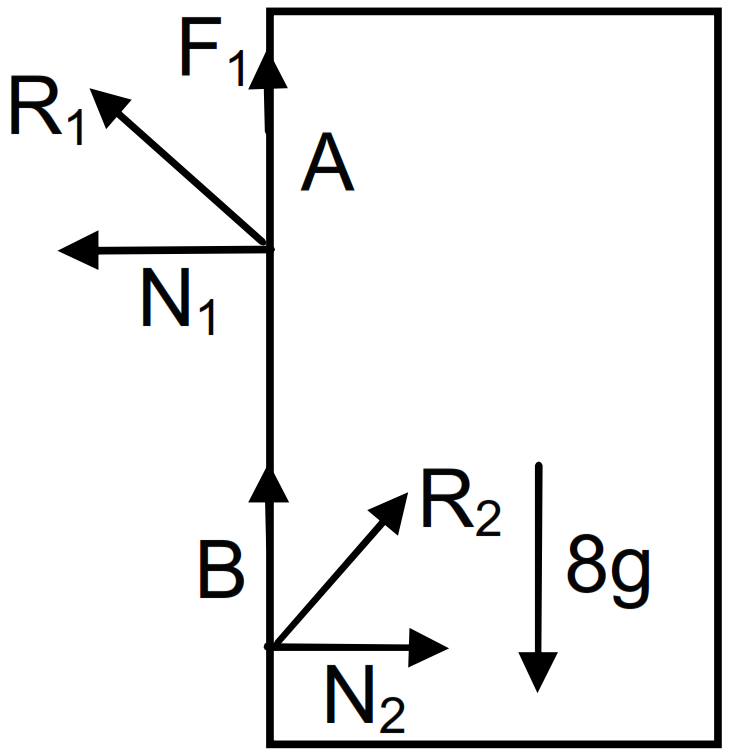
According to the question
$8 g=F_1+F_2 ; N_1=N_2$
Since, $R_1=R_2$
Therefore $\mathrm{F}_1=\mathrm{F}_2$
$\Rightarrow 2 \mathrm{~F}_1=8 \mathrm{~g}$
$\Rightarrow \mathrm{~F}_1=40$
Let us take torque about the point B , we will get $\mathrm{N}_1 \times 4=8 \mathrm{~g} \times 0.75$.
$\Rightarrow\text{N}_1=\frac{(80\times3)}{(4\times4)}=15\text{N}$
Therefore $\sqrt{\Big(\text{F}_1^2+\text{N}_1^2\Big)}=\text{R}_1$
$\sqrt{40^2+15^2}=42.72=43\text{N.}$ View full question & answer→Question 455 Marks
A uniform rod of length L lies on a smooth horizontal table. A particle moving on the table strikes the rod perpendicularly at an end and stops. Find the distance travelled by the centre of the rod by the time it turns through a right angle. Show that if the mass of the rod is four times that of the particle, the collision is elastic.
Answer
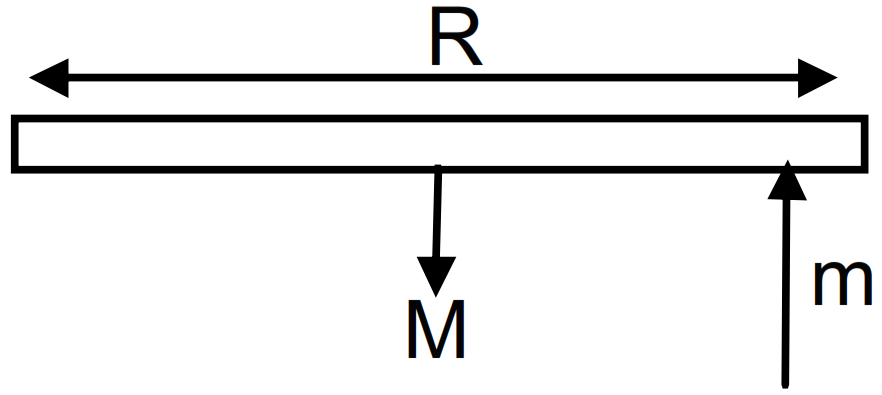 Let the mass of the particle = m & the mass of the rod = M.
Let the particle strikes the rod with a velocity V.
If we take the two body to be a system.
Therefore the net external torque & net external force = 0
Therefore Applying laws of conservation of linear momentum MV' = mV (V' = velocity of the rod after striking)
$\Rightarrow\frac{\text{V}'}{\text{V}}=\frac{\text{m}}{\text{M}}$
Again applying laws of conservation of angular momentum
$\Rightarrow\frac{\text{mVR}}{2}=\ell\omega$
$\Rightarrow\frac{\text{mVR}}{2}=\frac{\text{MR}^2}{12}\times\frac{\pi}{2\text{t}}$
$\Rightarrow\text{t}=\frac{\text{MR}\pi}{\text{m}\times12\times\text{V}}$
Therefore distance travelled:
$\text{V}'\text{t}=\text{V}'\Big(\frac{\text{MR}\pi}{\text{m}\times12\times\pi}\Big)$
$=\frac{\text{m}}{\text{M}}\times\frac{\text{M}}{\text{m}}\times\frac{\text{R}\pi}{12}=\frac{\text{R}\pi}{12}$ View full question & answer→Question 465 Marks
A body is in translational equilibrium under the action of coplanar forces. If the torque of these forces is zero about a point, is it necessary that it will also be zero about any other point?
AnswerYes, if the torque due to forces in translation equillibriumis zero about a point, it will be zero about other point in the plane.
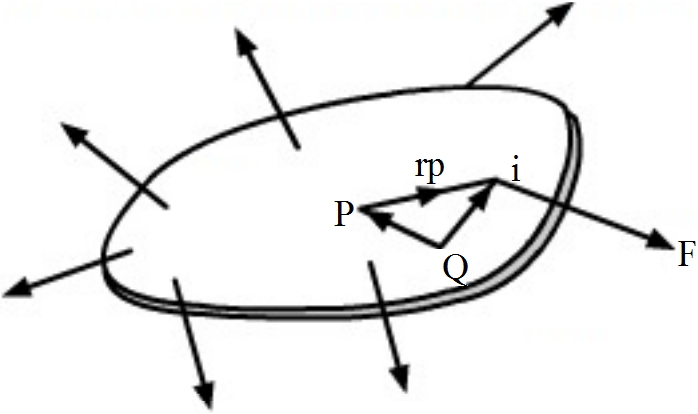
Let us consider a planner lamina of some mass, acted upon by forces $\vec{\text{F}}_1,\ \vec{\text{F}}_2,\ \dots\ \vec{\text{F}}_{\text{i,}}$ etc. Let a force $\vec{\text{F}}_1$ act on a $i^{th}$ particle and torque due to $\vec{\text{F}}_{\text{i}}$ be zeroat a point Q. Since the body is in translation equillibrium, we have: $\sum \vec{\text{F}}_{\text{i}}=0\ \dots(1)$ Again, torque about P is zero. Therefore, we have: $\sum\Big(\vec{\text{r}}_{\text{pi}}\times \vec{\text{F}}_{\text{i}}\Big)=0\ \dots(2)$ Now, torque about point Q will be: $\sum\vec{\text{r}}_{\text{Qi}}\times \vec{\text{F}}_{\text{i}}$
$=\sum\Big( \overrightarrow{\text{r}}_{\text{QP}}+ \overrightarrow{\text{r}}_{\text{pi}}\Big)\times \overrightarrow{\text{F}}_{\text{i}}$ [From fig.] $=\sum\Big( \vec{\text{r}}_{\text{Qp}}\times \vec{\text{F}}_{\text{i}}+ \vec{\text{r}}_{\text{pi}}\times \vec{\text{F}}_{\text{i}}\Big)$
$= \overrightarrow{\text{r}_{\text{Qp}}}\times \overrightarrow{\text{F}}_{\text{i}}+ \overrightarrow{\text{r}_{\text{pi}}}\times \overrightarrow{\text{F}}_{\text{i}}$
$=\sum \overrightarrow{\text{r}_{\text{QP}}}\times\sum \overrightarrow{\text{F}}_{\text{i}}+0$ [From (2)] $ \overrightarrow{\text{r}_{\text{Qp}}}\times0$ [From (1)] $=0$ Thus, $\overrightarrow{\text{F}}$ is zero about any other point Q. View full question & answer→Question 475 Marks
A grindstone has a moment of inertia of $6kg m^2$. A constant torque is applied and the grindstone is found to have a speed of $150rpm, 10s$. after starting from rest. Calculate the torque.
AnswerHere, Moment of inertia of grindstone, $I = 6kgm^2$ Initial angular velocity $\omega_1=0$ Final angular velocity, $\omega_2=2\pi\text{n}=2\pi\times\frac{150}{60}$
$=5\pi\text{ rad/sec}^2$ Time for which torque acts, $\text{t}=10\text{\sec.}$
$\therefore$ Angular acceleration $(\alpha)=\frac{\omega_2-\omega_1}{\text{t}}$
$=\frac{5\pi-0}{10}=\frac{\pi}{2}\text{rad/sec}^2$ As $\tau=\text{I}\alpha$
$\therefore\tau=6\times\frac{\pi}{2}=3\pi\text{Ns}.$
View full question & answer→Question 485 Marks
A 6.5m long ladder rests against a vertical wall reaching a height of 6.0m. A 60kg man stands half way up the ladder.
- Find the torque of the force exerted by the man on the ladder about the upper end of the ladder.
- Assuming the weight of the ladder to be negligible as compared to the man and assuming the wall to be smooth, find the force exerted by the ground on the ladder.
Answer
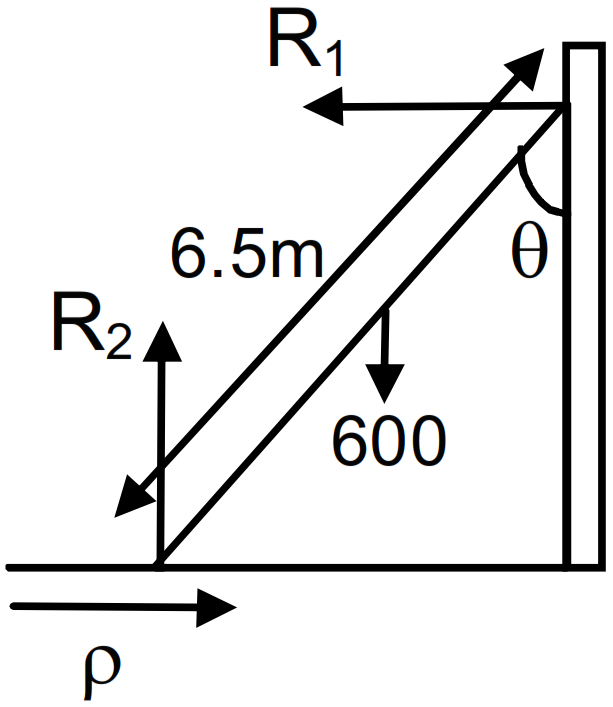 m = 60kg, ladder length = 6.5m, height of the wall = 6m
Therefore torque due to the weight of the body
- $\tau=\frac{600\times6.5}{2\sin\theta}=\text{i}$
$\Rightarrow\tau=\frac{600\times6.5}{2\times\sqrt{\big[1-\big(\frac{6}{6.5}\big)^2\big]}}$
$\Rightarrow\tau=735\text{N-m}$
- $\text{R}_2=\text{mg}=60\times9.8$
$\text{R}_1=\mu\text{R}_2$
$\Rightarrow6.5\text{R}_1\cos\theta=60\text{g}\sin\theta\times\frac{6.5}{2}$
$\Rightarrow\text{R}_1=60\text{g}\tan\theta=60\text{g}\times\Big(\frac{2.5}{12}\Big)\ \Big[$Because $\tan\theta=\frac{2.5}{6}\Big]$
$\Rightarrow\text{R}_1=\Big(\frac{25}{2}\Big)\text{g}=122.5\text{N}$ View full question & answer→Question 495 Marks
Calculate the total torque acting on the body shown in figure about the point O.
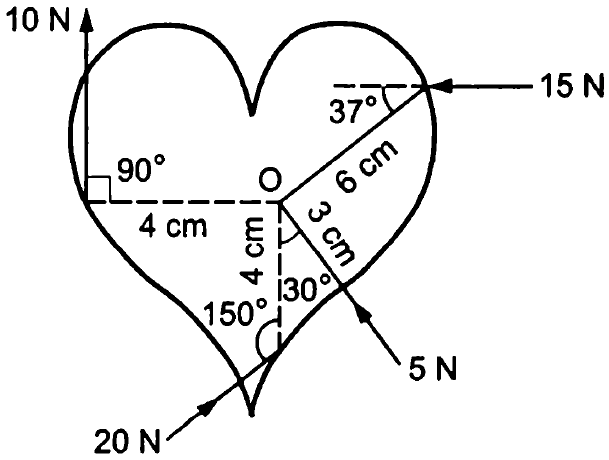
AnswerTorque about a point = Total force \times perpendicular distance from the point to that force.
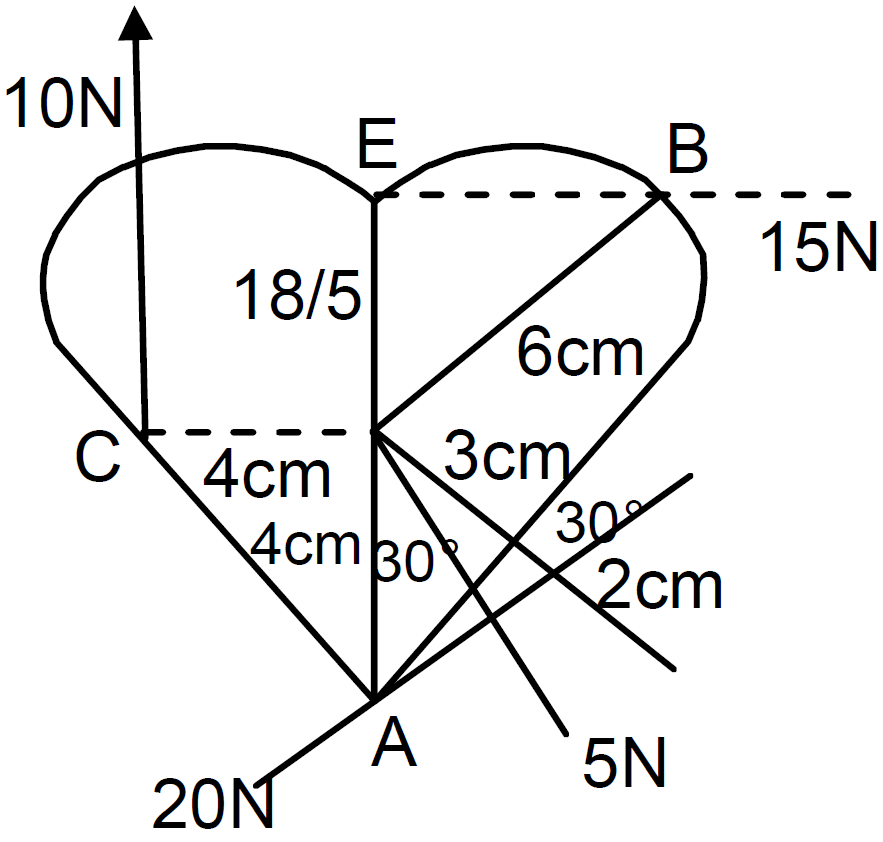
Let anticlockwise torque = +ve And clockwise acting torque = -ve Force acting at the point B is 15N Therefore torque at O due to this force $=15\times6\times10^{-2}\times\sin37^\circ$
$=15\times6\times10^{-2}\times\frac{3}{5}=0.54\text{N-m}$ (anticlock wise) Force acting at the point C is 10N Therefore, torque at O due to this force = $10 \times 4 \times 10^{-2} = 0.4N-m$ (clockwise) Force acting at the point A is 20N Therefore, Torque at O due to this force $=20\times4\times10^{-2}\times\sin30^{\circ}$
$=20\times4\times10^{-2}\times\frac{1}{2}=0.4\text{N-m}$ (anticlockwise) Therefore resultant torque acting at ‘O’ = 0.54 - 0.4 + 0.4 = 0.54N-m. View full question & answer→Question 505 Marks
A comet revolves around the sun in a highly elliptical orbit having a minimum distance of $7 \times 10^{10}m$ and a maximum distance of $1.4 \times 10^{13}m$. If its speed while nearest to the Sun is $60km s^{-1}$, find its linear speed when situated farthest from the Sun.
AnswerLet mass of comet be M and its angular speed be w when situated at a distance r from the Sun, then its angular momentum $L = I w = Mr^2w$ If v be the linear speed, then $L = Mr^2w = Mrv$ In accordance with conservation law of angular momentum, we can write that $\text{Mr}_1\text{v}_1=\text{mr}_2\text{v}_2$
$\therefore\text{v}_2=\frac{\text{r}_1\text{v}_1}{\text{r}_2}=\frac{7\times10^{10}\text{m}\times60\text{km/s}}{1.4\times10^{13}\text{m}}$ $=0.3\text{km/s}\text{ or }300\text{m/s.}$
View full question & answer→