Question 11 Mark
Methanol is now prepared from:
Answer
- Both A and B
Explanation:
On an industrial scale, methanol is predominantly produced from natural gas by reforming the gas with steam and then converting and distilling the resulting synthesized gas mixture to create pure methanol. The result is a clear, liquid, organic chemical that is water-soluble and readily biodegradable.
Some methanol can be produced during fermentation, but this is not derived from the ethanol or by carbohydrate oxidation. It is produced in small amounts, either by non-enzymatic reactions or through the reduction of formaldehyde.
View full question & answer→Question 21 Mark
Which of the following can not be the product of this reaction?
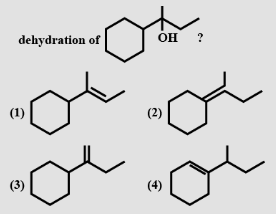
Answer
- 4
Explanation:
In the mechanism of dehydration, after the removal of water, elimination of a Hydrogen atom only occurs from an $\alpha$−Carbon atom. Thus, it is quite evident that (4) can not be the product of this reaction. View full question & answer→Question 31 Mark
Acid catalysed hydration of alkenes except ethene leads to the formation of.
Answer
- Secondary or tertiary alcohol.
Explanation:
Alkenes react with water in the presence of acid as a catalyst to form alcohol. In case of unsymmetrical alkenes, OH is added to the carbon having fewer hydrogen atoms according to Markovnikov's rule.
Hence, acid catalyzed hydration of alkenes except ethene leads to the formation of secondary or tertiary alcohol. To obtain primary alcohol, hydroboration oxidation is used.
View full question & answer→Question 41 Mark
IUPAC name of the given compound is:
$\text{H}_3\text{C}\text{−CH}−\text{CH}_2\text{−CH}\text{−CH}−\text{CH}_2−\text{CH}_3\\ \ \ \ \ \ \ \ \ \ \ \ \ \ | \ \ \ \ \ \ \ \ \ \ \ \ \ \ \ \ \ \ \ \ | \ \ \ \ \ \ \ \ | \\ \ \ \ \ \ \ \ \ \ \ \ \ \text{OH} \ \ \ \ \ \ \ \ \ \ \ \ \ \text{OH} \ \ \ \ \text{C}_2\text{O}_5$
Answer
- 5-ethylheptane-2.4-diol
Explanation:
The compound have ethyl group at carbon no 5, two hydroxyl groups at carbon no 2 and 4. So its name is 5−ethylheptane−2.4−diol.
View full question & answer→Question 51 Mark
Which of the following statement is not correct?
AnswerPhenol does not react with $\ce{Na_2CO_3}$ because it is weaker acid than carboxylic acid and thereby do not have the strength to substitute or give away its $H+$ ions to that of weak bases like sodium carbonate.
Phenol is used for the preparation of aspirin which is used as an analgesic as well as antipyretic drugs.
Phenol is more soluble in water than chlorobenzene due to formation of $H-$bond with water molecules.
$o-$nitrophenol form intramolecular $H-$bonding while $p-$nitrophenol form intermolecular $H-$bonding.
Due to this, nature $o-$nitrophenol has a lower boiling point than $p-$nitrophenol.
View full question & answer→Question 61 Mark
The other name for Syngas is:
Answer
- Water gas
Explanation:
Syngas is also called as water gas which is a mixture of carbon monoxide and hydrogen.
View full question & answer→Question 71 Mark
How many alcohols with molecular formula $\ce{C_4H_{10}O}$ are chiral in nature?
Answer Only one alcohol contains chiral carbon atom.
- $\ce{CH_3CH_2CH_2CH_2OH}$
- $\ \ \ \ \ \ \ \ \ \ \ \ \ \text{CH}_3 \\ \ \ \ \ \ \ \ \ \ \ \ \ \ \ | \\ \text{CH}_3 - \text{C} - \text{OH} \\ \ \ \ \ \ \ \ \ \ \ \ \ \ \ | \\ \ \ \ \ \ \ \ \ \ \ \ \ \ \text{CH}_3$
- $\text{CH}_3\text{CH}_2\text{CH} - \text{CH}_3 \\ \ \ \ \ \ \ \ \ \ \ \ \ \ \ \ \ | \\ \ \ \ \ \ \ \ \ \ \ \ \ \ \ \ \text{OH}$
Only $III$ is chiral in nature. View full question & answer→Question 81 Mark
The boiling point of methanol is greater than that of methyl thiol because:
Answer
- There is intermolecular hydrogen bonding in methanol and no hydrogen bonding in methyl thiol.
Explanation:
Methanol has high boiling point than methyl thiol because there is intermolecular hydrogen bonding in methanol and no hydrogen bonding in methyl thiol.
View full question & answer→Question 91 Mark
Which reagent is suitable for this conversion?
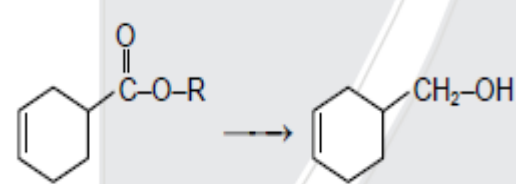
AnswerSuitable Reagent for this conversion is $\ce{LiAlH_{4}}.$
View full question & answer→Question 101 Mark
Which of the following alcohol on dehydration will produce a pair of isomeric alkene?
Question 111 Mark
Which of the following alcohols is dehydrated most easily with conc. $\ce{H_2SO_4}$?
Answer
- $\ce{p−CH_3OC_6H_4CH(OH)CH_{3}}$
The dehydration reaction is as: Alcohol $+ H_2SO_{4 }$
$\rightarrow$ alkene is an elimination reaction that goes via carbocation formation.
Higher is the stability of carbocation more easily it can be dehydrated.
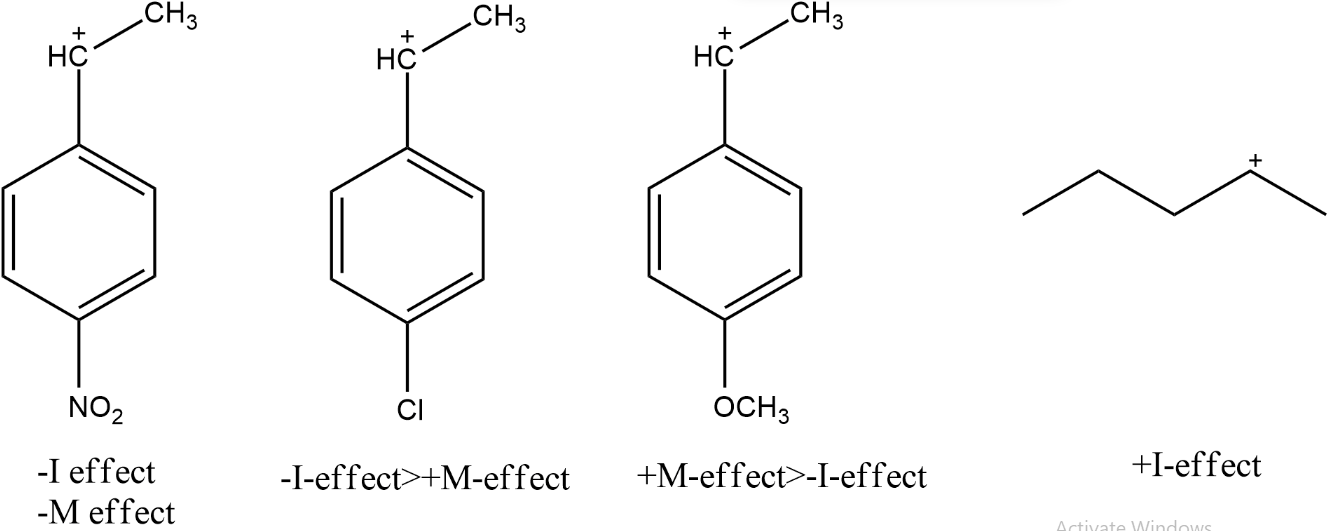
The corresponding carbocations formed by given molecules are shown in the figure.
Due to the $--$Inductive effect $(-I)$and $--$Mesomeric effect $(-M)$ of $NO_2$ group, it will decrease the electron density on benzene and will, therefore, destabilise the carbocation the most and makes it difficult to dehydrate.
In case of $\ce{p−ClC_6H_4CH(OH)CH_3}$, the Cl has stronger $-I$ effect $($due to high electronegativity$)$ than its +M effect (due to a lone pair of electrons) thus will destabilise the carbocation and unfavour dehydration.
In case of $\ce{p−CH_3OC_{6}H_4CH(OH)CH_3}$, the $CH_3O$ has the stronger $+M$ effect due to a lone pair of electrons on $O$ than its $-I$ effect and will stabilise the carbocation by increasing the electron density in the benzene ring and will favour dehydration.
$\ce{C_3H_5CH(OH)CH_3}$ has $+I$ effect that stabilises the carbocation but its impact is lower than the $+-$mesomeric effect of the methoxy group.
The alcohol that is dehydrated most easily with conc. $\ce{H_{2}SO_4}$ is $\ce{p−CH_3OC_{6}H_4CH(OH)CH_3}$
View full question & answer→Question 121 Mark
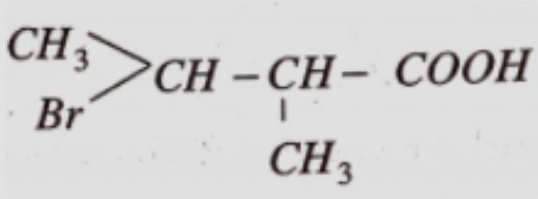
Give the IUPAC name of the above compound.
Answer
- 3-Bromo 2-methyl butanoic acid.
View full question & answer→Question 131 Mark
Correct order of acidic strength.
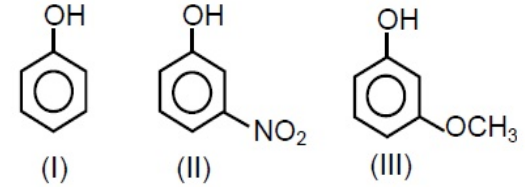
Answer
- II>III>I
Explanation:
Acidic nature $\alpha$−I
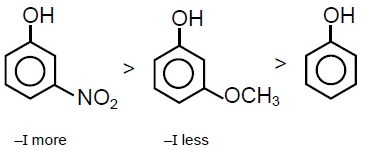
View full question & answer→Question 141 Mark
In an aqueous solution at $25^\circ C$ has twice as many $OH^-$ as pure water its $\ce{pOH}$ will be$:$
AnswerWe know that pure water at $25^\circ C$ has $10^{−7}M$ of $OH^−.$
According to the problem, the aqueous solution at the same temperature has $2 \times 10^{−7}\ce{M OH^−}$
Therefore, its $\ce{pOH} = −\log(2\times 10^{−7})$
$\ce{pOH} = 6.6989$
or, $\ce{pOH} = 6.699$
View full question & answer→Question 151 Mark
Which of the following is most acidic?
Answer
- m-Chlorophenol
Explanation:
Alcohols are less acidic than phenol. Further electron withdrawing group (like - Cl) increases the acidity of phenol, therefore, m-chlorophenol is most.
View full question & answer→Question 161 Mark
Give IUPAC name of the compound given below.
$\text{CH}_3-\text{CH}-\text{CH}_2-\text{CH}_2-\text{CH}-\text{CH}_3 \\ \ \ \ \ \ \ \ \ \ \ \ \ \ \ | \ \ \ \ \ \ \ \ \ \ \ \ \ \ \ \ \ \ \ \ \ \ \ \ \ \ \ \ \ \ \ \ \ \ \ | \\ \ \ \ \ \ \ \ \ \ \ \ \ \ \text{Cl} \ \ \ \ \ \ \ \ \ \ \ \ \ \ \ \ \ \ \ \ \ \ \ \ \ \ \ \ \ \ \ \ \text{CH}$
Answer
- 5-Chlorohexan-2-ol.
Explanation:
Priority will be given to -OH group.
View full question & answer→Question 171 Mark
The IUPAC name of the following compound is:
Answer
- 3-cyclohexylpentan-3-ol
Explanation:
The IUPAC name of the given compound is 3-Cyclohexylpentan-3-ol.
The parent compound contains 5 C atoms and is named pentane.
A hydroxyl group is present at third C atom.
Hence, the last alphabet e of pentane is replaced with the suffix -3-ol.
A cyclohexyl ring is present as substituent at third carbon atom.
View full question & answer→Question 181 Mark
Phenol is less acidic than ______________.
Answer
- o-nitrophenol.
Explanation:
In substituted phenols, the presence of electron withdrawing group such as nitro group, enhances the acidic strength of phenol. This effect is more pronounced when such a group is present at ortho and para positions. It is due to the effective delocalisation of negative charge in phenoxide ion. On the other hand, electron releasing groups, such as alkyl groups, in general, do not favour the formation of phenoxide ion resulting in decrease in acid strength. Cresols, for example, are less acidic than phenol.
View full question & answer→Question 191 Mark
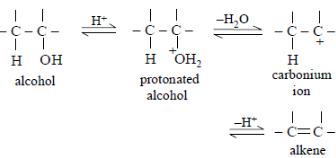
During dehydration of alcohols to alkenes by heating with conc. $\ce{H_2SO_{4}},$ the initiation step is$:$
AnswerDehydration of alcohol to alkene in presence of concentrated $\ce{H_2SO_{4}}$ involves following steps$:$
Thus, the initiation step is protonation of alcohol.
View full question & answer→Question 201 Mark
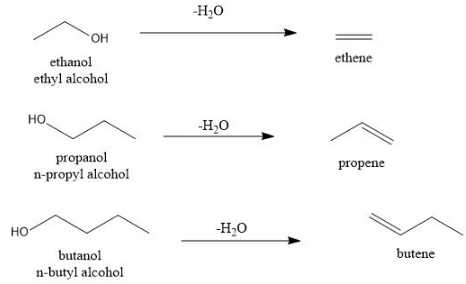
Which of the following alcohol does not give a stable compound on dehydration?
AnswerAlcohols undergo dehydration $($removal of water$)$ to form an alkene.
To form alkene, we need at least two carbon atoms. But, methanol $\ce{(CH_3OH)}$ has only one carbon atom. So, it does not give a stable compound on dehydration.
View full question & answer→Question 211 Mark
Which of the following substance will increase the acidity of phenol?
AnswerDilute $\ce{H_{2}SO_{4}}$ will increase the acidity of phenol. This is because now phenol will be easily able to donate $H^+$ ion and delocalise its negative charge more efficiently. Also addition of dilute $\ce{H_2SO_4}$ which is itself an acid increases the acidity of phenol.
View full question & answer→Question 221 Mark
Among the three isomers of the nitrophenol, the one that is least soluble in water is:
Answer
- o-nitrophenol
Explanation:
Intramolecular hydrogen bonding in ortho-substituted nitrophenol reduces water solubility and increases volatility.
Thus, o-nitrophenol is steam distillable while the isomeric p-nitrophenol is soluble in water.
View full question & answer→Question 231 Mark
What type of spectroscopy would be the best tool to analyze a clear and colorless solution for the presence of a functional group like an alcohol group (−OH)?
Answer
- IR spectroscopy.
Explanation:
Functional groups are best analyzed by IR spectroscopy. IR is infrared spectroscopy that works in IR region of electromagnetic radiations. stretching frequencies of functional groups are measured due to their vibration around bonds. Every functional groups have their particular stretching frequency range.In this way functional groups are analyzed by IR.
View full question & answer→Question 241 Mark
$3-$methyl$-2-$pentene on reaction with $\ce{HOCl}$ gives$:$
AnswerThe given reaction follows Markownikoff's addition mechanism and add $OH^−$ and $Cl^+$ across carbon$-$carbon double bond.
View full question & answer→Question 251 Mark
Write the $\ce{IUPAC}$ name of the given compound:$\text{HO}−\text{CH}_2−\text{CH}−\text{CH}_2−\text{OH}\\ \ \ \ \ \ \ \ \ \ \ \ \ \ \ \ \ \ \ \ \ \ \ ∣ \\ \ \ \ \ \ \ \ \ \ \ \ \ \ \ \ \ \ \ \ \ \text{CH}_3$
AnswerThe given compound can be numbered from left to right or vice versa. At the $2^{nd}$ position, there is a methyl group and is designated as $2-$Methyl.
The parent carbon chain contains $3$ carbon atoms resembling propane and at the positions $1$ and $3,$ there's the hydroxyl group designated as $1, 3-$diol.
So the $\ce{IUPAC}$ name of the given compound is $2-$Methylpropane$-1, 3-$diol.
View full question & answer→Question 261 Mark
Which of the following compounds will react with sodium hydroxide solution in water?
AnswerPhenol being more acidic reacts with sodium hydroxide solution in water to give sodium phenoxide which is resonance stabilized. Alcohols are very weak acids. $\ce{C_6H_5OH + NaOH \rightarrow C_6H_5ONa + H_2O}$
View full question & answer→Question 271 Mark
Monochlorination of toluene in sunlight followed by hydrolysis with aq. NaOH yields.
Answer
- Benzyl alcohol.
Explanation:
Monochlorination of toluene in sunlight gives benzyl chloride. On hydrolysis with aq. NaOH, benzyl chloride, shows nucleophilic substitution reaction to give benzyl alcohol.
View full question & answer→Question 281 Mark
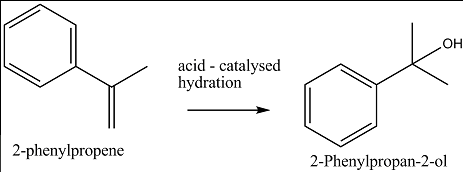
The major product obtained on acid - catalysed hydration of 2-phenylpropene is:
Answer
- 2-phenylpropan-2-ol
Explanation:
The major product obtained on acid - catalysed hydration of 2-phenylpropene is 2-Phenylpropan-2-ol. A molecule of water is added to C=C double bond. −OH group is added to more substituted C atom.
View full question & answer→Question 291 Mark
Which of the following combinations can be used for the preparation of cis vic diol?
AnswerOsmium tetroxide $\ce{(OsO_4)}$ is a volatile liquid that is most useful for the synthesis of $1,2$ diols from alkene.
The $\ce{OsO_4}$ is a catalyst. It reacts with the $\pi$ electrons of the alkene in a syn addition to form a cyclic osmate ester.
The $OH^-$ hydrolyzes the ester. This forms the cis$-$diol and $\ce{H_2OsO_4}.$
View full question & answer→Question 301 Mark
The order of reactivity of the following alcohols towards dehydration is$:$
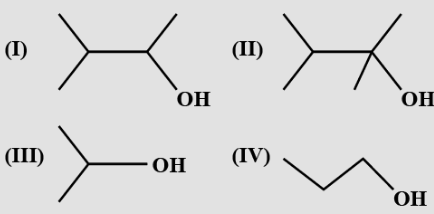
AnswerReactivity of alcohol towards dehydration is increased by the stability of the carbocation formed subsequently. Order of carbocation stability is$:$ tertiary $>$ secondary $>$ primary.
Also presence of $+I$ groups like $CH_3$ increases the stability.
According to this the order of reactivity is, $II>I>III>IV$
View full question & answer→Question 311 Mark
What is the $\text{IUPAC}$ name of the following compound? $\ce{CH_3−CH_2−CH_2−OH}$
AnswerIn this compound, the number of carbon atoms is $3.$ So, the parent alkane is propane.
The functional group present is $−OH$
i.e alcohol. $−OH$ is present at the first carbon atom.
Thus the $\text{IUPAC}$ name is Propan $- 1 - $ol.
View full question & answer→Question 321 Mark
$\ce{CH_3CH_2OH}$ can be converted into $\ce{CH_3CHO}$ by $.........$
AnswerAlcohols are oxidized to aldehydes and finally to acids.
$\text{CH}_3\text{CH}_2\text{OH}\xrightarrow{[\text{O}]}\text{CH}_3\text{CHO}\xrightarrow{[\text{O}]}\text{CH}_3\text{COOH}$
Oxidations can be stopped at aldehyde stage by using puridinium chlorochromate $\ce{(CrO_3C_5H_5N.HCl)}$
$\text{CH}_3\text{CH}_2\text{OH}\xrightarrow{\text{PCC}}\text{CH}_3\text{CHO}$
View full question & answer→Question 331 Mark
The common name for propan-2-ol is:
Answer
- iso-Propyl alcohol.
Explanation:
Isopropyl alcohol (IUPAC name 2-propanol), also called isopropanol or dimethyl carbinol.
View full question & answer→Question 341 Mark
Ethene reacts with $Y$ to produce ethanol. ethene $+ Y \rightarrow$ ethanol What is $Y$?
AnswerEthanol can be manufactured by hydration of ethene.
Ethene is heated with steam in the presence of a catalyst of phosphoric acid to produce ethanol.
$\ce{C_2H_{4 }+ H_2O \rightarrow C_2H_5−OH}$
View full question & answer→Question 351 Mark
Which of the following are used to convert $\text{RCHO}$ into $\ce{RCH_2OH}$?
AnswerAldehydes and ketones are reduced to the corresponding alcohols by addition of hydrogen in the presence of catalysts catalytic hydrogenation. It is also prepared by treating aldehydes and ketones with sodium borohydride $\ce{(NaBH_4)}$ or lithium aluminium hydride $\ce{(LiAlH_4)}.$
View full question & answer→Question 361 Mark
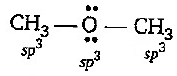
What is the hybridisation of carbon and oxygen in electronic structure of ether?
Answer$sp^3 (4-$bond pairs$)$ and $sp^{3 }(2-$bond pairs and $2-$lone pairs$)$ hybridisations of carbon and oxygen in the electronic structure of an ether.
View full question & answer→Question 371 Mark
The process of converting alkyl halides into alcohols involves_____________.
Answer
- Substitution reaction.
Explanation:
The reaction is a type of nucleophilic substitution reaction in which -Cl group is replaced by -OH.
View full question & answer→Question 381 Mark
The decreasing order of boiling points of the following alcohols is?
Answer$3-$methylbutan$-2-ol$ is a secondary alcohol $\ce{CH_3CH(CH_3)CH(OH)CH_{3}}$
$2-$methylbutan$-2-ol$ is a tertiary alcohol
$\ce{CH_{3}CH_2C(CH_3)(OH)CH_{3}}$
pentan$-1-ol$ is a primary alcohol
$\ce{CH_{3}CH_{2}CH_2CH_2CH_2OH}$
Boiling point of alcohols is determined by the ease and extent of $H-$bonding among the alcohol molecules. Tertiary alcohols being highly hindered will have least hydrogen bonding and thus low boiling point as compared to less hindered secondary alcohol.
Therefore the order of boiling point is primary alcohol $>$ secondary alcohol>tertiary alcohol as:
pentan$-1-ol > 3-$methylbutan$-2-ol > 2-$methylbutan$-2-ol.$
View full question & answer→Question 391 Mark
Which of the following compounds is aromatic alcohol?
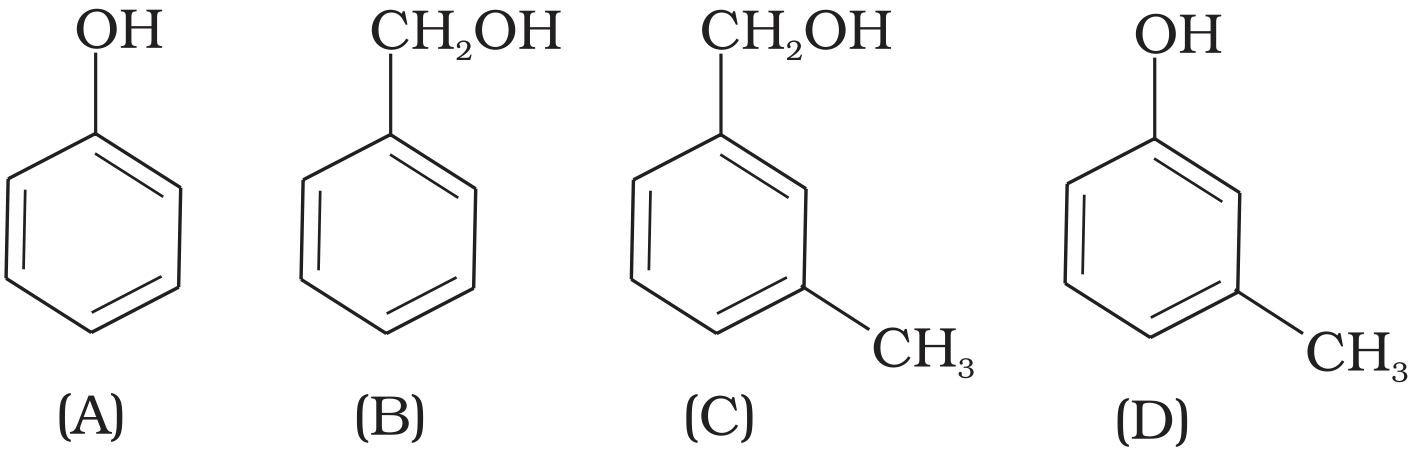
AnswerCompound $(A)$ i.e., phenol and compound $(D)$ i.e., a derivative of phenol cannot be considered as aromatic alcohol. As phenol is also known as, carbolic acid cannot be considered as aromatic alcohol.
Compound $(B)$ and $(C), -OH$ group is bonded to $sp^3$ hybridised carbon which in turn is bonded to benzene ring.
View full question & answer→Question 401 Mark
Which of the following is produced during the following reaction? $\text{CO(g)} + \text{H}_2\text{(g)}\xrightarrow[\text{ZnO}\text{Cr}_2\text{O}_3]{575\text{k}}$
AnswerMethanol is produced during the following reaction
$\text{CO(g)} + \text{H}_2\text{(g)}\xrightarrow[\text{ZnO}\text{Cr}_2\text{O}_3]{575\text{k}}\text{CH}_3\text{OH}$
A mixture of $CO$ and hydrogen $(1:2$ molar ratio$)$ is called synthetic gas.
It is heated to a temperature of $573K$ in presence of $\ce{ZnO/Cr_2O_3}$ catalyst to form methanol.
It is industrial method of preparation of methanol.
View full question & answer→Question 411 Mark
The IUPAC name of the following compound is:
Answer
- 1-Phenylpropan-2-ol
Explanation:
The IUPAC name of the given compound is 1-Phenylpropan-2-ol.
The parent hydrocarbon contains 3 C atoms and is named as propane.
A hydroxyl group (−OH) is present at second C atom.
Hence, the last alphabet e of propane is replaced with the suffix -2-ol.
A phenyl group is present as a substituent at first carbon atom.
View full question & answer→Question 421 Mark
Common name for methanol is:
Answer
- Wood spirit
Explanation:
Methanol acquired the name "wood spirit" because it was once produced chiefly as a byproduct of the destructive distillation of wood.
View full question & answer→Question 431 Mark
The $\text{IUPAC}$ name of $\ce{CH_{3}−C(CH_{3})(OH)CH_2−CH(CH_3)_2}$ is:
AnswerIn the longest carbon chain, $−OH$ group is closest to the left$-$hand side, therefore we number from the left$-$hand side. There is $5$ carbon in the longest chain, in second and fourth positions methyl group is attached and in second position there is an alcoholic group. Thus $\text{IUPAC}$ name is $2,4-$Dimethyl pentan$-2-ol.$
View full question & answer→Question 441 Mark
The compound which gets dissolved in water is$:$
AnswerEthanol has electronegative oxygen atom in it, and hence it takes part in hydrogen bonding with water. Because of excessive hydrogen bonding with water, Ethanol dissolves in it.
View full question & answer→Question 451 Mark
Which of the following alkenes on acid-catalysed hydration gives a tertiary alcohol:
Question 461 Mark
Among ethanol, dimethyl ether, methanol and propanal, the isomers are$:$
AnswerEthanol $\ce{(C_2H_5OH)}$ and dimethyl ether $\ce{(CH_{3}−O−CH_3)}$ have same molecular formula but different functional groups, so they are isomers.
View full question & answer→Question 471 Mark
An ester can be prepared by the reaction of:
Answer
- An alcohol and an organic acid.
Explanation:
Esters (RCOOR') are prepared by the reaction between alcohol (R'OH) and organic acid (RCOOH).
View full question & answer→Question 481 Mark
Unlike phenol, $2,4-$dinitrophenol is soluble in sodium carbonate solution in water because?
AnswerPresence of two electron withdrawing $\ce{−No_2}$ groups in the ring makes $2,4-$dinitrophenol a stronger acid than phenol.
Hence it react with aqueous $\ce{Na_2CO_3}$ solution to form sodium salt thus making it soluble in $\ce{Na_2CO_3}.$
View full question & answer→Question 491 Mark
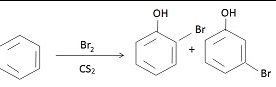
Phenol reacts with bromine water in carbon disulphate at low temperature to give$:$
Answer$−OH$ is ring activating group because it is electron$-$donating so it is ortho and para director with compound $o^−$ and $p^{− }$bromophenols.
View full question & answer→Question 501 Mark
Primary, secondary and tertiary alcohols can be distinguish by:
Answer
- Lucas reagent
Explanation:
Primary alcohols react on heating with Lucas elegant.
Secondary alcohols react with Lucas reagent after 5 min tertiary alcohol react immediately with Lucas reagent.
View full question & answer→Question 511 Mark
Which is the best reagent to convert cyclohexanol into cyclohexene?
AnswerCyclohexanol is used as substrate and phosphoric acid is present as catalyst which promotes the reaction but is not consumed in it. The hydroxyl group in $\ce{R-OH}$ is a poor leaving group because it leaves as hydroxide ion. An acid is used to protonate the alcohol and form $\text{R}−\text{OH}_2^+$
View full question & answer→Question 521 Mark
Ethyl alcohol exhibits acidic character on reacting with$:$
Answer$\ce{CH_3CH_2−OH + Na \rightarrow CH_3−CH_{2}−O^−Na^{+ } + \frac{1}{2} H_2}$ Acid reacts with metal to give hydrogen gas.
Hence, in above reaction $\ce{CH_{3}CH_2OH}$ behaves as an acid.
View full question & answer→Question 531 Mark
Lower alcohols are highly soluble in water due to _____.
Answer
- H-bonding
Explanation:
The solubility of lower alcohols is due to the existence of hydrogen bonds between water and polar -OH group of alcohol molecules.
The -OH group in alcohols and phenols contain a hydrogen bonded to an electronegative oxygen atom. Thus they form hydrogen bonds with water molecules.
View full question & answer→Question 541 Mark
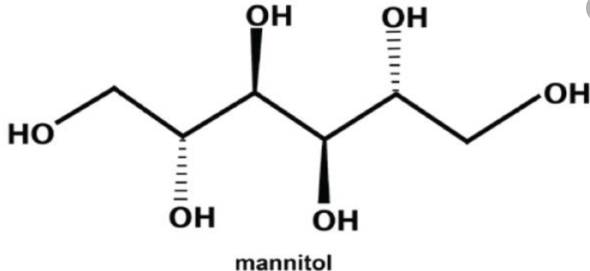
An example for a polyhydric alcohol is:
Answer
- Mannitol
Explanation:
So, mannitol is a polyhydric alcohol, because it has 6-OH groups. Rest all are monohydric alcohols because they contain single hydroxy group.
View full question & answer→Question 551 Mark
Mixed ether will not be formed in the reaction?
Answer$\ce{C_{2}H_5−OH + H_2SO_{4} (140^\circ C) \rightarrow C_2H_{5}−O−C_{2}H5 + H_2O}$
Ethyl alcohol when heated with Sulphuric acid at $140^\circ C$ produces a symmetric ether i.e. Diethyl ether.
View full question & answer→Question 561 Mark
$\ \ \ \ \ \ \ \ \ \text{CH}_3\\\ \ \ \ \ \ \ \ \ \ \ \ |\\\text{CH}_3−\text{C}−\text{CH}_2−\text{CH}_3\\\ \ \ \ \ \ \ \ \ \ \ \ |\\\ \ \ \ \ \ \ \ \ \ \text{OH}$
The correct IUPAC name of the above compound is:
Answer
- 2-methylbutan-2-ol
Explanation:
The IUPAC name of the given compound is 2-Methylbutan-2-ol.
The parent hydrocarbon contains 4 carbon atoms and is named butane.
A methyl substituent is present at second C atom.
A hydroxyl group is present at second C atom.
Hence, the last alphabet e of butane is replaced with the suffix -2-ol.
View full question & answer→Question 571 Mark
Carbinol is a trivial name of$:$
AnswerCarbinol is a trivial name of methanol $\ce{CH_3OH}.$
View full question & answer→Question 581 Mark
Which of the following alcohol has highest solubility in water?
Answer
- Glycerol
Explanation:
More the number of hydroxyl groups in a compound more is the tendency to form hydrogen bonds with water and hence, more will be the solubility.
Thus, among the given, glycerol, because of the presence of more number of hydroxyl groups, readily dissolves in water.
View full question & answer→Question 591 Mark
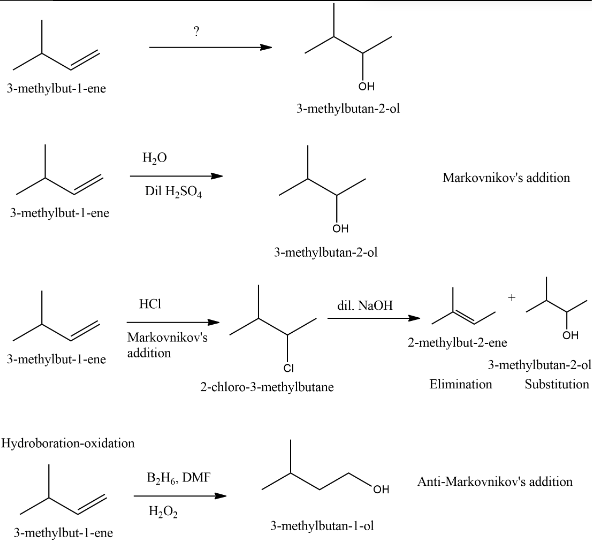
The best method to prepare $3-$methylbutan$-2-ol$ from $3-$methylbut$-1-$ene is:
AnswerTo prepare $3-$methylbutan$-2-ol$ from $3-$methylbut$-1-$ene shouls involve Markovnikov's addition of $H−OH$ across double bond.Addition of water in presence of dil. $\ce{H_2SO_4}$ follows Markovnikov's addition of $H−OH$ across the alkene.
Addition of $\text{HCI}$ followed by reaction with dil. $\text{NaOH}$ to an alkene can give substitution and elimination product after alkyl halide formation.
Hydroboration$-$oxidation reaction follows Anti$-$Markovnikov's addition of $H−OH.$
Reimer $-$ Tiemann reaction is a chemical reaction used for the ortho$-$formylation of phenols.
Thus the best method to prepare $3-$methylbutan$-2-ol$ from $3-$methylbut$-1-$ene is the addition of water in presence of dil. $\ce{H_{2}SO_4}.$
View full question & answer→Question 601 Mark
Ether is formed when alkyl halide is treated with sodium alkoxide. This method is known as$:$
AnswerEther is formed when alkyl halide is treated with sodium alkoxide. This method is known as Williamson synthesis.
For example, methyl iodide reacts with sodium methoxide to form dimethyl ether. $\ce{CH_3−I + CH_3−O−Na \rightarrow CH_3−O−CH_{3 }+ NaI}$
View full question & answer→Question 611 Mark
Ether is obtained from ethyl alcohol in presence of $\ce{H_{2}SO_4}$ at?
AnswerAcid$-$catalyzed method of preparing symmetrical ethers from primary alcohols is temperature dependence.
At $110^\circ \ 413\ \ce{KC}$ or $383K$ to $130^\circ C$ or $403K,$ a $SN^{2 }$ reaction of the alcohol conjugate acid leads to an ether product.
At higher temperatures $($over $150^\circ C$ or $423K)$ an $E_2$ elimination takes place and instead of ether, an alkene is obtained.
Thus, Ether is obtained from ethyl alcohol in presence of $\ce{H_2SO_{4}}$ at $413K.$
View full question & answer→Question 621 Mark
Reagents used for industrial preparation of methanol are$:$
AnswerCarbon monoxide and hydrogen react over a catalyst to produce methanol.
Today, the most widely used catalyst is a mixture of copper and zinc oxides,supported on alumina.
At $5–10 \ \ce{MPa (50–100 atm)}$ and $250^\circ C (482^\circ F),$ the reaction is characterized by high selectivity $(>99.8\%).$
$\ce{CO + 2H_2 \rightarrow CH_{3}OH}$
View full question & answer→Question 631 Mark
Select the correct order of boiling point:
Answer
- n-butyl alcohol > n-butaraldehyde > n-pentane > diethylether.
Explanation:
As we know that the higher the extent of intermolecular Hydrogen bonding in a molecule, the higher its boiling point becomes.
By that logic, n-butyl alcohol will have a higher boiling point than n-butyraldehyde due to the presence of more extensive H-bonding.
Again, there is no H-bonding present in both diethyl ether and n-pentane. But as n-pentane has a higher molecular weight than that of diethyl ether, it will possess a higher boiling point.
View full question & answer→Question 641 Mark
What is the functional group in alcohol?
Answer$−OH ($Hydroxyl group$)$ is the functional group of alcohol. Because, if we add $−OH$ to a Methyl group $\ce{(−CH_3)},$ it will be converted to Methyl alcohol $\ce{(CH_3OH)}.$
View full question & answer→Question 651 Mark
Isopropyl benzene on air oxidation in the presence of dilute acid gives$:$
View full question & answer→Question 661 Mark
View full question & answer→Question 671 Mark
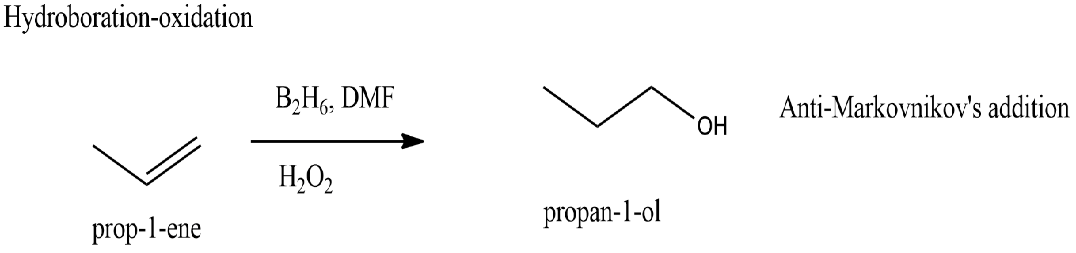
An alkene $\ce{CH_3CH=CH_2}$ is treated with $\ce{B_2H_6}$ in presence of $\ce{H_2O_2}.$ The final product formed is$:$
AnswerHydroboration$-$oxidation reaction follows anti-Markovnikov's addition of $\ce{H−OH}$ across $\ce{C=C}$ to give alcohol.
Thus an alkene $\ce{CH_3CH=CH2}$ when treated with $\ce{B_2H_{6}}$ in presence of $\ce{H_2O_2}$ will yield the final product as $\ce{CH_3CH_2CH_{2}OH}$
View full question & answer→Question 681 Mark
Which is the only alcohol that can be prepared by the indirect hydration of alken?
AnswerAlkene is treated with sulfuric acid to give alkyl sulphate esters. In the case of ethanol production, this step can be written: $\ce{H_2SO_4 + C_2H_{4 }\rightarrow C_2H_5−O−SO_3H}$
Subsequently, this sulphate ester is hydrolyzed to regenerate sulphuric acid and release ethanol:
$\ce{C_2H_{5}−O−SO_3H + H_2O \rightarrow H_2SO_4 + C_2H_5OH}$
This two step route is called the "indirect process".
Only in case of ethane it will produce ethyl alcohol while in case of other alkenes product is according to Markovnikov′s Rule.
Methyl alcohol can't be produced by indirect hydration of alkene.
View full question & answer→Question 691 Mark
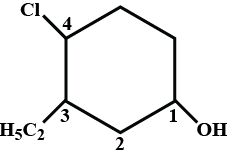
The correct IUPAC name of the compound is?

Answer
- 4 chloro-3-ethylcyclohexanol.
Explanation:
-OH group is given preference over Cl group so, 1 number to carbon attach to -OH group
so, 4-chloro-3 ethyl-cyclohexan -1-ol.
View full question & answer→Question 701 Mark
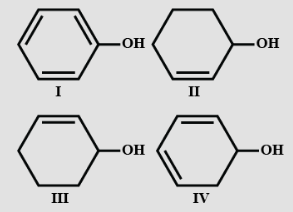
Dehydration of the following in increasing order is:
Answer
- I
Explanation:
Phenol (I) is stable aromatic compound. So it is most stable. The diene (IV) undergoes quick dehydration because it will form stable phenol. The alkene (III) undergoes dehydration. less readily because it gives a more stable diene. Alcohol (II) undergoes much lesser dehydration to form alkene. So, order is: 4>3>2>1.
View full question & answer→Question 711 Mark
Strength of acidity is in order:
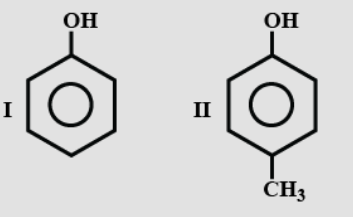
AnswerAs we know that the strength of acidity inversely depends upon the $+I$ effect.Thus, due to $+I$ effect of methyl group $(−CH_3), I$ is more acidic than $II.$
Hence the correct order of strength of acidity is $-I > II.$
View full question & answer→Question 721 Mark
Which of the following species can act as the strongest base?
Answer
- $^\ominus\text{OR}$
Explanation:
Weakest acid has the strongest conjugate base. Among all the four options ROH is the weakest acid. View full question & answer→Question 731 Mark
Butane has a _______ boiling point to that of propanol.
Answer
- Lower
Explanation:
The molecules of butane are held together by weak vander Waals forces of attraction, while those of propanol are held together by stronger intermolecular hydrogen bonding.
Therefore, the boiling point of propanol is much higher than of butane.
View full question & answer→Question 741 Mark
The bond angle of the bond $C−O−C$ in methoxy methane is:
Answer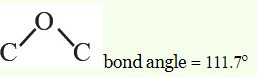
Ethers feature $C–O–C$ linkage defined by a bond angle of about $110^\circ$ and $C–O$ bond length of about $140\ pm.$
In methoxymethane, the bond angle is $111.7^\circ $. Methoxymethane show positive deviation in the bond angle. This is basically due to the steric crowding on carbon atoms of methyl group.
Due to the crowding, the repulsion between bond pair of carbons and lone pair of oxygen is low. Thus, the bond angle of methoxymethane is $111.7^\circ.$ View full question & answer→Question 751 Mark
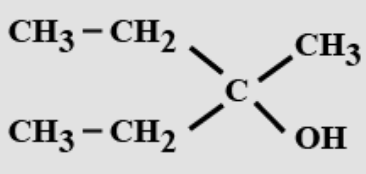
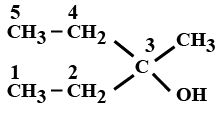
The IUPAC name is:
Answer
- 3-Methyl-3-pentanol
Explanation:
Hence IUPAC name is 3-methyl-3-pentanol.
View full question & answer→Question 761 Mark
Which of the following are benzylic alcohols?
AnswerBenzylic alcohols: In these alcohols, the $-OH$ group is attached to a $sp^3 -$ hybridised carbon atom next to an aromatic ring. For example,
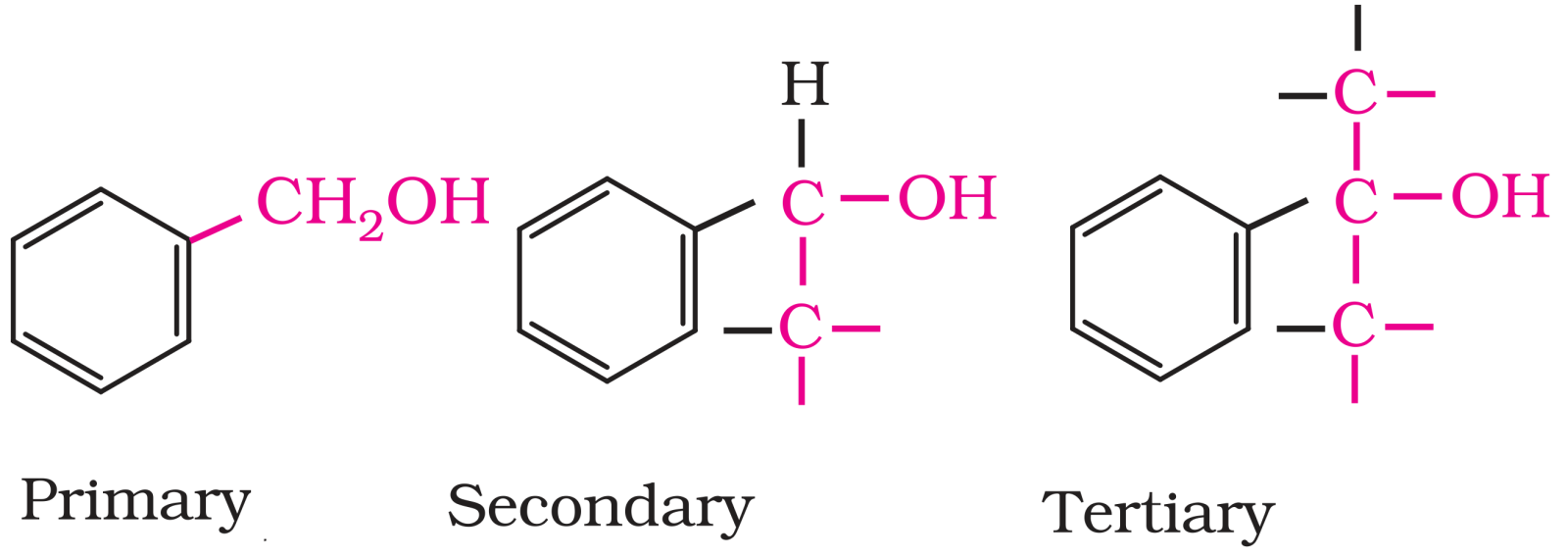
Allylic and benezylic alcohols may be primary, secondary or tertiary. View full question & answer→Question 771 Mark
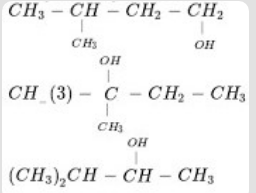
Arrange the following alkanols 1, 2 and 3 in order of their reactivity towards acid catalyzed dehydration.
Question 781 Mark
Answer
- Methanol
Explanation:
Methanol is the contraction of Methyl Alcohol. Methanol may also be called, wood alcohol or wood spirit because it can be produced as a by-product of the wood distillation.
View full question & answer→Question 791 Mark
Which compound is the most soluble in water?
AnswerAmong given compounds, ethylene glycol $\ce{(HO−CH_{2}−CH_2−OH)}$ is the most soluble in water. Ethylene glycol has two hydroxy groups both of which form hydrogen bonds with water. Greater is the number of hydrogen bonds, greater is the extent of hydrogen bonding and greater is the solubility in water.
View full question & answer→Question 801 Mark
Which of the following is not characteristic of alcohols:
Answer
- Lower members are insoluble in water and organic solvents but solubility regularly increases with molecular weight.
Explanation:
Lower members are soluble in water and solubility decreases with increasing molecular mass because the length of the hydrophobic chain increases.
View full question & answer→Question 811 Mark
With ethoxyethane which compound is miscible to almost the same extent?
Answer
- Butan-1-ol
Explanation:
Ethoxyethane is an ether group which is miscible to the alcohol that is Butan −1−ol. This is because they have the same molecular mass.
View full question & answer→Question 821 Mark
Alcohols containing only up to ___________ carbon atoms are completely miscible with water.
Answer
- Three
Explanation:
Hydroxyl group makes the alcohol molecule polar and these are used as protic solvents. Two opposing solubility trends in alcohols are the tendency of the polar OH to promote solubility in water and the tendency of the carbon chain to resist it.
So, methanol, ethanol, propanol are miscible in water as the OH group overcomes the short carbon chain.
View full question & answer→Question 831 Mark
Alcohols containing only up to ________________ carbon atoms are completely miscible with water.
Answer
- 3
Explanation:
Alcohol-containing up to 3− carbon atoms are completely miscible with water in all proportions. This is due to the hydrogen bonding with water molecule.
View full question & answer→Question 841 Mark
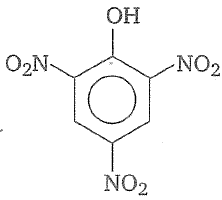
The nature of $2, 4, 6-$trinitrophenol is$:$
Answer$2, 4, 6−$trinitrophenol is picric acid. It is acidic in nature. The withdrawing nature of $\ce{NO_2}$ groups make the compound acidic.
View full question & answer→Question 851 Mark
Which of the following reagents can be used to oxidise primary alcohols to aldehydes?
AnswerStrong oxidising agents such as acidified potassium permanganate are used for getting carboxylic acids from alcohols directly. $\ce{CrO_3}$ in anhydrous medium is used as the oxidising agent for the isolation of aldehydes.$\text{RCH}_2\text{OH}\xrightarrow{\text{CrO}_3}\text{RCHO}$
A better reagent for oxidation of primary alcohols to aldehydes in good yield is pyridinium chlorochromate $\ce{(PCC)},$ a complex of chromium trioxide with pyridine and $\ce{HCl}.$
View full question & answer→Question 861 Mark
In iodine charge transfer test the color of ether compound formed is$:$
AnswerEther forms charge transfer complexes with Iodine to give a brown solution.
$\ce{R−O−R′ ⟶ R′ I −+ RI + H_2O}$
View full question & answer→Question 871 Mark
Which of the following reacts fastly with Na?
Answer
- 1° alcohol
Explanation:
1° alcohols are more acidic than 2° and 3° alcohols and hence they react faster with Na.
View full question & answer→Question 881 Mark
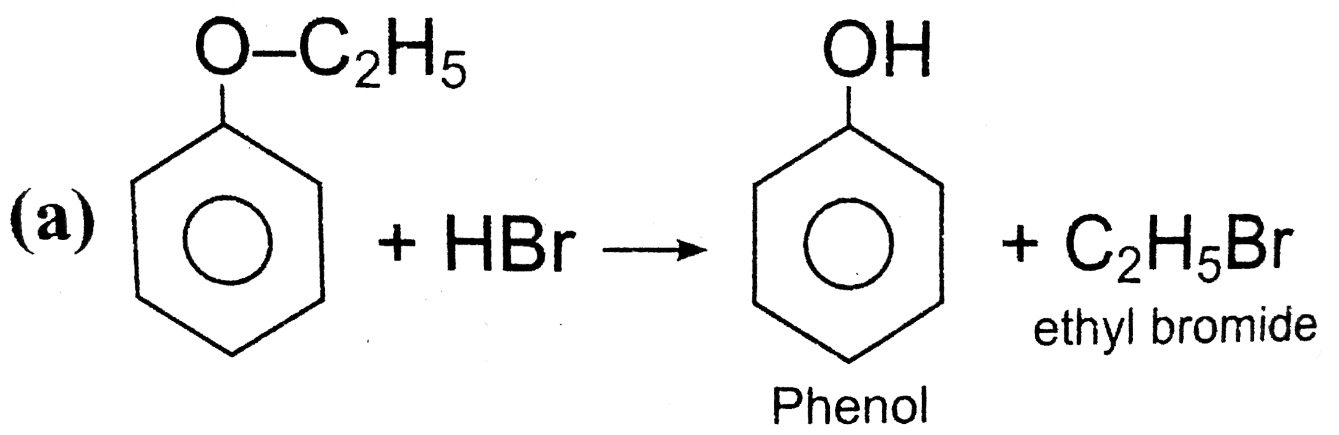
On boiling with concentrated hydrobromic acid, phenyl ethyl ether will yield:
Answer
- Phenol and ethyl bromide.
Explanation:
On boiling with concentrated hydrobromic acid, phenyl ethyl ether will yield phenol and ethyl bromide.
View full question & answer→Question 891 Mark
What amount of bromine will be required to convert $2g$ of phenol into $2, 4, 6−$tribromophenol?
AnswerWrite equation for chemical change, find molecular masses of reactants and products and solve it.Molecular weight of phenol
$= 12 \times 6 + 1 \times 6 + 16 = 94$
Molecular$ wt.$ of $Br_{2 }= 3 \times 160 = 480$
$\because 94$ of phenol requires $=480g$ of $Br_2$
$\therefore 2g$ of phenol requires = $\frac{480}{94}\times 2=10.22\text{g}$
The correct answer is $10.22g$
View full question & answer→Question 901 Mark
The $\text{IUPAC}$ name for $\ce{CH_3CH(OH)CH_2C(CH_3)_2OH}$ is$:$
AnswerThe compound has $2$ alcohol groups at $C-2$ positions on both the sides. From this point we can not say from where to start numbering.
But if we number from right hand side there is also a methyl group at $C-2$ position. So we start number from right hand side.
Since there are two alcoholic group, we use suffix "diol".
Thus $\text{IUPAC}$ name is: $2-$Methyl$-2,4$ pentanediol.
View full question & answer→Question 911 Mark
IUPAC name of the compound $\text{CH}_3-\text{CH}-\text{OCH}_3 \\ \ \ \ \ \ \ \ \ \ \ \ \ \ \ | \\ \ \ \ \ \ \ \ \ \ \ \ \ \ \text{CH}_3$ is ___________.
Answer
- 2-methoxypropane.
Explanation:
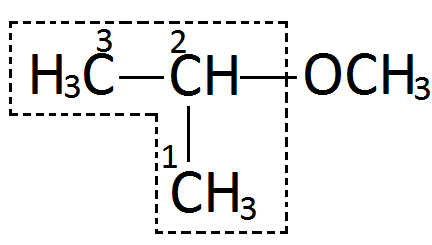
IUPAC name of the above compound is 2-methoxypropane.
View full question & answer→Question 921 Mark
The suffix used in the nomenclature of alcohol is:
Answer
- 'ol'
Explanation:
According to IUPAC system suffix for alcohols is ' ol'.
View full question & answer→Question 931 Mark
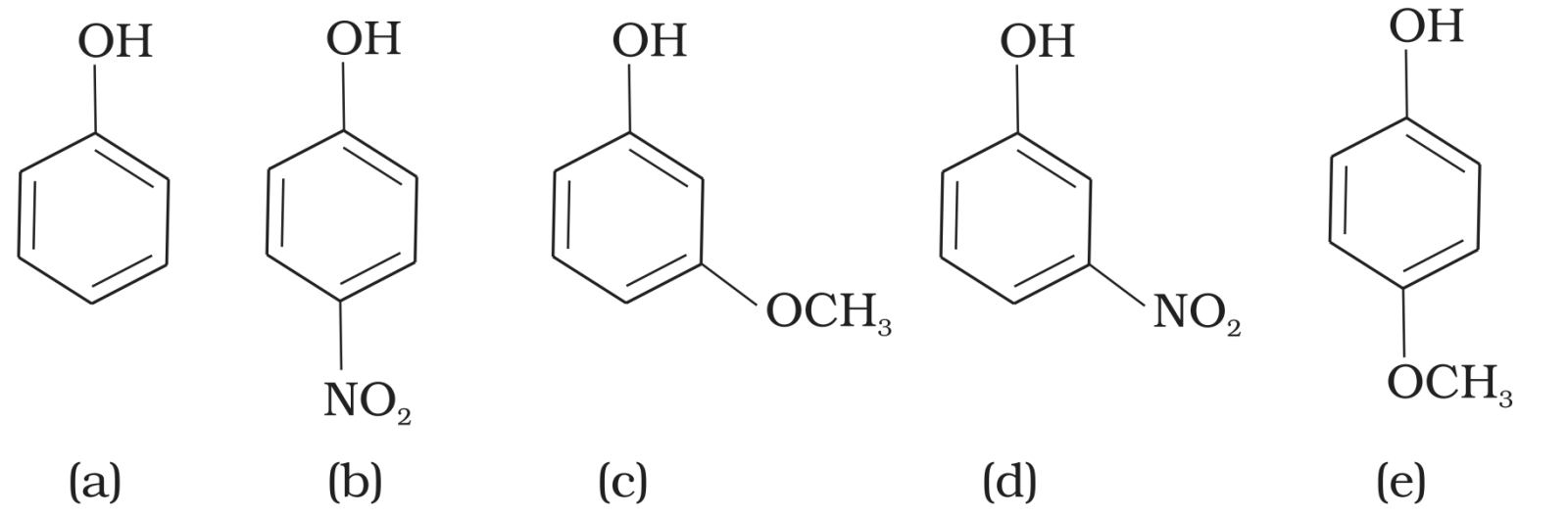
Mark the correct order of decreasing acid strength of the following compounds.
Answer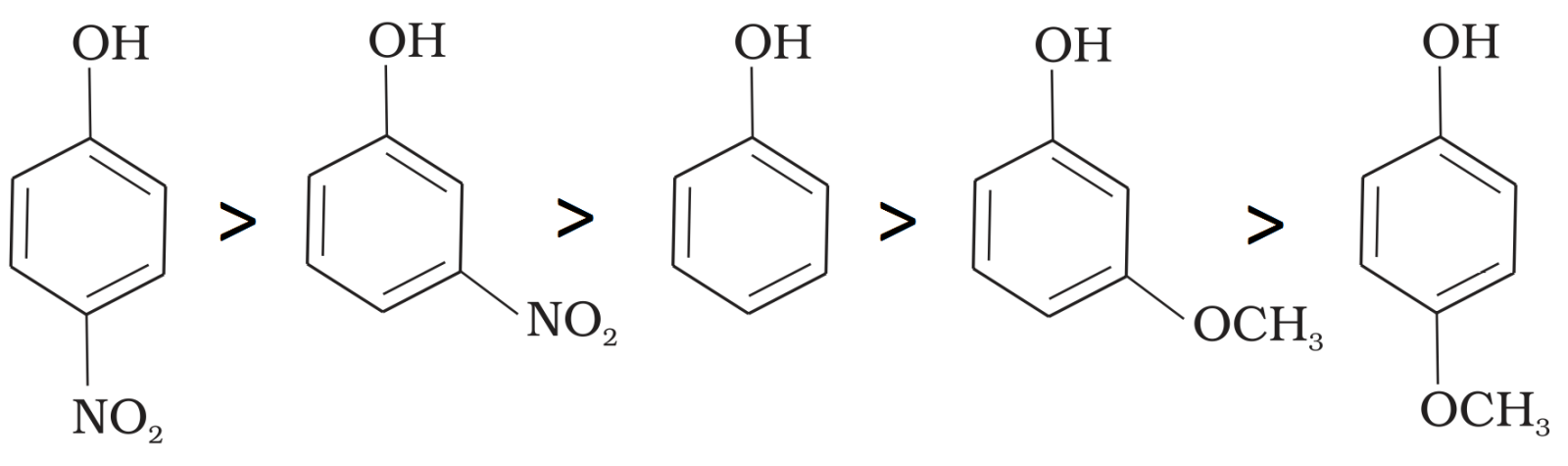
$-NO_2$ is an electron withdrawing group which increases the acidity of phenol and the effect is more pronounced at ortho and para positions. Similarly methoxy group is an electron releasing group which decreases the acidity of phenol and the effect is more pronounced at ortho and para positions. View full question & answer→Question 941 Mark
When ethyl alcohol reacts with nitric acid, it forms$:$
Answer$\ce{CH_3–CH_2–OH + HNO_{3 }\rightarrow C_2H_5NO_3 + H_2O}$
View full question & answer→Question 951 Mark
Baeyers reagent is $\ce{KMnO_4}$ in which medium?
AnswerBaeyer's reagent, named after the German organic chemist Adolf von Baeyer, is used in organic chemistry as a qualitative test for the presence of unsaturation, such as double bonds.
Baeyer's reagent is an alkaline solution of cold potassium permanganate, which is a powerful oxidant making this a redox reaction.
View full question & answer→Question 961 Mark
The general formula for alcohol series is $\ce{C_nH_{2n+1}OH}.$ Which is the formula for alcohol contains four carbon?
AnswerThe general formula for alcohol series is $\ce{C_nH_{2n+1}OH}.$ The formula for alcohol contains four carbon atoms is
$\ce{C_nH_{2n+1}OH = C_4H_{2(4)+1 }OH = C_4H_{8+1} OH = C_4H_9OH}.$
View full question & answer→Question 971 Mark
The order of boiling point of primary (1), secondary (2) and tertiary (3) alcohols is:
Answer
- 1 > 2 > 3
Explanation:
The order of the boiling point is Primary (1) > secondary (2) > tertiary (3) alcohol
This is because the surface area decreases and the van Der waals forces decreases.
View full question & answer→Question 981 Mark
Solubility of alcohols in water is _______ to that of hydrocarbons of comparable molecular masses.
Answer
- Greater than
Explanation:
Since alcohols can participate in H−bonding while hydrocarbons cannot, alcohols are able to interact with water molecules more easily than hydrocarbons of comparable molecular masses.
Hence alcohols possess greater solubility in water than hydrocarbons of comparable molecular masses.
View full question & answer→Question 991 Mark
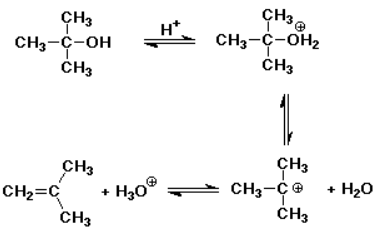
Which of the following gives the most stable carbocation by dehydration?
AnswerEasy dehydration of compound depends on the following parameters.Resonance stabilized carbocation formation after dehydration.
$+M$ and $+I$ effect of an adjacent group of atoms.
The number of $\alpha$ hydrogen attached with carbocation.
Compound $B$ is the one that is most readily dehydrated because it forms a tertiary carbocation with nine $\alpha−H$ atoms which makes it the most stable carbocation.
The dehydration reaction is shown as below;
View full question & answer→Question 1001 Mark
What is the correct order of reactivity of alcohols in the following reaction?
$\text{R}-\text{OH}+\text{HCL}\xrightarrow{\text{ZnCl}_2}\text{R}-\text{Cl}+\text{H}_2\text{O}$
Answer
- 3° > 2° > 1°
Explanation:
This reaction is a type of nucleophilic substitution reaction in which -OH group is replaced by -Cl. The intermediate formed by tertiary alcohol is more stable as carbocation is more stable than primary and secondary carbocation. Thus, the order of reactivity of alcohol will be 3° > 2° > 1°.
View full question & answer→Question 1011 Mark
Which of the following is used in the manufacture of ethanol?
AnswerAlcohols can be prepared by the hydration of alkenes. Therefore, ethanol $\ce{( C_2H_5OH)}$ can be prepared from the corresponding alkene; $\ce{C_2H_4}$ as $: \ce{CH_2=CH_2 + H_2O \rightarrow H + CH_3CH_2OH}$
View full question & answer→Question 1021 Mark
Which of the following has a higher boiling point?
Answer
- Butanol
Explanation:
There is a large difference between boiling points of butanol and butanal, although they have almost the same solubility in water.
Butanol contains -OH group and can form hydrogen bonds. Hence, the molecules are associated. A large amount of energy is required to break the association.
Hence, butanol has a higher boiling point. Hydrogen bonding is not possible in butanal.
View full question & answer→Question 1031 Mark
Molecular formula of ethanol is?
AnswerEthanol is alcohol and is a primary $1$ degree monohydric alcohol with moleculer formula $\ce{C_2H_{5}OH}.$
View full question & answer→Question 1041 Mark
The correct decreasing order of dehydration of following alcohols with conc. $\ce{H_{2}SO_{4}}$ is$:$
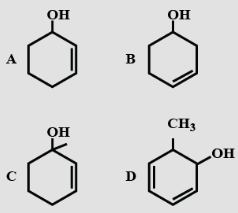
AnswerDehydration order will include $D$ first because after dehydration aromatic compound$($stable$)$ is formed . In this way, the order is arranged according to the stability of the compound formed.
View full question & answer→Question 1051 Mark
Trivial name of methanol is _________.
Answer
- All of the above
Explanation:
Methanol is known as methyl alcohol, wood alcohol, wood naphtha or wood spirit because it was once produced as a byproduct of the destructive distillation of wood.
View full question & answer→Question 1061 Mark
The compound $A$ on treatment with $Na$ gives $B,$ and with $\ce{PCI_{5 }}$ gives $C. B$ and $C$ react together to give diethyl ether. $A, B$ and $C$ are in the order.
View full question & answer→Question 1071 Mark
The number of carbon atoms present in a molecule of simple ether is$:$
AnswerSimple ethers have the same alkyl groups on both sides of the Oxygen atom. Like, $\ce{CH_3−O−CH_{3}}$
Thus, the number of carbon atoms is always even.
View full question & answer→Question 1081 Mark
Methanol is called as Marine Methanol beacuse:
Answer
- It is used as a marine fuel.
Explanation:
Currently, methanol is being developed and utilized as a marine fuel. Interest in methanol as a ship fuel is growing in response to international regulatory changes and cost advantages relative to other fuels. Methanol is an alternative which is sulphur free, has low emissions; perhaps three to four times cheaper than marine distillate fuel; and has a higher score on the International Martine Organization (IMO) energy efficiency design index (EEDI)than LNG or diesel. Globally, Methanol is already in widespread production (~70 million tons per annum) for a multitude of chemical and energy applications, and is one of the world’s most widely shipped chemicals.
View full question & answer→Question 1091 Mark
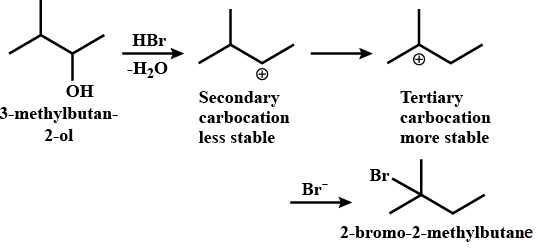
When $3-$methylbutan$-2-$ol is treated with $\ce{HBr},$ the following reaction takes place. What are the correct steps for formation of the above product?
AnswerThe reaction $($along with mechanism$)$ for the conversion of $3-$methylbutan$-2-$ol to $2-$bromo$-2-$methylbutane is as given below.
View full question & answer→Question 1101 Mark
Which of the following phenols has lowest solubility in water?
Answer
- o-Nitrophenol
Explanation:
O− nitrophenol undergoes creation because of intra-moleculer hydrogen bonding. So, it is least soluble.
View full question & answer→Question 1111 Mark
Phenol can be distinguished from ethanol by the reactions with $.........$
AnswerPhenol reacts with bromine water to give a colourless tribromo derivative and gives a violet coloured complex with $\ce{FeCl_3}.$ Ethanol does not give these reactions.
View full question & answer→Question 1121 Mark
$\text{IUPAC}$ name of the compound $\ce{CH_3−CH(CH_2CH_3)−CH_2−CH(OH)−CH_3}$ is$:$
AnswerLongest carbon chain has $6$ atoms. We number from right hand side as alcohol group at $C-2$ gets least number in this case and suffix used for alcohol is "-ol". Methyl group is present at $C-4$ position.
Thus, $\text{IUPAC}$ name is $4-$Methyl$-2-$hexanol.
View full question & answer→Question 1131 Mark
IUPAC name of the tertiary butyl alcohol is:
Answer
- 2-methyl-2-propanol
Explanation:
Above is the structure of tertiary butyl alcohol. Longest carbon chain contains 3 carbons and one methyl group and one hydroxy group at 2 position.
Hence, the IUPAC name of tertiary butyl alcohol is 2-methyl-2-propanol.
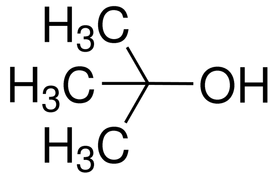
View full question & answer→Question 1141 Mark
Mark the correct increasing order of reactivity of the following compounds with $\ce{HBr/HCl}.$
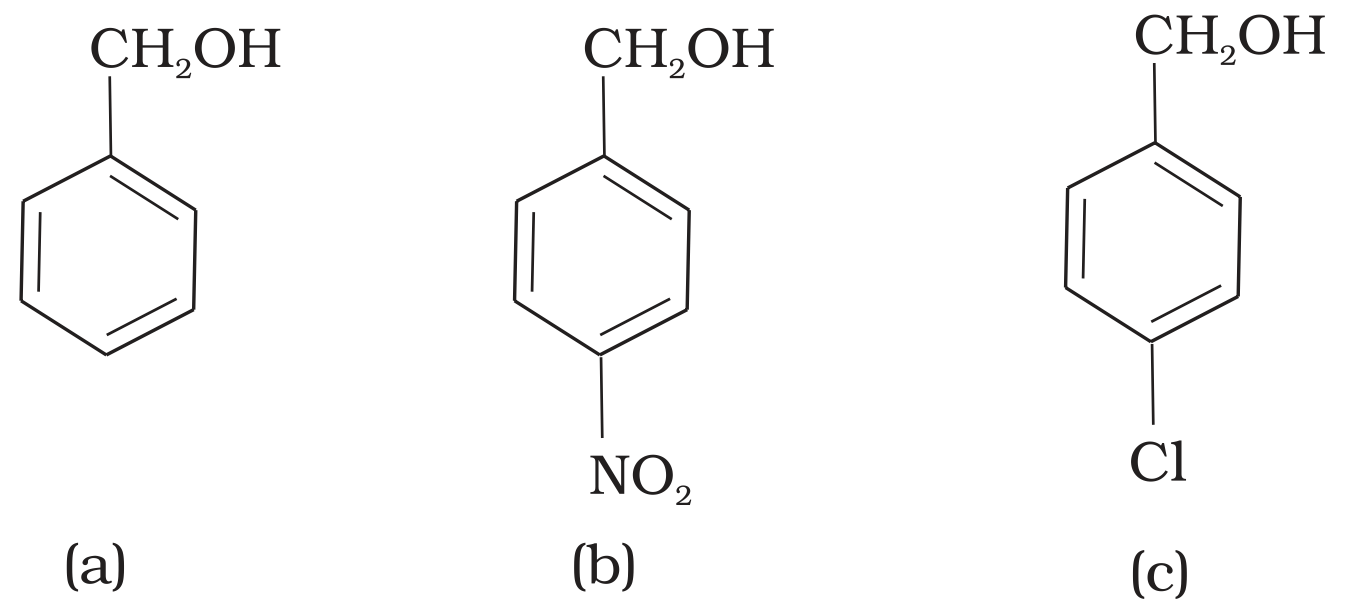
AnswerIt is type of nucleophilic substitution reaction followed by $S_N1$ mechanism. $S_N1$ mechanism depends on the stability of carbocation. Presence of electron withdrawing group will decrease the stability of carbocation.
View full question & answer→Question 1151 Mark
The only alcohol that can be prepared by the indirect hydration of alkene is$:$
AnswerExcept for ethyl alcohol, no other primary alcohol can be prepared by this method as the addition of $\ce{H_2SO_4}$ follows Markownikoff's rule. Generally, secondary and tertiary alcohols are obtained.

View full question & answer→Question 1161 Mark
Arrange the following compounds in increasing order of boiling point.
Propan-1-ol, butan-1-ol, butan-2-ol, pentan-1-ol.
Answer
- Propan-1-ol, butan-2-ol, butan-1-ol, pentan-1-ol
Explanation:
The boiling points of alcohols and phenols increase with increase in the number of carbon atoms (increase in van der Waals forces.). In alcohols, the boiling points decrease with increase of branching in carbon chain (because of decrease in van der Waals forces with decrease in surface area.).
View full question & answer→Question 1171 Mark
By treating alkylchloride with aq. KOH produce:
Answer
- Both A and B
Explanation:
In the presence of aqueous KOH, alkyl chloride gives the substitution product as alcohol. The reaction can be written as:
RCl + KOH(aq) → ROH + KCl
View full question & answer→Question 1181 Mark
Which of the following represents monohydric alcohol?
Answer$\ce{C_nH_{2n} +_1OH}$
View full question & answer→Question 1191 Mark
Vapours of an alcohol X when passed over hot reduced copper, produce an alkene, the alcohol is:
Answer
- Tertiary alcohol
Explanation:
Given: X(ROH) + Cu(hot) → alkene
Primary alcohol passed over Cu at 300°C is dehydrogenated to aldehydes and hydrogen gas liberates.
Secondary alcohols are dehydrogenated to ketones with liberation of hydrogen gas
Tertiary alcohol is dehydrated to alkene.
This method can therefore be used to distinguish between primary, secondary and tertiary alcohol
Thus X should be a tertiary alcohol.
View full question & answer→Question 1201 Mark
What is the common name of methyl alcohol?
Answer
- Wood spirit
Explanation:
Methanol acquired the name wood spirit because it was once produced chiefly by the destructive distillation of wood.
View full question & answer→Question 1211 Mark
Which of the following is a primary alcohol?
Answer$\ce{CH_3−CH(CH_3)−CH_{2}−OH}$ is a primary alcohol as hydroxal group; $\ce{-OH}$ is attached to the primary carbon.
View full question & answer→Question 1221 Mark
Mark the correct statement:
Answer
- Water gas is used in the manufacture of methyl alcohol.
View full question & answer→Question 1231 Mark
Rate of dehydration when given compound is treated with conc $,\ce{H_2SO_4}.$
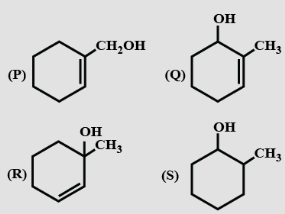
View full question & answer→Question 1241 Mark
The correct order of boiling point for primary (1), secondary (2) and tertiary (3) alcohols is:
Answer
- 1 > 2 > 3
Explanation:
Alcohols with same molecular weight are expected to have almost same boiling point however two more factors other than molecular weight are important, they are namely H-bonding and surface area of molecule. Both these factors are least in 3 alcohols and maximum in 1 alcohols. Hence, 3 alcohols have least boiling point while 1 alcohols have maximum boiling point.
View full question & answer→Question 1251 Mark
Methanol can be prepared when$:$
AnswerMoist Silver oxide
$\ce{Ag_2O + H_2O \rightarrow 2AgOH}$
$\ce{CH_3−I + AgOH \rightarrow CH_3−OH + AgI}$
Therefore, methanol can be prepared when iodomethane is heated with moist silver oxide.
View full question & answer→Question 1261 Mark
The correct reactivity order of alcohols towards H−X will be:
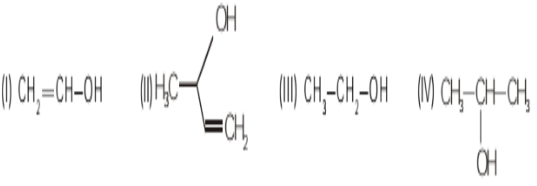
Answer
- II>IV>III>I
Explanation:
The correct reactivity order of alcohols towards H−X will be II>IV>III>I
Alcohol II has maximum reactivity as the carbocation formed will be stabilized by resonance with adjacent C=C double Bond.
Alcohol I has minimum reactivity as the carbocation formed will have positive charge on sp2 carbon atom.
Alcohol IV is more reactive than alcohol III because alcohol IV gives secondary carbocation whereas alcohol III gives primary carbocation.
Secondary carbocation is more stable than primary carbocation.
View full question & answer→Question 1271 Mark
Which of the following name does not fit a real name?
Answer
- 3 -methyl 3 -hexanone
Explanation:
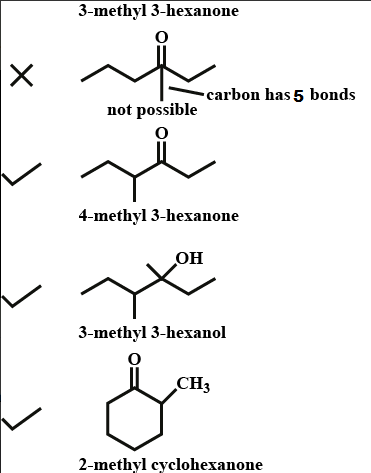
View full question & answer→Question 1281 Mark
On reacting with grignard reagent acetone gives?
Question 1291 Mark
Compound $\ce{C_2H_6O}$ has two isomers $X$ and $Y.$ On reaction with $HI, X$ gives alkyl iodide and water while $Y$ gives alkyl iodide and alcohol.Compounds $X$ and $Y$ are respectively:
Answer$\ce{(X): C_{2}H_5OH + HI \rightarrow C_2H_{5}I+H_2O(Y):
CH_{3}OCH_3 + HI \rightarrow CH_{3}I+CH_{3}OH}$
View full question & answer→Question 1301 Mark
$\text{CH}_3\text{−CH}\text{−CH}−\text{CH}_3\\ \ \ \ \ \ \ \ \ \ \ \ \ | \ \ \ \ \ \ \ \ \ \ | \\ \ \ \ \ \ \ \ \ \ \text{OH}\ \ \ \ \ \ \text{OH}$IUPAC name of the given compound is:
Answer
- Butane-2, 3-diol
Explanation:
Two functional group OH(ol) is attached at carbon no 2 & 3 so its name is butane−2,3−diol.
View full question & answer→Question 1311 Mark
Which of the following reactions will yield phenol?
Question 1321 Mark
The miscibility of ether with _______ resembles those of alcohol of the same molecular mass.
Answer
- Water
Explanation:
The miscibility of ether with water resembles those of alcohol of the same moleculer mass. It is generally due to the hydrogen bonding with water in alcohol.
View full question & answer→Question 1331 Mark
Electrophilic substitution reaction in phenol takes place at:
Answer
- Ortho and para position
Explanation:
Electrophilic substitution reaction in phenol takes place at ortho and para position. −OH is an ortho para directing group.
The electron density at ortho and para positions will be higher than the electron density at meta position.
View full question & answer→Question 1341 Mark
Salicylic acid, picric acid, aspirin, nylon and plastics have a common raw material, namely:
Answer
- Phenol
Explanation:
Phenol is used as starting material in the manufacture of nylon, plastics, aspirin, picric acid, and salicylic acid, etc.
View full question & answer→Question 1351 Mark
Consider the reaction between $\ce{C_2H_{5}O^{⊝ }}$ and dimethyl sulphate. The leaving group in this reaction is$:$
View full question & answer→Question 1361 Mark
Ethers show dipolar nature due to the presence of ______.
Answer
- Central O atom
Explanation:
Ethers have general structural formula R-O-R'. Hence all of them have the C-O bond. We know that the C-O bond is polar due to the difference between the electronegativities of carbon and oxygen. Hence, ethers show dipolar nature.
View full question & answer→Question 1371 Mark
Which of the following order is true regarding the acidic nature of phenol?
Answer
- O-cresol < phenol < O- nitrophenol
Explanation:
The following order is true regarding the acidic nature of phenol.
O-cresol < phenol < O- nitrophenol.
Phenols having electron withdrawing substituents such as nitro group are more acidic due to delocalization of negative charge.
Phenols having electron releasing substituents such as alkyl group are less acidic as negative charge is not delocalised.
View full question & answer→Question 1381 Mark
Formation of 2-butene as a major product by dehydration of 2-butanol is according to:
Answer
- Saytzeff rule
Explanation:
The formation of 2-butene as major product by dehydration of 2-butanol is according to Saytzeff rule.
The minor product is 1-butene.
In this reaction, more substituted alkene is obtained as it is more stable.
View full question & answer→Question 1391 Mark
When alkyl halide is heated with dry $\ce{Ag_2O,}$ it produces:
AnswerAlkyl halide on reaction with dry silver oxide gives ether. $\ce{ 2RX + Ag_2O ⟶ R−O−R + 2AgX}$
View full question & answer→Question 1401 Mark
The high boiling point of ethanol $(78.2^\circ C)$ compared to dimethyl ether $(−23.6^\circ C),$ though both having the same molecular formula $C_2H_6O,$ is due to:
AnswerThe high boiling point of ethanol $(78.2^\circ C)$ compared to dimethyl ether $(−23.6^\circ C),$ though both having the same molecular formula $C_{2}H_6O,$ is due to Hydrogen bonding.Hydrogen bonding is observed when $H$ atom is attached to more electronegative $N, F$ or $O$ atom.
Ethanol molecules are associated due to hydrogen bonding. This results in higher boiling point.
However, hydrogen bonding is not possible in dimethyl ether.
View full question & answer→Question 1411 Mark
Which of the following alcohols is the least soluble in water?
Answer
- 1-Pentanol
Explanation:
Alcohols are soluble in water due to hydrogen bonding. However, as the length of carbon chain increases, the extent of hydrogen bonding decreases due to bulky chain.
According to this, 1−pentanol will be the least soluble in water, among the other given alcohols.
View full question & answer→Question 1421 Mark
Which of the following is wood alcohol?
AnswerMethanol, also known as methyl alcohol, wood alcohol, wood naphtha, methyl hydrate, or wood spirits, is a chemical with the formula $\ce{CH_3OH}.$ Methanol acquired the name wood alcohol because it was once produced chiefly by the destructive distillation of wood.
View full question & answer→Question 1431 Mark
Which of the following can not be formed by hydrolysis of alkenes?
Answer
- Methanol
Explanation:
Hydrolysis of alkene mainly gives alcohol simplest alkene that is ethane on hydrolysis gives ethanol. So Methanol cannot be formed by hydrolysis of alkene.
View full question & answer→Question 1441 Mark
The strongest acid in the following compounds is:
Answer$o-$nitro phenol participates in intra$-$molecular $H-$bonding, which makes it less acidic than p-nitro phenol. Since acidic strength depends on the stability of negative ion after removal of acidic $H, −NO_2$ group in o and p position provides $-M$ effect as the negative charge delocalizes.
View full question & answer→Question 1451 Mark
Destructive distillation of wood in the laboratory will result in the formation of:
Answer
- Methanol
Explanation:
Methanol acquired the name "wood spirit" because it was once produced chiefly as a byproduct of the destructive distillation of wood.
View full question & answer→Question 1461 Mark
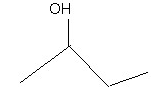
The IUPAC name of sec. butyl alcohol is:
Answer
- 2-butanol
Explanation:
The IUPAC name of the sec. butyl acohol is 2-butanol because the longest continue chain contain 4-carbon as well as the −OH group is attached to 2nd carbon , hence the name is 2-butanol.
View full question & answer→Question 1471 Mark
Dehydration of alcohol is an example of which type of reaction?
Answer
- Elimination
Explanation:
When heated with strong acids catalysts, alcohols typically undergo a 1,2-elimination reactions to generate an alkene and water. Also known as dehydration since it involves the removal of a molecule of water.
View full question & answer→Question 1481 Mark
Ethanol on reaction with acetic anhydride gives:
AnswerThe reaction of acetic anhydride with ethanol yields ethyl acetate and ethanoic acid.
$\ce{(CH_3CO)_2O + CH_3CH_{2}OH \rightarrow CH_3COOCH_2CH_{3 }+ CH_3COOH}$
View full question & answer→Question 1491 Mark
Phenol on reaction with $NH_3$ gives:
AnswerPhenol on reaction with ammonia gives aniline. In this reaction, $-OH$ group is replaced with $-NH_2$ group.
View full question & answer→Question 1501 Mark
Phenol reacts with alkali to give:
Answer
- Both a and b
Explanation:
Phenol is weakly acidic in nature. Hence when it reacts with alkali, it gives a salt and water i.e. the neutralization reaction takes place.
View full question & answer→Question 1511 Mark
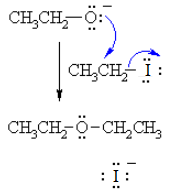
Heating together of sodium ethoxide and ethyl iodide will give:
Answer
- Ether
Explanation:
Williamson's ether synthesis reaction.
View full question & answer→Question 1521 Mark
Which among the following reactions does not give methyl alcohol?
AnswerThe reaction of ethylene with $H_2SO_{4}$ at $80^\circ\ C$ gives ethyl hydrogensulphate.$\ce{CH_2=CH_2 + H_2SO_4 \rightarrow CH_3CH_2OSO_{2}OH}$
Water gas $($carbon monoxide and hydrogen$)$ at high temperature gives methanol.
$\ce{CO + 2H_{2 }\rightarrow CH_3OH}.$
Alkaline hydrolysis of methyl bromide gives methanol
$\ce{CH_{3}Br + H_2O \rightarrow CH_3OH + HBr.}$
View full question & answer→Question 1531 Mark
Maximum boiling point would be shown by:
AnswerMaximum boiling point would be shown by n propanol, $\ce{CH_3−CH_{2}−CH_2−OH}.$In $n-$propanol, the molecules are associated due to hydrogen bonding.
Hence, the boiling point is higher. In dimethyl ether and diethyl ether, the boiling point is lower as hydrogen bonding is not possible.
The extent of the hydrogen bonding in isopropanol is lower than that in $n-$propanol due to $+I$ effect of two methyl groups.Also, as the degree of branching increases, the boiling point decreases.
View full question & answer→Question 1541 Mark
Which of the following is the functional group of an ether?
Answer
- R−O−R
Explanation:
R−O−R is generally the functional group of the ether which is non-polar and does not form hydrogen bonding.
View full question & answer→Question 1551 Mark
Which of the following alcohol has the highest boiling point?
Answer
- 2−Methylpropan−2−ol
Explanation:
Creakr the molecules mass, higher the boiling point, further greather the branching, lesser the boiling. Point.
View full question & answer→Question 1561 Mark
Which of the following reactions is possible?
AnswerSix types of ethers cannot be prepared by Williamson's synthesis.
Not feasible, $RX = 3^\circ , \text{RONa}= 3^\circ$
Not feasible,$ RX = 2^\circ , \text{RONa} = 2^\circ$
Not feasible$, \text{ArX},$
Feasible,$ RX = 1^\circ , \text{ArONa}$
View full question & answer→Question 1571 Mark
Which of the following cannot be dissolved in alcohol?
Answer
- Rubber and plastics
Explanation:
Rubber and plastic cannot be dissloved in alchol because of nonpolar nature of rubber and plastics.
View full question & answer→Question 1581 Mark
Which of the following is soluble in water?
AnswerEthanol $\ce{(C_2H_5OH)}$ forms hydrogen bonding with water.
Hence, it is soluble in water.
View full question & answer→Question 1591 Mark
Among the four compounds $(i)$ acetone, $(ii)$ propanol, $(iiii)$ methyl acetate and $(iv)$ propionic acid, the two that are isomeric are:
AnswerPropionic acid and methyl acetate both have same molecular formula $\ce{(C_3H_6O_2)}$ but different functional groups, so they are isomers.
View full question & answer→Question 1601 Mark
$\ce{IUPAC}$ name of $m-$cresol is $.......$
Answer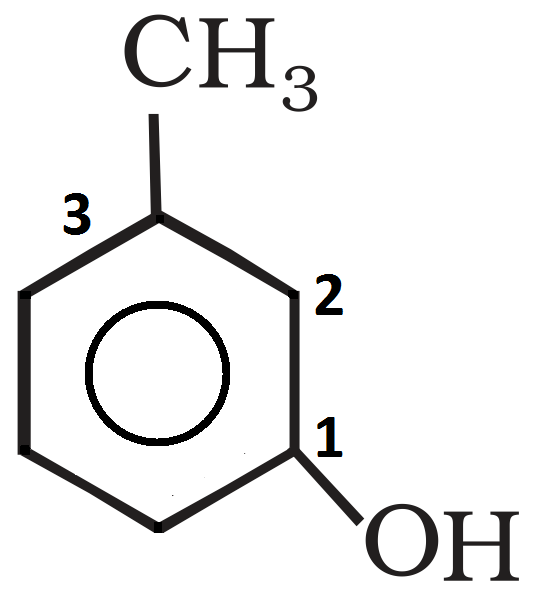
$-OH$ is functional group and $-CH_3$ is substituent.
$\ce{IUPAC}$ name: $3-$methylphenol. View full question & answer→Question 1611 Mark
The product formed by decolourization of $\ce{KMnO_{4}}$ by ethylene is $.......$ which is used as $.......$
AnswerWhen ethylene react with $\ce{KMnO_4},$ than pink colour of $\ce{KMnO_4}$ gets disappear and ethylene gets converted with ethylene glycol.
View full question & answer→Question 1621 Mark
$........$ is prepared on a large seals from water gas.
AnswerMethanol is generally prepared on a large scale using water gas. Water gas is also called syn gas is the mixture of $(CO + H_2).$
View full question & answer→Question 1631 Mark
Which of the following species show maximum volatility?
AnswerDue to the lack of any Hydrogen bonding in case of $\ce{CH_3−O−CH_3},$ its boiling point is comparatively low. In other words, it is the most volatile among the given compounds.
View full question & answer→MCQ 1641 Mark
View full question & answer→MCQ 1651 Mark
IUPAC name of phenol is -
MCQ 1661 Mark
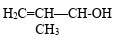
The nature of alcoholic group in
MCQ 1671 Mark
The Product formed by the reaction of phenol with Zn dust
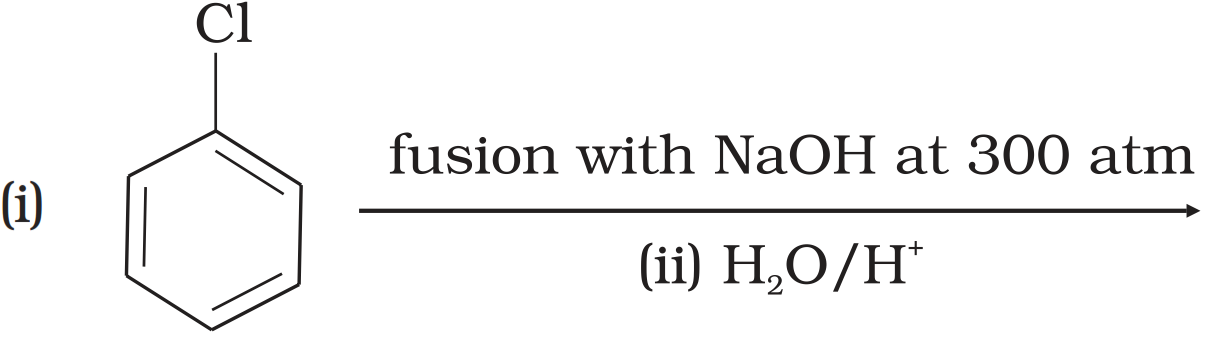
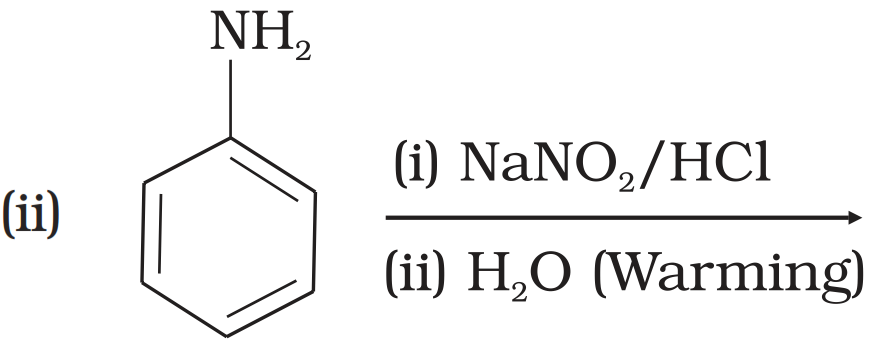
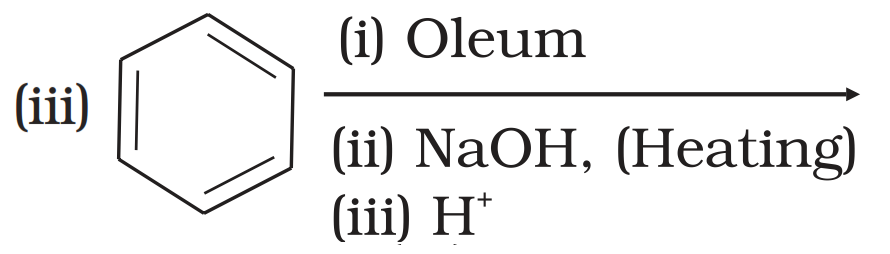 Explanation: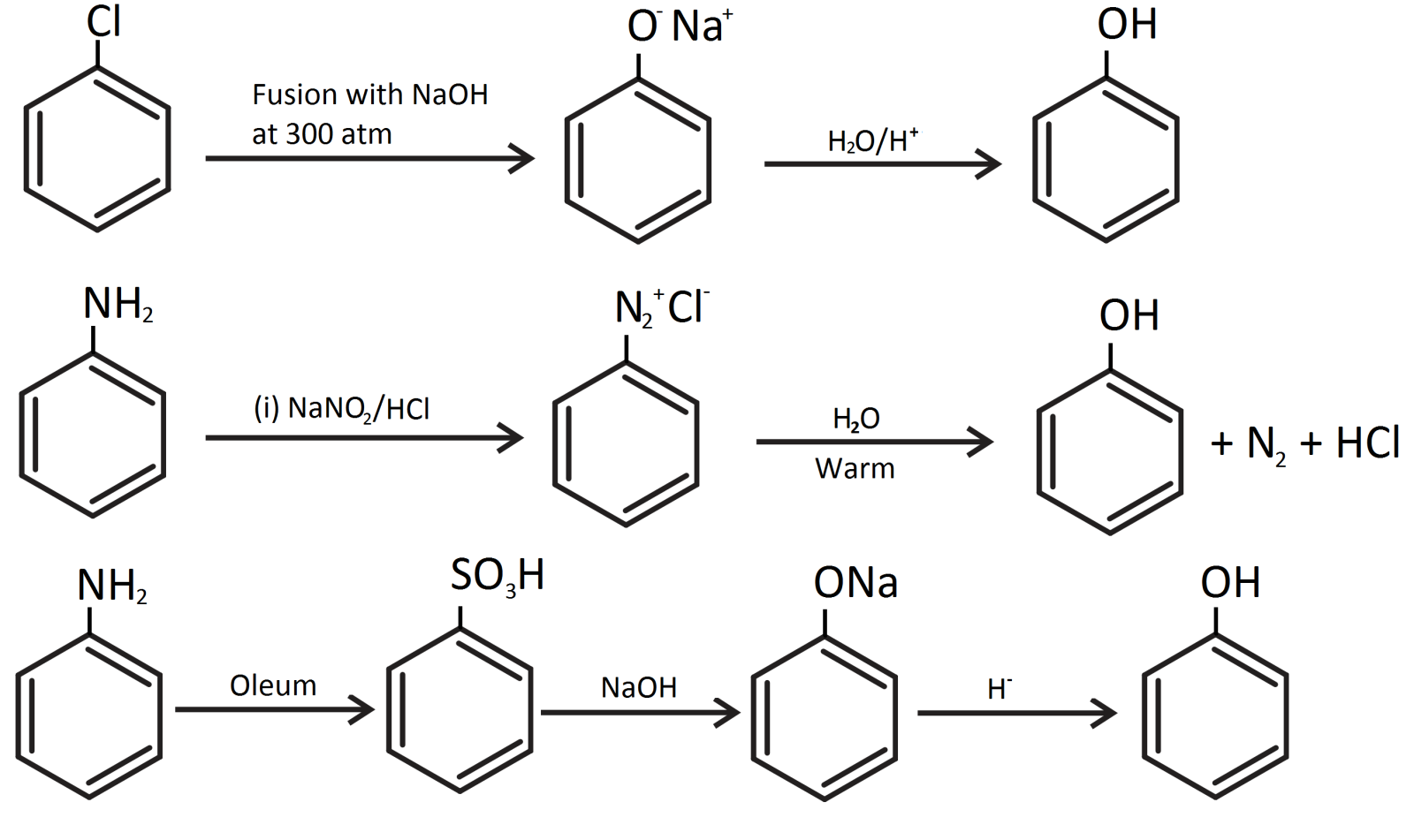
 is-
is-