Question 14 Marks
यदि $x$ के सभी वास्तविक मानों के लिये $\,\,\frac{{4{x^2} + 1}}{{64{x^2} - 96x\,\sin \alpha + 5}} < \frac{1}{{32}}$ तब निम्न अन्तराल में स्थित होगा
Answerd
(d) $\frac{{4{x^2} + 1}}{{64{x^2} - 96x\sin \alpha + 5}} < \frac{1}{{32}}$
==> $128{x^2} + 32 < 64{x^2} - 96x\sin \alpha + 5$
==> $64{x^2} + 96\sin \alpha .x + 27 < 0$
$\therefore$ $x < \frac{{ - 96\sin \alpha \pm \sqrt {{{(96\sin \alpha )}^2} - (4 \times 64 \times 27)} }}{{2 \times 64}}$
चूँकि $x$ वास्तविक है $\therefore \,\,\,{(96\sin \alpha )^2} - (4 \times 64 \times 27) \ge 0$
==> ${\sin ^2}\alpha \ge \frac{{4 \times 64 \times 27}}{{96 \times 96}} \Rightarrow \sin \alpha \ge \pm \sqrt 3 /2$
$(+)$ चिन्ह लेने पर, $\sin \alpha \ge \sqrt 3 /2,\alpha \in (\pi /3,\,2\pi /3)$
$(-)$ चिन्ह लेने पर, $\sin \alpha \ge - \sqrt 3 /2,\alpha \in (4\pi /3,\,5\pi /3)$.
View full question & answer→Question 24 Marks
यदि ${x_1},\,{x_2},\,{x_3},..,{x_n}$ समान्तर श्रेणी में हैं जिनका सार्वअन्तर $\alpha$ है तब $\sin \alpha (\sec {x_1}\sec {x_2} + \sec {x_2}\sec {x_3} + .... + \sec {x_{n - 1}}\sec {x_n})$ का मान है
Answera
(a) यहाँ $\sin \alpha \sec {x_1}\sec {x_2} + \sin \alpha \sec {x_2}\sec {x_3} + ....$
$... + \sin \alpha \sec {x_{n - 1}}\sec {x_n}$
$ = \frac{{\sin ({x_2} - {x_1})}}{{\cos {x_1}\cos {x_2}}} + \frac{{\sin ({x_3} - {x_2})}}{{\cos {x_2}\cos {x_3}}} + .... + \frac{{\sin ({x_n} - {x_{n - 1}})}}{{\cos {x_{n - 1}}\cos {x_n}}}$
$ = \tan {x_2} - \tan {x_1} + \tan {x_3} - \tan {x_2} + .... + \tan {x_n} - \tan {x_{n - 1}}$
$ = \tan {x_n} - \tan {x_1} = \frac{{\sin ({x_n} - {x_1})}}{{\cos {x_n}\cos {x_1}}} = \frac{{\sin (n - 1)\alpha }}{{\cos {x_n}\cos {x_1}}}$
View full question & answer→Question 34 Marks
${\left( {\frac{{\cos A + \cos B}}{{\sin A - \sin B}}} \right)^n} + {\left( {\frac{{\sin A + \sin B}}{{\cos A - \cos B}}} \right)^n}$ $(n$ सम या विषम $) =$
Answerc
(c) व्यंजक ${\cot ^n}\frac{{A - B}}{2} + {\cot ^n}\frac{{B - A}}{2}$ में परिवर्तित हो जाता है।
अतः यदि $n$ द सम है, तब उत्तर $(b)$ है तथा यदि $(n)$ विषम है, तब उत्तर $(a)$ होगा
View full question & answer→Question 44 Marks
यदि $A + B + C = {180^o},$ तब $\sum {\tan \frac{A}{2}\tan \frac{B}{2} = } $
Answerb
(b) यहाँ $A + B + C = {180^o}$
==> $\frac{A}{2} = \frac{\pi }{2} - \left( {\frac{{B + C}}{2}} \right)$
$\therefore$ $\cot \frac{A}{2} = \tan \left( {\frac{B}{2} + \frac{C}{2}} \right)$
==> $\frac{1}{{\tan \frac{A}{2}}} = \frac{{\tan \frac{B}{2} + \tan \frac{C}{2}}}{{1 - \tan \frac{B}{2}\tan \frac{C}{2}}}$
==> $1 - \tan \frac{B}{2}\tan \frac{C}{2} $
$= \tan \frac{A}{2}.\tan \frac{B}{2} + \tan \frac{A}{2}.\tan \frac{C}{2}$
$\tan \frac{A}{2}.\tan \frac{B}{2} + \tan \frac{B}{2}\tan \frac{C}{2} + \tan \frac{A}{2}\tan \frac{C}{2} = 1$
अर्थात्, $\sum {\tan \frac{A}{2}\tan \frac{B}{2} = 1} $.
View full question & answer→Question 54 Marks
यदि $\sqrt x + \frac{1}{{\sqrt x }} = 2\cos \theta ,$ तब ${x^6} + {x^{ - 6}} = $
Answerb
(b) दिया है $\sqrt x + \frac{1}{{\sqrt x }} = 2\cos \theta $…..$(i)$
दोनों तरफ वर्ग करने पर, $x + \frac{1}{x} + 2 = 4\,{\cos ^2}\theta $
$\Rightarrow$ $x + \frac{1}{x} = 4{\cos ^2}\theta - 2$
$\Rightarrow$ $x + \frac{1}{x} = $$2(2{\cos ^2}\theta - 1)$ $ = 2\cos 2\theta $…..$(ii)$
पुन: दोनों तरफ वर्ग करने पर,
${x^2} + \frac{1}{{{x^2}}} + 2 = 4{\cos ^2}2\theta $
$\Rightarrow$ ${x^2} + \frac{1}{{{x^2}}} = 4{\cos ^2}2\theta - 2$$ = 2(2{\cos ^2}2\theta - 1)$
$\Rightarrow$ ${x^2} + \frac{1}{{{x^2}}} = 2\cos 4\theta $…..$(iii)$
अब दोनों तरफ घन करने पर, ${\left( {{x^2} + \frac{1}{{{x^2}}}} \right)^3} = {(2\cos 4\theta )^3}$
$\Rightarrow$ ${x^6} + \frac{1}{{{x^6}}} + 3{x^2} \times \frac{1}{{{x^2}}}\left( {{x^2} + \frac{1}{{{x^2}}}} \right) = 8{\cos ^3}4\theta $
$\Rightarrow$ ${x^6} + \frac{1}{{{x^6}}} + 3\,(2\cos 4\theta ) = 8{\cos ^3}4\theta $
$ \Rightarrow {x^6} + \frac{1}{{{x^6}}} = 8{\cos ^3}4\theta - 6\cos 4\theta $
$= 2\,(4{\cos ^3}4\theta - 3\cos 4\theta )$
$= 2\cos 3(4\theta ) = 2\cos 12\theta $.
View full question & answer→Question 64 Marks
यदि $\sin \beta $, $\sin \alpha $ व $\cos \alpha $ के बीच का गुणोत्तर माध्य है, तब $\cos 2\beta $ का मान होगा
Answerd
चूँकि $\sin \beta $,$\sin \alpha $ व $\cos \alpha $ के बीच गुणोत्तर माध्य है
$\therefore \,\,{\sin ^2}\beta = \sin \alpha \cos \alpha $
अब $\cos 2\beta = 1 - 2{\sin ^2}\beta = 1 - 2\sin \alpha \cos \alpha $
$ = {(\cos \alpha - \sin \alpha )^2} = 2\,{\left( {\frac{1}{{\sqrt 2 }}\cos \alpha - \frac{1}{{\sqrt 2 }}\sin \alpha } \right)^2}$
$ = 2{\sin ^2}\left( {\frac{\pi }{4} - \alpha } \right)$,
जो $(a)$ में दिया गया है
एवं $\cos 2\beta = 2{\cos ^2}\left\{ {\frac{\pi }{2} - \left( {\frac{\pi }{4} - \alpha } \right)} \right\} $
$= 2{\cos ^2}\left( {\frac{\pi }{4} + \alpha } \right)$,
जो विकल्प $(b)$ में दिया गया है।
View full question & answer→Question 74 Marks
यदि $\sin A + \sin 2A = x$ तथा $\cos A + \cos 2A = y,$ तब $({x^2} + {y^2})({x^2} + {y^2} - 3) = $
Answera
वर्ग करके जोड़ने पर,
${x^2} + {y^2} = 1 + 1 + 2\,\cos \,(2A - A)$
$\therefore \,\,\,\frac{{{x^2} + {y^2} - 2}}{2} = \cos \,A$…..$(i)$
साथ ही, $\cos A + 2\,{\cos ^2}A - 1 = y$
या $(\cos A + 1)\,(2\,\cos A - 1) = y$
समीकरण $(i)$ से $\cos A$ का मान रखने पर उत्तर प्राप्त हो जाता है।
View full question & answer→Question 84 Marks
यदि $\tan \alpha = {(1 + {2^{ - x}})^{ - 1}},$ $\tan \beta = {(1 + {2^{x + 1}})^{ - 1}}$, तब $\alpha + \beta =$
Answerb
(b) $\tan \,(\alpha + \beta ) = \frac{{\tan \alpha + \tan \beta }}{{1 - \tan \alpha \tan \beta }}$
==> $\tan (\alpha + \beta ) = \frac{{\frac{1}{{1 + \frac{1}{{{2^x}}}}} + \frac{1}{{1 + {2^{x + 1}}}}}}{{1 - \frac{1}{{1 + 1/{2^x}}}\frac{1}{{1 + {2^{x + 1}}}}}}$
==> $\tan (\alpha + \beta ) = \frac{{{2^x} + {{2.2}^{x + x}} + {2^x} + 1}}{{1 + {2^x} + {{2.2}^x} + {{2.2}^{x + x}} - {2^x}}}$
==> $\tan (\alpha + \beta ) = 1$
$ \Rightarrow \alpha + \beta = \frac{\pi }{4}$.
View full question & answer→Question 94 Marks
यदि $\alpha \in \left( {0,\,\frac{\pi }{2}} \right),$ तब $\sqrt {{x^2} + x} + \frac{{{{\tan }^2}\alpha }}{{\sqrt {{x^2} + x} }}$ सदैव निम्न से अधिक या बराबर होगा
Answera
(a) $\sqrt {{x^2} + x} + \frac{{{{\tan }^2}\alpha }}{{\sqrt {{x^2} + x} }} \ge 2\tan \alpha $
(समान्तर माध्य गुणोत्तर माध्य)
View full question & answer→Question 104 Marks
फलन $f:R \to R$ इस प्रकार परिभाषित है $f(x) = {\cos ^2}x + {\sin ^4}x$, $x \in R$ के लिए तब $f(R) \in $
Answerc
(c)$y = f(x) = {\cos ^2}x + {\sin ^4}x$
==> $y = f(x) = {\cos ^2}x + {\sin ^2}x(1 - {\cos ^2}x)$
==> $y = {\cos ^2}x + {\sin ^2}x - {\sin ^2}x{\cos ^2}x$
==> $y = 1 - {\sin ^2}x{\cos ^2}x$ ==> $y = 1 - \frac{1}{4}.{\sin ^2}2x$
$\frac{3}{4} \le f(x) \le 1$,$(\because 0\le {{\sin }^{2}}2x\le 1)$
==> $f(R) \in [3/4,\,\,1]$.
View full question & answer→Question 114 Marks
$\cos \,\,2\theta + 2\,\,\cos \theta $ हमेशा है
Answerc
यहाँ $\cos 2\theta + 2\cos \theta = 2{\cos ^2}\theta - 1 + 2\cos \theta $
$ = 2{\left( {\cos \theta + \frac{1}{2}} \right)^2} - \frac{3}{2}$
अब $2{\left( {\cos \theta + \frac{1}{2}} \right)^2} \ge 0$ सभी $\theta $ के लिए
$\therefore \,\,2{\left( {\cos \theta + \frac{1}{2}} \right)^2} - \frac{3}{2} \ge \frac{{ - 3}}{2}$ सभी $\theta $ के लिए
$\cos 2\theta + 2\cos \theta \ge \frac{{ - 3}}{2}$ सभी $\theta $ के लिए
साथ ही, इस व्यंजक का अधिकतम मान $3$ है।
View full question & answer→Question 124 Marks
यदि $A = {\cos ^2}\theta + {\sin ^4}\theta ,$ तब $\theta$ के सभी मानों के लिए
Answerd
(d)$A = {\cos ^2}\theta + {\sin ^4}\theta $
$\Rightarrow$ $A = {\cos ^2}\theta + {\sin ^2}\theta .{\sin ^2}\theta $\
$\Rightarrow$ $A \le {\cos ^2}\theta + {\sin ^2}\theta $,
$\Rightarrow$ $A \le 1$
पुन: $A = {\cos ^2}\theta + {\sin ^4}\theta = (1 - {\sin ^2}\theta ) + {\sin ^4}\theta $
$A = {\left( {{{\sin }^2}\theta - \frac{1}{2}} \right)^2} + \frac{3}{4} \ge \frac{3}{4}$
अत: $3/4 \le A \le 1$.
View full question & answer→Question 134 Marks
यदि $(\sec A + \tan A)\,(\sec B + \tan B)\,(\sec C + \tan C)$$ = \,(\sec A - \tan A)\,(\sec B - \tan B)\,(\sec C - \tan C),$ तब प्रत्येक पक्ष बराबर है
Answerd
(d) यदि $L = M$, तब ${L^2} = LM$ या $ML = {M^2}$
दोनों $LM = ML = 1$ चूँकि ${\sec ^2}A - {\tan ^2}A = 1$
$\therefore$ ${L^2} = {M^2} = 1$.
View full question & answer→Question 144 Marks
यदि $A$ तृतीय चतुर्थांश में स्थित है तथा $3\,\tan A - 4 = 0,$ तब $5\,\sin 2A + 3\,\sin A + 4\,\cos A = $
Answera
(a) $3\tan A - 4 = 0 \Rightarrow \tan A = \frac{4}{3} $
$\Rightarrow \sin A = - \frac{4}{5},\cos A = - \frac{3}{5}$
$\therefore $ $5\sin 2A + 3\sin A + 4\cos A$
$= 10\sin A\cos A + 3\sin A + 4\cos A$
$= 10\,\left( {\frac{{12}}{{25}}} \right) - \frac{{12}}{5} - \frac{{12}}{5} = 0$.
View full question & answer→Question 154 Marks
यदि $\sin 6\theta = 32{\cos ^5}\theta \sin \theta - 32{\cos ^3}\theta \sin \theta + 3x,$ तब $x = $
Answerd
(d) $\sin 6\theta = 2\sin 3\theta \cos 3\theta $
$ = 2\,[3\sin \theta - 4{\sin ^3}\theta ]\,[4{\cos ^3}\theta - 3\cos \theta ]$
$=24 \sin \theta \cos \theta (\sin ^2 \theta + \cos ^2 \theta) -18\sin \theta \cos \theta -32 \sin ^2 \theta \cos^2 \theta$
$ = 32{\cos ^5}\theta \sin \theta - 32{\cos ^3}\theta \sin \theta + 3\sin 2\theta $
तुलना करने पर, $x = \sin 2\theta .$
View full question & answer→Question 164 Marks
यदि $\frac{x}{{\cos \theta }} = \frac{y}{{\cos \left( {\theta - \frac{{2\pi }}{3}} \right)}} = \frac{z}{{\cos \left( {\theta + \frac{{2\pi }}{3}} \right)}},$ तो $x + y + z = $
Answerb
(b) यहाँ $\frac{x}{{\cos \theta }} = \frac{y}{{\cos \left( {\theta - \frac{{2\pi }}{3}} \right)}} = \frac{z}{{\cos \left( {\theta + \frac{{2\pi }}{3}} \right)}} = k$
==> $x = k\cos \theta $,
$y = k\cos \left( {\theta - \frac{{2\pi }}{3}} \right)$,
$z = k\cos \left( {\theta + \frac{{2\pi }}{3}} \right)$
==> $x + y + z = k\left[ {\cos \theta + \cos \left( {\theta - \frac{{2\pi }}{3}} \right) + \cos \left( {\theta + \frac{{2\pi }}{3}} \right)} \right]$
$ = k[(0) = 0$
$ \Rightarrow $ $x + y + z = 0$.
View full question & answer→Question 174 Marks
यदि $2\sec 2\alpha = \tan \beta + \cot \beta ,$ तब $\alpha + \beta $ का निम्न में से एक मान होगा
Answera
(a) दिये गये समीकरण को निम्न प्रकार लिखा जा सकता है
$\frac{2}{{\cos 2\alpha }} = \frac{{\sin \beta }}{{\cos \beta }} + \frac{{\cos \beta }}{{\sin \beta }}$
$= \frac{{{{\sin }^2}\beta + {{\cos }^2}\beta }}{{\cos \beta \sin \beta }}$
$ = \frac{1}{{\cos \beta .\sin \beta }}$
==> $\cos 2\alpha = \sin 2\beta $
==> $\cos 2\alpha $= $\cos \,\left( {\frac{\pi }{2} - 2\beta } \right)$
==> $2\alpha = \frac{\pi }{2} - 2\beta $
==> $2\alpha + 2\beta = \frac{\pi }{2}$
==> $\alpha + \beta = \frac{\pi }{4}$.
View full question & answer→Question 184 Marks
यदि ${\rm{cosec}}\theta = \frac{{p + q}}{{p - q}},$ तब $\cot \,\left( {\frac{\pi }{4} + \frac{\theta }{2}} \right) = $
Answerb
(b) दिया है, ${\rm{cosec}}\theta = \frac{{p + q}}{{p - q}}$
==> $\frac{1}{{\sin \theta }} = \frac{{p + q}}{{p - q}}$
योगान्तरानुपात नियम से,
$\frac{{1 + \sin \theta }}{{1 - \sin \theta }} = \frac{{p + q + p - q}}{{p + q - p + q}}$
==> ${\left\{ {\frac{{\cos \frac{\theta }{2} + \sin \frac{\theta }{2}}}{{\cos \frac{\theta }{2} - \sin \frac{\theta }{2}}}} \right\}^2} = \frac{p}{q}$
==> ${\left\{ {\frac{{1 + \tan \frac{\theta }{2}}}{{1 - \tan \frac{\theta }{2}}}} \right\}^2} = \frac{p}{q}$
==> ${\tan ^2}\left( {\frac{\pi }{4} + \frac{\theta }{2}} \right) = \frac{p}{q}$
==> ${\cot ^2}\left( {\frac{\pi }{4} + \frac{\theta }{2}} \right) = \frac{q}{p}$
नोट : $\cot \left( {\frac{\pi }{4} + \frac{\theta }{2}} \right) = \sqrt {\frac{q}{p}}$ सिर्फ, यदि $\cot \,\left( {\frac{\pi }{4} + \frac{\theta }{2}} \right) > 0$.
View full question & answer→Question 194 Marks
यदि $a\,\cos 2\theta + b\,\sin 2\theta = c$ के दो हल $\alpha$ और $\beta$ हों, तो $\tan \alpha + \tan \beta $ का मान होगा
Answerb
(b) $a\cos 2\theta + b\sin 2\theta = c$
==> $a\left( {\frac{{1 - {{\tan }^2}\theta }}{{1 + {{\tan }^2}\theta }}} \right) + b\frac{{2\tan \theta }}{{1 + {{\tan }^2}\theta }} = c$
$ \Rightarrow $ $a - a{\tan ^2}\theta + 2b\tan \theta = c + c{\tan ^2}\theta $
$ \Rightarrow $$ - (a + c){\tan ^2}\theta + 2b\,\tan \theta + (a - c) = 0$
$\therefore \tan \alpha + \tan \beta = - \frac{{2b}}{{ - (c + a)}} = \frac{{2b}}{{c + a}}$ .
View full question & answer→Question 204 Marks
$\sin {20^o}\,\sin {40^o}\,\sin {60^o}\,\sin {80^o} = $
Answerc
(c) $\sin 20^\circ \sin {40^o}\sin 60^\circ \sin 80^\circ $
$ = \frac{1}{2}\sin 20^\circ \sin 60^\circ \,(2\sin {40^o}\sin 80^\circ )$
$ = \frac{1}{2}\sin 20^\circ \sin 60^\circ (\cos 40^\circ - \cos 120^\circ )$
$ = \frac{1}{2}.\frac{{\sqrt 3 }}{2}\sin 20^\circ \left( {1 - 2{{\sin }^2}20^\circ + \frac{1}{2}} \right)$
$ = \frac{{\sqrt 3 }}{4}\sin 20^\circ \left( {\frac{3}{2} - 2{{\sin }^2}20^\circ } \right)$
$ = \frac{{\sqrt 3 }}{8}(3\sin 20^\circ - 4{\sin ^3}20^\circ )$
$ = \frac{{\sqrt 3 }}{8}\sin 60^\circ = \frac{{\sqrt 3 }}{8}.\frac{{\sqrt 3 }}{2} = \frac{3}{{16}}$.
View full question & answer→Question 214 Marks
यदि ${\cos ^6}\alpha + {\sin ^6}\alpha + K\,{\sin ^2}2\alpha = 1,$ हो तो $K $ का मान होगा
Answerb
(b) चूँकि ${\cos ^6}\alpha + {\sin ^6}\alpha + K{\sin ^2}2\alpha = 1$
सूत्र ${a^3} + {b^3} = {(a + b)^3} - 3ab(a + b)$ का प्रयोग करके हल करने पर अभीष्ट मान अर्थात्
$K = \frac{3}{4}$ प्राप्त होता है।
View full question & answer→Question 224 Marks
यदि $\tan \theta = \frac{{\sin \alpha - \cos \alpha }}{{\sin \alpha + \cos \alpha }},$ तो $\sin \alpha + \cos \alpha $ व $\sin \alpha - \cos \alpha $ बराबर होंगे
Answera
(a) यहाँ $\tan \theta = \frac{{\sin \alpha - \cos \alpha }}{{\sin \alpha + \cos \alpha }}$
$ \Rightarrow \tan \theta = \frac{{\sin \left( {\alpha - \frac{\pi }{4}} \right)}}{{\cos \left( {\alpha - \frac{\pi }{4}} \right)}} $
$\Rightarrow \tan \theta = \tan \left( {\alpha - \frac{\pi }{4}} \right)$
$ \Rightarrow \theta = \alpha - \frac{\pi }{4}$
$\Rightarrow \alpha = \theta + \frac{\pi }{4}$
अतः $\sin \alpha + \cos \alpha = \sin \left( {\theta + \frac{\pi }{4}} \right) + \cos \left( {\theta + \frac{\pi }{4}} \right)$
$ = \sqrt 2 \cos \theta $
एवं $\sin \alpha - \cos \alpha = \sin \left( {\theta + \frac{\pi }{4}} \right) - \cos \left( {\theta + \frac{\pi }{4}} \right)$
$ = \frac{1}{{\sqrt 2 }}\sin \theta + \frac{1}{{\sqrt 2 }}\cos \theta - \frac{1}{{\sqrt 2 }}\cos \theta + \frac{1}{{\sqrt 2 }}\sin \theta $
$ = \frac{2}{{\sqrt 2 }}\sin \theta = \sqrt 2 \sin \theta $.
View full question & answer→Question 234 Marks
यदि $\sin A = n\sin B,$ तो $\frac{{n - 1}}{{n + 1}}\tan \,\frac{{A + B}}{2} = $
Answerb
(b) यहाँ $\sin A = n\sin B \Rightarrow \frac{n}{1} = \frac{{\sin A}}{{\sin B}}$
$ \Rightarrow \frac{{n - 1}}{{n + 1}} = \frac{{\sin A - \sin B}}{{\sin A + \sin B}} $
$= \frac{{2\cos \frac{{A + B}}{2}\sin \frac{{A - B}}{2}}}{{2\sin \frac{{A + B}}{2}\cos \frac{{A - B}}{2}}}$
$ = \tan \frac{{A - B}}{2}\cot \frac{{A + B}}{2}$
$ \Rightarrow \frac{{n - 1}}{{n + 1}}\tan \left( {\frac{{A + B}}{2}} \right) = \tan \frac{{A - B}}{2}$ .
View full question & answer→Question 244 Marks
यदि $A + B + C = \frac{{3\pi }}{2},$ तब $\cos 2A + \cos 2B + \cos 2C = $
Answerd
$\cos 2A + \cos 2B + \cos 2C$
$ = 2\cos (A + B)\cos (A - B) + \cos 2C$
$ = 2\cos \left( {\frac{{3\pi }}{2} - C} \right)\cos (A - B) + \cos 2C$
$ = - 2\sin C\cos (A - B) + 1 - 2{\sin ^2}C$
$ = 1 - 2\sin C\{ \cos (A - B) + \sin C\} $
$ = 1 - 2\sin C\left\{ {\cos (A - B) + \sin \left( {\frac{{3\pi }}{2} - (A + B)} \right)} \right\}$
$ = 1 - 2\sin C\{ \cos (A - B) - \cos (A + B)\} $
$ = 1 - 4\sin A\sin B\sin C$.
ट्रिक : $A = B = C = \frac{\pi }{2}$ रखकर परीक्षण करें।
View full question & answer→Question 254 Marks
यदि $A + B + C = \pi \,(A,B,C > 0)$ तथा $C$ अधिककोण है, तब
Answerb
$A + B + C = \pi \Rightarrow A + B = \pi - C$
$ \Rightarrow \tan (A + B) = \tan (\pi - C)$
$ \Rightarrow \frac{{\tan A + \tan B}}{{1 - \tan A\tan C}} = \tan (\pi - C)$
$ \Rightarrow \frac{{\tan A + \tan B}}{{1 - \tan A\tan B}} = - \tan C$
अब चूँकि $C$ एक अधिक कोण है। अत:
$ \Rightarrow \tan C < 0 \Rightarrow - \tan C > 0$
$ \Rightarrow \frac{{\tan A + \tan B}}{{1 - \tan A\tan B}} > 0 $
$\Rightarrow 1 - \tan A\tan B > 0$
$( \because A,B$ न्यून कोण हैं अत: $\therefore \tan A > 0,\tan B > 0)$
$ \Rightarrow \tan A\tan B < 1$.
View full question & answer→Question 264 Marks
यदि $A + B + C = {180^o},$ तब $\cot \frac{A}{2} + \cot \frac{B}{2} + \cot \frac{C}{2}$ का मान होगा
Answerc
$A + B + C = {180^o}$,
$\therefore \,\frac{A}{2} + \frac{B}{2} = {90^o} - \frac{C}{2}$
$\therefore \cot \left( {\frac{A}{2} + \frac{B}{2}} \right) = \cot \left( {{{90}^o} - \frac{C}{2}} \right)$
या $\frac{{\cot \frac{A}{2}\,.\,\cot \frac{B}{2}\, - 1}}{{\cot \frac{B}{2}\, + \,\cot \frac{A}{2}}} = \tan \frac{C}{2} = \frac{1}{{\cot \frac{C}{2}}}$
या $\left( {\cot \frac{A}{2}\cot \frac{B}{2} - 1} \right)\cot \frac{C}{2} = \cot \frac{B}{2} + \cot \frac{A}{2}$
$\cot \frac{A}{2}\,.\,\cot \frac{B}{2}\,.\,\cot \frac{C}{2} = \cot \frac{C}{2} + \cot \frac{B}{2}$ $ + \cot \frac{A}{2}.$
View full question & answer→Question 274 Marks
यदि $A + B + C = {180^o},$ तब $(\cot B + \cot C)\,(\cot C + \cot A)$ $(\cot A + \cot B)$ का मान होगा
Answerb
(b) $\cot B + \cot C = \frac{{\sin C\,\cos B + \sin B\,\cos C}}{{\sin B\,\sin C}}$
$ = \frac{{\sin (B + C)}}{{\sin B\,\sin C}}$
$ = \frac{{\sin ({{180}^o} - A)}}{{\sin B\,\sin C}}$
$ = \frac{{\sin A}}{{\sin B\sin C}}$
इसी प्रकार, $\cot C + \cot A = \frac{{\sin B}}{{\sin C\sin A}}$
एवं $\cot A + \cot B = \frac{{\sin C}}{{\sin A\sin B}}$
अत: $(\cot B + \cot C)(\cot C + \cot A)(\cot A + \cot B)$
$ = \frac{{\sin A}}{{\sin B\sin C}}.\frac{{\sin B}}{{\sin C\sin A}}.\frac{{\sin C}}{{\sin A\sin B}}$
$ = \cos {\rm{ec}}A\cos {\rm{ec}}B\cos {\rm{ec}}C.$
View full question & answer→Question 284 Marks
यदि $\cos A = \cos B\,\,\cos C$ और $A + B + C = \pi ,$ तो $\cot \,B\,\cot \,C$ का मान है
Answerd
(d) यहाँ $\cos A = \cos B\cos C$
$A + B + C = \pi \Rightarrow B + C = \pi - A$
$\therefore \cos (B + C) = \cos (\pi - A) \Rightarrow \cos (B + C) = - \cos A$
$ \Rightarrow \cos B\cos C - \sin B\sin C = - \cos B\cos C$
$( \because {\rm{Given}}\cos A = \cos B\cos C)$
$ \Rightarrow 2\cos B\cos C = \sin B\sin C$
$ \Rightarrow \frac{{\cos B\cos C}}{{\sin B\sin C}} = \frac{1}{2}$
$\Rightarrow \cot B\cot C = \frac{1}{2}$.
View full question & answer→Question 294 Marks
यदि $A + B + C = \pi ,$ तो ${\tan ^2}\frac{A}{2} + {\tan ^2}\frac{B}{2} + $${\tan ^2}\frac{C}{2}$ हमेशा है
Answerb
(b) $\tan \left( {\frac{A}{2} + \frac{B}{2} + \frac{C}{2}} \right) $
$= \frac{{{S_1} - {S_3}}}{{1 - {S_2}}} = \tan \frac{\pi }{2} = \infty $
$\therefore {S_2} = 1$ or $xy + yz + zx = 1$,
यहाँ $x = \tan \frac{A}{2}$ इत्यादि.
अब ${(x - y)^2} + {(y - z)^2} + {(z - x)^2} \ge 0$
या $2\sum {x^2} - 2\sum xy \ge 0 \Rightarrow \sum {x^2} \ge 1$. $\{ \because \sum xy = 1\} $
View full question & answer→Question 304 Marks
एक त्रिभुज में $\tan A + \tan B + \tan C = 6$ तथा $\tan A\tan B = 2,$ तब $\tan A,\,\,\tan B$ तथा $\tan C$ के मान हैं
Answerc
(c) $\tan A + \tan B + \tan C = \tan A\tan B\tan C$
$\therefore \tan A\tan B\tan C = 6 \Rightarrow \tan C = \frac{6}{2} = 3$
एवं $\tan A + \tan B = 6 - 3 = 3$
$\therefore \tan A,\tan B = 2,1$ या $1, 2$ तथा $\tan C = 3$.
View full question & answer→Question 314 Marks
$A, B, C$ एक त्रिभुज के कोण हैं, तब ${\sin ^2}A + {\sin ^2}B + {\sin ^2}C - 2\cos A\,\cos B\,\cos C = $
Answerb
(b) ${\sin ^2}A + {\sin ^2}B + {\sin ^2}C$
$ = 1 - {\cos ^2}A + 1 - {\cos ^2}B + {\sin ^2}C$
$ = 2 - {\cos ^2}A - \cos (B + C)\cos (B - C)$
$ = 2 - \cos A[\cos A - \cos (B - C)]$
$ = 2 - \cos A[ - \cos (B + C) - \cos (B - C)]$
$ = 2 + \cos A.2\cos B\cos C$
$\therefore$ ${\sin ^2}A + {\sin ^2}B + {\sin ^2}C - 2\cos A\cos B\cos C = 2$.
View full question & answer→Question 324 Marks
यदि $A + B + C = {180^o},$ तब $\frac{{\sin 2A + \sin 2B + \sin 2C}}{{\cos A + \cos B + \cos C - 1}} = $
Answerb
(b) यहाँ ${D^r} = 4\sin \frac{A}{2}\sin \frac{B}{2}\sin \frac{C}{2}$
एवं ${N^r} = 4\sin A\sin B\sin c$
$\therefore L.H.S. = \frac{{{N^r}}}{{{D^r}}}$
तथा $\sin A = 2\sin \frac{A}{2}\cos \frac{A}{2}$ .
View full question & answer→Question 334 Marks
यदि $A + B + C = \pi ,$ तब $\cos \,\,2A + \cos \,\,2B + \cos \,\,2C = $
Answerc
(c) $L.H.S.$ $ = 2\cos (A + B)\cos (A - B) + (2{\cos ^2}C - 1)$
$ = - 1 - 2\cos C\cos (A - B) + 2{\cos ^2}C$
$ = - 1 - 2\cos C[\cos (A - B) + \cos (A + B)]$
$ = - 1 - 4\cos A\cos B\cos C$.
View full question & answer→Question 344 Marks
यदि $A + B + C = \pi ,$ तो $\frac{{\cos A}}{{\sin B\sin C}} + \frac{{\cos B}}{{\sin C\sin A}} + \frac{{\cos C}}{{\sin A\sin B}} = $
Answerc
(c) $L.H.S.$ $ = \frac{1}{2}\frac{{\sin 2A + \sin 2B + \sin 2C}}{{\sin A\sin B\sin C}} = 2$.
View full question & answer→Question 354 Marks
$\frac{{\sin 3\theta - \cos 3\theta }}{{\sin \theta + \cos \theta }} + 1 = $
Answera
(a) $\frac{{\sin 3\theta - \cos 3\theta }}{{\sin \theta + \cos \theta }} = \frac{N}{D}$ (माना)
तब $N = 3\sin \theta - 4{\sin ^3}\theta - (4{\cos ^3}\theta - 3\cos \theta )$
$ = 3(\sin \theta + \cos \theta ) - 4({\sin ^3}\theta + {\cos ^3}\theta )$
$ = (\sin \theta + \cos \theta )\{ 3 - 4({\sin ^2}\theta - \sin \theta \cos \theta + {\cos ^2}\theta )\} $
$\therefore \;\frac{N}{D} + 1 $
$= \frac{{(\sin \theta + \cos \theta )\{ 3 - 4(1 - \sin \theta \cos \theta )\} }}{{\sin \theta + \cos \theta }} + 1$
$ = 3 - 4(1 - \sin \theta \cos \theta ) + 1$
$ = 4\sin \theta \cos \theta = 2\sin 2\theta $.
View full question & answer→Question 364 Marks
$\frac{{\tan A + \sec A - 1}}{{\tan A - \sec A + 1}} = $
Answerc
(c) $\frac{{\tan A + \sec A - 1}}{{\tan A - \sec A + 1}}$
$ = \frac{{\sin A - \cos A + 1}}{{\sin A - 1 + \cos A}} $
$= \frac{{\sin A + (1 - \cos A)}}{{\sin A - (1 - \cos A)}}$
$ = \frac{{2\sin \frac{A}{2}\cos \frac{A}{2} + 2{{\sin }^2}\frac{A}{2}}}{{2\sin \frac{A}{2}\cos \frac{A}{2} - 2{{\sin }^2}\frac{A}{2}}}$
$ = \frac{{\cos \frac{A}{2} + \sin \frac{A}{2}}}{{\cos \frac{A}{2} - \sin \frac{A}{2}}} $
$= \frac{{{{\left( {\cos \frac{A}{2} + \sin \frac{A}{2}} \right)}^2}}}{{{{\cos }^2}\frac{A}{2} - {{\sin }^2}\frac{A}{2}}}$
$ = \frac{{1 + \sin A}}{{\cos A}}$.
View full question & answer→Question 374 Marks
$\cos 2(\theta + \phi ) - 4\cos (\theta + \phi )\sin \theta \sin \phi + 2{\sin ^2}\phi $ का मान है
Answera
(a) यहाँ $\cos 2(\theta + \phi ) - 4\cos (\theta + \phi )\sin \theta \sin \phi + 2{\sin ^2}\phi $
अब $\theta = \phi = \frac{\pi }{4}$ रखने पर,
$\cos 2\left( {\frac{\pi }{2}} \right) - 4\cos \left( {\frac{\pi }{2}} \right)\sin \left( {\frac{\pi }{4}} \right)\sin \left( {\frac{\pi }{4}} \right) + 2{\sin ^2}\left( {\frac{{2\pi }}{4}} \right) = 0$
विकल्प $(a)$ में $\theta = \phi = \frac{\pi }{4}$ रखने पर, $\cos 2\theta = \cos \frac{\pi }{2} = 0$
अत: विकल्प $(a)$ सही है।
View full question & answer→Question 384 Marks
यदि $\sin 2\theta + \sin 2\phi = 1/2$ तथा $\cos 2\theta + \cos 2\phi = 3/2$, तब ${\cos ^2}(\theta - \phi ) = $
Answerb
दिया है $\sin 2\,\theta + \sin 2\phi = 1/2$…..$(i)$
एवं $\cos 2\,\theta + \cos 2\,\phi = 3/2$…..$(ii)$
वर्ग करके जोड़ने पर,
$\therefore \,({\sin ^2}2\theta + {\cos ^2}2\theta ) + ({\sin ^2}2\phi + {\cos ^2}2\phi )$
$ + 2\,[\sin 2\,\theta \,\sin 2\,\phi + \cos 2\,\theta \,\cos 2\,\phi ] = (1/4) + (9/4)$
$\Rightarrow$ $\cos 2\theta \cos 2\,\phi + \sin 2\theta \sin 2\phi = 1/4$
$\Rightarrow$ $\cos (2\theta - 2\phi ) = 1/4$
$\Rightarrow$ ${\cos ^2}(\theta - \phi ) = 5/8$.
View full question & answer→Question 394 Marks
यदि $\cos \left( {\frac{{\alpha - \beta }}{2}} \right) = 2\cos \left( {\frac{{\alpha + \beta }}{2}} \right)$, तो $\tan \frac{\alpha }{2}\tan \frac{\beta }{2}$ का मान होगा
Answerb
(b) $\cos \left( {\frac{{\alpha - \beta }}{2}} \right) = 2\cos \left( {\frac{{\alpha + \beta }}{2}} \right)$
==> $\cos \frac{\alpha }{2}\cos \frac{\beta }{2} + \sin \frac{\alpha }{2}\sin \frac{\beta }{2} = 2\cos \frac{\alpha }{2}\cos \frac{\beta }{2} - 2\sin \frac{\alpha }{2}\sin \frac{\beta }{2}$
$ \Rightarrow 3\sin \frac{\alpha }{2}\sin \frac{\beta }{2} = \cos \frac{\alpha }{2}\cos \frac{\beta }{2}$
==> $\tan \frac{\alpha }{2}\tan \frac{\beta }{2} = \frac{1}{3}$.
View full question & answer→Question 404 Marks
यदि $2\tan A = 3\tan B,$ तब $\frac{{\sin 2B}}{{5 - \cos 2B}}$ का मान होगा
Answerb
(b) $2\tan {\rm A} = 3\tan B$
==> $\tan A = \frac{3}{2}\tan B = \frac{3}{2}t$, [माना $\tan B = t$]
==> $\sin 2B = \frac{{2t}}{{1 + {t^2}}},\cos 2B = \frac{{1 - {t^2}}}{{1 + {t^2}}}$
$\therefore$ $\frac{{\left( {\frac{{2t}}{{1 + {t^2}}}} \right)}}{{5 - \left( {\frac{{1 - {t^2}}}{{1 + {t^2}}}} \right)}}$
$ = \frac{{2t}}{{4 + 6{t^2}}} = \frac{t}{{2 + 3{t^2}}} = \tan (A - B)$.
View full question & answer→Question 414 Marks
यदि $A = 133^\circ ,$ तब $\;2\cos \frac{A}{2} =$
Answerc
$A = {133^o}$ के लिए $\frac{A}{2} = {66.5^o}$
$\Rightarrow$ $\sin \frac{A}{2} > \cos \frac{A}{2} > 0$
अत: $\sqrt {1 + \sin A} = \sin \frac{A}{2} + \cos \frac{A}{2}$…..$(i)$
तथा $\sqrt {1 - \sin A} = \sin \frac{A}{2} - \cos \frac{A}{2}$…..$(ii)$
समी $(i)$ में से $(ii)$ को घटाने पर,
$2\cos \frac{A}{2} = \sqrt {1 + \sin A} - \sqrt {1 - \sin A} $.
View full question & answer→Question 424 Marks
यदि $\alpha $ समीकरण $25{\cos ^2}\theta + 5\cos \theta - 12 = 0$, $\pi /2 < \alpha < \pi $ का एक मूल हो, तो $\sin 2\alpha $ का मान होगा
Answerb
चूँकि $\alpha $ समीकरण $25{\cos ^2}\theta + 5\cos \theta - 12 = 0$ का मूल है।
$\therefore$ $25{\cos ^2}\alpha + 5\cos \alpha - 12 = 0$
$\cos \alpha = \frac{{ - 5 \pm \sqrt {25 + 1200} }}{{50}}$ $ = \frac{{ - 5 \pm 35}}{{50}}$
$\cos \alpha = - 4/5$ $[ \because \pi /2 < \alpha < \pi \Rightarrow \cos \alpha < 0]$
$\therefore $$\sin 2\alpha = 2\sin \alpha \cos \alpha = - 24/25$.
View full question & answer→Question 434 Marks
$\frac{{\sqrt 2 - \sin \alpha - \cos \alpha }}{{\sin \alpha - \cos \alpha }} = $
Answerc
(c) $\frac{{\sqrt 2 - \sin \alpha - \cos \alpha }}{{\sin \alpha - \cos \alpha }}$
$= \frac{{\sqrt 2 - \sqrt 2 \left\{ {\frac{1}{{\sqrt 2 }}\sin \alpha + \frac{1}{{\sqrt 2 }}\cos \alpha } \right\}}}{{\sqrt 2 \left\{ {\frac{1}{{\sqrt 2 }}\sin \alpha - \frac{1}{{\sqrt 2 }}\cos \alpha } \right\}}}$
$=\frac{{\sqrt 2 - \sqrt 2 \cos \left( {\alpha - \frac{\pi }{4}} \right)}}{{\sqrt 2 \sin \left( {\alpha - \frac{\pi }{4}} \right)}}$
$= \frac{{\sqrt 2 \left\{ {\,1 - \cos \theta } \right\}}}{{\sqrt 2 \sin \theta }},$ जहाँ $\theta = \alpha - \frac{\pi }{4}$
$= \frac{{2{{\sin }^2}(\theta /2)}}{{2\sin (\theta /2)\cos (\theta /2)}} = \tan \frac{\theta }{2}$
$ = \tan \left( {\frac{\alpha }{2} - \frac{\pi }{8}} \right)$.
View full question & answer→Question 444 Marks
यदि $\sin \theta + \cos \theta = x,$ तब ${\sin ^6}\theta + {\cos ^6}\theta = \frac{1}{4}[4 - 3{({x^2} - 1)^2}]$ होगा
Answerb
दिये गये सम्बन्ध का वर्ग करने पर,
$\sin 2\theta = {x^2} - 1 \le 1 \Rightarrow {x^2} \le 2$
या $ - \sqrt 2 \le x \le \sqrt 2 $ $[\because \,\,\sin 2\theta \le 1]$
अब ${\sin ^6}\theta + {\cos ^6}\theta $
$ = {({\sin ^2}\theta + {\cos ^2}\theta )^3} - 3{\sin ^2}\theta {\cos ^2}\theta ({\sin ^2}\theta + {\cos ^2}\theta )$
$ = 1 - 3{\sin ^2}\theta {\cos ^2}\theta = 1 - \frac{3}{4}{\sin ^2}2\theta $
$ = 1 - \frac{3}{4}{({x^2} - 1)^2} = \frac{1}{4}\{ 4 - 3{({x^2} - 1)^2}\} $
अत: दिया गया परिणाम सत्य होगा जब ${x^2} \le 2$ ना कि $x$ की सभी वास्तविक संख्याओं के लिए.
View full question & answer→Question 454 Marks
यदि $\tan \alpha = \frac{1}{7},\;\tan \beta = \frac{1}{3},$ तब $\cos 2\alpha = $
Answerb
(b) $\cos 2\alpha = \frac{{1 - {t^2}}}{{1 + {t^2}}} = \frac{{24}}{{25}}$ {यहाँ $t = \tan \alpha $}
$\sin 2\beta = \frac{{2T}}{{1 + {T^2}}} = \frac{3}{5} \Rightarrow \cos 2\beta = \frac{4}{5}$ {$T = \tan \beta $}
$\therefore \,\,\sin 4\beta = 2\sin 2\beta \cos 2\beta $
$= 2.\frac{3}{5}.\frac{4}{5} = \frac{{24}}{{25}} = \cos 2\alpha $.
View full question & answer→Question 464 Marks
यदि $cos A = {3\over 4} , $ तब $32\sin \left( {\frac{A}{2}} \right)\sin \left( {\frac{{5A}}{2}} \right) = $
Answerc
(c) $32\sin \frac{A}{2}\sin \frac{{5A}}{2} = 16(\cos 2A - \cos 3A)$
$ = 16(2{\cos ^2}A - 1 - 4{\cos ^3}A + 3\cos A)$
$ = 16\left( {2 \times \frac{9}{{16}} - 1 - 4 \times \frac{{27}}{{64}} + 3 \times \frac{3}{4}} \right) = 11$.
View full question & answer→Question 474 Marks
यदि $\tan \alpha = \frac{1}{7}$ तथा $\sin \beta = \frac{1}{{\sqrt {10} }}\left( {0 < \alpha ,\,\beta < \frac{\pi }{2}} \right)$, तब $2\beta $ बराबर है
Answera
चूँकि $\sin \beta = \frac{1}{{\sqrt {10} }} \Rightarrow \tan \beta = \frac{1}{3}$
$\Rightarrow$ $\tan 2\beta = \frac{{2\tan \beta }}{{1 - {{\tan }^2}\beta }} = \frac{3}{4}$
$\therefore \tan (\alpha + 2\beta ) = \frac{{\frac{1}{7} + \frac{3}{4}}}{{1 - \frac{1}{7}.\frac{3}{4}}} = \frac{{25}}{{25}} = 1$
अब $0 < \beta < \frac{\pi }{2}$ एवं $\tan 2\beta = \frac{3}{4} > 0$ दोनों
$\Rightarrow$ $0 < 2\beta < \frac{\pi }{2}$.
पुन: $0 < \alpha < \frac{\pi }{2}$ एवं $0 < 2\beta < \frac{\pi }{2}$ दोनों
$\Rightarrow$ $0 < \alpha + 2\beta < \pi $
अत: $0 < \alpha + 2\beta < \pi $ एवं $\tan (\alpha + 2\beta ) = 1$ दोनों
$\Rightarrow$ $\alpha + 2\beta = \frac{\pi }{4} $
$\Rightarrow 2\beta = \frac{\pi }{4} - \alpha $.
View full question & answer→Question 484 Marks
यदि $\frac{{2\sin \alpha }}{{\{ 1 + \cos \alpha + \sin \alpha \} }} = y,$ हो, तो $\frac{{\{ 1 - \cos \alpha + \sin \alpha \} }}{{1 + \sin \alpha }} $ बराबर है
Answerb
(b) यहाँ, $\frac{{2\sin \alpha }}{{1 + \cos \alpha + \sin \alpha }} = y$
तब $\frac{{4\sin \frac{\alpha }{2}\cos \frac{\alpha }{2}}}{{2{{\cos }^2}\frac{\alpha }{2} + 2\sin \frac{\alpha }{2}\cos \frac{\alpha }{2}}} = y$
==> $\frac{{2\sin \frac{\alpha }{2}}}{{\cos \frac{\alpha }{2} + \sin \frac{\alpha }{2}}} \times \frac{{\left( {\sin \frac{\alpha }{2} + \cos \frac{\alpha }{2}} \right)}}{{\left( {\sin \frac{\alpha }{2} + \cos \frac{\alpha }{2}} \right)}} = y$
==> $\frac{{1 - \cos \alpha + \sin \alpha }}{{1 + \sin \alpha }} = y$.
View full question & answer→Question 494 Marks
यदि $\cos \theta = \frac{3}{5}$ तथा $\cos \phi = \frac{4}{5},$ जहाँ $\theta $ तथा $\phi $ धनात्मक न्यूनकोण हैं, तो $\cos \frac{{\theta - \phi }}{2} = $
Answerb
यहाँ $\cos \theta = \frac{3}{5}$ व $\cos \phi = \frac{4}{5}$.
इसलिए $\cos (\theta - \phi ) = \cos \theta \cos \phi + \sin \theta \sin \phi $
$ = \frac{3}{5}.\frac{4}{5} + \frac{4}{5}.\frac{3}{5} = \frac{{24}}{{25}}$
लेकिन $2{\cos ^2}\left( {\frac{{\theta - \phi }}{2}} \right) $
$= 1 + \cos (\theta - \phi ) = 1 + \frac{{24}}{{25}} = \frac{{49}}{{50}}$
$\therefore$ ${\cos ^2}\left( {\frac{{\theta - \phi }}{2}} \right) = \frac{{49}}{{50}}$.
अत: $\cos \left( {\frac{{\theta - \phi }}{2}} \right) = \frac{7}{{5\sqrt 2 }}$.
View full question & answer→Question 504 Marks
$\frac{{\tan {{70}^o} - \tan {{20}^o}}}{{\tan {{50}^o}}}$ का मान होगा
Answerb
(b) $\frac{{\tan {{70}^o} - \tan {{20}^o}}}{{\tan {{50}^o}}}$
$= \frac{{\frac{{\sin {{70}^o}}}{{\cos {{70}^o}}} - \frac{{\sin {{20}^o}}}{{\cos {{20}^o}}}}}{{\frac{{\sin {{50}^o}}}{{\cos {{50}^o}}}}}$
$= \frac{{\frac{{\sin {{70}^o}\cos {{20}^o} - \cos {{70}^o}\sin {{20}^o}}}{{\cos {{70}^o}\cos {{20}^o}}}}}{{\frac{{\sin {{50}^o}}}{{\cos {{50}^o}}}}}$
$= \frac{2}{2} \times \frac{{\sin ({{70}^o} - {{20}^o})\cos {{50}^o}}}{{\cos {{70}^o}\cos {{20}^o}\sin {{50}^o}}}$
$= \frac{{2\sin {{50}^o}\cos {{50}^o}}}{{2\cos {{70}^o}\cos {{20}^o}\sin {{50}^o}}}$
$= \frac{{2\cos {{50}^o}}}{{\cos {{90}^o} + \cos {{50}^o}}}$
$= \frac{{2\cos {{50}^o}}}{{0 + \cos {{50}^o}}}$
$= 2.$
View full question & answer→Question 514 Marks
व्यंजक $\frac{{\cos 6x + 6\cos 4x + 15\cos 2x + 10}}{{\cos 5x + 5\cos 3x + 10\cos x}}$ बराबर है
Answerb
दिया गया व्यंजक निम्न प्रकार लिखा जा सकता है
$\frac{{(\cos \,6x + \cos \,4x) + 5\,(\cos \,4x + \cos \,2x) + 10\,(\cos \,2x + 1)}}{{\cos \,5x + 5\,\cos \,3x + 10\,\cos x}}$
सरल करने पर अभीष्ट परिणाम अर्थात्, $2\,\cos x$ है।
View full question & answer→Question 524 Marks
$\tan 9^\circ - \tan 27^\circ - \tan 63^\circ + \tan 81^\circ = $
Answerc
(c) $\tan \,\,{9^o} - \tan \,\,{27^o} - \tan \,\,{63^o} + \tan \,\,{81^o}$
$ = \tan \,\,{9^o} - \tan \,\,{27^o} - \cot \,\,{27^o} + \cot \,\,{9^o}$
$ = (\tan \,\,{9^o} + \cot \,\,{9^o}) - (\tan \,\,{27^o} + \cot \,\,{27^o})$
$ = \frac{{\cos ({9^o} - {9^o})}}{{\sin {9^o}\cos {9^o}}} - \frac{{\cos ({{27}^o} - {{27}^o})}}{{\sin {{27}^o}.\cos {{27}^o}}} = \frac{2}{{\sin {{18}^o}}} - \frac{2}{{\sin {{54}^o}}}$
$ = 2\,\left\{ {\frac{{\sin \,\,{{54}^o} - \sin \,\,{{18}^o}}}{{\sin \,\,{{18}^o}\,\sin \,\,{{54}^o}}}} \right\} $
$= 2.\,\,\frac{{2\,.\,\cos \,\,{{36}^o}.\,\sin \,\,{{18}^o}}}{{\sin \,\,{{18}^o}.\,\sin \,\,{{54}^o}}} = 4$
View full question & answer→Question 534 Marks
यदि $x = \cos 10^\circ \cos 20^\circ \cos 40^\circ $ हो, तो $x$ का मान होगा
Answerb
$x = \cos \,\,{10^o}\,\cos \,\,{20^o}\,\,\cos \,\,{40^o}$
$ = \frac{1}{{2\,\,\sin \,\,{{10}^o}}}\,[2\,\,\sin \,\,{10^o}\cos \,\,{10^o}\cos \,\,{20^o}\,\,\cos \,\,{40^o}]$
$ = \frac{1}{{2\,.\,2\,\,\sin \,\,{{10}^o}}}\,[2\,\,\sin \,\,{20^o}\cos \,\,{20^o}\,\,\cos \,\,{40^o}]$
$ = \frac{1}{{2\,.\,4\sin {{10}^o}}}[2\sin {40^o}\cos {40^o})$
$= \frac{1}{{8\sin {{10}^o}}}(\sin {80^o})$
$ = \frac{1}{{8\,\,\sin \,\,{{10}^o}}}\cos \,\,{10^o} = \frac{1}{8}\cot \,\,{10^o}$.
View full question & answer→Question 544 Marks
$\cot {70^o} + 4\cos {70^o}$ का मान होगा
Answerb
(b) $\cot {70^o} + 4\cos {70^o} = \frac{{\cos {{70}^o} + 4\sin {{70}^o}\cos {{70}^o}}}{{\sin {{70}^o}}}$
$ = \frac{{\cos {{70}^o} + 2\sin {{140}^o}}}{{\sin {{70}^o}}} $
$= \frac{{\cos {{70}^o} + 2\sin ({{180}^o} - {{40}^o})}}{{\sin {{70}^o}}}$
$ = \frac{{\sin {{20}^o} + \sin {{40}^o} + \sin {{40}^o}}}{{\sin {{70}^o}}} $
$= \frac{{2\sin {{30}^o}\cos {{10}^o} + \sin {{40}^o}}}{{\sin {{70}^o}}}$
$ = \frac{{\sin {{80}^o} + \sin {{40}^o}}}{{\sin {{70}^o}}} $
$= \frac{{2\sin {{60}^o}\cos {{20}^o}}}{{\sin {{70}^o}}} = \sqrt 3 $.
View full question & answer→Question 554 Marks
यदि $\sin \theta + \sin 2\theta + \sin 3\theta = \sin \alpha $ तथा $\cos \theta + \cos 2\theta + \cos 3\theta = \cos \alpha $, तब $\theta$ का मान होगा
Answera
$\sin \theta + \sin \,3\theta + \sin \,2\theta = \sin \,\alpha $
$2\sin 2\theta \cos \theta + \sin 2\theta = \sin \alpha $
$\sin 2\theta (2\cos \theta + 1) = \sin \alpha $…..$(i)$
अब $\cos \theta + \cos 3\theta + \cos 2\theta = \cos \alpha $
$2\cos 2\,\theta \cos \,\theta + \cos 2\theta = \cos \alpha $
$\cos 2\theta \,(2\cos \theta + 1) = \cos \alpha $…..$(ii)$
समीकरण $(i)$ एवं $(ii)$ से,
$\tan 2\theta = \tan \alpha $
$\Rightarrow$ $2\theta = \alpha $
$\Rightarrow$ $\theta = \alpha /2$.
View full question & answer→Question 564 Marks
यदि $\cos x + \cos y + \cos \alpha = 0$ तथा $\sin x + \sin y + \sin \alpha = 0,$ तब $\cot \,\left( {\frac{{x + y}}{2}} \right) = $
Answerc
दिये गये समीकरण $\cos x + \cos y + \cos \alpha = 0$ और $\sin x + \sin y + \sin \alpha = 0$ हैंं।
दिये गये समीकरण इस प्रकार लिख सकते हैं
$\cos x + \cos y = - \cos \alpha $ एवं $\sin x + \sin y = - \sin \alpha $
अत: $2\cos \left( {\frac{{x + y}}{2}} \right)\cos \left( {\frac{{x - y}}{2}} \right) = - \cos \alpha $…..$(i)$
$2\sin \left( {\frac{{x + y}}{2}} \right)\cos \left( {\frac{{x - y}}{2}} \right) = - \sin \alpha $…..$(ii)$
समी. $(i)$ को समी. $(ii)$ से भाग देने पर,
$\frac{{2\cos \left( {\frac{{x + y}}{2}} \right)\cos \left( {\frac{{x - y}}{2}} \right)}}{{2\sin \left( {\frac{{x + y}}{2}} \right)\cos \left( {\frac{{x - y}}{2}} \right)}}$
$ = \frac{{\cos \alpha }}{{\sin \alpha }}$
$\Rightarrow$ $\cot \left( {\frac{{x + y}}{2}} \right) = \cot \alpha $.
View full question & answer→Question 574 Marks
यदि $\tan x + \tan \left( {\frac{\pi }{3} + x} \right) + \tan \left( {\frac{{2\pi }}{3} + x} \right) = 3,$ हो, तब
Answerc
(c) $\tan x + \tan \,\left( {\frac{\pi }{3} + x} \right) + \tan \,\left( {\frac{{2\pi }}{3} + x} \right)$
$ = \tan x + \frac{{\tan x + \sqrt 3 }}{{1 - \sqrt 3 \,\tan x}} + \frac{{\tan x - \sqrt 3 }}{{1 + \sqrt 3 \,\tan x}}$
$ = \tan x + \frac{{8\tan x}}{{1 - 3{{\tan }^2}x}} $
$= \frac{{3\,(3\tan x - {{\tan }^3}x)}}{{1 - 3{{\tan }^2}x}} = 3\tan 3x$
अत: दिया गया समीकरण
$\Rightarrow$ $3\tan 3x = 3$==> $\tan 3x = 1.$ है।
View full question & answer→Question 584 Marks
${\sin ^2}\frac{\pi }{8} + {\sin ^2}\frac{{3\pi }}{8} + {\sin ^2}\frac{{5\pi }}{8} + {\sin ^2}\frac{{7\pi }}{8} = $
Answerd
(d) ${\sin ^2}\frac{\pi }{8} + {\sin ^2}\frac{{3\pi }}{8} + {\sin ^2}\frac{{5\pi }}{8} + {\sin ^2}\frac{{7\pi }}{8}$
$ = {\sin ^2}\frac{\pi }{8} + {\sin ^2}\frac{{3\pi }}{8} + {\sin ^2}\frac{{3\pi }}{8} + {\sin ^2}\frac{\pi }{8}$
$ = 2\left( {{{\sin }^2}\frac{\pi }{8} + {{\sin }^2}\frac{{3\pi }}{8}} \right) = 2 \times 1 = 2$.
View full question & answer→Question 594 Marks
यदि $\sin x + {\sin ^2}x = 1$ हो, तब ${\cos ^{12}}x + 3\,{\cos ^{10}}x + 3\,{\cos ^8}x + {\cos ^6}x - 1$ का मान है
Answera
(a) चूँकि $\sin x + {\sin ^2}x = 1$,
$ \Rightarrow \sin x = 1 - {\sin ^2}x = {\cos ^2}x$.....$(i)$
दिया गया व्यंजक
${\cos ^6}x({\cos ^6}x + 3{\cos ^4}x + 3{\cos ^2}x + 1) - 1$
$ = {\cos ^6}x{({\cos ^2}x + 1)^3} - 1$,
$ = {({\sin ^2}x + \sin x)^3} - 1 = 1 - 1 = 0$.
View full question & answer→Question 604 Marks
यदि $\sin \theta + \sin \phi = a$ व $\cos \theta + \cos \phi = b,$ तो $\tan \frac{{\theta - \phi }}{2}$ बराबर है
Answerb
दिया है $\sin \theta + \sin \phi = a$…..$(i)$
व $\cos \theta + \cos \phi = b$…..$(ii)$
वर्ग करने पर, ${\sin ^2}\theta + {\sin ^2}\phi + 2\sin \theta \sin \phi = {a^2}$
व ${\cos ^2}\theta + {\cos ^2}\phi + 2\cos \theta \cos \phi = {b^2}$
जोड़ने पर, $2+ 2$ $(\sin \theta \sin \phi + \cos \theta \cos \phi ) = {a^2} + {b^2}$
$\Rightarrow$ $2\cos (\theta - \phi ) = {a^2} + {b^2} - 2$
$\Rightarrow$ $\cos (\theta - \phi ) = \frac{{{a^2} + {b^2} - 2}}{2}$
$ \Rightarrow \frac{{1 - {{\tan }^2}\frac{{\theta - \phi }}{2}}}{{1 + {{\tan }^2}\frac{{\theta - \phi }}{2}}} = \frac{{{a^2} + {b^2} - 2}}{2}$
$\Rightarrow$ $({a^2} + {b^2}) + ({a^2} + {b^2}){\tan ^2}\frac{{\theta - \phi }}{2} - 2 - 2{\tan ^2}\frac{{\theta - \phi }}{2}$
$ = 2 - 2{\tan ^2}\frac{{\theta - \phi }}{2}$
$\Rightarrow$ $\frac{{4 - {a^2} - {b^2}}}{{{a^2} + {b^2}}} = {\tan ^2}\frac{{\theta - \phi }}{2}$
$\Rightarrow$ $\tan \frac{{(\theta - \phi )}}{2} = \sqrt {\frac{{4 - {a^2} - {b^2}}}{{{a^2} + {b^2}}}} $
ट्रिक : $\theta = \frac{\pi }{2},\phi = {0^o}$ रखने पर, $a = 1 = b$
$\therefore$ $\tan \frac{{\theta - \phi }}{2} = 1$, जो विकल्प $(a)$ व $(b)$ देते हैं।
अत: पुन: $\theta = \frac{\pi }{4} = \phi $ रखने पर, $\tan \frac{{\theta - \phi }}{2} = 0$ जो $(b)$ देता है।
View full question & answer→Question 614 Marks
$\tan {20^o} + 2\tan {50^o} - \tan {70^o}$ का मान है
Answerb
(b) $\tan {20^o} + 2\tan {50^o} - \tan {70^o}$
$ = \frac{{\sin {{20}^o}}}{{\cos {{20}^o}}} - \frac{{\sin {{70}^o}}}{{\cos {{70}^o}}} + 2\tan {50^o}$
$ = \frac{{\sin {{20}^o}\cos {{70}^o} - \cos {{20}^o}\sin {{70}^o}}}{{\cos {{20}^o}\cos {{70}^o}}}$$ + 2\tan {50^o}$
$ = \frac{{\sin ({{20}^o} - {{70}^o})}}{{\frac{1}{2}[\cos ({{70}^o} + {{20}^o}) + \cos ({{70}^o} - {{20}^o})]}}$$ + 2\tan {50^o}$
$ = \frac{{2\sin ( - {{50}^o})}}{{\cos {{90}^o} + \cos {{50}^o}}} + 2\tan {50^o}$
$ = \frac{{ - 2\sin {{50}^o}}}{{0 + \cos {{50}^o}}} + 2\tan {50^o}$
$ = - 2\tan {50^o} + 2\tan {50^o} = 0$.
View full question & answer→Question 624 Marks
${\cos ^2}\alpha + {\cos ^2}(\alpha + 120^\circ ) + {\cos ^2}(\alpha - 120^\circ ) $ बराबर है
Answera
(a) ${\cos ^2}\alpha + {\cos ^2}(\alpha + {120^o}) + {\cos ^2}(\alpha - {120^o})$
$ = {\cos ^2}\alpha + {\left\{ {\cos \,(\alpha + {{120}^o}) + \cos \,(\alpha - {{120}^o})} \right\}^2}$$ - 2\,\cos \,(\alpha + {120^o})\,\cos \,(\alpha - {120^o})$
$ = {\cos ^2}\alpha + {\left\{ {\,2\,\cos \,\,\alpha \,\cos \,{{120}^o}} \right\}^2} - 2\,\left\{ {{{\cos }^2}\alpha - {{\sin }^2}\,{{120}^o}} \right\}$
$ = {\cos ^2}\alpha + {\cos ^2}\alpha - 2\,{\cos ^2}\alpha + 2\,{\sin ^2}\,{120^o}$
$ = 2{\sin ^2}{120^o} $
$= 2 \times \frac{3}{4} $
$= \frac{3}{2}$.
View full question & answer→Question 634 Marks
${\cos ^2}{76^o} + {\cos ^2}{16^o} - \cos {76^o}\cos {16^o} = $
Answerd
(d) ${\cos ^2}{76^o} + {\cos ^2}{16^o} - \cos {76^o}\cos {16^o}$
$ = \frac{1}{2}\left[ {1 + \cos {{152}^o} + 1 + \cos {{32}^o} - \cos {{92}^o} - \cos {{60}^o}} \right]$
$ = \frac{1}{2}\left[ {2 - \frac{1}{2} + \cos {{152}^o} + \cos {{32}^o} - \cos {{92}^o}} \right]$
$ = \frac{1}{2}\left[ {\frac{3}{2} + 2\cos {{92}^o}\cos {{60}^o} - \cos {{92}^o}} \right]$
$ = \frac{1}{2}\left[ {\frac{3}{2} + \cos {{92}^o} - \cos {{92}^o}} \right]$
$ = \frac{3}{4}$.
View full question & answer→Question 644 Marks
$\sin \frac{\pi }{{16}}\sin \frac{{3\pi }}{{16}}\sin \frac{{5\pi }}{{16}}\sin \frac{{7\pi }}{{16}}$ का मान है
Answerb
यहाँ $\sin \frac{\pi }{{16}}.\sin \frac{{3\pi }}{{16}}.\sin \frac{{5\pi }}{{16}}.\sin \frac{{7\pi }}{{16}}$
$ = \frac{1}{4}\left[ {2\sin \frac{\pi }{{16}}\sin \frac{{3\pi }}{{16}}.2\sin \frac{{5\pi }}{{16}}\sin \frac{{7\pi }}{{16}}} \right]$
$ = \frac{1}{4}\left[ {\left( {\cos \frac{\pi }{8} - \cos \frac{\pi }{4}} \right)\left( {\cos \frac{\pi }{8} - \cos \frac{{3\pi }}{4}} \right)} \right]$
$ = \frac{1}{4}\left[ {\left( {\cos \frac{\pi }{8} - \frac{1}{{\sqrt 2 }}} \right)\left( {\cos \frac{\pi }{8} + \frac{1}{{\sqrt 2 }}} \right)} \right]$
$ = \frac{1}{4}\left[ {\left( {{{\cos }^2}\frac{\pi }{8} - \frac{1}{2}} \right)} \right] $
$= \frac{1}{8}\left[ {2{{\cos }^2}\frac{\pi }{8} - 1} \right]$
$ = \frac{1}{8}\left[ {\cos \frac{\pi }{4}} \right] $
$= \frac{1}{8} \times \frac{1}{{\sqrt 2 }}$
$= \frac{{\sqrt 2 }}{{16}}$.
View full question & answer→Question 654 Marks
${\cos ^2}\frac{\pi }{{12}} + {\cos ^2}\frac{\pi }{4} + {\cos ^2}\frac{{5\pi }}{{12}}$ का मान होगा
Answera
(a) ${\cos ^2}\frac{\pi }{{12}} + {\cos ^2}\frac{\pi }{4} + {\cos ^2}\frac{{5\pi }}{{12}}$
$ = 1 - {\sin ^2}\left( {\frac{\pi }{{12}}} \right) + {\left( {\frac{1}{{\sqrt 2 }}} \right)^2} + {\cos ^2}\left( {\frac{{5\pi }}{{12}}} \right)$
$ = 1 + \frac{1}{2} + \left( {{{\cos }^2}\frac{{5\pi }}{{12}} - {{\sin }^2}\frac{\pi }{{12}}} \right)$
$ = \frac{3}{2} + \cos \left( {\frac{{5\pi }}{{12}} + \frac{\pi }{{12}}} \right)\cos \left( {\frac{{5\pi }}{{12}} - \frac{\pi }{{12}}} \right) $
$= \frac{3}{2} + \cos \frac{\pi }{2}\cos \frac{\pi }{3}$
$ = \frac{3}{2} + 0.\frac{1}{2} = \frac{3}{2}$.
View full question & answer→Question 664 Marks
$\sin 12^\circ \sin 24^\circ \sin 48^\circ \sin 84^\circ = $
Answera
(a) $\sin \,\,{12^o}\,\,\sin \,\,{24^o}\,\,\sin \,\,{48^o}\,\,\sin \,\,{84^o}$
$ = \frac{1}{4}\,(2\,\,\sin \,\,{12^o}\,\sin \,\,{48^o})\,\,(2\,\,\sin \,\,{24^o}\,\,\sin \,\,{84^o})$
$ = \frac{1}{2}(\cos \,\,{36^o} - \cos \,\,{60^o})\,\,(\cos \,\,{60^o} - \cos \,\,{108^o})$
$ = \frac{1}{4}\,\left( {\cos \,\,{{36}^o} - \frac{1}{2}} \right)\,\,\left( {\frac{1}{2} + \sin \,\,{{18}^o}} \right)$
$ = \frac{1}{4}\left\{ {\frac{1}{4}(\sqrt 5 + 1) - \frac{1}{2}} \right\}\,\left\{ {\frac{1}{2} + \frac{1}{4}(\sqrt 5 - 1)} \right\} = \frac{1}{{16}}$
एवं $\cos \,\,{20^o}\,\cos \,\,{40^o}\,\,\cos \,\,60\,\,\cos \,\,{80^o}$
$ = \frac{1}{2}[\cos \,({60^o} - {20^o})\,\cos \,\,{20^o}\,\cos \,({60^o} + {20^o})]$
$ = \frac{1}{2}\,\left[ {\frac{1}{4}\cos \,\,3\,\,({{20}^o})} \right] = \frac{1}{8}\cos \,\,{60^o} = \frac{1}{2} \times \frac{1}{8} = \frac{1}{{16}}$.
View full question & answer→Question 674 Marks
यदि $\cos A = m\cos B,$ तो
Answera
दिया है $\cos A = m\,\,\cos B\, \Rightarrow \,\,\frac{m}{1} = \frac{{\cos A}}{{\cos B}}$
$ \Rightarrow \,\,\frac{{m + 1}}{{m - 1}} = \frac{{\cos A + \cos B}}{{\cos A - \cos B}}$
$= \frac{{2\cos \left( {\frac{{A + B}}{2}} \right)\cos \left( {\frac{{B - A}}{2}} \right)}}{{2\sin \left( {\frac{{A + B}}{2}} \right)\sin \left( {\frac{{B - A}}{2}} \right)}}$
$ = \cot \,\left( {\frac{{A + B}}{2}} \right)\,\cot \,\left( {\frac{{B - A}}{2}} \right)$
अत: $\cot \,\left( {\frac{{A + B}}{2}} \right) $
$= \frac{{m + 1}}{{m - 1}}\tan \frac{{B - A}}{2}$.
View full question & answer→Question 684 Marks
$2\cos \frac{\pi }{{13}}.\cos \frac{{9\pi }}{{13}} + \cos \frac{{3\pi }}{{13}} + \cos \frac{{5\pi }}{{13}}$ का मान है
Answerb
(b) $2\cos \frac{\pi }{{13}}.\cos \frac{{9\pi }}{{13}} + \cos \frac{{3\pi }}{{13}} + \cos \frac{{5\pi }}{{13}}$
$ = 2\cos \frac{\pi }{{13}}.\cos \frac{{9\pi }}{{13}} + 2\cos \frac{{4\pi }}{{13}}\cos \frac{\pi }{{13}}$
$ = 2\cos \frac{\pi }{{13}}\left[ {\cos \frac{{9\pi }}{{13}} + \cos \frac{{4\pi }}{{13}}} \right]$
$ = 2\cos \frac{\pi }{{13}}\left[ {2\cos \frac{\pi }{2}.\cos \frac{{5\pi }}{{26}}} \right] = 0$,. $\left[ \because {\cos \frac{\pi }{2} = 0} \right]$
View full question & answer→Question 694 Marks
$\sec {50^o} + \tan {50^o}$ का मान होगा
Answerc
(c) $\sec {50^o} + \tan {50^o}$
==> $\tan ({70^o} - {20^o}) = \frac{{\tan {{70}^o} - \tan {{20}^o}}}{{1 + \tan {{70}^o}\tan {{20}^o}}}$
==> $\tan {50^o} + \tan {70^o}\tan {20^o}\tan {50^o} = \tan {70^o} - \tan {20^o}$
==> $\tan {50^o} + \tan {50^o} = \tan {70^o} - \tan {20^o}$
$[\,\because \tan {70^o} = \cot {20^o}]$
==> $2\tan {50^o} + \tan {20^o} = \tan {70^o}$
==> $2\tan {50^o} + \tan {20^o} = \tan {50^o} + \sec {50^o}$.
View full question & answer→Question 704 Marks
यदि $\frac{\pi }{2} < \alpha < \pi ,\,{\rm{ }}\pi < \beta < \frac{{3\pi }}{2};$ $\sin \alpha = \frac{{15}}{{17}}$ तथा $\tan \beta = \frac{{12}}{5}$, तब $\sin (\beta - \alpha )$ का मान होगा
Answerd
दिया है, $\sin \alpha = \frac{{15}}{{17}},\tan \beta = \frac{{12}}{5}$
$ \Rightarrow \cos \alpha = - \frac{8}{{17}},\sin \beta = - \frac{{12}}{{13}}$ एवं $\cos \beta = - \frac{5}{{13}}$
$\pi < \beta < \frac{{3\pi }}{2}$ ,
$\therefore \cos \beta = - \frac{5}{{13}}$]
$\sin (\beta - \alpha ) = \sin \beta \cos \alpha - \cos \beta \sin \alpha $ = $\frac{{171}}{{221}}$.
View full question & answer→Question 714 Marks
$\sin {47^o} + \sin 61^\circ - \sin 11^\circ - \sin 25^\circ = $
Answerd
(d) $\sin \,\,{47^o} + \sin \,\,{61^o} - (\sin \,\,{11^o} + \sin \,\,{25^o})$
$= 2 sin 54^\circ cos 7^\circ - 2 sin 18^\circ cos 7^\circ$
$ = \,\,2\,\,\cos \,\,{7^o}\,(\sin \,\,{54^o} - \sin \,\,{18^o})$
$ = \,\,2\,\,\cos \,\,{7^o}\,\,.\,\,2\,\,\cos \,\,{36^o}\,\,.\,\,\sin \,\,{18^o}$
$ = \,\,4.\,\cos \,\,{7^o}.\,\frac{{\sqrt 5 + 1}}{4}.\frac{{\sqrt 5 - 1}}{4} = \cos \,\,{7^{o.}}$.
View full question & answer→Question 724 Marks
यदि $\cos \theta = \frac{8}{{17}}$ तथा $\theta $ प्रथम चतुर्थांश में हो, तब $\cos (30^\circ + \theta ) + \cos (45^\circ - \theta ) + \cos (120^\circ - \theta )$ का मान है
Answera
चूँकि $\cos \theta = \frac{8}{{17}}$ एवं $0 < \theta < \frac{\pi }{2}$
$ \Rightarrow \,\,\sin \theta = \sqrt {1 - \frac{{{8^2}}}{{{{17}^2}}}} = \frac{{15}}{{17}}$
दिये गये व्यंजक का मान
$ = \cos \,\,{30^o}\,.\,\cos \theta - \sin \,\,{30^o}\sin \theta + \cos \,\,{45^o}\cos \theta $
$ + \sin \,\,{45^o}\sin \theta + \cos \,\,{120^o}\cos \theta + \sin \,\,{120^o}\sin \theta $
$ = \cos \theta \,\left( {\frac{{\sqrt 3 }}{2} + \frac{1}{{\sqrt 2 }} - \frac{1}{2}} \right) - \sin \theta \,\left( {\frac{1}{2} - \frac{1}{{\sqrt 2 }} - \frac{{\sqrt 3 }}{2}} \right)$
$ = \frac{8}{{17}}\,\left( {\frac{{\sqrt 3 }}{2} + \frac{1}{{\sqrt 2 }} - \frac{1}{2}} \right) + \frac{{15}}{{17}}\,\left( {\frac{{\sqrt 3 }}{2} + \frac{1}{{\sqrt 2 }} - \frac{1}{2}} \right)$
$ = \frac{{23}}{{17}}\,\left( {\frac{{\sqrt 3 - 1}}{2} + \frac{1}{{\sqrt 2 }}} \right)$.
View full question & answer→Question 734 Marks
यदि $A + B = \frac{\pi }{4},$ तो $(1 + \tan A)(1 + \tan B) = $
Answerb
दिया है $A + B = \frac{\pi }{4}\,$
$\Rightarrow \,\tan \,(A + B) = \tan \,\frac{\pi }{4}$
$ \Rightarrow \,\,\frac{{\tan A + \tan B}}{{1 - \tan A\,\tan B}} = 1$
$ \Rightarrow \,\,\tan A + \tan B + \tan A\,\tan B = 1$
$ \Rightarrow \,\,(1 + \tan A)\,(1 + \tan B) = 2$.
View full question & answer→Question 744 Marks
यदि $\sin A = \frac{4}{5}$ तथा $\cos B = - \frac{{12}}{{13}},$ जहाँ $A$ तथा $B$ क्रमश: प्रथम तथा तृतीय चतुर्थांश में हैं, तो $\cos (A + B) = $
Answerd
यहाँ $\sin A = \frac{4}{5}$ एवं $\cos B = - \frac{{12}}{{13}}$
अब, $\cos \,(A + B) = \cos A\,\cos B - \sin A\,\sin B$
$ = \sqrt {1 - \frac{{16}}{{25}}} \,\left( { - \frac{{12}}{{13}}} \right) - \frac{4}{5}\sqrt {1 - \frac{{144}}{{169}}} $
$ = - \frac{3}{5} \times \frac{{12}}{{13}} - \frac{4}{5}\,\left( { - \frac{5}{{13}}} \right) $
$= - \frac{{16}}{{65}}$
(चूँकि $A$ प्रथम व $B$ तृतीय चतुर्थांश में हैं)
View full question & answer→Question 754 Marks
यदि $A + B = 225^\circ ,$ तो $\frac{{\cot A}}{{1 + \cot A}}.\frac{{\cot B}}{{1 + \cot B}} = $
Answerd
(d) $\frac{{\cot A}}{{1 + \cot A}}\,.\,\frac{{\cot B}}{{1 + \cot B}} $
$= \frac{1}{{(1 + \tan A)\,(1 + \tan B)}}$ $ = \frac{1}{{\tan A + \tan B + 1 + \tan A\tan B}}$ $[\,\because \tan (A + B) = \tan {225^o}]$
$ \Rightarrow \,\tan \,A + \tan \,B = 1 - \tan \,A\,\tan B$
$ = \frac{1}{{1 - \tan A\,\tan B + 1 + \tan A\tan B}} $
$= \frac{1}{2}$.
View full question & answer→Question 764 Marks
$\tan 20^\circ + \tan 40^\circ + \sqrt 3 \tan 20^\circ \tan 40^\circ = $
Answerb
हम जानते हैं,
$\tan \,({20^o} + {40^o}) = \frac{{\tan \,{{20}^o} + \tan \,{{40}^o}}}{{1 - \tan \,{{20}^o}\,\tan \,{{40}^o}}}$
$ \Rightarrow \,\,\,\sqrt 3 = \frac{{\tan \,{{20}^o} + \tan \,{{40}^o}}}{{1 - \tan \,{{20}^o}\,\tan \,{{40}^o}}}$
$ \Rightarrow \,\,\sqrt 3 - \sqrt 3 \,\tan \,{20^o}\,\tan \,{40^o} = \tan \,{20^o} + \tan \,{40^o}$
$ \Rightarrow \,\,\tan \,{20^o} + \tan \,{40^o} + \sqrt 3 \,\tan \,{20^o}\,\tan \,{40^o} $
$= \sqrt 3 .$
View full question & answer→Question 774 Marks
यदि $\sin A = \sin B$ तथा $\cos A = \cos B,$ तब
Answera
(a) दिया है $\sin A = \sin B$ एवं $\cos A = \cos B$
$\frac{{\sin A}}{{\sin B}} = \frac{{\cos A}}{{\cos B}}\, $
$\Rightarrow \,\,\sin A\,\cos B - \cos A\,\sin B = 0$
$ \Rightarrow \,\,\sin \,(A - B) = 0$, अत: $\sin \,\left( {\frac{{A - B}}{2}} \right) = 0.$
View full question & answer→Question 784 Marks
यदि $\sin A + \sin B = C,$ तथा $\cos A + \cos B = D,$ तो $\sin (A + B) = $
Answerd
दिया है $\frac{{\sin A + \sin B}}{{\cos A + \cos B}} = \frac{C}{D}$
$ \Rightarrow \,\,\frac{{2\,\,\sin \frac{{A + B}}{2}.\cos \frac{{A - B}}{2}}}{{2\cos \frac{{A + B}}{2}.\cos \frac{{A - B}}{2}}} = \frac{C}{D}$
$ \Rightarrow \,\,\tan \frac{{A + B}}{2} = \frac{C}{D}$
इस प्रकार, $\sin \,(A + B) = \frac{{2\,\,\tan \frac{{A + B}}{2}}}{{1 + {{\tan }^2}\frac{{A + B}}{2}}}$
$ = \frac{{2\,\frac{C}{D}}}{{1 + \frac{{{C^2}}}{{{D^2}}}}}$
$= \frac{{2CD}}{{({C^2} + {D^2})}}$.
View full question & answer→Question 794 Marks
यदि $\pi < \alpha < \frac{{3\pi }}{2}$, तो $\sqrt {\frac{{1 - \cos \alpha }}{{1 + \cos \alpha }}} + \sqrt {\frac{{1 + \cos \alpha }}{{1 - \cos \alpha }}} =$
Answerb
(b) $\sqrt {\frac{{1 - \cos \alpha }}{{1 + \cos \alpha }}} + \sqrt {\frac{{1 + \cos \alpha }}{{1 - \cos \alpha }}}$
$= \frac{{1 - \cos \alpha + 1 + \cos \alpha }}{{\sqrt {1 - {{\cos }^2}\alpha } }}$
$ = \frac{2}{{ \pm \sin \alpha }}$
$ = \frac{2}{{ - \sin \alpha }},\,\,( $ चूँकि $\pi < \alpha < \frac{{{\rm{3}}\pi }}{{\rm{2}}} ).$
View full question & answer→Question 804 Marks
$\cos y\cos \left( {\frac{\pi }{2} - x} \right) - \cos \left( {\frac{\pi }{2} - y} \right)\cos x$ $ + \sin y\cos \left( {\frac{\pi }{2} - x} \right) + \cos x\sin \left( {\frac{\pi }{2} - y} \right)$ का मान शून्य होगा यदि
Answerd
व्यंजक $\sin (x - y) + \cos (x - y) = \sqrt 2 \left\{ {\sin \left( {\frac{\pi }{4} + x - y} \right)} \right\}$ है
जो कि शून्य होगा यदि $\sin \left( {\frac{\pi }{4} + x - y} \right) = 0$
अर्थात्, $\frac{\pi }{4} + x - y = n\pi (n \in I) $
$\Rightarrow x = n\pi - \frac{\pi }{4} + y$.
View full question & answer→Question 814 Marks
यदि $\sin x + \sin y = 3(\cos y - \cos x),$ तब $\frac{{\sin 3x}}{{\sin 3y}}$ का मान है
Answerb
यहाँ $\sin x + \sin y = 3\,(\cos y - \cos x)$
$ \Rightarrow \,\sin x + 3\cos x = 3\cos y - \sin y$…..$(i)$
$ \Rightarrow \,r\cos \,(x - \alpha ) = r\cos \,(y + \alpha ),$
जहाँ $r = \sqrt {10} ,\,\tan \alpha = \frac{1}{3}$
$ \Rightarrow \,x - \alpha = \pm (y + \alpha )\, \Rightarrow \,x = - y$ या $x + y = 2\alpha $
स्पष्टत: $x = - y$ $(i)$ को सन्तुष्ट करता है
$\therefore \;\frac{{\sin \,3x}}{{\sin \,3y}} = \frac{{ - \sin \,3y}}{{\sin \,3y}} = - 1$.
View full question & answer→Question 824 Marks
यदि $\tan \,(A - B) = 1,\,\,\,\sec \,(A + B) = \frac{2}{{\sqrt 3 }},$ तब $B$ का न्यूनतम धनात्मक मान होगा
Answerb
(b) $\tan (A - B) = 1 \Rightarrow A - B = \frac{\pi }{4}$…..(i)
एवं $\sec (A + B) = \frac{2}{{\sqrt 3 }} \Rightarrow A + B = \frac{{11\pi }}{6}$…..(ii)
(i) व (ii) से, $B = \frac{{19\pi }}{{24}}$
View full question & answer→Question 834 Marks
$k$ के किस मान के लिए ${(\cos x + \sin x)^2} + k\,\sin x\cos x - 1 = 0$ एक सर्वसमिका होगी
Answerb
(b) दिया है , ${(\cos x + \sin x)^2} + k\sin x\cos x - 1 = 0,\,\forall \,x$
==> ${\cos ^2}x + {\sin ^2}x + 2\cos x\sin x + k\sin x\cos x - 1 = 0,\,\forall \,x$
==> $(k + 2)\cos x\sin x = 0,\,\forall \,x$ ==> $k + 2 = 0$ ==> $k = - 2$.
View full question & answer→Question 844 Marks
माना $A, B$ तथा $C$ त्रिभुज के कोण हैं तथा $\tan \frac{A}{2} = \frac{1}{3},$ $\tan \frac{B}{2} = \frac{2}{3}$ तब $\tan \frac{C}{2}$ का मान होगा
Answera
(a) $A + B + C = \pi $
$\therefore \,\,\,\tan \left( {\frac{{A + B}}{2}} \right) = \tan \left( {\frac{\pi }{2} - \frac{C}{2}} \right)$
==> $\frac{{\tan \frac{A}{2} + \tan \frac{B}{2}}}{{1 - \tan \frac{A}{2}.\tan \frac{B}{2}}} = \cot \frac{C}{2} $
$\Rightarrow \frac{{\frac{1}{3} + \frac{2}{3}}}{{1 - \frac{1}{3}.\frac{2}{3}}} = \frac{9}{7} = \cot \frac{C}{2}$
$\therefore \,\, \tan \frac{C}{2} = \frac{7}{9}$.
View full question & answer→Question 854 Marks
${\sin ^2}{5^o} + {\sin ^2}{10^o} + {\sin ^2}{15^o} + ... + $${\sin ^2}{85^o} + {\sin ^2}{90^o}$ का मान होगा
Answerd
दिया गया व्यंजक
${\sin ^2}{5^o} + {\sin ^2}{10^o} + {\sin ^2}{15^o} + ..... + {\sin ^2}{85^o} + {\sin ^2}{90^o}.$
हम जानते हैं कि, $\sin {90^o} = 1$ या ${\sin ^2}{90^o} = 1$.
इसी प्रकार, $\sin {45^o} = \frac{1}{{\sqrt 2 }}$ या $\,{\rm{si}}{{\rm{n}}^{\rm{2}}}{45^o} = \frac{1}{2}$
तथा $18$ पदों के कोण समान्तर श्रेणी में हैं।
हम यह भी जानते हैं${\sin ^2}{85^o} = {[\sin ({90^o} - {5^o})]^2}$$ = {\cos ^2}{5^o}$
$\therefore$ ${\sin ^2}{5^o} + {\sin ^2}{85^o} = {\sin ^2}{5^o} + {\cos ^2}{5^o} = 1.$
इसलिए ${\sin ^2}{5^o} + {\sin ^2}{10^o} + {\sin ^2}{15^o} + ... + {\sin ^2}{85^o} + {\sin ^2}{90^o}$ (पूरक नियम द्वारा)
$ = (1 + 1 + 1 + 1 + 1 + 1 + 1 + 1) + 1 + \frac{1}{2} = 9\frac{1}{2}$.
View full question & answer→Question 864 Marks
यदि $\theta $ तथा $\phi $ कोण प्रथम पाद में स्थित हों तथा $\tan \theta = \frac{1}{7}$ और $\sin \phi = \frac{1}{{\sqrt {10} }}$, तब
Answerd
(d) दिया है, $\tan \theta = \frac{1}{7},\sin \phi = \frac{1}{{\sqrt {10} }}$
$\sin \theta = \frac{1}{{\sqrt {50} }},\,\,\cos \theta = \frac{7}{{\sqrt {50} }},\,\,\cos \phi = \frac{3}{{\sqrt {10} }}$
$\therefore \,\,\cos 2\phi = 2{\cos ^2}\phi - 1 = 2.\frac{9}{{10}} - 1 = \frac{8}{{10}}$
$\sin 2\phi = 2\sin \phi \cos \phi = 2 \times .\frac{1}{{\sqrt {10} }} \times \frac{3}{{\sqrt {10} }} = \frac{6}{{10}}$
$\therefore \, \cos (\theta + 2\phi ) = \cos \theta \cos 2\phi - \sin \theta \sin 2\phi $
$ = \frac{7}{{\sqrt {50} }} \times \frac{8}{{10}} - \frac{1}{{\sqrt {50} }}.\frac{6}{{10}}$
$ = \frac{{56 - 6}}{{10\sqrt {50} }} = \frac{{50}}{{10\sqrt {50} }} $
$= \frac{{5\sqrt 2 }}{{10}} = \frac{1}{{\sqrt 2 }}$
$\therefore \, \theta + 2\phi = {45^o}$.
View full question & answer→Question 874 Marks
$6({\sin ^6}\theta + {\cos ^6}\theta ) - 9({\sin ^4}\theta + {\cos ^4}\theta ) + 4$ का मान होगा
Answerc
(c) $6({\sin ^6}\theta + {\cos ^6}\theta ) - 9({\sin ^4}\theta + {\cos ^4}\theta ) + 4$
$ = 6[{({\sin ^2}\theta + {\cos ^2}\theta )^3} - 3{\sin ^2}\theta {\cos ^2}\theta ({\sin ^2}\theta + {\cos ^2}\theta )]$
$ - 9[{({\sin ^2}\theta + {\cos ^2}\theta )^2} - 2{\sin ^2}\theta {\cos ^2}] + 4$
$ = 6[1 - 3{\sin ^2}\theta {\cos ^2}\theta ] - 9\,[1 - 2{\sin ^2}\theta {\cos ^2}\theta ] + 4$
$ = 6 - 9 + 4 = 1$.
View full question & answer→Question 884 Marks
यदि $\alpha = 22^\circ 30',$ तब $(1 + \cos \alpha )(1 + \cos 3\alpha )$ $(1 + \cos 5\alpha )(1 + \cos 7\alpha ) = $
Answera
हम जानते हैं कि, $\sin 22\frac{{{1^o}}}{2} = \frac{1}{2}\sqrt {2 - \sqrt 2 } $
एवं $\cos 22\frac{{{1^o}}}{2} = \frac{1}{2}\sqrt {2 + \sqrt 2 } $
$\therefore \left( {1 + \cos 22\frac{{{1^o}}}{2}} \right)\,\left( {1 + \cos 67\frac{{{1^o}}}{2}} \right)\,\left( {1 + \cos 112\frac{{{1^o}}}{2}} \right)$
$\left( {1 + \cos 157\frac{{{1^o}}}{2}} \right)$
$ = \left( {1 + \frac{1}{2}\sqrt {2 + \sqrt 2 } } \right)\,\left( {1 + \frac{1}{2}\sqrt {2 - \sqrt 2 } } \right)\,\left( {1 - \frac{1}{2}\sqrt {2 - \sqrt 2 } } \right)\,$
$\left( {1 - \frac{1}{2}\sqrt {2 + \sqrt 2 } } \right)$
$ = \left[ {1 - \frac{1}{4}(2 + \sqrt 2 )} \right]\,\left[ {1 - \frac{1}{4}(2 - \sqrt 2 )} \right]$
$ = \frac{{(4 - 2 - \sqrt 2 )(4 - 2 + \sqrt 2 )}}{{16}}$
$ = \frac{{(2 - \sqrt 2 )(2 + \sqrt 2 )}}{{16}} = \frac{{4 - 2}}{{16}} = \frac{1}{8}$.
View full question & answer→Question 894 Marks
यदि $\tan \theta - \cot \theta = a$ व $\sin \theta + \cos \theta = b,$ तो ${({b^2} - 1)^2}({a^2} + 4)$ बराबर होगा
Answerd
दिया है $\tan \theta - \cot \theta = a$…..$(i)$
एवं $\sin \theta + \cos \theta = b$…..$(ii)$
अब ${({b^2} - 1)^2}({a^2} + 4)$
$ = {\{ {(\sin \theta + \cos \theta )^2} - 1\} ^2}\{ {(\tan \theta - \cot \theta )^2} + 4\} $
$ = {[1 + \sin 2\theta - 1]^2}[{\tan ^2}\theta + {\cot ^2}\theta - 2 + 4]$
$ = {\sin ^2}2\theta ({\rm{cose}}{{\rm{c}}^2}\theta + {\sec ^2}\theta )$
$ = 4{\sin ^2}\theta {\cos ^2}\theta \left[ {\frac{1}{{{{\sin }^2}\theta }} + \frac{1}{{{{\cos }^2}\theta }}} \right] = 4$.
ट्रिक : व्यंजक ${({b^2} - 1)^2}({a^2} + 4)$ का मान $\theta $ से स्वतंत्र है इसलिए $\theta $ का कोई उपयुक्त मान रखने पर,
माना $\theta = 45^\circ $,
अत: $a = 0,\;b = \sqrt 2 $ ताकि ${[{(\sqrt 2 )^2} - 1]^2}$ $({0^2} + 4) = 4.$
View full question & answer→Question 904 Marks
यदि $x{\sin ^3}\alpha + y{\cos ^3}\alpha = \sin \alpha \cos \alpha $ व $x\sin \alpha - y\cos \alpha = 0,$ तो ${x^2} + {y^2} = $
Answerc
यहाँ $x\,{\sin ^3}\alpha + y\,{\cos ^3}\alpha = \sin \,\alpha \,\cos \,\alpha $…..$(i)$
एवं $x\,\sin \,\alpha - y\,\cos \,\alpha = 0$…..$(ii)$
अब $(ii)$ से, $x\,\sin \,\alpha = y\,\cos \,\alpha $
यह मान $(i)$ में रखने पर,
$ \Rightarrow \,\,y\,\cos \alpha \,{\sin ^2}\alpha + y\,{\cos ^3}\alpha = \sin \,\alpha \,\cos \,\alpha $
$ \Rightarrow \,\,y\,\cos \alpha \,\left\{ {{{\sin }^2}\alpha + {{\cos }^2}\alpha } \right\} = \sin \,\alpha \,\cos \,\alpha $
$ \Rightarrow \,\,y\,\cos \,\alpha = \sin \,\alpha \,\cos \,\alpha \,$
$\Rightarrow \,\,y = \sin \,\alpha $ एवं $x = \cos \,\alpha $
अत:, ${x^2} + {y^2} = {\sin ^2}\alpha + {\cos ^2}\alpha = 1.$
View full question & answer→Question 914 Marks
यदि $\sin x + {\sin ^2}x = 1,$ तब ${\cos ^8}x + 2{\cos ^6}x + {\cos ^4}x = $
Answerd
(d) We have $\sin x + {\sin ^2}x = 1\,\,$
$\Rightarrow \,\,\sin x = {\cos ^2}x$
$\therefore$ ${\cos ^8}x + 2{\cos ^6}x + {\cos ^4}x $
$= {\sin ^4}x + 2{\sin ^3}x + {\sin ^2}x$
$ = {(\sin x + {\sin ^2}x)^2} = 1$.
View full question & answer→Question 924 Marks
यदि $\cos x + {\cos ^2}x = 1,$ तब ${\sin ^2}x + {\sin ^4}x$ का मान है
Answera
(a) $\cos x + {\cos ^2}x = 1\,\, $
$\Rightarrow \,\,\cos x = {\sin ^2}x$
$\therefore \,\,{\sin ^2}x + {\sin ^4}x = \cos x + {\cos ^2}x = 1$.
View full question & answer→Question 934 Marks
यदि $\tan \theta = \frac{a}{b},$ तो $\frac{{\sin \theta }}{{{{\cos }^8}\theta }} + \frac{{\cos \theta }}{{{{\sin }^8}\theta }} = $
Answera
(a) दिया है $\tan \theta = \frac{a}{b}$
एवं $\cos \,2\theta = \frac{{1 - {{\tan }^2}\theta }}{{1 + {{\tan }^2}\theta }} = \frac{{{b^2} - {a^2}}}{{{b^2} + {a^2}}}$
$\therefore $ $\sin \theta = \pm \frac{a}{{\sqrt {{a^2} + {b^2}} }},\,\,\cos \,\theta = \pm \frac{b}{{\sqrt {{a^2} + {b^2}} }}$
अब, $\frac{{\sin \,\theta }}{{\cos {\,^8}\theta }} + \frac{{\cos \,\theta }}{{{{\sin }^8}\theta }} $
$= \frac{{\left( {\frac{a}{{\sqrt {{a^2} + {b^2}} }}} \right)}}{{{{\left( {\frac{b}{{\sqrt {{a^2} + {b^2}} }}} \right)}^8}}} + \frac{{\left( {\frac{b}{{\sqrt {{a^2} + {b^2}} }}} \right)}}{{{{\left( {\frac{a}{{\sqrt {{a^2} + {b^2}} }}} \right)}^8}}}$
$ = \frac{{a\,{{({a^2} + {b^2})}^4}}}{{{b^8}\,{{({a^2} + {b^2})}^{1/2}}}} + \frac{{b\,{{({a^2} + {b^2})}^4}}}{{{a^8}\,{{({a^2} + {b^2})}^{1/2}}}}$
$ = \pm \frac{{{{({a^2} + {b^2})}^4}}}{{\sqrt {{a^2} + {b^2}} }}\,\left( {\frac{a}{{{b^8}}} + \frac{b}{{{a^8}}}} \right)$.
View full question & answer→Question 944 Marks
यदि $p = \frac{{2\sin \,\theta }}{{1 + \cos \theta + \sin \theta }}$,तथा $q = \frac{{\cos \theta }}{{1 + \sin \theta }},$ तो
Answerd
$p = \frac{{2\,\sin \theta }}{{1 + \cos \theta + \sin \theta }},\,\,q = \frac{{\cos \theta }}{{1 + \sin \theta }}$
$ \Rightarrow \,\,p + q = \frac{{\cos \theta }}{{1 + \sin \theta }} + \frac{{2\,\sin \theta }}{{1 + \sin \theta + \cos \theta }}\,$
$\Rightarrow \,p + q = 1.$
View full question & answer→Question 954 Marks
यदि $x = \sec \,\phi - \tan \phi ,y = {\rm{cosec}}\phi + \cot \phi ,$ तो
Answerb
दिया है $xy = (\sec \phi - \tan \phi )\,\,{\rm{(cosec}}\,\,\phi + \cot \,\,\phi )$
$ = \frac{{1 - \sin \,\phi }}{{\cos \,\phi }}\,.\,\frac{{1 + \cos \,\phi }}{{\sin \,\phi }}$
$ \Rightarrow \,xy + 1 = \frac{{1 - \sin \,\phi + \cos \,\phi - \sin \,\phi \,\cos \,\phi + \sin \phi \cos \phi }}{{\cos \phi \sin \phi }}$
$ = \frac{{1 - \sin \,\phi + \cos \,\phi }}{{\cos \,\phi \sin \,\phi }}$…..$(i)$
$x - y = (\sec \,\phi - \tan \,\phi ) - (\cos ec\,\phi + \cot \,\phi )$
$ = \frac{{1 - \sin \,\phi }}{{\cos \,\phi }} - \frac{{1 + \cos \,\phi }}{{\sin \,\phi }} = \frac{{\sin \,\phi - {{\sin }^2}\phi - \cos \,\phi - {{\cos }^2}\phi }}{{\cos \,\phi \,\sin \,\phi }}$
$ = \frac{{\sin \,\phi - \cos \,\phi - 1}}{{\cos \,\phi \,\sin \,\phi `}}$…..$(ii)$
$(i)$ व $(ii)$ को जोड़ने पर, $xy + 1 + (x - y) = 0$
$ \Rightarrow x = \frac{{y - 1}}{{y + 1}}$
View full question & answer→Question 964 Marks
यदि $2y\,\cos \theta = x\sin \,\theta {\rm{ and }}2x\sec \theta - y\,{\rm{cosec}}\,\theta = 3,$ तो ${x^2} + 4{y^2} = $
Answera
(a) दिया है $2y\,\,\cos \theta = x\,\sin \theta $…..$(i)$
एवं $2x\,\sec \theta - y\,\,{\rm{cosec}}\,\theta = 3$…..$(ii)$
$ \Rightarrow \,\,\frac{{2x}}{{\cos \theta }} - \frac{y}{{\sin \theta }} = 3$
$ \Rightarrow \,\,2x\,\sin \theta - y\,\cos \theta - 3\,\sin \theta \cos \theta = 0$…..$(iii)$
$(i)$ व $(iii)$ को हल करने पर,
$y = \sin \theta $ एवं $x = 2\,\,\cos \theta $
अब, ${x^2} + 4{y^2} = 4\,\,{\cos ^2}\theta + 4\,\,{\sin ^2}\theta $
$ = 4\,({\cos ^2}\theta + {\sin ^2}\theta ) = 4$.
View full question & answer→Question 974 Marks
व्यंजक $1 - \frac{{{{\sin }^2}y}}{{1 + \cos \,y}} + \frac{{1 + \cos \,y}}{{\sin \,y}} - \frac{{\sin \,\,y}}{{1 - \cos \,y}}$ का मान है
Answerd
(d) व्यंजक को निम्न प्रकार लिखा जा सकता है
$\frac{{1 + \cos y - {{\sin }^2}y}}{{1 + \cos y}} + \frac{{(1 - {{\cos }^2}y) -{{\sin }^2}y}}{{\sin y\,(1 - \cos y)}}$
$ = \frac{{\cos y\,(1 + \cos y)}}{{1 + \cos y}} + 0 = \cos y.$
View full question & answer→Question 984 Marks
$\frac{{1 + \sin A - \cos A}}{{1 + \sin A + \cos A}} =$
Answerc
$\frac{{1 + \sin A - \cos A}}{{1 + \sin A + \cos A}}$
$ = \frac{{2\,{{\sin }^2}\frac{A}{2} + 2\,\sin \frac{A}{2}\cos \frac{A}{2}}}{{2\,{{\cos }^2}\frac{A}{2} + 2\,\sin \frac{A}{2}\cos \frac{A}{2}}}$
$ = \frac{{2\,\,\sin \frac{A}{2}\,\left( {\sin \frac{A}{2} + \cos \frac{A}{2}} \right)}}{{2\,\,\cos \frac{A}{2}\,\left( {\cos \frac{A}{2} + \sin \frac{A}{2}} \right)}}$=$\tan \frac{A}{2}$.
ट्रिक : $A = {60^o}$ रखने पर,
$\frac{{1 + (\sqrt 3 /2) - (1/2)}}{{1 + (\sqrt 3 /2) + (1/2)}} = \frac{{1 + \sqrt 3 }}{{3 + \sqrt 3 }} = \frac{1}{{\sqrt 3 }}$
जो कि विकल्प $(c)$ है अर्थात् $\tan \frac{{{{60}^o}}}{2} = \frac{1}{{\sqrt 3 }}$ है।
View full question & answer→Question 994 Marks
यदि $\cos \theta - \sin \theta = \sqrt 2 \sin \theta ,$ तो $\cos \theta + \sin \theta $ बराबर होगा
Answera
(a) चूँकि $\cos \theta - \sin \theta = \sqrt 2 \,\sin \theta $
$ \Rightarrow \,\cos \theta = (\sqrt 2 + 1)\,\sin \theta \, $
$\Rightarrow \,(\sqrt 2 - 1)\cos \theta = \sin \theta $
$ \Rightarrow \,\sqrt 2 \,\cos \theta - \cos \theta = \sin \theta $
$\Rightarrow \,\sin \theta + \cos \theta = \sqrt 2 \,\cos \theta .$
View full question & answer→Question 1004 Marks
यदि $\tan \theta + \sec \theta = {e^x},$ तो $\cos \theta $ का मान होगा
Answerb
(b) $\tan \theta + \sec \theta = {e^x}$…..$(i)$
$\therefore \,\,\,\sec \theta - \tan \theta = {e^{ - x}}$…..$(ii)$
$(i)$ व $(ii)$ से,
$\,2\sec \theta = {e^x} + {e^{ - x}}\,$
$\Rightarrow \,\cos \theta = \frac{2}{{{e^x} + {e^{ - x}}}}.$
View full question & answer→Question 1014 Marks
यदि $\sin A,\cos A$ तथा $\tan A$ गुणोत्तर श्रेणी में हों, तब ${\cos ^3}A + {\cos ^2}A$ का मान है
Answera
यहाँ $\sin A,\,\cos A$ एवं $\tan A$ गुणोत्तर श्रेणी में हैं
${\cos ^2}A = \sin A\,\tan A = \frac{{{{\sin }^2}A}}{{\cos A}}\,$
$\Rightarrow \,{\cos ^3}A - {\sin ^2}A = 0$
अत: ${\cos ^3}A + {\cos ^2}A = {\sin ^2}A + {\cos ^2}A = 1$
View full question & answer→Question 1024 Marks
$(m + 2)\sin \theta + (2m - 1)\cos \theta = 2m + 1,$ यदि
Answerb
दिये गये सम्बन्ध का वर्ग करके $\tan \theta = t$ रखने पर,
${(m + 2)^2}\,{t^2} + 2(m + 2)\,(2m - 1)t + {(2m - 1)^2} = {(2m + 1)^2}\,(1 + {t^2})$
$ \Rightarrow \,3\,(1 - {m^2})\,{t^2} + (4{m^2} + 6m - 4)\,t - 8m = 0$
$ \Rightarrow \,(3t - 4)\,[(1 - {m^2})\,t + 2m = 0$,
जो कि सत्य है यदि $t = \tan \theta = \frac{4}{3}$ या $\tan \theta = \frac{{2m}}{{{m^2} - 1}}$.
View full question & answer→Question 1034 Marks
समीकरण ${(a + b)^2} = 4ab\,{\sin ^2}\theta $ तभी सम्भव है जब
Answerb
(b) ${(a + b)^2} = 4ab{\sin ^2}\theta $
$ \Rightarrow {\sin ^2}\theta = \frac{{{{(a + b)}^2}}}{{4ab}} \le 1 $
$\Rightarrow {(a + b)^2} - 4ab \le 0$
$ \Rightarrow {(a - b)^2} \le 0 $
$\Rightarrow a = b.$
View full question & answer→Question 1044 Marks
यदि $x$ के वास्तविक मान के लिये $\cos \theta = x + \frac{1}{x}$ है, तब
Answerd
वर्ग समीकरण ${x^2} - x\cos \theta + 1 = 0$ है,
लेकिन $x$ वास्तविक है। अत: ${B^2} - 4AC \ge 0$
$ \Rightarrow {\cos ^2}\theta \ge 4(1)(1) \Rightarrow {\cos ^2}\theta \ge 4$, जो कि असम्भव है।
View full question & answer→Question 1054 Marks
यदि $x, y, z \in[0,1]$ है, तब $\sqrt{|x-y|}+\sqrt{|y-z|}+\sqrt{|z-x|}$ का अधिकतम मान क्या होगा ?
Answer(a)
$P=\sqrt{|x-y|}+\sqrt{|y-z|}+\sqrt{|z-x|}$
Assume $x \leq y \leq z$
for $P$ to be max take $x=0, z=1$
$P =\sqrt{| y |}+\sqrt{| y -1|}+1$
$P =\sqrt{ y }+\sqrt{1- y }+1$
Put $y=\sin ^2 \theta$
$P =\sin \theta+\cos \theta+1$
$P _{\max }=\sqrt{2}+1$
View full question & answer→Question 1064 Marks
$\sum_{k=0}^{44} \frac{1}{\cos k^{\circ} \cos (k+1)^{\circ}}$ दिये गये संख्या $k=0 \quad \cos k^{\circ} \cos (k+1)^{\circ}$ का पूर्णांक भाग है
Answerc
(c)
Let $S=\sum \limits_{k=0}^{44} \frac{1}{\cos k^{\circ} \cos (k+1)^{\circ}}$
$\Rightarrow \quad S=\frac{1}{\sin 1^{\circ}} \sum \limits_{k=0}^{44} \frac{\sin (k+1-k)^{\circ}}{\cos k^{\bullet} \cos (k+1)^{\circ}}$
$S=\frac{1}{\sin 1^{\circ}}$
$S=\frac{1}{\sin 1^{\circ}} \sum \limits_{k=0}^{44}\left(\tan (k+1)^{\circ}-\tan k^{\circ}\right)$
$S=\frac{1}{\sin 1^{\circ}}\left[\tan 1^{\circ}-\tan 0^{\circ}+\tan 2^{\circ}\right.$
$S=\frac{1}{\sin 1^{\circ}} \tan 45^{\circ}$
$S=\frac{1}{\sin 1^{\circ}}=\frac{1}{0.0174}=57.29$
$\left[\because \sin 1^{\circ}=0.017\right]$
$[S]=[57.29]=57$
View full question & answer→Question 1074 Marks
मान लें कि किसी वक्र $(curve)$ का निम्नलिखित प्राचलिक $(parametric)$ समीकरण से निरूपण होता है $ x(\theta)=|\cos 4 \theta| \cos \theta $ ; $ y(\theta)=|\cos 4 \theta| \sin \theta $ जहाँ $ 0 \leq \theta \leq 2 \pi $ . तब निम्नलिखित में से कौन सा आलेख वक्र को निरुपित करता है ?
Answera
(a)
We have,
$x(\theta)=|\cos 4 \theta| \cos \theta$ and $y(\theta)=|\cos 4 \theta| \sin \theta$
| $\theta$ |
$0$ |
$45^{\circ}$ |
$90^{\circ}$ |
$135^{\circ}$ |
$180^{\circ}$ |
$225^{\circ}$ |
| $x(\theta)$ |
$1$ |
$\frac{1}{\sqrt2}$ |
$0$ |
$-\frac{1}{\sqrt2}$ |
$-1$ |
$-\frac{1}{\sqrt2}$ |
| $y(\theta)$ |
$0$ |
$\frac{1}{\sqrt2}$ |
$1$ |
$\frac{1}{\sqrt2}$ |
$0$ |
$-\frac{1}{\sqrt2}$ |
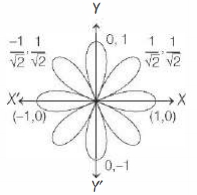
View full question & answer→Question 1084 Marks
यदि $C(\theta)=\sum_{n=0}^{\infty} \frac{\cos (n \theta)}{n !}$ है, तो निम्न में से कौन सा कथन असत्य है ?
Answerd
(d)
Given, $C(\theta)=\sum_{n=0}^{\infty} \frac{\cos (n \theta)}{n !}$
$C(0)=\sum_{n=0}^{\infty} \frac{1}{n !}=1+\frac{1}{1 !}+\frac{1}{2 !}+\frac{1}{3 !}+\ldots=e$
$C(\pi)=\sum_{n=0}^{\infty}(-1)^n \frac{1}{n !} \quad\left[\because \cos n \pi=(-1)^n\right]$
$C(\pi)=1-\frac{1}{1 !}+\frac{1}{2 !}-\frac{1}{3 !}+\ldots=e^{-1}$
(A) $C(0), C(\pi)=e \cdot e^{-1}=1$ T'rue
(B) $C(0)+C(\pi)=e+\frac{1}{e}>2$ True
(C) $C(\theta)>0 \forall \theta \in R$ True
(D) $C^{\prime}(\theta)=\sum_{n=0}^{\infty}-\frac{n \sin (n \theta)}{n !}$
$\therefore \quad C^{\prime}(\theta)=0 \Rightarrow \theta=0$ False
Hence, option $(d)$ is false.
View full question & answer→Question 1094 Marks
$\left(1+\tan 1^{\circ}\right)\left(1+\tan 2^{\circ}\right)\left(1+\tan 3^{\circ}\right) \ldots . .\left(1+\tan 45^{\circ}\right)$ का गुणनफल $($product$)$ इसके समान है:
AnswerWe have,
$\left(1+\tan 1^{\circ}\right)\left(1+\tan 2^{\circ}\right)\left(1+\tan 3^{\circ}\right)$
We know that,
$(1+\tan \theta)\left(1+\tan \left(45^{\circ}-\theta\right)\right)=2$
$\therefore\left(1+\tan 45^{\circ}\right)$
$\left(1+\tan 43^{\circ}\right)\left(1+\tan 44^{\circ}\right)\left(1+\tan 2^{\circ}\right)$
$\left(1+\tan 45^{\circ}\right)$
$\Rightarrow 2^{22} \cdot 2=2^{23} $
View full question & answer→Question 1104 Marks
$\alpha, \hat{p} \in\left(\hat{v}, \frac{\pi}{2}\right)$ के लिए, माना $3 \sin (\alpha+\beta)=2 \sin (\alpha-\beta)$ है। माना एक वास्तविक संख्या $\mathrm{k}$ के लिए $\tan \alpha=\mathrm{k} \tan \beta$ है। तो $\mathrm{k}$ का मान बराबर है।
Answerb
$3\sin \alpha \cos \beta+3 \sin \beta \cos \alpha$
$=2 \sin \alpha \cos \beta-2 \sin \beta \cos \alpha$
$5 \sin \beta \cos \alpha=-\sin \alpha \cos \beta$
$\tan \beta=-\frac{1}{5} \tan \alpha $
$\tan \alpha=-5 \tan \beta$
Not possible as $\tan \alpha, \tan \beta$ are positive
$\Rightarrow$ Data inconsistent
View full question & answer→Question 1114 Marks
यदि $2 \sin ^3 \mathrm{x}+\sin 2 \mathrm{x} \cos \mathrm{x}+4 \sin \mathrm{x}-4=0$ के अंतराल $\left[0, \frac{\mathrm{n} \pi}{2}\right], \mathrm{n} \in \mathrm{N}$, में ठीक $3$ हल है, तो समीकरण $\mathrm{x}^2+\mathrm{nx}+(\mathrm{n}-3)=0$ के मूल किस में है:
Answerb
$ 2 \sin ^3 x+2 \sin x \cdot \cos ^2 x+4 \sin x-4=0$
$ 2 \sin ^3 x+2 \sin x \cdot\left(1-\sin ^2 x\right)+4 \sin x-4=0 $
$ 6 \sin x-4=0 $
$ \sin x=\frac{2}{3} $
${n}=5 \text { (in the given interval) } $
$ x^2+5 x+2=0$
$ x=\frac{-5 \pm \sqrt{17}}{2}$
$ \text { Required interval }(-\infty, 0)$
Required interval $(-\infty, 0)$
View full question & answer→Question 1124 Marks
समीकरण $\frac{3 \cos 2 x+\cos ^3 2 x}{\cos ^6 x-\sin ^6 x}=x^3-x^2+6$ के हलों $\mathrm{x} \in \mathbb{R}$ का योगफल है
Answerc
$ \frac{3 \cos 2 x+\cos ^3 2 x}{\cos ^6 x-\sin ^6 x}=x^3-x^2+6 $
$ \Rightarrow \frac{\cos 2 x\left(3+\cos ^2 2 x\right)}{\cos 2 x\left(1-\sin ^2 x \cos ^2 x\right)}=x^3-x^2+6 $
$ \Rightarrow \frac{4\left(3+\cos ^2 2 x\right)}{\left(4-\sin ^2 2 x\right)}=x^3-x^2+6 $
$ \Rightarrow \frac{4\left(3+\cos ^2 2 x\right)}{\left(3+\cos ^2 2 x\right)}=x^3-x^2+6 $
$ x^3-x^2+2=0 \Rightarrow(x+1)\left(x^2-2 x+2\right)=0$
so, sum of real solutions $=-1$
View full question & answer→Question 1134 Marks
माना $a \in R$ के सभी मानों, जिनके लिए समीकरण $\cos 2 \mathrm{x}+\mathrm{a} \sin \mathrm{x}=2 \mathrm{a}-7$ का एक हल है, का समुच्चय $[p, q]$ है तथा $\mathrm{r}=\tan 9^{\circ}-\tan 27^{\circ}-\frac{1}{\cot 63^{\circ}}+\tan 81^{\circ} $ है। तो $pqr$ बराबरं है ...........|
Answerc
$\cos 2 x+a \cdot \sin x=2 a-7 $
$ a(\sin x-2)=2(\sin x-2)(\sin x+2) $
$ \sin x=2, \quad a=2(\sin x+2) $
$ \Rightarrow a \in[2,6] $
$ p=2 \quad q=6$
$ r=\tan 9^{\circ}+\cot 9^{\circ}-\tan 27-\cot 27 $
$ r=\frac{1}{\sin 9 \cdot \cos 9}-\frac{1}{\sin 27 \cdot \cos 27} $
$=2\left[\frac{4}{\sqrt{5}-1}-\frac{4}{\sqrt{5}+1}\right] $
$ r=4 $
$ \text { p.q. } r=2 \times 6 \times 4=48$
View full question & answer→Question 1144 Marks
$96 \cos \frac{\pi}{33} \cos \frac{2 \pi}{33} \cos \frac{4 \pi}{33} \cos \frac{8 \pi}{33} \cos \frac{16 \pi}{33}$ बराबर है
Answera
$P=96 \cos \frac{\pi}{33} \cos \frac{2 \pi}{33} \cos \frac{4 \pi}{33} \cos \frac{8 \pi}{33} \cos \frac{16 \pi}{33}$
$2 P \times \sin \frac{\pi}{33}=96 \times 2 \sin \frac{\pi}{33} \cos \frac{\pi}{33} \cos \frac{2 \pi}{33} \cos \frac{4 \pi}{33} \cos \frac{8 \pi}{33} \cos \frac{16 \pi}{33}$
$2 P \times \sin \frac{\pi}{33}=6 \times \sin \frac{32 \pi}{33}=6 \sin \frac{\pi}{33}$
$P=3$
View full question & answer→Question 1154 Marks
$\tan 9^{\circ}-\tan 27^{\circ}-\tan 63^{\circ}+\tan 81^{\circ}$ का मान है________
Answerc
The value of $\tan 9^{\circ}-\tan 27^{\circ}-\tan 63^{\circ}+\tan 81^{\circ}$
$\Rightarrow \tan 9^{\circ}+\cot 9^{\circ}-\tan 27^{\circ}-\cot 27^{\circ}$
$\Rightarrow \frac{2}{\sin 18^{\circ}}-\frac{2}{\sin 54^{\circ}}$
$\Rightarrow \frac{2 \times 4}{\sqrt{5}-1}-\frac{2 \times 4}{\sqrt{5+1}}$
$\Rightarrow 4$
View full question & answer→Question 1164 Marks
$36\left(4 \cos ^2 9^{\circ}-1\right)\left(4 \cos ^2 27^{\circ}-1\right)\left(4 \cos ^2 81^{\circ}-1\right)$
$\left(4 \cos ^2 243^{\circ}-1\right)$का मान है
View full question & answer→Question 1174 Marks
यदि $\tan 15^{\circ}+\frac{1}{\tan 75^{\circ}}+\frac{1}{\tan 105^{\circ}}+\tan 195^{\circ}=2 \mathrm{a}$ है, तो $\left(a+\frac{1}{a}\right)$ का मान है :
Answera
$\tan 15^{\circ}=2-\sqrt{3}$
$\frac{1}{\tan 75^{\circ}}=\cot 75^{\circ}=2-\sqrt{3}$
$\frac{1}{\tan 105^{\circ}}=\cot \left(105^{\circ}\right)=-\cot 75^{\circ}=\sqrt{3}-2$
$\tan 195^{\circ}=\tan 15^{\circ}=2-\sqrt{3}$
$2(2-\sqrt{3})=2 a \Rightarrow a =2-\sqrt{3}$
$a +\frac{1}{ a }=4$
View full question & answer→Question 1184 Marks
दी गई आकृति में $\theta_1+\theta_2=\frac{\pi}{2}$ तथा
$\sqrt{3}(\mathrm{BE})=4(\mathrm{AB})$ है। यदि $\triangle \mathrm{CAB}$ का क्षेत्रफल
$2 \sqrt{3}-3$ वर्ग इकाई है, जब $\frac{\theta_2}{\theta_1}$ अधिकतम है, तो
$\triangle \mathrm{CED}$ का परिमाप (इकाई में) बराबर है :
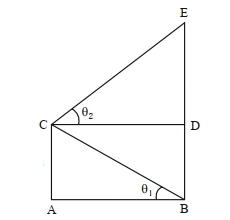
Answerc
$\sqrt{3} BE =4 AB$
$Ar (\triangle CAB )=2 \sqrt{3}-3$
$\frac{1}{2} x ^2 \tan \theta_1=2 \sqrt{3}-3$
$BE = BD + DE$
$= x \left(\tan \theta_1+\tan \theta_2\right)$
$BE = AB \left(\tan \theta_1+\cot \theta_1\right)$
$\frac{4}{\sqrt{3}} \tan \theta_1+\cot \theta_1 \Rightarrow \tan \theta_1=\sqrt{3}, \frac{1}{\sqrt{3}}$
$\theta_1=\frac{\pi}{6}$
$\theta_1=\frac{\pi}{3} \quad \theta_2=\frac{\pi}{3}$
$as \frac{\theta_2}{\theta_1} \text { is } \operatorname{largest} \therefore \theta_1=\frac{\pi}{6} \theta_2=\frac{\pi}{3}$
$\therefore x ^2=\frac{(2 \sqrt{3}-3) \times 2}{\tan \theta_1}=\frac{\sqrt{3}(2-\sqrt{3}) \times 2}{\tan \frac{\pi}{6}}$
$x ^2=12-6 \sqrt{3}=(3-\sqrt{3})^2$
$x =3-\sqrt{3}$
Perimeter of $\triangle C E D$
$= CD + DE + CE$
$=3 \sqrt{3}+(3-\sqrt{3}) \sqrt{3}+(3-\sqrt{3}) \times 2=6$
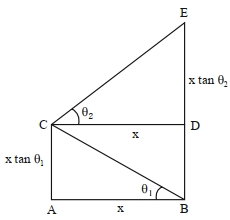
View full question & answer→Question 1194 Marks
यदि $\cot \alpha=1$ तथा $\sec \beta=-\frac{5}{3}$ है, जहाँ $\pi<\alpha<\frac{3 \pi}{2}$ तथा $\frac{\pi}{2}<\beta<\pi$ है, तो $\tan (\alpha+\beta)$ का मान तथा चतुर्थांश, जिसमें $\alpha+\beta$ स्थित है, क्रमश: है
Answera
$\cot \alpha=1, \sec \beta=\frac{-5}{3}, \cos \beta=\frac{-3}{5}, \tan \beta=\frac{-4}{3}$
$\tan (\alpha+\beta)=\frac{1-\frac{4}{3}}{1+\frac{4}{3} \times 1}=\frac{-1}{7}$
View full question & answer→Question 1204 Marks
$2 \sin \left(\frac{\pi}{22}\right) \sin \left(\frac{3 \pi}{22}\right) \sin \left(\frac{5 \pi}{22}\right) \sin \left(\frac{7 \pi}{22}\right) \sin \left(\frac{9 \pi}{22}\right)$ बराबर है।
Answerb
$2 \sin \frac{\pi}{22} \sin \frac{3 \pi}{22} \sin \frac{5 \pi}{22} \sin \frac{7 \pi}{22} \sin \frac{9 \pi}{22}$
$=2 \sin \left(\frac{11 \pi-10 \pi}{22}\right) \sin \left(\frac{11 \pi-8 \pi}{22}\right) \sin \left(\frac{11 \pi-6 \pi}{22}\right)$ $\sin \left(\frac{11 \pi-4 \pi}{22}\right) \sin \left(\frac{11 \pi-2 \pi}{22}\right)$
$=2 \cos \frac{\pi}{11} \cos \frac{2 \pi}{11} \cos \frac{3 \pi}{11} \cos \frac{4 \pi}{11} \cos \frac{5 \pi}{11}$
$=\frac{2 \sin \frac{32 \pi}{11}}{2^{5} \sin \frac{\pi}{11}}$
$=\frac{1}{16}$
View full question & answer→Question 1214 Marks
$\cos \left(\frac{2 \pi}{7}\right)+\cos \left(\frac{4 \pi}{7}\right)+\cos \left(\frac{6 \pi}{7}\right)$ का मान बराबर होगा।
Answera
$\cos \frac{2 \pi}{7}+\cos \frac{4 \pi}{7}+\cos \frac{6 \pi}{7}$
$=\frac{\sin \left(3 \times \frac{\pi}{7}\right)}{\sin \frac{\pi}{7}} \times \cos \left(\frac{\frac{2 \pi}{7}+\frac{6 \pi}{7}}{2}\right)$
$=\frac{2 \sin \left(\frac{3 \pi}{7}\right)}{2 \sin \frac{\pi}{7}} \times \cos \left(\frac{4 \pi}{7}\right)$
$=\frac{\sin \left(\frac{7 \pi}{7}\right)+\sin \left(\frac{-\pi}{7}\right)}{2 \sin \frac{\pi}{7}}$
$=\frac{-\sin \frac{\pi}{7}}{2 \sin \frac{\pi}{7}}$
$=-\frac{1}{2}$
View full question & answer→Question 1224 Marks
$16 \sin \left(20^{\circ}\right) \sin \left(40^{\circ}\right) \sin \left(80^{\circ}\right)$ का मान होगा
Answerb
$16 \sin 20^{\circ} \sin 40^{\circ} \sin 80^{\circ}$
$=16 \sin 40^{\circ} \sin 20^{\circ} \sin 80^{\circ}$
$=4(4 \sin (60-20) \sin (20) \sin (60+20))$
$=4 \times \sin \left(3 \times 20^{\circ}\right)$
${[\because \sin 3 \theta=4 \sin (60-\theta) \times \sin \theta \times \sin (60+\theta)]}$
$=4 \times \sin 60^{\circ}$
$=4 \times \frac{\sqrt{3}}{2}=2 \sqrt{3}$
View full question & answer→Question 1234 Marks
$2 \sin \left(12^{\circ}\right)-\sin \left(72^{\circ}\right)$ का मान होगा-
Answerd
$\sin 12^{\circ}+\sin 12^{\circ}-\sin 72^{\circ}$
$=\sin 12^{\circ}-2 \cos 42^{\circ} \sin 30^{\circ}$
$=\sin 12^{\circ}-\sin 48^{\circ}$
$=-2 \cos 30^{\circ} \sin 18^{\circ}$
$=-2 \times \frac{\sqrt{3}}{2} \times \frac{\sqrt{5}-1}{4}$
$=\frac{\sqrt{3}}{4}(1-\sqrt{5})$
View full question & answer→Question 1244 Marks
यदि $\sin ^2\left(10^{\circ}\right) \sin \left(20^{\circ}\right) \sin \left(40^{\circ}\right) \sin \left(50^{\circ}\right) \sin \left(70^{\circ}\right)$ $=\alpha-\frac{1}{16} \sin \left(10^{\circ}\right)$ है, तो $16+\alpha^{-1}$ बराबर है
Answerc
$\sin 10^{\circ}\left(\frac{1}{2} \cdot 2 \sin 20^{\circ} \sin 40^{\circ}\right) \cdot \sin 10^{\circ} \sin \left(60^{\circ}-10^{\circ}\right) \sin \left(60^{\circ}+10^{\circ}\right)$
$\sin 10^{\circ} \frac{1}{2}\left(\cos 20^{\circ}-\cos 60^{\circ}\right) \cdot \frac{1}{4} \sin 30^{\circ}$
$\frac{1}{2} \cdot \frac{1}{4} \cdot \frac{1}{2} \cdot \sin 10^{\circ}\left(\cos 20^{\circ}-\frac{1}{2}\right)$
$=\frac{1}{32}\left(2 \sin 10^{\circ} \cos 20^{\circ}-\sin 10^{\circ}\right)$
$=\frac{1}{32}\left(\sin 30^{\circ}-\sin 10^{\circ}-\sin 10^{\circ}\right)$
$=\frac{1}{32}\left(\frac{1}{2}-2 \sin 10^{\circ}\right)$
$=\frac{1}{64}\left(1-4 \sin 10^{\circ}\right)$
$=\frac{1}{64}-\frac{1}{16} \sin 10^{\circ}$
Hence $\alpha=\frac{1}{64}$
$16+\alpha^{-1}=80$
View full question & answer→Question 1254 Marks
$'k'$ के पूर्णाकीय मानों, जिनके लिए समीकरण $3 \sin x +4 \cos x = k +1$ का एक हल है, $k \in R$ है, की संख्या है
Answera
$3 \sin x+4 \cos x=k+1$
$\Rightarrow k +1 \in\left[-\sqrt{3^{2}+4^{2}}, \sqrt{3^{2}+4^{2}}\right]$
$\Rightarrow k +1 \in[-5,5]$
$\Rightarrow k \in[-6,4]$
No. of integral values of $k =11$
View full question & answer→Question 1264 Marks
यदि किसी $\alpha \in R$ के लिए $15 \sin ^{4} \alpha+10 \cos ^{4} \alpha=6$ है, तो $27 \sec ^{6} \alpha+8 \operatorname{cosec}^{6} \alpha$ का मान बराबर है
View full question & answer→Question 1274 Marks
यदि $\sin \theta+\cos \theta=\frac{1}{2}$, है, तो $16(\sin (2 \theta)+\cos (4 \theta)+\sin (6 \theta))$ बराबर है
Answerc
$16[2 \sin 4 \theta \cos 2 \theta+\cos 4 \theta]$
$16\left[4 \sin 2 \theta \cos ^{2} 2 \theta+2 \cos ^{2} 2 \theta-1\right]$
Now:
$\sin \theta+\cos \theta=\frac{1}{2}$
$1+\sin 2 \theta=\frac{1}{4}$
$\sin 2 \theta=-\frac{3}{4}$
$\cos ^{2} 2 \theta=1-\frac{9}{16}=\frac{7}{16}$
$16\left[-4(-3 / 4) \times \frac{7}{16}+2 \times \frac{7}{16}-1\right]$
$16\left[\frac{-7}{16}-1\right] \Rightarrow-23$
View full question & answer→Question 1284 Marks
$2 \sin \left(\frac{\pi}{8}\right) \sin \left(\frac{2 \pi}{8}\right) \sin \left(\frac{3 \pi}{8}\right) \sin \left(\frac{5 \pi}{8}\right) \sin \left(\frac{6 \pi}{8}\right) \sin \left(\frac{7 \pi}{8}\right)$ का मान है -
Answerc
$2 \sin \left(\frac{\pi}{8}\right) \sin \left(\frac{2 \pi}{8}\right) \sin \left(\frac{3 \pi}{8}\right) \sin \left(\frac{5 \pi}{8}\right) \sin \left(\frac{6 \pi}{8}\right) \sin \left(\frac{7 \pi}{8}\right)$
$2 \sin ^{2} \frac{\pi}{8} \sin ^{2} \frac{2 \pi}{8} \sin ^{2} \frac{3 \pi}{8}$
$\sin ^{2} \frac{\pi}{8} \sin ^{2} \frac{3 \pi}{8}$
$\sin ^{2} \frac{\pi}{8} \cos ^{2} \frac{\pi}{8}$
$\frac{1}{4} \sin ^{2}\left(\frac{\pi}{4}\right)=\frac{1}{8}$
View full question & answer→Question 1294 Marks
$\operatorname{cosec} 18^{\circ}$ निम्न में से किस समीकरण का एक मूल है?
Answerd
$\operatorname{cosec} 18^{\circ}=\frac{1}{\sin 18^{\circ}}=\frac{4}{\sqrt{5}-1}=\sqrt{5}+1$
Let $\operatorname{cosec} 18^{\circ}=\mathrm{x}=\sqrt{5}+1$
$\Rightarrow \mathrm{x}-1=\sqrt{5}$
Squaring both sides, we get
$x^{2}-2 x+1=5$
$\Rightarrow x^{2}-2 x-4=0$
View full question & answer→Question 1304 Marks
यदि $x \in\left(0, \frac{\pi}{2}\right)$ के लिए, $\log _{10} \sin x +$ $\log _{10} \cos x=-1$ तथा $\log _{10}(\sin x+\cos x)=\frac{1}{2}$ $\left(\log _{10} n -1\right), n >0$ हैं, तो $n$ का मान बराबर है
Answerb
$x \in\left(0, \frac{\pi}{2}\right)$
$\log _{10} \sin x+\log _{10} \cos x=-1$
$\Rightarrow \quad \log _{10} \sin x \cdot \cos x=-1$
$\Rightarrow \quad \sin x \cdot \cos x=\frac{1}{10}$ $....(1)$
$\log _{10}(\sin x+\cos x)=\frac{1}{2}\left(\log _{10} n-1\right)$
$\Rightarrow \quad \sin x+\cos x=10^{\left(\log _{10} \sqrt{n}-\frac{1}{2}\right)}=\sqrt{\frac{n}{10}}$
by squaring
$1+2 \sin x \cdot \cos x=\frac{n}{10}$
$\Rightarrow \quad 1+\frac{1}{5}=\frac{ n }{10} \quad \Rightarrow \quad n =12$
View full question & answer→Question 1314 Marks
यदि $0 < x, y < \pi$ तथा $\cos x+\cos y-\cos (x+y)=\frac{3}{2}$, है, तो $\sin x+\cos y$ बराबर है
Answerb
$\cos x+\cos y-\cos (x+y)=\frac{3}{2}$
$\cos ^{2}\left(\frac{x+y}{2}\right)-\cos \left(\frac{x+y}{2}\right) \cdot \cos \left(\frac{x-y}{2}\right)$
$+\frac{1}{4} \cdot \cos ^{2}\left(\frac{x-y}{2}\right)+\frac{1}{4} \sin ^{2}\left(\frac{x-y}{2}\right)=0$
$\Rightarrow\left(\cos \left(\frac{x+y}{2}\right)-\frac{1}{2} \cos \left(\frac{x-y}{2}\right)\right)^{2}+\frac{1}{4} \sin ^{2}\left(\frac{x-y}{2}\right)=0$
$\Rightarrow \sin \left(\frac{x-y}{2}\right)=0$ and $\cos \left(\frac{x+y}{2}\right)=\frac{1}{2} \cos \left(\frac{x-y}{2}\right)$
$\Rightarrow x=y$ and $\cos x=\frac{1}{2}=\cos y$
$\therefore \sin x=\frac{\sqrt{3}}{2}$
$\Rightarrow \sin x+\cos y=\frac{1+\sqrt{3}}{2}$
View full question & answer→Question 1324 Marks
$\cot \frac{\pi}{24}$ का मान है
Answerd
$\cot \theta=\frac{1+\cos 2 \theta}{\sin 2 \theta}=\{ \therefore 1+\cos 2 \theta=2 \cos ^{2} \theta \,\& \, \sin 2 \theta=2 \sin \theta \cos \theta\}$
put, $\theta=\frac{\pi}{24}$
$\left\{\therefore \cos \frac{\pi}{12}=\frac{\sqrt{3}+1}{2 \sqrt{2}} \, \& \, \sin \frac{\pi}{12}=\frac{\sqrt{3}-1}{2 \sqrt{2}}\right\}$
$\Rightarrow \cot \left(\frac{\pi}{24}\right)=\frac{1+\left(\frac{\sqrt{3}+1}{2 \sqrt{2}}\right)}{\left(\frac{\sqrt{3}-1}{2 \sqrt{2}}\right)}$
$=\frac{(2 \sqrt{2}+\sqrt{3}+1)}{(\sqrt{3}-1)} \times \frac{(\sqrt{3}+1)}{(\sqrt{3}+1)}$
$=\frac{2 \sqrt{6}+2 \sqrt{2}+3+\sqrt{3}+\sqrt{3}+1}{2}$
$=\sqrt{6}+\sqrt{2}+\sqrt{3}+2$
View full question & answer→Question 1334 Marks
माना समीकरण $( k +1) \tan ^{2} x -\sqrt{2} \cdot \lambda \tan x =$ $(1- k ), k (\neq-1),(\lambda \in R )$ के $\alpha$ तथा $\beta$ दो वास्तविक मूल हैं। यदि $\tan ^{2}(\alpha+\beta)=50$ है, तो $\lambda$ का एक मान है
Answerb
$\tan \alpha+\tan \beta=\frac{\lambda \sqrt{2}}{\mathrm{k}+1}$
$\tan \alpha . \tan \beta=\frac{\mathrm{k}-1}{\mathrm{k}+1}$
$\tan (\alpha+\beta)=\frac{\frac{\lambda \sqrt{2}}{\mathrm{k}+1}}{1-\frac{\mathrm{k}-1}{\mathrm{k}+1}}=\frac{\lambda \sqrt{2}}{2}=\frac{\lambda}{\sqrt{2}}$
$\Rightarrow \frac{\lambda^{2}}{2}=50 \Rightarrow \lambda=10 \;and\;-10$
View full question & answer→Question 1344 Marks
$\cos ^{3}\left(\frac{\pi}{8}\right) \cdot \cos \left(\frac{3 \pi}{8}\right)+\sin ^{3}\left(\frac{\pi}{8}\right) \cdot \sin \left(\frac{3 \pi}{8}\right) \text { का मान }$ है
Answerc
$\cos ^{3} \frac{\pi}{8} \cdot \sin \frac{\pi}{8}+\sin ^{3} \frac{\pi}{8} \cdot \cos \frac{\pi}{8}$
$=\sin \frac{\pi}{8} \cdot \cos \frac{\pi}{8}=\frac{1}{2} \sin \frac{\pi}{4}=\frac{1}{2 \sqrt{2}}$
View full question & answer→Question 1354 Marks
यदि $\frac{\sqrt{2} \sin \alpha}{\sqrt{1+\cos 2 \alpha}}=\frac{1}{7}$ तथा $\sqrt{\frac{1-\cos 2 \beta}{2}}=\frac{1}{\sqrt{10}}, \alpha$, $\beta \in\left(0, \frac{\pi}{2}\right)$, हैं, तो $\tan (\alpha+2 \beta)$ बराबर ........ है |
Answera
$\frac{\sqrt{2} \sin \alpha}{\sqrt{2} \cos \alpha}=\frac{1}{7} \Rightarrow \tan \alpha=\frac{1}{7}$
$\sin \beta=\frac{1}{\sqrt{10}} \Rightarrow \tan \beta=\frac{1}{3} \Rightarrow \tan 2 \beta=\frac{3}{4}$
$\tan (\alpha+2 \beta)=\frac{\tan \alpha+\tan 2 \beta}{1-\tan \alpha \tan 2 \beta}=1$
View full question & answer→Question 1364 Marks
यदि $\cos (\alpha+\beta)=\frac{3}{5}, \sin (\alpha-\beta)=\frac{5}{13}$ तथा $0<\alpha, \beta<\frac{\pi}{4}$ है, तो $\tan (2 \alpha)$ बराबर है -
Answerc
$0\, < \,\alpha \, + \,\beta \, = \,\frac{\pi }{2}$ and $\frac{{ - \pi }}{4} < \,\alpha \, - \,\beta \, < \,\frac{\pi }{4}$
If $\cos \,(\,\alpha + \,\beta )\, = \,\frac{3}{5}$ then $\tan \,(\,\alpha + \,\beta )\, = \,\frac{3}{4}$ and if $\sin \,(\,\alpha - \,\beta )\, = \,\frac{5}{{13}}$ then $\tan \,(\,\alpha - \,\beta )\, = \,\frac{5}{{12}}$
(since $\alpha - \,\beta $ here lies in the first quadrant)
Now $\tan \,(\,2\alpha ) = \tan \{ (\alpha \, + \,\beta ) + (\alpha \, - \,\beta )\} $
$ = \,\frac{{\tan \,(\alpha \, + \,\beta ) + \tan \,(\alpha \, - \,\beta )}}{{1 - \tan \,(\alpha \, + \,\beta ).\tan \,(\alpha \, - \,\beta )}}$
$ = \frac{{\frac{4}{3} + \frac{5}{{12}}}}{{1 - \frac{4}{3}.\frac{5}{{12}}}} = \frac{{63}}{{16}}$
View full question & answer→Question 1374 Marks
माना $k =1,2,3, \ldots$ के लिये $f _{ k }( x )=\frac{1}{ k }\left(\sin ^{ k } x +\cos ^{ k } x \right)$ तो सभी $x \in R$ के लिये, $f _{4}( x )- f _{6}( x )$ का मान बराबर है
Answera
${F_4}(x)\, = \,\frac{{{{\sin }^4}x + {{\cos }^4}x}}{4} = $ $\frac{{1 - 2{{\sin }^2}x.{{\cos }^2}x}}{4} = \frac{1}{4} - \frac{1}{2}{\sin ^2}x.{\cos ^2}x$
${F_6}(x)\, = \,\frac{{{{\sin }^6}x + {{\cos }^6}x}}{6} = $ $\frac{{1 - 3{{\sin }^2}x.{{\cos }^2}x\,({{\sin }^2}x\, + \,{{\cos }^2}x)}}{6}$
$ = \frac{1}{6} - \frac{1}{2}{\sin ^2}x.{\cos ^2}x$
${F_4}\left( x \right) - {F_6}(x) = \frac{1}{4} - \frac{1}{6} = \frac{{6 - 4}}{{24}} = \frac{2}{{24}} = \frac{1}{{12}}$
View full question & answer→Question 1384 Marks
$3 \cos \theta+5 \sin \left(\theta-\frac{\pi}{6}\right)$ का $\theta$ के किसी भी वास्तविक मान के लिये अधिकतम मान है
Answera
$5\,\sin \,\left( {\theta \, - \,\frac{\pi }{6}} \right)\, + \,3\,\cos \,\theta $
$ = \,5\left( {\sin \,\theta \,\cos \frac{\pi }{6}\, - \,\cos \,\theta \sin \frac{\pi }{6}} \right)\, + \,3\cos \,\theta $
$ = \frac{{5\sqrt 3 }}{2}\sin \,\theta \, + \,\frac{1}{2}\cos \,\theta $
Maximum value is $\sqrt {{{\left( {\frac{{5\sqrt 3 }}{2}} \right)}^2} + {{\left( {\frac{1}{2}} \right)}^2}} \, = \,\sqrt {\frac{{76}}{4}} \, = \,\sqrt {19} $
View full question & answer→Question 1394 Marks
$\sin 10^{\circ} \sin 30^{\circ} \sin 50^{\circ} \sin 70^{\circ}$ का मान है
Answerd
$\sin \,{10^o}\,\sin \,{30^o}\,\sin \,{50^o}\,\sin \,{70^o}$
$ = \,\,\sin \,{10^o}\,\sin \,{30^o}\,\sin \,{50^o}\,\sin \,{70^o}$
$ = \,\,\sin \,{30^o}\,\{ \sin \,{10^o}\sin \,({60^o} - {10^o})\,\sin ({60^o} + {10^o})\,\} $
$ = \,\,\sin \,{30^o}\,\left\{ {\frac{1}{4}\sin \,3({{10}^o})} \right\}$
$ = \,\frac{1}{2}\left( {\frac{1}{4} \times \frac{1}{2}} \right)$
$ = \,\frac{1}{{16}}$
View full question & answer→Question 1404 Marks
${\cos ^2}\,{10^o}\,\, - \,\cos \,\,{10^o}\,\cos \,\,{50^o}\, + \,{\cos ^2}\,{50^o}$ का मान है:
Answerb
$\frac{1}{2}\,(2\,{\cos ^2}{10^o}\, - \,2\cos \,{10^o}\,\cos \,{50^o} + \,2\,{\cos ^2}{50^o})$
$ \Rightarrow \frac{1}{2}\,(1 + \,\cos \,{20^o} - (\cos \,{60^o} + \cos \,{40^o})\, + 1 + \,\,\cos {100^o})$
$ \Rightarrow \frac{1}{2}\,\left( {\frac{3}{2} + \,\cos \,{{20}^o} + 2\sin \,{{70}^o}\sin \,( - {{30}^o})} \right)$
$ \Rightarrow \frac{1}{2}\,\left( {\frac{3}{2} + \,\cos \,{{20}^o} - \sin \,{{70}^o}} \right)$
$ \Rightarrow \frac{3}{4}$
View full question & answer→Question 1414 Marks
$\sin ^{2} 2 \theta+\cos ^{4} 2 \theta=\frac{3}{4}$ को संतुष्ट करने वाले $\theta \in\left(0, \frac{\pi}{2}\right)$ के सभी मानों का योग है
Answerc
${\sin ^2}2\theta \, + \,{\cos ^4}2\theta \, = \frac{3}{4}$
Let $\,{\cos ^2}2\theta \, =t $
$ \Rightarrow \,1\, - \,\,{\cos ^2}2\theta \, + \,{\cos ^4}2\theta \, = \frac{3}{4}$
$ \Rightarrow t = \frac{1}{2}\, \Rightarrow \,\,{\cos ^2}2\theta \, = \frac{1}{2}\,$
$ \Rightarrow 2\,{\cos ^2}2\theta - 1 = 0\, \Rightarrow \,\cos 4\theta \, = 0$
$ \Rightarrow \,4\theta \, = (2n + 1)\frac{\pi }{2}$
$ \Rightarrow \,\theta \, = (2n + 1)\frac{\pi }{8} \Rightarrow \theta = \frac{\pi }{8},\frac{{3\pi }}{8} \in \left[ {0,\frac{\pi }{2}} \right]$
Sum of values of $\theta $ is $\frac {\pi }{2}$
View full question & answer→Question 1424 Marks
किसी $\theta \in\left(\frac{\pi}{4}, \frac{\pi}{2}\right)$ के लिये, व्यंजक $3(\sin \theta-\cos \theta)^{4}+6(\sin \theta+\cos \theta)^{2}+4 \sin ^{6} \theta$ होगा
Answerb
$3\,{(1 - \sin 2\theta )^2}\, + \,6(1 + \sin 2\theta )\, + \,4\,{\sin ^6}\theta $
$ = 3\,(1 - 2\sin \,2\theta + {\sin ^2}2\theta ) + \,6 + 6\sin 2\theta + \,4\,{\sin ^6}\theta $
$ = \,9 + 3{\sin ^2}2\theta + 4\,{\sin ^6}\theta $
$ = \,9 + 12{\sin ^2}\theta {\cos ^2}\theta + 4\,{(1 - {\cos ^2}\theta )^3}$
$ = \,9 + 12(1 - {\cos ^2}\theta ){\cos ^2}\theta + 4\,(1 - 3{\cos ^2}\theta + 3{\cos ^4}\theta - {\cos ^6}\theta )$
$ = \,13 + 12{\cos ^2}\theta - 12{\cos ^4}\theta - 12{\cos ^2}\theta + 12{\cos ^4}\theta - 4{\cos ^6}\theta $
$ = \,13 - 4{\cos ^6}\theta $
View full question & answer→Question 1434 Marks
यदि $\tan A$ तथा $\tan B$, द्विघात समीकरण $3 x ^{2}-10 x -25=0$ के मूल हैं, तां $3 \sin ^{2}( A + B )-10 \sin ( A + B ) \cdot \cos ( A + B )$ $-25 \cos ^{2}( A + B )$ का मान है
Answerb
$\text { Given, } 3 x ^2-10 x -25=0$
$\tan A+\tan B=\frac{10}{3}$
$\tan A \times \tan B=\frac{-25}{3}$
$\tan (A+B)=\frac{\tan A+\tan B}{1-\tan A \tan B}$
$\frac{\frac{10}{3}}{1+\frac{25}{3}}$
$\frac{\frac{10}{3}}{\frac{28}{3}}=\frac{10}{28}=\frac{5}{14}$
$\therefore \tan (A+B)=\frac{5}{14}$
$\therefore \sin (A+B)=\frac{5}{\sqrt{221}}$
$\cos (A+B)=\frac{14}{\sqrt{221}}$
$\therefore 3 \sin ^2(A+B)-10 \sin (A+B) \cos (A+B)-25 \cos ^2(A+B)$
$=3 \times \frac{25}{221}-10 \times \frac{70}{221}-25 \times \frac{196}{221}$
$=\frac{75-700-4900}{221}$
$=-25$
View full question & answer→Question 1444 Marks
यदि $5\left( {{{\tan }^2}x - {{\cos }^2}x} \right) = 2\cos 2x + 9,$ तो $\cos 4x$ का मान है:
Answera
We have
$5\,{\tan ^2}x\, - 5{\cos ^2}x = 2(2{\cos ^2}x - 1) + 9$
$ \Rightarrow \,5\,{\tan ^2}x\, - 5{\cos ^2}x = 4{\cos ^2}x - 2 + 9$
$ \Rightarrow \,5\,{\tan ^2}x = 9{\cos ^2}x + 7$
$ \Rightarrow \,5\,({\sec ^2}x - 1) = 9{\cos ^2}x + 7$
Let ${\cos ^2}x = t$
$ \Rightarrow \frac{5}{t} - 9t - 12 = 0$
$ \Rightarrow 9{t^2} + 12t - 5 = 0$
$ \Rightarrow 9{t^2} + 15t - 3t - 5 = 0$
$ \Rightarrow (3t - 1)(3t + 5) = 0$
$ \Rightarrow t\, = \frac{1}{3}$ as $t\, \ne - \frac{5}{3}$
$\cos \,2x = 2{\cos ^2}x - 1 = 2\left( {\frac{1}{3}} \right) - 1 = - \frac{1}{3}$
$\cos \,4x = 2{\cos ^2}2x - 1 = 2{\left( { - \frac{1}{3}} \right)^2} - 1 = - \frac{7}{9}$
View full question & answer→Question 1454 Marks
यदि $A >0, B >0$ तथा $A + B =\frac{\pi}{6}$ है, तो $\tan A+\tan B$ का न्यूनतम मान है
Answerb
$\tan \,(A + B)\, = \,\frac{{\tan \,A\, + \tan \,B}}{{1 - \tan \,A\,\tan \,B}}$
$ \Rightarrow \,\frac{1}{{\sqrt 3 }}\, = \,\frac{y}{{1 - \tan \,A\,\tan \,B}}$ where $y\, = \tan \,A\, + \tan \,B$
$ \Rightarrow \tan \,A\,\tan \,B\, = \,1 - \sqrt 3 y$ Also $AM \geqslant GM$
$ \Rightarrow \,\frac{{\tan \,A\, + \,\tan \,B}}{2}\, \geqslant \,\sqrt {\tan \,A\,\tan \,B} $
$ \Rightarrow \,y\, \geqslant \,2\sqrt {1 - \sqrt 3 y} $
$ \Rightarrow \,{y^2}\, \geqslant \,4 - 4\sqrt 3 y$
$ \Rightarrow \,{y^2}\, + \,4\sqrt 3 y - 4 \geqslant 0$
$ \Rightarrow \,y\, \leqslant \, - \,2\sqrt 3 - 4$ or $ \Rightarrow \,y\, \geqslant \, - \,2\sqrt 3 + 4$
( $y\, \leqslant \, - \,2\sqrt 3 - 4$ is not possible as $\tan A\,\tan B\, > 0$
View full question & answer→Question 1464 Marks
यदि $m$ तथा $M$, व्यंजक $4+\frac{1}{2} \sin ^{2} 2 x-2 \cos ^{4} x, x \in R$ के क्रमशः न्यूनतम तथा अधिकतम मान हैं, तो $M-m$ बराबर है
Answerb
$4\, + \,\frac{1}{2}\,{\sin ^2}2x\, - \,2\,{\cos ^4}x$
$4\, + \,2(1 - {\cos ^2}x){\cos ^2}x - 2{\cos ^4}x$
$ - 4\left\{ {{{\cos }^4}x - \frac{{{{\cos }^2}x}}{2} - 1 + \frac{1}{{16}} - \frac{1}{{16}}} \right\}\, - \,4\left\{ {{{\left( {{{\cos }^2}x - \frac{1}{4}} \right)}^2} - \frac{{17}}{{16}}} \right\}$
$0\, \leqslant \,{\cos ^2}x\, \leqslant 1$
$ - \frac{1}{4}\, \leqslant \,\,{\cos ^2}x\, - \,\frac{1}{4}\, \leqslant \,\frac{3}{4}$
$0\, \leqslant \,{\left( {\,{{\cos }^2}x - \frac{1}{4}} \right)^2}\, \leqslant \,\frac{9}{{16}}$
$ - \frac{{17}}{{16}}\, \leqslant \,{\left( {\,{{\cos }^2}x - \frac{1}{4}} \right)^2}\, - \frac{{17}}{{16}}\, \leqslant \,\frac{9}{{16}}\, \leqslant \, - \frac{{17}}{{16}}\,$
$\frac{{17}}{4} \geqslant - \,4\left\{ {\,{{\left( {\,{{\cos }^2}x - \frac{1}{4}} \right)}^2} - \frac{{17}}{{16}}\,\,} \right\}\, \geqslant \,\frac{1}{2}$
$M = \frac{{17}}{4}$
$m = \frac{1}{2}$
$M - m\, = \,\frac{{17}}{4} - \frac{2}{4}\, = \frac{{15}}{4}$
View full question & answer→Question 1474 Marks
माना $f$ एक विषम फलन है जो कि वास्तविक संख्याओं के समुच्चय पर $f(x)=3 \sin x+4 \cos x$ द्वारा परिभाषित है जहाँ $x \geqslant 0$ है, तो $x=-\frac{11 \pi}{6}$ पर $f(x)$ बराबर है
Answerc
Given $f$ be an odd function
$f(x)\, = \,3\,\sin x + 4\,\cos x$
Now,
$f\left( {\frac{{ - 11\pi }}{6}} \right)\, = \,3\,\sin \left( {\frac{{ - 11\pi }}{6}} \right)\, + 4\,\cos \left( {\frac{{ - 11\pi }}{6}} \right)\,$
$f\left( {\frac{{ - 11\pi }}{6}} \right)\, = \,3\,\sin \left( { - 2\pi + \frac{\pi }{6}} \right)\, + 4\,\cos \left( { - 2\pi + \frac{\pi }{6}} \right)\,$
$f\left( {\frac{{ - 11\pi }}{6}} \right)\, = \,3\,\sin \left\{ { - \left( {2\pi - \frac{\pi }{6}} \right)} \right\}\, + 4\,\cos \left\{ { - \left( {2\pi - \frac{\pi }{6}} \right)} \right\}$
$\left\{ {For\,\,odd\,\,functions\,\begin{array}{*{20}{c}}
{\sin \theta \, = \, - \,\sin \theta } \\
{and\,\,\cos \,( - \theta ) = - \cos \,\,\theta }
\end{array}} \right\}$
$f\left( {\frac{{ - 11\pi }}{6}} \right)\, = \, - 3\,\sin \left( {2\pi - \frac{\pi }{6}} \right)\, - 4\,\cos \left( {2\pi - \frac{\pi }{6}} \right)$
$ \Rightarrow \,f\left( {\frac{{ - 11\,\pi }}{6}} \right)\, = \,\, + 3\sin \left( {\frac{\pi }{6}} \right) - 4\,\cos \left( {\frac{\pi }{6}} \right)$
$ \Rightarrow \,f\left( {\frac{{ - 11\,\pi }}{6}} \right)\, = \,\,3 \times \frac{1}{2} - 4\, \times \frac{{\sqrt 3 }}{2}$
or $\,f\left( {\frac{{ - 11\,\pi }}{6}} \right)\, = \,\,\frac{3}{2} - 2\sqrt 3 $
View full question & answer→Question 1484 Marks
माना $f_{k}(x)=\frac{1}{k}\left(\sin ^{k} x+\cos ^{k} x\right)$ है, जहाँ $x \in R$ तथा $k \geq 1$ है, तो $f_{4}(x)-f_{6}(x)$ बराबर है:
Answerb
${f_4}(x)\, - \,{f_6}(x)\, = \frac{1}{4}({\sin ^4} + {\cos ^4}x) - \frac{1}{6}({\sin ^6} + {\cos ^6}x)$
$ = \frac{1}{4}(1 - 2{\sin ^2}{\cos ^2}x) - \frac{1}{6}(1 - 3{\sin ^2}{\cos ^2}x)$
$ = \frac{1}{4} - \frac{1}{6} = \frac{{3 - 2}}{{12}} = \frac{1}{{12}}$
View full question & answer→Question 1494 Marks
व्यंजक $\frac{\tan A }{1-\cot A }+\frac{\cot A }{1-\tan A }$ को लिखा जा सकता है इस प्रकार
Answerb
$ = \frac{{\sin A}}{{\cos A}} \times \frac{{\sin A}}{{\sin A - \cos A}} + \frac{{\cos A}}{{\sin A}} \times \frac{{\cos A}}{{\cos A - \sin A}}$
$ = \frac{1}{{\sin A - \cos A}}\left\{ {\frac{{{{\sin }^3}A - {{\cos }^3}A}}{{\cos A\sin A}}} \right\}$
$ = \frac{{{{\sin }^2}A + \sin A\cos A + {{\cos }^2}A}}{{\sin A\cos A}}$ $ = 1 + \sec A\cos ecA$
View full question & answer→Question 1504 Marks
माना कि $\frac{\pi}{2} < x < \pi$ इस प्रकार है कि $\cot x=\frac{-5}{\sqrt{11}}$ है। तब
$\left(\sin \frac{11 x}{2}\right)(\sin 6 x-\cos 6 x)+\left(\cos \frac{11 x}{2}\right)(\sin 6 x+\cos 6 x)$ बराबर है
Answerb
$x \in\left(\frac{\pi}{2}, \pi\right)$
$\left(\sin \frac{11 x}{2}\right)(\sin 6 x-\cos 6 x)+\left(\cos \frac{11 x}{2}\right)(\sin 6 x+\cos 6 x)$
$=\left\{\sin 6 x \sin \frac{11 x}{2}+\cos \frac{11 x}{2} \cos 6 x\right\}$
$=\cos \left(6 x-\frac{11 x}{2}\right)+\sin \left(6 x-\frac{11 x}{2}\right)$
$=\cos \frac{x}{2}+\sin \frac{x}{2}$
$=\frac{1}{2 \sqrt{3}}+\frac{\sqrt{11}}{2 \sqrt{3}}$
$=\frac{\sqrt{11}+1}{2 \sqrt{3}} \Rightarrow \text { Option (B) is correct. }$
$\cot x=-\frac{5}{\sqrt{11}}$
$\frac{1-\tan ^2 \frac{x}{2}}{2 \tan \frac{x}{2}}=-\frac{5}{\sqrt{11}}$
$\tan \frac{x}{2}=\sqrt{11},-\frac{1}{\sqrt{11}}$
$\tan \frac{x}{2}=\sqrt{11}$, As $\frac{\pi}{4}<\frac{x}{2}<\frac{\pi}{2}$
View full question & answer→Question 1514 Marks
निम्न सूचियों पर विचार कीजिए $-$
| List $-I$ |
List $-II$ |
| $(I)\ \left\{x \in\left[-\frac{2 \pi}{3}, \frac{2 \pi}{3}\right]: \cos x+\sin x=1\right\}$ |
$(P)$में दो अवयव $($two elements$)$ हैं |
| $(II) \ \left\{x \in\left[-\frac{5 \pi}{18}, \frac{5 \pi}{18}\right]: \sqrt{3} \tan 3 x=1\right\}$ |
$(Q)$ में तीन अवयव $($three elements$)$ हैं |
| $(III)\ \left\{x \in\left[-\frac{6 \pi}{5}, \frac{6 \pi}{5}\right]: 2 \cos (2 x)=\sqrt{3}\right\}$ |
$(R)$ में चार अवयव $($four elements$)$ हैं |
| $(I)\ \left\{x \in\left[-\frac{6 \pi}{5}, \frac{6 \pi}{5}\right]: 2 \cos (2 x)=\sqrt{3}\right\}$ |
$(S)$ में पांच अवयव $($five elements$$) हैं |
| $(VI)\ \left\{x \in\left[-\frac{7 \pi}{4}, \frac{7 \pi}{4}\right]: \sin x-\cos x=1\right\}$ |
$(T)$ में छह अवयव $($six elements$)$ हैं |
सही विकल्प है : Answer$\begin{array}{l}\text { (I) }\left\{x \in\left[\frac{-2 \pi}{3}, \frac{2 \pi}{3}\right]: \cos x+\sin x=1\right\} \\ \cos x+\sin x=1 \\\end{array}$
$\Rightarrow \frac{1}{\sqrt{2}} \cos x+\frac{1}{\sqrt{2}} \sin x=\frac{1}{\sqrt{2}}$
$\Rightarrow \cos \left(x-\frac{\pi}{4}\right)=\cos \frac{\pi}{4}$
$\Rightarrow x-\frac{\pi}{4}=2 n \pi \pm \frac{\pi}{4} ; n \in Z$
$\Rightarrow x=2 n \pi ; x=2 n \pi+\frac{\pi}{2} ; n \in Z$
$\Rightarrow x \in\left\{0, \frac{\pi}{2}\right\}$ in given range has two solutions
$(II)$
$\left\{x \in\left[\frac{-5 \pi}{18}, \frac{5 \pi}{18}\right]: \sqrt{3} \tan 3 x=1\right\}$
$\sqrt{3} \tan 3 x=1 $
$\Rightarrow \tan 3 x=\frac{1}{\sqrt{3}} $
$\Rightarrow 3 x=n \pi+\frac{\pi}{6}$
$\Rightarrow x=(6 n+1) \frac{\pi}{18} ; n \in Z$
$\Rightarrow x \in\left\{\frac{\pi}{18}, \frac{-5 \pi}{18}\right\}$ in given range has two solutions
$\Rightarrow x \in\left\{\frac{\pi}{18}, \frac{-5 \pi}{18}\right\}$ in given range has two solutions
$(III)\left\{x \in\left[-\frac{6 \pi}{5}, \frac{6 \pi}{5}\right]: 2 \cos (2 x)=\sqrt{3}\right\}$
$2 \cos 2 x=\sqrt{3}$
$\Rightarrow \cos 2 x=\frac{\sqrt{3}}{2}=\cos \frac{\pi}{6}$
$\Rightarrow 2 x=2 n \pi \pm \frac{\pi}{6} ; n \in Z$
$\Rightarrow x=n \pi \pm \frac{\pi}{12} ; n \in Z$
$x\left.x \pm \frac{\pi}{12}, \pi \pm \frac{\pi}{12},-\pi \pm \frac{\pi}{12}\right\}$
Six solutions in given range
$(IV) $
$\left\{x \in\left[-\frac{7 \pi}{4}, \frac{7 \pi}{4}\right]: \sin x-\cos x=1\right\}$
$\cos x-\sin x=-1$
$\Rightarrow \cos \left(x+\frac{\pi}{4}\right)=\frac{-1}{\sqrt{2}}=\cos \frac{3 \pi}{4}$
$\Rightarrow x+\frac{\pi}{4}=2 n \pi \pm \frac{3 \pi}{4} ; n \in Z$
$\Rightarrow x=2 n \pi+\frac{\pi}{2} $ or $ x=2 n \pi-\pi ; n \in Z$
$\Rightarrow x \in\left\{\frac{\pi}{2}, \frac{-3 \pi}{2}, \pi,-\pi\right\}$ four solutions in given range
View full question & answer→Question 1524 Marks
माना कि $\alpha$ एवं $\beta$ ऐसी वास्तविक संख्यायें है कि $-\frac{\pi}{4} < \beta < 0 < \alpha < \frac{\pi}{4}$ है। यदि $\sin (\alpha+\beta)=\frac{1}{3}$ एवं $\cos (\alpha-\beta)=\frac{2}{3}$ है, तब$\left(\frac{\sin \alpha}{\cos \beta}+\frac{\cos \beta}{\sin \alpha}+\frac{\cos \alpha}{\sin \beta}+\frac{\sin \beta}{\cos \alpha}\right)^2$
से कम या बराबर महत्तम पूर्णांक (greatest integer less than or equal to$). . . .$ है।
Answer$\alpha \in\left(0, \frac{\pi}{4}\right), \beta \in\left(-\frac{\pi}{4}, 0\right)$
$\Rightarrow \alpha+\beta \in\left(-\frac{\pi}{4}, \frac{\pi}{4}\right)$
$\sin (\alpha+\beta)=\frac{1}{3}, \cos (\alpha-\beta)=\frac{2}{3}$
$\left(\frac{\sin \alpha}{\cos \beta}+\frac{\cos \alpha}{\sin \beta}+\frac{\cos \beta}{\sin \alpha}+\frac{\sin \beta}{\cos \alpha}\right)^2$
$\left(\frac{\cos (\alpha-\beta)}{\cos \beta \sin \beta}+\frac{\cos (\beta-\alpha)}{\sin \alpha \cos \alpha}\right)^2$
$=4 \cos ^2(\alpha-\beta)\left(\frac{1}{\sin 2 \beta}+\frac{1}{\sin 2 \alpha}\right)^2$
$=4 \cos ^2(\alpha-\beta)\left(\frac{2 \sin (\alpha+\beta) \cos (\alpha-\beta)}{\sin 2 \alpha \sin 2 \beta}\right)$$=\frac{16 \cos ^4(\alpha-\beta) \sin ^2(\alpha+\beta) \times 4}{(\cos 2(\alpha-\beta)-\cos 2(\alpha+\beta))^2}$
$=\frac{64 \cos ^4(\alpha-\beta) \sin ^2(\alpha+\beta)}{\left(2 \cos ^2(\alpha-\beta)-1-1+2 \sin ^2(\alpha+\beta)\right)^2}$
$=64 \times \frac{16}{81} \times \frac{1}{9} \frac{1}{\left(2 \times \frac{4}{9}-1-1+\frac{2}{9}\right)^2}$
$=\frac{64 \times 16}{81 \times 9} \cdot \frac{81}{64}=\frac{16}{9}$
${\left[\frac{16}{9}\right]=1 \text { Ans. }}$
View full question & answer→Question 1534 Marks
माना $x , y$ तथा $z$ धनात्मक वास्तविक संख्यायें है। माना $x , y$ तथा $z$ त्रिभुज की भुजाओं की लम्बाईयाँ क्रमशः इसके कोणों $X , Y$ तथा $Z$ के सम्मुख है। यदि
$\tan \frac{x}{2}+\tan \frac{Z}{2}=\frac{2 y}{x+y+z},$
हो, तो निम्न में से कौनसा/कौनसे कथन सत्य होगा/होंगे ?
$(A)$ $2 Y = X + Z$ $(B)$ $Y=X+Z$ $(C)$ $\tan \frac{x}{2}=\frac{x}{y+z}$ $(D)$ $x^2+z^2-y^2=x z$
Answerb
(IMAGE)
$\tan \frac{x}{2}+\tan \frac{z}{2}=\frac{2 y}{x+y+z}$
$\frac{\Delta}{S(S-x)}+\frac{\Delta}{S(S-z)}=\frac{2 y}{2 S}$
$\frac{\Delta}{ S }\left(\frac{2 S -( x + z )}{( S - x )( S - z )}\right)=\frac{ y }{ S }$
$\Rightarrow \frac{\Delta y}{S(S-x)(S-z)}=\frac{y}{S}$
$\Rightarrow \quad \Delta^2=(S-x)^2(S-z)^2$
$\Rightarrow \quad S ( S - y )=( S - x )( S - z )$
$\Rightarrow \quad(x+y+z)(x+z-y)=(y+z-x)(x+y-z)$
$\Rightarrow \quad(x+z)^2-y^2=y^2-(z-x)^2$
$\Rightarrow \quad(x+z)^2+(x-z)^2=2 y^2$
$\Rightarrow \quad x ^2+ z ^2= y ^2 \Rightarrow \angle Y =\frac{\pi}{2}$
$\Rightarrow \quad \angle Y =\angle X +\angle Z$
$\tan \frac{x}{2}=\frac{\Delta}{S(S-x)}$
$\tan \frac{x}{2}=\frac{\frac{1}{2} x z}{\frac{(y+z)^2-x^2}{4}}$
(IMAGE)
$\tan \frac{x}{2}=\frac{2 x z}{y^2+z^2+2 y z-x^2}$
$\tan \frac{x}{2}=\frac{2 x z}{2 z^2+2 y z} \quad \text { (using } y^2=x^2+z^2 \text { ) }$
$\tan \frac{x}{2}=\frac{x}{y+z}$
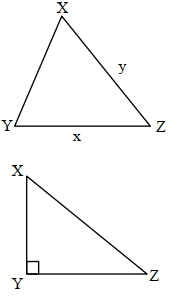
View full question & answer→Question 1544 Marks
माना फलन $f:(0, \pi) \rightarrow R$ है, जो
$f (\theta)=(\sin \theta+\cos \theta)^2+(\sin \theta-\cos \theta)^4$
द्वारा परिभाषित है। माना फलन $f$ का $\theta$ पर स्थानीय निम्निष्ठ है जब $\theta \in\left\{\lambda_1 \pi, \ldots, \lambda_{ s } \pi\right\}$, जहाँ $0<\lambda_1<\ldots<\lambda_{ s }<1$ है। तब $\lambda_1+\ldots+\lambda_{ s }$ का मान होगा
Answerb
$f(\theta) =(\sin \theta+\cos \theta)^2+(\sin \theta-\cos \theta)^4$
$f(\theta) =\sin ^2 2 \theta-\sin 2 \theta+2$
$f^{\prime}(\theta) =2(\sin 2 \theta) \cdot(2 \cos 2 \theta)-2 \cos 2 \theta$
$ =2 \cos 2 \theta(2 \sin 2 \theta-1)$
critical points
so, minimum at $\theta=\frac{\pi}{12}, \frac{5 \pi}{12}$
$\lambda_1+\lambda_2=\frac{1}{12}+\frac{5}{12}=\frac{6}{12}=\frac{1}{2}$
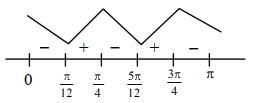
View full question & answer→Question 1554 Marks
अनुच्छेद में दी गई जानकारी के आधार पर सूचियों का उचित मिलान करके प्रश्न का उत्तर दें।
माना कि $f(x)=\sin (\pi \cos x )$ और $g ( x )=\cos (2 \pi \sin x )$ दो फलन (function) हैं जो $x >0$ में परिभाषित हैं। निम्नलिखित समुच्चय (sets) जिनके तत्वों को बढ़ते हुए क्रम में लिखा गया है, इस प्रकार परिभाषित हैं :
$X =\{ x : f( x )=0\}, Y =\left\{ x : f^{\prime}( x )=0\right\}$
$Z =\{ x : g ( x )=0\}, W =\left\{ x : g ^{\prime}( x )=0\right\}.$
सूची-$I$($List-I$) $X,Y,Z$ और $W$ समुच्चय है। सूची-$II$($List-II$) में इन समुच्चयों के बारे में कुछ सूचनाऐं हैं।
| $List-I$ |
$List-II$ |
| $(I)$ $X$ |
$(P)$ $\supseteq\left\{\frac{\pi}{2}, \frac{3 \pi}{2}, 4 \pi, 7 \pi\right\}$ |
| $(II)$ $Y$ |
$(Q)$ समान्तर श्रेणी (An arithmetic progression) |
| $(III)$ $Z$ |
$(R)$ समान्तर श्रेणी नहीं है (Not an arithmetic progression) |
| $(IV)$ $W$ |
$(S)$ $\supseteq\left\{\frac{\pi}{6}, \frac{7 \pi}{6}, \frac{13 \pi}{6}\right\}$ |
| |
$(T)$ $\supseteq\left\{\frac{\pi}{3}, \frac{2 \pi}{3}, \pi\right\}$ |
| |
$( U )$ $\supseteq\left\{\frac{\pi}{6}, \frac{3 \pi}{4}\right\}$ |
($1$) निम्न में से कौनसा एकमात्र संयोजन सही है?
$(1) (II), (R), (S)$ $(2) (I), (P), (R)$ $(3) (II), (Q), (T)$ $(4) (I), (Q), (U)$
($2$) निम्न में से कौनसा एकमात्र संयोजन सही है?
$(1) (IV), (Q), (T)$ $(2) (IV), (P), (R), (S)$ $(3) (III), (R), (U)$ $(4) (III), (P), (Q), (U)$
दिये गए सवाल का जवाब दीजिये ($1$) और ($2$)
Answer($2$) $f(x)=\sin (\pi \cos x)$
$X :\{ x : f ( x )=0\}$
$f(x)=0 \Rightarrow \sin (x \cos x)=0 \Rightarrow \cos x=n \Rightarrow \cos x=1,-1,0 \Rightarrow x=\frac{n \pi}{2}$
$x =\left\{\frac{ n \pi }{2}: \pi \in N \right\}-\left\{\frac{\pi}{2}, \pi \cdot \frac{3 \pi}{2}, 2 \pi,\right\}$
$g(x)=\cos (2 \pi \sin x)$
$Z=\{x: g(x)=0\}$
$\cos (2 \pi \sin x)=0 \Rightarrow 2 \pi \sin x=(2 n+1) \frac{\pi}{2} \Rightarrow \sin x-\frac{(2 n+1)}{4}$
$\sin x=-\frac{1}{4} \cdot \frac{1}{4} \cdot \frac{-3}{4} \cdot \frac{3}{4}$
$Z=\left\{n \pi \pm \sin ^{-1}\left(\frac{1}{4}\right), m \pi \pm \sin ^{-1}\left(\frac{3}{4}\right), n \in I\right\}$
$Y =\{ x : f ( x )=0\}$
$f(x)=\sin (\pi \cos x) \Rightarrow f^{\prime}(x)=\cos (\pi \cos x) \cdot(-\pi \sin x)=0$
$\sin x=0 \Rightarrow x=m \pi \text {. }$
$\cos (\pi \cos x)=0 \Rightarrow \pi \cos x=(2 n+1) \frac{\pi}{2} \Rightarrow \cos x-\frac{(2 n+1)}{2} \Rightarrow \cos x=-\frac{1}{2} \cdot \frac{1}{2}$
$Y=\left\{2 \pi, n \pi \pm \frac{\pi}{3}\right\}-\left\{\frac{\pi}{3}, \frac{2 \pi}{3}, \pi, \frac{4 \pi}{3}, \frac{5 \pi}{3}, 2 \pi, \ldots . .\right\}$
$W=\left\{x: g^{\prime}(x)=0\right\}$
$g(x)=\cos (2 \pi \sin x) \Rightarrow g^{\prime}(x)=-\sin (2 \pi \sin x) \cdot(2 \pi \cos x)=0$
$\cos x =0 \Rightarrow x =(2 n +1) \frac{\pi}{2}$
$\sin (2 \pi \sin x)=0 \Rightarrow 2 \pi \sin x=n \pi \Rightarrow \sin x=\frac{\pi}{2}=-1-\frac{1}{2} \cdot 0 \cdot \frac{1}{2} \cdot 1$
$W=\left\{\frac{n \pi}{2}, n \pi \pm \frac{\pi}{6}, \pi \in I\right\}-\left\{\frac{\pi}{6}, \frac{\pi}{2}, \frac{5 \pi}{6}, \pi, \frac{7 \pi}{6}, \frac{3 \pi}{2}, \ldots\right\}$
Now check the options
View full question & answer→Question 1564 Marks
माना कि $a, b, c$ ऐसी तीन शून्येत्तर (non-zero) वास्तविक संख्याएं (real numbers) हैं जिनके लिये समीकरण $\sqrt{3} a \cos x+2 b \sin x=c, x \in\left[-\frac{\pi}{2}, \frac{\pi}{2}\right],$ के दो भिन्न वास्तविक मूल (distinct real roots) $\alpha, \beta$ हैं, जहाँ $\alpha+\beta=\frac{\pi}{3}$ । तब $\frac{b}{a}$ का मान है .............|
Answerc
$\sqrt{3} a \cos x+2 b \sin x=c$
$\sqrt{3} \cos x+\frac{2 b}{a} \sin x=\frac{c}{a}$
As $\alpha, \beta$ are roots $\Rightarrow \sqrt{3} \cos \alpha+\frac{2 b }{ a } \sin \alpha=\frac{ c }{ a }$ $. . . . . .(1)$
$(1)$ $-(2)$
$\sqrt{3} \cos \beta+\frac{2 b}{a} \sin \beta=\frac{c}{a}$ $. . . . . .(2)$
$\sqrt{3}(\cos \alpha-\cos \beta)+\frac{2 b}{a}(\sin \alpha-\sin \beta)=0$
$\sqrt{3}\left(2 \sin \frac{\alpha+\beta}{2} \sin \frac{\beta-\alpha}{2}\right)+\frac{2 b}{a}\left(2 \cos \frac{\alpha+\beta}{2} \sin \frac{\alpha-\beta}{2}\right)=0$
Given $\alpha+\beta=\frac{\pi}{3}$
$\sqrt{3}\left(2 \cdot \frac{1}{2} \sin \frac{\beta-\alpha}{2}\right)+2 \frac{2 b}{a}\left(\frac{\sqrt{3}}{2} \sin \frac{\alpha-\beta}{2}\right)=0$
$\Rightarrow 1=\frac{2 b}{a} \quad \Rightarrow \frac{b}{a}=\frac{1}{2}$
View full question & answer→Question 1574 Marks
माना कि $S=\left\{x \in(-\pi, \pi): x \neq 0, \pm \frac{\pi}{2}\right\}$ है। समुच्चय $S$ में समीकरण $\sqrt{3} \sec x+\operatorname{cosec} x+2(\tan x-\cot x)=0$ के सभी भिन्न हलों (all distinct solutions) का योग (sum) है
Answerc
$\sqrt{3} \sec x+\csc x+2(\tan x-\cot x)=0$
$\Rightarrow \sqrt{3} \sec x+\csc x=2(\cot x-\tan x)$
$\Rightarrow \frac{(\sqrt{3} \sec x+\csc x)}{2}=\cot x-\tan x$
$\Rightarrow \frac{\sqrt{3}}{2} \sec x +\frac{1}{2} \csc x =\cot x -\tan x$ by dividing both sides by $2$
We know that $\sec x=\frac{1}{\cos x}, \csc x=\frac{1}{\sin x}, \tan x=\frac{\sin x}{\cos x}$ and $\cot x=\frac{\cos x}{\sin x}$ $\Rightarrow \frac{\sqrt{3} 1}{2 \cos x}+\frac{11}{2 \sin x}=\frac{\cos x}{\sin x}-\frac{\sin x}{\cos x}$
$\Rightarrow \frac{\sqrt{3} \sin x}{2 \sin x \cos x}+\frac{1 \cos x}{2 \sin x \cos x}=\frac{\cos ^2 x}{\sin x \cos x}-\frac{\sin ^2 x}{\cos x \sin x}$
$\Rightarrow \frac{\sqrt{3}}{2} \sin x +\frac{1}{2} \cos x =\cos ^2 x -\sin ^2 x$
$\Rightarrow \sin \frac{\pi}{3} \sin x+\cos \frac{\pi}{3} \cos x=\cos 2 x$ where $\frac{\sqrt{3}}{2}=\sin \frac{\pi}{3}$ and $\frac{1}{2}=\cos \frac{\pi}{3}$
$\Rightarrow \cos \left(\frac{\pi}{3}-x\right)=\cos 2 x$
$\Rightarrow 2 x=2 n \pi \pm\left(x-\frac{\pi}{3}\right)$ since if $\cos \theta=\cos \alpha \Rightarrow \theta=2 n \pi \pm \alpha$
$\Rightarrow 2 x =2 n \pi+ x -\frac{\pi}{3}$ or $2 x =2 n \pi- x +\frac{\pi}{3}$
$\Rightarrow x=2 n \pi-\frac{\pi}{3}$ or $3 x=2 n \pi+\frac{\pi}{3}$ or $x=\frac{2 n \pi}{3}+\frac{\pi}{9}$
For $n =0, x =\frac{-\pi}{3}, \frac{\pi}{9}$
For $n =-1, x =\frac{-7 \pi}{3}$ which does not lie between $(-\pi, \pi)$
and $x=\frac{-2 \pi}{3}+\frac{\pi}{9}=\frac{-5 \pi}{9} \in(-\pi, \pi)$
For $n =2, x =\frac{5 \pi}{3}$ does not lie between $(-\pi, \pi)$
and $x=\frac{2 \pi}{3}+\frac{\pi}{9}=\frac{7 \pi}{9} \in(-\pi, \pi)$
$\therefore x =\frac{-\pi}{3}, \frac{\pi}{9}, \frac{-5 \pi}{9}, \frac{7 \pi}{9}$
Sum of all the solutions $=\frac{-\pi}{3}+\frac{\pi}{9}-\frac{5 \pi}{9}+\frac{7 \pi}{9}=\frac{-3 \pi}{9}+\frac{\pi}{9}-\frac{5 \pi}{9}+\frac{7 \pi}{9}=0$
View full question & answer→Question 1584 Marks
यदि $\cos (\alpha - \beta ) = 1$ तथा $\cos (\alpha + \beta ) = \frac{1}{e}$, $ - \pi < \alpha ,\beta < \pi $, तो युग्म $(\alpha ,\beta )$ के कुल मान है
Answerd
$ - 2\pi < \alpha - \beta < 2\pi $
$\cos (\alpha - \beta ) = 1$
$\Rightarrow$ $\alpha - \beta = 0$
$\Rightarrow$ $\alpha = \beta $
$\cos 2\alpha = \frac{1}{e}$
एवं $ - 2\pi < 2\alpha < 2\pi $
अत: इसके चार हल हैं।
View full question & answer→Question 1594 Marks
यदि $\alpha + \beta = \frac{\pi }{2}$ तथा $\beta + \gamma = \alpha ,$ तब $\tan \,\alpha $ =
Answerc
(c)$\alpha + \beta = \frac{\pi }{2} \Rightarrow \tan \beta = \cot \alpha $
$\tan (\beta + \gamma ) = \tan \alpha $ ==> $\tan \alpha = \frac{{\tan \beta + \tan \gamma }}{{1 - \tan \beta \tan \gamma }}$
==> $\tan \alpha = \frac{{\cot \alpha + \tan \gamma }}{{1 - \cot \alpha \tan \gamma }}$
==> $\tan \alpha - \tan \gamma = \cot \alpha + \tan \gamma $
==> $\tan \alpha = \tan \beta + 2\tan \gamma $.
View full question & answer→Question 1604 Marks
यदि $0 \le {\alpha _1},\,{\alpha _2},.......,\,{\alpha _n} \le \frac{\pi }{2}$ तथा ${\rm{cot}}{\alpha _1}.{\rm{cot}}{\alpha _2}....{\rm{cot}}{\alpha _n} = 1$, तब ${\rm{cos}}{\alpha _1}.{\rm{cos}}{\alpha _2}........{\rm{cos}}{\alpha _n}$ का अधिकतम मान होगा
Answera
(a) यहाँ $(\cot {\alpha _1})\,.\,(\cot {\alpha _2})....(\cot {\alpha _n}) = 1$
$\therefore \cos {\alpha _1}\,.\,\cos {\alpha _2}...\cos {\alpha _n} = \sin {\alpha _1}\,.\,\sin {\alpha _2}...\sin {\alpha _n}$
अब, ${(\cos {\alpha _1}\,.\,\cos {\alpha _2}...\cos {\alpha _n})^2}$
$ = (\cos {\alpha _1}\,.\,\cos {\alpha _2}...\cos {\alpha _n})$$(\cos {\alpha _1}\,.\,\cos {\alpha _2}...\cos {\alpha _n})$
$ = (\cos {\alpha _1}\,.\,\cos {\alpha _2}...\cos {\alpha _n})$$(\sin {\alpha _1}\,.\,\sin {\alpha _2}...\sin {\alpha _n})$
$ = \frac{1}{{{2^n}}}\sin 2{\alpha _1}\,.\,\sin 2{\alpha _2}...\sin 2{\alpha _n}.$
लेकिन प्रत्येक $\sin 2{\alpha _i} \le 1$
$\therefore \,{(\cos {\alpha _1}\,.\,\cos {\alpha _2}...\cos {\alpha _n})^2} \le \frac{1}{{{2^n}}}$
$\cos {\alpha _i}$ का प्रत्येक मान धनात्मक है।
$\therefore \,\,\cos {\alpha _1}\,.\,\cos {\alpha _2}....\cos {\alpha _n}\, \le \,\,\sqrt {\frac{1}{{{2^n}}}} = \frac{1}{{{2^{n/2}}}}.$
View full question & answer→Question 1614 Marks
किसी धनात्मक पूर्णांक $n$ के लिये, यदि ${f_n}(\theta ) = \left( {\tan \frac{\theta }{2}} \right)\,(1 + \sec \theta )\,(1 + \sec 2\theta )\,(1 + \sec 4\theta )$ .....$(1 + \sec \,{2^n}\theta ).$ तो
Answerd
(d) ${f_n}(\theta ) = \frac{{\sin (\theta /2)}}{{\cos (\theta /2)}}\left[ {\frac{{2{{\cos }^2}\theta /2}}{{\cos \theta }}.\frac{{2{{\cos }^2}\theta }}{{\cos 2\theta }}.\frac{{2{{\cos }^2}2\theta }}{{\cos 4\theta }}..} \right]$
दो पदों को एक साथ लेने पर, ${f_n}(\theta ) = \frac{{\sin \theta }}{{\cos \theta }}\left[ {\frac{{2{{\cos }^2}\theta }}{{\cos 2\theta }}.\frac{{2{{\cos }^2}2\theta }}{{\cos 4\theta }}.....} \right]$
पुन: प्रथम दो पदों को समायोजित करने पर,
${f_n}(\theta ) = \tan 2\theta \left[ {\frac{{2{{\cos }^2}2\theta }}{{\cos 4\theta }}.....} \right] = \tan ({2^n}\theta )$
$\therefore {f_2}\left( {\frac{\pi }{{16}}} \right) = \tan \frac{{4\pi }}{{16}} = \tan \left( {\frac{\pi }{4}} \right) = 1$
${f_3}\left( {\frac{\pi }{{32}}} \right) = \tan \frac{{8\pi }}{{32}} = \tan \left( {\frac{\pi }{4}} \right) = 1$
${f_4}\left( {\frac{\pi }{{64}}} \right) = \tan \frac{{16\pi }}{{64}} = \tan \,\left( {\frac{\pi }{4}} \right) = 1$
${f_5}\left( {\frac{\pi }{{128}}} \right) = \tan 32\frac{\pi }{{128}} = \tan \,\left( {\frac{\pi }{4}} \right) = 1$.
View full question & answer→Question 1624 Marks
निम्न में से कौन सी संख्या परिमेय हैं
Answerc
$\sin {15^o} = \sin ({45^o} - {30^o}) = \frac{{\sqrt 3 - 1}}{{2\sqrt 2 }} =$ अपरिमेय
$\cos {15^o} = \cos ({45^o} - {30^o}) = \frac{{\sqrt 3 + 1}}{{2\sqrt 2 }}=$ अपरिमेय
$\therefore \,\,\,\sin {15^o}\cos {15^o} = \frac{1}{2}(2\sin {15^o}\cos {15^o})$
$ = \frac{1}{2}\sin {30^o} = \frac{1}{2}.\frac{1}{2} = \frac{1}{4} =$ परिमेय
$\therefore \, \sin {15^o}\cos {75^o} = \sin {15^o}\sin {15^o} = {\sin ^2}{15^o}$
$ = {\left( {\frac{{\sqrt 3 - 1}}{{2\sqrt 2 }}} \right)^2} = \frac{{4 - 2\sqrt 3 }}{8}=$ अपरिमेय
View full question & answer→Question 1634 Marks
माना ${A_0},{A_1},{A_2},{A_3},{A_4},{A_5}$ किसी इकाई त्रिज्या के वृत्त के भीतर बनने वाले समषटभुज के शीर्ष हों, तो रेखाखण्डों ${A_0}{A_1},\,\,{A_0}{A_2}$ तथा ${A_0}{A_4}$ की लम्बाईयों का गुणनफल होगा
Answerc
(c) प्रत्येक त्रिभुज समबाहु त्रिभुज है
अत: ${A_o}{A_1} = 1$
${A_0}A_2^2 = {A_0}A_1^2 + {A_1}A_2^2 - 2{A_0}{A_1}{A_1}{A_2}$$\cos {120^o}$
$ = 1 + 1 - 2.1.1\left( { - \frac{1}{2}} \right) = 3$
==> ${A_0}{A_2} = \sqrt 3 = {A_0}{A_4}$
$\therefore $ ${A_0}{A_1} \times {A_0}{A_2} \times {A_0}{A_4} = 1$.$\sqrt 3 .\sqrt 3 = 3$.
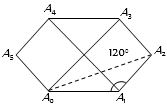
View full question & answer→Question 1644 Marks
यदि $\cos (\theta - \alpha ),\;\cos \theta $ तथा $\cos (\theta + \alpha )$ हरात्मक श्रेणी में हों, तब $\cos \theta \sec \frac{\alpha }{2}$ बराबर है
Answera
दिया हैं, $\cos (\theta - \alpha ),\cos \theta $ और $\cos (\theta + \alpha )$ ह.श्रे. में हैं
$\Rightarrow$ $\frac{1}{{\cos (\theta - \alpha )}},\frac{1}{{\cos \theta }},\frac{1}{{\cos (\theta + \alpha )}}$ स.श्रे. में होंगे
अत: $\frac{2}{{\cos \theta }} = \frac{1}{{\cos (\theta - \alpha )}} + \frac{1}{{\cos (\theta + \alpha )}}$
$ = \frac{{\cos (\alpha + \theta ) + \cos (\theta - \alpha )}}{{{{\cos }^2}\theta - {{\sin }^2}\alpha }}$
$\Rightarrow$ $\frac{2}{{\cos \theta }} = \frac{{2\cos \theta \cos \alpha }}{{{{\cos }^2}\theta - {{\sin }^2}\alpha }}$
$\Rightarrow$ ${\cos ^2}\theta - {\sin ^2}\alpha = {\cos ^2}\theta \cos \alpha $
$\Rightarrow$ ${\cos ^2}\theta \,(1 - \cos \alpha ) = {\sin ^2}\alpha $
$\Rightarrow$ ${\cos ^2}\theta \left( {2{{\sin }^2}\frac{\alpha }{2}} \right) $
$= 4{\sin ^2}\frac{\alpha }{2}{\cos ^2}\frac{\alpha }{2}$
${\cos ^2}\theta {\sec ^2}\frac{\alpha }{2} = 2$
$\Rightarrow \cos \theta \sec \frac{\alpha }{2} = \pm \sqrt 2 $.
View full question & answer→Question 1654 Marks
यदि वास्तविक संख्यायें $\alpha ,\,\,\beta \,$ तथा $\,\gamma $,$\alpha + \beta + \gamma = \pi $ को संतुष्ट करते हैं, तो व्यंजक $\sin \alpha + \sin \beta + \sin \gamma $ का न्यूनतम मान है
Answerc
चूँकि $\sin \alpha + \sin \beta + \sin \gamma > \sin (\alpha + \beta + \gamma )$
जब $\alpha + \beta + \gamma = \pi $.
$\therefore $ $\sin \alpha + \sin \beta + \sin \gamma > 0$
अत: $\sin \alpha + \sin \beta + \sin \gamma $ का न्यूनतम मान हमेशा धनात्मक होता है।
View full question & answer→Question 1664 Marks
यदि $0 < x < \frac{\pi }{4}$, तब $\sec 2x - \tan 2x$ का मान होगा
Answerb
(b) $\sec 2x - \tan 2x = \frac{{1 - \sin 2x}}{{\cos 2x}}$
$ = \frac{{{{(\cos x - \sin x)}^2}}}{{({{\cos }^2}x - {{\sin }^2}x)}} $
$= \frac{{\cos x - \sin x}}{{\cos x + \sin x}} = \frac{{1 - \tan x}}{{1 + \tan x}}$
$ = \frac{{\tan \frac{\pi }{4} - \tan x}}{{1 + \tan \left( {\frac{\pi }{4}} \right)\sin x}} = \tan \left( {\frac{\pi }{4} - x} \right)$.
View full question & answer→Question 1674 Marks
यदि $n$ एक धनात्मक पूर्णांक इस प्रकार है कि $\sin \frac{\pi }{{{2^n}}} + \cos \frac{\pi }{{{2^n}}} = \frac{{\sqrt n }}{2}$, तब
Answerb
(b) $\sin \frac{\pi }{{{2^n}}} + \cos \frac{\pi }{{{2^n}}} = \frac{{\sqrt n }}{2}$
==> $\sqrt 2 \left( {\sin \frac{\pi }{{{2^n}}}.\cos \frac{\pi }{4} + \cos \frac{\pi }{{{2^n}}}.\sin \frac{\pi }{4}} \right) = \frac{{\sqrt n }}{2}$
==> $\sqrt 2 \sin \left( {\frac{\pi }{4} + \frac{\pi }{{{2^n}}}} \right) = \frac{{\sqrt n }}{2}$
चूँकि $\sin \,\left( {\frac{\pi }{4} + \frac{\pi }{{{2^n}}}} \right) \le 1$
$\therefore \;\frac{{\sqrt n }}{2} \le \sqrt 2 \Rightarrow \sqrt n \le 2\sqrt 2 \Rightarrow n \le 8$.
पुन: $\frac{{\sqrt n }}{2} = \sqrt 2 \sin \left( {\frac{\pi }{4} + \frac{\pi }{{{2^n}}}} \right) > \sqrt 2 .\frac{1}{{\sqrt 2 }} = 1$
$\therefore \;n > 4$, अत: $4 < n \le 8$.
View full question & answer→Question 1684 Marks
$0 < \phi < \frac{\pi }{2}$ के लिये, यदि $x = \sum\limits_{n = 0}^\infty {{{\cos }^{2n}}\phi ,} $ $y = \sum\limits_{n = 0}^\infty {{{\sin }^{2n}}\phi ,} $ $z = \sum\limits_{n = 0}^\infty {{{\cos }^{2n}}\phi \,{{\sin }^{2n}}\phi ,} $ तो
Answerd
(b) $x = 1 + {\cos ^2}\phi + {\cos ^4}\phi + .... = \frac{1}{{(1 - {{\cos }^2}\phi )}} = \frac{1}{{{{\sin }^2}\phi }}$
$y = 1 + {\sin ^2}\phi + {\sin ^4}\phi + .... = \frac{1}{{(1 - {{\sin }^2}\phi )}} = \frac{1}{{{{\cos }^2}\phi }}$
$z = 1 + {\cos ^2}\phi {\sin ^2}\phi + {\cos ^4}\phi {\sin ^4}\phi + .. = \frac{1}{{(1 - {{\cos }^2}\phi {{\sin }^2}\phi )}}$
अब $xyz = \frac{1}{{{{\sin }^2}\phi {{\cos }^2}\phi (1 - {{\cos }^2}\phi {{\sin }^2}\phi )}}$
$xy + z = \frac{1}{{{{\sin }^2}\phi {{\cos }^2}\phi }} + \frac{1}{{1 - {{\cos }^2}\phi {{\sin }^2}\phi }}$
$ = \frac{1}{{{{\sin }^2}\phi {{\cos }^2}\phi (1 - {{\cos }^2}\phi {{\sin }^2}\phi )}} = xyz$
जो कि $(b)$ में दिया है।
एवं $x + y + z = xyz$, जो $(c)$ में दिया है .
View full question & answer→Question 1694 Marks
यदि $k = \sin \frac{\pi }{{18}}\,.\,\sin \frac{{5\pi }}{{18}}\,.\,\sin \frac{{7\pi }}{{18}},$ तो $k$ का आंकिक मान है
Answerb
(b) यहाँ $ k = \sin \frac{\pi }{{18}}\sin \frac{{5\pi }}{{18}}\sin \frac{{7\pi }}{{18}}$
$ = \cos \left( {\frac{\pi }{2} - \frac{\pi }{{18}}} \right)\cos \left( {\frac{\pi }{2} - \frac{{5\pi }}{{18}}} \right)\cos \left( {\frac{\pi }{2} - \frac{{7\pi }}{{18}}} \right)$
$ = \cos \frac{\pi }{9}\cos \frac{{2\pi }}{9}\cos \frac{{4\pi }}{9} = \frac{{\sin {2^3}\frac{\pi }{9}}}{{{2^3}\sin \frac{\pi }{9}}} = \frac{{\sin \frac{{8\pi }}{9}}}{{8\sin \frac{\pi }{9}}}$
$ = \frac{{\sin \left( {\pi - \frac{\pi }{9}} \right)}}{{8\sin \frac{\pi }{9}}} = \frac{1}{8}$.
View full question & answer→Question 1704 Marks
अन्तराल $\left( {0,\frac{\pi }{2}} \right)$ में $\sin \left( {x + \frac{\pi }{6}} \right) + \cos \left( {x + \frac{\pi }{6}} \right)$ का अधिकतम मान है
Answera
$\sqrt 2 \cos \left( {x + \frac{\pi }{6} - \frac{\pi }{4}} \right) = \sqrt 2 \cos \,\left( {x - \frac{\pi }{{12}}} \right)$.
अत: $x = \frac{\pi }{{12}}$पर अधिकतम मान होगा।
View full question & answer→Question 1714 Marks
$\frac{{\tan x}}{{\tan \,3x}}$ का मान जब भी परिभाषित हो, तो वह निम्न अन्तराल में नहीं होगा
Answera
माना $y = \frac{{\tan x}}{{\tan 3x}} = \frac{{\tan x}}{{\frac{{3\tan x - {{\tan }^3}x}}{{1 - 3{{\tan }^2}x}}}}$
$y = \frac{{1 - 3{{\tan }^2}x}}{{3 - {{\tan }^2}x}} = \frac{{\frac{1}{3} - {{\tan }^2}x}}{{1 - \frac{1}{3}.{{\tan }^2}x}}$
अत: $y$ के परिभाषित होने के लिए इसे $\frac{1}{3}$ एवं $3$ के बीच में स्थित नहीं होना चाहिए।
View full question & answer→Question 1724 Marks
$\sin \frac{\pi }{{14}}\sin \frac{{3\pi }}{{14}}\sin \frac{{5\pi }}{{14}}\sin \frac{{7\pi }}{{14}}\sin \frac{{9\pi }}{{14}}\sin \frac{{11\pi }}{{14}}\sin \frac{{13\pi }}{{14}}$ का मान होगा
Answerd
(d) $\sin \frac{\pi }{{14}}\sin \frac{{3\pi }}{{14}}\sin \frac{{5\pi }}{{14}}\sin \frac{{7\pi }}{{14}}\sin \frac{{9\pi }}{{14}}\sin \frac{{11\pi }}{{14}}\sin \frac{{13\pi }}{{14}}$
$ = \sin \frac{\pi }{{14}}\sin \frac{{3\pi }}{{14}}\sin \frac{{5\pi }}{{14}} \times 1$
$ \times \sin \left( {\pi - \frac{{5\pi }}{{14}}} \right)\sin \left( {\pi - \frac{{3\pi }}{{14}}} \right)\sin \left( {\pi - \frac{\pi }{{14}}} \right)$
$ = {\left[ {\sin \frac{\pi }{{14}}\sin \frac{{3\pi }}{{14}}\sin \frac{{5\pi }}{{14}}\sin \frac{{7\pi }}{{14}}} \right]^2} = \frac{1}{{64}}$.
View full question & answer→Question 1734 Marks
$\sqrt 3 \,{\rm{cosec}}\,{20^o} - \sec \,{20^o} = $
Answerc
(c) $\sqrt 3 {\rm{cosec}}\,20^\circ - \sec 20^\circ = \frac{{\sqrt 3 }}{{\sin 20^\circ }} - \frac{1}{{\cos \,20^\circ }}$
$ = \frac{{\sqrt 3 \cos 20^\circ - \sin 20^\circ }}{{\sin 20^\circ \cos 20^\circ }} $
$= \frac{{2\left[ {\frac{{\sqrt 3 }}{2}\cos 20^\circ - \frac{1}{2}\sin \,20^\circ } \right]}}{{\frac{2}{2}\sin 20^\circ \cos 20^\circ }}$
$ = \frac{{4\cos (20^\circ + 30^\circ )}}{{\sin 40^\circ }} $
$= \frac{{4\cos 50^\circ }}{{\sin 40^\circ }} = \frac{{4\sin 40^\circ }}{{\sin 40^\circ }} = 4$.
View full question & answer→Question 1744 Marks
$\tan \alpha + 2\tan 2\alpha + 4\tan 4\alpha + 8\cot \,8\alpha = $
Answerc
(c) $\tan \alpha + 2\tan \,\,2\alpha + 4\tan \,\,4\alpha + 8\cot \,8\alpha $
$ = \tan \alpha + 2\tan \,2\alpha + 4\left[ {\frac{{\sin 4\alpha }}{{\cos 4\alpha }} + 2\frac{{\cos \,8\alpha }}{{\sin \,8\alpha }}} \right]$
$ = \tan \alpha + 2\tan 2\alpha + $
$4\left[ {\frac{{\cos \,4\alpha \,\cos \,8\alpha + \sin \,4\alpha \,\sin \,8\alpha + \cos \,4\alpha \cos \,8\alpha }}{{\sin \,8\alpha \,\cos \,4\alpha }}} \right]$
$ = \tan \,\alpha + 2\tan \,2\alpha + 4\left[ {\frac{{\cos \,4\alpha + \cos \,4\alpha \,\cos \,8\alpha }}{{\sin \,8\alpha \cos \,4\alpha }}} \right]$
$ = \tan \,\alpha + 2\,\tan \,2\alpha + 4\,\left[ {\frac{{\cos \,\,4a(1 + \cos \,8\alpha )}}{{\cos \,4\alpha \sin \,8\alpha }}} \right]$
$ = \tan \alpha + 2\tan \,2\alpha + 4\left[ {\frac{{2{{\cos }^2}4\alpha }}{{2\sin \,4\alpha \,\,\cos \,\,4\alpha }}} \right]$
$ = \tan \,\alpha + 2\tan \,2\alpha + 4\cot \,4\alpha $$ = \tan \alpha + 2(\tan 2\alpha + 2\cot 4\alpha )$
$ = \tan \,\alpha + 2\left[ {\frac{{\sin \,\,2\alpha }}{{\cos 2\alpha }} + 2\frac{{\cos \,4\alpha }}{{\sin \,4\alpha }}} \right]$
$ = \tan \,\alpha + 2\left[ {\frac{{\cos \,2\alpha (1 + \cos \,4\alpha )}}{{\sin \,4\alpha \cos \,2\alpha }}} \right]$
$ = \tan \alpha + 2\cot 2\alpha = \frac{{\sin \,\alpha }}{{\cos \,\alpha }} + \frac{{2\cos \,2\alpha }}{{\sin \,2\alpha }}$
$ = \frac{{\cos \,\alpha + \cos \alpha \cos \,2\alpha }}{{\sin \,2\alpha \cos \alpha }}$
$ = \frac{{1 + \cos \,2\alpha }}{{\sin \,2\alpha }} = \frac{{2{{\cos }^2}\alpha }}{{2\sin \alpha \cos \alpha }} = \cot \,\alpha $.
View full question & answer→Question 1754 Marks
$3\,\left[ {{{\sin }^4}\,\left( {\frac{{3\pi }}{2} - \alpha } \right) + {{\sin }^4}\,(3\pi + \alpha )} \right]$ $ - 2\,\left[ {{{\sin }^6}\,\left( {\frac{\pi }{2} + \alpha } \right) + {{\sin }^6}(5\pi - \alpha )} \right] = $
Answerb
(b) $3\left\{ {{{\sin }^4}\left( {\frac{{3\pi }}{2} - \alpha } \right) + {{\sin }^4}(3\pi + \alpha )} \right\}$
$ - 2\left\{ {{{\sin }^6}\left( {\frac{\pi }{2} + \alpha } \right) + {{\sin }^6}(5\pi - \alpha )} \right\}$
$ = 3\,\{ {( - \cos \alpha )^4} + {( - \sin \alpha )^4}\} - 2\,\{ {\cos ^6}\alpha + {\sin ^6}\alpha \} $
=$3\,\,\{ {({\cos ^2}\alpha + {\sin ^2}\alpha )^2} - 2{\sin ^2}\alpha {\cos ^2}\alpha \} $
$ - 2\,\{ {({\cos ^2}\alpha + {\sin ^2}\alpha )^3} - 3{\cos ^2}\alpha {\sin ^2}\alpha ({\cos ^2}\alpha + {\sin ^2}\alpha )\} $
$ = 3 - 6{\sin ^2}\alpha {\cos ^2}\alpha - 2 + 6{\sin ^2}\alpha {\cos ^2}\alpha = 3 - 2 = 1$
ट्रिक : $\alpha = 0,\frac{\pi }{2}$ रखने पर व्यंजक का मान $1$ आता है अर्थात् यह $\alpha $ से स्वतंत्र है।
View full question & answer→Question 1764 Marks
$\cos \frac{{2\pi }}{{15}}\cos \frac{{4\pi }}{{15}}\cos \frac{{8\pi }}{{15}}\cos \frac{{16\pi }}{{15}} =$
Answerd
(d) $\cos \frac{{2\pi }}{{15}}\cos \frac{{4\pi }}{{15}}\cos \frac{{8\pi }}{{15}}\cos \frac{{16\pi }}{{15}}$
$ = \frac{{\sin \,{2^4}\frac{{2\pi }}{{15}}}}{{{2^4}\sin \frac{{2\pi }}{{15}}}} $
$= \frac{{\sin \,\frac{{32\pi }}{{15}}}}{{16\,\sin \frac{{2\pi }}{{15}}}} $
$= \frac{1}{{16}}\frac{{\sin \frac{{2\pi }}{{15}}}}{{\sin \frac{{2\pi }}{{15}}}} $
$= \frac{1}{{16}}$.
View full question & answer→Question 1774 Marks
यदि $x\cos \theta = y\cos \,\left( {\theta + \frac{{2\pi }}{3}} \right) = z\cos \,\left( {\theta + \frac{{4\pi }}{3}} \right)$ , तब $\frac{1}{x} + \frac{1}{y} + \frac{1}{z}$ बराबर है
Answerc
(c) दिया है
$x\cos \theta = y\cos \left( {\theta + \frac{{2\pi }}{3}} \right) = z\cos \left( {\theta + \frac{{4\pi }}{3}} \right) = k$
==> $\cos \theta = \frac{k}{x},\cos \left( {\theta + \frac{{2\pi }}{3}} \right) = \frac{k}{y}$ व $\cos \left( {\theta + \frac{{4\pi }}{3}} \right) = \frac{k}{z}$
अत: $\frac{k}{x} + \frac{k}{y} + \frac{k}{z} = \cos \theta + \cos \left( {\theta + \frac{{2\pi }}{3}} \right) + \cos \left( {\theta + \frac{{4\pi }}{3}} \right)$
$ = \cos \theta + \cos \left( {\frac{\pi }{3} - \theta } \right) - \cos \left( {\frac{\pi }{3} + \theta } \right)$
$ = \cos \theta - 2\cos \frac{\pi }{3}\cos \theta = 0$.
View full question & answer→Question 1784 Marks
$\left( {1 + \cos \frac{\pi }{8}} \right)\,\left( {1 + \cos \frac{{3\pi }}{8}} \right)\,\left( {1 + \cos \frac{{5\pi }}{8}} \right)\,\left( {1 + \cos \frac{{7\pi }}{8}} \right) = $
Answerc
(c) $\left( {1 + \cos \frac{\pi }{8}} \right)\,\left( {1 + \cos \frac{{3\pi }}{8}} \right)\,\left( {1 + \cos \frac{{5\pi }}{8}} \right)\,\left( {1 + \cos \frac{{7\pi }}{8}} \right)$
$ = \left( {1 + \cos \frac{\pi }{8} + \cos \frac{{7\pi }}{8} + \cos \frac{\pi }{8}\cos \frac{{7\pi }}{8}} \right)$
$\left( {1 + \cos \frac{{5\pi }}{8} + \cos \frac{{3\pi }}{8} + \cos \frac{{3\pi }}{8}\cos \frac{{5\pi }}{8}} \right)$
$ = \left( {1 + \cos \frac{\pi }{8} - \cos \frac{\pi }{8} + \cos \frac{\pi }{8}\cos \frac{{7\pi }}{8}} \right)$
$\left( {1 + \cos \frac{{5\pi }}{8} - \cos \frac{{5\pi }}{8} + \cos \frac{{3\pi }}{8}\cos \frac{{5\pi }}{8}} \right)$
$ = \left( {1 + \cos \frac{\pi }{8}\cos \frac{{7\pi }}{8}} \right)\,\left( {1 + \cos \frac{{3\pi }}{8}\cos \frac{{5\pi }}{8}} \right)$
$ = \frac{1}{4}\,\,\left( {2 + 2\cos \frac{\pi }{8}\cos \frac{{7\pi }}{8}} \right)\,\,\left( {2 + 2\cos \frac{{3\pi }}{8}\cos \frac{{5\pi }}{8}} \right)$
$ = \frac{1}{4}\left( {2 + \cos \frac{{3\pi }}{4} + \cos \pi } \right)\left( {2 + \cos \frac{\pi }{4} + \cos \pi } \right)$
$ = \frac{1}{4}\,\left( {1 + \cos \frac{{3\pi }}{4}} \right)\,\left( {1 + \cos \frac{\pi }{4}} \right) = \frac{1}{4}\left( {1 - \cos \frac{\pi }{4}} \right)\,\left( {1 + \cos \frac{\pi }{4}} \right)$
$ = \frac{1}{4}\left( {1 - {{\cos }^2}\frac{\pi }{4}} \right) = \frac{1}{4}\left( {1 - \frac{1}{2}} \right) = \frac{1}{8}$.
वैकल्पिक : $\left( {1 + \cos \frac{\pi }{8}} \right)\,\left( {1 + \cos \frac{{7\pi }}{8}} \right)\,\left( {1 + \cos \frac{{3\pi }}{8}} \right)\,\left( {1 + \cos \frac{{5\pi }}{8}} \right)$
$ = \left( {1 + \cos \frac{\pi }{8}} \right)\,\left( {1 - \cos \frac{\pi }{8}} \right)\,\left( {1 + \cos \frac{{3\pi }}{8}} \right)\,\left( {1 - \cos \frac{{3\pi }}{8}} \right)$
$ = \left( {1 - {{\cos }^2}\frac{\pi }{8}} \right){\rm{ }}\left( {1 - {{\cos }^2}\frac{{3\pi }}{8}} \right) = {\sin ^2}\frac{\pi }{8}{\sin ^2}\frac{{3\pi }}{8}$
$ = \frac{1}{4}{\left( {2\sin \frac{\pi }{8}.\sin \frac{{3\pi }}{8}} \right)^2}$$ = \frac{1}{4}{\left( {\cos \frac{\pi }{4} - \cos \frac{\pi }{2}} \right)^2} = \frac{1}{8}$.
View full question & answer→Question 1794 Marks
यदि $\tan A = \frac{{1 - \cos B}}{{\sin B}},$ तो $\tan 2A$ को $\tan B$ के पदों में निकालिए और दिखलाइए कि
Answera
(a) $\tan A = \frac{{1 - \cos B}}{{\sin B}}$
$ = \frac{{2{{\sin }^2}(B/2)}}{{2\sin (B/2)\cos (B/2)}} = \tan \frac{B}{2}$
==> $\tan 2A = \tan B$.
View full question & answer→Question 1804 Marks
$\sin 12^\circ \sin 48^\circ \sin 54^\circ = $
Answerc
(c) $\sin \,{12^o}\,\sin \,{48^o}\,\sin \,{54^o} = \frac{1}{2}\,\left\{ {\cos {{36}^o} - \cos {{60}^o}} \right\}\,\cos \,{36^o}$
$ = \frac{1}{2}\,\left[ {\frac{{\sqrt 5 + 1}}{4} - \frac{1}{2}} \right]\,\left[ {\frac{{\sqrt 5 + 1}}{4}} \right] $
$= \frac{1}{2}\,\left[ {\frac{{\sqrt 5 - 1}}{4}} \right]\,\left[ {\frac{{\sqrt 5 + 1}}{4}} \right]$
$ = \frac{{5 - 1}}{{32}} = \frac{4}{{32}} = \frac{1}{8}$.
View full question & answer→Question 1814 Marks
यदि $A = {\sin ^2}\theta + {\cos ^4}\theta ,$ तो $ \theta$ के सभी वास्तविक मानों के लिए
Answerb
यहाँ $A = {\sin ^2}\theta + {\cos ^4}\theta $
$ {\sin ^2}\theta + {\cos ^2}\theta {\cos ^2}\theta \le {\sin ^2}\theta + {\cos ^2}\theta $
(चूँकि ${\cos ^2}\theta \le 1)$
$ \Rightarrow {\sin ^2}\theta + {\cos ^4}\theta \le 1 \Rightarrow A \le 1$
पुन: ${\sin ^2}\theta + {\cos ^4}\theta = 1 - {\cos ^2}\theta + {\cos ^4}\theta $
$ = {\cos ^4}\theta - {\cos ^2}\theta + 1 = {\left( {{{\cos }^2}\theta - \frac{1}{2}} \right)^2} + \frac{3}{4} \ge \frac{3}{4}$
अत: $\frac{3}{4} \le A \le 1.$
View full question & answer→Question 1824 Marks
यदि $\alpha + \beta - \gamma = \pi ,$ तो ${\sin ^2}\alpha + {\sin ^2}\beta - {\sin ^2}\gamma $ बराबर है
Answera
(a) यहाँ $\alpha + \beta - \gamma = \pi .$
अब ${\sin ^2}\alpha + {\sin ^2}\beta - {\sin ^2}\gamma $
$ = {\sin ^2}\alpha + \sin (\beta - \gamma )\sin (\beta + \gamma )$
$ = {\sin ^2}\alpha + \sin (\pi - \alpha )\sin (\beta + \gamma )$
$(\because \alpha + \beta - \gamma = \pi )$
$ = {\sin ^2}\alpha + \sin \alpha \sin (\beta + \gamma ) = \sin \alpha \{ \sin \alpha + \sin (\beta + \gamma )\} $
$ = \sin \alpha \{ \sin (\pi - \overline {\beta + \gamma )} + \sin (\beta + \gamma )\} $
$ = \sin \alpha \{ - \sin (\gamma - \beta ) + \sin (\gamma + \beta )\} $
$ = \sin \alpha \{ 2\sin \beta \cos \gamma \} = 2\sin \alpha \sin \beta \cos \gamma $.
View full question & answer→Question 1834 Marks
यदि $\alpha + \beta + \gamma = 2\pi ,$ तो
Answera
(a) यहाँ $\alpha + \beta + \gamma = 2\pi $
$\Rightarrow \frac{\alpha }{2} + \frac{\beta }{2} + \frac{\gamma }{2} = \pi $
$ \Rightarrow \tan \left( {\frac{\alpha }{2} + \frac{\beta }{2} + \frac{\gamma }{2}} \right) = \tan \pi = 0$
$ \Rightarrow \tan \frac{\alpha }{2} + \tan \frac{\beta }{2} + \tan \frac{\gamma }{2} - \tan \frac{\alpha }{2}\tan \frac{\beta }{2}\tan \frac{\gamma }{2} = 0$
$ \Rightarrow \tan \frac{\alpha }{2} + \tan \frac{\beta }{2} + \tan \frac{\gamma }{2} $
$= \tan \frac{\alpha }{2}\tan \frac{\beta }{2}\tan \frac{\gamma }{2}$.
.
View full question & answer→Question 1844 Marks
यदि $\cos (\alpha + \beta ) = \frac{4}{5}$ तथा $\sin (\alpha - \beta ) = \frac{5}{{13}}$ और $\alpha $ तथा $\beta ,0$ तथा $\frac{\pi }{4}$ के बीच में हों, तो $\tan 2\alpha = $
Answerb
दिया है $\cos \,(\alpha + \beta ) = \frac{4}{5}$
एवं $\sin \,(\alpha - \beta ) = \frac{5}{{13}}$
$ \Rightarrow \,\,\sin \,(\alpha + \beta ) = \frac{3}{5}$
एवं $\cos \,(\alpha - \beta ) = \frac{{12}}{{13}}$
$ \Rightarrow \,\,2\alpha = {\sin ^{ - 1}}\frac{3}{5} + {\sin ^{ - 1}}\frac{5}{{13}}$
$ = {\sin ^{ - 1}}\left[ {\frac{3}{5}\sqrt {1 - \frac{{25}}{{169}}} + \frac{5}{{13}}\sqrt {1 - \frac{9}{{25}}} } \right]$
$ \Rightarrow \,\,2\alpha = {\sin ^{ - 1}}\,\left( {\frac{{56}}{{65}}} \right)\, $
$\Rightarrow \,\sin \,2\alpha = \frac{{56}}{{65}}$
अब, $\tan \,2\alpha = \frac{{\sin \,2\alpha }}{{\cos \,2\alpha }}$
$= \frac{{56/65}}{{33/65}} = \frac{{56}}{{33}}$.
View full question & answer→Question 1854 Marks
यदि $\tan \theta = \frac{{ - 4}}{3},$ तो $\sin \theta = $
Answerb
(b) चूँकि ${\rm{cose}}{{\rm{c}}^2}\theta = 1 + {\cot ^2}\theta = 1 + \frac{9}{{16}} = \frac{{25}}{{16}}$
$\left( \because {\tan \theta = - \frac{4}{3}} \right)$
${\sin ^2}\theta = \frac{1}{{{\rm{cose}}{{\rm{c}}^2}\theta }} = \frac{{16}}{{25}} \Rightarrow \sin \theta = \pm \frac{4}{5},$
दोनों मान हो सकते हैं, क्योंकि $\tan \theta = - \frac{4}{3}\,\,$
अर्थात् $\theta $ दूसरे व चौथे चतुर्थांश में है।
View full question & answer→Question 1864 Marks
यदि $\tan \alpha = \frac{m}{{m + 1}}$ तथा $\tan \beta = \frac{1}{{2m + 1}}$, तो $\alpha + \beta = $
Answerb
यहाँ $\tan \,\alpha = \frac{m}{{m + 1}}$ एवं $\tan \,\beta = \frac{1}{{2m + 1}}$
हम जानते हैं, $\tan \,(\alpha + \beta ) = \frac{{\tan \,\alpha + \tan \,\beta }}{{1 - \tan \,\alpha \,\tan \,\beta }}$
$ = \frac{{\frac{m}{{m + 1}} + \frac{1}{{2m + 1}}}}{{1 - \frac{m}{{(m + 1)}}\,\frac{1}{{(2m + 1)}}}} = \frac{{2{m^2} + m + m + 1}}{{2{m^2} + m + 2m + 1 - m}}$
$ = \frac{{2{m^2} + 2m + 1}}{{2{m^2} + 2m + 1}} = 1\,\, $
$\Rightarrow \,\,\tan \,(\alpha + \beta ) = \tan \frac{\pi }{4}$
अत: $\alpha + \beta = \frac{\pi }{4}$.
ट्रिक : चूँकि $\alpha + \beta $, $m$ से स्वतंत्र है।
अत: $m = 1$रखने पर, $\tan \,\alpha = \frac{1}{2}$ व $\tan \,\beta = \frac{1}{3}$, इसलिए
$\tan \,(\alpha + \beta ) = \frac{{(1/2) + (1/3)}}{{1 - (1/6)}} = 1$
अत: $\alpha + \beta = \frac{\pi }{4}$
($m$ के किसी और मान के लिए भी जाँच करें )
View full question & answer→Question 1874 Marks
$2\,{\sin ^2}\beta + 4\,\,\cos \,(\alpha + \beta )\,\,\sin \,\alpha \,\sin \,\beta + \cos \,2\,(\alpha + \beta ) = $
Answerc
(c) $\cos 2(\alpha + \beta ) = 2{\cos ^2}(\alpha + \beta ) - 1,$
$2{\sin ^2}\beta = 1 - \cos 2\beta $
$L.H.S.$ $ = - \cos 2\beta + 2\cos (\alpha + \beta )\,[2\sin \alpha \sin \beta + \cos (\alpha + \beta )]$
$ = - \cos 2\beta + 2\cos (\alpha + \beta )\cos (\alpha - \beta )$
$ = - \cos 2\beta + (\cos 2\alpha + \cos 2\beta ) = \cos 2\alpha $.
View full question & answer→Question 1884 Marks
$\tan 20^\circ \tan 40^\circ \tan 60^\circ \tan 80^\circ = $
Answerc
(c) $\tan \,\,{20^o}\tan \,\,{40^o}\tan \,\,{60^o}\tan \,\,{80^o}$
$ = \frac{{\sin \,\,{{20}^o}\sin \,\,{{40}^o}\sin \,\,{{80}^o}\tan {{60}^o}}}{{\cos \,\,{{20}^o}\cos \,\,{{40}^o}\cos \,\,{{80}^o}}}$
यहाँ ${N^r} = (\sin \,\,{20^o}\sin \,\,{40^o}\sin \,\,{80^o})$
$ = \frac{{\sin \,\,{{20}^o}}}{2}\,(2\,\,\sin \,\,{40^o}\sin \,\,{80^o})$
$ = \frac{{\sin \,\,{{20}^o}}}{2}\,(\cos \,\,{40^o} - \cos \,\,{120^o})$
$ = \frac{1}{2}\sin \,\,{20^o}\,\left( {1 - 2\,\,{{\sin }^2}{{20}^o} + \frac{1}{2}} \right)$
$ = \frac{1}{2}\sin \,\,{20^o}\,\left( {\frac{3}{2} - 2\,\,{{\sin }^2}{{20}^o}} \right) = \frac{{\sin \,{{60}^o}}}{4} = \frac{{\sqrt 3 }}{8}$
अब, we take ${D^r} = \cos {20^o}\cos {40^o}\cos {80^o}$
$ = \frac{{\sin \,\,{2^3}\,{{20}^o}}}{{{2^3}\,\sin \,\,{{20}^o}}} = \frac{{\sin \,\,{{160}^o}}}{{8\,\,\sin \,\,{{20}^o}}} = \frac{{\sin \,\,{{20}^o}}}{{8\,\,\sin \,\,{{20}^o}}} = \frac{1}{8}$
$\therefore $ अतः $\tan \,\,{20^o}\tan \,\,{40^o}\tan \,\,{80^o} = \frac{{\sqrt 3 /8}}{{1/8}}$
इसलिए $\tan {20^o}\tan {40^o}\tan {60^o}\tan {80^o} = \sqrt 3 .\sqrt 3 = 3$.
View full question & answer→Question 1894 Marks
$\frac{1}{{\sin 10^\circ }} - \frac{{\sqrt 3 }}{{\cos 10^\circ }} =$
Answerd
(d) $\frac{1}{{\sin 10^\circ }} - \frac{{\sqrt 3 }}{{\cos 10^\circ }}$
$ = \frac{{2\left( {\frac{{\cos 10^\circ }}{2} - \frac{{\sqrt 3 }}{2}\sin 10^\circ } \right)}}{{(2\sin 10^\circ \cos 10^\circ ) \times \frac{1}{2}}}$
$ = \frac{{4\,\sin \,({{30}^o} - {{10}^o})}}{{\sin \,{{20}^o}}} $
$= \frac{{4\,\sin \,{{20}^o}}}{{\sin \,{{20}^o}}} = 4$.
View full question & answer→Question 1904 Marks
यदि $\tan \theta + \sin \theta = m$ तथा $\tan \theta - \sin \theta = n,$ तो
Answerd
$(m + n) = 2\,\tan \theta ,\,\,m - n = 2\,\sin \theta $
$\therefore \,\,\,{m^2} - {n^2} = 4\,\tan \theta \,.\,\sin \theta $…..$(i)$
$4\sqrt {mn} = 4\sqrt {{{\tan }^2}\theta - {{\sin }^2}\theta } $
$= 4\,\sin \theta \,.\,\tan \theta $…..$(ii)$
$(i)$ व $(ii)$ से, ${m^2} - {n^2} = 4\sqrt {mn} $.
View full question & answer→Question 1914 Marks
यदि $A, B, C, D$ एक चक्रीय चतुर्भुज के कोण हों, तो $\cos \,A + \cos B + \cos \,\,C + \cos D = $
Answerd
दिया है $A, B, C, D$ चक्रीय चतुर्भुज है।
अतः $A + C = 180^\circ \Rightarrow A = 180^\circ - C$
$ \Rightarrow \cos A = \cos (180^\circ - C) = - \cos C$
$ \Rightarrow \cos A + \cos C = 0$.....$(i)$
इसी प्रकार, $\cos B + \cos D = 0$ .....$(ii)$
जोड़ने पर, $\cos A + \cos B + \cos C + \cos D = 0.$
View full question & answer→Question 1924 Marks
यदि $\tan A = - \frac{1}{2}$ तथा $\tan B = - \frac{1}{3},$ तो $A + B = $
Answerb
दिया है $\tan A = - \frac{1}{2}$ एवं $\tan B = - \frac{1}{3}$
अब, $\tan \,(A + B) = \frac{{\tan A + \tan B}}{{1 - \tan A\,\tan B}} $
$= \frac{{ - \frac{1}{2} - \frac{1}{3}}}{{1 - \frac{1}{2}.\frac{1}{3}}} = - 1$
$ \Rightarrow \,\,\tan \,(A + B) = \tan \frac{{3\pi }}{4}$
अत: $A + B = \frac{{3\pi }}{4}.$
View full question & answer→Question 1934 Marks
समीकरण ${\sec ^2}\theta = \frac{{4xy}}{{{{(x + y)}^2}}}$ तभी सम्भव है जब
Answera
(a)चूँकि ${\cos ^2}\theta \le 1$
${\sec ^2}\theta = \frac{{4xy}}{{{{(x + y)}^2}}} \ge 1 $
$\Rightarrow 4xy \ge {(x + y)^2} $
$\Rightarrow {(x - y)^2} \le 0$
$x = y$, $(x,\,y \in R)$
View full question & answer→Question 1944 Marks
$\sqrt 2 + \sqrt 3 + \sqrt 4 + \sqrt 6 = $
Answera
यहाँ $\cot A = \frac{{\cos A}}{{\sin A}} $
$= \frac{{2{{\cos }^2}A}}{{2\sin A\cos A}} = \frac{{1 + \cos 2A}}{{\sin 2A}}$
$A = 7\frac{{{1^o}}}{2}$ रखने पर
$ \Rightarrow \cot 7\frac{{{1^o}}}{2} = \frac{{1 + \cos {{15}^o}}}{{\sin {{15}^o}}}$
सरल करने पर,
$\cot 7\frac{{{1^o}}}{2} = \sqrt 6 + \sqrt 2 + \sqrt 3 + \sqrt 4 $.
View full question & answer→Question 1954 Marks
यदि $m\tan (\theta - 30^\circ ) = n\tan (\theta + 120^\circ ),$ तो $\frac{{m + n}}{{m - n}} = $
Answera
(a) $\frac{m}{n} = \frac{{\tan \,({{120}^o} + \theta )}}{{\tan \,(\theta - {{30}^o})}}$
$ \Rightarrow \,\,\frac{{m + n}}{{m - n}} $
$= \frac{{\tan \,(\theta + {{120}^o}) + \tan \,(\theta - {{30}^o})}}{{\tan \,(\theta + {{120}^o}) - \tan \,(\theta - {{30}^o})}}$
(योगान्तरानुपात से)
$ = \frac{{\sin (\theta + {{120}^o})\cos (\theta - {{30}^o}) + \cos (\theta + {{120}^o})\sin (\theta - {{30}^o})}}{{\sin (\theta + {{120}^o})\cos (\theta - {{30}^o}) - \cos (\theta + {{120}^o})\sin (\theta - {{30}^o})}}$
$ = \frac{{\sin \,(2\theta + {{90}^o})}}{{\sin \,({{150}^o})}} $
$= \frac{{\cos \,2\theta }}{{1/2}} = 2\,\cos \,2\theta $.
View full question & answer→Question 1964 Marks
$\frac{{\sin (B + A) + \cos (B - A)}}{{\sin (B - A) + \cos (B + A)}} = $
Answerb
(b) $\frac{{\sin \,(B + A) + \cos \,(B - A)}}{{\sin \,(B - A) + \cos \,(B + A)}}$
$ = \frac{{\sin \,(B + A) + \sin \,({{90}^o} - \overline {B - A} )}}{{\sin \,(B - A) + \sin \,({{90}^o} - \overline {A + B} )}}$
$ = \,\frac{{2\,\sin \,(A + {{45}^o})\,\cos \,({{45}^o} - B)}}{{2\,\sin \,({{45}^o} - A)\,\cos \,({{45}^o} - B)}}$
$ = \frac{{\sin \,(A + {{45}^o})}}{{\sin \,({{45}^o} - A)}} $
$= \frac{{\cos A + \sin A}}{{\cos A - \sin A}}$.
View full question & answer→Question 1974 Marks
$\sin 36^\circ \sin 72^\circ \sin 108^\circ \sin 144^\circ = $
Answerd
(d) $\sin \,\,{36^o}\,\,\sin \,\,{72^o}\,\sin \,\,{108^o}\,\,\sin \,\,{144^o}$
$ = {\sin ^2}{36^o}\,\,{\sin ^2}\,{72^o} = \frac{1}{4}\,\left\{ {(2\,\,{{\sin }^2}{{36}^o})\,\,(2\,\,{{\sin }^2}\,\,{{72}^o})} \right\}$
$ = \frac{1}{4}\left\{ {(1 - \cos \,\,{{72}^o})\,\,(1 - \cos \,\,{{144}^o})} \right\}$
$ = \frac{1}{4}\left\{ {(1 - \sin \,\,{{18}^o})\,\,(1 + \cos \,\,{{36}^o})} \right\}$
$ = \frac{1}{4}\left[ {\left( {1 - \frac{{\sqrt 5 - 1}}{4}} \right)\,\,\left( {1 + \frac{{\sqrt 5 + 1}}{4}} \right)} \right]$
$= \frac{{20}}{{16}} \times \frac{1}{4} = \frac{5}{{16}}$.
View full question & answer→Question 1984 Marks
$1 + \cos \,{56^o} + \cos \,{58^o} - \cos {66^o} = $
Answerc
(c) $1 + \cos 56^\circ + \cos 58^\circ - \cos 66^\circ $
$ = 2{\cos ^2}28^\circ + 2\sin 62^\circ .\sin 4^\circ $
$ = 2{\cos ^2}28^\circ + 2\cos 28^\circ .\sin 4^\circ $
$ = 2\cos 28^\circ (\cos 28^\circ + \cos 86^\circ )$
$ = 2\cos 28^\circ .2\cos 57^\circ \cos 29^\circ $
$ = 4\cos 28^\circ \cos 29^\circ \sin 33^\circ $.
वैकल्पिक : प्रतिबन्धित सर्वसमिका के उपयोग से,
$\cos A + \cos B - \cos C = - 1 + 4\cos \frac{A}{2}\cos \frac{B}{2}\sin \frac{C}{2}$ $[\, \because 56^\circ + 58^\circ + 66^\circ = 180^\circ ]$
अभीष्ट व्यंजक का मान $4\cos 28^\circ \cos 29^\circ \sin 33^\circ $ होगा।
View full question & answer→Question 1994 Marks
${e^{{{\log }_{10}}\tan 1^\circ + {{\log }_{10}}\tan 2^\circ + {{\log }_{10}}\tan 3^\circ + ........... + {{\log }_{10}}\tan 89^\circ }}$ का मान है
Answerd
${e^{{{\log }_{10}}\tan \,\,{1^o} + {{\log }_{10}}\tan \,\,{2^o} + {{\log }_{10}}\,\tan \,\,{3^o} + .......... + {{\log }_{10}}\,\tan \,\,{{89}^o}}}$
$ = {e^{{{\log }_{10}}\,(\tan \,\,{1^o}\,\tan \,\,{2^o}\,\,\tan \,\,{3^o}.....\tan \,\,{{89}^o})}} = {e^{{{\log }_{10}}\,\,1}} = {e^o}$
$= 1$
View full question & answer→Question 2004 Marks
यदि $f(x) = {\cos ^2}x + {\sec ^2}x,$ तो
Answerd
चूँकि ${\left( {x - \frac{1}{x}} \right)^2} \ge 0,\,\,{\rm{\rlap{--} V}}\,\,x \in R,$
यहाँ ${x^2} + \frac{1}{{{x^2}}} \ge 2$
अत: $f(x) = {\cos ^2}x + \frac{1}{{{{\cos }^2}x}} \ge 2$
View full question & answer→Question 2014 Marks
$\sin \theta + \cos \theta $ का मान अधिकतम होगा जब
Answerb
माना $f(x) = \sin \theta + \cos \theta = \sqrt 2 \sin \left( {\theta + \frac{\pi }{4}} \right)$
लेकिन $ - 1 \le \sin \left( {\theta + \frac{\pi }{2}} \right) \le 1$
$\Rightarrow - \sqrt 2 \le \sqrt 2 \sin \left( {\theta + \frac{\pi }{4}} \right) \le \sqrt 2 $
अत: $(\sin \theta + \cos \theta )$ का अधिकतम मान
अर्थात्, $\sqrt 2 \sin \left( {\theta + \frac{\pi }{4}} \right) = \sqrt 2 $ है।
$\therefore $$\sin \left( {\theta + \frac{\pi }{4}} \right) = 1 $
$\Rightarrow \sin \left( {\theta + \frac{\pi }{4}} \right) = \sin \frac{\pi }{2}$
$\theta + \frac{\pi }{4} = \frac{\pi }{2} $
$\Rightarrow \theta = \frac{\pi }{4} = {45^o}$.
View full question & answer→Question 2024 Marks
फलन $f(x) = 3\sin x + 4\cos x$ का महत्तम मान है
Answerc
$f(x)$ का अधिकतम मान $ = \sqrt {{3^2} + {4^2}} = 5$.
View full question & answer→Question 2034 Marks
फलन $\sqrt 3 \sin x + \cos x$ के ग्राफ में $x-$ अक्ष से उच्चतम बिन्दु की दूरी है
Answerb
अधिकतम दूरी $ = \sqrt {{{\left( {\sqrt 3 } \right)}^2} + {{(1)}^2}} = 2$.
अत: फलन $\sqrt 3 \sin x + \cos x$ के ग्राफ की $x-$ अक्ष से अधिकतम दूरी $2$ है।
View full question & answer→Question 2044 Marks
$f(x) = \sin x + \cos x$ का उच्चिष्ठ मान है
Answerd
$f(x)$ का अधिकतम मान $ = \sqrt {{1^2} + {1^2}} = \sqrt 2 $.
View full question & answer→Question 2054 Marks
यदि $ABCD$ एक चक्रीय चतुर्भुज हो, तो $\cos A - \cos B + \cos C - \cos D = $
Answera
(a) हम जानते हैं, $A + C = 180^\circ ,$ चूँकि $ABCD$ चक्रीय चतुर्भुज है
$ \Rightarrow A = 180^\circ - C$
$ \Rightarrow \cos A = \cos (180^\circ - C) = - \cos C$
$ \Rightarrow \cos A + \cos C = 0$.....$(i)$
अब $B + D = 180^\circ ,$ तब $\cos B + \cos D = 0$.....$(ii)$
समीकरण $(i)$ में से $(ii)$ को घटाने पर,
$\cos A - \cos B + \cos C - \cos D = 0$.
View full question & answer→Question 2064 Marks
$(\sqrt 3 \,\sin x + \cos x)$ के अधिकतम मान के लिये $x$ का मान......$^o$ है
Answerc
$\sqrt 3 \sin x + \cos x$ का महत्तम मान $\sqrt {3 + 1} = 2$ है एवं स्पष्टत: यह $x = 60^\circ $ पर है।
वैकल्पिक : $2\,\left( {\frac{{\sqrt 3 }}{2}\sin x + \frac{1}{2}\cos x} \right) = 2\sin \,\left( {x + \frac{\pi }{6}} \right)$
चूँकि $\sin x$, $x = \frac{\pi }{2}$ पर महत्तम है
अत: $x + \frac{\pi }{6} = \frac{\pi }{2}$ या $x = \frac{\pi }{3}$.
View full question & answer→Question 2074 Marks
$\sin x - \cos x$ का उच्चिष्ठ मान है
Answera
$(\sin x - \cos x)$ का अधिकतम मान $\sqrt {{1^2} + {1^2}} $ अर्थात् $\sqrt 2 $ है।
View full question & answer→Question 2084 Marks
$3\sin \theta + 4\cos \theta $ का निम्निष्ठ मान है
Answerd
$(3\sin \theta + 4\cos \theta )$ का न्यूनतम मान $ - \sqrt {{3^2} + {4^2}} $ अर्थात् $-5$ है।
View full question & answer→Question 2094 Marks
$9{\tan ^2}\theta + 4{\cot ^2}\theta $ का न्यूनतम मान है
Answerd
(d) समान्तर माध्य $ \ge $ गुणोत्तर माध्य
$ \Rightarrow \frac{{9{{\tan }^2}\theta + 4{{\cot }^2}\theta }}{2} \ge \sqrt {4{{\cot }^2}\theta .9{{\tan }^2}\theta } $
$ \Rightarrow 9{\tan ^2}\theta + 4{\cot ^2}\theta \ge 12$
अतः न्यूनतम मान $12$ है।
View full question & answer→Question 2104 Marks
$4{\sin ^2}x + 3{\cos ^2}x$ का अधिकतम मान होगा
Answerb
$f\,(x) = 4{\sin ^2}x + 3{\cos ^2}x={\sin ^2}x + 3$ व $0 \le \,|\sin x|\, \le 1$
$\therefore $ ${\sin ^2}x + 3$ का अधिकतम मान 4 है।
.
View full question & answer→Question 2114 Marks
$\cos \theta + \sin \theta $ का निम्निष्ठ मान है
Answerb
माना $f(x) = \cos \theta + \sin \theta = \sqrt 2 \cos \left( {\theta - \frac{\pi }{4}} \right)$
चूँकि $ - 1 \le \cos \left( {\theta - \frac{\pi }{4}} \right) \le 1$
$\Rightarrow$ $ - \sqrt 2 \le \sqrt 2 \cos \left( {\theta - \frac{\pi }{4}} \right) \le \sqrt 2 $
अत: $f(x)$ का न्यूनतम मान $ - \sqrt 2 $ है।
View full question & answer→Question 2124 Marks
$\sin x\cos x$ का अधिकतम व न्यूनतम मान है
Answerb
माना $f(x) = \sin x\cos x = \frac{1}{2}\sin 2x$
हम जानते हैं कि, $ - 1 \le \sin 2x \le 1 \Rightarrow - \frac{1}{2} \le \frac{1}{2}\sin 2x \le \frac{1}{2}$
अत: $f(x)$ के उच्चिष्ठ व निम्निष्ठ मान क्रमश: $\frac{1}{2}$ व $ - \frac{1}{2}$ हैं।
View full question & answer→Question 2134 Marks
$3\cos x + 4\sin x + 5$ का निम्निष्ठ मान होगा
Answerd
$3\cos x + 4\sin x$ का न्यूनतम मान $ - \sqrt {{3^2} + {4^2}} = - 5$
अत: $3\cos x + 4\sin x + 5$ का न्यूनतम मान
$ = - 5 + 5 = 0$.
View full question & answer→Question 2144 Marks
$\sqrt 3 \cos x + \sin x$ का मान महत्तम होगा, यदि $x =$
Answera
माना $f(x) = \sqrt 3 \cos x + \sin x$
$ \Rightarrow f(x) = 2\left( {\frac{{\sqrt 3 }}{2}\cos x + \frac{1}{2}\sin x} \right) = 2\sin \left( {x + \frac{\pi }{3}} \right)$
लेकिन$ - 1 \le \sin \left( {x + \frac{\pi }{3}} \right) \le 1$
अत: $f(x)$ अधिकतम है यदि
$x + \frac{\pi }{3} = 90^\circ \Rightarrow x = 30^\circ $.
View full question & answer→Question 2154 Marks
${\tan ^2}\theta + {\cot ^2}\theta =$
Answera
हम जानते हैं ${\left( {x - \frac{1}{x}} \right)^2} \ge 0$
$\Rightarrow {x^2} + \frac{1}{{{x^2}}} - 2 \ge 0$
$x = \tan \theta $ रखने पर, ${\tan ^2}\theta + {\cot ^2}\theta \ge 2$.
View full question & answer→Question 2164 Marks
${\cos ^2}\left( {\frac{\pi }{3} - x} \right) - {\cos ^2}\left( {\frac{\pi }{3} + x} \right)$ का उच्चिष्ठ मान है
Answerc
${\cos ^2}\left( {\frac{\pi }{3} - x} \right) - {\cos ^2}\left( {\frac{\pi }{3} + x} \right)$
$ = \left\{ {\cos \left( {\frac{\pi }{3} - x} \right) + \cos \left( {\frac{\pi }{3} + x} \right)} \right\}\left\{ {\cos \left( {\frac{\pi }{3} - x} \right) - \cos \left( {\frac{\pi }{3} + x} \right)} \right\}$
$ = \left\{ {2\cos \frac{\pi }{3}\cos x} \right\}\left\{ {2\sin \frac{\pi }{3}\sin x} \right\}$
$ = \sin \frac{{2\pi }}{3}\sin 2x = \frac{{\sqrt 3 }}{2}\sin 2x$
अधिकतम मान $ = \frac{{\sqrt 3 }}{2}$ है, $\{ - 1 \le \sin 2x \le 1\} $
View full question & answer→Question 2174 Marks
$5{\sin ^2}\theta + 4{\cos ^2}\theta $ का न्यूनतम मान है
Answerd
माना $f(\theta ) = 5{\sin ^2}\theta + 4{\cos ^2}\theta = 4 + {\sin ^2}\theta $
$\therefore f(\theta ) \ge 4 + 0$ $( \because {\sin ^2}\theta \ge 0)$
$\therefore $$f(\theta )$ का न्यूनतम मान $4$ है
View full question & answer→Question 2184 Marks
$3\cos \theta + 4\sin \theta $ का महत्तम मान है
Answerc
(c) माना $3 = r\cos \alpha ,4 = r\sin \alpha ,$ अत: $r = 5$
$f(\theta ) = r.(\cos \alpha \cos \theta + \sin \alpha \sin \theta ) = 5.\cos (\theta - \alpha )$
$\therefore $ $f(\theta )$ का उच्चिष्ठ मान $ = 5.1 = 5$
{चूँकि $\cos (\theta - \alpha )$का उच्चिष्ठ मान $1$ है}
वैकल्पिक : चूँकि हम जानते हैं कि $a\sin \theta + b\cos \theta $ का अधिकतम मान $ + \sqrt {{a^2} + {b^2}} $
तथा न्यूनतम मान $ - \sqrt {{a^2} + {b^2}} $है।
अत: $(3\cos \theta + 4\sin \theta )$ का अधिकतम मान $ + \sqrt {{3^2} + {{( - 4)}^2}} = 5$
एवं न्यूनतम मान $-5$ है।
View full question & answer→Question 2194 Marks
यदि $\tan \,(A + B) = p,\,\,\tan \,(A - B) = q,$ तो $\tan \,2A$ का मान $p$ तथा $q$ के पदों में है
Answerc
(c) $2A = (A + B) + (A - B)$
$ \Rightarrow $$\tan 2A = \frac{{\tan (A + B) + \tan (A - B)}}{{1 - \tan (A + B)\tan (A - B)}}$
$= \frac{{p + q}}{{1 - pq}}$.
View full question & answer→Question 2204 Marks
यदि $\alpha ,\,\beta ,\,\gamma \in \,\left( {0,\,\frac{\pi }{2}} \right)$, तो $\frac{{\sin \,(\alpha + \beta + \gamma )}}{{\sin \alpha + \sin \beta + \sin \gamma }}$ का मान होगा
Answera
(a) यहाँ $\sin \alpha + \sin \beta + \sin \gamma - \sin (\alpha + \beta + \gamma )$
$ = \sin \alpha + \sin \beta + \sin \gamma - \sin \alpha \cos \beta \cos \gamma $
$ - \cos \alpha \sin \beta \cos \gamma - \cos \alpha \cos \beta \sin \gamma + \sin \alpha \sin \beta \sin \gamma $
$ = \sin \alpha (1 - \cos \beta \cos \gamma ) + \sin \beta (1 - \cos \alpha \cos \gamma )$
$ + \sin \gamma (1 - \cos \alpha \cos \beta ) + \sin \alpha \sin \beta \sin \gamma > 0$
$\therefore \sin \alpha + \sin \beta + \sin \gamma > \sin (\alpha + \beta + \gamma )$
$ \Rightarrow \frac{{\sin (\alpha + \beta + \gamma )}}{{\sin \alpha + \sin \beta + \sin \gamma }} < 1$ .
View full question & answer→Question 2214 Marks
यदि $x = \sin {130^o}\,\cos {80^o},\,\,y = \sin \,{80^o}\,\cos \,{130^o},\,\,z = 1 + xy,$ तब निम्न में से कौन सा कथन सत्य है
Answerb
(b) $x = \sin {130^o}\cos {80^o},$ $y = \sin {80^o}\cos {130^o}$
==> $x = \cos {40^o}\cos {80^o},\,\,\,y = - \sin {80^o}\sin {40^o}$
अतः $x > 0$ एवं $y < 0$ एवं $xy < 0$
अब $z = 1 + xy$ ==> $0 < z < 1$.
View full question & answer→Question 2224 Marks
यदि $x + \frac{1}{x} = 2\,\cos \theta ,$ तो ${x^3} + \frac{1}{{{x^3}}} = $
Answerb
(b) यहाँ $x + \frac{1}{x} = 2\cos \theta $,
अब ${x^3} + \frac{1}{{{x^3}}} = {\left( {x + \frac{1}{x}} \right)^3} - 3x\frac{1}{x}\left( {x + \frac{1}{x}} \right)$
$= {(2\cos \theta )^3} - 3(2\cos \theta ) = 8{\cos ^3}\theta - 6\cos \theta $
$= 2(4{\cos ^3}\theta - 3\cos \theta ) = 2\cos 3\theta $.
ट्रिक : $x = 1$ $ \Rightarrow $ $\theta = {0^\circ }$.
तब ${x^3} + \frac{1}{{{x^3}}} = 2 = 2\cos 3\theta $.
View full question & answer→Question 2234 Marks
यदि $A + B + C = {270^o},$ तब $\cos \,2A + \cos 2B + \cos 2C + 4\sin A\,\sin B\,\sin C = $
Answerb
$A + B + C = {270^o}\,\,\, \Rightarrow A = B = C = {90^o},$ तब
$\cos 2A + \cos 2B + \cos 2C + 4\sin A\,\sin B\,\sin C$
$ = \cos {180^o} + \cos {180^o} + \cos {180^o} + 4\sin {90^o}\sin {90^o}\sin {90^o}$
$ = - 1 - 1 - 1 + 4 \cdot 1\cdot 1\cdot 1 = - 3 + 4 = 1$.
View full question & answer→Question 2244 Marks
किसी त्रिभुज $ABC$ में, ${\sin ^2}\frac{A}{2} + {\sin ^2}\frac{B}{2} + {\sin ^2}\frac{C}{2}$ का मान होगा
Answerc
ट्रिक: $A = B = C = {60^o}$ रखने पर केवल विकल्प $(c)$ सन्तुष्ट होता है।
View full question & answer→Question 2254 Marks
यदि $A, B, C$ किसी त्रिभुज के कोण हों, तो $\sin 2A + \sin 2B - \sin 2C$ का मान होगा
Answerd
$\sin 2A + \sin 2B\, - \sin 2C$
$ = 2\sin A\cos A + 2\cos (B + C)\sin (B - C)$
$\{ \because A + B + C = \pi ,\,\therefore \,B + C = \pi - A,\cos (B + C) = \cos (\pi - A),$ $\cos (B + C) = - \cos A,\,\sin (B + C) = \sin A\} $
$\cos (B + C) = - \cos A,\,\sin (B + C) = \sin A\} $
$ = 2\cos A\,\,[\sin A - \sin (B - C)]$
$ = 2\cos A\,[\sin (B + C) - \sin (B - C)]$
$ = 2\cos A.2\cos B.\sin C$
$ = 4\cos A.\,\cos B.\,\sin C$.
ट्रिक: $A = B = C = {60^o}$ रखने पर इन मानों के लिए विकल्प $(a)$ तथा $(d)$ सन्तुष्ट होते हैं,
अब केवल $A = B = 45^\circ $ तथा $c = {90^o}$ रखने पर केवल विकल्प $(d)$ सन्तुष्ट होता है।
अत: विकल्प $(d)$ सही उत्तर है।
View full question & answer→Question 2264 Marks
यदि $A + B + C = {180^o},$ तो $\frac{{\tan A + \tan B + \tan C}}{{\tan A\,.\,\tan B\,.\,\tan C}} = $
Answerc
(c) चूँकि ${S_1} = {S_3} \Rightarrow \frac{{{S_1}}}{{{S_3}}} = 1$.
View full question & answer→Question 2274 Marks
यदि $x + y + z = {180^o},$ तो $\cos 2x + \cos 2y - \cos 2z$ बराबर है
Answerb
(b) $\cos 2x + \cos 2y - \cos 2z$
$ = 2\cos (x + y)\cos (x - y) - 2{\cos ^2}z + 1$
$ = 2\cos (\pi - z)\cos (x - y) - 2{\cos ^2}z + 1$
$ = 1 - 2\cos z\{ \cos (x - y) - \cos (x + y)\} $
$ = 1 - 2\cos z2\sin x\sin y = 1 - 4\sin x\sin y\cos z$.
View full question & answer→Question 2284 Marks
त्रिभुज $ABC$ में $\sin 2A + \sin 2B + \sin 2C$ बराबर है
Answera
(a) हम जानते हैं $A + B + C = 180^\circ $ ($\Delta ABC$ में)
अब, $\sin 2A + \sin 2B + \sin 2C$
$ = 2\sin (A + B)\cos (A - B) + 2\sin C\cos C$
$ = 2\sin (\pi - C)\cos (A - B) + 2\sin C\cos (\pi - \overline {A + B} )$
$ = 2\sin C\cos (A - B) - 2\sin C\cos (A + B)$
$ = 2\sin C\{ \cos (A - B) - \cos (A + B)\} $
$ = 2\sin C\{ 2\sin A\sin B\} = 4\sin A\sin B\sin C$.
View full question & answer→Question 2294 Marks
त्रिभुज $ABC$ में $\sin A + \sin B + \sin C$ का मान है
Answerb
(b) $\Delta ABC$ में ,$A + B + C = 180^\circ $
$ \Rightarrow \sin A + \sin B + \sin C $
$= 2\sin \frac{{A + B}}{2}\cos \frac{{A - B}}{2} + 2\sin \frac{C}{2}\cos \frac{C}{2}$
$ = 2\sin \left( {\frac{\pi }{2} - \frac{C}{2}} \right)\cos \frac{{A - B}}{2} + 2\cos \frac{C}{2}\sin \left( {\frac{\pi }{2} - \frac{{\overline {A + B} }}{2}} \right)$
$ = 2\cos \frac{C}{2}\cos \frac{{A - B}}{2} + 2\cos \frac{C}{2}\cos \frac{{A + B}}{2}$
$ = 2\cos \frac{C}{2}\left[ {\cos \frac{{A - B}}{2} + \cos \frac{{A + B}}{2}} \right]$
$ = 2\cos \frac{C}{2}\left( {2\cos \frac{A}{2}\cos \frac{B}{2}} \right) $
$= 4\cos \frac{A}{2}\cos \frac{B}{2}\cos \frac{C}{2}$ .
View full question & answer→Question 2304 Marks
$\sqrt {\frac{{1 - \sin A}}{{1 + \sin A}}} = $
Answerd
(d) $\sqrt {\frac{{1 - \sin A}}{{1 + \sin A}}} = \sqrt {\frac{{1 - \cos \left( {\frac{\pi }{2} - A} \right)}}{{1 + \cos \left( {\frac{\pi }{2} - A} \right)}}} $
$ = \sqrt {\frac{{2{{\sin }^2}\left( {\frac{\pi }{4} - \frac{A}{2}} \right)}}{{2{{\cos }^2}\left( {\frac{\pi }{4} - \frac{A}{2}} \right)}}} = \tan \left( {\frac{\pi }{4} - \frac{A}{2}} \right)$.
View full question & answer→Question 2314 Marks
${\cos ^2}A{(3 - 4{\cos ^2}A)^2} + {\sin ^2}A{(3 - 4{\sin ^2}A)^2} = $
Answerc
${\cos ^2}A{(3 - 4{\cos ^2}A)^2} + {\sin ^2}A{(3 - 4{\sin ^2}A)^2}$
$ = {(3\cos A - 4{\cos ^3}A)^2} + {(3\sin A - 4{\sin ^3}A)^2}$
$ = {(\cos 3A)^2} + {(\sin 3A)^2} = 1$.
ट्रिक : $A = \frac{\pi }{2},{0^o}$ रखने पर व्यंजक का मान $1$ आता है।
अत: यह $A$ से स्वतंत्र व $1$ के बराबर है।
View full question & answer→Question 2324 Marks
यदि $\sin x + \cos x = \frac{1}{5},$ तब $\tan 2x$ का मान होगा
Answerd
(d) $\sin x + \cos x = \frac{1}{5}$
==> ${\sin ^2}x + {\cos ^2}x + 2\sin x\cos x = \frac{1}{{25}}$
$\sin 2x = \frac{{ - 24}}{{25}}$
==> $\cos 2x = \frac{{ - 7}}{{25}}$
==> $\tan 2x = \frac{{24}}{7}$.
View full question & answer→Question 2334 Marks
यदि ${\tan ^2}\theta = 2{\tan ^2}\phi + 1,$ तब $\cos 2\theta + {\sin ^2}\phi $ बराबर है
Answerb
${\tan ^2}\theta = 2{\tan ^2}\phi + 1 $
$\Rightarrow 1 + {\tan ^2}\theta = 2\,(1 + {\tan ^2}\phi )$
$\Rightarrow$ ${\sec ^2}\theta = 2{\sec ^2}\phi $
$\Rightarrow {\cos ^2}\phi = 2{\cos ^2}\theta $
$\Rightarrow$ ${\cos ^2}\phi = 1 + \cos 2\theta $
$\Rightarrow {\sin ^2}\phi + \cos 2\theta = 0$.
ट्रिक : माना $\theta = {45^o}$ तब $\phi = 0$
$\therefore \;\cos (2 \times {45^o}) + {\sin ^2}0 = 0 + 0 = 0$.
View full question & answer→Question 2344 Marks
$2{\cos ^2}\theta - 2{\sin ^2}\theta = 1$, तो $\theta =$ ..........$^o$
Answerb
(b) $2{\cos ^2}\theta - 2{\sin ^2}\theta = 1$
==> $2\cos 2\theta = 1$
==> $\cos 2\theta = \frac{1}{2} = \cos {60^o}$
==> $2\theta = {60^o}$
$\Rightarrow \theta = {30^o}$.
View full question & answer→Question 2354 Marks
यदि $\sin A + \cos A = \sqrt 2 ,$ तो ${\cos ^2}A = $
Answerb
$\sin A + \cos A = \sqrt 2 $
दोनों तरफ वर्ग करने पर,
$\Rightarrow 1 + \sin 2A = 2\, \Rightarrow \sin 2A = 1 = \sin {90^o}$
$\Rightarrow 2A = {90^o}$या $A = {45^o}$
अब ${\cos ^2}A = {(\cos {45^o})^2}$
$= {\left( {\frac{1}{{\sqrt 2 }}} \right)^2} = \frac{1}{2}$.
View full question & answer→Question 2364 Marks
यदि $\tan \frac{\theta }{2} = t,$ तब $\frac{{1 - {t^2}}}{{1 + {t^2}}}$ का मान होगा
Answera
(a) $\tan \frac{\theta }{2} = t$
$ \Rightarrow \frac{{1 - {{\tan }^2}\frac{\theta }{2}}}{{1 + {{\tan }^2}\frac{\theta }{2}}} = \cos \theta $.
View full question & answer→Question 2374 Marks
यदि $90^\circ < A < 180^\circ $ तथा $\sin A = \frac{4}{5},$ तब $\tan \frac{A}{2}$ का मान होगा
Answerd
$\sin \,A = \frac{4}{5}$
$\Rightarrow$ $\tan A = - \frac{4}{3}$, $({90^o} < A < {180^o})$
$\tan A = \frac{{2\tan \frac{A}{2}}}{{1 - {{\tan }^2}\frac{A}{2}}}$, (माना $\tan \frac{A}{2} = P$)
$ - \frac{4}{3} = \frac{{2P}}{{1 - {P^2}}}$
$\Rightarrow$ $4{P^2} - 6P - 4 = 0$
$\Rightarrow$ $P = \frac{{ - 1}}{2}\,$(असम्भव),
अत: $\tan \frac{A}{2} = 2$.
View full question & answer→Question 2384 Marks
यदि $\cos \theta = \frac{1}{2}\left( {a + \frac{1}{a}} \right),$ तब $\cos 3\theta $ का मान होगा
Answerc
(c) $\because$ $\;\cos 3\theta = 4{\cos ^3}\theta - 3\cos \theta $
$\therefore \cos 3\theta = 4\frac{1}{{{2^3}}}{\left( {a + \frac{1}{a}} \right)^3} - 3\frac{1}{2}\left( {a + \frac{1}{a}} \right)$
$ \Rightarrow \cos 3\,\theta = \frac{1}{2}\left( {a + \frac{1}{a}} \right)\,\left[ {{{\left( {a + \frac{1}{a}} \right)}^2} - 3} \right]$
==> $\cos 3\theta = \frac{1}{2}\left( {{a^3} + \frac{1}{{{a^3}}}} \right)$.
View full question & answer→Question 2394 Marks
यदि $\tan \theta = t,$ तो $\tan 2\theta + \sec 2\theta = $
Answera
(a) $\tan 2\theta = \frac{{2\tan \theta }}{{1 - {{\tan }^2}\theta }},\cos 2\theta = \frac{{1 - {{\tan }^2}\theta }}{{1 + {{\tan }^2}\theta }}$
$\tan 2\theta + \sec 2\theta = \frac{{2t}}{{1 - {t^2}}} + \frac{{1 + {t^2}}}{{1 - {t^2}}} $
$= \frac{{{{(1 + t)}^2}}}{{(1 - t)(1 + t)}} = \frac{{1 + t}}{{1 - t}}$.
View full question & answer→Question 2404 Marks
यदि $\sin \alpha = \frac{{ - 3}}{5},$ जहाँ $\pi < \alpha < \frac{{3\pi }}{2},$ तो $\cos \frac{1}{2}\alpha = $
Answera
$\cos (\alpha /2) = - \sqrt {\frac{{1 + \cos \alpha }}{2}} $
$\cos \alpha = - \sqrt {1 - {{\sin }^2}\alpha } $ [$\because \alpha$ तृतीय चतुर्थांश में है]
$ = - \sqrt {1 - \frac{9}{{25}}} = - \frac{4}{5}$
$\therefore \,\,\,\cos (\alpha /2) = - \sqrt {\frac{{1 - \frac{4}{5}}}{2}} = - \frac{1}{{\sqrt {10} }}$.
View full question & answer→Question 2414 Marks
$\tan \frac{A}{2}$ बराबर है
Answerc
(c) $\tan \left( {\frac{A}{2}} \right) $
$= \frac{{\sin (A/2)}}{{\cos (A/2)}} $
$= \pm \sqrt {\frac{{(1 - \cos A)/2}}{{(1 + \cos A)/2}}} $
$= \pm \sqrt {\frac{{1 - \cos A}}{{1 + \cos A}}} $.
View full question & answer→Question 2424 Marks
$\frac{{\cos A}}{{1 - \sin A}} = $
Answerd
(d) $\frac{{\cos A}}{{1 - \sin A}} = \frac{{\cos A(1 + \sin A)}}{{{{\cos }^2}A}} = \frac{{(1 + \sin A)}}{{\cos A}}$
$ = \frac{{{{\left( {\cos \frac{A}{2} + \sin \frac{A}{2}} \right)}^2}}}{{\left( {\cos \frac{A}{2} + \sin \frac{A}{2}} \right)\,\left( {\cos \frac{A}{2} - \sin \frac{A}{2}} \right)}} $
$= \frac{{\cos \frac{A}{2} + \sin \frac{A}{2}}}{{\cos \frac{A}{2} - \sin \frac{A}{2}}}$
$ = \frac{{1 + \tan \frac{A}{2}}}{{1 - \tan \frac{A}{2}}}$, (अंश तथा हर को ${\cos \frac{A}{2}}$ से भाग देने पर )
$ = \tan \left( {\frac{\pi }{4} + \frac{A}{2}} \right)$.
View full question & answer→Question 2434 Marks
यदि $\cos A = \frac{3}{4}$, तब $32\sin \frac{A}{2}\cos \frac{5}{2}A = $
Answerb
(b) $\cos A = \frac{3}{4} \Rightarrow \sin A = \frac{{\sqrt 7 }}{4}$
$L.H.S.$ $ = 16(\sin 3A - \sin 2A)$
$ = 16\sin A(3 - 4{\sin ^2}A - 2\cos A)$
$ = 16.\frac{{\sqrt 7 }}{4}\left( {3 - 4.\frac{7}{{16}} - 2.\frac{3}{4}} \right) = - \sqrt 7 $.
View full question & answer→Question 2444 Marks
यदि $\tan \beta = \cos \theta \tan \alpha ,$ तब ${\tan ^2}\frac{\theta }{2} = $
Answerc
(c) ${\tan ^2}\frac{\theta }{2} = \frac{{1 - \cos \theta }}{{1 + \cos \theta }} $
$= \frac{{\tan \alpha - \tan \beta }}{{\tan \alpha + \tan \beta }} $
$= \frac{{\sin (\alpha - \beta )}}{{\sin (\alpha + \beta )}}$.
View full question & answer→Question 2454 Marks
$\frac{{\sec 8A - 1}}{{\sec 4A - 1}} = $
Answerb
(b) $\frac{{\sec 8A - 1}}{{\sec 4A - 1}}$
$ = \frac{{1 - \cos 8A}}{{\cos 8A}}.\frac{{\cos 4A}}{{1 - \cos 4A}}$
$ = \frac{{2{{\sin }^2}4A}}{{\cos 8A}}\frac{{\cos 4A}}{{2{{\sin }^2}2A}}$
$ = \frac{{2\sin 4A\cos 4A}}{{\cos 8A}}\frac{{\sin 4A}}{{2{{\sin }^2}2A}}$
$ = \tan 8A\frac{{2\sin 2A\cos 2A}}{{2{{\sin }^2}2A}} $
$= \frac{{\tan 8A}}{{\tan 2A}}.$
View full question & answer→Question 2464 Marks
$\frac{{\sin \theta + \sin 2\theta }}{{1 + \cos \theta + \cos 2\theta }} = $
Answerc
(c) $\frac{{\sin \theta + \sin 2\theta }}{{1 + \cos \theta + \cos 2\theta }}$
$ = \frac{{\sin \theta + 2\sin \theta \cos \theta }}{{2{{\cos }^2}\theta + \cos \theta }} $
$= \frac{{\sin \theta (1 + 2\cos \theta )}}{{\cos \theta (1 + 2\cos \theta )}} $
$= \tan \theta $.
ट्रिक : $\theta = 30^\circ $ रखने पर, चूंकि $\theta = 30^\circ $ के लिए कोई भी विकल्प उभयनिष्ठ मान नहीं देता है।
View full question & answer→Question 2474 Marks
$2\sin A{\cos ^3}A - 2{\sin ^3}A\cos A = $
Answerb
(b) $2\sin A{\cos ^3}A - 2{\sin ^3}A\cos A$
$ = 2\sin A\cos A({\cos ^2}A - {\sin ^2}A)$
$ = 2\sin A\cos A\cos 2A $
$= \sin 2A\cos 2A $
$= \frac{1}{2}\sin 4A$.
View full question & answer→Question 2484 Marks
$(\sec 2A + 1){\sec ^2}A = $
Answerd
(d) $(\sec 2A + 1){\sec ^2}A $
$= \left( {\frac{{1 + {{\tan }^2}A}}{{1 - {{\tan }^2}A}} + 1} \right)\,(1 + {\tan ^2}A)$
$ = \frac{{2\,(1 + {{\tan }^2}A)}}{{1 - {{\tan }^2}A}}$
$= 2\sec 2A.$
View full question & answer→Question 2494 Marks
$\frac{{\sqrt {1 + \sin x} + \sqrt {1 - \sin x} }}{{\sqrt {1 + \sin x} - \sqrt {1 - \sin x} }} , \,\,($ जब $x \, \in $ द्वितीय चतुर्थांष $) =$
Answerb
(b) $\frac{{\sqrt {1 + \sin x} + \sqrt {1 - \sin x} }}{{\sqrt {1 + \sin x} - \sqrt {1 - \sin x} }}$
$= \frac{{\cos \frac{x}{2} + \sin \frac{x}{2} + \sin \frac{x}{2} - \cos \frac{x}{2}}}{{\cos \frac{x}{2} + \sin \frac{x}{2} - \sin \frac{x}{2} + \cos \frac{x}{2}}}$
$ = \tan \frac{x}{2}$.
View full question & answer→Question 2504 Marks
यदि $\tan A = \frac{1}{2},$ तो $\tan 3A = $
Answerb
(b) We have $\tan A = \frac{1}{2}$
$ \Rightarrow \tan 3A = \frac{{3\tan A - {{\tan }^3}A}}{{1 - {{3+an }^2}A}} $
$= \frac{{3.\frac{1}{2} - \frac{1}{8}}}{{1 - 3.\frac{1}{4}}} $
$= \frac{{12 - 1}}{2} = \frac{{11}}{2}$.
View full question & answer→Question 2514 Marks
$\frac{{\sin 3A - \cos \left( {\frac{\pi }{2} - A} \right)}}{{\cos A + \cos (\pi + 3A)}} = $
Answerd
(d) $\frac{{\sin 3A - \cos \left( {\frac{\pi }{2} - A} \right)}}{{\cos A + \cos (\pi + 3A)}}$
$ = \frac{{\sin 3A - \sin A}}{{\cos A - \cos 3A}}$
$=\frac{{2\cos 2A\sin A}}{{2\sin 2A\sin A}}$
$= \frac{{\cos 2A}}{{\sin 2A}} = \cot 2A$.
View full question & answer→Question 2524 Marks
$1 - 2{\sin ^2}\left( {\frac{\pi }{4} + \theta } \right) = $
Answerd
(d) $1 - 2{\sin ^2}\left( {\frac{\pi }{4} + \theta } \right) $
$= \cos \left( {\frac{\pi }{2} + 2\theta } \right) $
$= - \sin 2\theta $.
View full question & answer→Question 2534 Marks
यदि $\tan x = \frac{b}{a},$ तो $\sqrt {\frac{{a + b}}{{a - b}}} + \sqrt {\frac{{a - b}}{{a + b}}} = $
Answerb
(b) दिया है, $\tan x = \frac{b}{a}$
अब $\sqrt {\frac{{a + b}}{{a - b}}} + \sqrt {\frac{{a - b}}{{a + b}}} $
$= \sqrt {\frac{{1 + b/a}}{{1 - b/a}}} + \sqrt {\frac{{1 - b/a}}{{1 + b/a}}} $
$ = \frac{2}{{\sqrt {1 - \frac{{{b^2}}}{{{a^2}}}} }} = \frac{2}{{\sqrt {1 - {{\tan }^2}x} }} $
$= \frac{2}{{\sqrt {1 - \frac{{{{\sin }^2}x}}{{{{\cos }^2}x}}} }} $
$= \frac{{2\cos x}}{{\sqrt {\cos 2x} }}$.
View full question & answer→Question 2544 Marks
${(\cos \alpha + \cos \beta )^2} + {(\sin \alpha + \sin \beta )^2} = $
Answera
(a) ${(\cos \alpha + \cos \beta )^2} + {(\sin \alpha + \sin \beta )^2}$
$ = {\cos ^2}\alpha + {\cos ^2}\beta + 2\cos \alpha \cos \beta + {\sin ^2}\alpha + $
${\sin ^2}\beta + 2\sin \alpha \sin \beta $
$ = 2\{ 1 + \cos (\alpha - \beta )\}$
$= 4{\cos ^2}\left( {\frac{{\alpha - \beta }}{2}} \right)$.
View full question & answer→Question 2554 Marks
यदि $\cos 3\theta = \alpha \cos \theta + \beta {\cos ^3}\theta ,$ तो $(\alpha ,\beta ) = $
Answerc
(c) दिया है $\cos 3\theta $
$= \alpha \cos \theta + \beta {\cos ^3}\theta $
लेकिन $\cos 3\theta = 4{\cos ^3}\theta - 3\cos \theta $
==> $(\alpha ,\beta ) = ( - 3,\,4)$.
View full question & answer→Question 2564 Marks
$\sqrt {2 + \sqrt {2 + 2\cos 4\theta } } = $
Answerc
(c) $\sqrt {2 + \sqrt {2 + 2\cos 4\theta } } $
$=\sqrt {2 + \sqrt {2.2{{\cos }^2}2\theta } } $
$ = \sqrt {2 + 2\cos 2\theta }$
$= \sqrt {4{{\cos }^2}\theta } $
$= 2\cos \theta $.
View full question & answer→Question 2574 Marks
${\rm{cosec }}A - 2\cot 2A\cos A = $
Answera
(a) ${\rm{cosec}}\,A - 2\cot 2A\cos A $
$= \frac{1}{{\sin A}} - \frac{{2\cos A\cos 2A}}{{\sin 2A}}$
$ = \frac{1}{{\sin A}} - \frac{{2\cos A\cos 2A}}{{2\sin A\cos A}} $
$= \frac{{1 - \cos 2A}}{{\sin A}} $
$= \frac{{2{{\sin }^2}A}}{{\sin A}}$
$ = 2\sin A$.
View full question & answer→Question 2584 Marks
$\frac{1}{{\tan 3A - \tan A}} - \frac{1}{{\cot 3A - \cot A}} = $
Answerd
(d) $\frac{1}{{\tan 3A - \tan A}} - \frac{1}{{\cot 3A - \cot A}}$
$=\frac{1}{{\tan 3A - \tan A}} + \frac{{\tan A\tan 3A}}{{\tan 3A - \tan A}}$
$= \frac{1}{{\tan 2A}} = \cot 2A$.
View full question & answer→Question 2594 Marks
$\left( {\frac{{\sin 2A}}{{1 + \cos 2A}}} \right)\,\left( {\frac{{\cos A}}{{1 + \cos A}}} \right)= $
Answera
(a) $\left( {\frac{{\sin 2A}}{{1 + \cos 2A}}} \right)\,\left( {\frac{{\cos A}}{{1 + \cos A}}} \right)$
$ = \frac{{2\sin A\cos A}}{{2{{\cos }^2}A}}\frac{{\cos A}}{{1 + \cos A}}$
$= \frac{{\sin A}}{{1 + \cos A}} $
$= \tan \frac{A}{2}$.
View full question & answer→Question 2604 Marks
यदि $a\tan \theta = b$, तो $a\cos 2\theta + b\sin 2\theta = $
Answera
दिया है $\tan \theta = \frac{b}{a}$.
अब $a\cos 2\theta + b\sin 2\theta $
$= a\left( {\frac{{1 - {{\tan }^2}\theta }}{{1 + {{\tan }^2}\theta }}} \right) + b\left( {\frac{{2\tan \theta }}{{1 + {{\tan }^2}\theta }}} \right)$
$\tan \theta = \frac{b}{a}$ रखने पर,
$ = a\left( {\frac{{1 - \frac{{{b^2}}}{{{a^2}}}}}{{1 + \frac{{{b^2}}}{{{a^2}}}}}} \right) + b\left( {\frac{{2\frac{b}{a}}}{{1 + \frac{{{b^2}}}{{{a^2}}}}}} \right) $
$= a\left( {\frac{{{a^2} - {b^2}}}{{{a^2} + {b^2}}}} \right) + b\left( {\frac{{2ba}}{{{a^2} + {b^2}}}} \right)$
$ = \frac{1}{{({a^2} + {b^2})}}\{ {a^3} - a{b^2} + 2a{b^2}\} $
$= \frac{{a({a^2} + {b^2})}}{{{a^2} + {b^2}}} = a$.
View full question & answer→Question 2614 Marks
$\sin 4\theta $ को लिखा जा सकता है
Answera
(a) $\sin 4\theta = 2\sin 2\theta \cos 2\theta $
$ = 2.2\sin \theta \cos \theta (1 - 2{\sin ^2}\theta )$
$ = 4\sin \theta (1 - 2{\sin ^2}\theta )\sqrt {1 - {{\sin }^2}\theta } $
View full question & answer→Question 2624 Marks
$\cos \frac{\pi }{7}\cos \frac{{2\pi }}{7}\cos \frac{{4\pi }}{7} = $
Answerd
(d) $\cos \frac{\pi }{7}.\cos \frac{{2\pi }}{7}.\cos \frac{{4\pi }}{7} $
$= \left[ {\frac{{\sin \left( {{2^3}.\frac{\pi }{7}} \right)}}{{{2^3}\sin \left( {\frac{\pi }{7}} \right)}}} \right] $
$= \frac{{\sin \frac{{8\pi }}{7}}}{{8\sin \frac{\pi }{7}}}$
$= - \frac{1}{8}$.
View full question & answer→Question 2634 Marks
$1 + \cos 2x + \cos 4x + \cos 6x = $
Answerc
(c) $1 + \cos \,\,2x + \cos \,4x + \cos \,6x$
$ = (1 + \cos \,6x) + (\cos \,2x + \cos \,4x)$
$ = 2\,{\cos ^2}3x + 2\,\cos \,3x\,\cos x $
$= 2\,\cos \,3x\,(\cos \,3x + \cos \,x)$
$ = 4\,\cos x\,\cos \,2x\,\cos \,3x$.
View full question & answer→Question 2644 Marks
$2\cos x - \cos 3x - \cos 5x = $
Answera
(a) $2\,\cos x - \cos \,3x - \cos \,5x = 2\cos x(1 - \cos 4x)$
$ = 2\cos x\,2{\sin ^2}2x$$ = 4\,\cos x\,{\sin ^2}\,2x $
$= 16\,{\sin ^2}x\,{\cos ^3}x$.
View full question & answer→Question 2654 Marks
$\cos \alpha .\sin (\beta - \gamma ) + \cos \beta .\sin (\gamma - \alpha ) + \cos \gamma .\sin (\alpha - \beta ) = $
Answera
(a) $\cos \alpha \sin (\beta - \gamma ) + \cos \alpha \sin (\gamma - \alpha ) + \cos \gamma \sin (\alpha - \beta )$
$\alpha = \beta = \gamma = {60^o} $ रखने पर
$\Rightarrow \frac{1}{2}(0) + \frac{1}{2}(0) + \frac{1}{2}(0) = 0$.
View full question & answer→Question 2664 Marks
$\cos A + \cos (240^\circ + A) + \cos (240^\circ - A) = $
Answerb
(b) $\cos A + \cos \,({240^o} + A) + \cos \,({240^o} - A)$
$ = \cos A + 2\cos {240^o}\cos A$
$ = \cos A\{ 1 + 2\cos ({180^o} + {60^o})\} $
$= \cos A\,\left\{ {1 + 2\,\left( { - \frac{1}{2}} \right)} \right\}$
$ = 0$.
View full question & answer→Question 2674 Marks
$\sin 600^\circ \cos 330^\circ + \cos 120^\circ \sin 150^\circ $ का मान होगा
Answera
(a) $\sin \,{600^o}\,\cos \,{330^o} + \cos \,{120^o}\,\sin \,{150^o}$
$ = - \sin \,{60^o}\,\cos \,{30^o} - \sin \,{30^o}\,\cos \,{60^o}$
$ = - \left\{ {\sin \,({{60}^o} + {{30}^o})} \right\} = - 1$.
View full question & answer→Question 2684 Marks
$\sin {163^o}\cos {347^o} + \sin {73^o}\sin {167^o} = $
Answerb
(b) $\sin {163^o}\cos {347^o} + \sin {73^o}\sin {167^o}$
$ = \sin ({180^o} - {17^o})\cos ({360^o} - {13^o}) + \cos ({90^o} - {17^o})\sin ({180^o} - {13^o})$
$ = \sin {17^o}\cos {13^o} + \cos {17^o}\sin {13^o} $
$= \sin {30^o} = 1/2$.
View full question & answer→Question 2694 Marks
$\frac{{\sin 3\theta + \sin 5\theta + \sin 7\theta + \sin 9\theta }}{{\cos 3\theta + \cos 5\theta + \cos 7\theta + \cos 9\theta }} = $
Answerc
(c) $\frac{{\sin \,\,3\theta + \sin \,\,5\theta + \sin \,7\theta + \sin 9\theta }}{{\cos 3\theta + \cos 5\theta + \cos \,7\theta + \cos \,9\theta }}$
$ = \frac{{(\sin \,3\theta + \sin \,9\theta ) + (\sin \,5\theta + \sin \,7\theta )}}{{(\cos \,3\theta + \cos \,9\theta ) + (\cos \,5\theta + \cos \,7\theta )}}$
$ = \frac{{2\,\sin \,6\theta \,\cos \,3\theta + 2\,\sin \,6\theta \,\cos \,\theta }}{{2\,\cos \,6\theta \,\cos \,3\theta + 2\,\cos \,6\theta \,\cos \,\theta }}$
$ = \frac{{2\,\sin \,6\theta \,(\cos \,3\theta + \cos \theta )}}{{2\,\cos \,6\theta \,(\cos \,3\theta + \cos \theta )}}$
$= \tan \,6\theta $.
View full question & answer→Question 2704 Marks
$\tan 3A - \tan 2A - \tan A = $
Answera
(a) चूँकि $\tan \,\,3A = \frac{{\tan A + \tan 2A}}{{1 - \tan A\,\,\tan 2A}}$
$ \Rightarrow \,\,\tan \,\,3A - \tan \,\,2A - \tan A = \tan \,\,3A\,\tan \,\,2A\,\,\tan A$.
View full question & answer→Question 2714 Marks
$\cos 20^\circ \cos 40^\circ \cos 80^\circ = $
Answerd
(d) $\cos {20^o}\cos {40^o}\cos {80^o} = \frac{{\sin {2^3}{{20}^o}}}{{{2^3}\sin {{20}^o}}}$
$ = \frac{{\sin {{160}^o}}}{{8\sin {{20}^o}}} = \frac{1}{8}$.
View full question & answer→Question 2724 Marks
$\frac{{\cos 12^\circ - \sin 12^\circ }}{{\cos 12^\circ + \sin 12^\circ }} + \frac{{\sin 147^\circ }}{{\cos 147^\circ }} = $
Answerc
(c) $\frac{{\cos \,{{12}^o} - \sin \,{{12}^o}}}{{\cos \,\,{{12}^o} + \sin \,\,{{12}^o}}} + \frac{{\sin \,\,{{147}^o}}}{{\cos \,\,{{147}^o}}}$
$ = \frac{{1 - \tan \,\,{{12}^o}}}{{1 + \tan \,\,{{12}^o}}} + \tan \,\,{147^o}$
$ = \tan \,\,{33^o} - \tan \,\,{33^o} = 0$.
View full question & answer→Question 2734 Marks
$\cos \frac{\pi }{5}\cos \frac{{2\pi }}{5}\cos \frac{{4\pi }}{5}\cos \frac{{8\pi }}{5} = $
Answerd
(d) $\cos \frac{\pi }{5}\cos \frac{{2\pi }}{5}\cos \frac{{4\pi }}{5}\cos \frac{{8\pi }}{5}$
$ = \frac{{\sin \frac{{{2^4}\pi }}{5}}}{{{2^4}\sin \frac{\pi }{5}}} = \frac{{\sin \frac{{16\pi }}{5}}}{{16\,\sin \frac{\pi }{5}}} $
$= \frac{{\sin \,\left( {3\pi + \frac{\pi }{5}} \right)}}{{16\,\sin \frac{\pi }{5}}}$
$ = \frac{{ - \sin \frac{\pi }{5}}}{{16\,\sin \frac{\pi }{5}}} = - \frac{1}{{16}}$.
View full question & answer→Question 2744 Marks
$\tan 5x\tan 3x\tan 2x = $
Answera
(a) यहाँ $5x = 3x + 2x $
$\Rightarrow \tan 5x = \tan (3x + 2x)$
==> $\tan 5x = \frac{{\tan 3x + \tan 2x}}{{1 - \tan 3x\tan 2x}}$
==>$\tan 5x - \tan 5x\tan 3x\tan 2x = \tan 3x + \tan 2x$
==> $\tan 5x\tan 3x\tan 2x = \tan 5x - \tan 3x - \tan 2x$.
View full question & answer→Question 2754 Marks
$\cos 15^\circ - \sin 15^\circ $ का मान है
Answera
(a) $\cos {15^o} - \sin {15^o} = \sqrt 2 \,.\cos \,({45^o} + {15^o}) $
$= \sqrt 2 \,.\,\cos \,\,{60^o}$
$ = \sqrt 2 \,.\frac{1}{2} = \frac{1}{{\sqrt 2 }}$.
View full question & answer→Question 2764 Marks
$\tan 75^\circ - \cot 75^\circ = $
Answera
(a) $\tan \,{75^o} - \cot \,{75^o} = \cot \,{15^o} - \cot \,{75^o}$
$ = (2 + \sqrt 3 ) - (2 - \sqrt 3 ) = 2\sqrt 3 $.
View full question & answer→Question 2774 Marks
यदि $\tan A = \frac{1}{2},\tan B = \frac{1}{3},$ तब $\cos 2A = $
Answerb
(b) $A + B = 45^\circ ,$
इसलिए $2A = 90^\circ - 2B$
$\therefore \cos 2A = \sin 2B$.
View full question & answer→Question 2784 Marks
$\tan 15^\circ = $
Answerc
(c) $\tan {15^o} = \tan ({45^o} - {30^o})$
$ = \frac{{1 - 1/\sqrt 3 }}{{1 + 1/\sqrt 3 }} = \frac{{\sqrt 3 - 1}}{{\sqrt 3 + 1}} \times \frac{{\sqrt 3 - 1}}{{\sqrt 3 - 1}} $
$= 2 - \sqrt 3 $.
View full question & answer→Question 2794 Marks
यदि $\tan \frac{A}{2} = \frac{3}{2},$ तो $\frac{{1 + \cos A}}{{1 - \cos A}} = $
Answerd
(d) दिया है $\tan \frac{A}{2} = \frac{3}{2}$.
$\frac{{1 + \cos A}}{{1 - \cos A}}$
$ = \frac{{2{{\cos }^2}\frac{A}{2}}}{{2{{\sin }^2}\frac{A}{2}}} $
$= {\cot ^2}\frac{A}{2} = {\left( {\frac{2}{3}} \right)^2} = \frac{4}{9}$.
View full question & answer→Question 2804 Marks
यदि $\sec \theta = 1\frac{1}{4}$, तो $\tan \frac{\theta }{2} = $
Answera
दिया है $\sec \theta = \frac{5}{4}$
$\sec \theta = \frac{{1 + {{\tan }^2}(\theta /2)}}{{1 - {{\tan }^2}(\theta /2)}}$
$\Rightarrow \frac{5}{4} = \frac{{1 + {{\tan }^2}(\theta /2)}}{{1 - {{\tan }^2}(\theta /2)}}$
$\Rightarrow 5 - 5{\tan ^2}(\theta /2) = 4 + 4{\tan ^2}(\theta /2)$
$\Rightarrow 9{\tan ^2}(\theta /2) = 1\, $
$\Rightarrow \tan (\theta /2) = \frac{1}{3}$.
View full question & answer→Question 2814 Marks
$\frac{{{{\cot }^2}15^\circ - 1}}{{{{\cot }^2}15^\circ + 1}} = $
Answerb
(b) $\frac{{{{\cot }^2}{{15}^o} - 1}}{{{{\cot }^2}{{15}^o} + 1}} $
$= \frac{{\frac{{{{\cos }^2}{{15}^o}}}{{{{\sin }^2}{{15}^o}}} - 1}}{{\frac{{{{\cos }^2}{{15}^o}}}{{{{\sin }^2}{{15}^o}}} + 1}}$
$ = \frac{{{{\cos }^2}{{15}^o} - {{\sin }^2}{{15}^o}}}{{{{\cos }^2}{{15}^o} + {{\sin }^2}{{15}^o}}}$
$= \cos ({30^o}) = \frac{{\sqrt 3 }}{2}$.
View full question & answer→Question 2824 Marks
$\sin (\beta + \gamma - \alpha ) + \sin (\gamma + \alpha - \beta )$$ + \sin (\alpha + \beta - \gamma ) - \sin (\alpha + \beta + \gamma ) = $
Answerb
(b) प्रथम दो तथा अन्तिम दो पदों को मिलाने पर,
$L.H.S.$ $ = 2\,\sin \gamma \cos \,(\beta - \alpha ) + 2\,\sin \,( - \gamma )\,\cos \,(\alpha + \beta )$
$ = 2\,\sin \,\gamma \,[\cos \,(\beta - \alpha ) - \cos \,(\alpha + \beta )]$
$ = 2\,\sin \,\gamma \,.\,2\,\sin \alpha \,\sin \beta $
$ = 4\sin \alpha \sin \beta \sin \gamma $.
View full question & answer→Question 2834 Marks
यदि $\frac{{\sin (x + y)}}{{\sin (x - y)}} = \frac{{a + b}}{{a - b}},$ तब $\frac{{\tan x}}{{\tan y}}$ बराबर है
Answerb
(b) $\frac{{\sin \,(x + y)}}{{\sin \,(x - y)}} = \frac{{a + b}}{{a - b}}$
$ \Rightarrow \,\,\frac{{\sin \,(x + y) + \sin \,(x - y)}}{{\sin \,(x + y) - \sin \,(x - y)}} $
$= \frac{{(a + b) + (a - b)}}{{(a + b) - (a - b)}}$
$ \Rightarrow \,\,\frac{{2\,\sin x\,\cos y}}{{2\,\cos x\,\sin y}} = \frac{{2a}}{{2b}}\, $
$\Rightarrow \,\,\frac{{\tan x}}{{\tan y}} = \frac{a}{b}$.
View full question & answer→Question 2844 Marks
यदि $b\sin \alpha = a\sin (\alpha + 2\beta ),$ तो $\frac{{a + b}}{{a - b}} = $
Answerc
दिया है $b\,\sin \,\alpha = a\,\sin \,(\alpha + 2\beta )\, $
$\Rightarrow \,\frac{a}{b} = \frac{{\sin \,\alpha }}{{\sin \,(\alpha + 2\beta )}}$
$ \Rightarrow \,\,\frac{{a + b}}{{a - b}} $
$= \frac{{\sin \,\alpha + \sin \,(\alpha + 2\beta )}}{{\sin \,\alpha - \sin \,(\alpha + 2\beta )}} $
$= \frac{{2\,\sin \,(\alpha + \beta )\,\cos \,\beta }}{{ - 2\,\cos \,(\alpha + \beta )\,\sin \,\beta }}$
$ = - \tan \,(\alpha + \beta )\,\cot \,\beta $
$= - \frac{{\cot \beta }}{{\cot \,(\alpha + \beta )}}$.
View full question & answer→Question 2854 Marks
${\cos ^2}\left( {\frac{\pi }{6} + \theta } \right) - {\sin ^2}\left( {\frac{\pi }{6} - \theta } \right) = $
Answera
(a) ${\cos ^2}\left( {\frac{\pi }{6} + \theta } \right) - {\sin ^2}\left( {\frac{\pi }{6} - \theta } \right)$
$ = \cos \left( {\frac{\pi }{6} + \theta + \frac{\pi }{6} - \theta } \right)\cos \left( {\frac{\pi }{6} + \theta - \frac{\pi }{6} + \theta } \right)$
$[ \because {\cos ^2}A - {\sin ^2}B = \cos (A + B)\cos (A - B)]$
$ = \cos \frac{{2\pi }}{6}\cos 2\theta = \frac{1}{2}\cos 2\theta $.
View full question & answer→Question 2864 Marks
${\cos ^2}\left( {\frac{\pi }{4} - \beta } \right) - {\sin ^2}\left( {\alpha - \frac{\pi }{4}} \right) = $
Answerd
(d) ${\cos ^2}\left( {\frac{\pi }{4} - \beta } \right) - {\sin ^2}\left( {\alpha - \frac{\pi }{4}} \right)$
$ = \cos \,\left( {\frac{\pi }{4} - \beta + \alpha - \frac{\pi }{4}} \right)\,\cos \,\left( {\frac{\pi }{4} - \beta - \alpha + \frac{\pi }{4}} \right)\,$
$ = \cos (\alpha - \beta )\cos \left( {\frac{\pi }{2} - \overline {\alpha + \beta } } \right) $
$= \cos (\alpha - \beta )\sin (\alpha + \beta )$.
View full question & answer→Question 2874 Marks
यदि $\tan A - \tan B = x$ तथा $\cot B - \cot A = y,$ तो $\cot (A - B) = $
Answerd
(d) $\cot \,(A - B) = \frac{1}{{\tan \,(A - B)}} $
$= \frac{{1 + \tan A\,\,\tan B}}{{\tan A - \tan B}}$
$ = \frac{1}{{\tan A - \tan B}} + \frac{{\tan A\,\,\tan B}}{{\tan A - \tan B}} $
$= \frac{1}{x} + \frac{1}{y}$.
View full question & answer→Question 2884 Marks
यदि $\sin \theta = \frac{{12}}{{13}},(0 < \theta < \frac{\pi }{2})$ तथा $\cos \phi = - \frac{3}{5},\,\left( {\pi < \phi < \frac{{3\pi }}{2}} \right)$, तो $\sin (\theta + \phi )$ का मान होगा
Answerb
दिया है $\sin \theta = \frac{{12}}{{13}}$
$\cos \theta = \sqrt {1 - {{\sin }^2}\theta } = \sqrt {1 - {{\left( {\frac{{12}}{{13}}} \right)}^2}} = \frac{5}{{13}}$
एवं $\cos \phi = \frac{{ - 3}}{5},\sin \phi = \sqrt {1 - \frac{9}{{25}}} = \frac{{ - 4}}{5}$,
$\left[ \because {\pi < \phi < \frac{{3\pi }}{2}} \right]$
अब, $\sin (\theta + \phi ) = \sin \theta .\cos \phi + \cos \theta .\sin \phi $
$ = \left( {\frac{{12}}{{13}}} \right)\,\left( {\frac{{ - 3}}{5}} \right) + \left( {\frac{5}{{13}}} \right)\,\left( {\frac{{ - 4}}{5}} \right)$
$= \frac{{ - 36}}{{65}} - \frac{{20}}{{65}}$
$ = \frac{{ - 56}}{{65}}$.
View full question & answer→Question 2894 Marks
यदि $\cos P = \frac{1}{7}$ तथा $\cos Q = \frac{{13}}{{14}},$ जबकि $P$ व $Q$ दोनों न्यूनकोण हैं, तब $P - Q$ का मान ......$^o$ होगा
Answerb
दिया है, $\cos P = \frac{1}{7},\cos Q = \frac{{13}}{{14}}$
$\therefore$ $\cos (P - Q) = \cos P\cos Q + \sin P\sin Q$
$ = \frac{1}{7}.\frac{{13}}{{14}} + \frac{{\sqrt {48} }}{7}.\frac{{\sqrt {27} }}{{14}} $
$= \frac{{13 + 36}}{{98}} = \frac{1}{2} = \cos {60^o}$
==> $P - Q = {60^o}$.
View full question & answer→Question 2904 Marks
$\frac{{\cos {{10}^o} + \sin {{10}^o}}}{{\cos {{10}^o} - \sin {{10}^o}}} = $
Answera
(a) $\frac{{\cos {{10}^o} + \sin {{10}^o}}}{{\cos {{10}^o} - \sin {{10}^o}}}$
$ = \tan ({45^o} + {10^o}) = \tan {55^o}$.
View full question & answer→Question 2914 Marks
$\tan 100^\circ + \tan 125^\circ + \tan 100^\circ \tan 125^\circ = $
Answerd
$\tan \,({100^o} + {125^o}) = \frac{{\tan \,{{100}^o} + \tan \,{{125}^o}}}{{1 - \tan \,{{100}^o}\,\tan \,{{125}^o}}}$
$\therefore $$\tan \,{225^o} = \frac{{\tan \,\,{{100}^o} + \tan \,\,{{125}^o}}}{{1 - \tan \,{{100}^o}\,\tan \,{{125}^o}}}$
अर्थात्, $1 = \frac{{\tan \,{{100}^o} + \tan \,\,{{125}^o}}}{{1 - \tan \,\,{{100}^o}\,\tan \,\,{{125}^o}}}$
अर्थात्, $\tan {100^o} + \tan {125^o} + \tan {100^o}\tan {125^o} = 1.$
View full question & answer→Question 2924 Marks
यदि $\cos (A - B) = \frac{3}{5}$ तथा $\tan A\tan B = 2,$ तब
Answera
$\cos \,(A - B) = \frac{3}{5}$
$\therefore $ $5\,\,\cos A\,\,\cos B + 5\,\,\sin A\,\,\sin B = 3$…..$(i)$
द्वितीय सम्बन्ध से, $\sin A\sin B = 2\cos A\cos B$.....$(ii)$
$\therefore $ $\cos A\cos B = \frac{1}{5}$
एवं $5\,\left( {\frac{1}{2} + 1} \right)\,\sin A\,\,\sin B = 3$.
View full question & answer→Question 2934 Marks
$\frac{{\sin 70^\circ + \cos 40^\circ }}{{\cos 70^\circ + \sin 40^\circ }} = $
Answerc
(c) $\frac{{\sin \,\,{{70}^o} + \cos \,\,{{40}^o}}}{{\cos \,\,{{70}^o} + \sin \,\,{{40}^o}}}$
$ = \frac{{\sin 70^\circ + \sin 50^\circ }}{{\sin 20^\circ + \sin 40^\circ }} $
$= \frac{{2\sin 60^\circ \cos 10^\circ }}{{2\sin 30^\circ \cos ( - 10^\circ )}}$
$ = \frac{{\sin \,\,{{60}^o}}}{{\sin \,\,{{30}^o}}} = \frac{{\sqrt 3 }}{2}.\frac{2}{1} = \sqrt 3 $.
View full question & answer→Question 2944 Marks
$\frac{{\cos 9^\circ + \sin 9^\circ }}{{\cos 9^\circ - \sin 9^\circ }} = $
Answera
(a) $1+ tan 9^\circ \over {1 - tan 9^\circ}$
$= \tan \,\left( {{{45}^o} + {9^o}} \right) = \tan {54^o}$.
View full question & answer→Question 2954 Marks
$\frac{{\cos 17^\circ + \sin 17^\circ }}{{\cos 17^\circ - \sin 17^\circ }} = $
Answera
अंश व हर में $\cos \,\,{17^o}$ से भाग देने पर,
$\frac{{\cos \,\,{{17}^o} + \sin \,\,{{17}^o}}}{{\cos \,\,{{17}^o} - \sin \,\,{{17}^o}}}$
$ = \frac{{1 + \tan \,\,{{17}^o}}}{{1 - \tan \,\,{{17}^o}}} $
$= \frac{{\tan \,\,{{45}^o} + \tan \,\,{{17}^o}}}{{1 - \tan \,\,{{45}^o}\tan \,\,{{17}^o}}} = \tan \,\,{62^o}$.
View full question & answer→Question 2964 Marks
$\cos 52^\circ + \cos 68^\circ + \cos 172^\circ $ का मान है
Answera
(a) $\cos \,\,{52^o} + \cos \,\,{68^o} + \cos \,\,{172^o}$
$ = (\cos \,\,{52^o} + \cos \,\,{172^o}) + \cos \,\,{68^o}$
$ = 2\,\,\cos \,\,{112^o}\,\cos \,\,{60^o} + \cos \,\,{68^o}$
$ = \cos \,\,{112^o} + \cos \,\,{68^o} = 2\,\,\cos \,\,({90^o})\,\,\cos \,\,{22^o} = 0$.
View full question & answer→Question 2974 Marks
$\cos 12^\circ + \cos 84^\circ + \cos 156^\circ + \cos 132^\circ $ का मान है
Answerc
$\cos \,\,{12^o} + \cos \,\,{84^o} + \cos \,\,{156^o} + \cos \,\,{132^o}$
$ = (\cos \,\,{12^o} + \cos \,\,{132^o}) + (\cos \,\,{84^o} + \cos \,\,{156^o})$
$ = 2\,\,\cos {72^o}\cos \,{\kern 1pt} {60^o} + 2\cos \,\,{120^o}\cos \,\,{36^o}$
$ = 2\,\left[ {\cos \,\,{{72}^o} \times \frac{1}{2} - \frac{1}{2} \times \cos \,\,{{36}^o}} \right]$
$ = [\cos \,\,{72^o} - \cos \,{36^o}]$
$ = \left[ {\frac{{\sqrt 5 - 1}}{4} - \frac{{\sqrt 5 + 1}}{4}} \right] = \frac{{ - 1}}{2}$.
View full question & answer→Question 2984 Marks
$\tan \frac{{2\pi }}{5} - \tan \frac{\pi }{{15}} - \sqrt 3 \tan \frac{{2\pi }}{5}\tan \frac{\pi }{{15}}$ बराबर है
Answerd
यहाँ $\frac{{\tan \frac{{6\pi }}{{15}} - \tan \frac{\pi }{{15}}}}{{1 + \tan \frac{{6\pi }}{{15}}\tan \frac{\pi }{{15}}}} = \tan \frac{\pi }{3}$
$ \Rightarrow \,\,\tan \frac{{6\pi }}{{15}} - \tan \frac{\pi }{{15}} = \sqrt 3 + \sqrt 3 \,\tan \frac{{6\pi }}{{15}}\tan \frac{\pi }{{15}}$
$ \Rightarrow \,\,\tan \frac{{6\pi }}{{15}} - \tan \frac{\pi }{{15}} - \sqrt 3 \,\tan \frac{{6\pi }}{{15}}\tan \frac{\pi }{{15}} = \sqrt 3 $.
View full question & answer→Question 2994 Marks
$\frac{{{{\sin }^2}A - {{\sin }^2}B}}{{\sin A\cos A - \sin B\cos B}} = $
Answerb
(b) $\frac{{{{\sin }^2}A - {{\sin }^2}B}}{{\sin A\cos A - \sin B\cos B}}$
$= \frac{{2\,\sin \,(A + B)\,\sin \,(A - B)}}{{\sin \,2A - \sin \,2B}}$
$ = \frac{{2\,\sin \,(A + B)\,\sin \,(A - B)}}{{2\,\cos \,(A + B)\,\sin \,(A - B)}} $
$= \tan \,(A + B)$.
View full question & answer→Question 3004 Marks
यदि $\cos (A + B) = \alpha \cos A\cos B + \beta \sin A\sin B,$ तो $(\alpha ,\beta ) =$
Answerc
दिया है $\cos \,(A + B) = \alpha \,\cos A\,\cos B + \beta \,\sin A\,\sin B$
लेकिन $\cos \,(A + B) = \cos \,A\,\cos B - \sin A\,\sin \,B$
$ \Rightarrow \,\,\alpha = 1,\,\,\beta = - 1.$
View full question & answer→Question 3014 Marks
$\frac{1}{4}\left[ {\sqrt 3 \cos 23^\circ - \sin 23^\circ } \right] = $
Answerd
(d) $\frac{1}{4}\{ \sqrt 3 \cos {23^o} - \sin {23^o}\} $
$ = \frac{1}{2}\{ \cos {30^o}\cos {23^o} - \sin {30^o}\sin {23^o}\} $
$ = \frac{1}{2}\,\cos \,({30^o} + {23^o}) $
$= \frac{1}{2}\,\cos \,{53^o}.$
View full question & answer→Question 3024 Marks
$\sin 75^\circ = $
Answerb
(b) $\sin \,{75^o} = \sin \,\,({90^o} - {15^o}) $
$= \cos \,{15^o} = \cos \,\,({45^o} - {30^o})$
$ = \frac{{\sqrt 3 + 1}}{{2\sqrt 2 }}$.
View full question & answer→Question 3034 Marks
${\cos ^2}48^\circ - {\sin ^2}12^\circ = $
Answerb
(b) ${\cos ^2}A - {\sin ^2}B = \cos \,(A + B)\,.\,\cos \,(A - B)$
$\therefore \,\,{\cos ^2}{48^o} - {\sin ^2}{12^o} = \cos \,\,{60^o}\,.\,\cos \,\,{36^o}$
$ = \frac{1}{2}\,\left( {\frac{{\sqrt 5 + 1}}{4}} \right) = \frac{{\sqrt 5 + 1}}{8}.$
View full question & answer→Question 3044 Marks
$\sin 50^\circ - \sin 70^\circ + \sin 10^\circ = $
Answerb
(b) $\sin \,\,{50^o} - \sin \,\,{70^o} + \sin \,\,{10^o}$
$ = - 2\,\,\cos \,\,{60^o}\sin \,\,{10^o} + \sin \,\,{10^o}$
$ = \,\sin \,{10^o}\,(1 - 2\,\,\cos \,\,{60^o}) = 0.$
View full question & answer→Question 3054 Marks
यदि $\tan A = 2\tan B + \cot B,$ तो $2\tan (A - B) = $
Answerc
(c) $2\,\,\tan \,(A - B) = 2\,\left( {\frac{{\tan A - \tan B}}{{1 + \tan A\tan B}}} \right)$
$ = 2\frac{{(2\tan B + \cot B - \tan B)}}{{1 + (2\,\tan B + \cot B)\,\tan B}} $
$= 2\,\frac{{\tan B + \cot B}}{{2\,(1 + {{\tan }^2}B)}}$
$ = \frac{{\cot B\,({{\tan }^2}B + 1)}}{{(1 + {{\tan }^2}B)}} $
$= \cot B$.
View full question & answer→Question 3064 Marks
यदि $\sin A = \frac{1}{{\sqrt {10} }}$ तथा $\sin B = \frac{1}{{\sqrt 5 }},$ जहाँ $A$ तथा $B$ धनात्मक न्यून कोण हैं, तो $A + B = $
Answerd
हम जानते हैं, $\sin \,(A + B) = \sin A\cos B + \cos A\sin B$
$ = \frac{1}{{\sqrt {10} }}\sqrt {1 - \frac{1}{5}} + \frac{1}{{\sqrt 5 }}\,\sqrt {1 - \frac{1}{{10}}} $
$ = \frac{1}{{\sqrt {10} }}\sqrt {\frac{4}{5}} + \frac{1}{{\sqrt 5 }}\sqrt {\frac{9}{{10}}} $
$= \frac{1}{{\sqrt {50} }}(2 + 3) = \frac{5}{{\sqrt {50} }} = \frac{1}{{\sqrt 2 }}$
$ \Rightarrow \,\,\sin \,(A + B) = \sin \frac{\pi }{4}$
अत: $A + B = \frac{\pi }{4}$
View full question & answer→Question 3074 Marks
$\cos (270^\circ + \theta )\,\cos (90^\circ - \theta ) - \sin (270^\circ - \theta )\,\cos \theta $ का मान होगा
Answerd
(d) $\cos (270 + \theta )\cos (90 - \theta ) - \sin (270 - \theta )\cos \theta $
$ = \sin \theta .\sin \theta + \cos \theta .\cos \theta = 1$.
View full question & answer→Question 3084 Marks
$(\sec A + \tan A - 1)(\sec A - \tan A + 1) - 2\tan A = $
Answerc
(c) $(\sec A + \tan A - 1)(\sec A - \tan A + 1) - 2\tan A$
$ = ({\sec ^2}A - {\tan ^2}A) + \sec A + \tan A - \sec A$$ + \tan A - 1 - 2\tan A = 0$
$( \because {\sec ^2}A - {\tan ^2}A = 1)$
View full question & answer→Question 3094 Marks
यदि $x = y\cos \frac{{2\pi }}{3} = z\cos \frac{{4\pi }}{3}$, तब $xy + yz + zx = $
Answerb
यहाँ $x = y\cos \frac{{2\pi }}{3} = z\cos \frac{{4\pi }}{3}$
$ \Rightarrow \frac{x}{1} = \frac{y}{{ - 2}} = \frac{z}{{ - 2}} = \lambda $(माना)
$ \Rightarrow x = \lambda ,\;y = - 2\lambda ,\,z = - 2\lambda $
$\therefore xy + yz + zx = - 2{\lambda ^2} + 4{\lambda ^2} - 2{\lambda ^2} = 0$.
View full question & answer→Question 3104 Marks
$\tan \theta \sin \left( {\frac{\pi }{2} + \theta } \right)\cos \left( {\frac{\pi }{2} - \theta } \right) = $
Answerd
(d) $\tan \theta \cos \theta \sin \theta = {\sin ^2}\theta $.
View full question & answer→Question 3114 Marks
$\tan A + \cot (180^\circ + A) + \cot (90^\circ + A) + \cot (360^\circ - A)$
Answera
(a) $\tan A + \cot (180^\circ + A) + \cot (90^\circ + A) + \cot (360^\circ - A)$
$ = \tan A + \cot A - \tan A - \cot A = 0$.
View full question & answer→Question 3124 Marks
$\cot (45^\circ + \theta )\cot (45^\circ - \theta ) = $
Answerc
(c) $\cot (45^\circ + \theta )\cot (45^\circ - \theta ) $
$= \tan (90^\circ - 45^\circ - \theta )\cot (45^\circ - \theta )$
$ = \tan (45^\circ - \theta )\cot (45^\circ - \theta ) = 1$.
View full question & answer→Question 3134 Marks
$\sin (\pi + \theta )\sin (\pi - \theta )\,{\rm{ cose}}{{\rm{c}}^2}\theta = $
Answerb
(b) $\sin (\pi + \theta )\sin (\pi - \theta ){\rm{cose}}{{\rm{c}}^2}\theta $
$ = - \sin \theta \sin \theta \frac{1}{{{{\sin }^2}\theta }} = - 1$.
View full question & answer→Question 3144 Marks
$\tan \left( {\frac{\pi }{4} + \theta } \right) - \tan \left( {\frac{\pi }{4} - \theta } \right) = $
Answera
(a) $\tan \left( {\frac{\pi }{4} + \theta } \right) - \tan \left( {\frac{\pi }{4} - \theta } \right) $
$= \frac{{1 + \tan \theta }}{{1 - \tan \theta }} - \frac{{1 - \tan \theta }}{{1 + \tan \theta }}$
$ = \frac{{4\tan \theta }}{{1 - {{\tan }^2}\theta }} $
$= 2\left( {\frac{{2\tan \theta }}{{1 - {{\tan }^2}\theta }}} \right) $
$= 2\tan 2\theta $.
View full question & answer→Question 3154 Marks
$\cos A + \sin (270^\circ + A) - \sin (270^\circ - A) + \cos (180^\circ + A) = $
Answerb
(b) $\cos A + \sin (270^\circ + A) - \sin (270^\circ - A) + \cos (180^\circ + A)$
$=\cos A - \cos A + \cos A - \cos A = 0$.
View full question & answer→Question 3164 Marks
$\cos 105^\circ + \sin 105^\circ $ का मान है
Answerd
(d) $\cos 105^\circ + \sin 105^\circ = \cos (90^\circ + 15^\circ ) + \sin (90^\circ + 15^\circ )$
$= \cos 15^\circ - \sin 15^\circ $
$= \frac{{\sqrt 3 + 1}}{{2\sqrt 2 }} - \frac{{\sqrt 3 - 1}}{{2\sqrt 2 }} $
$= \frac{2}{{2\sqrt 2 }} = \frac{1}{{\sqrt 2 }}$.
View full question & answer→Question 3174 Marks
$\sin 15^\circ + \cos 105^\circ = $
Answera
(a) $\sin 15^\circ + \cos 105^\circ $
$\sin 15^\circ + \cos (90^\circ + 15^\circ ) = \sin 15^\circ - \sin 15^\circ = 0$.
View full question & answer→Question 3184 Marks
यदि $A + C = B,$ तब $\tan A\,\tan B\,\tan C = $
Answerb
(b) $B = A + C \Rightarrow \tan B = \tan (A + C)$
==> $\tan B = \frac{{\tan A + \tan C}}{{1 - \tan A\tan C}}$
==> $\tan A\tan B\tan C = \tan B - \tan A - \tan C$.
View full question & answer→Question 3194 Marks
यदि $A + B + C = \pi $ तथा $\cos A = \cos B\,\cos C,$ तब $\tan B\,\,\tan C$ का मान होगा
Answerb
(b) $\cos [\pi - (B + C)] = \cos B\cos C$
$⇒$ $ - \cos (B + C) = \cos B\cos C$
$⇒$ $ - [\cos B\cos C - \sin B\sin C] = \cos B\cos C$
$⇒$ $\sin B\sin C = 2\cos B\cos C$
$⇒$ $\tan B\tan C = 2$.
View full question & answer→Question 3204 Marks
यदि $\sin x + {\rm{cosec}}\,x = 2,$ तो $sin^n x + cosec^n x$ बराबर है
Answera
(a) $\sin x + \cos {\rm{ec}}x = 2$
$\Rightarrow {(\sin x - 1)^2} = 0 \Rightarrow \sin x = 1$
$\therefore {\sin ^n}x + {\rm{cose}}{{\rm{c}}^n}x = 1 + 1 = 2$ .
View full question & answer→Question 3214 Marks
यदि $\frac{{3\pi }}{4} < \alpha < \pi ,$ हो, तब $\sqrt {{\rm{cose}}{{\rm{c}}^2}\alpha + 2\cot \alpha } $ बराबर है
Answerc
(c) $\sqrt {{\rm{cose}}{{\rm{c}}^2}\alpha + 2\cot \alpha }$
$= \sqrt {1 + {{\cot }^2}\alpha + 2\cot \alpha } = \,\,|1 + \cot \alpha |$
लेकिन $\frac{{3\pi }}{4} < \alpha < \pi \Rightarrow \cot \alpha < - 1$
$\Rightarrow 1 + \cot \alpha < 0$
अतः $|1 + \cot \alpha | = - (1 + \cot \alpha )$.
View full question & answer→Question 3224 Marks
$10$ सेमी. व्यास के वृत्तीय तार को काटकर, $1$ मीटर व्यास वाले वृत्त की परिधि पर रखा जाये, तो इस तार द्वारा वृत्त के केन्द्र पर अन्तरित कोण होगा
Answerc
(c) दिया है वृत्तीय तार का व्यास $= 10$ सेमी.
अत: तार की लम्बाई $= 10\pi $.
अत: अभीष्ट कोण $=$ चाप$/$त्रिज्या $ = \frac{{10\pi }}{{50}} = \frac{\pi }{5}$ रेडियन
View full question & answer→Question 3234 Marks
$\cos 15^\circ = $
Answera
(a) $\cos {15^o} = \sqrt {\frac{{1 + \cos (2 \times {{15}^o})}}{2}} $
$= \sqrt {\frac{{1 + \cos {{30}^o}}}{2}} $ .$\left( {\,\,\,\,\because \cos {{15}^o} > 0} \right)$
View full question & answer→Question 3244 Marks
यदि $\cos A = \frac{{\sqrt 3 }}{2},$ तो $\tan 3A = $
Answerd
(d) दिया है $\cos A = \frac{{\sqrt 3 }}{2} $
$\Rightarrow A = {30^o}$
==> $\tan 3A = \tan {90^o} = \infty $.
View full question & answer→Question 3254 Marks
$\cos A - \sin A$ का मान जब $A = \frac{{5\pi }}{4},$ है
Answerc
(c) $\cos A - \sin A = \cos \frac{{5\pi }}{4} - \sin \frac{{5\pi }}{4},\left( \because {A = \frac{{5\pi }}{4}} \right)$
$ = - \cos \frac{\pi }{4} + \sin \frac{\pi }{4} = - \frac{1}{{\sqrt 2 }} + \frac{1}{{\sqrt 2 }} = 0$.
View full question & answer→Question 3264 Marks
$\tan ( - 945^\circ )$ का मान है
Answera
(a) $\tan ( - 945^\circ ) = \tan [ - (945^\circ )]$
$ = - \tan [(2 \times 360^\circ + 225^\circ )]$
$ = - \tan [225^\circ ] = - \tan 45^\circ = - 1$.
View full question & answer→Question 3274 Marks
यदि $A = 130^\circ $ तथा $x = \sin A + \cos A,$ तब
Answera
(a) $x = \cos 40^\circ + \cos 130^\circ $
$= 2\cos 85^\circ \cos 45^\circ > 0$.
View full question & answer→Question 3284 Marks
यदि $x\sin 45^\circ {\cos ^2}60^\circ = \frac{{{{\tan }^2}60^\circ {\rm{cosec}}30^\circ }}{{\sec 45^\circ {{\cot }^2}30^\circ }},$ तब $x = $
Answerc
(c) $x.\frac{1}{{\sqrt 2 }}.\frac{1}{4} = \frac{{3.2}}{{\sqrt 2 .3}} $
$\Rightarrow \frac{x}{{4\sqrt 2 }} = \sqrt 2 $
$\Rightarrow x = 8$.
View full question & answer→Question 3294 Marks
$\sin \left( {\frac{\pi }{{10}}} \right)\sin \left( {\frac{{3\pi }}{{10}}} \right) = $
Answerc
(c) $\sin \frac{\pi }{{10}}\sin \frac{{3\pi }}{{10}} = \sin 18^\circ .\sin 54^\circ $
$ = \sin 18^\circ .\cos 36^\circ = \frac{{\sqrt 5 - 1}}{4}.\frac{{\sqrt 5 + 1}}{4} = \frac{1}{4}$.
View full question & answer→Question 3304 Marks
$\cos 1^\circ + \cos 2^\circ + \cos 3^\circ + ..... + \cos 180^\circ = $
Answerc
(c) $(\cos 1^\circ + \cos 179^\circ ) + (\cos 2^\circ + \cos 178^\circ ) + ....$
$ + (\cos 89^\circ + \cos 91^\circ ) + \cos 90^\circ + \cos 180^\circ = - 1$.
View full question & answer→Question 3314 Marks
$\sin 10^\circ + \sin 20^\circ + \sin 30^\circ + ... + $ $\sin 360^\circ $ का मान है
Answerb
चूँकि $\sin 190^\circ = - \sin 10^\circ ,\;\sin 200^\circ = - \sin 20^\circ ,$
$\sin 210^\circ = - \sin 30^\circ ,\;\sin 360^\circ = \sin 180^\circ = 0$ इत्यादि।
View full question & answer→Question 3324 Marks
$\frac{{\cot 54^\circ }}{{\tan 36^\circ }} + \frac{{\tan 20^\circ }}{{\cot 70^\circ }}$ का मान होगा
Answera
$\tan (90^\circ - \theta ) = \cot \theta ,\;\cot (90^\circ - \theta ) = \tan \theta .$
इसलिए $\frac{{\cot 54^\circ }}{{\tan 36^\circ }} + \frac{{\tan 20^\circ }}{{\cot 70^\circ }}$
$ = \frac{{\cot 54^\circ }}{{\tan (90^\circ - 54^\circ )}} + \frac{{\tan 20^\circ }}{{\cot (90^\circ - 20^\circ )}}$
$= \frac{{\cot 54^\circ }}{{\cot 54^\circ }} + \frac{{\tan 20^\circ }}{{\tan 20^\circ }} = 1 + 1 = 2$.
View full question & answer→Question 3334 Marks
$\cos 1^\circ .\cos 2^\circ .\cos 3^\circ .........\cos 179^\circ = $
Answera
(a) हम जानते हैं कि दिये गये व्यंजक का एक गुणांक $\cos 90^\circ = 0$ है।
इसलिए $\cos 1^\circ .\cos 2^\circ .\cos 3^\circ ...\cos 179^\circ = 0$.
View full question & answer→Question 3344 Marks
यदि ${\sin ^2}\theta = \frac{{{x^2} + {y^2} + 1}}{{2x}}$, तो $x$ का मान है
Answerd
${\sin ^2}\theta \le 1$
$\therefore$ $\frac{{{x^2} + {y^2} + 1}}{{2x}} \le 1$
$\Rightarrow$ ${x^2} + {y^2} - 2x + 1 \le 0$
$\Rightarrow$ ${(x - 1)^2} + {y^2} \le 0$
यह सम्भव है यदि $x = 1$ एवं $y = 0$,
अर्थात् यह $y$ के मान पर भी निर्भर है।
अत: विकल्प $(d)$ सही है।
View full question & answer→Question 3354 Marks
यदि $\sin {\theta _1} + \sin {\theta _2} + \sin {\theta _3} = 3,$ तब $\cos {\theta _1} + \cos {\theta _2} + \cos {\theta _3} = $
Answerd
(d) $\sin {\theta _1} + \sin {\theta _2} + \sin {\theta _3} = 3$
$ \Rightarrow \sin {\theta _1} = \sin {\theta _2} = \sin {\theta _3} = 1$, $( \because - 1 \le \sin x \le 1)$
$ \Rightarrow {\theta _1} = {\theta _2} = {\theta _3} = \frac{\pi }{2}$
$\Rightarrow \cos {\theta _1} + \cos {\theta _2} + \cos {\theta _3} = 0$.
View full question & answer→Question 3364 Marks
यदि $(\sec \alpha + \tan \alpha )(\sec \beta + \tan \beta )(\sec \gamma + \tan \gamma )$
$ = \tan \alpha \tan \beta \tan \gamma $, तब $(\sec \alpha - \tan \alpha )(\sec \beta - \tan \beta )$$(\sec \gamma - \tan \gamma ) = $
Answera
दिया है : $(\sec \alpha + \tan \alpha )(\sec \beta + \tan \beta )(\sec \gamma + \tan \gamma )$
$ = \tan \alpha \tan \beta \tan \gamma $ ...$(i)$
माना $x = (\sec \alpha - \tan \alpha )(\sec \beta - \tan \beta )(\sec \gamma - \tan \gamma )$ ...$(ii)$
समी. $(i)$ व $(ii)$ को गुणा करने पर,
$({\sec ^2}\alpha - {\tan ^2}\alpha )({\sec ^2}\beta - {\tan ^2}\beta )({\sec ^2}\gamma - {\tan ^2}\gamma )$
$ = x.(\tan \alpha \tan \beta \tan \gamma )$
$ \Rightarrow x = \frac{1}{{\tan \alpha \tan \beta \tan \gamma }}$,
$\therefore x = \cot \alpha \cot \beta \cot \gamma $
View full question & answer→Question 3374 Marks
यदि $(1 + \sin A)(1 + \sin B)(1 + \sin C)$
$ = (1 - \sin A)(1 - \sin B)(1 - \sin C),$ तब प्रत्येक पक्ष बराबर है
Answerb
$(1 - \sin A)(1 - \sin B)(1 - \sin C)$ का दोनों पक्षों में गुणा करने पर
$(1 - {\sin ^2}A)(1 - {\sin ^2}B)(1 - {\sin ^2}C)$
$ = {(1 - \sin A)^2}{(1 - \sin B)^2}{(1 - \sin C)^2}$
$\Rightarrow$ $(1 - \sin A)(1 - \sin B)(1 - \sin C) = \pm \cos A\cos B\cos C$
इसी प्रकार, $(1 + \sin A)(1 + \sin B)(1 + \sin C) = \pm \cos A\cos B\cos C$.
View full question & answer→Question 3384 Marks
$2({\sin ^6}\theta + {\cos ^6}\theta ) - 3({\sin ^4}\theta + {\cos ^4}\theta ) + 1$ का मान है
Answerb
${({\sin ^2}\theta + {\cos ^2}\theta )^3} = {(1)^3}$
$ \Rightarrow \,\,{\sin ^6}\theta + {\cos ^6}\theta + 3\,{\sin ^2}\theta \,{\cos ^2}\theta = 1$
तथा ${\sin ^4}\theta + {\cos ^4}\theta + 2\,{\sin ^2}\theta \,{\cos ^2}\theta = 1$
$\therefore$ $2\,\,({\sin ^6}\theta + {\cos ^6}\theta ) - 3\,({\sin ^4}\theta + {\cos ^4}\theta ) + 1 = 0$.
View full question & answer→Question 3394 Marks
${\sin ^6}\theta + {\cos ^6}\theta + 3{\sin ^2}\theta {\cos ^2}\theta = $
Answerc
${\sin ^6}\theta + {\cos ^6}\theta + 3\,{\sin ^2}\theta \,{\cos ^2}\theta $
$ = {({\sin ^2}\theta + {\cos ^2}\theta )^3} - 3{\sin ^2}\theta {\cos ^2}\theta + 3{\sin ^2}\theta {\cos ^2}\theta = 1.$
ट्रिक : $\theta = {0^o}$ रखने पर, व्यंजक का मान $1$ है।
पुन: $\theta = {45^o}$ रखने पर मान $1$ आता है,
इसका अर्थ है कि व्यंजक $\theta$ से स्वतंत्र व $1$ के बराबर है।
View full question & answer→Question 3404 Marks
यदि $x = a{\cos ^3}\theta ,y = b{\sin ^3}\theta ,$ तब
Answerc
${\left( {\frac{x}{a}} \right)^{1/3}} = \cos \,\theta ,\,\,{\left( {\frac{y}{b}} \right)^{1/3}} = \sin \theta $
वर्ग करके योग कीजिए।
View full question & answer→Question 3414 Marks
यदि $a\cos \theta + b\sin \theta = m$ तथा $a\sin \theta - b\cos \theta = n,$ तो ${a^2} + {b^2} = $
Answerc
दिया है $a\,\cos \theta + b\,\sin \theta = m$
एवं $a\,\sin \,\theta - b\,\cos \theta = n.$
वर्ग करके जोड़ने पर
${(a\,\,\cos \theta + b\,\sin \theta )^2} + {(a\,\sin \theta - b\,\cos \theta )^2} = {m^2} + {n^2}$
$ \Rightarrow \,\,{a^2}({\cos ^2}\theta + {\sin ^2}\theta ) + {b^2}({\cos ^2}\theta + {\sin ^2}\theta )$
$ + 2ab\,(\cos \theta \,\sin \theta - \sin \theta \,\cos \theta ) = {m^2} + {n^2}$
अत:, ${a^2} + {b^2} = {m^2} + {n^2}.$
ट्रिक : यहाँ हम अनुमान लगा सकते हैं कि ${a^2} + {b^2}$ का मान $\theta$ से स्वतंत्र है।
अत: $\theta$ का कोई भी मान रखने पर अर्थात् $\frac{\pi }{2},$
$b = m$ व $a = n.$ अत: ${a^2} + {b^2} = {m^2} + {n^2}$
($\theta$ के अन्य मान के लिए परीक्षण करें).
View full question & answer→Question 3424 Marks
यदि $\tan A + \cot A = 4,$ तब ${\tan ^4}A + {\cot ^4}A $ का मान होगा
Answerd
(d) $\tan A + \cot A = 4$
$ \Rightarrow \,{\tan ^2}A + {\cot ^2}A + 2\,\tan A\,\,\cot A = 16$
$ \Rightarrow \,{\tan ^2}A + {\cot ^2}A = 14\,\, $
$\Rightarrow \,{\tan ^4}A + {\cot ^4}A + 2 = 196$
$ \Rightarrow \,{\tan ^4}A + {\cot ^4}A = 194.$
View full question & answer→Question 3434 Marks
$\frac{{2\sin \theta \,\tan \theta (1 - \tan \theta ) + 2\sin \theta {{\sec }^2}\theta }}{{{{(1 + \tan \theta )}^2}}} = $
Answerb
दिया गया व्यंजक
$ = \frac{{2\,\sin \theta }}{{{{(1 + \tan \,\theta )}^2}}}\,\{ \tan \,\theta \,(1 - \tan \,\theta ) + {\sec ^2}\theta \} $
$ = \frac{{2\,\sin \theta }}{{{{(1 + \tan \,\theta )}^2}}}\,\{ \tan \,\theta \, - {\tan ^2}\,\theta + 1 + {\tan ^2}\theta \} $
$ = \frac{{2\,\sin \theta }}{{1 + \tan \theta }}$.
View full question & answer→Question 3444 Marks
$\cot x - \tan x = $
Answerc
(c) $\cot x - \tan x = \frac{{\cos x}}{{\sin x}} - \frac{{\sin x}}{{\cos x}} = \frac{{{{\cos }^2}x - {{\sin }^2}x}}{{\sin x\,\cos x}}$
$ = \frac{{2\,\cos \,2x}}{{\sin \,2x}} = 2\,\,\cot \,\,2x.$
View full question & answer→Question 3454 Marks
यदि $\cos \theta = \frac{1}{2}\left( {x + \frac{1}{x}} \right)$, तो $\frac{1}{2}\left( {{x^2} + \frac{1}{{{x^2}}}} \right) = $
Answerb
(b) दिया है $\cos \theta = \frac{1}{2}\,\left( {x + \frac{1}{x}} \right)\,\, $
$\Rightarrow \,x + \frac{1}{x} = 2\,\cos \theta $
हम जानते हैं कि, ${x^2} + \frac{1}{{{x^2}}} = {\left( {x + \frac{1}{x}} \right)^2} - 2$
$ = {(2\cos \theta )^2} - 2 = 4\,{\cos ^2}\theta - 2 = 2\,\cos \,\,2\theta $
$\therefore \,\,\frac{1}{2}\,\left( {{x^2} + \frac{1}{{{x^2}}}} \right) $
$= \frac{1}{2} \times 2\,\cos \,2\theta = \cos \,2\theta $
View full question & answer→Question 3464 Marks
यदि $x + \frac{1}{x} = 2\cos \alpha $, तो ${x^n} + \frac{1}{{{x^n}}} = $
Answerd
(d) यहाँ $x + \frac{1}{x} = 2\cos \alpha $
${x^2} + \frac{1}{{{x^2}}} + 2 = 4{\cos ^2}\alpha $.
${x^2} + \frac{1}{{{x^2}}} = 4{\cos ^2}\alpha - 2$,
${x^2} + \frac{1}{{{x^2}}} = 2(2{\cos ^2}\alpha - 1) = 2\cos 2\alpha $
इसी प्रकार ${x^n} + \frac{1}{{{x^n}}} = 2\cos \,n\alpha $.
View full question & answer→Question 3474 Marks
यदि $x = \sec \theta + \tan \theta ,$ तो $x + \frac{1}{x} = $
Answerb
(b) दिया है $x = \sec \theta + \tan \theta $
$ \Rightarrow \,x + \frac{1}{x} = \sec \theta + \tan \theta + \frac{1}{{\sec \theta + \tan \theta }}$
$ = \sec \theta + \tan \theta + \sec \theta - \tan \theta = 2\sec \theta $
View full question & answer→Question 3484 Marks
यदि $\sec \theta + \tan \theta = p,$ तब $\tan \theta $ बराबर है
Answerb
$\sec \theta + \tan \theta = p$…..$(i)$
$\sec \theta - \tan \theta = \frac{1}{p}$…..$(ii)$
$(ii)$ को $(i)$ से घटाने पर,
$2\tan \theta = p - \frac{1}{p}$
$ \Rightarrow \,\tan \theta = \frac{{{p^2} - 1}}{{2p}}$.
View full question & answer→Question 3494 Marks
$\frac{{\sin \theta }}{{1 - \cot \theta }} + \frac{{\cos \theta }}{{1 - \tan \theta }} = $
Answerd
(d) $\frac{{\sin \theta }}{{1 - \cot \theta }} + \frac{{\cos \theta }}{{1 - \tan \theta }}$
$ = \frac{{\sin \theta \,.\,\sin \theta }}{{\,\sin \theta - \cos \theta }} + \frac{{\cos \theta \,.\cos \theta }}{{\cos \theta - \sin \theta }}$
$ = \frac{{({{\cos }^2}\theta - {{\sin }^2}\theta )}}{{(\cos \theta - \sin \theta )}} = \cos \theta + \sin \theta $.
View full question & answer→Question 3504 Marks
यदि $\theta $ द्वितीय चतुर्थाशं में हो, तो $\sqrt {\left( {\frac{{1 - \sin \theta }}{{1 + \sin \theta }}} \right)} + \sqrt {\left( {\frac{{1 + \sin \theta }}{{1 - \sin \theta }}} \right)} = $
Answerb
$\sqrt {\left( {\frac{{1 - \sin \theta }}{{1 + \sin \theta }}} \right)} + \sqrt {\left( {\frac{{1 + \sin \theta }}{{1 - \sin \theta }}} \right)} $ दो धनात्मक संख्याओं का योग है।
अत: योग भी धनात्मक होगा, परन्तु $\frac{\pi }{2} < \theta < \pi ,$ के लिए योग
$\frac{{1 - \sin \theta + 1 + \sin \theta }}{{\sqrt {1 - {{\sin }^2}\theta } }} = \frac{2}{{\cos \theta }};$ जो कि ऋणात्मक है।
($\because$ $\cos \theta $ द्वितीय चतुर्थांश में ऋणात्मक होता है)
अत: अभीष्ट धनात्मक मान
$ = \frac{{ - 2}}{{\cos \theta }} = - 2\,\sec \theta ,\,\left( {\frac{\pi }{2} < \theta < \pi } \right)$.
View full question & answer→Question 3514 Marks
यदि $A$ द्वितीय चतुर्थांश में हो और $3\tan A + 4 = 0,$ तो $2\cot A - 5\cos A + \sin A$ का मान है
Answerd
$3\,\tan A + 4 = 0\, \Rightarrow \,\tan A = - \frac{4}{3}$
$ \Rightarrow \,\,\sin A\, = \pm \,\frac{{\tan A}}{{\sqrt {1 + {{\tan }^2}A} }} = \pm \frac{{ - 4/3}}{{\sqrt {1 + 16/9} }} = \frac{4}{5}$
($\because$ $A$ द्वितीय चतुर्थांश में है)
एवं $\cos \,A = - \frac{3}{5}$. अत: $2\cot A - 5\cos A + \sin A$
$ = 2\,\left( { - \frac{3}{4}} \right) - 5\,\left( { - \frac{3}{5}} \right) + \frac{4}{5} = \frac{{23}}{{10}}$.
View full question & answer→Question 3524 Marks
यदि $\tan \theta = - \frac{1}{{\sqrt {10} }}$ तथा $\theta $ चतुर्थ चतुर्थाश में हो, तो $\cos \theta = $
Answerc
$\tan \theta = - \frac{1}{{\sqrt {10} }},$अत: $\theta $, $IV$ चतुर्थांश में है।
अत: $\cos \theta = $ धनात्मक.
अब $1 + {\tan ^2}\theta = {\sec ^2}\theta $
$\Rightarrow 1 + \frac{1}{{10}} = {\sec ^2}\theta $
$ \Rightarrow {\sec ^2}\theta = \frac{{11}}{{10}}$
$\Rightarrow \cos \theta = \sqrt {\left( {\frac{{10}}{{11}}} \right)} $..
View full question & answer→Question 3534 Marks
यदि $\sin (\alpha - \beta ) = \frac{1}{2}$ तथा $\cos (\alpha + \beta ) = \frac{1}{2},$ जहाँ $\alpha $,$\beta $ धनात्मक न्यूनकोण हैं, तो
Answera
$\sin (\alpha - \beta ) = \frac{1}{2} = \sin 30^\circ \Rightarrow \alpha - \beta = 30^\circ $….$(i)$
एवं $\cos (\alpha + \beta ) = \frac{1}{2} \Rightarrow \alpha + \beta = 60^\circ $…..$(ii)$
$(i)$ व $(ii)$ को हल करने पर $\alpha = 45^\circ $ एवं $\beta = 15^\circ $.
ट्रिक : विद्यार्थी इस प्रकार के प्रष्नों में दिये गये प्रतिबंध को विकल्पों के मान द्वारा सन्तुष्ट कर सकते हैं,
यहाँ $\alpha = 45^\circ, \beta = 15^\circ $ दोनों प्रतिबन्धों को सन्तुष्ट करते हैं ।
View full question & answer→Question 3544 Marks
यदि $\sin \theta = \frac{{ - 4}}{5}$ तथा $\theta $ तीसरे चतुर्थांश में हो, तो $\cos \frac{\theta }{2} = $
Answerb
दिया है $\sin \theta = - \frac{4}{5}$ एवं $\theta $ तृतीय चतुर्थांष में है
$ \Rightarrow \cos \theta = \sqrt {1 - \frac{{16}}{{25}}} = \pm \frac{3}{5}$
$\cos \frac{\theta }{2} = \pm \sqrt {\frac{{1 + \cos \theta }}{2}} $
$= \sqrt {\frac{{1 - 3/5}}{2}} = \pm \sqrt {\frac{1}{5}} $
लेकिन $\cos \frac{\theta }{2} = - \frac{1}{{\sqrt 5 }}$
चूँकि $\frac{\theta }{2}$ द्वितीय चतुर्थांष में है।
अत: $\cos \frac{\theta }{2} = - \frac{1}{{\sqrt 5 }}$.
View full question & answer→Question 3554 Marks
यदि $\sin \theta = - \frac{1}{{\sqrt 2 }}$ तथा $\tan \theta = 1,$ तो $\theta $ कौन से चतुर्थांष में है
Answerc
$\sin \theta = - \frac{1}{{\sqrt 2 }}$ और $\tan \theta = 1$
$ \Rightarrow $$\sin \theta = \sin 225^\circ $
$\Rightarrow \theta = 225^\circ $
चूँकि तृतीय चतुर्थांश में $\sin \theta $ ऋणात्मक व $\tan \theta $ धनात्मक है।
View full question & answer→Question 3564 Marks
यदि $\sin x = \frac{{ - 24}}{{25}},$ तब $\tan \, x$ का मान होगा
Answerb
(b) $\cos x = \sqrt {1 - {{\sin }^2}x} $
$= \sqrt {1 - {{\left( {\frac{{ - 24}}{{25}}} \right)}^2}} = \frac{7}{{25}}$
$ \Rightarrow \tan x = \frac{{\sin x}}{{\cos x}} = \frac{{ - 24}}{7}$.
View full question & answer→Question 3574 Marks
यदि $\tan \theta = \frac{{20}}{{21}},$ cos$\theta$
Answerc
(c)$\tan \theta = \frac{{20}}{{21}} \Rightarrow \cos \theta = \pm \frac{{21}}{{29}}$.
View full question & answer→Question 3584 Marks
यदि $5\tan \theta = 4,$ तो $\frac{{5\sin \theta - 3\cos \theta }}{{5\sin \theta + 2\cos \theta }} = $
Answerc
(c) $5\tan \theta = 4 \Rightarrow \tan \theta = \frac{4}{5}$
$\therefore \sin \theta = \frac{4}{{\sqrt {41} }}$ एवं
$\cos \theta = \frac{5}{{\sqrt {41} }}$
$\frac{{5\sin \theta - 3\cos \theta }}{{5\sin \theta + 2\cos \theta }}$
$= \frac{{5 \times \frac{4}{{\sqrt {41} }} - 3 \times \frac{5}{{\sqrt {41} }}}}{{5 \times \frac{4}{{\sqrt {41} }} + 2 \times \frac{5}{{\sqrt {41} }}}}$
$\frac{{20 - 15}}{{20 + 10}} = \frac{5}{{30}} = \frac{1}{6}$.
View full question & answer→Question 3594 Marks
यदि ${\rm{cosec }}A + \cot A = \frac{{11}}{2},$ तो $\tan A = $
Answerc
${\rm{cosec}}\,A + \cot A = \frac{{11}}{2} $
$\Rightarrow {\rm{cosec}}\,A - \cot A = \frac{2}{{11}}$
अत: $2\cot A = \frac{{117}}{{22}}$
$\Rightarrow \tan A = \frac{{44}}{{117}}$.
.
View full question & answer→Question 3604 Marks
यदि $\sin \theta = \frac{{24}}{{25}} $ हो और $\theta $ द्वितीय चतुर्थांश में है, तब $\sec \theta + \tan \theta = $
Answerc
(c) $\sin \theta = \frac{{24}}{{25}} $
$\Rightarrow \cos \theta = \frac{{ - 7}}{{25}},\,\tan \theta = \frac{{ - 24}}{7}$
$\therefore$ $\sec \theta + \tan \theta = \frac{{ - 25}}{7} + \frac{{ - 24}}{7} = - 7$
View full question & answer→Question 3614 Marks
यदि $\sin \theta + \cos \theta = 1$, तो $\sin \theta \cos \theta = $
Answera
(a) $\sin \theta + \cos \theta = 1$
दोनों पक्षों का वर्ग करने पर
$ \Rightarrow {\sin ^2}\theta + {\cos ^2}\theta + 2\sin \theta \cos \theta = 1$
$\therefore \sin \theta \cos \theta = 0$.
View full question & answer→Question 3624 Marks
यदि $\sin \theta + \cos \theta = m$ तथा $\sec \theta + {\rm{cosec}}\theta = n$, तो $n(m + 1)(m - 1) = $
Answerc
(c) $n({m^2} - 1) = (\sec \theta + {\rm{cosec}}\theta ).2\sin \theta \cos \theta $ ($\because$ ${m^2} = 1 + 2\sin \theta \cos \theta $)
$ = \frac{{\sin \theta + \cos \theta }}{{\sin \theta .\cos \theta }}.2\sin \theta \cos \theta = 2m$.
View full question & answer→Question 3634 Marks
यदि $\sin \theta + {\rm{cosec}}\theta = {\rm{2}}$, तो ${\sin ^2}\theta + {\rm{cose}}{{\rm{c}}^{\rm{2}}}\theta = $
Answerc
${\sin ^2}\theta + {\rm{cose}}{{\rm{c}}^2}\theta$
$ = {(\sin \theta + {\rm{cosec}}\theta )^2} - 2\sin \theta {\rm{ cosec}}\theta $
$ = {(2)^2} - 2 = 4 - 2 = 2,$
चूँकि $(\sin \theta + {\rm{cosec}}\theta ) = 2.$
View full question & answer→Question 3644 Marks
यदि $\sin \theta + {\rm{cosec}}\theta = 2,$ तो ${\sin ^{10}}\theta + {\rm{cose}}{{\rm{c}}^{10}}\theta $ का मान होगा
Answerd
(d) यहाँ $\sin \theta + {\rm{cosec}}\theta = 2$
$ \Rightarrow $${\sin ^2}\theta + 1 = 2\sin \theta $
$ \Rightarrow $${\sin ^2}\theta - 2\sin \theta + 1 = 0$
$ \Rightarrow $${(\sin \theta - 1)^2} = 0 \Rightarrow \sin \theta = 1$
${\sin ^{10}}\theta + {\rm{cose}}{{\rm{c}}^{10}}\theta $ का अभीष्ट मान
$ = {(1)^{10}} + \frac{1}{{{{(1)}^{10}}}} = 2$.
View full question & answer→Question 3654 Marks
$\tan 1^\circ \tan 2^\circ \tan 3^\circ \tan 4^\circ ........\tan 89^\circ = $
Answera
(a) $\tan 1^\circ \tan 2^\circ ....\tan 89^\circ $
$ = (\tan 1^\circ \tan 89^\circ )(\tan 2^\circ \tan 88^\circ )......$$ = 1 \times 1 \times 1.... = 1.$
View full question & answer→Question 3664 Marks
निम्न में से कौन सा सम्बन्ध सत्य है
Answerb
सही सम्बन्ध $\sin 1 > \sin 1^\circ $ है
चूँकि $\sin \theta $ का मान $\left[ {0 \to \frac{\pi }{2}} \right]$ में वर्धमान है।
View full question & answer→Question 3674 Marks
Answera
As, $\tan 1=1.557$
and $\tan 2=-2.185$
Clearly, $\tan 1 > \tan 2$
View full question & answer→Question 3684 Marks
निम्न में से कौन सा सम्बन्ध सम्भव है
Answerb
विकल्प $(a), (c), (d)$ असत्य है लेकिन $(b)$ सत्य है अर्थात् $\tan \theta = 1002$ संभव है।
View full question & answer→Question 3694 Marks
Answerc
$\sec \theta = \frac{1}{2}$ असत्य तथ्य है, क्योंकि $\sec \theta $ हमेशा $ \ge 1$ होता है।
View full question & answer→Question 3704 Marks
उस वृत्त की त्रिज्या जिसका $15$ सेमी का चाप केन्द्र पर $3/4$ रेडियन का कोण ..... सेमी बनाता है
Answerb
कोण $ = \frac{{{\rm{arc}}}}{{{\rm{radius}}}} = \frac{{15}}{{(3/4)}}\,$ सेमी
त्रिज्या $= 20$ सेमी
View full question & answer→Question 3714 Marks
$7$ सेमी त्रिज्या के एक वृत्तीय तार को काटकर, $12$ सेमी त्रिज्या वाले वृत्त की परिधि पर रखा गया है, तो इस तार द्वारा वृत्त के केन्द्र पर अंतरित कोण.......$^o$ होगा
Answerb
दिया है वृत्तीय तार का व्यास $= 14$ सेमी
अत: वृत्तीय तार की लम्बाई $= 14\pi$ सेमी
$\therefore $ अभीष्ट कोण $ = \frac{{{\rm{arc}}}}{{{\rm{radius}}}} = \frac{{14\pi }}{{12}} = \frac{{7\pi }}{6}$
$ = \frac{7}{6}\pi .\frac{{{{180}^o}}}{\pi } = {210^o}$
View full question & answer→Question 3724 Marks
यदि वृत्त की त्रिज्या $13$ मीटर तथा चाप की लम्बाई $1$ मीटर है, तो वृत्त के केन्द्र पर बना कोण होगा
Answerc
दिया है त्रिज्या $(r) = 3$ मी एवं चाप $(d) = 1$ मी
हम जानते हैं कि कोण $= \frac{{{\rm{arc}}}}{{{\rm{radius}}}} = \frac{1}{3}$ रेडियन
View full question & answer→Question 3734 Marks
यदि $A, B, C$ एक त्रिभुज के कोण हैं, तब $\sum {\frac{{\cot A + \cot B}}{{\tan A + \tan B}} = } $
Answera
(a) $\sum\limits_{}^{} {\frac{{\cot A + \cot B}}{{\tan A + \tan B}}} $$ = \sum\limits_{}^{} {\frac{{\frac{{\cos A}}{{\sin A}} + \frac{{\cos B}}{{\sin B}}}}{{\frac{{\sin A}}{{\cos A}} + \frac{{\sin B}}{{\cos B}}}}} $
$ = \sum\limits_{}^{} {\frac{{\sin B\cos A + \sin A\cos B}}{{\sin A.\sin B}}} \frac{{\cos A.\cos B}}{{(\sin A\cos B + \cos A.\sin B)}}$
$ = \sum\limits_{}^{} {\cot A\cot B} $
हम जानते हैं कि यदि $A + B + C = \pi $ हो, तो
$\cot A\cot B + \cot B\cot C + \cot C\cot A = 1$.
View full question & answer→Question 3744 Marks
यदि $\tan \theta = \sqrt {\frac{3}{2},} $ तब श्रेणी $1 + 2\,(1 - \cos \theta ) + 3\,{(1 - \cos \theta )^2} + 4\,{(1 - \cos \theta )^3} + ....\infty $ के अनन्त पदों का योगफल होगा
Answerd
(d) $1 + 2x + 3{x^2} + 4{x^3} + ...... + (r + 1){x^r} + ......$ अनन्त तक
$ = {(1 - x)^{ - 2}}$, [माना ${\rm{(1}} - \cos \theta ) = x]$
$\therefore$ श्रेणी $ = {(1 - 1 + \cos \theta )^{ - 2}} = {\sec ^2}\theta $
$ = (1 + {\tan ^2}\theta ) = 1 + \frac{3}{2} = \frac{5}{2}$.
View full question & answer→Question 3754 Marks
यदि ${\sin ^3}x\sin 3x = \sum\limits_{m = 0}^n {{c_m}\cos mx} $ जहाँ ${c_0},\,{c_1},\,{c_2},.....,{c_n}$ अचर हैं तथा ${c_n} \ne 0,$ तो $n$ का मान होगा
Answerb
(b) ${\sin ^3}x\sin 3x = \frac{1}{4}(3\sin x - \sin 3x)\,\sin 3x$
$ = \frac{3}{8}\,.\,2\sin x\sin 3x - \frac{1}{8}\,.\,2\,{\sin ^2}3x$
$ = \frac{3}{8}(\cos 2x - \cos 4x) - \frac{1}{8}(1 - \cos 6x)$
$ = - \frac{1}{8} + \frac{3}{8}\cos 2x - \frac{3}{8}\cos 4x + \frac{1}{8}\cos 6x$.....$(i)$
तथा $\sum\limits_{m = 0}^n {{c_m}\cos mx} = {c_0} + {c_1}\cos x + {c_2}\cos 2x$
$ + {c_3}\cos 3x + ...... + {c_n}\cos nx$..…$(ii)$
समी. $(i)$ व $(ii)$ के दोनों पक्षों की तुलना करने पर $n = 6$.
View full question & answer→Question 3764 Marks
यदि $\frac{{{{\sin }^4}A}}{a} + \frac{{{{\cos }^4}A}}{b} = \frac{1}{{a + b}}$ हो, तब $\frac{{{{\sin }^8}A}}{{{a^3}}} + \frac{{{{\cos }^8}A}}{{{b^3}}}$ का मान बराबर है
Answera
(a) दिया है $\frac{{{{\sin }^4}A}}{a} + \frac{{{{\cos }^4}A}}{b} = \frac{1}{{a + b}}$
==> $\frac{{{{(1 - \cos 2A)}^2}}}{{4a}} + \frac{{{{(1 + \cos 2A)}^2}}}{{4b}} = \frac{1}{{a + b}}$
==> $b(a + b)(1 - 2\cos 2A + {\cos ^2}2A)$
$ + a(a + b)(1 + 2\cos 2A + {\cos ^2}2A) = 4ab$
==>$\{ b(a + b) + a(a + b)\} {\cos ^2}2A + 2(a + b)(a - b)\cos 2A$
$ + a(a + b) + b(a + b) - 4ab = 0$
==> ${(a + b)^2}{\cos ^2}2A + 2(a + b)(a - b)\cos 2A + {(a - b)^2} = 0$
==> ${\{ (a + b)\cos 2A + (a - b)\} ^2} = 0$या $\cos 2A = \frac{{b - a}}{{b + a}}$
अत: $\frac{{{{\sin }^8}A}}{{{a^3}}} + \frac{{{{\cos }^8}A}}{{{b^3}}} = \frac{{{{(1 - \cos 2A)}^4}}}{{16{a^3}}} + \frac{{{{(1 + \cos 2A)}^4}}}{{16{b^3}}}$
$ = \frac{1}{{16{a^3}}}{\left[ {1 - \frac{{b - a}}{{b + a}}} \right]^4} + \frac{1}{{16{b^3}}}{\left[ {1 + \frac{{b - a}}{{b + a}}} \right]^4}$
$ = \frac{{16{a^4}}}{{16{a^3}{{(b + a)}^4}}} + \frac{{16{b^4}}}{{16{b^3}{{(b + a)}^4}}}$
$ = \frac{1}{{{{(b + a)}^4}}}(a + b) = \frac{1}{{{{(a + b)}^3}}}$
ट्रिक : $A = {90^o}$ रखने पर,
$\frac{{{{\sin }^4}A}}{a} + \frac{{{{\cos }^4}A}}{b} = \frac{1}{{a + b}}$==>$\frac{1}{a} = \frac{1}{{a + b}} \Rightarrow b = 0$
$\therefore \,\,\,\,\frac{{{{\sin }^8}A}}{{{a^3}}} + \frac{{{{\cos }^8}A}}{{{b^3}}} = \frac{1}{{{a^3}}}$ जो कि विकल्प $(a)$ द्वारा दिया जाता है।
नोट : विद्यार्थी इस प्रश्न का $A$ के अन्य मानों के लिए भी निरीक्षण करें।
View full question & answer→Question 3774 Marks
यदि असमिका $4{x^2} - 16x + 15 < 0$ का पूर्णांक हल $\tan \alpha $ है तथा $\cos \beta $ प्रथम चतुर्थाश के समद्विभाजक की प्रवणता है, तब $\sin (\alpha + \beta )\sin (\alpha - \beta )$ बराबर है
Answerd
यहाँ $4{x^2} - 16x + 15 < 0\,\, \Rightarrow \,\frac{3}{2} < x < \frac{5}{2}$
$\therefore $ अत: $4{x^2} - 16x + 15 < 0$ का पूर्णांक हल $x = 2$ है।
अत: $\tan \alpha = 2$ यह दिया गया है कि $\cos \beta = \tan {45^o} = 1$
$\therefore \,\,\sin \,(\alpha + \beta )\,\sin \,(\alpha - \beta ) = {\sin ^2}\alpha - {\sin ^2}\beta $
$ = \frac{1}{{1 + {{\cot }^2}\alpha }} - (1 - {\cos ^2}\beta ) = \frac{1}{{1 + \frac{1}{4}}} - 0 = \frac{4}{5}$.
View full question & answer→Question 3784 Marks
यदि $\tan \alpha ,\tan \beta $ समीकरण ${x^2} + px + q = 0{\rm{ }}(p \ne 0)$ के मूल हों, तब
Answerd
चूँकि $\tan \,\alpha ,\,\tan \beta $ समीकरण ${x^2} + px + q = 0$ के मूल हैं।
$\therefore$ $\tan \alpha + \tan \beta = - p,$ $\tan \alpha \tan \beta = q$
$\therefore$ $\tan \,(\alpha + \beta ) = \frac{{\tan \alpha + \tan \beta }}{{1 - \tan \alpha \tan \beta }} = \frac{p}{{q - 1}}$,
जो $(b)$ में दिया गया है।
एवं जब $\tan \,(\alpha + \beta ) = \frac{p}{{q - 1}}$.
तब (a) में व्यंजक का L.H.S.
$ = {\cos ^2}(\alpha + \beta )\,\,[{\tan ^2}(\alpha + \beta ) + p\tan \,(\alpha + \beta ) + q]$
$ = \frac{1}{{1 + {{\tan }^2}(\alpha + \beta )}}\,\left[ {\frac{{{p^2}}}{{{{(q - 1)}^2}}} + \frac{{{p^2}}}{{q - 1}} + q} \right]$
$ = \frac{{{{(q - 1)}^2}}}{{{{(q - 1)}^2} + {p^2}}}\left[ {\frac{{{p^2} + {p^2}(q - 1) + q\,{{(q - 1)}^2}}}{{{{(q - 1)}^2}}}} \right]$
$ = \frac{{q\,\left\{ {{p^2} + {{(q - 1)}^2}} \right\}}}{{{p^2} + {{(q - 1)}^2}}} $
$= q = (a)$ का $R.H.S.$
अर्थात् $(a)$ में दिया गया सम्बन्ध सन्तुष्ट होता हैं।
View full question & answer→Question 3794 Marks
यदि $\theta$ एक न्यूनकोण है तथा ${\rm{sin}}\theta = \frac{{p - 6}}{{8 - p}},$ तब $p$ निम्न सम्बन्ध को निश्चित रूप से संतुष्ट करेगा
Answerb
(b) $\theta$ एक न्यूनकोण है, इसलिए ${0^o} \le \theta < {90^o}$
$\therefore$ $0 \le \frac{{p - 6}}{{8 - p}} < 1$==> $0 \le (p - 6) < (8 - p)$ ==> $6 \le p < 7$.
View full question & answer→Question 3804 Marks
यदि $A = {\rm{si}}{{\rm{n}}^8}\theta + {\rm{co}}{{\rm{s}}^{14}}\theta ,$ तब के सभी वास्तविक मानों के लिए
Answerb
(b)दिया है $A = {\sin ^8}\theta + {\cos ^{14}}\theta $
हम जानते हैं ${({\sin ^2}\theta )^4} \le {\sin ^2}\theta $ एवं ${({\cos ^2}\theta )^7} \le {\cos ^2}\theta $
जोड़ने पर, ${\sin ^8}\theta + {\cos ^{14}}\theta \le 1$
या $0 < {\sin ^8}\theta + {\cos ^{14}}\theta \le 1$ अत: $0 < A \le 1$.
View full question & answer→Question 3814 Marks
यदि $\sin \alpha = 1/\sqrt 5 $ and $\sin \beta = 3/5$,तो $\beta - \alpha $ lies in the interval
Answerd
(a) यहाँ $\sin \alpha = 1/\sqrt 5 \Rightarrow \cos \alpha = 2/\sqrt 5 $
और $\sin \beta = 3/5 \Rightarrow \cos \beta = 4/5$
$\sin (\beta - \alpha ) = \sin \beta \cos \alpha - \sin \alpha \cos \beta $
$ = \frac{3}{5}.\frac{2}{{\sqrt 5 }} - \frac{1}{{\sqrt 5 }}.\frac{4}{5} = \frac{2}{{5\sqrt 5 }} = 0.1789$
अब $\sin \frac{\pi }{4} = \frac{1}{{\sqrt 2 }} = 0.7071 = \sin \frac{{3\pi }}{4}$
चूँकि $0 < 0.1789 < 0.7071$
$\therefore $$\sin 0 < \sin (\beta - \alpha ) < \sin \frac{\pi }{4}$
$\Rightarrow 0 < (\beta - \alpha ) < \frac{\pi }{4}$
तथा $\sin \pi < \sin (\beta - \alpha ) < \sin \frac{{3\pi }}{4}$
$\therefore $$(\beta - \alpha ) \in [0,\,\pi /4]$ और $[3\pi /4,\,\pi ]$.
View full question & answer→Question 3824 Marks
यदि $\alpha ,\,\,\beta ,\gamma ,\,\,\delta $ परिमाण के बढ़ते क्रम में न्यूनतम धनात्मक कोण हैं जिनकी ज्या $(sines)$ धनात्मक राशि $k$ के बराबर हैं, तब $4\,\sin \frac{\alpha }{2} + 3\,\sin \frac{\beta }{2} + 2\,\sin \frac{\gamma }{2} + \sin \frac{\delta }{2}$ का मान है
Answerc
(c) दिया है $\alpha < \beta < \gamma < \delta $
एवं $\sin \alpha = \sin \beta = \sin \gamma = \sin \delta = k$ एवं $\alpha ,\beta ,\gamma ,\delta $ सबसे छोटे धनात्मक कोण हैं जो ऊपर दिये गये प्रतिबन्धों को संतुष्ट करते हैं।
$\therefore$ $\beta = \pi - \alpha ,\gamma = 2\pi + \alpha ,\delta = 3\pi - \alpha $.
अत: दिया गया व्यंजक
$ = 4\sin \frac{\alpha }{2} + 3\sin \left( {\frac{\pi }{2} - \frac{\alpha }{2}} \right) + 2\sin \left( {\pi + \frac{\alpha }{2}} \right) + \sin \left( {\frac{{3\pi }}{2} - \frac{\alpha }{2}} \right)$
$ = 4\sin \frac{\alpha }{2} + 3\cos \frac{\alpha }{2} - 2\sin \frac{\alpha }{2} - \cos \frac{\alpha }{2} = 2\left( {\sin \frac{\alpha }{2} + \cos \frac{\alpha }{2}} \right)$
$ = 2\sqrt {{{\left( {\sin \frac{1}{2}\alpha + \cos \frac{1}{2}\alpha } \right)}^2}} = 2\sqrt {1 + \sin \alpha } = 2\sqrt {1 + k} $.
View full question & answer→Question 3834 Marks
${\sin ^4}\frac{\pi }{4} + {\sin ^4}\frac{{3\pi }}{8} + {\sin ^4}\frac{{5\pi }}{8} + {\sin ^4}\frac{{7\pi }}{8} = $
Answerc
(c) ${\sin ^4}\frac{\pi }{8} + {\sin ^4}\frac{{3\pi }}{8} + {\sin ^4}\frac{{5\pi }}{8} + {\sin ^4}\frac{{7\pi }}{8}$
$= \frac{1}{4}\,\left[ {{{\left( {2{{\sin }^2}\frac{\pi }{8}} \right)}^2} + {{\left( {2{{\sin }^2}\frac{{3\pi }}{8}} \right)}^2}} \right]$
$ + \frac{1}{4}\,\left[ {{{\left( {2{{\sin }^2}\frac{\pi }{8}} \right)}^2} + {{\left( {2{{\sin }^2}\frac{{3\pi }}{8}} \right)}^2}} \right]$
= $\frac{1}{4}\,\left[ {{{\left( {1 - \cos \frac{\pi }{4}} \right)}^2} + {{\left( {1 - \cos \frac{{3\pi }}{4}} \right)}^2}} \right]$
$ + \frac{1}{4}\,\left[ {{{\left( {1 - \cos \frac{\pi }{4}} \right)}^2} + {{\left( {1 - \cos \frac{{3\pi }}{4}} \right)}^2}} \right]$
$= \frac{1}{4}\,\left[ {{{\left( {1 - \frac{1}{{\sqrt 2 }}} \right)}^2} + {{\left( {1 + \frac{1}{{\sqrt 2 }}} \right)}^2}} \right] + \frac{1}{4}\,\left[ {{{\left( {1 - \frac{1}{{\sqrt 2 }}} \right)}^2} + {{\left( {1 + \frac{1}{{\sqrt 2 }}} \right)}^2}} \right]$
$= \frac{1}{4}(3)\, + \frac{1}{4}(3) = \frac{3}{2}$.
View full question & answer→Question 3844 Marks
यदि $a{\sin ^2}x + b{\cos ^2}x = c,\,\,$$b\,{\sin ^2}y + a\,{\cos ^2}y = d$ तथा $a\,\tan x = b\,\tan y,$ तब $\frac{{{a^2}}}{{{b^2}}}$ बराबर है
Answerb
(b) $a{\sin ^2}x + b{\cos ^2}x = c \Rightarrow (b - a){\cos ^2}x = c - a$
$\Rightarrow (b - a) = (c - a)(1 + {\tan ^2}x)$
$b{\sin ^2}y + a{\cos ^2}y = d \Rightarrow (a - b){\cos ^2}y = d - b$
$ \Rightarrow (a - b) = (d - b)(1 + {\tan ^2}y)$
$\therefore {\tan ^2}x = \frac{{b - c}}{{c - a}},\,\,{\tan ^2}y = \frac{{a - d}}{{d - b}}$
$\therefore \frac{{{{\tan }^2}x}}{{{{\tan }^2}y}} = \frac{{(b - c)(d - b)}}{{(c - a)(a - d)}}$…..$(i)$
लेकिन $a\tan x = b\tan y,$
अर्थात् $\frac{{\tan x}}{{\tan y}} = \frac{b}{a}$…..$(ii)$
$(i)$ व $(ii) $ से,
$\frac{{{b^2}}}{{{a^2}}} = \frac{{(b - c)(d - b)}}{{(c - a)(a - d)}}$
$ \Rightarrow \frac{{{a^2}}}{{{b^2}}} = \frac{{(c - a)(a - d)}}{{(b - c)(d - b)}}$.
View full question & answer→Question 3854 Marks
यदि $\tan x = \frac{{2b}}{{a - c}}(a \ne c),$
$y = a\,{\cos ^2}x + 2b\,\sin x\cos x + c\,{\sin ^2}x$
तथा $z = a{\sin ^2}x - 2b\sin x\cos x + c{\cos ^2}x,$ हो, तब
Answerb
(b) यहाँ , $y + z = a({\cos 4^2}x + {\sin ^2}x) + c({\sin ^2}x + {\cos ^2}x) = a + c$
$(\therefore (b) $ हल है $)$
$y - z = a({\cos ^2}x - {\sin ^2}x) + 4b\sin x\cos x$
$ - c({\cos ^2}x - {\sin ^2}x)$
$ = (a - c)\cos 2x + 2b\sin 2x$
$ = (a - c).\,\left( {\frac{{1 - {{\tan }^2}x}}{{1 + {{\tan }^2}x}}} \right) + 2b.\left( {\frac{{2\tan x}}{{1 + {{\tan }^2}x}}} \right)$
$ = (a - c).\left\{ {\frac{{1 - 4{b^2}/{{(a - c)}^2}}}{{1 + 4{b^2}/{{(a - c)}^2}}}} \right\} + 2b.\left\{ {\frac{{2.2b/(a - c)}}{{1 + 4{b^2}/{{(a - c)}^2}}}} \right\}$
चूँकि $\tan x = \frac{{2b}}{{(a - c)}}$,
$\therefore y - z = \frac{{(a - c).\{ {{(a - c)}^2} - 4{b^2}\} + 8{b^2}(a - c)}}{{{{(a - c)}^2} + 4{b^2}}}$
$ = \frac{{(a - c){{(a - c)}^2} + 4{b^2}}}{{\{ {{(a - c)}^2} + 4{b^2}\} }} = (a - c)$
$ \Rightarrow y \ne z\,,\,(a \ne c)$
View full question & answer→Question 3864 Marks
यदि $\cos \,(\theta - \alpha ) = a,\,\,\sin \,(\theta - \beta ) = b,\,\,$ हो, तब ${\cos ^2}(\alpha - \beta ) + 2ab\,\sin \,(\alpha - \beta )$ बराबर है
Answerc
(c) यहाँ $\sin (\alpha - \beta ) = \sin (\theta - \beta - \overline {\theta - \alpha } )$
$ = \sin (\theta - \beta )\cos (\theta - \alpha ) - \cos (\theta - \beta )\sin (\theta - \alpha )$
$ = ba - \sqrt {1 - {b^2}} \sqrt {1 - {a^2}} $
एवं $\cos (\alpha - \beta ) = \cos (\theta - \beta - \overline {\theta - \alpha } )$
$ = \cos (\theta - \beta )\cos (\theta - \alpha ) + \sin (\theta - \beta )\sin (\theta - \alpha )$
$ = a\sqrt {1 - {b^2}} + b\sqrt {1 - {a^2}} $
$\therefore $ अतः दिया गया व्यंजक ${\cos ^2}(\alpha - \beta ) + 2ab\sin (\alpha - \beta )$
$ = (a\sqrt {1 - {b^2}} + b\sqrt {1 - {a^2}{)^2}} + 2ab\{ ab - \sqrt {1 - {a^2}} \sqrt {1 - {b^2}} \} $
$ = {a^2} + {b^2}$.
ट्रिक : $\alpha = 30^\circ ,\beta = 60^\circ ,$$\theta = 90^\circ $ रखने पर
$a = \frac{1}{2},b = \frac{1}{2}$
$\therefore {\cos ^2}(\alpha - \beta ) + 2ab\sin (\alpha - \beta ) = \frac{3}{4} + \frac{1}{2} \times \left( { - \frac{1}{2}} \right) = \frac{1}{2}$
जो कि विकल्प $(c)$ द्वारा दिया जाता है।
View full question & answer→Question 3874 Marks
यदि $A, B, C$ धनात्मक न्यूनकोण इस प्रकार हैं कि $A + B + C = \pi $ तथा $\cot A\,\cot \,B\,\cot \,C = K,$ तब
Answera
$A + B + C = \pi $
$ \Rightarrow \tan A + \tan B + \tan C = \tan A\tan B\tan C$
अब समान्तर माध्य $\ge$ गुणोत्तर माध्य
$ \Rightarrow \frac{{\tan A + \tan B + \tan C}}{3} \ge {(\tan A\tan B\tan C)^{1/3}}$
$ \Rightarrow \left( {\frac{{\tan A\tan B\tan C}}{3}} \right) \ge {(\tan A\tan B\tan C)^{1/3}}$
$ \Rightarrow {(\tan A\tan B\tan C)^{2/3}} \ge 3$
$ \Rightarrow {\left( {\frac{1}{K}} \right)^{2/3}} \ge 3$
$\Rightarrow \frac{1}{K} \ge {3^{3/2}} $
$\Rightarrow K \le \frac{1}{{3\sqrt 3 }}$.
View full question & answer→Question 3884 Marks
यदि $\theta $ न्यून कोण है तथा $\sin \frac{\theta }{2} = \sqrt {\frac{{x - 1}}{{2x}}} $, तो $\tan \theta $ का मान है
Answer$\tan \theta = \frac{{\sin \theta }}{{\cos \theta }}$
$\tan \theta = \frac{{2\sin \frac{\theta }{2}\cos \frac{\theta }{2}}}{{1 - 2{{\sin }^2}\frac{\theta }{2}}} = \frac{{2\tan \frac{\theta }{2}}}{{1 - {{\tan }^2}\frac{\theta }{2}}}$
$\left[ \begin{array}{l}{\rm{Using\,}}\,\,{\rm{sin}}\frac{\theta }{{\rm{2}}} = \sqrt {\frac{{x - 1}}{{2x}}} \\\therefore \,\,\cos \frac{\theta }{2} = \sqrt {1 - {{\sin }^2}\frac{\theta }{2}} = \sqrt {\frac{{x + 1}}{{2x}}} {\rm{\, \,and\,\,}}\,{\rm{tan}}\frac{\theta }{{\rm{2}}} = \frac{{\sqrt {x - 1} }}{{\sqrt {x + 1} }}\end{array} \right]$
$\therefore \tan \theta = \sqrt {{x^2} - 1} $.
View full question & answer→Question 3894 Marks
$\tan 7\frac{1}{2}^\circ $ का मान है
Answerb
यहाँ $\tan A = \frac{{\sin A}}{{\cos A}} $
$= \frac{{2\sin A\cos A}}{{2{{\cos }^2}A}} = \frac{{\sin 2A}}{{1 + \cos 2A}}$
$A = 7{\frac{1}{2}^o}$ रखने पर,
$ \Rightarrow \tan 7{\frac{1}{2}^o} = \frac{{\sin {{15}^o}}}{{1 + \cos {{15}^o}}}$
सरल करने पर, $\tan 7{\frac{1}{2}^o} = \sqrt 6 - \sqrt 3 + \sqrt 2 - 2$
View full question & answer→Question 3904 Marks
यदि $\sin \alpha = \frac{{336}}{{625}}$ तथा $450^\circ < \alpha < 540^\circ ,$ हो तो $\sin \left( {\frac{\alpha }{4}} \right) $ बराबर है
Answerc
(c) $\sin \alpha = \frac{{336}}{{625}}$
$\Rightarrow$ $\cos \alpha = - \sqrt {1 - {{\sin }^2}\alpha } = - \sqrt {1 - {{\left( {\frac{{336}}{{625}}} \right)}^2}} $
[ $\because \alpha $, $II$ चतुर्थांश में है]
अब $\cos \left( {\frac{\alpha }{2}} \right) = - \sqrt {\frac{{1 + \cos \alpha }}{2}} = - \frac{7}{{25}}$
[ $\because \frac{\alpha }{2}$ $III$ चतुर्थांश में है]
$\therefore \,\,\,\sin \left( {\frac{\alpha }{4}} \right) = + \sqrt {\frac{{1 - \cos (\alpha /2)}}{2}} = \sqrt {\frac{{1 + \frac{7}{{25}}}}{2}} = \frac{4}{5}$
[ $\because \frac{\alpha }{4}$ दूसरे चतुर्थांश में है]
View full question & answer→Question 3914 Marks
$cos^4 {\pi \over{8}} + cos^4 {3\pi \over{8}} + cos^4 {5\pi \over{8}} + cos^4 {7\pi \over{8}} = $
Answerc
(c) ${\cos ^4}\frac{\pi }{8} + {\cos ^4}\frac{{3\pi }}{8} + {\cos ^4}\frac{{5\pi }}{8} + {\cos ^4}\frac{{7\pi }}{8}$
$ = {\cos ^4}\frac{\pi }{8} + {\cos ^4}\frac{{3\pi }}{8} + {\cos ^4}\frac{{3\pi }}{8} + {\cos ^4}\frac{\pi }{8}$
$ = 2\left( {{{\cos }^4}\frac{\pi }{8} + {{\cos }^4}\frac{{3\pi }}{8}} \right)$
$ = 2\left[ {{{\left( {{{\cos }^2}\frac{\pi }{8} + {{\cos }^2}\frac{{3\pi }}{8}} \right)}^2} - 2{{\cos }^2}\frac{\pi }{8}{{\cos }^2}\frac{{3\pi }}{8}} \right]$
$ = 2\left[ {1 - \frac{1}{2}\left( {2{{\cos }^2}\frac{\pi }{8}} \right)\,\left( {2{{\cos }^2}\frac{{3\pi }}{8}} \right)} \right]$
$ = 2 - \left( {1 + \cos \frac{\pi }{4}} \right)\,\left( {1 + \cos \frac{{3\pi }}{4}} \right)$
$ = 2 - \left( {1 + \cos \frac{\pi }{4}} \right)\,\left( {1 - \cos \frac{\pi }{4}} \right)$
$ = 2 - \left( {1 - {{\cos }^2}\frac{\pi }{4}} \right) = 2 - \left( {1 - \frac{1}{2}} \right) $
$= 2 - \frac{1}{2} = \frac{3}{2}$.
View full question & answer→Question 3924 Marks
व्यंजक ${\cos ^2}(A - B) + {\cos ^2}B - 2\cos (A - B)\cos A\cos B$ है
Answerc
${\cos ^2}(A - B) + {\cos ^2}B - 2\,\cos \,(A - B)\,\cos A\,\,\cos B$
$ = {\cos ^2}(A - B) + {\cos ^2}B$
$ - \cos \,(A - B)\,\left\{ {\cos (A - B) + \cos (A + B)} \right\}$
$ = {\cos ^2}B - \cos \,(A - B)\,\,\cos \,\,(A + B)$
$ = {\cos ^2}B - ({\cos ^2}A - {\sin ^2}B) = 1 - {\cos ^2}A$
अत: $A$ पर निर्भर है।
ट्रिक : $A$ के दो भिन्न मान रखने पर,
माना $A = {90^o},$ तब व्यंजक का मान ${\sin ^2}B + {\cos ^2}B = 1$
अब $A = {0^o}$ रखने पर मान ${\cos ^2}B + {\cos ^2}B - 2\,\,{\cos ^2}B = 0$ है
इसका अर्थ है कि व्यंजक, $A$ के भिन्न मानों के लिए भिन्न है अर्थात् यह $A$ पर निर्भर है।
इसी प्रकार $B = {90^o}$ के लिए व्यंजक ${\sin ^2}A + 0 - 0 = {\sin ^2}A$
व $B\,\, = {0^o}$ पर ${\cos ^2}A + 1 - 2{\cos ^2}A = {\sin ^2}A$है।
अत: व्यंजक, $B$ के भिन्न मानों के लिए समान मान देता है
इसलिए यह $B$ पर निर्भर नहीं करता है।
View full question & answer→Question 3934 Marks
यदि $\sin (\theta + \alpha ) = a$ तथा $\sin (\theta + \beta ) = b,$ हो, तब $\cos 2\,(\alpha - \beta ) - 4ab\,\cos (\alpha - \beta )$ का मान है
Answerb
दिया है $\sin \,(\theta + \alpha ) = a$…..$(i)$
एवं $\sin \,(\theta + \beta ) = b$…..$(ii)$
अब, $\cos \,(\theta + \alpha ) = \sqrt {1 - {a^2}} \, \Rightarrow \,\,\theta + \alpha = {\cos ^{ - 1}}\sqrt {1 - {a^2}} $
एवं $\alpha \, - \beta = (\theta + \alpha ) - (\theta + \beta )$
$ = \,\,{\cos ^{ - 1}}\sqrt {1 - {a^2}} - {\cos ^{ - 1}}\sqrt {1 - {b^2}} $
$ \Rightarrow \,\,\alpha - \beta = {\cos ^{ - 1}}(\sqrt {1 - {a^2}} \,\sqrt {1 - {b^2}} + ab)$
$ \Rightarrow \,\,\cos \,(\alpha - \beta ) = \sqrt {1 - {a^2}} \,\sqrt {1 - {b^2}} + ab$
अब, $\cos \,\,2\,(\alpha - \beta ) - 4ab\,\,\cos \,(\alpha - \beta )$
$ = 2\,\,{\cos ^2}\,(\alpha - \beta ) - 1 - 4ab\,\,\cos \,(\alpha - \beta )$
$ = 2\,{\left( {\sqrt {1 - {a^2}} \sqrt {1 - {b^2}} + ab} \right)^2}$
$ - 4ab\,\left( {\sqrt {1 - {a^2}} \sqrt {1 - {b^2}} + ab} \right) - 1$
$ = 2\,\{ (1 - {a^2})(1 - {b^2}) + {a^2}{b^2} + 2ab\sqrt {1 - {a^2}} \sqrt {1 - {b^2}} \} $
$ - 4ab\,(\sqrt {1 - {a^2}} \sqrt {1 - {b^2}} + ab)$
$ = \,\,2\,(1 - {b^2} - {a^2} + {a^2}{b^2}) + 2{a^2}{b^2} - 4{a^2}{b^2} - 1$
$ = \,\,2\,(1 - {a^2} - {b^2}) - 1 = 1 - 2{a^2} - 2{b^2}.$
View full question & answer→Question 3944 Marks
यदि $y = (1 + \tan A)(1 - \tan B)$ जहाँ $A - B = \frac{\pi }{4}$, तो ${(y + 1)^{y + 1}}$ का मान है
Answerc
$A - B = \frac{\pi }{4}\, $
$\Rightarrow \,\tan \,(A - B) = \tan \frac{\pi }{4}$
$ \Rightarrow \,\,\frac{{\tan A - \tan B}}{{1 + \tan A\,\tan B}} = 1$
$ \Rightarrow \,\,\tan A - \tan B - \tan A\,\tan B = 1$
$ \Rightarrow \,\,\tan A - \tan B - \tan A\,\tan B + 1 = 2$
$ \Rightarrow \,\,(1 + \,\tan A)\,\,(1 - \tan B) = 2$
$ \Rightarrow y = 2$
अत: ${(y + 1)^{y + 1}} = {(2 + 1)^{2 + 1}} = {(3)^3} = 27$.
ट्रिक : $A$ व $B$ को इस प्रकार रखें कि $A - B = \frac{\pi }{4}$
अर्थात् $A = \frac{\pi }{4},B = 0$
$\therefore \,\,\,\left( {1 + \tan \frac{\pi }{4}} \right)\,(1 -\tan {0^o}) = 2(1) = 2$
View full question & answer→Question 3954 Marks
दिया है $\pi < \alpha < \frac{{3\pi }}{2},$ तो व्यंजक $\sqrt {(4{{\sin }^4}\alpha + {{\sin }^2}2\alpha )} + 4{\cos ^2}\left( {\frac{\pi }{4} - \frac{\alpha }{2}} \right)$ बराबर होगा
Answerc
दिया है $\pi < \alpha < \frac{{3\pi }}{2}$ अर्थात् $\alpha $ तृतीय चतुर्थांश में है।
अब $\sqrt {(4{{\sin }^4}\alpha + {{\sin }^2}2\alpha )} + 4{\cos ^2}\left( {\frac{\pi }{4} - \frac{\alpha }{2}} \right)$
$ = \sqrt {(4{{\sin }^4}\alpha + 4{{\sin }^2}\alpha {{\cos }^2}\alpha )} + 2.2{\cos ^2}\left( {\frac{\pi }{4} - \frac{\alpha }{2}} \right)$
$ = \sqrt {4{{\sin }^2}\alpha ({{\sin }^2}\alpha + {{\cos }^2}\alpha )} + 2\left[ {1 + \cos \left( {\frac{\pi }{2} - \alpha } \right)} \right]$
$ = \pm 2\sin \alpha + 2 + 2\sin \alpha $
$(-)$ चिन्ह लेने पर उत्तर $2$ और $(+)$ चिन्ह लेने पर उत्तर $2 + 4\sin \alpha $ है।
लेकिन $\pi < \alpha < \frac{{3\pi }}{2},$
अत: $2 - 4\sin \alpha $ उत्तर है क्योंकि यह तीसरे चतुर्थांश में ऋणात्मक होता है।
View full question & answer→Question 3964 Marks
यदि कोण $\theta $ को दो भागों में इस प्रकार विभाजित किया जाए कि एक भाग की स्पर्शज्या $(tangent)$ दूसरे की स्पर्शज्या की $k$ गुनी है तथा $\phi $ उनका अंतर है, तब $\sin \theta = $
Answera
माना $A + B = \theta $ एवं $A - B = \phi $.
तब $\tan A = k\tan B$
या $\frac{k}{1} = \frac{{\tan A}}{{\tan B}} = \frac{{\sin A\cos B}}{{\cos A\sin B}}$
योगन्तरानुपात से
$ \Rightarrow \frac{{k + 1}}{{k - 1}} = \frac{{\sin A\cos B + \cos A\sin B}}{{\sin A\cos B - \cos A\sin B}}$
$ = \frac{{\sin (A + B)}}{{\sin (A - B)}} = \frac{{\sin \theta }}{{\sin \phi }}$
$\Rightarrow \sin \theta = \frac{{k + 1}}{{k - 1}}\sin \phi $.
View full question & answer→Question 3974 Marks
यदि $\left| {\,a\,{{\sin }^2}\theta + b\sin \theta \cos \theta + c\,{{\cos }^2}\theta - \frac{1}{2}(a + c)\,} \right|\, \le \frac{1}{2}k,$ तब ${k^2}$ बराबर है
Answera
(a) $a{\sin ^2}\theta + b\sin \theta \cos \theta + c{\cos ^2}\theta - \frac{1}{2}(a + c)$
$ = \frac{1}{2}[ - a\cos 2\theta + b\sin 2\theta + c\cos 2\theta ]$
$ = \frac{1}{2}[b\sin 2\theta - (a - c)\cos 2\theta ]$
$|b\sin 2\theta - (a - c)\cos 2\theta |\, \le \sqrt {{b^2} + {{(a - c)}^2}} $
$\therefore $$\left| {\frac{1}{2}\{ b\sin 2\theta - (a - c)\cos 2\theta \} } \right| \le \frac{1}{2}\sqrt {{b^2} + {{(a - c)}^2}} $
==> $\left| {a{{\sin }^2}\theta + b\sin \theta \cos \theta + c{{\cos }^2}\theta - \frac{1}{2}(a + c)} \right|$
$ \le \frac{1}{2}\sqrt {{b^2} + {{(a - c)}^2}} $
View full question & answer→Question 3984 Marks
यदि $\left| {\cos \,\theta \,\left\{ {\sin \theta + \sqrt {{{\sin }^2}\theta + {{\sin }^2}\alpha } } \right\}\,} \right|\, \le k,$ तब $k$ का मान है
Answerb
माना $u = \cos \theta \left\{ {\sin \theta + \sqrt {{{\sin }^2}\theta + {{\sin }^2}\alpha } } \right\}$
$ \Rightarrow {(u - \sin \theta \cos \theta )^2} = {\cos ^2}\theta ({\sin ^2}\theta + {\sin ^2}\alpha )$
$ \Rightarrow {u^2}{\tan ^2}\theta - 2u\tan \theta + {u^2} - {\sin ^2}\alpha = 0$
चूँकि $\tan \theta $ वास्तविक है।
अत: $4{u^2} - 4{u^2}({u^2} - {\sin ^2}\alpha ) \ge 0$
$ \Rightarrow {u^2} - (1 + {\sin ^2}\alpha ) \le 0$
$ \Rightarrow |u|\, \le \sqrt {1 + {{\sin }^2}\alpha } $.
View full question & answer→Question 3994 Marks
यदि $a\,{\cos ^3}\alpha + 3a\,\cos \alpha \,{\sin ^2}\alpha = m$ तथा $a\,{\sin ^3}\alpha + 3a\,{\cos ^2}\alpha \sin \alpha = n,$ हो, तब ${(m + n)^{2/3}} + {(m - n)^{2/3}}$ बराबर है
Answerc
(c) दिये गये सम्बन्ध को जोड़ने व घटाने पर,
$(m + n) = a{\cos ^3}\alpha + 3a\cos \alpha \,{\sin ^2}\alpha $ $ + 3a{\cos ^2}\alpha .\sin \alpha + a{\sin ^3}\alpha $
$ = a{(\cos \alpha + \sin \alpha )^3}$
एवं इसी प्रकार $(m - n) = a\,\,{(\cos \alpha - \sin \alpha )^3}$
अतः ${(m + n)^{2/3}} + {(m - n)^{2/3}}$
$ = {a^{2/3}}{\{ \cos \alpha + \sin \alpha )^2} + {(\cos \alpha - \sin \alpha )^2}\} $
$ = {a^{2/3}}\{ 2({\cos ^2}\alpha + {\sin ^2}\alpha )\} = 2{a^{2/3}}$.
View full question & answer→Question 4004 Marks
यदि ${\tan ^2}\alpha \;{\tan ^2}\beta + {\tan ^2}\beta \;{\tan ^2}\gamma + {\tan ^2}\gamma \;{\tan ^2}\alpha + 2{\tan ^2}\alpha \;{\tan ^2}\beta \;{\tan ^2}\gamma = 1,$ तब
${\sin ^2}\alpha + {\sin ^2}\beta + {\sin ^2}\gamma $ का मान है
Answerc
(c) ${\sin ^2}\alpha + {\sin ^2}\beta + {\sin ^2}\gamma $
$ = \frac{{{{\tan }^2}\alpha }}{{1 + {{\tan }^2}\alpha }} + \frac{{{{\tan }^2}\beta }}{{1 + {{\tan }^2}\beta }} + \frac{{{{\tan }^2}\gamma }}{{1 + {{\tan }^2}\gamma }}$
$ = \frac{x}{{1 + x}} + \frac{y}{{1 + y}} + \frac{z}{{1 + z}}$ $(x = {\tan ^2}\alpha ,\,y = {\tan ^2}\beta ,\,z = {\tan ^2}\gamma )$
$ = \frac{{(x + y + z) + (xy + yz + zx + 2xyz) + xy + yz + zx + xyz}}{{(1 + x)(1 + y)(1 + z)}}$
$ = \frac{{1 + x + y + z + xy + yz + zx + xyz}}{{(1 + x)(1 + y)(1 + z)}} = 1$ $( \because xy + yz + zx + 2xyz = 1)$
View full question & answer→Question 4014 Marks
यदि $\sin x + {\sin ^2}x = 1$, तो ${\cos ^{12}}x + 3{\cos ^{10}}x + 3{\cos ^8}x + {\cos ^6}x - 2$ बराबर है
Answerc
दिया है , $\sin x + {\sin ^2}x = 1$
या $\sin x = 1 - {\sin ^2}x$ या $\sin x = {\cos ^2}x$
$\therefore$ ${\cos ^{12}}x + 3{\cos ^{10}}x + 3{\cos ^8}x + {\cos ^6}x - 2$
$ = {\sin ^6}x + 3{\sin ^5}x + 3{\sin ^4}x + {\sin ^3}x - 2$
$ = {({\sin ^2}x)^3} + 3{({\sin ^2}x)^2}\sin x + 3({\sin ^2}x){(\sin x)^2} + {(\sin x)^3} - 2$
$ = {({\sin ^2}x + \sin x)^3} - 2$
$ = {(1)^3} - 2$ $[ \because \sin x + {\sin ^2}x = 1$ (दिया है)$]$
$= -1.$
View full question & answer→Question 4024 Marks
यदि $\cot \,\theta + \tan \theta = m$ तथा $\sec \theta - \cos \theta = n,$ तब निम्नलिखित में से कौन सा सही है
Answera
दिये गये अनुसार,
$\frac{1}{{\tan \theta }} + \tan \theta = m\,$
$\Rightarrow \,1 + {\tan ^2}\theta = m\,\tan \theta $
$ \Rightarrow \,\,{\sec ^2}\theta = m\,\tan \theta $…..$(i)$
व $\sec \theta - \cos \theta = n\,\, $
$\Rightarrow \,\,{\sec ^2}\theta - 1 = n\,\sec \theta $
$ \Rightarrow \,\,{\tan ^2}\theta = n\,\,\sec \theta $
$ \Rightarrow \,\,{\tan ^4}\theta = {n^2}\,{\sec ^2}\theta = {n^2}.\,m\,\,\tan \theta $ {$(i)$ द्वारा}
$ \Rightarrow \,\,\tan \theta = {({n^2}m)^{1/3}}$…..$(ii)$
तथा ${\sec ^2}\theta = m\,\,\tan \theta = m\,{({n^2}m)^{1/3}}$ {$(i)$ व $(ii)$ से}
$\therefore$ सर्वसमिका ${\sec ^2}\theta - {\tan ^2}\theta = 1$ से,
$ \Rightarrow \,\,m\,{(m{n^2})^{1/3}} - {({n^2}m)^{2/3}} = 1$
$ \Rightarrow \,\,m\,{(m{n^2})^{1/3}} - n\,{(n{m^2})^{1/3}} = 1.$
View full question & answer→Question 4034 Marks
यदि $\tan \theta = \frac{{x\,\sin \,\phi }}{{1 - x\,\cos \,\phi }}$ तथा $\tan \,\phi = \frac{{y\sin \,\theta }}{{1 - y\,\cos \,\theta }}$, तो $\frac{x}{y} = $
Answerb
(b) चूँकि $\tan \theta = \frac{{x\,\sin \,\phi }}{{1 - x\,\cos \,\,\phi }}$
$ \Rightarrow \,\,\frac{1}{x}\tan \theta - \tan \theta \,\,\cos \phi = \sin \,\phi $
$ \Rightarrow \,\,\frac{1}{x} = \frac{{\sin \,\phi + \cos \,\,\phi \,\tan \,\theta }}{{\tan \,\theta }}$
एवं $\tan \,\phi = \frac{{y\,\sin \,\theta }}{{1 - y\,\cos \,\theta }}$
$ \Rightarrow \tan \,\phi \, = \frac{{\sin \,\theta }}{{\frac{1}{y} - \cos \,\theta }}$
$ \Rightarrow \,\,\frac{1}{y}\tan \,\phi - \tan \,\phi \cos \theta = \sin \theta $
$ \Rightarrow \,\,\frac{1}{y}\tan \,\phi \, = \sin \,\theta + \tan \,\phi \,\cos \theta $
$\therefore \,\,\,\,\frac{1}{y} = \frac{{\sin \,\theta + \tan \,\phi \,\cos \theta }}{{\tan \,\phi }}$
अब $\frac{x}{y} = \left[ {\frac{{\tan \,\theta }}{{\sin \,\phi + \cos \,\phi \,\tan \,\theta }}} \right] \times \left[ {\frac{{\sin \,\theta + \tan \,\phi \,\cos \,\theta }}{{\tan \,\phi }}} \right]$
$ = \frac{{\tan \,\theta }}{{\tan \,\phi }}\,\left[ {\frac{{\sin \,\theta + \cos \,\theta \frac{{\sin \varphi }}{{\cos \phi }}}}{{\sin \phi + \cos \phi \frac{{\sin \theta }}{{\cos \theta }}}}} \right] $
$= \frac{{\tan \theta \,\,\cos \theta }}{{\tan \,\phi \,\cos \phi }} = \frac{{\sin \theta }}{{\sin \phi }}$
वैकल्पिक : $x\,\sin \,\phi = \tan \,\theta - x\,\cos \,\phi \,\tan \,\theta $
$ \Rightarrow \,x = \frac{{\tan \,\theta }}{{\sin \,\phi + \cos \,\phi \,\tan \,\theta }}$
$ = \frac{{\sin \,\theta }}{{\cos \,\theta \sin \,\phi + \cos \,\phi \,\sin \,\theta }} $
$= \frac{{\sin \,\theta }}{{\sin \,(\theta + \phi )}}$
इसी प्रकार, $y = \frac{{\sin \,\phi }}{{\sin \,(\theta + \phi )}}$;
$\therefore \,\,\frac{x}{y} = \frac{{\sin \theta }}{{\sin \phi }}.$
View full question & answer→Question 4044 Marks
यदि $A=\sin ^{2} x+\cos ^{4} x$, तो सभी वास्तविक $x$ के लिए :
Answerc
$A=\sin ^{2} x+\cos ^{2} x$
We have $\cos ^{4} x \leq \cos ^{2} x$
$\sin ^{2} x=\sin ^{2} x$
Adding $\sin ^{2} x+\cos ^{4} x \leq \sin ^{2} x+\cos ^{2} x$
$\therefore A \leq 1$
Again $A=t+(1-t)^{2}=t^{2}-t+1, t \geq 0$,
where minimum is $3 / 4$
Thus $3 / 4 \leq A \leq 1$.
View full question & answer→Question 4054 Marks
माना $\cos (\alpha+\beta)=\frac{4}{5}$ और $\sin (\alpha-\beta)=\frac{5}{13},$ जहाँ $0 \leq \alpha, \beta \leq \frac{\pi}{4}$ तो $\tan 2 \alpha$ बराबर है
Answerb
$\cos \,(\alpha \, + \beta ) = \frac{4}{5} \Rightarrow \tan (\alpha \, + \beta ) = \frac{3}{4}$
$\sin \,(\alpha \, - \beta )\, = \frac{5}{{13}} \Rightarrow \tan \,(\alpha \, - \beta ) = \frac{5}{{12}}$
$\tan 2\alpha \, = \tan [(\alpha \, + \beta ) + (\alpha \, - \beta )]$ $\, = \,\frac{{\frac{3}{4} + \frac{5}{{12}}}}{{1 - \frac{3}{4}.\frac{5}{{12}}}} = \frac{{56}}{{33}}$
View full question & answer→Question 4064 Marks
माना $A$ और $B$ दिए गए प्रकथन हैं
$A : \cos \alpha+\cos \beta+\cos \gamma=0$
$B : \sin \alpha+\sin \beta+\sin \gamma=0$
यदि $\cos (\beta-\gamma)+\cos (\gamma-\alpha)+\cos (\alpha-\beta)=-\frac{3}{2}$ हो, तो
Answerb
$\cos (\beta-\gamma)+\cos (\gamma-\alpha)+\cos (\alpha-\beta)=-\frac{3}{2}$
$\Rightarrow 2[\cos (\beta-\gamma)+\cos (\gamma-\alpha)+\cos (\alpha-\beta)]+3=0$
$\Rightarrow 2[\cos (\beta-\gamma)+\cos (\gamma-\alpha)+\cos (\alpha-\beta)]+\sin ^{2} \alpha+\cos ^{2} \alpha+\sin ^{2} \beta$
$+\cos ^{2} \beta+\sin ^{2} \gamma+\cos ^{2} \alpha=0$
$\Rightarrow\left[\sin ^{2} \alpha+\sin ^{2} \beta+\sin ^{2} \gamma+2 \sin \alpha \sin \beta+2 \sin \beta \sin \gamma+2 \sin \gamma \sin \alpha\right]$
$+\left[\cos ^{2} \alpha+\cos ^{2} \beta+\cos ^{2} \gamma+2 \cos \alpha \cos \beta+2 \cos \beta \cos \gamma+2 \cos \gamma \cos \alpha\right]$
$=0$
$\Rightarrow[\sin \alpha+\sin \beta+\sin \gamma]^{2}+[\cos \alpha+\cos \beta+\cos \gamma]^{2}=0$
$\sin \alpha+\sin \beta+\sin \gamma=0$
$\cos \alpha+\cos \beta+\cos \gamma=0$
$\therefore \mathrm{A}$ and $\mathrm{B}$ both are true.
View full question & answer→Question 4074 Marks
माना $\alpha ,\beta $ इस प्रकार है कि $\pi < (\alpha - \beta ) < 3\pi $. यदि $\sin \alpha + \sin \beta = - \frac{{21}}{{65}}$ तथा $\cos \alpha + \cos \beta = - \frac{{27}}{{65}},$ तो $\cos \frac{{\alpha - \beta }}{2}$ का मान है
Answerd
(d) $\sin \alpha + \sin \beta = - \frac{{21}}{{65}},\;\cos \alpha + \cos \beta = - \frac{{27}}{{65}}$
अब ${(\sin \alpha + \sin \beta )^2} + {(\cos \alpha + \cos \beta )^2}$
$ = {\left( {\frac{{ - 21}}{{65}}} \right)^2} + {\left( {\frac{{ - 27}}{{65}}} \right)^2}$
==> $2 + 2\sin \alpha \sin \beta + 2\cos \alpha \cos \beta = \frac{{441}}{{{{65}^2}}} + \frac{{729}}{{{{65}^2}}}$
==> $2 + 2\left[ {\cos (\alpha - \beta )} \right] = \frac{{1170}}{{{{(65)}^2}}} \Rightarrow 2.2{\cos ^2}\left( {\frac{{\alpha + \beta }}{2}} \right) = \frac{{1170}}{{{{(65)}^2}}}$
==> $\cos \left( {\frac{{\alpha - \beta }}{2}} \right) = \frac{{3\sqrt {130} }}{{130}} = \frac{3}{{\sqrt {130} }}$
अत: $\cos \left( {\frac{{\alpha - \beta }}{2}} \right) = \frac{{ - 3}}{{\sqrt {130} }}$, .
View full question & answer→Question 4084 Marks
यदि $\frac{{{{\cos }^4}\,\alpha }}{{{{\cos }^2}\,\beta }}\, + \,\frac{{{{\sin }^4}\,\alpha }}{{{{\sin }^2}\,\beta }}\, = \,1$ , है तो $\left[ {\frac{{{{\cos }^4}\,\beta }}{{{{\cos }^2}\,\alpha }}\, + \,\frac{{{{\sin }^4}\,\beta }}{{{{\sin }^2}\,\alpha }}\,} \right]$ की किंमत बताये (where $[.]$ denotes greatest integer function)
Answerb
${\text { Given }: \frac{\cos ^{4} \alpha}{\cos ^{2} \beta}+\frac{\sin ^{4} \alpha}{\sin ^{2} \beta}=1}$
$ {\text { Let : } \frac{\cos ^{2} \alpha}{\cos \beta}=\cos \theta} \,\,\,\,\,\,\,\, {\frac{\sin ^{2} \alpha}{\sin \beta}=\sin \theta}$
$ {\cos ^{2} \alpha=\cos \beta \cos \theta} \,\,\,\,\,\,\,\,\, {\sin ^{2} \alpha=\sin \beta \sin \theta} $
${1=\cos (\beta-\theta)} \,\,\,\, \,\,\,\,\,\,{\Rightarrow \beta=\theta+2 n \pi} $
$\therefore $ ${\cos ^2}\alpha = {\cos ^2}\beta \,\,\,\,\,\,\,\,\,\,and\,\,\,\,\,\,\,\,\,\,\,\,\,\,\,\,\, {\sin ^2}\alpha = {\sin ^2}\beta $
${\therefore \quad \frac{\cos ^{4} \beta}{\cos ^{2} \alpha}+\frac{\sin ^{4} \beta}{\sin ^{2} \alpha}=\cos ^{2} \beta+\sin ^{2} \beta=1}$
View full question & answer→Question 4094 Marks
यदि $E$ = $\left( {1 - \frac{{\cos \,{{61}^o}}}{{\cos \,{1^o}}}} \right)\left( {1 - \frac{{\cos \,{{62}^o}}}{{\cos \,{2^o}}}} \right)....\left( {1 - \frac{{\cos \,{{119}^o}}}{{\cos \,{{59}^o}}}} \right)$ , है तो $E$ का मूल्य
Answerb
${\rm{ Given }}\quad {\rm{I}} = \prod\limits_{r = 1}^{59} {\left( {1 - \frac{{\cos \left( {{{60}^\circ } + {{\rm{r}}^\circ }} \right)}}{{\cos {{\rm{r}}^\circ }}}} \right)} $
$ = \prod\limits_{r = 1}^{59} {\frac{{\sin \left( {{{30}^\circ } + {{\rm{r}}^\circ }} \right)}}{{\cos {{\rm{r}}^\circ }}}} $
$ = \frac{{\sin {{31}^\circ } \cdot \sin {{32}^\circ } \ldots \ldots \sin {{89}^\circ }}}{{\cos {1^\circ } \cdot \cos 2 \ldots \ldots \cos {{59}^\circ }}} = 1$
View full question & answer→Question 4104 Marks
निम्नलिखित में से कौन सा सही है ?
Answerc
$1 > 95\ -\ 30 \pi > 63 - 20 \pi $
$sin\ 1 > sin\ 95 > sin\ 63$
View full question & answer→